This is topic Masking On Leading Edges of Curtain in forum Film Handlers' Forum at Film-Tech Forum ARCHIVE.
To visit this topic, use this URL:
https://ft-forum.com/ft/cgi-bin/ubb/ultimatebb.cgi?ubb=get_topic;f=1;t=012221
Posted by Robert Bradley (Member # 9560) on 11-07-2017, 07:26 PM:
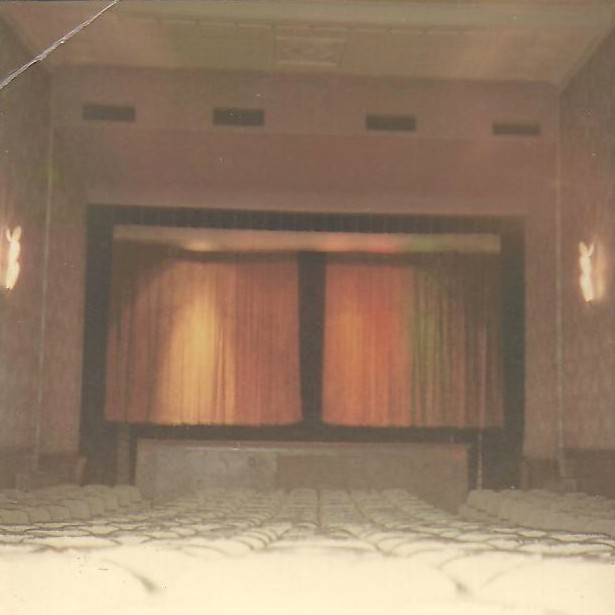
Several of our theatres had masking strips on the leading edges of the curtain, as in the picture of the Bluebird in Petersburg, VA. How common was that?
Posted by Frank Angel (Member # 248) on 11-07-2017, 08:22 PM:
In one installation where the org didn't have enough money to spring for both a motor for the curtain and a motor for the mask, we used something almost identical to the above, except there were two tracks -- one for the curtain, but right behind it a track for the mask. The mask consisted of a lightweight aluminum frame of about 3 feet width covered with the black velour material. The mask was on the track behind the curtain track and it was pulled along as the curtain opened and closed by a 2 foot cable. The curtain of course had to stop at the right position in order for the mask to stop where it was supposed to.
This did work well except for the odd fact of seeing masking as soon as the curtain opened just as you see in the above picture; it starts off looking like there is a black, fully closed traveler behind the screen curtain until the curtain opens far enough to start pulling the masking frame along with it. It's odd until you get used to it, and when everything stops moving, it looks perfectly normal.
It may be a poor man's answer to the cost of needing a masking motor AND a grand curtain motor, which cheap-ass exhibitors seem to think is so incredibly expensive that they can't afford both...sometimes neither.
Posted by Robert Bradley (Member # 9560) on 11-07-2017, 09:07 PM:
One of our theatres, the Regent in Colonial Heights, VA, had two curtains before CinemaScope was installed, so I know they had two motors. But after they got CinemaScope, they had just one curtain with the masking attached to the leading edges of the curtain, and they had to stop the curtain in order to mask a flat picture. I don't know why they didn't use the other motor for separate masking. Quite a few of our theatres in Richmond, Petersburg, Hopewell, and Colonial Heights had this system. They were all operated by Neighborhood Theatres of Virginia.
Posted by Terry Monohan (Member # 8285) on 11-08-2017, 10:27 AM:
The old main curtain in the 1950's at the huge Fox West Coast Paramount Theatre in Oakland CA had a black strip down the middle that they used for masking but they had regular masking on the top and sides that moved. The deco new curtain at the Paramount does not have a black strip down the middle and the curtain when they show movies or other live events must be moved by a union stage hand back stage. No more moving masking from the booth, the screen must be raised backstage. That 1950's curtain with It's black strip down the middle was a joy to see when It opened and closed, they even closed on cue with the image on the curtain and after the trailers to open on the main feature logo.
Posted by Randy Stankey (Member # 64) on 11-08-2017, 11:02 AM:
I did something similar at Mercyhurst.
Mercyhurst was a regular theater and the screen was on the flies.
The screen was on line#3. The main rag was line#2 and the valence was line#1. You couldn't use the rag as masking because it was too far downstage.
If found an old traveler track, stripped the pulleys off, cut it in half and hung it on the same pipe as the screen using angle iron brackets. I called BMI Supply and had them make me two masking curtains out of sharktooth scrim with 12" of velour on the leading edges.
I could manually pull the masking to fit the picture.
The scrim material was accoustically transparent but, when the lights went down, became opaque. The velour strips acted as the masking. Then, I could draw the rag in tight to frame the screen and get the "Picture in a Picture" kind of effect.
It did the job, looked decent and it was a lot cheaper than rearranging all the lines to accommodate a traditional set of masking curtains.
Posted by Stephen Furley (Member # 1277) on 11-08-2017, 12:24 PM:
Pictureville in Bradford, has this on the curtains for the flat screen which is a roller screen, bottom roller type, in front of the Cinerama screen.
Powered by Infopop Corporation
UBB.classicTM
6.3.1.2