This is topic Justice League 70mm C/O Cues in forum Film Handlers' Forum at Film-Tech Forum ARCHIVE.
To visit this topic, use this URL:
https://ft-forum.com/ft/cgi-bin/ubb/ultimatebb.cgi?ubb=get_topic;f=1;t=012226
Posted by Aaron Ridenour (Member # 5735) on 11-15-2017, 08:07 PM:
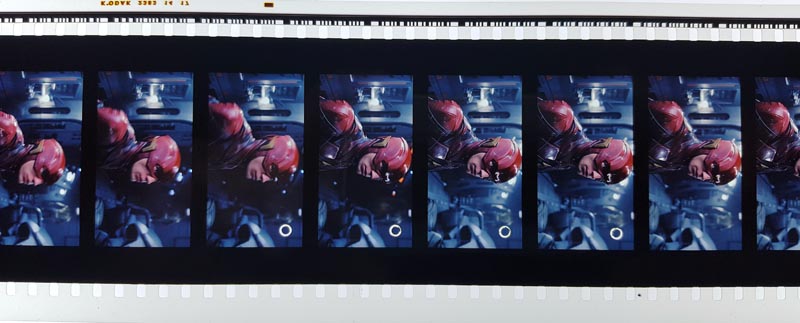
Change-over houses please be advised: Your Justice League change-over cues may be outside of the printed image area.
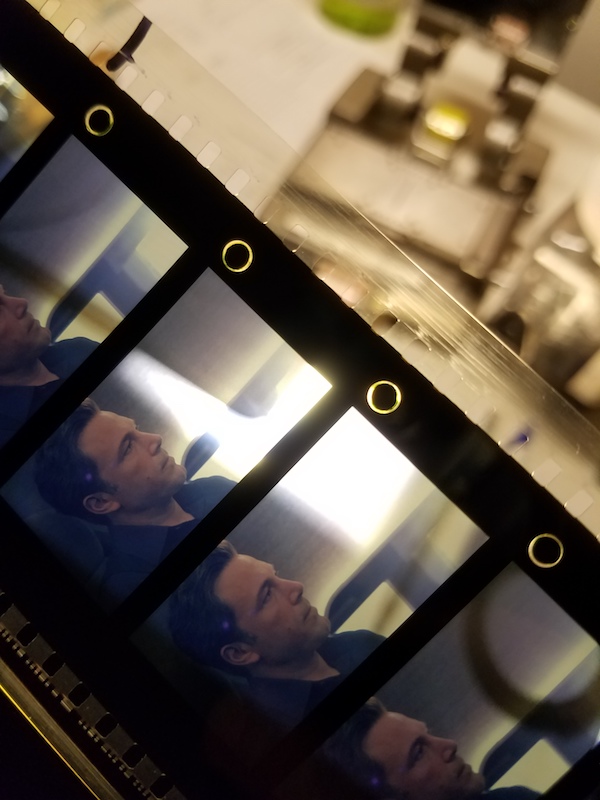
Posted by Sascha F. Roll (Member # 9043) on 11-15-2017, 08:15 PM:
What the ....
Posted by Jim Cassedy (Member # 4115) on 11-15-2017, 08:29 PM:
- - - but they're much easier to see there! ![[Razz]](tongue.gif)
Posted by Brad Miller (Member # 2) on 11-15-2017, 09:47 PM:
That's doing it wrong! ![[Confused]](confused.gif)
Posted by Frank Angel (Member # 248) on 11-15-2017, 10:41 PM:
Geez, are the lab tech so far removed from film that they don't even understand how changeover cues work...like you have to SEE them? No "may be" about it -- assuming that this is not just some weird framing of that particular shot done on purpose (someone looking at the guy thru a window frame or some such) those cues will DEFINATELY be where you won't expect them to be...like on the masking. Other than that, maybe you will need to play this with no masking at all. Oh wait...no problem; half the theatres do just that nowadays anyway...you know, Film (or Digital) Done Wrong (and a tip of the hat to the late, great and much missed, John Pytlak -- our old friend and Academy Award Winner). ![[beer]](graemlins/beer.gif)
Posted by Bobby Henderson (Member # 840) on 11-15-2017, 11:39 PM:
Yeah, it's SOP (Standard Operating Procedure) for most commercial movie theaters to show movies with no movable masking. So, yeah, if you wanted to show Justice League correctly (with all the extra steps Brad is doing) the cues would not be visible. I guess the lab thinks all these prints will be run only from a platter and single projector setup.
I sort of like seeing the cue dots at reel changes. It contributes more to that movie feel.
One other thing I really don't like about these Justice League prints is the freaking window-boxing. I expected to see the usual pillar-boxing phenomenon common to 1.85:1 movies on 70mm film prints. The window-boxing is just ridiculous. Maybe not as ridiculous as the 35mm prints of Fantasia in 1990 (seriously window-boxed). But it's bad.
When I see window-boxing I instantly think of cheap/shitty TV commercials playing on 24 hour cable news/emotion porn channels. They might have initially made the commercial in HD quality, but it got dumped down to SD-quality out of fear the target audience was comprised mostly with luddites using old TV sets. Then when everyone was stuck with using HD no one could seem to find the original HD source tape. Window-boxed video is the end result, one good definition of Presented In ShitVision.
Posted by Steve Roberts (Member # 9544) on 11-16-2017, 03:25 AM:
This is one of the ONLY occasion when a projectionist should add new cue's using a black marker pen to make a SMALL cue dot.
This way they can be removed at the end of the run.
Posted by Frank Angel (Member # 248) on 11-16-2017, 06:24 AM:
Well, I must confess, it has always gone very much against my every instinct to mare a pristine print with handmade, scribed cue marks, even when lab cues are missing and even though it is a perfectly acceptable thing to do. Especially after platter operation began to dominate the industry and I KNEW changeover cues were unnecessary in the majority of the houses those prints would play and for the rest of the print's life. We would indeed get many such prints as we played many sneaks and foreign prints that had no lab cues.
So in order for me to not get an involuntary facial twitch for a week caused by having to scratch emulsion off a pristine print and making an irreversible, visible scar in the emulsion that would intrude on everyone who saw that print...forever, I went to another method that I am sure I must have mentioned here in the past. For the youngin's, I will repeat it:
This method not only will create cues that can be removed later for those brothers and sisters who will run this same print on platters, but to the audience, it looks MUCH better than even the neatest scribed cues that are always more distracting than lab cues because they are always brighter than lab cues (emulsion is scratched away) and no matter how neat you think you can make them, even with the scribe tool, they still are "alive" and dance if only around the edges of the circles.
In the booths I have rolls of artist's line tape (black, of course) clicky here: Artists line tape. 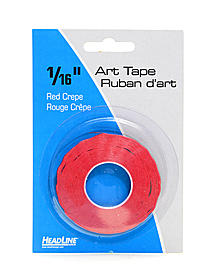
I apply it over the four Motor Start frames and the four Changeover frames. The 1/8 inch width is perfect as it is about the same width as the diameter of the scribed cue. In fact, once I saw how good this looked on the screen compared to emulsion marring cues, I started using it to cover cues on all prints other than those with real lab cues. The "cue lines" as I called them, covered those horrid multiple hand-etched cues made by multiple blind projectionists over the years especially on old prints of classic titles -- you know, the operators who evidently needed an explosion of light to go off in order to notice a cue. I've seen many prints where guys felt they need to use a razor blade to scratch over perfectly good and visible lab cues. WTF?
Anyway, using this black, adhesive-backed artist liner, sometimes to add cues where none exists, but most times just to cover ugly, distracting, dancing circles etched on top of more circles. The beauty is, what this cue method looks like on the screen to the audience is simply that for those fractions of a second, the image gets a wee-bit narrower -- like a lab masking issue; no question it's MUCH less intrusive, yet still does the job very effectively -- it's visible, it's black not white, and it covers a multitude of sins. It is so neat that it truly looks like something a lab did, not a human hand having at and scarring the emulsion. In fact, I had a a few projectionist friends sit down an watch a screening where I had used this method; I didn't mention anything about it and after the show, without me even commenting, a discussion started when one of them asked, "Did you see those strange changeover cues?" I was amused to hear them all trying to figure out what the lab did...was it on purpose or was it an error? One of them actually said he didn't see any chaneover cues at all (of course he was the youngest and only worked platter booths, so he knew what they changeover cues looked like, but since he never had to actually make changeovers, his mind wasn't attentive to them so he totally missed the connection that the frame masking anomalies were changeover cues. All of them thought they were done by the lab.
In my first experiments with covering ugly scribed cues, I tried cutting squares of the line stuff to cover just the circles, but because I could never really get the snippets of material to be exactly the same shape or put the four of them in exactly the same location, while they were black and did cover the dancing scribed circle cues, they themselves looked animated. Simply laying a line down the side of the full four frame was more effective (and much easier). Plus, that line of tape was less likely to come off the film than multiple small bits of material. BTW, the adhesive backing was so good that in all the years I have been using it, none have ever come off the prints. That said, it could easily be pulled off in a platter booth operator cared to, although I don't think the splice jockeys would be that conscientious.
I have also used the thinner, 1/16in width material to cover those diagonal scratches that some Neanderthals would scratch across entire frames, you know, in case they miss the circle. Sure, the audience does see the black lines, but no question, they are a lot less intrusive and less jarring than what white emulsion scratches look like to the audience.
And yes, Bobby, I get the nostalgia thing that those of us of a certain age have for what we have been seeing since childhood every time we saw a movie, (change-over cues), but still, that's just us. And as much as I can romanticize with the best of them over the "film look," I will readily admit that a lot of it is totally subjective -- changeover cues, while they are perfectly comfortable for us, you have to admit, objectively they are superfluous and only an artifact of film that is intrusive.
For those who have grown up in the digital age, to them, cues add nothing positive to the viewing experience and more than likely are seen as just distracting and another reason for them to claim that digital is "cleaner than film and has no scratches or whatever those stupid circles are in the corner" as I heard someone once argue. Sure, cues marks are synonymous with film, but even I have been covering them up for decades!
Posted by Stephan Shelley (Member # 8587) on 11-16-2017, 06:04 PM:
These cues are not in the negative like the days of past but scribed in after printing a processing. They even have marks where they made there measurements.
Posted by Scott Norwood (Member # 30) on 11-16-2017, 06:16 PM:
I suppose that the one good thing about cues like this is that venues that do not need them (platter houses or automated c/o houses) can cut aperture plates that mask off the scratched cues so that the audience never sees them.
Otherwise, the idea of having cues that are only visible on masking is completely idiodic. Those cues are awfully big, too.
Posted by Monte L Fullmer (Member # 2797) on 11-16-2017, 06:32 PM:
....could have made them a LOT smaller-even a pinhole.
You see those cues on a good sized screen, that's really going to distract being white on black...!
Posted by Steve Guttag (Member # 268) on 11-17-2017, 06:36 AM:
Those cues are consistent with lab scribed cues for 70mm. I'm sure they don't have a jig for the idiotic framing that was used on Justice League. That said, I've definitely seen my share of rather small cues (same size as 35mm so when used on 70mm appear significantly smaller).
Posted by Rick Raskin (Member # 1561) on 11-17-2017, 07:57 AM:
When I was projecting at Ft. Benning in my army days we'd often get films that were so new that the prints had no changeover cues at all. We'd use a grease pencil to make our own cues, which could easily be removed when the print was shipped out. I don't see why that process wouldn't work here.
Posted by Leo Enticknap (Member # 534) on 11-17-2017, 07:59 AM:
Yes, those cues were done with a 70mm Clint Phare scriber. We had one at my last workplace.
FotoKem normally do excellent work, but changeover cues seem to be their Achilles' Heel. I've had at least three (that I can remember) 35mm 1.85 hard matted prints in which the film was placed in the wrong pins of the scriber, resulting in cues on the black matte above the frame (and thus invisible).
quote: Steve Roberts
This is one of the ONLY occasion when a projectionist should add new cue's using a black marker pen to make a SMALL cue dot.
This way they can be removed at the end of the run
Black marker pen? Firstly, it'll be nearly invisible on a dark scene, and secondly, if the marker ink is not water-based, it won't come off at all. And if you mark the emulsion side, it certainly won't come off, whatever the dye is made of (because the emulsion will absorb it).
Unless there's a strong argument against it (e.g. the booth is very noisy), I would always prefer click strips using good quality splicing tape than marking the print. That's as near to 100% guaranteed as you'll ever get that the cues can be removed without a trace.
Posted by Arthur Allen (Member # 969) on 11-17-2017, 08:50 AM:
Frank: Canadian television used the technique you mentioned. I always wondered why, and then in college I found a book written by a Canadian television engineer who advocated the practice.
Posted by Brad Miller (Member # 2) on 12-04-2017, 11:06 PM:
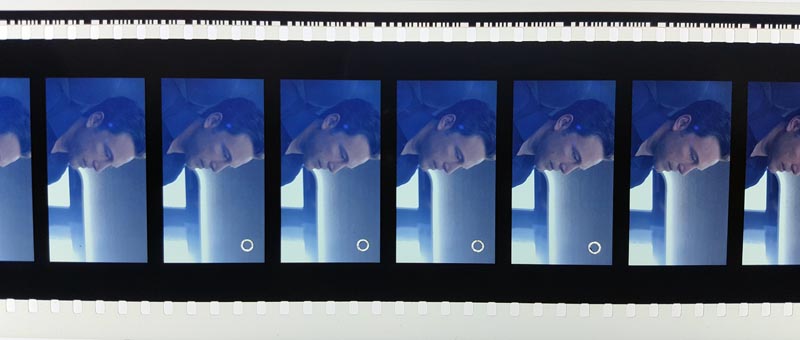
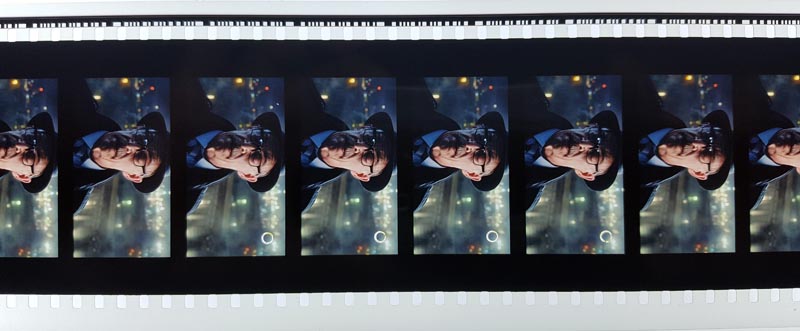
Aaron's print...
Our prints... ![[thumbsup]](graemlins/thumbsup.gif)
Posted by Larry V. Price (Member # 2287) on 12-09-2017, 10:31 PM:
I was one of the two projectionists who ran Justice League at the Cinerama. Aaron did add china marker cues in the proper location. The scribed cues were visible enough on the masking however so that changeovers could have been made but it was nice to have them relocated.
Posted by Alexandre Pereira (Member # 9295) on 12-09-2017, 11:15 PM:
Interesting technique - could this be meant for an auto reader for automatic change over? - another way to do it manually is with a small video camera mounted to view the change over cues. Connect a monitor on each side of the projectors and you do not need to look at the screen and the audience sees no cue marks.
When I ran change over I thought of this as a possible technique to mask the cue marks.
Powered by Infopop Corporation
UBB.classicTM
6.3.1.2