This is topic "Lawrence of Arabia" 70mm from 4K DI in forum Film Handlers' Forum at Film-Tech Forum ARCHIVE.
To visit this topic, use this URL:
https://ft-forum.com/ft/cgi-bin/ubb/ultimatebb.cgi?ubb=get_topic;f=1;t=012244
Posted by Bill Brandenstein (Member # 7758) on 12-30-2017, 12:25 PM:
Anyone familiar with the 2012 Sony 4K restoration knows the options for seeing "Lawrence" on the big screen are
- worn, aging 70mm prints from the 1988 restoration
- the 2012 4K DCP
- and now, new 70mm prints from the 4K DI. But is this heresy? Ruination? Well, happy holidays: as they did with "2001" last year, the American Cinematheque has financed its own new 70mm print. But it's from a new negative sourced from the 4K DI.
Took 2 of my kids (who were fully absorbed throughout) to the near sell-out screening at the Egyptian on Thursday night. From row 6, it looked very, very good. Don't hate me for saying this, but I think the resolving power of 1962 camera negative rarely comes up to 4K potential, as widely varying levels of grain, some of which was remarkably pronounced, will attest. However, to see a film-based image, with its remarkable color saturation, deep blacks, and stunning contrast, look this clean and clear was a great and lovely sight to behold. The entire print, as you'd expect, was nearly devoid of any film flaws. If a photochemical print is no longer viable, I'd rather my kids experience it on the big screen this way than through digital projection any day.
To my eye, certainly not of an expert but very discriminating, this presentation did not have a digital look to it. So if any other readers here see a print from the new 70mm generation of "Lawrence," I hope you'll post your critique here.
And I wish the veteran projectionists - Leo, we're looking to you here - who know how the 1988-sourced 70mm prints should look would comment as well after seeing it.
What a great thing it would be if you could interlock two 70mm projectors and run the same reel side-by-side and switch between the two throughout for the sake of comparison.
The Egyptian's presentation was nearly flawless, as you'd expect, as was the print, minus occasional white negative specks, and a very few weird noise or fogging problems in dark parts of the picture that I'm surprised weren't removed digitally with the other negative damage intrusions. (My daughter noticed these, else I wouldn't bother to mention it.)
As if this post isn't long enough, here's an article about the 2012 restoration that spells out some important technical details and distinctives. Photos at the source link are worth your time:
Lawrence of Arabia: Sony's Beautiful 4K Restoration, by Debra Kaufman
quote: Debra Kaufman
When Lawrence of Arabia opened in 1962, Columbia Pictures' epic included a career establishing starring turn by Peter O'Toole, Alec Guinness, Anthony Quinn, the young Omar Sharif, and a stunning score by Maurice Jarre, directed by David Lean and edited by Anne V. Coates. Sony Pictures Entertainment, under the guidance of Grover Crisp, Executive Vice President of Asset Management, Film Restoration & Digital Mastering, has brought this film back to life in a stunning 4K restoration that began in 2009 and worked steadily towards the film's 50th anniversary release. In doing so, Sony's restoration team collaborated with its digital intermediate facility Colorworks as well as MTI Film, MTI Film, Prasad Film and Chace Audio.
"I knew it would easily take a year if not two to do all the work that needed to be done," said Crisp, describing why the restoration began in 2009. "I was aware of some of the problems we would encounter and, as we got into it, those problems were far worse than I thought."
Lawrence of Arabia had actually had an extensive reconstruction and restoration in 1988, initiated and overseen by Robert A. Harris and co-produced by Jim Painten. During this reconstruction, Lean and Coates went through every scene to fine tune the movie into the Director's Cut. This version of the film, as it exists in the restored 65mm original negative, was the basis of the new restoration.
But many major problems still existed. One of the issues was that all the 70mm prints over the last two decades had been struck from the duplicate 65mm negative that was made from the 1988 wetgate-manufactured 65mm Interpositive, a process that serves to camouflage many of the scratches and dirt. "We did not have the advantage of scanning this large format film with a wetgate, so all the film's flaws were very evident directly from the original negative," said Crisp.
Other problems included slight color fading and typical wear and tear. The negative was also warped, dried out and exhibited chemical stains. The film was shot in several desert locations and the heat there distorted the film stock in the cameras, in places cracking the emulsion. According to Crisp, "it was unlike anything we had seen before and quite challenging to fix."
"The plan was to fix the damage to the film that they could not deal with in 1988 because the technology didn't exist," he said. "They did a great job in putting the film back together and the photo-chemical work then was top notch, but we knew there would be some challenges ahead for us in going back to the original negative. It was a fragile element then as it is now, damaged, brittle and all those things you'd expect from a film that's half a century old. What we didn't know was how prevalent these problems would be. I thought we'd encounter the worst types of damage in only a few places and instead if was in almost every reel."
The process began with a thorough inspection of the negative a frame at a time, a splice at a time and making a protection element out of it. "We then made a new IP at FotoKem, and that exercise proved to be quite useful," he said. "Prior to making that, we had made a dry print and that showed us the kind of issues we were going to face."
The 65mm original negative was scanned on two large format 65mm Imagica XE scanners at FotoKem at 8K to capture the resolution of the 65mm negative, resulting in a file size of 8192x3584 pixels. "I reserved half of 2010 to do this work," said Crisp. "If you do the math, it's over 325,000 frames at 13 seconds per frame, which equals about 1,200 hours of scanning alone." The files were then reduced to 4K and moved to Sony Pictures Studios' digital image restoration/digital intermediate facility Colorworks for color grading and restoration. But the restoration work would require more than one facility to accomplish.
"We sent some sample test to a number of restoration companies to see how well certain things would be done," he added. Two external groups were selected: Prasad Corporation in India, which handled general image cleanup, and MTI Film in Los Angeles, which handled the more challenging and specialized restoration work. Meanwhile, Chace Audio used the 6-channel stereo masters, which were created in the 1988 restoration, as the basis for restoration and re-mastering.
At Colorworks, colorist Scott Ostrowsky, who had previously graded the restoration of The Bridge on the River Kwai and Taxi Driver among other films, began grading the film. Ostrowsky graded the film with a Baselight 8 in a 4K grading theatre. Ostrowsky had actually worked on the film in 2004/2005, working from a ten-year old HD transfer of the Interpositive. This time, he got the raw scan, which came to him in reels for all the associated dissolves.
"I needed to QC all the reels to make sure every frame was there and in its correct place," Ostrowsky said. "I also needed to make sure there were no duplicate frames and that the conform matched every print exactly." In the second QC pass, Crisp and Ostrowsky catalogued the dirt, scratches and other issues and determined what would go to Prasad for general cleanup or MTI Film for the more complicated issues. "Most of it was highly infected with negative dirt, called minus density that becomes white when it's printed," he said. "There were scratches, bad splices, film bumps and what looked like tiny scratches, which we determined was due to the emulsion cracking."
"The negative was pretty beat up," he added. "It definitely looked its age."
His first step was to put a basic timing on it. "Then we'd watch the 70mm print and compare what I did to that element, to make sure we were consistent with what was done," he said. "Once that was done, we went reel by reel, constantly referencing the previous work." Regarding color, Ostrowsky said there were fading and many shading errors. "When I re-master a feature like Lawrence, you're just trying to make sure that you're getting as close as possible to what David Lean and Freddy Young [the cinematographer] wanted for that project.
One highlight of the project for Ostrowsky was that he worked with Coates. "Anne came in several times," he said. "She certainly knows the film and had a few comments that were very astute. There were about ten areas she wanted touched out of the whole film and I went in and fixed those. She came in again and was impressed with the overall look. The last time she came in to watch the final marriage of picture and sound, a wrapped 4K DCP and she told us it looked gorgeous." Also involved in the project was restorer Harris, who also sent notes to the restoration team after watching a Blu-ray.
Ostrowsky talked about how using the Baselight 8 at Colorworks helped. "Because it's treated as a file system color correction tool and was created to work in log as well as linear space, it gave me a ton of flexibility," he said. "I could create layers on every individual shot that might need a little more help and was able to use the Baselight to work with printer lights like a film timer. I'd also use custom curves, secondary color corrections, if I needed to take out some red or change the hue of a color."
"The only windowing I did was to fix film problems, not to create lighting," he added. "It really helped in lessening the egregious nature of the sealed-over emulsion cracks. Because they looked like white streaks, we could change the color density of that to match better. It was a wonderful tool in helping us make Lawrence the best it could be and representative of what the filmmakers wanted."
Simultaneously, the reels were sent to Prasad Image and MTI Film for restoration. "I started timing fro the uncorrected, un-restored files," said Ostrowsky. "With more than 325,000 frames, we might not have enough time if I'd waited for clean files." He noted that Prasad handled basic dirt and scratches. "If it was something where they needed to create an algorithm for things like the sealed-in scratches, MTI came on and fixed that," he said. "They created tools specific to repair these issues."
"The movie is almost four hours long, so it's like working on two films," noted Crisp. "As we did all the color work, all the image restoration was being done at the other venues. As partial reels were done and returned one big file at a time, we'd look and adjust things and have things redone, over and over again until I felt it was right. We hadn't encountered a lot of this kind of work before, so vendors like MTI Film did a lot of research and development to handle it."
Ostrowsky echoed what many who worked on Lawrence of Arabia felt. "I felt honored and humbled by this and I'm very proud of having worked on it," he said. "I hope audiences around the world find pleasure in it. I hope it attracts a new audience and that those who saw it in 1962 are happy with the results."
I did see the film in 1962 as a child and was lucky enough to see the newly restored version in 4K at the Sony Pictures Entertainment lot. The restoration is marvelous and the film has held up well after 50 years: I found it gripping, immersive and beautiful. Having seen Sony's restoration of Taxi Driver last year, I can say that the company -- with Crisp at the helm -- is treating its priceless cultural artifacts with the respect and care they deserve. Next up, said Crisp, is On the Waterfront, The Last Detail and, next year, Funny Girl. I can hardly wait.
Posted by Mark Ogden (Member # 43) on 12-30-2017, 12:46 PM:
I suppose the question here is what exactly was gained by transferring the 4K file to 70mm, as opposed to running it by itself on a digital projector. As I mentioned in the other thread, "brand new 70mm print" implies a pure-play photochemical 70mm print from either the OCN or an internegative. While this may be a fine looking show, the fact that it was sourced from a digital file is probably unknown to many film-goers who expect the above. I believe that while it is technically a 70mm print, there is a dishonesty inherent in this and that the Cinematheque is pulling a fast one by playing up the 70mm angle, because that's what gets people into the tent. Or as P. T. Barnum said . . .
Posted by Chris Haller (Member # 9206) on 12-30-2017, 02:33 PM:
quote: Mark Ogden
I suppose the question here is what exactly was gained by transferring the 4K file to 70mm, as opposed to running it by itself on a digital projector.
So far, from what I've personally experienced, 4K projectors at least in the Rochester area don't really have the greatest contrast capabilities, and suffer from poor black levels. Now, I've never done a side by side DCP vs film to compare their black levels or contrast, but I imagine a well made 70mm print could most likely best it, and have a brighter image, and perhaps even a sharper one at large magnifications.
4K DCPs are essentially letterboxed presentations at 4096x1716, so I would imagine the image used to generate this new printing negative would hopefully use the full 4K resolution for the 65mm laser-out instead of the letterboxed version.
Posted by Scott Norwood (Member # 30) on 12-30-2017, 04:08 PM:
Did they fix the sound mix, or is this still the overly de-noised DTS mix that was used for the 2002 DTS reprints?
Posted by Bill Brandenstein (Member # 7758) on 12-30-2017, 05:31 PM:
Mark, I respect your opinion here, but I've seen a lot of digital projection and, unless it's Imax laser or Dolby Cinema, the 70mm presentation beats anything else for saturation, contrast, and brightness. My kids were onto this too (proud daddy comment). Since the Egyptian has a 4K laser-illuminated machine, it would be interesting to compare. However, if the trailers before the feature are any indication, the black level and brightness of the film blows away even that excellent machine.
Scott, without any expert information, I'm going to guess yes on the audio fix. There's a credit in the 2012 portion to Chace Audio in Burbank, so something was certainly revisited. Although there's certainly no discernable hiss left in the soundtrack, it doesn't sound overly processed. Since audio de-noising is part of my professional work, I'm usually pretty sensitive to this and annoyed when I can hear it on shows. This was quite pleasant (although I would've liked just a few dB more volume in the room).
Posted by Bobby Henderson (Member # 840) on 12-30-2017, 08:21 PM:
quote: Debra Kaufman
The 65mm original negative was scanned on two large format 65mm Imagica XE scanners at FotoKem at 8K to capture the resolution of the 65mm negative, resulting in a file size of 8192x3584 pixels. "I reserved half of 2010 to do this work," said Crisp. "If you do the math, it's over 325,000 frames at 13 seconds per frame, which equals about 1,200 hours of scanning alone." The files were then reduced to 4K and moved to Sony Pictures Studios' digital image restoration/digital intermediate facility Colorworks for color grading and restoration. But the restoration work would require more than one facility to accomplish.
Does anyone know if the original LOA 8K scan data was preserved? Or was that tossed out? If the 8K data was not stored it would be a shame. I don't expect Sony to go back and do a third restoration on Lawrence of Arabia. But if the 8K scan data was at least stored the possibility for creating an 8K DI would at least possible. If I remember correctly (from comments by Robert Harris) the film elements for LOA are not in great shape at all. Any attempt to do another scan would be somewhere between very difficult and impossible.
In 2010 it made sense to do the digital restoration work and DI work in 4K. Computer hardware and software didn't have the muscle to do everything in full color 8K, much less at deep color bit depths. You could do work on lower resolution proxies or work on separate grayscale color separations. It's reminiscent of still photographers and graphic artists in the early 1990's having to use software like LivePicture or Macromedia XRes back when RAM cost $20-$40 per megabyte. Nearly 8 years later modern computing technology and software is a lot more powerful.
quote: Mark Ogden
I suppose the question here is what exactly was gained by transferring the 4K file to 70mm, as opposed to running it by itself on a digital projector. As I mentioned in the other thread, "brand new 70mm print" implies a pure-play photochemical 70mm print from either the OCN or an internegative. While this may be a fine looking show, the fact that it was sourced from a digital file is probably unknown to many film-goers who expect the above. I believe that while it is technically a 70mm print, there is a dishonesty inherent in this and that the Cinematheque is pulling a fast one by playing up the 70mm angle, because that's what gets people into the tent. Or as P. T. Barnum said . . .
It's sure not the best way to sell "70MM." I'm used to the 4K standard being regarded as the digital equivalent to 4-perf 35mm film. Viewers familiar with presentations of 70mm prints sourced from genuine 65mm elements have certain expectations. Those not familiar with 70mm and wanting to check out such a show may come away unimpressed. They won't understand why film geeks make such a big deal about it, especially if they can't see an obvious difference.
A 4K sourced 70mm print may have better black levels than the image thrown by most d-cinema projectors. But how is the resolution of that print going to compare to that of a 4K DCP? Are the prints laser recorded directly or are they made from interpostive or internegative dupes?
Then there's the issue with audio. Even if the 70mm imagery is the real deal, we're still using a lossy data compressed 5.1 audio track that was fine for the 1990's, but inferior to other audio formats used in theaters now. I really wish there was a solution to sync 70mm prints with modern uncompressed LPCM audio as well as formats like Dolby Atmos.
There is a growing number of 6K and 8K camera systems, but there is no sign d-cinema projection will ever go above the 4K standard. 70mm prints might be a good alternative at preserving much of that better-than-4K image detail. I think some of these film restoration projects should be a starting point for getting full blown 8K DI work flows off the ground. Ever-improving digital technology might be an off-beat way at keeping 70mm film presentation alive.
Posted by Steve Guttag (Member # 268) on 12-30-2017, 08:59 PM:
I don't get it...you do an 8K scan but work in 4K? What a waste. So technology isn't there yet to work in 8K/16K for a project like Lawrence...so wait until it is there. 4K is below 70mm resolution and the 4K DCP I've personally seen is really bad (on a 4K projector).
I have had the honor of showing the 1988 restoration to Sir David Lawrence and Freddy Young. He seemed to like that version very much and stated "it has never looked better." That is straight from the man himself. We'll never know what he would think of either the various DCPs or this Frankenprint of Cylon/Film. I have not seen it so I cannot comment on its quality or perceived differences from the prior work. Note, the AFI/Silver CAN do a frame-for-frame lock-sync on their two 70mm projectors, if the desire were to ever surface. I suspect that it would not and that the powers that be will want to push this current version as the definitive version and shove prior work away in the past.
Posted by Leo Enticknap (Member # 534) on 12-30-2017, 10:52 PM:
quote: Bill Brandenstein
And I wish the veteran projectionists - Leo, we're looking to you here - who know how the 1988-sourced 70mm prints should look would comment as well after seeing it.
No cattiness intended, but during the three years and two months I worked at the Egyptian, I think I showed that thing (the worn-out 2002 print of the 1988 restoration) at least 20 times, and it's going to be a very, very long time before my memory of that movie will have faded enough for me to be able to sit through it again!
The next time I'm paying a visit, though, I'll ask Mike or one of the guys if they could throw up a reel for me.
quote: Bill Brandenstein
...minus occasional white negative specks...
So they must have filmed out a 65mm IN from the DI files, and struck the print from that. I wonder how many others they made.
quote: Chris Haller
So far, from what I've personally experienced, 4K projectors at least in the Rochester area don't really have the greatest contrast capabilities, and suffer from poor black levels.
That is a known problem with 4K. It can be mitigated to a great extent by using a small aperture lens and a lot of light, though. I saw the 4K DCP of Dunkirk on a Barco DP4K-P with the high contrast lens. I hope I don't get flamed for writing this, but the blacks looked properly black, not dark gray, and frankly, I don't think a 70mm print (though I confess, I haven't seen one) could have bettered it for contrast range. However, this was in a private screening room, with a 3kW bulb in the projector lighting a screen that is only 15ft across. The amount of light needed to enable one of these lenses to be used on a decent sized theater screen would mean that even a 7kW bulb probably wouldn't be enough for the Egyptian.
quote: Scott Norwood
Did they fix the sound mix, or is this still the overly de-noised DTS mix that was used for the 2002 DTS reprints?
When I was at the Egyptian, we had three versions of the DTS track: 5.1, Todd-AO (five stage channels plus mono surround), and a baby boom mix. Agreed - they all sounded bad. My rule of thumb with magnetic-originated tracks of that era is that unless you can hear a little tape hiss on the quieter scenes (as you can with the Todd-AO mix for 2001: ASO remastered to DTS), the noise reduction has been overly aggressive. You simply can't reduce tape hiss above around 8KHz without taking some of the signal out as well, and I'd rather that they left both. The noise reduction was certainly too aggressive with the DTS transfer of LOA that was done for the 2002 prints, and I too hope that they've fixed that for this version.
quote: Bill Brandenstein
Since the Egyptian has a 4K laser-illuminated machine, it would be interesting to compare. However, if the trailers before the feature are any indication, the black level and brightness of the film blows away even that excellent machine.
Many of the trailers shown at the Egyptian are ripped from YouTube or BDs, and so the color space from the original is probably sRGB - not even Rec.709, and certainly not DCI P3. Don't take the preshow stuff as an indication of what that projector is capable of. The black level of the DP4K-30L at the Egyptian is a lot better than that of a comparable Series 2 xenon-lit projector ... when it's playing a professionally made DCP that was mastered in DCI P3 to start with. I believe that this projector is even Rec.2020 capable, but am not 100% sure on that point.
One final thought on black levels, which is that I can't understand why Kodak continues to manufacture 2383 release print stock, but not 2393. The tiny number of film prints (16, 35 and 70) still being made are now probably all destined for viewers who actually want to see film, are making the positive choice to seek it out, and are willing to pay a premium for the viewing experience. If Kodak is only going to offer one color print stock going forward, surely it makes more sense to retire 2383 and continue producing 2393, not the other way round?
By the same token, almost all vinyl LPs being made now are 180-gram or 200-gram pressings with no more than 20 minutes on each side: no more Dynaflex with 35-40 minutes on a side, because the few remaining customers who are willing to pay double or triple the price of a CD or download are doing so because they want the best audio quality the format can offer. I'm surprised that Kodak and FotoKem don't appear to believe that the same principle applies to film prints.
Posted by Bobby Henderson (Member # 840) on 12-30-2017, 11:08 PM:
To the bean counters any version of "digital" is perfect, no matter how low in resolution and cheap/fast it might be to produce. And that's one of the biggest frustrations I have with the movie industry these days.
20-30 years ago the movie industry was frequently trying to break new ground with technology and movie presentation standards. Today? Not so much. Doing things good enough, fast enough and cheap enough is more important. Back then productions had to be more sure about their story lines and other developmental details far in advance since there were no do-overs for classic analog film-based visual effects and early CGI that took forever and a day to render.
Plain HDTV quality 2K still reigns supreme as the de facto movie production standard (and 4K a relatively high end luxury) because 2K is cheap, fast and allows a production to keep its options open til the bitter end. Digital backlot work is faster. CGI stuff is produced faster. A principal actor in the production of All the Money in the World can be removed from the project and replaced by another actor without the production skipping more than a couple beats. Almost like they're shooting a TV show.
Posted by Tyler Purcell (Member # 9213) on 12-31-2017, 04:27 AM:
The problem is the industry is so focused on money over anything else, they could give two shits about making the theatrical experience better. The only reason 3D exists is so they can charge more money per seat. The only reason we get 70mm prints is because they can charge more per seat. Restorations don't make the studio's ANY money, nobody cares. So I'm impressed they even scanned the negative at 8k, that's pretty impressive and it will give them a beautiful 16 bit full raster image to work from. The reason why a 4k finish is simple, the restoration was done for a UHD BluRay release.
In terms of a photochemical finish vs digital finish. Ya know, I'm on the fence. Had the finish been done in 8k entirely, I'd be ok with the digital finish. However, since it was done in 4k, eh... it'll always be a lingering thing issue with these "new" prints in my opinion.
I think 4k is good enough for 35mm but not for 70mm. The negative does resolve greater than 4k, so why not just do the whole darn thing in 8k. It's all about money and the penny pushers gave them a budget and they worked within their means. I'm glad the restoration is done, I'm beyond ecstatic it exists on 70mm and I honestly can't wait to have some time off to see it.
Posted by Leo Enticknap (Member # 534) on 12-31-2017, 08:54 AM:
The industry always has been focused on money over everything else. Every significant technological advance in the history of cinema was invented, developed, and rolled out in an attempt to make money out of it, large format film included.
If higher resolution than 2K is not grabbing a significant market share of the overall screens, it's because studios and theater owners believe that customers aren't willing to pay for it.
And I'm afraid they're right. My wife refuses to see movies anywhere other than the recently opened Harkins, just down the road from us. This is for three reasons: easy, plentiful parking, all around the building, leather reclining seats, and a short walk to the bathroom. She does not want to go to the ex-Krikorian, now Studio Movie Grill (a 1980s building that appears to have had no significant front-of-house investment since it opened), even if it's playing something we'd like to see, but the Harkins isn't. She'd rather wait until it's on Netflix. This is because the parking spots are too narrow, and often a significant walk from the building, the seats are less comfortable, and it's a long walk to the bathroom from most of the auditoria (it looks to me like one of the bathrooms was converted into a second concessions stand at some point). If the Harkins were playing DVDs and the Studio Movie Grill had 70mm in every screen, she'd still want to go to the Harkins, and I'd guess that 99% of moviegoers apply similar reasoning when deciding what theater to go to.
Even I struggle to see the difference between 2K and 4K on a screen less than around 40 feet across (unless I'm sitting very close to the front), and find the lower contrast range on 4K irritating, unless viewed through a high contrast lens or an RGB laser projector. Unless the screen is really, really big, I'd prefer the extra contrast of 2K to the extra resolution of 4K, if I have to choose between them. For prestige presentations such as LOA, I'd obviously like both, but I think we have to accept the fact that the industry's reluctance to chase ever higher pixel counts for theatrical presentation is that the customer demand for them simply isn't there.
Posted by Scott Norwood (Member # 30) on 12-31-2017, 10:12 AM:
Couldn't higher-than-4k resolution be obtained in the future by tiling multiple 4K projectors? This is done pretty regularly in the rental-and-staging business and seems to work fine with hardware and software that are designed for the purpose.
Alternatively, one would think that the big-screen-TV cinema system that has been demonstrated could be made to support higher resolutions.
Posted by Bobby Henderson (Member # 840) on 12-31-2017, 03:11 PM:
LED-based systems certainly could be configured to do higher than 4K resolutions. Some really big displays like the one on the Marriott Marquis hotel in Times Square already do that. There are newer systems out there with very tight pitches between pixel centers. It's possible to configure something like a 8K display for a large movie theater screen. But the thing would cost a ridiculous amount of money and would require speakers above and below the screen. There are some see-through LED types of displays with the LEDs on little horizontal or vertical bars or lines. I've seen them used most frequently on concert stages. But they don't have tight enough pixel pitches to show high resolution imagery.
Posted by Mark Gulbrandsen (Member # 72) on 12-31-2017, 04:26 PM:
I find it hard to believe another restoration of this is even necessary. I bet the printing I.N. they made is still just fine to use. It looks like more of a poor attempt at a money grab by the studio because everyone likes to see the word "Restoration" and they think it's some big deal. Unfortunately, it's going to be the exact opposite. What a waste! But if noting else the studios can ruin 70mm film from the inside out. That hasn't been done yet.
Mark
Posted by Brad Miller (Member # 2) on 01-01-2018, 12:11 AM:
quote: Leo Enticknap
I'd prefer the extra contrast of 2K to the extra resolution of 4K, if I have to choose between them.
I couldn't agree more. I'll take a 2K machine ANY DAY over a 4K because the lower contrast of a 4K machine in no way looks better than a lower resolution 2K with better contrast.
That being said I do always equip my 2K machines with high contrast lenses whenever possible and account for the light loss when calculating the bulb and make sure to keep the screen surface flat and install masking (again, to not lose contrast). The image quality is WELL worth it, and in the end its noticeably cheaper than a 4K system too. (Keep in mind not all content is even in 4K and many 4K projectors have enough vibration in the lens to negate the extra resolution anyway.)
Posted by Tyler Purcell (Member # 9213) on 01-01-2018, 03:15 AM:
Wait, why is there a contrast difference between 2k and 4k machines? I thought contrast differences were merely related to the lamp output.
Posted by Steve Guttag (Member # 268) on 01-01-2018, 12:08 PM:
The new Christie CP4325-RGB. 4K and 6000:1 contrast ratio (3X contrast ratio of Christie's 2K machines).
What I don't like about the 2K images is the hyper-flat appearance of them.
Posted by Leo Enticknap (Member # 534) on 01-04-2018, 10:58 PM:
quote: Tyler Purcell
Wait, why is there a contrast difference between 2k and 4k machines?
I've never heard a totally convincing answer to that question. I think it has to be related to the light source, because, as Steve points out, and as I've seen with my own eyes with the Egyptian's Barco, the 4K contrast on an RGB laser is an order of magnitude better than on a xenon-lit machine.
Posted by Steve Guttag (Member # 268) on 01-05-2018, 07:23 AM:
Why the difference? It has to do with the light, how it hits the mirrors, the fact that you have a finite space between the mirrors for the mechanical portion. The DMD grew from 1.2 to 1.38" but added 4x as many mirrors however you still have essentially the same spacing between the mirrors as before so your mirrors are smaller.
Ever look at the light path of xenon in a DLP? It is anything but easy. Just before reaching the DMD it has to be broken into its primaries via a prism and delivered to the DMD chips, which make images, then recombined and sent out of a single lens. It is amazing that it works at all and with xenon/white light you are constantly battling stray light everywhere. With laser, you are putting the color of light you want where you want. Half the light path goes away (except for Laser-Phosphor, it uses the xenon light path because it too is generating "whiteish" light.
Posted by Leo Enticknap (Member # 534) on 01-05-2018, 09:00 AM:
Thanks. I've looked into the light path of xenon machines (and even disassembled a light engine for repair), but not the light engine end of an RGB laser machine. I didn't know that there was no integrator rod, and therefore that there is no white light involved, except where it is desired and thus created by mixing the three primaries in the light engine.
I always suspected that the contrast issue with xenon was something to do with the image of each pixel being closer together on the same sized screen, and guessed that it was possibly caused by the image of one bleeding into the one next to it more than is the case with 2K. From your explanation, it would seem that the optical processing that takes place between the bulb and the lens places an inherent limitation on resolution, which can be mitigated to some extent by using a small aperture lens ... but that costs you light output.
So if resolutions larger than 2K are ever going to become a widespread industry norm, this can only really happen when xenon arc illumination is a thing of the past. With xenon illumination, you either have to eat the higher overheads of using a high contrast lens and a bigger bulb, or live with the contrast hit.
Posted by Steve Guttag (Member # 268) on 01-05-2018, 01:27 PM:
I think xenon's days are numbered, particularly for big screens. 4KW is about the break even point on laser. Most people with smaller lamps aren't thinking 4K, let alone 8K.
I think the new Christie CP4325-RGB could be a game changer on laser, if the pricing I heard at last CinemaCon proves true. It brings RGB laser in the same ballpark as Laser-Phosphor.
Then again, I think the OLED screens will be the end/severe reduction of projectors (xenon or laser). By 2022, most of the installed projectors will have been in for 10-years and much of it will start to 1000/2000 you to death (with light engines 20,000 you to death). We'll see were direct-view screens are then. You might find that projectors give way to screens.
Posted by Tyler Purcell (Member # 9213) on 01-05-2018, 03:49 PM:
Interesting, thanks for the info. The current laser projection technology has been a marketable improvement over xenon in my opinion, especially IMAX's system. Super bright and excellent color reproduction, for sure a step above the rest in many ways.
The only way OLED will replace projectors is if the tech is as malleable as current screen technology, with the holes required for sound. If someone comes up with that tech and can produce OLED in the kind of quality/quantity necessary, I think in 20 years we may see some switchover, but I don't think it's coming that fast. They can make small displays no problem, but a 40ft screen? That's an entirely different manufacturing process and yes they do make low-resolution ones for stadiums and such, but they're not the type of quality needed for the theater yet.
Posted by Steve Guttag (Member # 268) on 01-05-2018, 05:55 PM:
Oh it is MUCH closer than you think. They are already up to nearly 40-feet now and DCI compliant (Samsung but Sony is also working on it).
Yes, the sound issue has to be solved but the technology is already there to "print" screens and even make them flexible for direct view. Creating sound transmissive screens will probably be here within 5 years.
Consider this in your 20-year prediction.
1998, no DCinema, just film and various "video" for non 1st run release. 1999, 1.3K "Series 0" DCinema based on SXGA projectors, 2004, 2K DCinema projectors (and some are STILL running DCinema!). 2007, the start of DCinema roll out, 2010, DCinema roll out intensifies,(2011-2012, 4K shows up) by 2013, mostly mopping up and finishing up the small town theatres/drive-ins. It happened that fast and we are a tiny industry with a scant 150K screens world wide.
The market for direct view large screen movies is the entire world. The big players, at the moment, are Samsung and Sony. These people have every reason to make high-end, affordable ginormous direct view screens for cinema so they can sell smaller version to the consumer and use the theatre presence as a qualifier/marketing.
It would end the discussion on having a booth and anything else associated with a projector (laser and its speckle/cost, xenon, filters, convergence, focus...etc.). Will there be new problems, sure and they need to figure out how to protect that screen from sodapop being flung against it but the day is coming and it is coming faster than you think, in my opinion, of course.
Oh, and Samsung, they own Harmon, which owns JBL and Crown so they also have incentive to have speakers/amps playing from behind the screen.
If you are a curved screen person like me, I also see it as a way of having the curved screen without the image distortion.
I'm sure they'll have them at CinemaCon this year, check them out and tell me what you think.
Posted by Bobby Henderson (Member # 840) on 01-05-2018, 06:25 PM:
The term "OLED" only applies to high end TV screens and other smaller mobile device displays that use Organic LED based displays. I'm not sure what the best term should be to describe LED-based "jumbotron" displays where the RGB LEDs are exposed. Maybe "direct view LED?" In the sign industry they're most often just called LED signs.
Regarding LED displays that allow sound to pass through, I think it's possible to develop such a screen. The LEDs themselves can get very tiny. Currently there are displays that allow pixel pitches as tight 1.2mm between pixel centers, still with a decent amount of black surrounding the pixel cluster to help generate great contrast.
Manufacturers would just have to change the design of the driver board tiles so the backs of the LED clusters aren't completely covered with a bunch of solid, hard plastic, metal and computer parts. Currently no manufacturer has done that. The board would end up having the look of a grille with lots of little square holes in it between the pixels.
I think a layer of some type pourous yet opaque black material might be needed to help hide any wires and other components on the backs of the driver board tiles as well as maintain high contrast. The material could have acoustic properties to cut down on unwanted reflections. That's been a big complaint about other solid screens, like the Torous screens AMC used 20 years ago in some theaters. A traditional LED display with solid driver board tiles would not only require speakers above and below the screen, but it too would be prone to all those bad acoustic reflections.
I'm skeptical about printing large, direct view LED screens. Such displays are modular, with each board having its own components, wiring and other stuff. The LEDs in these boards, especially ones rated for outdoor use are pretty powerful. It's going to take some radical adjustment making the best of this technology fit into a board that's not solid and perhaps even flexible. To print LEDs and supporting circuitry onto a flexible surface and have the resulting display emit the kind of light output needed for a cinema screen would require a lot of technology that hasn't been invented yet.
Posted by Robert Harris (Member # 1712) on 01-07-2018, 08:31 AM:
A few thoughts on Aurens in 70mm OCN, 70mm dupe, and 4k...
Based upon the quality of the intermediate stock that arrived from Kodak in the 1983 as 5243, we were allowed a superior grain structure, that even going two generations away from OCN, showed virtually no discernible difference in projection.
What will be noticeable to some is a slight reduction in apparent grain, which under a microscope, can be seen as the softening of the granular edges. Nothing more.
This means that the difference between an OCN test print, produced in 1988, vs a dupe is virtually nil on screen.
David Lean & Freddie Young preferred the dupe, for its slightly more velvety overall image quality.
Harvesting an 8k scan from OCN, and various other extant elements gives us a totally different beast.
Far more highly resolved in projection (at 4k) than anything on film.
Without a shutter, continuous film movement, bob & weave, etc, the eye is actually viewing the original as scanned and modified to create the digital facsimile of the 70mm prints.
Take that 4k data and record it out to a 65mm negative (not an easy feat), and print it to 70mm stock for projection, and you have a more than adequate means of replicating the filmed experience.
It's neither as stable, nor highly resolved than projected 4k data, but it's fine. And those seeking a 70mm experience, will get one. It's not a matter of smoke and mirrors.
Keep in mind that taking stocks in the 1960s were far more highly resolved than printing stocks, and all 70mm prints were produced on optical printers directly from the OCN, normally via auto-select single strand.
With our more finely grained printing stocks today, the difference between a 1960s-'70s 70mm OCN print and a 70mm print derived from a 4k data file is further blurred.
While a few 70mm prints can be produced from the digital negs (we also produced one for MFL, like LoA, as an archival analogue element), the main rationale for that production is not toward print-making, but rather as a polyester-based back-up, for negatives that are essentially no longer printable.
While I enjoy viewing 70mm prints, my current preference for Lawrence is the 4k data files. Same for MFL.
As an aside, and the discussion regarding 5283 vs 93, I can tell you that 93 is an odd beast. The original concept, as I understand it was as a higher contrast alternative to 83, akin to ENR processing.
It's a beautiful stock, and useful in certain circumstances, in my opinion, probably best suited for animation.
We tested both stocks for The Godfather, which as you know needs deep rich blacks, with a bit of air above true black.
Based upon a recorded 4k restoration negative, we saw the following results. While 83 gave us lovely quality, it was unable to hit anything close to true black.
And problematically, 93 could not allow that bit of air just above black.
Neither was able to give us what we needed to properly mimic the looks and texture of the original dye transfer prints.
4k came much closer.
As pertains to Aurens audio, I prefer the original mix that we did in 1988. The work performed in 2002, beyond re-cutting music, which was later fixed, over cleaned all of the work that was done to hide the various generations and types of audio used to in the audio reconstruction and restoration. Not a fan.
RAH
Posted by James Biggins (Member # 8574) on 01-07-2018, 09:11 AM:
"While I enjoy viewing 70mm prints, my current preference for Lawrence is the 4k data files. Same for MFL."
Having seen MFL projected in 4K a few months ago, I couldn't agree more. The image quality on a large screen (National Media Museum UK), was simply stunning.
Posted by Leo Enticknap (Member # 534) on 01-07-2018, 10:59 AM:
quote: Robert Harris (my emphasis)[/quote
The work performed in 2002, beyond re-cutting music, which was later fixed, over cleaned all of the work that was done to hide the various generations and types of audio used to in the audio reconstruction and restoration. Not a fan.
Amen to that! Comparing the 2002 DTS LOA audio to the DTS audio for 2001:ASO, done at around the same time, reveals exactly what you are talking about. The HF in 2001 is amazingly detailed, while the bass has substance, but without sounding like 1990s gangsta rap. Listening to the music cues actually evokes the sound of hearing a 1960s Deutsche Grammophon LP played through a high end cartridge, tube amp and speakers; the 2002 LOA DTS sounds like an MP3 file heard through an iPod.
If only the audio could be remastered by someone who knows what 1960s magnetic audio is supposed to sound like and is trying to recreate that, rather than single-mindedly killing tape hiss as if (s)he was gassing termites, never mind what other parts of the signal are killed along with it.
Posted by Steve Guttag (Member # 268) on 01-07-2018, 11:59 AM:
quote: Robert Harris
Take that 4k data and record it out to a 65mm negative (not an easy feat), and print it to 70mm stock for projection, and you have a more than adequate means of replicating the filmed experience.
It's neither as stable, nor highly resolved than projected 4k data, but it's fine. And those seeking a 70mm experience, will get one. It's not a matter of smoke and mirrors.
By what measure? Certainly not by resolution. 4K has but the resolution of .446" of film in height, IF it were to use all 2160 pixels. But, they don't , they have 1816 pixels (presuming a flat container and not a full container, as 65mm origination should receive). And .446" is not .870" (70mm projectable image height).
8K probably didn't really capture all that was on the negative, it was then squished into a 4K work space, manipulated and then output to 65/70mm.
I don't doubt that YOU could point to some metric that has this output being superior but as an overall statement, it would be pure opinion. The math isn't going to back you up, nor do I think the most units of quantitative measurement in a cinema. And the shutter? That does not come off of resolution, color...etc. It is an unfortunately artifact of film presentation in that it introduces a "flicker." I agree, I'd prefer presentations without it and prefer "3-wing" presentations to normal double-flash. But that won't sway me to 4K DCP.
Thus far, I've yet to see a DCP of a 70mm title that compared favorably to its 70mm version, including prior DCPs of LOA. It is an example, for me, of just how BAD DCPs of 70mm titles are. Naturally, I'd have to judge this latest effort on its own merits (or lack thereof). Thus far, for me, of 65mm workflows that outputted to 4K, the best I've seen has been "Samsura." It wasn't 70mm but it was damn good 4K! For classic titles, maybe Oklahoma! The image was respectable (definitely not 70mm though and there was something not right about the 30fps look as compared to the 70mm 30fps look but my time between seeing it in 70mm Todd AO and the DCP was too great to make an honest comparison). The Sound on Oklahoma! DCP as a travesty though (I did not hear it in an Atmos theatre so I have not heard it in all forms but the 5.1 and 7.1 renditions Sucked bad).
I'm not trying to convince you what you should like better (it would be futile as well as inappropriate) but I'm not buying what you are selling on 4K versus 70mm. EVERY chance I've given it has been met with disappointment. Mind you, I'm not ecstatic with most of the recent 70mm releases either. 70mm is my favorite format so the bar is VERY high for me on it. I was let down with Hateful Eight (way too much image motion, in the print) and the focus was all over the place and not representative of 70mm). Even some of the more recent dupes of LOA or 2001 have lost some of their luster, particularly around the edges of the frames.
Posted by Bobby Henderson (Member # 840) on 01-07-2018, 12:44 PM:
It's a tough judgment call what to do with re-issues of catalog titles like Lawrence of Arabia. Such titles generate only so much money, ticket sales, etc. Naturally budgets aren't going to be the greatest at funding something like a brand new 8K DI.
But for new productions that advertise "70MM," they really need to be pushing the edge of the envelope on what's possible with current technology. Choosing a 4K post production work flow has too much of a "good enough" stink to it. To me it currently seems like we're in a long drought of ground breaking technology developments in movie making.
Posted by Bill Brandenstein (Member # 7758) on 01-07-2018, 02:36 PM:
Mr. Harris, I am grateful and honored that you would post here. Thank you for these important details and assessments. I'd love to see the 4K restoration in RGB laser, and hope someday to have the pleasure. All the best to you and thanks for the amazing work you do and have done!
Leo, I grew up on mag sound - as all of us of this age did - and that, along with my years of audio restoration and mixing experience, make me salivate at the idea of putting my hand to a new soundtrack edition. However, since nobody in Hollywood knows me nor would see the need to do this, that will remain a dream only!
quote: Steve Guttag
By what measure? Certainly not by resolution. 4K has but the resolution of .446" of film in height, IF it were to use all 2160 pixels. But, they don't , they have 1816 pixels (presuming a flat container and not a full container, as 65mm origination should receive). And .446" is not .870" (70mm projectable image height).
Maybe I'm foolish to argue with someone who's seen far more 70 than I have, but Steve, the issue isn't image size of the format but resolving power. I just don't think there's as much in the photochemical molecules as you think there is - not that I can prove it! Unfortunately we all know that real-world resolving power is often far inferior to what's possible under perfect conditions.
Perhaps indeed some trailing-off fine detail is lost in such a 4K scan as this, but it's very significant that the efficiency and clarity of what's preserved within the image "bandwidth" has made Mr. Harris believer. I mean, obviously he's seen a lot more of Lawrence than any of us.
And over the decades, I've been amazed recurringly at how much more grainy and soft 70mm has tended to look against my expectations. For example, "Far and Away" should've been cleaner, as just one example of many. "It's a Mad 4x World" at the Egyptian in 2016 was far grainier than expected. However, the c1990 prints of Ben Hur would've given 4K a run for its money if my recollection is right.
Posted by Bobby Henderson (Member # 840) on 01-07-2018, 03:27 PM:
quote: Bill Brandenstein
I've been amazed recurringly at how much more grainy and soft 70mm has tended to look against my expectations. For example, "Far and Away" should've been cleaner, as just one example of many. "It's a Mad 4x World" at the Egyptian in 2016 was far grainier than expected. However, the c1990 prints of Ben Hur would've given 4K a run for its money if my recollection is right.
Using 70mm done wrong as an example is not very fair. Far and Away does not represent 5/65mm filmed work at its best.
I've seen very sharp, detailed image quality from 4/35mm sources in 4K presentations that was clearly better than regular 1080p/2K playback. If a 4K DI is going to be the final product in post production then shooting on 65mm film is pretty much a waste of time. A film-based production can do just as well shooting on 4/35mm, especially with the film stocks, cameras and lens designs available now.
A 5/65mm film frame is 2.5 times larger than a 4/35mm frame. It would stand to reason the 65mm negative would capture far more than mere 4K levels of detail. The lenses used on either format are not crap. We're talking about a single lens costing as much or more than a souped up luxury SUV. I think 5/65mm or 8K digital image acquisition coupled with 5/70mm release prints is a worthwhile high end release standard. At least that's something clearly better than anything people can view on the big flat panel TV sets in their living rooms.
Posted by Steve Guttag (Member # 268) on 01-07-2018, 08:26 PM:
quote: Bill Brandenstein
Maybe I'm foolish to argue with someone who's seen far more 70 than I have, but Steve, the issue isn't image size of the format but resolving power. I just don't think there's as much in the photochemical molecules as you think there is - not that I can prove it! Unfortunately we all know that real-world resolving power is often far inferior to what's possible under perfect conditions.
As someone who HAS measured it (numerous times), you are quite wrong in your assessments. What 70mm projected image can get off the film (if it is there) is quite a bit. There are many factors at play, certainly (just like in digital). The lamphouse, projector and lens all come into play from the projection standpoint. How the title was handled from negative to release print is not a projection issue but it does affect the final result. The quality there does indeed vary all over the place.
There is more detail there than you give the photochemical system credit for. Perhaps you are confusing detail with sharpness. They are two very different things. To exaggerate things, I can put up a digital image with say 4 (very large) pixels to represent an image. While the pixels will be VERY sharp, there is no detail. As pixel count is increased, detail improves though sharpness remains the same (presuming proper lensing to deal with the MTF of the larger resolution). And we're just discussing resolution here, nothing about color or contrast or luminance. There is a lot that goes into the image.
quote: Bill Brandenstein
Perhaps indeed some trailing-off fine detail is lost in such a 4K scan as this, but it's very significant that the efficiency and clarity of what's preserved within the image "bandwidth" has made Mr. Harris believer. I mean, obviously he's seen a lot more of Lawrence than any of us.
There is a LOT more lost at 4K than just trailing-off detail. You've thrown away over half the detail that was in the image. Now that doesn't mean the image goes blurry, digital does sharp pretty well (sharp pixels) but sharp != detail. Sharp fools a lot of people into thinking that they have detail that they don't have. Why else do they accept 2K images on a big screen? There is very little detail there and under magnification it is very apparent and without magnification it, to me at least, gives the image that "South Park" look of no depth. There is nothing there to make the depth, it is all gone. It is just a hyper-flat image to me.
As to Mr. Harris being a "believer," I'm sure he has is reasons and I don't doubt his sincerity or his expertise. It doesn't mean we agree on everything though. While he has certainly seen the individual frames of LOA more than probably anyone, I don't know if he has seen the film on the big screen as much as some (possibly me...I have run it a LOT on big screens, particularly the beginning and ending of reels, I've seen it a lot!). Again, I'm not going to pre-judged this latest effort, because I haven't seen it. However, saying 4K is the preferred way to see a 70mm classic sure sounds like someone is drinking the Kool-Aide and when 8K is available they will think THAT is the way to to see it (for the first time). Christ, I had to live through 1.3K DCinema being touted as good or better than 35mm...until it wasn't.
What (I'm searching for words here but scares seems to be the best) scares me a bit is how 4K is being ponied off as somehow as good/better than 70mm. And if that is the case, it is as if people are trying to rewrite history. Like when those that think nitrate films didn't look better than their acetate/polyester counterparts. They'll tell you about the silver content and all yet anyone that has seen nitrate comes away with the same awe in how that stuff looks. In 2018, 4K DCP projection does not equal 70mm in most measurable metrics. It will win in steadiness and less flicker.
quote: Bill Brandenstein
And over the decades, I've been amazed recurringly at how much more grainy and soft 70mm has tended to look against my expectations. For example, "Far and Away" should've been cleaner, as just one example of many.
Far and Away is a much maligned 70mm release. It didn't "showcase" 70mm like some perverted 3D movie that shoot things out at you. It was not shot like the "Epics" of yesteryear, for sure. It wasn Ben-Hur or LOA or even Sound of Music. I love Ron Howard movies (I really do, ever since Night Shift) but he doesn't tend to shoot with that epic look of David Lean, Stanley Kubrick, Cecil B DeMille or even Robert Wise. The movie had detail, the presentation was sharp and steady. There was some variation on the grain (sometimes shot to shot)...I ran that one a bunch too. I guarantee you that if they had shot it 4K (if available at the time), it wouldn't have looked better.
You like 4K, that is fine. I'm not going to try and tell you what you should like or not. But I do think you are settling for technology of the day rather than the technology that hasn't come to the surface yet, much the same way that George Lucas settled for HD of the day rather than waiting until DCinema was mature enough to handle a product like Star Wars. What George showed was how far digital had to go, not so much of how far it had come. I'm not saying he shouldn't have pursued digital production, just not with a property like Star Wars when the technology just wasn't there yet.
Posted by Robert Harris (Member # 1712) on 01-08-2018, 09:36 AM:
Steve,
I've always been of a mind to separate "projectionists," those old grizzled dudes, protected by their guilds (nothing against unions), who ran films out of frame, focus, tension slightly off, whilst reading a two year-old copy of Playboy...
From what I consider "projection engineers," who take their work uber-seriously, striving to get that last bit of visible grain on screen, with proper illumination, stability, and the flattest field possible.
I've had the pleasure of working with some of the best around the world, and place you in that trusted group.
Which is preface to saying that I take your comments seriously.
Viewing a film or data on screen comes down to a visceral, as opposed to measured experience, although measuring is an absolute necessity.
In working with data in 4k, we strive to put every possible pixel of real estate within the projected image.
Going by memory here, so please don't hold me to exact numbers, but starting with a 4k file derived from 8, ie. 4096 x 1792, is the starting point, from which there are several possible areas of final attack.
One can go anamorphic, or possibly do a slightly less than 4% field enlargement, which corrupts pixels, or go with an image, predicated on an RP91 at 3840 x 1744 inside 3996 x 2160.
I prefer to keep my pixels 1:1.
One of the questions, and your input will be helpful here, is the difference between the stability of a 4k image, vs the movement of an analogue image, with a projection purring along to perfection on all 12 cylinders.
How much is gained by a totally stable, albeit smaller image, and how does that affect the visceral takeaway by the audience?
Another question.
Have you run an RP91, (or other) test on film, vs one scanned from an RP91 negative at 8k and down-rezzed to 4k for projection? Anything that would give us an absolute in terms of lines?
When I'm comparing images, as projected, I generally look at grain structure, which is quite evident on 5248/50/51-based productions, even is running via a dupe, which simply has a slightly more velvety texture.
Screening MFL or LoA via properly projected 4k, I'm seeing those aspects of film, and the final image on screen, appears as film, but steady.
Interesting discussion. Look forward to your comments.
As I said at the outset, your voice is one of the most trustworthy out there.
RAH
Posted by Leo Enticknap (Member # 534) on 01-08-2018, 10:25 AM:
quote: Robert Harris
I've always been of a mind to separate "projectionists," those old grizzled dudes, protected by their guilds (nothing against unions), who ran films out of frame, focus, tension slightly off, whilst reading a two year-old copy of Playboy...
If their local's business agent can't negotiate a good enough hourly rate for his members to be able to afford the latest edition, no wonder they're not the best in the business!
Sorry, couldn't resist...
quote: Robert Harris
Viewing a film or data on screen comes down to a visceral, as opposed to measured experience, although measuring is an absolute necessity.
Exactly, and this is behind most of the opinions expressed here and everywhere else the "film vs. digital" debate has taken place. Those opinions tend to be informed by one of two things: in theory specifications causing someone to believe that either/or is "better," or liking or not liking a viewing or listening experience.
I'm as guilty of both as anyone else, though when technology loyalty starts to verge on the religious - whether that's George Lucas railing against "ancient, Victorian" film (by the same token, you could point out that the wheel is a Stone Age technology, but we still use it), or Tarantino trying to convince us that a scratchy, shrunk and pink print from the 1970s is preferable to the end result of a $2m restoration - it starts to become a bit trying.
Maybe my eyesight is not as good as it was, but as long as I'm sitting a reasonable distance from the screen, and the screen itself is not larger than around 35-40ft across, I feel that I can recognize film grain from a transfer even in 2K, let alone 4. Contrast and black levels are the only reason I'd really prefer to see a 70mm print (of content originated on large format film) over a 4K DCP; and even then only if the print is of the highest photographic quality the medium can deliver, and projected by a professional on properly installed and maintained equipment.
Posted by Bobby Henderson (Member # 840) on 01-08-2018, 02:27 PM:
quote: Leo Enticknap
Exactly, and this is behind most of the opinions expressed here and everywhere else the "film vs. digital" debate has taken place. Those opinions tend to be informed by one of two things: in theory specifications causing someone to believe that either/or is "better," or liking or not liking a viewing or listening experience.
Choices and actions made during a movie's production, post production and distribution create a lot of variables which affect the quality of image & sound on the film print (or DCP). The quality of how the image and audio track is presented in a commercial theater is also affected by variables ranging from how the theater building was designed and equipped down to actions by the staff running the show.
All of those variables accumulate. If every variable is well executed then it should add up to a stellar movie-going experience (provided we're watching a movie with a great story and acting performances). If too many compromises, short cuts and other "good enough" nonsense takes place in the chain then the viewing experience is watered down to something unremarkable or just plain bad. Far too often most movie-going customers are experiencing levels of presentation quality well below that elusive "stellar" level.
I know I did not see 70mm presentation at its best when I watched The Hateful Eight. I still drove up to Oklahoma City and paid a hefty ticket price premium to watch it (70mm didn't cost extra to see back in the 1980's). I wanted to support a 70mm movie with my dollars. It still irked me that the show was presented on a modest-sized, common width screen with the projected image being unmasked and seriously letter-boxed.
quote: Steve Guttag
Far and Away is a much maligned 70mm release. It didn't "showcase" 70mm like some perverted 3D movie that shoot things out at you. It was not shot like the "Epics" of yesteryear, for sure.
Considering the way Far and Away was marketed (with all the big "Panavison Super 70" banners in the newspaper ads) viewers might have been expecting something along those lines, -or at least something that looked very clearly better than a 1.85:1 movie blown up to 5/70mm. Far and Away wasn't filmed in ways meant to show off just how much intricate detail 70mm can display. The movie had a lot of dim, dark scenes and low depth of field shots. Those were Ron Howard's choices. Baraka was released the same year, and was deliberately filmed to get as much detail into the frame as possible.
Posted by Steve Guttag (Member # 268) on 01-13-2018, 01:28 PM:
quote: Robert Harris
One of the questions, and your input will be helpful here, is the difference between the stability of a 4k image, vs the movement of an analogue image, with a projection purring along to perfection on all 12 cylinders.
How much is gained by a totally stable, albeit smaller image, and how does that affect the visceral takeaway by the audience?
I don't subscribe to the romantics that somehow think of image movement in film projection as somehow more natural "alive" or in any way better. It is a negative artifact of film projection, for which 70mm inherently minimizes compared to 35mm. In fact, I was most disturbed by the The Hateful Eight print I saw in 70mm because it had movement. It wasn't the 70mm experience I was used to. That said, image movement caused by MOST 35mm and 70mm projectors isn't noticeable (there are DEFINITELY exceptions) and 70mm machines effectively eliminate image motion from the projection end. What motion that is left was put there in the printing process or in the origination. There are some directions that seem to specialize in seizure cam. Unless the camera is locked down, there is image motion. Whereas I've routinely achieved 120 lines/mm in 35mm projectors (NTAV's target film had 100 and 120 ln/mm targets in addition to the normal 35-PA targets), what motion they have isn't pulling away from image resolution.
What I find more distracting is when digital artifacts jump out at you. A picket fence that happens to line up with the pixel grid (or other straight line type objects). Morie interaction on perforated screens in solid colors, aliasing on diagonal lines (they tend to not be visible in 4K, however). They HYPER-Flat appearance to the image. Yeah, I get used to it but it is a shock each time. Kind of like scratches/dirt.
There seems to be a VAST disparity of what people's threshold is to seeing film artifacts like scratches and dirt. I'm not saying that they are required for film but that in all likelihood they will accompany film presentations (with greater likelihood as the print gets more use). Like image movement, they don't enhance the film experience and I don't care what some "nuts" say. That said, perhaps from having seen it so much in my life, I'm not as bothered by it as some. My threshold of seeing film type artifacts interfere with my enjoyment of a movie is pretty high compared to some others and maybe is a reason a often prefer the film presentation to the digital one (it all depends on who is showing both too). Dirt is annoying but not very distracting to me. Scratches depend on the many factors. Color fade again, I get used to but don't prefer it. A BIG edge to digital is in the color stability. While I prefer a well made film print, those are tough to come by and even "good ones" will have different color balance from reel-to-reel but that is but one metric to judge the whole presentation by.
quote: Robert Harris
One can go anamorphic, or possibly do a slightly less than 4% field enlargement, which corrupts pixels, or go with an image, predicated on an RP91 at 3840 x 1744 inside 3996 x 2160.
I prefer to keep my pixels 1:1.
I can certainly appreciate that though if one were to perform the anamorphic part during the image capture and go to 4096x2160, then you have no pixel corruption, yet. If the theatre has a suitable anamorphic lens, they still have no pixel corruption. But I appreciate that MOST do not have an anamorphic lens so the vast majority will see the image with a scaling artifact. Okay. Those sites, by and large, aren't going to notice the difference and it isn't 70mm anyway. It is 35mm 1.85 resolution so it is but a facsimile of the original to begin with.
quote: Robert Harris
Have you run an RP91, (or other) test on film, vs one scanned from an RP91 negative at 8k and down-rezzed to 4k for projection? Anything that would give us an absolute in terms of lines?
I have not seen a PA-70 target digitized for DCP. That is captured off of an OCN film. I've seen a DCP of 35PA and it was HIDEOUS! I don't know its origins though so I will discount that as a non-scientific origin. I wonder if BL&S ever had their target scanned to DCP (they had one made for Hateful 8 and it is a GOOD target, very high quality). the PA70 target was a bit erratic, based on batch. the 80 lines/mm didn't always have a clean look to them (not that the projector/lens had a problem but that the image almost looked retouched but definitely not as well defined as 35PA (or NTAV's NT-PT)
quote: Robert Harris
Screening MFL or LoA via properly projected 4k, I'm seeing those aspects of film, and the final image on screen, appears as film, but steady.
I'm curious, when you compare the grain structure, you are merely noting that grain is there or that the digital representation has captured the grain without the grain's detail. What I see in most digital images is sharpness without detail, which I believe gives its hyper-flat appearance. This is reinforced in that as one moves up in digital resolution, the flatness of the image subsides and gets more of the film-look.
Of course, as one moves up in resolution with current xenon based 4K projectors, one gives up contrast a bit and the lenses seem to, by and large, be pushing the resolving power a bit. Some projectors that have better contrast seem to have difficulty with color reproduction (greens, for instance) and lasers, they have speckle and I'm not quite sure their colors are right either (or is it that I'm comparing it to a xenon based image?).
What I do know is, I've yet to see any digital image that I'll take over a 70mm image (presuming both are well made). HFR film projection seems to enhance the image (both Todd AO at 30fps and ShowScan at 60fps...which also typically had a very high contrast image too) yet digital HFR looks just wrong with strange speed artifacts (sped up soap opera look).
I stand by the statement that I've YET to see a DCP of a classic 70mm title that compared favorably to the 70mm version and what I've personally seen of an LOA DCP in distribution was just awful.
I think 70mm presentations was summed up pretty well by a young person seeing 70mm for the first time after seeing nothing but DCPs in 2K and 4K...with 70mm, "...it looked so real you could reach out and touch it." When you get that sort of response, you know you did your job well and so did all of the players that lead up to that experience.
I agree, it is a fascinating discussion. I'd be interested in getting some 35PA and 70PA digitized by the same sort of process that one would digitize a 65mm movie and see how it looks. I suspect that you'd be shocked at the detail that is digitally removed...but it would be rock steady.
Posted by Mark Ogden (Member # 43) on 01-13-2018, 03:41 PM:
quote:
There seems to be a VAST disparity of what people's threshold is to seeing film artifacts like scratches and dirt . . . Like image movement, they don't enhance the film experience
Oh, I don't know. Really, it's come to the point with audiences, especially revival audiences, that scratches and dirt are actually things that authenticate film projection, artifacts that are expected and even, in a perverse way, looked forward to as part of the film experience.
And I had this notion at no less than the AFI Silver awhile back, when I went to see a 35mm print of Superman The Movie (I might add that the kid who tore my ticket looked EXACTLY like a younger version of your profile picture. Your son? Very polite young man). Not to break the Silver's chops but the print, in all honestly, was filthy. I have heard that Warner repertory prints are usually disgusting, but geezus, what a mess. But of perhaps a half-filled house, I was likely the only one who was put off to the point of walking. I wound up sneaking into another screen to see something first run in digital, where I was greatly amused to see that the Silver's policy dater has shots of the projection room with dirt and scratches digitally overlaid on it. When that ended I snuck back into the big house in time to see the last twenty minutes or so of Superman, in time to hear some gal in the back crying when Margot Kidder got smooshed by the rockslide. The print was still absolutely filthy and it seemed to bother no-one. For a moment I had the thought that if the film jumped the gate there would be a standing ovation.
Since the show had been advertised as in 35mm as more-or-less a selling point I began to wonder what the reaction would have been, if it would have registered the same way with the audience, if the print had been perfectly fresh-outta-the-lab clean. To the average film fan, who is certainly not going to pick up on minor image differences, how much have dirt/scratches/gate weave/fading become nostalgia touchpoints? Because if they are NOT, what is the point of booking in as badly messed up print as that and advertising it as in 35mm (unless "in 35mm" is meant as a warning to lower one's expectations)? What was gained by this over a DCP of the same title? I mean, I'm sure that as far as repertory prints go that to some extent you have to deal with what you are sent. But still.
Posted by Scott Norwood (Member # 30) on 01-13-2018, 04:36 PM:
quote: Mark Ogden
Oh, I don't know. Really, it's come to the point with audiences, especially revival audiences, that scratches and dirt are actually things that authenticate film projection, artifacts that are expected and even, in a perverse way, looked forward to as part of the film experience.
It seems that the horror-movie crowd is really into this sort of thing. I don't get it, personally, but I don't really see anything wrong with it, as long as they are buying tickets and enjoying the experience. I suppose that I do fear that someone might attend this type of screening and then come to the conclusion that film always has dirt and scratches and damange and therefore always looks bad.
Posted by Kenneth Wuepper (Member # 1174) on 01-13-2018, 04:57 PM:
Another bad technique of pseudo film in digital is showing the count down leader. What an insult to the non existent projectionist!
Posted by Steve Guttag (Member # 268) on 01-13-2018, 05:05 PM:
Mark,
Definitely not my son...who recently turned 12.
I believe I termed the people that want dirt/scratches/motion in their film image as "nuts."
As to the Silver running a filthy print, they are going to run what they are given. Depending on what the source is, they may or may not be precluded from cleaning it by any degree. Depending on the number of shows, even if they did clean it (and they may have on your show), if it is as bad as you say, nothing short of an Ultrasonic/solvent cleaning is going to get heavy dirt out (something like a Lipsner-Smith type cleaner).
The AFI/Silver has run prints in all conditions, including fresh from the lab on cores all of the way out to "really shouldn't be run because it won't make it." As you have observed by the audiences lack of concern, the threshold for what deems a print to not run is a judgement call by the powers that be and based on what their alternatives are. They may not have a DCP of the title and the alternative could have been a DVD (or possibly a Blu-ray, depending on when you witnessed it). A DVD, standard Def 480 is going to look rough too and definitely non-film. A Blu-ray probably would have been quite passable since many here have run them without customer complaint too.
I believe the AFI/Silver is more selective on film shows now since they don't maintain a staff of projectionists anymore. They are running The Phantom Thread in 70mm, however. The print is new, the light is at 16fL so come on down!
Posted by Mark Gulbrandsen (Member # 72) on 01-16-2018, 01:21 PM:
This is really all these 4K DI 70mm prints amount to.
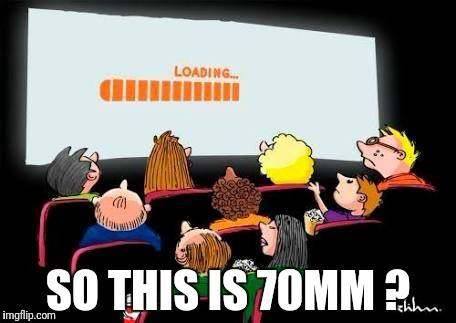
Posted by Leo Enticknap (Member # 534) on 01-16-2018, 06:02 PM:
quote: Kenneth Wuepper
Another bad technique of pseudo film in digital is showing the count down leader. What an insult to the non existent projectionist!
Especially bad when the pseudo-leader flashes 2 and 1, too. If these people think that including a visible leader in their movie is cool, they should at least get it right and have the flashing numbers stop at 3!
Posted by Bobby Henderson (Member # 840) on 01-17-2018, 01:00 PM:
quote:
It seems that the horror-movie crowd is really into this sort of thing. I don't get it, personally, but I don't really see anything wrong with it, as long as they are buying tickets and enjoying the experience. I suppose that I do fear that someone might attend this type of screening and then come to the conclusion that film always has dirt and scratches and damage and therefore always looks bad.
I remember being really annoyed by all the fake film damage cooked into Robert Rodriquez' Planet Terror half of Grindhouse. He shot the movie with digital cameras and then went nuts in post with all the scratches and other crap. I thought it was pretentious as hell. Quentin Tarantino shot the Death Proof part of Grindhouse on film and it didn't show nearly as much grain, scratches or damage. Unfortunately the story was a complete snore. 90% was pointless, long-winded dialog and 10% was actual stuff happening to move along the story.
Powered by Infopop Corporation
UBB.classicTM
6.3.1.2