This is topic New 2001 OCN (elements)70mm prints. in forum Film Handlers' Forum at Film-Tech Forum ARCHIVE.
To visit this topic, use this URL:
https://ft-forum.com/ft/cgi-bin/ubb/ultimatebb.cgi?ubb=get_topic;f=1;t=012288
Posted by Victor Liorentas (Member # 5272) on 03-28-2018, 12:41 PM:
https://www.hollywoodreporter.com/heat-vision/christopher-nolan-present-2001-a-space-odyssey-cannes-films-50th-ann iversary-1098021
'2001: A Space Odyssey'
The festival will be getting the world premiere of the unrestored 70mm print of the 1968 masterpiece.
Christopher Nolan will be heading to Cannes for the first time this year, but not with a film of his own.
The director will be on the Croisette to celebrate the 50th anniversary of Stanley Kubrick's masterpiece 2001: A Space Odyssey, introducing the world premiere of an unrestored 70mm print edition of the film.
The screening will take place on Saturday May 12, and is set to be attended by Kubrick's family, including his daughter Katharina Kubrick and long-time producing partner Jan Harlan.
"One of my earliest memories of cinema is seeing Stanley Kubrick’s 2001: A Space Odyssey, in 70mm, at the Leicester Square Theatre in London with my father," said Nolan. "The opportunity to be involved in recreating that experience for a new generation, and of introducing our new unrestored 70mm print of Kubrick’s masterpiece in all its analogue glory at the Festival de Cannes is an honour and a privilege."
For the first time since the original release, the 70mm print was struck from new printing elements made from the original camera negative, without any digital tricks, remastered effects or revisionist edits.
"Stanley Kubrick in the official selection! It is a great honour for the Festival de Cannes to host the 50th anniversary celebration of one of the most extraordinary films in the history of cinema. And to welcome to the Festival for the first time Christopher Nolan, whose presence creates a precious bond between past and present, without which cinema would have no history," said Cannes festival director Thierry Frémaux. "We are looking forward to this unique 70mm projection which will prove, if proof were necessary, that cinema was indeed invented for the big screen."
Nolan will also participate in a Cannes Masterclass on Sunday May 13, during which he will discuss his award-winning filmography and also share his passion for the work of Stanley Kubrick. 2001: A Space Odyssey will return to select U.S. theatres in 70mm beginning May 18, 2018.
“I’m delighted that Cannes has chosen to honour 2001: A Space Odyssey," said Christiane Kubrick. "If Stanley were alive today, we know he would be in admiration of the films of Christopher Nolan. And so, on behalf of Stanley’s family, I would personally like to thank Christopher for agreeing to introduce this very special screening."
Posted by Mark Ogden (Member # 43) on 03-28-2018, 03:55 PM:
Wow, talk about word salad. What exactly is being claimed here, that the print is off the original negative, or that it was
quote: Victor Liorentas
struck from new printing elements made from the original camera negative
which would tend to indicate that it was struck from an internegative, thus not quite living up to the hype.
Posted by Scott Norwood (Member # 30) on 03-28-2018, 04:30 PM:
quote: Victor Liorentas
For the first time since the original release, the 70mm print was struck from new printing elements made from the original camera negative, without any digital tricks, remastered effects or revisionist edits.
I don't get this at all. The original cut no longer exists. And when have digital effects ever been used in a 70mm print of 2001? There is no way that the above quote can be correct.
And how many of the "select US theatres" will this print visit before it gets scratched or otherwise mangled beyond recognition?
Posted by Victor Liorentas (Member # 5272) on 03-28-2018, 04:47 PM:
I hope they printed a few.
The last new print I saw looked like it was generations away from sharp. Though it could have been the focus issues and double panes of glass.
Posted by David Kornfeld (Member # 9964) on 03-29-2018, 06:04 PM:
As far as Ive been able to find out (so far), it's off an IN. Now, whether it's a new IN or the old IN#1 thats been used for every recent 70mm print, Ive yet to discover.
Ive also heard -- and this is also unconfirmed -- that theyll be striking four new prints, all of which will be road showed (read: eventually wrecked).
Obviously, all this is subject to revision.
Posted by David Kornfeld (Member # 9964) on 03-29-2018, 07:51 PM:
Okay, more info: 2001
quote:
Not So Fast On That 70mm “2001” Mastering
It’s been announced that Cannes Classics will host the world premiere of an unrestored 70mm print of Stanley Kubrick’s 2001: A Space Odyssey on Saturday, 5.12.18, in the midst of the forthcoming Cannes Film Festival.
A new but not restored 70mm print of 2001, struck from “new printing elements made from the original camera negative”, will be shown. An official festival release says that the idea is to “present the cinematic event audiences experienced 50 years ago.” The 70mm Cannes print, created by Warner Bros. with supervision by director Chris Nolan (who will introduce the film at the special Cannes screening), “is a true photochemical film recreation — no digital tricks, remastered effects or revisionist edits.”
Sounds like a reasonable idea, but restoration guru Robert Harris (Lawrence of Arabia, Vertigo, Spartacus, Rear Window) says “non…c’est des conneries. C’est pour les nerds de cinema.”
The new 70mm print they’ll be showing in Cannes “will not look like 2001 did in 1968,” Harris claims. “My problems with the project are not with what’s being done, or how it’s being done. It’s with the verbiage of the press release. It can’t be an authentic recreation of how the film looked 50 years ago for any number of reasons. Color stocks, black levels and grain structure are different now, color temperature of the lamps has changed but can be adapted. They were using carbon arc lamps in ’68 and they aren’t now, and on top of everything else the film stock is different — the stock used for original prints was a stock that arrived back in 1962. And so the images will ironically look too clear.”
(Harris is speculating, for example, that Cannes audiences might see that Dr. Heywood Floyd‘s floating pen is actually mounted on a circular piece of lucite or glass, which the original ’68 film didn’t have the resolution to deliver.)
“What they show may be beautiful — I’d like it to be — but they’re not working from the original camera negative, which has been badly damaged,” Harris explains. “They’re working from ‘new printing elements’ taken from the original negative, which basically means a fourth-generation print. All original prints were struck from the camera original. They won’t be using the original film stock that the original 2001 was printed on, which was Eastman 5385, a 1962 film stock, that had appropriate film grain to the way the film had been designed. So it’s not off the negative, they don’t have the original film stock, and they’re be making it off a dupe rather than using 4K or 8K files.
“All of that noted, stocks are so good today that the fact that a print is fourth-generation may not matter.”
Final Harris thought: The promising news is that FotoKem, the lab producing the elements, does superb work, so in the end everything should look wonderful, if a bit shop-worn. Most important thing is that the skies must be black, black, black!”
2001: A Space Odyssey will also return to U.S. theaters in 70mm beginning on 5.18.18. But why not in uprezzed IMAX, fellas? 2001 freaks worldwide would cheer this.
Mr Harris certainly always knows what hes talking about.
Posted by Scott Norwood (Member # 30) on 03-29-2018, 08:13 PM:
Obviously 70mm is the way to see this, but is there a passable DCP version yet? Or is Warners still sending out the same DCP that looks worse than the Blu-Ray?
Posted by Mark Ogden (Member # 43) on 03-29-2018, 08:19 PM:
quote:
not working from the original camera negative, which has been badly damaged,” Harris explains. “They’re working from ‘new printing elements’ taken from the original negative
So, if the original camera negative is too badly damaged to strike a print, how do you get an interpositive off it to make a "new" printing internegative?
I remember hearing that when Kubrick was working on Eyes Wide Shut for Warner Bros. he asked Terry Semel about what they had for protection on 2001, and was told that there were 70mm b/w separations made. I wonder what became of them. They'd probably make a hell of a print.
Posted by Martin Brooks (Member # 1269) on 04-11-2018, 11:43 PM:
quote: Scott Norwood
Obviously 70mm is the way to see this
If it's a large enough screen, but few theaters have large enough screens anymore. The only proper way to see this is as originally presented on a deeply curved Cinerama screen. IMO, this film really needs to be seen on a gigantic screen, especially the scenes in space outside the ship, to have the intended impact.
Posted by Frank Angel (Member # 248) on 05-24-2018, 08:12 PM:
Exactly right, Martin. I have never been to the Village East 70mm room, but my fear is that when I go tonight, I will be greeted by a moderately sized screen at best. Having seen it in both Cinerama and Super Panavision, it truly does beg for a screen that encompasses your peripheral vision. Cinerama certainly did that, but of course you had to suffer the join lines and the bow distortion. I shall let you know if I come back home tonight at 2pm elated or just ready for bed.
Posted by Frank Angel (Member # 248) on 05-25-2018, 07:03 PM:
And now the bad news: Attended the 10:55pm show at the Village East Cinemas. Never been there before. Fairly nice restoration of what must have been a very impressive Yiddish Theatre in its day. After admiring the architecture, I then do notice that the screen and masking (yes, at least there was masking) seem to have been just propped up against the wall as and after thought. No curtain of course, and the screen is silver so I know no matter how good this 70mm image is going to look, it is going to have a hotspot.
That said, it's all minor stuff, because after I encouraged all the professors in the Film Department and the young techs there that they HAD to experience a 70mm presentation of this masterpiece, and then dragging two of my colleagues into the Manhattan from Brooklyn at a little more than an hour before midnight to watch a 3 hour movie...how embarrassed and astonished was I to find a picture that was out of focus on 1/3rd of the right side for the entire THE DAWN OF MAN sequence, and it remained soft overall throughout.
This certainly was not what 70mm should have looked like. Was this the fault of this newly minted print? I can't imagine Chris Nolan would have been OK with it ever being released if this was the best all that work could produce. So let's assume it was the lenses, the projector gate, whatever, and not the print. Lets assume the weave and jitter, though not terribly bad, was also the projector and not the print.
Next comes the second half and the lopsided focus is somewhat improved, but only to the extent that it is even, but still very soft across the screen. I (and my colleagues) sit and watch a picture that is not even as good as a 35mm print. So much for all the blah blah bah I had done about the incredibly sharp image they would see watching 70mm FILM.
Now the REALLY bad news...the horror actually: probably about 10 min into the second half after the Intermission, comes two parallel scratches in the MIDDLE of the effen image; two about a foot apart and then soon after, two more show up a couple of feet way from the first set of train tracks. These black lines remained for the rest of the film, scarring the bright image of Jupiter and playing across the Victorian room and poor aging Bowman's face and then across final image of the Star Child. My friends could hear me gasp when they first appeared and them moan softly as they stayed forever.
How is it possible for a print to get damaged so soon after only playing a week? Stupid question -- if the projectionist doesn't have a clue or the equipment hasn't been serviced in decades, a print can get ruined after one showing. This whole experience, especially seeing that print condition and an image that looked NOTHING like the 2001 I knew and loved gave me cramps in my stomach for three hours.
Luckily these aren't emulsion scratches (but give this theatre another week), and I assume some Film-Guard can to some extent minimize these scratch lines, but the idea that a brand new 70mm print can't last pristine for more than a week says something about the state of affairs even in NYC when it comes to the level of technical expertise available for film presentation. It almost makes it seem like all that work and love that Chris Nolan poured into this project was for nothing. Or maybe Warners should be more careful where they book these expensive prints.
Posted by Sam D. Chavez (Member # 1841) on 05-25-2018, 07:44 PM:
I did the tech check for the Castro in SF last week. The print looked OK but had quite a lot of tiny negative dirt specks. It was projected properly with masking etc., but the hot spot from the silver screen was a bit agonizing since there was only so much that can be done when the projectors are pointing down at quite an angle from the balcony projection room. The balcony had maybe 11 FL with slightly darkish corners, while the main floor had a hot spot around 30FL, with the sides and corners dropping off quite a lot. Pity, but still a great experience with the theatre playing the theme on its pipe organ. (Sounded better than the soundtrack.) It's a good sized screen but not the wraparound screen I saw it on in my youth. Still it's 70mm on a brand new print. There are worse things.
Posted by David Kornfeld (Member # 9964) on 05-25-2018, 09:25 PM:
I'm really sorry to be the one to have to state the obvious, but it should come as a surprise to exactly nobody that these prints are going to get damaged; some of them heavily; and many of them almost immediately. As Ive said -- exhaustively -- on a different forum, in interviews, in the press, blah blah blah, almost nobody working a booth these days knows how to handle this supremely unforgiving format anymore. There are a few -- a precious few -- scattered about who still do. But those few will not be the ones handling these prints throughout the entirety of their runs, so expect all of them to wheeze back to Warner in a disastrous or semi-disastrous state. Thats simply how things are these days. It's awful, but there it is.
You cant spend forty years busting unions, firing operators, forcing them to retire, replacing them with floor staff, & then wonder why the skills they had no longer exist & your elements are getting trashed. Occam's Razor applies here: it's a simply case of cause & effect. I mean, duh.
Mr Angel: I feel for your crummy experience; I really do. If you want to see it done right, come to Somerville any time from 1 - 14 June. Bring your friends. The picture will be sharp, bright, & clear. Unless someone at the Music Box screws up (highly unlikely), the print will be in excellent shape. I know it's a bit of a trek, but itll be worth the effort, even though we dont have a huge curved screen here.
There are members on this forum who will vouch for my presentation. And Mr Angel: itll be my treat.
Posted by Brad Miller (Member # 2) on 05-26-2018, 12:35 AM:
I can't vouch for David's on-screen presentation, but I CAN vouch for his film handling skills. He played H8 in 70mm longer than any other theater and his print came back in lab mint condition (and I mean that's straight-out-of-the-lab mint, meaning no dust or handling marks at the reel ends...nothing).
That being said, I have absolutely no reason to believe his on-screen presentation is anything less than excellent.
Posted by Frank Cox (Member # 6258) on 05-26-2018, 01:22 AM:
Heavens t'Murgatroyd, even.
My brother lives near Boston.
I'm going to send him an email right now to tell him about the Somerville presentation.
Posted by Robert Harris (Member # 1712) on 05-26-2018, 09:43 AM:
Could not agree more with David K.
70mm is a major problem. When we opened Vertigo in LA, a theater in Westwood, destroyed two newly struck prints over four days.
Posted by Stephan Shelley (Member # 8587) on 05-26-2018, 10:47 AM:
There are other some places around the country you are likely to get good 70mm presentations: The Willows in Plymouth, Minnesota, Heights in Columbia Heights, Minnesota, The Look and The Studio Grill in the Dallas Texas area, Grand Lake in Oakland CA, New Mission San Francisco CA, Cinerama Theatre Seattle WA. I know that the Grand Lake and New Mission have seasoned union projectionist full time. The Willows part time.
I am sure there are a few others. Most of these are independents that try hard to do it right.
Posted by Leo Enticknap (Member # 534) on 05-26-2018, 12:08 PM:
The problem is that it takes just one staff movement from one of these venues to transform it from a place that does it right to one that does it wrong. This is especially true of theatres outside LA and NY, because they're unlikely to be able to find someone else who has the necessary expertise, and not many people are going to be willing to relocate long distance for what the job is likely to pay.
Posted by Frank Angel (Member # 248) on 05-26-2018, 01:36 PM:
Well, I don't know if I'd vouch for NY any more. As far back as 2002, when Warners did a limited release -- only 2 or 3 prints struck (I think from that 1988 element), one 700 print for each coast and I think one for Europe, I saw the East coast print trashed at what at one time was considered one of the top draw theatres in the city -- the Astor Plaza. I think there is an account of that here on FT somewhere. So I am almost thinking that NO place guarantees safety for film prints, 70mm or 35mm...that going directly to Dave's point.
Now it simply depends on the technician/craftsman who is in the booth; reality is, they are fewer and farther between. And that's only going to get worse. We can't live forever.
And David, thanks for that kind offer. Just so happens, I actually may be taking a trip up to Boston sometime between the 6th - 8th. If I can finagle it, I would love to detour to see your place and take you up only your kind offer. It may be the one last time I'll get to see 2001 in 70. Location of your theatre?
Posted by Brad Miller (Member # 2) on 05-26-2018, 02:28 PM:
Leo, It might surprise you that NY and LA are the two locations with the Hateful 8 prints returned in the worst condition. In fact NY and LA each chewed through 3 prints. They are such high profile locations though, when they trash a print, a new replacement print is quickly sent.
Location has absolutely nothing to do with expertise or the ability to find it, but I do get what you were trying to say.
That being said I don't think operator error is the big culprit with these towns damaging seemingly every print that plays there. I fully believe the equipment was not setup properly and in some cases I know for a fact the equipment is missing critical parts to prevent film damage.
Stephan, WB did not book 2001 into any of the Dallas locations, but honestly unless they would strike me a brand new print, I would not want to play it here because I don't want to present other people's damage. There is no possible way those 4 prints of 2001 will play their engagements through and not have damage on them at the end of the roadshow engagement.
Posted by David Kornfeld (Member # 9964) on 05-26-2018, 06:40 PM:
Mr Angel: we're located at 55 Davis Square, in Somerville, MA, 02144. I'm working on all the days youll be swinging through. If you arrive early enough between shows, I'll give you the grand tour. If you arrive for the last show of the day, I'll throw some special stuff on the screen! I would really look forward to meeting you!
And, no, it wont be the last time youll be able to see it in 70. My venue purchased its own print of 2001 from Warner, & we'll be running it....one of these days. We were going to run it for this 50th Anniversary thing, but then this new new print came along, so our print -- still unrun -- is just sitting & waiting. And trust me: as long as I'm working here, that print is going to stay MINT.
As for operators vs equipment: sure, a lot of the newly-installed equipment unquestionably wasnt up to snuff, but heres where the infrastructure loss makes its disappearance known: you need operators who can recognize whats wrong, technicians who can respond to that, equipment distributors who can supply them all, & the skill set to make the requisite repairs, adjustments, & alignments. And almost all of that is gone, now.
Projecting 70mm successfully is a hard-won skill. It's not something you can master in a two or three day training session. It's not something you can just walk in & "figure out." You have to be trained by people who know what theyre doing, and, as I keep repeating, theres almost none of them left these days, except for the occasional still-lumbering dinosaur like me.
So it cant some as a surprise that these problems keep recurring. 70 is just so damn easy to damage. In the olden days -- god, I'm dating myself -- when there were mag tracks on acetate, the tracks would give you a bit of a buffer that might prevent some types of contact damage, if you were lucky. But with these new mylar prints -- hell, mylar scratches if you look at it cross-eyed -- you dont have that, so everything in the film path has to be ultra-critically in adjustment or buh-bye.
And thats probably what happened in NY. And thats probably why it will keep happening.
Sometimes I despair.
Posted by Frank Cox (Member # 6258) on 05-26-2018, 06:59 PM:
My brother and his son are now planning a trip to the Somerville Theatre. ![[Big Grin]](biggrin.gif)
Posted by Stephan Shelley (Member # 8587) on 05-26-2018, 07:29 PM:
Brad I have concerns about what shape the print will be in when we get it in late August. Decision is not mine so will have to do the best I can with what we get then. My statement about presentation at your locations was a general one about any film presentation there not just 2001.
Posted by Jean-Pierre Gutzeit (Member # 7275) on 05-30-2018, 03:03 PM:
And is the result now really "closer" to the premiere prints struck of the camera negative in 1968? Regarding a. neutral color correction and balance, b. Image steadiness, c. gamma/contrast, d. sharpness, e. flesh tones, f. real pure white spaceships, g. real black space, h. unchanged directional sound mix?
For what did Warner need 5 months and 45 people in manufacturing a normal 65mm Intermed negative?
Posted by Frank Bolkovac (Member # 6201) on 05-31-2018, 09:55 AM:
Why would anyone with a new or equal 70MM (or 35) print attempt to operate it on equipment that needs serviced??.
Posted by Terry Monohan (Member # 8285) on 05-31-2018, 10:07 AM:
The former Fox Hollywood Cinerama Theatre in Portland OR has sold out all the 2001 70mm showing starting on Fri June 1 ending on Sun June 3 2018. They do have a curved screen, not as good as the Cinerama screen that was in the Hollywood in the 60's but still has a nice curve to it. They always do a great job and take care with all their 70mm prints. Now let's hope they do a curtain fund sponsorship fund to bring back the nice curtains and put in some color lights on a new curtain in the theatre.
Posted by Leo Enticknap (Member # 534) on 05-31-2018, 10:21 AM:
quote: Frank Bolkovac
Why would anyone with a new or equal 70MM (or 35) print attempt to operate it on equipment that needs serviced??.
The film revival, and its promotion by people like Nolan and Tarantino, has led to some places trying to screen film prints who don't fully understand (or misunderstand) what they are getting themselves into. Specific answers to your question include:
- They don't know that their equipment has defects that can cause print damage and/or substandard presentation.
- They know, but find some reason to rationalize doing it anyway.
- They believe that scratches and dirt on film is part of the viewing experience, and not a defect.
Posted by Frank Angel (Member # 248) on 05-31-2018, 12:58 PM:
Filmack used to coat all their trailers with some kind of polymer that was cured by ultraviolet light. It is nearly impervious to normal wear-and-tear dirt scratches and it didn't seem to affect the image sharpness or the sound in any way. We have many piece of film from them with that coating. Dirt doesn't seem to adhere to it. It did add some thickness which was no problem when you are dealing only with short snipes and trailers, but that might be an issue with really full reels of a feature.
The one thing that I could imagine might be a problem would be that it would yellow or not stay fully transparent and colorless. So far, after some 30 years, that seems not to be the case. All that coated film still is like it came from the lab. Just for kicks, I pulled a few trailers out and inspected it; it feels supple and smooth, no dried feel that some uncoated film of that age can have; it seems to have a bit more strength.
My recollection is that using it for acetate was a problem as it did have a big negative of trapping acidic gas from escaping the base and thus accelerating the acidosis cascade (the dreaded vinegar syndrome). With mylar, this wouldn't be a issue at all; seems like a natural for 70mm mylar prints which are so prone to scratches...as David rightly puts it, which scratch if you look at them cross-eyed.
If I owned a MINT 70mm print of 2001. aside from sporting a permanent erection, I would look into spending the $$ to have that print coated. I think it is a 3M process named PhotoGuard. Whether it's available for 70mm may be the real question; like everything film related, even if there were equipment that was designed to coat 70mm, would it still be available and would there be any technician who knew how to operate it?
Posted by Aron Toplitsky (Member # 6950) on 05-31-2018, 07:16 PM:
I got to see the Nolan print at the Arclight Hollywood on the Sunday after opening weekend. This was my third time seeing the film since 2008 (twice before in 70MM at American Cinematheque's Aero Theater)and 2001 grows on me more and more!
Comparing this print to what I've seen at The Aero in 2008 and 2011, I thought the Nolan print was darker and less colorful. I guess this is due to a lack of a DI? Still, it was great to see in a theater again and I appreciate the complete film process with no digital involved. There were some minor scratches and dirt but nothing major. A very solid presentation that Arclight should be proud of.
Posted by Brad Miller (Member # 2) on 05-31-2018, 09:04 PM:
There are no more Photoguard systems around anymore Frank. Personally I couldn't be happier. Yes that stuff made it almost impossible to scratch the print, but it hurt image registration, caused major shedding and any kind of liquid cleaner couldn't be used on the print. Total crap if you ask me.
Scratches and dirt on the print of 2001 already? Geez, what a surprise. ![[Roll Eyes]](rolleyes.gif)
Posted by Adam Martin (Member # 641) on 05-31-2018, 11:27 PM:
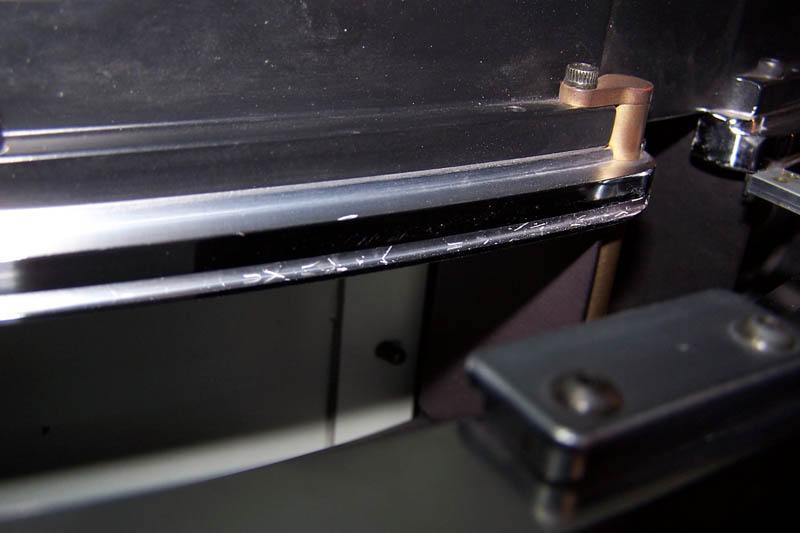
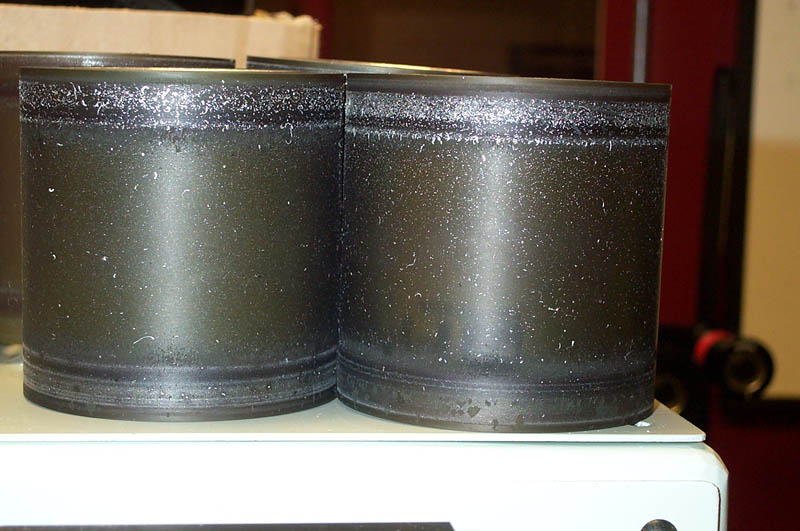
PhotoGuard is awesome so long as you never want to run your print. After a few hundred runs, you're left with a mess of flakes and shedding that you can sometimes see a film through and your gentlest of rolling loop projectors is covered in muck after just 40 minutes.
Posted by Leo Enticknap (Member # 534) on 06-01-2018, 08:10 AM:
quote: Aron Toplitsky
...and I appreciate the complete film process with no digital involved.
The audio was digital.
As for Scotchgard/Photogard, yet another of its many sucky features is that if it is applied to acetate or nitrate, the film pack deforms as the base shrinks, but the Photogard does not. Presumably this drawback would not apply to polyester, but I have never encountered a Photogard-treated polyester element.
It can discolor, giving the projected image a yellowy tint, too.
Posted by Tony Bandiera Jr (Member # 2365) on 06-01-2018, 10:34 AM:
Since the thread has drifted a bit off-topic already, figured this would be a good time to ask:
If PTR's are so despised and reviled for use in "regular" cinemas, why are the IMAX systems such fanboys of them, and never seem to complain about how horrible they are compared to their other format counterparts?
Are the IMAX versions made better, or is the higher linear speed of the film somehow making them work better?
BTW years ago I had a set of those for my own projector, and even with new PTR's they DID suck. Filmguard and a media cleaner tromped them every time. (I still have about 3/4 of a bottle of Filmguard, and dread running out.)
Posted by Steve Guttag (Member # 268) on 06-01-2018, 11:05 AM:
In Imax, they were used, mostly, correctly. They were to keep dust from accumulating on the film. The movies were relatively short (didn't have as much opportunity to build up) and they were changed for EVERY show so they were always clean. The booths, by and large were "clean rooms" so all you were keeping off, as I said before, was dust (air born or created through projection).
Also, with the rolling loop projector, a liquid based cleaner with any residue wouldn't work (gets on the field flattener).
I believe a "compromise" to photoguard in Imax was to go perf-to-perf rather than edge-to-edge to avoid the machine from rubbing it off and creating so much debris.
Posted by Scott Norwood (Member # 30) on 06-01-2018, 11:39 AM:
I have never operated an Imax projector, but isn't the machine designed to require the use of PTRs for proper operation?
And, yes, every Imax booth that I have seen has been incredibly clean, with filtered air.
Posted by Gordon McLeod (Member # 33) on 06-01-2018, 02:54 PM:
DKP7ommInc fotoguards only the image area not the perfs
other companies due it edge to edge and they do flake
overall it is a good system
Posted by Sascha F. Roll (Member # 9043) on 06-03-2018, 02:57 PM:
The new print which is circulating in germany (currently at it's second location) is already scratched throughout. Great success!
Posted by Alexandre Pereira (Member # 9295) on 06-03-2018, 03:16 PM:
What kind of scratches and how many?
Posted by Sascha F. Roll (Member # 9043) on 06-03-2018, 03:18 PM:
About 4-6 vertical scratches next to each other, only in the top part of the image, on the left side. Very visible.
Posted by Frank Angel (Member # 248) on 06-13-2018, 03:25 PM:
I would like to thank David Kornfeld for what was a spectacular presentation of a beloved film that launched Brooklyn Center Cinema (first film I ever ran there after I installed the Simplex projectors -- mag of course -- unfortunately they wouldn't let me buy 70s). 2001 was the seminal film that starts my career. After the disappointment of the Village East Cinema experience, seeing it as close to the original as we are ever going to get was not on old a treat, but an emotional experience. And David certainly did this film justice.
First I have to say, the Somerville theatre is a throw-back to the past -- the place has style, it has character; it has elfin CLASS! And Dave gave me the grand tour of his booth with the dual Norelcos-- yes he's running changeover -- the machines are so clean you could eat off them, the result being there was nary a speck of dirt through out the entire 2&half hours screen time. Five minutes in that booth and you can immediately see it is operated by someone who has both the specialized knowledge all all things 70mm and just as importantly, the love and passion for making this or any other film running through his machines, become real to his audience. Indeed, Mr. Kornfeld was called out of retirement to run this and the other 70mm roadshow series that the theatre is mounting. He is also an educator, explaining to his audience in a short but important stage talk about why seeing 70mm is a unique experience. He made it both informative and with a nice touch of humor. The fact that the theatre is having such success with their 70mm showings attests to the important of letting people know this is something special and worthwhile, certainly if one considers oneself a movie lover.
The Sumerville Theatre has a magnificent ruby red curtain. And imagine my delight when the MGM stylized lion hit the screen with the first rumblings of the Zarathustra theme and that curtain flew out, but then a SECOND white curtain split simultaneously! It was a great bit of old-school showmanship that is befitting the masterpiece that would follow and would be watched in awe by a packed house of both young, middle-aged and us old folk, ALL mesmerized. In the sequences of the space walk where Poole is killed and there is only the silence of space on the soundtrack, this audience of about 400 seemed to be mesmerized -- there as dead silence. My friend Bob who had come with me to this show said he could hear a pin drop, they were that quiet.
I thank David for the invite, but more importantly for the excellent presentation, which not course is due wholly to his experience and expertise, of a film that is especially important to me. It is the film that I saw in Cinerama and again many times in 70mm when I was just starting college; I couldn't get enough of it. It became the seminal film that I then used to launch Brooklyn Center Cinema which started my long career (50yrs this year) and then over the years, running it many times in a number of arts houses and museums, finally coming full circle, showing it for an audience of about 1200 with a Q&A with Mr. Kier Dullea after the show. It is the film that actually inspired me to want to give the film experience to an audience.
So than you, Mr. Kubrick; thank you Mr. Kornfeld for a great evening and for an experience that will probably be the last time I will get to see this exceptional piece of art in its original form and with the presentation quality and spectacular showmanship as I first saw it as a youngster, and which it truly deserves.
Posted by Mark Ogden (Member # 43) on 06-13-2018, 03:57 PM:
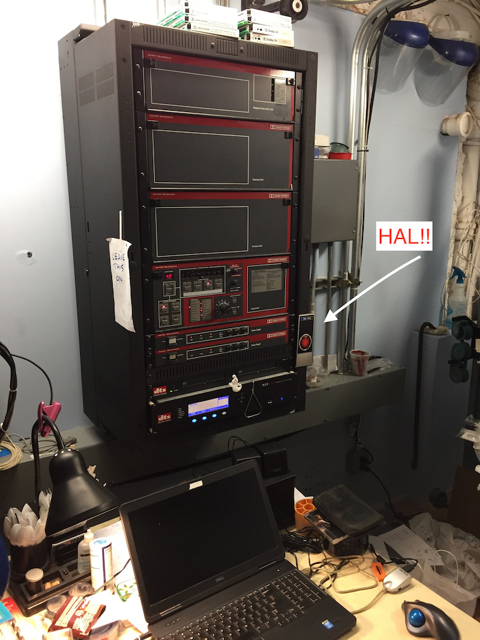
The audio rack at the Somerville is run by HAL 9000 himself!
Does anyone know if the print at the Somerville is the one moving to the Coolidge Corner on Friday? I'm coming up Sunday night to see it and I will be happy to know that it is, given Dave's rep for pristine film handling . . .
Posted by Brad Miller (Member # 2) on 06-13-2018, 04:13 PM:
Frank - After meeting David myself and also seeing how flawless his Hateful 8 print was when he was finished with his surprisingly long engagement at the Somerville, I've no doubt the presentation of 2001 was spectacular.
The sad part is that print will likely transfer to some other location in a week and get scratched. ![[Frown]](frown.gif)
BTW, David was not pulled out of retirement. He is and has been the active lead projectionist at the Somerville for some time now. They run real film regularly there.
Mark - I understand the Somerville is going to keep showing that "unrestored" print for another week, so the Coolidge must be having another print shipped in from another engagement. Since those two theaters are across the street from each other, if I was making the trek, no negativity intended towards the Coolidge, but I would absolutely choose the Somerville due to just how over the top David is as a perfectionist. There are probably less projectionists worthy of actually being referred to as an "archival film handler" than you have fingers on your hands currently working, but David is certainly one of them.
Posted by Jean-Pierre Gutzeit (Member # 7275) on 06-16-2018, 05:31 AM:
A reader's letter in "Variety" seems apt to get to the point. Written by a person with a lab's experience. Unfortunately, this meaningful realization is not analytically pursued, but bowed in gratitude to the achievements of the restoration team of Warner Brothers. At the moment, the re-use of the film earns a lot of money, so that a critical discussion could make a difference so that the same mistakes will not be repeated in the future.
Having seen this movie since 40 years in all versions 92x (included the 35mm and 70mm prints from our archive and additionally laterer Warner revivals), I fully agree with this:
Benoît Clariana-Roig says:
MAY 18, 2018 AT 12:29 AM
"Never saw a single 35 or 70mm with these crappy greenish-yellowish color grading.
Christopher Nolan is publicly known as color blind, he’s blind to reds & greens…
The current BR grading is the closest grade of the original print I saw at the theatrical release. Nolan should stop to appropriate things that is not his work. He was 7 at the original release."
https://variety.com/2018/artisans/production/christopher-nolan-2001-a-space-odyssey-1202811669/#article-comments
We could add furtherer issues:
- Nearly lost details in shadows and lights
- More grain ever seen
- Unsteadiness
- No depths and satisfied sharpness
- Desaturated colors
- Grey to grey?
- Unsharp title sequence
- Front projection sequence never looked worse...
Most of these efforts are gone now:
https://youtu.be/09LrEH4oIA0
Posted by David Kornfeld (Member # 9964) on 06-17-2018, 09:38 PM:
You know, I have to say I find Mr Gutzeit's remarks to be somewhat counter-productive & bordering on snarky. I'm not certain his approach will result in improved future film releases, even though that seems to be what hes agitating for.
Ive been running one of these new prints for over two weeks now. Is it perfect? No, it isnt. Is there room for improvement? Theres always room for improvement. Is it substantially better than the previous circulating prints struck from IN#1? Well, yes & no. Some sequences are the same, some are worse, & some are better. But you sort of have to expect that when youre dealing in the analogue world, & you have to expect it more when youre dealing with old elements.
Taking Mr Gutzeit's bullet points one by one:
- Nearly lost details in shadows and lights
In some sequences, thats true. In others, no.
- More grain ever seen
It has the same grain as the prints struck off IN#1. And, well, honestly, what would you expect from a third-gen print struck from an IN derived from an IP of unknown providence? Come on, now.
- Unsteadiness
Bullshit. I QC'd this print from at times six feet away from a 27' screen. No unsteadiness that I could see.
- No depths and satisfied sharpness
A. I repeat, third-gen print.
B. Those space scenes are plenty black.
C. Some shots are sharper than the previous IN prints. Dont argue with me: I have one here sitting here right now.
- Desaturated colors
Again, in some sequences. In others, plenty of saturation.
- Grey to grey?
I dont know what this means.
- Unsharp title sequence
Ha! I'm beginning to think you have projection problems!
- Front projection sequence never looked worse...
Oh yes it has: Ive run prints where the timing of that sequence was substantially worse.
I think Warner should be applauded for spending the money & taking this expensive step, & I hope they do it for future films, though I admit thats unlikely with naysayers like Mr Gutzeit at the helm. This is, as far as I'm concerned, a far, far better thing to do than release it in some 4K craptastic digital file, which will look like garbage & likely sound worse. (And there are a lot of people on online fora who are clamoring for just such an inferior release.)
Yes, this could have been better. But it also could have been a hell of a lot worse. And this title absolutely deserves to be shown in this format, just as Lawrence of Arabia deserves to be shown in this format. Griping that it's not as grainless & timed as flawlessly as a print struck from the OCN (before it started to fade & sustained damage from overuse) is simply unrealisitc.
Oh, & whomever it was that said that the BluRay is closest in grading to an original release? Thats a complete pile of rubbish. Ive run original release prints of this, I saw a couple of release prints of this, I ran rerelease prints struck from the OCN, & Ive seen the BluRay, & that statement is to laugh.
If this is the quality of a "person with a lab's experience," it goes a long way to explaining a lot of things.
Posted by Steve Guttag (Member # 268) on 06-18-2018, 08:07 AM:
The best I've personally have seen of this movie were prints struck in the early '80s and printed by Metrocolor. Though I saw a print in the early/mid 70s, I was too young to appreciate the differences/variances. The print run in the early 80s was on top-flight equipment and looked near-perfect.
Posted by Allan Young (Member # 6332) on 06-18-2018, 10:31 AM:
quote:
- Unsteadiness
Bullshit. I QC'd this print from at times six feet away from a 27' screen. No unsteadiness that I could see.
Interesting. I've seen two different prints and there was distinct unsteadiness on both. I figured the lab had screwed up but it could be that both cinemas had projector problems.
quote:
- Front projection sequence never looked worse...
The front projection sequences look significantly worse on any of the home media versions.
Posted by Mark Ogden (Member # 43) on 06-18-2018, 10:52 AM:
David and Jean-Pierre argue from two different viewpoints. David seems to accept Christopher Nolan’s view, that any 70mm presentation of the film, even one from a compromised printing element, is preferable. Jean-Pierre seems to feel that the film is best served as a work of cinema by an optimal presentation.
I saw the fourth play of a fesh-from-Fotokem print last night at the Coolidge Corner Cinema in Brookline, Massachusetts. Knowing what I know about this release I went in with low expectations, and I’m not even sure these were met. Don’t get me wrong, it was GREAT seeing the film in a with a top-notch, high showmanship presentation, and well worth the trip up. But while I was watching it I came to understand why Nolan underlined the whole “unrestored” qualification, because honestly, it didn’t look that good. Among the issues I saw: there were three quite serious tears in the printing element: the first about ninety seconds into the Dawn of Man sequence, the second in the Moon scene just as the astronaut is about to touch the monolith for the first time, the third just a few frames before the end credits began. There were many instance of white speckles observed, and some serious patches of dirt, the worst coming in the drawing room scene just as Bowman sits down at the table just before he knocks over the wine glass, very distracting. There was general low contrast throughout the print (but I noticed a few other things that made me believe that this may have been in part a theatre-specific issue). In general, highlights were quite blown-out and lacking in detail. And the color timing. Oy vay, the color timing. David might argue: in some scenes yes, others no. But if there are issues in any scenes at all, you're not seeing the best obtainable presentation.
If Nolan and van Hoytema obtained the best possible results from the remaining film elements, then from this point on to obtain a clean, color correct, OPTIMAL presentation of the title will absolutely require a digital restoration, because I don't see a way to address these issues photochemically. In fact, I found myself grading the film in my mind as I was watching it. So keyframe a tracking window there, there’s a yellow secondary correction, make a DVO REgrain layer there, you need the Phoenix plug-in to fix that tear . . . you get the point.
Again, very film-romantic to see a beloved movie this way, but I would have been equally happy to see a better looking image from a digital file. I just hope to Christ that nobody gets the idea to do the same thing to this picture that is being done to Lawrence Of Arabia, lay off a digital file onto film and pass it off as 70mm.
*****
The Coolidge Corner put on a great show last night. The projectionist was a young man named Riley who had a “Support Your Local Projectionist” teeshirt on, and who introduced the show. Very tasteful use of curtains and lights during the overture, entr’acte and exit. Dead-nuts changeovers from DP70s. I noticed that very bright images on dark backgrounds caused a faint ghost image at the bottom of the screen which I have never seen before and which makes me wonder about this theatre and the contrast issue mentioned above. Overall, though, a nice presentation shown to an appreciative crowd.
Posted by Brad Miller (Member # 2) on 06-18-2018, 02:08 PM:
Mark, David's theater is across the street from the Coolidge. Ashamed you didn't walk across the street and check out his presentation to more accurately compare the prints vs. potential projection/facility issues.
Posted by Mark Ogden (Member # 43) on 06-18-2018, 02:32 PM:
Brad, I’m not sure why you say that. In point of fact, the Somerville and the Coolidge Corner are nowhere near each other. It’s at least a half-hour subway ride between them. ![[Confused]](confused.gif)
Posted by Jean-Pierre Gutzeit (Member # 7275) on 06-18-2018, 05:06 PM:
It would be desirable to increase the number of 70mm sites and film inserts, especially classics.
However, the end customers, the dedicated cinema operators as well as the cinemagoers, must take responsibility for the quality of these film prints in their own hands and demand accountability from the distributors and the laboratories. The latter have to make their work transparent. Otherwise it threatens a disgrace on all levels.
Over the last six weeks, the most contradictory statements by Christopher Nolan or the lab have been read on the “unrestored version” [which is very much a restoration of the original, while a digital restoration should rather be called digitization]. Rendered in the sense:
a. We did not touch the camera negative
b. The camera negatives were elaborately repaired and cleaned
c. We found an unused 65mm interpositive from 1999, commissioned by the director [objection: however, looking at the 70mm clips of the Home Cinema editions since 2000/01, we discover the signs and edge numbering of an interpositive from the late 1990s ]
d. Over 40 employees worked on the production of the 65mm Internegative for several months in 2017/18 [Objection: an unprecedented effort]
e. More than 40 employees spent several months working on the 65mm Interpositiv in 1999 [Objection: an unprecedented effort]
f. we want to give the audience a version of the look of the premiere original [of course you could approach this goal successfully, if the print process developed exactly, properly color timed, intact printers for the production of intermediates keeps running and experienced employees from earlier labs with attracts]
The lab had to dismiss many experienced employees in recent years, as I was told. In addition, most of them live from orders for digitization, while traditional copying work is on the verge of a deficit.
It is therefore tragic to have experienced some very unbalanced 70mm prints of Fox classics for about 15 years: often with a strongly yellow discolored white, basic vote too green or too dark. [There may also be problems with the positive development machines, but that's just a speculation]. The internegatives of recent productions like INTERSTELLAR, HATEFUL 8 or DUNKIRK did not show sufficient sharpness in my experience. Unfortunately I did not see the direct prints of the camera original negative, but only the prints of the Internegativ. Had DUNKIRK and HATEFUL 8 been shot anamorphic in 35mm, the same result would have been achievable. One does not recognize the 65mm-shot - in contrast to earlier classics.
[part 1 of 2]
Posted by Brad Miller (Member # 2) on 06-18-2018, 07:45 PM:
Sorry Mark, I've heard a comment before "across the street" and I guess I took that literally when someone meant it figuratively.
Posted by Jean-Pierre Gutzeit (Member # 7275) on 06-18-2018, 07:52 PM:
Tendentiell noticed in all the mentioned 70mm titles INTERSTELLAR or HATEFUL 8 that loss of detail in the shadows and lights appeared. Then these movies on Blu-ray looked quite normal: like a 35mm direct print of the original negative from the 1990s. Without additions and enhancements. The 65mm Intermediates of films like MY FAIR LADY, VERTIGO, TITANIC or TRUE LIES, made in the 1990s, provided largely satisfactory results.
David Kornfeld mentioned the formerly I.N. I prints (2001-2017): I saw very different prints. Some awful, but one of a special festival print with much better saturation and details than the version from 2018.
The modern symptoms of the new production line seem now also affecting 2001: A SPACE ODYSSEY. 2001 has now the look of DUNKIRK. In the "2001"-prints of Metrocolor since 1968, which mentioned Steve Guttag, hardly complaints arose. The Blu ray from 2007 also contains many usable scenes that serve as orientation for comparisons and were obtained from intact interpositives.
What was printed to 70mm in 2018 is frightening. One might suspect that the original negative would be severely blurred, so full of soot, graying and poor in details looked like the picture. The color timing is definitely "in line" in my opinion, extensively striving for a scene correction. But the basic character is desolate. Unfortunately, in the reaction to criticism, the buzz words "dead negative" often serve to discredit the analogue film and casually refer to digitization. But if you look more closely, the starting materials at "2001" are apparently not that bad:
- 65mm Interpositiv from 1999 is untouched, said Warner [but I assume that the Blu ray Disc of 2007 was won, so the results of a 70mm-theatrical prints would have to be good in 2018 as well.]
- 65mm original negative: the restoration manager Ned Price said that the negative is in good condition according to his age. A slight color fading could be compensated on the way of the analog color timing and printing [I hereby like to confirm. And add: you should have tried the only one dozen new 70mm prints in 2018 to strike from the original negative. I doubt the alleged "impossibility". (Last week, a 35mm Eastman Color original negative from 1968 was scanned in this city, though not developed by Metrocolor, but perfectly flawless, no fading, no color crossings)]
The restoration must therefore be repeated photochemically (exceptly the title sequence, because it is yet a "dup" in the OCN) and possibly be used by additional personnel or a new lab. Christopher Nolan should take care of that if he does not want to risk the demise of the 70mm format.
[part 2 of 2]
Posted by Steve Guttag (Member # 268) on 06-19-2018, 03:54 AM:
Thanks Jean. I appreciate your comments.
I have not seen this release of 2001 yet (coming in July to a theatre near me). But I have definitely be underwhelmed by the 70mm that has been coming out in this last batch (last few years). They have been very un-70mm like. They seem to lack steadiness/sharpness, in particular. Whereas I had not seen the new movies before, I couldn't say if the saturation was right or not.
As I recall from back when the 25th Anniversary was run, they said that in addition to the OCN, that full separations also exist of 2001. One would think that a 1990s IP shouldn't have to be the starting point on this title. It isn't in my skill set to say what can or can't be done photochemically from the OCN is whatever its present state. Probably, a new negative should be struck to preserve it and in that process it should be properly "restored" with the best techniques of the day that also ensure that no detail is lost. My concern there is, every time I see a 70mm title go through the DCP conversion, it just looks wrong on a big screen. Thus far, Oklahoma! has looked the best to me but it wasn't 70mm. The colors were nice but the sound was a fail (didn't keep the Todd Ao mix). I just have yet to see a good modern digital restoration out to 70mm (or even 4K DCP) that really have that 70mm look.
My fear is that what is being passed off for 70mm in either modern prints or 4K DCP will soon be entrenched in people's minds as the look of 70mm when in fact, it is a pale comparison of what 70mm was. I've run a LOT of 70mm on reasonably large screens and what I'm seeing today just doesn't stand up.
Posted by Jean-Pierre Gutzeit (Member # 7275) on 06-19-2018, 05:15 PM:
Steve,
maybe the last integral 70mm roadshow productions had been made in 1970? A long debate. Since then, one can expect a fragmentation of the system and many half-hearted resurrections.
Also, I have just recently read that from "2001" color separations should have been made. Actually, 5 years ago, the intermediate process and additive color printing had been introduced to replace the process of color separations.
If these "2001" separations really exist and they were reexamined for possible errors before being put into storage, they might be another clue for the determination of color and light today. But they have almost never been used in the practice of printing or reprinting in 65/70mm format. Even more than the weaknesses of the 3-Strip Technicolor system on 35mm one feared covering problems and color fringes in the wide Gänge format. The wider the format, the more fringing the color fringes. But before the intermediate process the separations were security packages, thought also for the insurance companies. There are other types of material than the black and white negative films in the three-strip Technicolor, they are very grainy and they are positives.
Perhaps Robert Harris is the only one who had the opportunity to resort in 1994 to 65mm separations when inserts for damaged partals of the original negative of "My Fair Lady" had to be replaced (in the pub scene with Dolittle just before the end of the movie)?
In general, however, the production of intermediates, a prerequisite for internegatives, as well as for the scans for later DVD releases, the interpositive were preferred. They are able to absorb all the parameters of the original negative and usually also have the advantage of an integral light determination from the premiere time. They can still be used today for the production of new internegatives, new film prints and sometimes also for the production of HD masters. They have a threefold finer grain structure than the Print Film: the grain is almost invisible.
I sincerely hope that the interpositives of "2001" were always in good working order, as it should be the norm.
However, in the still popular "2001" Blu-ray disc, the color intersections appear in the interpositive, because the surfaces of the original white spaceships all have a green or yellow tint. With previous knowledge, one could fall back on the interpositive produced in 1968 or produced in 1999 or even produce a new interpositive in 2018, if the fading of the original negative should be justifiable, which Warner has at least admitted.
And it is by no means impossible to draw a new direct copy of an original negative from 1968 and certainly also on today's print materials (!), If one wants to approach the character of the premiere version. It is only an approximation, because the absolute picture cleanliness demanded today will not be possible in this way. But I would be happy if the sharpness and the colors would give away more than the catastrophic re-printing of the film. Because I doubt that this lab is even able to produce flawless intermediates. In my opinion, that is a question of qualification and available staff and much less a material question - that is what I would like to emphasize.
DCPs: I saw "Lawrence of Arabia" as DCP, but this version lacked the look and brilliance of a 70mm premiere print. The details in the 4k DCP hardly differ from the Blu-ray Disc. The image quality is very clean due to elaborate retouching, but the light determination is inconsistent. I can better accept the restoration of 1988, because the definition of light at that time is of one piece (I can see that on my own 70mm print, but also on the then released Sony Super Bit DVD).
Unfortunately, illumination errors have crept into both the interpositives of "2001" and "Lawrence of Arabia" because the image pages tend to be a different color from the center of the image.
"Ben Hur" in DCP and Blu-ray was disappointing: about 40% of the film is indoor and hopelessly drowned. An emerald green in this movie or glass green leaves now tend to turn blue.
"Oklahoma!" shows me some drawbacks in the picture, but you could imagine that the original negative 1955 was not developed process-accurate and therefore tended to stronger fading?
Posted by Steve Guttag (Member # 268) on 06-20-2018, 08:57 AM:
See my own personal viewing of the 4K DCP of Lawrence represents the absolute worst of the 70mm to DCP conversions. It was just awful.
In the separation to 70mm front, Vertigo also used separations for some scenes. They is a notable look difference when those scenes pop in/out. I've heard stories from Robert Harris of colors in the separations that come up missing. either due to missing reels or where they printed two reels of one color and seemingly never checked on it.
Posted by Robert Harris (Member # 1712) on 06-25-2018, 05:31 AM:
To Steve: At some point, I’d like to sit with you, and screen MFL in 4k.
As to 65mm sep masters, whether 5216, or 5235, there are always problems, although I’ve been far happier taking them through an 8k scan, than analogue.
Unless they are digitally massaged, they do not, in any way, replicate an original 65mm look and texture.
Many were improperly produced - optical defects, focus, improper field illumination - so we have what we have, and need them.
At their base, they exist, not for preservation, although that’s important, but rather as a means of stopping production insurance, which is why many do not conform to the finished production. Different cuts, missing fx, etc.
On another subject, original printings of 65mm productions were struck on optical printers. I believe they’re all now continuous contact. That could account for a bit of a drop in quality.
One major problem, c. 2005-6, was an inability at Tech to produce a flat field. We tested various contact printers, and found One capable of producing quality prints of Williamsburg. Exposure from sides to center of image was extreme enough to be seen on a light table.
Posted by Jean-Pierre Gutzeit (Member # 7275) on 06-27-2018, 07:30 PM:
This correctly presents the situation around the separations. They are extremely difficult to handle in copying and to bring to cover. In this case, digitization would be an advantage. But separations will not replicate the Todd AO impression of a print of the original negative even in 8K.
quote: Robert Harris
"On another subject, original printings of 65mm productions were struck on optical printers."
Typically, optical printing involves a higher reject rate, difficult illumination, and complicated color correction. The industry (at first DeLuxe) was glad to introduce CLEOPATRA for 65mm / 70mm Continuous Contact printers (additive printing) from 1963 onwards.
Over 90% of all 70mm film prints were made using Continous Contact printers. Exempted may be the blow-up prints of GREYSTOKE, some handpicked copies of INDIANA JONES AND THE TEMPLE OF DOOM, ALIEN 3 and of course the older Ultra Panavision films and Technirama movies on 70mm.
The new Blu ray version of MY FAIR LADY is excellent. And SPARTACUS, TEN COMMANDMENTS and VERTIGO are nearly perfect. Wished, that RAINTREE COUNTY find a sponsor for some 70mm prints, however the OCN is cut, if I was correct informed.
Posted by Steve Guttag (Member # 268) on 06-27-2018, 09:59 PM:
quote: Robert Harris
To Steve: At some point, I’d like to sit with you, and screen MFL in 4k.
That would sound like fun (or should I say, "Loverly")! Can you bring a 70mm print of it too?
BTW...my experiences with the most recent batch of 70mm prints have been less than stellar. Image movement and a lack of crispness to the image have been most un-70mm like.
I have now seen 3 reels of the unrestored 2001 print and my personal opinion is that the quality of the image is somewhere between where it "should" be and where some have been reporting it (it has been getting some negative reviews for not looking 70mm like). The print I saw definitely has some image jump (not horrible but not what it should be). There are some problems with the lack of "blackness" of space on the moon. I have zero problems believing it came from an old interpositive. It looks a little tired. I do miss Metrocolor. They knew how to print 70mm. Of course, those prints came from earlier generations and within a dozen years from its release.
I don't doubt that digital processing is going to yield the best results from a restoration standpoint. I'm not sure 8K is sufficient resolution to handle 65/70mm. I could believe that 16K would be sufficient to capture whatever the film had to offer. 8K seems way too close to resolution of 65/70 to be sufficient. But that is just my gut reaction. I have not done any restoration work. That isn't my part of the industry. I stand behind my statements that I have not seen ANY 4K presentations of 70mm titles were the 4K yielded the 70mm look or bested it in any manner but steadiness and that was primarily due to the print quality of today's prints. Thus far, the best 4K conversion of 65mm that I've seen has been Samsaura...where I had zero 70mm reference to compare to but it looked pretty damn good in 4K. Then again, Baraka looked pretty damn good in 70mm!
Posted by Martin Brooks (Member # 1269) on 06-28-2018, 02:44 AM:
Museum of the Moving Image in Astoria, NY is having a 70mm festival this summer and is playing a "new" print of 2001. And also Sound of Music, West Side Story and some others.
When I saw Playtime there a few years back, one of the 70mm projectors had a problem (I think it was soft), but hopefully it's been fixed since then.
Details here:
http://www.movingimage.us/programs/2018/07/26/detail/see-it-big-70mm/
Posted by Scott Norwood (Member # 30) on 06-28-2018, 11:50 AM:
Why would an optical printer be used to make same-size prints? What would be the advantage of that as opposed to contact printing? Wouldn't the optics introduce some distortion to the image?
My knowledge of motion-picture lab procedures is limited, but, for still photography, the best prints that I have ever seen have been contact prints from 8x10" negatives. I have never seen enlarged prints that looked that nice, even from 8x10.
Posted by Robert Harris (Member # 1712) on 06-28-2018, 05:26 PM:
65mm printing was generally not 1:1
Most were auto-select format, as opposed to A/B
Some were cut & conformed as Techniscope.
Continuous contact was not the order of the day.
Posted by Allan Young (Member # 6332) on 06-29-2018, 06:04 AM:
quote: Robert Harris
Most were auto-select format, as opposed to A/B
Wasn't auto-select unique to Technicolor? So the majority of 70mm productions used Technicolor labs?
quote: Robert Harris
Some were cut & conformed as Techniscope.
Confused. What does Techniscope have to do with printing 70mm?
Posted by Robert Harris (Member # 1712) on 06-29-2018, 07:07 AM:
Auto-select was not limited to Technicolor, at least not in 35mm. 65, possibly.
By Techniscope format, I’m referring to the negative conformation, of extra frames at the head and tail of every shot, hence the need for an optical printer.
A nice format, which solved some problems, especially as elements aged.
Posted by Jean-Pierre Gutzeit (Member # 7275) on 07-01-2018, 06:40 PM:
https://www.quora.com/Is-Christopher-Nolan-color-blind
Posted by Jean-Pierre Gutzeit (Member # 7275) on 07-02-2018, 05:38 PM:
To Scott:
To 100% I would like to agree with your statement. The requirements for optical printing require an increase of 60% image cleanliness in the negative. In contact printing, many dust grains would remain invisible.
All of the labs were reluctant to switch to Bell & Howell Model C in the contact process due to the rejects and too slow printing on serial production on subtractive optical printers.
As a rule, 65mm negatives in the same format take 1 to 1 prints. In the case of the Ultra Panavision films, however, they worked together with the Technicolor laboratories, because variable rectified prints (more compressed at the edles) were required for Ultra Panavision/70mm Cinerama prints (THE GREATEST STORY EVER TOLD) or even copied spherically (FALL OF THE ROMAN EMPIRE).
After the start of the additive serial copying in contact printing with CLEOPATRA (A/B and C reels) at DeLuxe 1963, the labs Technicolor, Rank Film and LTC St. Cloude also switched to additive printung in the contact process. At least for the European copy Labs, especially for Technicolor in London or in Rome, I know that.
As you already argue for medium format photography, this also applies to the film printing: the purity of the colors was unsurpassed in the additive printing process! In the subtractive and optical printing it came again and again to impurities of complementary colors. The effort also for the preparation of the original negatives extremely questionable (treatments for 35mm for example).
It is therefore an absolute feat as Technicolor has succeeded in producing perfect 70mm prints as well as perfect 35mm Scope prints of Technirama negatives. And it's just one disaster that has been released in recent years in Burbank on behalf of the 70mm movie.
Posted by Allan Young (Member # 6332) on 07-21-2018, 09:00 AM:
quote: Allan Young
Interesting. I've seen two different prints and there was distinct unsteadiness on both. I figured the lab had screwed up but it could be that both cinemas had projector problems.
Yup, turns out both cinemas had problems with their projectors.
I caught the British print again last week on the Cinerama screen in Bradford (where the projection standards are impeccable) and there was no evidence of unsteadiness.
Posted by Stephan Shelley (Member # 8587) on 08-11-2018, 01:47 PM:
Grand Lake got print 16. Only run reel to reel prior to us. If anyone reading this had this print go over the projector that ran the odd number reels your doing base side scratches on that machine. All the odd reels have scratching on the extreme left side of the image that would be the time code side and in places scratching across the whole image. Also in places looks like the flanges of a 35mm roller was running on the film. The even reels are fine.
Posted by Brad Miller (Member # 2) on 08-11-2018, 03:53 PM:
The leaders should have a sticker on it noting the initial playdate's location. Where did that print start?
Posted by Stephan Shelley (Member # 8587) on 08-11-2018, 05:19 PM:
Destination is blank. There is a WO number and a TN number.
Posted by Brad Miller (Member # 2) on 08-11-2018, 08:41 PM:
It must've been one of the replacement prints then. (Actually at #16 that would make sense.)
Powered by Infopop Corporation
UBB.classicTM
6.3.1.2