This is topic Long speaker runs VS. short runs. in forum Film Handlers' Forum at Film-Tech Forum ARCHIVE.
To visit this topic, use this URL:
https://ft-forum.com/ft/cgi-bin/ubb/ultimatebb.cgi?ubb=get_topic;f=1;t=012301
Posted by Frank Angel (Member # 248) on 04-23-2018, 06:12 PM:
A tech I spoke with is saying that whenever possible, it Is better to place power amps backstage, close to the speakers than placing them in the booth and then have to run long runs of cable. Better long runs of balanced audio cables -- something about long speaker runs add more capacitance which amps, especially class D amps don't like as they reduces damping.
Then again I have also been told using separate wire for the + and ground from the amp and running them separately a few feet apart instead of in a 2 conductor cable was better. So I am naturally skeptical when I hear stuff that sound more like myth than science.
Posted by William Kucharski (Member # 7246) on 04-23-2018, 06:27 PM:
This has actually been an argument in the audiophile community for decades - short interconnects/long speaker cables vs. long interconnects and placing monoblock amps next to each speaker.
Really there has been no definitive evidence either way, though in a theater environment if the cabling to the amps is balanced it may help solve noise problems to go with longer interconnects and shorter speaker cables.
Posted by Mark Gulbrandsen (Member # 72) on 04-23-2018, 06:45 PM:
First off I'd never use any Class D amplifiers anyplace. I've had my rounds with a number of them and they pretty much suck. The worst aspect is that they have a finite amount of dynamic range available. Regular analog smplifiers can output peak power well beyond their rated power. Class D has a lot to offer. Efficiency, low heat, multi channels in one package, etc. Now if they could just sound good.
Properly sized speaker runs will work fine no matter the distance. Some local codes do not allow amplifiers back stage unless the room they are in is sprinkled. And frankly, the sprinkler is gonna cost way more to install than properly sized runs of THHN stranded wire.
Here is wire for 22 surround speakers in a 1000 seat room. We hired oil field electricians to do all the installation and they did it for a resonable price and got the job done on time.
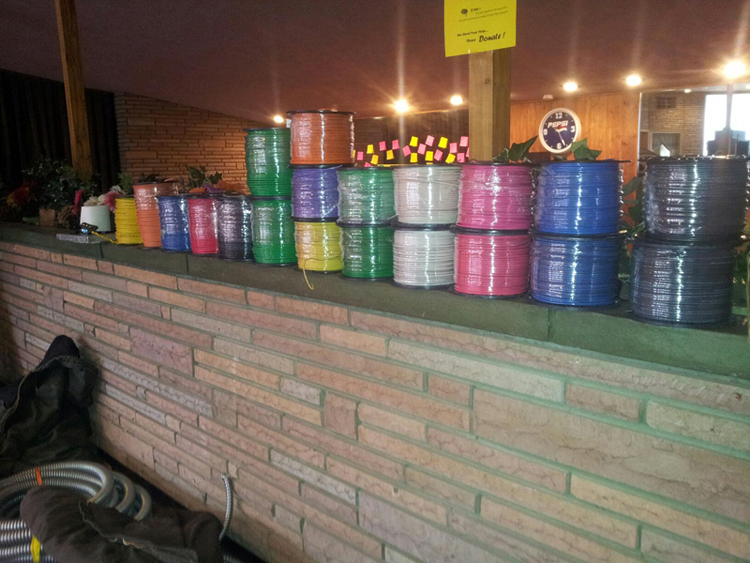
Mark
Posted by Frank Angel (Member # 248) on 04-23-2018, 08:46 PM:
Definitely with you on Class Ds -- someone sold these folks a bunch of Crown XTi2 Series -- the ones that Crown claims sound as good as Class ABs. says so right in their manual, :-) So far I haven't heard them in any real setup because the rooms are being treated and haven't been B chain calibrated yet.
The question about hookup run is because the screening room has a control "Smart Podium" at the front of the room which controls their Barca in the booth. So they have these 7 Crown amps and they want to put them in the podium. This will require them running an additional set of cables from the podium back to the booth for no good reason really, except to have manual control of the amps at the podium. Why, I asked would that even be necessary, once the room is calibrated, as long as the "processor" (a Marantz receiver is in the podium to make minor adjustments, no one should be playing with the amps, ESPECIALLY professors. Plus,building them into the podium will mean a concentration of heat in a small space.
But it's hard convincing the client once someone has read on the internet that if you wrap speaker wires in magazine paper (must be the clay coated type at that), it will do wonders for the sound. Me thinks acousticlly treating the hard plaster walls and ceiling in this all-parallel-walled room might have a bit more affect on the quality of the sound than wrapping the wires wth paper (no doubt the fire code will require sprinklers for that, ya no?). ![[evil]](graemlins/evil.gif)
Posted by Steve Guttag (Member # 268) on 04-24-2018, 08:15 AM:
First, there are some electrical facts to this:
Shorter speaker runs means lower resistance, which improves damping (or doesn't reduce damping is more accurate). That said, the driving determination of actual damping is the voice ccoil of the driver itself, the speaker wire is relatively insignificant compared to that unless you run REALLY small stuff.
Long analog lines tend to beget ground loop issues since keeping the same ground potential at varying distances can prove challenging.
So, with conventional amplifiers, I prefer them in the booth and deal with the longer, larger, more expensive speaker runs.
Now with various DSP systems (RANE's former HAL system, QSC's DCP200 or DCP300) where the audio signal can be delivered behind the screen digitally such that the analog amplifier can be delivered a clean hum-free signal, there are cases were I prefer that method and it makes for a cleaner, lower-cost installation that has all benefits and little-to-no downsides.
As for Class D, I'm experimenting with it now. QSC has their DPA series that is Class D and despite Mark's claims, has MORE RESERVE power than a DCA amplifier. They typically run with 155V power rails and can gain share between the channels (The LF section of a stage speaker is bound to need more power than the HF section). I'm building a set of speakers and plan to do some critical listening to the quality difference between the DCA and DPA-Q series of amps. Sure QSC says their Class-D is good but there is ample opportunity to mess up the sound with the whole PWM conversion of the audio.
With a platform like QSYS, DPA-Q amps make a lot of sense (it is like they were designed with each other in mind!) And with that, putting amps behind the screen right at the speaker also makes a lot of sense. Shorter, cheaper speaker runs and just CAT6 between the CORE and Amplifier with the ability to have dual redundant QLAN connections for reliability. With a minimal mount of amplifiers, you can run your stage channels sans any passive crossovers. Personally, I think QSC could take the next step and just put the appropriate amplifier IN the speaker and just have QLAN ports (and analog in for non QSYS) on the outside and a power connector. You'd always have the right amount of power and it would be a fast installation that is essentially already tuned.
However for surrounds, you are still going to have long speaker runs but I don't put surrounds in the same critical listening category as stage channels.
I'm done using THHN for speaker wire. It has to be twisted to prevent inductive crosstalk and there is no good way to twist it in the field. Most use a drill and that is just flat out wrong, I don't care how many times you've done it. It stresses the copper strands as it adds a rotation to the individual conductor for every twist put on the cable. I've found West Penn's 2522xB series to be pretty cost effective and Plenum rated (available non-plenum by omitting the first "25" and the "B" at the end). it isn't esoteric but it gets the job done at a fair price.
Posted by Carsten Kurz (Member # 5396) on 04-24-2018, 08:26 AM:
I guess it also depends a lot on passive vs. active. The long speaker runs are no big issue with passive crossovers, but once you go active EQ, I would immediately place at least the screen system crossovers and amps behind the screen. And yes, it is easier, even cheaper, to transport balanced line level analog or digital audio to that location than multiple runs of speaker cable.
What is your general experience concerning the choice between 'general use' amplifiers vs. dedicated system/networked/smart amps?
I understand the general benefits of using networked/monitored amps, but are they reliable enough to not come across replacement issues once they fail? They are also usually a lot more expensive than general use PA amps, so, it hurts smaller operators to keep replacements on site.
- Carsten
Posted by Tony Bandiera Jr (Member # 2365) on 04-24-2018, 09:59 AM:
I went through this exact discussion nearly 30 years ago, and had a few locations in my service "kit" with amps located behind the screen.
I can tell you that putting the amps behind the screen in ANY location EXCEPT private screening rooms is a very bad idea for a number of reasons:
- As Mark pointed out, fire codes often require a sprinklered space;
- The area behind a screen is far too often crammed with junk storage, blocking access and creating a fire hazard;
- The area behind a screen is extremely filthy, with dirt, dust, popcorn and other food residue often building up;
- Unauthorized persons can easily tamper with settings or just steal the equipment;
- The projectionist has NO IDEA if the amps are on, working or going up in smoke unless they constantly go into each auditorium every show;
- Connecting the amp outputs to a booth monitor requires runs of wire all the way back to the booth anyways (and using a single multi-conductor cable to do this often results in crosstalk or RF pickup.) ;
- It would be impossible for the projectionist to repatch a failed amp "on the fly" without totally disrupting the show by going behind the screen with a flashlight and tools, whereas in the booth it can be done with minimal disruption to the show.
In real life, the drawbacks I mentioned above, IMHO, make it one of the dumbest things to do in cinema design. Even UC Irvine's screening room (see the pics in the warehouse) suffers from the junk storage, dust build up, no way to readily spot an amp that has failed, and no output monitoring issues.
As for having powered speakers behind the screen, that would be even worse, as now a failed built - in amp cannot be repatched during a show or intermission, and good luck getting that module out with the speakers on skinny stands up in the air with only inches of clearance to the rear wall. (Plus having powered speakers behind the screen WILL in most places make sprinklers mandatory, yet another added cost.) And speaking of added costs, now you'll have to have an electrician wire in power, receptacles and extra circuit breakers to EACH speaker location, which will cost a LOT more than a single large conduit that the system installer simply pulls wire through later.
Historical installations have proven why having a true projection booth, with ALL equipment (including lighting control) located in that booth, has proven to be the most efficient, cost effective and more importantly, SAFE way to construct a cinema or screening room. Just because the industry has gone digital is no reason to change that. (And don't even get me started on how retarded this whole "Boothless" concept for digital is... I don't care what anyone tries to claim, the costs and ongoing maintenance of projector lifts and "hush houses" and the more complicated cooling setup does NOT SAVE MONEY in the the long term. It is cheaper during construction to provide a simple open plan booth space.)
To address Frank's installation:
1: Crown amps suck ass. They are overpriced, unreliable, bad sounding pieces of shit. You would be better off to sell them off and buy some used QSC DCAs.
2: Never, and I mean NEVER install any critical equipment in a podium used by professors and/or students. Most professors can't figure out how to use a smartphone, much less operate an A/V system. They need simple controls for source selection, (and play, pause, stop, etc.), volume and room lighting and NOTHING ELSE. Giving them any other equipment to get into is begging for serious trouble. Install a mixer/source switcher in the booth or whatever A/V space, set up the levels during install and lock the equipment up. My 12 years at UCI proved this over and over again.
3: Putting the marantz receiver in the podium is a disaster waiting to happen, and it will happen soon. How are you going to prevent someone from boosting the bass or treble all the way up, not to mention the volume? (Kiss your speakers goodbye.) How about keeping them from playing with any DSP effects? Cranking up the radio because they are bored? NO ONE NEEDS TO BE DOING "minor adjustments" to the system, through the receiver. A properly set up system would only require the users to use the master volume control provided for them.
Candidly, I must say to Frank, if YOU cannot take over the design of this install and get things done right, keeping all the equipment isolated from users, then you need to either walk from the job or be ready for YEARS of constant service calls and complaints. (And carry hefty liability insurance.) Again, I tell you this from my 12 years at UCI and setting up two screening rooms there.
Posted by Scott Norwood (Member # 30) on 04-24-2018, 12:04 PM:
Having worked in a number of multi-use facilities as described here, I agree 1000% with everything that Tony has said.
Really, the best option is to have a "good enough" system for professors to use (including a separate video projector) and a "professional" system to be operated only by knowledgeable people (which could include responsible, trained students).
And, if you do this, be sure to power the D-cinema projector up from time to time. At least with the Christies, the crypto board will fail if the unit is powered off (or even left in standby mode) for six months or more.
I can't really speak to the new-technology stuff that Steve discussed above, but, as an operator, I like having the ability to monitor sound off of the amplifier outputs, and I do worry about dust accumulation behind the screen.
Posted by Carsten Kurz (Member # 5396) on 04-24-2018, 01:26 PM:
Frank - is this a 'cinema' or a screening room for educational purposes, presentations, and the occasional film showing? If the latter, just skip the idea of putting amps near the speakers and forget what I said. Having ultimately short speaker cable runs makes only sense for large auditoriums with very powerful speakers where you want to achieve the best possible frequency response and dynamics, and where the cost of high-gauge speaker wires makes you shake.
I don't think that applies to the scenario you are talking about. d'accord to the other opinions regarding podium controls. Don't expose an AV receiver to the general public. It's hopeless. Look at a CP750 processor. That one is built to be operated by trained booth staff. Even that one only offers input and level control on the front...
- Carsten
Posted by Steve Guttag (Member # 268) on 04-25-2018, 08:28 AM:
quote: Tony Bandiera Jr
I can tell you that putting the amps behind the screen in ANY location EXCEPT private screening rooms is a very bad idea for a number of reasons:
As Mark pointed out, fire codes often require a sprinklered space
In this area, you already need sprinklers in that space, so amps behind the screen or not, it is a non-issue, cost wise.
quote: Tony Bandiera Jr
The area behind a screen is far too often crammed with junk storage, blocking access and creating a fire hazard
It depends where you locate the amps or the mini rack as to the difficulty to get to it. If you have a speaker loft, it would be no more complicated than getting to the speakers themselves.
quote: Tony Bandiera Jr
The area behind a screen is extremely filthy, with dirt, dust, popcorn and other food residue often building up;
Unauthorized persons can easily tamper with settings or just steal the equipment
Well yeah, I guess if you just throw the amps on the floor that they will get filthy with food stuffs on them and kids will steal the blinkly light boxes. But gee what about, I don't know, just securing them? Put them in a rack, wall mount if desired or even up at the speaker level? For a typical 5.1/7.1 theatre, we are only talking about 4U of rack space or 6U if you'd like a spare Center amp.
Given that HVAC is typically above the ceiling anyway, it wouldn't be rocket science to drop a small supply/return just to the rack but really a decent filter would be all that is needed. They aren't moving that much air, with a sufficient sized filter, your change would be what? Every year or two?
quote: Tony Bandiera Jr
The projectionist has NO IDEA if the amps are on, working or going up in smoke unless they constantly go into each auditorium every show
Um NO! In fact, in a modern DSP system like QSYS (which, by the way, is one of the conditions I set forth on doing a split system), the projectionist or NOC will know of an amplifier failure BEFORE you would ever know in a traditional system. All of that data is already at whatever user interface you choose including amp presence, temp or any other failure.
quote: Tony Bandiera Jr
Connecting the amp outputs to a booth monitor requires runs of wire all the way back to the booth anyways (and using a single multi-conductor cable to do this often results in crosstalk or RF pickup.)
No (again) you are once again using prior knowledge of traditional analog linear amp systems to a current DSP system. With a System like QSYS (though it can be done with other DSP), you can have "amplifier out" at your booth monitor of any channel of any section of any channel all you want. In fact, you can have it on your phone or monitor it from your house if you desire. All with out the extra runs of cable. That CAT6 cable, information (signal) goes BOTH WAYS.
quote: Tony Bandiera Jr
It would be impossible for the projectionist to repatch a failed amp "on the fly" without totally disrupting the show by going behind the screen with a flashlight and tools, whereas in the booth it can be done with minimal disruption to the show.
Guess what I'm going to say here? Wrong again. In fact, the projectionist (manager, NOC) can repatch every bit as fast in either system. Why? Well, at the press of a button, you can have Center come out of Left/Right (with left and right) or vice-versa (depending on what has failed) or in a 5-screen channel ATMOS, use LC/RC as backups in addition to their role in an ATMOS track. But wait, since we are all DSP here, add a spare amp to the screen rack and always feed "Center" to it, in the even of the main Center amp failure, again press a button and you are on your backup amp with just the addition of a suitably sized relay connected to GPIO. And this isn't theoretical, people already put a spare amp in for center and with DSP, feeding one signal to two sources doesn't cost anything extra and carries no potential for interaction.
quote: Tony Bandiera Jr
In real life, the drawbacks I mentioned above, IMHO, make it one of the dumbest things to do in cinema design.
Open your mind and don't apply a set of rules that were quite valid for traditional system and think that they apply to different systems. The only really valid points you make (and are a concern of mine too) is the dirt level and equipment longevity as a result.
I have been doing split systems for years, with zero incidents. In some situations, it was the only practical method of accomplishing what the space needed (even the speakers are portable and roll out of the way) In the venue, I had about 400A of electrical service to supply the amps (the room was designed for traveling shows and such) but NO conduit paths from the booth to the stage for speaker wires. The original design presumed that the cluster speakers for PA would be used for cinema. The results were so unsatisfactory that they rented cinema sound systems for each performance! Getting a couple of plenum CAT cables was going to be a LOT easier and more efficient than getting speaker wires to go that distance. From the booth they have full audio monitoring of the amps (audio and diagnostics), control over the amps going on/off as well as fault indication. Also, by doing it as a split system, we could wire the speakers as 4-ways and quad amp each speaker.
Another site, the amps are in the organ loft and not in any danger of jujubees and again, significantly lowered the cost of the retro fit since electricity (sufficient for the needs) was available but connectivity to the booth was very limited.
quote: Tony Bandiera Jr
As for having powered speakers behind the screen, that would be even worse, as now a failed built - in amp cannot be repatched during a show or intermission
See above about "repatching" in a DSP system. As for getting a different amp onto the Center speaker, you are right, that would be decidedly more difficult. I'm not completely behind the power-speaker idea but I've heard the idea floated. The primary reason it is floated is that it allows a self-contained system whereby the amplifier is appropriately sized and whatever tuning the particular speaker needs is built in. It is "EQed" out of the box. As such, installation is VERY fast because you are merely connecting a small cable and plug them in.
Then again, the amp will probably do well cooling wise and dirt wise living in the speaker rather than completely in the elements. The self powered speakers I've used (studio monitors) have been rather reliable and amplifier failure just about non-existent.
Again, I think it is a bit of a false economy since a DSP system with the speaker's parameters has the benefits without tying two different failure points together so if either fails, you are completely down.
quote: Tony Bandiera Jr
And speaking of added costs, now you'll have to have an electrician wire in power, receptacles and extra circuit breakers to EACH speaker location
Oh stop, now you are reaching. Getting sufficient AC behind the screen on a new-build would add near zero to the cost. They are running AC anyway. The cost of getting two circuits of AC from the booth to the screen is nowhere near the cost of getting large conduit runs (with just AC, they can run MC cable if not small, easy to bend EMT), with the larger conduit, everything is more expensive and every bend is larger ordeal. One chain found it cheaper to buy all Plenum speaker cable (which typically doubles cost) then pay for the dedicated speaker conduit run.
What I suggest is open your mind to some changes in technology that negate some of the negative effects you've experienced in the past (as I have experienced them too). I've never had a split system, all analog where, noise didn't find its way in but not so with DSP/Digital systems.
I'm not saying you have to do it, but it is a viable alternative now where it was a poor choice in the past because the negatives out-weighed the positives. I think the balance has shifted now where the benefits are there with minimal negatives.
Posted by Tony Bandiera Jr (Member # 2365) on 04-25-2018, 10:00 AM:
Steve, IF we were discussing a setup as you described using all the latest technologies you pointed out, I would be in full agreement with most everything you said (except the increased cost of electrical power vs. single large conduit.) I have been an electrician longer than I have been a cinema tech, and have been involved in the bidding processes of all kinds of jobs..and sorry, you are wrong. The costs of individual runs of smaller conduits (or MC cable) WILL always be greater than one larger conduit capable of holding the same amount of wire. (By how much though does vary depending on the individual job and construction.) It is the material, and to a somewhat lesser extent, the labor that adds up fast in that case. (And in a large room, I would always have each powered speaker on it's own circuit, especially with the dynamics of today's soundtracks.)
But we are NOT talking about a full cinema, with a budget to accommodate the latest technologies. We are talking about a public facility where multiple users and operators are involved, and seeing as they are talking about (used?) Crown amps and a marantz receiver, a facility with no idea what they are doing (not talking about you Frank) and evidently no budget.
As for this: quote: Steve Guttag
Given that HVAC is typically above the ceiling anyway, it wouldn't be rocket science to drop a small supply/return just to the rack but really a decent filter would be all that is needed. They aren't moving that much air, with a sufficient sized filter, your change would be what? Every year or two?
IF that is designed into a new build, sure it is easy and cost effective. Try pricing it out as an add-on, or worse, a change order/refit and now it isn't such a small deal. The HIB100 screening room had NO A/C in the back room where the amp rack is...and to this day it still doesn't. It was deemed too costly to add a 6 foot run off of the duct above the stage. (Plus, as all my HVAC contractors have pointed out, changing an existing system requires new air flow calcs and often changes in dampers, settings and in extreme cases, upgraded air handlers.) Oh, and despite HIB 100 being a relatively clean space, clearing dust from the amps was a quarterly requirement.
Back to the original discussion, and Frank can fill in any errors or omissions in what I am about to say... they are most likely not doing a QSYS or other DSP tech system, they will not be on a NOC to keep an eye on the system, they will not have a full time qualified operator on-hand to address any issues, they certainly will have to call in Frank or another tech as needed to address any problems, the facility owners have no idea what they actually need, and have no realistic budget.
So as far as this particular situation is concerned, (and as applied to non-DSP tech installs) I stand by each and every one of my original points. ![[Wink]](wink.gif)
Posted by Scott Norwood (Member # 30) on 04-25-2018, 12:20 PM:
So, what kind of venues are getting Q-sys installations now? It sounds like a good product. The places that I deal with either have older cinema style sound systems or systems that are intended for live sound (with associated DSP boxes) for which cinema is an afterthought.
Posted by Frank Angel (Member # 248) on 04-25-2018, 01:09 PM:
You guys always give a lively discussion. To answer some points, I am on loan to a film department at the college and just for a short time; they have two 140 seat screening rooms -- SQUARE with bare, plaster walls and a cement floor and hard tiled ceiling. You could clap your hands and then relax and have a cup of coffee while the slap-back echo finally fades. Where they put the Crown amps is the least of their problems.
In one of the rooms the amps are already installed in what they call a "smart" podium -- control panel for a Crestron system simply controls the source selection and source functions for the BluRay, Mac, LaserDisc and even a VHS player. This podium has a Marantz receiver as the processor.
I am not making any decisions here, just making suggestions for them. And yes, professions and non-tech people will be the ones using these podiums which in one room already has the 7 Crown amps installed in that podium; in the other room they have already purchased 7 Crowns which sit waiting to be installed the same way -- in the podium, which is why I started this thread. My instinct was to suggest NOT to do what they have already done in the other screening room, and for exactly the same reason that Tony and Scott immediately jumped on -- you DON'T want anyone messing around with anything except audio level. Having all those blinking lights and control right there where their sticky fingers can muck with them is a huge red flag because it that's just too much of an irresistible temptation to those who think they know what they are doing. And what's worse, there already is a culture of casual FUTZING. I was told they select on of the many MANY DSP presets to make the movie sound better...they are all very different. There are presets that take sources that are 2 channel or even mono and "spreads" the sound out to every one of the 7 speakers with varying amounts of reveb and time delay and phasing crap, and usually with emphasis on the side and rear channels...seems everyone wants to hear stuff coming out of their surrounds no matter what the original mix might be. So even worse than end-users being able to muck with the amps, they can muck with the receivers, which, as Tony and Scott suggest, is a disaster waiting to happen. Imagine someone seeing the word "Cinema Surround" on the fancy LED display panel and thinking, "Oh yah, THAT'S what I want it to sound like," and then cranking up the "spread" control, taking it out of Direct and Original Source, i.e., no processing, and coming up with this reverb crap coming out of every speaker in the room.
They do have a person on site all the time and she is good, but her role and expertise is in network servers and video editing. I don't thing she appreciates that once the B-chain is calibrated, everything but the volume control should be dipped in carbonite like Hans Solo. The college has an IT dept that installs and maintains the smart podiums, but they are the ones set up one room with the center channel speaker just sitting there not connected to anything and with the center channel routed to the rear surrounds. Complaints came in that they couldn't understand dialog (duh!). The other night I saw what one professor's fix was; he turned on the closed captioning so they could READ the dialog! Actually a pretty clever solution, and from a professor, no less (I jest).
I am on the cusp of retiring so they won't be calling me. Any calls will be that someone wants to run 35mm in the PACs big 2500 seat theatre.
At least I was able to get them to agree to treating the walls, which, when that gets done, will be a contribution that will be more important than anything else I can do for them. After the wall treatment, I'll calibrate and voice the room and then what happens with professors playing with all that digital surround nonsense the receivers offer will be up to them. I don't think whether or not I convince them to keep the amps in the booth or in the podium will really change the way the rooms are going to be operated.
BTW, these are the screening rooms in which the seats (hard plastic, no cushioning) are designed for a flat floor but are anchored to the rooms'slope floors so they are pitched forward. Sit in them for an hour and you get back cramps because you are constantly using your leg muscles to keep you from sliding forward. It's almost funny...unless you are a student needing to sit in them for an hour class watching movie on a screen that, btw, has a visible seam about two feet from the bottom, i.e., a permanent solid line in the image. It is what it is.
Posted by Mike Blakesley (Member # 26) on 04-25-2018, 08:34 PM:
They should put a small shim under the seat legs to fix the floor-slant problem.
Posted by Kenneth Wuepper (Member # 1174) on 04-26-2018, 06:38 AM:
Our civic theatre has the slanted floor and properly mounted chairs but the slanting floor remains. Therefore when seated for a long time with your toes lower than your heel, it is very difficult to stand up without falling forward against the back of the chair in the next row.
They also have the steps in the aisles so you have the trip and fall in all of the aisles. Handicapped seating is only in the very back of the auditorium.
Our 1927 theatre has sloping aisles and the chairs are on leveled steps so it is barrier free and has level floor under the chairs and for your feet. Handicapped patrons can be accommodated in front row, middle section and rear of the main floor.
Posted by Steve Guttag (Member # 268) on 04-26-2018, 10:50 AM:
quote: Tony Bandiera Jr
The costs of individual runs of smaller conduits (or MC cable) WILL always be greater than one larger conduit capable of holding the same amount of wire
We are entitled to our experiences, I guess. I've never had a quote come in larger for dropping a couple of circuits versus a larger (or couple of semi-large) conduit runs. And on new construction, the circuits generally have zero or near zero cost addition as they are just drawn in as part of the entire electrical spec.
You use of a separate circuit for each speaker is just plain silly. You have 2400VA available per circuit presuming that the amps have no capacitors. Actual current draw on an amp is going to be far less as it stores much of the power it needs and the odds a stage speaker hits the current capacity driving even all three stage speakers is near zero unless you have very inefficient speakers as stage speakers. Subwoofers? That is a different story, yes, I like separate circuits for them, they can and do suck a lot of power for short periods of time.
And you don't need a NOC for monitoring on a semi-current DSP system (any by semi-current, I mean within the last 10-15 years). The whole fault analysis for cinema goes as far back as the DCP amplifiers, at least so we are approaching 20-years.
I suppose we'll have to agree to disagree on methodologies.
Scott as to what types of venues? In the A/V world most any type as it can handle all of the usual A/V needs, including VTC (they even have cameras now for it).
In Cinema, up until now, the vast majority have been Atmos systems. However, QSC just came out with a nifty I/O module the DCIO and THE DCIO-H. They provide what one would need on a typical 5.1/7.1 cinema. It has 16 channels of AES audio in, mic/line in. Monitor Out (both line and amplified), HI/VI out, GPIO and the "H" version has HDMI audio in as well as pass-through out for alternate content (with DTS and Dolby decoding).
Price wise, the DCIO-H is cheaper that most any cinema processor however, once you add in the cost of the core(s) and user interface (typically a 7 inch touchpanel but it could be a phone/pad/PC), you really need to get it up to 4 screens or more for a strict cost benefit. A CORE 510c can handle up to 256 channels in/out so that could be a lot of cinemas. There is a full redundant core mode (completely separate core) so if one tanks, you have not just a spare tire, you have the car. The QLAN network uses normal IT switches (from an approved/tested list) and can have two completely separate networks for again, redundancy and reliability (most all QSYS devices have dual NICs for this too.
Posted by Marcel Birgelen (Member # 6801) on 04-26-2018, 02:04 PM:
I think the "end game" here will be active speakers, especially with the increasing adoption of Multi-dimensional audio, it makes sense. For lights, we've been doing something similar for years already: Splitting power and signalling with e.g. DMX. Obviously, those mostly have been lower bandwidth applications, but bandwidth on all kinds of transmission technology has become cheap over the years.
In essence, every speaker will have both 110/220V power and a "data bus", which will most likely just be Cat5e or Cat6 Ethernet carrying something like to QLAN, Dolby Atmos Connect, CobraNet or equivalent protocol.
Yes, having an amplifier in each speaker does have some practical downsides, like the increased weight and need for extra cooling. Then again, I've seen a shrinkage in average auditorium size in the last few years and an increased density of speakers could also allow for a less power-dense speaker design.
Posted by Carsten Kurz (Member # 5396) on 04-26-2018, 07:12 PM:
At some point I also thought that active speakers with a bus-type power and audio distribution system would become common for object based audio. However, I think it won't happen. Separate amps have options to balance power and achieve higher energy densities, cooling is facilitated even in rack environments. Smart and powered speakers will naturally have higher failure rates than passive speakers, where the speaker itself is the only component that can fail. Replacing on walls and ceilings means more work than in racks.
Ceiling mounting creates higher loads than for passive speakers, quite a problem for retrofits where no one ever thought that a dropped ceiling would need to carry such loads at the time. Every speaker needs it's own power supply (unless you also implement direct DC powering - which again needs much higher supply wire gauges than AC powering). No, I think we will see more specialized amps like Dolbys multichannel amps or QSCs DPA-Q. And large rolls of speaker wire.
- Carsten
Posted by Steve Guttag (Member # 268) on 04-26-2018, 10:44 PM:
Yeah, I think the notion of self-powered speakers as a cost/installation savings is a false one except, maybe (and it is just a maybe for me) for stage and subwoofers. Cooling isn't the issue as the amps are bound to be Class-D at this point so the speaker will provide sufficient cooling. It is the wiring. You now have to have outlets everywhere with power cords going everywhere and, on top of that, signal/network connections going everywhere. You've doubled your wiring and involved another trade (electricians) as well as the circuits to handle all of that.
The surround speaker wires are rarely above 16awg unless you are talking about the front most ones in an Atmos system. For 5.1/7.1 system, 16 gauge is all you are going to need for all but the largest rooms. So the wire isn't too fat.
I suppose wiring could be reduced if the CAT cables daisy-chained, which would seem good...until...one failed and took the entire string out! You'd have to have a relay or like item in each speaker that would crowbar if the power went off in the speaker to ensure that the chain wasn't broken. Or...just run the speaker wire to the nearest amplifier, which for some, is just on the other side of the booth wall, or in the boothless theatre, behind the screen.
BTW, MIT has a behind-the-screen rack that is pretty nifty. Has filters front/rear and the quietest fans I've seen on the top to pump air out (and can be connected to an HVAC system, if desired.
Posted by Marcel Birgelen (Member # 6801) on 04-27-2018, 03:36 AM:
Ethernet actually is a bus protocol, you don't necessarily need a switch to string some devices together, you can even hook quite some of them together using passive splitters.
I agree on the practical issues, at least for now. But I'm pretty sure we're looking at a world where Ethernet in some form will be the primary data interface. The massive economy of scale behind it will more or less even dictate it and you see it also creeping into the cinema industry, with stuff like Atmos Connect and QSC's QSYS/QLAN.
For live events, we're now seeing stuff like NDI making its way in for live HD and 4K video transmission over IP/Ethernet, rapidly replacing SDI. And for lightning, stuff like Art-Net (essentially DMX over UDP) is creeping in too.
Most speakers for live events have been active speakers for a while now, although most of them still expect a balanced analog input rather than a digital one. Heat dissipation almost never seems to be a problem, since you've got a whole room to dump your heat in, in many cases no active cooling is even needed, just some good heatsinks. And for energy efficiency: Instead of more cooling in the booth, you now need to cool the auditorium a bit more.
Although concentrating heat might sound like it makes it more efficient to cool, from the collective experience we gathered with high-density datacenters over the years, we know that this is generally not the case. It's usually more efficient to spread your heat load over a larger volume, because the ΔT will be lower.
As for using Ethernet as the absolute backbone for "all-things-data", we've actually been looking at stuff like GPON, where we can use a "single" string of fiber to hook up all kinds of subscribers, which will then all get an optical isolated assignment. All splitters are purely passive and relatively cheap. For now, the terminals and concentrators are still a bit pricey, but I suspect we'll see a dramatic decrease in cost of this kind of equipment in the coming years. One big advantage: fiber is pretty cheap nowadays, especially compared to heavy bundles of copper wire, it is also not as fragile as some make it out to be.
Posted by Steve Kraus (Member # 476) on 04-27-2018, 08:42 AM:
Why would they install seating for flat floors when they can be ordered for various slopes?
Posted by Carsten Kurz (Member # 5396) on 04-27-2018, 07:25 PM:
For the same reason they want to put amps into the podium and an AV receiver into reach of the general public. They don't know better.
- Carsten
Posted by Mark Gulbrandsen (Member # 72) on 04-27-2018, 08:09 PM:
quote: Steve Guttag
In this area, you already need sprinklers in that space, so amps behind the screen or not, it is a non-issue, cost wise.
Actually many local codes will require EXTRA sprinklers in an enclosed amplifier (electrical) room. I actually ran into this issue at the theater in Wyoming above with all the rolls of wire. As lax as Wyoming electrical codes are they insisted on two sprinkler heads in the amplifier room. Needless to say that room did not get built and the amplifiers landed n a rack in the booth.
Mark
Posted by Sam D. Chavez (Member # 1841) on 04-27-2018, 10:49 PM:
I installed Meyer surrounds in an Atmos house that are powered by a 48 Volt power supply mounted in the booth rack. Meyer spec's Belden 1503, two pairs, one for the DC power and a shielded pair for line level audio. Hard to beat the sound of Meyer speakers, but of course at quite a price.
Posted by Steve Guttag (Member # 268) on 04-28-2018, 09:26 AM:
With Meyer, it isn't the cost of meeting code that drives the cost of the system.
Posted by Tony Bandiera Jr (Member # 2365) on 04-28-2018, 10:02 AM:
Steve Guttag, so which is it? I see a pretty big contradiction in your positions on powered speakers. (Bold emphasis added by me in the quotes)
To me, you responded:
quote: Steve Guttag
I've never had a quote come in larger for dropping a couple of circuits versus a larger (or couple of semi-large) conduit runs. And on new construction, the circuits generally have zero or near zero cost addition as they are just drawn in as part of the entire electrical spec.
You use of a separate circuit for each speaker is just plain silly. You have 2400VA available per circuit presuming that the amps have no capacitors. Actual current draw on an amp is going to be far less as it stores much of the power it needs and the odds a stage speaker hits the current capacity driving even all three stage speakers is near zero unless you have very inefficient speakers as stage speakers. Subwoofers? That is a different story, yes, I like separate circuits for them, they can and do suck a lot of power for short periods of time.
Oh, and BTW I promise you that even in new construction, there is no such thing as "zero or near zero" cost addition, as all the materials and labor still has to be paid for, and in many cases, the EE has to review and approve any changes, which is NEVER free.
And then to Carsten (and/or Marcel) you responded with this:
quote: Steve Guttag
Yeah, I think the notion of self-powered speakers as a cost/installation savings is a false one except, maybe (and it is just a maybe for me) for stage and subwoofers. Cooling isn't the issue as the amps are bound to be Class-D at this point so the speaker will provide sufficient cooling. It is the wiring. You now have to have outlets everywhere with power cords going everywhere and, on top of that, signal/network connections going everywhere. You've doubled your wiring and involved another trade (electricians) as well as the circuits to handle all of that.
Care to explain that? ![[Big Grin]](biggrin.gif)
Posted by Steve Guttag (Member # 268) on 04-28-2018, 10:54 AM:
No problem Tony,
You wanted a separate circuit for EACH SPEAKER, which is silly. I said to drop a couple of circuits for the entire behind the screen sound. There are, at least 3 stage speakers and subwoofer(s) with the subwoofers being the big draw and the others considerably less so.
You can promise whatever you please, I four decades in this and, as I said, we have our own experiences, yours differs from mine. I've had construction companies price out theatres strictly on square-foot for everything included because pricing out every screw, nut, fixture would put costing at more than it would save in materials. Unless you have something that is way out of the norm (and electrical circuits behind the screen, from the booth have not been since masking (and sometimes curtain machines and self-powered subwoofers like the KT90 of the 80s/90s...etc) have been there traditionally, I've never seen an add for having additional circuits back there outside of normal cinema construction. I guess you have, and that is fine.
There is a difference between self-power speakers and merely putting the amplifiers by the speakers. The failure points are different and the installation is different. Putting the amps near the speakers consolidates wiring. All of the power is brought to one place, not 4 places. All of the signal is brought to one place (the amps) not to four places. The speaker wires, that which costs, copper wise, are kept short, especially in 3 and 4-way systems.
I know you want to "catch" me but there is nothing to catch. You are stuck on applying an older design when new equipment MAY make that design no longer be the more cost effective solution (let alone performance).
And then there is the Meyer stuff where indeed, EVERYTHING is self-powered and expensive but everything about a Meyer system is expensive. Then again, they have a reputation of being one of the best sounding systems in the world. There is something to being able to control the sound, including the amplifiers.
Posted by Marcel Birgelen (Member # 6801) on 04-28-2018, 11:08 AM:
quote:
And then to Carsten (and/or Marcel) you responded with this:
Tony, please don't put my name on quotes that aren't mine, even if it's in parenthesis.
I've clearly stated that I see a definitive move forward into a "single digital data transmission system", being Ethernet and most likely also a move towards active speakers in the long run. I also acknowledge the practical implications for now and why those setups aren't yet pretty much common.
I'm not all-seeing, but I'm trying to extrapolate from what we've seen in other, similar markets. And we've already seen something similar happen for "live" setups, where almost all speakers nowadays are some form of active speakers. No matter whether it's a "classical" setup or a line array setup or a mix of both. I've also seen similar things happen in the theme park industry, and although the applications are somewhat different, there is also considerable overlap between those and the cinema industry.
I don't see a move where we're starting to put amplifiers near speakers. Besides for stage speakers in some configurations, this is just backwards in my opinion.
Posted by Harold Hallikainen (Member # 5405) on 04-28-2018, 12:59 PM:
The Meyer speakers that run on 48 VDC over twisted pair is interesting. That's a bit like PoE which can run 48 VDC on up to four pairs (generally "phantom power" method with power pulled off the center tap of the Ethernet transformers). Anyway, PoE is currently limited to 71W. Is that sufficient to drive these speakers? I guess that very efficient surround speakers could do this, but with object-based sound, you may have quite a bit of power coming from surrounds.
Harold
Posted by Sam D. Chavez (Member # 1841) on 04-28-2018, 01:39 PM:
Just in case there's any confusion, it's a 4 wire cable and the power and audio are on different conductors. The DC needs to be quite filtered or you'll induce hum on to the audio over the run.
The 48 Volts come from a rack mounted unit that serves several channels.
Posted by Tony Bandiera Jr (Member # 2365) on 04-28-2018, 05:42 PM:
Marcel: My apologies, no calling you out was intended, but it was not clear to whom Steve was replying to. (And I was quoting Steve, not you or Carsten.)
Steve, Not trying to "catch" you at anything, just pointing out the contradictions in your posts on essentially the same topic. We will have to agree to disagree on the cost issue, as our locations are different and as such introduce variables that we would not have in common. (For example, as Mark pointed out, codes here and back in Cali. would mandate more sprinklers than normally required for a "basic" behind the screen, if any powered speakers or an amp rack is installed.)
As for the separate circuits, IMHO the modest cost increase of the (what would be, based on your criteria) 2-3 extra circuits is minimal, and would ensure reliability and prevent a near-total loss of sound behind the screen if an amp develops a hard fault (which has happened.)
Call it silly if you want, but even in a conventional, old-school install with the amps racked in the booth, there had been several times a bad amp tripped the single breaker powering the whole rack of amplifiers (or in the rare times they put two circuits in, the design had all the stage speakers on one breaker, and the subs and surrounds on the other), which resulted in a near total loss of sound and a mad scramble to figure out which amp was the troublemaker.
I worked for the old RCA Service Company and other companies in Southern California for the first part of my career, and had over 150 locations and close to a thousand screens in my "kit" as it was called. As well as installing around 100 private screening rooms. So I speak based on real world, long term experience as a cinema tech AND licensed electrician.
BTW, I am NOT stuck on applying an older design at all. Again, this thread was and is about the specific situation that Frank asked about.
I am all for the newer tech being applied and used, and yes our experiences differ (I have three decades in the biz myself) and of course our local codes, labor costs, etc. will also differ.
But it all boils down to this: in a given space, what is the best system for the budget at hand, and therefore what equipment and technologies are going to work and meet both criteria? If old school fits the budget and room, that's what should go in. If the budget and room warrant it, I am all for going all-in on QSYS, powered speakers, ATMOS and whatever else the client wants and is willing to pay for. And that's one thing I hope we do agree upon.
Powered by Infopop Corporation
UBB.classicTM
6.3.1.2