This is topic 35mm Rear Projection in 2018 in forum Film Handlers' Forum at Film-Tech Forum ARCHIVE.
To visit this topic, use this URL:
https://ft-forum.com/ft/cgi-bin/ubb/ultimatebb.cgi?ubb=get_topic;f=1;t=012303
Posted by Sam Cuthbert (Member # 4857) on 04-30-2018, 05:16 AM:
Hi friends,
I'm working with a film festival that builds a temporary 16mm/35mm/HD digi cinema in a hotel ballroom every year. It's a bit of a labour of love (no money) type affair and the audience really enjoys having the 35mm machine in the room with them. This year we upgraded our 35mm setup to a Ernemann 15 on a long play base, what a lovely machine.
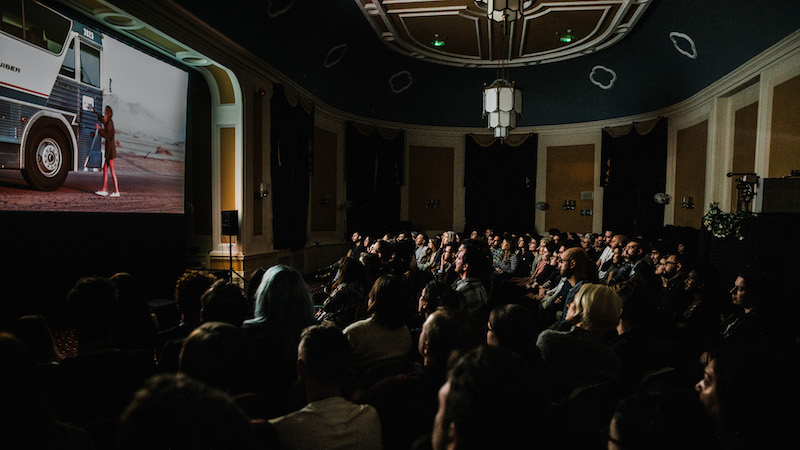
We'd like to increase our audience capacity and doing so would mean orienting the room 90 degrees to use the length rather than the width of the ballroom. Only trouble is we have two giant (quite low hanging) chandeliers in the room (installed in 1890) that we aren't going to ever move. The audience sits on a flat floor without a rake, so far this has worked well enough as the screen has been raised up much higher than the backs of folks heads (as well the projector too).
Current screen is 16ft x 9ft front projection only, we're looking at staying similar sized or upgrading to 25ft x 15ft - (seems tricky to find native 1:85/Scope screens for hire these days)
So in 2018 is anyone running 35mm rear projection? What considerations does one need to take into account when planning for such a thing? How short could you get short throw lenses? Did rear projection setups ever use fish eye lenses? Where would the 45 degree mirror get mounted, onto the machine or separately?
We know we might take a hit on light levels and sharpness but we're curious to explore the option!
Cheers for any and all thoughts.
Photo of the room below (this was digi screening)
Posted by Richard Fowler (Member # 893) on 04-30-2018, 07:00 AM:
We have done 30 foot images with Barco DCI compliant projector which the image flipped for rear projection without the need for a mirror. For stage shows 40 foot image with a Christie with medium throw lenses to minimize hot spotting of the image. 35mm we have used an optical grade mylar mirror on a stand to capture and reverse the image. Separate units allow more room for adjustment. The rear projection surface from Pro AV rental companies will be light grey so color and image gain will be different versus a matte screen. Above the head viewing plus audience layout will also look different.
Work up some scale shop drawings of your site to help you plan your hardware set up.....cheaper on paper than playing on site.
Posted by Scott Norwood (Member # 30) on 04-30-2018, 10:46 PM:
The Brattle Theatre in Cambridge, MA. has done rear projection since the 1950s. The projectors face each other and there are 45-degree mirrors mounted between them. I don't know what focal length lenses they use, but they are fairly short. Masking is done with curtains on the audience side of the screen, and the operator needs to be aware of the setting in order to frame subtitles properly (the entire frame is visible from the booth).
They have loudspeakers mounted above and to the left and right of the screen. Picture quality is what you would expect (a bit hot-spotty, although it improved when they upgraded the screen a while back).
This is not the sort of thing that would would do by design--it is the result of necessity, not desirability.
Posted by Jonathan Wood (Member # 4614) on 05-01-2018, 09:09 AM:
Hi Sam,
It’s very difficult to tell fro the picture, but I would have thought you would need quite a lot of space behind the screen to make it work unless you use a very wide angle lens?
To fill your existing screen with the same lenses you will still need the same throw - but the throw will be comprised of the distance from the lens to the mirror and then after a 90degree turn from the mirror to the screen. I don’t know if there’s anything much wider than a 25mm lens you could use ? There are special semi fish eyes that were used in special sets ups but I think these would create unacceptable distortion with regular films ?
Also you relegate the projector to behind the screen which would be a shame as you say people have commented on how nice it is to have the machine in the ‘auditorium ‘ Also if you use very wide lenses you will need a very big mirror ! Is there no way you can lower the screen to avoid those lights ? I think you will probaboly end up with a set up where the rear projection screen is set quite a distance from the rear wall which might not buy you more space. There’s someone I could put you in touch with , who doesn’t live far from you, he might be able to help. PM me if you would like his details . Good luck!
Posted by Carsten Kurz (Member # 5396) on 05-01-2018, 05:51 PM:
Are you sure there is no way to lift the chandeliers (or at least one of them) up? The picture is not clear there, but it looks as if that was possible. Also, if you use the length of the room, you may get more people in front of the screen, but without raking, it may be very unsatisfying for those in the back third.
- Carsten
Posted by Peter Hall (Member # 695) on 05-03-2018, 10:50 PM:
How big is the screen? Odeon Barnet was rear proj in 2 and 3 - bloody awful although Safari Croydon was the worst as the mirror was massive and near the screen. All is possible and it can work well - no stereo behind the screen, but if over 3m in any direction the screen seams will be a pain. Good mirrors and on a screen under 30' you wont lose any visible resolution - we have Digitals running on 40' with no issues. But WHY if the audience like to see the Ernemann ? Sorry but cant agree on the Ernemann 15- was this Ch4, the Tate or Barbican ? Does it have the Ernemann bounce ? Hate belts, REALLY hate the Radio-shack electrics, didnt mind the lamphouse (same ignotir and mirror as Kinoton) but how many terminals and relays to run a motor or two and a changeover shutter...
Posted by Louis Bornwasser (Member # 3063) on 05-05-2018, 11:58 AM:
I have used a 45 degree solution: shoot corner to corner. Sometimes obstacles move out of the light cone by an inch or so. The University of Louisville's screening room was designed that way because of pipes in the walls that could not be moved.
Powered by Infopop Corporation
UBB.classicTM
6.3.1.2