This is topic 2001 A.S.O. - DTS discs compatible between 35 and 70mm? in forum Film Handlers' Forum at Film-Tech Forum ARCHIVE.
To visit this topic, use this URL:
https://ft-forum.com/ft/cgi-bin/ubb/ultimatebb.cgi?ubb=get_topic;f=1;t=012318
Posted by Sascha F. Roll (Member # 9043) on 06-14-2018, 08:15 PM:
Because we‘re going to screen 2001 in 35mm (as well as DCP) next month I have the following question(s).
We definitely want the 5 channel front plus Surround (Original ToddAO mix).
Does anyone know for sure:
Is it possible to use the DTS discs shipped with the 70mm prints (5.1 remix and Classic 6 Channel ToddAO) for playback with the 35mm reissue print of 2001?
Reason for my question is that I heard that the SDDS tracks on those prints are somewhat misprinted - if those were okay we could just play the 8 channel SDDS.
But I would feel a lot better if we could run it with the DTS discs that are around for the „old“ new (2001 and later) 2001 prints.
Input would be highly appreciated!
PS: I‘ve also posted this an old thread in another Subforum that is not displayed in the list of „recent threads / posts“ so please forgive me that I reposted this in a new thread. If any moderator feels that this topic should be discussed in an existing thread please feel free to move my post there...
Posted by Steve Guttag (Member # 268) on 06-14-2018, 09:18 PM:
What determines it is the movie number. In the DTS code is the movie number and that has to match the discs. So if the 35 and 70mm versions use the same number, then yes, they should work.
Typically, the answer is yes.
Posted by Mitchell Dvoskin (Member # 751) on 06-16-2018, 03:24 PM:
Uninformed question. Did 2001 or any other single panel 70mm Cinerama films actually use the Todd-AO sound configuration, or was it the old Cinerama sound configuration, or just the regular 70mm 6 track configuration? The IMDB is not a reliable source for questions such as this.
Posted by Steve Guttag (Member # 268) on 06-16-2018, 08:57 PM:
5-screen, 1 surround is the only configuration for 2001 or other "Todd Ao" films (e.g. Logan's Run") during initial releases. There was a version of 2001 that had a bastard 5.1 mix in 70mm but it wasn't format 43, they laid it down like a dubber on 6-track so LC/RC were Ls/Rs and S was Sub...very dangerous thing to do because you will blow your surrounds up with that print. I have no idea if any survive.
Posted by Bobby Henderson (Member # 840) on 06-17-2018, 01:04 AM:
Blowing up surrounds. That reminds me of when our Carmike 8 theater (now closed) here in Lawton finally started getting DTS discs with movie prints. The system wasn't installed correctly; the surround channels were somehow getting sub-bass audio. The speaker drivers were hammering forward hard enough on the speaker grilles to create a "brrappp!" sound effect on loud parts of a movie audio mix. Braveheart was the first movie there to show off the problem. The movie Seven just made it seem like the sound system was going to destroy itself, or at least all the surround speakers. I was raising hell about it as a concerned movie fan, but I don't think I was the only one sounding alarms. Carmike finally sent a tech to correct all the stupid problems that were created when the place first opened late in 1994. After the "re-tune" job the two THX houses sounded great.
Posted by David Kornfeld (Member # 9964) on 06-17-2018, 09:05 PM:
Actually, I believe there was a separate, slightly different mix for the Cinerama theatres. I saw a few prints with a label on them marking them so.
Posted by Jean-Pierre Gutzeit (Member # 7275) on 06-18-2018, 05:30 PM:
There don't exist any "Cinerama" versions of 2001: A SPACE ODYSSEY. Only the normal Todd-AO standard of the 60s.
Posted by Sascha F. Roll (Member # 9043) on 06-18-2018, 11:36 PM:
Update: I received the discs (both 5.1 and SV) and will test it within the next weeks.
Posted by David Kornfeld (Member # 9964) on 06-20-2018, 04:38 PM:
quote: Jean-Pierre Gutzeit
There don't exist any "Cinerama" versions of 2001: A SPACE ODYSSEY. Only the normal Todd-AO standard of the 60s.
Wow! I cant tell you how thrilled I am to be enlightened! You sound so sure, so positive, so definitive: it would never enter my mind to doubt you in the tiniest way, because there couldnt possibly exist any evidence that might contradict you! Oh, wait....
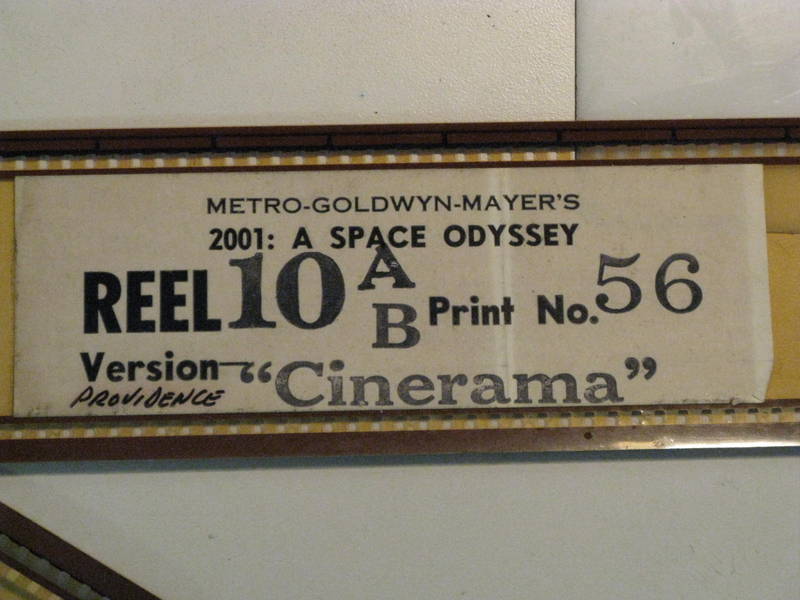
Thats the leader of an original 1968 print.
Heres a piece of well-meant, though unasked-for advice, Herr Gutzeit: tread lightly. Film technical history is a bottomless pit: I dont know it all, all my friends who are super-techs would be the first to admit they dont know it all, & you dont know it all. And even if you know a great deal, there will always be someone who knows more. Always. Thats a given. So, unless you are absolutely lock-tight certain that theres nothing out there that would prove you wrong, qualify your statements. It's safer, it prevents the spread of misinformation, & you dont feel like a dummkopf when someone more knowledgeable corrects you, & that will inevitably happen. It's a big world out there.
Now, I heard from two New York former Cinerama projectionists, working a former Cinerama booth, that there were slight differences in the 2001 mix from the Cinerama version to the general release version, & I heard the same thing from one former Boston Cinerama projectionist, & one other projectionist who heard from a different Cinerama projectionist. I had no reason to doubt their veracity, but because I'm careful & I dont know for certain, I tempered my response by saying "I believe," meaning, it may exist, it may not. I'm not sure. Are you? Are you really, really sure?
Also take into consideration the fact that there are now six different 70mm mixes for 2001 in existence -- not even counting the (at least) two 35 versions, & the VHS/laserdisc/DVD/BluRay versions -- and it doesnt seem too far-fetched to believe that there may possibly have existed a seventh version made exclusively for Cinerama theatres. Some pretty impressive showmanship was going on in those days.
But, as I said, I dont know for certain. So I tread lightly. That way, no one will think ill of me when I do err, & I wont lose anyone's respect by coming across as an arrogant know-it-all while being repeatedly proven incorrect.
And we wouldnt want that to happen, would we, mein Herr?
Posted by Sean Weitzel (Member # 244) on 06-20-2018, 07:29 PM:
I prefer to become enlightened on a particular subject than to be proven wrong should I speak out on something so I tend to not speak out too much. Finding out new things I never knew about (Cinerama mix) just amazes me.
Posted by Steve Guttag (Member # 268) on 06-20-2018, 07:37 PM:
So David...what WERE the differences in this Cinerama mix? What was Cinerama about the mix? Cinerama, something I've never personally shown, was 7-channel yet even your print with the Cinerama label only has the normal composite 6-tracks so one would presume it is a different mix. But how different and where would the differences be?
Having different mixes for different release versions is believable given that even a movie like Star Wars, less than 10 years later also had numerous mixes to it in the first run that were not mere mixdowns.
Did the Cinerama prints get a different "cut" of the movie more so than a different mix? Stanley Kubrick was notorious for re-cutting movies after they premiered. So I could believe the Cinerama prints were the first cut of it.
Posted by Robert Harris (Member # 1712) on 06-25-2018, 05:05 AM:
I’m unaware of a specific Cinerama “cut.” The OCN was re-cut to the version of the film that we now know, very early on, with many deletions, plus additions. That occurred early in April, around the 8th to 11th.
I was told, that aside from all of the various mixes based upon the original, that the film was 4-track, with the exception of the last reel, which was standard 6-track. I presume that original prints were produced from a modified, 6-track print master, but earlier films, such as El Aurens, had been recorded directly from the 4-track.
I’ve personally never seen any optically modified prints, specifically produced for highly curved screens, as had been created for early Todd-AO, although there are stranger things in heaven & earth.
Posted by Michael Coate (Member # 757) on 08-21-2018, 10:11 AM:
quote: David Kornfeld
I believe there was a separate, slightly different mix for the Cinerama theatres. I saw a few prints with a label on them marking them so.
quote: Jean-Pierre Gutzeit
There don't exist any "Cinerama" versions of 2001: A SPACE ODYSSEY. Only the normal Todd-AO standard of the 60s.
quote: David Kornfeld
Heres a piece of well-meant, though unasked-for advice, Herr Gutzeit....
Don't feel bad, Jean-Pierre, you're not the first person Mr. Kornfeld has lashed out at or condescendingly lectured over a tech detail. Kornfeld once served up a thirty(!) paragraph missive directed at me because of a disagreement over an aspect ratio detail. (Infuriatingly, had Kornfeld simply acknowledged the SMPTE projection spec he would've grasped my point.)
Anyway.... Why must the alleged differences in some prints of "2001" be related to the audio? Maybe it is, but... why can't it be pictorial-related? Why can't the "Cinerama" notation on the leader be in reference to the format billing that was tailored for the end credits of each print (and promotional material) based upon the venue to which the print was destined ("Cinerama," "D-150," "Vistarama," unbranded "70mm," no format credit on 35mm prints, etc)?
Or, could it be nothing more than someone's confusion/mistaken recollection about the cuts Kubrick famously made to the film, mistakenly thinking they were made as the film was transitioning out of roadshow and into general release? (The cuts were, in fact, made only a few days after the premiere.)
Posted by Paul Linfesty (Member # 214) on 08-22-2018, 01:43 AM:
How many reels did 2001: a Space Odyssey have? If it had 10 reels (which I suspect it had), and this is reel number 10, then, as Michael Coate suggested, it may refer only to the Cinerama credit. It would have been more telling if any of the other leaders showed Cinerama or not. When I saw a (relatively) recent print of 2001 back in 1991 at the AMC Century 14 (a Sunday morning show only), the entire print had a few scratches, but the color was deeply rich and practically grain free, unlike the prints that followed for the 199902000 re-issue...EXCEPT for the final reel 9only about a couple of minutes of actual image followed by the credits). THAT reel was badly faded to red, and it was the first time I saw the film with an "in 70mm" logo where the Cinerama logo had gone before when I saw it at the Dome in 1977. he quality was quite jarring, and I wonder why it was, unless it was not to be shown with the Cinerama logo. All subsequent 70mm showings of 2001 that I saw at the Cinerama credit.
Posted by Marcel Birgelen (Member # 6801) on 08-22-2018, 02:43 AM:
quote: David Kornfeld
Wow! I cant tell you how thrilled I am to be enlightened! You sound so sure, so positive, so definitive: it would never enter my mind to doubt you in the tiniest way, because there couldnt possibly exist any evidence that might contradict you! Oh, wait....
Why not just go into the discussion without all those very personal insults? It also seems to be very important to stress his most likely German heritage. Accusations like "arrogance" feel very "projective" this way...
quote: Paul Linfesty
How many reels did 2001: a Space Odyssey have? If it had 10 reels (which I suspect it had), and this is reel number 10, then, as Michael Coate suggested, it may refer only to the Cinerama credit.
There is very little evidence for a different Cinerama edit and there are indeed 10 reels. This is the last one. Chances are that it's just the credits that are different.
But given the amount of personal involvement of Stanley Kubrick and that the movie got an essential different "final cut" just a few days after it's initial release, I'd say never say never...
Posted by Monte L Fullmer (Member # 2797) on 08-23-2018, 02:27 PM:
I ran 2001 back in 1970 at a drive-in and yes, 10 reels long and the last reel was almost all credits.
Posted by Martin Brooks (Member # 1269) on 08-24-2018, 06:31 PM:
quote: Robert Harris
I’m unaware of a specific Cinerama “cut.” The OCN was re-cut to the version of the film that we now know, very early on, with many deletions, plus additions. That occurred early in April, around the 8th to 11th.
I was told, that aside from all of the various mixes based upon the original, that the film was 4-track, with the exception of the last reel, which was standard 6-track. I presume that original prints were produced from a modified, 6-track print master, but earlier films, such as El Aurens, had been recorded directly from the 4-track.
I’ve personally never seen any optically modified prints, specifically produced for highly curved screens, as had been created for early Todd-AO, although there are stranger things in heaven & earth.
I always heard the same thing - that it was 4-track except for the last reel (although you may have been the source of that info). I saw it at the Boston Cinerama in the Fall of 1968 and I can't say whether I remember hearing 3 or 5 stage channels, but when I saw it recently in 70mm at the Museum of the Moving Image in Astoria, NY, I could swear I could hear discrete audio out of LC and RC before the last reel, which really surprised me. The other thing I noticed was that the mix was quite different than that of a recent TV broadcast.
Did anyone here project the 70mm and listen or monitor closely enough to know whether there was LC and RC activity before the last reel?
And while there might not have been prints rectified for a curved screen, one memory I do have is the early shot where the bone is thrown in the air and becomes the spaceship. At the Boston Cinerama, I remember the angle of the bone and the angle of the ship to be a perfect match. So perfect that I remember the audience gasping. But I've never seen it that way since and I've always wondered whether this shot was made to work on the curved Cinerama screen and not on a flat screen (whether purposely or accidentally) or whether it's just a false memory and the cut was always imperfect.
Posted by Stephan Shelley (Member # 8587) on 08-24-2018, 08:39 PM:
I can tell you that the current 6.0 mix has a lot of surrounds on all the reels. There are some station announcements on the space station that are on surrounds only and that seems like it would be an original thing. All the music has fill on the surrounds. Hal when speaking on the ship but not the pods comes in part from the surrounds. Air hissing and the breathing on the space wakes comes in part through the surrounds.
Posted by Paul Linfesty (Member # 214) on 08-24-2018, 10:51 PM:
I thought the original 2001 mix was 4 track (L-C-R-S) that was faked up to 6 track for the 70mm prints. I would think that all reels would have contained the fake LC-RC stage channels. I do have a question about this process.
1) Did they take the 4-track print master and run it through a mixer that created LC-RC at the time of sounding each print? Or:
2) Di d they take the 4-track master and make a 6 track master in which the 70mm prints were sounded?
Posted by Steve Guttag (Member # 268) on 08-25-2018, 11:22 AM:
I've run this movie a LOT over the years, in 70mm, at various venues, with various prints.
While it is evident that they started with a 4-track mix, it most definitely had the "spread" mix applied on EVERY print I've run. Any dialog present in LC is present (at a lower level) in Left as well as Center. Likewise for RC. That said, there are scenes when LC or RC are a dominate channel. For instance, on the space-station while Dr. Floyd is in the phone booth. His dialog is very much centered on Left-Center. Even on cut-aways, his dialog stays there. I would suspect that any 4-track prints (35mm) while would likely have the same mix would have a far less convincing effect without the hard channel there. It would be very room and speaker dependent.
HAL plays out of all 6 channels, pretty uniformly. I'm wondering if the track wasn't hand tweaked for that since a basic spread mix would have LC/RC elevated due to the combination of the channels.
Posted by Frank Angel (Member # 248) on 08-30-2018, 09:51 AM:
quote: Martin Brooks
I remember the angle of the bone and the angle of the ship to be a perfect match. So perfect that I remember the audience gasping.
Martin, while I can't say how close the bone and the ship's position on the screen match on the Cinerama vs. flat screen -- I only saw the Cinerama presentation twice in '68, much too long to say definitively if it were a better match in Cinerama -- but no matter, ANY time I have seen it or run it, the audience most definitely reacts. Today it may no longer be a gasp exactly, (pretty much everyone under the sun knows that cut is coming) but at the very least, there is always a noticeable reaction, be it acknowledgement or appreciation, and yes, maybe for the few first timers a gasp, but it is always there.
Posted by Michael Coate (Member # 757) on 08-30-2018, 11:10 PM:
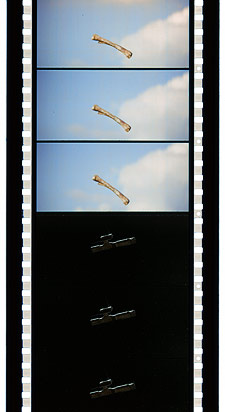
Posted by Martin Brooks (Member # 1269) on 08-31-2018, 12:36 AM:
Well those frames would seem to indicate that my memory was totally incorrect.
Posted by Steve Guttag (Member # 268) on 08-31-2018, 07:24 AM:
FWIW, I've mostly seen the movie on a Cinerama screen (Uptown in DC) and I don't recall it precisely lining up, ever. Then again, I wasn't looking for it. I think it would have made a cool shot even cooler though.
Where did you get the print Michael? That looks like a Metrocolor print yet the colors are good and the last Metrocolors where prior to 1982 so it should be faded by now.
Posted by Michael Coate (Member # 757) on 09-11-2018, 02:08 PM:
quote: Steve Guttag
Where did you get the print Michael?
From a collector friend (so that it could be included as an image in my 50th anniversary article). I don't know the vintage of the print or what, if any, digital tinkering was done.
Posted by Marcel Birgelen (Member # 6801) on 09-11-2018, 04:03 PM:
I've never remembered the flying bone and the spaceship to match-up perfectly. It was an interesting cut, but not half as mind-boggling as the rest of the stuff that's going on. ![[Wink]](wink.gif)
Why would this segment be cut differently on a Cinerama cut than on any other cut?
If it actually would line-up perfectly, wouldn't it be equally impressive, no matter what the presentation format?
Posted by Thomas Hauerslev (Member # 566) on 09-12-2018, 03:07 AM:
Mike's 70mm clip of the bone / space ship is (almost) same as used from Jerome Angels "The Making of Kubrick's 2001".
https://www.amazon.com/Making-Kubricks-2001-Jerome-Agel/dp/0451059018
The only difference I ever saw between 70mm prints of 2OO1, was a print that said "in 70mm", instead of CINERAMA at the credits.
Posted by Steve Kraus (Member # 476) on 09-13-2018, 12:04 AM:
I saw it in Laser LIEMAX recently and they had the "in Cinerama" credit.
Posted by Marcel Birgelen (Member # 6801) on 09-13-2018, 02:17 AM:
I've seen it in 70mm and it also had the Cinerama credit, which made me wonder a bit, but seemingly that was Nolan's source...
I think we can, with a bit of reasonable doubt, conclude that the only difference between the 70mm and the Cinerama "cut" was the last reel and the Cinerama credit. While it technically is a different cut, I doubt that's sufficient to really consider it to be an alternate version.
Posted by Steve Kraus (Member # 476) on 09-13-2018, 06:40 AM:
Did they make prints with "in 70mm" or was that always that physically spliced in?
Posted by Steve Guttag (Member # 268) on 09-13-2018, 08:07 AM:
As I recall, it was "In Super Panavision 70" was what was spliced in versus the "In Cinerama" . I've shown it both ways.
Posted by Rick Raskin (Member # 1561) on 09-13-2018, 01:49 PM:
I showed it with the "in 70mm" credit which was not spliced in (c 1975).
Posted by Jean-Pierre Gutzeit (Member # 7275) on 09-15-2018, 04:20 PM:
To David Kornfeld:
quote: David Kornfeld
Now, I heard from two New York former Cinerama projectionists, working a former Cinerama booth, that there were slight differences in the 2001 mix from the Cinerama version to the general release version, & I heard the same thing from one former Boston Cinerama projectionist, & one other projectionist who heard from a different Cinerama projectionist.
If I follow English correctly, does that mean that first the Cinerama-labeled evaluation took place and then other 70mm evaluations?
My opinion found equal 70mm premieres in all lucrative theaters with Todd-AO cinema projection instead: in D-150- and Vistarama theaters (by Michael Coate rediscovered) in 70mm Cinerama houses, in normal Todd-AO sites. So in all available and sufficiently lucrative houses.
This has led to great confusion right now in the Facebook community in 2018, where I read hundreds of "eyewitness accounts" that referenced the movie "in Cinerama". Those who do not deal with it on a daily basis and know by heart the many graduated offshoots and follow-up systems of the Cinerama process must assume that the eyewitnesses have seen 3-stripe demonstrations. Two of the witnesses emphasized seriously, having seen the film in 3-strip Cinerama (FB: Kubrick Apperciation Socitey).
Highly interesting is your discovery that the sound mix for the Cinerama houses was slightly remixed. And so I ask why this was done? Because of the wide-angle positioning with very wide screens? However, there were many smaller 70mm Cinerama venues (in Germany, there is still a so called Cinerama cinema with the image width of 14 meters and 16.20 meters measured over the curve and 105 degree in the curve) as well as in 1968 about all in the world very large Todd AO houses with almost flat screens that showed these films.
If the witnesses may still remember the reasons for the deviant sound mix, I find that interesting.
In the image geometry, Aspect Ratio and Kadrage I think all 70mm prints are without deviations (exceptly the two different logos in the credits). The film was not printed optically to direct prints on 70mm in 1968 or optically printed to another 70mm version. But that would have been possible, for example in extenso, with Technicolor. And, on special request, the laboratories were always ready to produce different versions: Suppose a millionaire in 1968, a friend of MGM, had ordered a special optical-format version of his 70mm home theater, like OKLAHOMA !, AROUND THE WORLD IN 80 DAYS , ITS A MAD ... WORLD, THE GREATEST STORY EVER TOLD or BEN HUR happened.
Never seen, never heard, unfortunately.
On the home cinema track, with laserdics and first DVDs, there are other deviant sound mixes.
The big problem is more the work of Fotokem since 16 years regarding normal color timed prints.
Posted by Marcel Birgelen (Member # 6801) on 09-17-2018, 01:51 AM:
It would make sense that the films coming back from the Cinerama runs would be "rebagged" as "In Super Panavision 70", at least if they were still in good condition.
quote: Jean-Pierre Gutzeit
Two of the witnesses emphasized seriously, having seen the film in 3-strip Cinerama (FB: Kubrick Apperciation Socitey).
People's memory is pretty flawed, especially over such a big period of time. What I've read is that Kubrick initially considered 3-strip Cinerama, but the process was essentially dead already when he started filming.
quote: Jean-Pierre Gutzeit
Highly interesting is your discovery that the sound mix for the Cinerama houses was slightly remixed. And so I ask why this was done?
There hasn't been any conclusive evidence of a "Cinerama" sound mix.
Posted by Mark Lensenmayer (Member # 134) on 09-17-2018, 02:08 PM:
It would not have made much sense to have 2001 in 3-strip as by then the Cinerama theatres had converted to 70mm. It would have been very difficult to reinstall the 3-strip equipment.
Posted by Steve Guttag (Member # 268) on 09-18-2018, 07:18 AM:
You'd think, the world premier of the movie, in a Cinerama theatre would have been in 3-strip, if it was, in fact, available in that format...but it played in conventional spherical 70mm, on the deep curved Cinerama screen. It is difficult to prove a negative but I've yet to see any evidence of a 3-strip Cinerama print of 2001 and the likelihood is very low. Where did the negative come from? There is enough evidence of how the movie was made to know that it was shot spherical 65mm.
There are no records that I'm aware of a Cinerama 3-lens camera on set. So where would the source material be for a 3-strip presentation? If it were done, it would have to have come from the 65mm original...and then what would be the point? And then good-luck getting the join lines to work with 1960s technology. Take a look at one of the videos on YouTube on how they make smilebox Videos from 3-strip and you'll see what it takes to make that look right...pretty impressive stuff.
Posted by Marcel Birgelen (Member # 6801) on 09-18-2018, 10:20 AM:
I don't know of any such installation, but you could probably come up with a rig, where you optically extract a "three strip" version from a 70mm positive.
I've never seen an account or a picture of a 3-strip camera setup being used on-set, I'm pretty sure the 65mm negatives will be the only negatives.
Posted by Mark Ogden (Member # 43) on 09-18-2018, 04:46 PM:
According to Michael Benson's excellent and exhaustive new book on the making of the film , Kubrick decided to film in "second-version Cinerama" (65mm) on advice from his good friend, cinematographer Robert Gaffney. Also, if you look closely, there are also a number of hand-held shots in the picture which Kubrick photographed himself with a shoulder-mounted Panaflex, one of which is the flying bone shot seen above. This of course would have precluded the three strip Cinerama camera.
Posted by Michael Coate (Member # 757) on 09-18-2018, 05:57 PM:
quote: Mark Ogden
Michael Benson's excellent and exhaustive new book on the making of the film...
Excellent and exhaustive? Perhaps...but did you catch the glaring tech error on Page 421 where Benson states 70mm prints had optical soundtracks?! Or his claim "2001" was nominated for Best Picture?!
Posted by Mark Ogden (Member # 43) on 09-18-2018, 06:12 PM:
Yeah, there's a coupla' howlers in it. He seems to think that three-strip Cinerama was three 70mm prints running together (pg.33). Which would have been really something to see, but . . .
Still a fascinating book, although learning how Kubrick manipulated and ultimately screwed over Arthur C. Clarke forever diminished him in my eyes.
Posted by Martin Brooks (Member # 1269) on 09-19-2018, 09:53 PM:
I saw it at the Boston Cinerama in the Fall of 1968 and it was absolutely 70mm Cinerama. It was also 70mm Cinerama at the Loews Capitol nee Loews Cinerama nee Loews Capitol. If they didn't run 3-strip in New York, I have to believe there was no 3-strip anywhere, but even if there was, so what? It would have been generated from the 70mm, not from a 3-strip Cinerama camera since we know it wasn't shot in 3-strip.
Posted by Mark Ogden (Member # 43) on 09-19-2018, 10:36 PM:
I'm not even sure how it would be possible to optically extract three Cinerama-style prints from a spherical 65mm negative without severely cropping the image vertically. If you wanted to maintain a 1:1 aspect ratio then the Able and Charlie prints would have only half-width images, which would mean, I suppose, special half-width aperture plates?
Perhaps early in the film's run some theatre ran a second version 70mm print on an original hanging-strip style Cinerama screen, and that's how the confusion started.
Posted by Marcel Birgelen (Member # 6801) on 09-20-2018, 01:56 AM:
While Cinerama had an original, maximum aspect ratio of 3:1, the bottom and top was usually cropped quite a bit.
Getting a three-strip Cinerama out of a spherical 65mm negative or 70mm positive, would require some trade-offs, like cropping into the image and accepting some "pillarboxing" at both edges.
It's certainly not an entirely straight-forward process if you had to implement it 100% optical. It would require a custom-built rig and a lot of custom-built optics and therefore most likely was never done.
With a digital intermediate, the process would be almost straight-forward though.
Posted by Allan Young (Member # 6332) on 09-20-2018, 02:10 AM:
quote: Marcel Birgelen
Getting a three-strip Cinerama out of a spherical 65mm negative or 70mm positive, would require some trade-offs, like cropping into the image and accepting some "pillarboxing" at both edges.
It's certainly not an entirely straight-forward process if you had to implement it 100% optical. It would require a custom-built rig and a lot of custom-built optics and therefore most likely was never done.
Three strip extraction from flat 65mm was done for Holiday in Spain. No idea what the aspect ratio was though.
Posted by Marcel Birgelen (Member # 6801) on 09-20-2018, 02:36 AM:
Well, you learn something new every day.
I did some Googling and apparently there were also prints made for the similar Cinemiracle process for "Holiday in Spain".
I didn't find anything regarding the aspect ratio of the Cinerama release, neither what process was used.
Still, how likely is it that this same process was being used for 2001? Around 1968 there might just be a handful Cinerama locations left that could even play 3-strip.
Posted by Allan Young (Member # 6332) on 09-20-2018, 09:50 AM:
quote: Marcel Birgelen
I did some Googling and apparently there were also prints made for the similar Cinemiracle process for "Holiday in Spain".
I seem to recall reading that the prints were all Cinemiracle but they were exhibited in Cinerama theaters too. This was a couple of years after Cinerama had bought out Cinemiracle.
ETA: Come to think of it, how would that work? The outer panels in Cinemiracle were reversed. Could the film have been run through the Cinerama projectors backwards?
quote: Marcel Birgelen
Still, how likely is it that this same process was being used for 2001?
At a guess - "not remotely likely".
Posted by Bill Brandenstein (Member # 7758) on 09-20-2018, 03:17 PM:
Just to further confirm and confuse the issue: there are scenes in "How the West Was Won," particularly on the river raft, that were shot 1-strip 70mm and then separated to 3-strip.
Posted by Paul H. Rayton (Member # 1817) on 09-21-2018, 12:27 AM:
Bill's comment above ^^^ is correct. As is widely known among true Cinerama aficionados, the single-strip (65mm) camera was used for many of the scenes on the river rapids of HTWWW. If you look at the images, and study them, one can observe the shots so made, because the 3 respective horizon lines don't misalign in the same manner that they do in the scenes made with their conventional 3-strip camera.
Also, another tidbit -- a few of the battle scenes in HTWWW, in the Civil War sequence, were actually out-takes (or non-used scenes, not sure which) from the movie "Raintree County", from 1957! Again, these were photographed in the single-strip (65mm) camera process which came to be known as MGM Camera 65.
I confirmed these details with David Strohmaier, who many of you will know as our latter-day "Mr. Cinerama", for he's been responsible for all the restorations to date of these original Cinerama productions.
He added that, as was mentioned by Allan Young above, a few extracted 3-strip prints of "Holiday In Spain" were made from the 65mm negative. That film had a difficult career: it started out as the "Smell-O-Vision" show, "Scent of Mystery" (1960), a Michael Todd production. The Smell-O-Vision process, of course, left a lot of people unhappy with the results, so Mr. Todd renamed the show to "Holiday In Spain", and created a few 3-strip prints to try to make something out of it via "Cinerama" exhibition. Sadly, the prints were, per David, very grainy. And it wasn't much better in that format, either.
There was one other show around that era which flirted with (but ultimately did not use) 3-strip, that one being "The Golden Head" (1964), also known as "Milly Goes to Budapest". Allegedly, the production was originally envisioned for 3-strip, and (according to the rumor) a few scenes were actually photographed that way. But then the production company revised their thinking, and so the entire film was then photographed on 65mm film. No true 3-strip prints were made, though it may show the "Cinerama" logo in the credits. But of course, Cinerama corporation seemed to feel the result on screen was close enough to allow their name to remain identified with the movies thus projected in the single strip (70mm) mode.
By the time of the movie "2001" (1968), actual 3-strip projection of new movies was well and truly finished.
Posted by Allan Young (Member # 6332) on 09-21-2018, 07:22 AM:
quote: Bill Brandenstein
Just to further confirm and confuse the issue: there are scenes in "How the West Was Won," particularly on the river raft, that were shot 1-strip 70mm and then separated to 3-strip.
They used anamorphic Ultra Panavision though, with an aspect ratio much closer to 3-strip Cinerama than Holiday in Spain or 2001.
quote: Paul H. Rayton
There was one other show around that era which flirted with (but ultimately did not use) 3-strip, that one being "The Golden Head" (1964), also known as "Milly Goes to Budapest".
Cleopatra too, according to Wide Screen Movies by Carr and Hayes - "began shooting in Cinemascope, then switched over to the new Super Cinerama, then to Todd-AO. The anamorphic and tripanel scenes were discarded."
(Admittedly not the most reliable of sources, but the statement stands uncorrected in Daniel Sherlock's exahustive list of errors - http://www.film-tech.com/warehouse/tips/WSMC20.pdf.)
Posted by Jim Cassedy (Member # 4115) on 09-21-2018, 09:34 AM:
Link above was
1) Bad
2)THIS ONE (Correctly Formatted & Using the FT "URL" Button ) works.
(sorry if I sound cranky- - but I haven't had my coffee yet)
Posted by Jean-Pierre Gutzeit (Member # 7275) on 09-23-2018, 10:18 AM:
Interesting comments by Paul Raython on the test shots of various films in 3-stripe Cinerama. The GREATEST STORY EVER TOLD also had three-week filming in 3-stripe Cinerama, but I never find a complete listing of all Cinerama test shots.
2001: A SPACE ODYSSEY was to be leased in so calles Cinerama venues only with 70mm prints, which was known during the production, and there are corresponding Cinerama labels on the 65mm Super Panavision's camera blimps. And because of Cinerama Inc.'s dissolving production in the 3-stripe process around about 1962, Ultra Panavision productions were wanted as a large-format system for the Cinerama cinemas, then Super Panavision titles, Todd-AO or Sovscope 70, 35mm blow-up titles which went into 70mm lending, or pure 35mm at last in 1974. Between 1963 and 1967, the new cinemas of Cinerama Inc. were equipped with a more moderate curvature of the screen and opened often with only a single-stripe projection in the last moment (1963: Cinerama Dome, Los Angeles with 120 degree; 1965: Royal Palast Europacenter, Berlin-Germany with 120 degree; 1963: Europa Palast, Essen-Germany and Coliseum London-England with 3-stripe Projection with 146 degree; 1964: conversation of the Gaumont Palace, Paris-France, from 35mm / 70mm to 3-stripe Cinerama).
On page 1, David Kornfeld had taken the research to get a photo of the leaders label of the 70mm premiere version of 2001, which contains the entry "version: Cinerama". On other known to me labels of the 70mm premiere prints this entry is missing. So the entry could have a meaning. Maybe there was a special mix of sound for one or two of the 70mm Cinerama premiere cinemas? Two projectionists of the 70mm premiere in former Cinerama houses confirm a special sound mix for the delivered 70mm print, according to Mr. Kornfeld. Such urgently needed special mixes are very possible and have occurred again and again in other cases (ALIENS in 1987 for example).Varying ndoor equipment? (special Cinerama speakers, Cinerama amplifiers with other curves? Horn speakers with narrower focus?). I never saw a special printer lens for rectified 70mm prints of Super Panavision productions to screen them at the Cinerama curved screen. Such a 70mm theatrical copy would have an image field of about 1.96: 1, with the sides of the image on the copy containing black stripes. From a technical point of view, such a rectified print would have advantages when projecting on deeply curved screens, but the curtain or the lamination of the Cinerama screen would have to be closed slightly.
Posted by Paul H. Rayton (Member # 1817) on 09-24-2018, 12:53 AM:
In the interest of keeping the record correct, I've been reminded that, according to The American Wide Screen Museum, "The Golden Head" completed its cinematography using (mostly) 35mm Technirama AND some 65mm film for certain scenes, but was produced by Cinerama, Inc. so their name may show up. (And soon to be released as a Blu-ray, so I hear)
See the article at this following link. It's full of photos, so I can't readily post the full contents directly here, so let's hope the link continues to work: web page
Posted by Thomas Hauerslev (Member # 566) on 09-24-2018, 01:44 AM:
About Ultra Panavision 70: http://www.in70mm.com/news/2005/ultra_panavision_70/index.htm
All about "to split or not to split": http://www.in70mm.com/newsletter/2000/63/split/index.htm
Cinerama never had an aspect ratio. The screen was described as 146 degrees.
The only reason CINERAMA was associated with "2OO1" was a deal made between MGM and CINERAMA to produce film together (four I think) in 65mm. "2OO1", "Grand Prix" and "Ice Station Zebra". Just like CINERAMA did with other producers of 65mm films like "Mad World" (Ultra Panavision 70), "Khartoum" (Ultra Panavision 70), "Battle of the Bulge" (Ultra Panavision 70), "Krakatoa" (uncredited Todd-AO), "Custer of the West" (35mm Technirama) to present them "in Cinerama". None of them had any 3-strip involved.
All 3-strip cameras were put in storage after "How the West Was Won" was completed. One camera was taken out and repaired and used for "In the Picture" (2012)
Posted by Jean-Pierre Gutzeit (Member # 7275) on 09-24-2018, 06:24 AM:
"Wonderful World of the Brothers Grimm" followed "How the West was won".
Widescreen.org writes on Cinerama and has several opinions:
<>Cinerama example of How The West Was Won
© 1962 MGM
Cinerama
Aspect ratios: 2.59:1 to 2.65:1
Cinerama was the first widescreen format to be introduced after the Academy Ratio became a standard in 1932. It involved projecting images from three synchronized 35mm projectors onto a deeply-arced screen. Although the final result had an optimal aspect ratio of 2.65:1, no anamorphic lenses were used.>
But I couldn't find a standardization of the SMPTE for Cinerama's Aspect Ratio.
#
Mr. Lobban asked at Technicolor Laboratories in London for the existence of rectified 70mm prints,who could replace the D-150 curvulon lens: nothing was found. Such a lens could provide rectified prints for all the other spherical 65mm 5 perf productions,for example 2001.
Posted by Thomas Hauerslev (Member # 566) on 09-24-2018, 06:39 AM:
According to Greg Kimble, the 4-picture MGM/Cinerama deal was: "West", "Grimm", "2OO1" and "Zebra".
http://www.in70mm.com/news/2002/west/index.htm
"Grimm" production began after "West" was started, and finished before "West" was completed. I seem to recall reading, the absolutely final use of 3-strip Cinerama was the overhead shot of the LA free way, at the very end of "West".
Posted by Jean-Pierre Gutzeit (Member # 7275) on 09-24-2018, 08:49 AM:
I could never good distinguish between Cinerama Coproduction and/or Cinerama presentation. (Going better to the bibliotheques now.)
If we see the 70mm trailers and the show case posters of GRAND PRIX we could believe that the Cinerama Inc. had it coproduced.
https://mubi.com/de/lists/cineramaranked
Later I found advertisements "in Cinerama" for THE STORY OF THE FLAMING YEARS or LAWRENCE OF ARABIA, too.
Disturbing - similar to the Imax policy.
Posted by Frank Angel (Member # 248) on 09-24-2018, 09:21 AM:
So the consensus among you guys is that there never were any 3 strip extraction prints of 2001 for presentation in Cinerama theatres that still had 3 strip equipment? Because if that is an indisputable fact, then my mind is playing some very bizarre tricks on me because in 1968 I had already seen 2001 in NYC at the Ziegfeld (70mm) and then just a little later I was in Chicago and saw it was playing in Cinerama at (I think) the Palace. As I was in awe of the film, no way I could miss a chance to see it again in Cinerama. I recall being quite aware of the join lines at the Cinerama presentation. And while I can't be absolutely sure of the theatre other than it was definitely a Cinerama theatre because that is specifically why I wanted to see it again, I distinctly can recall how bad the join lines looked after seeing it without them in the NY normal screening. I even remember details about the theatre that was unusual -- from the edge of the front isle all the way up to the bottom of the screen, was an area that arched up to the deeply curved screen that was covered with carpet -- a light brown carpet to match the curtains. I recall thinking, funny they put in carpet which is good for sound, but for the picture they should have gone with black. So that is some pretty specific details for it to be a faulty memory, no?
So is this just my imagination, or could there have been at least a few BAC prints extracted for any existing Cinerama houses? MGM certainly poured lots of $$ into marketing this title and since there was the technology to pull three strip prints out of the 70mm neg, wouldn't it be possible there were actually screenings in 3 strip? And if it is a severely inaccurate and faulty recollection (admittedly, possibly enhanced by some natural herb), then this is one excellent example of why eye-witness accounts aren't worth the brain cells that generates them. Dare I say, though, that a bit-o-the-weed probably made the join lines stand out even MORE to me.
Posted by Thomas Hauerslev (Member # 566) on 09-24-2018, 11:13 AM:
Frank, it was playing at the Cinestage in Chicago in 1968: http://www.in70mm.com/library/engagements/film/_number/2001_in_70mm/engagements/index.htm
This thread with 3-strip of "2OO1" is totally nonsence - but very entertaining.
Posted by Mark Lensenmayer (Member # 134) on 09-25-2018, 02:56 PM:
The Chicago Cinestage, which had an exclusive run of 2001, did not show any Cinerama features until GRAND PRIX in 1970. They were never equipped for 3-strip.
Posted by Marcel Birgelen (Member # 6801) on 09-25-2018, 06:17 PM:
quote: Frank Angel
So is this just my imagination, or could there have been at least a few BAC prints extracted for any existing Cinerama houses? MGM certainly poured lots of $$ into marketing this title and since there was the technology to pull three strip prints out of the 70mm neg, wouldn't it be possible there were actually screenings in 3 strip? And if it is a severely inaccurate and faulty recollection (admittedly, possibly enhanced by some natural herb), then this is one excellent example of why eye-witness accounts aren't worth the brain cells that generates them. Dare I say, though, that a bit-o-the-weed probably made the join lines stand out even MORE to me.
Your memory can play bad tricks on you, unfortunately.
Although it's often hard to prove something that's technically possible didn't actually happen, it's still mostly a case of Ockham's Razor. And also, extraordinary claims need extraordinary evidence.
By 1968, few Cinerama venues were still equipped for playing 3-strip and you can assume that all of whom were still in business by then, had the capability to play "single strip 70mm Cinerama".
Although there is sufficient proof, the technology to extract 3-strip out of a 65mm negative existed and had been used multiple times before (thanks for those in this topic who pointed that out), the process must still have been quite expensive.
So, why go through the hassle of creating a 3-strip version of 2001, if this didn't increase the number of Cinerama engagements?
Posted by Thomas Hauerslev (Member # 566) on 09-26-2018, 12:24 AM:
The International Cinerama Society made an extensive list of everything Cinerama, including a very accurate record of all 3-strip and 70mm Cinerama houses:
http://www.in70mm.com/cinerama/ics_newsletters/cinerama_theatre_list_18.pdf
PS: regarding 70mm/CINERAMA in the end titles:
"2OO1" DIALOGUE CUTTING CONTINUITY, 8. July 1968:
Reel 10, page 4
No 13B, Frs 273/3 "The following title is Superimposed"
IN CINERAMA
Posted by Allan Young (Member # 6332) on 09-26-2018, 02:54 AM:
quote: Mark Lensenmayer
The Chicago Cinestage, which had an exclusive run of 2001, did not show any Cinerama features until GRAND PRIX in 1970.
Confused. If the Cinestage had an exclusive run of 2001, surely it would have been shown in Cinerama?
Posted by Mark Lensenmayer (Member # 134) on 09-26-2018, 03:45 PM:
2001 at the Cinestage presented in Cinerama, Super Panavision and Metrocolor
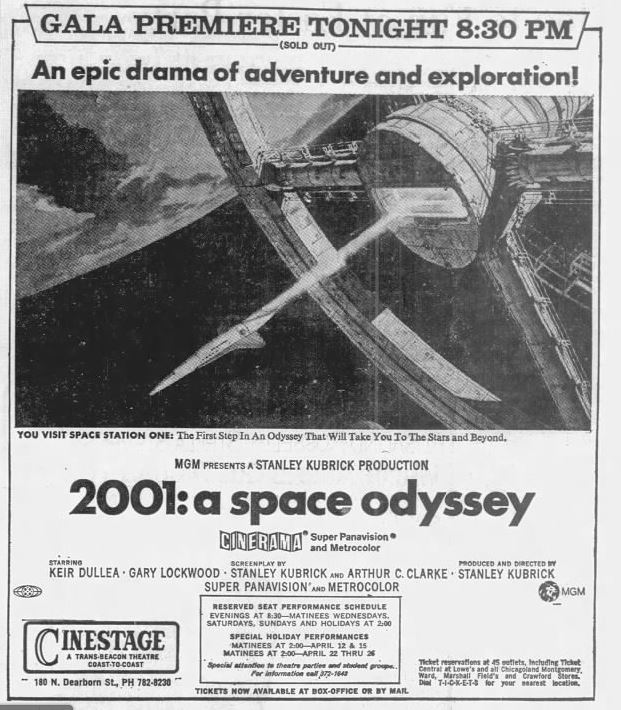
Posted by Allan Young (Member # 6332) on 09-27-2018, 05:22 AM:
quote: Mark Lensenmayer
The Chicago Cinestage, which had an exclusive run of 2001, did not show any Cinerama features until GRAND PRIX in 1970.
So you got that date wrong? 1966 maybe?
Posted by Mark Lensenmayer (Member # 134) on 09-27-2018, 07:15 AM:
Thank you for the correction. Actually, upon checking with Michael Coate's Chicago Cinerama list, the Cinestage played:
12/25/64 - Mediterranean Holiday
1/25/67 - Grand Prix
4/9/68 - 2001
4/17/69 - Ice Station Zebra
6/26/69 - Krakatoa: East of Java
Apologies for the error.
Posted by Jean-Pierre Gutzeit (Member # 7275) on 09-27-2018, 05:42 PM:
The collection of advertisements and the discovery of the listing of the Cinerama Association is extremely appreciated and helpful.
Based on that, we will have to add more additions, discoveries and corrections in the future - that's why film-tech.com is a suitable forum.
Specifically, I would like to advertise, despite the ads "in Cinerama" for various film titles such as THE GREAT RACE, SONG OF NORWAY, CIRCUS WORLD or 2001 urgently to change this wording.
Because the following is to ask: What sets the "70mm projections advertised in Cinerama" from other 70mm projections in Todd AO or D-150 houses on 120 degree or 100 degree screens?
Technically, and for the viewer, it is the same result. There was nothing extra added to the "advertised in Cinerama" projection. Except for the red-anodised 70mm projection optics of Cinerama Inc., which mostly represented the house optics in the cinemas converted or operated by Cinerama Inc. But also in terms of this look, I know no big difference to Todd AO optics of Isco Göttingen (T-Kiptagon) or Philips (Cine-Apergon). Thomas Hauerslev has probably completely archived them and could name any differences. To my knowledge, the 70mm optics offered by the Cinerama Inc. are spherical optics without special corrections of the image geometry. A little different is the D-150 optic, which variably stretches the edges of the image: a great invention of Mr. Vetter, but here too, the ad promises "in D-150" in the reason the same as a high quality normal Todd AO Projection at 120 degree screens.
It would therefore have to explain why the image impression of a 70mm film, for example in the Uptown Theater in Washington D.C. (World premiere of "2001") should have been completely different than at the time when a Todd AO screen was installed in Grauman's Egyptian Theater?
One could also claim that the two world premieres of "2001" in Washington and New York were not seen "in Cinerama" but "in Todd-AO". At First, because the image impression was similar or the same, and secondly, because "2001" was partly shot with optics and cameras by Todd A.O. - but not with systems from the Technology Park of Cinerama Inc.
If one tries to rewrite the dilemma, such a sentence could come out as follows: "2001 had its 70mm premieres also in houses, which were built or operated by the Cinerama Inc. and therefore had a comparatively strong curvature of the screen".
*
Some supplements to the list http://www.in70mm.com/cinerama/ics_newsletters/cinerama_theatre_list_18.pdf:
- "Krueger Halle" in Essen (has to corrected to "Gruga-Halle")
- For the Capitol Berlin appear 70mm projections only after the end of the 3-stripe projections. Correction: they ran at times alternately.
- Schauburg Karlsruhe is missing on this list as one of the last 70mm Cinerama conversions.
Posted by Sigurd Wik (Member # 6131) on 10-25-2018, 11:29 AM:
Hi, wanted to hear if someone has the DTS 5.1 mix of 2001 and are willing to share? We are screening the 2001 70mm print and are "missing" two front channels... Don't know if the track will match the print, but worth a try.
Sigurd
Powered by Infopop Corporation
UBB.classicTM
6.3.1.2