This is topic Once Upon a Time ... in Hollywood 70mm/35mm release? in forum Film Handlers' Forum at Film-Tech Forum ARCHIVE.
To visit this topic, use this URL:
https://ft-forum.com/ft/cgi-bin/ubb/ultimatebb.cgi?ubb=get_topic;f=1;t=012467
Posted by Jan Eberholst Olsen (Member # 10133) on 07-01-2019, 03:12 PM:
Any theaters confirmed for the new Tarantino movie? I will be in San Fransisco the opening weekend, would love to see it on film.
Posted by Mark Lensenmayer (Member # 134) on 07-01-2019, 03:48 PM:
New Beverly in LA has confirmed 35mm screenings.
Posted by Mark Ogden (Member # 43) on 07-01-2019, 05:42 PM:
quote: Mark Lensenmayer
New Beverly in LA has confirmed 35mm screenings.
Well, that would stand to reason ![[Wink]](wink.gif) .
.
Posted by Sean Weitzel (Member # 244) on 07-03-2019, 02:04 PM:
According to in70mm.com The Grand Lake in Oakland, CA will be showing a 70mm print.
Posted by Jim Cassedy (Member # 4115) on 07-03-2019, 02:48 PM:
I'm aware of two theaters in San Francisco that have said they will
be getting 35mm prints, although there are probably more, and as
Sean said, The Grand Lake in Oakland will have 70mm, and it's
worth the trip over to Oakland to see it there. (And it's an easy
trip to get across The Bay using the BART train from SF)
I'm not mentioning by name the two possible 35mm venues, because,
one of them needs some extensive work to get its' 35mm equipment
back in shape, and I'm not sure they have time to do that by the
release date, although they might surprise me. (I can't help them
- - I'm busy working on two other projects)
- - and the 2nd venue is in much better shape, equipment-wise, but
they have nobody on staff at present who has any idea how to run film.
And I can't help them either.
But you know,there's a lot to do here in SF and Oakland, that doesn't
involve spending time in the dark. No matter what you decide to do,
enjoy your visit to the Bay Area!
Posted by Jan Eberholst Olsen (Member # 10133) on 07-03-2019, 04:24 PM:
Grand Lake seems to be the best choice, thank you very much. Do they have a white screen, or silver? I see that they do dual projection 3D, so hopefully it will be on a white screen?
If I decide to watch downtown in a modern theatre, which auditorium is the best regarding sound/image quality? Would love to avoid a silver screen.
Yes, wife and daughter traveling with me, so this will be the only cinema related stop for me on this trip.
Posted by Mark Ogden (Member # 43) on 07-03-2019, 06:38 PM:
The Grand Lake in Oakland is absolutely worth the trouble to get to, especially if you want to see a still-intact example of classic theaters. They have the Golden Age of Cinema thing still happening, curtains, light cues and an organist. Great quality projection from two nicely maintained DP70s, and terrific sound. Of the five unique 70mm showings of 2001 that I saw last year, the Grand Lake had the probably the best on-screen image and certainly the best sound.
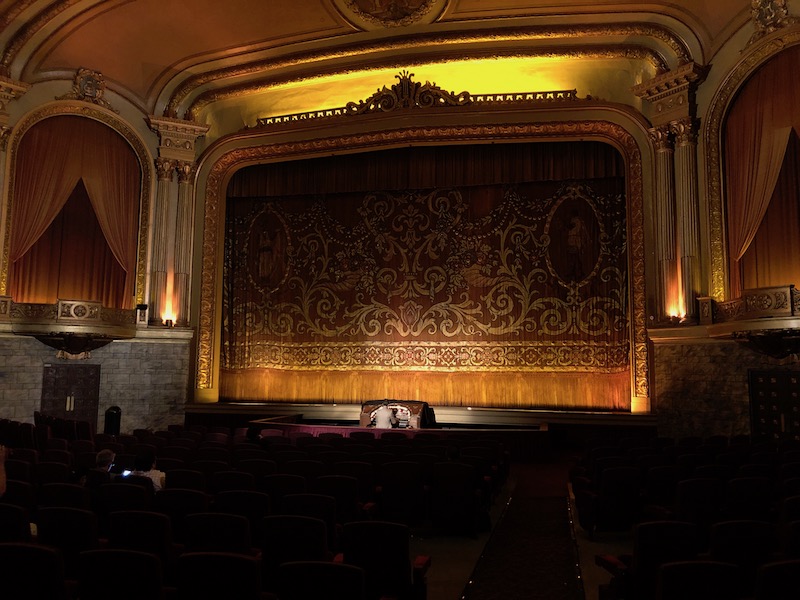
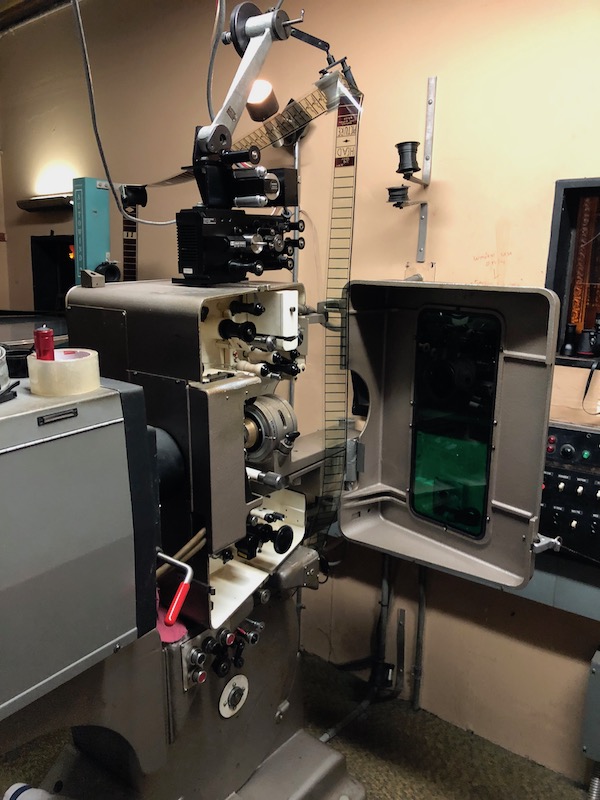
Posted by Chris Haller (Member # 9206) on 07-03-2019, 08:58 PM:
The Little Theater, Rochester's only true independent theater left, has issued a release stating that they will be playing a 1st run 35mm print day and date with the digital theaters in the area.
The Little Theater has one large screen, and a separate building right behind it, which is 4 additional screens converted from a previous facility. My mother and her family, who grew up in the city during the 60s and 70s say it used to be a mechanic's garage.
They were the last theater in the area to run new film prints of foreign and art films and fully converted to digital a few years back. I guess they retained two of their film projectors and kept them installed to run repertory films in changeover.
Beyond that, I have zero idea what they've got installed, what condition the equipment is in, and how often it gets used. They've played a few 35mm prints as part of their Saturday Night Rewind series, but a local projectionist told me they sourced most of those prints from a collector in New Jersey and the quality was questionable at best.
Their chief projectionist must be good at what she does, as she was called into service during the 70mm run of Dunkirk in LA or in California someplace, but I plan on seeing it as early as possible before anything heinous could happen to it.
Posted by Stephan Shelley (Member # 8587) on 07-03-2019, 09:22 PM:
Unfortunately it is unconfirmed what sort of a print the Grand Lake is getting. There was talk of a 70mm and then it was 35mm for sure and possible 70mm but were told not to advertise anything film related.
I will followup when I know for sure.
Nice shots of the theatre whoever took them.
Posted by Stephan Shelley (Member # 8587) on 07-08-2019, 01:51 PM:
I have just heard that the New Mission theatre in San Francisco is getting the only 70mm print in northern California. The Grand Lake is still in the running for a 35mm print.
Posted by Tyler Purcell (Member # 9213) on 07-08-2019, 07:39 PM:
Arclight Cinemas is getting a 70mm print for Hollywood. They will probably have 2 prints, one at Sherman Oaks as well, that's been the trend so far. Not sure how many prints they're making tho, I know Fotokem is working pretty hard on them, they've got more staff then normal over there.
Posted by Bobby Henderson (Member # 840) on 07-08-2019, 11:59 PM:
Why so stingy on the damned 70mm prints? Film prints overall are expensive to create these days. How much more does a 70mm print with DTS time code cost over a 35mm print, presumably with either DTS time code and/or on-print Dolby Digital audio? It's not like anyone is having to mag-stripe anything anymore.
![[Roll Eyes]](rolleyes.gif)
The Hateful Eight had a shit-ton of 70mm prints, along with a bunch of 70mm-capable film projector installations. But on this go-round they can't have more than two 70mm prints of a QT movie booked in the Bay Area? What the hell is going on? Are these guys on dope? I don't get it.
Posted by Marcel Birgelen (Member # 6801) on 07-09-2019, 02:50 AM:
Around this time, the cost for a 70mm print is anything between $20K and $30K, depending on run time and probably also the number of copies. That is "plain 70mm" without mag tracks. I'm not sure if there is still a lab able to do mag tracks out there.
Back in the days of mass-produced 35mm film, I guess the costs for the film itself were around $1000 to $1500 on average. Prices will have gone up significantly by now, but I can still order single copies of 35mm features (~2 hours) for around $2500~$3000.
Currently, the only digital audio format compatible with 70mm is good old DTS (the disc based system). It's not likely anybody will come up with a way to sync e.g. Atmos or DTS-X with a 70mm print, although it should technically be doable.
Posted by Steve Guttag (Member # 268) on 07-09-2019, 06:06 AM:
Where are you getting your print costs from on 70mm? 70mm film typically costs double 35mm (last I heard, anyway) and the length will be 25% longer so I get it being more than double that of 35mm and even a premium to handle but $20K-$30K is not numbers I've heard before.
The cost would be in getting the first print. That is generating a color timed IN will be where the money is to get that first print. Thereafter, it is straight up duplication (film chemicals and processing). I could easily see it costing $30K to get the first print.
Posted by Scott Norwood (Member # 30) on 07-09-2019, 08:48 AM:
What Steve said. The Kodak motion-picture price catalog is here:
https://www.kodak.com/uploadedFiles/Motion/Products/Product_Information/Kodak-Motion-Picture-Products-Price-Catalog-US-Prices.pdf
2500' of 70mm 2383 is $723.12. If prices are similar to 35mm, the price for a print will be about double that (due to the printing labor and processing), so that makes it about $1500/reel. That makes abut $12k for a print of a 160-minute film at full list price. There is no way that Sony Pictures is paying full list price for anything. There might be some extra cost for shipping and such, but, again, a major studio will never pay full list price.
And, yes, the DTS licensing, optical (or digital) blowup, and 65mm IP/INs will be the expensive part of the process. I have no idea what DTS licensing costs now, but I could easily see the intermediates costing $3-4/foot, plus the cost of the optical work.
If there are really only a handful of 70mm prints, this seems awfully stingy. There are at least a dozen venues in the USA alone that are equipped to show 70mm properly using existing, installed equipment and which would probably be happy to get prints.
Posted by Mark Ogden (Member # 43) on 07-09-2019, 08:49 AM:
quote: Bobby Henderson
What the hell is going on? Are these guys on dope? I don't get it.
Someday, if I ever encounter Harvey Weinstein, I will ask him if he ever regretted the money he blew on the 70mm Super Panavision release of The Hateful Eight, one of Quentin Tarantino's least successful movies. All those projectors and lenses that he scavenged and refurbished, the print costs, the logistics, for what? This thing wasn't exactly Lawrence of Arabia. The expenditure on the theatre level as well, between $40 - 80,000 per screen, I remember reading at the time. I hope they got some of it back.
Since Harvey is a little preoccupied these days, Once Upon a Time . . . is going out via Sony/Columbia, a studio that's a little more bottom-line oriented and not as interested in indulging directors with unnecessary 70mm prints. I wouldn't be at all surprised if they brought up the matter of The Hateful Eight and it's financial performance to him when talking about this release.
Posted by Terry Monohan (Member # 8285) on 07-09-2019, 10:34 AM:
Once A Time was filmed on 35mm film stock. Was not shot in 65mm like Hateful 8, why bother even to blow up a 35mm scope print to 70mm just for a few cinemas to run. It may look a little better then 35mm or DCP who knows, the DTS stereo sound will be the same as the best digital multi track systems around today but probably not as good as a Dolby Atmos® cinema.
The average movie ticket buyer is not going to care. At worst the few theatres that may get a 70mm print won't even advertise they are showing in 70mm film with a live projectionist not in DCP video as they don't even advertise in any newspapers these days.
The Grand Lake Theatre in Oakland will put up big 70mm plastic letters on their giant neon marquee If they indeed get a 70mm film print in a few weeks. No other SF Bay Area will do this if they run 70mm, maybe the Drafthouse New Mission in SF, they have a great neon marquee also.
This 'Once In A Time In Hollywood' is very long. It was not shot for a roadshow run. There is no intermission or overture/exit music like the 70mm Hateful 8 was.
Id hate to see this new 70mm blow up movie at the Pacific Cinerama Dome Hollywood as they seem to have the wrong masking and lens as the scope picture at least on DCP is
curved way up on the bottom right and left of their semi giant Cinerama curved screen. Go to the Seattle Cinerama Theatre and you don't see this going on much on the bottom curved screen in film 35mm/70mm or DCP.
I don't seem to remember this curve up problem at the Hollywood Dome till they put in DCP projectors and It has gotten worse. I have been to many large curved screens around the USA and I don't see the keystone problem like at the Cinerama Dome on the bottom of the screen on the far right & left sides of the screen.
I think the Forman family at Pacific Theatres owes Quentin big time as he did not get to run Hateful 8 a 70mm film print in the Dome as he had it pre booked as he wanted to do roadshow with curtains ect. Pacific Theatres ran it in a smaller 70mm space in the Arclight that is why he is getting to play his new movie in the Dome this time around.
At least his new film was shot around the Dome and many other old cinemas on Hollywood Blvd to make It look like the 1960's.
Bring a flashlight if you see 'Once A Time In Hollywood' at the Hollywood Cinerama Dome as when you enter the blue curtain lights and overhead ceiling lights are on so low you won't be able to find your reserved seat number at least on the bottom floor section.
Posted by Mark Louis (Member # 10632) on 07-09-2019, 12:30 PM:
Here at Alamo we have time and again proven that there is still a great deal of public interest in 35mm and 70mm. We have consistently had higher grosses for movies we've played in those formats compared to their DCP versions. When we ran Phantom thread in 70mm in our three 70mm houses, all three were were in the top 10 list of highest grossing screens and Brooklyn was #1.
Posted by Bobby Henderson (Member # 840) on 07-09-2019, 01:23 PM:
quote: Terry Monohan
Once A Time was filmed on 35mm film stock. Was not shot in 65mm like Hateful 8, why bother even to blow up a 35mm scope print to 70mm just for a few cinemas to run. It may look a little better then 35mm or DCP who knows, the DTS stereo sound will be the same as the best digital multi track systems around today but probably not as good as a Dolby Atmos® cinema.
To date, none of Quentin Tarantino's movies has had a Dolby Atmos mix, including Once Upon a Time in Hollywood.
There are some benefits to projecting a 70mm print as opposed to 35mm, even if the original source is 35mm. A 5/70mm image will usually be brighter and more steady than a 4/35mm print shown on the same screen. The difference is critical when throwing the image onto large screens. Back in the late 1990's during the stadium seated theater building boom chains like Cinemark, UA and others were building some giant-sized screens but only equipping them for 35mm. I hated that practice because the projected images would often be soft and unacceptably dim. Any steadiness issues with the projector would be magnified on those screens. 5/70mm projectors and blow-up prints would have been great in those big houses. But that crap gave way to the DMR 15/70 blow-ups on IMAX. And we all know what happened from there with IMAX over the last couple decades.
I'm extremely critical of D-cinema projection regarding the 2.39:1 "Scope" format. Basically it's a digital version of 2-perf 35mm TechniScope. A 35mm 'Scope print from a film-based work flow is going to look better and a 70mm print even better still. IIRC, Once Upon a Time in Hollywood was shot on 35mm, but I don't know for certain if QT used the film-based, analog route in post production or squeezed it through a digital intermediate. If the movie was squeezed through a DI bottleneck and then output back to film I would consider the 35mm and 70mm prints a waste of time.
20 years ago I would go to some considerable lengths to catch movies I wanted to see in commercial theaters. I felt like I would be missing a lot by waiting to rent a DVD. These days I don't feel like I'm missing anything at all by skipping a movie's theatrical release. There is barely any perceptible difference between a 2K DCP shown in a theater versus watching a Blu-ray disc at home on my 65" TV set. Hell, as fast as my Internet connection is now most movies and TV shows I stream pass for Blu-ray quality.
quote: Terry Monohan
I don't seem to remember this curve up problem at the Hollywood Dome till they put in DCP projectors and It has gotten worse. I have been to many large curved screens around the USA and I don't see the keystone problem like at the Cinerama Dome on the bottom of the screen on the far right & left sides of the screen.
If you're ever in the Tulsa area check out one of the 2 "Grand Infinity" houses at the Regal Broken Arrow Warren theater. They have big D-150 style deep curved screens. But the projected image is so smile-warped (and cut off at the corners) that it makes movies all but un-watchable there. It completely killed any desire of mine to watch movies on deep curved screens. Unless they can get both the alignment and lens optics just right the movie watching experience just ends up sucking.
quote: Mark Louis
Here at Alamo we have time and again proven that there is still a great deal of public interest in 35mm and 70mm. We have consistently had higher grosses for movies we've played in those formats compared to their DCP versions.
Mark, do you know any details about where Alamo might be building new locations? I've heard rumors they were going to open a theater in the Oklahoma City area (specifically in the new Chisholm Creek development). But I've seen no official word about it from Alamo on their web site.
Posted by Leo Enticknap (Member # 534) on 07-09-2019, 03:59 PM:
quote: Mark Ogden
Someday, if I ever encounter Harvey Weinstein, I will ask him if he ever regretted the money he blew on the 70mm Super Panavision release of The Hateful Eight...
I can't resist pointing out that if he does, it probably comes quite a long way down the list of things he's regretting having done, right now.
Posted by Bill Brandenstein (Member # 7758) on 07-09-2019, 05:31 PM:
quote: Terry Monohan
Id hate to see this new 70mm blow up movie at the Pacific Cinerama Dome Hollywood as they seem to have the wrong masking and lens as the scope picture at least on DCP is
curved way up on the bottom right and left of their semi giant Cinerama curved screen.
Just for the record: the "smiling" lower masking at the Dome is a relatively recent matter, added specifically for the installation of their current laser projection equipment. Their original digital projectors, whatever they were, used no such masking, and the screen simply used common-height curtains for adjustment between all formats.
For proof, here's a snapshot during the Dome's 60th Cinerama Anniversary celebration in 2012. After a 3-strip film screening, they were aligning the digital projection for the next title with a few of us stragglers still milling about:
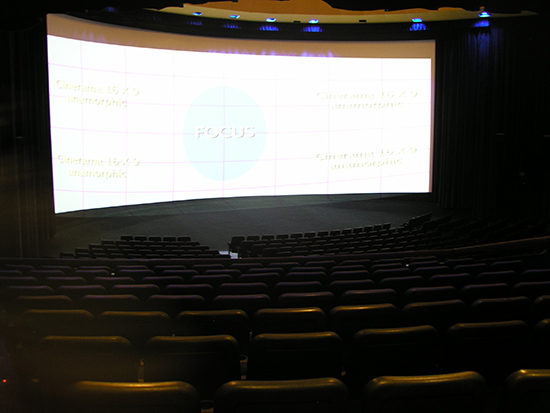
A lot of image is cropped off the center bottom of the image, as you can see. None is now with the "smile" shape. Of course we all hope they can remove that mask for film screenings.
Posted by Marcel Birgelen (Member # 6801) on 07-09-2019, 09:34 PM:
quote: Steve Guttag
Where are you getting your print costs from on 70mm? 70mm film typically costs double 35mm (last I heard, anyway) and the length will be 25% longer so I get it being more than double that of 35mm and even a premium to handle but $20K-$30K is not numbers I've heard before.
It was an indicative number from the same guys that have done some 35mm film work for me in the past. They don't handle 70mm themselves, so it may be a misquote, but I've heard similar numbers before. Also, this was probably the price for a single copy, so the second copy might be considerably cheaper.
We don't know what Sony/Columbia Pictures will be paying for their prints, but I think even for them, the days for extreme discounts are over as even they don't order prints by the ten-thousands anymore.
quote: Bobby Henderson
There are some benefits to projecting a 70mm print as opposed to 35mm, even if the original source is 35mm. A 5/70mm image will usually be brighter and more steady than a 4/35mm print shown on the same screen.
Yes, I know I'm going "wild" here, but to be honest, I don't see much benefit for a 35mm to 70mm blowup compared to a good 4K RGB laser projection of a proper 35mm scan, even if the picture is in scope and we're losing a bunch of pixels and brightness in the process. We can also have the benefits from a full, uncompressed PCM soundtrack then, compared to compressed DTS.
quote: Bobby Henderson
Back in the late 1990's during the stadium seated theater building boom chains like Cinemark, UA and others were building some giant-sized screens but only equipping them for 35mm. I hated that practice because the projected images would often be soft and unacceptably dim.
While I agree that 35mm on such huge screens had a whole lot of issues, the lack of 70mm projection equipment can be somewhat forgiven, especially for those locations that only showed first-run content. How many 70mm releases where there back in the 1990's? I count three, of which one is a documentary.
Posted by Geoff Jones (Member # 3668) on 07-10-2019, 10:54 AM:
quote: Mark Louis
Here at Alamo we have time and again proven that there is still a great deal of public interest in 35mm and 70mm. We have consistently had higher grosses for movies we've played in those formats compared to their DCP versions. When we ran Phantom thread in 70mm in our three 70mm houses, all three were were in the top 10 list of highest grossing screens and Brooklyn was #1.
Why wasn't a film projector installed in the "Big Show" auditorium at Alamo's new Westminster, Colorado location?
Posted by Sean McKinnon (Member # 612) on 07-10-2019, 01:14 PM:
Go Alamo Brooklyn!
Posted by Bobby Henderson (Member # 840) on 07-10-2019, 02:29 PM:
quote: Marcel Birgelen
Yes, I know I'm going "wild" here, but to be honest, I don't see much benefit for a 35mm to 70mm blowup compared to a good 4K RGB laser projection of a proper 35mm scan, even if the picture is in scope and we're losing a bunch of pixels and brightness in the process. We can also have the benefits from a full, uncompressed PCM soundtrack then, compared to compressed DTS.
Only a tiny minority of theaters have 4K RGB laser projection. Let's not forget very few contemporary movies are fully produced in 4K resolution; most are still 2K. Of theaters that that have 4K RGB laser projection they all charge a significant up-charge on top of the normal ticket price. Meanwhile a good UHD OLED TV can deliver comparable image quality at home. Lossless surround sound has been available for the home market as well. You can crank the sound at home too if you like, unlike so many theaters that have the fader turned down to TV speakers volume. Basically it's just as easy to turn the "digital is better than film" argument around against itself. I've got digital at home. It looks and sounds just about as good as it does in the theater, but way cheaper. Why do I need to go to the theater?
Taking the current de facto post production work flows into account, I'd rather watch a 70mm blow-up of a 35mm-sourced movie that went through a 100% analog work flow than a digital TechniScope derived version of it. I might feel different about it if d-cinema audio/video standards were remarkably different from the tech available for home.
Regarding audio on 70mm, yeah DTS, Datasat or whatever it's called now is technically inferior to lossless or uncompressed surround sound. However if enough key people actually gave a damn about 70mm they could use the time code on the film print to sync up any kind of audio track, be it uncompressed LPCM or even freaking Dolby Atmos.
quote: Marcel Birgelen
While I agree that 35mm on such huge screens had a whole lot of issues, the lack of 70mm projection equipment can be somewhat forgiven, especially for those locations that only showed first-run content. How many 70mm releases where there back in the 1990's? I count three, of which one is a documentary.
The early 1990's had quite a few 70mm blow-up releases. Things didn't start falling off until the 1993-94 time frame. Nevertheless, doing 5/70mm in these new giant-screen stadium seated theaters would have been easy.
There was still a LOT of perfectly functional 70mm-capable projectors in use during the early 1990's. IIRC, over 1000 screens in North America were capable of showing 70mm in 1990. In 1995, when the stadium seated theater building boom began nearly all those projectors will still functional. But they were in traditional seated theaters that were starting to be closed to make way for new stadium seated theater "megaplex" sites. Those projectors could have been re-installed in the booths of these new theaters. DTS already had time code readers for 70mm. Infrastructure was in place to create 70mm DTS prints. If theater chains like Cinemark, UA and others building giant screen houses had simply bothered to install 70mm it would not have been difficult at all for Hollywood movie distributors to make 70mm prints for them.
The failure of new stadium seated theaters to support 70mm in mid-late 1990's had zero to do with any technical problems. It was all due to various deciders not giving a shit about 70mm and the benefits of using it. The fact that Boston Light & Sound, the Weinstein Company and Quentin Tarantino could scrounge together around 100 70mm systems just for the release of one movie illustrates just how pathetic and disgraceful that failure was in the 1990's.
Posted by Mark Lensenmayer (Member # 134) on 07-10-2019, 03:06 PM:
ONCE UPON A TIME IN HOLLYWOOD will be shown in 35mm at the Gateway Film Center in Columbus, OH.
Posted by Stephan Shelley (Member # 8587) on 07-10-2019, 08:30 PM:
Have to point out H8 was Ultra Panovision not Super Panovision. The former is anamorphic on 70mm gives a 2.78:1 ration and the latter spherical on 70mm 2.2:1 ratio.
Posted by Scott Norwood (Member # 30) on 07-11-2019, 05:11 AM:
The Somerville Theatre has it booked in 35mm.
Posted by Benjamin Ruder (Member # 10765) on 07-11-2019, 09:24 AM:
The Music Box Theatre in Chicago has it booked in 70MM
Posted by Stephan Shelley (Member # 8587) on 07-11-2019, 01:20 PM:
Grand Lake is getting a 35mm print.
Posted by Scott Norwood (Member # 30) on 07-11-2019, 04:42 PM:
Here are the (North American?) 70mm bookings:
https://screencrush.com/once-upon-a-time-in-hollywood-70mm-theaters/
* Alamo Drafthouse New Mission, San Francisco, CA
* Arclight Cinemas Hollywood, Los Angeles, CA
* Cineplex Varsity, Toronto, Canada
* City Cinemas Village East, New York, NY
* Music Box Theatre, Chicago, IL
Posted by Scott Norwood (Member # 30) on 07-11-2019, 05:05 PM:
And here are some of the 35mm bookings that I have pieced together from this thread and Google results. No doubt there will be many more. (Why doesn't Sony Pictures have a list anywhere?)
Alamo Drafthouse Brooklyn (NY, NY)
Alamo Drafthouse Cedars (DFW, TX)
Alamo Drafthouse Downtown LA (LA, CA)
Alamo Drafthouse Lakeline (Austin, TX)
Alamo Drafthouse Las Colinas (DFW, TX)
Alamo Drafthouse Littleton (Denver, CO)
Alamo Drafthouse Lubbock (Lubbock, TX)
Alamo Drafthouse Mainstreet (Kansas City, MO)
Alamo Drafthouse Marketplace (San Antonio, TX)
Alamo Drafthouse Montecillo (El Paso, TX)
Alamo Drafthouse Park North (San Antonio, TX)
Alamo Drafthouse Raleigh (Raleigh, NC)
Alamo Drafthouse Richardson (DFW, TX)
Alamo Drafthouse Ritz (Austin, TX)
Alamo Drafthouse South Lamar (Austin, TX)
Alamo Drafthouse Tempe (Phoenix, AZ)
Alamo Drafthouse Village (Austin, TX)
Alamo Drafthouse Yonkers (NY, NY)
Arclight La Jolla (LA, CA)
Arclight Pasadena (LA, CA)
Arclight Sherman Oaks (LA, CA)
Belcourt (Nashville, TN)
Coolidge Corner (Brookline, MA)
Gateway (Columbus, OH)
Grand Lake (SF, CA)
Hollywood (Portland, OR)
Landmark SF East Bay (SF, CA)
Little (Rochester, NY)
New Beverly (LA, CA)
Nitehawk Cinema (Brooklyn, NY)
SIE Film Center (Denver, CO)
SIFF Cinema Uptown (Seattle, WA)
Somerville (Somerville, MA)
Posted by Jan Eberholst Olsen (Member # 10133) on 07-11-2019, 05:16 PM:
Just bought my ticket for Sunday 7/28 3PM screening at The New Mission Theater in SF, really looking forward to see it in 70mm. What kind of projectors/screen/sound system is installed in the main screen?
Posted by Stephan Shelley (Member # 8587) on 07-11-2019, 05:21 PM:
New Mission has Century JJs, CP650 daisy chained into a Trinnov Ovation 1, DTS XD10 (I think), silver screen. No platter just reel to reel.
Posted by Adam Towill (Member # 7683) on 07-11-2019, 07:55 PM:
Australian locations for 35mm are:
Sydney - Ritz Theatre, Randwick; Hayden Orpheum Theatre, Cremorne
Melbourne - Sun Theatre, Yarraville; Astor Theatre, St Kilda
Only four prints in the country, as far as I know. Sony has indicated sub run bookings are possible, but those are basically the only theatres that care enough to do it or that are still equipped, or have equipped themselves to do it.
Posted by Steve Guttag (Member # 268) on 07-11-2019, 09:27 PM:
The AFI/Silver is slated to run it in 35mm with a potential option to get one of the 70mm prints.
Posted by Chris Haller (Member # 9206) on 07-11-2019, 11:04 PM:
Only 5 locations so far for 70mm. So many of those Hateful Eight locations going dark, not even running 35mm. Seems like a good waste of equipment, most of which likely hasn't been run since Dunkirk.
Did those Weinstein kits even come with the appropriate 35mm rollers and what not for those JJs? Seems like it would have made those installs a bit more versatile if they did.
Also, I saw Hateful Eight at Cineplex in Toronto. Not exactly a huge screen for 70mm, and it was a constant width screen to boot. I wouldn't exactly jump at the chance to make the trip again!
Posted by Stephan Shelley (Member # 8587) on 07-11-2019, 11:16 PM:
The H8 stuff was stripped of anything not need to run 70mm. Some of the sprockets did not have the 35mm teeth.
Posted by Marcel Birgelen (Member # 6801) on 07-12-2019, 02:05 AM:
quote: Bobby Henderson
Only a tiny minority of theaters have 4K RGB laser projection. Let's not forget very few contemporary movies are fully produced in 4K resolution; most are still 2K.
I consider it to be the difference between 35mm and 70mm back in the film days. You'd also see 70mm only go into the "premium" locations, the big rooms. The primary difference was that it wasn't common back then to charge a premium for the "big room experience".
The amount of RGB laser setups is steadily on the rise, as theaters start to replace their equipment in their bigger rooms. I guess that the install base of RGB laser systems already exceeds that of 70mm installs in its heydays or at least it is getting close.
quote: Bobby Henderson
Taking the current de facto post production work flows into account, I'd rather watch a 70mm blow-up of a 35mm-sourced movie that went through a 100% analog work flow than a digital TechniScope derived version of it. I might feel different about it if d-cinema audio/video standards were remarkably different from the tech available for home.
Isn't the end-result what counts, even if the technology in your living room and that in the cinema has a lot in common those days?
A good 4K scan of a 35mm film will get you any relevant information of what is in there. If you present it back using a high-contrast, digital projection system like an RGB laser setup, you get an extremely stable image and lose essentially nothing of what was in the 35mm frame.
Now, for a movie natively shot in 65mm, it's an entirely different story, but I don't necessarily see why we should put all the money into 70mm blowups if we've got cheaper alternatives that, if you cut out the nostalgia, don't under-perform.
quote: Bobby Henderson
The early 1990's had quite a few 70mm blow-up releases. Things didn't start falling off until the 1993-94 time frame. Nevertheless, doing 5/70mm in these new giant-screen stadium seated theaters would have been easy.
We were talking late 90's and things were pretty dire back then. I'd say from 96 on, there were like 2 or 3 movies a year getting a 70mm blow-up, but they got like 3 or 4 prints for the entire world, usually only reserved for the high-profile premiere locations or special screenings.
I worked at two different places back then that still had their DP70s and magnetic sound setup in full working order for 70mm, but it was just impossible to get a 70mm prints for anything other than the known repertoire titles and even that was hard.
I know a few big multiplexes that went up around the same time and that still put 70mm capabilities into their big houses, only to never play a single 70mm print in there until the day they went digital.
The failure of 70mm wasn't so much the fault of the theaters, but it was more a failure of the film industry not caring for the format. Even back then, volume was more important than quality.
Posted by David J Hilsgen (Member # 2614) on 07-12-2019, 05:30 AM:
Emagine Willow Creek in Plymouth Minnesota is getting a 35mm
Posted by Bobby Henderson (Member # 840) on 07-12-2019, 11:52 AM:
quote: Marcel Birgelen
Isn't the end-result what counts, even if the technology in your living room and that in the cinema has a lot in common those days?
The end result counts big time. 25 or so years ago there was a tremendous difference between watching a movie in a theater via a 70mm film print (or even 35mm) versus watching it on a modest, square shaped, low resolution TV set at home. I drove significant distances to theaters in other cities just to check out a movie shown in 70mm. And if I chose to wait to watch the home video version instead I often had to wait upwards of year or more to do so. Today, with so little perceptible difference in image quality between the theatrical d-cinema version and HD version on home video, I have little desire to even drive across town to see a given at a local theater, much less drive 100 or 200 miles to the nearest theater equipped with laser projection.
quote: Marcel Birgelen
A good 4K scan of a 35mm film will get you any relevant information of what is in there. If you present it back using a high-contrast, digital projection system like an RGB laser setup, you get an extremely stable image and lose essentially nothing of what was in the 35mm frame.
Not with 'scope movies. And the 2.39:1 ratio is by far the most commonly used one these days. You can scan a 4/35mm film negative in 4K and get most of the image detail. But then the post production folks throw away half the image when squeezing it down to what's effectively a TechniScope 2/35 image. They don't expand the full 4/35mm image out wide the way a 35mm projector's anamorphic lens would do. They delete detail to acheive the proper aspect ratio.
quote: Marcel Birgelen
We were talking late 90's and things were pretty dire back then. I'd say from 96 on, there were like 2 or 3 movies a year getting a 70mm blow-up, but they got like 3 or 4 prints for the entire world, usually only reserved for the high-profile premiere locations or special screenings.
The fall-off of 70mm print production by distributors in the late 1990's is not all the fault of the distributors. The movie theater chains helped create that situation. They goofed big time in a lot of their new stadium seated megaplex sites by not installing any 70mm capability in their giant screen houses. The theater chains removed the necessary infrastructure for showing 70mm. Why would a movie distributor stike any 70mm DTS blow-up prints of a given movie if none of the big new stadium seated theater houses could play it? This one is 100% all on the theater chains as far as I'm concerned. They had perfectly workable options in front of them. There were lots of still-working 70mm capable projectors in theaters that were being closed down. Those systems could have been relocated to new theaters at no extra cost other than what it cost to move and re-install a projector they already owned. And if the chains insisted on buying new 35/70mm projectors they could have done so back then. They didn't bother.
What makes the situation even more absurd is when IMAX strolled along offering to do the job right. They saw how terrible 4/35 looked when projected on a 80' wide screen. They jumped on the opportunity to roll together some fancy DMR marketing and install some 15/70 systems. The movie studios had little hesitation at making 15/70mm blow-ups of their movies, using 3 times as much film as a 5/70 print!
If the theater chain operators had their heads screwed on correctly back in the late 1990's they could have installed traditional 70mm in those big houses, deliver a comparable experience to IMAX DMR, yet keep that revenue for themselves instead of handing it over to IMAX. The IMAX company itself has been in the driver's seat on efforts to eliminate 70mm. They chose to push their 2K Xenon system over 15/70 in the goal of boosting profits.
Posted by Tyler Purcell (Member # 9213) on 07-12-2019, 02:42 PM:
Bobby, you're so right. It's a real shame 70mm wasn't installed into those megaplex theaters. IMAX tried to do something for megaplex theaters, but it came too late and at too high of a cost. Plus 15 perf is way overkill for a standard screen. I think 5 perf was the best solution.
The problem with 5 perf of course is that doing a photochemical blowup costs a lot of money. When dolby stereo and eventually surround sound came out, the need for 6 channel 70mm soundtracks was negated. We went backwards technology wise until the digital audio age which solved many of the issues 35mm faced. 35mm prints were so much cheaper, it was down to a cost element. Yes IMAX did make a hand full of prints, but reality is, they cost so much money, it was the end of IMAX film. Had they just sucked it up and did 5 perf projection instead, we may still have film around in IMAX theaters today, considering the digital format we use today, has way less resolution than any of the film formats.
Posted by Marcel Birgelen (Member # 6801) on 07-12-2019, 07:01 PM:
quote: Bobby Henderson
Today, with so little perceptible difference in image quality between the theatrical d-cinema version and HD version on home video, I have little desire to even drive across town to see a given at a local theater, much less drive 100 or 200 miles to the nearest theater equipped with laser projection.
Sure, but try to keep a realistic view on things. I know many people with pretty big TVs but none of them is set up in a way that closely resembles a proper cinema setup. Also, there are more factors than just image and sound for going to the movies. The social aspect of "going out" is also important. It's the same as going to a concert, where sound quality is often shitty and the performers are so far away, they could be remotely operated puppets for all you know.
Also, history has the tendency to paints stuff rosier than it really was. The quality of many 35mm screenings back in the multiplex heydays was often so bad, that even a good VHS recording could compete with the experience.
While I'm not trying to defend the way theaters got eventually pressured into digitizing their auditoriums, the good thing was, that many theaters took this occasion to fix some long-standing issues in many of them.
quote: Bobby Henderson
Not with 'scope movies. And the 2.39:1 ratio is by far the most commonly used one these days. You can scan a 4/35mm film negative in 4K and get most of the image detail. But then the post production folks throw away half the image when squeezing it down to what's effectively a TechniScope 2/35 image. They don't expand the full 4/35mm image out wide the way a 35mm projector's anamorphic lens would do. They delete detail to acheive the proper aspect ratio.
Even a good 4K scan of a scope 35mm image retains the information. It's not that a 35mm frame suddenly grows more grains, because an anamorphic lens was used to compress the image. The problem is with the projection, where scope simply looses too much light and some vertical resolution.
But I'm personally a proponent of introducing "non-square pixels" (or pixels, with a "virtual" aspect ratio) into the DCI format itself. That way, the extra vertical resolution of the DCI imagers can be used, in combination with an anamorphic lens. There is also no need to stretch the image across the DMD in that case.
quote: Bobby Henderson
The fall-off of 70mm print production by distributors in the late 1990's is not all the fault of the distributors. The movie theater chains helped create that situation.
Well, there was probably a shared responsibility here. What I want to add is that from my perspective, I've seen quite some theaters that maintained their 70mm equipment and even some new developments that still put in 70mm equipment into their new houses back in the late 90's.
And like I indicated, we really tried to get 70mm blowups for some popular films, but we never could get hold of one. We even didn't ask for subtitled versions, just the original releases.
If they really cared, they would have some around for the select few theaters that still could play 70mm, wouldn't they?
Keep in mind that the first feature release for IMAX ever was Fantasia 2000 in 1999 and the first DMR releases only started to show up in 2002. I think that IMAX's entry into the Hollywood firm distribution process was primarily due to the failing market they found themselves in. The possibility to run some Hollywood blockbusters in those huge IMAX ventues would also open up some new possibilities for those venues that, until now, only played the same documentaries over and over for the last 15 or so years.
Posted by Bobby Henderson (Member # 840) on 07-13-2019, 12:21 AM:
quote: Tyler Purcell
The problem with 5 perf of course is that doing a photochemical blowup costs a lot of money. When dolby stereo and eventually surround sound came out, the need for 6 channel 70mm soundtracks was negated. We went backwards technology wise until the digital audio age which solved many of the issues 35mm faced.
The budget breaker on 70mm back then was the magnetic audio striped onto the film print. That was the thing that ballooned the cost of a 70mm print over 35mm. Those mag-stripe prints could only be "sounded" in real time. The mag coating (which has all sorts of issues in itself) is applied to the print like a blank cassette tape. Then the sound mix is played back to that print in real time. Not a very efficient way to make movie prints, especially if you had to make a bunch. I wonder how much time it took the print labs to make all the 70mm Dolby mag prints of huge runs like Dick Tracy, Indiana Jones & the Last Crusade, Hoffa or Far and Away. If there was only one print replication setup making prints they could not have made any more than perhaps 10 prints per day working on a 24 hour schedule.
70mm DTS prints are easier to produce. It's just image and time code, nothing else. Had the movie theater chain executives used a few brain cells they could have ran with that and ended up with a 70mm format whose prints only cost 2.5 times what an ordinary 35mm print would cost (rather than a 10 to 20 fold price increase per print). But no, 35mm with 3 different brands of lossy compressed digital sound is a perfect replacement for 70mm. That was the mindset until IMAX came along and started making up their own rules.
quote: Marcel Birgelen
Sure, but try to keep a realistic view on things. I know many people with pretty big TVs but none of them is set up in a way that closely resembles a proper cinema setup. Also, there are more factors than just image and sound for going to the movies.
I'm sorry, but what the hell does "proper cinema setup" mean when I'm watching a movie (or any kind of program) on a huge 65" flat panel TV screen in my living room? My sense of color acuity is a hell of a lot better than most people (thank God considering what I do for a living). I don't see anything obviously wrong with the color and contrast of my TV screen. When I watch a movie on that screen I'm pretty much seeing just about all the color and detail I would see in a commercial movie theater. The difference in detail and color between the two platforms is very marginal at best. As for the communal experience of watching the movie among an audience, we all know that has giant pros and cons. As much as I like a big crowd reaction to an important moment in a movie I really cannot stand the fucking constant disruptions from inconsiderate assholes in the audience. I wish every movie theater had a zero tolerance policy on the damned mobile phones.
quote: Marcel Birgelen
Also, history has the tendency to paints stuff rosier than it really was. The quality of many 35mm screenings back in the multiplex heydays was often so bad, that even a good VHS recording could compete with the experience.
I was lucky in my own personal circumstances living in NYC in the late 1980's and early 1990's. Most of the movies I watched in cinemas were shown in 70mm. But even the ones I watched in 35mm, movies like Robocop, Big, Dances With Wolves and Full Metal Jacket still looked better than what I see in d-cinema and at least sounded decent for 2 channel audio. I've seen plenty of sub-par 35mm shows as well. But NONE of them would be bested by a fucking VHS tape or even a damned Laserdisc for that matter. A sub-par 35mm presentation in a theater was still showing something effectively in high definition. No home format back then could equal that. Compared to a crappy 35mm presentation a good home video setup might have sported better color and contrast but the detail-resolution level would not have been for shit. Throw in some pan and scan vomit for good measure. That was VHS back in the day.
quote: Marcel Birgelen
Even a good 4K scan of a scope 35mm image retains the information. It's not that a 35mm frame suddenly grows more grains, because an anamorphic lens was used to compress the image. The problem is with the projection, where scope simply looses too much light and some vertical resolution.
But I'm personally a proponent of introducing "non-square pixels" (or pixels, with a "virtual" aspect ratio) into the DCI format itself. That way, the extra vertical resolution of the DCI imagers can be used, in combination with an anamorphic lens. There is also no need to stretch the image across the DMD in that case.
That gets back to the concept I think movie studios and theater should have been using from the outset: use 1.25x anamorphic lenses in conjunction with DCPs covering all of the pixels of 2048x1080 or 4096x2160 d-cinema projector imaging chips. It would have been similar to what DVD offered with 16x9 enhanced widescreen.
Going more extreme, I don't think d-cinema projectors should have rectangular imaging chips. I think they should be taller and much closer to square in order to improve overall optical quality. I think the chips should have the same ratio as a 4/35mm film frame and basically be a little over 3000 pixels tall by 4096 pixels wide. If the movie is in 'scope format then a 2:1 anamorphic lens will stretch that 3Kx4K image out to that width. And it will look a hell of a lot better than anything we're seeing in d-cinema currently. The optical path in a projector is not rectangle shaped. It is a sphere. The circle/square relationship has greater harmony there. When someone involves a rectangle shape in the path that essentially means needing a much bigger lens. I think if you have a roughly 4:3 ratio chip in the projector and a more modest sized anamorphic lens (maybe even on a turret) it could potentially be a more cost effective approach than some of the honking huge applications I've seen (such as those giant looking Konica-Minolta lenses on Christie d-cinema projectors).
quote: Marcel Birgelen
Well, there was probably a shared responsibility here. What I want to add is that from my perspective, I've seen quite some theaters that maintained their 70mm equipment and even some new developments that still put in 70mm equipment into their new houses back in the late 90's.
I hear what you're saying, but I still insist the theater chains should carry the bulk of the blame on this one for building lots of new theaters in the late 1990's as 35mm-only. They didn't give the distributors a chance to attempt booking anything in 70mm.
Yeah, there were still quite a few standard slope theaters equipped for 70mm still in operation til the end of the 1990's and even on into the early 2000's. I visited a bunch of those places, really stellar places like the GCC Northpark 1-2 theater in Dallas. The problem back then was stadium seating had turned into a big, Goddamned fad at the time. Attendance levels at the old fashioned theaters was plummeting. Given the choice between seeing a movie at the old Northpark theater versus watching it at a new stadium seated site like the AMC Grand 24 I would have picked the Northpark theater every single time. But I was in the tiny minority of movie-goers. Everybody else loved the stadium seating thing and chose that over theaters that actually had better projection, better sound quality and even bigger auditoriums. The Northpark had over 1000 seats! It was a legit world-premiere class theater. Yet it closed down amidst a bunch of recently built 35mm-only stadium seated "megaplex" locations around the greater DFW area.
If any new builds were installing 70mm in the late 1990's it had to be a very rare thing or for a niche purpose. I remember the UA Galaxy 9 theater in Garland, TX (Dallas-Fort Worth suburb). That theater had two giant sized 80' wide screen houses, but only 35mm in the booths. Yet it had a special venue Showscan theater (70mm @ 60fps) when it first opened. But no one ever shot a 2 hour feature film completely in the Showscan process. Douglas Trumbull, the guy who invented Showscan, had the best shot when he filmed Brainstorm, but that ended up being a mix of 4/35mm and 5/65mm material at 24fps.
Regarding IMAX, Fantasia 2000 and their later DMR releases, like The Matrix: Reloaded, I still stand by my opinion that IMAX jumped onto an obvious opportunity when they saw how theater chains were screwing up with their new megaplex sites and 35mm-only on 70'-80' wide screens. They did some great salesmanship and talked theater chains like Cinemark into adding IMAX 15/70 houses onto existing high profile sites and including IMAX 15/70 screens in new builds. The opportunity would not have been there for IMAX if the executives at various theater chains like UA, Cinemark, Lowes/Sony and others had been thinking clearly. This wasn't any kind of secret. Even back in 1995-1996 when the first of these new 35mm-only giant screen houses were being installed people in the exhibition industry were scoffing at how 35mm wouldn't work on screens like that. You can only get so many watts worth of light out of that little hole. 70mm throws a much brighter (and more steady) image. All it would have took was a few key people between the theater chains and distributors having a simple conversation. We could have had a LOT of movies in the late 1990's through the 2000's released with 70mm DTS prints. Unfortunately that didn't happen.
I consider it a tragedy of sorts IMAX effectively abandoned its large format roots. I thought they had a good thing going when it was all about documentaries in 15/70mm film format. Now IMAX is just regular Save The Cat! movies projected in 2K HDTV resolution with sound a bit louder than the old people TV speakers volume one can hear in the non-premium houses.
Posted by Marcel Birgelen (Member # 6801) on 07-13-2019, 03:18 AM:
quote: Bobby Henderson
70mm DTS prints are easier to produce. It's just image and time code, nothing else. Had the movie theater chain executives used a few brain cells they could have ran with that and ended up with a 70mm format whose prints only cost 2.5 times what an ordinary 35mm print would cost (rather than a 10 to 20 fold price increase per print). But no, 35mm with 3 different brands of lossy compressed digital sound is a perfect replacement for 70mm. That was the mindset until IMAX came along and started making up their own rules.
Dolby could've developed a 70mm version of SRD, even allowing for higher bandwidths (which could've been used for extra channels or better quality), yet choose not to do so. CDS was available for 70mm, but that format failed miserably and there have been a number of other experimental implementations dating back to the 80's.
The failure of digital sound formats adapting for 70mm, with the exception of DTS somewhere in 1996, also shows the lack of interest for 70mm back in the late 90's.
quote: Bobby Henderson
I'm sorry, but what the hell does "proper cinema setup" mean when I'm watching a movie (or any kind of program) on a huge 65" flat panel TV screen in my living room?
The point is that not everybody has their living room optimized to watch movies, even if they put in a big TV.
For cinemas it's pretty hard to follow the current technological race. I've upgraded my TV in the living room to a 65" 4K OLED about a year and a half ago and the next iteration of 8K screens is already around the corner.
So, the technical gap, so to say, is closing in rapidly, but not everybody is following the trends and there are still other incentives to go to a cinema.
quote: Bobby Henderson
As much as I like a big crowd reaction to an important moment in a movie I really cannot stand the fucking constant disruptions from inconsiderate assholes in the audience. I wish every movie theater had a zero tolerance policy on the damned mobile phones.
Most theaters have policies regarding mobile phone use and almost all of them are very strict on paper.
Maybe the theaters that don't police those rules should not make those rules in the first place. Maybe promote it as a feature: Mobile phone use during movie welcome. Chattering with your friend? No problem, welcome in our cinema cafe, where the movie is just a sideshow. Those theaters who actually follow their policy and do have the guts to effectively warn and eject people should also clearly advertise it. At the very least it would help me to choose the correct theater.
quote: Bobby Henderson
A sub-par 35mm presentation in a theater was still showing something effectively in high definition. No home format back then could equal that. Compared to a crappy 35mm presentation a good home video setup might have sported better color and contrast but the detail-resolution level would not have been for shit. Throw in some pan and scan vomit for good measure. That was VHS back in the day
There was a bigger technological gap back then, but I've been to 35mm shows, so crappy, where the digital sound had given up or wasn't even installed and the analog audio sounded so bad, you were lucky you had subtitles to make out what the dialog was about, all the while the print looked like it was dragged right out of a giant trashcan, combined with an out-of-focus and unstable image... yeah, watching it at home on VHS or Laserdisc would've been a better experience overall...
Laserdisc was actually a pretty step-up compared to crappy VHS, even though the image part was still analog.
quote: Bobby Henderson
That gets back to the concept I think movie studios and theater should have been using from the outset: use 1.25x anamorphic lenses in conjunction with DCPs covering all of the pixels of 2048x1080 or 4096x2160 d-cinema projector imaging chips. It would have been similar to what DVD offered with 16x9 enhanced widescreen.
The irony is that, the first production generation pre-DCI digital machines from e.g. Barco/Kinoton did use an anamorphic lens and "non-square pixels" in the source format for scope. Look for example at the Barco DP50. Eventually, DCI explicitly eliminated the concept from its standards.
quote: Bobby Henderson
All it would have took was a few key people between the theater chains and distributors having a simple conversation. We could have had a LOT of movies in the late 1990's through the 2000's released with 70mm DTS prints. Unfortunately that didn't happen.
I think that the major mistake they made is that they all waited for digital systems that would fill in the gap. Meanwhile, 35mm was considered "good enough" and since the volume was enormous, it was also relatively cheap and it "worked". IMAX in that sense, may have been the fore-runner of the PLF trend, although I never considered the 15/70 format a good format for film, since its native aspect ratio was almost never used for feature films.
The first fully digital projections didn't come around until 1999, and it would take another 10 years before it would turn main-stream, but by then it could barely replace 35mm.
The irony is that even now, we don't really have an off-the-shelf digital solution that can easily replace 70mm, at least none that's DCI compliant. Filling giant screens with decent looking images is still a challenge, while, sadly, the trend seems to go to smaller rooms, for a more "intimate" and "customized" experience...
Posted by Steve Guttag (Member # 268) on 07-13-2019, 05:23 AM:
quote: Bobby Henderson
The fall-off of 70mm print production by distributors in the late 1990's is not all the fault of the distributors. The movie theater chains helped create that situation. They goofed big time in a lot of their new stadium seated megaplex sites by not installing any 70mm capability in their giant screen houses. The theater chains removed the necessary infrastructure for showing 70mm.
I remember it quite differently. And I put the blame 95% on the distributors, not the exhibitors. The distributors didn't want to strike 70mm prints anymore and therefore exhibitors stopped putting in the equipment if they weren't going to get the prints. An exhibitor isn't going to spend upwards of 3-4 times on projection equipment for something they aren't going to get. A 70mm projector was significantly more expensive than the 35mm counterpart, not merely double. Even in the heyday of 70mm, the number of 70mm projectors made was a tiny drop compared to 35mm.
From the studio's standpoint, once 65mm origination stopped happening, 70mm was all about the sound. Once digital 5.1 audio made it to 35mm, that was it, as far as the studios were concerned. Remember, the studios are judging their prints on relatively smallish screens. 70mm did nothing for them but introduce an optical blow up that lowered contrast. Studios also judge their movies on "EK" prints (off of camera original, except for the opticals), and the 70mm prints were at least one generation away from that so in a studio setting, the 70mm prints would look worse than their 35mm EK reference. It is a different world out there.
I saw 70mm equipped theatres denied prints because none were being made or perhaps such a limited run that only a small handful were being made for large markets.
Now you can probably blame the exhibitors for not complaining and DEMANDING (from people that will do what they want anyway) that they wanted 70mm for their largest screens and perhaps, the likes of AMC/Regal could have forced the issue. But when have they ever been about doing the right thing for quality's sake? They lead the way against masking in the digital era, for crying out loud.
quote: Marcel Birgelen
Even a good 4K scan of a scope 35mm image retains the information. It's not that a 35mm frame suddenly grows more grains, because an anamorphic lens was used to compress the image. The problem is with the projection, where scope simply looses too much light and some vertical resolution.
You are incorrect on this one. 35mm Scope starts with more information than 4K can capture. 4K is about the resolution of 35mm 1.85, not scope. The scope frame is significantly taller and there aren't enough pixels to capture that at full resolution. 35mm gets to use all of that resolution and efficiently. On a proper scope screen where scope is the big format, the scope image is brighter than the 1.85 image despite scope being larger because it is a more efficient format with the space available.
We would be better served to have retained the concept of anamorphic projection for digital (and I have done so on several installations...both 2K and 4K).
Posted by Marcel Birgelen (Member # 6801) on 07-13-2019, 11:14 AM:
quote: Steve Guttag
You are incorrect on this one. 35mm Scope starts with more information than 4K can capture. 4K is about the resolution of 35mm 1.85, not scope.
Sure, scope uses almost the full frame available on 4-perf 35mm. Still, there is an ongoing discussion about how much information there is in 4 perf 35mm. It also depends a lot on the type of film used and the process it took from camera to film, so it's not all that clear cut.
If you ask IMAX, there is sufficient "hidden" information between the grains to blow it up to 15perf 70mm... now, that's one nice fairy tale...
In reality, 4K is enough to come sufficiently close to the "human perceivable resolution" of 35mm film, both for flat and "scope-done-wrong". It will be difficult to do an unbiased A/B test though, since everybody of us will almost spot immediately if something is a digital or analog projection.
I think we can all agree on the fact that scope is actually done wrong in DCI. What used to be the bigger format, now is essentially the format with less light and less resolution.
While anamorphic lenses solve the brightness issue, the resolution issue can only be solved by changing the DCI standard to allow for "anamorphic pixels" to be in the actual DCP.
Posted by Steve Guttag (Member # 268) on 07-13-2019, 12:09 PM:
quote:
Someday, if I ever encounter Harvey Weinstein, I will ask him if he ever regretted the money he blew on the 70mm Super Panavision release of The Hateful Eight, one of Quentin Tarantino's least successful movies. All those projectors and lenses that he scavenged and refurbished, the print costs, the logistics, for what? This thing wasn't exactly Lawrence of Arabia. The expenditure on the theatre level as well, between $40 - 80,000 per screen, I remember reading at the time. I hope they got some of it back.
This is one of those statements that REALLY misses the point and is more than deceptive.
Let's start with, H8 is currently ranked 6th on his list but has nominally the same amount of revenue as 4-6 with a significant drop to #7. In the world-wide gross it is #5. It is hardly is least successful or even in that group.
Reservoir Dogs is at the bottom for him but most QT fans would not put it down there in terms of their favorites.
Now let's look closer at H8. Can you or anyone say how much 70mm impacted the final gross?
With only 100-screens, it was ranked #10 on gross going up against the likes of Star Wars! Speaking of which Disney ensured that Star Wars gobbled up the largest and most appealing screens for H8 too and it still took in an average of $46K/screen on the opening weekend. That's not to shabby for an R rated film on the holidays going up against a franchise like Star Wars.
How much of that success was due to the 65/70mm production and the hoopla surrounding it? How many people that otherwise wouldn't have checked out a QT movie (he doesn't make the family fare and is known for "different") had it not been for UP-70mm?
The facts are, we have no way of knowing how much extra revenues that 70mm pulled in (if any, for that matter). We do know that it was a very profitable venture (the movie itself) including the 70mm investment. (if you could bring in $156M against a $44M investment, would you not do it every time? Remember too, TWC owned the equipment (until they sold it to WB) so they could have taken advantage of that investment again, had political/human issues had not arisen. So some of their investment was recouped while another studio took advantage of it.
Dunkirk ranks as #5 for Nolan...bringing $525M against $100M. And again, we have no way of knowing how much of that gross can be attributed to the use of 65/70mm other than those theatres running it in 70mm tend to do better than those that don't (is has traditionally been a 5:1 ratio).
QT has made profitable movies and H8 is not exception. If QT says he wants to shoot on film or shoot on 65mm or release in 70mm as terms of his contract, he can do so. Studios want to make money. They'll make no money off of QT if they don't handle his movie so it is there choice, more so than the studio dictating. In the case of QT (and other prominent directors), you are banking on their reputation and past performance.
Posted by Bobby Henderson (Member # 840) on 07-13-2019, 12:54 PM:
It's anecdotal to say, but I went out of my to watch 65mm-originated films like H8, Dunkirk and Interstellar in 70mm. I remember a packed house when I watched H8 in Oklahoma City.
quote: Steve Guttag
I remember it quite differently. And I put the blame 95% on the distributors, not the exhibitors. The distributors didn't want to strike 70mm prints anymore and therefore exhibitors stopped putting in the equipment if they weren't going to get the prints. An exhibitor isn't going to spend upwards of 3-4 times on projection equipment for something they aren't going to get. A 70mm projector was significantly more expensive than the 35mm counterpart, not merely double. Even in the heyday of 70mm, the number of 70mm projectors made was a tiny drop compared to 35mm.
Yes, there were plenty of people on the distribution side who didn't want to spend extra money making 70mm prints. Dolby even marketed Dolby Digital on 35mm as a cost cutting (for the distributors) replacement for 70mm. With three different digital sound formats becoming rapidly available for 35mm in the 1993-95 time frame there was no need for 70mm blow-up prints anymore. But not everyone thought that way. Some people did see a real benefit in making 5/70mm prints for really big theater screens.
While there was plenty of opposition to making 70mm prints on the distribution side, the commercial movie theaters sealed the fate of 5/70mm on their own. They did it themselves when they launched the stadium seated theater building boom and made it a totally 35mm-only affair. Then they closed down just about all the older theaters that were equipped for 70mm. If anyone on the distribution side had a change of heart and wanted to book 70mm prints in some giant screen stadium seated theater houses they could no longer do so. At least not until IMAX came along.
There wasn't a lot of theaters equipped with 70mm, but I think there were enough systems to go around for a giant screen house in a new $30 million megaplex to get a 70mm system. The Dallas-Fort Worth market was ground zero for the stadium seated theater boom. Out of new stadium seated theaters getting built there in the late 1990's maybe half a dozen or so houses had these giant sized screens. There were more than that many older screens there equipped for 70mm.
quote: Steve Guttag
Now you can probably blame the exhibitors for not complaining and DEMANDING (from people that will do what they want anyway) that they wanted 70mm for their largest screens and perhaps, the likes of AMC/Regal could have forced the issue. But when have they ever been about doing the right thing for quality's sake? They lead the way against masking in the digital era, for crying out loud.
I pretty much blame IMAX for inspiring the trend of building theater screens with no masking, curtains, etc. Taller, common width screens go along with it -with most movies in digital TechniScope, letter-boxed on the screen just like watching a letter-boxed movie on the TV at home. Perhaps if the first giant-sized screens in stadium seated theaters had any 70mm capability it might have taken away IMAX' opportunity to goof up how modern theater screens are configured.
quote: Marcel Birgelen
Sure, scope uses almost the full frame available on 4-perf 35mm. Still, there is an ongoing discussion about how much information there is in 4 perf 35mm. It also depends a lot on the type of film used and the process it took from camera to film, so it's not all that clear cut.
It's pretty clear cut to me considering the digital approach to 4/35mm in post production deletes half the image. On 35mm 'scope was the biggest, highest resolution format. In d-cinema the 'scope format is the low resolution format. It has the least pixel count. I even think the movie studios choose 'scope for nearly every release because it has the smallest pixel count. It's cheaper to render in post production. We're still stuck with 2K for most movies for the same reason: cost cutting. All the major advancements in computing technology are only being used to render 2K even faster and cheaper.
Posted by Steve Guttag (Member # 268) on 07-13-2019, 03:16 PM:
Bobby,
Again, i think your facts are wrong in terms of what the pressures were on the Distributor/Exhibitor.
Exhibitors put in stadium seating (like they are putting in recliners) because that is what the audience wanted. Exhibitors are relatively simple people. They want to make money in a business that seems to go out of its way to deny them profits so their customers can bitch about how much they charge for sugar water and popcorn while they drive away in their Rolls Royces back to their mansions (they put up such good acts about such things).
They didn't put in 70mm because there were NO PRINTS BEING MADE or if there were, they were in such limited supply that unless you were in a major market, you weren't going to get one of the 5-15 prints. It is a pretty big gamble to spend a lot more money with no return on the investment. How many extra tubs of popcorn do you have to sell to cover the extra cost of a 70mm installation over a 35mm one? (Hint: A lot!).
If 70mm was available, exhibitors would have kept putting it in for their larger screens but they would want to know that there is a reasonable chance of being able to use it. Remember, I've been on the dealer and exhibitor side of this industry for a long time and particularly during that era. I got to see the forces involved on putting in/exhibiting 70mm. There aren't many people more of a fanboy for 70mm than I. I worked at a prominent 70mm venue for close to 18-years in a major market and the number of 70mm titles, which used to consume our screen 80-90% of the time drop to practically never unless there was the odd revival or one of the aforementioned low print run titles. Lesser theatres simply would never have the opportunity to get such a print and therefore would be foolish to buy 70mm equipment. If there were 70mm prints available, I have no doubt those exhibitors interested would change out the equipment to put 70mm in and move the 35mm equipment to another screen or new build.
As for masking. IMAX back when it was IMAX always filled their screen. As such, it was masked. It is only when they wanted a piece of the Hollywood pie did they present movies in a non-masked fashion.
Note, IMAX is another reason that the studios stopped 5/70 releases...they had a means to put out a large format version of the title.
Some exhibitors put in 8/70 systems to get from under the IMAX monopoly only to get burned by studios (Disney, in particular) to cease supporting the format. There has to be a degree of trust between the exhibitor and the studio on specialty formats (of which 70mm is included) because exhibitors are buying equipment based on the belief (and nothing more) that the studios will release in the format. There is no penalty to the studio for abandoning any format.
Posted by Mark Louis (Member # 10632) on 07-13-2019, 04:28 PM:
Sorry for the delay. Busy with new venue openings and preparing for the most 35mm screens of any exhibitor for OUaTiH. Even though we still employ projectionists, finding enough 35mm talent to cover 3 to 5 reel to reel shifts a day for at least 2 weeks has been a challenge
quote: Bobby Henderson
Mark, do you know any details about where Alamo might be building new locations? I've heard rumors they were going to open a theater in the Oklahoma City area (specifically in the new Chisholm Creek development). But I've seen no official word about it from Alamo on their web site.
Just opened Westminster, CO and LA in two weeks. Followed by Manhattan, Staten Island, Orlando, several in Texas, St. Louis, Washington DC, Arizona and North Carolina. No official word on Oklahoma yet.
quote: Geoff Jones
Why wasn't a film projector installed in the "Big Show" auditorium at Alamo's new Westminster, Colorado location?
We of course can run 35mm over at Littleton and seriously considered it for Westminster in the PLF house and another smaller auditorium. Still under consideration but I did change some specs for our PLF and decided to just concentrate on D-cinema for now.
quote:
Go Alamo Brooklyn!
Brooklyn is cooking for sure! OUaTiH will be there in 35mm and we're working on getting another 70mm print from Sony for that run. We'll have 9 more D-Cinema screens there by mid 2020.
quote: Mark Lensenmayer
ONCE UPON A TIME IN HOLLYWOOD will be shown in 35mm at the Gateway Film Center in Columbus, OH.
Hi Mark. I used to service the Gateway as a Tech years ago. Good to know you're still humming along!
quote: Stephan Shelley
New Mission has Century JJs, CP650 daisy chained into a Trinnov Ovation 1, DTS XD10 (I think), silver screen. No platter just reel to reel.
This is correct. The silver screen is an MDI HGA and I like the 2D image quality so much compared to other silver screens that I contracted MDI to use the same 3 year old paint formula for our PLF houses. Never my preference to install silver screens but we need to be able to offer 3D in these premium houses. In smaller auditoriums where we use Barco instead of Sony, I'm going with Active 3D so I can have a white screen. Still working on how best to keep the glasses from walking out the door.
quote: Marcel Birgelen
Those theaters who actually follow their policy and do have the guts to effectively warn and eject people should also clearly advertise it. At the very least it would help me to choose the correct theater.
We try..... Alamo Drafthouse Don't Talk or Text
Posted by Mark Ogden (Member # 43) on 07-13-2019, 04:34 PM:
quote: Steve Guttag
if you could bring in $156M against a $44M investment
If you are going to A) accuse me of deception and B) convince me that I am wrong then you had better be more forthcoming about those numbers and what they mean.
A $156,000,000 worldwide gross is NOT a $156,000,000 worldwide NET returned to the studio. You will need to reduce that number by about 25-30% to cover the exhibitor's cut, and I honestly hope it was more than that considering the spending that some theaters did to cover their costs and the sheer annoyance of having to deal with this thing (like putting in a projector, schlepping a fucking 400lb. Anvil case to the booth with the print and paying an operator for the run, although I hope that Brad and Emma et.al. made some extra cash on the deal). In the same way, $44,000,000 was the production cost, the "negative cost" in industry lingo, literally the cost to take the film from nothing to a duplicatable negative. It does not include the cost for prints, advertising and exploitation, which, on a worldwide basis would have been an additional 75 - 80%, and which in the case of The Hateful Eight would not have included the additional dubious and possibly wasteful costs of the whole Ultra-Panavision thing. So on a realistic basis you are talking about $80 million against a return of maybe $110 million, give or take. It doesn't matter what its opening weekend did, or what its per-screen average was, or what it did against Star Wars. As far as its total box-office, it was only a moderate success, and, yes, low for Tarantino.
quote: Steve Guttag
The facts are, we have no way of knowing how much extra revenues that 70mm pulled in (if any, for that matter)
No. No, we don't know, do we? And that means my original question is still valid. Was it worth it?
I'll grant you that in one sense it might have been. If you recall, the screenplay for The Hateful Eight was leaked on-line quite far in advance of the production, and I suppose that it became necessary to find another angle to exploit what would have been a puerile, trivial and frankly racist picture in order to save it. So, brainstorm! Make it in an obscure cinema process and turn it into some sort of "event". It didn't matter that the picture was little more than a three-hour version of the campfire scene from Blazing Saddles with gunfire instead of farting, you could see the guys nuts get blown off in ULTRA!PANAVISION!!70MM!!! It sucked me in, I held off on seeing it until I was in L.A. near the Arclight on Sunset.
But that's me. Like Bobby here, I have been known to travel for exceptional or unusual presentations. What about everybody else? I have an idea that anyone who truly wanted to see the picture would have seen it one way or another, but maybe a small percentage more may have fallen for the 70mm thing. So I repeat my original question to Harvey W.: was the UltraPanivision release worth what must have been a considerable outlay and reduction in profit?
It looks like Sony/Columbia doesn't think so.
Posted by Leo Enticknap (Member # 534) on 07-13-2019, 05:10 PM:
quote: Mark Ogden
It didn't matter that the picture was little more than a three-hour version of the campfire scene from Blazing Saddles...
Actually, the plot structure is very, very, similar to that of a British murder mystery novel published in 1939:

...which might at least partly explain your comments about the racism in H8 (though I suspect that the real explanation is more simple: Tarantino has a bit of a Touretty streak when it comes to the n-word, and doesn't really get that after about the 100th utterance of it, the viewer is no longer shocked, but just bored and irritated).
Even in 1939, that title was considered problematic, and the book was hastily renamed And Then There Were None, and reprinted.
Posted by Steve Guttag (Member # 268) on 07-13-2019, 05:12 PM:
I'm quite aware of gross versus net costs.
As I recall, on the H8 the cost of showing the movie (projectionists, technicians for install, projectors) was covered by the studio. Exhibitors would never fork over enormous sums for a 1-off. About all the exhibitor had to do was provide the space for the projector with port(s) and yes, ensure they could get the print in the booth). The only ones that paid for the projectionist, that I'm aware were the reel-to-reel houses that also didn't get the free equipment (except lenses...which technically were on loan)...so less money for TWC.
The opening weekend give one a sense of what the 70mm venues did relative to the others since they had an exclusive and even when it went wide what the take/screen was can give an indicator of the draw of 70mm versus just seeing the movie somewhere. Naturally, it would be better to have the numbers of the 70mm venues as compared to the 35mm to see how big a draw it was on this title. It wouldn't tell you how many EXTRA people you got to the theatre (you could merely be competing with yourself).
Was it worth it, not even TWC would know unless they could know how many people they drew in that they wouldn't have without the 70mm prints and how those that saw it or heard about it and how that affected their home viewing choice (did they buy the Blu-ray/pay for streaming). You'd need that information to make a better calculation as to the 70mm value.
I think you'll be waiting a long time (read never) to find out from Harvey. A better tell would have been had TWC continued and if they were to continue to release in 70mm (figure the business would continue to do things that made it more money)...but again, we won't know. We do know that WB thought enough about 70mm to buy the equipment from TWC and they too would have better knowledge of how the 70mm venues performed compared to others and any ripple effects of releasing in the format.
While it would be easy to show that the UP70 from shooting to presentation was a considerable outlay (and I strongly question the Ultra Panavision part as I didn't see it adding anything to movie and quite probably lowered its overall quality as compared to normal SP70 not to mention smaller images since most people had to reduce height, not gain width). You cannot declare it lost profits unless you can show that releasing in UP70 didn't bring in at least the money it cost. Neither you nor I have those numbers.
As for Columbia (Sony)...they struck 5 prints that we know about in 70mm of a 35mm (and 16mm and 8mm) origination movie. Why? As others have pointed out, it isn't for the sound. Picture wise, I think it will look better in commercial theatres than the 35mm prints. As for costs, they spent a fair amount of money to get those 5 prints since they had to pay to get the 65mm IN.
I strongly suspect that IF QT stated he was shooting in 65mm that Columbia/Sony would have still green lit the movie. And if that happened, the odds of a wide release in 70mm would have been likely. However, being shot in 35mm (primarily), what is the point of a 70mm release, by and large? The big venues will be all too happy to play it digitally. The 35mm venues will be able to play it in "film" for the warm and fuzzies.
I never got the impression that QT was the 70mm crusader that Nolan and PTA are. He is a FILM guy, for sure but other than H8, when has he mentioned that he wanted to shoot in 65mm? And for a period piece, I could see him rationalizing shooting in lower formats to create a look that 65mm would destroy. Shooting in 65mm also alters one's needs in terms of lighting, depth of field and the physical space for the camera/equipment.
I just don't think you can draw conclusions about Sony's position on 70mm based on this title which, again, they are striking/stuck a handful of prints anyway for likely dubious benefits. I would presume that the venues that are getting them are known for their film projection and have rather largish screens...in which case, I can see 70mm to overcome typical projection systems trying to blow the image up that big and get enough light out there.
Posted by Marcel Birgelen (Member # 6801) on 07-13-2019, 05:51 PM:
quote: Bobby Henderson
There wasn't a lot of theaters equipped with 70mm, but I think there were enough systems to go around for a giant screen house in a new $30 million megaplex to get a 70mm system. The Dallas-Fort Worth market was ground zero for the stadium seated theater boom. Out of new stadium seated theaters getting built there in the late 1990's maybe half a dozen or so houses had these giant sized screens. There were more than that many older screens there equipped for 70mm.
The situation regarding 70mm was even more dire in Europe than in the U.S. As I told you, I worked for two venues, both equipped for 70mm, but we simply never got one of the blowup prints.
I remember that back in 2001, Touchtone made a big deal about Pearl Harbor getting a widespread 70mm release. I still remember us upgrading one of the rooms with a DTS 70mm timecode reader, because this would be the FIRST non-repertoire 70mm movie we would get in more than a decade and a half...
In the end, there would be no 70mm print, what we got wasn't even the Technicolor IB version of the print that was also promised as a compensation for not being able to deliver on the 70mm blowup.
The studios simply didn't care. I remember it was James Cameron himself who paid for a dozen or so 70mm blowups of Titanic. That was the biggest release in the 90s and the most successful movie ever until then...
Posted by Bobby Henderson (Member # 840) on 07-13-2019, 06:06 PM:
I liked it that QT chose to film the The Hateful Eight entirely in 5/65mm. But I hated his choice of Ultra Panavision. The choice seemed like a stunt or ego-driven challenge just to see if he could pull it off. But the choice completely ignored how modern movie theaters are designed. Most have taller, common width screens where ordinary 'scope is shown letter-boxed. There are very few common height, Cinerama style theaters in operation. I would have been much happier with a regular 5/70mm show, and slightly taller image than regular 'scope. That would have been a lot better.
Then there was the movie itself. My biggest complaint about H8 is that most of the movie took place in a freaking log cabin and that it was just talk talk talk talk talk. The damned thing could have been a stage play. It's not the kind of thing that lends itself to 70mm. There was very little in the way of big scenic vistas in that movie.
quote:
Exhibitors put in stadium seating (like they are putting in recliners) because that is what the audience wanted. Exhibitors are relatively simple people. They want to make money in a business that seems to go out of its way to deny them profits so their customers can bitch about how much they charge for sugar water and popcorn while they drive away in their Rolls Royces back to their mansions (they put up such good acts about such things).
They didn't put in 70mm because there were NO PRINTS BEING MADE or if there were, they were in such limited supply that unless you were in a major market, you weren't going to get one of the 5-15 prints. It is a pretty big gamble to spend a lot more money with no return on the investment. How many extra tubs of popcorn do you have to sell to cover the extra cost of a 70mm installation over a 35mm one? (Hint: A lot!).
Just to be clear, I was not suggesting 70mm equipment could have been installed into just any theater. I'm talking about major market locations that did get a lot of 70mm prints in the past, such as Dallas.
This chicken vs egg situation on 5/70mm could have been solved with some conversations between exhibitors building these new megaplex sites and the distributors. They might have been able to persuade distributors to book a 5/70mm print at a certain location if the exhibitor told them the house has a giant 80' wide screen too big for 4/35mm imagery to look good, but several hundreds seats with a ticket sales capacity far higher than so many ordinary 35mm houses with just a couple hundred seats.
70mm is a very serious investment, but repeating the earlier point, these chains already owned quite a few 70mm systems in theaters they were closing. Why couldn't they have simply re-used those existing 70mm systems they already owned? In Dallas a new megaplex would open and the same chain would shut down an old 70mm-equipped theater right around the same time. It wasn't like they would have to buy all brand-new 70mm-related equipment. Theater chains have moved plenty of equipment from theaters they closed over to other still operational theaters lots of times. Here in Lawton our old (now closed) Carmike 8 theater went from 2 DTS-equipped houses to having all 8 equipped for DTS out of that scenario. Carmike wasn't just going to throw that gear in the dump.
quote: Steve Guttag
As for masking. IMAX back when it was IMAX always filled their screen. As such, it was masked. It is only when they wanted a piece of the Hollywood pie did they present movies in a non-masked fashion.
And that's exactly the model the theater chains copied with their own big-screen premium theater concepts. They chose to imitate the look of an IMAX house without having to pay for that IMAX branding. The practice spread from there, but IMAX is the one who launched the trend.
quote: Mark Louis
Just opened Westminster, CO and LA in two weeks. Followed by Manhattan, Staten Island, Orlando, several in Texas, St. Louis, Washington DC, Arizona and North Carolina. No official word on Oklahoma yet.
Well that's too bad. I was hoping Alamo would get a location built in Oklahoma sometime soon. Flix Brewhouse is opening a location in Oklahoma City off the Broadway Extension freeway this fall. I don't know how they compare to Alamo Drafthouse though.
Posted by Mark Louis (Member # 10632) on 07-13-2019, 06:57 PM:
quote: Bobby Henderson
I liked it that QT chose to film the The Hateful Eight entirely in 5/65mm. But I hated his choice of Ultra Panavision. The choice seemed like a stunt or ego-driven challenge just to see if he could pull it off. But the choice completely ignored how modern movie theaters are designed. Most have taller, common width screens where ordinary 'scope is shown letter-boxed. There are very few common height, Cinerama style theaters in operation. I would have been much happier with a regular 5/70mm show, and slightly taller image than regular 'scope. That would have been a lot better.
The vast majority of our screens that are over 35' wide are native scope screens and all of our screens have movable masking. My PLF spec is a minimum 66' wide screen that must be native scope. At 28 Liberty in Manhattan, we're in the basement of the building and we're so limited by height that all of our screens are under 35' wide. However, we decided to go with native scope screens anyway and have the masking curve back and lay flat against the side walls when open. This way we don't have to leave room for masking to stack on the sides so the wrapped screens can go wall to wall to give the best image possible in a small auditorium, even with native scope screens.
And to put some hard numbers to the question of whether 35mm/70mm is worth it, we crunched quite a few in making the decision to put OUaTiH on so many 35mm screens. Here's the most telling: Looking back at Dunkirk, Hateful 8 and Roma, only 9% of our shows were 35mm or 70mm compared to DCP, but the 35mm/70mm accounted for 38% of our ticket sales for those three features.
Posted by Geoff Jones (Member # 3668) on 07-13-2019, 07:29 PM:
quote: Mark Louis
We of course can run 35mm over at Littleton and seriously considered it for Westminster in the PLF house and another smaller auditorium. Still under consideration but I did change some specs for our PLF and decided to just concentrate on D-cinema for now.
Please do reconsider. And don’t stop with 35mm, put a 70MM projector in there.
Regal and AMC have shown recent 70MM films (like H8 and Dunkirk) in the Denver area on small screens that really don’t do them justice. Alamo could command the market if they brought 70MM to the big show screen.
AND, has been explained in this thread, the resolution of scope movies is reduced drastically with D-Cinema. A screen like the one you have in the Big Show auditorium deserves the best picture it can get.
Posted by Mark Louis (Member # 10632) on 07-13-2019, 10:06 PM:
quote: Geoff Jones
Please do reconsider. And don’t stop with 35mm, put a 70MM projector in there.
Sorry, should have clarified. We are considering 70mm on the PLF in Westminster and 35mm on a smaller screen. Our new venue planned for Cedar Park, TX will have 70mm on the PLF screen.
Posted by Eric Hooper (Member # 1730) on 07-14-2019, 04:27 PM:
The Angelika in Dallas is advertising a 35mm film print for this. (In addition to two Alamo Drafthouse locations in Dallas and Los Colinas .)
Posted by Daniel Schulz (Member # 1881) on 07-14-2019, 07:45 PM:
quote: Mark Louis
The vast majority of our screens that are over 35' wide are native scope screens and all of our screens have movable masking. My PLF spec is a minimum 66' wide screen that must be native scope.
God bless you for this, this right here is doing the Lord's work.
Can't wait for the Downtown LA opening!
Posted by Sean McKinnon (Member # 612) on 07-16-2019, 09:23 AM:
quote: Mark Louis
Brooklyn is cooking for sure! OUaTiH will be there in 35mm and we're working on getting another 70mm print from Sony for that run. We'll have 9 more D-Cinema screens there by mid 2020.
Thats GREAT! I installed the 70mm projector there for "Dunkirk" and really enjoyed working with your GREAT staff! It was also a pleasure to have some of them join us for the AMIA advanced projection class that we run.
Posted by William Kucharski (Member # 7246) on 07-16-2019, 05:58 PM:
quote: Mark Louis
Sorry, should have clarified. We are considering 70mm on the PLF in Westminster and 35mm on a smaller screen. Our new venue planned for Cedar Park, TX will have 70mm on the PLF screen.
That's great news, and certainly could shake things up in the area considering one of the only two 70mm-capable theaters in the Denver metro area is down the street at the AMC Westminster 24.
I saw Dunkirk both there and at the other 70mm screen, the Regal Continental, and the latter did a much better job, even if both were played way too quietly.
Maybe you can get 70mm installed just in time for Christopher Nolan's Tenet, which is almost certainly going to be released in 70mm and 15/70 IMAX in 2020.
Meanwhile I've already got my ticket for a 35mm showing of Once… in Littleton.
Posted by Mark Louis (Member # 10632) on 07-16-2019, 06:52 PM:
quote:
Maybe you can get 70mm installed just in time for Christopher Nolan's Tenet, which is almost certainly going to be released in 70 mm in 2020.
Not a bad idea! In regards to movies being too quiet, that is a real pet peeve of mine. Since there is not a consistent enough audio reference level for features, we tech every movie with an SPL meter and set the fader for good dialogue listening level throughout the film but minimize action scene peaks above 105dB. If peaks exceed 105dB but aren't uncomfortable, we may switch from C weighting to A weighting to verify that low frequency is what's driving the needle that high. At least 5 different projectionists report in with their fader setting and then we post the average level for all venues. Of course it took a while to get our service techs across the country all on the same page with EQ's and levels for a consistent baseline.
Since we instituted this, we have not received one complaint on social media about volume being too low at Alamo. Once in a while we will get complaints that we're too loud however.
Posted by Peter Mork (Member # 1336) on 07-17-2019, 04:03 PM:
West Newton Cinema will run 35mm.
Posted by Jan Eberholst Olsen (Member # 10133) on 07-17-2019, 06:56 PM:
Does any one know the estimated cost for the 70mm and 35mm prints of Once Upon a Time... In Hollywood? Not the cost for a first print, but the general release prints made by Fotokem.
Posted by Scott Norwood (Member # 30) on 07-17-2019, 08:11 PM:
List price on 35mm prints is somewhere in the $.30/foot range from an existing, timed IN and soundtrack negative. No doubt, Sony is paying less.
There is a limit to the number of times that one IN and soundtrack negative can be printed; above a certain number of release prints, additional INs and track negatives need to be made. The number is in the hundreds, so it's unlikely that any current release would hit that.
Posted by David J Hilsgen (Member # 2614) on 07-21-2019, 03:48 AM:
Say anybody know if it's going to have both Dolby digital and DTS on the 35 mm Prints
Posted by Terry Monohan (Member # 8285) on 07-21-2019, 10:11 AM:
The small 4 Star Theatre in San Francisco CA is playing 'Once Upon' starting this Friday 7/26 on 35mm film in MONO sound.
They have no stereo at this tiny neighborhood twin. I don't think they ever put a stereo system in even in the 4 track CinemaScope® days. Must be the only 35mm film booking in the USA next Friday showing It in Mono single speaker sound! No Dolby®Digital no DTS no surrounds just one speaker on the stage.
The owner MR Lee I hope some day can get a used Dolby® system and just add R&L speakers behind the screen and a few surround speakers in the back.
I have been told he or other people has some used stereo units in storage at his other two theatres in SF?
I wonder if MR Tarantino knows this SF Theatre is showing his new 35mm film print in mono sound in San Francisco? Will anyone care that see's It at the 4 Star Theatre? At least they are still showing movies on film at times!
Another semi small cinema in SF 'The Balboa' is also getting this new film in 35mm this next Friday and have to make major changes to their booth including cutting a hole in the projection booth wall to add a second 35mm projector port. At least they will be showing 'Once Upon' in stereo sound.
Posted by Peter Mork (Member # 1336) on 07-21-2019, 10:06 PM:
Heck why not? Many of the filmmakers Quentin Tarantino rips off (and I say that with love and respect) worked in mono, some exclusively, and as long as it's played good and loud, it can be a jolly good show.
Posted by Jim Cassedy (Member # 4115) on 07-22-2019, 08:08 AM:
quote:
Maybe you can get 70mm installed just in time for
Christopher Nolan's Tenet, which is almost certainly
going to be released in 70mm
... and if you really rush, maybe you can get 70mm installed
in time for Todd Phillip's JOKER release this October
Posted by William Kucharski (Member # 7246) on 07-22-2019, 08:56 AM:
I mentioned Tenet because I have no desire whatsoever to see Joker, even on home video. ![[Big Grin]](biggrin.gif)
To bring this full-circle, the premiere at the Cinerama Dome was in 70mm, and the regular run will be in 70mm in the dome and 35mm in an additional theater.
If you're in the Los Angeles area, I can't imagine not going to see it at the Dome if for no other reason than the meta moment of seeing the Dome projected in the Dome.
Posted by Mark Louis (Member # 10632) on 07-25-2019, 04:48 PM:
911! We were just finishing our test run of 70mm in San Francisco and on the last reel our drive shaft coupler between the projector head and sound head on the Century JJ broke. First show is in less than 2 hours. Any one have JJ parts in San Francisco? We need the sounhead to drive the take up reel.
Posted by Chris Haller (Member # 9206) on 07-25-2019, 10:25 PM:
Reporting back from the first public screening here in Rochester at The Little Theater.
Movie was alright. A little long, and a little over-indulgent in Tarantino-isms.
I had the bar set pretty low based on previous memory of 35mm presentation at The Little before they converted to digital, and this was about what I expected.
The print looked to be running in a 2 projector changeover booth with optical sound. Not sure what formats were on the print, no one seemed to have any info for me on that.
- the print was super unsteady from start to finish (not sure if everyone is having this issue, figured I'd note it)
- the left channel of sound dropped off on the changeover to reel 2 for the entire duration of the reel
- reels 3 and 5 were flat out, out of focus
- a misthread caused a nice big wave of distortion in the right sound channel on one of the last big changeovers
- honestly, the sound was pretty awful throughout the duration of the film, even when it was working
- the cues at the end of each reel were these ridiculously large hand drawn marker cues
Honestly, had I enjoyed the movie more, I don't think I would have been tuned in as aggressively....but I had plenty of time to assess the situation. It was not a great first impression. This venue benefited greatly from the switch to digital, and honestly I think I'd like to see it again at the local.......multiplex.....
Posted by Tyler Purcell (Member # 9213) on 07-26-2019, 12:15 AM:
I went to go see it today in 35mm and they didn't run it in film because after checking the print earlier in the day, they found distortion and audio issues on the dolby digital soundtrack. This most likely means, all of the 35mm prints are going to be bad.
I was planning on seeing it in 70mm, but the film is so uninteresting, I don't think it's worth seeing it a 2nd time right now.
Posted by Leo Enticknap (Member # 534) on 07-26-2019, 12:44 AM:
WARNING - PLOT SPOILER AHEAD
I read the plot synopsis, and apparently it's a sort of "what if" the murder of Sharon Tate had been stopped just before it happened.
If that's the case, I'm not sure that I want to go see it, even if perfectly presented from a gorgeous 70mm print in the perfect theater. I love new perspectives and interpretations on historical events, but pretending that one flat out didn't happen ... as a fan of documentaries more than any other movie genre (you're in a darkened room, with your entire attention on the big screen: therefore, if someone wants to present a complicated case to you, that takes time and a lot of information to push through, a theatrical movie is their best chance), I don't think I'd be able to do the disbelief suspending necessary.
Posted by Martin McCaffery (Member # 37) on 07-26-2019, 08:06 AM:
How'd you feel about Hitler being killed in Inglorius Basterds?
Posted by Paul Finn (Member # 10726) on 07-26-2019, 08:43 AM:
Do the 35mm prints have Datasat digital time code along with the accompanying CD/USB program audio, in addition to the SRD soundtrack?
Thanks, Paul Finn
Posted by Kieran Hall (Member # 10268) on 07-26-2019, 09:02 AM:
There's a photo doing the rounds online posted by the Belcourt Theatre that has the shipping cases newly labelled as "quad track" -- not sure how seriously I'd take this, though!
Posted by Jim Cassedy (Member # 4115) on 07-26-2019, 09:02 AM:
quote: Tyler Purcell
they found distortion and audio issues on the dolby digital soundtrack.
This most likely means, all of the 35mm prints are going to be bad.
I wonder if the theater Terry M mentioned a few posts back, which will be
playing it in straight optical/analog/mono has the same issues?
> I'm not far from that venue. I may go down there today or tomorrow
if I have time & check it out if I have time.
Posted by Sascha F. Roll (Member # 9043) on 07-26-2019, 09:13 AM:
@Paul Finn:
SR and SRD only on the 35mm prints.
Posted by Geoff Jones (Member # 3668) on 07-26-2019, 09:31 AM:
Mark, I hope you are able to get the 70MM equipment fixed in San Francisco. I'm sure that's stressful, but bravo to your crew for testing it first. My brother has tickets to see Once Upon a Time in Hollywood Sunday night and is excited for the opportunity.
quote: Mark Louis
Sorry, should have clarified. We are considering 70mm on the PLF in Westminster and 35mm on a smaller screen.
Why would you put 35mm on a smaller screen? Why not install a good dual-format projector in the Big Show auditorium so that you can show both 70MM and 35mm? 35mm is great for classics, and fans already have the ability to watch classics on smaller screens at home. Classics need to be on the Big Show screen. Harkins recently moved some of their Tuesday Night Classics into their giant Cine Capri auditoriums, and they are selling more tickets for these shows than whatever current release would have been in that auditorium at the time. Just think of the $$ you will make.
And why wait? Denver audiences are missing out!
For example, Alamo is showing The Abyss: Special Edition in 35mm in San Francisco next month. It just got announced and they've already sold more tickets than the smaller screens at Westminster. Because The Abyss hasn't been released for home viewing outside of 480i, 35mm is the only way to watch it, outside a decent-looking fan restoration.
Please bring 35mm and 70MM to the Big Show auditorium in Westminster and put more classics in there!
Posted by Leo Enticknap (Member # 534) on 07-26-2019, 11:22 AM:
quote: Geoff Jones
Why not install a good dual-format projector in the Big Show auditorium so that you can show both 70MM and 35mm?
Because finding used, ex-multiplex 35mm only projectors in good condition is still not too much of a problem; but finding dual gauge ones is much more difficult, especially ones that don't need unavailable parts to restore them to reliable working order.
The Hateful Eight release gobbled up a lot of the remaining, viable dual gauge projectors out there, and even of those, some of them don't have the components needed for them to run 35mm.
Posted by Bobby Henderson (Member # 840) on 07-26-2019, 12:53 PM:
quote:
Please bring 35mm and 70MM to the Big Show auditorium in Westminster and put more classics in there!
Yeah, 70mm really needs to be shown in BIG screens. With The Hateful Eight release it was a shame they couldn't get a lot of truly big screen theaters booked to show the movie. In Oklahoma City that movie would have been a whole lot better on Harkins' big Cine Capri screen in Bricktown rather than where it was actually booked: a smaller, common-width screen auditorium at the AMC Quail Springs Mall 24 theater in the Northern suburbs. I still paid upwards of $20 for a ticket to watch a 2.76:1 ratio movie shown on a HDTV-shaped screen.
I realize the biggest screen houses are very hard to book during certain peak times of year, such as Memorial Day weekend. The latest super hero movie or other big budget sequel/remake is gobbling up all the biggest rooms then. However there are other times of the year movie going falls into the toilet. Early January to Valentines Day is a period where big studios dump their garbage releases into theaters. Most of August and April are terrible times to see movies as well. The August dregs period can sometimes stretch well into September. The April dregs period has historically bled over to Mid May, but Marvel and others have kick-started the summer movie-going season a bit earlier in recent years.
Still, there are key windows where a 70mm revival, 70mm art house release or something unique involving 70mm could get into those big screen houses. Just gotta pick the right time of year to do it. And if the movie is good enough it should capture the big screens during peak times anyway.
Posted by Mike Spaeth (Member # 524) on 07-26-2019, 01:38 PM:
quote:
And why wait? Denver audiences are missing out!
Jeez...give the guy a break! While he may have a say in the budget process, he most likely has to get any budgets approved. I'm sure he isn't in a position to single-handedly pull the trigger on the install.
Posted by Jim Cassedy (Member # 4115) on 07-26-2019, 05:55 PM:
quote: Paul Finn
Do the 35mm prints have Datasat digital time code
I let myself in to one of the local theaters running it in 35mm and
took a quick look at the print this morning before they opened.
> No DTS. Just SR (cyan) & SRD
> Print was on Kodak 2383 film stock
> Leaders said: "PhotoKem Digital" on them
> They shipped it on on the GOOD plastic reels- not those really
cheap "split reel" type with the non-standard core in the middle.
> - and the reels were shipped in fairly new METAL film shipping cases;
not those horrible hybrid cardboard/plastic things they used for the last decade.
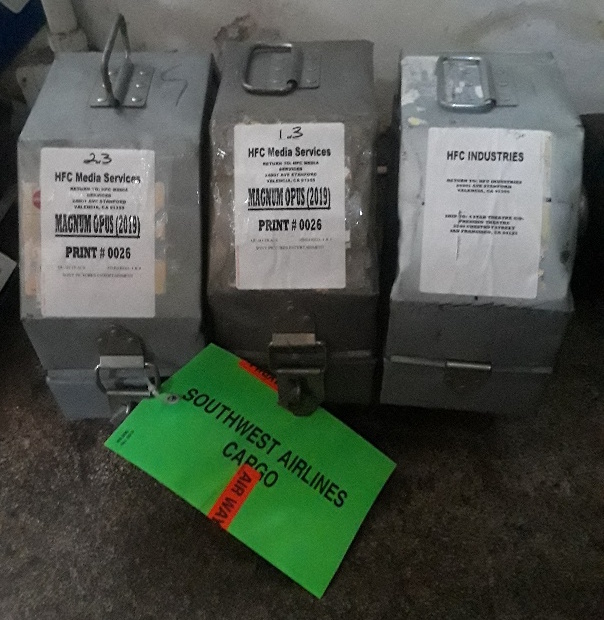
I'm curious about the cue-mark comment made a few posts back.
>Does anyone know if the film has lab-cues on it?
The theater I was at had their print platterized, & I didn't want to
disturb it to look & see. (And I won't have time to watch a show till Sunday)
Posted by Mark Ogden (Member # 43) on 07-26-2019, 07:01 PM:
From Indiewire: Big problems at the Arclight Hollywood last night and this morning. 70mm died halfway thru the midnight show, first show this morning digital all the way. Back to full-on 70mm with 3:00 show this afternoon. No other details, but at least one person had a good riposte. Bravo!
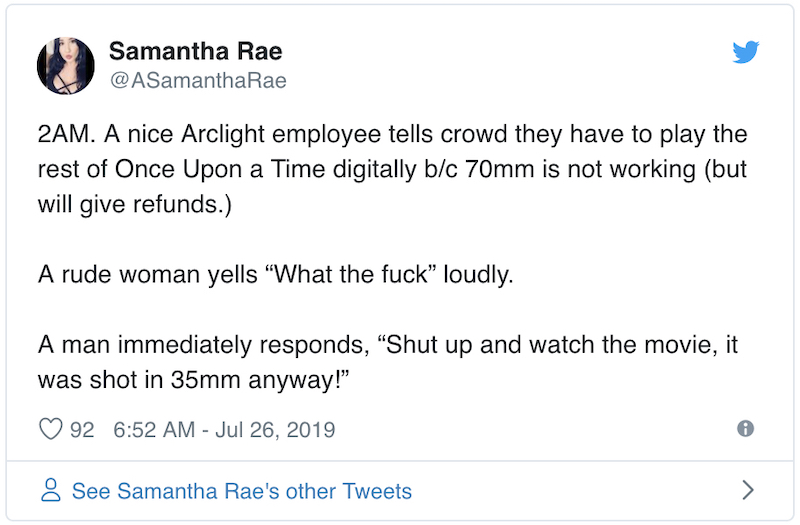
Posted by Terry Monohan (Member # 8285) on 07-26-2019, 07:46 PM:
Saw he movie this morning 7/26 at the 11AM (was to be 70mm showing) at the New Mission in San Francisco. As many of you know they have had problems with their 70mm projectors for two days now.
The manager of the Drafthouse New Mission Theatre sent out nice e mails this morning to tell everyone with 70mm tickets that the projectors are waiting for parts and the new 70mm film will be shown on a digital format today.
This is probably the only movie circuit in the USA 'Drafthouse' that lets the ticket buyers know about the 70mm problem today. They gave everyone a rain check and most of us watched the movie in DCP and It looked and sounded great on their large wide scope screen with curtains that work.
We enjoyed all the pre show trailers/shorts that Drafthouse always does a good job with.
Will try to see it in a few days in 70mm film once they get the old 70mm projectors working again and I hope they get some spare parts this time.
Thanks Jim C for the film print can info photos I think you will enjoy the movie either on 35mm,70mm or DCP.
You need to go to work for Drafthouse New Mission Theatre in SF, I bet with you working for them the old 70mm projectors would be working again with your connections for spare parts and pre run test maintenance.
Lets hope they can get the 'Once Upon A Time In Hollywood' 70mm blow up prints working, as It is the only 70mm showing at this time in Northern CA and It has been locked up in the cans since Thursday!
Posted by Mark Louis (Member # 10632) on 07-27-2019, 09:29 AM:
quote: Terry Monohan
Will try to see it in a few days in 70mm film once they get the old 70mm projectors working again and I hope they get some spare parts this time.
Happy to report that as of the 10:50 show last night we are back up and running with 70mm. It took a little longer because I decided to wait until we could find the correct part to prevent the risk of film damage. We discovered that both JJ soundheads had a modified vertical drive shaft that consisted of a zinc die-cast gear coupler assembly that includes a flexible rubber sleeve. One failed completely and the other was not long for this world, so I did not want to replace them with anything but the original Century flexible steel shaft. This obviously is much tougher to find.
Master technician Matt Leach drove to Oakland and back during rush hours to pick up the part, just to get us back on screen last night. Kudo's Matt, you're one of the best!
Concerning Westminster, I'm working to make 70mm there in the Big Show possible so stay tuned.
Concerning LA, after fighting what we thought was a Dolby 700 reader issue for two days, we discovered that the digital dropouts were actually being caused by the print itself. Replacement prints are hard to come by so we have made sure that any temporary default to SR is as seamless as possible.
Posted by Mark Gulbrandsen (Member # 72) on 07-27-2019, 10:34 AM:
Bel-Court Theater here in Nashville is running a 35mm print. Doubt I'll bother to go see the soap opera though.
Mark
Posted by Leo Enticknap (Member # 534) on 07-27-2019, 11:24 AM:
The LA problem was weird. The SR-D would drop to SR for a few seconds after the changeover to each even numbered reel, and then come back in again. After a lot of investigation of the cat700 penthouse reader on the projector that was exhibiting the glitch, we swapped the reel order, such that the even numbered reels played on the other projector. The glitch moved to the other projector.
My only guess is that the lab used one panel contact printer to create the track dupe negs of the even numbered reels, and another for the odds, or even that two printers were used to strike the release prints itself (one for evens, one for odds).
A DTS/Datasat mix must have been created for the 70, so it's a pity that they didn't put a timecode on the 35mm prints as well. For DTS 35-equipped venues, that would have offered significantly more dynamic range, especially at the high end.
Posted by Stephan Shelley (Member # 8587) on 07-27-2019, 01:46 PM:
BWT Mark those parts that came from Oakland were from my personal stock that an old projectionist and mentor gave to me before he passed away. I was also the one that made the arrangements for the loan of parts from the Presidio Theatre in San Francisco.
[edit]
Leo,
Running a 35mm print at the Grand Lake in Dolby Digital with no issues. Most reel are between 2-4 on error rate. One reel is 5-5.5 but no dropouts.
Posted by David Kornfeld (Member # 9964) on 07-27-2019, 02:33 PM:
I'm running a 35mm print of this as I type.
Print is nine reels, cyan track, SR-D, scope. The Dolby Digital track is 5.1, though the DCP has a 7.1 track. Go figure. There are NO cues at the end of any of the reels; had to scribe my own. There is NO sound distortion, NO dropping down to SR, NO soft focus on the print we have here. If you have seen/heard/experienced these problems, either something is wrong with the equipment, something is wrong with the operators, or something went wrong with the later prints (ours is #16).
From what I was told, one digital master was created & used for all formats (looks 4K to me), so 4K DI to 4K DCP, 4K 35mm IN, 4K 70mm IN. There are the usual problems from going this route, which are especially apparent in the darker scenes. Also, spoiler, 4K is not nearly enough for a full scope frame, but what do I know.
As for those individuals advocating for more 70mm installations: I beg you to stop. As I have mentioned on other threads, the number of people who can run 70mm without introducing damage to the print(s) is frighteningly small. The only thing that will successfully be achieved with an increase in 70mm venues is that the ever-dwindling number of available archival prints out there will be further depleted from damage & destruction from shoddy equipment and/or operator incompetence. I have seen this with my own eyes: prints we received in excellent condition have come back damaged the next time we booked them. This is a situation that is not going to improve.
Please face reality: the vast majority of Hateful 8 prints were wrecked. The vast majority of those recent 2001 prints were wrecked. You can bank that the majority of these Once Upon a Time prints will BE wrecked. And I'd even be willing to bet that a majority of the 35mm prints will also get wrecked.
This is the world we now live in. Cherish it.
Posted by Stephan Shelley (Member # 8587) on 07-27-2019, 04:06 PM:
Grand Lake has print #30.
Posted by Mark Louis (Member # 10632) on 07-27-2019, 04:37 PM:
quote: Stephan Shelley
BWT Mark those parts that came from Oakland were from my personal stock that an old projectionist and mentor gave to me before he passed away. I was also the one that made the arrangements for the loan of parts from the Presidio Theatre in San Francisco.
Thanks Stephan! Real life saver!
Posted by Chris Haller (Member # 9206) on 07-27-2019, 05:48 PM:
I received word from a Facebook friend that The Little made it 3 or 4 reels onto their print before they tossed in the towel and finished the film in digital today.
It’s going to be a rough engagement....
Posted by Stephan Shelley (Member # 8587) on 07-27-2019, 06:10 PM:
Your welcome Mark. I come from an era when theatres would help each other out in emergency even if they were competitors. If the theatre did not have the part needed the projectionist(s) knew who to call and where to find the needed parts.
Posted by Mark Louis (Member # 10632) on 07-27-2019, 06:13 PM:
Getting great feedback about 70mm at New Mission. Other than an additional gear lash adjustment possibly needed on one machine, shows are humming along nicely. In addition to aforementioned Stephan Shelley and Matt Leach, shout out to Sam Chavez, Frank Lee and Matt Pire who were also integral in saving the day. Knowing passionate people in this industry makes all the difference!
Concerning 35mm, I'm reliving my film past with many reports now coming in about possible equipment issues. Now that we're getting more than a few hours on these puppies, noisy intermittents, image unsteadiness, sound drums dragging and sound processor issues are some of what I'm hearing. Hold on to your butts! It's going to be a hell of a ride!
Posted by Steve Guttag (Member # 268) on 07-28-2019, 05:43 AM:
Note, that coupler (I "think" its part number was CG-639 or CG-629...it's been a while). That is what we ran on at the Uptown was the original coupler. Wolk was the only one that was supplying that coupler in later years; Strong never supplied it as a repair part.
Under the various stewardships of Century, it changed to a flex shaft that didn't survive very well and then to a helical type flex shaft and I think that was its last incarnation.
What normally did in the original rubber type was "grease" running down form the projector head via the vertical shaft and soaking the rubber and causing it to pucker up become too soft. The penthouse one (exact same coupler) never suffered from these issues. Its only real stress would be whatever tension was on the supply reel.
Posted by Sam D. Chavez (Member # 1841) on 07-28-2019, 10:28 AM:
Agree with Steve about the cause of the failure, but oil from the intermittent plus grease flow downward to deteriorate the coupling. This does not happen with the magnetic penthouse as gravity is our friend here.
A number of folks on the west coast converted the projectors from direct drive to standard drive as the little shaft seemed awfully wimpy. Which in part is why there are some spare parts available.
Posted by Mark Louis (Member # 10632) on 07-28-2019, 10:45 AM:
I sourced a replacement Gear Grip Flexible Rubber Shaft Coupling from Guardian in Michigan City, IN, and had it shipped in case we couldn't find an original vertical shaft in time. Rubber had definitely been softened over time.
Posted by Steve Guttag (Member # 268) on 07-28-2019, 08:43 PM:
The metal parts never wore out (unless the tech went crazy on the set screws) so only the rubber part would be needed. In many ways, I preferred the rubber coupling to the later incarnations and definitely didn't like the flex shaft thing.
Posted by Mark Louis (Member # 10632) on 07-28-2019, 09:06 PM:
Actually, the metal hubs are die-cast zinc and were noticeably out of round. On the second machine the sleeve didn't fail. Instead, the hub actually started slipping on the shaft as it became oblong and the set screw slipped passed the flat spot on the shaft.
Posted by Tim Androes (Member # 9010) on 07-29-2019, 12:49 AM:
Steve...are the parts you reference different from R31-73 flexible coupling assembly and R50-373?
Posted by Marcel Birgelen (Member # 6801) on 07-29-2019, 01:25 AM:
quote: David Kornfeld
From what I was told, one digital master was created & used for all formats (looks 4K to me), so 4K DI to 4K DCP, 4K 35mm IN, 4K 70mm IN. There are the usual problems from going this route, which are especially apparent in the darker scenes. Also, spoiler, 4K is not nearly enough for a full scope frame, but what do I know.
That doesn't really sound like Tarantino to me. Are you sure the film prints are sourced from the 4K DI?
Posted by Emiel De Jong (Member # 4225) on 07-29-2019, 04:15 AM:
Were the 70mm release prints of Hateful Eight not also from a 4K DI ?
Posted by David J Hilsgen (Member # 2614) on 07-29-2019, 04:27 AM:
Everything's running fine in 35mm with a Dolby cp-650 and a cat 701 reader in Minnesota at Emagine Willow Creek the old simplex 35/70 1987 vintage Been chugging right along ,I have been running it for 30 years since I installed it ,in 1989 when the theater opened
Posted by Chris Haller (Member # 9206) on 07-29-2019, 11:43 AM:
quote: Emiel De Jong
Were the 70mm release prints of Hateful Eight not also from a 4K DI
Hateful Eight was photochemical from end to end. A 4K scan of the film was used as a means for generating the DCP and other digital versions of the movie.
Once Upon a Time in Hollywood was shot on 4-perf with anamorphic lenses, finished digitally in 4K, and then that 4K master was filmed out for 35mm and 70mm print runs.
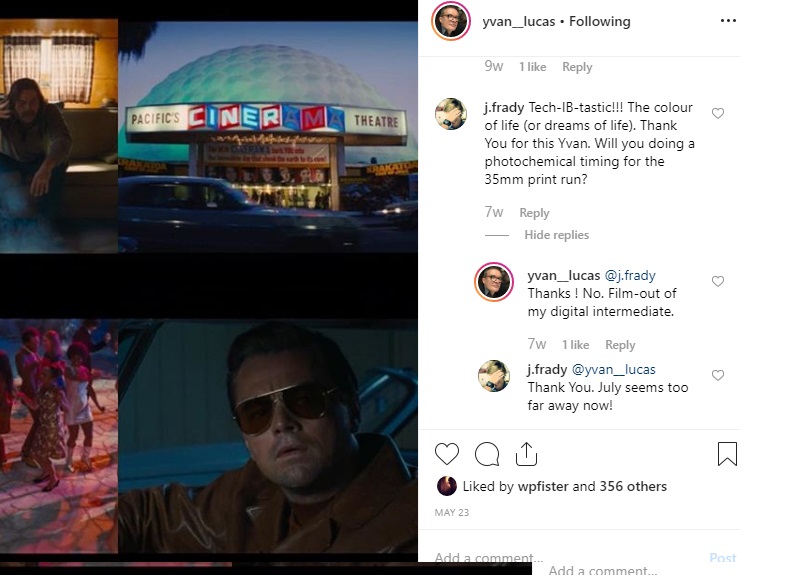
Posted by David Kornfeld (Member # 9964) on 07-29-2019, 01:00 PM:
Anyone who claims that the colour in this movie resembles the look of IB Tech is either blind, mistaken, or stupid.
Perhaps all three.
Whats lacking? Well, the deep blacks, the high gamma, the gleaming whites, the bang-on flesh tones (one of the glories of the process), the controlled contrast, the absence of blown-out highlights, the trademark red, the saturated colour, & the shadow detail.
Other than those, sure, just like Tech. On a bad day. In 1982.
Posted by Chris Haller (Member # 9206) on 07-29-2019, 02:06 PM:
Just so we’re clear, none of those comments belong to me! Just wanted to lock down the discussion on the DI.
Posted by Emiel De Jong (Member # 4225) on 07-29-2019, 03:41 PM:
I would like to lock down discussion about DI on 70mm prints of H8 too; in fact I really want to know what happened... One very knowledgable lab person in the Netherlands stated those prints were from a DI. I saw the Amsterdam 70mm print in "Eye" Filmmuseum; though I have seen some film in my life I wasn't really sure about this. It was sharp, colors were from time to time really red and yellow (the outfit of Mr. Jackson...) but in general it was not the abundant imagery of old-fashioned Photochemical in my opinion. Could have been the snowy landscape ;-) Really would appreciate some detailed information.
Posted by David Kornfeld (Member # 9964) on 07-29-2019, 04:15 PM:
Mr De Jong:
Mr Haller (above) is correct when he writes that H8 was photochemical all the way through. It should be noted that it was planned that way.
The 70mm prints of H8 went the standard release print route: OCN to IP to IN to print. The "very knowledgeable lab person in the Netherlands" is mistaken.
Hope that helps!
Mr Haller: Wasnt accusing you! ![[Smile]](smile.gif)
Posted by Tyler Purcell (Member # 9213) on 07-29-2019, 05:36 PM:
The DCP looked pretty good, but it looked like a modern movie. I didn't feel for a second it was shot in the 70's. Even the lensing was too damn crisp for the vintage.
Had it been MY movie, I would have shot the entire thing with 50D and 200T for night scenes. I would have used very vintage glass and never once resorted to modern cranes or jib's with stabilizers. No steadicam, no smooth shots, make it really rough and if ya have crane shots, make it possible to do with old school studio cranes, with the shake and everything.
Then in post, 100% photochemical finish. Cut the original negative and experiment with different coloring methods to get the look with printer lights. Then the colored IP would be used to make a 35mm IN and 70mm IN blowup.
Because there were so many digital shots in the film, cleanup work and such, it would be very difficult to do a photochemical finish at low cost. Laser-out's are way less money because you can get precice finishes without worrying about striking a bunch of answer prints and re-tweaking constantly. It's a no-brainer to do a digital finish these days, but there goes your "look" the moment you do so.
Posted by Steve Guttag (Member # 268) on 07-29-2019, 06:16 PM:
Marcel,
The ones I didn't like where the R50-372 and the mating one for the penthouse.:
The one that had the rubber coupling is the CG-629 (looked it up). I don't know if we have any scanned manuals that have it and if we do, that doesn't mean that there is picture of it (Century wasn't the best at that and they were mostly hand drawn).
Posted by David J Hilsgen (Member # 2614) on 07-29-2019, 09:10 PM:
Emagine Willow Creek in Plymouth Minnesota is going to hold for another week on the 35mm
Posted by Geoff Jones (Member # 3668) on 07-29-2019, 09:14 PM:
@Mark Louis, my brother reports that the “presentation was astounding” at the New Mission in SF on Sunday night. Kudos.
And thank you for your continued efforts to bring film to the Big Show auditorium in Westminster.
Posted by Jean-Pierre Gutzeit (Member # 7275) on 07-30-2019, 10:42 AM:
It should be a matter of honour to preserve the cultural technique of film against the virus-like digitalisation of the living worlds as expertly supervised and appropriately endowed practice. The high potential of film does not have to be explained separately.
But what should we do if, in the last 15 years, there has been a reduction in the number of staff in all existing film laboratories without exception and the specialist knowledge is increasingly disappearing? The reason for this is, of course, today's lower order situation, but also further cost reductions in process flows or the additional answer prints required.
Despite the reference to the fact that the Kodak Image Process still exists, I experienced the premature termination of this process in Europe. Unfortunately, however, American film prints also show errors and deficits that would have prevented them from being accepted twenty years ago.
That is why I suspect that one of the biggest problems is the lack of active participation of the cinemas, other professionals, the film distributors and the filmmakers themselves, which led to this result.
There is no critical public on this subject because, as defenders of the film process, we fear that too harsh a criticism could lead to the suspension of all further film commissions.
In the last 15 years unfortunately almost without exception was the "trademark" of 70mm copies:
- unbalanced light determinations, lack of scene compensation, incorrectly filtered basic tuning of the printers
- false gradation, dropping or discolored shadows
- yellow-green colour cast
- disappointing sharpness and resolution of the 65mm Intermediates
- slight image uncleanliness and negative rainfall
"Hardly a difference to 35mm" was often heard.
Posted by Scott Norwood (Member # 30) on 07-30-2019, 01:07 PM:
One thing that I can say for this is that the 35mm print that I have shown was exteremely steady, with no vertical movement or "bounce" at all. I'm wondering if the prints were made off of the DI negative(s) directly, without the IP/IN stages in between. Were they?
The lack of printed lab cues might be a clue to this as well.
Posted by Chris Haller (Member # 9206) on 07-30-2019, 01:19 PM:
quote:
One thing that I can say for this is that the 35mm print that I have shown was exteremely steady, with no vertical movement or "bounce" at a
This is the second person who's made this claim, which makes me think my experience here in Rochester was operator incompetence.
The Little ran their trailer pack on digital, and then cut to the film's opening production titles. The Sony logo looked like it was having a seizure of some sort.
Posted by Scott Norwood (Member # 30) on 07-30-2019, 02:11 PM:
Or maybe they had multiple printing negatives and one or more of them has problems? I'd be curious to see what Foto-Kem has to say about the postproduction process, especially since they normally do very good work--way better than what was coming out of Deluxe and Technicolor Hollywood in the mid-2000s.
Posted by Sean McKinnon (Member # 612) on 07-30-2019, 02:41 PM:
From what I saw the "Show" prints as well as the regular release print test reels were extremely steady on both our FP10A's and a Simplex millenium in hollywood
Posted by Marcel Birgelen (Member # 6801) on 07-31-2019, 12:57 AM:
If it's true that the 35mm and 70mm film prints originate from the same 4K DI as the DCP, then I don't know what all the fuss is about this being presented in film. It's more of a Tarantino vanity project, a half-misplaced nostalgic thing.
I haven't seen the movie yet, since it's not been released here yet, but if it's true, then I wouldn't even dare to run this in 35mm or even 70mm. If the 4K DI is the master, then all color timings were done on that. The closest thing to the 4K DI is the 4K DCP. It doesn't only have the superior image, as it involves less duplication steps (it's essentially a single step conversion of a lossless 12 bit format into a lossy, but still high quality 12 bit M-JPEG2000 format), it also has the superior sound...
Posted by Steve Guttag (Member # 268) on 07-31-2019, 05:16 AM:
...but not the superior contrast.
However, yes, if it is a 4K DI, digital is going reproduce that, color and resolution wise as precise as it can be. Only the particulars of projection digitally will degrade it.
Posted by Jean-Pierre Gutzeit (Member # 7275) on 07-31-2019, 05:55 AM:
The frame steadiness at MURDER ON THE ORIENT EXPRESS and PHANTOM THREAD in70mm was excellent, the sharpness of the dup at PHANTOM THREAD also good. However both titles had a bad photographic quality, which was corrected in the home cinema editions (Blu ray). The same with DARK KNIGHT and DARK KNIGHT RISES in 70mm vs. Blu ray.
When 35mm was printed on traditional Bell and Howell Model C at 480 feet per minute, the picture steadiness on contact machines since 1962 was also excellent. Panel printers like BHP 7700 HD continuous motion contact printer, they was designed primarily for high-speedrelease printing, was modified for illegal speed up to [xxx] fpm in some english laboratories since the mid of 90s.
Unfortuntaly HATEFUL 8 and INTERSTELLAR in70mm had a not very satisfying picture sharpness (I have seen many hundreds of classic 70mm prints of the 60s for comparision), showed a lack of unsatisfied balanced scene by scene color correction. In 2001: ASO the color and gradation were an absolute catastrophe in the last 70mm version from 2018, but also on the home cinema media. The look of the most titles was similar to the earlier Eastern European Orwocolor prints.
Five years ago, we wondered how the filmmakers in question could go through the full analogue process from original negative to intermed positive, intermed negative and release print (Nolan, Almodovar, Tarantino) without making any compromises, and sooner or later be forced by post-production to accept the Digital Intermediate Process with certainty. This has now been proven true at ONCE U.A.T.I.H.
By the way, the fully analog 70mm film prints of HATEFUL 8 and INTERSTELLAR already looked as bad in color as they did from Digital Intermediate between 2000 and 2013. But here we also know from the history of the European labs that bottlenecks and under-budgeting also led to cheating: this is unavoidable in our industry.
A question: Were there struck 70mm film prints of the 65mm original negative of HATEFUL? One heard, it could have been six to ten prints? I have never seen such a print.
I don't know of similar substandards from DeLuxe and Technicolor, although Technicolor had recently declined very much. But Burbank is in my eyes the lowest point of 70mm print quality and standards. As said a "Orwocolor" look.
Posted by Emiel De Jong (Member # 4225) on 07-31-2019, 08:24 AM:
quote: Jean-Pierre Gutzeit
By the way, the fully analog 70mm film prints of HATEFUL 8 and INTERSTELLAR already looked as bad in color as they did from Digital Intermediate between 2000 and 2013.
And that's what got me wondering while watching HATEFUL 8. Maybe it has something to do with the original negative (Vision 3) being designed for DI and not for traditional finishing ? Three years ago I had some Vision3 50D printed directly and the soft, pastel, "digital" colors amazed me (in a bad way) and could definitely not be corrected by traditional color correction. I was told Fuji made a print stock to correct this effect but that print stock was long sold out.
Posted by Mark Ogden (Member # 43) on 07-31-2019, 08:42 AM:
quote: Marcel Birgelen
. . . If the 4K DI is the master, then all color timings were done on that. The closest thing to the 4K DI is the 4K DCP.
That's not necessarily true. The practice when film prints are planned to be made from a digital file is to create a seperate color-timed version of the file (a "deliverable" in industry terms) that takes into account the reproduction characteristics of the film stock. There are color management systems associated with digital color grading that include look-up tables for such things as Kodak 2383, and I have a feeling that Tarantino and Robert Richardson carefully tested and signed off on the 35/70mm release by viewing an in-theatre projection, or at least I hope they did, knowing how meticulous they are about image quality. I saw a 35mm print yesterday, and while I haven't seen a DCP of this yet to compare it with, I doubt highly that there was enough of a discrepancy between the two color-wise to make a difference.
quote: Jean-Pierre Gutzeit
In 2001: ASO the color and gradation were an absolute catastrophe in the last 70mm version from 2018, but also on the home cinema media.
Everybody knew that the last 70mm release of this title was warts-and-all, a final attempt to release pure-play photochemical prints from worn elements. It was a very successful release, by the way. I don't know what was released there in Germany home video wise, but my BluRay of the 2018 restoration looks damn good.
Posted by Bobby Henderson (Member # 840) on 07-31-2019, 10:19 AM:
quote: Steve Guttag
...but not the superior contrast.
Steve, how do you think laser-based systems, such as the ones in Dolby Cinema theaters or IMAX with Laser compare to 35mm or 70mm contrast?
quote: Jean-Pierre Gutzeit
Unfortuntaly HATEFUL 8 and INTERSTELLAR in70mm had a not very satisfying picture sharpness (I have seen many hundreds of classic 70mm prints of the 60s for comparision), showed a lack of unsatisfied balanced scene by scene color correction.
One obvious difference between 50+ year old classic movies on 70mm and the more recent films from Christopher Nolan: low depth of field. So much of the 65mm footage in Nolan's films, from The Dark Knight to Dunkirk, was shot in light-starved conditions with the aperture opened up wide, yielding a very narrow plane of focus. Even in scenes with bright daylight, such as the beginning of The Dark Knight as the camera dollies toward Joker's back and his mask, the 15/65mm image still has low DOF. The end results are images with fleeting levels of 70mm quality sharpness.
When I think of classic 50+ year old movies shot on 65mm film I think of scenes shot on big sound stages with plenty of light or outdoor scenes in bright daylight. A bunch of the night time scenes in Lawrence of Arabia were shot in daylight (a common practice back then).
Posted by Martin Brooks (Member # 1269) on 07-31-2019, 10:42 AM:
quote: Tyler Purcell
The DCP looked pretty good, but it looked like a modern movie. I didn't feel for a second it was shot in the 70's. Even the lensing was too damn crisp for the vintage.
So? If was supposed to take place in 1910, should it have been in black and white with soft focus, low contrast and vignetting?
I'm seeing it tomorrow, but the funny thing is that when I saw the trailers (in a theater), it DID look like a movie from the 70's with somewhat washed out color and a bit soft and grainy. (It doesn't look that way in the TV spots.) And I thought that was a mistake. Just because it takes place in the past doesn't mean it has to look like a film print from the past.
Posted by Marcel Birgelen (Member # 6801) on 07-31-2019, 03:22 PM:
quote: Bobby Henderson
Steve, how do you think laser-based systems, such as the ones in Dolby Cinema theaters or IMAX with Laser compare to 35mm or 70mm contrast?
I'm not answering for Steve, but this is my own experience:
A proper RGB laser setup like a Barco 6P system is comparable to the contrast of a good 35mm projection, one with a sufficiently sized lamp.
A Dolby Vision setup will not beat the resolution of 70mm, but it will beat the contrast of 70mm projection, at least at the screen sizes currently used. If it can beat 15/70 on proper IMAX sized screens remains to be seen. I guess the current Dolby Vision projectors / light source combos (Christie only) are unable to produce light levels sufficient to fill those screens.
The remaining problem nowadays is ambient light due to a mixture of local codes and people not giving a flying #@$5 to keep the ambient light away from the screen.
My experience with lasersharktank-IMAX is limited, but bad. Distracting speckle all over the place, bad contrast, bad focus and pixel-soup all over the screen, due to the enormity of the screens. I've only ever seen it in action in former "documentary" 70mm venues (those with the real huge screens). It's the most convincing example of 4K laser not being able to replace proper 15/70 film in terms of pure resolution and and apparently also not in contrast.
quote: Mark Ogden
That's not necessarily true. The practice when film prints are planned to be made from a digital file is to create a seperate color-timed version of the file (a "deliverable" in industry terms) that takes into account the reproduction characteristics of the film stock. There are color management systems associated with digital color grading that include look-up tables for such things as Kodak 2383, and I have a feeling that Tarantino and Robert Richardson carefully tested and signed off on the 35/70mm release by viewing an in-theatre projection, or at least I hope they did, knowing how meticulous they are about image quality. I saw a 35mm print yesterday, and while I haven't seen a DCP of this yet to compare it with, I doubt highly that there was enough of a discrepancy between the two color-wise to make a difference.
I don't want to be the petulant child here, but to be honest, it would be the least I'd expect that they would make a color-corrected DI or "correction map" for the film prints, so the colors in the film prints end up being as close to the DI and therefore the DCP as possible.
Still, the DI, in this case, is the master, the way the movie is supposed to look and the version that adapts for errors in the printing process is just nothing more than a purposely color corrected version.
And like Steve also pointed out, you won't get any extra resolution by copying/printing a "digital master" to an analog medium, even if this analog medium would have a far greater resolution than the digital medium. Also, it involves at least two more duplication steps, none of which adds any resolution but only adds potential errors.
Posted by David Kornfeld (Member # 9964) on 07-31-2019, 03:41 PM:
quote: Jean-Pierre Gutzeit
A question: Were there struck 70mm film prints of the 65mm original negative of HATEFUL? One heard, it could have been six to ten prints? I have never seen such a print.
An answer: ONE print was struck off the OCN. And it was destroyed on its first & only (attempted) play at a critics' screening in New York.
Posted by Mark Louis (Member # 10632) on 07-31-2019, 04:06 PM:
quote:
@Mark Louis, my brother reports that the “presentation was astounding” at the New Mission in SF on Sunday night. Kudos.
Thanks for the feedback! Good to know as it was a true labor of love getting that back on screen. Concerning the talk of unsteadiness, all 19 of our film screens are reporting very steady images. I have to admit, I have not had time to actually see the 35mm on screen yet but I'll be at our new LA location next week to judge image quality for myself.
A few interesting print issues of note, one location had a digital dropout in the exact same place at the beginning of only the even number reels. Water marks have been noticed on some reels and one customer complained of "registration errors". Misplaced negative sound sync pips are also noticeable on some reels immediately after changeover.
Posted by Sascha F. Roll (Member # 9043) on 07-31-2019, 05:39 PM:
I wonder if Q.T. watched THE LOVE WITCH in 35mm (with really good projection equipment) - if he did so he should know how darn good a modern 35mm photochemical finish can look. (And they tried all that crazy stuff while shooting to give it a 60s look, vintage lenses diffusion filters etc.. To make it less sharp and give it an ancient look. It still looked absolutely spectacular.)
Posted by Emiel De Jong (Member # 4225) on 08-01-2019, 05:34 AM:
If you search "Increase contrast photochemically" (search with the "" ) on cinematography.com you'll find that cinematographer David Mullen has some interesting things to say about how he got his contrast and saturation for The love Witch.
I couldn't be there when The Love Witch played in a festival in Amsterdam but I know now I should have cancelled my other appointment... hope to still see it on 35mm one day.
Posted by Leo Enticknap (Member # 534) on 08-01-2019, 07:47 AM:
quote: Emiel de Jong
Maybe it has something to do with the original negative (Vision 3) being designed for DI and not for traditional finishing ?
Ironic, isn't it? Film purists make repeated claims about the uniqueness of the photochemical aesthetic, and then go and use a stock, the formulation of which is designed to mimic the look of digital!
As for The Love Witch, I agree that the visuals were very stylish, but that movie is yet more proof of Enticknap's Law: the higher the technical quality of the print being viewed, the lower the quality of the actual movie (writing, acting, direction, etc.) is likely to be.
Posted by Marcel Birgelen (Member # 6801) on 08-01-2019, 04:51 PM:
quote:
As for The Love Witch, I agree that the visuals were very stylish, but that movie is yet more proof of Enticknap's Law: the higher the technical quality of the print being viewed, the lower the quality of the actual movie (writing, acting, direction, etc.) is likely to be.
Damn, somebody should strap that Enticknap guy on a rocket and fire it directly into the sun, maybe together with that other guy called Murphy. Don't you think?
But yes, "The Love Witch" was a beautiful film to look at, but a terrible movie to watch. ![[Razz]](tongue.gif)
Posted by Carl Martin (Member # 1146) on 08-02-2019, 03:41 AM:
i thought of the love witch when i saw samantha robinson's name in the credits of ouat(...)i(...)h this morning. while i like it, it's a flawed film, particularly as it's wrapping up and there's an awkward scene between her and the cop in a bar that seems like it was censoriously edited to the point that noone's motivations make any sense. that may be the point but it doesn't really come off right.
anna biller's previous film viva, however, is an out-and-out masterpiece and utterly sumptuous to look at.
Posted by Martin Brooks (Member # 1269) on 08-02-2019, 02:22 PM:
Saw this yesterday at an AMC Prime theatre in digital and I thought it looked (and sounded) absolutely fine. It didn't look like 3-strip Technicolor, but it wasn't meant to. I can't decide whether I want to sit through it again to see what the 70mm looks like, which wouldn't be an apples-to-apples comparison anyway because the theaters are so different.
Three nitpicks: The TV shows were not in a 4:3 AR - they were actually taller than they were wide...strange choice. Hullabaloo was widescreen and should have also been 4:3, unless the rationale was that we were watching them in the studio and not on a TV (and while there were a few episodes shot in L.A., most were shot in Brooklyn), and most of the KHJ audio was full fidelity (and some in stereo) instead of what it really would have sounded like in a car with an AM radio in 1969, although certainly playing the music in full fidelity gave it more emotional impact. One could also ask whether the characters in the newer cars wouldn't have actually been listening to album rock on FM in that era. FM rock radio had been around since the summer of '66.
Personally, I don't like Tarantino's apparent obsession with changing history, although it bothered me much more in "Inglorious Basterds" than it did here for reasons I can't explain.
I have to wonder how many younger people will see this and not realize that this is about Manson and the Tate-Labianca murders or now believe that Tate and the others weren't actually murdered.
Posted by Leo Enticknap (Member # 534) on 08-02-2019, 02:59 PM:
Will look out for the other Anna Biller pic - thanks.
Feel a bit guilty about slagging off The Love Witch, because I showed it in 35mm at the Aero a few years ago and met her - she couldn't have been more charming - the complete opposite of a stereotypical a-hole movie director. But I did remember thinking that the film itself was visually beautiful, but in every other respect, an overhyped chick flick.
quote: Martin Brooks
Personally, I don't like Tarantino's apparent obsession with changing history, although it bothered me much more in "Inglorious Basterds" than it did here for reasons I can't explain.
I haven't seen Once Upon a Time... yet, but my initial reaction is the opposite. I guess that there is so much fiction about the Nazis and WWII already out there - everything from sh!t lit novels to video games, and of course a vault full of movies - that one more example to add to is isn't going to do much harm (as long as it doesn't make a serious attempt at Holocaust denial). Added to which, very few participants in WWII are still alive to be upset by it, and Tarantino's parody of a Nazi entertainment film is hilariously funny and very accurate. I had to watch lots of them as a student, and the movie within a movie is spookily accurate in capturing the atmosphere of a Karl Ritter or Veit Harlan propaganda pic. Tarantino must have seen lots of them, too.
But the Manson gang murders are still pretty recent, most of the protagonists are still alive, and AFAIK, have not been used as the inspiration for any history-rewriting fiction so far, which makes me feel a bit uneasy about the idea. Still, I'll try to reserve judgment until I've had a chance actually to see the movie. One scene was filmed in a drive-in that I service (the Bianchi drive-in in Paramount, CA), so I'd be intrigued to see it, just for that reason. I was on vacation during the week that this all happened, but am told that he brought a 35mm projector in for the shoot.
Posted by Jean-Pierre Gutzeit (Member # 7275) on 08-02-2019, 05:45 PM:
Missing DTS and SDDS track?
Posted by Harold Hallikainen (Member # 5405) on 08-02-2019, 06:23 PM:
The DTS time code discussion got me thinking. SMPTE ST 430-12 is a Frequency Shift Keyed synchronization signal on Atmos soundtracks that is used by the CP850. It includes the Edit Unit Index (frame number) and UUID. I wonder about putting this in an optical track on film. A CP850 could pull the Atmos bitstream (SMPTE ST 2098-2) from a USB drive, decrypt it, and synchronize with the FSK signal from the film. The Barco APX uses the SMPTE ST 430-14 binary sync signal, so that would not work with film (unless they wanted to add an FSK decoder).
Anyway, DTS timecode on film is interesting...
Harold
Posted by Sean Weitzel (Member # 244) on 08-02-2019, 07:11 PM:
SDDS hasn't been printed on 35mm releases for a long time. The last 35mm title I personally handled with SDDS on it was Gravity (2013). The last title sdds.com listed on their sdds database was 47 Ronin which was a february 2013 release. The website died shortly thereafter. Gravity was an October release. It's entirely possible that was one of the last releases with an SDDS track.
Posted by Marcel Birgelen (Member # 6801) on 08-02-2019, 07:32 PM:
quote: Harold Hallikainen
The DTS time code discussion got me thinking. SMPTE ST 430-12 is a Frequency Shift Keyed synchronization signal on Atmos soundtracks that is used by the CP850. It includes the Edit Unit Index (frame number) and UUID. I wonder about putting this in an optical track on film. A CP850 could pull the Atmos bitstream (SMPTE ST 2098-2) from a USB drive, decrypt it, and synchronize with the FSK signal from the film. The Barco APX uses the SMPTE ST 430-14 binary sync signal, so that would not work with film (unless they wanted to add an FSK decoder).
A system largely built on plain consumer hardware could sync with film-based time-code about 25 years back, so there is no technical reason why a modern decoder could not do the same. One of the companies that Dolby acquired (ImmSound) actually used MDA files stored on an internal hard disk and their files had to be separately ingested.
Posted by Stephan Shelley (Member # 8587) on 08-02-2019, 08:25 PM:
The clips shown of the spaghetti westerns were 1:37 but the poster of same film says scope. Sounds like an opps to me. Not to mention all the real spaghetti westerns I showed were scope.
Posted by Bobby Henderson (Member # 840) on 08-02-2019, 11:14 PM:
I still want someone to make a modern CDS playback system. C'mon now! I know someone out there can do it! Can they?
![[Confused]](confused.gif)
Posted by Martin Brooks (Member # 1269) on 08-03-2019, 12:34 PM:
quote: Bobby Henderson
I still want someone to make a modern CDS playback system. C'mon now! I know someone out there can do it! Can they?
Do any CDS prints still exist? If they don't, what would be the point? By my count there were a max of only 10 CDS releases (some historians dispute whether all of these were released in CDS). Only two of them weren't also released in 70mm 6-track Dolby mag. So if those mag masters still exist, they could be reprinted in either film or digital. The exceptions are "Hudson Hawk" and "Universal Soldier", both of which were only released in 35mm and probably in mono, the latter being the last CDS release.
I saw some of those CDS releases, including the first one, "Dick Tracy". I remember the sound being quite brittle and harsh, but it didn't play in the best theater.
Posted by Carl Martin (Member # 1146) on 08-03-2019, 01:40 PM:
quote: Harold Hallikainen
A CP850 could pull the Atmos bitstream (SMPTE ST 2098-2) from a USB drive, decrypt it, and synchronize with the FSK signal from the film.
arclight hollywood advertises some shows as being both 35mm and atmos so either they're doing something like this or they're full of shit.
Posted by Marcel Birgelen (Member # 6801) on 08-03-2019, 01:55 PM:
Though luck, the movie doesn't even have an Atmos mix...
Posted by Adam Martin (Member # 641) on 08-03-2019, 10:24 PM:
OnceUponATimeH_FTR_S_EN-XX-CCAP_OV_71-HI-VI-Atmos_4K_SPE_20190718_DTB_SMPTE_VF
Posted by Marcel Birgelen (Member # 6801) on 08-04-2019, 12:21 AM:
So, what was the reason for 35mm again?
And does it really have Atmos? And if it does, does it have more than just the 5.1 stems in them?
Then again, syncing Atmos and 35mm is pretty much impossible, without cooperation from Dolby. You'd require a compatible server that can operate headless, because the CP850 won't read a DCP from some USB stick. Then you still would need to sync the server to the 35mm projector. While there is a way to sync some of those servers via dual-projector support options, those interfaces aren't really open and documented.
Posted by Bobby Henderson (Member # 840) on 08-04-2019, 04:32 PM:
quote: Martin Brooks
Do any CDS prints still exist? If they don't, what would be the point?
Aside from the joke, I would be a little surprised if all existing 70mm and 35mm CDS prints had been junked or destroyed. Nevertheless someone would need a working CDS system in order to play any of those prints. It would be interesting to see what would happen if someone made a new film reader using current era components rather than the circa 1990 stuff that went into the CDS readers. Would playback be more reliable? I guess there's not much point in finding out since merely playing a CDS print would put it in jeopardy.
Posted by Jean-Pierre Gutzeit (Member # 7275) on 08-04-2019, 04:51 PM:
https://m.soundcloud.com/upintheboothpodcast/the-return-of-35mm-70mm-film-in-2019
Posted by Sean McKinnon (Member # 612) on 08-05-2019, 11:14 AM:
Bobby, I think the biggest contributor to CDS failures was overheating of the processing unit. It is quite possible that a modern design of this system would yield better results. I think SDDS was based on CDS so that should give some indication.
Posted by Marcel Birgelen (Member # 6801) on 08-05-2019, 03:55 PM:
Optical digital scanners have enormously improved since the early 1990s. Every modern smartphone has one we only could dream off back then.
Also, CDS had a bandwidth of about 5.1 MBps including error correction. You could do the processing of that in software nowadays. No need for expensive, customized hardware.
You would still need the internal documentation of the CDS implementation. And why recreate CDS, if you can do something better with current tech?
I still think that if you want to bring modern digital sound to projected film, you should use a timecode based solution just like DTS. Files should no longer be on CD-ROMs, but simply digital downloads or "ingestables" like DCPs.
DTS-X could easily become the new MDA for 70mm, but with an install base so small, it's hard to convince anybody to put in the money to do it, even if the amount of R&D you'd have to put into it would be manageable. Nobody is going to invest any considerable money if your potential market is maybe 75~100 units at best.
The only reason why DCI is still a business, is because it can use existing technology as its base. Still, the customizations needed specifically to be DCI compliant make it an expensive niche.
Posted by Leo Enticknap (Member # 534) on 08-05-2019, 04:04 PM:
Rather than do all this reinventing of the wheel and/or trying to resurrect flawed 1990s technology, why not simply come up with a way of synchronizing the film projector to the playback of DCP audio from a media block?
You would need some kind of a box that takes the output from the DTS timecode reader(s), and from an LTC output on the media block, processes those two streams, and then controls an AC inverter on the projector in order to keep the two in sync. I'm not enough of an electronic engineer to be able to create such a thing, but the R & D involved shouldn't be a showstopper, as far as I can see.
The only serious gotcha I can think of with such an arrangement would be the film and DCP versions were substantively different (e.g. logos on the front of one that weren't on the other), but if the release was being properly co-ordinated, it would surely be possible to avoid doing that.
Posted by Paul H. Rayton (Member # 1817) on 08-05-2019, 04:06 PM:
Regarding CDS: I know that at least one or two of the original CDS 70mm demo reels still exist, in the vaults at AMPAS (the Academy). Each ran around 10 minutes. I'm not sure if AMPAS has any of the original playback equipment, but some processors were still around ... but that was ~10 years ago. I also recall that, back when DTS was still in business under their own name, one of their techs also had some of the original playing equipment, too. I haven't heard anything about any of that equipment recently, though I haven't asked anyone. It's possible something could be found. Making it work? A true "science project!"
Posted by Thomas Hauerslev (Member # 566) on 08-06-2019, 01:04 AM:
"the original CDS 70mm demo reels" = title was "Sounds Like The Real World"
https://www.in70mm.com/library/process/cds/index.htm
https://www.in70mm.com/news/2017/cds/index.htm
Plus a comment to Bobby on one of the previous pages:
"When I think of classic 50+ year old movies shot on 65mm film I think of scenes shot on big sound stages with plenty of light or outdoor scenes in bright daylight.
"LOA" was photographed on 12 ASA film stock.
Posted by Sean McKinnon (Member # 612) on 08-06-2019, 11:48 AM:
I think i've mentioned this before but I have a simple concept for how to achieve Atmos playback synced to 35 or 70mm film using all "off the shelf" type components that are readily available at plex's running 70mm and some support from the studio and Dolby.
Posted by Mark Gulbrandsen (Member # 72) on 08-06-2019, 07:47 PM:
quote: Sean McKinnon
I think SDDS was based on CDS so that should give some indication.
The CDS processor would run very hot, but if the front was left open for better air flow it could be stable. What killed most screenings was there were no fall back tracks AT ALL. They would run fine for a few days, or a dozen shows or so but then could not be reliably read back. Some of CDS and some of the people there did become SDDS.
SDDS was also a YUGE failure overall with short print life spans in many locations causing reversion to analog and back to digital and back to analog and so on. Had they put a latch in to hold it in analog once it reverted then it wouldn't have been so annoying. The 2000 readers were a big part of the problem as was getting partslike LED's, sprockets and lateral guide rollers. There was a whole year where you literally cold not get any of those parts. We finally had LaVezzi make us custom sprockets. The real down side of it was the high track wear. There was no more room left on a 35mm width of film to move it some where else. But it did sound very good the first few weeks of the runs. We finally replaced all the 2000 units with CP-650's and laid them to rest in the electronic bone year. The 3000's were a lot better until the parts for those ran out.
Syncing somethig SMPTE to DTS is very easy with the right tools.
Mark
Posted by Sam D. Chavez (Member # 1841) on 08-07-2019, 01:51 AM:
Roger Hibbard was part of the CDS team and later a senior engineer at USL told me one of the big failings was very poor depth of field. Even little particles of splicing tape could knock the film out of focus and with no backup all was lost. Very arrogant approach but they had their chance and blew it.
Posted by Steve Guttag (Member # 268) on 08-07-2019, 07:39 AM:
With SDDS, they learned to to stagger the tracks so splicing tape wouldn't take the system down since "the other" track was at a different part of the audio.
I didn't have the problems with SDDS that Mark had. We had 2000 and 3000 series systems. It was nowhere as stable as Dolby or DTS but it could be run reliably for weeks on end. The 2000 series reader was too delicate. It could be put into precise alignment but that required effort and the tiny screws were poor at holding it in alignment. Poor platter back tension (if you had an AW3 with those center roller springs that could jerk the film was more than it could overcome).
The 3000 series reader had a really terrible design with their magnetic clutch. Way too much tension (probably to combat unstable platter tension from some platters as mentioned above) that would wear the butter-like aluminum sprocket down, that was also overly expensive. The LED/Reader part was MUCH more stable than the 2000 series readers. The Reader cables were overly complicated and sensitive to hot-plugging (would damage the system.
And shame on Sony for trying to force a "dB" scale fader (which on the 2000 series took about 100 turns). dB scales only make sense internally when calibrating...they have no real-world meaning to end users that just want to make the sound a little louder or a little quieter. Percentage wins the day there.
Posted by Scott Norwood (Member # 30) on 08-07-2019, 12:03 PM:
One of the things that Dolby got right that Sony didn't was the error counter display. It is useful to know when the digital track is marginal before it fails completely. SDDS tracks are (were?) sufficiently problematic that lab-new prints regularly fail to play properly in the format. I only ever used the 2000-series units; maybe they added an error counter later?
Anyway, I haven't touched SDDS anything since 2003-ish, and never want to see it again.
Posted by Steve Guttag (Member # 268) on 08-07-2019, 12:18 PM:
On the rarely seen DFP-D2500, they did have a display of the "quality" of the SDDS tracks...it was a simple yellow, green, red but better than nothing.
Posted by Scott Norwood (Member # 30) on 08-07-2019, 12:31 PM:
Interesting. Sony VTRs for digital formats use something similar to indicate "channel condition" (more-or-less the video equivalent to the SRD error rate, I think). Good tapes show green and marginal tapes show yellow. I have never seen a red indicator.
Posted by Jean-Pierre Gutzeit (Member # 7275) on 08-09-2019, 06:45 PM:
For spatial vision, a deep-sharp photography, which also takes on the character of a relief through the art of lighting, is of formative importance, thus suggesting an immersive effect. Thank you for reply. I absolutely agree with that.
In David Lean's films is that at least since OLIVER TWIST evident.
With LAWRENCE OF ARABIA, however, I assume less of 12 ASA than rather the material type 5250 50 ASA T and 32 ASA D with Wratten 85 filters. (Maybe someone would like to research this?)
The way I saw LAWRENCE OF ARABIA in 1973, it was never the best-looking 70mm film, but always a bit grainy.
But with the bad lab's work of the last 15 years I meant blurring and false colors of the theater prints. In earlier years this was unthinkable. HATEFUL 8 and INTERSTELLAR showed slightly blurred internegatives, PHANTOM THREAD and 2001 showed a sharper grain reproduction, but even more terrible colors. Before about the years I lost my hope for improvements. With H8 the lab had done nothing right. ONCE UPON A TIME will run with only one 35mm print in Germany. And I have to ask regarding this special D.I. title: why film? We need a financial and personal change at the laboratories urgently.
Posted by Tyler Purcell (Member # 9213) on 08-10-2019, 03:55 PM:
quote: Jean-Pierre Gutzeit
But with the bad lab's work of the last 15 years I meant blurring and false colors of the theater prints. In earlier years this was unthinkable. HATEFUL 8 and INTERSTELLAR showed slightly blurred internegatives, PHANTOM THREAD and 2001 showed a sharper grain reproduction, but even more terrible colors. Before about the years I lost my hope for improvements. With H8 the lab had done nothing right. ONCE UPON A TIME will run with only one 35mm print in Germany. And I have to ask regarding this special D.I. title: why film? We need a financial and personal change at the laboratories urgently.
I do think the labs are partially responsible as there is basically no competition for 70mm. I think competition is critical in ANY market because it drives innovation and currently, film is one of those "art" things that doesn't need anymore innovation.
I also think filmmakers today are more attuned to digital color correction. Thus, films do look very different then they have in the past. Even photochemical finish guys like Paul Thomas Anderson and Christopher Nolan, have made their films look bland on film for purposeful reasons, it's the look they're going after.
- Hateful Eight was a mess due to lenses, so you can forget its issues.
- Interstellar was pretty bland all the way around, it was a look he was going after. It was also a 35mm anamorphic optical blow up, so yea it's going to be soft.
- Phantom Thread was very grainy, it was 500T 35mm pushed 1 or 2 stops scene depending, so SUPER noisy. It was a very crisp blow up however, thanks to no trickery and the print I saw was struck directly off the 35mm camera negative. It was however a very "bland" looking film color wise, which was the director's intent as it looks identical on Bluray.
- The 2001 Nolan Redux was great, very crisp image, but the color retention was good as well. Having seen that film many times, I can attest to how much nicer the new version was, outside of a few moments where the printer lights were setup to reduce contrast. It was not a mistake, Nolan mentioned that was the look he was going after and it brought more detail to the image in those moments, but I wholeheartedly disagreed with that. Can't blame the lab for it.
I have seen nearly all of the new 70mm releases and all of them have had their ups and downs. Dunkirk Imax was the only print I've seen in recent memory with actual lab issues. The 5 perf stuff looked like it was dragged on the floor before being blown up to 15 perf. They attributed it to the source being a dupe negative since the entire 5 perf release was done photochemically. So they would have duped those scenes to 5 perf IP, then blown them up to 15 perf IN, then used that to cut them into the 15 perf camera negative. The IMAX prints were all made from the original camera negative and the 5 perf prints were a cut IMAX negative, reduction printed directly to 5 perf prints evidently.
Posted by Emiel De Jong (Member # 4225) on 08-11-2019, 04:38 AM:
quote: Tyler Purcell
Hateful Eight was a mess due to lenses, so you can forget its issues
You mean the camera lenses, or the anamorphic attachments used for projection? I have seen the attachments can cause trouble: the show I saw in Amsterdam had some sharpness issues: the image was sharp in the center field and the area around it slightly blurred, after the intermission it was the other way round.
Posted by Steve Guttag (Member # 268) on 08-11-2019, 11:31 AM:
I found that the image quality on H8 was all over the place. Depending on the taking lens used (close up versus establishing shot) the quality of the image/sharpness varied greatly.
I also found that the print quality to be very wanting and quite unsteady on the print I saw.
Posted by Marcel Birgelen (Member # 6801) on 08-11-2019, 04:37 PM:
quote: Emiel De Jong
You mean the camera lenses, or the anamorphic attachments used for projection? I have seen the attachments can cause trouble: the show I saw in Amsterdam had some sharpness issues: the image was sharp in the center field and the area around it slightly blurred, after the intermission it was the other way round.
Maybe I was lucky, I've also seen it in 70mm in the same theater and the presentation itself was good, but not perfect, at least I didn't encounter uneven focus across the picture.
But I've seen similar focus issues during the latest screening of 2001 in 70mm in the same theater, although this was obviously without an anamorphic lens. Also, there have been a lot of comments regarding the print quality of that latest 70mm Nolan-sponsored release, which was notoriously "unaltered", so maybe it was the print...
Also, their Kinotons seem to have slight registration issues on both screenings. I've seen steadier 70mm projections even on Vic-8's...
Too bad they don't use a pair of DP-70s, but I guess they made their choice based on part availability and technical knowledge at hand.
But in case of the H8 print, maybe the print itself wasn't entirely steady, like Steve mentioned and I'm blaming them for nothing.
My opinion might be unpopular, but I thought that the use of Ultra Panavision 70 was pretty misplaced for a release like H8, where the format had almost no added value. Then again, it's only one guy who could've pulled it off... I consider it his personal f-u towards Hollywood for trashing film...
Posted by Steve Guttag (Member # 268) on 08-11-2019, 07:21 PM:
I don't know of anyone on the presentation side of things that thought H8 was the right vehicle for UP70.
As for the steadiness, it was the print (very evident in the walk-in card where it shook quite a bit). Test film was steady as a rock.
Posted by Tyler Purcell (Member # 9213) on 08-12-2019, 12:36 AM:
I saw the 70mm print of Once Upon a Time in Hollywood today at the Cinerama dome and it was good, but the digital absolutely looked better. It was brighter, greater contrast and deeper colors. I just think the lamp on the ol' Kinton was running out of juice. I seemed dull to me, especially in the night scenes. There were for sure inconsistencies with the print, but for sure not the projectionists fault.
quote: Emiel De Jong
You mean the camera lenses, or the anamorphic attachments used for projection?
The projection lenses had an issue. Evidently when they'd heat up, the elements were shifting. I saw Hateful Eight 3 times on 70mm and the only screening that was perfect was the one where they used the original Panavision projection lenses. The ones that used the new lenses, they were all over the place. It was really too bad because someone should have said "no" to Quentin and that would have been the end of that.
Posted by Thomas Hauerslev (Member # 566) on 08-12-2019, 01:42 AM:
"H8" picture quality with new anamorphic lens was perfect in Copenhagen on the DP70.
Posted by Allan Young (Member # 6332) on 08-12-2019, 04:03 AM:
quote: Tyler Purcell
So they would have duped those scenes to 5 perf IP, then blown them up to 15 perf IN, then used that to cut them into the 15 perf camera negative. The IMAX prints were all made from the original camera negative and the 5 perf prints were a cut IMAX negative, reduction printed directly to 5 perf prints evidently.
Not quite. For the IMAX prints the 5-perf footage was blown-up at the negative to IP stage. The IN derived from that was intercut with the IMAX negative. Similarly, a 5-perf reduction IP was produced directly from the 15-perf negative to create an IN for the 5-perf prints.
As you say, all the 15-perf prints were created directly from the original negative. What I don't know is whether the 5-perf prints were produced in the same fashion. I can't think of a good reason why they wouldn't have been.
Posted by Jean-Pierre Gutzeit (Member # 7275) on 08-12-2019, 05:13 AM:
After the clarification of my question, for which I thank the forum that not a single 70mm print of THE HATEFUL 8 was included in the evaluation, which was produced according to the traditional 70mm principle, some legends have to be cleared up, according to which in city X, Y or Z a result was achieved that was even close to the level of the 1960s or somehow new and modern so called stunning levels. In four cities I have seen this H8 experiment full of hope, and also the use of the projection lenses recommended by the production company could not overturn this general evaluation and ideologically lapsed from the questionableness of a controversial photography and the film print quality rightly deplored in this thread as well.
If THE HATEFUL 8 introduces the marketing attribute "perfect", then the views on research but also defence of really worth preserving characteristics of roadshow procedures are far apart.
But everyone is free to like or dislike something...
I am afraid we lose sight of the overall context. Even if the projection quality of H8 in 70mm was, in my opinion, excellent in at least two or three European cities, it does not help to overcome the often mentioned lack of sharpness, contrast or color timing of the new 70mm prints. The fact that a normal digital projection of ONCE UPON A TIME IN H. in Los Angeles is richer in contrast and brighter versus the 35mm print does not prove the superiority of Digital Cinema, but the deficiencies and financial budgets of the 35mm laboratories works.
It is absolutely true to point out that the "lack of competition" has always led to a decline in quality in the history of film processing.
Allow me to cite a few examples of my disappointment with THE HATEFUL 8:
- permanently fluctuating color and light balance, especially in the hut at the end. Anyone who has ever worked in a laboratory knows how demanding the color timing of snow scenes is. Already here THE HATEFUL 8 collapsed all along the line regarding the snow scenes in the beginning: sometimes green, sometimes yellow, sometimes blue-green-blue and altogether too darkly timed. On the other hand there existed an other Ultra Panavision film with snow scenes in excellent film print quality in 1965 with stunning snow scenes: THE FALL OF THE ROMAN EMPIRE
- "Razor-sharp images, pseudoplastic images without glasses, brighter images of 70mm images"? Seen in THE HATEFUL 8? There is to ask: On what basis should H8 have achieved these advantages? On the basis of a dup print over two further generations to this Intermediate?
We are convinced that the 70mm result seen with H8 in terms of sharpness and resolution could have been achieved with 35mm photography. Nevertheless, it cannot be excluded that the filmmakers got better results and better than DCPs when viewing the 70mm dailies derived off the 65mm OCN, but unfortunately not the rest of the world
- Compared to Ultra Panavision productions like KHARTOUM, THE GREATEST STORY EVER TOLD, THE FALL OF THE ROMAN EMPIRE, THE HALLELUJAH TRAIL, BEN HUR or MUTINY ON THE BOUNTY you might ask, what is more interesting, new, sharper, more steadiness, more immersive or "perfect" about THE HATEFUL 8? I ask for examples
There would have been possibilities to avoid these weaknesses, both with regard to photography and undoubtedly with regard to the film laboratory.
One explanation is that the interest, but also the influence of the filmmakers on the film laboratories that still exist today is limited. Therefore I think it came also for the first time to the compulsion for Mr. Q.T. to work on ONCE UPON A TIME IN H. with film prints over the digital Intermediate Process. Another is that in recent years there has been a reduction in the workforce at the aforementioned lab due to economic bottlenecks.
One final explanation is that the photochemical development process is now difficult to get under control.
Posted by Aaron Garman (Member # 1653) on 08-12-2019, 09:50 AM:
Saw a print at the Michigan Theatre in Ann Arbor, MI over the weekend. Great presentation (complete with organ prelude). Some minor scratches on reel three and part of four, but overall really really clean.
Thoroughly enjoyed the experience and the movie. If you're around Ann Arbor, the Michigan is well worth a visit!
Posted by Jean-Pierre Gutzeit (Member # 7275) on 08-12-2019, 05:07 PM:
Impressive, thanks. (A non profit center. Art Deco?)
https://www.michtheater.org/about/the-historic-auditorium/
Posted by Jean-Pierre Gutzeit (Member # 7275) on 08-13-2019, 04:12 AM:
Interview with the DOP Mr. Richardson (HATEFUL 8, ONCE UPON A TIME IN H.) in "Filmmaker":
Filmmaker: Not only did you shoot on film, but you projected your dailies on film as well.
Richardson: Yes, we printed every select in 35mm. That’s the way Quentin reviews the dailies—35mm projected on a screen. So, if you fail in shooting, you fail in your dailies. There’s no correcting. There was a digital aspect in that we did a digital intermediate, which we didn’t do on The Hateful Eight. However, that digital intermediate was all about replicating the work accomplished in our 35mm dailies.
Filmmaker: There are about 50 theaters playing the movie in 35mm on opening weekend and another half dozen screening it in 70mm. When you did The Hateful Eight, there were a lot of stories about the monumental undertaking of getting the 70mm projectors up and running. Were there any similar difficulties for the 35mm release of Once Upon a Time In Hollywood?
Richardson: From [an equipment] perspective, no, there wasn’t that much work because there are so many theaters that still have 35mm projection equipment. But there are very few people who know how to properly project film. It’s an art that’s lost. Because of that, the projection is going to be hit or miss. We’ve lost that art, we’ve lost that skill. Just like we’re going to lose [the art of film development]. How many labs can actually take film in and develop it and print it? Very few. We’re going to lose that art and I’m sad about that. I love digital as well. Don’t look at me as a naysayer. I love both, but we need to keep film alive.
https://filmmakermagazine.co m/107926-there-is-no-video-village-dp-robert-richardson-on-shooting-once-upon-a-time-in-hollywood-in-35mm/?fbclid=IwAR1NmXm-OzGpsR7LxKMM0v5NmASMMHCTzs_0JrgF3jix25mbMEoEQTXKJcU#.XUkobfIzZaQ
-> How many labs can actually take film in and develop it and print it? Very few. We’re going to lose that art and I’m sad about that.
This statement could already have been made 15 years ago, at least with regard to many 70mm prints and in the recent years also the development of original negatives. First and foremost the 70mm prints of since about 2002 have now the so-called Orwocolor Look (green-yellow, wrong gradation, lack of contrast, lack of color saturation, some losses in the shadow zones), which in the decades of cinema distribution before neither with Eastman Color nor Fujicolor applied and deeply dejected.
Some titles with the so called "70mm Orwocolor look": MURDER ON THE ORIENT EXPRESS, PHANTOM THREAD, "Christopher Nolan's" 2001: A SPACE ODYSSEY, INTERSTELLAR, DUNKIRK, DOCTOR DOLITTLE, SPARTACUS/LAWRENCE OF ARABIA (prints from about 2003) and so on.
This suddenly becomes clear even to people who have never worked in a lab or who have been trained in photography, as soon as the comparison appeared later on home cinema editions (Blu ray Disc of INTERSTELLAR, 2001: A SPACE ODYSSEY [still recognizable in places in the Blu ray version from 2008], PHANTOM THREAD, SPARTACUS [version from 2014]). It is astonishing that suddenly (with the delay of a finalized post-production) "original" film qualities usual for decades become visible again, although it would have been the task of the photochemical labs to defend such standards.
Even with the 70mm 5perf print of INTERSTELLAR, I was surprised that the Warner distribution mark was still sharp, but the rest of the film unfortunately showed a slight weakness of the dupnegative. Later, the Blu ray disc could be considered to be absolutely flawless, true to color and also sufficiently sharp (this doesn't concern the photographic style).
Posted by David Kornfeld (Member # 9964) on 08-13-2019, 03:52 PM:
quote: Tyler Purcell
The projection lenses had an issue. Evidently when they'd heat up, the elements were shifting.
There were two different sets of lenses manufactured for H8's release. The first set, the majority, were made by ISCO. The second set, the minority, were made by Hyperion.
I was told the ISCO lenses were troublesome, but, as I only handled a bunch of them & never actually used them, I cant say for certain. I will say that the suggestion that the elements heated up & lost focus strikes me as unlikely. Some KOWA lenses, sure, that could happen. ISCOs? I'm doubtful. There are so many varying factors that can cause focus problems in 70mm, I would be hesitant to place the blame on this single cause.
The Hyperion lenses were reverse anamorphics, & those were the lenses I used, and those, if they were correctly adjusted -- repeat: correctly adjusted -- were pin sharp. And there was no focus drift at all. And my theatre ran H8 longer than any other venue in the country, so I had ample time to check.
quote: Gutzeit
But there are very few people who know how to properly project film. It’s an art that’s lost. Because of that, the projection is going to be hit or miss. We’ve lost that art, we’ve lost that skill. Just like we’re going to lose [the art of film development].
Okay, time to get real: film projection is a CRAFT, not an "art." Film processing & printing are CRAFTS, not "arts." Whats next? The "art" of changing a tyre? The "art" of pouring cement? The "art" of house painting? The "art" of tying a necktie?
People: we tiny few who continue to work in this DYING CRAFT are not composing Beethoven's Ninth, or scribing Othello, or directing Citizen Kane. We are running machines & showing a movie. And when we go -- and we will! -- we'll take our CRAFT down with us, & it will die the way so many other crafts have died.
But, hey: if Mr Tarantino wants to cut me a large cheque to thank me for being one of the very few projectionists to keep his new print in pristine condition -- and I have! -- I'll be happy to cash it in!
quote: also Gutzeit
On the other hand there existed an other Ultra Panavision film with snow scenes in excellent film print quality in 1965 with stunning snow scenes: THE FALL OF THE ROMAN EMPIRE
Yeah: I'd really like to know where exactly you had a chance to see an LPP UP reprint of that movie. Is there one floating around that I havent heard of? Because if there is, I'd love to book it & run it. I know there are none in the US, & the one print in Europe that I do know about has completely faded.
Very interested in your reply. Sure hope youre not talking about one of the Tech prints, as that would be an unfair comparison.
Posted by Leo Enticknap (Member # 534) on 08-13-2019, 06:34 PM:
I only handled the Hyperions (two sets on two occasions, both loaners from BL&S), and can confirm that, set up and aligned with care, and with decent backing lenses on them, they were among the best anamorphics I've ever seen - very sharp and even.
On one of the weekends we had them, I also played It's a Mad x4 World and Khartoum, and saw sharp and even grain across the image - so I had something to compare the H8 prints to.
Posted by Tyler Purcell (Member # 9213) on 08-13-2019, 08:42 PM:
quote: David Kornfeld
There were two different sets of lenses manufactured for H8's release. The first set, the majority, were made by ISCO. The second set, the minority, were made by Hyperion.
I was told the ISCO lenses were troublesome, but, as I only handled a bunch of them & never actually used them, I cant say for certain. I will say that the suggestion that the elements heated up & lost focus strikes me as unlikely. Some KOWA lenses, sure, that could happen. ISCOs? I'm doubtful. There are so many varying factors that can cause focus problems in 70mm, I would be hesitant to place the blame on this single cause.
The Hyperion lenses were reverse anamorphics, & those were the lenses I used, and those, if they were correctly adjusted -- repeat: correctly adjusted -- were pin sharp. And there was no focus drift at all. And my theatre ran H8 longer than any other venue in the country, so I had ample time to check.
Yes must have been the ISCO's. All I know is what I was told and what I saw with my own eyes. I saw Hateful Eight 3 times, once was with the original 1960's panavsion projection lenses over a month before the theatrical release at a special DGA screening. It was flawless. The 2nd time at LACMA during a double screening of It's a Mad Mad Mad world and Hateful Eight. During that screening, the lenses were screwed up. I then saw Hateful Eight at the Laemmle with the same issues, all be it a bit better. The issues were odd out of focus blotches, it was a real oddball.
quote: Jean-Pierre Gutzeit
This suddenly becomes clear even to people who have never worked in a lab or who have been trained in photography, as soon as the comparison appeared later on home cinema editions (Blu ray Disc of INTERSTELLAR, 2001: A SPACE ODYSSEY [still recognizable in places in the Blu ray version from 2008], PHANTOM THREAD, SPARTACUS [version from 2014]). It is astonishing that suddenly (with the delay of a finalized post-production) "original" film qualities usual for decades become visible again, although it would have been the task of the photochemical labs to defend such standards. Even with the 70mm 5perf print of INTERSTELLAR, I was surprised that the Warner distribution mark was still sharp, but the rest of the film unfortunately showed a slight weakness of the dupnegative. Later, the Blu ray disc could be considered to be absolutely flawless, true to color and also sufficiently sharp (this doesn't concern the photographic style).
Honestly, when doing a photochemical blow up from 35mm to 70mm, there are a lot of variables. Interstellar was "soft" but it had good contrast and excellent colors, especially the 15 perf scenes. I've seen it on 5 perf many times and of course have the BluRay to compare it to. The BluRay looks flat and uninteresting, the 70mm print has so much more depth to it.
I watched the new print of 2001 made from the original IP, which looked like dogshit, soft, noisy, lots of registration issues. Then I saw the new Nolan version and outside of some very minor issues with Nolans grading choices, it looked amazing. Far better than the BluRay, perfectly sharp and you could actually see the grain, where the BluRay is flat and uninteresting in comparison.
The Phantom Thread is a different story, the 70mm prints were outstanding, one of the best I've ever seen. Color was spot on, looks identical to the BluRay. Why it's different is because it's a spherical show, so blowing up was a lot easier and it worked great. I was very impressed with the print and saw it twice.
Yes, Fotokem is the last lab doing 70mm print work in the world. There are rumors of a new lab opening in Europe AND another in Arizona, both dedicated to large format. Until they open, we're stuck with Fotokem, who did an OK job on Once Upon a Time, but not a perfect job. One of the rolls of the print I saw wasn't very good, but I didn't really care, the film over-all looked great from start to finish.
Posted by Sascha F. Roll (Member # 9043) on 08-13-2019, 08:54 PM:
No problem with the new Isco 1.25 anamorphic lens and ISCO Ultra Star HD 70mm8perf base lense in Oslo. Pin sharp picture.
Posted by Jean-Pierre Gutzeit (Member # 7275) on 08-14-2019, 09:56 AM:
I also think filmmakers today are more attuned to digital color correction. Thus, films do look very different then they have in the past. Even photochemical finish guys like Paul Thomas Anderson and Christopher Nolan, have made their films look bland on film for purposeful reasons, it's the look they're going after.
In my opinion, this also plays a personal role. And at the same time we have the technical problem of color crossings in all versions of HATEFUL 8. Here I would like offer an example from another category, which certainly can't represent 70mm evidence, but due to technical as well as artistic deficits shows the basic tendency of this film. The 70mm print weren't that bad, though. All these views brought back memories of FALL OF THE ROMAN EMPIRE, and the drastic "jumps at you" (sorry for the German voice over sound and the terrible youtube quality - I couldn't find another link)
please): https://www.youtube.com/watch?v=yGI7nns8xAU
This is not the only reason why I share this view again:
I found that the image quality on H8 was all over the place. Depending on the taking lens used (close up versus establishing shot) the quality of the image/sharpness varied greatly.
I also found that the print quality to be very wanting and quite unsteady on the print I saw.
In addition, the use of the negative types Vision 3 250D and Vision3 500T 5219 is subject to the respective characteristics. But I would also add from memory: unsteadomess in image quality even appeared in the DCP.
Like INTERSTELLAR the whole film was strange in colour. The DOP of H8, Mr. Richardson, however, tells in "Variety":
And I think brilliantly so because when I watched the film, the colors scream on 70mm. They scream at you. The red in particular looks like we could have shot this film Kodachrome.
https://variety.com/2015/artisans/in-contention/robert-richardson-hateful-eight-dp-1201655879/
Does he mean the dailies seen or the actual theatre prints?
And here the path of seriousness is abandoned:
And the original negative will probably only give you 15-to-20 prints, maybe, if you stretch it. You don’t want to damage it, but I’m kind of hoping we can go a little further.
https://variety.com/2015/artisans/in-contention/robert-richardson-hateful-eight-dp-1201655879/
How else could the industry and the quality of roadshow prints have been justified other than by direct copying? Has Mr. Richardson ever worked in laboratory? Even after three hundred serial prints, especially off the 65mm negative, there is no need for any damage. I am no longer surprised why HATEFUL 8 chose the unfortunately unfortunate path of intermediate printing. The "cardinal error" in the overall strategy, especially since it is known that for many years no labs has been able to produce good intermediate negatives by purely photochemical means. To change this would require concerted cooperation between the donors as well as between retired lab's experts.
And that's what got me wondering while watching HATEFUL 8. Maybe it has something to do with the original negative (Vision 3) being designed for DI and not for traditional finishing ? Three years ago I had some Vision3 50D printed directly and the soft, pastel, "digital" colors amazed me (in a bad way) and could definitely not be corrected by traditional color correction. I was told Fuji made a print stock to correct this effect but that print stock was long sold out.
There is an adaptation of the original negatives to the needs of the digital intermediate. There are subtle differences, but I would clearly prefer the Kodak film negatives of the 1990s also in terms of skin tones: in terms of color, it was the best material ever to come on the market. But already in the 1990s it had become the practice in some film copying plants (which were under the obligation of another company) to produce theatrical copies on Fuji material. Nevertheless, photochemical copies of the original negative of HATEFUL 8 do not have to look as inconsistent as they did.
I would like to lock down discussion about DI on 70mm prints of H8 too; in fact I really want to know what happened... One very knowledgable lab person in the Netherlands stated those prints were from a DI. I saw the Amsterdam 70mm print in "Eye" Filmmuseum; though I have seen some film in my life I wasn't really sure about this. It was sharp, colors were from time to time really red and yellow (the outfit of Mr. Jackson...) but in general it was not the abundant imagery of old-fashioned Photochemical in my opinion. Could have been the snowy landscape ;-) Really would appreciate some detailed information.
A very courageous statement, but one that suggests a professionally trained eye. I would appreciate to meet this person. Unfortunately I had to make the same observation and I am astonished that there is another comment about it, even if it is not public. To support the above mentioned observation: At least one of the 70mm prints held in the hand had characteristics of K.V.3 C.D.I.F. 5254.
This might meet with the most massive contradiction in the further discussion, since in no written source did a similar observation appear, but the opposite.
***
I'd really like to know where exactly you had a chance to see an LPP UP reprint [FALL OF THE ROMAN EMPIRE] of that movie. Is there one floating around that I havent heard of? Because if there is, I'd love to book it & run it. I know there are none in the US, & the one print in Europe that I do know about has completely faded.
Justifiable counter-question, but this should not put the advantages of older films completely aside. I still know FALL OF THE ROMAN EMPIRE as an nearly unfaded 70mm print. Such comparisons with faded film prints are therefore contestable. For example, the last time I was able to compare 2018 with old material, my 70mm print from 1965 of FALL OF THE ROMAN EMPIRE, which brings back the memories of the few dense scenes. The 70mm version is optically printed with lateral image loss. In the estimation of my teacher, at that time head of the plant, this film did not differ from a spherical print after the Todd-AO or Super Panavision system at its premiere in 1965. This is important to note. This again proves the high level of Technicolor at its time. (For Technicolor in 1964 it would have been no extra effort to print 1:1 in Ultra Panavision, which is why you can't seriously rule it out. There is even the rumor that there was an anamorphic print: in the first run of the Gartenbau-Kino in Vienna, Austria, where the lamination was raised for this film. But there is no evidence and no further report. Let's assume that FALL OF THE ROMAN EMPIRE on 70mm could only be projected in 2.21 :1.)
Also on the faded basis of today's comparisons with material from the time of the first performance (FALL OF THE ROMAN EMPIRE 1965 in the A/B comparison with LAWRENCE OF ARABIA 1963), LAWRENCE OF ARABIA, for example, performs grainier (due to the older negative type). It is a pity that these comparisons or films uses only rarely take place in festivals, as faded prints are generally rejected. It is also a pity that the 70mm film festivals are becoming superlatives and unique selling points of the newer dup prints, as they were not even noticed at the time of the premieres in the 60s, but a debate does not take place. Understandably, people are afraid of this.
Honestly, when doing a photochemical blow up from 35mm to 70mm, there are a lot of variables. Interstellar was "soft" but it had good contrast and excellent colors, especially the 15 perf scenes. I've seen it on 5 perf many times and of course have the BluRay to compare it to. The BluRay looks flat and uninteresting, the 70mm print has so much more depth to it.
INTERSTELLAR was altogether soft, I agree. Both with regard to the photography an impudence and unsatisfactory in the quality of the dup print. The distributor‘s logo was sharper as mentioned. Especially the parts shot in 65mm IMAX would have had to come out more clearly in the detail drawing even in a dup print on 70mm 5perf. The 70mm 15-perf Imax version in Prague/Czech was also very disappointing. For this reason, I suggest that those interested in INTERSTELLAR make a direct comparison between the 70mm 5perf screening of INTERSTELLAR and the Blu-ray Disc on the occasion of the next date. In most photographic parameters the Blu ray Disc is (unfortunately) far superior, it shows natural and vivid colours like in times of best labs and no colour crossings from a colorist's point of view. The same applies to a 70mm Imax print of THE DARK KNIGHT (blue-tinted and flat) seen at the time, compared to the corrections unfortunately made late during Blu-ray evaluation. Very annoying.
Okay, time to get real: film projection is a CRAFT, not an "art." Film processing & printing are CRAFTS, not "arts."
O.K, Let's stick to the material description.
I watched the new print of 2001 made from the original IP, which looked like dogshit, soft, noisy, lots of registration issues. Then I saw the new Nolan version and outside of some very minor issues with Nolans grading choices, it looked amazing. Far better than the BluRay, perfectly sharp and you could actually see the grain, where the BluRay is flat and uninteresting in comparison.
The Nolan version of "2001" from 2018 also contains half of it‘s running time parts of the older interpositive and half of the time of the younger interpositive of 1999. The version from the year 2001 was printed from the old 65mm interpositive to new 35mm and 65mm dupnegatives, and it disappointed many connoisseurs of the film, because the color timing in the then circulating correction prints was extremely different, and only in 2016 I could see an archival print of this now 15 years old version, which was somewhat balanced and nevertheless in no way comparable with the technically perfect first issue print. The latest version by Mr. Nolan shows for a film print in the fourth and also already in the sixth generation still sharp grain images in the dupnegative, which is to be mentioned positively. Apparently it worked with the settings in the printer's image stage. Nevertheless, there is a lack of resolution and sharpness of detail. Unfortunately, there is not a single piece of information that a version other than this green-yellowish one was used in 2018 for 70mm. In the new 70mm version there is a frightening "drowning" of details in the shadow areas from beginning to end. To give an example: please compare the newest 70mm print (see the beginning of the film with Jan Jacobsen's trick shot of a moonrise) with the same scene in the Blu-ray Disc from 2008. In the new 70mm print from 2018 there are hardly any craters visible on the surface of the moon. I made this comparison dozens of times.
The very latest Blu ray Disc from "2001" (2018) again shows an improvement of sharpness compared to the Blu ray Disc from 2008 and is clearly clean and corrected the illumination error. However, it lacks a consistent color and light balance. All in all, the new Blu-ray Disc from 2018 is too bright and too cold, while the final scene in the "Hotel" is clearly too dark. In the jargon of the labs one speaks of a "thundery mood". The new Home Cinema version is predominantly saturated with colour compared to the 2008 Blu-ray Disc. However, the material ageing symptoms in the 65mm original negative are "new" in some scenes of the Travelling Mattes, where suddenly "blue rings" appear as contours around the moon bus or also at the end around the monolith in the hotel room. This is new. Fortunately, these blue rings were not visible in the 70mm Christopher Nolan version at the same time! Nolan's version based on interpositives that are older than twenty years, in which the ringing symptoms that only appear today do not yet occur. In any case, material weaknesses of the 2000 newly produced dupe negative, which was struck off an already older interpositive (produced before the introduction of the ECN/ECP II process) and resulted in colour crossings (e.g. discoloured white surfaces of the spacecrafts), were already apparent in the 70mm reissue from 2001. At this point, the scan of the original negative in 2018 for the 4K DCP distribution and for the UHD Blu ray, which appeared later, starts to avoid these errors. I found the result not overwhelmingly sharp in a direct comparison with a faded 70mm print of the first run and certainly not true to color. It has to be mentioned, however, that already in spring 1968 the first "double" dups (after a negative damage at MGM lab Culver City) were inserted, which concerned the "jogging" scene in the centrifuge. In later years there were further inserts in the 65mm original negative by dup-material. In the end, it should be noted that this film was already available at its premiere almost halfway through its running time (!) due to the trick shots on dup material and was somewhat more grainy than other 65mm productions of its time (GRAND PRIX). - These numerous problems, however, are no justification for total greenish-yellowish-tinged and drowning 70mm film prints of this title in 2018 or for the withered digisates up to the Blu ray and UHD in 2018. Even a rudimentary faded original negative could not be a reason for all the deplored symptoms. In addition, Vincent Pr., who was in charge of the work, stated that the original negative was in good condition and hardly faded. (-> Opinion Comment on this: Even if the original negative had been faded: many unsatisfactory results in now all versions of "2001" from 2018 are always based on craftsmanship, which could have been avoided quite clearly and unsatisfactorily.)
It can be summed up that I have never seen such "alarming" 70mm prints as in the last 15 years. (I myself worked in three labs and can assess this well). The last excellent print quality was a blow up prints (blown up from 35mm anamorphic Intermediate) of the Super 35 production TITANIC. After all, as far as I know, the director had learned his profession in his youth at the DeLuxe laboratories in Toronto.
So when it comes to defending the film as a cultural medium with its technical advantages, too, we should please do our utmost to influence possibilities for improving the work flow, including light determination, through education. Personally, I would very much like this to happen.
Posted by David Kornfeld (Member # 9964) on 08-14-2019, 04:39 PM:
quote: Gutzeit
Justifiable counter-question, but this should not put the advantages of older films completely aside.
Justifiable or not, it was a simple question: is there an existing 70mm unfaded print of Fall of the Roman Empire? Yes or no? Ja oder Nein?
quote: also Gutzeit
I still know FALL OF THE ROMAN EMPIRE as an nearly unfaded 70mm print.
This sentence makes absolutely no sense. Recast, please.
quote: also also Gutzeit
my 70mm print from 1965 of FALL OF THE ROMAN EMPIRE, which brings back the memories of the few dense scenes.
Your 70mm print?!? Really. And struck in 1965? And "nearly unfaded"? Post a picture, mein Freund. Seeing is believing.
quote: Gutzeit again
The 70mm version is optically printed with lateral image loss.
Translation (for those of you who dont know about the built-in flexibility of the UP format): The lab made a spherical 2.21 print from the anamorphic 2.75 negative. This was a common practice. Many prints of Ben-Hur were made this way. And as for the "lateral image loss," the information contained outside the 2.35 frame was considered extraneous. The format was designed to produce the following ratios with no significant loss of picture information: 2.75, 2.21, 2.55, 2.35. The camera's viewfinder had clearly delineated safe frames to make sure that nothing critical was placed outside those lines.
quote: Gutzeit yet again
Even after three hundred serial prints, especially off the 65mm negative, there is no need for any damage.
And it is here, ladies and gentlemen, that I get to call bullshit: 100%, USDA Prime Grade A BULLSHIT.
Despite anything Herr Gutzeit may add to this thread, I am telling you all, clear as crystal, that there is NO FRIGGING WAY that any OCN, ESPECIALLY a 65mm one, could survive a 300 copy printing run without suffering severe and irreparable damage. That is a cold, hard, unassailable, photochemical FACT.
FACT: Lawrence had a 150-200 print run. The OCN was in horrible condition by the time Mr Harris went in to rescue it. This is really, really well known & publicly available information, Herr Gutzeit!
FACT: My Fair Lady also had a 150-200 print run, & that OCN was also in horrible condition when Mr Harris went in to restore it.
FACT: Rear Window had a 300 print run, & that OCN was trashed because of it. Mr Harris was called in to help with that one, too.
FACT: The OCNs for Dr Strangelove, Days of Heaven, 2001, & many other titles I can list were all severely damaged or made utterly unusable from over-printing.
Yet youre going to claim, with a straight face & with no actual evidence to back you up, that 100+ years of film printing knowledge is mistaken & wrong, & you can just miraculously use a triacetate negative to strike 300 copies with no damage, no wear, no tears, no breaking splices, no scratches, no blown sprockets, & no negative density?
Sure. And the Kaiser was my uncle. ![[Eek!]](eek.gif)
Posted by Jean-Pierre Gutzeit (Member # 7275) on 08-14-2019, 05:15 PM:
I only can repeat my comments. In the 70s I had seen FALL OF THE ROMAN EMPIRE unfaded and pocess regarding this title and "2001" or other titles own prints, today faded. Furthermore unfaded prints, LPP prints or Orwocolor prints of other mentioned titles.
Yes, it is possible to strike 300 prints off an original negative without damages. Usus. And it is possible to damage several types of negatives and better avoiding some printers. CLEOPATRA had many hundred runs and was the first title for the 70mm additive printing process via Bell and Howell Model C. I see no problems.
All what you cite, comes not from experiences at laboratories, but apparently from persons who tell commercial and fairy tales.
You are not willing to learn more about film prints. See also here: http://www.film-tech.com/cgi-bin/ubb/f1/t012288/p3.html At this point I finish my explanations and wish you luck with your illusions and your trust in the industry.
Goodbye.
Posted by Tyler Purcell (Member # 9213) on 08-14-2019, 09:56 PM:
quote: Jean-Pierre Gutzeit
have the technical problem of color crossings in all versions of HATEFUL 8
Honestly, I saw no problems with Hateful Eight. The 70mm prints I saw, looked identical to the DCI and BluRay for that matter. I also saw the film prior to it's release, probably with Quintens personal print. I'm not sure what the standard roadshow prints across the world looked like.
I believe the print I saw was off the original camera negative. They for sure did a protection IP/IN process and made the regular prints off an IP. So perhaps many of the issues came from that process? Also, there was no digital work done on Hateful Eight, the entire film was done photochemically, including compositing the title cards through the optical printer evidently.
quote: Jean-Pierre Gutzeit
especially since it is known that for many years no labs has been able to produce good intermediate negatives by purely photochemical means. To change this would require concerted cooperation between the donors as well as between retired lab's experts.
FotoKem is the only full-service 65mm/70mm lab in the world and they do a good job. Are they perfect? No, they've made some bogus prints, but I don't think it was their fault. Consistency at Kodak has also been an issue according to people I've talked to in the lab business. It's not difficult to make a decent print, it's very difficult to make 1000 of them, but we don't do that anymore. The prints of Hateful Eight, Phantom Thread and Dunkirk presented here in California, were all struck from the original camera negative, so it's hard for me to tell. Interstellar's prints I believe were struck from IN because there wasn't a 5 perf camera negative. So they would have blown up the 35mm to 5 perf IP, spliced it together with the 15 perf IP material and created an IN. Interstellar looked great, but the "softness" was not the printing process, it was the older anamorphic lenses they used, shooting wide open in many scenes, that made it soft. The BluRay doesn't share the same softness, mostly because it's such a lower resolution image, you don't get the resolution required to even tell if it's out or in focus. I had zero issues with the consistency of Interstellar, the prints looked and sounded great.
quote: Jean-Pierre Gutzeit
The Nolan version of "2001" from 2018 also contains half of it‘s running time parts of the older interpositive and half of the time of the younger interpositive of 1999.
Yes this is correct. Sadly the original camera negative is too damaged. To do a proper photochemical finish, they had to use IP elements from various years. I'm 90% sure the BluRay is made from the same IP elements, just colored differently, as Kubrick had passed before the film's release on BluRay and was not around for the final coloring approval.
The Nolan 2001 version does not look like the BluRay. It has stunning colors, much richer with greater color contrast. I was dismayed with the sound mix because it was 100% original and it sounded like crap. However, picture wise, it was quite stunning and an entirely different experience than the new 2017 print made from the original IN or the BluRay, which is flat and has less contrast. BluRay also has way less color space than film, even DCI-P3 is less than film.
On another note, I think people are so use to digital perfection, they forget that film is an organic medium that changes from print to print. Currently, there is no competition in the print market, Kodak is the only company making new color print film and Fotokem is the only lab used for release prints in the US. If there was more competition from Fuji and perhaps another lab, things would be better. We would see Fotokem have to step it up and of course the film manufacturers do the same. It's a shame because sometimes they do make good prints, other times, they're not so good. I also feel projection has been failing because equipment isn't up to snuff and operators have their hands tied in terms of service. They can't get the support they needed in the past to keep things running. We have good enough quality today and getting better requires a ton of money, nobody is willing to put in.
Posted by Thomas Hauerslev (Member # 566) on 08-15-2019, 01:37 AM:
Richard Vetter once told me the "My Fair Lady" neg had been run 241 times.
You all fall into the Gutzeit trap.
Posted by Jean-Pierre Gutzeit (Member # 7275) on 08-15-2019, 09:04 AM:
Mr. Hauerslev published the article by Rick Mitchell about CLEOPATRA in 65/70mm:
A representative of Fotokem Laboratories, which struck the print, said the negative was in perfect shape.
https://in70mm.com/news/2006/cleopatra/
Would like to add: more than 300 runs of the original negative (zero close printing) from May to June 1963.
Posted by Chris Haller (Member # 9206) on 08-15-2019, 12:29 PM:
It sounds to me like there are a lot of variables out there in terms of running prints straight off the negative. There must've been a substantial difference between the labs who ran prints of Cleopatra and the prints of say, Lawrence of Arabia or My Fair Lady.
At the end of the day, I think we just need to settle on the fact that these modern films will never match the expectations set by the grand 65mm epics and carefully crafted blow ups of the long lost era where film was the dominant format for premium presentations.
Filmmaking has shifted directions in terms of shooting preferences, post-production needs, and the ecosystems to support the most ideal situations. We only have one major company that makes release prints, and limited tools to make the best of what we have. I'm of the mindset that as long as something doesn't drive the quality of prints dramatically below the equivalent digital presentation, that we should be grateful that these small runs happen at all.
We can sit here and complain till the cows come home about the last fifteen years of large format releases, but at the end of the day if you're dissatisfied, just skip it and hit up your nearest digital theater, you know?
Anywho, is anyone here still running their prints? How are they holding up?
Posted by Christian Appelt (Member # 1067) on 08-18-2019, 02:01 PM:
I'd like to add some remarks to the print discussion:
1. There are actually some (very, very few) 70mm Eastman prints from the 1960 with no fading oder no noticeable color fading. Some years ago, we screened a Super Panavision 70 print of John Ford's 1964 CHEYENNE AUTUMN. The print came from Scandinavia and had been in cool storage for many years. Maybe there would have been a visible difference in density or color saturation when projected side-by-side, but sadly, unless they invent time travel, we will never know.
Some years ago, I inspected a 70mm Todd-AO print of DOCTOR DOLITTLE (1967) which looked like new in projection. A single reel from the same title, although stored in a cool and dry environment since the mid-1970s, has faded completely to the usual pink cast.
2. There are great differences in the color stability of 70mm Eastman Color prints from the 1960s. I recall a vintage 70mm print of THOSE MAGNIFICENT MEN IN THEIR FLYING MACHINES (1964) which I checked around 1999/2000. To my surprise, the animated credits (very colorful with numerous national flags) looked absolutely perfect colorwise. After the credits, there came a lab splice and the image went pink/red.
The animated credits were done in different languages and spliced to the beginning of reel #1 for the different national markets. This was done within a few months and by the same film lab (Technicolor London) on the same print stock (I checked). There was no remark by distributors/film exchanges that the print had been assembled from two different prints in later months, and the wet splice looks different from anything done at a 1960s projection booth.
So what makes one segment fade rapidly while the others remains stable for decades? I have no idea. But these rare cases DO exist, and I would not recommend denying them just because one has not encountered them personally.
3. The subject of release print runs has been mentioned a few times in this thread.
Here we need to look at what exactly we are really talking about. The printing process used is as important as the film format itself. The cement splices in the original camera negative are the most vulnerable part of the film, and this is where damage will occur in large print numbers. With 65/70mm, the splices are obviously twice as wide as with 35mm.
Some of the classic roadshow titles were printed in step printers frame-by-frame, others were created using continuous printers. In some cases, first-generation opticals (fades, dissolves) were created by running the negative forward and backward for every single projection print made. This puts more strain on both sprockets and splices than one-directional continous printing.
This is why I believe there is no definite number of printings that will damage an original camera negative. I know that in the 1950s to 1970s, many european films had large print runs from OCN, sometimes the neg was shipped through different labs in multiple countries. The greatest danger was the physical edge nodging used in color printers before the Frame Count Cueing (FCC) system was widely used. I have seen negatives with three different edge nodges which all make the film edge more vulnerable.
Another questions is whether wet/immersion printing was used because the fluids may influence image density and weaken cement splices.
4. Printing procedures for FALL OF THE ROMAN EMPIRE were quite different from those of BEN HUR. With the latter, I believe all the first-run 70mm prints were anamorphic Ultra Panavision contact-printed from OCN. The 1968 rerelease had spherical prints from a dupe negative with the anamorphic squeeze removed and the image cropped to 2.21. I have seen both anamorphic and spherical BEN HUR prints on 70mm, and the spherical versions looks inferior, much more grain and it lacks the "velvet structure" look of first-generation large format.
With FALL OF THE ROMAN EMPIRE, it seems that a decision was made to print the release in spherical 70mm only. I have never heard about an anamorphic EMPIRE print, but I'd be glad to learn if someone knows better.
Jean-Pierre's ROMAN EMPIRE print is definitely an optical print from OCN to 70mm positive. When I saw it in projection for the first time many years ago, I couldn't believe it was shot anamorphic and cropped in printing because it was so extremely sharp and detailed. But the original lab leaders tell the story, and it speaks for what 1960s film stock, Technicolor's immersion printing and Panavision's lens design could achieve.
BEN HUR deanamorphosized to 2.21 looks like crap compared to ROMAN EMPIRE.
I suspect that they did a survey when the film was about to be released and found that other Ultra Panavision productions (IAMMMMW, Greatest Story Every Told) would block the large theatres which actually could show the full width of UP.
5. I have not seen H8 in any format, so no comment on that. But I do understand the disappointment felt by many people who were lucky (and old) enough to see the original release prints of many 70mm titles. Even in a faded condition, some of these prints remain most impressive, and it is painful to see that restoration work done from dupe negatives very seldom succeeds in recreating the original sharpness and resolution. This is true for 65/70mm as well as for Technirama 8-perf originated films - neither in photochemical nor in digital work have I seen anything as impressive as the original Super Technirama 70mm of SPARTACUS, KING OF KINGS or even moderately budgeted films like ERCOLE ALLA CONQUISTA DI ATLANTIDE (1961).
Most of the times I saw a new 70mm print, it had more grain, less definition and sometimes lacked the perfect steadiness of 65/70mm. Colors tended to be either bluish or yellow, which may or not be because of OCN fading and/or duplication losses.
The closest replication of 70mm experience I have seen in the last decade has been a new print of THE AGONY AND THE ECSTASY, but almost anything else has been a mild or strong disappointment. For myself, I have lowered my expectations because it seems old films cannot be printed because the OCN is to valuable and maybe too damaged, and new films are photographed in a way and style that in my opinion does not suit 65/70mm and does benefit little from the format choice. Is there a single shot in any feature films from the last years that could evoke the excitement of some shots in BARAKA, RYAN'S DAUGHTER or even THE LAST VALLEY (1971, the last Todd-AO 65mm production)?
I sympathize with filmmakers trying to revive historic formats and processes, and with audiences who have not seen the original processes and believe they are seeing something equal or even better ("than ever!"). But while I applaud good intentions, the final quality of cinematography, lab work and presentation is what has be be evaluated.
Whether a project like the 2001 reprinting will raise interest in film history and technical work, or does more damage because it leads people who have not seen the original version to believe that this was how it looked back then, I cannot say. I wouldn't lecture filmmakers on how to use their tools, but I get the impression that some of them have no idea what can be done with the 65/70mm thing and that they just want it for nostalgic or marketing reasons. If this keeps film stock in production and a single lab running, it's OK with me.
6. While I understand many of the technical points Jean-Pierre adressed and sympathize with his dedication, I strongly disagree on one important one.
I believe he is wrong about the lab work done at FotoKem. I have seen and/or projected more than a hundred 35mm feature film prints from vintage and new films printed and processed by FotoKem. There was not a single piece of sloppy work. Black & white was always excellent, and with color it was obvious that the old dupe negatives always were the limiting factor. Dupe negative prints from the 1950s did look lousy compared to OCN prints, and this will not change when you do a perfect new print from such a dupe in 2019. The first question when judging lab work would have to be: WHAT ELEMENTS DID THE PROPERTY OWNER GIVE TO THE LAB?
Even with electronic color analyzers and sophisticated color correction equipment of the 1990s, even for new productions it took a number of answer/correction prints until everything was fine-tuned. I doubt that anyone today will pay for the correction and doing-it-again-once-more required when vintage negatives 50 or 60 years old, maybe damaged or faded, are printed in 2019.
So unless there is a clear indication that the lab made an obvious mistake, one should not blame them for what may be due to the inferior elements given to them.
Posted by Jean-Pierre Gutzeit (Member # 7275) on 08-18-2019, 06:59 PM:
Mostly I can agree with you, and we have been discussing these questions for two decades.
There are few points that I interpret in a different way.
First of all, I consider it possible that the 35mm copies of a certain lab you sighted were made in earlier periods than the decade I considered.
The deficiencies I complain about, however, are without exception found in all 70mm prints of the last 15 years. None of the prints looked standard compliant. In the meantime I also received information about the whereabouts of once experienced employees.
What I complained about the look on the front pages, a so-called Orwocolor Look, was like a prediction for the show I visited 1 hour ago: ONCE UPON A TIME in 35mm. With the same disastrous symptoms: mint green, exhausted, without contrasts.
It's clear to me that it hasn't worked for 15 years. Why should we protect such a lab and hope for a second chance if we cannot see the slightest reason for it?
One would be hopeful if at least one scene were right. Although the colorists have made massive efforts to achieve a scene balance in Christopher Nolan's 2001 version and in ONCE UPON A TIME. I respect this work really. But the basic tuning is completely wrong.
The blatant blue cast of some 70mm copies you observed obviously refers to FLYING CLIPPER and THE BIBLE, I believe. Both issues are not caused by negative fading, but by a wrong pre-filtering of the printer. Negative fading would result in different color shifts and crossings, especially in the shadows and to some extent in the fleshtones. But with FLYING CLIPPER I wouldn't be able to rule it out.
Despite the notches as a risk I would dare to make direct copies of 60's negatives, but shrinkage would affect the image quality.
We are currently talking about 55 year old films. But my uprising concerns the release of the latest films with the same symptoms as the reprints of 60s titles you discussed. This is a serious general problem, regardless of the material delivered by the copyright holders.
Finally, it should be added that in 1968, when BEN HUR was reprinted again, few copies of the original negative were still made, but two or three negative splices were the result. Here also doubts about Metrocolor arise.
The yellow cast in white areas in later copies struck off 50's and 60's negatives resulted from a misinterpretation of the LAD standard on the negative analyzer. The orange masking was confused with the red masking. The old LAD standard, which looked quite normal on the Anylizer, came out quite different after printing.
Today it is not longer possible to produce good photochemical Intermediates, I think. Therefore my critic regarding HATEFUL 8. They would have been supposed to strike completely all prints of the original negative. But what happened? I detected the same issue as the mentioned lab expert from Amsterdam: this was very annoying.
Posted by Sean McKinnon (Member # 612) on 08-19-2019, 12:27 PM:
quote: Tyler Purcell
I just think the lamp on the ol' Kinton was running out of juice.
Thats funny because AFAIK new lamps were installed for the 70mm pre premiere screenings so the lamp would only have a few dozen hours on it
quote: Tyler Purcell
The projection lenses had an issue. Evidently when they'd heat up, the elements were shifting.
As David said which lenses? there were two different anamorphics made by two different manufacturers with two different designs as well as different prime lenses.
Posted by Tyler Purcell (Member # 9213) on 08-21-2019, 12:09 AM:
quote:
Thats funny because AFAIK new lamps were installed for the 70mm pre premiere screenings so the lamp would only have a few dozen hours on it [Confused]
Lamp was flickering like crazy, brightness was moving side to side during the entire show. Nobody else would have noticed it, but I did because I see a lot of film prints there and never seen it on that house before. I know they run a very different lamp house then normal in the Dome.
quote: Sean McKinnon
As David said which lenses? there were two different anamorphics made by two different manufacturers with two different designs as well as different prime lenses.
The one's that don't work? lol I didn't have my hands on them, so I'm speaking from a consumer having talked to the projectionists about the issues.
I made that post a while back, it's already been talked about in later posts.
Posted by Julian Antos (Member # 5497) on 08-22-2019, 12:02 AM:
Our 70mm print left the Music Box in Chicago after 4 weeks. It's circuiting to another venue and we will be running a 35mm print beginning Friday (from god knows where). We ran the DCP today and will run it tomorrow as well.
We were very happy with the print quality. The differences between the DCP and the print are subtle (easier to "see into" darker scenes on the print, blues and yellows really "pop" on the print) but very important. No complaints about sharpness, steadiness, or color timing - all as good as you would hope for. If it were my movie I would have done an all photochemical workflow, but it's not my movie!
We had 36 people for our two DCP shows today, and 353 people for 3 70mm shows yesterday.
And I have nothing but nice things to say about FotoKem's work. They're a great lab and I've run hundreds of gorgeous prints from them. Many of their restrikes of 80s titles look better than the original release prints, even off internegatives.The print stock has improved considerably. I also use them to process my own 16mm home movies and am consistently pleased with the results. Not mint green, just lab mint.
Posted by David Kornfeld (Member # 9964) on 08-22-2019, 07:26 PM:
Herr Gutzeit: I dont know what fantasy land you reside in, what alternative dimension you occupy, what parallel Earth 2 youre posting from, but here on Earth 1, here in The Real World, here on this Forum --where there are actual professionals who know what theyre actually talking about -- we acknowledge the simple confirmable fact that we no longer live in 1965, that the film format so many of us love is on the verge of dying (though holding on for dear life by its fingernails), and that the blathering, uninformed, prolix, endless, meandering, repetitious posts that ooze from your keyboard are not helpful, nor informative, nor interesting, nor even technically cogent. What they are is annoying. Really, really annoying.
You plainly have too much time on your hands. Maybe you should spend it somewhere else.
And youre clearly wrong most of the time. Heres the latest:
quote: Gutzeit 1
ONCE UPON A TIME in 35mm. With the same disastrous symptoms: mint green, exhausted, without contrasts.
"Mint green," huh? Okay, people: any of you seen this title on film? Any of you seen this "mint green" colour cast that so offends Herr Gutzeit's sensitive eyes? I'm running the movie on film, & I sure havent seen it. In fact, here are some shots from the screen I just took:
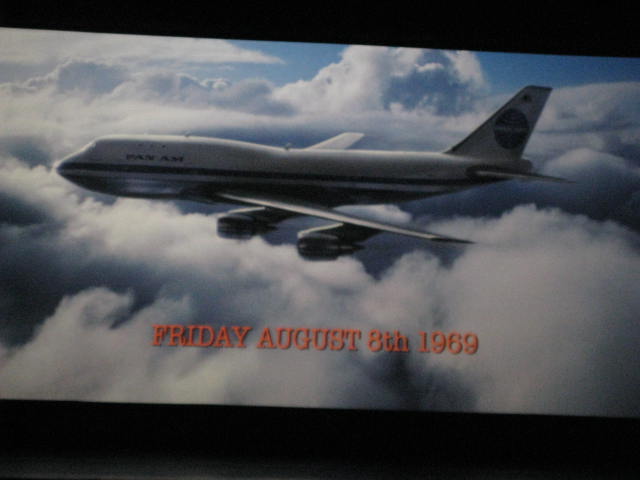
Do these look "mint green" to anyone? At all? Bueller? Come on, folks: dont be shy.
[And please note: these have not been colour corrected: I dont have PhotoShop, & wouldnt know how to work it if I did. Also please note: four weeks in, & no dirt, no lines, no sign of wear.]
Heres a suggestion, Herr Gutzeit: the next time you watch a movie, take off your sunglasses. I am going to seriously question your judgement about anything having to do with colour balance after this insane asseveration. I also question whether your viewing condition are at spec, or even competent. In fact, I'm going to question pretty much every damn thing you say.
We get it. Film images were superior decades ago. In some cases, thats somewhat debatable. In the case of 70mm, thats close to correct, although there are always exceptions [all the prints of The Master, for instance, were struck off the OCN]. Nonetheless, overall, film prints looked a little bit better in the past.
And there were reasons for that; lots & lots of reasons, which you seem incapable of acknowledging. So let me bring you up to speed:
quote: Gutzeit 2
How else could the industry and the quality of roadshow prints have been justified other than by direct copying?
YES, in 1965, 70mm release prints were struck off their OCN. Want to know why? Let us count the ways:
1. Hollywood was, at the time, seriously interested in putting out the best looking prints they could, in order to compete with the perceived threat of television.
2. There was a huge infrastructure in place that could make such an effort technically viable.
3. It followed a long-standing practice. Since the birth of film, most release prints were struck off the OCN. But not many prints were struck: they would make the number they needed & those prints would be shuttled from theatre to theatre, and from state to state, and from city to city, and the movie would break slowly over the country & would then wind its way down to some podunk movie house in gooberville (as seen in something like The Last Picture Show) before finally coming to rest. No one was sending out 2/3/4000 prints: thats not how the release patterns worked back then.
4. Also back then, Hollywood cared a lot less about preserving or archiving its back catalogue, with the exception of what were known as "evergreen" titles -- ones that could be released & make money again & again, such as The Wizard of Oz, Gone with the Wind, etc. All the others? Of no importance. Thousands of titles were lost to neglect.
5. MOST IMPORTANT: There was no good duplicating stock. Over time, reasonably good duplicating stocks were made for B&W (lavenders, for instance -- if you know what those were). But colour stock was something new & different. Eastman colour negative stock rolled out of the factory in 1947, but it didnt get used by Hollywood until around the middle 1950s. Up to that point, the 3-strip Technicolor process held sway. By 1965, the stock had only been used for about 10 years, and, following what was then standard practice, a small number of release prints were struck off the OCNs & then travelled around. When 70mm was introduced, the studios again followed standard practice. They had to: there was no good duplicating stock. Prints struck off (then) dupe negatives looked awful, so nobody used them unless they had no choice.
Got that? All clear? Good, because heres the rub: None of that applies any more, because we're living in 2019, not 1965.
1. Hollywood is no longer interested in putting out the best looking anything, as anyone with two eyes & a brain can see. DCPs look mostly wretched, & the majority of old titles transferred to DCP look worse. People are shooting movies ON THEIR PHONES. People are watching Lawrence of Arabia ON THEIR IPADS. And nobody cares. At all.
2. The huge infrastructure is GONE. No competing labs, no competing wide screen formats, nothing. We have one working 70mm lab in America, & you, Mein Herr, cant stop shitting all over it every bloody chance you get. To wit:
quote: Gutzeit 3
It's clear to me that it hasn't worked for 15 years. Why should we protect such a lab and hope for a second chance if we cannot see the slightest reason for it?
Heres a really good, solid reason: theyre processing film. Hows that? And I like that they are. So, how about you just STOP with these baseless & pointless attacks? Robert Harris says FotoKem is top-rank, & I'll take Mr Harris's word over yours any moment of any second of any day of any year. I know Mr Harris knows what hes talking about. And I wouldnt believe you if you told me rain was wet & fell from the sky.
3. Hollywood now does care about preserving its back catalogue. Unlike you, Hollywood learned a important, critical lesson: the studios learned that spending millions of dollars to resuscitate a OCN damaged from overuse or neglect is a considerable unforeseen & undesirable expenditure. How to avoid it? By not letting the irreplaceable OCN get damaged through overuse or neglect in the first place! You know what that is, Herr Gutzeit? Intelligent.
4. Because of that, the long-standing practice is of printing off OCNs is DEAD. And there are several other reasons for this: Release patterns changed, necessitating a larger volume of prints than any OCN could strike without falling to pieces. Kodak finally created a worthy duplicating stock, which, while it isnt quite as sharp & grainless as a show print, can come -- with careful lab work & exposure -- pretty damn close. [Example: Thelma & Louise. Release prints were 3rd gen. They didnt look it.]
5. So, striking several hundred 70mm prints off the 65mm OCN is now considered inconceivable. And you know what else it is, Herr Gutzeit? Irresponsible. You have an element that represents a multi-million dollar investment, & you want to take a chance that no lab technician, nor the printer, can possibly make an error or have something go mechanically wrong? And permanently screw up the master element? Just so you can sit in some theatre & watch a print off the OCN the way you did fifty years ago, when the chances are that not only will you complain about how the print isnt up to snuff anyway, but also the very likely fact that said print will be TOTALLY WRECKED within a couple of days because almost nobody alive knows how to handle the 70mm format without damaging it anymore? Do you know how misinformed & oblivious you come across when you make statements like this? Whats your point? What do you hope to achieve? Do you think the film industry revolves around the glory that is you, & by annoying everyone with your pusillanimous posts, A New World will spring into being, with thousands of high-quality film labs laying print after print at your feet to win your seal of anal-retentive, punctilious approval?
And if this is making you mad? Hey, buddy: welcome to my world......the world that isnt stuck, like a needle in a broken record, in 1965.
Lets continue.
Heres a recent example of Herr Gutzeit's typical flying trapeze act leaps of illogic:
quote: Gutzeit 4
The Nolan version of "2001" from 2018 also contains half of it‘s running time parts of the older interpositive and half of the time of the younger interpositive of 1999. The version from the year 2001 was printed from the old 65mm interpositive to new 35mm and 65mm dupe negatives, and it disappointed many connoisseurs of the film, because the color timing in the then circulating correction prints was extremely different...
Okay, so here we have Herr Gutzeit whining like a kinder because we're not striking prints from 2001's OCN, which was A) Damaged from overuse & overprinting and, B) Fading. It's all but dead. (And maybe it was used 300 times!) And the IPs & the INs we have are just so inferior; so sad, so disappointing; lets all hang our heads & have a good cry, because no prints are ever going to look like they did in 1968. Keeping that in mind, we have this pearl of wisdom:
quote: Gutzeit 5
Even after three hundred serial prints, especially off the 65mm negative, there is no need for any damage.
Got that? See what he did here? Now we have Herr Gutzeit proclaiming that we should endanger some future 2001 to some similar fate by overprinting the OCN & leaving us (once again) with some inferior IN that he will no doubt find infinite reasons to complain about decades from now ["exhausted" -- whatever that means -- "without contrasts" -- and also whatever that means]!
Isnt that sweet? Herr Gutzeit is trying to be irrefutable....by having it both ways every time.
I dont know what you do for a living, or even if youre working at all. Are you? Or are you sitting at home, studying BluRays (BluRays!!!) & reminiscing about times long past? Wandering through your yellowing memories (see what I did there?) & thinking wistfully about the days when you could see 70mm, shot high key, well printed & well projected? Well, those days are GONE. That time is PAST. That system is all but DEAD. The technology has CHANGED (as technologies tend to do). And the fact that you refuse to accept this, & stubbornly play the same boring, relentless tune over & over & over & over (this colour is a little off, this isnt the way I remember, this isnt where I think it should be, this is inferior to this other thing, this doesnt look the same as a BluRay [and give me a break on that], this isnt as sharp as it should be, &c&c&c), marks you as someone who is interested not in helping, but in hindering, not in advancing, but in retreating, not in being constructive, but in being destructive and, most especially, not in keeping the film format alive, but doing all that you can -- with your continuous nit-picking, unreasonable complaints -- to help it die.
I think film has enough enemies in the world without adding your name to the list. Maybe you should evaluate your life choices & do something helpful for a change. I think we would all welcome that.
Posted by Jean-Pierre Gutzeit (Member # 7275) on 08-23-2019, 08:25 AM:
The 35mm print brought to our city unfortunately had no similarities with the screenshots. I regret that very much! (To Mr. Kornfeld's screenshots: I don't want to miss out on the picture transforming systems of Smartphone and Internet. I would find scans of prints or negatives more revealing). Thank you.
Posted by Chris Haller (Member # 9206) on 08-23-2019, 11:08 PM:
My sister still hadn't seen the movie, so I took her to see the 35mm print that's still running here at The Little in Rochester. A month later, I still found it to be a disappointing viewing experience. They fixed the sound channel dropouts and focus, but in exchange we got:
various dirt and scratches on the base side of the film; not terrible, but definitely present from a month of average quality screenings in terms of handling
Even reels of the film were plagued with TONS of emulsion side green speckling at the heads, kind of like what a lot of rep houses get with their prints and the heads and tails of reels on the base side. I've never seen the speckling at the heads of reels like this.
The left projector, which played the even reels, was projecting off center onto the curtain slightly, revealing the soft edge of the film on the right side, as well as some dead space on the screen. It wasn't a ton of space, but it was definitely noticeable.
The right projector, after awhile, seemed to have developed some sort of lens issue where everything just sort of started slanting to the left like a \. It was hard to notice in full scope shots, but closeups started to look a little odd, and the pillarboxed images definitely slanted to the left from the right side, while the left side of the image was perfectly fine. Not really sure what could cause this either, but it was obnoxious.
Not a great experience, but at least I got to hear both channels of analog sound throughout the entire movie! I wanted to stick around to chat with the projectionist about it, but no one seemed to be able to get a hold of him.....hmmmmmm.
Posted by Mark Louis (Member # 10632) on 08-27-2019, 08:29 AM:
quote: Chris Haller
The left projector, which played the even reels, was projecting off center onto the curtain slightly, revealing the soft edge of the film on the right side, as well as some dead space on the screen. It wasn't a ton of space, but it was definitely noticeable.
The right projector, after awhile, seemed to have developed some sort of lens issue where everything just sort of started slanting to the left like a \. It was hard to notice in full scope shots, but closeups started to look a little odd, and the pillarboxed images definitely slanted to the left from the right side, while the left side of the image was perfectly fine. Not really sure what could cause this either, but it was obnoxious.
We're still running OUaTiH 35mm in several locations at Alamo and we're having an encore run over Labor Day weekend. Just like the old days, it definitely requires vigilance to maintain a good presentation with 35 and 70. Our projectionists are trained to watch out for the types of issues you saw at that Rochester theatre but we're not perfect either. The soft right edge could have simply been a case of the aperture plate not pushed in all the way or (especially in the case of reel to reel) the projector could have moved slightly from the action of mounting the reels time and time again. The slanting of the image could have either been caused by keystone, or misalignment of the anamorphic lens. With keystone, due to the angle of the projector, certain areas of the image are significantly farther away from the lens, causing those areas to be magnified greater, thus causing distortion. In the case of the anamorphic, if the lens is slightly rotated off axis after being aligned with RP-40, the image will be slanted.
Posted by Robert Harris (Member # 1712) on 08-27-2019, 09:59 AM:
I almost hate to post in this thread, but here goes...
A number of facts:
Films such as Lawrence, My Fair Lady, and others, from the 1960s, were printed optically.
Lawrence was cut and conformed auto-select, single strand.
MFL was cut and conformed auto-select, single strand, Technicope.
OCN & print stock moved back and forth in the printer in order to achieve standard printer functions, ie. fades and dissolves.
To illustrate, if there was a dissolve in Lawrence, the A side would continue, sometimes to leader, and then cut to the B side, which in certain instances, began with a slate. The OCN could be hundreds of feet longer than the resultant print.
The number of prints that I was able to confirm on L and MFL, was around 150, and certainly nowhere near 300. Keep in mind that it would not be unusual in the '50s and '60s, for a print to appear pristine, after a year's run.
Also, keep in mind that while printing (and cleaning) were recorded, when damage was done to a print, the lab would pull the OCN, and print the first 50 feet, or whatever was needed.
Dupes were cut in as necessary, as the OCN was damaged.
As I recall, in the case of MFL, there were well over 2,000 feet of dupes, with the entire (as I recall) reel 8B, coming off the 65 seps, which had been produced defectively, and had optical holes running throughout the entire set.
As to IP/IN dupes, with the appearance of Kodak's 5243 stock in the 1986, it became virtually impossible to see the difference at the print level, between an EK print, and a dupe. Both David Lean, as well as Freddie Young preferred the dupe to the original (even though we could not print the original, if we desired to do so), as they both felt that contrast, color, shadow detail, and resolution were on par with the original, and the only difference being a "slightly more velvety appearance to the grain," Freddie Young's words.
It is extremely dangerous to print OCNs of the era, and they should no longer be printed.
For those negatives that have not be re-cut and reconfirmed, they can not be printed, as the ability no longer exists.
Example: When we were working with the MFL OCN, splices were dried, and opening, and what saved the negative, was our decision to create new splices at every cut, and re-conform to A/B from auto-select.
Even going to 35mm, one finds the auto-select conundrum, for example in GF 1.
Hope this is helpful.
RAH
Posted by Mitchell Dvoskin (Member # 751) on 08-27-2019, 01:59 PM:
In answer to David's question above, I saw OUATIH in 35mm the first matinee show on the Saturday July 27th at the Alamo Drafthouse in Yonkers NY. Both the print and the presentation was flawless. No color timing issues, and at that point (and maybe still) no damage to the print. No focus issues.
Posted by Bill Brandenstein (Member # 7758) on 08-30-2019, 04:15 PM:
For those of us who really, really want to still be able to love on film: Mr. Kornfeld, Mr. Harris, Mr. Dvoskin, etc.: thank you.
Posted by Mark Louis (Member # 10632) on 08-30-2019, 04:47 PM:
quote: Mitchell Dvoskin
In answer to David's question above, I saw OUATIH in 35mm the first matinee show on the Saturday July 27th at the Alamo Drafthouse in Yonkers NY. Both the print and the presentation was flawless. No color timing issues, and at that point (and maybe still) no damage to the print. No focus issues.
Thanks for the feedback Mitchell! Can't tell you how happy I am to hear what great job our team is doing in Yonkers.
Posted by Scott Norwood (Member # 30) on 08-30-2019, 09:42 PM:
As one whose only experience with negative cutting is in small-format film (16mm)--and by "experience," I mean that I have paid people who know more about this stuff than I do to do it for me--why isn't/wasn't everything cut into A&B rolls? That has the advantage of allowing contact-printing for everything and avoiding opticals altogether for standard fades and dissolves. Further, the ability to print them is not tied to a particular type or technology of printer. Is/was it a storage-space issue?
I guess I just don't see much of a disadvantage to this method, and see many advantages to it. Am I grossly misinformed?
Posted by Jean-Pierre Gutzeit (Member # 7275) on 08-31-2019, 07:55 PM:
Agree. (In 16mm I had made such prints at a Paterson continous printer, checkerboard)
Mr. Harris means the risks of optical step printers. Otherwise I mentioned additive color printing and zero close since 1963 and the excellent condition of many laterer negatives. Fox had struck 40 years later a couple of 70mm prints directly off the 65mm original negative: DOCTOR DOLITTLE, AGONY AND ECSTASY, CLEOPATRA, THOSE MAGNIFICENT MEN, THE BIBLE, HELLO DOLLY. COLUMBIA/SONY made new direct prints of LORD JIM, MGM/UA made KHARTOUM and MAD WORLD. They looked very clean, without missing frames and much sharper than restored 70mm versions of LAWRENCE, FAIR LADY, VERTIGO or SPARTACUS because of their lossy intermediate process, necessary because of the high amount of new prints.
Today in conjunction with brand new negatives of H8 or OUATIH we should demand all prints struck off the OCN. To defend the real brillance of photochemical film!
Thank you for reports of better prints of OUATIH in USA. Me was told by another technician, the 35mm print in London was poor.
Today I saw again MURDER ON THW ORIENT EXPRESS in70mm: much to bright, slight desaturated, with wrong flesh tones, slight greenish, similar to Orwocolor or Swena Color. But nowhere as poors as Berlin's current 35mm print of OUATIH.
Posted by Jean-Pierre Gutzeit (Member # 7275) on 09-01-2019, 03:49 AM:
Improvements in the Eastman Color negatives were always noticeable. After 5257 in 1950 followed 5248 in 1952. 1959: 5250. 1962/63 a new emulsion with 5251, which also favoured the blow up process 35>70. 1968 with 5254 the next improvement.
Very clear improvement of the resolution followed with the long lasting change from ECN-I to ECN-II between 1974 and approx. 1977 with the new 5247-Type.
(Even within the same material designation, however, changes were always made tacitly and constantly.)
In principle, the Eastman Color Intermediate materials had always an approximately triple higher resolution than the OCN since the 60s. But I know only very few examples until today, in which a visible difference between direct copy and duplicate was not noticeable, and here also the exemplary mentioned title THELMA AND LOUISE was copied (in 35mm).
Further distinctions have to be made in the print materials:
We were not very happy with the print materials 5384 and 5386 in the 80s and 90s and spoke of "plum-soft" material: too little silver, too little black. Unfortunately, this also affects prestigious restorations such as LAWRENCE O.A. or SPARTACUS. But also new productions like FAR AND AWAY, BARAKA or HAMLET.
Occasionally the 35mm series copying was based on the somewhat more advantageous Fuji print material.
Only with the introduction of the Eastman 2383 and 2393 print material (Vision and Vision Premier) around 1998 did the own grading of the material again correspond to that of the 60s with higher density and better black! Thus BARAKA was copied again at Vision or Vision Premiere.
One could have been happy here, if better times had begun for new copies of so many still intact negatives.
And these possibilities were then also used for the mentioned 70mm revivals with prints off original negatives by Schawn Belston and Grover Crisp, also new revivals of SPARTACUS, LAWRENCE or 2001 of existing internegatives. The results showed in individual cases (HELLO DOLLY, LORD JIM, AGONY AND ECSTASY) partly satisfying results, while "2001", SPARTACUS and LAWRENCE deteriorated after 2002 in 70mm steadily and at today's 70mm festivals the elderer 70mm revival copies of Mr. Harris 1989 and 1991 were sometimes preferred (despite the weak print material). Even as new 70mm direct copies DOCTOR DOLITTLE, THE BIBLE or MEDITERREANIAN HOLLIDAY could be seen in Europe, but disappointed in the unfinished color timing.
Meanwhile it could look more critical with the 65mm OCN negatives, which were used ten or 18 years ago by Columbia and Fox for 70mm direct copies in intact condition, but today already look more critical with regard to color fading and advanced shrinkage, which can hardly be corrected analogously. This would always have to be checked on a case-by-case basis. In general, one cannot say that all older negatives can no longer be copied. Where this may still be possible (perhaps GRAND PRIX, RYANS DAUGHTHER, FALL OF THE ROMAN EMPIRE, THE LAST VALLEY?), everyone would certainly be happy about a revival.
With regard to my criticism of a so called "Orwocolor look" of newer film copies, I will try to include some picture examples as
Link removed by Admin due to violation of site policies.
[ 09-01-2019, 04:44 PM: Message edited by: Brad Miller ]
Posted by Robert Harris (Member # 1712) on 09-01-2019, 03:19 PM:
You seem to be looking at the world of laboratory printing through rose-colored glasses. When the studios strike a print today, it is not a run, but rather a color sample, before an IP.
I’m aware of no studio asset exec who would permit additional OCN printing.
Eastman stocks have worked very well for us over the decades, but you seemingly have a problem with Kodak.
You should not consider Spartacus along with other films, as the 65 printing dupe was derived from optically produced masters, and not an IP.
Nothing personal, but you and I will agree to disagree regarding the care and feeding of original large format negatives. I’ve seen the horrific wear and tear, and will work against ever printing them again.
As to the greatest problem toward striking 70mm prints post 2005, it would be the overall inability to control an even exposure across the frame. When I examined tests for the Williamsburg project, I found just a single printer capable of producing an even field, and every print was ordered struck from the same printer. Keep in mind that the light sources were 35, with the beam spread, and not specifically produced for 65.
Lastly, you seem to have a problem with Eastman 5243 dupes, while I consider the stock a godsend.
As did David Lean and Freddie Young.
Please carry on.
RAH
Posted by Brad Miller (Member # 2) on 09-01-2019, 04:42 PM:
I believe the key word here is irresponsible regarding the concept of printing off of the OCN. There is only one OCN. The slightest mistake or hiccup and it is ruined forever.
Jean-Pierre, I've read your postings elsewhere and here. You seem to never have anything positive to say and are clearly still living in a world that existed 50 years ago. (A world which you likely recall as being better than it actually was, since that was a time in your life of fond memories.) All I read from you is complain, bitch, whine and moan about how horrific you think things are today.
For those of us who DO find Fotokem's work to be top notch and who DO welcome current and future film prints regardless of their source, please do us all a favor and lay off of the constant complaining and inaccurate facts that seem to plague every post you make.
Finally, site rules require you to upload any photos here to this thread. I have removed your link above as that is a direct violation of how this site preserves the discussion archives. Please feel free to make a reply post with the images you were referencing above.
Posted by Robert Harris (Member # 1712) on 09-01-2019, 06:12 PM:
Re: Scott’s question about why everything wasn’t simply A/B roll, I can only guess.
Probably because with single strand auto-select, multiple versions, be they 70mm or 35 dye transfer, could be print from the same negative roll. Domestic, foreign, long road show, abridged.
I’ve not a clue why Techniscope cutting would be used, as 2.21 covered the splice lines.
Checkerboard enabled easy re-cutting, without losing frames.
Posted by Steve Guttag (Member # 268) on 09-02-2019, 09:07 AM:
Brad, I must admit, I'm non-plussed by what I've seen of Fotokem's 70mm prints. The prints have been anything but steady and the reel-to-reel consistency isn't there either.
One thing I don't believe Bob mentioned was also the lack of color consistency coming out of the labs/lab such that on reel changes the color may (and often does) shift. This is more noticable and attributable when it is a plattered show since the lamphouse variable is removed from why the color shifted.
Back in the day when we would get an EK print and a select print backup, the difference in quality of image was astounding. The select print felt like a poor stepchild of the EK print in terms of everything measurable, color, sharpness, steadiness. The select print seemed like someone put a gauze filter over the lens compared to the EK. I remember one screening where the EK print ran in the primary room and the select ran in the overflow...you could A/B the difference.
Posted by Scott Norwood (Member # 30) on 09-02-2019, 10:07 AM:
quote: Steve Guttag
One thing I don't believe Bob mentioned was also the lack of color consistency coming out of the labs/lab such that on reel changes the color may (and often does) shift. This is more noticable and attributable when it is a plattered show since the lamphouse variable is removed from why the color shifted.
Hasn't this always been a problem, though? Dye-transfer prints have this problem, as did the prints that Deluxe and Technicolor were turning out by the thousands in the late '90s and 2000s. Is Foto-Kem any worse, really?
Posted by Robert Harris (Member # 1712) on 09-02-2019, 11:54 AM:
The labs do what they can. I don't know if it's still current procedure, but in the old days someone would read the lab chart, and create prints by the color of each reel. If things matched decently, the print would end up at a major venue. If not, it's off to Horse's Breath, Montana.
Another problem is that generally a run of reels would be printed and processed, followed by another run, so that different prints, chemistry would affect different reels.
For major releases in the '90s, multiple labs might run certain reels, while other labs...
You get the picture. Not pretty.
I do know that Fotokem does what they can. They're a fine lab. But when there's a major order for multiple 70mm prints, asap, something has to give.
RAH
Posted by Carsten Kurz (Member # 5396) on 09-02-2019, 06:52 PM:
A lot of people jumped at the jittering opening title ('Cinerama' and such) of 'The Hateful Eight'. A lot of people also seem to believe that Quentin Tarantino is sold on film because he want's to demonstrate films superior resolution, color range, contrast, and various other mystic properties of film against digital. I am quite sure that Mr. Tarantino gives a shit about demonstrating that 35mm has a higher resolution than 4k. He is sold on the general look and feel and handling, not characterizing isolated aspects against a competing technology. As such, I am absolutely sure that the shaky opening title is not a 'fault' or a demonstration of inadequate handling capabilities, but was deliberately done so or, 'deliberately accepted'.
Tarantino came up with grindhouse double features, does anyone really think he developed an ambition towards velvety high end film work?
- Carsten
Posted by Steve Guttag (Member # 268) on 09-02-2019, 10:55 PM:
Carsten,
I found H8 was all over the place on the 70mm print I saw the most. R1 was just horrible and un 70mm like. Depending on the taking lens, the image was sharp or not sharp. I can't imagine he was going for the look that I saw and the opening card should not have had any movement in it. In fact, I wish that there was a letter instructing it to not be run if you had a curtain (just use the sound for walk-in music).
Posted by Marcel Birgelen (Member # 6801) on 09-03-2019, 03:57 AM:
It's been a while, but I remember that the shaking wasn't just in the title-card, but also in the opening scene itself. Since it seemed to be much worse than I remembered from the 4K DCP screening, I blamed the venue at first.
I've seen the 35mm version of OUaTiH in that same theater now, and I've also seen some shaking in the image, but now there was subtitling added to that particular scene. The subtitling remained rock-steady, so whatever it was, it was in the film, before they added the subtitling. From the looks of it, it was laser-etched, probably directly into this particular print. (I doubt there is more than one in circulation with Dutch subtitles.)
I've also seen OUaTiH in Dolby Cinema and although the screen wasn't masked for scope (really Dolby?), I liked the look of that presentation more than the nostalgia laden 35mm show. For whatever it is worth, film never looked better, projected digitally...
Deep blacks, the lack of flicker from a shutter and both bright and saturated colors. Uncompressed digital audio. What do we want more?
Maybe we're really a bit too nostalgic here. Film could look absolutely fabulous when done right and still outperforms digital in some aspects, but let's be honest, most screenings that people got to see were mass-produced strips of polyester that were produced as cheaply as possible, only to end up in the shredder a few weeks later. Films were often threaded by the same guy who handled the popcorn and looked like they had been dragged through the mud after barely a week of usage. If you were lucky, the lamp in the machine was somewhat fresh and halfway steady and the digital sound and most of the sound channels actually worked. Yes, I'm exaggerating somewhat... well, mostly, but things weren't always so rosy in the past.
Posted by Jean-Pierre Gutzeit (Member # 7275) on 09-03-2019, 06:56 AM:
The "nervous opening title" i THE HATEFUL8 is certainly an ironic replica: actually a good idea. It was discussed whether the funds he used could credibly represent the "erroneous look" of some failed Techniscope productions, especially the late days in the Technicolor labs(Italy for example).
Ten years ago, his 35mm Eastman original negative of INGLORIOUS BASTERDS was processed in this city (at a Calda Negative developer), especially as he also shot in neighboring Potsdam-Babelsberg and was definitely looking for contacts with the lab staff. Camera work and exposure of the negative, I was completely fine, the film prints also.
Also, his ambitious and original featurette leaves "What Is 'The Hateful 8' Roadshow?" (I am unsure to post a link here) to close to enthusiasm for attractive large-format or roadshows. I did not expect an identical renaissance, but modestly only good qualities based on the available possibilities. A filmmaker alone does not create a renaissance. A large number of filmmakers would have to join in, already in order to get a handle on the conditions of the film developments (which were predictable ten years ago). There is, fortunately, even a consensus here.
Maybe he wanted to exceed the results of common 4K standards with the choice of the 65mm format? That should give the OCN also partially. What came afterwards, has already been discussed sufficiently, because I was not granted such a deluxe sighting, and the Blu-ray Disc for the home cinema nerds disappointed a lot, too.
It is fair to work towards what can be improved with existing funds. Far more direct and precise than me @Steve Guttag has written comments on this. The deciding factor in his contributions is that the noticed, confused scene balances (which, consciously or unconsciously, are perceived by the general public as irritating) are all correctable! (Please no further comments on the excessive costs of the check prints. You are right). The Color Timing has not disappeared, not even the work of the Focus Puller. The production companies could work towards that.
But I am very surprised that such observations are not shared, supported or supplemented accordingly. Could it be that an anticipatory gratitude led to a relativization of perception? This also explains the emotionally divergent attitudes, which are characterized on all sides by fear, the existence of the photochemical film could be endangered by inappropriate ratings and criticism. But what would be, who sooner the opposite must be assumed: if permanent dubious print become the rule. Is it easier for the home cinema industry to attack the cinema industry with their post-corrected products? Film prints have a lasting function and as the original format are the most important commodity of the festival. The best possible film prints should prevent film festival guests from enjoying themselves on Youtube or on consumer discs. Not a small number of former film lab colleagues, film friends and former 35mm collectors have turned away from the public film screening. Therefore, it is urgent to make strong in defense of just the 70mm film with its special claim and considerable potential and to seek contact with those responsible.
As a lack of optimismus was denounced:
Very commendable is the ONCE UPON A TIME IN HOLLWOOD in 35mm the excellent picture steadiness and the very clean image. Here, the satisfaction with the current labs work compared to the last years of the now closed labs (mass printing for multiplexes) was mentioned more often, as @ Scott Norwood cited. I assume OUATIH it's a wetgate print?
From a distance, I could never translate the term "showprint" into our countrie's language, because it seems is also country-specific. At premieres, for example, we did not do any dry contact copying via the panel printer at 960 feet, but copied it in the wetgate process with 240 feet and light values changed to the household needs. Nevertheless, of course, with American blockbusters from I.N. (Dupnegativ in our language). This is probably comparable to the American showprints.
Posted by Emiel De Jong (Member # 4225) on 09-03-2019, 07:25 AM:
quote: Marcel Birgelen
I've also seen OUaTiH in Dolby Cinema and although the screen wasn't masked for scope (really Dolby?), I liked the look of that presentation more than the nostalgia laden 35mm show. For whatever it is worth, film never looked better, projected digitally...
I saw OUaTiH in Dolby Cinema too (in Eindhoven...) and I agree it was good. There were no flaws picturewise that distracted me and I never had the feeling that I "missed" something. That's a first for me since digital took over, but I admit that doesn't say much since I almost never visited a commercial cinema anymore in the last 7 years.
I didn't check out the 35mm playing in Amsterdam (Eye Dutch Filmmuseum) but I saw their advertisement for it and that is I think a perfect example of where it goes wrong (knowing this 35mm is from 4k DI) when discussing in mainstream media the merits of both photochemical and digital; some quotes: (translation by myself....)
-Watching the newest Tarantino on 35mm is no false nostalgia. The main reason: this is the format Tarantino meant the movie to be seen in.
-A fresh 35mm print equals 6K in the digital world, while most movies are shown digitally in 2K.
-That, and the rich analog colors (colors are more lively, the black is darker), plus the beauty of the gritty filmgrain, make a unique cinematographic experience. Film like film is meant to be.
-Why Tarantino likes analog projection? It's best to let himself explain: "When you shoot film you are not recording movement, but a sequence of still images. When you move 24 of those in front of a lightsource that creates the illusion of movement. So when you watch an analog film you are looking at an illusion. And for me that illusion is connected to the magic of movies."
(For the record: I never implied that Quentin himself really said that in this context...) Link to the advertisement, Dutch only:
https://www.eyefilm.nl/over-eye/nieuws/waarom-je-once-upon-a-time…-in-hollywood-op-35mm-moet-zien
Posted by Jean-Pierre Gutzeit (Member # 7275) on 09-03-2019, 09:15 AM:
Maybe we're really a bit too nostalgic here. Film could look absolutely fabulous when done right and still outperforms digital in some aspects,
So I admire cinematic and analog high performances in the past and present.
That was certainly the reason for Messrs Nolam, Abrams, Tarantino, Anderson and others to keep this valuable technology alive.
The shredding of individual films in cinemas can easily be avoided and is not an final argument against analog projection, especially since the majority of DLP theaters operating worldwide with often low contrast and silver screens created new widespread flaws.
The Estar-Stock helped the mechanical life extension, but had other disadvantages.
Unfortunately, until a few years ago, a large proportion of the 35mm films scanned and post-produced via Digital Intermediate since 1999 have revealed clear distortions and "crossings" in colour balance. I will not name individual companies and equipment.
Examples: orange fleshtones and blueish grey tones. It was absolutely impossible to either correct the grey halfway neutrally or to counter-correct the fleshtones without accepting discolorations of the grey areas.
The whole dilemma continued in the DCPs or Blu-ray Discs versions.
This could also have been a reason why not only the above-mentioned filmmakers who were still active on the market suddenly fell out of the clouds with their 35mm or 70mm dailies, how good intact film material looks if it is not digitized.
So far, in my opinion, it has not been possible in everything to maintain the claim of analogue film to analogue theatrical copies in recent years. Even the demands to no longer printing off the original negative and to increasingly accept "filmouts" represent a contradiction to previous promises and statements of the above filmmakers.
Up to now I have had little interest in filmouts and urgently support the direct printing of intact negatives for the already few venues.
The film historical monuments LAWRENCE OF ARABIA, MY FAIR LADY, SPARTACUS and VERTIGO have also been massively upgraded, albeit for the friends of the digital world. Others more known than me are the retouching of layer splinters in the original negative ("LoA") or a fading correction ("Spartacus"). It had to be restored for all to see and not just printed again.
James C. Katz and Robert Harris (since NAPOLÈON) were the first to achieve the international commercial breakthrough for a broad public in film restoration, and they also achieved success in the film theatre scene again with re-run copies. And on the broad exploitation level it is certainly only practicable to use internegative pinting. Unfortunately, the state archives have been less successful in doing this due to a lack of public relations work.
Independently, I would like to be able to make uncensored and unpunished comparisons on the basis of these and other film prints that we have to fall back on at today's film festivals now and later. For the future of the 70mm film it would be interesting to be able to reference some features in top condition, from a purely technical point of view and to prove that a new printing or restoration was always preceded by an original. The available and suitable material exists depressingly little, today's festivals have to be organized with very extremely different examples, whereas 70mm festivals from the mid-1970s could still offer very similar looking films and film prints - the original roadshow prints.
This would be the chance for the festivals to devote themselves to the lectures and documentations of the changes in production practice, to make film comparisons popular without devaluing the uniqueness of their own elaborate equipment and also the value of expensive film prints (and misprints). One could juxtapose a newly copied version with an old film reel at the end of the performance. Comparisons and exclusive performance variants that are only possible in dedicated film theatres. Such knowledge transfer can easily outweigh the "disadvantages" of aged materials or insufficient DCPs and motivate new and repeated film restorations, also in the form of fundraising.
This is all the more important as a cultural break has taken place since the times of the DVD and at the same time the documentary section has moved to the category of bonus materials. Personally, I would regret it if cinema marketing were to transfer film screenings to the realm of the untouchable myth. Sometimes the whirl in the format announcements is astonishing. Until the mid-1960s, apart from a few logos for "CinemaScope", we rarely find such imposed format advertising as we do today, and that at a time when negatives were still completely intact and venues even more numerous with curved panorama screens.
Posted by Marcel Birgelen (Member # 6801) on 09-03-2019, 07:57 PM:
quote: Emiel De Jong
"When you shoot film you are not recording movement, but a sequence of still images. When you move 24 of those in front of a lightsource that creates the illusion of movement. So when you watch an analog film you are looking at an illusion. And for me that illusion is connected to the magic of movies."
I do get Tarantino's nostalgia, but ironically, there's nothing essentially different from what he describes as the magic of movies between the analog and the digital process. If you shoot your movie at 24 frames per second digitally, it's still just 24 frames per second played in front of you. Many digital movie cameras are even constructed to mimic the look of film, using full 35mm sensors and mechanical shutters...
quote: Jean-Pierre Gutzeit
So I admire cinematic and analog high performances in the past and present.
That was certainly the reason for Messrs Nolam, Abrams, Tarantino, Anderson and others to keep this valuable technology alive.
I admire many of our technical achievements, in the past and the present, we should honor them, preserve them and give them a place. But there has to be room for progress too...
Film had a good, long run, the fact that it lasted more than 100 years as our primary imaging medium, both for still and moving pictures is probably the biggest proof of the quality, versatility and also relative durability of the medium.
But right now, we're at a point where digital technology starts to outperform analog film in almost any aspect. It already outperforms film on light sensitivity, color spectrum and speed. It will be just a matter of time before it outperforms even 65mm film on pure 2D resolution too. As a matter of fact, many sensors already do, but getting that resolution onto a recording medium is primarily a bandwidth problem, which will probably solve itself in the upcoming years.
My primary grief with digital cinema is that the transition from analog and digital wasn't motivated by technological progress, but rather as a cost-saving measure for the studios. That way, DCI never became what it could've been, if we just waited a few years longer.
I'm not proclaiming there is no room for film, but we need to accept that film is now a niche thing. That doesn't need to be that bad either, just like vinyl never really went away, there are still people that like the nostalgia of film, together with all its shortcomings. The good thing about niches is that they're usually filled with passionate people, people that care about the quality of the product. So in the end, the relegation of 35mm and 70mm film to a niche product might be very well a positive development for the quality of the medium itself.
Posted by Terry Monohan (Member # 8285) on 09-03-2019, 08:27 PM:
'Once Upon' opens in Portland Or at the Hollywood Theatre in 70mm film on Friday Sept 13 ending on Tues Sep 17. 3 shows per day.
Hope they get a good print as this former Cinerama® Theatre has a great curved screen.
I think they played it in 35mm also a few weeks ago.
The Castro Theatre in SF will open it in 35mm film on Wed Sept 4 till Sept 9 for the first time. We hope they will play It in 70mm in the near future?
Castro Theatre SF goes first run on Friday Sept 20 with 'Downton Abbey' for a few weeks.
Posted by Emiel De Jong (Member # 4225) on 09-04-2019, 04:07 AM:
quote:
quote: Emiel De Jong
"When you shoot film you are not recording movement, but a sequence of still images. When you move 24 of those in front of a lightsource that creates the illusion of movement. So when you watch an analog film you are looking at an illusion. And for me that illusion is connected to the magic of movies."
I do get Tarantino's nostalgia, but ironically, there's nothing essentially different from what he describes as the magic of movies between the analog and the digital process. If you shoot your movie at 24 frames per second digitally, it's still just 24 frames per second played in front of you.
That is, exactly, my point: I gave some examples of false information. Apart from what exactly Quentin Tarantino said and in which context: this form of advertisement does not help analog film to stay alive where it still has some valuable things to offer. Especially film institutes which have an educational function should stay far away from this BS.
Posted by David Kornfeld (Member # 9964) on 09-04-2019, 12:31 PM:
quote: Dhr Birgelen
But right now, we're at a point where digital technology starts to outperform analog film in almost any aspect. It already outperforms film on light sensitivity, color spectrum and speed. It will be just a matter of time before it outperforms even 65mm film on pure 2D resolution too.
Light sensitivity & speed (which are much the same thing), sure, but you pay a heavy price for them in artifacting & digital noise. Colour spectrum? No; not nearly; not yet. Outperforming 65? In your dreams, but for argument's sake, lets say that happens. You can capture at any resolution you want, and then? Out into the world at 2 or 4K, because thats what the vast majority of projectors out there can handle. And thats not going to change any time soon: those machines are expensive. And theatre owners are notoriously parsimonious.
And now lets move to an aspect where digital is likely never going to outperform film: permanence. Give me an Edison film shot in 1895, and as long as it's in reasonable shape, I can run it through my projectors tomorrow. Give me a raw digital file shot five years ago & the chances are high that the codec is now unreadable. Go back ten years & the problem increases. And should there be any corruption? Kiss the entire file bye-bye.
The studios, which had to be pounded into submission to finally getting around to maintaining their back catalogue (and that took decades), are now facing a far more onerous problem. For film, preserve the OCN & strike a preservation copy (IP, 3-strip seps, things like that). One & done. In digital, it never ends. Each file has to be preserved & migrated to a new codec every five years, & then checked, & then migrated again. A mistake? A problem? A mis-read? Bye-bye! And all those thousands upon thousands of independently made productions? Kiss those ALL good-bye.
I am making it a point to live long enough to watch what I am certain will be the inevitable end game here. Know how much we lost from the silent era? LoC estimates 70% of features, 90% of cartoons, shorts, newsreels, &c. Thats going to be chump change next to what we're going to lose in this magic era of ever-changing digital formats. It's going to be a Holocaust, & I use that word deliberately.
And the sound youll hear echoing in your ears will be my very, very, very loud laughter.
Those Edison shorts will still play fine, though. Remember that, because they were shot 125 years ago.
Posted by Marcel Birgelen (Member # 6801) on 09-04-2019, 03:26 PM:
quote: David Kornfeld
Light sensitivity & speed (which are much the same thing), sure, but you pay a heavy price for them in artifacting & digital noise. Colour spectrum? No; not nearly; not yet. Outperforming 65? In your dreams, but for argument's sake, lets say that happens. You can capture at any resolution you want, and then? Out into the world at 2 or 4K, because thats what the vast majority of projectors out there can handle. And thats not going to change any time soon: those machines are expensive. And theatre owners are notoriously parsimonious.
Both CMOS and CCD image sensors get better every year, unlike film, which doesn't nearly see as much development. It's therefore only natural that digital will outperform film eventually, on practical all aspects.
Film has about 13 stops of dynamic range, depending on the type of film obviously, but that's according to Kodak's own research. Arri Alexa is doing 14+ and next generation cameras will go higher. There are specialty sensors, like 3CCD setups that can go far higher right now, but the costs are still prohibitive. But the CMOS world is on it, the whole "HDR" stuff is a thing and the next generation sensors will not only increase pixel density, but also color resolution, light sensitivity, electronic shutter speeds, etc.
So, the same is true about light sensitivity. I see an enormous progress between now and just 10 years ago. Where 10 years ago everything shot at low light got you into terrible DNR situations, the world is looking different now. The best sensors out there now easily outperform film on this.
Regarding sensor resolutions... we're at a point that a tiny sensor in a smartphone fits 48 megapixels and the next generation will fit like 64 and a 108 megapixel model has announced. Ever wonder how many megapixels you could potentially put onto a 65mm CMOS or CCD sensor? The reasons why not to do it, is because we simply can't handle the bandwidth... yet.
But things are evolving fast. Wile I can have a full 4K setup for a reasonable price at home, I can already buy 8K TVs.
Last year at the IBC (International Broadcasters Convention), everything revolved around 8K already. It wasn't in the future, it was right there. While the infrastructure around us may not be ready for 8K yet, it will evolve and maybe faster than you think. In a few years, pro-gear will maybe even scale up to 16K. You simply can't deny it it's just happening, I've seen the first experimental 16K gear already on display and yes, even some 32K experiments...
So, whatever argument you put forward, it's either already taken over or will probably be taken over in the near future. Welcome to progress. Sometimes it's hard, I like a sense of nostalgia, but progress is generally better than standing still. Like I said before, we should honor our history, we should honor film, but film will never ever become main stream again, even DJs eventually ditched their vinyl and went all digital... (yeah, there are the rare exceptions that still lug around cases full of that stuff.)
I do give you one point though. I'm worried about archival in a digital world too. The world is moving so fast, that yesterday's format can easily be forgotten. If somebody hands you a 5.25" floppy, do you still have the means to read it? What about some oddball format like a ZIP drive. The same goes for file formats, especially difficult stuff with highly advanced compression on it. Encryption also doesn't make it easier (yes, an understatement, I know).
Archival of our digital creations is a challenge, especially since it's clear we can't trust Hollywood on this. But, hose are challenges, not unsolvable problems... at least not technically. Politically, it's another story all-together.
Posted by Mark Lensenmayer (Member # 134) on 09-12-2019, 10:14 AM:
70mm Print of ONCE UPON A TIME IN HOLLYWOOD opening 9/13/19 at Gateway Film Center, Columbus, OH for one week.
Posted by Julian Antos (Member # 5497) on 09-12-2019, 01:07 PM:
About to enter week 8 at the music box. 4 weeks in 70mm, 4 weeks in 35mm. In our small theater now but still drawing respectable numbers.
If things pan out, we may have as many as FOUR new releases on film for the end of the year.
Posted by Tyler Purcell (Member # 9213) on 09-12-2019, 05:55 PM:
quote: Marcel Birgelen
Both CMOS and CCD image sensors get better every year, unlike film, which doesn't nearly see as much development. It's therefore only natural that digital will outperform film eventually, on practical all aspects.
First off, CCD is a dead technology for cinema. Nobody uses it anymore for anything but scientific equipment and a few low-end cameras. It also can't be used in a 3 chip array and continue to use our standard cinema lenses. There are issues with how big you can make the imagers AND how far away the imagers are from the film plane, thanks to the prism.
Second, CMOS technology hasn't changed much. CMOS inherently is a horrible technology because to create a color image, it requires assignment of RGB pixels. Thus, your 4k image, only has half the Blue and Red information as green information. Yes, shooting at 6k and down-resing to 4k, does remove it, but that doesn't make the tech any good. CMOS is also a very hot technology, requiring substantial cooling which means there is a much larger potential for overheating and pixel failure. Mostly ALL CMOS cameras have dead pixels and software to map them out. Eventually as the imagers get hot and cold, the pixel mapping software will stop working and there will be visible dead pixels.
CCD and CMOS are also single ISO technologies. The optimal dynamic range is stuck at a single ISO. Thus, to change sensitivity, you need to either increase or decrease the signal after the imager preamp, which causes noise OR have multiple preamp sections like double ISO cameras. Currently there are only a few cameras on the market with double ISO and that tech hasn't taken off yet. When that tech hits the Alexa's and Red's of the world, we can start having a conversation about the future. However, it's not going to anytime soon.
quote: Marcel Birgelen
Film has about 13 stops of dynamic range, depending on the type of film obviously, but that's according to Kodak's own research.
I've done my own research, as all I do is shoot and scan film for a living. Film's "latitude" is limited by the scanning technology. Until recently, we've only been able to use CCD or standard CMOS imagers to scan. However, HDR scanners are around these days and the amount of latitude on film is staggering. For instance, on a recent shoot, we had had a bit of film left over after shooting a scene and shot a person dancing in nearly pitch black. The HDR scanner was able to bring up the blacks and we were shocked how much data was in the image, far more than any digital camera I've shot with and for the record, I've used them all. Plus, you don't get ANY color bleeding, aliasing or contrast rings with film. You just get a perfect image every time you shoot.
Where it's true, with a photochemical finish, film will have much less latitude, especially in the blacks. With a completely digital HDR finish, the amount of dynamic range film can produce, especially in the highlights, is superior. Plus, when film "clips" it does so very softly, it retains much more detail. So from a cinematographers perspective, you don't need to worry about clipping ever.
Did I mention that film has multiple ISOs unlike digital? We can run 50D, 200/250 and 500. We also push 500 to 1000 on a regular basis and it comes out perfect, looks perfect with the HDR scan.
quote: Marcel Birgelen
Arri Alexa is doing 14+ and next generation cameras will go higher.
None of the digital camera manufacturers release actual dynamic range information. Red says their new imager can do 17+ stops? Bullshit. I've done tests with Alexa, Red and Film, there is no comparison. Film blows the doors off the digital cameras in terms of dynamic range, especially with an HDR scan.
quote: Marcel Birgelen
So, the same is true about light sensitivity. I see an enormous progress between now and just 10 years ago. Where 10 years ago everything shot at low light got you into terrible DNR situations, the world is looking different now. The best sensors out there now easily outperform film on this.
This is true, the imagers have become less complex, with less layers, allowing more light to enter in AND the preamp's are more sensitive. However, each pixel still works like a potentiometer. You can only give it so much light before it distorts the image OR clips. So from my perspective, the breakthrough isn't the imagers themselves, the breakthrough is better software to remove noise. That's part of what makes the hypersensitive Sony A7SII so revolutionary. The noise reduction can clean the image up to the point where it's usable at 120,000 ISO. Of course take the camera outside on a sunny day and it's worthless, looks like total shit. Again, there is no magic, it's impossible to make an imager tech that will do both.
quote: Marcel Birgelen
Regarding sensor resolutions... we're at a point that a tiny sensor in a smartphone fits 48 megapixels and the next generation will fit like 64 and a 108 megapixel model has announced. Ever wonder how many megapixels you could potentially put onto a 65mm CMOS or CCD sensor? The reasons why not to do it, is because we simply can't handle the bandwidth... yet.
Resolution doesn't mean much for the film buffs. The #1 film format today is 16mm, so I don't think resolution means much. Yes it's amazing we have a smart phone with a 48 megapixel camera. I doubt it captures a 8k image tho, most likely the file on camera is 4k.
quote: Marcel Birgelen
But things are evolving fast. Wile I can have a full 4K setup for a reasonable price at home, I can already buy 8K TVs.
4k was announced at the same time HD TV moved into the US. The first real digital cinema camera made was 4k. Very few people outside of media cities even know what a 4k TV is, let alone care. They're still pissed they had to get rid of their CRT in place of a flat screen. I don't even think 4k will become a broadcast standard, as it would require massive upgrades and there is no impetus like the move from SD to HD. Also, the broadcast standard in the US would need to be updated to .h265 in order to make it a reality and that's a huge infrastructure challenge. Sure, Satellite and Cable have some .h265 content, not everything is and none of it is over the air. Heck, most movies are still finished in 2k and nearly all 3D presentations are 2k as well. So in reality, today we try to shoot in 4k, but very little of that is being seen by the consumer. I just did my first 4k feature film delivery and the next one is 2k.
quote: Marcel Birgelen
Last year at the IBC (International Broadcasters Convention), everything revolved around 8K already.
I'm sick and tired of the resolution game. The IBC convention is run by the Japanese. It's a place for them to show off how good they are at making cool toys. I saw a demo of "12k" years ago and it was garbage, looked like a TV soap opera.
As a filmmaker, we care about image quality, rather than image resolution. Here in Hollywood California, the home of the film industry world-wide, rental houses are tired of having to buy new cameras. Until someone requests a certain camera, they are keeping what they have, which is generally Alexa Mini's, Sony Venice and Red Dragon/Gemini's, all sub 5k cameras. Yes, the Red Helium is making some waves, but only with filmmakers obsessed with resolution. It's mostly used for VFX plates, music videos and commercials. The Canon C700? Complete failure of a camera. The Panasonic EVA1? Total joke, everyone stays away. Heck, even the Chinese high-resolution cameras, I haven't seen a single one on sale or for rent in LA.
Trade shows can be a glimpse at the next year or the next 10, it all depends on what people are willing to pay. There is a HUGE cost difference to store 8k vs 4k. There is a huge cost difference to use a full frame imager camera as well. People are very much use to the 4k workflow and to change it, is going to take a lot more than some new toys at a convention.
quote: Marcel Birgelen
I do give you one point though. I'm worried about archival in a digital world too.
Yea, there are no solutions to this problem. In 20 years, people will look back on today and be in horror so much was lost. In fact, there was a recent study saying that during the beginning of the digital camera age, more content has been lost than when photography first started. It's better today for sure, but the studios just stopped making separation negatives of their movies. So now there is NO film backup for digital movies. I'm grabbing my popcorn because I'm going to laugh at those idiots when the only copy they have of a given movie is a 2k DCP file. Plus, digital has a fixed resolution, film doesn't. As scanning technology gets better, we should be able to extrapolate more information from film then we can today.
One final note on the way out. My concern is the death of projection more than anything else. I will be bold and state for the record, in the next 10 years the vast majority of "projection" will have vanished. OLED displays are already being installed in theaters here in So Cal, replacing theater projectors. They deliver a much better image than any digital theater projection system can, better blacks, much brighter image with less maintenance. My fear is with those installed, the job of a projectionist will completely die. No need to have an expert to do anything and over time, the knowledge will be lost. Film projection will stick around like it has, but not in the bigger mainstream theaters, which we were so lucky to have recently. It will be relegated to places where people want to view history and that's the sad part.
Posted by Bobby Henderson (Member # 840) on 09-13-2019, 12:15 AM:
quote: Tyler Purcell
Yea, there are no solutions to this problem. In 20 years, people will look back on today and be in horror so much was lost. In fact, there was a recent study saying that during the beginning of the digital camera age, more content has been lost than when photography first started.
I don't work in the film industry, but I have been making a living doing computer graphics work for nearly 30 years. From what I have observed personally since the end of the 1980's, there is no question at all about it: for the most part digital data is absolute fucking garbage as an archival medium. I can go on and on about all sorts of dead file formats, dead software programs, dead storage media formats and more. Digital only fucking sucks for storing anything of value for the long term.
Even to this day it's shocking how many people have totally unrealistic, naive views about the stability of digital files. I remember trying to contain my laughter at a local college function when someone on stage in the school's amphitheater got onto this thing about the greatness of digital technology. This person was going to put a bunch of stuff on a CD-R and stick it into a time capsule for someone to dig up 100 years later. Yeah. Good luck with that. And that's really at the root of why keeping all kinds of digital files "alive" and still useful is such a complicated, needlessly annoying problem. Most people are blissfully unaware of what has already been happening for decades. So there is little in the way of market demand to make files from specific software programs forward compatible with new versions. There's not enough demand to make various storage mediums stable and available for the long term. Hell, I even worry about something as simple as a CD player not being available in the future.
I've used this example before when describing this topic, but it's a good example. Let's say someone at Universal or Amblin wanted to "remaster" Jurassic Park in native 4K to show in a Dolby Cinema theater or even higher resolution for use on 70mm film or some of those 8K TV sets. Unless the folks over at Industrial Light and Magic were really creative at both archiving and exporting data they would pretty much have to start from scratch with all those visual effects sequences. The movie was released in June of 1993, just 26 years ago. Nearly all the digital software and hardware used to create the movie is DEAD. Alias Power Animator and Softimage are both dead applications, as is the IRIX OS on which they ran. Silicon Graphics finally went defunct in 2009, but was comatose by 1999. Even if someone had a vintage SGI workstation that was still operational could they successfully recover data off tape cartridges dating back to the early 1990s?
Something as simple as an optical disc would seem to be pretty bullet proof as a storage medium, right? I learned to back up important files in multiple places, thanks to varying CD-R and CD-RW standards that made discs read on one computer but not another. Now most computers don't even come with an optical disc drive included, much less something that can write to an optical disc. Flash-based storage (such as all those USB memory sticks) sucks ass. These days data archival is a dance of moving huge amounts of data from one large capacity hard drive to a newer one with even greater capacity.
quote: Tyler Purcell
Trade shows can be a glimpse at the next year or the next 10, it all depends on what people are willing to pay. There is a HUGE cost difference to store 8k vs 4k. There is a huge cost difference to use a full frame imager camera as well. People are very much use to the 4k workflow and to change it, is going to take a lot more than some new toys at a convention.
Modern computer graphics technology is massively more powerful and faster than it was 10 or 20 years ago. Back in the Jurassic Park and Terminator 2 era super computers were just then breaking the 1 teraflop per second barrier. That was a room full of mainframe "sectional" machines doing that back then. Today a single high end graphics board for a workstation PC can crank out nearly 30 teraflops per second. A single workstation box could hold four of those cards along with a 4-way Xeon CPU motherboard. Multiply that by however many boxes go into a typical render farm. It's staggering computer horsepower, but it's not being used to make movies look better.
Unfortunately virtually all the speed and power gains have been directed at rendering 2K/HDTV resolution imagery even faster. The UHD Blu-ray format and 4K UHDTV sets in general are a waste of money considering how rare native 4K content continues to be for those kinds of displays. The push for 8K from TV set manufacturers is really pretty hilarious looking at it from a content provider point of view.
As for the comparisons between digital and film, by the time the movie is reaching the d-cinema projector and screen so much of the original data has been thrown away. There is nothing "lossless" about JPEG2000-based DCPs. And the studios definitely play fast and loose with how they create those DCP files. Film is organic in its latitude of color and contrast. Digital can be harsh, with a lot of blocky stair steps between levels of color and value. When reducing file sizes and speeding render times becomes more important than image quality all sorts of compromises creep into the picture. JPEG introduces a wide variety of quality cutting compromises.
Powered by Infopop Corporation
UBB.classicTM
6.3.1.2