This is topic Emulsion-on-sound-drum projectors in forum Film Handlers' Forum at Film-Tech Forum ARCHIVE.
To visit this topic, use this URL:
https://ft-forum.com/ft/cgi-bin/ubb/ultimatebb.cgi?ubb=get_topic;f=1;t=012515
Posted by Simon Wyss (Member # 6218) on 12-17-2019, 02:16 AM:
Hi, friends, I’d like to know more about 35mm projectors that have the sound head so oriented that prints wrap around the drum with the photographic layer next to it. That way constant focus is secured. In Europe there seems to be the Philips FP 20 alone. Among the American makes I know of DeVry. Are there any more brands?
Posted by Leo Enticknap (Member # 534) on 12-17-2019, 07:19 AM:
I last used one in 1998, so my memory may be failing me, but I have a dim recollection that the optical reader on the Gaumont-Kalee GK-37 is so arranged. If so, the unusual sound drum arrangement is likely because it was a Frankenprojector, cobbled together from the ashes of Rank's VistaVision adventure.
Posted by Mitchell Dvoskin (Member # 751) on 12-17-2019, 11:30 AM:
An easier question would be what American projectors do not have the film's emulsion wound against the sound drum. As far as I know, none.
All the major brands such as Simplex, Century were designed this way. This has never been a problem unless something is wrong with the projector's sound head, such as bad bearings or an off balance flywheel.
Posted by Randy Stankey (Member # 64) on 12-17-2019, 12:36 PM:
I don’t think the 5-Star sound head works with the emulsion against the drum.
The film wraps counter clockwise around the drum. If the film is threaded with the emulsion side facing the rear of the projector, that puts the base side against the drum.
That stupid pinch roller is another kettle of fish.
In fact I don’t remember any projector that I worked on to place the emulsion against the drum. Century. Simplex. Christie. I don’t even remember the Kinoton to be that way.
Posted by Steve Guttag (Member # 268) on 12-17-2019, 09:21 PM:
The Kinoton FP20/FP30 optical sound head is that way (original one). It also is susceptible to picking up the work light because the cell is "looking" forward.
An advantage to the emulsion facing the drum is that focus isn't dependent on film thickness. The same was true of film gates. Straight gates let the emulsion side be the reference...curved gates, typically had the base side. Cinemeccanica sort of did a curved gate with the emulsion side as the reference.
Posted by Simon Wyss (Member # 6218) on 12-18-2019, 01:03 AM:
Thanks, gentlemen, for the commitment. Since we’re at it, the Philips-Kinoton FP 20/23/30 have a curved gate, the convex part of it movable and the concave one rigid.
Posted by Steve Guttag (Member # 268) on 12-18-2019, 06:24 AM:
That is true...however, the runner strips on Kinoton are a wearable part that get thinner with use. So you do have focus drift over time as well as the aperture to film spacing changing as well. On the up side, as the skate and runners wear, they tend to get better with time...until the point that they wear out.
Posted by Brad Miller (Member # 2) on 12-18-2019, 03:33 PM:
A point of clarity, I can't think of any major projector that has the emulsion against the sound drum. Absolutely Century, Simplex, Christie, etc does not. The base side is what is in contact with the sound drum.
Now Simplex and RCA soundheads do have that dreadful pinch roller that is marvelous at adding wear to the emulsion of the image, but the base side of the film is what is against the sound drum itself.
Posted by Mark Gulbrandsen (Member # 72) on 12-18-2019, 07:36 PM:
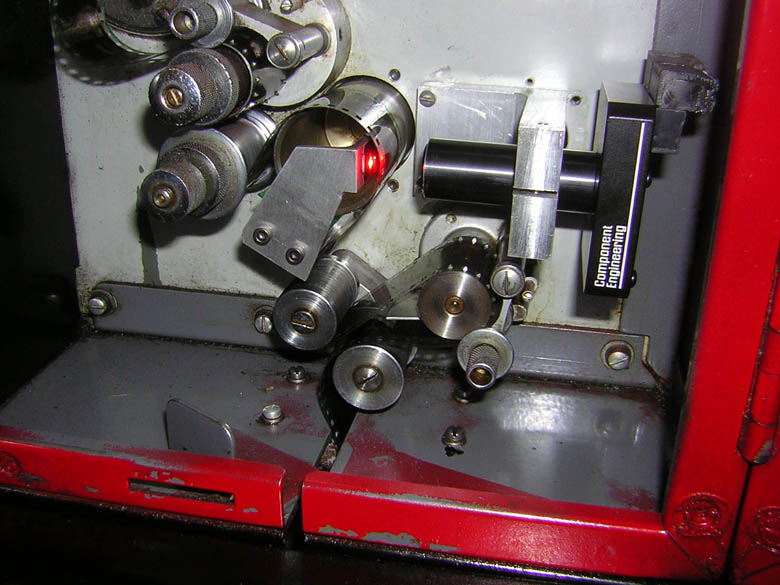
Here is the DeVry, but with a red reader I retrofitted in. Normally the Exciter lamp is to the right and the photo tube or cell went inside the sound drum.
Posted by Emiel De Jong (Member # 4225) on 12-19-2019, 04:07 AM:
The older type FP20 / FP30 soundheads have emulsion side in contact with the drum, however image and sound area is not touched. The newer (reverse scan) soundheads are base side in contact with the drum.
Posted by Simon Wyss (Member # 6218) on 12-20-2019, 02:14 AM:
quote: Emiel De Jong
The older type FP20 / FP30 soundheads have emulsion side in contact with the drum
That’s the reason for my asking, somebody on a German forum said it were the only such projector known to him. I thought to myself, not possible, someone must have had the idea before, I mean the FP 20 is from 1957-58 but optical sound is at least thirty years older.
Emulsion-on-drum sound projectors are well known with 16mm film, Bell & Howell had it, Bauer, Siemens & Halske, Paillard-Bolex, RCA. Not Ampro, not Kodak, not Hortson
Posted by Steve Guttag (Member # 268) on 12-20-2019, 07:23 AM:
16mm is a different animal. Unlike 35mm MOST 16mm prints had the emulsion facing the lens. It all depends on where your print was in the dupe-chain (how far away from the negative it was). Kinoton even had a lever on their FP16/FP18 and portables built off those mechanisms for changing the focus between standard/non-standard to compensate for emulsion in/out.
Posted by Kenneth Wuepper (Member # 1174) on 12-20-2019, 07:32 AM:
When servicing 16mm in the day, we had an SMPTE focus loop with half of the loop in each emulsion position and did a compromise focus balancing both positions. The oscilloscope was our best friend for this task.
Basic service on RCA, Bell & Howell, Ampro and Eiki projectors.
Posted by Leo Enticknap (Member # 534) on 12-20-2019, 07:38 AM:
The printing and projection orientation of 16mm never had a global standard stick in the way that it did with 35. This is likely because it started as exclusively a reversal process (i.e. it was invented for home movies), and then negative-positive workflows in 16mm came later. The fact that 16mm was originally double perf, and then a single perf variant came along with sound could also have been part of that mix. So Kodak originally started with the base facing the lens (for projection), and later processes had the emulsion facing the lens.
In the UK, at least, the latter were known as "DIN prints," (Deutsches Institut für Normung, a German technical standards organization that presumably defined a standard for 16mm release printing) and a BTH 16mm portable I once remember using actually had the optical photocell adjustment lever for flipping positions labeled "Standard" at one end and "DIN" at the other.
Posted by Jim Cassedy (Member # 4115) on 12-20-2019, 07:59 AM:
quote: Leo Enticknap
a BTH 16mm portable I once remember using actually had the optical photocell adjustment lever
The Kodak Pageant projectors had a small lever for focusing the sound head optics
depending on the orientation of the sound track. (or more correctly, the emulsion position)
In the earlier(1950's) models, I believe it was actually labeled "FOCUS", but in later models
it was labeled "FIDELITY"
The levers were labeled "R" and "P" for "Reversal" and "Print" by a large university I worked
at many years ago, since the student films could be one way or the other depending on how
they were made, such as if they contained opticals, etc .
Posted by Gordon McLeod (Member # 33) on 12-20-2019, 09:24 AM:
Some of the EL5000 machines had that little lever as well
Posted by Simon Wyss (Member # 6218) on 12-20-2019, 11:27 AM:
It would be nice, if we had another 35mm projector make like DeVry with the print emulsion on drum. There must be one more. Brenkert is not in, as far as I could detect. Monee? A Russian product?
Posted by Leo Enticknap (Member # 534) on 12-20-2019, 04:16 PM:
IIRC, Monees were basically Indian clones of the British Westar machines, which in turn were badge engineered Centurys. Tokiwa in Japan made Century/Westar clones with minor tweaks, too. I doubt if either significantly redesigned the optical sound reader.
Posted by Simon Wyss (Member # 6218) on 12-21-2019, 08:48 AM:
Thank you, Leo, for that information
Posted by Gordon McLeod (Member # 33) on 12-21-2019, 04:16 PM:
The spanish Wasman Kino 35 portable had emulsion on the sound drum
Posted by Simon Wyss (Member # 6218) on 12-22-2019, 02:58 AM:
Great! Seems the name is Luis Wassmann.
Posted by Gordon McLeod (Member # 33) on 12-22-2019, 10:53 AM:
I dont think they are in business anymore. They had discontinued projector manufacturing and were just making speakers and amps the last I heard
Powered by Infopop Corporation
UBB.classicTM
6.3.1.2