 )
)-I can watch it more than once without the picture getting all scratched and dirty.
-It's video. If video is good enough for Steven Sodaburger it's probably too good for me.
-The cases. Extra entertainment value is included in most DVD packaging in the form of spending countless hours peeling the stickers off of the top and bottoms.
-The animated menus. Why would anyone want to put the disc in and just press play? That's stupid. Unskippable animated menus are definitely the best thing ever to grace my television screen. It's a known fact that they add a great deal of value to any DVD.
-The copyright warnings. I was going to copy my DVDs for my friends, but since that copyright warning is unskippable I definitely won't now.
-The compression. Wow, everything I love is compressed! DVD's, MP3's, DLP. Compression is obviously the most important advancement in history. Nobody notices the details anyway. How can they when there are none to notice?
- Remixed soundtracks. Why yes, let's have a bunch of flunkies in the home video department replace half the foley sound effects, change the balance, and do fake 5.1 from an original mono mix. Who cares if the people who did the original sound mix won Academy Awards for Best Sound. It was done in the past, so it's primitive and needs to be replaced. It's almost as good as colorization!
- Cropped transfers. I just love it when I can't see all the way to the edges of the picture. There was nothing important there anyway! The Ben Hur DVD is a great example.
Seamless branching would have been even better on that disc. We could have had the option to skip that really creepy scene where the young blond girl has to kiss that old dude that played on "Medical Center" in the 1970's.
Another Lynch DVD, "The Straight Story" goes straight to play when inserting the disc. I wasn't expecting that. I'll usually go pee while the DVD is cycling through the opening menus. So I missed the first couple minutes.
Not all remixes are bad. Some are quite good, using all of the original tracks and sounds, just remixed using the new 5.1 technology.
I will agree that I have heard some of the fake 5.1 remixes from mono sound. What the hell is that?
Dave
quote:
DVD accomodates an ego-driven penchant to customize a DVD to make it more inconvenient --like eliminating all chapter stops!
Isn't the act of adding chapter stops to a DVD customizing a movie for the DVD experience?
------------------
Evans A Criswell
Huntsville-Decatur Movie Theatre Information Site
Speaking of the titles available, and this may not be true anymore, but releases were often reissued several times in better packaging, (remember DVDs in jewel cases?) a better disc, (no dual-layered discs early on) or a new director's cut or additional scenes, etc. Why didn't they do this on the original disc?!? Sometimes it's planned in advance, as is the case with Lord Of The Rings. In some cases, a new disc SHOULD be issued because the previous version is inferior. (There is still no widescreen version of Happy Gillmore available, or the Titanic DVD where the only real "extra" was the trailer.)
True that the quality of the image on a DVD surpasses VHS, and this would be especially noticable in my screening room on a large screen, and the fact that my projector has Component inputs makes me really want to get one. But I feel I have more control over VHS. I can fast-forward past the FBI Warning and all that nonsense. I don't have to deal with a menu. I can have my screen masked to the correct aspect ratio for the film and not have to worry that the menu is fullscreen and would be partially on my cieling while I search for the "Play Movie" option.
So I guess i'll wait until the format settles down and gets on a straight track. Oh, and when Warner Bros./New Line switch from that stupid cardboard packaging, and start listing the aspect ratio on the box. (instead of just "...the black bars at the top and bottom of your screen are normal" )
=TMP=
But if some filmmakers want to be totally puritanical about it, they'll also disable your pause button so you can't go take a pee break while the DVD is playing. They'll disable the fast forward and rewind buttons so you can't track back to figure out what some mumbling character just said.
I noticed (according to Amazon.com) that the Neverending Story DVD will be released tomorrow, Sept. 3, and that it's 1.85:1
However, IMDB lists under "technical details" as 2.35:1, and a laserdisc release in 2.20:1. (I know, I know, IMDB is about as accurate as the National Enquierer.)
So what's the real aspect ratio on this film?
=TMP=
quote:
"But I feel I have more control over VHS. I can fast-forward past the FBI Warning and all that nonsense. I don't have to deal with a menu. I can have my screen masked to the correct aspect ratio for the film and not have to worry that the menu is fullscreen and would be partially on my cieling while I search for the "Play Movie" option."
This is actually one of the main reasons why I dislike DVDs. Enough of the cutesy crap. When I press PLAY, just play the movie! Seeing that non-bypassable FBI logo just makes me want to copy the thing to spite them for making me sit through it. And what's with Universal? I watched a Universal DVD the other day and had to sit through a 60 second promo showing off their "fabulous" movies as well as the FBI logo before my player would give me control. Back when LaserDiscs were popular, I used to dupe them onto S-VHS just so I wouldn't have to deal with the intermission(s). I'm tempted to start doing that with DVDs. No FBI menu, no studio promos and no silly menus. Duping to D-VHS wouldn't lose a bit of quality either.
Also if the movie is 1.85 letterboxed, at least have the courtesy when designing the silly Flash-like menu screens to keep all options within that frame. Same for 2.39 letterbox.
Oh well, DVDs are overrated.
Part of me wonders if some of you are against DVD's just because they're digital?
Finally, if it wasn't for DVD, I would've never gotten that good CD recording of the film version of Pink Floyd, The Wall.
Bob
The Old Showman

I know its a matter of tast, but I think everything should be released to video whether it is VHS or DVD in its original apect ratio.
P&S means POS in my book 
------------------
Find me online
AOL: Dexter Caldwell
yahoo!: dexter_caldwell
"It is the opinion of the entire staff the Dexter is criminally insane."
Have you priced wide screen TVs lately? They don't fall within my budget. I agree that 'scope should be seen in 'scope (remember I was a projectionist when CinemaScope premiered and have seen the industry through all it's transitions) but unless someone is going to gift me with one I'll have to stick to P&S or STAND. Have a great day!
Bob
The Old Showman
------------------
Find me online
AOL: Dexter Caldwell
yahoo!: dexter_caldwell
"It is the opinion of the entire staff the Dexter is criminally insane."
quote:
"I guess I feel that having to wait for an FBI warning doesn't even come remotely close to tipping the scales againt DVD. Like Evan said, it's the best medium ever for home. Random access, not having to rewind the damn thing every time, better picture, clear pauses, clear frame-by-frame, and better sound are just a few reasons why DVD is the best.Part of me wonders if some of you are against DVD's just because they're digital?"
Chad, actually you are incorrect. The BEST home video format right now is a little something called D-VHS. It's 1080i digital video in a VHS shell. And as far as tape vs. disc, I have no problem whatsoever dealing with tape shuttling. It's much less annoying than navigating those stupid menus every time I play the tape. The buttons are always the same. "PLAY" means just that...PLAY! 
As for DVD--it's definitely the best home format, but it's still substandard in many ways. It seems to have been designed more for low cost and convenience rather than quality. If they had used larger-diameter disks, then they could have used a higher bitrate with fewer of the objectionable lossy compression artifacts which exist on every DVD that I have seen.
quote:
As for DVD--it's definitely the best home format, but it's still substandard in many ways. It seems to have been designed more for low cost and convenience rather than quality. If they had used larger-diameter disks, then they could have used a higher bitrate with fewer of the objectionable lossy compression artifacts which exist on every DVD that I have seen.
It's interesting to consider what kind of video quality DVDs might be capable of if they were on 12" discs (like LaserDiscs) instead of 5 1/4". But there's NO POSSIBLE WAY a consumer-oriented mass-produced system will EVER use discs any larger than they are now. As for the artifacting, I'm a pretty harsh critic, and I have to say that with a good progressive-scan DVD player with 3:2 pulldown, noticeable artifacting is pretty rare. I HATE artifacting, but it's all but disappeared on my 53" HD-capable set since I got a better DVD player (with component video of course). Transfers & compression techniques have improved too.
quote:
The BEST home video format right now is a little something called D-VHS.
Tape-based D-VHS is a stop-gap measure meant to facilitate recording and playback of true high-definition today. It's on the market now because DVD technology isn't quite ready yet for high-definition (for whatever reason). But D-VHS is doomed to fail. Unless I suddenly strike it rich, I wouldn't spend 2 cents on any "new" tape-based home video format. Better DVDs are coming and they will make tape-based systems instantly obsolete. I can wait. Consumer Videotape: Just Say No. Besides which, the studios are very nervous about releasing mass quantities of their product in full 1080i. Though some are currently supporting D-VHS, the quantities are miniscule in terms of the overall market. I just can't see D-VHS ever being very big unless the price suddenly drops below $300 for the hardware. I'll be very surprised if we ever see mass-production of hollywood product for the consumer market in real 1080i, whether it's D-VHS or a future true HD-capable version of DVD.
"The opinions expressed herein are solely those of the author."
Well, actually you can buy them at Costco now. The Samsung Direct View CRT 16 by 9 set is a little over 1K in price. RCA also has them at about this price if ya shop around. RCA otherwise known as Thomson Electronics has the hand up in this stuff as they built the first wide screen CRT plant down in Indiana. All in all, for 1K, its not such a bad deal or unaffordable either.
Mark
quote:
I noticed (according to Amazon.com) that the Neverending Story DVD will be released tomorrow, Sept. 3, and that it's 1.85:1
It was released (in Region 1) September 4 of last year!!! The disc includes a 2.35:1 original and 1.33:1 pan-and-scan edition.
As to DVD artifacts...I've seem on some of the best stuff and they still have compression artifacts that I don't like. The whole, only update those pixels that change seems to have a look I don't like.
The DVD player was certianly impressive (in appearance and weight!)...check out the Panasonic DVD-H2000
http://www.prodcat.panasonic.com/shop/NewDesign/ModelTemplate.asp?ModelID=11671
Looked pretty good....for video.
Steve
------------------
"Old projectionists never die, they just changeover!"
quote:
Actually, what I have noticed is that it is a better buy to get a 4:3 set and deal with the letterbox. The 16:9 sets don't seem any "wider" just less tall.
What if the primary reason someone wishes to purchase a 16:9 set is so they *won't* have to deal with the letterbox?
Steve
------------------
"Old projectionists never die, they just changeover!"
At any rate, those options make DVD much more convenient and fast than VHS to get to the movie. As others have pointed out, many VHS tape releases have lots and lots of previews and other crap on the front, all of which must be fast forwarded past to get to the show. Thank God for chapter buttons on DVD.
To address the P&S versus letterbox topic, I personally feel it is far better to stomach some thick black bars on a 4:3 TV set than buy a P&S version. I don't have a huge TV either (32" RCA model).
The problem with buying a pan and scan version is it is not "future proof" for a TV you'll likely buy a few years from now. If anyone thinks black bars on the top and bottom of a picture is distracting, try watching a show with black bars on the sides. That's exactly what you'll be doing with any P&S "fullscreen" DVD shown on a widescreen TV.
I watched HBO's HDTV channel this past week at my parents' place in Colorado. That channel sidebars all non-HD 4:3 content. And the effect doesn't look all that good. Any 4:3 P&S DVD will be treated the same way, unless you want to distort the picture by stretching it or doing an even worse thing by zooming into it.
Widescreen TV models (even boasting HDTV tuners) are replacing more and more category levels of monitors. Virtually all NTSC big screen sets have been replaced in electronics stores with HD or HD-ready models. In recent visits to various Best Buy, Soundtrack and Ultimate Electronics stores in Denver, Oklahoma City and Dallas, I found smaller and smaller CRT-based monitors with prices nearing the $1000 level. It won't be but maybe another year or two before we start seeing HDTV CRT monitors dropping well below the under-$1000 price level. The FCC has mandated all new TV sets must come equipped with DTV tuners by 2006. I think it is very likely the marketplace with make that happen before then, like perhaps 2004 or 2005.
So, no P&S DVDs for me --unless the 4:3 version is the only thing offered (like "Citizen Kane" or "Full Metal Jacket").
What I would prefer to see (I know it won't happen, but...) is a higher-quality 1.33:1 TV format, probably 1050p or 1080p, which would quadruple the effective resolution of NTSC television, would be compatible with all of the television programming ever produced, and would provide sufficiently high resolution that letterbox broadcasts of widescreen movies would be of acceptible quality. The legitimate objection to letterbox broadcasts now is that the gain in providing the original image composition is outweighed by the loss in resolution. For some films, I would agree with this, and there are some acceptible P&S versions on certain titles. With a significant increase in TV resolution, however, this objection becomes less meaningful. Trying to convert everything--from 1.33 TV shows and films to CinemaScope movies--to fit on a 1.77 screen which does not correspond to any aspect ratio ever used before--just seems silly to me.
Besides, I don't personally think that a widescreen format is particularly appropriate for most TV programming. Does "Wheel of Fortune" or a nightly news program gain anything from a wider aspect ratio?
Lots of people objected to it. Some wanted HDTV to take on the shape of a 2.35:1 screen, just like a commercial theater screen. Companies like Zenith patented moving shutter frame designs to imitate the masking of theater screens while working it into the cabinet construction.
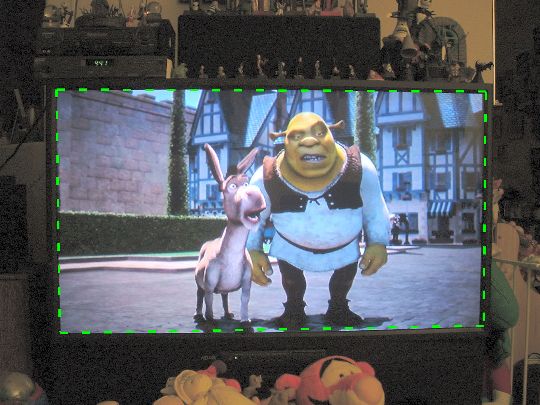
This first image of course shows Shrek on my set. The set is running in progressive scan standard mode it stretches the anamorphic image to the 1.77:1 ratio. Close enough for me to 1.85:1
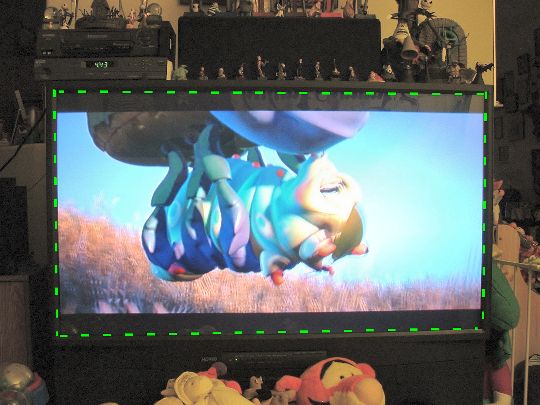
This next one is A Bug's Life and the anamorphic 2.35:1 image is slightly padded with black bars and that image is stretched over the viewing area.
Most of the anamorphic movies I have encountered have been pretty damn close to the original theatrical ratio as long as the image has not been butchered (cropped) to hell like Ben Hur.
As for 4:3 movies and regular TV, I watch those in one of two modes on my set. One mode is side letterboxed (bars on the sides) or in what Mitsubishi calls "Stretched" mode. The whole image is slightly distorted by stretching the far right and left sides of the image and then lessening the effect as it moves to the center of the screen. I only notice the effect when there are quick pans on the image of wide shots. For the most part, it feels as if the screen wraps around your head when it is in that mode.
quote:
As for 4:3 movies and regular TV, I watch those in one of two modes on my set. One mode is side letterboxed (bars on the sides) or in what Mitsubishi calls "Stretched" mode. The whole image is slightly distorted by stretching the far right and left sides of the image and then lessening the effect as it moves to the center of the screen. I only notice the effect when there are quick pans on the image of wide shots. For the most part, it feels as if the screen wraps around your head when it is in that mode.
I've been contemplating the purchase of a new wide-screen set for some time, but when I walk into an electronics store and see those distorted, stretched images, it makes me insane and I walk out. Why would I spend thousands of dollars for a high-quality monitor to watch a distorted image? And standard NTSC 4:3 images seem to look especially bad on these high-end progressive scan sets. Guess I'll stick with my 20 year old 20" Sony for a few more years.
Steve
------------------
"Old projectionists never die, they just changeover!"
But I can walk into just about any electronics store anywhere and see 4:3 ratio TV sets playing DVDs in anamorphic wide mode with the image all squeezed to hell. I think they pull that crap on purpose just to minimize black bars on super-wide films. Maybe they're paranoid many newbies to DVD won't buy a DVD player when seeing the black bars. Hmmm. Y'know, it is kind of scary, but there may actually be real market study cases showing DVD players with wide-mode improperly set on 4:3 TVs will sell more players. I just wonder how many people keep the DVD players they purchased improperly set in wide mode.
EBU work on defining scanned areas of film:
http://www.ebu.ch/pmc_scan.html
http://www.ebu.ch/tech_text_r102-1999.pdf
------------------
John P. Pytlak, Senior Technical Specialist
Worldwide Technical Services, Entertainment Imaging
Research Labs, Building 69, Room 7525A
Rochester, New York, 14650-1922 USA
Tel: +1 585 477 5325 Cell: +1 585 781 4036 Fax: +1 585 722 7243
e-mail: john.pytlak@kodak.com
Web site: http://www.kodak.com/go/motion

Unlike Evans, though, I am fortunate enough to have very good theatres in my area, so I have yet to see a 35mm presentation bad enough to make me prefer the DVD.
I'd be very interested to find a package that overcomes these faults; and ideally one which can convert MPEG-2 files which aren't DVD-compliant (e.g. ones without GOP headers), or even different file formats.
quote:
What is the purpose of 2.0 mono?
I assume so if you only have a two channel stereo set-up or just plug in the l/r into your tv set, you'll get the sound out of both speakers. Not everyone will have a Dolby Pro-logic set-up to send this to the center channel.
The debate over the black bars top/bottom or side/side on tv's is a little silly...dont look at them! you should be looking at the picture and in case you hadn't noticed that in the cinemas we have black bars on the sides and top/bottom of the screen
When browsing in the stores i often find widescreen tv's being displayed with a 4:3 image stretched to fit, i also like to evesdrop on salespeople pitching to punters, the amount of bullshit they spin to people is quite disgusting, the guy that sold me my widescreen tv didn't know what a component video lead was, i had to point it out to him on the rack right next to him!
I hope this doesn't sound too snobby, but i can bearly bring myself to watch a video these days, if it doesn't come out on DVD the same time as video i'll just wait for the DVD.
quote:
"More and more I hear VHS referred to as "video". "Do you want that on DVD or video?" When the heck did VHS become synonymous with "video"? It's as if DVD is something other than video."
Yes David didn't you know, a DVD isn't that lousy "video" thing, but PURE DIGITAL, which is of course perfect and makes people flock to get it.
------------------
John P. Pytlak, Senior Technical Specialist
Worldwide Technical Services, Entertainment Imaging
Research Labs, Building 69, Room 7525A
Rochester, New York, 14650-1922 USA
Tel: +1 585 477 5325 Cell: +1 585 781 4036 Fax: +1 585 722 7243
e-mail: john.pytlak@kodak.com
Web site: http://www.kodak.com/go/motion
quote:
"I bet Brad saw a tremendous increase in the number of participants when this was briefly the Film- Tech DIGITAL Forums. The quality of the postings probably was much better too."
Why yes John, but not only did the traffic increase 5000 times over, the quality of the posts skyrocketed to perfection too.
quote:
Not everyone will have a Dolby Pro-logic set-up to send this to the center channel.
I rented The Man With Two Brains, which has a 1.0 mono soundtrack, this is back before I decided to connect the stereo to the DVD player, it played on both speakers (on my TV which has ok seperation) in mono. My brothers rented Airplane 2, which has 2.0 mono in english and french (2 separate audio streams) it also plays in mono on both speakers (after I connected the stereo). Both of these discs played the same way on my equipment.
What I'm asking is why do producers use an extra channel of audio, which uses up more bits (bits that could have gone to the video stream or to one, better-sounding audio stream)?
Battlestar Galactica has a 1.1 mono soundtrack (center/sub), but Road to Morrocco has 2.0 mono (left/right) These were both released by Universal.
Perhaps someone who actually works with some sort of DVD authoring program with full AC3 (1.0, 1.1, 2.0, 2.1, 3.0, 3.1, 4.0, 4.1, 5.0, 5.1) capabilities can tell me the advantage to 2.0 mono over 1.0 mono.
With that in mind, a 1.0 mono track is going to only come out of the center channel speaker on some newbie's home theater setup. And while that center-only placement may be artistically correct, the newbie is still going to be pissed off beyond belief, thinking that his home theater system is defective or something. Anyway, that is the mindset behind 2.0 mono. And the funny thing with 2.0 Mono is if you engage Pro-Logic with it much of the audio grounds itself to the center speaker anyway. Hehe.
This is just another one of those "controversies" such as the differing opinions on altering a Dolby Digital 5.1 track so it is optimized for downmixing into stereo --or not doing it at all and just including a separate DD 2.0 English track instead. Then there is the dialog normalization argument about Dolby Digital. And then you have the deal about when and when not to use Dolby Digital Surround EX enhancement. Oh yeah, and then there is that argument that Dolby Digital EX is 6.1 when it is really only 5.1.
Maybe Dolby should come up with a series of "format numbers" for video use, just like they did for film use. Then, the disk packaging could contain a note about "play this in format xx" and home sound processors could have a way for the user to select a format by number. Even better, there could be some type of connection (serial link?) between the player and processor which would then select the proper format from data on the disk.
quote:
What I'm asking is why do producers use an extra channel of audio, which uses up more bits (bits that could have gone to the video stream or to one, better-sounding audio stream)?
What I've found is that most 1.0 and 2.0 mono DVD soundtracks are encoded at the same 192 kbps rate. Other bit rates have been used, but 192 seems to be the most common for mono discs whether they are 1.0 or 2.0. A data rate of 192 kbps isn't really taking up much disc space. Now, full rate DTS (1509 kbps) and PCM tracks start to eat up space....
On VHS and laserdisc formats (whether Hi-Fi, linear, or PCM) there are two audio tracks -- no more, no less -- so mono soundtracks are essentially "2.0" signals there too. Apparently people never really realized this or made a fuss about it until DVD came along.
quote:
Battlestar Galactica has a 1.1 mono soundtrack (center/sub), but Road to Morrocco has 2.0 mono (left/right) These were both released by Universal.
Apples and oranges comparison, I think. The GALACTICA disc was an attempt to preserve its original Sensurround presentation (there are a couple other 1.1 Sensurround titles on disc as well). Actually, I was surprised Universal didn't issue that one in "2.1" given that they customarily issue their mono titles in 2.0.
quote:
Perhaps someone who actually works with some sort of DVD authoring program with full AC3 (1.0, 1.1, 2.0, 2.1, 3.0, 3.1, 4.0, 4.1, 5.0, 5.1) capabilities can tell me the advantage to 2.0 mono over 1.0 mono.
I'm not sure there are any real advantages or disadvantages. It's merely a choice, just like the choice the companies make when deciding if a disc will have only a 5.1 track or if it will have separate 5.1 and 2.0 tracks. The 5.1 soundtracks are flagged to down-mix themselves when played back on systems that cannot reproduce 5.1 discrete channels. Likewise, 1.0 tracks are flagged to "up-mix" to 2.0 for Dolby Pro-Logic and similar process playback, which in turn reproduces it as "phantom" mono.
One distinct problem with 2.0-encoded mono tracks is that if they are even slightly out of phase or encoded incorrectly, they won't properly "phantom"-image. In addition, some audio processors have difficulty playing these back as phantom-image mono. This is where that one particular magazine's term "big fat mono" comes from.
Bobby Henderson wrote:
quote:
Oh yeah, and then there is that argument that Dolby Digital EX is 6.1 when it is really only 5.1.
Bobby,
You and Paul L. should chill out over this "argument." If you would've simply made a distinction between "tracks" and "channels" (multiple channels can be derived from a track) then no argument would have been necessary. Moreover, if one were to write a sentence describing a Dolby Digital Surround EX soundtrack (whether theatrical or DVD) and simply framed the 5.1 term in quotes ("6.1") then it would be a subjectively correct statement (e.g. Harry Potter sounds great in "6.1").

As far as I am concerned 5.1 audio is 6 track. There is no if's or but's about it. Another thing that bothers me is when a sound mix that does not use the right and left surround and LFE and uses only the front soundfield - Left, Center and right and is referred to as 5.1 really annoys me very much.
-Claude
The ".1" thing comes from the fact that it isn't full bandwidth and on most systems can't be full bandwidth. Thus if someone wanted to use a 5.1 system to say do a special mix in Todd-AO format, it couldn't do it. So how could one equate a 70mm 6-track film (or mag masters for dubbers) where there is the possibility of 6 full-range channels with a crippled 5.1 system? Heck, for the bulk of DTS systems, they cheat it even more...there are only 5-channels on the disc.
5.1 is mostly a consumer term anyway. Most people I deal with in the industry never refer to any of the digitals as "5-1" as many, many consumer people do. What I like about the whole 5.1 thing is it immediately identifies the morons out there just trying to use buzzwords.
Steve
------------------
"Old projectionists never die, they just changeover!"
But, Steve, I think that's a bit harsh. I often use ".1" when referring to these audio systems and I know I am not a moron who's just using buzzwords. A decade ago, the ".1" thing may have been a buzzword but I think that it has gradually "taken hold" and become bona fide terminology. The phrase may not be the most accurate form of reference but that does not mean than only morons use it.
~Manny.
"In space, no-one can hear you scream."
Tagline for Alien
Seriously...the only people that have referred to the film digitals as "5-1" (they don't say the "point") are the morons that come from the consumer side. If you are talking about Dolby Digital, say so. If it is DTS, say so...if it is SDDS call it that. If you need to append EX, then do so. If you just talking about channel configuration, then I suppose 5.1 is a good descriptor. It just doesn't come up for me. But when some bozo claims to "have 5-1" they are almost always a moron just trying to use buzzwords.
Steve
------------------
"Old projectionists never die, they just changeover!"
My Sony DVD player uses progressive scan (sometimes referred to as "liberal scan") with 3:2 Pullup (pronounced "Thirty-Two Pullup"). The salesman said that means it doubles the number of pixels in each frame and doubles the number of frames. Based on that, you'd think it would be "Four Pullup" (the original frame data x 2 x 2) but since a DVD spins 8 times faster than a VCR, it's technically accurate to say DVDs are 4 x 8 = 32 times better than "videos". Obviously "thirty-two" has more marketing sizzle than "four". But then the lawyers made them stick a ":" in the middle in case anyone questions the 32-times-better claim. The bottom line is, all of this techno-wizardry means DVDs look as good as HDTV (Hi-Digital Tele-Vision) or even IMAX (Image MAXimus).
Anyway that's what the salesman at Circuit City told me. Also I read some of it on the Internet.
Anyway, I am right in saying a lot of misuse has been made of the "6.1" term for audio tracks that are essentially 5.1. Dolby Labs has made it clear in their advertising rules that Dolby Digital Surround EX is a 5.1 format and should never be described in product literature as "6.1".
quote:
I am right in saying a lot of misuse has been made of the "6.1" term for audio tracks that are essentially 5.1.
Agreed. Which is why Ive always been careful to refer to them as CHANNELS and not TRACKS. Same principle of calling the Dolby SVA system 4:2:4 (two tracks on the film print, 4 channels being reproduced in the theatre). So, in dropping that silly .1, I'll just keep adapting Dolby's original idea of a theatrical 2 track 4 channel system, to Dolby Digital Surround EX as a 5-track, 6 channel system, the way Dolby and THX orginally pushed the system as. Dolby can sue if they want!
------------------
John P. Pytlak, Senior Technical Specialist
Worldwide Technical Services, Entertainment Imaging
Research Labs, Building 69, Room 7525A
Rochester, New York, 14650-1922 USA
Tel: +1 585 477 5325 Cell: +1 585 781 4036 Fax: +1 585 722 7243
e-mail: john.pytlak@kodak.com
Web site: http://www.kodak.com/go/motion

quote:
Actually, Mr Stambaugh, dts ("dits") stands for Digital Theater Systems, not Stereo
Michael, Hopefully you spotted a few other technical errors in my earlier post. It was meant as a joke. Although some salesmen and consumers really are almost that misinformed or ignorant.
 . In fact, the last time I had that complaint is when I ran CURSE OF THE JADE SCORPION. You should have seen the face of the customer when I told him that all Woody Allen films are SR-D mono (except EVERYBODY SAYS I LOVE YOU of course). I even I have an employee now that talks through his ass about his home theatre and how we should "tweek" our system at my theatre. Of course I blame the sales personel at Circuit City or Best Buy becuase they were talking through their collective asses first. They are like a cancer...
 However, somehow I did get the one with progressive=liberal scan, and I even laughed a bit!
My friend has his "5.1" system set up in his living room. Lo and behold, each and every speaker is always on at the same level. The bass is turned up so high, that when someone closes a door on-screen the shelves rattle. And he's proud of it. I can explain to him what it's supposed to sound like until I'm blue in the face, and he'll just look dumbfounded, smile, and nod. Then again, he also thinks he's getting a Digital picture from his Digital cable on his Analog TV.
Salesmen are just repeating what they are fed in a 30 minute training seminar: That the more expensive one is better. Sometimes while browsing, I overhear salesmen talking to a clueless customer about DVD players and "S-video gives you a much better DIGITAL picture..." and how "5.1 Digital Sound is included in this model..." --- to someone who probably has a 25" mono TV with only a coax input who will probably come back and complain that the black bars are cutting off the picture.
All thanks to mindless consumerism.
=TMP=