This is topic Benny Hill (uncut) in forum The Afterlife at Film-Tech Forum ARCHIVE.
To visit this topic, use this URL:
https://ft-forum.com/ft/cgi-bin/ubb/ultimatebb.cgi?ubb=get_topic;f=12;t=000332
Posted by Will Kutler (Member # 770) on 09-12-2004, 04:43 PM:
Just saw this advertised today:
The Benny Hill Show....the origonal uncut British versions are now available through A & E (Arts and Entertainment) Home Video. And I do believe they are DVD.
cheers
Kutler
Posted by Evans A Criswell (Member # 381) on 09-13-2004, 01:56 PM:
Yes. I've been watching those and have seen the first 8. Episodes 1 through 5 are in color and 6, 7, and 8 have been black and white. When episode 6 started, and the picture was in black-and-white, I thought something had gone wrong and spent several minutes checking cables and such. I finally got the box and it stated that three of the episodes were in black and white. Why? They appear to have been recorded on the same quad machine that the others were, using "black-and-white in color mode". When there are tape dropouts, there is color in the blemishes! It seems if they were using a quad machine capable of recording in color, it wouldn't save them any money by shooting in black-and white? What is the meaning of life?
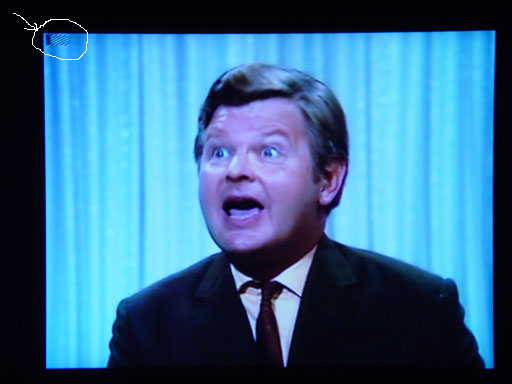
Also, I've noticed in the shows, a little rectangle pops up in the upper left (or sometimes right) corner of the screen with a white and black moving stripe pattern, and I suppose it was something the technicial was using to tweak the quad machine while recording? I'd never noticed that on a show before? Any ideas on this?
Posted by Paul Mayer (Member # 355) on 09-13-2004, 03:26 PM:
Evans, can you post a frame grab of that pattern? Don't remember anything like that from my quad days.
As for color showing up around tape dropouts, welcome to composite video. When luminance signals of just the right shape or frequency hit your display's color decoder, they can be interpreted as being color signals. The problem can be largely eliminated with proper comb filtering during encoding, which removes the troublesome energy bands before they hit the encoder. Accom and Vistek were the first to market professional NTSC and PAL encoders using this technique back in the '80s. Composite video encoded this way will play back without spurious color problems on even the cheapest home display decoders.
It is possible to comb filter the output during decoding and playback as well. But the solution does not lend itself to affordable implementation--such decoders carried price tags upwards of $20,000USD in the '90s. ![[Eek!]](eek.gif)
Posted by Phil Hill (Member # 371) on 09-13-2004, 05:16 PM:
Yes! One of my all-time favorite shows! Have many hours on VHS!

>>> Phil
Posted by Mark Hajducki (Member # 1732) on 09-13-2004, 05:40 PM:
quote: Evans A Criswell
Also, I've noticed in the shows, a little rectangle pops up in the upper left (or sometimes right) corner of the screen with a white and black moving stripe pattern, and I suppose it was something the technicial was using to tweak the quad machine while recording? I'd never noticed that on a show before? Any ideas on this?
That may be the signal used to cue the adverts (So the regional station could show region specific, rather than UK wide, adverts).
Posted by Evans A Criswell (Member # 381) on 09-13-2004, 08:03 PM:
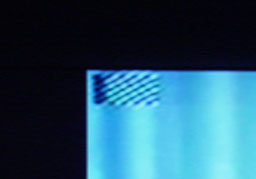
It's not a commercial cue. The stripes in the pattern move and they're not stationary. The speed varies, as if a technician is adjusting something, using the pattern in the box as a guide. The strips go from stationary to moving sideways rapidly within the little box. The stripes are black and white. The camera didn't do a good job of capturing that. I didn't bother correcting the color balance, since it's not important to what I'm illustrating.
I'm curious what this was. It appears in many scenes on these discs during scenes.
Here's an example of an entire picture with the little pattern circled in the upper left corner.
Here's a closer zoom-in on it:
I also tried to take a picture showing the obvious banding in the picture, but the camera doesn't capture things nearly as well as my eye does. ![[Frown]](frown.gif)
By the way, the liner notes (which I finally read) explain the lack of color in some episodes. The entire BBC was hit by a technicians' dispute during the middle of the second season of Benny Hill. Production crews wanted higher wages for working the new color cameras. While the debate was going on, color was abandoned. The tail end of 1970 and the first two months of 1971 were affected.
Posted by Bruce McGee (Member # 131) on 09-14-2004, 07:14 AM:
Not trying to change the subject, could this be the reason that the first ep. of Are You Being Served? is in B/W?
I love the Benny Hill shows. I worked for a station back in the early 1980's that wanted to edit these shows before air. They gave up after ruining the first show with their edits... not to mention all the complaints from viewers.
Posted by David Buckley (Member # 2600) on 09-14-2004, 07:32 AM:
That box is certainly in the wrong place for the advert blob, and I cant ever recall seeing a blob like it on UK TV, including the original screenings of Benny and Are you being served, and Python/towers.
The advert blobs on UK TV on the top right were originally a solid white box, but in latter years were a stripy box, with moving lines, at 45 degrees, but rather clearer than your example.
As to the banding, could this not just be an artifact of standards conversion?
Posted by Evans A Criswell (Member # 381) on 09-14-2004, 09:38 AM:
This box does have moving lines (whose speed of movement vary while it is present), but it sometimes comes up during the middle of a scene and goes away before the scene is over. That's why I didn't think it was a commercial cue or anything.
The lines in the box are sharper than the picture indicates. I had to do some blurring on the photograph to eliminate moire patterns caused by interference between the LCD display spacing and the camera's sensor array.
I guess I could figure out what frequencies the lines are in the horizontal and vertical directions. Maybe that would be a clue.
Posted by Stephen Furley (Member # 1277) on 10-01-2004, 04:20 AM:
quote: Evans A Criswell
I finally got the box and it stated that three of the episodes were in black and white. Why?
Are there any artifacts on these episodes which indicate that they may have been recorded onto film at some time. There have been cases where original recordings have been discarded, and the programmes have been recovered from black and white 16mm recordings which have been made for export, which were the only surviving copies. Could this have happened with any of the Benny Hill shows?
Posted by Dick Vaughan (Member # 540) on 10-05-2004, 04:03 AM:
Phil, Isn't Benny your long lost brother?
quote: David Buckley
That box is certainly in the wrong place for the advert blob, and I cant ever recall seeing a blob like it on UK TV, including the original screenings of Benny and Are you being served, and Python/towers
There were commercial cues similar to the ones described. i have asked our TV curators at the Museum to provide additional info.
the reason you never saw these on Monty Python , Fawlty Towers, Are You Being Served etc is because they were BBC programmes. BBC does not carry commercials.
Benny Hill ,although he did some BBC programmes ,was mainly associated with Thames TV a commercial TV staion see below
Benny Hill Show
Posted by Dick Vaughan (Member # 540) on 10-06-2004, 06:26 AM:
From John Trenouth our TV God
quote:
The small squares appearing on the top right of TV screens on ITV and Channel 4 just before commercial breaks are called cue dots. Some cue dot generators inserted the dot top left of the picture, but most inserted it top right (the most common position). The horizontal moving black stripe (sometimes diagonal - depended on the manufacturer of the generator) is not locked to the picture ie it's rate of movement varied & sometimes would appear stationary. The black stripe was added after operators complained that they could not see the white dot if the background picture was also white.
Their main purpose was as a visual warning to operators who were manually controlling video or telecine machines. They appear 5 seconds before the time when the next machine should be started. This is usually to allow the operators to roll the adverts appearing in programme breaks and to roll the programmes following such breaks. They were extensively used in ITV because adverts were played in locally, even during a networked programme.
If cue dots appear during the programme, they have been used for editing purposes.
The ones used by the BBC appear in the top left corner, coming on and off twice to give a 15 and a 5 second roll, for older two-inch tape machines. Later videocassete machines stabilised within 3 seconds of being switched to play, so 5 seconds was then enough.
Cue dots don't appear on all TV receivers because some have been adjusted to make the raster (and hence the picture) larger than the screen.
Powered by Infopop Corporation
UBB.classicTM
6.3.1.2