This is topic Anyone here familiar with Cartrivision? in forum The Afterlife at Film-Tech Forum ARCHIVE.


To visit this topic, use this URL:
https://ft-forum.com/ft/cgi-bin/ubb/ultimatebb.cgi?ubb=get_topic;f=12;t=000395

Posted by Jesse Skeen (Member # 586) on 03-20-2005, 05:46 PM:
 
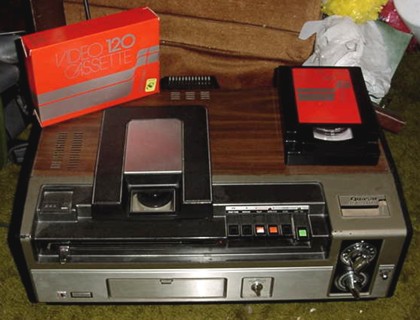
Kind of a shot in the dark here, but about a year ago I got a Cartrivision videotape machine, which was the first consumer videocassette format launched in 1972. The machine I have was built into a console TV system, then removed for later use. Although the guy I got it from said it worked, upon receipt the motor wouldn't spin up. I managed to find another motor and replace it, which works but now it won't thread the tape, and I stupidly broke something else when searching for the answer to that problem so I'm afraid to touch it now. Is anyone here familiar with these or know of anyone reasonably close to Sacramento who might be able to give me some help (for a reasonable price of course?)
I don't know how many working machines are still around today, but I have a tape of Richard Nixon's resignation recorded live off the air that I'd like to see. There was even a pre-recorded tape showing how to operate the Cartrivision system, though I don't have that one. I wonder if anyone's successfully transferred that to DVD or any other somewhat current format.
Here's a link to more info on Cartrivision for anyone who's interested: http://www.labguysworld.com/Museum017.htm
 
Posted by James R. Hammonds, Jr (Member # 673) on 03-21-2005, 04:17 PM:
 
I know a guy who can fix it for you, but after he does, anything you play back through that machine will have his logo in the nottom right-hand corner of the screem [Big Grin]

Ok, seriously, I have nothing.
 
Posted by Leo Enticknap (Member # 534) on 03-24-2005, 05:17 PM:
 
Another useful obsolete video formats site.
 
Posted by Stephen Furley (Member # 1277) on 04-19-2005, 12:31 PM:
 
quote:
The tape formats are listed with Obsolescence Ratings as follows:

Extinct: Only one or two playback machines may exist at specialist laboratories. The tape itself is more than 20 years old.

Critically endangered: There is a small population of aging playback machinery, with no or little engineering or manufacturing support. Anecdotal evidence indicates that there are fewer working machine-hours than total population of tapes. Tapes may range in age from 40 years to 10 years.

Endangered: The machine population may be robust, but the manufacture of the machinery has stopped. Manufacturing support for the machines and the tapes becomes unavailable. The tapes are often less expensive, and more vulnerable to deterioration.

Threatened: The playback machines are available; however, either the tape format itself is unstable or has less integrity than other available formats, or it is known that a more popular or updated format will be replacing this one in a short period of time.

Vulnerable: This is a current but highly proprietary format.

Lower risk: This format will be in use over the next five years (1998-2002).

Interesting that something which will be around for five years is considered to be a format with a future. U-matic managed about thirty years, and Quad over twenty. Even Super-8 film, one of the most recent formats, has managed to survive for 40 years, and IMAX is now 35.

Another site:
 
Posted by Monte L Fullmer (Member # 2797) on 04-20-2005, 02:18 AM:
 
Tim Stoffel who runs Quadraplex park in Reno has quite the massive collection. Playing with the quads is quite a feat in itself-kinda like running changeover 70mm machines: just something you'll never forget.

One should check out the Yahoo VTR and AMPEX forums and talk with these old VTR "tape handlers", for a bunch of them are just like us "film handlers" in FT - perfectionists in their trade.

There is one format that was left out in that one site, and that is the 1/4" inch open reel format.

AKAI originated the 1/4" inch reel format for portable use. The tape, even though looks like regular audio tape but of the difference being of the highly polished CR02 oxide surface as we see with the VHS/Beta tapes. If one used audio tapes in these machines, quality will be much lower and the rotating heads will definitely suffer of quick wear due to the coarseness of the oxide base of the audio tape.

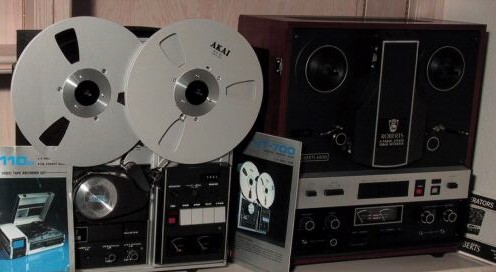
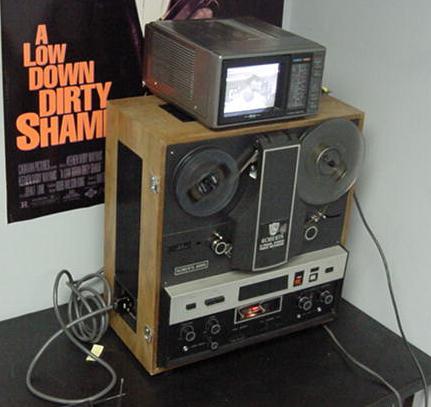
Here are two picts of the 1/4" reel format. One of them is my Roberts 1000 in video mode and the other showing the only two AKAI/Roberts 1/4"inch home deck machines: The one on the left is the AKAI VT-700, and the right is the Roberts 1000(AKAI-VT500). the 1000 had a price tag of over $1300.00 with a B/W camera and a special BW TV/monitor, since the unit could only be hooked up to a monitor by a special 8-pin video baseband cable. Being a quarter inch tape, thes AKAI's weren't part of the EIAJ forum being of a special format.

1-  -

2-  -

...and also, there is the extinct "VX" format of Quasar/Panasonic of the mid-70's.

This is my first VCR, the VR-1000 "the Great Time Machine" that I purchased back in the summer of 1977. Thing weighs in at 45 lbs and the 2hr tapes had a $34.99 price tag on the box.

1-  -

One has to do a search on the Cartrivision concept. It was a beginning of an idea that never took off commerically.
..Monte
 
Posted by Stephen Furley (Member # 1277) on 04-20-2005, 03:36 AM:
 
I've used an Akai quarter inch portable; I didn't know that they made non-portable versions.

I can think of quite a few other formats, there was the Grundig SVR system, based on the Philips 1500 and 1700 series, but with the playing time extended further. Then there was the Sony CV2100ACE half inch machine, which were widely used in London schools in the '70s, similar to the EIAJ machines, but the oxide was different, and the tape ran faster, 11.5 ips. There was a PAL colour wersion, the CV5600P, but I never saw any mention of an NTSC varient. These machines could record both the 625 line and 405 line standards, though I doubt if many of them ever did 405. I did make a recording from a 405 line signal once, just to try it. The longest tape which Sony made for these machines was the V-32, which ran 40 minutes, and cost over twenty pounds, a lot of money in the early '70s. 3M made a 60 minute tape, but it was on a thinner base, and sometimes caused problems. Sony also made an endless loop tape, which ran about five minutes I think. It was similar to an 8-track audio cartridge, but a length of tape had to be pulled out and threaded through the machine. The lubricant drom the back of the tape found its way onto the heads, and the thing generally jammed after it had run through few times.

I quite liked the Philips V2000 system; it was better than VHS, but was introduced too late.

Somebody, I think it was National, before they teamed up with Panasonic, made a 2/3 inch machine, which took a cartridge with only one spool; the take-up spool was permanently fixed in the machine.

Formats I've used, in some cases only once, and a long time ago:

Sony CV2100
Half inch EIAJ
One inch Ampex
One inch IVC
Quarter inch Akai
Philips LDL-1001 half inch reel to reel
Philips 1500
Philips 1700
Philips V2000
One inch 'C' format
Two inch Quad (at the very little used half speed version)
Two inch IVC 9000
Betamax
VHS
U-Matic
M-II
Betacam (Original oxide version and SP)
Video 8

I'm yet to get my hands on any digital format. The media department at the college where I work uses DV-Cam, but I've never used it.
 
Posted by Jesse Skeen (Member # 586) on 04-20-2005, 01:59 PM:
 
I've got one of those Quasar machines too, but don't know if it works- I've never been able to find any tapes for it- there were a couple on Ebay last week but someone else was bidding on them and I didn't want to get into a bidding war not knowing what was on them.
 
Posted by Monte L Fullmer (Member # 2797) on 04-20-2005, 06:48 PM:
 
quote: Jesse Skeen
I've got one of those Quasar machines too, but don't know if it works- I've never been able to find any tapes for it
..I've got 14 of these tapes... 2-60min (black label), 4-100min (blue label) and 8 of these red 2hr tapes.

This unit is that extinct VX format I mentioned earlier. This unit was in storage for a long time. The unit still runs,but there is no video.

I've been thinking of selling this unit and tapes off to any collector who might be interested, yet would like to see if I can get the video going to really "ante' up the selling price.

The Roberts 1000 was a thrift store purchase for 30 bucks and it had the video cable to go with it. I converted the video cable to have one end with RCA A/V plugs on it due to the machine is a baseband unit with no RF circuitry. Unit only does B/W.

The tape I purchased from a video collector who had some of these quarter inch video tapes on hand..a bit pricey-10 bucks for that5inch reel, which only lasts about 22 minutes with tape speed of 11.5ips.

The audio stereo tape recorder section of the Roberts works with no problems.

-Monte
 
Posted by Mark Gulbrandsen (Member # 72) on 04-20-2005, 07:22 PM:
 
I can understand why someone would want to collect and restore an old quad machine, 1" type C or early D format stuff or old broadsact equipment but not that stuff Monte. What for and why? This is right along the lines of the CED stuff......

Mark
 
Posted by Monte L Fullmer (Member # 2797) on 04-20-2005, 09:34 PM:
 
Wooooo..Marko...CED stuff! Good ol' RCA's 'comeback' to Laserdisks...but with a stylus.

Definitely wouldn't touch that stuff, even though the styli's are still available when doing a search.

Actually, I've had nibbles on that VR-1000 VX machine from the obscure video collectors, for they love anything that was unique and can be fixed to made to work.

-Monte
 
Posted by System Notices (Member # 2357) on 05-22-2006, 08:58 PM:
 

It has been 396 days since the last post.


Posted by Peter Mork (Member # 1336) on 05-22-2006, 08:58 PM:
 
Jumping into this discussion late, but I did have a machine once. It's now at my brother's and not workable. He claims he will repair it someday, but I'm not holding my breath. I too have a bunch of tapes I'd like to look at again. It was bought in the 80s from someone selling off a lot of unwanted gear. Worked reasonably well, but it only recorded every third video field, which made everything originated on film play back with a slightly jumpy look.

There are still unused machines - the works without a cabinet - which turn up on Ebay now and then. Only this week I bid on one, but didn't win, so there must be some interest out there.
 
Posted by Jesse Skeen (Member # 586) on 05-23-2006, 02:31 PM:
 
Go to http://www.labguysworld.com/VideoFiles.htm to see the instore demo tape for Cartrivision- LOVE the music on it!

Still haven't gotten mine to work- I've pretty much given up on it til I can find someone in the area who can come look at it.
 
Posted by Peter Mork (Member # 1336) on 05-24-2006, 12:48 AM:
 
Right! Jolly good luck with that! There may be no specialists out there, but I bet if you try you can find someone to take a poke at it just for laughs. (You might raise their interest if you mention it's all transistors, no ICs, thus relatively simple to work on.)

If and when I ever get a working machine in my grasp, I will post and let you know.
 
Posted by System Notices (Member # 2357) on 08-28-2007, 11:48 AM:
 

It has been 461 days since the last post.


Posted by Jesse Skeen (Member # 586) on 08-28-2007, 11:48 AM:
 
A Cartrivision VCR demonstrated on What's My Line?

This clip has a Game Show Network bug on it, but I had to add this to my favorites list anyways. The tape shown here is a shorter-length one, and the physical cassette is shorter than the ones used for the longer tapes.

I just got a 4th machine but haven't been able to try it out yet. Oddly enough, I got it from the same person I got my 2 new kitties from, and I don't want to turn it on while they're running around. (I don't have the whole console with the built-in TV, just the mechanical unit and its corresponding electronics that were removed from the console.)
 
Posted by Mark Gulbrandsen (Member # 72) on 08-28-2007, 07:15 PM:
 
I remember them as a kid at Sears... but I wood be more inclined to restore something useful like an all germanium transistor 2" Quad low band color Video Tape Machine like an early RCA TR series.

I seem to remember that Olsen Electronics bought out the remaining stock of Cartrivision machines and was selling them back in the mid 70's...

Mark
 
Posted by Stephen Furley (Member # 1277) on 08-29-2007, 10:56 AM:
 
quote: Mark Gulbrandsen
I wood be more inclined to restore something useful like an all germanium transistor 2" Quad low band color Video Tape Machine like an early RCA TR series.

Like this fellow does: web page
 
Posted by Mark Gulbrandsen (Member # 72) on 09-19-2007, 10:27 AM:
 
deleted double post
 
Posted by Mark Gulbrandsen (Member # 72) on 09-19-2007, 10:32 AM:
 
I don't think he has a TR-22 which was the first and last of the all germanium 2" machines that RCA made. I used to maintain 4 of them and they were always a good challenge but can be real dogs to work on!!

Mark
 
Posted by Stephen Furley (Member # 1277) on 09-19-2007, 02:21 PM:
 
I don't think I've ever seen a RCA reel to reel quad machine, at least not one in service. I've got a feeling that the one in the museum at Bradford may have been a RCA of some sort; Dick? If it was it was not the early type with the spools arranged vertically, but the sale sort of layout as Ampex used. Apmex machines were far more common here, but when I went to the then new LWT (London Weekend Television) studios on the South Bank, basically next door to the National Film Theatre, in the early '70s they had two of the RCA cartridge machines with the belt arrangement on the front for selecting the carts; that was the only place I ever saw one of these. They also had one of the Ampex instant replay type disk recorders, something else I only saw once.

I used to work for the ILEA (Inner London Education Authority), and they had their own television service at one time, distributing four or five of their own channels, plus relaying the three broadcast ones which existed in this country at that time, over a Post Office RF cable distribution system. This was in black and white, and was unusual in that while it was 625 lines it was VHF; normal broadcast television here has always been UHF for 625 lines, though the old 405 line system was VHF. They had a studio centre in South London, and used Ampex quad machines, VR2000 I think, though I only ever saw them once, and it was a long time ago, but they ran them in the seldom-used half speed format, with narrow heads. I don't know of anybody else who used that format.

Soon after VHS tape came in they gave up the cable system, converted one studio to colour and the other to a tape duplicating facility, and distributed programmes on tape alongside the 16mm prints sent out from their large film library. They used the then very new 1" 'C' format when they went colour. This was when the 'B' and 'C' formats were still fighting it out to become the new broadcast standard.

The man who runs Quadruplex Park seems to have three interests in life, lions, God and video recorders, which somehow seems to be an unusual combination.

I did get to see the two 'big' machines; in 1972 the BBC had several exibitions in London for their 50th year. One of these was a technical one at Mullard House, not far from the University of London. Mullard made valves and picture tubes, and I think became part of Philips. One of the exhibits there was a new Ampex AVR1.

I once had to collect some film prints from a facilities house in London which had a pair of IVC 9000 2" helical machines, something else that I never saw anywhere else.
 
Posted by Monte L Fullmer (Member # 2797) on 09-20-2007, 02:10 AM:
 
I used to frequent our local TV station back in the early 70's since I had a friend that worked in the control room there. Station had two AMPEX quads (can't remember what model nos. though). He'd show me how to run those quads - lacing them up with the commericals that came in and queing them in for broadcast.

...that got my attention for videotape movies..on how video was captured on that wide tape.

Yes, Tim Stoffer's LionLamb, Quadraplex museum, along with Richard Diehl's "Lab Guy's World" page, plus this page are the pages to visit in this department.
 
Posted by Mark Gulbrandsen (Member # 72) on 09-20-2007, 09:22 AM:
 
quote: Stephen Furley
I once had to collect some film prints from a facilities house in London which had a pair of IVC 9000 2" helical machines, something else that I never saw anywhere else.

These were oddball machines and Ampex also made one... Hugh Heffner had an Ampex 2" Helical in the PlayBoy mansion in Chicago back in the 70's.

The early quad machines had horrible to non-existant tape interchange... many machines were kept in television production facilities just to be able to play back certain series of tapes. Later head assemblies were precisley aligned and this problem went away.

There is supposedly an AVR-1 that is kept in working condition show somewhere in LA that is used to transfer over the old 2" live shows onto digital... I saw one of the Twilight Zone shows on TV last week that looks to have come from this machine... tracking errors and all. Till I saw this I was not aware that older Twilight Zone shows were taped live...

Mark
 
Posted by John Walsh (Member # 168) on 09-20-2007, 11:55 AM:
 
I worked on Ampex VR660B's while in high school; couldn't find a picture, though but here's VR 660's look-alike; the VR1500
 
Posted by Monte L Fullmer (Member # 2797) on 09-20-2007, 12:21 PM:
 
What was the reasoning for the supply tape to have "B" wind (oxide out) on those machines anywho?
 
Posted by Mark Gulbrandsen (Member # 72) on 09-20-2007, 09:03 PM:
 
I can't speak for the 2" helicals but all of the other video tape machines I've worked with had the oxide wound in. Just the way the reel servos were designed to wind the tape. They were not reversable in direction.

I will be in Western Nevada next month and perhaps I should go see that guy....

Mark
 
Posted by Mark Ogden (Member # 43) on 09-21-2007, 10:35 AM:
 
The Ampex AVR-1 was an incredible machine, the all-vacuum, capstan free transport also formed the basis of the ACR-25 dual-transport spot playback machine. It was fascinating the way it worked, the tape getting sucked into air columns for speed control (using a vacuum servo system, I was in charge of replacing the column sensor lamps), and the head-wheel guard curving up to hold the tape against the heads. The lock-up time on the machines was for all intents and purposes instant as opposed to at least 5 seconds for the RCA quads. Genius. In fact, the station I was working for at the time took delivery of one of the first ACRs, they had bought it right off the floor of the NAB convention. A few weeks later, they got a call from RCA, offering them TWO of the vastly inferior TCR-100s, if they would box up the ACR and send it to them so they could tear it down and see how it worked. They declined, wisely.

CBS still has a couple of AVR-3s, the successor to the AV-1, set up in NY for transfer of archive material, of which there is a ton of. The vast majority of the old stuff plays back beautifully after a scraping and dry-web cleaning to remove loose oxide. Mark G. remembers correctly about the old head panels and interchange problems with the VR-1000 and 2000 series. About three years ago, they finally removed the last VR-2000s that were still on the master routing switcher and playback-to-air capable. They tossed out no fewer then twenty old-series head panels that they still had hanging around for just such problems, as in the old days the engineers had to note which head panel was on which machine for which recording. Starting with the AVR-1, he head panels auto-optimized, which solved a lot of such screwing around.
 
Posted by Monte L Fullmer (Member # 2797) on 09-21-2007, 01:11 PM:
 
Interesting reading of AMPEX broadcast equipment.
 
Posted by Damien Taylor (Member # 4255) on 09-24-2007, 08:26 AM:
 
Where can you go these days for quarter inch. I guess 10.5 pancakes would do the trick, I'm just sick of only two plays before I have to crack out the iso.

Ninja edit: Why do my laserdiscs look kick-ass on a crt monitor, but poobum on my lcd projector [puke] Do I need some kind of doubler or scaler to really enjoy LD's?

I wanna meet the jackass who made all the flip-points in the middle of sentences.
 
Posted by Monte L Fullmer (Member # 2797) on 09-25-2007, 12:39 AM:
 
(Quantegy prob still sells 10.5inch pancakes for you if you're still interested..)

quote: Damien Taylor
Why do my laserdiscs look kick-ass on a crt monitor, but poobum on my lcd projector
Prob due that LD's were in the component (chroma and luminance), interlaced FM analog video signal era with 420 lines of resolution which a standard CRT can easily playback with. LCD machines with the three panel RGB panels are more capable of higher resolutions.

Change your resolution factors on your machine to accept lower resolution results from this analog source.
 
Posted by Scott Norwood (Member # 30) on 09-29-2007, 11:56 AM:
 
On the topic of antiquated TV equipment: I've been playing with an Ikegami HL-79E tube camera lately. Yes, I am a masochist. Anyway, does anyone have any tips for aligning the tubes? This is causing much frustration, as I can never seem to get the geometry correct for all three tubes.

Do I really need a "proper" registration chart? I've been using a grid chart, but not one of the fancy $100ish charts. Are the expensive charts really that much better.

Also, what kind of cable do I need to connect this to the 14-pin input on a Sony 3/4" VTR (mine is a VO-8800, if that makes a difference)? I've been using the generic composite video BNC output, but that doesn't allow for remote start/stop of the recorder.

(No need to tell me that I am crazy to even touch this stuff in an age of cheap handycams that are better than this thing ever was. I know that already. I like doing things the hard (and heavy) way. At least this has a real lens.)
 
Posted by Mark Ogden (Member # 43) on 09-29-2007, 01:14 PM:
 
You could probably get a fairly good coarse alignment with a grid chart, but yeah, you really should use an EIA registration chart to get better results. You’ll notice that the lines are more condensed in the sides and corners, out where the scanning gets more critical; you’ll be able to finesse the finer pin/trap type adjustments if you use one. Also, better registration equals better electrical focus and resolution (which as I recall, if everything was dead-nuts on, maxed out at a whopping 650 TVL.)

The rule was always to start at the centers and move out. That is, get your R/B centering, rotation and skew dead on, and then deal with H & V sizes and linearity after. As I mentioned above, the corners and sides are the hardest part, and you will notice the pin-cushioning adjustments and trap really come into play here, so note where they are.

As far as the cable goes, this camera was introduced after the U-Matic era and if my dubious memory serves you actually cannot control a VTR from this camera. The side buttons on the lens, where the traditional REC buttons were, were actually for view finder return selection. That multi-pin connector on the back was for interface with the CCU unit, or with the optional triax adaptor if you were going that way. I spent years with these cameras, and I can safely say that I never saw anyone roll a tape from it (but that’s not to say that is not possible, and I could be happily corrected on this point).

Hope this helps. We may have an old manual around the shop; e-mail me at ogd/at/cbsnews.com if you get hung-up and if I can get a spare second I'll hunt around for it.
 
Posted by Scott Norwood (Member # 30) on 09-29-2007, 01:40 PM:
 
Thanks. I will get a registration chart and try again.

One other issue that I'm having is that the infinity stop on the lens (a Fujinon something-or-other) isn't quite at infinity and the picture can't quite be focused at the extreme telephoto setting. I know about the backfocus adjustment, but that only seems to correct the wide end of the range (which was fine to begin with). This might be a lens issue, rather than a camera issue. Any ideas?
 
Posted by Mark Ogden (Member # 43) on 09-29-2007, 03:11 PM:
 
Well, the question is can you achieve sharp focus at any focal length? Bearing in mind what we said above, if the tube alignment is significantly out you will not get a truly sharp image anywhere, and the softness will be exaggerated at telephoto range. The way to eliminate the camera from the equation is to monitor the G channel only on either a B/W monitor (preferred) or thru the viewfinder, and see if a sharp image can be obtained. If you can get a good image that way, then the camera is at least OK (and be sure, BTW, that the 2x lens extender is up and out before doing any of this).

If you turned the back-focus flange, then before you make any kind of evaluation you need to reset that, as front and back focus play off each other. The procedure is:

1. Open the iris as far as possible, dial in an ND on the filter wheel if you need to.
2. Look at the Green channel only, as above.
3. Zoom into a sharply defined object at least 30 ft. away, and set front focus on the lens ring as best as possible. Having the viewfinder peaking cranked up will help.
4. Zoom all the way out, and rotate the back focus flange till the same image is as sharp as possible.
5. Recheck things a few times before locking the flange down.

If none of that helps, the lens probably needs to be collimated.
 
Posted by Mark Gulbrandsen (Member # 72) on 09-29-2007, 05:23 PM:
 
The HL-79 is still a viable performer and a great camera. You will need a grid(registration chart) AND a resolution chart to properly align it and a really good hi-rez monitor... B&W is preferable for camera alignment, a waveform monitor and vectorscope. A multiburst chart would also help to check channel bandwidth and condition of the Stats... All pickup toobs have a tendency to go soft as they age because of the cathode aging in the electron gun.

First looking only at the green channel zoom the camera lens in all the way on some well defined object... doesn't have to be a chart... set back focus so image is as sharp as you can get it and then zoom back. Image should stay just as sharp. If not lens needs servicing or back focus of toob is slightly off. Go back and forth adjusting back focus and till the back focus and lens zoom . Once its in correct alignment and you have proper video bandwidth then align the red channel and then register it to the green channel. Blue is last and least important since it only accounts for about 12% of the NTSC spectrum. Registration still has to be on for the blue channel too or it will be painfully obvious but frequency response is not as critical and getting a perfect focus on the blue channel might not be quite as easy or possible.

You will have to go back and forth over many of the adjustments to get em perfect! Just remember the green channel is the refrence channel so once its set don't touch any of those adjustments.

Mark
 
Posted by Scott Norwood (Member # 30) on 09-29-2007, 09:00 PM:
 
Wow...thanks to both Marks for all the tips. Please keep them coming, along with any other comments from anyone who has worked on these beasts.

So, each tube has three adjustments: focus, beam, and "cal." I assume that focus does the obvious, but haven't messed with that one. Beam seems to have something to do with comet-tail reduction (or increase). What is "cal" and what is the proper setting for "beam"? I have a small manual for this camera, but it's badly translated from Japanese and seems to be written for people who already understand camera alignment.

I don't have a separate waveform monitor and vectorscope, but I do have an SGI workstation that can run "videoscope" (software implementations of both). Not sure how accurate this is, but it is probably better than nothing. I have a pretty good color monitor (Sony PVM-8045Q), but no B&W monitor. Would a B&W security-camera monitor work, or do I need a studio model?

On my camera, the blue tube seems to be pretty noisy until it warms up (takes about 30-45 minutes), then it works fine. Not sure if this is normal or not. The hour meter is about halfway to 5000 (is this the recommended tube replacement interval?).

[ 09-30-2007, 10:34 AM: Message edited by: Scott Norwood ]
 
Posted by David Stambaugh (Member # 1102) on 09-30-2007, 10:27 AM:
 
FWIW there's a service manual for that camera being offered for bid on one of the "foreign" ebay sites, starts at $15 (US) shipped. Google on "ikegami hl-79e service manual" and it's currently the first hit.
 
Posted by Mark Ogden (Member # 43) on 09-30-2007, 10:39 AM:
 
The adjustments are this: FOCUS is the tube electrical focus, as opposed to optical focus. This is another reason why it’s a good idea to use an EIA registration chart; there are vertical wedges that will allow you to set this up by looking at them on a waveform monitor and then peaking the adjustment. BEAM is an anti-comet-tail adjustment; you want to set it to cancel any color lag. There is an automatic beam optimization (ABO) circuit on the camera, but it never worked very well and is best left off. The best way to set this manually is by very brightly illuminating a white object, and with the iris quite far open pan the camera very quickly left to right and see how much trailing flare you get. You can then tweak it out with this adjustment. Be warned: BEAM and FOCUS play off each other, so when changing one you will have to double check the other. CAL is the overall output level of the individual channel. If you hunt around on the camera, somewhere you will find a switch that applies a sawtooth voltage across the tube’s pre-amp. Looking at a waveform monitor, set the RGB CAL levels to 1V for each of the RGB channels.

Strictly speaking, you don’t need a B/W monitor to do this stuff, but you will get better and less frustrating results if you have one, it’s easier to look at R/B/-G with a monochrome set. If you can hunt one up that underscans, then mo' better. Any monitor that you can feed an image to via an RGB or other connector will do.

The B channel noise is not normal at all, but I’d be surprised if it’s the tube and not the pre-amp itself, very likely a transistor somewhere that is having a thermal issue.

Yeah, Ikegami was pretty well known for it's poor and sometimes unintentionally hilarious manual traslations. The worst, though, was the Thompson TV1515, the first triax-able camera. Everything inside was in French. Sacrebleu, what a pain.
 
Posted by Mark Gulbrandsen (Member # 72) on 09-30-2007, 10:47 AM:
 
Scott,

The B&W Security monitor would be better for regestration than the color one. Any slight mis-adjustment in the color monitor's convergence would just make camera regestration all the more difficult to see. Also typically B&W monitors overall geometry can also be made better than a color CRT set is capable of. The geometry of the B&W monitor can esaily be confirmed by looking at the composite output of a Tektronix pattern/sync generator and adjusted to be good. I'm not familiar with your WFM/Vectorscope program but I too agree that its better than nothing. I would reccomend you get that manual!

Different techs set the beam in different ways but following the camera manual for now would be best till you master it. Too much beam current can ruin the toobs and cause target burn.... to little and you get lots of comet trail. Focus is just what it says but I don't remember having to touch the Calibrate adjustments ever.... The channels noise levels are from worst to best... Blue, Red, Green, This is due to the amount of gain used in each toob's preamp and directly relates to the amount of light hitting each toob's target after it is filtered in the prism assy... I believe the light level percentages are as follows.... Blue 12% Red 26% Green 62%... these may not be completely accurate but are close. Also, don't mess with any other adjustments in the camera at all... you have to assume they are correct untill otherwise prooven that they are off. Some of them can be a real pain to set up and very time consumming.

Camera toob life span is more a factor of sticking highlights, ultimate resolution, and noise level than other factors although target blemishes would not be far behind. If you can't get rid of comet trailing without excessive beam current then its time for new toobs..... VERY EXPENSIVE BTW! Last time I re-toob'd an RCA TK-76 (around 1979) the toobs were in the 12K price range... Larger toobes like the 1" studio camera Plumbicons were that much apiece! There are probably good used toobs out there for a song and a dance.

Mark
 
Posted by Scott Norwood (Member # 30) on 10-02-2007, 09:38 PM:
 
Thanks, again. I think that I will try to rent a proper waveform/vectorscope when I get a registration chart and go through the setup procedure described in the operator's manual. I'll probably have more questions then.

For those who care, I've uploaded to Youtube an example of the noise that I am getting in the blue channel before the camera warms up. The color bars are fine at powerup, so the issue is definitely in the camera end of things. It looks somewhat worse on a monitor than it does here (the Youtube compression seems to reduce the problem slightly).
 
Posted by Mark Gulbrandsen (Member # 72) on 10-04-2007, 08:10 AM:
 
Can't see any noise, just a black screen. Will try later with my laptop....

Mark


Powered by Infopop Corporation
UBB.classicTM 6.3.1.2