This is topic OMG they showed Star Warz 2 in HD on TV 2nite LOL! in forum The Afterlife at Film-Tech Forum ARCHIVE.
To visit this topic, use this URL:
https://ft-forum.com/ft/cgi-bin/ubb/ultimatebb.cgi?ubb=get_topic;f=12;t=000405
Posted by Joe Redifer (Member # 3) on 05-22-2005, 08:23 PM:
The only time I ever watch Fox is when MadTV comes on. During one of the commercials (which I mute) I saw that they were showing Episode 2 tonight. I figured they'd be broadcasting it in HDTV 720p. I decided to check out about 10 or 15 minutes worth, and it is indeed cropped 720p (sides are cut off, aspect is limited to 16:9). Amazingly, it really doesn't look much, if any better than the DVD. Since it is being broadcast, that means there are more noticeable artifacts since the broadcast industry is no longer "professional" in regards to their presentation standards. But the 5.1 Dolby Digital EX sounded the same as the DVD... I think. Actually I don't remember hearing any left surround.
At least they cut out Anakin's "I don't like sand" shlock.
Posted by David Stambaugh (Member # 1102) on 05-22-2005, 09:27 PM:
The picture looks like it's barely DVD quality. The sound is great.
No FOX logo in the corner though. The power of George!
Posted by Joe Redifer (Member # 3) on 05-22-2005, 10:08 PM:
Hmm... Jesse Skeen must have watched that!
Posted by David Stambaugh (Member # 1102) on 05-23-2005, 12:09 PM:
I watched about 45 mins or so of it last night. There is NO WAY that was HD. There were very obvious digital artifacts that usually aren't seen even in DVDs, including posterization. The best that can be said about the image is it was 16:9 (and didn't have the FOX bug), and that's not saying much because George likes to use the entire scope frame and it was very obvious that stuff was being cropped. ![[thumbsdown]](graemlins/thumbsdown.gif)
Posted by Paul Mayer (Member # 355) on 05-23-2005, 03:58 PM:
I watched a few minutes of it too, on good ol' SD 4:3 in stereo no less.
Posted by Joshua Waaland (Member # 287) on 05-23-2005, 05:17 PM:
I have a 51" HDTV and I tuned into the HD channel of Fox. The commercials were in 4:3 but the movie took up the entire screen. I agree though that it wasn't in HD. I commented to my wife several times that the quality wasn't that great. I figured with George being so adamant about picture quality that it would for sure be in HD.
Posted by Ian Price (Member # 14) on 05-23-2005, 05:21 PM:
I suspect that they just ran the DVD so the source material wasn't HD even though the channel was. I think they just up-res the source material and send it out.
Posted by Joe Redifer (Member # 3) on 05-23-2005, 05:49 PM:
They would have had to have a special DVD without letterbox bars yet still 16:9.
Posted by Lyle Romer (Member # 1266) on 05-23-2005, 06:06 PM:
quote: Joe Redifer
They would have had to have a special DVD without letterbox bars yet still 16:9.
Why would they need a special DVD? My Mitsubishi TV can "expand" and letterboxed DVD I play to fill the screen and crop the sides. I never do it, but I've played around with it.
Posted by Mike Heenan (Member # 392) on 05-23-2005, 06:38 PM:
Here's what I don't get about the 16:9 thing on dvds (for scope films that is), they're cropped when you watch them 16:9 on your widescreen tv right? How much of a difference quality wise is there watching a dvd in 16:9 vs watching it normally with the black bars?
Posted by Lyle Romer (Member # 1266) on 05-23-2005, 07:49 PM:
Assuming the same screen width (not diagonal), it would be the exact same. I guess it looks a little better because it has smaller lines so you aren't "wasting" as much screen area.
Posted by Joe Redifer (Member # 3) on 05-23-2005, 09:53 PM:
Mike,
scope films are still letterboxed on 16:9 TVs, just less so.
There is still much more vertical resolution with an anamorphic DVD than there is when you watch it letterboxed on a 4:3 set.
Posted by Joshua Waaland (Member # 287) on 05-24-2005, 06:47 AM:
I was a little disappointed when I got my widescreen tv and tried to watch a widescreen dvd and it still had black bars. Why do they do this?
By the way when are the HD-DVD's coming out?
Posted by John Lasher (Member # 968) on 05-24-2005, 02:23 PM:
There are 3 possibilities that come to mind offhand.
a) Your DVD player is set up improperly, refer to the instruction manual and make sure it's set properly for your widescreen TV.
b) You were watching a 'Scope movie, in which case it should still have black bars (they'll just be smaller black bars)
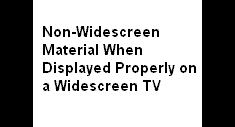
c) The transfer on your DVD is non-anamorphic (Either done for LaserDisc, or from one of those cheap-ass companies like MTI) in which case you can either set your TV so it displays the picture with black on all four sides, or zoom in, which will degrade the perceived image quality.
Posted by Joe Redifer (Member # 3) on 05-24-2005, 06:12 PM:
Yeah Joshie, your TV ain't be as wide as a scope movie screen yo.
Posted by Joshua Waaland (Member # 287) on 05-24-2005, 08:29 PM:
So only scope films are released in widescreen formats on DVD? In other words, scope = widescreen? Seriously I don't know that much about tv's so I realize this may be a completely stupid question to most of you. Sorry for my ignorance. ![[Wink]](wink.gif)
Posted by Adam Martin (Member # 641) on 05-24-2005, 09:43 PM:
Widescreen DVD = in some way, shape or form, NOT full-frame (aka pan & scan). On a 4:3 tv set it will have letterboxing bars.
Anamorphic DVD = it uses the entire height of the video image to store picture data and then squishes it down for "widescreen" on 4:3 tv sets or stretches it to the sides for 16:9 sets. Think about the anamorphic lens on a projector ... the image area on a scope (anamorphic) film is mostly full frame and it is stretched out side-to-side to achieve the wide screen effect. (In some cases, a reverse anamorphic is used to squish it vertically to the correct shape.)
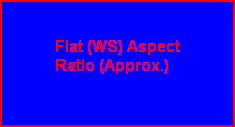
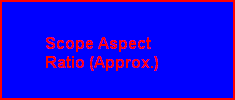
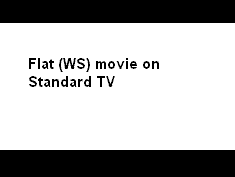
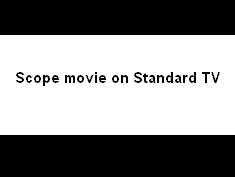
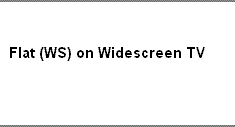
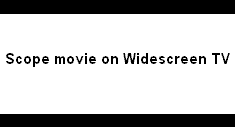
16:9 is an aspect ratio of 1.78:1, so a flat (1.85:1) film will be slightly cropped on the sides or have very small black bars at the top and bottom. Scope (2.39:1) will have larger black bars at the top and bottom.
Posted by Joshua Waaland (Member # 287) on 05-25-2005, 12:03 PM:
So the aspect ratio of a scope lens is different than a Widescreen TV? That would explain the bars. I am still learning the meanings of the aspect ratios.
Common sense would say though that since the scope films are short and wide, and widescreen tv's are short and wide, everything would match. I guess that isn't so. I will have learn more about the aspect ratios I guess to completey understand it.
Posted by Joe Redifer (Member # 3) on 05-25-2005, 06:13 PM:
Scope movies are wider than a widescreen TV.
Posted by John Lasher (Member # 968) on 05-25-2005, 06:25 PM:
It would seem some visual aids may be in order.
 |
| 
--
 |
| 
--
 |
| 
--
Posted by Joshua Waaland (Member # 287) on 05-25-2005, 11:00 PM:
Thanks John.
As if this wasn't enough to confuse me, the TV has 4 or 5 different picture size settings that you can choose from. I usually pick whichever one fills the screen. I paid for that big screen, I'm gonna use it. Besides once you get used to the fat heads everyone gets when you stretch 4:3 to 16:9, you don't even notice it anymore.
Posted by Adam Wilbert (Member # 1184) on 05-25-2005, 11:42 PM:
ugh... I can't stand fat heads. No way. Not ever. I look at it this way, if I'm going to spend all of that money, I don't want everything to be distorted. I've been watching square TV all of my life, I don't understand why stretched TV is better? ![[puke]](graemlins/puke.gif)
Joshua, I sure hope you're not running all of your films with the 2.35:1 lens because, damnit, those customers paid for a widescreen movie, and they're going to get it. ![[Smile]](smile.gif)
Posted by Adam Martin (Member # 641) on 05-26-2005, 12:22 AM:
I hear that when you buy one of them fancy televisions, you *have* to view everything stretched out because otherwise, the screen will form some sort of burn-in from always having pillarboxes from SD signals. ![[Roll Eyes]](rolleyes.gif)
Posted by Joe Redifer (Member # 3) on 05-26-2005, 04:34 AM:
Not true. But if you're dumb enough to buy a plasma or a rear projection CRT, then you deserve the burn in.
Posted by Joshua Waaland (Member # 287) on 05-26-2005, 09:13 PM:
I love playing films with the wrong lens. It's my chance to put my own artistic spin on the production. Rest easy Adam, I am a full-time student now and haven't worked a booth for a few years.
Actually now that you bring it up, back in my wilder days me and another co-conspirator projectionist attached a "Last Starfighter" trailer to a sold out film on opening night. Our biggest house too. We then went down into the theater to listen to the patrons reactions. People were all excited thinking it was being re-released. The mono sound was stunning to boot. Yea I know, not one of my prouder moments.
I stretch the image on my tv so as to avoid the "burn".
Posted by Manny Knowles (Member # 1171) on 05-26-2005, 11:32 PM:
Video done wrong. ![[Frown]](frown.gif)
Posted by Michael Schaffer (Member # 1204) on 05-27-2005, 01:57 AM:
Here is my question for Joshua: if you don't care about proper aspect ratios, why did you buy the widescreen TV in the first place? You can also display wrong and distorted images on a standard 4:3 TV, for much less money.
Posted by Joshua Waaland (Member # 287) on 05-27-2005, 03:41 PM:
Manny,
I didn't claim to be proud of it.
Michael,
They did't sell HD big screens that weren't 16:9 where I got mine. I wanted a big screen tv. I wanted HD. I watch a lot of movies and I like the bigger screen. I have been stuck with a 13" K-Mart simulated wood grain special for the last 15 years. I was also under the assumption that more programs would be broadcast in the 16:9 ratio and everyone claims that eventually all programs will be broadcast in 16:9. Why in the hell would I spend $1,500 on a tv and not get the latest technology. I also thought that a widescreen dvd would actually fill up my screen and not still have the black bars.
Why would they devise a new aspect ratio, make it the standard for all new tv's, and have it be something that doesn't coincide with the scope lens aspect ratio? It doesn't make sense to me. You would think that they would consider that a lot of people would watch dvd's of films that were shot in scope. Unless there is some other reason for tv broadcasts to go in 16:9.
Posted by Joe Redifer (Member # 3) on 05-27-2005, 06:07 PM:
What type of TV do you have, Joshua? Plasma? Rear projection CRT? Direct view CRT (like most TVs up until recently)? LCD? What?
Posted by Joshua Waaland (Member # 287) on 05-28-2005, 06:05 AM:
It's a Toshiba model number 51H84. It is a 51" rear projection HD monitor. There is no HD receiver built in. You have to have the cable companies box to receive HD.
Posted by Michael Schaffer (Member # 1204) on 05-28-2005, 06:31 AM:
quote: Joshua Waaland
Why would they devise a new aspect ratio, make it the standard for all new tv's, and have it be something that doesn't coincide with the scope lens aspect ratio?
Dunno, but my best guess here is that scope size TVs would actually be too expensive and I don't see a scope type aspect ratio ever coming into use for regular TV. It wouldn't make a whole lot of sense either for the medium. The whole industry, including composition standards for typical TV content, would have to reinvent itself. And news programs or cooking shows wouldn't make a whole lot of sense in scope either. There is probably not a big enough market for actual scope ratio TVs to watch DVD features, although it is certainly technically possible. I guess 16:9 was at the time the plans for widescreen TVs were cooked up the best compromise. It actually seems to make sense, even though it is still shy of the actual 1.85 widescreen. Although I don't think cropping a little bit at the sides to fit an 1.85 image into the 16:9 screen would be too big a problem.
Personally, I don't see the point in having those big-ass TV sets which just show you even more than smaller TVs how little resolution TV actually has. I have never seen one that I would want to have. It all comes down to how far you sit away from the set anyway. But they certainly do seem to make a lot of people happy, otherwise they wouldn't be on the market. And isn't that what TV was invented for - to bring happiness into the homes?
Posted by Adam Wilbert (Member # 1184) on 05-28-2005, 05:07 PM:
I also wondered why 16:9 became the standard and where that ratio came from... maybe it's just more marketable than a 1.85:1. ???
Posted by David Stambaugh (Member # 1102) on 05-28-2005, 05:45 PM:
I recall reading somewhere that a major consideration was that television design engineers figured out early on that 1.77:1 was the widest aspect ratio that conventional CRTs [glass picture tubes] could achieve and still be mass-producible and acceptable to consumers. Something to do with laws of physics and how streams of electrons are controlled within the glass envelope, and if you had a scope-ratio screen the neck of the tube for a 30-something inch set would be too deep to fit through a door. I'm googling it but so far I can't find anything though. Maybe someone else knows. Maybe I imagined reading this while in a drunken stupor. ![[beer]](graemlins/beer.gif)
EDIT: I found this on www.tvtechnology.com (nothing mentioned about my CRT theory though):
quote:
16:9 is close to the linear (1.76:1) and geometric (1.75:1) means of the world's most popular theatrical projection aspect ratios (1.66:1 and 1.85:1). It's close to a Motion Picture Association-proposed 1.5x anamorphic projection system (1.76:1). It nicely matches a three-perforation length frame of 35mm film. It's close to an old 1.75:1 projection standard. It allows a large 4:3 image to be displayed with three smaller ones stacked next to it. It works with digital component sampling rates and color sub-sampling. It allows square-sampled HDTV with 1920 active pixels per line to fit in common memory sizes. It allows dual-aspect-ratio memory readouts at 4fsc and 3fsc sampling rates. It's 4:3 x 4/3 (and another 4/3 factor brings it up to CinemaScope).
Posted by Adam Wilbert (Member # 1184) on 05-28-2005, 08:26 PM:
quote:
It allows a large 4:3 image to be displayed with three smaller ones stacked next to it.
Thats cool. I've never seen an HDTV take advantage of that though. That beats picture-in-picture where the second screen overlaps the first.
Posted by Martin Brooks (Member # 1269) on 05-31-2005, 08:28 PM:
quote:
Why would they devise a new aspect ratio, make it the standard for all new tv's, and have it be something that doesn't coincide with the scope lens aspect ratio?
Dunno, but my best guess here is that scope size TVs would actually be too expensive and I don't see a scope type aspect ratio ever coming into use for regular TV.
The 16:9 HDTV aspect ratio was developed by the SMPTE Working Group on High Definition Electronic Production as a compromise between the 4:3 “narrowest” aspect ratio of traditional TV broadcasts and the “widest” desired aspect ratio of 2.35:1, using the following formula:
D=W* (1/W) 1/2 /(1/N) 1/2
Where D is the desired aspect ratio, W is the widest aspect ratio and N is the narrowest aspect ratio.
There is less than 4% difference between 16:9 and 1.85:1 and as we all know, most films are shot to be presented in 1.85:1, not 2.35:1 (or current standard of 2.39:1)
Mark Schubin describes this in an article in the August 1996 issue of SMPTE Journal. Kern Powers, with RCA Labs in 1984, purportedly proposed the 16:9 aspect ratio based on the formula above and other factors.
Other technical reasons for 16:9 are described in the article as well as a quite detailed analysis and history of aspect ratios.
The article also details the fact that the American Society of Cinematographers objected to the 16:9 HDTV format and suggested a compromise aspect ratio of 2:1.
Posted by Carl Martin (Member # 1146) on 06-01-2005, 03:12 AM:
simplify! D=W* (1/W) 1/2 /(1/N) 1/2 = (WN) 1/2
Posted by Joshua Waaland (Member # 287) on 06-01-2005, 06:34 AM:
When I first saw your post Carl, the math didn't look right. I had to get out the paper and pen and do it myself but you are right.
Posted by Pravin Ratnam (Member # 1417) on 06-01-2005, 10:18 AM:
I thought one of the reasons(not necessarily the driving reason) for the 16:9 was the compromise between the European flat ratio of 1.66 and the American ratio of 1.85.
Posted by John Pytlak (Member # 331) on 06-03-2005, 02:57 PM:
16:9 History:
http://www.tvtechnology.com/features/Masked-Engineer/f_masked_engineer.shtml
quote:
After that, they tackled the second most basic of issues, the shape of the pictures.
This much they knew: Cinemat-ographers sometimes shoot for a 4:3 TV screen. They sometimes shoot for a roughly 2.4:1 CinemaScope-shaped theatrical screen (at the time it was called 2.35:1). They sometimes shoot for shapes in between. Only in extraordinary circumstances do they shoot for any wider or narrower shapes.
The E of SMPTE stands for engineers. So the engineers tackled an engineering problem. What is the shape that will have minimum area loss for any shape between 4:3 and 2.35:1? The answer is roughly 1.77:1, pretty close to 16:9.
Like it so far? There's more. 16:9 is close to the linear (1.76:1) and geometric (1.75:1) means of the world's most popular theatrical projection aspect ratios (1.66:1 and 1.85:1). It's close to a Motion Picture Association-proposed 1.5x anamorphic projection system (1.76:1). It nicely matches a three-perforation length frame of 35mm film. It's close to an old 1.75:1 projection standard. It allows a large 4:3 image to be displayed with three smaller ones stacked next to it. It works with digital component sampling rates and color sub-sampling. It allows square-sampled HDTV with 1920 active pixels per line to fit in common memory sizes. It allows dual-aspect-ratio memory readouts at 4fsc and 3fsc sampling rates. It's 4:3 x 4/3 (and another 4/3 factor brings it up to CinemaScope). Methinks I could go on, but this paragraph is already too long.
NOT SO FAST
With so much going for 16:9, the engineers of SMPTE's WG-HDEP voted unanimously in favor of it the very first time it was brought up. They were probably very pleased that they had solved their little engineering problem. And, with SMPTE's approval, 16:9 spread worldwide.
There's not much that everyone agrees on in television. Frame rate? Hah! The infamous Table 3 of ATSC standard A/53 lists six of them. Number of active lines in HDTV? There are at least 1080 and 720 (with some folks also buying 810, 576, 540, and even 480 under certain circumstances). Colorimetry? Surely you jest. Rec. 709? Rec. 601?
The one and only thing that everyone in the world agrees on for HDTV is that it has a 16:9 aspect ratio. After all, SMPTE's WG-HDEP solved that little engineering challenge back in 1984.
There's just one little problem with the little solution to that little engineering challenge. It wasn't an engineering challenge in the first place.
Yes, 16:9 is close to the ideal shape for minimum area loss for all aspect ratios between 4:3 and 2.35:1. So? Who cares about minimum area loss?
If cinematographers were concerned about saving film stock, they could have switched to three-perforation 35mm film frames long ago. Instead, if they haven't been using anamorphic lenses on 4:3 frames, they've been shooting on roughly 4:3 film frames and using horizontal viewfinder lines to determine what'll be seen in various display aspect ratios. That way, each display has the same left and right edges, and characters enter and leave the frame at the same time regardless of aspect ratio. And, anyhow, even the SMPTE WG-HDEP engineers intended the 16:9 shape only for shooting, not for display.
Kerns Powers, who introduced 16:9 to the SMPTE working group, acknowledged the error in an NAB presentation 10 years later. "Had the SMPTE working group been aware in 1984 of the full-frame (soft mat) protection scheme, it is by no means obvious that 16x9 would have amassed the advantages over 4x3 that persuaded the working group to make that choice." Oops.
http://www.smpte.org.au/societynews2003-06.asp
quote:
SMPTE recognizes Dr. Kerns Powers for his contributions to electronic cinematography, including important work in progressive scanning and the engineering basis for the 16:9 aspect ratio. Dr. Powers has been active in the broadcast industry for over 50 years, and has been instrumental in key developments in the work of SMPTE. He held technical and management positions with RCA/Sarnoff Laboratories beginning in 1951. As Director of
Communications Research, in addition to directing RCA's Communications Research program, he had responsibility for supporting RCA's Broadcast Equipment and Cable TV businesses. Prior to his retirement in 1987 Dr. Powers was Staff Vice President of Communications Research, which included responsibility for three Laboratories, including the Advanced Video Systems Research Laboratory. His contributions to the communications industry were at the highest level, including work which led to important SMPTE standards. His research while at RCA included work on ELF communications systems, satellite communications, and studies of cellular array mobile communications systems, ballistic missile technology, speech synthesis, and other applied and pure research projects. He holds BSEE and MSEE degrees from the University of Texas and an Sc.D. degree from MIT. Dr. Kerns Powers holds SMPTE's highest level of membership, and received the Progress Medal in 1988, and is a Fellow of the IEEE.
http://www.cinemasource.com/articles/Intro_digital_tv.pdf
quote:
The Father Of 16:9
The most prevalent aspect ratios filmmakers deal with today are: 1.33 (The Academy standard aspect ratio),
1.67 (The European widescreen aspect ratio), 1.85 (The American widescreen aspect ratio), 2.20
(Panavision), and 2.35 (CinemaScope). Attentive videophiles may note that 1.77 (16:9) isn't on this list and
may ask: "If 16:9 isn't a film format, then just exactly where did this ratio come from". The answer to this
question is: "Kerns Powers".
The story begins in the early 1980s when the issue of high definition video as a replacement for film in movie
theaters first began to arise. During this time, the Society Of Motion Picture And Television Engineers
(SMPTE) formed a committee, the Working Group On High-Definition Electronic Production, to look into
standards for this emerging technology. Kerns H. Powers was then research manager for the Television
Communications Division at the David Sarnoff Research Center. As a prominent member of the television
industry, he was asked to join the working group, and immediately became embroiled in the issue of aspect
ratios and HDTV. The problem was simple to define. The film community for decades has been used to the
flexibility of many aspect ratios, but the television community had just one. Obviously a compromise was
needed.
As the story goes, using a pencil and a piece of paper, Powers drew the rectangles of all the popular film
aspect ratios (each normalized for equal area) and dropped them on top of each other. When he finished, he
discovered an amazing thing. Not only did all the rectangles fall within a 1.77 shape, the edges of all the
rectangles also fell outside an inner rectangle which also had a 1.77 shape. Powers realized that he had the
makings of a "Shoot and Protect" scheme that with the proper masks would permit motion pictures to be
released in any aspect ratio. In 1984, this concept was unanimously accepted by the SMPTE working group
and soon became the standard for HDTV production worldwide.
Ironically, it should be noted, the High-Definition Electronic Production Committee wasn't looking for a display
aspect ratio for HDTV monitors, but that's what the 16:9 ratio is used for today. "It was about the electronic
production of movies," Kerns Powers states, "that's where the emphasis was". Interestingly, today, there is
little talk today about the extinction of film as a motion picture technology, but there is a lot of talk about
delivering HDTV into the home. And, as a testament to Kern H. Powers clever solution, it's all going to be on
monitors with a 16:9 aspect ratio.
Posted by Andy Summers (Member # 3207) on 07-13-2005, 06:04 PM:
Guys have you tried adjusting the horizontal VR variable resistor on your HDTV to gain a little more of the side, has I have done this with my none HDTV as we hearing the UK don’t have this feature, so I can see more width on my 4:3 monitor over what I have seen on my friends widescreen TV monitors about 1 ¾ in is cut from the right side and 1in my dad said he’s goy me this ole Sony 4:3 TV monitor with true NTSC 3:58Mhz look forward to it been dropped off 26in with lots of other features on it, and this will need adjusting, stick on the test card and get adjusting….
Powered by Infopop Corporation
UBB.classicTM
6.3.1.2