This is topic Was there a home VTR before Beta? in forum The Afterlife at Film-Tech Forum ARCHIVE.
To visit this topic, use this URL:
https://ft-forum.com/ft/cgi-bin/ubb/ultimatebb.cgi?ubb=get_topic;f=12;t=000411
Posted by Robert Harrison (Member # 3202) on 06-21-2005, 08:36 PM:
I ask this question because of the film "Auto-Focus," wherein the prototype VTRs depicted are largely cumbersome and always with a B&W picture. Later in the film, the arrival of Beta machines are heralded as the first CONSUMER VTRs. My memory isn't the best, so I would like to know if anyone out there can answer this question: did Sears sell a large console VTR prior to the release of Beta which could play and record in color? I believe it was a high-ticket item (i.e., not many sold due to the cost). Any information on this would be appreciated. Thanks.
Posted by Paul Mayer (Member # 355) on 06-21-2005, 09:47 PM:
GE had a 1" B&W reel-to-reel helical tape format back in the late '60s. There was also the EIAJ 1/2" B&W reel-to-reel helical tape format that many manufacturers supported. Akai had a 1/4" color reel-to-reel helical format as well.
Don't know about your Sears unit. I suppose any of these could be used at home, though I don't think they were marketed that way. Most of these were pitched towards educational and industrial use.
Posted by Mark Ogden (Member # 43) on 06-21-2005, 09:57 PM:
quote: Paul Mayer
There was also the EIAJ 1/2" B&W reel-to-reel helical tape format that many manufacturers supported.
Like these . . .
The Sears console machine was based on the awful Cartrivision system that used a one-time-play-only cartridge for playback of rental movies. Unfortunatly, it seems all the movie cartridges had a strange tendency to rot. Another triumph of technology (but I'll bet next week's check that someone here has a complete working machine and a large collection of still-viewable tapes).
Posted by Joe Redifer (Member # 3) on 06-21-2005, 10:30 PM:
Cartrivision used something called "Skip field" technology which, of course, was space-age. Does this mean it recorded and played back at 240p and disregarded every other field?
Also, if Cartrivision was one-time-play-only then there is no way that anyone could still have working tapes since they can only be played one time. Also the page you linked to says they could record.
Posted by Mark Ogden (Member # 43) on 06-22-2005, 08:18 AM:
Cartrivision could record on blank tapes. But as I mentioned, rental movie tapes were playback only. They were also non-rewindable, they had an (eaisly defeatable) internal ratchet system similar to an NAB audio cartridge that prevented repeat viewing.
More on skip-field video and Cartrivision. (Click on the 'hardware/ software' link).
Posted by Mitchell Dvoskin (Member # 751) on 06-22-2005, 08:22 AM:
The first "consumer" VTR was Cartrivision, a big and bulky home unit. Akia in the late 1960's introduced a small portable camera/recorder package, first in B&W and later color.
Of course, 3/4" U-matic VCR machines existed from the early 1970's, and while not specifically marketed toward consumers, they were not significantly more expensive then the first generation of Beta machines and where widely used by consumers.
As far as portability goes, all these early formats used a seperate camera/portable recorder. The first true camcorders did not appear until the Sony introduced 8mm and JVC responsed with VHS-C. Full size VHS camcorders soon followed.
Posted by Bruce McGee (Member # 131) on 06-22-2005, 08:36 AM:
I've still got a working Sony VO-1600 3/4" consumer machine with a built-in tuner! Built in 1972. The camera is long-gone. It was large... weighed about 10 pounds.
Sometimes, I have to use this Sony. Some tapes that it recorded back in 1975 won't play on anything else.
In case you are wondering, I'm attempting to dupe everything that I have on 3/4" to VHS... for now.
Posted by Bill Gabel (Member # 1105) on 06-22-2005, 08:50 AM:
In the movie "Auto-Focus" they used a 3/4" U-matic VCR.
Posted by Joe Redifer (Member # 3) on 06-22-2005, 06:07 PM:
What about Pixelvision? Did that se skip-field?
Posted by Jesse Skeen (Member # 586) on 06-23-2005, 02:26 AM:
I've got 2 Cartrivision machines now, but neither are up to the task of actually getting a picture on the screen. Not sure what the exact problem is, but hoping I can eventually salvage one working unit out of the two. I've got a few rental tapes that can only be rewound with a special machine the rental stores had, though the tapes seem to have been taken apart to defeat that mechanism, and I've got one home-recorded tape that is supposedly a live recording of President Nixon's resignation. We'll just have to see how well the tapes have actually held up. I've got a few Beta tapes going back to 1977 that look like they were recorded yesterday though. (It took me until 1985 to convince my parents to get a VCR, though at least it was one of the first Hi-Fi models that could record broadcast stereo. I've been buying up all the older tapes I can find at the flea markets and thrift stores though and have found some treasures.)
Another odd 70s video format was Quasar's Great Time Machine, which used tapes bigger than VHS, circa 1976. I have a machine but no tapes, so I don't know if it works. There was a format from Sanyo called V-Cord that used smaller tapes that were shaped like 8-tracks but had a supply and take-up reel inside next to each other. I found some unused blanks once so I bought one to open up and one to keep sealed, never seen a machine though- there was one on Ebay a couple months ago but it went for more than I could afford to pay.
BTW anyone here wanna trade DVDs of old (pre-1980) TV recordings with commercials? I've been transferring all the old stuff I've found with my Philips DVD recorder, then duplicating them on my computer. I've got one disc put together with TV station sign-offs, mostly from Sacramento in the mid-80s but I've got one for KABC in 1978 and a CBS station in Roswell, NM too. Although I despise what cable TV has become now, I've also put together a disc with older movie intros and previews from HBO, Showtime and a number of defunct pay channels such as MovieVision and The Z Channel, which you had to rent a microwave antenna and receiver to get.
Posted by Bruce Hansen (Member # 281) on 06-25-2005, 08:51 PM:
Many years ago Ampex tried to market a 1" B&W VTR (model 6000) to consumers. I remember seeing them in several stores, but it was large and heavy, and hard to work, so it did not sell. Then Sony tried to sell a 1/2" B&W pre EIAJ that did skip field scanning (in this case it recorded every other field, and then played each recorded field back twice), it did not sell well either. When the EIAJ models came out, they sold the old skip field units out at half price. I talked my parents into getting me one for Christmas. I remember telling friends that I had a video recorder. They would look at me strangely, and ask "what can you do with that?" I would explane that I can time shift showes that are on when I am not going to be home, if there are two showes on at the same time that I want to watch, I can watch one, and tape the other to watch later, and I can tape my favorit showes, and movies, and watch them any time I wanted to. About this time they would be asking where they could get one of these things. I remember thinking that if someone could make an easy to use VTR, at a price people could afford, they could sell a lot of them.
Mark, I enjoyed to site with all the old VTRs on it. It's nice to know there is someone out there that has even more old strange VTRs laying around than I do.
Posted by Jesse Skeen (Member # 586) on 09-28-2005, 01:07 PM:
http://www.labguysworld.com/VideoFiles.htm
There's a video file of an instore demo tape for the Cartrivision system from 1972. Must have been done by the same people who did the "Mr. Realistic" quadraphonic demo tape for Radio Shack.
Posted by Leo Enticknap (Member # 534) on 09-28-2005, 03:19 PM:
More weird, wonderful and obsolete VT formats...
Posted by Phil Blake (Member # 2012) on 11-28-2005, 09:45 AM:
An interesting thread, I did some ressearch into this and discovered that not only was Tweety Bird colored PINK in 1942 cartoons but it was in 1956 The first practical videotape recorder (VTR) was developed by the AMPEX Corporation in 1951.
The first commercially-feasible ones (with 2 inch tape reels) were sold for $50,000 in 1956.
1963 Ampex began to offer its first consumer version of a videotape recorder, sold through the Neiman-Marcus Christmas catalogue for $30,000 - a non consumer-friendly price.
1964 Sony began marketing the first reel-to-reel VTR designed specifically for home use in 1964.
1967 Sony introduced a portable (but bulky), expensive, out-of-studio video camera system (or video tape recorder - VTR) called the Portapak -- it inaugurated the modern era of video.
1969 Sony introduced a new device -- the videocassette recorder (VCR).
1972 The AVCO Cartrivision system (for CARTRIdige teleVISION) was a combination receiver / recorder / playback unit. It was also the first videocassette recorder to have pre-recorded tapes of popular movies (from Columbia Pictures) for sale and rental -- three years before Sony's Betamax VCR system emerged into the market. However, the company went out of business a year later.
1972 Sony introduced the U-Matic line of video cassette recorders.
1975 The Sony Corporation introduced the 1/2 inch Betamax video format and videocassette recorder (VCR) for consumer home use, with the capability of recording up to one hour.
1976 JVC introduced the VHS (video home system) 1/2 inch video format to compete with Sony's Betamax system. In 1977, RCA began marketing the first VCRs in the United States based on JVC's system, capable of recording up to four hours. By now, Japanese manufacturers had taken over the VCR market.
and there we have it ............ i still can't believe tweety was pink!
Posted by Greg Mueller (Member # 17) on 11-28-2005, 05:57 PM:
I remember one right before the VHS/Beta machines. It was called something like "The Great American Movie Machine" or something weird like that. It had proprietary tapes that I think I remember looking like an 8 track tape, and was about the size of the original VHS decks. It was not around long. I finally bought one of the first RCA VHS machines with mechanical push buttons (levers) Tapes were very hard to find and were $25 each. I still have it in the attic and I think it still works (as good as it ever did)
Posted by Mike Heenan (Member # 392) on 11-28-2005, 09:44 PM:
More interesting info.... which I dont have as entirely correct but close to, anyways, the first person to have a home VCR was Lyndon Johnson, then Alfred Hitchcock, and then Richard Dawson, who got Bob Crane hooked on the format.
Posted by Monte L Fullmer (Member # 2797) on 11-29-2005, 01:53 AM:
quote: Greg Mueller
It was called something like "The Great American Movie Machine" or something weird like that. It had proprietary tapes that I think I remember looking like an 8 track tape, and was about the size of the original VHS decks.
In late 1976, Quasar, division of Panasonic and both of parent company of Matsushita developed this home VTR machine called the VR-1000, commonly called "the Great Time Machine." This is a pict of my VR-1000 that I purchased back in the spring of 1977-
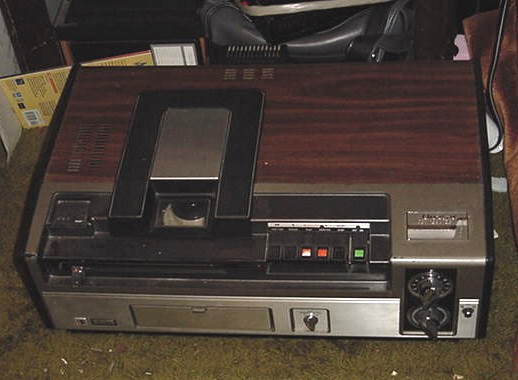 Unit had a sticker price of $999.95 (I now, why not an even grand...). The tape format was called the VX format.
Unit was a single head helical scan, full alpha wrap unit. Headdrum spun at 3600 rpm. Tape speed was 2.0 IPS - 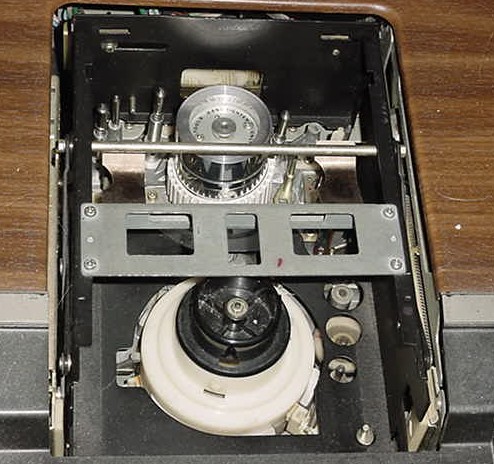
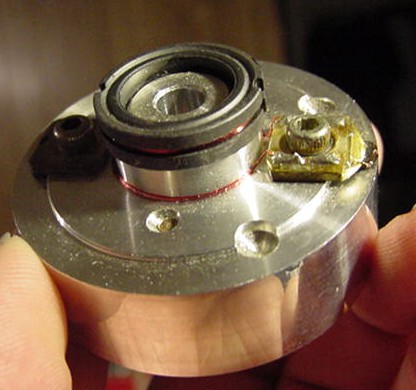
Head changeout was a very simple, consumer used device. a Left handed thumb knurl held the headdrum down on the motor shaft.
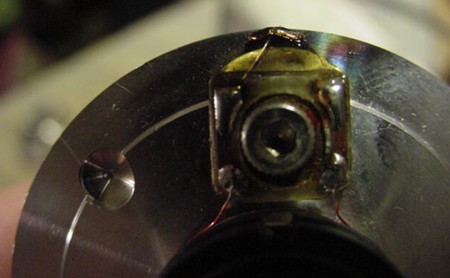 Closeup of the headchip assembly. Extremely thin, will shatter easily, yet very rigid. This head wheel is 1 and 7/8 inches across. That gives a circumference of roughly 6.08 inches. Rotating at 59.94 RPS (for NTSC) gives it a head to tape writing speed in the vicinity of 365 IPS. Not bad at all.
Here is a pict of one of the tapes:
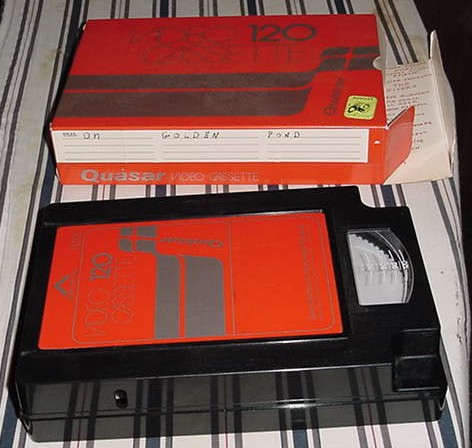
There were three sizes (and box/label colors to match) of tapes. A Black for 60min usage, a Blue for 100min usage and the Red for a 120 min usage. Tape stock was a polished red oxide backcoated with a black coat. Tape reels were stacked one on another, with the takeup reel rotating in the opposite direction of the feed reel. Tape wind within the cartridge was held in place by a circular collar that would retract down into the recorder when the cartridge was loaded, exposing the pre-set loop to be wound and tightened around the headdrum. Prices for these tapes were quite high: $34.95 for the 2hr tape, $29.95 for the 100min tape and $19.95 for the 60min tape. (I remember when the first VHS blank tapes that came out were $24.95 for a blank T-120)
Unit was well ahead of its time that almost rivaled BETA with a long write length. But the big fault that this unit had was that the head shaft was belt driven with the only motor that drove all of the mechanisms inside with additional belts. Thus, the head rotation speed would always have a slight speed variation when the belt would gather glaze or stretch due to internal heat, thus keeping a tracking and skewing was a continual problem. Unit had a built in humid warning so that if any moisture were present inside the unit a "dew" light would come on and prevent the unit from operating. To get rid of the humidity, a small "hair dryer" inside would dry out the inside for continual usage.
In 1980, Quasar came out with the VR-1550, which was their new VHS recorder with an advertising slogan: "They only have one kind of recorder, where we now have two." Of course, we knew that the VR-1000 was falling out of popularity since the VHS machine was really grabbing a hold on the market, and this was a quiet way for Quasar to phase out the VR-1000 in a quick way.
Posted by Jesse Skeen (Member # 586) on 11-29-2005, 02:28 AM:
I have one of those machines, but don't know if it works- I've never been able to find any tapes for it.
Powered by Infopop Corporation
UBB.classicTM
6.3.1.2