The images you've posted show that there's image on the entire frame, but I think they show very clearly that the images are composed for 1.66. There's just way too much head room for the picture to look good at 1.37. Also, very few major theatrical releases were being made at 1.37 by 1968.
As we all know, just because the full frame on a movie is exposed, it doesn't mean it was intended to be exhibited at 1.37. Here's an example of a live-action film that's composed for 1.85, but the entire frame has been exposed.
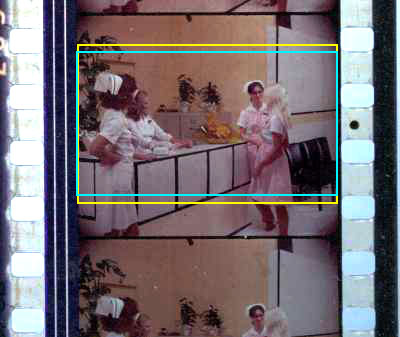
The yellow line indicates 1.66, and the blue is 1.85.
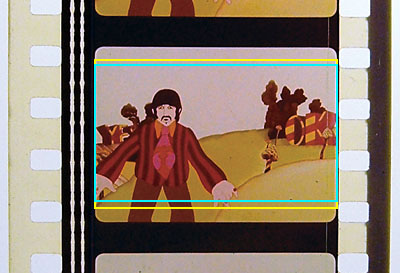
Here are some other images from Yellow Submarine that show the same thing. In the first, the green line is 1.37, the yellow is 1.66, and the blue is 1.85.
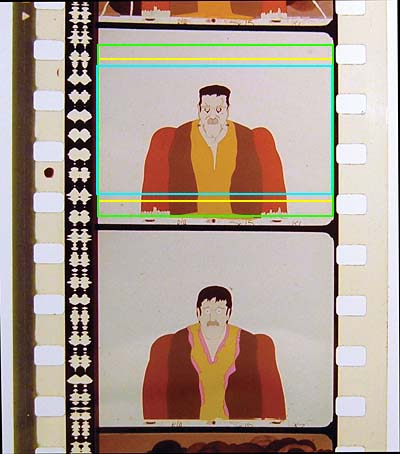
I think the 1.37 comes uncomfortably close to showing the edge of the animation cel at the bottom of the frame.
The live action segment at the end is also composed for wide screen:
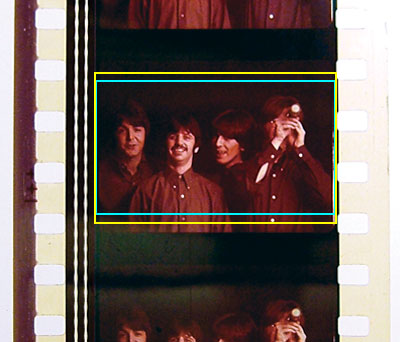
I don't know how many more images I can put in a post, but here are some other examples, including one showing that the titles have been carefully kept inside a 1.66 area. If you check 1.37 movies, you'll find that's almost never the case.
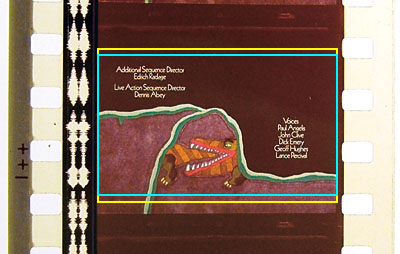
Additionally, for the 1999 re-release, UA sent out information with prints explicitly stating that the original aspect ratio was 1.66, but suggesting it be played at 1.85.
Posted by Monte L Fullmer (Member # 2797) on 12-05-2005, 02:05 AM:
Oh, I fully agree with you about studios shooting animated and live-action features in full-frame and intended for "widescreen" flat presentations. For when I ran that print in 1970, I was using the 1.75/1 aperture..and saw it the year before in 1.66/1.
Just when I had the original VHS video of the movie, it was full-frame (whether or not they had cropped the image down to fit the 4.3 TV screen is an answer that I don't have..) on the TV screen.
Now, the DVD copy that I have of "YS" is of the 1.75/1 presentation format.

EDIT: -> I had to add this in from the DVD booklet to show a good case of a probable "crop job": Ad shows a "Standard" and Widescreen" comparision, yet the "widescreen" could be the actual 1.75/1 of the frame, whereas the "standard" could have been the cropped edition of the original VHS/Beta release, and even the TV broadcast...
Excellent presentation of film clips to show the examples of various flat aperture sizes and how much of the image is cropped out per each aperture. - "Congrats" on this.
thx-Monte
Posted by William Hooper (Member # 71) on 12-06-2005, 12:35 AM:
Whoops, deleted.
Posted by John Hazelton (Member # 898) on 12-06-2005, 07:44 PM:
Thanks, Monte. The way you had projected it would have looked great!
By the way, the graphic you show was the crux of a class-action lawsuit brought against MGM/UA Home Video. It turns out that some of the 4x3 (or "Standard") DVDs produced by the company were open aperture, or full-frame transfers. Of course, those showed more image than was intended by the film-makers.
The lawsuit came about because the graphic (like the one you picture) doesn't indicate that in some cases, the Standard version provided more picture than the Widescreen version. Thus, the idea that Standard always gives you less picture than Widescreen was not true, so someone sued.
"Yellow Submarine" was one of the releases covered in the suit. Details are here: http://www.mgmdvdsettlement.com/
There was a thread in this forum as well under the topic "MGM Widescreen DVD Class Action Lawsuit."
It was a spectacularly silly suit.
Posted by System Notices (Member # 2357) on 05-08-2008, 11:46 PM:
It has been 884 days since the last post.
Posted by David Stambaugh (Member # 1102) on 05-08-2008, 11:46 PM:
Bump since this topic came up elsewhere. John Hazelton made a pretty strong case for 1.66 (or maybe Monte's 1.75).