This is topic How Much Difference Does Film Make in HDTV? in forum The Afterlife at Film-Tech Forum ARCHIVE.
To visit this topic, use this URL:
https://ft-forum.com/ft/cgi-bin/ubb/ultimatebb.cgi?ubb=get_topic;f=12;t=000463
Posted by Joe Redifer (Member # 3) on 01-17-2006, 10:07 PM:
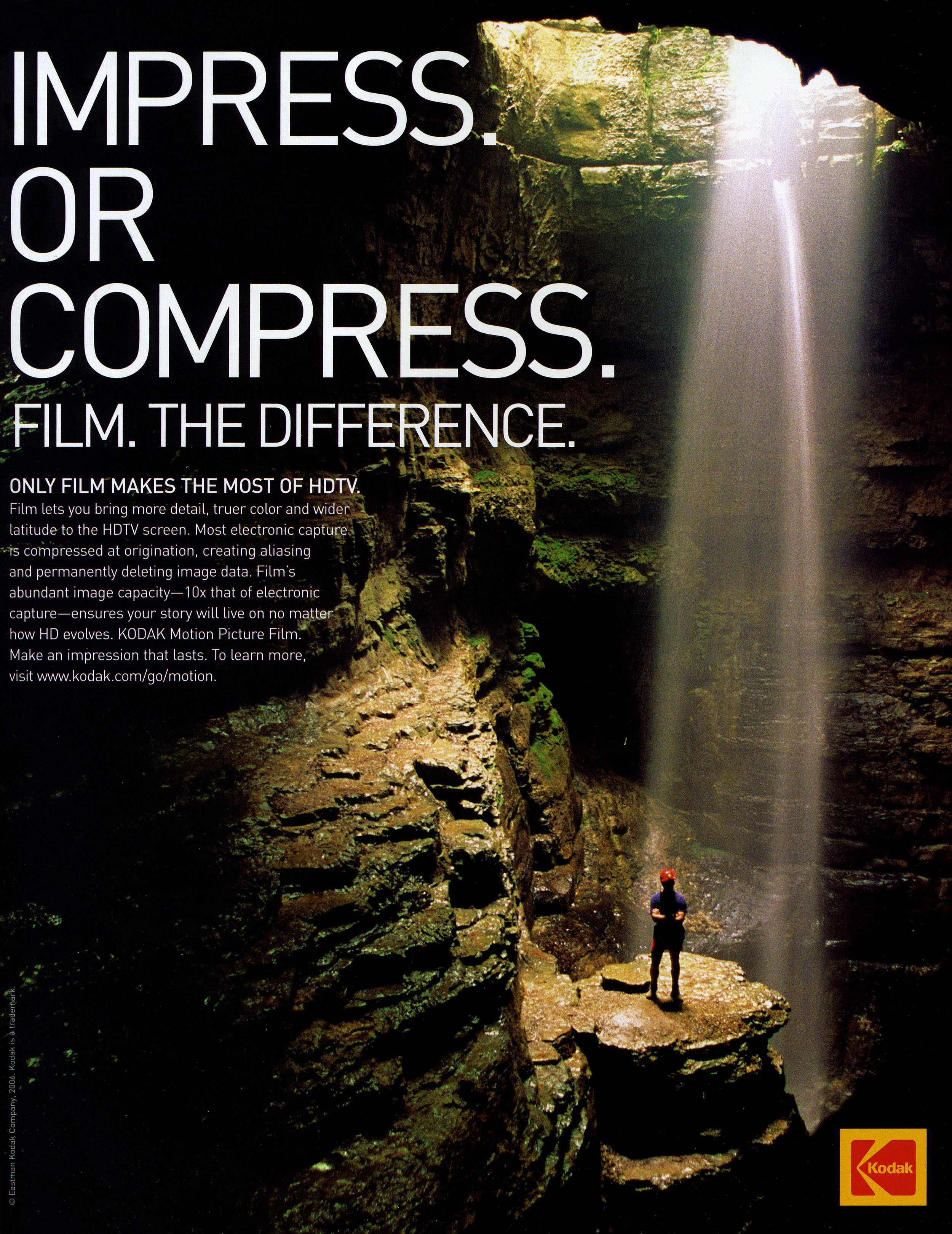
Check out this Kodak ad I scanned from a magazine:

(Protip: Click on the ad for a bigger view)
Now I pretty much agree with the ad, but why is it whenever I see a film-originated program in HDTV, it just doesn't seem very impressive? Hell, for all intents and purposes shows like CSI look the same in HDTV as they do in standard definition unless they show a wide shot with lots of detail like a cityscape. Why is this? I've also seen lots of movies in HDTV and it really doesn't impress as much as it should, and my TV kicks all sorts of ass, so I know that's not the culprit.
So what's the deal? Where is the extra definition that film should be affording? I do see lots and lots of grain. Grain sucks ass.
Posted by David Stambaugh (Member # 1102) on 01-17-2006, 11:15 PM:
I'd like to know the answer to this too. Filmed TV shows rarely (if ever) look like real HD. More like uprez'd SD, if that. The NBC show "Surface" is shot on film and broadcast in HD, yet it looks like crap. Sometimes theatrical movies shown in HDTV look pretty good, but still not as good as they should. Live sporting events usually look WAY better than film. It makes no sense to me that film usually looks so much worse. ![[Confused]](confused.gif)
Posted by Bobby Henderson (Member # 840) on 01-17-2006, 11:23 PM:
The likely culprit is a run of the mill (read: shitty) video transfer. Good enough to get by -the gold standard. I've seen film-originated movies in HD (on D-VHS) that looked really great.
There's also one other possible culprit, one that can occur from shot to shot. Joe's comment regarding great looking exterior shots but then everything looking soft raised the point. That point is: the vain ego of aging actors.
We've heard the stories about photographing Liz Taylor through bride's veil or smearing a little Vaseline on the lens. Are these old wive's tales or what? Still, I don't put it past certain actors to tell that focus puller to fudge it a little to hide the crow's feet around the eyes of some 45 year old guy trying to pass for 25.
I'm sure the rush for time could also throw things off a bit. It does take more time to shoot film well than video.
Posted by Paul Linfesty (Member # 214) on 01-18-2006, 12:29 AM:
quote: Bobby Henderson
Are these old wive's tales or what?
All too real. The worst offender IMHO were the close-ups of Lucille Ball in MAME. While all other shots were in sharp focus, these were badly out-of-focus. It wasn't even funny.
Posted by John Pytlak (Member # 331) on 01-18-2006, 08:29 AM:
Cinematographers' Test
quote:
The Cinematographers' Test compares film and 24P
On the set.
"I participated in this test because I care about the future of our art form," says Aaron Schneider, ASC, one of three cinematographers who took part in a comprehensive test comparing images recorded in 35mm film and high definition 24P digital video formats.
Schneider was referring to his motivation for participating in The Cinematographers' Test, which premiered at the Academy of Television Arts and Sciences theater in Los Angeles. John Bailey, ASC, and James Chressanthis also contributed to the project. Following the premiere, the three cinematographers discussed their rationales for selecting different scenes for comparing the two formats and offered insights into the importance of differences in nuances rendered in colors, contrast, texture, focus and other characteristics of the images.
Some shows have to use a mix of formats:
Tales from the HD Trenches
quote:
Online assembly and finishing for HD, though, remains a thornier issue, regardless of how the images are acquired. At Hollywood Digital (a Liberty Livewire facility), Bob Williamson says his job is “pretty standard” on certain shows, and “markedly different” with others, largely depending on the genre and creative needs of a particular program.
On JAG, for instance, it is routine to use large amounts of standard-def stock footage and some digital effects, all of which can present a host of problems for the online editor because he is forced to work in both the HD and SD worlds simultaneously.
“JAG is largely film-acquired, but they regularly use stock elements and effects, and the stock might often come to us in 16mm or any of a number of video formats,” says Williamson. “Dealing with that stuff can be a daunting task. We have to up-rez those shots in the proper aspect ratio, since that stuff is almost always coming to us at 4x3. Then, we have to make creative decisions about which part of the frame to use when you up-rez it. We don’t want to be in a situation of having to up-rez and then down-rez again if we can possibly avoid it, so we always try to keep those elements in the standard-def post stream and cut them directly into the SD version of the show. We try to avoid going up-and-down because you can harm the image that way. If you took a stock NTSC shot of an aircraft carrier, for example, and up-rezzed it to fit the 16x9 frame, it usually softens a bit in the up-rez, and you lose a bit of the top and bottom. Then, to down-rez that back to 4x3 NTSC for broadcast—since the network airs a 4x3 edge cut of the 16x9 master—you can cut off the sides again and lose more of the image.”
Posted by Greg Mueller (Member # 17) on 01-18-2006, 09:15 AM:
They've been using "glamour filters" for a long time. I've pointed them out to the wife a number of times in older films. They shoot the woman through the filter and make her look all soft and squishy then shoot the guy without the filter so he looks all angular and hard and tough. Maybe not today, but I think all films used a glamour filter to make the woman a little glowier
I wonder if Joe's problem is a transfer issue? Maybe the video originated material is easier to transfer to HD where film might suffer a semi generation loss? Maybe it's compression ?
We were really amazed at the difference between the broadcast version of Carnivale and the DVD version. In the DVD version you could see the threads in the material the actors were wearing, but of course that was the difference between "I" and "P"
Posted by Larry Myers (Member # 738) on 01-18-2006, 11:27 AM:
With my system, a Panasonic widescreen HDTV and a Sony progressive scanner with 5.1 surround sound, I get very good results. I do notice the DVD's themselves are another matter. Out of my limited DVD collection, the best DVD I have is Alexander. It looks very sharp and nice contrast even with viewing at 2.5 times the screen height, typical of a standard movie theater. Pearl Harbor besides being a little too high in contrast, needs a view distance of about 3.5 times screen height to look sharp. Gladiator clocks in at about 3 times height with the contrast somewhere between Alexander and Pearl Harbor. So it looks like you have a wide sector of quality just with the DVD's themselves.
Posted by Joe Redifer (Member # 3) on 01-18-2006, 01:16 PM:
quote:
"I participated in this test because I care about the future of our art form," says Aaron Schneider
Aaron Schneider, nobody cares WHY you participated in that test. No wonder your wife left you. I hope you get into a car wreck today and lose an arm.
quote: Greg Mueller
I wonder if Joe's problem is a transfer issue?
My problem? Trust me if I were working on these programs they would look much better than they do right now because I am at least slightly competent and definitely have higher standards than the people who master that material. This is also why I'd be fired right away! Today it's about getting the job done and going home, not about getting the job done WELL. People hate doing a good job these days.
quote: Larry Myers
With my system, a Panasonic widescreen HDTV and a Sony progressive scanner
What is a Sony progressive scanner? Is that one of those things that messes with interlaced video? Screw that. Leave interlaced video alone and enjoy true progressive scan material untouched.
Posted by John Pytlak (Member # 331) on 01-18-2006, 01:20 PM:
quote: Greg Mueller
We were really amazed at the difference between the broadcast version of Carnivale and the DVD version. In the DVD version you could see the threads in the material the actors were wearing, but of course that was the difference between "I" and "P"
I've heard the same kind of comment relative to the HDNet broadcasts of old syndicated film shows like "Hogan's Heroes". You can see the weave of the fabric in the uniforms, even in a medium shot. Trouble is, you often see the defects in the sets, which were only good enough to look "real" on SD. Pretty good for film shot forty years ago.
Posted by Larry Myers (Member # 738) on 01-18-2006, 04:11 PM:
Well maybe I should say a Sony DVD player set for progressive scan. I am not sure it even works but that is what it's set on. I do know if I try to play progressive scan on a non HDTV, I get what looks like a triple image all overlaped.
Posted by Bobby Henderson (Member # 840) on 01-18-2006, 06:01 PM:
quote: John Pytlak
Trouble is, you often see the defects in the sets, which were only good enough to look "real" on SD. Pretty good for film shot forty years ago.
I forgot about that factor (in addition to vain actors wanting thrown off focus to blur their wrinkles).
Sometimes I have suspicions about cheapness in production design and set decoration whenever I see a show where lots of low depth of field shots are used, typically zoomed into the actor's face and blurring the background all out to hell. Add in the fashionable dimness, the bleach bypass look and throw everything in the color off into the green area for good measure.
The Airplane! DVD commentary has funny comments from the "ZAZ" team. There are numerous times where they make fun of how cheap the sets were on the movie, pointing out little details to prove the cheapness. Imagine how it will look when it gets released on Blu-Ray.
Posted by Mike Blakesley (Member # 26) on 01-23-2006, 01:13 PM:
BluRay is going to flop, for the same reasons HDCD is flopping. Because what's out there now is "good enough" for the majority. 99.9% of people won't notice any difference or be convinced to scrap what they've got now to make a teensy improvement (on their system) in quality.
Posted by Monte L Fullmer (Member # 2797) on 01-23-2006, 01:48 PM:
quote: Mike Blakesley
Because what's out there now is "good enough" for the majority. 99.9% of people won't notice any difference or be convinced to scrap what they've got now to make a teensy improvement (on their system) in quality.
..kinda like what happened for analog audio: SQ, CD4 - quad sound.
-Monte
Posted by Mark Gulbrandsen (Member # 72) on 01-23-2006, 08:14 PM:
quote: Mike Blakesley
BluRay is going to flop, for the same reasons HDCD is flopping.
Mike,
HDCD is hardly flopping at all. Pacific Microsonics started up in 1996 and was recently bought out by Microsoft. I'm sure that Keith Johnson one of the designers of the HDCD encode-decode scheme and one of the owners of Pacific Microsonics is laughing all the awy to the bank. Microsoft plans on adapting some of the technology into computers.
HDCD actually does sound better than a standard CD does and it really does fit an extra 4 bits if info into the standard 16 bit CD system. You probalby won't hear the difference on the average system though. HDCD was targeted more at the high end folks and it is included in many pieces of high end gear and in hundreds and hundreds of consumer CD players and CD changers.
Mark
Posted by Don Bruechert (Member # 1538) on 02-03-2006, 07:07 PM:
OK, FWIW, here is the scoop. Yeah, yeah... I came out of the closet... But I've been an A/V geek longer than the 2 years I was a film geek...
It all has to do with the bandwidth that is allocated to the program that you are watching. The truth about HD, at least right now, and allowing a wide latitude for the competence of your local broadcasters, is that you will usually get a much better and much better HD presentation off the air from your local station that you will from your satellite or cable provider. Next in line is cable, which in most cases allocates higher bandwidth to HD than do our friendly satellite providers.
To my knowledge, at one time it was rumored that Voom was providing the best HD bandwidth of those up there, and Direct and Dish were running pretty close - with one eeking out the other on occasion. Cut me some slack if you know the numbers better than me, but for the purposes of illustration, an HD signal is ideally transmitted at 14 - 18 MBps. Generally if you are watching programming sent out in this range it's going to knock your socks off. Your local off-air afilliate is not as limited in the power they have and they are not transmitting as much at one time so they ship it out at a higher bandwidth which can really look great (unfortunately a lot of them also don't know how to run the equipment so you end up with lip sync problems and other picture degrading things), but the satellite folks are transmitting off a satellite that might be shipping 150 channels, and they only have so much power and so many transponders to send them on. So they "multiplex" and compress the bandwidth they have so they are sending many channels on each transponder. If I remember correctly, a transponder is rated at somewhere around 24MBps. In an ideal world they would send one HD channel per transponder and there would be plenty of extra "headroom" for a few regular channels in there as well. If you're lucky they send 2 at a time and your bandwidth per channel is still running 12 - 13 MBps, which isn't all that bad, actually, but more recently they have been cramming 3 on there - which drops the bandwidth to around 8MBps per channel.
When it gets that low the picture really starts to suck. The people on the A/V geek forums (avsforum.com) call it "HD Lite" and piss and moan at the unfairness that they have to pay $10 extra a month to get that crappy signal. The detail is crap, and the picture begins to pixelate - it is most noticable in fast moving actions flicks and ones with fire and a lot of contrast in them. Everyone is hoping once DTV finished up their new satellite rollout that they will boost things up where they belong, but right now they hold back a lot of bandwidth for their sports crap and it really sucks.
So when you see a crappy HD picture it may not be the quality of the cameras, film, production, mastering, etc... it might just be a shitty signal. There can also be quality problems introduced by your equipment, etc, but a lot of the time it's the signal.
Take a look at a Superbit DVD sometime. Assuming you have a good quality, DVD player, projector or display you can see the difference to at least some degree that higher bandwidth makes - especially on a bigger screen. On a regular "small" TV it is not noticiale at all, but project it up to 110" or so and you will see the difference. Superbit DVDs leave off all the bonus features and crap and use more of the disk to render the movie at a better quality. Think of your MP3 files... 128MPps is acceptable, 196 is much better, and 320 is pretty close to what comes off the CD - you can hear the difference, especially when you get down to 128 and below. The same is true for video.
So now hopefully you have some insight into the whole HD thing, and I didn't just inspire everyone to come and flame my first post in 6 months by telling me I'm FOS!
Powered by Infopop Corporation
UBB.classicTM
6.3.1.2