This is topic Letterbox variations in forum The Afterlife at Film-Tech Forum ARCHIVE.
To visit this topic, use this URL:
https://ft-forum.com/ft/cgi-bin/ubb/ultimatebb.cgi?ubb=get_topic;f=12;t=000506
Posted by Greg Mueller (Member # 17) on 06-16-2006, 09:14 AM:
Why does the position and size of the letter boxed picture vary from source to source? Seems like every channel I switch to, puts the picture higher or lower and varies it a bit in size. (This is all from the same satellite receiver). Seems like they would have a "standard"
Posted by Mitchell Dvoskin (Member # 751) on 06-16-2006, 09:37 AM:
Same problem with DVD's. It seem that whoever does the mastering controls the size & location.
Posted by John Pytlak (Member # 331) on 06-16-2006, 10:23 AM:
There is a standard for scanned image areas (SMPTE 96M-2004), but it is not always followed.
Posted by Ian Price (Member # 14) on 06-16-2006, 02:50 PM:
For this very reason, at Mountainfilm we decided to run 16x9 animorphic full screen but to run letterboxed images inside the 4x3 frame. We found than no two letterboxed videos were the same and frequently subtitles were placed outside of the letterboxed image.
So I like 16x9 and I like 4x3, but letterbox is just a waste of pixels.
Posted by Mike Schindler (Member # 1309) on 06-16-2006, 03:17 PM:
quote: Ian Price
So I like 16x9 and I like 4x3, but letterbox is just a waste of pixels.
Maybe I'm misinterpreting this statement, but what about movies that were not originally in either of those aspect ratios?
Posted by Steve Guttag (Member # 268) on 06-16-2006, 07:55 PM:
The subtitling thing is just plain absurd. Those that have letterboxed 4:3 sources, should be required to have their subtitles conform to the safe-title area of the aspect ratio of the picture. This business of placing them so they chase the bottom of the image (not in the letterboxed area...or worse top line is in the picture, the bottom line is in the letterbox bar) is just criminal. As Ian noted, one can't zoom in and eliminate the letterbox bars (on a widescreen display device).
Steve
Posted by Mike Schindler (Member # 1309) on 06-16-2006, 08:03 PM:
But didn't most 4:3 letterboxed content come out before the existence of 16:9 TVs? Sure, it's annoying now, but I remember watching foreign films on LaserDisc as a kid and thinking how cool it was that the subtitles were on a black background, and the picture wasn't obscured.
Posted by Brad Miller (Member # 2) on 06-16-2006, 09:17 PM:
I seem to recall the Return of the Jedi LaserDisc had it's letterbox positioned high in the frame, so those couple of scenes with subtitles could be in the black below. That drove me nuts. Subtitles outside of the picture just distracts from the movie, as it draws attention outside of the image area that you are focused on.
Posted by David Stambaugh (Member # 1102) on 06-16-2006, 11:29 PM:
In the early days of letterboxed laser discs, I remember Pioneer or someone trying to convince consumers that the black bars were actually a "feature" that made it easier to read subtitles. I think Brad's right about Jedi being one of the laserdiscs mastered like that. Luckily the idea of putting the subtitles down there never really caught on, or someone figured out it wasn't going to work in the long run.
Posted by Paul Mayer (Member # 355) on 06-16-2006, 11:57 PM:
AnimEigo used to shift the image toward the top for all of their anime and samurai movie releases. I too liked the subs being completely in the black area. The typical TV display at that time was small enough that your eyes wouldn't be pulled all that far away from the picture, and I liked being able to see the picture uncluttered by the subs. It was no worse than going to see an opera with projected super titles. Plus, I could mask off the bottom for language listening practice without losing any picture.
Posted by Ian Price (Member # 14) on 06-17-2006, 05:45 PM:
quote: Mike Schindler
Maybe I'm misinterpreting this statement, but what about movies that were not originally in either of those aspect ratios?
It may be true that some movies that are letterboxed in their original aspect ratios. But most videos that I run at film festivals are letterboxed in some totally random way. Either just a little letterbox with very small black bars top and bottom to something that looks 2 to 1. Some are high, some change aspect ratios during the program. Mountainfilm videos are almost always amateur productions. Also documentaries draw from many sources where the aspect ratios change.
Posted by Michael Coate (Member # 757) on 06-17-2006, 06:23 PM:
quote: David Stambaugh
In the early days of letterboxed laser discs, I remember Pioneer or someone trying to convince consumers that the black bars were actually a "feature" that made it easier to read subtitles.
Well, it's true. Subtitles are definitely easier to read when you have white or yellow lettering placed against a black background. If I'm watching a foreign film or an English-language film with lots of subtitles for effect ("Dances With Wolves," for instance) on a small to average size TV (27" or smaller), I prefer this. However, if we're talking something like "Star Wars" or "Return Of The Jedi," which feature subtitles only briefly, I'd prefer they be kept on the image as they were on the theatrical prints (especially since in their quest to create "better" subtitles they misspelled a word or two on "Jedi").
quote: David Stambaugh
I think Brad's right about Jedi being one of the laserdiscs mastered like that.
Just to clarify, the "Jedi" laserdisc with the letterbox image placed high in the frame was the version issued in, I think, 1989 or 1990. It was the first letterbox version released for "Jedi." The subsequent laserdiscs -- and I think there were three subsequent versions of "Jedi" released -- had a centered letterbox image.
That "Jedi" laserdisc was pretty crappy when I think back (although at the time I sure was glad to have it). If I remember correctly, the image was placed high in the frame (as previously mentioned), the image was a bit fat (as if the anamorphic unsqueeze during the transfer was slightly greater than 2x), and the sound for the first reel was out of sync. And to think it retailed for $70!
quote: Paul Mayer
AnimEigo used to shift the image toward the top for all of their anime and samurai movie releases.
I remember a lot of those AnimEigo releases, especially the "Lone Wolf & Cub" series. I also remember a lot of those discs -- many of which were scope productions -- being transferred not only high in the frame but at around a 2.00:1 ratio instead of the full 2.35-ish.
Posted by Greg Anderson (Member # 235) on 06-18-2006, 08:56 AM:
I remember how the theatrical version of Galaxy Quest started with a 4:3 clip from the "old TV series" and then switched to 1.85:1 for a little while. Then, at a key moment, it went to full-blown 'Scope. I assume most projectionists just left the masking wide open throughout the whole show (starting with the trailers).
I understand why the DVD version doesn't have the same aspect changes as the theatrical version but it's still kind of sad that, since the movie might never be seen in 35mm again, this little gimmick will be lost forever.
[ 06-19-2006, 01:32 AM: Message edited by: Greg Anderson ]
Posted by Joe Redifer (Member # 3) on 06-18-2006, 06:11 PM:
I remember doing a masking change during the opening of some movie. It couldn't have been Galaxy Quest, though. I think I went from 4:3 to 2.39545:1.
Posted by Mitchell Dvoskin (Member # 751) on 06-22-2006, 09:50 AM:
I remember how the theatrical version of Galaxy Quest started with a 4:3 clip from the "old TV series" and then switched to 1.85:1 for a little while. Then, at a key moment, it went to full-blown 'Scope.
Actually, it switches to scope just before the end of reel 1, in a spot that makes no artistic sense. It should have switched to scope when they got to outer space. That would have made sense.
At least the flat/scope changes in "Brainstorm" made sense.
There is a 1950's scope film called "The Girl Can't Help It" that opens in 1.37, with a man on screen introducing the film. He looks around, then walk over to the left side of the image and pushes it out to the full left width of scope, then walks over to the right side of the image and pushes it out to the full width of scope.
Posted by Michael Coate (Member # 757) on 06-22-2006, 06:34 PM:
"ABBA: The Movie" (1977), "JFK" (1991) and "The Horse Whisperer" (1998) are other scope productions that come to mind for beginning with a less-than-full-width image. Then, at a key moment, switch to full-width scope.
The "ABBA" DVD transfer retains the original image. Those other two titles had their narrow aspect ratio segments altered somewhat for their laserdiscs and DVDs.
Posted by Greg Anderson (Member # 235) on 06-22-2006, 07:25 PM:
As I recall, the switch to full-blown 'Scope in Galaxy Quest happened at the moment when Tim Allen's character suddenly realizes that all the space stuff is real. It made artistic sense to me.
I loved the aspect change in The Horse Whisperer because I expected it and yet I never noticed the exact moment when it happened. (I only saw the movie once.) It was just, suddenly, "Oh, wow. It's using the whole screen now!"
Posted by Mike Schindler (Member # 1309) on 06-22-2006, 09:05 PM:
Correct me if I'm wrong, but I recall the original JFK DVD, which was a 4:3 transfer, starting in full frame and then letterboxing to 2.35:1 at the appropriate time. But for the later 16:9 release, they pillarboxed the 4:3 footage into the 2.35:1 frame. So the second release is actually how it was in theaters.
As a side note, Kathryn Bigelow originally wanted to shoot STRANGE DAYS primarily in 1.85:1, and then switch to 2.39:1 for the POV sequences. But then she realized that that wouldn't be practical.
Posted by Michael Coate (Member # 757) on 06-22-2006, 09:12 PM:
quote: Mitchell Dvoskin
At least the flat/scope changes in "Brainstorm" made sense.
Not when watching on TV! "Brainstorm" is best if watched only in a movie theatre with a large screen and great sound. I don't think it works at all as a television experience.
When watching the film in 1.33:1 pan-and-scan, one never even has a chance to know about the aspect ratio differences between the "objective" and "subjective" segments.
The laserdisc and DVD versions aren't much better. Sure, they're letterboxed, but one particular version (and I can't remember if it was the first version or the remaster) had the aspect ratio changes made in the vertical plane just so an image always fills the width of your TV (the "objective" 1.66:1-ish scenes were taller than the "subjective" full-width 65mm-originated segments). The other release was letterboxed "correctly" but in this instance most of the movie would include matting on all four sides of your TV. Now, of course, most of us here understands why that would be the case, but you can imagine many viewers scratching their heads and advancing their dislike for all things letterboxed.
Also, when viewing "Brainstorm" on TV, I doubt one can see any resolution difference between the 35mm and 65mm segments. Not that that necessarily would prevent anyone from enjoying the movie, but I think the difference certainly adds to the enjoyment and appreciation when watching the movie in a theatre, especially when shown in 70mm.
I wonder how it'll be handled if and when it gets released on HD.
Posted by Ron Curran (Member # 3631) on 06-22-2006, 10:44 PM:
We love taking the masking out to Scope when the image goes from flat to Scope. "Brother Bear" and "The Horse Whisperer" are two examples.
It's easy with a single or twin but a little tricky (though do-able) in a multi. And it wouldn't work at all with those constant width horror.
Is there anyreason why all prints couln't be Scope format and lesser width images printed with black sides?
Posted by Brad Miller (Member # 2) on 06-23-2006, 12:29 AM:
The Horse Whisperer change happened exactly at the reel change. There wasn't anything particular going on screen at the time. Heck, it wasn't even at a scene change. Just all of a sudden, 8, 7, 6, 5, 4, 3, 2, 1, changeover...BAM, widescreen.
I thought my print was defective since the attached trailer was pillarboxed as well.
Posted by Michael Coate (Member # 757) on 06-23-2006, 12:46 AM:
quote: Ron Curran
We love taking the masking out to Scope when the image goes from flat to Scope. "Brother Bear" and "The Horse Whisperer" are two examples.
I already mentioned "The Horse Whisperer"! I think the appropriate handling of your post would have been to acknowledge this by quoting my original comment and elaborating from there instead of pretending my post doesn't exist.
Posted by Ron Curran (Member # 3631) on 06-23-2006, 01:11 AM:
Apologies Michael, I was simply stating my own feelings about films I have projected and responding to the masking question related toshowmanship.
I would appreciate hearing your feelings about how these films would handled on a constant width set-up and the all-Scope prints question.
While I'm at it, do you think the changeover to digital will eventually kill off Scope?
Posted by Michael Coate (Member # 757) on 06-23-2006, 02:36 AM:
I think I made my thoughts known regarding common-width screens in the Harkins Southlake thread. But to recap, I think common-width screens suck. The idiotic practice runs counter to the original concept of w-i-d-e-s-c-r-e-e-n. I believe theaters should be designed around the projection systems, not the systems designed around the theater!
Do I think flat productions should be printed in scope with the sides matted? Interesting idea which, in theory, could/would boost the light put onto the screen and improve steadiness, etc. This and other similar ideas have been proposed over the years and, obviously, none of them have been implemented. So I imagine this would be a tough sell to the powers that be.
I'm not sure why digital projection would kill off scope since the system was designed from the get-go to accommodate the current flat and scope projection standards. I doubt scope is in any danger of becoming obsolete (but perhaps it should be retired, but my reasons for making such an opinion will have to wait for a future discussion). This decade we are enjoying more scope releases per year since the decade of the 1950s. Letterboxed laserdiscs and DVDs and megaplexes with larger screens have contributed to the increase, although during this time there has been a dramatic shift from anamorphic to Super-35 origination.
Posted by Ron Curran (Member # 3631) on 06-23-2006, 03:34 AM:
Thanks for your input, Michael. As it wouldn’t add to cost, the masked Scope concept could fly but there is probably no interest.
Excuse my ignorance on digital. I was thinking digital capture for digital exhibition. I thought that digital’s native format was 16x9 and that there would be savings involved going from theatrical 16x9 to home formats. That’s why I wondered if it would affect the future of Scope.
Posted by Michael Coate (Member # 757) on 06-23-2006, 05:44 PM:
Oh, you meant digital image capture. Well, again, same answer: no. In fact, I see no reason to single out "digital capture for digital exhibition." For the immediate future, there will be choices of film origination, digital origination, film exhibition, and digital exhibition. They're all compatible with one another.
Many of the HD-originated productions have output to film in scope format. Native format and exhibition format(s) have little to do with one another. The process of capturing a larger-than-necessary image in the camera (1.78:1, AKA 16:9) and then extracting a 2.39:1 scope image from within isn't all that different in concept from the Super-35 process (there are alternative HD origination methods as well), and the steps involved do not seem to be cost-prohibitive. Productions of all budget types and genres have shot in HD and released in scope, including mega-budgeted shows like the last two "Star Wars" episodes (2002 & 2005) to the micro-budgeted "Jackpot" (2001). "A Prairie Home Companion" is in current release and was shot in HD and composed for scope release. "Superman Returns" and "Miami Vice" are soon to be released.
High-Def origination got a huge endorsement from George Lucas when he announced that he would shoot "Star Wars Episode II Attack Of The Clones" digitally." At a press event held at Skywalker Ranch a few years ago, I asked Lucas his thoughts on digital origination and his love for the scope aspect ratio and his response was that he would not have gone forward with shooting in HD if he didn't think the format could satisfactorily accommodate a scope-format finished product.
Once 16:9 TVs in homes, stores, restaurants, bars, etc. becomes the norm, and HD-based DVD format(s) become the primary viewing choice, I don't think there's any reason to believe that the studios won't offer their scope titles in both a 1.78:1 version (which at this point would be considered the "full frame" version) and also in a 2.35:1-ish letterboxed version.
"Scope" is a style as much as it is a technology. And filmmaking styles and trends come and go. So who's to say if the number of scope titles made in subsequent years will stay about the same or dramatically go up or down.
Posted by Frank Angel (Member # 248) on 06-28-2006, 05:16 PM:
Let me add to the list: one of the MOST fun aspect ratio switches was in the print of WOODSTOCK which starts out with the entire first reel was 1.37 and mono sound with only dialog, no music -- basically documentary footage. It had the look and feel of TV with thin, tinny sound. There is a fade-to-black and boom, change-over to full scope and and full sterophonic sound with the surrounds kicking ("By the time I got to Woodstock...." CSNY giving it their all). VERY dramatic and LOTS of fun to do, and over the many years that I've played it, that switch always got an applause.
WB had Technicolor, 4track mag prints on this title making it that much more impressive. The new (1999 I think) director's cut had Dolby SRD.
Thing is, I hate having the curtains open full while the image is masked for 1.85 or narrower -- in this case 1.37. So we have a second curtain stop just wider than 1.85 so that the curtain frames the narrower ratios avoiding those huge expanses of black on either side of the picture. So when this change occurred in WOODSTOCK, both the grand curtain AND the mask moved in unison to expose the full CinemaScope screen.
DAMN; I love the movie business.
Posted by Ron Curran (Member # 3631) on 06-28-2006, 07:04 PM:
Frank, I almost forgot Woodstock. I think a lot of it was shot in 16mm. Yes, it was fun to run.
Your comment about opening curtains and masking reminds me of another reason why 1.85 is a waste. You have a layer of masking in front of left and right speakers, or you outrig them. This is where the constant width advocated will bite us on the bum.
If DC won't be all 16x9, we can have this discussion again in another decade.
Posted by Michael Coate (Member # 757) on 06-29-2006, 02:03 AM:
quote: Frank Angel
The new (1999 I think) director's cut had Dolby SRD.
1994.
quote: Frank Angel
WB had Technicolor, 4track mag prints on this title making it that much more impressive.
Some sources suggest there were 70mm six-track prints too. I've never been able to confirm, though. I've never seen a 70mm print of "Woodstock"... never handled a 70mm print... never read about a 70 at a retrospective fest... never seen any newspaper ads promoting a 70mm showing... but have heard endless hearsay and memories from folks.
quote: Frank Angel
Thing is, I hate having the curtains open full while the image is masked for 1.85 or narrower -- in this case 1.37. So we have a second curtain stop just wider than 1.85 so that the curtain frames the narrower ratios avoiding those huge expanses of black on either side of the picture. So when this change occurred in WOODSTOCK, both the grand curtain AND the mask moved in unison to expose the full CinemaScope screen.
Good job, Frank! Now that's showmanship.
Posted by Paul Mayer (Member # 355) on 06-29-2006, 02:43 AM:
I'm pretty sure Woodstock played at the Cinerama dome here in 70mm. Again, hearsay based on a colleague's report of it. Also remember seeing print ads in American Cinematographer talking about how well the 16mm-to-70mm blowups came out.
Posted by Michael Coate (Member # 757) on 06-29-2006, 02:51 AM:
The L.A. first run of "Woodstock" wasn't even at the Dome... Hear-say + memories often = ![[bs]](graemlins/bs.gif)
EDIT:
Oh, wait...do you mean the Dome in Las Vegas? Why not look up the original ads on microfilm of the Las Vegas Review-Journal? (I can predict the result...)
"Woodstock" and its alleged 70mm status was accounted for here. It's under "1970," footnotes 3 & 19.
Posted by Paul Mayer (Member # 355) on 06-29-2006, 03:40 AM:
As you predicted, there are no public-access microfilm records for the LVRJ for any year prior to the late '90s. If you know the right people access can be gained, but those people don't like snoopers. So it would be difficult to impossible to check old movie ads here.
But the American Cinematographer ads talking about the 70mm Woodstock are something I do remember clearly. Shouldn't be too difficult to check back issues at a decent library. Of course I realize that existance of those ads doesn't prove that there actually was a public release of a 70mm print.
Posted by Jeffry L. Johnson (Member # 453) on 06-29-2006, 01:42 PM:
1961
Carthage In Flames (1)
AFI: Foreign release in Super-Technirama 70.
The Savage Innocents (1)
AFI: Although some sources list the gauge as Technirama 70, the onscreen credits list Technirama.
1963
Hercules And The Captive Women (1)
AFI: Originally shown in 70mm Supertechnirama.
1964
The Carpetbaggers (1,15)
AFI: Blown up to 70mm for some roadshow presentations.
The Long Ships (1)
AFI: Filmed along the coast of Yugoslavia in Technirama 70.
The Pink Panther (1)
AFI: Press material indicates that the film was photographed in 70mm Super Technirama.
Zulu (1,11)
AFI: gauge: 35 & 70
Widescreen/ratio: Super-Technirama 70
1965
Genghis Khan (1,11)
AFI: Released in West Germany in both 70mm and 35mm versions in Apr 1965 as Dschingis Khan ; running time: 128 min; in Yugoslavia in 1965 as Dzingis-Kan ; British release: Aug 1965.
The Great Wall (1)
AFI: Released in Japan in 1962 as Shin no shikotei in 70mm Super Technirama; running time: 160 min.
1967
Thoroughly Modern Millie (16,23)
AFI: Blown up to 70mm for some roadshow presentations.
1968
The Jolson Story [re-issue] (1,3)
AFI: On 14 Aug 1969, a re-issued version of the film in 70mm format began a roadshow engagement in London. The 70mm re-issue had its American premiere in Aug 1975.
The Young Girls Of Rochefort (1,3)
AFI: Opened in Paris in Mar 1967 in 70mm as Les demoiselles de Rochefort ; running time: 120 min.
1969
Those Daring Young Men In Their Jaunty Jalopies (1,3)
AFI: gauge: 35 & 70
Widescreen/ratio: Panavision
The Young Rebel (1,3)
AFI: Produced in 70mm Totalscope.
Posted by Michael Coate (Member # 757) on 06-29-2006, 03:33 PM:
quote: Paul Mayer
there are no public-access microfilm records for the LVRJ for any year prior to the late '90s.
Paul...where are you looking? Online? I've researched Las Vegas stuff before on microfilm at University of Nevada Las Vegas, University of Nevada Reno and at the Library of Congress. All have full sets going back to the early 20th century.
Jeffry...before you spend too much time on this, let me stress that I'm well aware that many of the suspect titles had foreign 70mm engagements. The genesis of the "mystery titles" project was to clarify what played in the U.S., principally L.A. and New York. The fact that so many sources, including but not limited to the maligned Carr & Hayes "Wide Screen Movies" and the equally awful Richard Haines book (notice how often their "1" & "3" footnotes appear), make unsubstantiated claims of 70mm print availability in the U.S. is a tremendous source of frustration for anyone interested in a serious history of the subject.
Posted by Paul Linfesty (Member # 214) on 06-29-2006, 04:15 PM:
quote: Michael Coate
Those other two titles had their narrow aspect ratio segments altered somewhat for their laserdiscs and DVDs.
Didn't they just use the full-width "scope" image for the DVD of HORSE WHISPERER?" I had assumed the opening segments had origniated in scope, because the theatre I saw it at was off frame and the negative splices showed throughout.
Posted by Bill Gabel (Member # 1105) on 06-29-2006, 05:32 PM:
quote: Paul Mayer
I'm pretty sure Woodstock played at the Cinerama Dome here in 70mm.
Woodstock opened in the Los Angeles market at the National General's Fox Wilshire Theatre in Beverly Hills in 35mm 4-Track Stereo.
Paul the film you might be thinking of was "The Concert for Bangladesh" (1972), which was shot in 16mm and blown up to 70MM. Which opened at the National Theatre in Westwood and the DeMille Theatre in NYC in 70MM.
I have that issue of American Cinematographer somewhere at home. But in the recent release on DVD of "Concert for Bangladesh" there is a short featurette about how they put the film together and how they built the first optical printer to blow up 16mm to 70MM in 1972 for this film. That is two years after the release of "Woodstock" in 1970.
There where two films I remember opening in a 4x3 ratio and then opening up to scope image. "Superman" right before the main titles and "The Road Warrior". Mike the projectionist at the Chinese Theatre in Hollywood at the time had it timed to open the masking up as the main titles hit.
Posted by Michael Coate (Member # 757) on 06-30-2006, 04:24 PM:
quote: Bill Gabel
But in the recent release on DVD of "Concert for Bangladesh" there is a short featurette about how they put the film together and how they built the first optical printer to blow up 16mm to 70MM in 1972 for this film. That is two years after the release of "Woodstock" in 1970.
I don't think the optical printer built for "The Concert For Bangladesh" proves that there could not have been 70mm prints for "Woodstock." (I have my doubts but for other reasons.)
Recall that much of "Woodstock" consists of composite images (multiple images of different shapes and sizes on screen at one time), so wouldn't it have been composited in something other than 16mm before being optically enlarged? I've read/heard accounts (second-hand, of course) that the composite format may have been Techniscope or 35mm anamorphic, formats of which were being routinely enlarged to 70mm by the time of "Woodstock's" release.
Posted by Mike Heenan (Member # 392) on 06-30-2006, 04:54 PM:
Abba the Movie also has the 4x3 image opening and then full scope image a little bit later (not sure if this was blown up or not).
Posted by Michael Coate (Member # 757) on 06-30-2006, 05:05 PM:
Heenan...I already mentioned "ABBA: The Movie"!!! First post, page two. ![[Mad]](mad.gif)
Posted by David Stambaugh (Member # 1102) on 06-30-2006, 07:06 PM:
I saw "Concert for Bangladesh" in 70MM at the National. My memory of it is hazy, but one thing I recall is the theater was empty except for me.
Posted by Michael Coate (Member # 757) on 06-30-2006, 08:32 PM:
quote: Paul Mayer
Also remember seeing print ads in American Cinematographer talking about how well the 16mm-to-70mm blowups came out.
An advertisement or an article? The October 1970 issue of American Cinematographer, included a series of articles, a few key passages of which I'll paste in below.
quote:
16mm to 35mm---But Which Way to Go?
All of the footage for "WOODSTOCK" was, of course shot in 16mm.
We knew from the start that we were going to use multiple-images in certain sequences and that we wanted the film to end up in the so-called 'CinemaScope' format---that is, a 2.35:1 aspect ratio. The question was: how to get all those opticals into it and blow it up to 35mm with the least loss of quality?
We eventually made tests at several optical houses, but the first one we went to was Pacific Title. There's a very bright guy who works there named Dick Bond and he came up with an excellent suggestion as to the way to go. We had originally assumed that we would go from the ECO original directly to a 35mm anamorphic negative, which meant that we would have had to use anamorphic lenses in positioning and printing our opticals---putting the squeeze in at that point, while selecting the sizes and positions of the various images. It was just too much.
Bond came up with the suggestion that we go from our ECO original directly to a Techniscope negative, with the opticals put in, flat-to-flat, all in one generation. That would mean that the only thing standing in the way of the release prints would be the 35mm anamorphic matrices that Technicolor would make in the course of their standard Techniscope printing process. They would put the squeeze in at that point and there would be no additional generations involved---no inter-negatives or inter-positives to dilute the quality. I might add that Technicolor has, far and away, some of the best anamorphic lenses in the country.
At any rate, that's the way we elected to go---and it was a good decision.
quote:
Getting the Sounds Just Right
We were to end up with 4-channel stereophonic sound---a left, center and right channel, plus a surround channel.
All of the passages above were quotes from "Woodstock" director Michael Wadleigh. After I locate it (hopefully today or tomorrow), I will quote Wadleigh again from an interview he gave to Kodak's magazine 30 years later where every film format reference is given as 70mm and every stereo sound reference is given as six-track.
Posted by Paul Mayer (Member # 355) on 07-01-2006, 12:40 AM:
Read my posts or your own quotes of me again Michael. In two posts above I used the term "ads." So yes, it was an advertisement in American Cinematographer that I am remembering, apparently incorrectly. If I recall correctly, that issue had a still from the IMAX space film, Voyage To the Outer Planets on the cover, which was the reason I read that particular issue.
Posted by Greg Anderson (Member # 235) on 07-01-2006, 09:18 AM:
Back when I saw the 1978 Superman movie, some older theatres still had curtains that would completely close between shows. Some "thoughtful" projectionists started the movie with the big, velvet curtains revealing a 4:3 (approximately) aspect ratio to match the black-and-white introduction to the movie. But the movie included curtains to the sides of the black-and-white image. Therefore, there were curtains projected on top of the real curtains! And it drove me nuts even as a 12-year-old kid!
Posted by Michael Coate (Member # 757) on 07-01-2006, 08:44 PM:
quote: Paul Mayer
Read my posts or your own quotes of me again Michael. In two posts above I used the term "ads." So yes, it was an advertisement in American Cinematographer that I am remembering, apparently incorrectly. If I recall correctly, that issue had a still from the IMAX space film, Voyage To the Outer Planets on the cover, which was the reason I read that particular issue.
Relax, Paul, there's nothing out of line in seeking a clarification especially given your "batting average" in the memory department! At any rate, I found the back issue you identified (August 1973) and found a two-page Kodak advertisement on pages 984/5. The verdict: you're half correct... an ad did appear in the issue featuring the cover you mentioned. But the content of the advertisement in question is regarding "The Concert For Bangladesh" (as Bill Gabel suspected) rather than "Woodstock." The text of the ad is:
quote:
Blow up 16mm to 70mm? Impossible.
"At least that's what Cecil and I [Don Weed of Film Effects of Hollywood] first thought when [producer/director] Saul Swimmer handed us the Eastman 16mm film footage from 'The Concert For Bangladesh.' We had our reservations, but we told him we'd try.
Then we started experimenting. Saul wanted to go to 70mm to get maximum stereo effect from the 14-track music tapes. Because the 16mm format is in the wrong aspect ratio to be blown up directly to 70mm wide-screen, we realized that we would lose about 50% of our original 16mm frame area... assuming that it could be done at all. No one had ever tried it, but we found the answer. We adapted a wet-gate system to an existing 65/70mm optical printer at Film Effects of Hollywood. Then we scanned each image vertically 'on the fly' as we were printing. Accurately.
"Our first trial experiments without the wet-gate were weak and scratchy. But we saw enough quality in the results to be convinced that the excellent Eastman 16mm negative would hold up going to 70mm. When we went to final process, the results were beautiful. Cecil, Saul and I were astounded. So was everybody else.
The last step was release prints. Those we hand-made by going directly from the 16mm Eastman color negative film to 70mm Eastman color print film 5385.
"We had done something probably no one else had ever done before. With the right materials, nothing's impossible in this business."
Posted by Mike Heenan (Member # 392) on 07-01-2006, 10:08 PM:
Coate: Sorry, I dont memorize every single post ever made by you on this site. Take it easy bud. ![[Roll Eyes]](rolleyes.gif)
Posted by Michael Coate (Member # 757) on 07-01-2006, 10:12 PM:
Heenan: ![[fu]](graemlins/fu.gif)
Posted by Mike Heenan (Member # 392) on 07-01-2006, 11:59 PM:
You need to chill out man.
Posted by Paul Mayer (Member # 355) on 07-02-2006, 12:09 AM:
Word.
Posted by Frank Angel (Member # 248) on 07-02-2006, 01:54 AM:
Two years ago at the 3D World Expo, an actress who starred in one of the 3D films that was run gave a Q&A after one of the screenings and she stated with much conviction that working in a 3D movie was very difficult because of the 3D, everything had to be shot twice. Jeff Joseph couldn't let that stand and very diplomatically corrected her misinformation.
So sometimes even the people who were involved in a production can have foggy memories. I went to an SMPTE screening of WOODSTOCK and Michael Wadleigh spoke and handed out a full 10 pages of narative that he wrote to explain how they shot the festival and how it was edited and blown up to 35mm. No place was there any mention of 70mm. A misrecollection here and there is understandable, after all, in the case of WOODSTOCK we are talking 30+ years ago. Hell, in my post I said the when the film went to scope in the second reel, the sound went to full stereo with Crosby Stills and Nash belting out the title song, which of course is totally wrong -- it was "A Long Time Coming," not "Woodstock" that played when it went to the full scope.
And having time to think about it, I am pretty sure I was mistaken about when it went to scope. I don't think it was at the reel change; it was more like just a few minutes into the first reel.
Many times memory is a liar.
[ 07-02-2006, 04:16 AM: Message edited by: Frank Angel ]
Posted by Michael Coate (Member # 757) on 07-03-2006, 02:40 AM:
I agree with the "memory is a liar" thing. I've stressed the unreliability of memory since I started posting here a few years ago. Memory simply should not be used to reconstruct the past. It can, however, be used effectively as a starting point in investigating a subject, but should never be the lone "source" used.
And speaking of bad memory, here are those "Woodstock" quotes I promised. These are from the April 1999 issue of Kodak's incamera magazine.
quote:
The filmmakers decided on 16mm blown up to 70mm.
quote:
A custom-built Technicolor lens would provide single-generation, liquid gate blowups, with opticals done simultaneously. The lens was simply aimed at various parts of the 65mm frame to produce the trademark multiple images.
quote:
The 70mm projection prints afforded six channel stereo sound, as opposed to the more common optical soundtracks that limited previous concert films. The result was a stunning theatical experience that had people dancing in the aisles at theaters across the country.
quote:
"We knew we wanted the six track sound from the beginning," says Wadleigh. "That was a huge advantage. You could just blow people out of the theater."
quote:
"During the day I had an 85 filter on most of the time," [DP Chuck] Levey continues. "That left me with an ASA of 16. We were often pushing the film a stop already [at night] and, remember, this was destined for blowup to 70mm. But it was a pretty fine grain film, and even though it was blown up, with the multiple images on screen, one image is rarely filling the whole frame."
quote:
Wadleigh agrees. "Without question, without Kodak, there wouldn't be a Woodstock movie," he says. "That ECO stock was the beginning, middle and end of it. If we hadn't had that image on that material, we could never have done the 70mm blowup."
Posted by Paul Linfesty (Member # 214) on 07-06-2006, 11:37 PM:
quote: Michael
And speaking of bad memory, here are those "Woodstock" quotes I promised.
Perhaps, then, whoever is responsible for the content of Michael's site might consider retiring the Fox Wilshire entry for showing WOODSTOCK in 70mm (with 6-Track Stereo). Yes, there is a notation that the 70mm was unconfirmed, but it sounds more and more like the opposite has been comfirmed.
(I seem to remember in another publication or website some writer thought that a theatre was actually claiming to show WOODSTOCK in 70mm by using the term "Vistarama." This despite the fact that Vistarama was actually a 35mm anamorphic projection lens compatable to CinemaScope).
Posted by Michael Coate (Member # 757) on 07-07-2006, 12:02 AM:
Paul...kiss my ass! The timing of your post reveals the nastiness of your intentions.
Posted by Carl Martin (Member # 1146) on 07-08-2006, 06:39 AM:
michael,
i think we all respect your dedication to accuracy and journalistic integrity in a world where those are rare virtues, but the way it's coming across lately is pretty abrasive. in the above comment, it looks like you're the one who has nasty intentions, though at heart i'm sure you don't.
people will have faulty memories, and that's just another thing for you to take into account when you tally up your facts. it's good to correct mistakes, but don't browbeat.
and not everyone reads or retains every scrap of information you make available. you can lead a horse to water....
maybe you're having a bad week and it's coming through in your postings? try reading over your recent posts; a lot of them come off as attacks, against a number of different people. there's a frustrated, world-weary vibe about them. maybe there are legit reasons for that, but it's not good to take it out on everyone. hey, effective communication is a bitch. i'm not the best at it myself.
ok, i'm not a moderator or analyst or anything, just trying to be helpful.
Posted by Greg Mueller (Member # 17) on 07-08-2006, 09:34 AM:
Boy you just never know where a thread is going to go when you start one.
Posted by Ron Curran (Member # 3631) on 07-10-2006, 03:26 AM:
Michael Coate, several days ago you mentioned that you would expand on your “Aspect ratio is fashion” position.
I have been a fan of true wide screen (70, Scope, vistaVision, etc) since the 50s. Most cinema screens are 2.4:1 approx., so anything less is cropped. Anything less on a 35mm print is waste. Even Super 35 is better than 1.85 because you can get more light through the full frame. A similar argument is valid for 70 blow-ups for large screens.
We have a video projector that does a great job of pre-show and of features originated on video AS LONG AS THEY ARE IN THE 16X9 FORMAT. We refuse to consider resting our 35mm gear if the feature was originated on film.
This is why I am concerned that 16x9 will become the standard format because it is easier. Perhaps I am missing something but I don’t understand what the operational differences will be from 1.3 to 2K systems.
Michael, please tell me why I am wrong.
Posted by Michael Coate (Member # 757) on 07-25-2006, 09:04 PM:
quote: Carl Martin
michael,
i think we all respect your dedication to accuracy and journalistic integrity in a world where those are rare virtues, but the way it's coming across lately is pretty abrasive. in the above comment, it looks like you're the one who has nasty intentions, though at heart i'm sure you don't.
people will have faulty memories, and that's just another thing for you to take into account when you tally up your facts. it's good to correct mistakes, but don't browbeat.
and not everyone reads or retains every scrap of information you make available. you can lead a horse to water....
maybe you're having a bad week and it's coming through in your postings? try reading over your recent posts; a lot of them come off as attacks, against a number of different people. there's a frustrated, world-weary vibe about them. maybe there are legit reasons for that, but it's not good to take it out on everyone. hey, effective communication is a bitch. i'm not the best at it myself.
ok, i'm not a moderator or analyst or anything, just trying to be helpful.
With the exception of a couple of recent postings, I've been on a self-imposed two-week vacation from film-tech in an attempt to calm down. Did you miss me. ![[Smile]](smile.gif)
Carl...thank you for your concerns and effort to help me identify the tone and probable interpretation by others of my recent postings. Upon reflection I agree with most of what you identified. I do, however, think you're letting others off the hook way too easily. After all, none of us are posting in a vacuum. But I'm just going to have to bite the bullet and let it go. Since I am a fan of effective communication, as challenging as it may be to pull off, I'll take this opportunity to apologize for lashing out at everyone.
Posted by Martin Brooks (Member # 1269) on 07-29-2006, 08:30 PM:
quote: Michael Coate
Some sources suggest there were 70mm six-track prints too. I've never been able to confirm, though. I've never seen a 70mm print of "Woodstock"... never handled a 70mm print... never read about a 70 at a retrospective fest... never seen any newspaper ads promoting a 70mm showing... but have heard endless hearsay and memories from folks.
I'm one of those "memories." Michael and I have had some off-line discussion about this, but in this particular case, even though my memory does sometimes prove faulty, I'm going to stick by my memory.
I saw Woodstock in 70mm at the Trans-Lux West on Broadway and 49th St. It was a special engagement because the Trans-Lux West was normally a newsreel theatre. I remember that I specifically chose the Trans-Lux West because it was the only Manhattan theatre playing in 70mm 6-track discrete. If it had been playing anywhere else, I would have gone to the other theatre because I would not have expected the Trans-Lux to be well equipped. (Michael says he can find absolutely no proof that it played there.)
It was also playing at the Trans-Lux East, but in 4-track.
One of the things I remember about this showing is that all of the announcements from Chip Monck and Wavy Gravy came through the surrounds. And for this engagement, the surrounds weren't tiny speakers mounted on the walls -- they were large Altecs sitting in the outer aisles.
[My recollection is clear enough that I even remember the girl I took to this show. I remember that she wore a very conservative pink dress that I thought was really un-hip, especially to go see Woodstock and while I tried to play it cool, she could tell that something was wrong and was very pissed with me.]
I saw the film again some years ago (it might have been the director's cut version, probably released concurrently with the 1st DVD version or maybe a VHS release) at the Museum of the Moving Image in Queens, but it must have been remixed because I remember the sound being disappointing. I believe that this was also in 70mm (although I wouldn't stake my life on it), because I don't think I would have bothered had it not been in 70mm.
I've promised Michael that when I have some time (probably not until I retire), I'm going to find proof of this and some other 70mm presentations that we disagree about. I've already done some research in the NY Times microfilm and haven't found much. I think the ads that would have driven me to see this (and other) 70mm films (with notation of the sound format) must have been in the Village Voice. I've got to find a library that has the Village Voice on microfilm.
I don't remember the beginning of the film being in mono, as Frank does, but it's possible. What I do remember is that the beginning of the film had a lot of songs from performers at Woodstock, but the original recorded versions, not the live versions recorded at the event. I do remember A Long Time Coming being in stereo.
I also remember the film width expanding in the first big shot of the audience. Because the film was shot in 16mm, the 70mm frame was often used to capture multiple shots concurrently.
If someone can prove that the film never played at the Trans-Lux West, I will check into a hospital!!
Posted by Frank Angel (Member # 248) on 07-30-2006, 07:01 AM:
Martin, there was a Trans-Lux Travelog theatre at 49th & Broadway? I was only aware of the one in Grand Central Station only because I would take the train on the way to school and when I just couldn't stand the thought of going to class, I would get off the subway at Grand Central and slip in there to kill time. It was almost as painful as going to class -- they played some pretty gawdawful stuff. Even as a kid I couldn't fingure out how a theatre could stay opened only playing schlock travelogs much less get audiences to actually pay money to see this horrific stuff. I am stunned that they had TWO travelog theatres operating in the same town!
The Trans-Lux at Grand Central only had an Academy ratio screen. In fact, they might only have been playing 16mm. I don't think they could have played a scope picture even if they wanted to. At some point the company morphed into a company that makes LED display signs for outdoor marquees and stadiums and such; they still call themselves Trans-Lux, but they are not in the theatre business, at least not that I know of.
Well, I just did a search and seems they were very active in the movie business. They have a very informative history on their website.
Clicky
" History
The paths that Trans-Lux followed since the early 1920s laid the foundation for the company we are today. Following is a brief summary of the journey we’ve taken to get here.
History of Innovation
With the development of rear-projection technology in the early 1920s, Trans-Lux Daylight Picture Screen Corporation, the fledgling company that later became Trans-Lux Corporation, was founded by Percy Norman Furber. In the early years, rear projection technology was used in a lecture series as a visual aid that eliminated dimming of overhead lights. In 1923, this technology was installed at the New York Stock Exchange as a ticker tape projection system that changed the complexion of stock trading forever.
Movies and Television
Advancements in rear projection technology led Trans-Lux Daylight Picture Screen Corporation to development of a total screen, projector and lens system, which made its debut at New York City’s Roxy Theater in 1927. Trans-Lux Movies Corporation was born with the introduction of the company’s first newsreel theater in the 1930s. By 1950 Trans-Lux had expanded its “art” theatre operations to 14 locations and by 1955, Trans-Lux began distribution of European films, including a hard-won battle to run A Stranger Knocks to American audiences, paving the way for running of controversial films the likes of Deep Throat .
In 1956 Trans-Lux formed a television subsidiary to syndicate the Encyclopedia Britannica Films library to bring educational films to children. Expansion in children's programming is evidenced by successful syndicated cartoons including Felix the Cat, Gigantor and Speed Racer .
In keeping with its expansion plans, Trans-Lux followed the suburban theater trend and built its first shopping center theater in 1964. Changes in theater economics led the “twinning” of theater auditoriums to reduce operating costs and later area localization to screens in the Northeast brought Trans-Lux through the slump of the 1970s.
In September 1973 Trans-Lux debuted the longest running multimedia program in history, “The New York Experience .” This major tourist attraction ran for more than 16 years in Manhattan's Rockefeller Center before closing in 1989.
Trans-Lux sold its northeast-based movie theatre chain to Paramount in 1986, and in 1988 began rebuilding its theater chain in select markets in the western Mountain States.
Electronic Displays
In 1940 Trans-Lux launched another venture, purchasing a patent for a remote-control signaling system used in the famous Boston “Pill” sign, the first of the so-called “spectacular “ traveling message signs that would light up Broadway with messages circling the tops of the tallest buildings. By 1948 Trans-Lux News Sign Corporation was supplying electrical traveling signs to advertisers, publishers and radio stations throughout the U.S. In 1959, the Electronics Division was formed.
The tremendous boom in stock market activity in the early 1960s hastened the need for a ticker with a higher transmission speed. The industry’s first real-time stock ticker was introduced in 1965 as the Trans-Lux Jet, named for the jets of air that controlled character formation, becoming an industry staple.
The early 1970s brought an unexpected slump to the stock market and left Trans-Lux with many unrented Jets in storage. Diversification was the answer and Trans-Lux began seeking new customers in the commodities field, where a modified version of the Trans-Lux Personal Ticker (a selective tape read-out device) replaced the Western Union ticker network at the Chicago Board of Trade. The 1974 introduction of the TLT Telex Teleprinter represented a complete breakthrough for the company into the general data communications field and the TLT is awarded a place in the Smithsonian Institution.
In 1981, Trans-Lux temporarily installed an experimental prototype of an LED stock market display on the floor of the New York Stock Exchange. The first entirely solid state, microprocessor wall ticker display, the LED Jet ® , was installed at the New York Stock exchange in 1982. The introduction of DataWall ® in 1984 allowed Trans-Lux to provide a new type of service and expand into new market areas.
Expansion through acquisition began in 1985 with the purchase of SignLine (Cedar Rapids, IA), a firm that was a pioneer in designing and manufacturing LED signage for gaming venues, airports and other public gathering places. In 1986 Trans-Lux installed the mammoth “race book” at Circus Circus casino in Las Vegas, the first major display installation outside of the brokerage market.
Expansion into the outdoor market occurred in 1990 with the purchase of AS&I’s (American Sign & Indicator) contract portfolio of installed, leased signage. In 1993 Trans-Lux purchased a portfolio of service and maintenance contracts for installed, customer owned signage from Winkomatic, the successor of AS&I.
In 1995, Trans-Lux acquired Integrated Systems Engineering, Inc. (ISE, Logan, UT) to round out the Trans-Lux product line to include high quality, cost-effective outdoor LED display systems for the custom commercial and sports markets. In 1997, Fairtron/Fair-Play of Des Moines, IA joined our corporate family and expanded our product line to include catalog scoreboards. In 2003, Trans-Lux sold the custom scoreboard division, which operated as Trans-Lux Sports, and consolidated the remaining custom commercial business into our Des Moines manufacturing facilities.
Trans-Lux Firsts
As an acknowledged industry leader in information display systems, the company has numerous “firsts” to its credit:
The first large-scale moving display in the world.
Installed in 1923 at the New York Stock Exchange, this Trans-Lux innovation provided simultaneous access to trading information.
The first rear-projection system.
Trans-Lux first presented this technology at the 1927 opening of New York's Roxy Theatre.
The first electronic, continuous-flow wall display.
Developed by Trans-Lux, this device was installed in 1965 to provide real-time stock information.
The first electronic memory teleprinter.
Trans-Lux introduced the TLT I teleprinter for the TELEX network in 1974. TLT I recorded the first message from Westar I (one of the nation's earliest communications satellites), and was later awarded placement in the Smithsonian Institution.
The first LED large-scale scrolling multi-line news display.
Trans-Lux developed the LED News Jet technology in 1983.
The first commercially viable low voltage wedgebase incandescent technology.
In 1989, Integrated Systems Engineering (ISE), a division of Trans-Lux, made lower power consumption and brighter displays a reality.
The first software application providing full news service.
Developed by Trans-Lux in 1993 for use with Dow Jones Financial News Services providing options for full news stories, first paragraphs, headlines only, and hot news interrupt.
The first digital full matrix LED display with an alarm system.
Developed for the financial industry in 1996, the large-scale tricolor PictureWall with digital signal emulates data from a PC window while an alarm system polls for problematic anomalies.
The first compact .7-inch tricolor LED display to show alpha/numeric characters.
Installed in 1997, the .7-inch DataWall display is the smallest size LED character to be developed for the financial and other industries.
The first of its type "Spread Spectrum" wireless scoreboard controller.
Introduced by Trans-Lux’s Fair-Play division in 1999, the new controller enables event managers to manage content displayed on Trans-Lux Fair-Play’s new generation of scoreboards from anywhere in their facility.
Posted by Paul Mayer (Member # 355) on 07-30-2006, 08:21 AM:
And our very own Bob Maar was a part of that Trans-Lux history. Here's a case where going directly to the source shouldn't be too difficult.
Posted by Bill Gabel (Member # 1105) on 07-31-2006, 02:58 PM:
The Trans-Lux 49th Street Theatre in question was located at 1607 Broadway. It was also known as Trans-Lux West, Embassy 49th Street, Bryanston West, West Theatre and the last name was the Grand Pussycat Theatre. This theatre was remodeled in 1963 and they tried to book the Trans-Lux West & East together.
There were two people that posted they saw "Woodstock" at this theatre over that the Cinematreasure site.
quote:
I saw "Woodstock" here & I recall it being a small unattractive theatre.
from Mar. 28 2004 philpgoldberg
quote:
I saw "Woodstock" here in 1970. It was presented in 4 Track stereo...
from Feb 23 2006 RichardR
Posted by Martin Brooks (Member # 1269) on 07-31-2006, 10:07 PM:
quote: Frank Angel
Martin, there was a Trans-Lux Travelog theatre at 49th & Broadway?
It wasn't a travelog theatre as much as a newsreel theatre.
There was also a Trans-Lux East at 3rd Avenue and 58th St, which I believe eventually became the Gotham. As I posted, this is the Trans-Lux that played the 4-track mag print of Woodstock (according to my memory).
In earlier days, there were also TransLux theatres at
Madison at 60th (at least through 1955)
340 East 72nd St. (at least through 1955)
52nd & Lex (at least through 1965)
85th & Madison (at least through 1975)
but I don't remember any of them. This info comes from Variety.
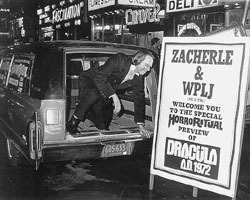
You can't see the marquee, but here's a photo of TV host/radio jock John Zacherley getting ready to go into the theatre for a personal appearance circa 1972.
Posted by Bill Gabel (Member # 1105) on 08-01-2006, 07:29 AM:
Up until 1938 there was a Trans-Lux Theatre at 1619 Broadway in the Brill Building. The Trans-Lux 49th Street Theatre opened around 1938.
Powered by Infopop Corporation
UBB.classicTM
6.3.1.2