This is topic TV/DVD aspect ratios in forum The Afterlife at Film-Tech Forum ARCHIVE.
To visit this topic, use this URL:
https://ft-forum.com/ft/cgi-bin/ubb/ultimatebb.cgi?ubb=get_topic;f=12;t=000606
Posted by Thomas Pitt (Member # 4322) on 11-28-2007, 04:54 PM:
I'm just curious as to why 16:9 has been chosen as the new aspect ratio for widescreen TV sets and monitors? I was under the impression that it was to make movies available in widescreen for home formats, but neither of the two common film aspect ratios (flat and scope) seem to fit the 16:9 screen properly!
On DVDs, I've often noticed that 'flat' films fill the entire screen, often using anamorphic widescreen to get all the width into a standard NTSC/PAL signal. Even so, a small amount is cropped off the edges to get it to fit the screen.
'scope' films are even worse - they're shown in anamorphic widescreen, but with horizontal black bars at the top and bottom to preserve the scope aspect ratio.
Some TVs have a mode where you can zoom the picture in slightly and get rid of the black bars, but then you're losing a small amount of the image off the left and right instead.
What's your opinion on the 16:9 aspect ratio and how films are converted to fit? I would have posted a poll about zooming in the picture, but polling is disabled in the forum.
Does anyone know why 16:9 was chosen for widescreen TV?
Posted by Joe Redifer (Member # 3) on 11-28-2007, 05:03 PM:
16:9 was chosen probably for the same reason 1080i exists... the people in charge of making these decisions are completely inept at being alive, much less logical, forward thinking. They made these decisions many years ago with their technology standards, figuring that technology would never advance so screens obviously can not be wider than 16:9 and high definition MUST be interlaced or compromised with a lower resolution progressive version (of course I am referring to 720p, which also should not exist). This is also the reason HDTV is broadcast with the horrible MPEG2 codec.
I wish the format was 1.85:1, but that doesn't roll off the tongue as easily as "16:9". I think 2.4:1 is too wide for general TV viewing. I don't mind a little letterboxing when watching scope movies. Movie theaters letterbox their screens for scope, so it's obviously good enough for everyone.
Posted by Steve Guttag (Member # 268) on 11-28-2007, 06:38 PM:
Actually, 16:9 is not without merit. It splits the difference between 1.85 and 1.66 formats reasonably well (1.78:1) such that either should be able to be shown without substantial cropping. It is 4:3 squared so there is a nice mathematical progression from traditional SD material to HD. It allows for a nicer transition from SD to HD as if TVs were to go for 2.39:1 or so, that SD material (the entire history of TV plus the first half century of film) would look horribly small. When widescreen TVs first came out and there was virtually no product to run on them, even if you got a "bigger TV" the picture if in 4:3 was often smaller than the TV it was replacing. 2.39 sets would have made that transition even worse.
So with 16:9 you have a compromise that address most things except Scope well. However, there is some nice factors again with 16:9 (mathematically speaking). Reduce its width 33%, it is 4:3, enlarge its width 33%, it is 2.35. Thus with an anamorphic lens of 1.33X you can make a 16:9 projector project full resolution 4:3, 16:9 or 2.35. In fact, both ISCO and Schneider (ever heard of them) make anamorphic lenses for 16:9 video projectors that do just that!
Steve
Posted by Leo Enticknap (Member # 534) on 11-29-2007, 02:21 AM:
quote: Thomas Pitt
Does anyone know why 16:9 was chosen for widescreen TV?
It was initially chosen by the International Telecommunications Union in the mid-80s, because (i) it represented a compromise between 1:1.85 and 1:1.66, and (ii) it almost exactly matched the super 16 frame. This was before the days of digital origination in the TV industry, and the expectation was that if HDTV caught on, super 16 would be the main capture medium. Its first use as a broadcast video format was in the short-lived MAC and MUSE systems (analogue picture plus digital sound HD telly): the former was effectively stillborn and the latter used on a small scale in Japan from the early '90s (and I believe still is for one or two channels, just).
Brian Winston has an interesting chapter on early HDTV research and standardisation in his book Technologies of Seeing. His conclusion - that there was a conspiracy to kill it off by the manufacturers of standard definition hardware - is not one I agree with, but the basic historical background, including around the standardisation of 16:9, is in there.
It seems to me that the stampede to widescreen telly, with everyone queuing up at their local Dixons or Comet to buy a flat panel LCD, has caused exactly the opposite problem to the one which emerged in the '50s and '60s. Then, we had broadcasters having to pan and scan to reformat widescreen film for 4:3 TV: now, we have 'legacy content' originated in 4:3 being cropped or stretched to fit 16:9 TV sets. What makes this even more chaotic is that the decision doesn't just lie with the broadcasters: many of these TVs include features which allow the owner to view a 4:3 broadcast cropped, anamorphically stretched or properly but with a vertical matte. So even the broadcasters are now no longer in control of the reformatting process.
Posted by Thomas Pitt (Member # 4322) on 11-30-2007, 01:41 AM:
The UK is rapidly moving towards 16:9 for all TV programmes as well. It's very hard to find something recently made in Britain that's still in the 4:3 format.
Even old 4:3 programmes are being cropped to fit into a 16:9 screen; they crop off the top and bottom of the picture. This leads to framing errors, since the original cameraman and director never shot with 16:9 in mind!
I think for 4:3 shows, the TV networks should just broadcast them in their original 4:3 format. Most TVs have an option to crop it to 16:9, or show it in 4:3 with borders at the side - it should be up to the viewer, not the broadcaster!
I distinctly remember watching something that had been cropped this way. At one point, someone was talking to their dog... except you couldn't see the dog; it had been cropped off!
CBBC in particular likes to show everything in 16:9, even when most of their original source material (such as old theatrical cartoons) is in 4:3 or Academy ratio.
Posted by Frank Angel (Member # 248) on 11-30-2007, 04:15 AM:
A few years ago I was visiting a friend in Florida for a week just after he had purchased a big Sharp (I believe) flat panel which had a slew of settings designed to deal with what to do about 4:3 images. It had two types of anamorphic stretch settings to get 4:3 to fit into the 16:9 frame.
One was a linear stretch which made everyone looking fat. The other was a non-linear stretch which put more stretch at the corners and less or none in the center of the screen. Thus, most of the time, people didn't look fat unless they were off to either side of the screen, in the middle, they looked like normal -- i.e., not like a lens had fallen off the projector. And I must say, on a fairly static image, the stretch at the corners was hardly noticeable....until the camera panned. Then it looked like you were looking thru a reverse fisheye lens.
When he picked this setting, I complained loudly at first as is my wont, but realized that he had just spent gobs of money on his big screen and by gum, he was going to have a wide screen picture on it. Plus, I was a guest and figured it wasn't polite to call his anamorphic setting "stretch and wretch." At least not if I wanted to keep being fed.
In the end, I guess it's better to let the end user decide what evil is less likely to cause him to upchuck his lunch.
And a quick question -- can anyone remember how long it took for NBC to stop putting the peacock logo before EVERY color program with the announcer crowing about "The following color is brought to you in Living Color" (as opposed to dead color?). Because quite frankly, I am just about having enough of them making a big deal about every program they broadcast in HiDef. I guess when they turn off SD in 2009, that will pretty much make pointing out that a program is broadcast in HD pretty assinine. But quite honestly, I don't think I can hold out until 2009.
Posted by Mark Ogden (Member # 43) on 11-30-2007, 06:18 AM:
This is commonly misunderstood, but actually, standard definition doesn't get "turned off" in '09. What goes away is analog signal transmission from your local station. While everything over-the-air will be sent in digital, the vast majority of programming will still be SD.
The NBC peacock, along with the post-show "chime" logo both were dropped in September of 1975 with the introduction of the new "N" logo, the one that looked like two trapezoids side-by-side.
Posted by Mike Blakesley (Member # 26) on 12-05-2007, 05:37 PM:
I think there should be a large penalty for operating a wide-screen TV with a 4:6 picture stretched to fill the screen. The bar next door to the theatre just installed one of these TVs and it drives me crazy, every time I look thru their window I see this huge TV picture with these fat-headed ESPN talkers on it. I see this nonsense all over the place. Wake up, America!! ![[Roll Eyes]](rolleyes.gif)
Posted by Joe Redifer (Member # 3) on 12-05-2007, 06:06 PM:
People are afraid of black bars. Remember, 98% of the world is stupid.
Posted by Bobby Henderson (Member # 840) on 12-05-2007, 06:38 PM:
I think it's funny how some new widescreen televisions have what I like to call a "fun house mirror filter." It's a different way of stretching a 4:3 image to 16:9 proportions.
When this filter is in effect, objects in the central area of the frame appear to be in proper proportion. Objects closer to the right and left ends of the frame become increasingly stretched. This fun house mirror filter may not be all that noticeable on images which don't have much movement. But anything with a good degree of movement will look strange. Imagery from lateral camera pans left to right or the reverse direction will also look weird.
Posted by Mike Blakesley (Member # 26) on 12-05-2007, 09:46 PM:
Why do TVs have this adjustbable aspect ratio function, anyway? Why doesn't the image just automatically appear in the right aspect ratio? Is it just because people would return TVs as defective if the image didn't fill the screen?
As you can tell, I'm an old-school TV person. But I'm considering an upgrade at the house -- the 25" Zenith console in our living room is starting to show its age. So as much as I hate the thought, I need to start learning about this crap.
Posted by Jon P. Inghram (Member # 4125) on 12-07-2007, 04:37 PM:
"People are afraid of black bars. Remember, 98% of the world is stupid. "
We had a manager who would always tell me to "get rid of the side bars" whenever we had ESPNHD on the big screen with a 4x3 show using the "ESPNHD" logo bars on the sides. And then there was the time he wanted both ESPNHD and ESPN2HD split on the screen side-by-side while still filling the vertical height of the screen, in glorious 8x9 aspect ratio!
Posted by Brad Allen (Member # 470) on 12-07-2007, 05:37 PM:
quote: Mike Blakesley
Why do TVs have this adjustbable aspect ratio function, anyway? Why doesn't the image just automatically appear in the right aspect ratio?
I guess they do this to satisfy those that don't know any better. If your using a set top box, from your cable co or Directv, etc. you can set those up to display different aspects properly and automagically.
Posted by Larry Myers (Member # 738) on 12-07-2007, 07:16 PM:
I have two DVD versions of the title Beautiful Mind. One in 4:3 and the other is 16:9 anamorphic wide screen. The 16:9 clearly has the tops and bottoms cropped off. I am not sure if the 4:3 DVD scan is from a full frame 35mm print or not. It could be from a 1.85 35mm print that has had it's sides cropped. This would mean the widescreen version is really a tunnel vision version of the original 35mm theater presentation.
Posted by Joe Redifer (Member # 3) on 12-07-2007, 10:15 PM:
There's no way that the 4:3 DVD is cropped from the theatrical version and then the 16:9 DVD cropped from that. You wouldn't be able to see anything! The 4:3 version simply unmasks the flat image (I assume that movie was flat or Super35). It wasn't composed for the 4:3 ratio, though. The 16:9 will be far closer to what was shown in theaters. I think I had a Terminator 2 picture like that around here somewhere.
Posted by Bobby Henderson (Member # 840) on 12-08-2007, 12:12 AM:
4:3 "full frame" DVDs do not guarantee you'll see the entire original negative 35mm picture in a spherically shot 1.85:1 movie or a 2.39:1 Super35 movie.
A few years ago when The Matrix first appeared on HBO, I compared the 4:3 broadcast version to the framing on the DVD. The differences were interesting.
Sure, the 4:3 version added more to the top and bottom area of the image compared to the 2.39:1 version. However, most of those 4:3 images were missing image detail on the left and right ends of the frame that you could clearly see on the DVD.
A number of close up shots of actors were severely cropped just like regular pan and scan transfer (if image tops and bottoms were restored you would no longer have much of a close-up).
Finally, most of the visual effects shots in The Matrix were composed for the 2.39:1 aspect ratio. Those shots are as badly panned/scanned as any anamorphic photographed movie.
You can also see many of these same differences in other Super35 movies such as Terminator 2: Judgment Day.
Posted by Larry Myers (Member # 738) on 12-08-2007, 09:31 AM:
I will say this. I believe the 4:3 version of the DVD looks much better. One clear difference is the a shot of John Nash sitting at his desk. In the 4:3 version you see all his papers with his calculations. The 9:16 version you see John Nash sitting but you don't see the desk or his papers at all. In other words, the 4:3 version you see him sitting at his desk with all his work. The 16:9 version you really don't see the desk. You only see him leaning over working on something with the top of his pen revealed in frame. He could be drawing stick figures for all we know. You can't tell me that form of cropping was the Directors intention.
Posted by Bobby Henderson (Member # 840) on 12-08-2007, 11:13 AM:
Maybe the director didn't intend for you to see all that stuff on the desk. If it was important he would have included it in the shot.
Revealing previously cropped imagery can also have some nasty side effects. A number of movies and movie trailers have had things like boom mics become visible in the frame when recomposed to taller, closer to square aspect ratios.
Posted by Thomas Pitt (Member # 4322) on 12-08-2007, 11:52 AM:
I mentioned the CBBC channel in the UK crops all 4:3 programmes to 16:9. But I saw a couple of Cinemascope Tom & Jerry cartoons on that channel recently, and what they've done is awful!
The Cinemascope version was telecined by a company, and pan and scanned to 4:3 before being put onto a videotape to be shown on TV. CBBC now took that pan and scan tape, and cropped it again to 16:9! So you're effectively seeing the middle of the frame zoomed in, like Joe said!
Posted by Larry Myers (Member # 738) on 12-08-2007, 01:01 PM:
Well Bob, all that STUFF is included in the shot or at least with the DVD 4:3 version. It could very well have been a series of stick figures and half eaten donuts in the disk. Then I would say the Director didn't intent for the desk and paperwork to be included in the shot.
The whole 4:3 DVD version looks very clean to me which makes me think the widescreen 16:9 version is really a tunnel vision version of the original 1.85 screen play. Then again the Director might have known that a 1.33 version would be needed for a future DVD and television release so better keep those coffee cups and sound mikes out of the scene all together.
Posted by Joe Redifer (Member # 3) on 12-08-2007, 03:15 PM:
I found the Terminator 2 pictures I was talking about which I posted years and year and years ago.
Here they are:
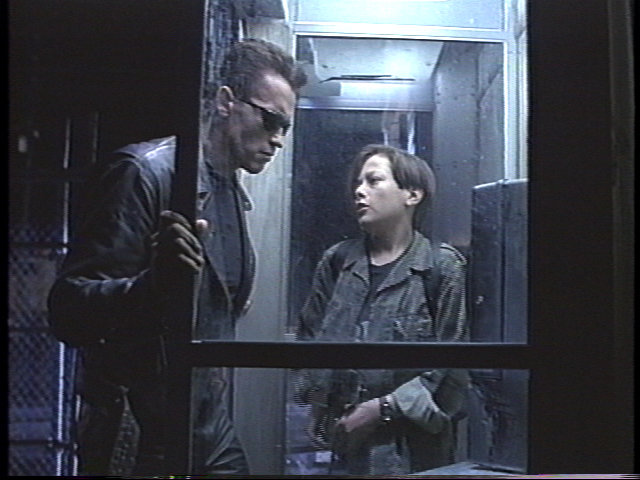
Here is a direct capture from the VHS version. You can see by looking at the bottom of the payphone how it is rigged to smash when Arnold hits it.
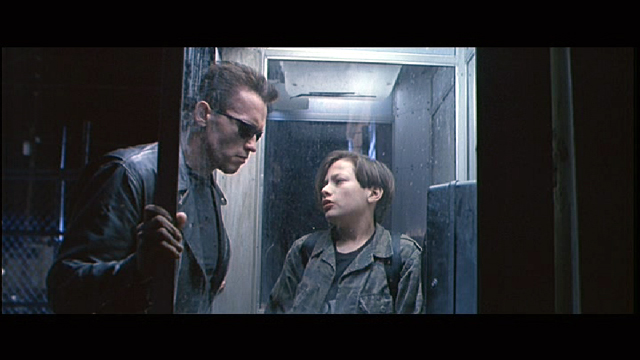
Here is a direct capture from same exact frame of the DVD. You can't see the bottom of the rigged phone here because you're not supposed to know it was a simple prop.
Posted by Brad Miller (Member # 2) on 12-08-2007, 03:38 PM:
Thanks for posting that Joe. I have never understood people who think just because picture info is there that it should be seen. Flat movies quite simply were MEANT to be masked at the 1.85 mark. The director did NOT intend for information outside of that area to be seen.
Similarly, people who do not keep their flat movies carefully center-framed, either due to that foolish "they are cutting off their heads" argument or whether it is from sheer laziness (aka "I don't see a frameline so it must be right"), are also presenting them incorrectly. The director screened a 1.85 crop...end of story.
Posted by Randy Stankey (Member # 64) on 12-08-2007, 10:31 PM:
I was sitting in a bar across the street from the theater where I used to work, having a beer with a friend who still worked in that theater. We were watching a billiards match on ESPN being displayed on a wide screen TV with "stretch mode" turned on. It looked like they were batting Easter eggs around the table!
The two of us were laughing our asses off. (Get a few beers in us and ANYTHING is funny! ![[Eek!]](eek.gif) )
)
The beertender couldn't figure out what was so funny.
Neither could he see the problem even after being told, nor would he let us put the TV into the correct display mode.
The picture is always SUPPOSED to fill the entire screen.
So, I go to the video store to rent a DVD. I pick out my movie and take it up to the counter. The clerk asks me if I want the Widescreen version of the DVD instead. He can't figure out why I want the Full Screen version... Maybe it's because I don't have a Widescreen TV?
It took me ten minutes to explain to him. If you have a "regular" TV you should get the "regular" DVD. Widescreen is useless unless you have a large screen or a wide screen TV.
Posted by Steve Guttag (Member # 268) on 12-08-2007, 10:35 PM:
Got a problem with Letterbox Randy?
Steve
Posted by Randy Stankey (Member # 64) on 12-08-2007, 11:45 PM:
On a 20 inch TV? Yes! ![[dlp]](graemlins/dlp.gif)
Posted by Frank Angel (Member # 248) on 12-09-2007, 01:57 AM:
quote: Brad Miller
Similarly, people who do not keep their flat movies carefully center-framed, either due to that foolish "they are cutting off their heads" argument or whether it is from sheer laziness (aka "I don't see a frameline so it must be right"), are also presenting them incorrectly. The director screened a 1.85 crop...end of story.
OK....point well made, but I would also add, that if the director was so concerned about his film being projected the way it was intended in the theatre, then there is a simple solution -- hard matte the damn thing like the SMPTE suggests. Yah, it suggests 1.66:1 hard matte instead of 1.85 just to protect slight errors in some theatres' lensing and plates, but with a 1.66:1 hard matte, there is a lot less wiggle room for framing errors.
I searched but can't find that post some time ago where one of our FT members said he was running a sneak and the director kept coming up to the booth telling him to rack it up, then rack it down then rack it just a little more....all during the show. Well, I would have told him, hey, if you're was so concerned about the exact position of that frame center-line, next time just hard matte the release print; now get out of my booth. ![[evil]](graemlins/evil.gif)
Posted by Bobby Henderson (Member # 840) on 12-09-2007, 03:13 AM:
On the subject of "center framed" Super35 or Super1.85, in terms of Terminator 2 much of that movie was set with the 2.39:1 safe action placed in a sort of upper third of the frame rather than something horizontally across dead center.
quote: Larry Myers
I will say this. I believe the 4:3 version of the DVD looks much better.
Sounds entirely like an opinion to me.
quote: Larry Myers
The whole 4:3 DVD version looks very clean to me which makes me think the widescreen 16:9 version is really a tunnel vision version of the original 1.85 screen play.
Again, an opinion over aesthetics and not something that really has anything to do with what the director truly intended with the movie.
[ 12-09-2007, 09:17 AM: Message edited by: Bobby Henderson ]
Posted by Larry Myers (Member # 738) on 12-09-2007, 09:16 AM:
Actually the only thing for sure we might know what the Director intended to do with any film is to get paid at the end of the week. Otherwise, how will he pay his mortgage on the 6.7 million dollar house at Malibu Beach that his ex wife and her boyfriend are now living in?
[ 12-09-2007, 12:09 PM: Message edited by: Larry Myers ]
Posted by Robert W. Jones (Member # 4228) on 12-09-2007, 09:59 AM:
There is one redeeming value to television zoom ratios. It get's rid of the annoying scroll if I'm watching a 24/7 news channel. Too much info, I hate that crap.
Some of the older "non-16x9 enhanced" DVD's I own still work like they are supposed to on my HD TV. A have letterboxing and a (full?) scope aspect ratio. Nothing's perfect. Compromise is for the mass consumers with no clue at all. In fact, my late Father refused to buy any DVD unless it was in "Full Screen" Format. That's because he was accustomed to his TV screen being full and found the letterboxing annoying.
Posted by Steven J Hart (Member # 2340) on 12-16-2007, 08:22 PM:
I watched The Lord of the Rings "The Two Towers" on TNT HD last night. The image seemed pretty good, but it filled the whole 16:9 screen, so they had to be tinkering with the original format somehow. I'm no expert, but I wonder if they simply cropped off the sides and zoomed in to fill the 16:9 screen. I also remember the film being darker at my theater than what I saw on TNT. Are films sometimes altered in other ways, such as overall brightness, for TV broadcast?
Steve
Posted by Joe Redifer (Member # 3) on 12-16-2007, 10:01 PM:
Perhaps you need to recheck the amount of light you're projecting onscreen at your theater? ![[Razz]](tongue.gif)
Posted by Jack Theakston (Member # 4484) on 12-26-2007, 12:58 AM:
Most TV sets' default settings are overly bright in order to compensate for the "theoretical setting," where companies seem to believe that everyone's living room is going to have the windows open and the sun blaring in at high noon.
You can adjust it, of course, and I usually find that the "cinema" mode on a lot of these are far more realistic in tone.
As for the aspect ratio stuff-- I still cannot believe how thick some people are about this, particularly with vintage titles. It's not rocket science.
Posted by John Hawkinson (Member # 1135) on 12-26-2007, 09:41 PM:
Today I found myself wondering...does anyone make a TV (LCD or CRT) with adjustable masking? So you can really watch those 2.39:1 and 1.85:1 movies with no black bars of screen anywhere?
I realize nobody would actually buy this, but...
--jhawk
Posted by Joe Redifer (Member # 3) on 12-26-2007, 10:46 PM:
quote: John Hawkinson
I realize nobody would actually buy this, but...
You've pretty much answered your own question there, though that might be kind of cool.
Posted by Frank Angel (Member # 248) on 01-06-2008, 06:26 AM:
quote: Jon P. Inghram was the last to post
People are afraid of black bars. Remember, 98% of the world is stupid.
Nah, it's only we Americans who are stupid when it comes to letterboxing on TV (as well as not being able to master the metric system). In Europe and Japan they were broadcasting scope films in letterbox about a decade before we started doing it on Laserdisc. And we STILL are aren't doing it on broadcast TV -- ABC just did their broadcast of THE SOUND OF MUSIC in the pan and scan abortion. I take that back -- PBS does some of their movies in letterbox, but it's a crapshoot; some are still P&S versions. Movies-on-Demand here on Cablevision NY are all 4:3....and they expect you to PAY $5 a pop for that crap!
Posted by Michael Coate (Member # 757) on 01-06-2008, 04:05 PM:
quote: Frank Angel
ABC just did their broadcast of THE SOUND OF MUSIC in the pan and scan abortion.
Anyone remember the mid-90s broadcast where every other segment was letterboxed? You'd see a few scenes in pan-and-scan, go to a commercial break, then return from the commercial break to see a few scenes in letterbox up through the next commercial break. Then the pan-and-scan abortion would reappear for the next segment, and it went back and forth like this for the entire broadcast!
Posted by Frank Angel (Member # 248) on 01-13-2008, 05:04 AM:
Yup, definately remember that....and laughed my ass off. Talk about confusing the already stupid public! If they thought letterboxing meant there was "something wrong with the TV," then this thing must have make people's heads explode.
Don't you wish you could sit in on the network meetings where these young turks, who are probably too young to have ever seen THE SOUND OF MUSIC in a theatre, make these gawdawful decisions? I would love to have heard the logic going on in there...and see what crack they were smoking.
Posted by Tim Reed (Member # 137) on 01-20-2008, 02:51 AM:
quote: Brad Miller
I have never understood people who think just because picture info is there that it should be seen. Flat movies quite simply were MEANT to be masked at the 1.85 mark.
This was the main reason I stopped going to those "movie mistake" websites. Every mic or below-the-belt gimmick that showed up in the VHS was listed as a "mistake".
Gave up trying to explain it to them. Imbeciles.
Powered by Infopop Corporation
UBB.classicTM
6.3.1.2