This is topic Any turntable junkies out there? in forum The Afterlife at Film-Tech Forum ARCHIVE.
To visit this topic, use this URL:
https://ft-forum.com/ft/cgi-bin/ubb/ultimatebb.cgi?ubb=get_topic;f=12;t=000624
Posted by Allison Parsons (Member # 2728) on 02-27-2008, 11:07 PM:
I've looked for a thread about record players and found none. If there is one hiding from me, please move this topic.
Well, I bought this litte guy today for $30 at a thrift store. He's a Pioneer PL 550 Quartz Synchro Pulse (whatever that means). Looks better than what the picture shows. I need to get a preamp for it, but it works great and still has it's needle.
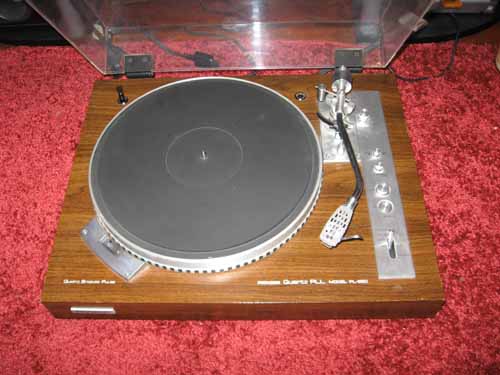
It doesn't have a manual, and I'm wondering about two things:
1)What does the Quartz Lock do
2)what is the Anti-Skate knob do
I can't find any info on it whatsoever online. This is my first vintage turntable. I have a Teac that I think I bought at Best Buy in the early 90's. But vintage is oh so nicer ![[Cool]](cool.gif) If any of you have knowledge of these old workhorses, please let me know.
If any of you have knowledge of these old workhorses, please let me know.
Posted by Brad Miller (Member # 2) on 02-27-2008, 11:57 PM:
The quartz lock controls the speed to get it dead on. The anti-skate is a very critical adjustment, as it keeps the tonearm from wanting to ride inward toward the center of the record (which causes groove damage in the record as well as throws your audio balance off).
Posted by Allison Parsons (Member # 2728) on 02-28-2008, 12:16 AM:
Thanks Brad! I just noticed if I adjust the speed and hit the lock button, it locks that speed into place. I'm probably going to have to buy a manual for this to find how to adjust the arm just right. I know a few guys around town that could help me out since all they do is restore and collect turntables, but they are uber creepy and I'm not inviting them over to help me ha.
Posted by James Westbrook (Member # 3690) on 02-28-2008, 01:51 AM:
On my Techniques turntable (circa 1983, and it still works), it recommended setting the anti-skate to the exact number that you have your tracking weight. Mine is a P-Mount cartridge and tracks at a light 1.25 grams.
Your cartridge is of a more conventional type, and tracks at a heavier weight, I believe.
The data you are looking for is bound to be on the internet somewhere, so the uber-creeps shouldn't need to visit...
Posted by Damien Taylor (Member # 4255) on 02-28-2008, 04:02 AM:
These things are evil! They will suck up all your money and time until black plastic discs cover every inch of your house.
Seriously though, good find on the turntable, I agree with setting the anti-skate the same as the counterweight, usually about 2 grams. It is possible to blow a lot of money on this stuff, my last turntable was a ridiculously cheap $900 and the cartridge/stylus I want(need) is $1100. More dollars than sense I guess.
Posted by David Stambaugh (Member # 1102) on 02-28-2008, 08:59 AM:
Congrats on the nice find. Turntables rock - Here's mine, a Technics SL-1200MK2 with upgraded tonearm:
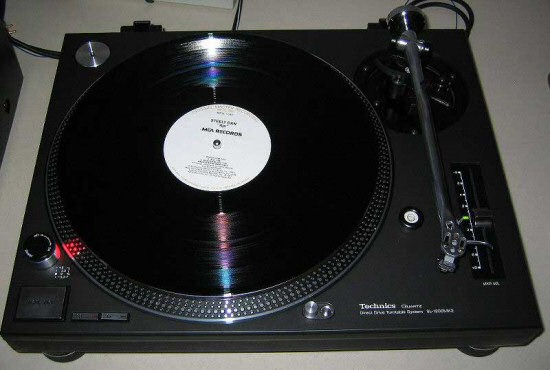
There are lots of forums for vinyl junkies but my current favorite is Vinyl Engine. People are generally very friendly and knowledgeable there, and someone will undoubtedly know something about your specific Pioneer TT if you post a question about it. Some of the conversations get very esoteric but beginners are welcome too.
Happy listening!
Posted by Mike Blakesley (Member # 26) on 02-28-2008, 09:42 AM:
I have a Technics turntable too, very similar to Davids except an earlier model. I think it's SL1500 but need to look to make sure. It still runs perfectly except the speed controls can be a little erratic.
I concur with all the above people about setting the anti-skate to the same value as your counterweight. Generally anything up to 3 grams is OK. If you have anm LP with a big warp in it, you can go a little higher to help with tracking.
Posted by Mark Gulbrandsen (Member # 72) on 02-28-2008, 10:27 AM:
I used to repair the Technics stuff when I was a bench tech at Pansonic back in the early 70's. The SP-10 is still the best of the best direct drive TT's ever made and a mint one commands a much higher price than it originally sold for. Parts however are scarce with some of the IC's having been manufactured by Matsushita are NLA. The poles in the SP-10 actually were wound at an oblique angle so they overlapped... this way there was no hunting between poles(common on Hall Effect Motors) and resulting higher flutter. I think the SP-10 was the only direct drive TT to ever feature this.
I still have my RS-1500 2 track closed loop recorder which I purchased when I worked at Panasonic as an employee purchase... It too still functions beautifully.
Mark
Posted by James Westbrook (Member # 3690) on 02-28-2008, 11:47 AM:
David,
Is that a DJ turntable?
Posted by David Stambaugh (Member # 1102) on 02-28-2008, 12:20 PM:
Yes, Technics primarily markets to DJs now but there's also a lot of "audiophiles" who like them. Aftermarket mods are available, like the arm I installed. Whatever some people may dislike about the Technics, nobody can say it doesn't spin a record at exactly the correct speed. There are $5K turntables that can't get speed dead on.
Posted by Damien Taylor (Member # 4255) on 02-28-2008, 03:34 PM:
Yeah I'm using a Mk II. Theres a lot of audiophiles who like to bring the SL-1200 down for some reason, I never could figure out why.
Posted by Robert Minichino (Member # 3495) on 02-28-2008, 04:52 PM:
I love my SL-1200Mk2, black like David's but with the stock tonearm and a Shure M97xE.
The PL-550 is a very nice direct-drive TT, I'm sure you'll be happy with it. Can you tell what cartridge is in it?
Posted by James Westbrook (Member # 3690) on 02-28-2008, 06:47 PM:
Since I prefer Direct Drive over Belt Drive, I would have to get a DJ-Style turntable when my existing one goes kaput. I prefer Techniques, so this would likely start at $500.
I purchased my Onkyo receiver in 03 (to replace my old Hitachi) as this particular model (TX 8511) has turntable inputs. A lot of receivers don't, especially the home theatre kind.
The only turntables I don't see anymore are the Akias (Sp?) (Akai?). Other brands are still churning along after being in use for 20 some-odd years.
The Bang and Olfsson turntables were quite odd...one could lift one side up while a record was playing and it would still track.I don't know why anyone would want to do that, though...
Then there were Dual and Yamaha.
Oh...and Denon.
Posted by Monte L Fullmer (Member # 2797) on 02-28-2008, 07:02 PM:
..unless you want to invest in some extremely high end audiophile turntable like this... 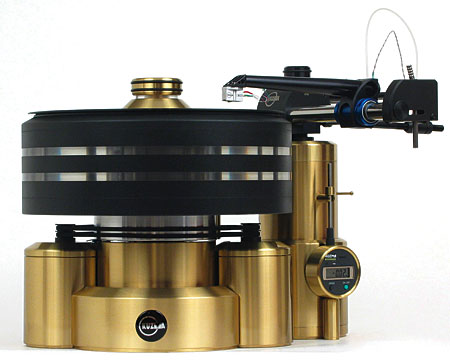 ...
...
Specs: The spindle shaft of the Stabi XL is more than an inch in diameter, with an inverted bearing tipped with a ruby ball. Its massive base weighs 59.4 lbs and consists of two round slabs of solid brass smoothly machined and pressed together.
The brass tonearm tower consists of two hollow brass cylinders, the inner one riding on a linear ball-bearing system more than 1" in diameter and almost 4" long. Your choice of tonearm attaches to the inner, movable cylinder via a cylindrical locking armboard collar.
Double motor/belt driven setup for absolute rotation speed.
The heavier the setup, the less turntable rumble, wow and flutter there can be.
Since the lacquers are basically cut in the same manner, audiophiles love to find a turntable that closely matches those Scully or Fairchild lathes that the lacquers were cut on - to be as close to the master tape recording as possible.
These massive turntables aren't for the weak at heart, nor the budget minded individual: You'd better be prepared for the best and have some green lying everywhere around you to pay for these units.
I have two turntables: an ELAC 3 speed unit (does great with a mono cartridge and styli in doing 78rpms) and a Sony Linear tonearm, direct drive unit.
Posted by Damien Taylor (Member # 4255) on 02-29-2008, 01:53 AM:
It seems from the activity here that an interest in film and records go hand in hand. How about the Thorens, are the 124's all they are cracked up to be?
also... I am considering an Ortofon SPU, probably the Classic GM Mk II, anyone heard these in action and know what the sound is like?
Posted by Allison Parsons (Member # 2728) on 02-29-2008, 02:36 AM:
Riddle me this:
What is the point of the strobe light on these things? Was it a way to pinpoint how many RPM it's turning (when the speed adjust dial is being used), or are/were they just for show?
I didn't see any number on the counter weight. Then I pulled the whole thing off and whomever had it before me had it on backwards. I'm probably going to take it over to Peoria's only place for TT repair and see if they can help me with it.
quote: Damien Taylor
These things are evil! They will suck up all your money and time until black plastic discs cover every inch of your house.
yeaaahhh, tell me about it. Try working at a record store for 10 years. I live in a 2 bedroom house. The second bedroom is my LP/CD room. I would like to have a roommate to help me with the bills, but I can't get rid of my beloved LP's to make room for them haha
Posted by Monte L Fullmer (Member # 2797) on 02-29-2008, 04:15 AM:
Gee Allison - with all of that vinyl you're saying that you have, got a VPI 16.5 record cleaning machine mixed in with that collection?
Posted by Damien Taylor (Member # 4255) on 02-29-2008, 07:47 AM:
I've found myself as some what of a custodian for all the world's terrible records that would otherwise go unwanted. The scope of stuff out there is virtually infinite and theres basically no market for the things here. I get 'donations' of hundreds at a time, although they are always the same. Sometimes I swear Nana Mouskouri and Demis Roussos have made the most records... ever.
I always wanted to work in a record store, unfortunately theres not a real boom for the things over here, sure I could work in a CD store selling "popular" music, but wheres the edge ![[Razz]](tongue.gif)
Excuse the pointless rant, but its hard finding people who share interests who aren't mega creepz0rs
Posted by Scott Norwood (Member # 30) on 02-29-2008, 02:23 PM:
The "stroboscope" is there to allow you to check the speed. It may be useful in calibrating your pitch control if there is an adjustment pot for the pitch range inside the unit and if the pitch control has markings (e.g. +/- 2%, 4%, etc.).
A standard turntable will have adjustments for tracking force, anti-skate, and tonearm height. These need to be set correctly unless you like bad sound and damaged records. The instructions that come with the cartridge/stylus should tell you how to mount the cartridge to the headshell (alignment here is important) and the recommended tracking force. If you don't have a cartridge or need a new one, find a good stereo shop; they can recommend a cartridge based on the characteristics of the tonearm (different types of arms work best with different types of cartridges). As others have mentioned, anti-skate is normally set to the same value as the tracking force, but this may need to be tweaked to keep warped disks from skipping. The tonearm height adjustment depends on the cartridge and the thickness of the disk.
I have a Technics SL-1200 with the stock arm and an AT440 cartridge. It's a tank, but not really the best-sounding unit available. At some point, I'd like to upgrade to a Thorens or some other mid-range belt-drive unit. The VPI cleaning machine is also on my "wish list."
Posted by Mark Ogden (Member # 43) on 02-29-2008, 02:32 PM:
Here is how the strobe works: in a dark room, turn the turntable on and turn the quartz lock off. Notice the line of black dashes on the bottom edge of the turntable platter. Look at these dots thru the clear plastic piece on top of the strobe, and using the speed adjustment knob, adjust the speed of the platter until just the point that the dots seem to float in place, without moving to the left or right. This should be precisely 33.3 rpm. When you have done that, turn the quartz lock back on.
Anti-skating: You’ll need a flashlight and possibly magnifying glass for this. Place a record on the turntable and allow the tone arm to drop towards the center. Look at the relationship of the needle to the rest of the cartridge. The needle should still be perfectly centered to the body of the cartridge. If it looks like it’s deflecting one way or another, adjust the anti-skating until it stays centered both off the disc and on. Better: this is a long shot, but if you can lay your hands on an old transcription disc, or any other disc that has a blank (no grooves) side, just let the tone arm drop on it and adjust the anti-skating till it stays in place, that is, does not move inward.
Posted by Brad Miller (Member # 2) on 02-29-2008, 07:15 PM:
quote: Scott Norwood
As others have mentioned, anti-skate is normally set to the same value as the tracking force, but this may need to be tweaked to keep warped disks from skipping.
Unless you have a cartridge like this. 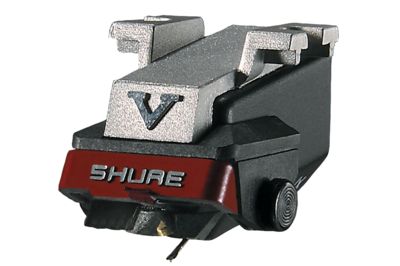
In this case, typically the tracking force is set 1/2 point higher than the anti-skate to offset the dust brush. (Note in this picture the brush is in it's locked upright position, not the operating position.)
Here is the spec sheet for this magnificent unit.
And this one just may be the last one "new in the box".
Posted by Joe Redifer (Member # 3) on 03-01-2008, 12:39 AM:
quote: Brad Miller was the last to post
When I first looked at this I thought it was some kind of mega-lawnmower or maybe a zamboni.
Posted by Allison Parsons (Member # 2728) on 03-01-2008, 01:00 AM:
Monte, I would LOVE to have one of those record cleaning machines! But I find a soft Viva paper towel and some Windex with no alcohol in it works just as good for what i need ![[Smile]](smile.gif)
Can you basically turn a piece of crap TT into a wonderful sounding machine just by adding a high-end cartridge/needle?
Posted by Monte L Fullmer (Member # 2797) on 03-01-2008, 01:41 AM:
Hi Allison - just have to watch out for using Windex or any ammonia based cleaners: granted no alcohol, but you can leave a soapy scum residue in the grooves. Then, you'd definitely have to "soap and water" wash your vinyl and let them air dry in the dish drainer.
As what is printed on some of the old inner sleeves: a slightly damp terri cloth is really all you need.
Thing about doing the 'crappy turntable into a gem' idea - I did that once with a Garrard turntable - originally had a ceramic cartridge, then added a magnetic cartridge and a pre-amp which worked out not too bad. But, those simple rim drive units have so much turntable rumble were the cartridge really had fun with picking up the rumble plus the rimtire drive noise as well which became apparent in tape recording reproductions. Thus, not a real good idea to do, unless you love to tinker..
Those old cheapie turntables were designed for those casual vinyl listeners who bought those Audiovox/ Craig/Garrard/Lafayette/"RatShack" dime store units that had horrible speakers that came with it as a package unit. Obviously, they weren't in the audiophile world but in a world just to listen to music as they know how it sounds from their transistor radios back then.
Posted by Adam Martin (Member # 641) on 03-01-2008, 01:42 AM:
quote: Allison Parsons
Can you basically turn a piece of crap TT into a wonderful sounding machine just by adding a high-end cartridge/needle?
Can you turn a piece of crap theater into a gem by installing a digital projector?
Posted by Brad Miller (Member # 2) on 03-01-2008, 02:02 AM:
Garrard did make one very good turntable, the GT55. This was the final version of the Zero 100's linear pivoting articulated arm and produces fantastic sound when outfitted with a quality stylus and cartridge such as the Shure I posted above. I have been enjoying mine since 1976/1977ish and it still performs magnificently to this day.
One of the main reasons why the GT55 worked so well was because of the linear tracking, combined with a traditional pivoting arm. Here is a page I found on a google search which explains how it works. Inner groove distortion was something I never had to endure with this unit.
I recall taking the unit into Marvin Electronics in Fort Worth in the mid 80s where they were doing free "turntable evaluations" (which was a marketing trick to get audiophiles into the store to show them how their equipment did not perform as well as the $5000 unit they were pushing. I actually saw them sell 2 of them while I was in line!) Anyway, when my GT-55 got it's turn, the technician started chuckling at me a little bit, but then he just sat there and stared at his equipment as my little cheapie GT-55 was amazingly on par with their $5000 monster. Some of the guys behind me in line waiting to see how well their turntables performed were amazed, and borderline angry (no doubt because they had spent WAY more than I had).
I am actually seeking another one of these, as a backup. I have never truly liked any other turntable as much as this one. Anyway, don't knock Garrard as a whole, because they did make at lease one damn good turntable.
Posted by Monte L Fullmer (Member # 2797) on 03-01-2008, 03:40 AM:
True, I forgot all about the GT55 with the pivoting headshell that kept the head square to the grooves - as if it was a linear tonearm turntable.
I was just barely getting into serious vinyl listening (mainly classical music listening, but listened to others) back in the mid to late 70's, but was confined to the turntable that I converted to magnetic from ceramic being on a smallish budget then.
True, Garrard really wasn't a bad company in the whole since they had the dominating market with their better turntables available through Lafayette and Allied electronics (in which, I do believe the GT55 was available through these catalog electronic venues) in the 70's, but in retail stores, were their lesser quality lines - lines that I was accustomed with at the time.
Posted by Steve Guttag (Member # 268) on 03-01-2008, 11:29 AM:
Hmmmm....now this brings back memories. I spend a lot of time and $$$ trying to find MY perfect match of turntable and cartridge/stylus. For awhile, I used a Techniques SL-1301 with an array for cartidges...with an Audio-Technica cartridge eventually winning out on the best for it...Back then Sure was on the V15 type IV (just before Brad's). I must have spent 500-700 on cartridges to find the sound I was looking for.
I then found the turntable that suited me the best...a Mitsubishi LT-30. It is a linear track type and once again the cartridge search was on! Fortunately, I found home much sooner since th AT was still a good sounding unit...I eventually settled on a Signet TK-9LCa. That is the combination I have till this day. In fact, I just was able to locate a replacement stylus for it (new in the box dispite being discontinued for decade(s)).
The SL-1301, being a quite decent unit was outfitted with a lesser/larger stylus/cartridge (still and AT) to be used for lesser or damaged records so that tracking could be optimized for such records without affecting the settings for my higher end records. I had/have quite a collection of half-speed masters (Mobile Fidelity, Natulus and such), UHQRs, a couple of direct-to-discs and even imports on some titles, like Pink Floyd's THE WALL to get better (quieter virgin vinyl).
Sometimes it is like that scene in "This is Spinal Tap"...some of the records are in the "Don't Touch" category but there are touchable versions. Some were transfered to 1/2-track tape and the tapes are used for listening. I have a Cat Steven's "Tea for the Tillerman" UHQR still in the shrinkwrap ("don't even look at it".... ![[Wink]](wink.gif) ). While it is odd for me to have "not for use" items...every once in a while I check on ebay the value of UHQRs...and they are definately holding or rising!
). While it is odd for me to have "not for use" items...every once in a while I check on ebay the value of UHQRs...and they are definately holding or rising!
I swear to you that on some pressings, the vinyl versions are notably better than the CD versions but this is not always the case.
Other things I've been known to do to get that sound out of a turntable...take a set of identical phone books, put them down on the counter, lay a piece of wood on top of them, then take isolation pads and put them on the wood and then place the turntable on top...you can really knock down tonearm feedback with that technique. If you want to see how bad a problem you have...don't turn on the turntable (or stop the platter), set your tonearm down on the lead-in groove of any record (I suggest one tht you don't charish as each set down can cause a tick) and then choose the phono input with the volume down...slowly raise the volume and you will eventually get the system to feadback...the better the isolation the higher the volume you can get. That phonebook trick really knocks it down.
Steve
Posted by Allison Parsons (Member # 2728) on 03-01-2008, 01:00 PM:
quote: Steve Guttag
I swear to you that on some pressings, the vinyl versions are notably better than the CD versions but this is not always the case.
True. John Cale's Paris 1919 was rereleased a year or so ago on 180g vinyl. Sounded horrible. Some of the stuff I have from the 80's is hit or miss as well. Broke out my Pink Floyd DSOFTM Original Master Recordings on LP last night. The Floyds always sound good on LP. Even listened to my Division Bell on LP.
quote: Steve Guttag
"...some of the records are in the "Don't Touch" category but there are touchable versions.
I'm 100% guilty of this. If I buy a record, my rule is I don't open it until I want to listen to it just incase it flys up in value. Sometimes I even buy two, one to open, one to sell a few years down the line (which I do do). Thats probably the main reason why I'm running out of room in my house haha.
Posted by Brad Miller (Member # 2) on 03-01-2008, 01:34 PM:
I used to be guilty of taking a brand new record and copying it to tape for listening, at which point the record would not be played again. Nowadays, I so rarely listen to records that I just play the actual record (plus my reel to reel deck is long since dead and I am not going to shell out any money for another one). At some point I need to sit down and digitize the records.
Posted by Monte L Fullmer (Member # 2797) on 03-01-2008, 02:34 PM:
..and when you find GALE boxed sets, some M&K Realtime vinyls along with a quadry of RCA "Shaded Dog" classicals in thrift stores and the vinyls are still in a mint condition, you know that you've picked up someone serious vinyl collection.
Posted by Steve Guttag (Member # 268) on 03-01-2008, 07:43 PM:
Much to my wife's shagrin, all three of my reel-to-reels and the assorted cassette machines are still with me and working (to the best of my knowledge though they are not presently out, except the Tascam 35-2B (1/2-track stereo Rec/Play and 1/4-track play...kinda like Mark's RS1500US but in a Teac form instead of a Techniques).
One rule I have with the playable vinyls are that the needle can only touch-down on the lead-in groove...there will not be any cueing on any of the tracks...I've found that can put ticks into the record. This is one of the reasons I have for the r-t-r and even cassette tapes...though the cassettes were traditionally used for car and booth (via a VERY early Sanyo version of a walkman)....because, lets face it... a r-t-r really drains a car battery and way too much hassle to bring to the booth each night! ![[Big Grin]](biggrin.gif)
Posted by Brad Miller (Member # 2) on 03-01-2008, 07:53 PM:
quote: Steve Guttag
One rule I have with the playable vinyls are that the needle can only touch-down on the lead-in groove...there will not be any cueing on any of the tracks...I've found that can put ticks into the record.
Same here...and there is no maybe to it, every drop of the needle DOES put a tick in the record.
Posted by Monte L Fullmer (Member # 2797) on 03-01-2008, 09:20 PM:
? Has anybody ever picked up on this laser turntable below?
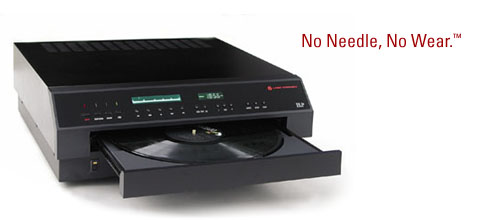
-Monte
Posted by Brad Miller (Member # 2) on 03-01-2008, 09:47 PM:
I have considered it, but have heard various reports that it is TOO good and picks up every little imperfection in the disc. Plus my LP collection isn't big enough to warrant that kind of money on a player when my current unit sounds great.
Posted by Monte L Fullmer (Member # 2797) on 03-01-2008, 11:35 PM:
What I was wondering on the imperfection issue since we're dealing with many pressings from stampers that are generations apart from the mothers - let alone the distance from the original metal master.
Sounds then that this player would be only good for original lacquer cuttings (or DMM cuttings) and including the metal masters since these were close to the production tapes.
Posted by Damien Taylor (Member # 4255) on 03-01-2008, 11:50 PM:
Those DMM records were really nice, in fact I've found Japanese records are of excellent quality and many times better than any other country, some of the Toshiba Records DMM's are awesome. Japanese jazz is sweet.
The laser turntable would be good for cracked transcription discs and 78s.
Posted by Paul Trimboli (Member # 1509) on 03-03-2008, 04:38 AM:
I am looking into getting a turntable as I will now have a very nice system to listen to records on. I would like to collect SACDs but there is just not the range of music on them so vinyl is really my only choice aside from CDs. What do people here think of the Rega P1 as this is a turntable I had been looking at? Is the sound of vinyl really better then CD? If you ask me I would say the sound is different with vinyl having a mellower quality about it. How fast does the sound quality of vinyl deteriorate when played back on good equipment?
Posted by Damien Taylor (Member # 4255) on 03-03-2008, 09:34 AM:
Even though there is an obvious Technics SL series fetish in this forum, of which I suffer myself, on a price to quality graph, the Rega really makes sense. It's no frills, but some audiophiles like that, in fact some downright refuse to have graphic equalisation of any kind.
As far as record wear is concerned, you can play a record once with a slightly chipped stylus and ruin it forever, but with a perfect stylus and setup like you mentioned...
The RIAA states that the frequency respose drops:
20 kHz after one play
18 kHz after three plays
17 kHz after five
16 kHz after eight
14 kHz after fifteen
13 kHz after twenty five
10 kHz after thirty five
8 kHz after eighty plays
This is all fine, but alot has to do with the crap the previous owner was playing it on. Way back when, people didn't see the stuff as collectable so they probably just threw it around at parties, or maybe they did know and just didn't care.
A lot has to do with the quality the record had when it was produced, if the stamper was worn, it was crap to start with, but I have played records many, many times and not heard much degradation, but if it was a $500 record, I would probably just buy the CD.
Posted by Pete Naples (Member # 761) on 03-03-2008, 12:13 PM:
I have 3 turntables here, one Goldring Lenco GL75 which is mainly used for 78's, a Linn LPK12 Sondek which is LP and 45s when really in the mood, and a Rega Planar 2 which is the day to day turtable. I really love the Rega's uncomplicated solidity. It just works, no frills, bells or whistles, just good sound.
Posted by Brad Miller (Member # 2) on 03-03-2008, 12:28 PM:
quote: Damien Taylor
The RIAA states that the frequency respose drops:
20 kHz after one play
18 kHz after three plays
17 kHz after five
16 kHz after eight
14 kHz after fifteen
13 kHz after twenty five
10 kHz after thirty five
8 kHz after eighty plays
That can't be correct, as I've got records that have been played hundreds of times and in no way are the high frequencies above 8kHz gone. Good hearing isn't even required to hear those frequencies.
Posted by Bruce McGee (Member # 131) on 03-03-2008, 01:31 PM:
I've owned 3 'quality' turntables since about 1976. 2 Dual belt-drives, and one Kenwood direct drive.
I am currently playing a Benjamin Miracord unit made in 1968. Got it for $4 at the thrift store. It only needed a bit of oil.
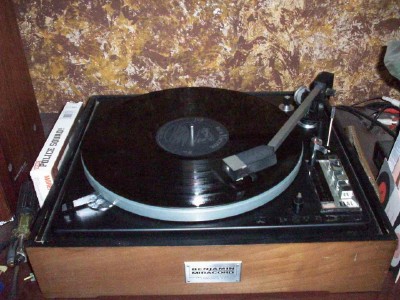
Since 1983, I've been using an Audio Technica cartridge that I bought then for about $170. It is on its fifth replacement diamond stylus.
I have original albums that I bought in the early 1960's. All original Beatles, etc. The total LP collection numbers are over 2500.
Many of my favorites are recorded onto reel to reel tape. I own a Technics RS-1500U deck, and an Ampex AG-440. Both have switchable 1/2 track, and 1/4 track playback.
Dont know how many 45's I have. Probably enough for several juke boxes!
[ 03-06-2008, 06:34 PM: Message edited by: Bruce McGee ]
Posted by Evans A Criswell (Member # 381) on 03-03-2008, 02:27 PM:
Brad, I agree that the high frequency dropoff can't be anywhere near that bad after so few plays. I have records that got played hundreds of times back in the 80s and I never noticed a high frequency dropoff. All I noticed was increased pops and scratches over time.
Posted by Bruce Hansen (Member # 281) on 03-03-2008, 06:17 PM:
Back before CDs, I had a box of 10 reel to reel tapes that I would use to record "just bought" records, so that all the playings that the record would have gotten when I first got them, came from the r-t-r tapes. About the time I was not listening to some album much anymore, that tape would come up for reuse to record my latest record. This way the record would get one playing when I first got it, then just very occasional play. The tapes were recorded at 7.5 IPS with DBX noise reduction. There was no quality difference between the record and the tape.
Posted by Monte L Fullmer (Member # 2797) on 03-03-2008, 07:39 PM:
(Gee Bruce, since you have that AG-440, you should take a peek at this page..back when sound was definitely reproduced..in analog form.)
Guess I don't feel too bad having a collection of vinyl then as what Bruce has in his collection... Yet, heard that there are some who has wall to wall shelves covered in vinyl.
Only thing I can see if the HF were dropping off is if the styli pressure was too great causing excessive groove wear, or the wrong kind of styli (conical instead of elliptical) was used.
Posted by Will Kutler (Member # 770) on 03-04-2008, 12:06 AM:
I too am a turntable nut. New vinyl audiphile grad vinyl is still being pressed.
One of the largest and best vinyl stores in the Us is in Tucson, AZ: PDQ Records and Tapes
Posted by Damien Taylor (Member # 4255) on 03-04-2008, 01:31 AM:
I believe the numbers may have been for badly adjusted equipment. I'm crazy about the RIAA's equalization curve, but not so much their statistics.
Posted by Robert W. Jones (Member # 4228) on 03-04-2008, 01:01 PM:
Has anyone tried one of those USB turntables with the software for marking tracks and eliminating hiss, ticks and pops? I think Sharper Image had them (now in Bankrupcy). I thought it would be a cheap quick solution for burning some vinyl on CD. I have a Technics MKII with Shure cartriges, but don't really have the ambition to to mess around with doing it that way.
Posted by Mark Gulbrandsen (Member # 72) on 03-04-2008, 05:21 PM:
quote: Steve Guttag
kinda like Mark's RS1500US but in a Teac form instead of a Techniques).
I just E-Bayed it off to be exact... It was my last analog playback device. Hadn't used it in about two years... let someone thats "into it" have it to enjoy.
Mark
Posted by James Westbrook (Member # 3690) on 03-06-2008, 01:38 AM:
The usb turntables don't really hold a candle to using a pro turntable, hooked up to a receiver, with audio cord running from the tape-out jack to the sound card on one's computer. Then one would have access to their choice of software to clean up and edit the recordings. I'm using Pyro, and one has to tweak the settings on the audio restoration as this will wreak havoc with the high notes.
Posted by Allison Parsons (Member # 2728) on 03-06-2008, 01:46 AM:
quote: Monte L Fullmer
Yet, heard that there are some who has wall to wall shelves covered in vinyl
Meet the wall of LP's my boss at the record store I work with has (and thats not even all of his collection!):
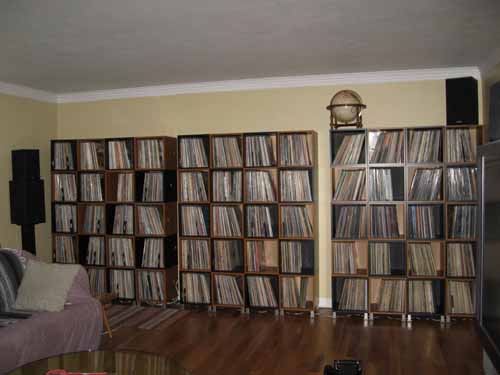
Posted by Leo Enticknap (Member # 534) on 03-07-2008, 01:49 AM:
quote: Brad Miller
I have considered it, but have heard various reports that it is TOO good and picks up every little imperfection in the disc. Plus my LP collection isn't big enough to warrant that kind of money on a player when my current unit sounds great.
I was chatting to someone from the National Sound Archive I met at a conference a couple of years back. They bought one, and he reported exactly the same thing. The laser reads crud in the grooves as if it was part of the signal, and the only way to get round the problem is to operate the machine in a clean air environment and ultrasonically clean the record first. Of course, the latter completely defeats the object of the exercise, i.e. a 'no contact', non-invasive way of copying the signal from the record.
Most of my collection consists of 78s - about 300 in total (you can hear a sample on my website, mainly of political speeches and comic songs from between the wars (though my oldest record is from 1907). I used to use a Goldring Lenco GL78, bought from Ebay for £30. But that died when my landlord sent a safety inspector into my flat to check the wiring, who tried to stand on it to reach a light fitting (he succeeded too, but totally destroyed the turntable in the process). With the insurance money I bought a Vestax BDT2600 and a Shure M78S cartridge. The fine speed adjustment feature is useful, but the belt drive doesn't give as accurate or as consistent a speed as the combination of the idler wheel drive and the fookin' heavy platter deck (it was quite an impressive slab of metal, about 7-8cm thick and weighing five kilos!) on the Goldring. It has a built-in preamp to line level (which can be bypassed), but this applies the RIAA curve and so is useless for playing pre-RIAA 78s. For that I take the phono level output into the mike input of my PC's sound card, and then equalise and normalise using Adobe Audition.
quote: Monte L Fullmer
Then, you'd definitely have to "soap and water" wash your vinyl and let them air dry in the dish drainer.
Fully immersing the record in a saucepan of boiled and filtered water after it has cooled down to lukewarm is my favourite method of record cleaning - no limescale or detergent to clog the grooves. I then dry them by stringing them up in the living room by a rod through the centre hole (so the playing surface isn't touching anything as the record dries).
[ 03-07-2008, 03:02 AM: Message edited by: Leo Enticknap ]
Posted by John Hawkinson (Member # 1135) on 03-08-2008, 08:13 AM:
"The laser reads crud in the grooves as if it was part of the signal, and the only way to get round the problem is to ...clean the record first"
Umm, to me this sounds like a problem for postprocessing. The software associated with the laser should be able to decide what kind of resolution to apply and what represents crud and perform some smoothing. Sure, somebody's gotta tune the algorithm, but it should certainly be doable.
Now, before you jump up-in-arms and say "I want the real audio! Not some modified tinkered thing!" just remember that a turntable cartridge does smoothing too, by the physical nature of the shape of its head and the various adjustable parameters. All of that you should be able to mimic with the software (heck, or even hardware) of the laser.
This is handwavy, I don't have direct experience with laser vinyl systems, but I know something about the problem in the abstract.
--jhawk
Posted by Steve Guttag (Member # 268) on 03-08-2008, 08:27 AM:
With enough software...sure anything is possible. In the case of a record though...think of it as an encode/decode process...how the lathe cut the record versus a needle playing it back...a laser is having to mimick the needle's characteristics and then the software is having to interpret THAT as to what the intended sound is. The record was cut to be played by a particularly shaped stylus...so I don't really buy the "smoothing" part of the arguement. One was made to fit the other...like a punch and die.
Plus...as they say...if you really care about your records, give them a diamond!
Posted by Mark Gulbrandsen (Member # 72) on 03-08-2008, 10:02 AM:
Actually the laser just scans the groove and refflects back to sensors... the laser doesn't actually trace the groovev per say like a stylus would. The fact that it traces the groove is the reason for all the crud in the groove standing out as it does. What ever reflects back to the sensors relects back... it requires exceptional cleanliness. You wouldn't want to listen to 78's on one!
Mark
Posted by Monte L Fullmer (Member # 2797) on 03-15-2008, 09:12 PM:
..a story from Time Magazine for us vinyl junkies:
Article below
- From college dorm rooms to high school sleepovers, an all-but-extinct music medium has been showing up lately. And we don't mean CDs. Vinyl records, especially the full-length LPs that helped define the golden era of rock in the 1960s and '70s, are suddenly cool again. Some of the new fans are baby boomers nostalgic for their youth. But to the surprise and delight of music executives, increasing numbers of the iPod generation are also purchasing turntables (or dusting off Dad's), buying long-playing vinyl records and giving them a spin.
Like the comeback of Puma sneakers or vintage T shirts, vinyl's resurgence has benefited from its retro-rock aura. Many young listeners discovered LPs after they rifled through their parents' collections looking for oldies and found that they liked the warmer sound quality of records, the more elaborate album covers and liner notes that come with them, and the experience of putting one on and sharing it with friends, as opposed to plugging in some earbuds and listening alone. "Bad sound on an iPod has had an impact on a lot of people going back to vinyl," says David MacRunnel, a 15-year-old high school sophomore from Creve Coeur, Mo., who owns more than 1,000 records.
The music industry, hoping to find another revenue source that doesn't easily lend itself to illegal downloads, has happily jumped on the bandwagon. Contemporary artists like the Killers and Ryan Adams have begun issuing their new releases on vinyl in addition to the CD and MP3 formats. As an extra lure, many labels are including coupons for free audio downloads with their vinyl albums so that Generation Y music fans can get the best of both worlds: high-quality sound at home and iPod portability for the road. Also, vinyl's different shapes (hearts, triangles) and eye-catching designs (bright colors, sparkles) are created to appeal to a younger audience. While new records sell for about $14, used LPs go for as little as a penny--perfect for a teenager's budget--or as much as $2,400 for a collectible, autographed copy of Beck's Steve Threw Up.
Vinyl records are just a small scratch on the surface when it comes to total album sales--only about 0.2%, compared to 10% for digital downloads and 89.7% for CDs, according to Nielsen SoundScan--but these numbers may underrepresent the vinyl trend since they don't always include sales at smaller indie shops where vinyl does best. Still, 990,000 vinyl albums were sold in 2007, up 15.4% from the 858,000 units bought in 2006. Mike Dreese, CEO of Newbury Comics, a New England chain of independent music retailers that sells LPs and CDs, says his vinyl sales were up 37% last year, and Patrick Amory, general manager of indie label Matador Records, whose artists include Cat Power and the New Pornographers, claims, "We can't keep up with the demand."
Big players are starting to take notice too. "It's not a significant part of our business, but there is enough there for me to take someone and have half their time devoted to making vinyl a real business," says John Esposito, president and CEO of WEA Corp., the U.S. distribution company of Warner Music Group, which posted a 30% increase in LP sales last year. In October, Amazon.com introduced a vinyl-only store and increased its selection to 150,000 titles across 20 genres. Its biggest sellers? Alternative rock, followed by classic rock albums. "I'm not saying vinyl will become a mainstream format, just like gourmet eating is not going to take over from McDonald's," says Michael Fremer, senior contributing editor at Stereophile. "But there is a growing group of people who are going back to a high-resolution format." Here are some of the reasons they're doing it and why you might want to consider it:
Sound quality LPs generally exhibit a warmer, more nuanced sound than CDs and digital downloads. MP3 files tend to produce tinnier notes, especially if compressed into a lower-resolution format that pares down the sonic information. "Most things sound better on vinyl, even with the crackles and pops and hisses," says MacRunnel, the young Missouri record collector.
Album extras Large album covers with imaginative graphics, pullout photos (some even have full-size posters tucked in the sleeve) and liner notes are a big draw for young fans. "Alternative rock used to have 16-page booklets and album sleeves, but with iTunes there isn't anything collectible to show I own a piece of this artist," says Dreese of Newbury Comics. In a nod to modern technology, albums known as picture discs come with an image of the band or artist printed on the vinyl. "People who are used to CDs see the artwork and the colored vinyl, and they think it's really cool," says Jordan Yates, 15, a Nashville-based vinyl enthusiast. Some LP releases even come with bonus tracks not on the CD version, giving customers added value.
Social experience Crowding around a record player to listen to a new album with friends, discussing the foldout photos, even getting up to flip over a record makes vinyl a more socially interactive way to enjoy music. "As far as a communal experience, like with family and friends, it feels better to listen to vinyl," says Jason Bini, 24, a recent graduate of Fordham University. "It's definitely more social." -
Maybe it's a good thing that the lot of us are lucky to keep our turntables in fully operatable conditions.
I went to a thrift store in my area to see how the vinyl situation looked like and true, there is tons of junk vinyl out there. But, once in a while, a gem stands out amongst the coal: nailed a 4 vinyl German import boxed set in a near mint condition of Brahms Symphonies with vinyl that looks like it never saw a turntable....for 2 bucks.
Posted by David Stambaugh (Member # 1102) on 03-17-2008, 10:34 PM:
I scored a minty fresh copy of "Sgt. Pepper" at a used record store today. Appears to be a 1983 Capitol US reissue, not all that collectible, but it plays like new after a good cleaning on my VPI 16.5. Even the sleeve is mint.
"A splendid time is guaranteed for all" ![[beer]](graemlins/beer.gif)
Posted by Allison Parsons (Member # 2728) on 03-18-2008, 12:14 AM:
quote: Monte L Fullmer
Contemporary artists like the Killers and Ryan Adams have begun issuing their new releases on vinyl in addition to the CD and MP3 formats. As an extra lure, many labels are including coupons for free audio downloads with their vinyl albums
Very true. It's almost uncommon to get in new LP's at the store and this is not included (the new bands, not the nice reissues of the classics). Some of the more limited 'newer' releases come with 7" which are fun. I think I've only taken advantage of the free download once. But I don't own an iPod so I haven't done it since.
quote: Monte L Fullmer
Matador Records, whose artists include Cat Power and the New Pornographers, claims, "We can't keep up with the demand."
One of the more nicer indie labels that put out great quality LP's of their artists. Deluxe packaging, heavy wax + downloads. They don't skimp on the LP packaging. You get what you pay for.
quote: David Stambaugh
to be a 1983 Capitol US reissue
Well, does it have a barcode on it?
Posted by David Stambaugh (Member # 1102) on 03-18-2008, 11:36 AM:
quote: Allison Parsons
does it have a barcode on it?
Nope, no barcode. I figure it's from circa 1983 based on info at this site. The label on my copy looks like this:
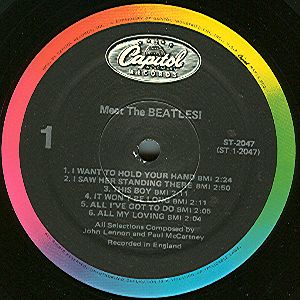
The printing inside the colorband (top and bottom), instead of outside, is supposedly the tipoff that the record was made in 1983 (or later?).
Posted by Monte L Fullmer (Member # 2797) on 03-18-2008, 01:06 PM:
You can also check the matrix numbers - which is printed in the deadwax right in the runout area of the vinyl .. after the matrix nos, there should be a letter with either one or two numbers afterwards. Low number means an original release pressing, high numbers be the '83 pressing.
Monte
Posted by James Westbrook (Member # 3690) on 03-18-2008, 03:03 PM:
My copy of Sgt Pepper had the Apple label on it, if I recall correctly.
Meet The Beatles, which is the album pictured, was released with the Capitol Records label that was in use at the time. The early 80s reissue of Hey Jude was using the same Capitol label.
This may mean...
Apple label - Original or close to...(from 66 forward)
Capitol label - later reissue, likely after John Lennon's death.
I could be wrong.
Posted by Monte L Fullmer (Member # 2797) on 03-18-2008, 11:50 PM:
..course, "Meet the Beatles" was originally released on the "VJ" label - the record company who originally signed up the Beatles to have their songs released here in the States .. in the summer of 1963.
If one has a curious bug driving them insane about record labels, one needs to chek out this vinyl label site on which record label they're wanting to do a search on.
Excellent reading .. -Monte
quote: James Westbrook
My copy of Sgt Pepper had the Apple label on it, if I recall correctly.
...you should pull it out to make sure of the label and the matrix nos, for if it had the Apple label, then it's either an inport, or a late pressing.
Capitol Records SMAS 2653 stereo, is the catalog number for this album.
Apple Records began in 1968 under an agreement with EMI, Capitol Records and the Beatles..
Posted by James Westbrook (Member # 3690) on 03-19-2008, 11:23 AM:
I bought Sgt Pepper in 1975, so I am sure it's a late pressing.
Posted by David Stambaugh (Member # 1102) on 03-19-2008, 11:41 AM:
Vee-Jay Records released Introducing The Beatles on January 10, 1964. There were numerous variations on that one, and many counterfeits exist. Vee-Jay had some financial problems, didn't bother to report all their sales for royalty calculations, and ultimately Capitol Records took control of US distribution for The Beatles.

Ten days later, Capitol Records US released Meet The Beatles!, on January 20, 1964.

Each contains some unique material. They're not the same album.
Posted by Monte L Fullmer (Member # 2797) on 03-20-2008, 03:27 AM:
I have the plain black/silver label of the VJ album "Meet the Beatles" - found it in a thrift store for a buck in decent condition. Sadly, it's the later mono pressing..not the rare 'AD', or stereo pressing.
I also have the Swan label 45rpm release of "Love me do" by the Beatles.
Posted by Leo Enticknap (Member # 534) on 03-20-2008, 06:41 PM:
quote:
Social experience Crowding around a record player to listen to a new album with friends, discussing the foldout photos, even getting up to flip over a record makes vinyl a more socially interactive way to enjoy music.
If it's interactivity they want, it's not vinyl they should be collecting but shellac! I have Bruckner's 8th symphony on 26 sides, with record flips needed every four minutes or so, if that's any use to them!
Another form of listening social interactivity is the screaming of x-rated language when you accidentally drop a shellac record and it shatters into a bazillion little pieces...
Posted by Monte L Fullmer (Member # 2797) on 03-20-2008, 07:04 PM:
Leo - If you think of the screams that would emit when shellac hits the floors, see what happens with cylinder recordings...with this accident ..quite funny, yet sad at the same time ..
For glorious shellac stacking and flipping, try Beecham's "Messiah" 1947 recording on RCA Victor . has 42 sides - set was in two, 11 sleeved album books-weighed over 20 lbs. Then Malcom Sargent did the same piece with Columbia (the MM-666) that garnished 19 shellacs in 1948.
RCA came out with a console in 1942 that was like an automatic turntable that incorporated the "Magic Eye" - a system with two tonearms - one arm to play the one side and the other arm to play the other. When one shellac was finished, it would remove the shellac from the turntable and drop another shellac to continue the performance. Then, when that stack was done, it would reverse the process to play the other side of the stack. I've only seen picts of it, but what a mechanical marvel that RCA put together, along with their "Golden Throat" hi-fi concept before hi-fi was realized for shellac and then onto vinyl when the LP came out.
-Monte
Posted by Bruce McGee (Member # 131) on 03-21-2008, 04:14 PM:
Monte:
I thought Motorola had the Golden Throat idea.
I could be wrong, of course.
I've seen pics of the RCA system that played both sides of the records. Wild.
Posted by Monte L Fullmer (Member # 2797) on 03-21-2008, 11:03 PM:
Hi Bruce/All: -
Here's a topic on RCA's "Golden Throat" Era that you can gander at. Quite interesting to read.
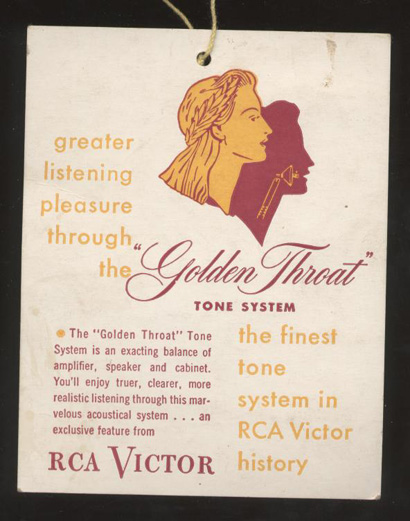
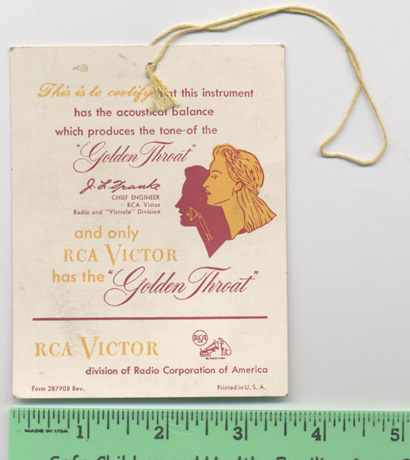
Looks like RCA was almost reverting back to the acoustial era in depending on speaker surroundings and additions to make the reproduction as best as it could be.
-Monte
Posted by Warren Dewey (Member # 3609) on 03-30-2008, 01:44 AM:
Vinyl junkies might bear in mind that one of the toughest things about producing albums was the disc mastering stage. It was really difficult to get vinyl to sound anything like the master tape. Every once in a while the Black Magic would work in your favor and your pressings would sound great, but most of the time the final product was disappointing compared to the master mixes.
Long ago I was on the engineering staff at Capitol Records, working in the tower on Vine St in Hollywood. One of the most fun things to do in down time was to bust into the library and play the 15 ips masters from Sgt Pepper or Abbey Road in the studio through the (tube) Macintosh-driven Altec monitors.
Posted by Monte L Fullmer (Member # 2797) on 03-30-2008, 02:18 AM:
quote: Warren Dewey
but most of the time the final product was disappointing compared to the master mixes
Would that be due to the major steps from lacquer, master, mother, and stamper..plus the many stampers that were plated from the mothers and when that set of stampers begin to wear down from the many pressings?
Then, the RIAA "e.q." thing that had to be just right as well, but one would realize that even if the pressing was just right, the results in the home wasnt because of worn needles, sub-par amplifiers and speakers that didn't match up to the amplifiers.
I've heard that if one plays a fresh lacquer cutting, that it's just like the production master tapes - not like the session masters.
Posted by Warren Dewey (Member # 3609) on 03-30-2008, 08:42 AM:
quote: Monte L Fullmer
Would that be due to the major steps from lacquer, master, mother, and stamper..plus the many stampers that were plated from the mothers and when that set of stampers begin to wear down from the many pressings?
The most difficult transition was from tape to cut lacquer-- the mastering process. It's a big leap from a magnetized pattern on tape, which could reproduce the input signal quite well, to the physical representation formed by a heated stylus cutting a groove-- which was then reproduced by another mechanical linkage and translated back into an ac waveform.
Sometimes there would be problems in the pressing plant. It was pretty easy to tell if the stampers weren't right. But the mastering process was a lot more than just making a copy of the tape. The distortions that occurred during cutting were fairly nonlinear; it was difficult to predict what you would end up with.
A huge problem at the time was dealing with the high frequency rolloff that had to be imposed as you got closer to the center of the disc. There is less real estate per revolution to work with and top end, especially sibilants in vocals and other complex high-frequency information, would not reproduce well.
There was a lot of competition between mastering facilities, all with their own individual brands of voodoo-- Capital had a pretty good setup that used Neumann equipment. My favorite was Doug Sax's Mastering Lab-- he was also the guy that cut a lot of the direct-to-disc albums. Bernie Grundman at A&M did a great job also.
quote: Monte L Fullmer
I've heard that if one plays a fresh lacquer cutting, that it's just like the production master tapes - not like the session masters.
Usually when a project was new and you were working on the "first edition" pressings, you would use the tape of the original studio mixes. After that, the mastering engineer might make a production master based on eq, compression, level changes etc. that were decided on in the original mastering sessions.
Posted by Monte L Fullmer (Member # 2797) on 03-30-2008, 05:09 PM:
quote: Warren Dewey
Capital had a pretty good setup that used Neumann equipment.
...why "Mr. Blue Eyes" - Frank Sinatra .. loved his U47. He wouldn't use any other brand of mic but this one Neumann.
Prob why Deutche Grammophon, when they cut their lacquers, left a lot of territory towards the center of the disc..to prevent this high-end rolloff..
quote: Warren Dewey
My favorite was Doug Sax's Mastering Lab-- he was also the guy that cut a lot of the direct-to-disc albums. Bernie Grundman at A&M did a great job also.
Course, Bernie went solo with his Classic Recordings releases - by somehow gaining permission from major labels for their session masters and recutting lacquers for those 180 and 200g vinyl pressings..
And we can't forget about George Piros and his famous P17 and P23 lathes that he loved to cut the lacquers for the Mercury and Command labels...
Posted by Sean McKinnon (Member # 612) on 03-31-2008, 10:02 AM:
I have a pretty crapper turn table. It is one of those all in one tuner, tape deck, phono jobs from Sanyo that I got for free from the trash (a neighbor set it out on the curb with a FREE sign on it) but the speakers are pretty big they come up to above my belly button and they sound good, it also has aux inputs (RCA) for a cd player, and video. anyways...
I have a very small collection (3 records! one is a double!) of local boston punk/hardcore bands. I have 2 "Blood for Blood" albums. One is a double album with the first record a compilation of thier more popular songs, the second record is a live recording of a benefit show for these two kids that died. I also own a record by the (former) band "Reach The Sky".
My father has a pretty nice collection of all the origional beatles albums, rolling stones albums, led zepplin, beach boys, moody blues, and a ton more origional albums from that era.
Posted by Monte L Fullmer (Member # 2797) on 03-31-2008, 12:37 PM:
..and if your father has the first 7 albums from the "Moodies" (Moody Blues), that's a treat in itself..for I have them too.
...and if one can find the mono copy in great condition of "Days of Future Passed", you've got a rare and collectable vinyl since London/Deram didn't press too many of the mono version.
...plus, Led Zeppelin rocks the world! He's got some great taste there in his "liquorice pizza" collection.
Posted by Damien Taylor (Member # 4255) on 03-31-2008, 05:43 PM:
The best collections to come by are radio station clearances, the albums are rarely crappy, and the jackets are sometimes a bit worn, but the records usually look and sound brand new. Depending on the DJ's and the equipment and care I suppose.
Posted by Monte L Fullmer (Member # 2797) on 03-31-2008, 07:35 PM:
Usually about DJ copies is that they're usually demo copies, or special pressing for non-purchase only (and sometimes, these are also 1st stamper pressings, which collectors sees these as better sounding vinyls being from 1st generation stampers from a 1st generation mother..), which could be borderline collectable material..if only the jackets weren't so badly worn...
Posted by Brad Miller (Member # 2) on 04-01-2008, 02:07 PM:
Has anyone else found that Swiffers do an amazing job of cleaning off static related dust on vinyl? I get the non-scented / non-wet type at Wal-Mart and have been very pleased.
Posted by Philip Wittlief (Member # 1724) on 04-02-2008, 11:42 AM:
What is everyone's opinions suggestions on phono preamps.
Posted by Allison Parsons (Member # 2728) on 04-02-2008, 02:43 PM:
Brad,
Do those Swifters take the dust out of the grooves, or just dust off the top of the LP? I'm going to have to try one of those. Thanks for the tip! ![[thumbsup]](graemlins/thumbsup.gif)
Posted by Damien Taylor (Member # 4255) on 04-02-2008, 05:41 PM:
For preamps, I love my Phono Box II, price meets quality!
Posted by Brad Miller (Member # 2) on 04-03-2008, 12:43 AM:
They don't deep clean the grooves, but they certainly do a great job in cutting the static and static-attracted dust.
Posted by Mike Blakesley (Member # 26) on 04-07-2008, 11:25 AM:
I still have a couple of old "Discwashers" and containers of the original fluid - they do a good job of getting dirt out of the grooves.
An online friend of mine has one of those "record vacuum" doohickeys that he says is the best. I've never seen one of those in person though.
Posted by David Stambaugh (Member # 1102) on 04-07-2008, 11:48 AM:
quote: Philip Wittlief
What is everyone's opinions suggestions on phono preamps.
If you want something inexpensive that does a pretty good job, check out phonopreamps.com. I have a TCC-750 and I gotta say it sounds fine to me for routine listening.
I also have a Cambridge Audio Azur 640 which probably qualifies as low-end of high-end gear. I've compared it to the TCC-750 and I can tell a difference but it's not like crazy different. There's a very long thread at vinylengine.com about various mods for the Cambridge to "improve" its sound.
Last but not least I bought one of these Chinese tube preamps on eBay last week. Haven't received it yet.
Posted by Monte L Fullmer (Member # 2797) on 04-10-2008, 01:07 PM:
quote: Mike Blakesley
has one of those "record vacuum" doohickeys that he says is the best. I've never seen one of those in person though.
He prob has one of these classic VPI vacuum machines.
Posted by David Stambaugh (Member # 1102) on 04-10-2008, 01:43 PM:
I have a VPI HW-16.5 record cleaner. It's awesome. Have had it for about 20 years. I put it on ebay a while back, sold it, but the buyer backed out. Now I'm glad he did.
Posted by David Stambaugh (Member # 1102) on 04-12-2008, 07:47 PM:
A couple of pretty good youtube videos on how vinyl records are mastered and manufactured:
Video 1 - Features Ron Murphy of NSC Records, passed away recently, apparently something of a legend among Detroit DJs.
Video 2 - from Science Channel or something, goes into a little more detail.
Posted by Monte L Fullmer (Member # 2797) on 04-14-2008, 05:43 AM:
And, one has to watch how shellac records are made. This is definitely a classic even though the processes are very close to the same as doing vinyl in our present day.
-Monte
Posted by Leo Enticknap (Member # 534) on 05-06-2008, 05:25 AM:
Video 2 - didn't know that the lacquer cutting masters were nitrocellulose. So nitrate is still used for something, even if it isn't film! I was also a bit surprised that the ladies inspecting the lacquer blanks and the engineer operating the cutting lathe handled the discs with their bare hands (i.e. no gloves).
Incidentally, if you've got £5,000 to spare, Vestax sell a machine which cuts vinyl directly. Not a cheap hobby, though - the blanks are around £20 each, as well. Must be a great training tool for mastering engineers, though.
Posted by Monte L Fullmer (Member # 2797) on 05-13-2008, 02:36 AM:
...definitely needs a vacuum to draw up those vinyl shavings-love how the shavings wrap around the platter weight.
Hmmm...think they missed the part of making the "mother" before the "stamper" - but probably these are limited pressings.
Posted by Mark Gulbrandsen (Member # 72) on 05-14-2008, 04:43 PM:
I had one of those VPI cleaning machines too. It does to an excellent job at claening deep down dirt... but cleaning too often is also not good for the vinyl. I also had a VPI turntable with an air bearing tone arm and all the hoopla. I sold all of it about 5 years ago. I'm glad I did... it was too much hassle. I'm at a point where I'm far more likely to enjoy the music than care about the system it's playing on. Even the car radio is great as long as the music is good!
Mark
Posted by Monte L Fullmer (Member # 2797) on 05-14-2008, 08:17 PM:
True Mark, esp. with that homemade stereo unit (with those tube driven pre-amps) that you made - even makes CD's sound as good as vinyl.
Yea, I bet your LR and your wifes's H3 have got pretty good sound systems by themselves....
Posted by Phil Hill (Member # 371) on 05-14-2008, 08:38 PM:
Mark, I saw this and immediately thought of you and your "high-end" turntable...
Posted by Mark Gulbrandsen (Member # 72) on 05-14-2008, 11:01 PM:
Whoa Phil...
That is way to cool and very rare, I've set "MY E-Bay" to watch that one. While I did sell my VPI stuff off I did keep my Edison Victrola, Edison Cylinder player and 78's and such. That Cacti sharpener would come in handy to use with them. Cacti needles are supposed to play 78's without all the background noise. I once heard a high end CD of Caruso recordings where they placed a Victrola in a famous Italian Opera House and played back his 78's with cactus needles. The effect was erie but none the less very stunning!!
So I'll bid on it and if I don't win I'll still grab some cacti needles this weekend when I'm out in the desert. I could sharpen them by hand and still give it a try... All I need is an Opera House to play back in.
Heck... I wonder what the fines are for stealing cactus needles out on BLM lands???? I'll may do it at noght ![[uhoh]](graemlins/uhoh.gif) .
.
Monte: The LR "radio" is just that. Nothing special.. just the stock LR radio/CD. The H3 system is much better quality although I don't know what it is or who made it. I just thank god neither are by Bose!
Mark
Posted by Aaron Garman (Member # 1653) on 05-16-2008, 09:11 PM:
I've finally done it, and bought me my first turntable. The first few days went great, and I was enjoying the great sound it was outputting. Now though, and I don't know why, the high frequency seems to have an odd distortion, say if you're suppose to hear the word snake and it sounds like sssssssnake. The cart is new, and everything was balanced at the audio shop I picked it up at. Like I said, the unit did not exhibit this on the first couple days. I plan on calling them in the next day or so, but maybe you all might have an idea of what it could be.
AJG
Posted by Brad Miller (Member # 2) on 05-16-2008, 09:46 PM:
You cannot balance a turntable and then move it. It sounds like your counterweight has slipped and you are destroying every record you play in it (and your stylus/cartridge as well) due to the tracking force too high.
Posted by Monte L Fullmer (Member # 2797) on 05-16-2008, 10:12 PM:
..and if you know that your vinyl is destroyed is to rub your hand over the grooves and you feel groove ridges-raised walls of each groove.
Lookswise, things won't be as shiny either due to the raised groove walls from too much stylus pressure. Be more of a duller/blacker nature.
It sucks when that happens - Monte
Posted by Allison Parsons (Member # 2728) on 05-17-2008, 02:39 AM:
Probably a silly question but how do you know when you need a new stylus? And how long of life do most have? I need to take the TT that I pictured in for some minor fixing. I'm 99% the stylus is still good because it sounds fantastic while playing LP's. But can they rust or deteriorate and you're not able to see it with the naked eye, thus ruining your records?
Posted by Damien Taylor (Member # 4255) on 05-17-2008, 09:51 AM:
They die in two main ways, mainly the diamonds go blunt.
The stock standard quoted lifespans are:
1000 hours for Hi-Fi
500 hours max for DJ use.
Your mileage may vary
They can also crack from very rough use, effectively turning them into a nice little knife on your records.
Oh, and if you are really rough the metal cantilever might snap. I mean really rough.
Posted by Mark Gulbrandsen (Member # 72) on 05-17-2008, 11:28 AM:
quote: Allison Parsons
Probably a silly question but how do you know when you need a new stylus?
Thats easy to tell.. its when your clothes look remarkably different fomr everyone elses!
Posted by Aaron Garman (Member # 1653) on 05-18-2008, 04:28 PM:
Thanks for the tips Brad. I did some research on balancing and tracking force, and it looked descent but I decided to fiddle with it. It seems to sound much better than it was sounding, but some records still exhibit the distortion. They are used, and perhaps it's possible it's the record itself, so I'm going to try it out on one of their units at the store and see if it is exhibiting the same problem.
Nevertheless, their is still a lot to be desired from the highs. I'd imagine a better phono preamp could help this? I'm using one in my old Yamaha receiver, and outputting that to my new Onkyo receiver. I was using the Onkyo's built in preamp but it had so little gain, it was awful. This setup exhibits "better" sound, but it is not ideal.
My references have been Billie Jean off of "Thriller", most of Fleetwood Mac's Rumors (which luckily has always sounded lovely), and U2's Joshua Tree. Billie Jean has been the real trouble maker.
AJG
Posted by Monte L Fullmer (Member # 2797) on 05-19-2008, 02:51 AM:
quote: Allison Parsons
but how do you know when you need a new stylus
Here's a good link on the topic of
Stylus wear
Basically with two small lights straight across from each other with the diamond in the middle. If light reflections from each side of the diamond are present, the sides of the diamond have flat surfaces from the wear in the groove and should be replaced. - for both conical and elliptical styli.
Posted by Leo Enticknap (Member # 534) on 05-28-2008, 08:51 AM:
I was at a sound archivists' conference last Friday, which included a presentation from the professor running this project. Most of what they're doing is analysing the content of classical music recordings from the '20s and '30s, but their site does have some interesting stuff on transferring 78s. I'm not sure how much I agree with their assertion that you need £25k-worth of gear to do the job properly. Frankly, some of the transfers I've done with a £200 turntable, a £50 cartridge and Adobe Audition (using the mike input to avoid RIAA preamplification and applying a Blumlein or Westrex curve using Audition's EQ feature) sound very nearly as good, to my ears.
Posted by David Stambaugh (Member # 1102) on 05-28-2008, 11:09 AM:
I've been using a Creative Soundblaster X-Fi Platinum to digitize records. It does a decent job but I suspect it's not all that great. I just ordered an M-Audio 2496 Card to try out. It's supposed to be superior to the Creative consumer-grade stuff.
Posted by David Stambaugh (Member # 1102) on 06-04-2008, 01:39 PM:
Big-box retailer Fred Meyer is carrying records again
Fred Meyer returns to vinyl -- yes, vinyl -- to boost music sales
Posted by jrose June 03, 2008 08:37AM
What can you say about the latest product in the electronics departments in 60 Fred Meyer stores? Well, here's something: Spin the black circle!
The newest piece of merchandise getting display space isn't from the MP3 age but from music's 33 1/3 rpm past. In a sign that vinyl is indeed "staging a comeback," as this week's issue of Rolling Stone reports, Fred Meyer has started to restock LP's and turntables.
Sure, plenty of indie stores in the Northwest have stayed true to what many hi-fi enthusiasts insist is the one true way to listen to music. The web site alt.Portland keeps a decent list of some of the city's vinyl haunts. (Of course, we would add Mississippi Records, an absolute gem of a shop, to the must-visit inventory).
But now that a big-dog department store/supermarket chain like Fred Meyer is stocking the left-for-dead LP, it appears that a bona fide resurrection is underway. Even officials at Kroger, Fred Meyer's parent company, were caught off guard.
"There's a funny little story behind this," said Melinda Merrill, a Fred Meyer spokeswoman. "We got back into vinyl by accident."
Earlier this spring, someone in charge of ordering CD's for Fred Meyer, intended to order a special edition compact disc and DVD set of R.E.M.'s new album "Accelerate." But the employee mistakenly clicked the "LP" option on the electronic order form.
Stacks of the R.E.M. vinyl showed up at the warehouse and were sent out to several stores without question. "We didn't catch the mistake until the records started showing up in the stores," Merrill said.
Puzzled by the boxes of vinyl, most managers sent them back. But a nostalgic few decided to give the retro-product a whirl. A handful of stores figured out ways to display the album, with its skinny 12 inch-by-12 inch packaging.
Twenty copies sold on the first day. After a week, 55 had sold.
Now Fred Meyer is "doing a test" in 60 stores, stocking 20 albums, ranging from a reissue of The Beatles' "Abbey Road" to the new Raconteurs album on premium 180-gram vinyl.
"They're selling really, really well," Merrill said. "The biggest seller is 'Abbey Road.'"
She added that Fred Meyer stores will likely roll out more vinyl releases and different models of turntables, including one with a computer port that allows vinyl-to-MP3 transfer, in coming months.
"I really don't know what to make of it," Merrill said.
This much is clear: It's once again safe to lug those old Who and Bob Marley records out of the basement without looking like a dinosaur to your kids. Play 'em if you've got 'em.
-- Joseph Rose; josephrose@news.oregonian.com
Powered by Infopop Corporation
UBB.classicTM
6.3.1.2