This is topic Disney reveals that its digital masters FADE! in forum The Afterlife at Film-Tech Forum ARCHIVE.
To visit this topic, use this URL:
https://ft-forum.com/ft/cgi-bin/ubb/ultimatebb.cgi?ubb=get_topic;f=12;t=000772
Posted by Frank Angel (Member # 248) on 10-07-2009, 09:32 PM:
According to Disney, it seems that all the digital masters of their old classics which they have remastered and used on previous DVD releases, seem to fade, and dramatically so, while in the famous Disney vault. And we thought only film fades!
The digitally encoded colors on the masters evidently become unstable while in storage. Disney is just now re-releasing SNOW WHITE AND THE SEVEN DWARFS but they had to "fully restore" it. This is frightening....digital libraries all at risk! Mind you, this title was "fully restored" just a short while ago for the 2001 release. So now we know definatively the shelf life of digital masters to be only 8 to 10 years at best.
The Disney artists worked arduously to get the colors absolutely perfect for their 2001 release, then they put the digital master back in the Disney vault and when they took it out to make the current rerelease, just look at how the colors faded -- thus requiring yet another FULL restoration! At least Disney is honest and is not afraid to show the industry the problem. Just to dramatically demonstrate how much work they had to do, Disney shows a frame in split screen in their current TV ad campaign for the new SW&7D BluRay release. Imagine, needing to restore every digital master after only a few years. That's worse than low fade film!
Now this is not necessarily true for all digital masters, it only proves that Disney masters fade or at least Disney is the only studio that seems to be forthright about it, even showing the fade in those split screens in their ads for every DVD release -- here:
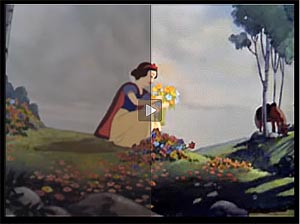
Oh my.
Posted by Alex Edwards (Member # 5413) on 10-07-2009, 09:54 PM:
Good heavens, this is terrible!! I must go out and buy my own copy before the color fades from sitting too long on the shelf!
Posted by Paul Linfesty (Member # 214) on 10-07-2009, 10:03 PM:
Disney has used these dubious split screens before to "demonstrate" how they restored imnages. Back in 1990 they put out the same comparison for Fantasia (restored on FILM). Trouble is, Fantasia looked nowhere as bad the last release they had as they claimed from the left side.
Posted by John Wilson (Member # 269) on 10-07-2009, 11:01 PM:
quote: Paul Linfesty
Disney has used these dubious split screens before to "demonstrate" how they restored images.
I don't know...I think they do a pretty amazing job. Here's another I found.

Posted by Bobby Henderson (Member # 840) on 10-08-2009, 12:12 AM:
quote:
According to Disney, it seems that all the digital masters of their old classics which they have remastered and used on previous DVD releases, seem to fade, and dramatically so, while in the famous Disney vault. And we thought only film fades!
Although the idea is pretty hilarious, Disney created a new master because the old master was derived with older equipment inferior for use related to Blu-ray. It's a pretty common problem in why certain catalog movie titles don't look so good when released on Blu-ray.
Telecine equipment that runs a film print through in real time with a high definition camera recording it can deliver good results on DVD. The limits of standard definition and its muted color gamut range hide many of the flaws in this approach. When that same, dusty old telecine master is reused as a source for Blu-ray release the flaws become more noticeable.
It costs more money to have a film print carefully scanned and post processed with digital intermediate techniques. Obviously Disney chose this modern approach for creating a new master for this home video release of Snow White.
IMHO, any movie released on Blu-ray should be coming from a scan and digital intermediate source. The only exceptions should be movies that were shot electronically instead of shot on film. But even many those "digital" movies receive digital intermediate style treatment to correct color differences between scenes, CGI plates, etc.
Posted by Joe Tommassello (Member # 4632) on 10-08-2009, 11:04 AM:
Frank - I can't tell whether your post is tongue-in-cheek/sarcasm or not. I suppose that means it was well written. In any case I don't believe it's possible. Looks like a marketing ploy. I think everyone who bought SW&T7D this time around should join a class action suit and get their money back.
Posted by Michael Gonzalez (Member # 593) on 10-08-2009, 11:20 AM:
Come on now we all know that all those ones eventually fade into zeros over time. Always been the problem with binary. ![[Roll Eyes]](rolleyes.gif)
Posted by Jesse Skeen (Member # 586) on 10-08-2009, 04:46 PM:
Of all movies, "Harold and Kumar Go To White Castle" was reissued with "REMASTERED!" on the cover. My immediate question- what was so wrong with the previous disc that it needed remastering?
When I worked for Tower Records people would ask me if a particular CD was remastered- I'd ask first what exactly was wrong with the existing edition.
Posted by Evans A Criswell (Member # 381) on 10-29-2009, 01:41 PM:
I'm sorry. I just don't buy this "fading" thing for digital masters at all. It's a string of numbers. If those numbers can be read without error, it doesn't matter how long the tape has been sitting in the vault. The same string of numbers will produce the same image if decoded in the manner intended.
Posted by Bobby Henderson (Member # 840) on 10-29-2009, 06:47 PM:
I think the "remastering" has more to do with other factors.
For instance, there is a GIANT level of varying quality in how movie film negatives, inter-positives are acquired into the digital domain. An old HD telecine machine playing back the movie in real time is going to deliver shitty results compared to the latest film scanning systems where each frame is precisely scanned, but kind of slowly scanned as well. These systems have gone through a few generations of changes just over the last decade.
On top of that, numerous choices can be made in how the movie is digitally acquired -like the resolution setting (2K, 4K, 1080p, 1080i, etc.).
Then there's the digital intermediate that gets tuned and tweaked following the scan -that is if there's any digital intermediate at all. Lots of choices get made there.
Summing it up, one digital master certainly is not the same as the next. Even on the same movie. Just look at the differences on the two Blu-ray versions of The Fifth Element. As technology improves there are good reasons to dig out archival film elements and digitally remaster them again.
Posted by Mark Gulbrandsen (Member # 72) on 10-29-2009, 08:41 PM:
Frank,
Left half of the image looks like D-Cinema MPEG and the right half like D-Cinema JPEG 2000!!
Powered by Infopop Corporation
UBB.classicTM
6.3.1.2