This is topic Panasonic unveils world's first integrated full HD 3D camcorder at CES 2010 in forum The Afterlife at Film-Tech Forum ARCHIVE.
To visit this topic, use this URL:
https://ft-forum.com/ft/cgi-bin/ubb/ultimatebb.cgi?ubb=get_topic;f=12;t=000815
Posted by Jeremy Weigel (Member # 4208) on 01-10-2010, 01:05 AM:
Panasonic HD 3D Video Camera
quote:
PANASONIC UNVEILS WORLD’S FIRST INTEGRATED
FULL HD 3D CAMCORDER AT CES 2010
Available In Fall 2010 - Solid-State Recording System Will Offer
Highly-Efficient Full HD 3D Video Production
LAS VEGAS, NV (January 6, 2010) – Panasonic Corporation (NYSE: PC) will release the world’s first* professional, fully-integrated Full HD 3D camcorder in Fall 2010. The company will begin taking orders in April. Engineering samples of the professional Full HD 3D solid-state camcorder will be exhibited at the Panasonic booth (Las Vegas Convention Center, Main Hall, #9405) at the 2010 International CES in Las Vegas, USA, from January 7-10.
This Full HD 3D camcorder will offer the following core benefits:
Easier to Use
Current 3D systems are large-scale setups in which two cameras are fitted to a rig in parallel, or vertically intersect across a half-mirror. Separate recorders are also required. In Panasonic’s new Full HD 3D camcorder, the lenses, camera head, and a dual Memory Card recorder are integrated into a single, lightweight body. The camcorder also incorporates stereoscopic adjustment controls making it easier to use and operate.
The twin-lens system adopted in the camcorder’s optical section allows the convergence point** to be adjusted. Functions for automatically correcting horizontal and vertical displacement are also provided. Conventional 3D camera systems require these adjustments to be made by means of a PC or an external video processor. This new camcorder, however, will automatically recalibrate without any need for external equipment, allowing immediate 3D image capture.
More Flexible
The solid-state memory file-based recording system offers greater flexibility to produce Full HD 3D videos in more challenging shooting environments. The camcorder is lighter weight and smaller than current 3D rigs, while providing the flexibility of handheld-style shooting. Setup and transportation is simplified, making it ideal for sports, documentary and filmmaking projects.
Solid-State Reliability and Workflow
Right and left Full HD video streams of the twin-lens 3D camcorder can be recorded as files on SDHC/SD Memory Cards, ensuring higher reliability than on other tape, optical disc, HDD or other mechanical-based recording systems. This solid-state, no-moving-parts design will help significantly reduce maintenance costs, and the 3D camcorder will be better able to perform in extreme environments and be more resistant to temperature extremes, shock, and vibration.
And users will enjoy a fast, highly-productive file-based workflow, with instant, random access to recorded content; easy plug-in to both Mac and PC-based platforms; and longer recording capacity.
More Affordable
Using a standardized, fully integrated design, the Full HD 3D camcorder will be offered at a much lower price than traditional 3D rigs. Transportation expenses for this handheld unit will be less and faster setup times reduce labor costs. Using standard, re-recordable SDHC/SD Memory Cards available already everywhere, media costs become almost insignificant.
In addition to a camcorder, Panasonic also plans to offer a professional-quality 3D Full HD LCD monitor for field use as well as a professional HD digital AV mixer for live event production. Panasonic will offer professional production equipment to allow video professionals to efficiently create 3D content, so consumers can enjoy 3D video using Panasonic 3D home theater systems.
Major Specifications (tentative)
- Product Name: Twin-lens Full HD 3D camcorder (made-to-order)
- Suggested Retail Price for Main Unit: $21,000
- Available: Fall 2010 (made to order)
- Power Consumption: Under 19 W (main unit only)
- Weight: Under 3 kg (main unit only)
- Recording Media: SDHC/SD Memory Card
* As an integrated twin-lens Full HD 3D camcorder capable of recording Full HD 3D video to Memory Cards. As of January 2010 (based on our investigation)
** The point at which the left and right-camera lenses’ optical axes converge
Development Background
Movie companies and content producers are eager to produce more 3D content. 3D video is set to become a mainstream motion picture technology. In response to the resurgence of 3D movies, in September 2009, Panasonic proposed the world’s first 3D home theater systems, based around 3D-enabled Blu-ray Disc players and Plasma TVs (announced and exhibited at CEATEC 2008). In February 2009, the company established the Advanced Authoring Center (within Panasonic Hollywood Laboratory) – at which 3D movies are authored for replication on 3D Blu-ray Discs (announced at CES 2009). Currently, producing 3D movies is a painstaking process. Panasonic intends to promote the production of high-quality 3D video content by accelerating the development of 3D video production systems designed to boost production speed and efficiency.
Supplementary data:
Differences from conventional 3D camera systems:
Conventional 3D camera systems are built from two off-the-shelf film or broadcast cameras. Normally, the two cameras are installed horizontally and side by side, with the right and left camera axes approximately 6.5 cm apart – equivalent to the distance between the human eyes – to create binocular parallax. This can be done with small cameras, but broadcast or film cameras cannot be installed side by side since their bodies and lenses are too large. They must be installed vertically using half-mirrors, or mounted on metal frames called rigs, using prisms. This results in a bulky system that must be carefully adjusted to prevent the right and left cameras from going out of alignment before image capture. In addition, if the system is moved, the shock or vibration inevitably puts the cameras out of alignment, making frequent re-adjustment necessary.
In this fully-integrated Full HD 3D camcorder that Panasonic has developed, the two lenses, camera head, and memory card recorder are incorporated into a single compact housing. Unlike large 3D camera systems, this camcorder allows video shooting with greater mobility and from all angles; significantly reducing the time required for set up and adjustments, thereby leaving more time for creative activities.
Convergence Point Adjustment
The convergence point is the point at which the left and right cameras’ optical axes converge to produce 3D images. To take natural-looking 3D video, the convergence point needs to be adjusted to match that of a human’s eyes, whose convergence point varies according to the closeness of the objects being viewed. Panasonic’s new Full HD 3D camcorder adopts newly-developed twin-lens system that realizes convergence point control with its integrated design.
About Panasonic
Panasonic Corporation is a worldwide leader in the development and manufacture of electronic products for a wide range of consumer, business, and industrial needs. Based in Osaka, Japan, the company recorded consolidated net sales of 7.77 trillion yen (US$78.4 billion) for the year ended March 31, 2009. The company's shares are listed on the Tokyo, Osaka, Nagoya and New York (NYSE: PC) stock exchanges. For more information on the company and the Panasonic brand, visit the company's website at http://panasonic.net.
[ 01-20-2010, 10:29 AM: Message edited by: Mike Olpin ]
Posted by Joe Redifer (Member # 3) on 01-10-2010, 01:48 AM:
SD card recording means the bitrate will be very low. Should have gone for at least Compact Flash Extreme 12.
Posted by Julio Roberto (Member # 4976) on 01-10-2010, 03:32 AM:
quote: Joe Redifer
SD card recording means the bitrate will be very low. Should have gone for at least Compact Flash Extreme 12.
Nah, not really anymore.
Panasonic has been selling class 10 SD cards (10MB/s or 80Mb/s, however you fancy ![[Wink]](wink.gif) ) for a while now. Plus there's been SD cards in the market for a while that sustain close to 19MB/s in practice (peak at 22MB/s).
) for a while now. Plus there's been SD cards in the market for a while that sustain close to 19MB/s in practice (peak at 22MB/s).
Let's remember this camera is for TV/video usage rather than "motion pictures". For comparison, DCI 3D cinema image, which is INEFFICIENTLY compressed and needs a bit more bandwidth due to "inefficient" XYZ colorspace and 4:4:4 12bits sampling and slightly higher resolution 1998x1080 (vs HD 1920x1080) peaks at 31MB/s.
DCI is made for "universality" and low computing requirements (other than bandwidth and hard drive space), rather than efficiency. Thus the use of things like 12 bits color depth when many Digital Intermediate scans from film i.e. comes in 10bits (log) form and until not too long ago some digitally shot movies were shot 4:2:2 (star wars, etc).
Posted by Mark Gulbrandsen (Member # 72) on 01-10-2010, 07:14 AM:
Ikegami used to sell a 3-D version of one of it's TV cameras but I'm not sure that is still available. Last one I saw was on E-Bay at around 30 grand used...
Posted by Cameron Glendinning (Member # 3516) on 01-10-2010, 07:59 AM:
Cool porn will never be the same.
Posted by Julio Roberto (Member # 4976) on 01-10-2010, 09:18 AM:
Toshiba had one too (I have one), albeit VHS-C.

Also Canon made a couple of dual-lenses for one of their camcorders (literally a couple, I think only 3 units were ever sold).
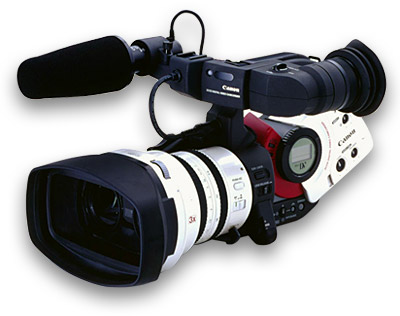
But none of these, including the Ikegami, were HD. Panasonic can indeed claim to have the first "real" (mass produced) full HD-per-eye integrated camcorder.
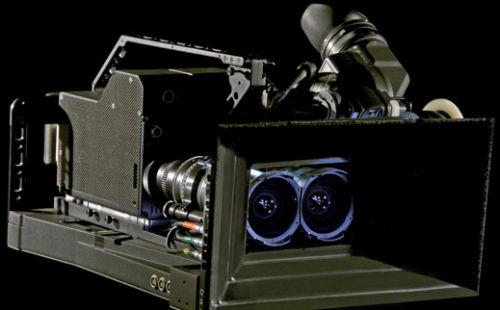
But Cameron financed the building of hacked ones (custom altered Sony's sticked together) that were also full HD per eye many years ago, which he used to shoot Ghost of the Abyss with.
Posted by Joe Redifer (Member # 3) on 01-10-2010, 10:24 AM:
Julio, 80mbps is too slow. Panasonic's P2 cards do over 100mbps and they are too slow. Remember, we are capturing video, not playing it back. Each frame must be its own individual entity which cannot happen if it is captured in MPEG4 or similar form. When it is captured as MPEG4 or some wimpy variety thereof, the video is destroyed before it can be edited because only the differences between the frames are stored. Very cheesy. With two independent "full HD" (god I hate that term) streams, one would need at least 200mbps to adequately capture it all and keep it in a non-destructive and easily editable form.
I'm pretty sure DCI exceeds 31mbps, especially with sound.
Posted by Mark Gulbrandsen (Member # 72) on 01-10-2010, 12:19 PM:
The Iki looked more like Cameron's camera... two stuck together but it had one central double lens assembly... Cameron's camera adjusts the occular distance when you focus it.
Ikegami has gotten completely away from tape based H-D systems all together. Ikegami's H-D ENG camera recorder combos record on special flash media cards at 100mbps on a per frame type of system at this point in time. Higher bitrate ability is anticipated and forthcomming fopr progressive scan type systems.
Mark
Posted by Julio Roberto (Member # 4976) on 01-10-2010, 01:36 PM:
quote: Joe Redifer
Julio, 80mbps is too slow. Panasonic's P2 cards do over 100mbps and they are too slow.
Well, as I said, current SD cards in the market, like the 8GB SanDisk Extreme III, can do 152Mb/s sustained (240Mb/s peak).
quote: Joe Redifer
Remember, we are capturing video, not playing it back. Each frame must be its own individual entity which cannot happen if it is captured in MPEG4 or similar form. When it is captured as MPEG4 or some wimpy variety thereof, the video is destroyed before it can be edited because only the differences between the frames are stored. Very cheesy.
Well, while ideally each frame should have its own independent space if you have the bandwidth and don't mind the storage waste, this doesn't (necessarily) "destroy" the video or anything like that. Simply makes the editing a lot more computer intensive to do natively and limits a bit your options to do native-compressed editing. But if you are editing lossless or transcoding the final result anyway (say to blu-ray, another HD format for broadcast, etc), then ...
quote: Joe Redifer
With two independent "full HD" (god I hate that term) streams, one would need at least 200mbps to adequately capture it all and keep it in a non-destructive and easily editable form.
Well, if you insist in intraframe compression only, and don't even want to use the redundancies between a stereo frame pair (left/right pair), I'd say a bit less is fine nowadays. Even if P2 is doing 100Mb/s, it's only because DVCPRO is NOT the best intraframe-only codec available today.
quote: Joe Redifer
I'm pretty sure DCI exceeds 31mbps, especially with sound.
As I said, DCI is 31MBps (Uppercase "B") for the image. Quoting myself:
quote:
For comparison, DCI 3D cinema image ... ... peaks at 31MB/s.
The sound is additional.
Which is the same as saying 250Mb/s. Remember there are in the market TODAY SD cards that obtain 240Mb/s peak, even if they fall a bit short in sustained recording.
So yeah. SD cards are "up there" already. Of course, newer and faster ones are bound to appear anytime soon in time for Panasonic's 3D camera
And those cameras will use AVC-ULTRA encoding, so figure they need under 80Mbs (10MB/s) to do fine with two HD streams at up to 30fps, even if their codec tops at above 200Mbs. That's totally surpassed with plenty of SD cards in the market.
http://blog.panasonic-broadcast.com/2009/04/avc-ultra/
Posted by Bobby Henderson (Member # 840) on 01-10-2010, 05:40 PM:
Simply put, Joe is talking about professional standards of videography. Professional standards dictate ways to deliver a full UNCOMPRESSSED video stream via outputs like HD-SDI.
If you are recording some severely compressed stream of video onto a mere, very bandwidth limited, flash memory card you are effectively delivering a consumer quality camcorder. Not professional quality.
Posted by Joe Redifer (Member # 3) on 01-10-2010, 05:48 PM:
Julio, your standards must be very low.
quote: Julio Roberto
Well, as I said, current SD cards in the market, like the 8GB SanDisk Extreme III, can do 152Mb/s sustained (240Mb/s peak).
No, you did not say that. It must be able to WRITE that fast sustained, not read. I have yet to see any flash media type that can write as fast as it can read. I have an Extreme 3 card and it maxes out around 30mbps. So I guess "Extreme 3" means jack shit if there are different versions of extremity.
quote: Julio Roberto
As I said, DCI is 31MBps (Uppercase "B") for the image.
Then why do you even compare with DCI? DCI wipes the floor with any home format. It is compressed for quality. I'll take quality over space savings any day of the week... twice on Sundays! I don't consider bigger codecs a waste of space at all. 4:4:4 is da phiggidy phat bomb.
AVC Ultra may be better than normal AVC, but each frame still does not exist independently. That is fine for a delivery format but not for a capture format.
Posted by Ian Parfrey (Member # 5122) on 01-10-2010, 05:51 PM:
Just shoot on 2 Arri 416's and be done with it.
Better quality, better redundancy, better legacy.
Posted by Julio Roberto (Member # 4976) on 01-10-2010, 09:10 PM:
quote: Joe Redifer
No, you did not say that. It must be able to WRITE that fast sustained, not read.
Of course, Joe, I meant indeed WRITE at those SUSTAINED speeds. Read performance is EVEN FASTER (but not by much). It was MEASURED AND TESTED, not by me, but by a guy online that is a pro.
Here is an example:
http://www.robgalbraith.com/bins/camera_multi_page.asp?cid=6007-9597
quote: Bobby Henderson
Simply put, Joe is talking about professional standards of videography. Professional standards dictate ways to deliver a full UNCOMPRESSSED video stream via outputs like HD-SDI.
Well, Bobby, sorry to burst the bubble but virtually no video camera used in adquisition, especially the models most used to SHOOT THE MOVIES YOU SEE IN CINEMAS, records uncompressed, much less to HD-SDI, which is very limited.
They record stuff like COMPRESSED 4K RAW or any other variation. Some are starting to show up that record COMPRESSED 4:4:4 HD.
Typically, everybody in TV records COMPRESSED 4:2:2 HD. More and more using interframe compressed. And these are PROFESSIONALS. Uncompressed recording is basically only used to transfer stuff from one place to another or sometimes for editing. But even then, lossless compression is mostly used instead.
quote: Joe Redifer
AVC Ultra may be better than normal AVC, but each frame still does not exist independently. That is fine for a delivery format but not for a capture format.
Joe: AVC has an intraframe-only compression mode were each frame indeed "lives independently", in both, 4:2:2 and 4:4:4. And a lossless one too, BTW. AVC-ULTRA even has a 12 bits 4:4:4 mode.
Sorry to refer to wikipedia, but it's fast and convinient. If you have doubts, you can find the specs yourself I'm sure.
http://en.wikipedia.org/wiki/H.264/MPEG-4_AVC
You guys are too fixated, and wrongly IMHO, with the following:
-Somehow, capturing with interframe redundancies removed MUST destroy the quality. This is NOT true at all. Only if the bandwidth is too small to produce a decent frame individually, can some scene suffer. A 100Mbps AVC-ULTRA interframe compressed stream is ALWAYS *vastly* superior in quality to a 100Mbps intraframe only codec. Agree?
-An interframe compressed captured video can not be "professional". This notion comes from the inability to flexibly edit it natively. But if you are editing it, you don't have to (or usually want to) do it natively if you are a true professional. Nobody hands over a final product in DVCPRO 100Mbps on a P2 card. You have to transcode just about ALL capture formats into something the network/cinema/DVD/blu-ray will take or the movie industry wants. As a result, 99% of the time you transcode to lossless or your favorite lossy editing format and transcode again to your final format. Tell me a workflow that is NOT recompresses from adquisition to DELIVERY and that, according to you, is better in quality to say 80mbps AVC-intra. I won't even ask for one that is uncompressed "HD-SDI" because I don't think there is any used beyond especial effects units in video studios.
Intra adquisition stopped being a "absolute professional requirement" when professionals stopped using the DV format. Now its a DESIRABLE feature, so you don't have to transcode and can keep the original edit in the original form, but this form is at most 4:2:2 XDCAM or some "crap".
But if you don't think that Panasonic's new $23.000 3-D camera is suitable for "for professional use", or the 34Mbps Canon 5D Mark II (which has been used in plenty of TV commercials and even TV programs and indie motion pictures), well, suit yourself. But you better start finding some FAST, really FAT memory format to put all those MBPS and hope they aren't too expensive if you want to become "video" professionals
Posted by Bobby Henderson (Member # 840) on 01-10-2010, 09:25 PM:
The Canon EOS 7D (as well as the Canon EOS 5D Mark II) records HD video only in MPEG-4 AVC format at a fairly high ratio of video compression.
According to specs posted at dpreview.com the data rate for the 7D's movie mode is constant at roughly 5.5 MB second in both 1080p and 720p modes, that works out to 44 million bits per second. That's a bit better than you see with the video bit rates on most Blu-ray movies, but far below the bit rate levels used by professional HDTV cameras.
Video capable DSLR cameras would be much better if they provided a way to output uncompressed video or mildly compressed video via standard HD-SDI outputs. Obviously that would mean recording the video externally to some kind of RAID setup. But a lot of that kind of thing already happens anyway.
Posted by Julio Roberto (Member # 4976) on 01-10-2010, 10:05 PM:
Uncompressed HD-SDI origination only happens in a couple of situations. Well, mostly.
One is when the camera in use is REALLY CHEAP compared with alternatives, but the quality is seriously compromised by the recording format. Then you "hack" the stuff. But you don't shoot a "newscast" piece, or a sport events that way. At least not 99.99% of the time.
The second situation where you such set ups are common is in special effects work. For technical reasons.
The third would be some Live TV show in a studio. Goes straight from the camera to the editing to the air. It is compressed to store in tape, though.
And little more.
Originating formats are almost always compressed. And the "higher the quality", the "more compressed", as it must fit somewhere *fast* and flash memory is nor *that* cheap nor *that* fast, although it's getting there quickly.
RED one, the camera most used for digital adquisition for TV shows and movies today, i.e., until recently used ONLY 28MBS and it recorded RAW 4K 4:4:4 12 bits up to 30fps!!!!
quote:
Two variants were offered previously, one with a maximum data rate of 28 MB/s (224 megabits), and one with a maximum data rate of 36 MB/s (288 megabits), but the camera was recently updated to record with an additional data rate option of 42 MB/s (336 megabits).
This is the camera used to shoot many of the movies you see on the big screen as well as the series you see on the TV today.
And you are complaining that the new Panasonic 3D camera, which may top at 25MB/s (guessing) but only does HD 4:2:2 8 bits (I think) "60fps" (but using stereo-pair compression, I'm guessing from the announcements), is "not professional by any means" because it uses SD memory cards ![[Roll Eyes]](rolleyes.gif)
BTW, I guess you knew that the P2 cards used by "professionals" were nothing but 4 SD memory cards inside in a RAID configuration ![[Big Grin]](biggrin.gif) Since then, some SD cards have increased in performance quite a bit. And AVC, even intra mode, kicks the butt off DVCPRO, reducing the need for bandwidth while KEEPING THE SAME QUALITY ...
Since then, some SD cards have increased in performance quite a bit. And AVC, even intra mode, kicks the butt off DVCPRO, reducing the need for bandwidth while KEEPING THE SAME QUALITY ...
Posted by Joe Redifer (Member # 3) on 01-11-2010, 12:05 AM:
I think you might be forgetting about Canon's HDV camcorders. The XLH1 and the model below it I believe can both output uncompressed HD and SD SDI. It can't record to that format since it can only record to a videotape, but it can output it live to an external recorder.
You also might be forgetting that transcoding takes a lot of extra time. Time is money. It must be converted to Uncompressed or Apple Pro Res 4444. Either format takes up a FUCK TON of space, more than a nice high bit rate intraframe codec would. No biggie, though. Now you can edit. BUT WAIT! Uncompressed video or even Apple Pro Res both require insanely hefty CPUs to play back in real time compared to a nice, high bit rate intraframe codec, especially when you start to add effects and anything more complicated than a straight cut. You'll need to render before you can see the result. Your work flow will be slower even if you have a screaming CPU. And yes, I edit directly in DVCPro HD. I deliver to whatever format I deliver to, but the point is that it goes straight from DCVPro HD to that format. It doesn't go somewhere else first. This is why I chose DVCPro HD over the super wimpy HDV. I had to edit using an HDV source before and I hated it. I do this kind of shit for a living. If the camera allows intraframe recording then that is great, so long as each eye records higher than 100mbps like DVCPro HD. It had better offer that option, being $21,000 and all. You never answered my question about Extreme 3 and how it doesn't mean anything if there are different speeds of Extreme 3.
Why are we even talking about this, anyway? Why the comparison to DCI? DCI is 2048 pixels wide, by the way. Watch the file that is currently being offered on Film-Tech's front page... 2048x1080, 24-bit 7.1 channel audio. Thems the shit!
Posted by Julio Roberto (Member # 4976) on 01-11-2010, 10:35 AM:
quote: Joe Redifer
think you might be forgetting about Canon's HDV camcorders. The XLH1 and the model below it I believe can both output uncompressed HD and SD SDI
No. I never said there aren't cameras that can output full HD uncompressed. On the contrary, there are lots and lots of all price ranges. But "NOBODY" (well, I said 99.9% of the time), uses it for adquisition since, well, it basically can't be recorded on anything portable efficiently and cheaply.
Now, that doesn't mean that it can't be recorded at all or that it must be too expensive. It just means, as I said, that 99.9% of the people would NEVER use uncompressed HD-SDI for adquisition except in the cases I mentioned (hacks, special fx work, live studio).
quote: Joe Redifer
Either format takes up a FUCK TON of space, more than a nice high bit rate intraframe codec would
So why are we even mentioning uncompressed? Oh, yeah, it was Bobby who mentioned it ...
quote: Joe Redifer
You also might be forgetting that transcoding takes a lot of extra time. Time is money. It must be converted to Uncompressed or Apple Pro Res 4444.
I'm not forgetting anything. This is the way most professional people editing in a Mac would deal with HD formats that don't originated in Xdcam or DVCPro. So I'll say that's being done 40% of the time by PROFESSIONALS out there. You've probably have had to transcode to DVCPro or Prores a number of times yourself.
I said it wasn't a DESIRABLE choice, but that it IS a choice and that quality is preserved since the delivery format is almost never DVCPro and transcoding has to happen anyway. You could just save the edit list and the original material and re-produce the edit if you need it later w/o saving the edit native or uncompressed.
quote: Joe Redifer
Uncompressed video or even Apple Pro Res both require insanely hefty CPUs to play back in real time compared to a nice, high bit rate intraframe codec, especially when you start to add effects and anything more complicated than a straight cut.
Ah, uhhhh, even if we consider "Apple" to be like the pinnacle of "professionals", using uncompressed video doesn't take that much CPU usage (obviously, there is no decompression going on at all), only high bandwidth. I did say that few people use uncompressed when they could use lossless compression or editing-friendly visually lossless compression, right?
quote: Joe Redifer
And yes, I edit directly in DVCPro HD
There you go. As I said, "real pros" don't use stuff that starts with DV anymore
quote: Joe Redifer
This is why I chose DVCPro HD over the super wimpy HDV. I had to edit using an HDV source before and I hated it.
Good for ya, although few pros using DVCPro anymore , and even fewer (or none) using the domestic HDV, which sucks for just about anything and no professional has ever/will ever use it if there is an option.
quote: Joe Redifer
You never answered my question about Extreme 3 and how it doesn't mean anything if there are different speeds of Extreme 3.
I didn't see that question. Extreme 3 is not a speed or anything. Just a marketing term by a particular manufacturer, I guess. When it comes to memory cards, whether the "professional" CF or the now-becoming-professional SD, unfortunately, speed ratings don't mean (almost) squat.
You can find a Class 6 SD card that can WRITE at peak anywhere from 5.5MBps to +45MBps (360Mbps). The only requirement to get the Class 6 name is that it can write at a minimun of 6MBps based on "the best fragmented state where no memory unit is occupied":
http://www.sdcard.org/developers/tech/speed_class/
Even the new Class 10 name doesn't mean sh*t. Same with the speed rating (66x, 133x, 233x, 300x etc). Some class 4 are faster writers than some class 6. Some class 6 should be called "class 20" if such a thing existed and are superior in sustained writing speed to many class 10.
Just a mess. You just have to buy one and test it, I'm afraid.
http://en.wikipedia.org/wiki/Secure_Digital
quote:
Why the comparison to DCI? DCI is 2048 pixels wide, by the way. Watch the file that is currently being offered on Film-Tech's front page... 2048x1080, 24-bit 7.1 channel audio. Thems the shit!
DCI is 1996x1080 for 1.85 content and 2048x858 for Scope ratio 2.35. Audio can be anything up to 16 channels 24bits 96khz ...
The comparison is because, considering DCI is the "top quality digital format you can see video" (outside the labs and editing suites), and in spite of the "higher resolution" 1996x1080 vs 1920x1080 in HD, the higher bit depth 12 bits vs 8 bits in HD, the inneficient (but universal) color space at full resolution XYZ 4:4:4 vs YCC 4:2:2, it only uses 31MBps for the image maximun (often much less in the films sent to the theatres) AND it uses an intraframe-only codec like the ones you like ![[Razz]](tongue.gif)
The truth is I just mentioned DCI to be a bit on-topic and avoid being kicked out by the moderators.
BTW, I'm joking about DVCpro. It's was great format for adquisition AND editing while it lasted. Now, if your CPU is up to it, AVC-ultra (intra) at 100Mbps is better than DVCPro HD at 100Mbps. So AVC-ultra can be about the same quality and editing convenience of intra-only compression at ~80Mbps, requiring less space and slower memory (cards). The only downside: more CPU. Start saving for a new Mac
But it's not sh*t or "unprofessional" or "destroys quality" at all. It's just the future, so we better get used to it and embrace it ...
quote: Joe Redifer
Why are we even talking about this, anyway?
I don't know. I think it started when you said that Panasonic's (the makers of DVCPro you like so much) new ~$21.000 3D video camera was not professional and was going to be sh*t quality because it recorded AVC-ultra onto SD cards and I said that not necessarily, as SD cards can be fast enough and AVC-ultra is da bomb and the way to the future ![[thumbsup]](graemlins/thumbsup.gif)
Posted by Joe Redifer (Member # 3) on 01-11-2010, 04:44 PM:
quote: Julio Roberto
As I said, "real pros" don't use stuff that starts with DV anymore
Fuck your mom, pal.
quote: Julio Roberto
I think it started when you said that Panasonic's (the makers of DVCPro you like so much) new ~$21.000 3D video camera was not professional and was going to be sh*t quality because it recorded AVC-ultra onto SD cards and I said that not necessarily, as SD cards can be fast enough and AVC-ultra is da bomb and the way to the future
Hey idiot, you're putting words into my mouth. You are deliberately trying to piss me off.
Where is the IGNORE option on Film-Tech? I don't want to see any more of this guy's posts. EDIT: Found it, though it doesn't seem to work. Damn 1990 forum software!
Posted by Julio Roberto (Member # 4976) on 01-11-2010, 04:50 PM:
quote: Joe Redifer
Fuck your mom, pal.
![[Eek!]](eek.gif)
I guess I forgot the smiley face?
quote: Joe Redifer
Hey idiot, you're putting words into my mouth.
Sorry, I thought you asked. My bad. Not trying to piss you off.
![[sex]](graemlins/sex.gif)
quote:
Where is the IGNORE option on Film-Tech? I don't want to see any more of this guy's posts. EDIT: Found it, though it doesn't seem to work. Damn 1990 forum software!
Sorry to hear!! I'll try help not answering/chatting on your posts then (after this one, of course).
Hope no hard feelings, at least none on my side!
I'll keep enjoying your (almost) always fun posts!!!
![[beer]](graemlins/beer.gif)
Posted by Julio Roberto (Member # 4976) on 01-20-2010, 08:41 AM:
Thought this could be relevant to the thread:¨
PANASONIC INTRODUCES NEW 64 GB* AND 48 GB* SDXC MEMORY CARDS, AVAILABLE GLOBALLY IN FEBRUARY 2010
quote:
LAS VEGAS, NV (January 6, 2010) – Panasonic today announced the availability of the company’s first 64 GB* and 48 GB* SDXC Memory Cards. The new SDXC Memory Cards, the RP-SDW64GE1K (64 GB) and RP-SDW48GE1K (48 GB) are Panasonic’s largest-sized GOLD cards with Class 10 speed specification. Featuring new advanced Super Intelligent Controller helps to improve the reliability of the card and extend its lifetime. The new 64 GB and 48 GB SDXC Memory Cards will be globally introduced in February 2010 with suggested retail prices of $599.95 and $449.95, respectively.
SDXC is the next generation SD Memory Card, a new standard for storing data more than 32 GB and up to 2 terabytes. The Panasonic 64 GB SDXC Memory Card features a massive 64 GB of capacity, making it ideal for recording AVCHD High Definition video, high-resolution, or even RAW still photos. When used with Panasonic’s newly-released camcorders, such as the Panasonic HDC-TM55, the 64 GB SDXC Memory Card can record up to 8 hours and 30 minutes of video, while recording in the highest video quality in HA mode. Or when recording in 1920 x 1080i in HE mode, the SDXC Memory Card can hold approximately 27 hours and 30 minutes of video. The 48 GB SDXC Memory Card will have nearly the same capacity as a dual-layer Blu-ray Disc, and can hold 6 hours and 20 minutes of HD video content recorded in HA mode and 20 hours and 20 minutes when recorded in HE mode.
With the Class 10 speed specification and maximum data transfer speed of up to 22MB/s (176Mb/s), the new Panasonic SDXC Memory Cards allows users to enjoy superb performance when using with an HD camcorder or a digital interchangeable lens camera, such as the Panasonic LUMIX DMC-GF1, for high-speed burst shooting when taking still photos.
Posted by John Hawkinson (Member # 1135) on 01-20-2010, 09:01 AM:
quote:
RED one, the camera most used for digital adquisition for TV shows and movies today, i.e., until recently used ONLY 28MBS and it recorded RAW 4K 4:4:4 12 bits up to 30fps!!!!
I don't think, among professionals, that the RED is most-used. Compare the Varicam, the Genesis, the D21, the F35, F23, F900(R), etc. RED is new and up-and-coming and and low-cost and is being used by a lot of people, but really saw zero major feature use prior to Knowing, District 9, and The Lovely Bones (err, Soderbergh had a feature in there too...The Girlfriend Experience? But we're still talking a handful). Certainly more in TV, but not beating out the above established professional cameras.
That said, of course, it's absolutely true that HDCAM SR and D5 are compressed formats, and that recording uncompressed dual HD-SDI streams is extremely rare.
--jhawk
Posted by Julio Roberto (Member # 4976) on 01-20-2010, 09:57 AM:
Yeah, you are right. I shouldn't have said it was the most used for movies/TV drama. It's one of the most used.
It has been used in other films like:
Tom Hanks's Angels and Demons, The final, Jumper, Bloody Valentine, Book of Eli, Gamer, Beyond reasonable doubt, Anti-Christ, Van Diemens, Night at the museum 2, The girlfriend experience, Che, Easier with Practice, The Informant, Labor Pains, Splinterhead, Woodshop, Manure, and many more, including overseas like Achchamundu! Achchamundu! in India and many large TV shows, like Sanctuary, Supernatural, Southland, ER, etc.
As you said, many other models are used. This one is "new" but up-and-coming fast. And probably even more with the new models just-about-to-hit-the-market-now, since they are even cheaper and better (their new sensors are testing above 12 real, solid f-stops at nice ISO's low/noise!!! )
Adquisition is almost always compressed, outside special needs. Compression is usually intra-frame only out of convenience for editing and low CPU requirement for in-camera encoding, but I have the feeling inter-frame codecs are going to be used more in the future, as resolution keeps increasing (new cameras being 9K-bayer and even above) and memory is still expensive and not all that fast and CPU keeps getting faster and use less energy.
Specially with 3-D, a two-frame gop (for the stereo pair) makes sense as editing always happens in a two-frame boundary. You are not going to cut-edit one eye independent of the other, are you?
Posted by Julio Roberto (Member # 4976) on 02-08-2010, 07:43 PM:
I thought this was also relevant to the discussion. It talks about how the upcoming Adobe Premiere CS5 is capable of edit native AVCHD quite effortlessly helped by the GPU.
http://tv.adobe.com/watch/davtechtable/sneak-peek-at-the-new-adobe-mercury-playback-engine-technology/
Powered by Infopop Corporation
UBB.classicTM
6.3.1.2