This is topic The Jazz Singer (1927 version). in forum The Afterlife at Film-Tech Forum ARCHIVE.
To visit this topic, use this URL:
https://ft-forum.com/ft/cgi-bin/ubb/ultimatebb.cgi?ubb=get_topic;f=12;t=001095
Posted by Stephen Furley (Member # 1277) on 07-26-2015, 03:50 PM:
Bought a copy of the, I think quite recently released, DVD today. I'm quite impressed by the quality of the sound on it for something of that vintage. Says that it's taken from the disks rather than the later optical transfer.
Posted by Jim Cassedy (Member # 4115) on 07-26-2015, 06:37 PM:
About 5 or 6 years ago, WB released a boxed set with The Jazz Singer and
a number of the Vitaphone shorts, all of them with sound tracks pulled from
the original Vitaphone recordings. And yes, the sound is quite impressive.
But you've got to remember- - by 1927, disk recording technology had been
around for almost 50 years, and so, was far more advanced than the early
film recording processes of the time, which were not quite as perfected yet.
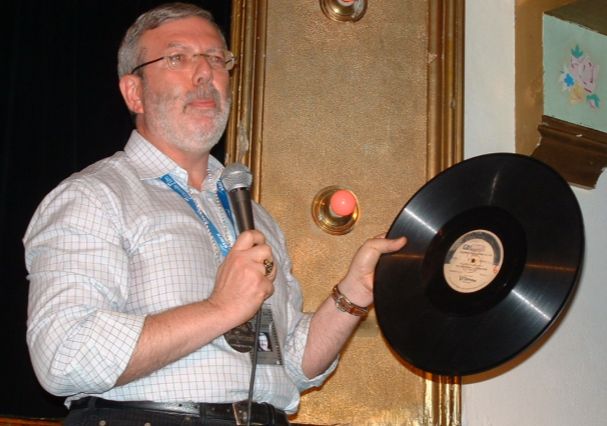
Writer & Film Critic Leonard Maltin Holds Up A Vitaphone Disk From
My Collection During a "Vitaphone Shorts" Program Several Years Ago
Posted by Leo Enticknap (Member # 534) on 07-26-2015, 07:25 PM:
![[Eek!]](eek.gif)
Fingerprint grease all over the groove ... all it would take is for his hand to slip ... that photo could be subtitled "How not to handle a record." I'm probably being OCD and that disc is just one of a dozen surviving copies, and not the one in the best condition, but even then if I were an archivist for the institution that preserved this record, I would be mightily p!ssed at that photo entering the public domain.
Also worth noting that there were some important differences in Vitaphone discs from consumer ones which made them sound a lot better. The groove pitch was wider, and they were made from a much softer mix (more shellac, less abrasive filler). The soft steel needles were only supposed to be used for one side before replacement (although there are numerous reports in the trade press of less reputable theaters using them two or three times), and the records had a designed lifetime of only 24 passes.
As SOD was winding down, Warners/Vitaphone tried to cut costs by subcontracting their record pressing to RCA Victor in 1931, who reduced the size to 12", reduced the groove pitch and used an early vinyl compound as the substrate. They didn't sound anything like as good, with a worse s/n and more surface noise. The final US SOD theater installations were done with a contract that guaranteed record availability until 1934, so Warners had to find a way to keep supplying the small number of screens that stuck it out until the end (not a dissimilar situation to the remaining 35mm installations now).
So when they're remastered carefully and sensitively, Vitaphone titles can sound seriously good.
Posted by Jim Cassedy (Member # 4115) on 07-26-2015, 08:53 PM:
Leo- Relax- - take a deep breath:
That's one of my "show & tell" disks - the surface is not in the best shape,
and it actually has a crack in it. It's the "pass around" disk used for
show & tell, such as you see here. I never would have let them treat a
'good' disk this way, and I'm pretty sure Mr Maltin, who has a great
knowledge and respect for these things, would have enough sense not to
handle handle it as you see in the photo had I not assured him it was OK.
That disk had been passed around classrooms & lecture halls and mis-
handled by tens of dozens of people long before Mr Maltin got his hands
on it. I even caught the cat sleeping on it once.
I can't recall the title of the film that particular disk is for, and while all
Vitaphone disks are 'rare', it is a title for which other disks, in much
better condition, are known to exist, and for which a restoration had already
been done. When I acquired a quantity of Vitaphone disks about 10 years
ago, I contacted The Vitaphone Project people, & they were not interested
in this particular disk at all for the reasons I stated in my previous sentence.
So, yes, you are 100% correct that this photo is a perfect illustration of
"how not to handle a Vitaphone disk", but in this case, it's OK! Trust me!
Posted by Leo Enticknap (Member # 534) on 07-27-2015, 10:30 AM:
I guessed, and, as stated above, was being a bit OCD. I'm just a bit leery of photos like that doing the rounds, because if someone ever does (for example) find a record of the missing reel of audio from Lights of New York in a thrift store, remembers seeing that photo, thinks it's OK to pick it up that way and then their hand slips ... that's all.
Posted by Paul Dorobialski (Member # 7536) on 10-23-2015, 07:13 PM:
I found some Vitaphone discs while cleaning out a former theatre sound techs house these past years. I found some that were from Universal studios & some Warners. 2 of them were 'test discs' one for Right machine & the other for Left machine. I played one of them at Bob Paquette's Microphone Museum & all they had were 1000 cycle tone for turntable audio balance. I didn't play the one from Universal.
Posted by Leo Enticknap (Member # 534) on 10-23-2015, 11:08 PM:
The test record would probably be very useful for someone setting up a turntable for remastering playback. I'm guessing that the Vitaphone Project guys have some. Microgroove setup test records are easy to get hold of; coarsegroove ones much less so.
Posted by Steve Matz (Member # 1890) on 10-26-2015, 10:40 PM:
I've posted this Photo before; The Original Vitaphone System I believe ![[beer]](graemlins/beer.gif)
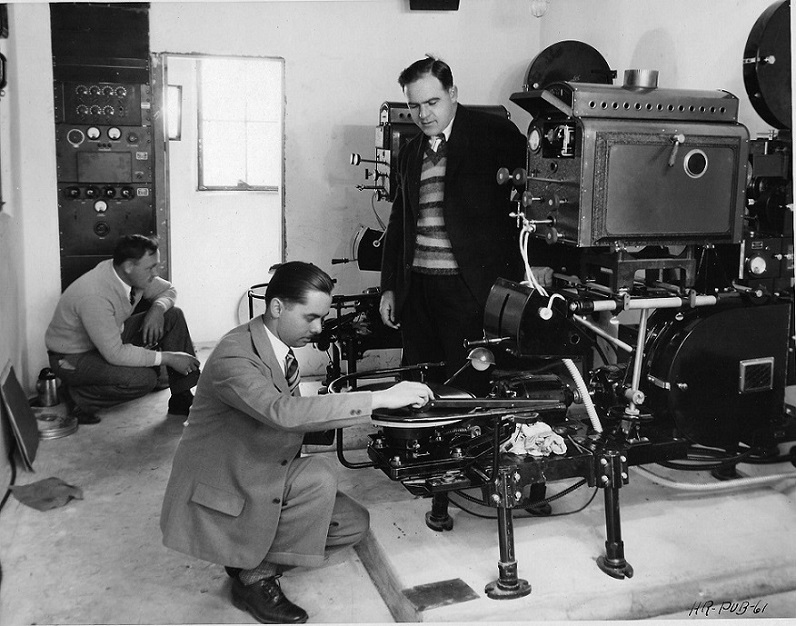
I think the Needle went from the Center outward !
Posted by Leo Enticknap (Member # 534) on 10-27-2015, 12:04 AM:
It did, and there are essentially two reasons why.
1 - Because the lead-in groove is in the dead wax area of the record, that enabled the mastering engineer to scribe a needle positioning mark (usually a big X) in that groove. That's where you placed the needle after threading up the projector with the start frame in the gate, in order for the two to start in sync.
2 - A mastering engineer would normally cut the groove wider towards the center of the record, because the smaller radius compresses the bandwidth more. The wider grove and less anti-skate force needed near the center has the added benefit that this is where the needle is least likely to jump during the rapidly increasing speed and torque of the motor ramp-up when the projector and turntable were started for a changeover. For obvious reasons, a needle jump at this stage in the game would be catastrophic - sync lost and no way of getting it back without interrupting the show. So by cutting the disc from the center out, you reduce that risk.
EDIT/AFTERTHOUGHT - they must have been seriously worried about vibration causing needle jump - look at the concrete plinth that projector/turntable combo in the foreground is sitting on! And is that a coffee/travel mug behind the guy kneeling, background left? If so, not much has really changed in the movie technician's working life in the last 90 years or so...
Posted by Paul Mayer (Member # 355) on 10-27-2015, 10:24 AM:
Look how they're dressed! Tech pay must've been good back in the day... (I know I know, it's most likely a staged promo pic).
My projection mentors and dearly departed best friends ever (Art Schruhl and Larry Little) told me stories of working/apprenticing in Vitaphone booths in Charleston, WV. Stories of some huge coal ore truck driving by and causing the needles to skip...
As it always has been, ain't technology grand? ![[Big Grin]](biggrin.gif)
FWIW, CEDs, LDs, CDs, and BDs all start from the inner tracks and work their way outward...
Posted by Kenneth Wuepper (Member # 1174) on 10-27-2015, 07:45 PM:
I did engineering and service for a local recording studio. He had 2 lathes for cutting acetate discs. The problem was when cutting from the outside to the center, the chip would get in the way of the cutter. He used a vacuum collecting system to catch the chip and remove it from the turntable.
Early broadcast transcriptions were cut from the inside out to eliminate the need for removing the chip produced by the cutter, it simply piled up around the spindle.
His last cutting system used a heated stylus and if the chip got caught near the stylus there was an immediate fire since the material was very combustible. If that burning chip got into the vacuum system the results were very astonishing and HOT.
Posted by Leo Enticknap (Member # 534) on 10-27-2015, 08:20 PM:
Yup - the lacquer discs that are cut on the lathe before being electroplated to form the mother are made of nitrocellulose - exactly the same stuff as nitrate film base, only thicker. One-time recordings were acetate, but for a reason I've forgotten acetate can't be electroplated and so can't be used to cut a disc that is to be mass-duplicated.
Back in the 1920s I believe that they were a glass or steel substrate coated with wax, hence the phrase "dead wax" to describe the unrecorded section (the run-out section on a conventional, plays from the outside record). But that isn't hard enough for microgroove cutting, and so the record industry started to use nitrate just as the film industry was abandoning it!
Posted by Monte L Fullmer (Member # 2797) on 10-28-2015, 02:33 PM:
From You Tube 1942.How a record is made
When making the wax masters, paraffin wax was used.
What's interesting is that Building 17 of the RCA Victor Camden Campus still stands.
The Nipper Building
-Monte
Posted by Mike Blakesley (Member # 26) on 10-28-2015, 07:22 PM:
quote: Jim Cassedy
I'm pretty sure Mr Maltin, who has a great
knowledge and respect for these things, would have enough sense not to
handle handle it as you see in the photo had I not assured him it was OK.
I'm surprised he handled it that way anyway. I don't think my DNA would allow me to handle a record that way no matter how beat up it was! ![[Smile]](smile.gif)
Posted by Leo Enticknap (Member # 534) on 10-28-2015, 08:18 PM:
Interesting in the 1942 RCA promo that the wax master blanks are actually made (as in, the wax coated onto the substrate) in the studio and then cut almost immediately. I wonder if it was possible to store them for any significant length of time before cutting (e.g. to transport them to a non-studio venue to make a field recording) or if they had to be used immediately, and your only option for recording outside the studio was to acetate and then re-record that onto a wax for electroplating and mass duplication.
The world's largest producer of lacquer master discs is actually located just a few miles from me, in Banning, CA. Here is a video of someone using a 1940s (by the look of it) field recorder to cut a disc on a modern Transco lacquer. That record must be one of the cleanest sounding 78s ever cut!
Posted by Stephen Furley (Member # 1277) on 10-31-2015, 01:51 PM:
Leo,
Have you seen 'The 78 Project Movie'? We ran it some months ago now, along with a short which I think was called 'Lomax', which I think is still sitting on our server.
Posted by Jack Theakston (Member # 4484) on 10-31-2015, 09:16 PM:
The above photo is of the installation at the Hal Roach screening room in Culver City—that's Roach with the striped shirt overseeing the installation. The man at the turntable is Elmer Raguse, head of the sound department at Roach.
Posted by Leo Enticknap (Member # 534) on 11-01-2015, 12:02 AM:
Stephen: No, I haven't, but it sounds (excuse the pun!) great, and I've just sent our programmers a suggestion email with that link. The Sunday evening Aero crowd would lap it up, especially if we could find someone with a 1930s or '40s portable disc cutter to do a live recording demo as part of the event. I'm guessing that Lomax is as in, Alan Lomax?
Posted by Stephen Furley (Member # 1277) on 11-01-2015, 06:01 AM:
Leo,
There's a teaser for 'Lomax' here:
web page
One of our projectionists saw it somewhere, probably at a film festival, and tipped us off about it. I'm not sure how we booked it, but I'll be seeing her this evening, so I could ask.
There was no DCP available at that time; it was supplied as a MP4 file and I built my own DCP. I think it ran about ten minutes. Notice how the disk on the recorder is warped; the cutter head is bouncing up and down.
Posted by Bill Brandenstein (Member # 7758) on 11-03-2015, 01:55 PM:
A little further OT, but don't forget that it was a 1947 RCA cutter and a 78RPM one-off that resulted in the founding of Sheffield Lab Records, eventually propelling Doug Sax to fame as a mastering (and recording) engineer. So yes, Leo, I agree that the 78 cut in that video ought to sound pretty sweet!
Sheffield Lab history
Posted by Leo Enticknap (Member # 534) on 11-03-2015, 11:14 PM:
Audiophile Records was another small label that started up around the coarsegroove to LP transition, which tried to market high (technical) quality records to geeks by using vinyl and microgroove, but sticking with 78rpm to increase bandwidth. I have one Audiophile disc in my collection (of J.S. Bach organ music - I'm guessing it was one of very few, if not the only classical record they did), and I can't hear any improvement over early Decca FFRR LPs pressed at around the same time. I don't know if they were direct to disc or cut from tapes.
quote: Sheffield Lab article
The LPs did not compare favorably with earlier 78RPM records, which, despite their scratchiness, yielded more beautiful piano sound. In particular, the Abbey Road (EMI) recordings of pianist Artur Schnabel, recorded in the nineteen thirties, were most realistic and musical sounding.
What???!!! UK (Hayes) pressed EMI/HMV 78s from the 1930s were arguably the noisiest and nastiest ever made. EMI used a really abrasive ceramic filler in their substrate and a lot less shellac than their competitors. They claimed that this made their records more resilient to wear (and keep in mind that being played with a steel needle on an acoustic phonograph, they wore VERY quickly), but if this was true, the cost in surface noise was huge. Compared with any of their competitors at the time, they do not sound good.
I have an original 78 album set from the HMV/Beethoven Society series of Schnabel playing Beethoven's sonata #29 from 1936. The discs are in near mint condition, but they're still so surface noisy as to be almost unlistenable. Most of the slow movement is inaudible for surface noise. If this was the standard the Sheffield Lab founders were aiming to replicate, I'm surprised, to put it mildly.
Posted by Jim Cassedy (Member # 4115) on 11-04-2015, 04:35 PM:
quote: Leo Enticknap
the lead-in groove is in the dead wax area of the record, that enabled the
mastering engineer to scribe a needle positioning mark (usually a big X) in
that groove. That's where you placed the needle after threading up the projector
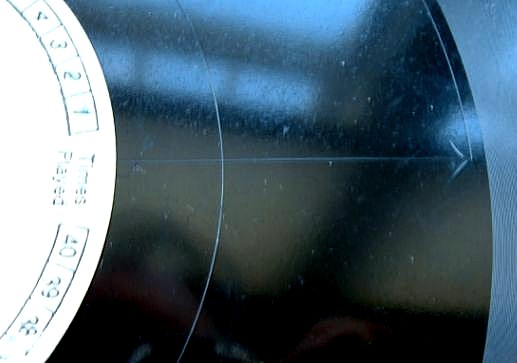
I pulled out one of my Vitaphone disks and here is an actual photo
(WoW!) of the start mark & groove on the disk. This one doesn't have
an "X", but a large arrowhead to mark the starting groove point.
Posted by Claude S. Ayakawa (Member # 1401) on 11-04-2015, 06:06 PM:
What was the playing time of the disc? I assume the playing time of the disc is exactly the same as the reel of film that plays along with it. Its about 20 minutes isn't it?
I have the original JAZZ SINGER on DVD as well as Blu Ray and the BD is much better. It Is a wonderful movie and the picture and sound by the standard of that period of time is fantastic!
-CLaude
Posted by Bill Brandenstein (Member # 7758) on 11-05-2015, 12:18 AM:
quote: Leo
If this was the standard the Sheffield Lab founders were aiming to replicate, I'm surprised, to put it mildly.
I'd have to agree with you, but there surely must be some clue missing from that story as it just doesn't make sense. But I also have nothing like the pressings mentioned and you do. Most interesting.
Posted by Leo Enticknap (Member # 534) on 11-05-2015, 10:10 AM:
Admittedly we're now going way OT from The Jazz Singer (sorry!), but the 1930s Schnabel Beethoven piano sonata recordings were a landmark, both in the history of music recording, and of significance for the performances themselves.
It was the first time anyone had attempted a classical recording project on that scale - all 32 of Beethoven's piano sonatas, direct to disc. Other leading concert pianists of the day had rejected the idea, mainly because of the difficulty of dividing them into four-minute chunks, the inability to correct minor errors without playing the four-minute section again and the sheer time commitment needed.
Minor errors didn't bother Schnabel - he infamously pointed out that Beethoven probably played his fair share of wrong notes, too, that this is what happens when you have a human being rather than a machine playing, and if the audience don't like it, that's their problem.
The series of records was sold by subscription only (you had to agree to buy the lot) - EMI would not take the project on otherwise, because they guessed that the more obscure sonatas would sell too few copies to be viable.
The playing is VERY idiosyncratic. For most of them, he takes the pace way above Beethoven's tempo/metronome markings, He plays the opening movement of the only Beethoven sonata I learned to play (no. 7 / op. 10, no. 3) at almost double the tempo Beethoven indicates. Maybe that was partly dictated by four-minute side breaks, but the down side is that even I, an amateur pianist and organist with almost no formal training, can land more fingers on right notes than he does in this recording!
So these records are a landmark in that it was the first time anyone had tried to record the lot (around 12-13 hours in total), but if you're expecting the polished, rehearsed up the wazoo style phrasing of Wilhelm Kempff or Martha Argerich, you're in for a shock!
EMI reissued them on LPs in the 1980s, and without the surface noise, the audio quality is surprisingly good. I'm guessing that either a surviving mother was played directly into a tape recorder, or new vinyl pressings made from surviving stampers and then those re-recorded. They absolutely cannot have been mastered from surviving original shellac release pressings: no matter how carefully you select the stylus pitch and tracking weight, or clean the record, you CANNOT get rid of the overwhelming frying egg surface noise on 1930s EMI/HMV shellac pressings.
Maybe the Sheffield Lab founders heard some US release pressings that were done by a different label on quieter shellac? As a general rule and with the exception of Columbias (both British and US ones are pretty quiet), I've always been struck by how much less surface noise there tends to be on American shellac records compared to British ones.
Posted by Bill Brandenstein (Member # 7758) on 11-05-2015, 07:57 PM:
Leo, I'm enjoying presuming upon our friends here with all this OT talk of Beethoven & Schnabel, which fits only LOOSELY because they're almost of the same era as Vitaphone discs! Perhaps we need to continue such a conversation over lunch someday so we can speak more freely of 78s, Beethoven, Adobe Audition, and whatnot.
Now here's something any interested party can take note of: my familiarity with the Schnabel recording Leo mentions comes from a restoration-based website, Pristine Audio, and if you go to that link and click the player to hear samples, the first thing up is what Leo's written of. Brilliant, yes, cleanly played, no. For what it's worth, my Niemann edition (Peters) has no metronome markings at all (suggesting that those in other editions are editorial suggestions) and merely gives "Presto" for the tempo. Well, it's certainly played "Presto." Whew.
I'd love to hear what Andrew Rose would do with Vitaphone discs, or the optical masters they were cut from (is that a correct assumption?).
Powered by Infopop Corporation
UBB.classicTM
6.3.1.2