This is topic SPARTACUS 2015 Restoration in forum The Afterlife at Film-Tech Forum ARCHIVE.
To visit this topic, use this URL:
https://ft-forum.com/ft/cgi-bin/ubb/ultimatebb.cgi?ubb=get_topic;f=12;t=001100
Posted by Claude S. Ayakawa (Member # 1401) on 10-04-2015, 04:22 PM:
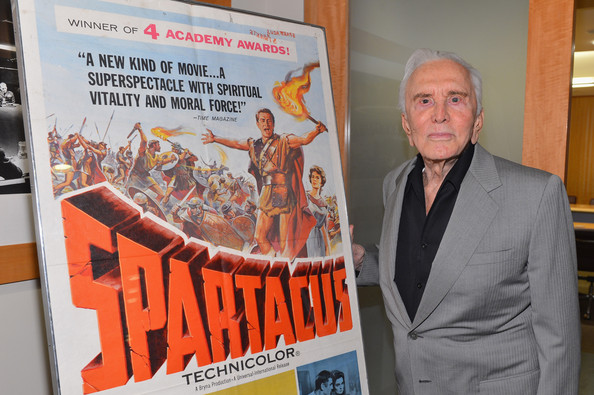
Because I kew I would have a tough time getting it from a local vendor like Best Buy, Target or Walmart, I ordered the 2015 Restoration Blu Ray of SPARTACUS online. It is scheduled to be released this coming Tuesday but imagine my surprise when I saw it in my mailbox yesterday. I guess some shipping clerk was not paying too much attention to the street date of that title and shipped it early.
Up until now, the only home video of SPARTACUS that did justice to the image of the movie and how it should look was the Criterion DVD. The Blu Ray of the movie that was released a few years ago was a joke and it looked terrible and pale compared to the Criterion DVD. All that has changed And now the Criterion DVD looks pale compared to the new BD that will be released on Tuesday. What I saw on my screen last night looked like an image I was watching in a theatre projected from a 70mm print. This was due to the fact that the restoration was made from the original 8 perf 35mm Technirama negative and scanned in 4k. Even the sound was terrific. The color and contrast was perfect. I only skipped over the movie last night to check the disc but plan to watch the entire movie tonight.
-Claude
Posted by Claude S. Ayakawa (Member # 1401) on 10-05-2015, 05:32 PM:
I watched the movie in it's entirety last night as planned and as expected, it was flawless. It is very interesting to note the fact that there is a person in the restoration segment on the disc say the movie was scanned from the original negative in 4k but the credit roll at the end of the movie had indicated the film was scanned at 6k.. Either way, the picture quality on the current blu ray is fantastic and look like it did in 70mm in theatres.
-Claude
Posted by Monte L Fullmer (Member # 2797) on 10-05-2015, 06:04 PM:
quote: Claude S. Ayakawa
Either way, the picture quality on the current blu ray is fantastic and look like it did in 70mm in theatres.
Sounds like excellent video fodder for someone to hook up a BR player to a cinema 4K unit via HDMI cabling and projecting it on a 65ft wide screen...which is a piece of cake to do.
Posted by Paul Mayer (Member # 355) on 10-05-2015, 07:30 PM:
Sounds good, though I'm waiting to see what titles will be forthcoming on the new UHD 4K Blu-rays coming this Christmas. Now running one of those into a 4K projector should be something to see. Progress never ends... ![[Wink]](wink.gif)
Posted by Claude S. Ayakawa (Member # 1401) on 10-05-2015, 08:17 PM:
Paul, SPARTACUS on a 4k display from a 4k disc should look awesome based on the way the picture looked from a standard Blu Ray on my 46 inch 1080p display. Now that I have seen the restored SPARTACUS on bd, bring on MY FAIR LADY at the end of the month on the 27th
-Claude
Posted by Paul Mayer (Member # 355) on 10-05-2015, 09:21 PM:
When I get back to work, I will be doing much the same Claude - picking up BDs of restorations of many of the Fox musicals that my parents worked on in the '50s and '60s.
Posted by Jonathan Goeldner (Member # 4854) on 10-05-2015, 10:57 PM:
between this and the restored 'My Fair Lady' at the end of the month - I am so stoked.
Posted by Monte L Fullmer (Member # 2797) on 10-07-2015, 05:20 PM:
quote: Paul Mayer
Progress never ends...
Ya, home cinema has been after us cinema people since TV came out where they want to be in a major competition to the cinema, while this home industry also generates the additional revenue to the studios.
Now, we have laser projection, ATMOS and AURO sound to keep one step ahead of this game.
No matter what, folks still want to get out of the house to be entertained and will pay the price for entertainment.
Posted by Steve Matz (Member # 1890) on 10-11-2015, 05:24 PM:
![[beer]](graemlins/beer.gif)
Posted by Paul Mayer (Member # 355) on 10-16-2015, 01:15 PM:
Speaking of "My Fair Lady"...
quote:
Latest digital restoration of 'My Fair Lady' negative improves sound and rejuvenates color
16 October 2015
By Susan King
When Robert A. Harris and James C. Katz first restored "My Fair Lady" more than 20 years ago, the original camera negative of the Alan Jay Lerner-Frederick Loewe musical was already in bad shape.
"The negative had been run about 140 or 150 times," Harris said. "Every 70mm print is always made from the camera original, so the negatives get run again and again. The more popular a film is, the worse the conditions the elements are going to be in. That one was horrible."
The Audrey Hepburn classic won eight 1964 Oscars including ones for George Cukor's director, Rex Harrison's acting and Cecil Beaton's exquisite costume design. But the negative of "My Fair Lady" had tears. "Perforations were missing, splices were opening up," Harris said. "But there was very little fading."
Harris and Katz's acclaimed restoration, released in theaters as well as home video, took eight months to complete and used traditional photochemical restoration, as well as new digital tools.
But that was two decades ago.
Last year Harris told Ken Ross, executive vice president and general manager of CBS Home Entertainment, that the original camera negative was now at risk and a new digital restoration was needed.
"When you are a steward of the brand, you have the responsibility to the public, to the fans and the culture to make sure these things are preserved," Ross said.
Though the negative was stored under proper conditions in a vault in Burbank for the last 20 years, the negative had faded extensively.
"There was a differential fade at the end and tails of a lot of the shots because oxygen gets into the layers of the film where there were splices," Harris said.
The new high-definition 4k restoration of "My Fair Lady" is from an 8K scan of the original negative and other surviving 65mm elements.
Five months were spent getting the color back to its lush, vibrant original.
More than 12 million digital fixes were made, including getting rid of dirt and other detritus. Thanks to digital tools, the soundtrack sounds as good as it did 50 years ago. In fact, it might sound a bit better because the soundtrack includes "things that you didn't hear before," Harris said.
This even-lovelier restoration of "My Fair Lady" will have a limited theatrical release around the country beginning Sunday. Among the theaters screening it include the TCL Chinese Theatre, iPic theaters in Westwood and Pasadena, and the Cinemark 18 & XD in Los Angeles. For dates and times, go to www.myfairlady50.com.
The "My Fair Lady" 50th anniversary edition arrives Oct. 27 on Blu-ray and DVD with a slew of extras.
susan.king@latimes.com
Privacy Policy
Copyright © 2015, Los Angeles Times
Posted by Leo Enticknap (Member # 534) on 10-16-2015, 01:35 PM:
Does this woman do anything besides copy and paste press releases?!
I'm not trying to detract from the achievement of this digital cleanup, but there could have been a serious, analytical article written about it, asking questions like, for example, how justified is it to do a repeat restoration of a movie that has already had millions lavished on it in the afterlife, when the same vaults contain many movies, the technical condition of which is just as problematic but which have never had so much as a single re-release after their initial run, let alone a gold-plated, top-of-the-line restoration project such as the ones Mr. Harris specializes in.
The same applies to The Red Shoes, which had all the resources of one of the world's leading film archives thrown at it, twice and separated by around 20 years. Yet none of the critics who reviewed it asked why the archives and studios devote so much of their time and resources to repeat restorations of a small canon of movies. The technology will always improve, and it will almost always be possible to revisit a previously restored movie and do a better job after a significant amount of time has gone by (unless the source elements are no longer available). But does that fact in itself justify doing it?
The answer is that concentrating on well-known classics is an easier sell to the public (hence the reason Lawrence of Arabia sells out whenever we show it), enables positive PR (i.e. the copying and pasting of press releases into the pages of major newspapers), and that in turn enables the fundraising that is vital to keeping the big non-profit archives and studio archive departments alive and in business. I get that, but still get frustrated that no-one seems prepared to question whether this phenomenon has a down side attached to the regular makeovers given to a small canon of classics.
A related problem is that most of the critics and academics who write the sort of article pasted above are fundamentally lazy people, who would prefer to copy and paste a press release and/or take their colleagues' word for it that something is or isn't a masterpiece than put the hours in to doing back-end research and forming their own judgments - or even worse, go into print with judgments that clash with their readers' opinions. Thus the process becomes self-feeding.
Posted by Robert Harris (Member # 1712) on 10-17-2015, 07:06 AM:
Leo,
Susan actually does quality interviews, which have to be homogenized a bit for the publication.
Wait for the piece coming in Post, which will reveal all, or check the interview on Home Theater Forum.
The short answer is that when we performed the analogue restoration in 1994, our digital tools, which were extremely necessary, were also extremely limited.
We could not return to sep masters, all digital fixes were at HD quality, audio was generations away from original. The list goes on.
If your questions aren't answered, you know where to find me. Just ask.
RAH
Posted by Leo Enticknap (Member # 534) on 10-17-2015, 05:55 PM:
I'm not questioning whether the restoration was justified on technical grounds, or on economic/political grounds.
You can take pretty much any movie that underwent significant preservation and/or restoration work from the '60s through the early '00s, and re-do that work using today's techniques and technology to achieve a far "better" result. The movies that underwent high-budget restorations done by the world's leading experts such as yourself during this period were selected, because they were already very well known, critically acclaimed, and/or popular, or a highly publicized rediscovery, combined with the identified risk of imminent loss or degradation of the surviving elements.
They're now being redone again, essentially for the same reasons. If it's a non-profit doing the restoration, they have an easier time fundraising (sponsors and grant-awarding bodies are less likely to invest in a film that only a handful of geeks and historians have heard of) and awareness-raising. If it's a for-profit studio, they can leverage the movie's reputation to sell it to theaters, on disc, to streaming, etc. etc. Probably the most extreme example of this is Metropolis, which was under more or less constant re-restoration for almost half a century, from the late 1960s until the last version that incorporated the Argentinian footage.
I understand how this happens and am not trying to argue that anyone should adopt a "once only" rule for restorations. Nor am I denying that many of the re-restorations are huge technical achievements in their own right. But I was disappointed that the LA Times article pasted above did try to ask any deep or serious questions about the impact of this trend, which is making it increasingly more difficult for archives and studios to promote awareness and appreciation of the lesser known holdings in their collections. I wouldn't have expected those questions to be asked in a fan magazine, but I would by the film critic of a serious newspaper.
Posted by Mark Ogden (Member # 43) on 10-17-2015, 06:24 PM:
Actually, Robert, I have a question. Why are 70mm prints always struck off the original camera negative? It was a surprising thing to hear. What's wrong with making up an internegative for printing?
Posted by Steve Kraus (Member # 476) on 10-17-2015, 07:51 PM:
I'll defer to Bob Harris but one presumes the duplicating stocks weren't as good back then so a contact print off the camera negative is going to look MUCH, MUCH better than one that is TWO generations (IP & IN) farther out. And remember that they generally were making only one print for each major city for the roadshow presentation, not hundreds like they would on a general release let alone the thousands we had recently up until the DC conversion.
Posted by Robert Harris (Member # 1712) on 10-18-2015, 12:40 AM:
Steve is correct. Duping stocks weren't of significant quality until the mid 1980s, with I believe 5243.
A dupe from 5235 step masters would yield a better dupe then IP IN in the '60s.
The only ways to create quality prints were either via dye transfer, or printing from the original.
Rear Window, for example struck around 350 prints, and was worn out. So many originals in horrific condition.
We were able to run dupes on Lawrence because the new stocks were superb. Without 43, the film could not have been released in 70mm after the reconstruction, as the OCN kept cracking up at each run.
RAH
Powered by Infopop Corporation
UBB.classicTM
6.3.1.2