This is topic Netflix in forum The Afterlife at Film-Tech Forum ARCHIVE.
To visit this topic, use this URL:
https://ft-forum.com/ft/cgi-bin/ubb/ultimatebb.cgi?ubb=get_topic;f=12;t=001113
Posted by Mike Blakesley (Member # 26) on 05-02-2016, 10:48 PM:
I have always been a hard-liner about Netflix, namely why should I spend money for that when I have a perfectly good movie theater I can watch the new releases in?
My wife, however, is out of town on business at least 3 nights (sometimes more) a week, and does not have satellite, cable or internet during these trips, so she wanted to get a Netflix account so she could watch movies on her iPad when there was nothing good on the 2 or 3 "antenna" channels.
OK so fine, now we have Netflix. I figured, sure, there are times my usual night-time TV isn't all it's cracked up to be so an occasional movie would be good. Until now my knowledge of Netflix has been limited to reading about all the idiotic ways they keep trying to screw the theater industry, and how they also keep trying to screw the studios. The fact that everybody wants to get in bed with these people (it's the $$$$) is a textbook example of what's wrong with this world. Still, I had to admit some excitement at being able to watch virtually any movie I wanted to!
I was under the impression that Netflix had "almost everything." Well I have found out that's not exactly the case. I've thought of at least a half-dozen movies, things we didn't play at the theater or older ones I wasn't sure I wanted to buy, that I would like to watch and guess what....they're not there. Same with a lot of TV shows that crossed my mind.
We also have Amazon Prime, which we have mainly for the shipping advantages -- the movies and music-on-demand are a nice little added perk. But it's a disappointment too, because although the movies you really want to see might be there, most of them cost extra to "rent." Well screw that, if I'm going to pay extra for a movie I'll just buy the blu-ray.
I thought the whole appeal of these online streaming things was "watch what you want, when you want, where you want." I'm finding it's not exactly the case. And then there's a whole range of stuff that Netflix DOES have, but only on physical disk, which (of course) costs extra.
It turns out that far from being the ultimate video store, Netflix is really just an online TV network. They only carry things that bring in viewers. So my bubble was quickly burst. If not for my wife I would shut it off right now, but she's already heavily into Breaking Bad, so...
Posted by Harold Hallikainen (Member # 5405) on 05-02-2016, 11:01 PM:
Someone from a TV network once called Netflix reruns. But, they donhave some good original stuff like House of Cards and Lillyhammrr. The streaming librsry is more limited than their disk library. I believevwith streaming they need to continuously renew licenses while once they have a disk, they can rent it until it breaks.
Harold
Posted by Daniel Schulz (Member # 1881) on 05-02-2016, 11:10 PM:
I take your point, but I still think Netflix Streaming is an incredible bargain for the amount of content that you do get. I do find it interesting, though, that so many people equate Netflix with the streaming service and don't think about the disc service at all. I use both, and I would give up the streaming service long before I would give up the discs, especially since video rental stores are now so few and far between. I periodically check my disc queue to see how much of it is available to stream, and it's usually less than 20%. Plus, for movies, you have to double-check aspect ratios, as many times a 'scope movie streams cropped to 16:9!
Posted by Justin Hamaker (Member # 2165) on 05-02-2016, 11:37 PM:
Mike, what you're talking about illustrates a growing problem with streaming services. Basically everything is becoming so fragmented that a person needs to subscribe to multiple services just to get all the content they desire: Neflix, Amazon Prime, Hulu, and HBOGo/HBONow to name a few.
Now we're starting to see Networks have their own streaming service which is replacing OnDemand services from TV providers, and have their own subscription rates.
I wouldn't mind this fragmentation so much if there was more real-time access to sports and other live events. Once this happens I will be happy to ditch my satellite service and just subscribe to the streaming services which offer the products I want to see.
What I have found with Netflix is their original content and archive of TV shows is what makes it worth while for me. Same with Amazon Prime, and since I mainly get Prime for the shipping the content is a bonus.
Posted by Mike Blakesley (Member # 26) on 05-03-2016, 12:12 AM:
quote: Daniel Schulz
I do find it interesting, though, that so many people equate Netflix with the streaming service and don't think about the disc service at all.
That's because the physical disk is completely dead and nobody has used or a DVD (or a CD) for the past 5 or 6 years, and everybody is streaming everything. At least that's the notion the media keeps puking out. I thought Netflix wanted to GET OUT of the business of shipping disks around.
quote: Justin Hamaker
Basically everything is becoming so fragmented that a person needs to subscribe to multiple services just to get all the content they desire
Isn't that the truth. I've often wondered how much people are spending every month while they're "saving money" but cutting their cable.
quote: Daniel Schulz
I would give up the streaming service long before I would give up the discs, especially since video rental stores are now so few and far between
Some of the stuff I searched for isn't there on disk either. Just one example that pops to mind is the John Belushi movie "Continental Divide." Not available on Netflix in any form, but you CAN buy the DVD from Amazon.
For a real big eye opener on how limited Netflix really is, try searching a person's name instead of a movie title. John Wayne for example. The man made over 200 movies, yet only three of them are on Netflix.
Posted by Justin Hamaker (Member # 2165) on 05-03-2016, 12:24 AM:
Netflix does still ship disks as DVD.com. I subscribed to the 1 at a time unlimited just because there were so many movies I was missing at the theatre.
Although I love watching the movies at the theatre, I'm finding it increasingly undesirable to stay late and watch movies after work. Partly because I spend so much time at work that I just want to go home when I'm done. And partly because hardly any of my staff is interested in watching movies late at night, so stay to watch usually means watching alone.
Posted by Frank Angel (Member # 248) on 05-03-2016, 03:42 AM:
I think Netflix originally intended to move everything to streaming and to actually phase out the DVD shipping side; in the early streaming months they were enticing people to go streaming, but after about two years out, when contract negotiations with the studios came around, they got into a pissing war with the studios demanding a lot more for their product than they had in the past. Evidently the studios saw how little they actually were getting for their titles via the new streaming services and wanted a much bigger piece of that growing pie. All of a sudden content on the streaming side began to get a lot less current and generally more limited compared to the disc offerings. Disc titles still dominate with the newest and the most popular titles.
Thing is, they have the disc service down to such a well-oiled operation that it's practically as "immediate" as streaming. I put a disc I have watched in their mailer and drop it in the mailbox in the AM on Monday. On Tuesday I get an email that they received my title (ONE day later) and it also tells me what title in our cue they are shipping out THAT SAME TUESDAY (I have at least 50 titles at all times in our cue) and THE NEXT DAY, I get the BRay in the mail! What kind of deal they have made with the USPS to get this kind of efficiency is beyond me because there is NO mail service that I can get from the post office with first class mail, that will get a letter delivered from point A to point B, even in the same zip code, in a single day. Sometimes from work to home -- 16 blocks away -- it takes 3 or even 4 days for first class mail.
Like Mike, I also have Amazon Prime mainly for the shipping advantage. I find their library much less interesting than Netflix, plus I get really annoyed when they have REALLY old titles, 1940s and 50s titles, that are not included with Prime that they charge a rental fee.
BTW, early Netflix streaming quality was awful -- blocky, studdery...totally unsatisfactory compared to a DVD and now BRay -- so bad that I didn't for a second think to give up the disc service. I had what I consider mid-level cable service, not fiberoptic, so probably about what most people were getting at the time and I couldn't enjoy watching streamed content at all. It has gotten a lot better in recent years and it is tolerable, but still doesn't come near DVD quality.
Plus, my cable company offers their own movies on demand -- lots of junk, but some good titles and new releases are mixed in. All titles used to be $4.99 for a 48 hour rental on Optimum On Demand service; in the last year or so, they have upped the pricing on the newest titles to $5.99 and $6.99. And again, it still is only the level of quality that the cable is delivering from one moment to the next.
Posted by Mitchell Dvoskin (Member # 751) on 05-03-2016, 09:02 AM:
From the studio's point of view, a streaming service is the same as premium cable channel in that they all have to compete against each other to get exclusive titles, for a limited period of time. This makes streaming a very different business that renting DVD/Bluray discs, where they buy the disc, usually at wholesale, and then can rent it forever with no additional fees.
I dropped Netflix streaming when they started charging for it separately from the DVD/Bluray service. My issue was not so much the limited streaming library, but rather constant reliability issues. When I called Netflix, they would blame Roku, Roku would blame my ISP, and my ISP would blame Netflix, and ultimately the problem never got resolved. I had the same issue last year with Amazon Prime, and when I called Amazon support, they checked something on their computer and blamed my ISP. Skeptical because of my earlier experiences with Netflix, I called Cablevision service, and much to my surprise it was a Cablevision issue that was promptly resolved.
In any event, between Amazon Prime, which I have mainly for the free shipping, and Netfilx's DVD/Bluray service, with a little patience I can see almost anything I want. Sooner or later everything ends up on DVD.
Posted by David Buckley (Member # 2600) on 05-03-2016, 03:41 PM:
I've dumped Netflix, mainly because there was so litle I wanted to see on it, or more accurately, what I wanted to see i couldn't find, and the last straw being when they became VPN unfriendly. The younguns like it 'cos its got all these new original series they like.
I've now gone over to the dark side. I watch less, but watch what I want to see.
Posted by Buck Wilson (Member # 5885) on 05-03-2016, 10:40 PM:
I like a lot of their original content but my biggest beef is also the lack of available titles. EVERY. SINGLE. TIME I look up some title I want to see(typically a really big title that I just happened to have not yet seen like The Big Lebowski, Pulp Fiction, Airplane!, Shindlers' List, etc etc etc It is NEVER on there. I once went through and searched though at least half of my 120+ IMDB watchlist looking on Netflix, and didn't find a single title. I hardly even load up Netflix anymore because it makes me so angry. Only reason I keep it is because my family avidly uses my account.
Posted by Scott Jentsch (Member # 1681) on 05-06-2016, 03:23 PM:
The promise and potential of streaming is what the media covers because it's exciting to think about what can be done with the technology. Covering "new media" gets the eyeballs that companies are looking for.
Somehow, these so-called "news" outlets fail to dig any deeper than the surface to point out the flaws outlined here that can be found without much work at all.
Libraries are fragmented across all kinds of services. If you really want to show someone that really cool movie that you like a lot, you better have it on disc, because more than likely, you're not going to find it online without a lot of looking, if then. Even if you watched it last month, that doesn't guarantee that it's still there.
Let's assume that you luck out, and the movie you want to see is available. Is the service going to deliver the movie, glitch-free, for the duration of the movie, and at a quality comparable to something approaching HD? Will it start buffering part of the way through?
If the movie does stall, whose fault is it? The server? The ISP? Your network? And you thought you were going to sit down and just enjoy a movie...
Buying a movie on disc is a relative bargain. New releases are available for $20. If you watch sales carefully, you can pick up some decent catalog titles for under $5 (Amazon and Best Buy have great sales periodically). Even Target has a decent collection of movies for $4.50-$5.00.
The trick is to build a library of movies that you find enjoyable. Sure, it's old-school to actually own a movie on a physical disc, if you listen to the media and that's permeated the public consciousness. But guess who our friends come to when they want to see a movie and they can't find it online and it's not available on the rack or via Redbox?
Losing the physical disc is one of the worst things that could happen to movie enthusiasts.
Posted by Justin Hamaker (Member # 2165) on 05-06-2016, 06:40 PM:
I find my expectations are lower when I'm streaming content. I know there is a good chance the quality will not be what I was expecting and there may be some glitching or buffering. But satellite and cable are not free from quality issues either.
If it's something I really want to watch in a true HD experience, then I'll be getting a BluRay. However I have limited my BluRay buying to about 3-4 a year because they mostly just sit on the self never to be watched again. In fact, many of the discs I purchase are movies I really liked and am likely to want to share with others.
Posted by Bobby Henderson (Member # 840) on 05-06-2016, 08:32 PM:
I use Amazon Prime and Netflix, but not primarily for streaming movies. It's about streaming entire seasons of TV shows without having to endure frequent commercial breaks 2 to 4 minutes each. That's the real attraction of the streaming services. On top of that, cable and premium cable TV series have been out-doing Hollywood movies in terms of dramatic content.
Of the movies I do watch on Netflix, they're often movies that never played in the local movie theaters around here.
I still prefer renting Hollywood movies on Blu-ray due to the superior video quality. For a growing number of people this is becoming a moot point due to increasing speeds of residential Internet connections. Once an Internet connection is sustaining 25-30 megabits per second Netflix will deliver 1080p at or very near Blu-ray quality.
After much deliberation I'm going to shit-can my AT&T "Univers" service and go with Fidelity Cable Internet. Univers can't even manage to match Fidelity's bottom tier of 10 megabits per second. I get the feeling AT&T doesn't even give a shit about residential Internet service anymore. Their concentration seems totally fixated on the mobile phone market. In my market Fidelity now offers 10, 25, 75 and 125 Megabit/sec service tiers. I'm trying to decide between the 25 and 75 Mb/s levels.
Much faster Internet connections are available in some markets. I heard Fidelity is rolling out 300 Mb/s service in some places. Fiber optic connections can potentially deliver connection speeds past the 1 Gigabit mark.
Physical media, like Blu-ray discs, will still be necessary for years to come since lots of people in sparsely populated areas still have very slow Internet connections. IMHO, the new Ultra-HD Blu-ray format is getting badly goofed up since so many of its initial launch titles are Fake-4K, movies originally rendered in 2K and then "up-rezzed" (faked) into 4K. The movie studios and electronics companies are courting disaster with such stunts.
Posted by Mike Blakesley (Member # 26) on 05-06-2016, 08:59 PM:
Geez, remember the good old days when the electronics industry was all about increasing quality all the time, not figuring out ways to make more money while delivering less quality?
I'm one of the poor souls out here in the hinterlands with the slow internet connection, although what's considered "slow" these days would have been blazingly fast about 10 years ago.
quote: Bobby Henderson
Fidelity's bottom tier of 10 megabits per second
10mb is our local provider's FASTEST available service, and in reality you usually don't get much more than 6 out of it. Here at the theater we have 4mb, because there's no great need to have a fast connection here -- no video streaming, no big downloads -- and I can't say there's that big a difference between the 4mb here and the 10mb we get at home.
In the ISP's defense though, they have been beefing up their infrastructure over the winter and expect to be offering "much faster" speeds starting this summer. I'm not sure what they're going to consider "much faster".... or what they'll charge for it.
Posted by Bobby Henderson (Member # 840) on 05-06-2016, 11:23 PM:
If your local ISP is cable-based and they're fixing to re-vamp their infrastructure they may be moving to the kinds of service tiers Fidelity has here in Lawton. A couple or so years ago Fidelity's Internet service wasn't nearly as fast. AT&T seems blissfully unaware of the situation.
It is pretty noticeable to move from a mere 3-6 meg connection to something in excess of 25 megs per second. Shows in Netflix start out looking pretty much perfect (my girlfriend has a 25 meg Fidelity connection at her home). Using my Uverse connection Netflix never gets above 720p and shows usually start out pretty crappy looking before getting to "okay" video quality.
Posted by Mike Blakesley (Member # 26) on 05-07-2016, 12:02 AM:
They're not cable-based, they're a telecom company. THey're installing a lot of fiber in the area which is supposed to give them the ability to increase speeds.
I can stream videos and they look pretty good, although not as good as BR, but decent enough. Takes about 15 seconds from the time I hit "play" to when playback starts, so it's not exactly intolerable, and I do most of my watching very late at night so buffering is almost never an issue.
Lack of content is my major gripe.
Posted by Scott Jentsch (Member # 1681) on 05-09-2016, 02:53 PM:
In the Milwaukee, Wisconsin area, AT&T is still pushing its U-Verse Internet product (I get mailings from them weekly trying to get me to buy it), but they are limited to 18 Mbps. You can get faster from them, but you have to be in very close proximity to their fiber optic lines, and they won't promise me anything above 18 until they do the install.
I admit, I do use the streaming services, but I use them for the equivalent of channel surfing. I'll watch House of Cards on Netflix streaming, but their selection of movies isn't that great. I really need to cancel the streaming side, but I keep forgetting to do so. When I'm looking for something to watch just to kill some time, I'll page through the listings on Amazon Prime, much like I would head over to TCM to see what they're playing.
If I had something like a Kaleidescape system, that would remove the convenience advantage that the streaming services have, but those systems are not for the budget-conscious.
If streaming services can increase reliability, increase quality, and increase availability, then many of my objections would be satisfied, but we're still at the mercy of a third party that is really in control. It's probably an age-related thing though, as younger people are being raised on streaming services for music and other media, where they are being milked monthly in exchange for what they think is unlimited access.
Posted by Justin Hamaker (Member # 2165) on 05-09-2016, 03:21 PM:
Where I live Uverse tops out at about 5 MBPS but is the same price as the cable company's 50MB service. The cable company is not as reliable as Uverse, but I can live with that for 10x faster speed.
Posted by Mike Blakesley (Member # 26) on 05-09-2016, 07:08 PM:
I think my biggest problem is, I'm too picky what I want to watch. I can't just surf and find something easily. Most new movies don't interest me that much (and if they do, I watch them at the theater).
For TV, I'm a comedy fan, so I like to surf around the late night shows, but the primetime comedies are all either bathroom humor/sex jokes, which get old, or the audience laughter is so obnoxious it drives me crazy. (I was a big fan of "The Office" and "Parks and Rec" because they were really funny and well written, but also because they didn't have an audience.)
Posted by Bobby Henderson (Member # 840) on 06-04-2016, 01:45 AM:
I finally switched Internet service providers, ditching AT&T Uverse for Fidelity's cable Internet. My connection went from a little over 3 megabits per second to over 27 megabits per second (according to the Speedtest app). Plus I was able to use a new, higher quality router rather than the cheap garbage router I had to use for Uverse.
The higher connection speed makes a really big difference on all the streaming options. Obviously content on Netflix looks better and streams a lot better than it did with Uverse. But so does the stuff from Amazon Prime and HBO GO, which ran even worse. With this new connection even Dish's on demand service works immediately, and in 1080p. With Uverse I had to download to the DVR and watch later, and even then it would download only around 720p quality levels at best.
All is not perfect however. Even though everything streams in 1080p, on my 65" TV the content varies in image quality. Some shows, such as House of Cards, look really good, but others really show some noisy compression issues. For instance Jurassic Park (which just got added to Netflix) was pretty noisy looking, not film grain noisy but more like some kind of dithering effect was applied. Definitely not Blu-ray quality, but maybe a little better than what you would see from a satellite TV broadcast. Maybe some of the issue could have to do with how each show is compressed/encoded. Internet connections do vary as well. Other devices on the network can sap Internet bandwidth with their own processes.
Posted by Randy Stankey (Member # 64) on 06-04-2016, 12:45 PM:
I recently switched to Time Warner Cable because they are the only other ISP in this area beside Verizon. I was paying $39.99/mo for for 2 Mb DSL plus another $29.99/mo for a landline phone. (They wanted me to have a landline in order to get DSL even though it's technically not needed.)
So... With Time Warner, I'm getting 50 Mb and it only cost me $59.99/mo... $10.00 cheaper than what I was paying before. Further, my actual bandwidth often exceeds 60 Mb. (Just this minute, Speedtest.net says 61.26 Mb.)
I don't have cable or satellite TV, nor do I plan to get them. I watch all my TV with Apple TV.
I have an account on Netflix and Hulu but I don't allow them to bill me monthly. I go to the store and get gift cards and pay them that way.
I will watch Netflix for a couple of months, until the gift card runs out, then I'll get a gift card for Hulu and watch than until it runs out. Every couple of months, I switch back and forth.
Since Netflix and Hulu have so much of the same content, it's doesn't make sense to pay for both at the same time.
With Time Warner cable at 50-60 Mbps, there's enough bandwidth in the house to watch TV and use two computers, plus an iPad on the wireless network with virtually no chance of stalling any of the connections.
Since Time Warner Cable was recently bought out by Charter Communications, cable service in this area is supposed to change to "Spectrum" and the are promising bandwidth boosts up to 100 Mbps and even 300 Mbps. I'm just keeping my fingers crossed...
Posted by Mike Blakesley (Member # 26) on 06-04-2016, 09:34 PM:
If you do one of those 30 day free trials for Hulu and then don't sign up, I wonder how long it would be before you can get another one?
Posted by Sam Graham (Member # 2889) on 06-05-2016, 10:28 AM:
While I have Amazon Prime (which probably kept me from killing myself during my recent hospitilization), I'm still a disc guy. I want to own something vs relying on a streaming service to keep the rights (and they don't necessarily...Netflix adds and drops stuff all the time). I own probably fifty complete TV series and a thousand or more movies. Certainly more than I will ever watch in my lifetime (which in itself is probably an argument for streaming, honestly).
Plus, my internet options here are still very primitive and limited, and I will not do business with the local cable company.
If you do have Amazon Prime, though, check out their original series "Bosch".
Posted by Aaron Garman (Member # 1653) on 06-05-2016, 02:26 PM:
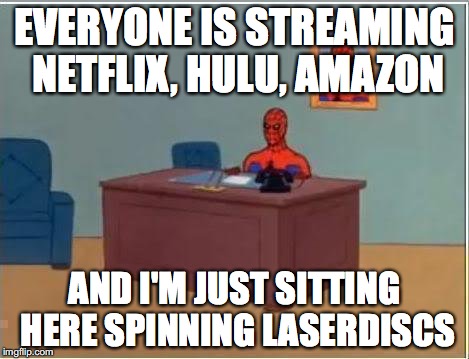
Posted by Justin Hamaker (Member # 2165) on 06-05-2016, 11:33 PM:
quote: Sam Graham
If you do have Amazon Prime, though, check out their original series "Bosch".
I second that. Just finished watching the second season.
Posted by Bobby Henderson (Member # 840) on 06-06-2016, 01:46 AM:
quote: Sam Graham
While I have Amazon Prime (which probably kept me from killing myself during my recent hospitilization), I'm still a disc guy. I want to own something vs relying on a streaming service to keep the rights (and they don't necessarily...Netflix adds and drops stuff all the time)
I'm still in favor of owning physical media, as opposed to buying a "HD Digital" download version of a movie. Movies on Blu-ray still have a quality edge over downloads. The audio-video bit rates are higher and the audio is typically lossless. In some cases the disc will have audio tracks in Dolby Atmos and/or DTS-X for those who have really high end home theater setups. That's not the case for download versions of movies.
On the other hand, it's very clear the movie studios couldn't give a rat's ass about physical discs anymore. They don't put much production value into the discs. It's a far different situation from what it was 10 or 15 years ago when studios busted their ass on really great DVD box sets like Fight Club or the extended editions of The Lord of the Rings trilogy. Today, more and more of these coasters don't even have a printed leaflet or anything else inside the case. It's just the damned disc. The studios have also gotten into this stupid habit of spreading "exclusive" extras to different SKU's specific to Target, Walmart, Amazon, etc.
The biggest hint the studios couldn't care less about discs is the release dates. Today a Blu-ray or DVD of a movie may hit store shelves a month or more after the "HD Digital" download first became available. Of course there is an obvious downside to that strategy of putting downloads in favor over discs: the very short release cycle makes it perfectly easy to wait for the same movie to appear on Netflix, cable, etc. It's probably going to look and sound every bit as good as the "HD Digital" download, but for a lot less money.
It's obvious the bean counters calling the shots for these movie studios have very little understanding of just what drives the home theater market. They're giving customers very little reason to collect movies. The product is becoming ever more disposable and as a download or stream it has little if any immediate value. It's no wonder the home video industry is hurting pretty badly right now. Bean counters are chasing after tiny short term gains in the stock market while ignoring the fundamentals of what fortifies the business in the first place.
Posted by Lyle Romer (Member # 1266) on 06-06-2016, 05:54 AM:
quote: Bobby Henderson
I get the feeling AT&T doesn't even give a shit about residential Internet service anymore.
They are (slowly) rolling out their Gigapower fiber service. My neighborhood got it last year and now I have 300 Mbps service. 1 Gbps is also available but I couldn't find any device, program or app that could actually make use of that bandwidth.
As for the topic Mike brought up, as has been mentioned by others, all the streaming services are essentially internet based premium cable networks. At least with DirecTV, you can get all the content from HBO, Showtime, etc. on demand in addition to watching live or recording an airing.
I would imagine that at some point you will be able to get the Netflix Channel on cable or satellite. I'd imagine it will happen when their subscriber growth slows and the burst of new subscriptions will spike the stock price.
Posted by Mitchell Dvoskin (Member # 751) on 06-06-2016, 08:08 AM:
For those not aware, Netflix has rolled out it's own speedtest web site. fast.com. It measure download only, but it originates from their servers so it will give you a more realistic number than the generic speed test sites. You do not need to be a Netflix subscriber to use it.
Posted by Bobby Henderson (Member # 840) on 06-06-2016, 09:19 AM:
quote: Lyle Romer
They are (slowly) rolling out their Gigapower fiber service. My neighborhood got it last year and now I have 300 Mbps service. 1 Gbps is also available but I couldn't find any device, program or app that could actually make use of that bandwidth.
AT&T isn't doing anything like that around here. I live a little over 1 mile from their midtown switch. They have some fiber leads going into the neighborhoods, but the rest of the infrastructure (the copper wires running from pole to pole and into homes) is badly outdated. If anything it seems like AT&T just wants to be rid of it. A friend of mine who used to work for AT&T said they have to pay certain taxes or other fees to keep service running in each home. That's on top of the taxes & fees the customer pays. The way it appears to me AT&T is only interested in running new wire, be it copper or fiber optic, into new neighborhoods. The trouble is around here all the biggest, newest homes are on the far east and far west sides of town, too far away from their switching centers.
The former AT&T guy said the company may try selling wireless residential Internet service in neighborhoods like mine, but I think such a scheme would be dead on arrival. So much wireless spectrum is getting gobbled up for cellular service. There isn't enough available for residential Internet that could possibly hold up a candle to cable-based or fiber-based Internet service. The wireless speeds wouldn't be as good and one could expect really stupid data caps, just like most smart phone plans.
Meanwhile the competing cable Internet service has been getting faster. Fidelity's top tier here is 125 megabit service. They're testing 300 megabit service in some markets.
Barring some major technological break through, I see no future for AT&T as a residential Internet service provider in Lawton.
quote: Lyle Romer
As for the topic Mike brought up, as has been mentioned by others, all the streaming services are essentially internet based premium cable networks. At least with DirecTV, you can get all the content from HBO, Showtime, etc. on demand in addition to watching live or recording an airing.
I would imagine that at some point you will be able to get the Netflix Channel on cable or satellite. I'd imagine it will happen when their subscriber growth slows and the burst of new subscriptions will spike the stock price.
I personally have no interest at all of adding a "Netflix channel" to an already way overpriced pay TV bill. AT&T just started selling some stupid offer involving Amazon prime that would actually cost customers more than just getting Prime directly from Amazon.
:angry:
I think cable TV providers are threatening to cut their own throats thanks to way out of control price gouging. My Dish network bill literally doubled between 2010 and 2014, with hardly any new channels being added. My paycheck sure didn't double during that period! DirecTV has been really bad about the price spikes too. Regular cable TV companies have been just as bad. It doesn't make any difference to the customer who is to blame for the price hikes, be it the pay TV companies or the TV networks. The really bad price inflation kicked off a big trend of cord cutting, which has really been embraced in a big way by the Millennial generation. But I know plenty of people in my Gen-X age group and older who have been cutting the cord the same way. The cord cutting is seen as pretty normal now. Even Fidelity didn't try hard selling me on their pay TV service. I only wanted the Internet. Nothing else.
If I didn't care about certain live sports programs I would turn off Dish Network right now. I have absolutely no use whatsoever for the fake news channels that spout different flavors of propaganda and celebrity worship 24/7. There's dozens of channels from MTV to Discovery that have been poisoned and polluted by so called reality TV. Hell, I can't even watch The Weather Channel anymore due to that garbage.
With networks like HBO "de-coupling," offering the streaming equivalent in HBO Now, it will eventually force cable companies to start selling channels al-a-carte. That's what really needs to happen. I could get by just fine with perhaps as little as a dozen channels. HBO, AMC, FX, ESPN, Fox Sports and the local OTA channels would be enough.
Posted by Mike Blakesley (Member # 26) on 06-06-2016, 11:21 AM:
The ala carte option would be nice but if they did that, it would either drastically reduce the channel choices, OR make the price for the popular channels skyrocket.
The cable companies lose money on the dozens of less popular channels, so the cost of them is made up from the profits from the popular channels. With an ala carte option those low-viewer channels would either disappear completely, or they would have to be priced higher to make a profit -- so eventually nobody would watch them and they would disappear anyway.
To avoid that happening, the cable companies would just crack up the prices on the channels everybody wants to watch.
So you could either have 300 channels for $100 a month or whatever, OR you can have the 6 channels you really want to watch for $18.50 each....your choice. There's progress for ya.
Posted by Bobby Henderson (Member # 840) on 06-06-2016, 08:38 PM:
Yep. I think a bunch of these cable channels are going to disappear one way or the other.
I'm surprised some of these channels still even exist under the current business model. All of the non-premium networks depend to some degree on commercial advertising to pay the bills. The network isn't going to sell many spots to advertisers if its ratings are shit. But how can the ratings be any better than shit when the programming blocks are filled with reruns of reality TV shows and infomercials?
Under an a la carte arrangement most of those shitty networks would die very much deserved, long overdue deaths. That's really the lesser of the two evils for satellite/cable TV providers.
Their other choice is to stay the course, keep passing along frequent price hikes from networks down to subscribers and continue net subscriber losses due to cord cutting. Eventually the cord cutting will put them and even the better cable TV networks into crisis.
This is why networks like HBO are now offering the de-coupled HBO NOW option. They can't afford to be totally dependent on the cable TV subscriber model. They have to diversify with a backup plan in case the traditional cable TV industry implodes on itself.
Posted by Justin Hamaker (Member # 2165) on 06-06-2016, 10:18 PM:
Bobby
Most of those "shit" cable channels are part of larger media companies like Time-Warner, NBC Universal, Disney, etc. I doubt they sell any advertising directly for content on those networks. Most likely they use them as add-ons to help attract big advertisers to the main network.
Since most of those networks do not have (much) original content, there is very little cost in providing them. They might go away if no one wants them as part of an ala carte model, but the threshold would likely be pretty low to keep those channels.
Posted by Bobby Henderson (Member # 840) on 06-06-2016, 11:49 PM:
Yes, I understand the shit cable channels are owned by giant global media companies who own a portfolio of other TV channels, some less shitty than others. They also own movie studios, music labels, etc. That doesn't make their shitty filler channels on the dial less shitty. It's like a package of Milk Duds with goat poop pellets mixed in with the candy.
Traditional pay TV customers have been getting price gouged for this garbage over the past decade. I can only guess it's to help prop up the stock prices for investors. For more and more people the product isn't worth the money and they're looking for ways out. Netflix and rabbit ears is one alternative. There are others, such as illegally downloading torrents. As little as 10 years ago there were no real alternatives at all.
Then there's the quality of content itself. I don't think there's enough in the way of great movies, TV shows and music to sustain the current business model. Due to less than a handful of global companies having a stranglehold on content production and distribution they've deliberately allowed things to get stale. They've interrupted the natural cycle of big changes in entertainment style that used to take place every few years. It's not healthy. In the long term something will happen to shake things up, violently even. The current situation with American-flavored global media companies reminds me a lot of the Big Three auto manufacturers in the 1960's & 70's. They kept doing things the same old way until they started getting their asses kicked by foreign competition. I think the same thing can happen here. What Netflix and Amazon are doing could just be the beginning.
Posted by Frank Angel (Member # 248) on 06-07-2016, 08:28 AM:
"It's like a package of Milk Duds with goat poop pellets mixed in with the candy." ...never heard it said any better, or more accurately. Let's face it, the consumer has ALWAYS been at the whim and mercy of the media conglomerates, just as exhibition also has been. The trick to NOT be at their mercy is to not let them convince you that you HAVE to see this or that product they seduce you into thinking your world will end if you don't see it and see it NOW. Will-power will thwart them every time.
The strange thing here in Brooklyn is that Cablevision cabled this bourough LONG after Manhattan got cable service -- I am talking like a decade later. Why? Because our borough president and city council wouldn't give a license to them until the company made some concessions; some had to do with stuff like maintaining street repair where they had to dig to lay their wire, etc., but the BIG stumbling block that Cablevision (Optimum) just wouldn't swallow was that council insisted that the company offer a "Basic" service for around $15-$20 a month. In the beginning this included all the broadcast stations and a handful of other channels thrown in, so you got about 25 channels, mostly stations from other markets. It basically was a way for people in poor reception areas could get decent TV reception. Thing is, Brooklyn doesn't have a lot of high-rises and most places, and what people didn't realize, for what they were paying even that absurdly low price for cable service, with the addition of a decent rooftop antenna, they could do just as well. But of course, once you have the cable, it was also a way to get cheap(er) internet service; cheaper, anyway than you could get if you moved off the Basic plan to their "triple play bundles" (triple bundles-o-shit) for $100 a month.
Posted by Bobby Henderson (Member # 840) on 06-07-2016, 12:22 PM:
I'm kind of surprised the cable and satellite service providers aren't culling some of the more worthless channels from their lineups. The only purpose I can see for keeping them is upping the channel count for marketing boasts. I don't care about having 100, 200 or even 500 channels. Most of it is shit I gotta click past to get to a good channel.
Maybe the cable companies can deal with channel bloat just fine, but I know it's tough on the satellite companies. They can squeeze only so many channels on those "birds" orbiting at 25,000 miles above the surface. My Dish Network dish is doing quite the balancing act; it's aimed so it can get signals from 3 different satellites. It was a huge production for Dish to transition from MPEG-2 to MPEG-4. They had to swap out satellites and swap out customer receivers. I imagine they'll have to do the same thing again with HEVC.
I still miss the DishHD package I had several years ago. It had nothing but HD channels, about 50 or 60 of them. This was also a time when many of the channels were still showing content relevant to their network names. I was paying a little over $50 per month for that package plus several HBO channels. The channel selection was actually better than what I have with Dish's "Top 120" package, which is the basic level offering. I'd have to upgrade up to their most costly package to get back some of the channels I used to have with the DishHD package. Considering what many of those channels are showing now, I'm not really missing anything.
I'm wondering how much impact Time-Shifting is still having on cable companies. I record a couple or so different shows to my DVR to watch later. I always fast-forward past the commercials. Some of these commercial breaks are freaking long, 4 or 5 minutes in some cases. The cable and satellite companies never would have incorporated DVRs into their receivers if not for the Tivo's onslaught umpteen years ago. Streaming services like Netflix take it a step farther. There are no ads to skip. An hour TV show episode originally from a regular cable network actually gets finished in roughly 40 minutes. The show's pacing is actually a little better without the ad interruption. When you binge watch it's a little more like watching a long movie.
Posted by Harold Hallikainen (Member # 5405) on 06-07-2016, 09:12 PM:
A couple comments. I believe that program suppliers require CATV companies to take programs as a package. Want the popular channel? You have to carry these several less popular ones. Another point is that these channels charge the cable system per subscriber, whether the subscriber watches that channel or not. I think ESPN is over $5 per subscriber. I imagine it would be a lot more if the cable company only had to pay for the people who actually wanted it (as in a la carte). Third, local TV stations charge the cable companies to carry their programming. TV stations have been increasing their rates substantially over the years. This has led to blackouts as contracts expire and negotiations continue.
Though broadcast (send the same thing to everyone) is more efficient and less expensive, the cost of wired bandwidth has dropped so much that it's affordable to pay for a separate stream to each subscriber. I think the future of television is streaming with each user getting their own stream. People may want to watch live TV, but even with live, they'd like to pause and replay a section. This pretty much gets us back to a separate stream per user. I was really surprised when AT&T bought Direct TV. It seemed like a step in the wrong direction.
Harold
(currently watching election results on the CBS News stream on Roku)
Posted by Evans A Criswell (Member # 381) on 06-21-2016, 03:48 PM:
I ditched cable in June 2013 and have occasionally used Netflix but I have noticed that the number of movies to choose from isn't that great. Netflix seems to prefer resolution over frame rate in their encoding and although the picture resolution is OK at normal viewing distance, the lower, jumpy frame rate on anything changing quickly is quite distracting. I was paying about $150 a month for cable and was never finding anything worth watching on TV. I've saved over $5000 in the past 3 years and my internet bill has been around $50 a month compared to around $200 it would have been with cable and the home phone (which I ditched as well). I was hoping in the early days of Netflix streaming that they would be able to just convert all their DVD library to online streaming but it did not work that way. Once every few months I get on and watch a few things and see what has changed because I can quickly exhaust everything I'm interested in on there.
Posted by Jesse Skeen (Member # 586) on 06-24-2016, 12:04 PM:
Commercials are the main reason why I've never had cable, aside from a time more than 20 years ago when I lived with an idiot roommate who wanted it and another when I moved into an apartment where the previous tenant forgot to cancel the cable "service" and I was getting it free for a few months before they switched it off. I've always accepted over-the-air TV as having commercials because I DON'T pay anything for it- they get their money selling ad time. No matter how you explain the cable business model, the bottom line is that someone is getting money both from advertisers AND viewers, and viewers are paying to watch commercials, and that isn't right.
Netflix started out pretty good, I was even willing to forgive their technical shortcomings. While some things have improved, their interface on newer devices is disturbing: at the end credits of movies, it shrinks the picture into a small box (much like some cable channels do) and tells you to hurry up and watch something else. Some jerk there came up with a way for their system to do this automatically so they don't even have a real human deciding when to do this. The whole point of Netflix is that you watch what you want, when you want, with NO interruptions- if I didn't want to watch the end credits, I'd pick up the remote and interrupt them myself.
Posted by Sean Weitzel (Member # 244) on 06-24-2016, 07:00 PM:
When I had a C band satellite dish system, it was possible to order channels via a package or a la carte. I've never been able to determine why that was either not offered or not feasible with dvb satellite and digital cable. Anyone know?
Posted by Harold Hallikainen (Member # 5405) on 06-24-2016, 08:26 PM:
I think the cable and satellite industry offer packages because al la carte would make the individual channels cost more since each channel would have lower subscriber numbers. As mentioned before, I think ESPN charges cable and satellite companies $5 or more per subscriber whether the subscriber watches it or not. If half the subscribers signed up a la carte, they'd have to pay $10 per month for ESPN to get the same revenue. Providing the content to people who don't want it lowers the cost to the people who do want it.
On advertising, it's pretty typical for publications to have a "dual revenue stream" consisting of subscription revenue and advertising revenue. Most newspapers operate this way. In fact, advertising on media where the subscriber paid for the subscription is seen as more valuable since the subscriber apparently actually wants the publication and is more likely to read it and see the ad. Cable channels also benefit from this dual revenue stream. Many movie theaters also use this dual revenue stream. Advertising allows them to charge lower subscription fees or lower admission prices. Consumers are free to choose a lower priced product with advertising or a higher priced product without advertising.
Harold
Posted by Ron Funderburg (Member # 4561) on 07-02-2016, 02:06 PM:
Now I know I’m old and old-fashioned but I like to read for entertainment and get away form the screen sometimes. Not always but sometimes it is nice to be caught up in a good book – even if you read it in digital format it is quite pleasing and you don’t have to worry about goat turds in milk duds then.
Now I know were in the movie exhibition business but still reading is much better than goat turds. Not that I have tried a goat turd
And yeah, before Bobby points it out, I have been away for a long time but I'm still a smart ass!
Powered by Infopop Corporation
UBB.classicTM
6.3.1.2