This is topic IT CAME FROM OUT OF SPACE now on 3D Blu Ray in forum The Afterlife at Film-Tech Forum ARCHIVE.
To visit this topic, use this URL:
https://ft-forum.com/ft/cgi-bin/ubb/ultimatebb.cgi?ubb=get_topic;f=12;t=001132
Posted by Claude S. Ayakawa (Member # 1401) on 10-05-2016, 06:34 PM:
I first saw IT CAME FROM OUT OF SPACE during it's first 3D theatrical showing in 1953 at the Liberty Theatre in Honolulu and I enjoyed it very much and was hoping one day it would be released in that format on Blu Ray. The day has come and the movie is now out on disc in 3D and it is terrific!. It is so good, I consider it one of the best disc released in the format and truly show how 50's 3D film making was much more superior to modern films. Unlike other 3D films released at the time, IT CAME FROM OUT OF SPACE, made subtle use of 3D and did not revert to gimmicks to show of the format. Unlike most modern films, the film has a lot of depth and at time images protrude out from the screen.
The film is in the 1.33:1 flat aspect ratio and in B&W and was directed by Jack Arnold and starred Richard Carlson, Barbara Rush and Charles Drake. The Universal-International 3D film was restored by the 3DFilm Archive group headed by Robert Furmanek and Grey Kintz . The disc is available only at Best Buy at the moment as a store exclusive for less than $10.00.
-Claude
Posted by Mark Ogden (Member # 43) on 10-05-2016, 07:47 PM:
It's, ah, It Came From Outer Space, isn't it?
Saw a very nice original print of this, 3D and the original sepia tone, just a few years back at Tarentino's New Beverly Cinema. Double feature with This Island Earth. The tie-in, besides being both Universal pictures, was that the Metallunian Mutant in the latter film was a rejected design for the alien in the former. Both were designed by former Disney animator Millicent Patrick, who also designed the Creature From the Black Lagoon (which is probably more than you wanted to know about any of this).
Posted by Claude S. Ayakawa (Member # 1401) on 10-05-2016, 08:07 PM:
I stand corrected on the title of the Movie, Thanks.
Where did you hear IT CAME FROM OUTER SPACE was in sepia during it's original release? My memory going back to the fifties is very good and I definitely remember seeing the 3D movie in regular B&W. in 1953 and that is the way it is on the Blu Ray.. Perhaps Robert Fumanek could enlighten us with the correct answer.
-Claude
Posted by Mark Ogden (Member # 43) on 10-05-2016, 08:34 PM:
Well, it was billed as an original print, and it was sepia toned. I found a picture from another screening just now:
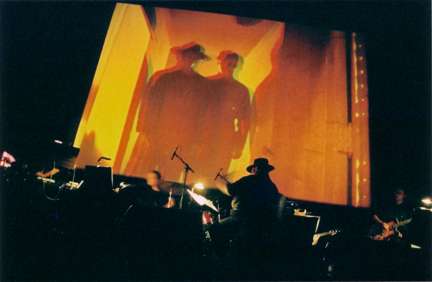
Possibly it is a case of "some prints were, some were not".
Here's a web page with more.
Posted by Robert Furmanek (Member # 7026) on 10-05-2016, 09:38 PM:
That's not sepia-toned. That's a recent print stuck from a badly faded anaglyphic negative. Yikes!
It was released in high-quality polarized 3-D in 1953, the inferior red/cyan conversion was done circa 1972.
Universal considered a dual-35mm sepia release in 1953 but scrapped the idea after sending their tech people to see Columbia's 3-D Man in the Dark in sepia. The loss of light with the polarization filters was too much so they went straight black and white on IT.
There's more info here: http://www.3dfilmarchive.com/it-came-from-outer-space
Posted by Robert Furmanek (Member # 7026) on 10-07-2016, 01:33 PM:
For the first time in 63 years, people are seeing IT CAME FROM OUTER SPACE with the original intermission card. It's created some confusion as to why a short film would require a break so I've updated the 3-D Myths page with the answer. Please share!
http://www.3dfilmarchive.com/home/top-10-3-d-myths
Posted by Jim Cassedy (Member # 4115) on 10-07-2016, 09:44 PM:
quote:
It's, ah, It Came From Outer Space, isn't it?
I thought it was "It Came From Out Of Outer Space" ![[Roll Eyes]](rolleyes.gif)
Posted by Jonathan Goeldner (Member # 4854) on 10-15-2016, 11:26 PM:
it's "Outta" ![[Wink]](wink.gif) LOL
LOL
Posted by Frank Angel (Member # 248) on 11-09-2016, 11:09 AM:
Bob, this made me wonder, was it a common thing for films, say after the era of sound, to be presented in sepia tone? Yes, I know silent features were hand-"colored" but was sepia-tone used on major sound B&W (or more accurately stated, Black & Sepia) releases...ever? And if not, then it is puzzling why Universal or Jack Arnold would even consider a sepia tone release for a major release, especially one that already had a hook -- 3D and stereo sound.
I know Filmack, the Chicago company that produced and snipes and daters in B&W would offer you the ability to order them printed on tinted stock. This was nice if you wanted to give some sense of color when you weren't rich enough to order color versions, to at lease give a sense of color when you were splicing them in with color trailers...the tinted snipes weren't as jarring if they came between color material as would be plain B&W, but I've never came across a full-length feature that was B&W stock on sepia-toned stock.
Posted by Robert Furmanek (Member # 7026) on 11-09-2016, 02:38 PM:
Oh, yes. There were lots of sepia releases in 35mm, including MAN IN THE DARK, SPOOKS and BEAST FROM 20,000 FATHOMS in 1953. Plenty of westerns too.
Posted by Frank Angel (Member # 248) on 11-10-2016, 07:03 AM:
Ah...learn something new every day. Coincidently, I actually did see BEAST FROM 20,000 FATHOMS when I was a kid in the Scouras Bayside Theatre in Queens NY. I can't remember it being in sepia -- but of course that doesn't mean it wasn't. Then again, I was probably too young to notice, although I was fairly astute in noticing cinematic oddities, for example, the stop-motion, jittery movement of the beast in BF2KF had the same quality as the movement of King Kong. No, I am not THAT old to have seen KING KONG in the theatres -- a station in NYC had a program "The Million Dollar Movie" (a movie that cost a million dollars...how quaint!) and they got rights to KING KONG or perhaps the station was partly owned by RKO, who knows, but they ran it literally three times a day for a week or more. I watched in on the 12in TV screen with my kid brother many nights until mom put a stop to it.
And I remember you never saw ads for movies on TV. But seems they were very innovative in marketing BEAST because I did see shorter versions of the trailer as TV ads. Movies just weren't sold to TV in those days and they didn't run ads for them either, so seeing this prehistoric beast on my TV made it something I HAD to see and pestered my parents day in and day out till they capitulated, just to shut me up, I think.
Movies were indeed special events back then. How times have changed, eh? Now they give them away for a dollar.
Posted by Mitchell Dvoskin (Member # 751) on 11-10-2016, 12:24 PM:
> perhaps the station was partly owned by RKO
It was the other way around. In the late 1950's, General Tire, which already owned WOR (radio and tv) in New York, bought RKO from Howard Hughes, primarily to gain access to the RKO film library for their television stations. Shortly thereafter, they shut down the studio and sold the lot and all it's contents to Desi and Lucy who renamed the studio Desilu. At that point, General Tire renamed their broadcasting division to RKO General.
Years ago, A friend of mine had a 35mm promotional short made for Westinghouse, filmed just after Desi and Lucy acquired the RKO studio. The plot of this short was that Desi was taking some Westinghouse executives on a tour of the studio, while Lucy was trying to convince Desi to buy her every Westinghouse appliance. It was rather funny. I remember as they walked though the prop department, seeing the King Kong model on a shelf. Everything in the studio was still as it was the day that RKO was shutdown.
Posted by Robert Furmanek (Member # 7026) on 11-10-2016, 09:14 PM:
There were many in the 30's and 40's but other sepia releases of the 1950's include all the Wild Bill Elliot and Gene Autry westerns; the Johnny Weismuller Jungle Jim features, FLAME OF STAMBOUL, THE JUNGLE, WACO, PURPLE HEART DIARY, A YANK IN INDO-CHINA, SKY COMMANDO, THE RIDE BACK, THIS IS RUSSIA, THE TOUGHER THEY COME and the opening/closing scenes of JACK AND THE BEANSTALK.
Posted by Frank Angel (Member # 248) on 11-11-2016, 01:17 AM:
I wonder if any sepia prints still exist -- collectors, some of the archives....LOC perhaps? Having seen almost every format and unique presentation type, at least since the early 50's, I think it would be fun to experience watching a full length feature in sepia tone. I suppose one could get that same effect by taking a B&W print and just using a yellow/orange filter in front of the lens, but who knows -- having the base actually tinted sepia might have a subtle difference than just filtering the light. Interesting stuff.
Posted by Robert Furmanek (Member # 7026) on 11-11-2016, 11:28 AM:
I'm sure there are many prints out there. The sepia 35mm BEAST FROM 20,000 FATHOMS screened in New York in the 1990's and we've got a left side of SPOOKS. Here's a frame:
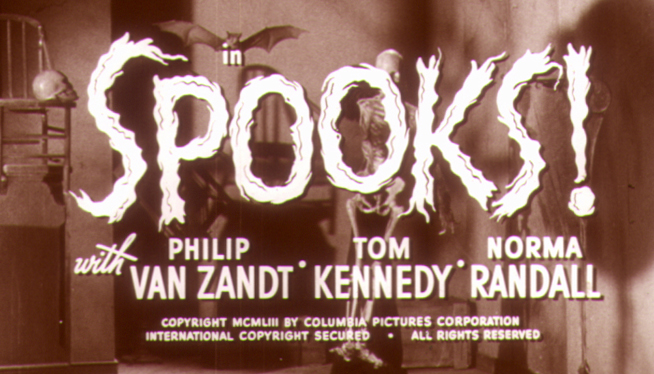
This article is quite interesting: http://www.archive.org/stream/internationalpr383940finn#page/n213/mode/2up
Posted by Bill Brandenstein (Member # 7758) on 11-11-2016, 04:58 PM:
OK, now based on Frank's comment, Bob's image does NOT look like tinted base but tinted emulsion. Did the camera make it look that way, or is there different chemistry going on?
Posted by Manny Knowles (Member # 1171) on 11-11-2016, 08:26 PM:
The 35mm print I showed last year was sepia toned -- it's unclear whether this was intentional, or bad printing.
Did someone mention bad printing? Consider the following:
Glasses needed to be "red-on-right" to get the 3D effect, even though the leader indicated "red-on-left."
Posted by Robert Furmanek (Member # 7026) on 11-11-2016, 08:48 PM:
That's a frame from the left side of a 3-D pair.
SPOOKS - and all the other Golden Age features and shorts (with a few exceptions) were shown in polarized 3-D. A few titles were reissued in anaglyphic in the 1970's.
See myth number one: http://www.3dfilmarchive.com/home/top-10-3-d-myths
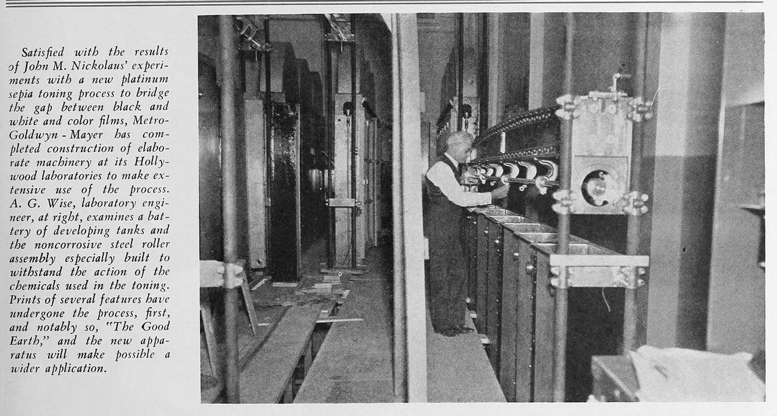
The first sound feature released in sepia was THE GOOD EARTH in 1937.
Posted by Frank Angel (Member # 248) on 11-15-2016, 01:54 PM:
So then it wasn't just tinting the base, but it was a way of toning the emulsion -- looking at the SPOOKS frame it seems quite apparent that the white lettering is still white while the rest of the image has the sepia tint in gray-scale, or better put, sepic-scale. I sure would love to get my hands on a sepia print of BEAST to book.
Posted by Bill Brandenstein (Member # 7758) on 11-16-2016, 11:56 AM:
That would look wonderful. The whites are white, the densest blacks would be too dark to think much of the sepia toning, and everything else in between would have a lovely tone to it.
Where does one ever see this? Was it true that the opening reel of "Wizard of Oz" would've used such a process?
Posted by Mark Ogden (Member # 43) on 11-16-2016, 01:25 PM:
Reels 1A & B and 5B of The Wizard of Oz use the process, although mid-50s re-release prints drop it for straight b/w. These ran a LONG time, I remember them from the old "MGM Children's Matinee" series back when I still was working on an apprentice card.
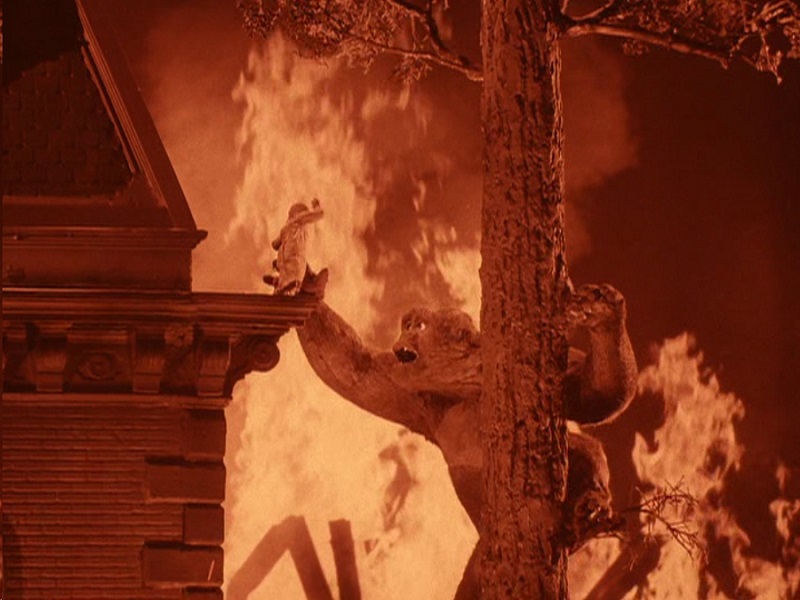
There is a startling sequence towards the end of the original Mighty Joe Young that contains an intensely dyed section, more vivid than just sepia. It takes place at the orphanage fire where Joe climbs the tree to save the little girl.
Posted by Robert Furmanek (Member # 7026) on 11-18-2016, 12:20 PM:
That was for the 1953 reissue. The orphanage sequence in the original 1949 release used a complex combination of tints, tone and dyes created by Technicolor. That version has not been seen since the original theatrical dates.
Posted by Jack Theakston (Member # 4484) on 11-18-2016, 03:20 PM:
Tinting is a process where the film is dunked in dye. The effect is like having a filter put in front of the image. Color and Black.
TONING is physically replacing the silver in the emulsion through chemical means with a silver salt. Hollywood labs typically had four toners to choose from—sepia, red sepia, blue and green. The effect of sepia toning, which was done with uranium ferrocyanide toning, gave a Brown & White image.
As Bob mentioned, MGM was big into Platinum sepia toning in the late '30s after testing it out on MAYTIME. It was a pet project of the MGM lab head, John Nickolaus. The studio called it "sepia-platinum," but many other labs offered it, too. But I've seen earlier sound prints that were Sepia-toned, including REACHING FOR THE MOON (1930) with Douglas Fairbanks.
WIZARD OF OZ, of course, is the most famous usage of sepia-platinum. The effect was so carefully conceived that the shot following the lab splice in Reel 2 goes to Technicolor, in which Dorothy opens to the door to Oz. The setting and her dress in that shot as she goes to open the door were carefully designed in sepia to match the tone of the first reel.
Posted by Manny Knowles (Member # 1171) on 11-19-2016, 11:29 PM:
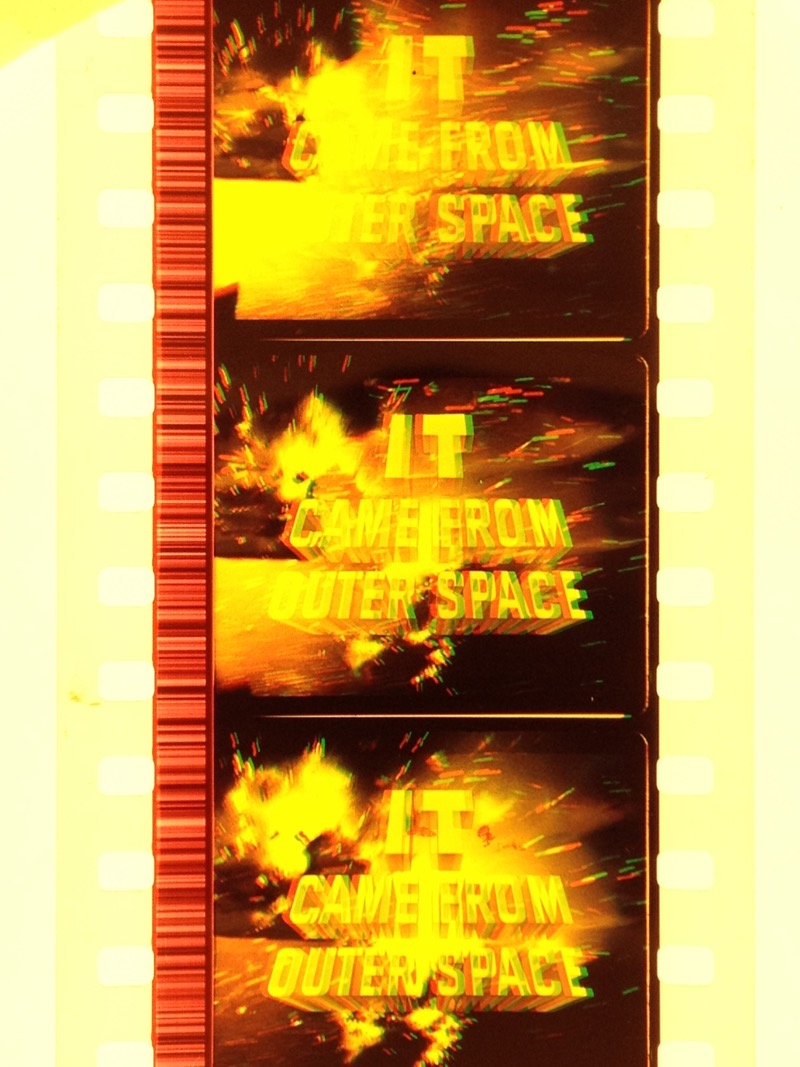
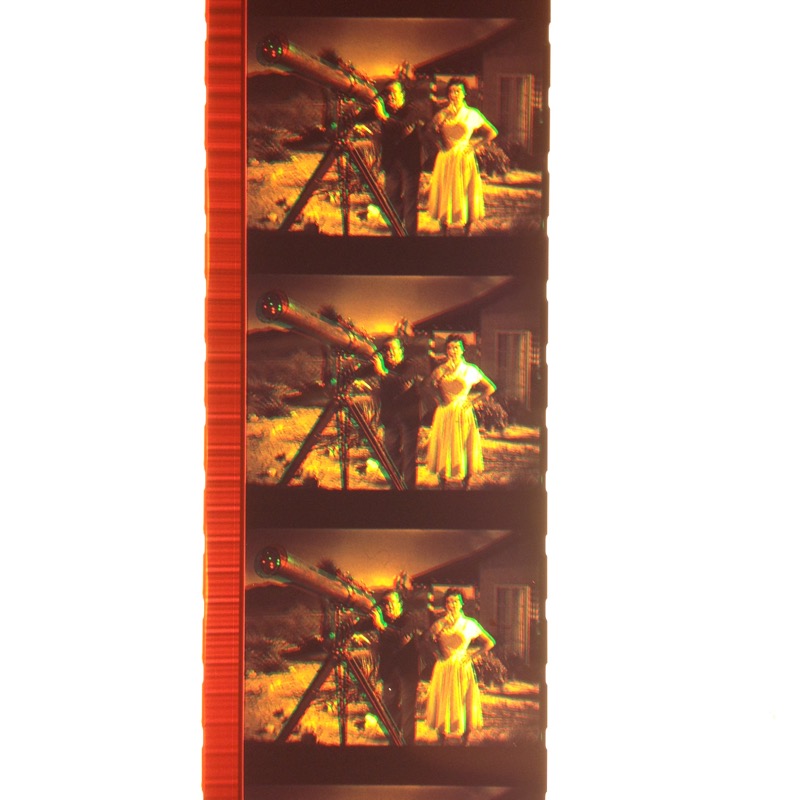
I knew I took photos. Here they are...
Posted by Robert Furmanek (Member # 7026) on 11-21-2016, 04:48 PM:
That's not sepia. It's a fairly recent print struck from a faded circa 1972 anaglyphic negative.
Posted by Mark J. Marshall (Member # 1409) on 11-21-2016, 07:31 PM:
quote: Robert Furmanek
The orphanage sequence in the original 1949 release used a complex combination of tints, tone and dyes created by Technicolor. That version has not been seen since the original theatrical dates.
Just to clarify - does that version still exist, or is it lost?
Posted by Robert Furmanek (Member # 7026) on 11-23-2016, 12:15 PM:
Sadly, I don't think the orphanage sequence survives with the original Technicolor tinting and toning.
Powered by Infopop Corporation
UBB.classicTM
6.3.1.2