
I saw that blow up. Grain the size of baseballs
Matthew
Quality will depend on a number of factors
a) Do you want to blow up a portion of Vistavision frame to fill the 1570 frame or are you going to letterbox the original aspect ratio?
b) The age and speed of the original stock
etc.
The person I would approach would be Chris Reyna at Imagica in LA .e-mail him at chrisr@imagicausa.com.
Imagica USA Inc.
5320 McConnell Avenue
Los Angeles, CA 90066
Phone: 310-305-8081
Fax: 310-305-7563
His company do all sorts of blow ups and transfers.
As Dick Vaughan notes, the image quality depends on the type of negative film used, and the quality of the cinematography. But even the area of an 8-perf VistaVision or a full frame "Super 35" negative won't match the quality of 65 mm origination. Look at the usable image areas available:
IMAX 15-perf 70mm: 2.74 x 1.91 inches (69.60 x 48.5 mm)
8-perf 35 mm VistaVision Negative: 1.472 x 0.997 inches
"Super 35" Full Camera Aperture: 0.980 x 0.735 inches
Imagica USA (Chris Reyna) ( http://www.imagica.com/company/group-e.html ), CFI ( http://www.cfi-hollywood.com/ ) or David Keighley Productions 70 MM Inc. ( http://www.imax.com/corporate/companies.html ) are very expert in this type of lab work.
But, as always, "Size DOES Matter".
------------------
John P. Pytlak, Senior Technical Specialist
Worldwide Technical Services, Entertainment Imaging
Eastman Kodak Company
Research Labs, Building 69, Room 7419
Rochester, New York, 14650-1922 USA
Tel: 716-477-5325 Fax: 716-722-7243
E-Mail: john.pytlak@kodak.com

Any of today's Kodak Color Negative films would look great in the VistaVision format:
http://www.kodak.com/US/en/motion/products/camera.shtml
(And they look even better in 65 mm formats  )
)
------------------
John P. Pytlak, Senior Technical Specialist
Worldwide Technical Services, Entertainment Imaging
Eastman Kodak Company
Research Labs, Building 69, Room 7419
Rochester, New York, 14650-1922 USA
Tel: 716-477-5325 Fax: 716-722-7243
E-Mail: john.pytlak@kodak.com
Transferring to Film Handler's Forum.
John is correct, no matter how much I like the Technirmama 70 or Vista Vision (motion picture hi-fidelity) processes, you just can't beat origination in 65mm. Ben Hur or Lawence are sooooo sharp in close ups you can see individual eyelashes!
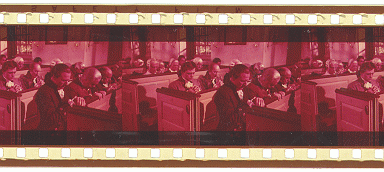
I would like to have seen a Vista Vision presentation.
If you look at the numbers I gave for the image areas of 15-perf 70 mm, VistaVision, and Super-35, I agree with you that the advantage of the more rectanular VistaVision frame over the better-fitting Super 35 frame are minimal.
As to "why?", the Michael Jordan film provides an example of mixing 35 mm "action footage" that would be very expensive or impossible to cover with 15-perf 65 mm, with the "super-high-definition pictures" of the 15-perf 65 mm format. It can work well.
------------------
John P. Pytlak, Senior Technical Specialist
Worldwide Technical Services, Entertainment Imaging
Eastman Kodak Company
Research Labs, Building 69, Room 7419
Rochester, New York, 14650-1922 USA
Tel: 716-477-5325 Fax: 716-722-7243
E-Mail: john.pytlak@kodak.com
You're correct about a 35mm still camera producing about the same image area as a VistaVision negative. Every few weeks on r.a.m.t and other newsgroups, someone comes up with the idea of shooting a widescreen (animation or CGI) epic using their 35 mm SLR camera. Nikons with pin-registered movements are in short supply .
------------------
John P. Pytlak, Senior Technical Specialist
Worldwide Technical Services, Entertainment Imaging
Eastman Kodak Company
Research Labs, Building 69, Room 7419
Rochester, New York, 14650-1922 USA
Tel: 716-477-5325 Fax: 716-722-7243
E-Mail: john.pytlak@kodak.com
Mark: Where did you get that high price???
The September 2000 Price List for Kodak Motion Picture Films lists a 1000-foot roll of 65 mm EASTMAN EXR 100T Color Negative Film 5248 as $1030.00, or a little over a dollar a foot. Even the latest KODAK VISION 800T Color Negative Film 5289 is only $1211.00 for 1000 feet, or $1.211 per foot in 65 mm.
As you might expect, for 65 mm negative, Kodak only charges two times the price of 35 mm film. (Since we get only 19 strips from each wide roll for both 65 mm and 70 mm, compared to 38 for 35 mm).
------------------
John P. Pytlak, Senior Technical Specialist
Worldwide Technical Services, Entertainment Imaging
Eastman Kodak Company
Research Labs, Building 69, Room 7419
Rochester, New York, 14650-1922 USA
Tel: 716-477-5325 Fax: 716-722-7243
E-Mail: john.pytlak@kodak.com