CROWN THEATRES
64 North Main Street
Norwalk, CT 06874
Tel: (203) 846-8800
Fax: (203) 846-9828
------------------
John P. Pytlak, Senior Technical Specialist
Worldwide Technical Services, Entertainment Imaging
Eastman Kodak Company
Research Labs, Building 69, Room 7419
Rochester, New York, 14650-1922 USA
Tel: 716-477-5325 Fax: 716-722-7243
E-Mail: john.pytlak@kodak.com
These are new machines supposedly cheaper,simpler and more efficient than the Imax rolling loop projectors which I have been operating,installing and maintaining since'83. They are apprently made by a company called Advanced Image Systems of Los Altos,Ca.
------------------
Advanced Image Systems, Inc.
371 First Street
Los Altos, California 94022
(650) 941-2773 administration office
bob@advancedimagesystems.com
http://www.advancedimagesystems.com/
------------------
John P. Pytlak, Senior Technical Specialist
Worldwide Technical Services, Entertainment Imaging
Eastman Kodak Company
Research Labs, Building 69, Room 7419
Rochester, New York, 14650-1922 USA
Tel: 716-477-5325 Fax: 716-722-7243
E-Mail: john.pytlak@kodak.com


Does anyone have an actual documentation on their projectors, or have they not released anything yet?
If you have a specific question, ask me- and I'll ask him.
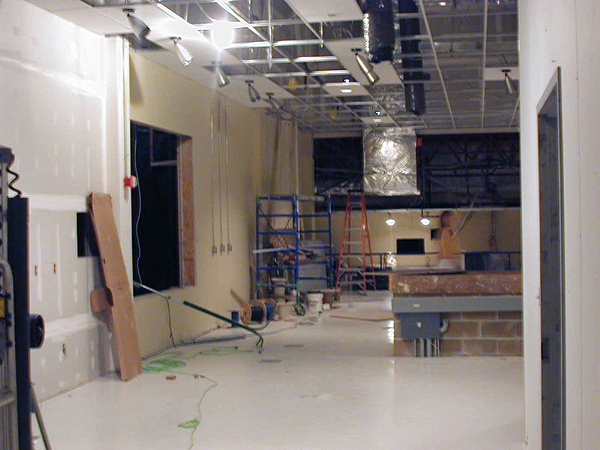
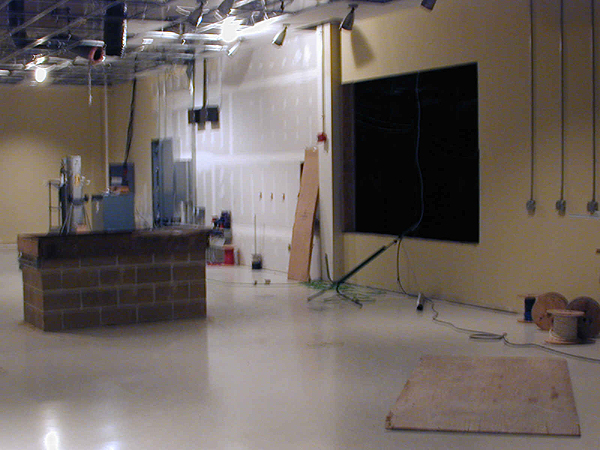
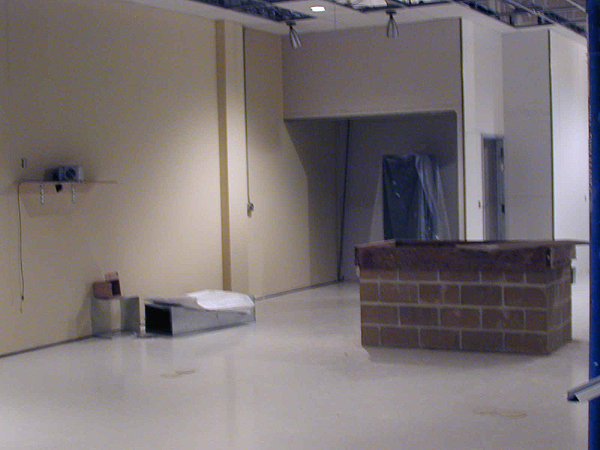
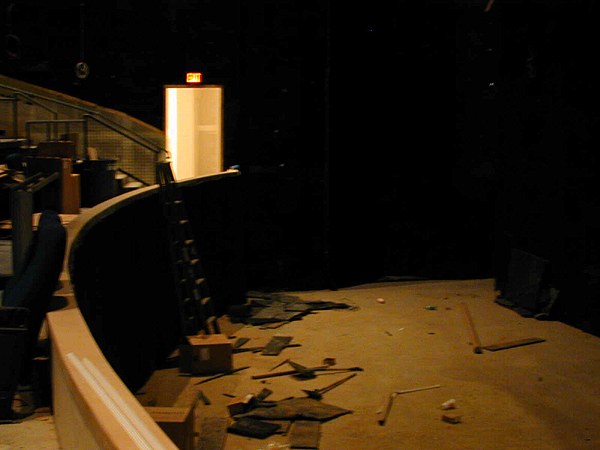
I've visited the theater we're building in Hartford, and took some pictures. There was very little light, so I had take pictures with long exposure times... which means they are a little blurry. As far as the IMAX-type booth goes, no equipment has been installed yet. I'll send what I have to Brad.. you'll have to give him a little time to put them up...
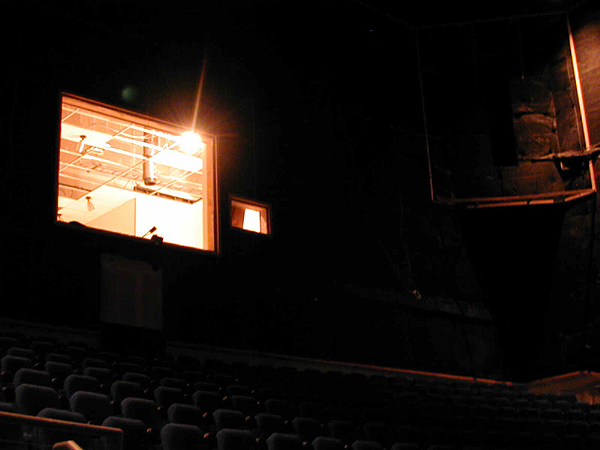
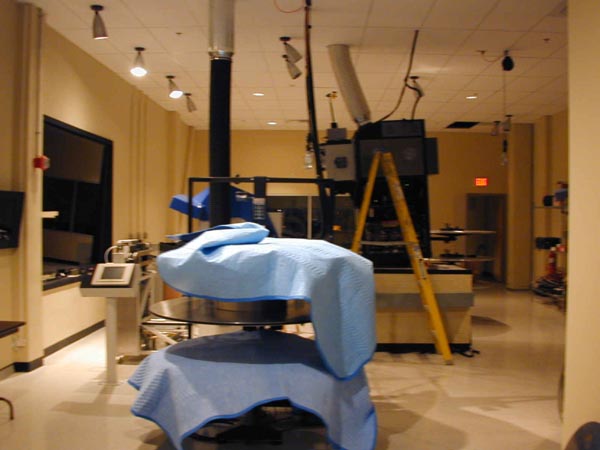
In the top two photos, you can see the large port window. It is about 12 feet square, and we are buying two peices of optical glass for it.
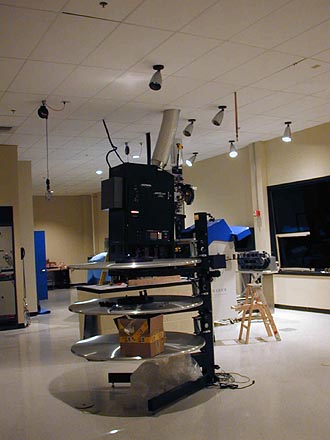
The 15/70 projector will go right in front of the port window. The pedastal a few feet back from the wall is for the regular 35mm projector (it's a dual-use theater.) The short throw requires a short focal length lens, and with two different projectors shining out, requires a large window.
In the third picture, (beyond the pedastal) will be the elecrical rack room. Once the racks fill up the opening, there's a door to get back there.
The fourth picture shows the pit down front.
The fifth picture shows the port window from the auditourum. The frame you can just about see to the far right is one of the rear speaker arrays.
Cool pictures 
Is this a 2D or a 3D system? How big is the auditorium?
In the top picture, there's a red colored ladder way back there. That's where a large window will across go so people can get the booth tour. So some of the booth will actually be viewing area.
The booth will be a little strange. Some of the other theaters have a raised loge seating area. To to conform to the handicap laws, we need to allow weelchair access to those seating areas. The only practicable way to do that is to allow weelchairs into the booth, to gain acess to the upper seating areas in the back of some auditoriums. So the projection room is considered a "full access public area," which means big wide hallways, ramps, and an elevator.
We thought we were doing a nice thing, by allowing people in wheelchairs to sit up in the back (if they want; there are other places down front, and on the sides.) But, even though the place has been approved by the state, a handicap group feels that it's degrading to make people go through the booth to get to the theater, and has offered to sue us if we don't put in a seperate method of access (seperate elevator) to those areas. Ya can't please everybody, I guess....

That really irks me that they would say that. Here you are trying to be nice and let people in wheel chairs get to some better seats and they attact you for it. I don't think the laws says where handicap seating is to be located. If they give you trouble, just change the seating to all up front. That'll teach them.
I'm just kidding of course, but that was a pretty rude thing for that handicap group to say and it annoyed me.
P.S. John, could you please ask someone up there if it is OK for me to send these pictures to Brad. After the CP500 posts (automation, cues, etc.), before I got to discuss it with my booth manager, we got a phone call making sure that I did not do this. I just would like some kind of approval so I can keep my job.
Steven Gorsky
------------------
Projectionist
Disclaimer:
Anything expressed in this post is my personal view/opinion, and not necessarily the view of the company for which I work.
Any technical questions are for my personal knowledge only.
You really can't blame the tech guys; they just have too many screens to watch over and can't be expected to remember slight differences from one screen to the next. It makes things much easier to keep all settings the same, as much as possiable.
"Who's the tall pro-jec-tor there?
Mav-er-ick is the name...
Never mind me. Please continue.
------------------
Better Projection Pays!
Can't find it on the pic's, only construction work! 
Now how does a Maverick look like?
Yes, I do avert my eyes...
I am little confused by the porthole layout.Are you saying that the 35mm is to project through the large central port?
On large format theatres I have worked on we have always tried to separate the two.
That large piece of glass seems over the top.
The projection port for each of our Imax projectors is only around 20" x 20" with a separate larger viewing port.
Your theatre acoustician is really going to love that large reflective surface on the back wall!
I am also a little confused as to why the pedestal for the 35mm projector is :
a) so far back fom the projection port and
b) so tall.
Definite need for the non vertically challenged variety of projectionist to reach the top roller I think.
As for disabled access through the projection booth this is a bad idea on two counts.
1) The obvious flak you will get from disabled groups about segregation
2) Equally as important is the dust and dirt that non essential traffic brings in to the booth. It's bad in standard theatres , a hundred times worse in large format.
To keep the film clean and in good condition you need good temperature and humidity control,good air filtration and a positive pressure in the room.Coupled with this there is a need to put tack mats outside the doors to the booth and restrict access to essential staff only.Oh yes and anti static carpet on the floor.
At an Imax theatre we recently opened in London we too had challenges with realation to placement of wheelchair spaces.
We had provided 6 permanent spaces at the back centre of the auditorium but were told that in order to not discriminate we had to provide 2 on the front row ,the worst possible poaition for a wheel chair user to view a large format film.
As for the projector does it have a version of the rolling loop or an intermittent system?
What size is the lamp?Is it air or water cooled?
What sound format are you using ,DTS?
Are you installing a silver screen straight away in preparation for conversion to 3D? if so are you spraying it on site or bringing in a prepainted sheet?
Just a suggestion about the public viewing window.Make sure there is a blind installed so that you can close it when/if you have a problem. Nothing worse than Joe Public leering in at you while you're trying to sort out a large format brain wrap!!
I guess I got lucky, my port glass is tilted. I wouldn't want to be looking at 15kW everytime I walked past the projectors, actually it would be 30kW between the two. OUCH!! Might need a pair of these .
I have a 35mm as well, and we installed it 10'6" off to the left of the center. It has a large amount of keystoning. So having the 35mm projector project over the 1570 machines and out the same port glass might be their way of avoiding that.
1. You made reference to a intermittent 1570 projector. Does anyone make (or made) a 1570 intermittent projector? I have only seen or heard of rolling loop projectors for 1570.
2. You also mentioned a 1570 brain wrap. Does your system have center feed 'brains?' I think I remember hearing about some systems that used center feeds, but I have only worked with 'Reel Units' that feed from the outer edge and have to be rewound.
Just curious.
Our large heavy duty platter for Special Venue applications does use a center-feed payout head. It's got a larger diameter than a standard theatre style and there are a few other chnages as well, but the basic concept is the same. The big Imax transports have the same idea, I believe.
I know that some locations use a center feed based system for 8-perf, but does anyone use a center feed for 15-perf?
Again, just curious.
First, as you can see, it is still early in the construction. So there is very little equipment, or even "roughed-in" electrical pipes and fixtures.
The throw is very short, and the screen is large, (the throw is only a little longer than the width of the screen) and that is why the port window is so large. The 15/70 projector will go almost directly in front of the window on the floor level... for servicing, it will not be placed right up to the glass. I don't know if the glass will be tilted; I'm fairly sure that someone has thought of that, ie: if it's not tilted, there was a reason. I have seen a 1 foot square sample of the glass, and it's very thick (about 1/2") and heavy. It's two thinner peices laminated with a safety layer in the center.
The regular 35mm projector will sit on the pedestal. It is located up fairly high so that it's image will clear the 15/70 projector. Since the throw is so short, there would be distortion if either projector was located to the left or right.
So the idea is both projectors are centered on the screen (the 15/70 projector is properly centered, the regular 35mm projector is only a few degrees high, and neither has to be moved to run a show. To keep the angle of the 35mm projector as close to "center" as possible, while not interfering with the 15/70 projector, the pedestal had to be located back aways... and with a short focal length lens, this means a big window.
As I said, this is early in construction; There will be a steel platform next to the pedestal to hold the platter and a place for the operator. The projector itself is heavy, so they made a concrete block pedestal just for it.
As unbelievable as this may sound, our company has actually slowed down the rate of construction. Some elements (HVAC, electrical, etc.) were not getting done in an orderly manner, and they want the place to turn out right. So, some trades on the project have been told to slow down, to allow others to catch up. In 25 years I been doing this, I think this is a first.
There's no doubt there's a large reflective surface with that glass. However, THX has approved a design. I don't know what they will recommend, but they say it can be done.
The 15/70 booth will not have traffic through it. When I mentioned the public viewing window, it will go entirely across the opening seen in pic#1 (top.) However if you look carefully at pic#1, in the background there are two small spotlight and a black rectangle. That is the viewing port for another (regular), theater, and it's floor lever is about 4 feet down from the 15/70 booth floor level. Handicap customers will pass through there to get to the back of other theaters (this theater complex has 19 screens.) And when I say the area is "public" I don't mean open all the time to wander as they please. To get up there, patrons will need to have someone let them in, as it's only for those who want to see the 15/70 booth, or are in wheelchairs.
It's not an ideal solution, but as a company goes through all the requirements set forth by the zoning laws, disability laws, avaiable property size, amount of money you have to spend, etc, etc, your choices get very limited. We could have satisfied our requirements for wheelchair seating by just taking out seats on the main floor(s), but everyone likes to sit in the balcony (or loge) and we thought it would be nice to allow people to do that. (We also added handicap bathrooms in the booth so people don't have go all the way back to the lobby.) But, we could hardly afford to build a theater complex with a seperate hallways, elevators, etc. just so patrons don't have to go through the booth. If that was required, we would have just bagged the idea and pulled out enough seats on the main floor to pass.
Now, as to the 15/70 projector itself, I have talked to the "powers that be," and they have asked me not to say who we are working with. Some contract details still need to be worked on, and until some "i"'s and "t"'s are dotted and crossed they would perfer not to say exact details like screen size, throw, wattage, projector make, 3D or not to 3D, etc. etc. It's not really so much a secret, as they just don't want anything to "jinx" the deal. They were rather amused that: ".... a guy in *England* was asking about it??!!..." To anyone knowledgeable about large format IMAX-type projection, I believe they would find the details only mildly interesting... while it's interesting technology, there's nothing really new and different.
And because of Tim, I keep thinking of that stupid TV theme!....
Oh, say no more, say no more! Livin' on Jacks and Queens,
Tim
------------------
Better Projection Pays!
the "secret" is that the projector slides backwards to allow threading /lacing and then forwards to project. In this position the front of the lens almost touches the polarisers.
At our theatre in Bradford the projection throw is about 57'6" ,screen width 65'4".
here we have the SR system with two small rotor projectors which slide diagonally back and apart to thread. there are some good shots of this type of system in the pictures section of the Cinemark Tulsa theatre
If I am correct you have a large rotor twin projector side by side set up that moves apart for threading then together for projection.
At bradford
our 35mm projector is offset by about 6 'from the centreline so keystoning in't too bad.
As for intermittent 1570 machines Cinemeccanica built one a number of years back but it was very unsteady and went through cross boxes at a rapid rate.
As for centre feed ,yes we have a QTRU (Quick Turn Reel Unit) which is a beefed up platter system built for Imax by Kinoton.
John,
the idea of having the 35mm project over the top of the 1570 is interesting. is the operation of the 35mm remoted to by the front wall? Just wondered from the point of focussing up from back there. Also are you installing any blinds/curtains to cut down the light spillage through the port when you are projecting 35?
As to my interest if you look at my profile you will see that i am interested in all projection systems.
Being based at a museum dedicated to the preservation and presentation of all aspects of cinema technology is a definite plus.
For those of you that don't know about us take a look at our website http://www.nmpft.org.uk.
I would love to see that twin rotor machine, I have only read about them. I haven't even seen a picture.
7000 watt air cooled lamp.
Will not be running 3D, but booth is designed to goto it if we want.
The screen is not silver, but it's not matte white either; there is some gain. No one actually knows what it is; the projector company spec'ed it.
It is a Maverick 15/70 projector.
The "secret" really is in the contracts (price, exclusivity to an area, getting prints, etc.) Management couldn't care less about how the projector operates. It's being built now- no one has seen it, yet.
There will regular masking at the screen to trim off IMAX-type, regular flat and regular scope. It is a fairly complicated rigging scheme.
I will try to take, "after" pictures.
Masking a curved screen that big has got to be a challenge. There are only a handful of Imax theatres with this facility mainly down to cost.
I hope they don't try and push the 35/70 picture out too far .
The Maverick Projector.........
The Rawhide platter transport......
The High Noon lamphouse........
The Butch Stereo Processor......You'll be fine if you don't fool with it!
The Unforgiven rectifier........
The True Grit film cleaner attachment......
The Wagon Train print mover machine.......
The Big Valley screen.........
Sundance Xenon Lamps.......
Booth maintainance by Doc Holladay.......
Jessie
There are two 8perf LF systems near me and both are suffering from the matte white blues and they are WAY underlamped. Just way too dim.
Gord, I don't think that CFS is manufacturing the Ultra 70 machine anymore. I doubt that they made that much of it anyway cept for the lamphouse. Someone else that had brains had to make the critical parts anyway. CFS could have never handled that without major problems. No one there ever had any brains. I guess they went off to see the Wizard.....
Mark gts
When I click on your link it takes me to www.dealhunting.com not a patent description on the Maverick film transport mechanism. 

Its interesting that the 15/70 time lapse camera the Ron Fricke had built for Chronos also used a chain type pull down with pin registration. It also was not able to run up to 24 fps either but I think it did attain 18 fps which in itself is pretty amazing for a chain type pull down on this size format. Running it at say up to 10 fps seems easy though.
MArk @ GTS
------------------
John P. Pytlak, Senior Technical Specialist
Worldwide Technical Services, Entertainment Imaging
Research Labs, Building 69, Room 7525A
Rochester, New York, 14650-1922 USA
Tel: +1 585 477 5325 Cell: +1 585 781 4036 Fax: +1 585 722 7243
E-Mail: john.pytlak@kodak.com
Web site: http://www.kodak.com/go/motion
We have two Maverick projectors, and I think that's all that have been made so far. The first one (installed in Hartford, CT) is about 1 1/2 years old, the other (in Florida) less.
There were concerns with the first projector for about 4 months after installation; Quite simply, it broke down a lot. But, Advanced Image Systems did provide parts and service every time to keep it going. I guess they did have some personnel changes, but the same service guy still always showed up, at the regular planned service times. So, they seem to be handling everything well.
We were satified enough to book and run the Beauty/Beast 15/70 feature. It hasn't missed any shows since we started running it.
It should be noted that the projector design was new, and we were willing to work through any problems that came up. The price is significantly lower than an IMAX; we simply couldn't afford/justify the cost of an IMAX. It would have taked too long to get a payback. And, in hindsight, I think it was the right decision for us.
So, I think if someone is looking into a 15/70 projector, the Maverick is worth looking into. While we had to deal with some problems, it has been refined over time, so the unit someone would get today would probably be very reliable.
I'm sending a picture of it to Brad to post. It was taken during construction of our Hartford, CT theater.
------------------
John P. Pytlak, Senior Technical Specialist
Worldwide Technical Services, Entertainment Imaging
Research Labs, Building 69, Room 7525A
Rochester, New York, 14650-1922 USA
Tel: +1 585 477 5325 Cell: +1 585 781 4036 Fax: +1 585 722 7243
e-mail: john.pytlak@kodak.com
Web site: http://www.kodak.com/go/motion
It has been 643 days since the last post.
![[Big Grin]](biggrin.gif)
