This is topic 5/70? 8/70? 15/70? in forum Large Format Forum at Film-Tech Forum ARCHIVE.
To visit this topic, use this URL:
https://ft-forum.com/ft/cgi-bin/ubb/ultimatebb.cgi?ubb=get_topic;f=14;t=000095
Posted by Richard Greco (Member # 2032) on 01-15-2005, 01:41 AM:
Can someone explain these numbers to a 35mm guy? I know the 70 means 70 mm, but what do the rest mean?
Posted by Paul Mayer (Member # 355) on 01-15-2005, 02:18 AM:
The number of perfs defining that dimension of the film frame. So 570 is five perfs high, 870 is eight perfs high, 1570 is 15 perfs wide (1570 runs horizontally).
Posted by Monte L Fullmer (Member # 2797) on 01-15-2005, 02:57 AM:
quote: Paul Mayer
870 is eight perfs high, 1570 is 15 perfs wide (1570 runs horizontally).
or...5/70 is your usual 70MM, 8/70 is the vertical film run SuperScreen, and the 15/70 is the IMAX/OmniMax presentation.
Here's some pics of 5/70 and 15/70 IMAX. The 5/70 is from "Dr. Dolittle" and the 15/70 is from that Space Shuttle show (forget the title).
the 5/70

the 15/70
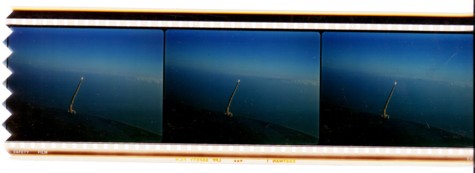
Sound for the 5/70 is on the magnetic tracks containing the standard six channels, whereas the 8/70 and the 15/70 uses a digital sound dubber that runs in sync with the film.
-thx Monte
Posted by Dick Vaughan (Member # 540) on 01-15-2005, 04:45 AM:
5 /70 prints can also carry DTS code in place of the mag tracks and have in the past had digital soundtracks (CDS)
8/70 and 15/70 can also be synchronised with 35mm mag tracks, 1/2" 8 track,multi CD ( IMAX DDP) and DTS.
And I am sure that Messrs Hill and McLeod can add to this
In fact Phil probably synchronised 1570 to Vitaphone discs in his youth ![[Big Grin]](biggrin.gif)
Posted by Richard Greco (Member # 2032) on 01-15-2005, 10:58 AM:
Thanks Guys, now I understand.
Posted by Darryl Spicer (Member # 711) on 01-15-2005, 11:51 AM:
....and if you notice on the 15/70 example strip the jagged cut on the left side. This is done to reduce the tendancy of the film pulling away from the splice do to the tension caused by the speed at wich the film flows.
Posted by Mark Gulbrandsen (Member # 72) on 01-15-2005, 12:53 PM:
quote: Darryl Spicer
This is done to reduce the tendancy of the film pulling away from the splice do to the tension caused by the speed at wich the film flows.
Actually it allows the film to flex without making a sharp bend as a straight splice might do. This is very important in a rotor based projector of any gauge where the rolling action of the film might cause a straight splice to bend 90 degrees and cause a resultant pile up in which severe damage may result to the projectors claw mechanism.
Mark
Posted by Adam Martin (Member # 641) on 01-15-2005, 01:17 PM:
Claw mechanism? What awful projector uses a claw mechanism?
Posted by Dave Macaulay (Member # 813) on 01-15-2005, 03:38 PM:
The "claw mechanism" is used in Imax 15/70 projectors (I'm not sure about the new one, but it probably does) and in all the other large format rolling loop systems I've seen. This claw does not do the frame advance, the rolling loop takes care of that. The film is set on stationary registration pins around the projection aperture when the loop rolls past; this changes frames quite rapidly. As well as having a loop formed and dissipated 24 times a second, the film is moving through the projector at 337.5 feet/min. Just laying it onto the registration pins would require the film's mass to be decelerated by the registration pins - and would damage the registration perforations slightly. After repeated passes the accumulated damage would make the screen image quite shaky horizontally. To prevent damage to the registering perforations a "claw arm" engages film perfs a few away ("before" if you look at the projector but "after" in the sense of film time) from the leading registration perfs. The arm is actuated by a cam system so that the pins enter the perforation at the same speed as the film motion, then decelerate relatively gently until the film is almost stationary as the registration pins are engaged. A properly adjusted Imax projector will run a film loop for thousands of passes with no perforation damage.
Posted by Adam Martin (Member # 641) on 01-15-2005, 08:18 PM:
Oh ... you mean the CAM and CAM ARM. I have never heard anyone call it a "claw mechanism", so I read it to mean a claw mechanism that advances the film, such as in an camera. (And let me tell you ... the claw mechanism in an Imax camera is something to behold!)
Posted by Phil Hill (Member # 371) on 01-16-2005, 07:48 PM:
Adam: I cannot believe it! You are soo naive! Dave said it best and eloquently explained what was meant by the term "claw" and its function as it pertains to a rolling-loop projector.
I'll have to go and look at my copies, but I believe that it is referred to as the "deceleration cam, arm, and CLAW" in the patent as well.
Gosh! For a mod, you sure are a dumbass sometimes! HA!
(Am I banned yet?)
Hugs,
>>> Phil
Posted by John Pytlak (Member # 331) on 01-17-2005, 01:56 PM:
Just a few of the US Patents for the IMAX projection system:
U.S. Patent Documents
3494524 Feb., 1970 Jones
3600073 Aug., 1971 Shaw
3794415 Feb., 1974 Jones
3944349 Mar., 1976 Jones
4039256 Aug., 1977 Teeple et al.
PAT. NO. Title
1 5,050,985 Film deceleration unit
2 4,997,270 Projected image alignment method and apparatus
3 4,993,828 Camera and method of producing and displaying a 3-D motion picture
4 4,971,435 3-D motion picture projection apparatus
5 4,957,361 Method of producing and displaying a 3-D motion picture
6 4,441,796 Film support element assembly
7 4,406,519 Projection screen assembly
8 4,365,877 Field flattener lens element assembly
9 4,114,996 Inlet guide structure for rolling loop film transport mechanism
Posted by Phil Hill (Member # 371) on 01-17-2005, 03:20 PM:
Oh yes. Thanks John for reminding me. ![[Mad]](mad.gif)
![[Wink]](wink.gif) I'd hate to say how many times I was in court and/or gave depositions about those patents. Ummmm, of why we were not infringing.
I'd hate to say how many times I was in court and/or gave depositions about those patents. Ummmm, of why we were not infringing.
The one that still kills me to this day and I still have nightmares over is: 4,365,877 Field flattener lens element assembly. I could NEVER figure a way around it without using a septum! DAMN!
Posted by Randy Stankey (Member # 64) on 03-16-2005, 05:28 PM:
quote: Dave Macaulay
To prevent damage to the registering perforations a "claw arm" engages film perfs...
So, this cam/claw mechanism operates in similar fashion to the claw in a sewing machine that advances the fabric under the needle, except in reverse? (It slows the film down rather than pushing it along.)
Posted by Thomas Dieter (Member # 2507) on 03-16-2005, 07:43 PM:
WOW, I have to say that all this information that everyone has just posted, just made me want to operate an 870, and a 1570 projector more than ever. I've watched 1570 film being threaded in an OmniMax projector before, and even had the guts to ask to come in and look at the projector(I got denied). I think was it is that facinates me about this film is the fact that it is so large, and the way it is handled is amazing.
The zigzag splice? I under stand how it works and all, and it's a great idea. What my question is, does the appature plate cut out the zigzaged area so that the film doesn't look to bleed on one side of the screen, or do you have to take and cut your splice back one tooth? Also to go with that question, would a / spice work too? The drive in theatre that I use to work for had a splicer that was able to make | and / splices. And this should go in another thread and what not, but beings that I've touched on it already, what's the purpose of the / splice?
Posted by Brian Michael Weidemann (Member # 2243) on 03-16-2005, 08:42 PM:
As the rolling loop is rolled across the aperture area, the cam catches the perfs and eases the frame across the registration pins. While the frame is projected on screen, the film frame is fully stationary. I'm not sure how much actual slowing down the "claw arm" does, but it must be a significant amount, seeing as it's the difference between damaged perfs after several passes, and none at all.
As for the zig-zag tape splice ... it will vary from theatre to theatre, but the aperture can show pretty much up to the full frame; and the zig-zag cut WILL be visible on screen. This is why the tape splices need to be painted with an opaque photographic paint when they're made. The "lightning bolt" flash on the sides of the screen where the light seeps is more noticeable than a painted splice. Some theatres have narrower apertures and even an opaque tape could be used without showing on screen at all.
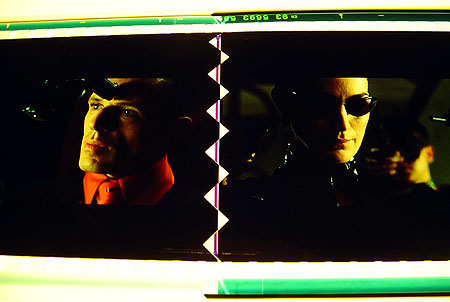
an unpainted splice from Matrix Revolutions: The IMAX Experience
A general slant splice wouldn't have an even enough hold. The zig-zag allows even distribution and maximum surface area for tape adhesion.
You shouldn't get a situation where part of a different frame "pokes through". If you have to remove footage, it is replaced by black slug film. It cannot just be cut out, like 35mm can, because the sound synchs to framecount. And when assembling a film, there is no such thing as a "reference frame" to be left on the head/tail.
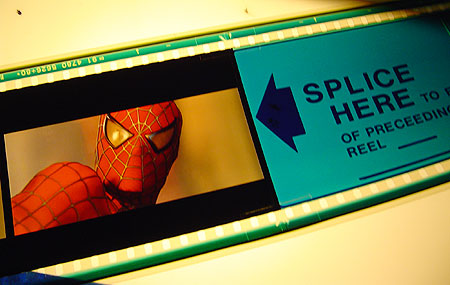
You cut where it tells you! Or Spidey will come for you!
Posted by Mark Gulbrandsen (Member # 72) on 03-16-2005, 08:59 PM:
Phil,
Ya can't tell there's a septum there though..... why all the worry?
Neil told me about the problems Imax had with supposed infringements on #4,114,996, the inlet giude. Told me he had to present his mathematical calculations to the courts for the design. Won that one as well as the inlet guide on the clones is completely different than Imax's.
Phils Nightmare?????
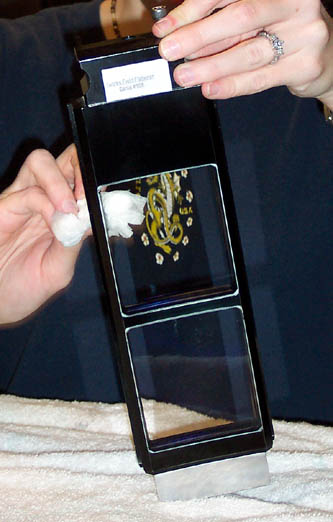
The cam unit is dead center in the photo. The curved input stator is to the left. The output stator is basically identical.
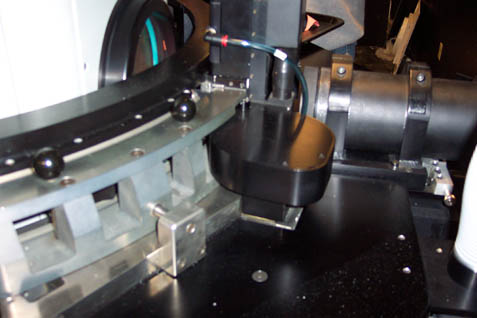
The inlet guide(s-curve) is to the left of the input stator.
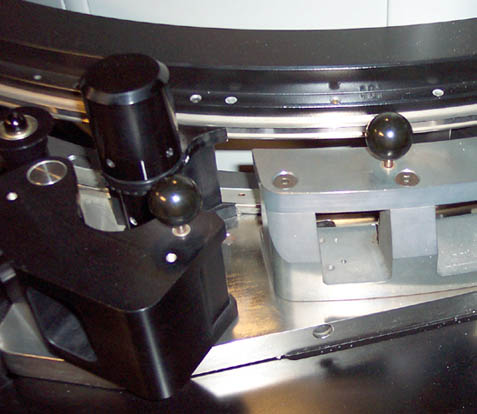
Hope these photos help make things easier to understand for those that have not seen a 15/70 projector.
Mark
Posted by Brian Michael Weidemann (Member # 2243) on 03-16-2005, 09:23 PM:
What "clone" brand is that, Mark? ![[Razz]](tongue.gif) I must admit ignorance, I've only become familiar with the IMAX GT. That looks remarkably like a clone of its basic layout, or possibly a very early model thereof?
I must admit ignorance, I've only become familiar with the IMAX GT. That looks remarkably like a clone of its basic layout, or possibly a very early model thereof?
Posted by Dave Macaulay (Member # 813) on 03-16-2005, 09:26 PM:
Must be annoying to need to to do lots of calculations after you BS your way into an Imax theatre and dismantle the projector to photograph and measure everything and copy a real engineer's design. Darn those patents, they do make for a lot of extra work when you steal someone's ideas
Oh, Thomas: The "/" splicer is for magnetic sound film, this avoids the POP that a straight cut would produce as the steel (even some stainless) blade will always have a bit of magnetism. You could use it for striped release prints I suppose but I was told it was for the fullcoat or striped sprocketed recording tape used in sound recording and mixing (defore digital audio, there isn't much if any mag used these days)
Posted by Adam Martin (Member # 641) on 03-16-2005, 09:55 PM:
The zig-zag splice is to prevent the film from folding while in a loop shape. This would cause the film to jam in the projector.
Posted by Mark Gulbrandsen (Member # 72) on 03-16-2005, 10:37 PM:
Brian,
Thats whats now called a Cinema Development Corp. projector or CDC. Same as the units that were installed by Iwerks and under a couple of other names. It dfinately has a far more sophisticated drive and control system than the Imax has for it's classics. Phil, that old coot, did alot of the developmental work on these projectors to get them into working-operational systems.
There are a small but still growing number of them here in the U.S. and one dome system in Greece. The lastest install replaced an Omnimax system in Texas whose costs were killing the museum budget.
Dave,
Don't be ignorant! Patents do expire and then a design is in the public domain. I will admit that going in and making measurements did save them time, but thats about it. The first machine was produced but was not sold till after the patents expired. They still would have produced a machine without access to the other in perhaps just an extra 6 months or so. The input guide is 100% original design and Imax apparently agreed. Dude, remember, Imax didn't invent the rolling loop either, they just bought the design. I guess you can also call every other projector manufacturer on earth that uses the geneva movement a thief? Get a life or go bark up another tree!
Mark
Posted by Brian Michael Weidemann (Member # 2243) on 03-17-2005, 06:36 AM:
Yeah, I don't doubt that there are much better ideas out there for controlling the projector. The IMAX PLC is fairly intuitive, but I imagine that the possibilities with its software and hardware are endless. I mean, there must be infinite ways to arrange saving show lists, starting/stopping the projector and individual components thereof, monitoring systems readouts ...
Posted by Gordon McLeod (Member # 33) on 03-17-2005, 09:34 AM:
Actually Mark the original rolling loop couldn't handle the large film but chopped it quite nicely into 1 frame lengths (refered to as the autum leaves effect) that came spraying out the output side
The rolling loop machine the use of the vacum and the use of air jets was the design work of a engineer named Bill Shaw and I doubt if the clones wouldn't hae happened at all if they adn't been there and created the market in the first place
Posted by Mark Gulbrandsen (Member # 72) on 03-17-2005, 06:11 PM:
quote: Gordon McLeod
The rolling loop machine the use of the vacum and the use of air jets was the design work of a engineer named Bill Shaw and I doubt if the clones wouldn't hae happened at all if they adn't been there and created the market in the first place
Gord,
I wouldn't argue that point at all, we can all thank those guys and give them the credit for perfecting it. My point is just that much of the Imax design is now in the public domain available to anyone that wants to persue it. Imax has repeatedly blown steam where steam can no longer legally be blown....
Mark
Mark
Posted by Scott Norwood (Member # 30) on 03-17-2005, 06:33 PM:
So how do 8/70 machines work? Are they basically the same as 5/70, or is it, too, a totally different format?
I've run 5/70 (on JJs) and seen a couple of 15/70 installations, but I've never seen an 8/70 machine (except for the pictures on the Kinoton web site....
Posted by Adam Martin (Member # 641) on 03-17-2005, 06:53 PM:
8/70 is a vertical pulldown format much like 5/70, but with 8 perfs per frame.
Posted by Mark Gulbrandsen (Member # 72) on 03-17-2005, 07:19 PM:
Have a look Here
Mark
Posted by Richard Hamilton (Member # 321) on 03-17-2005, 09:32 PM:
Mark,
What part of Greece? I did an install in Thessolinikki a couple of years ago. The complex had our 8/70. They also had a small digital 3d theater. They were just starting construction of the dome when I left the site. It was a pretty big complex, just wondering if its the same your talking about?
Rick
Posted by Mark Gulbrandsen (Member # 72) on 03-17-2005, 10:28 PM:
Hi Richard,
Yes thats the place. Neil Johnson and company(CDC)did the 15/70 installation over there. We did a quote dorectly to them for the sound system. IN the end the sound system supplied was contracted out to some east coast company that specializes in Planetarium installations. We just don't have the manpower to handle that sort of thing in a foreign country. No problem here though. I would assume that all the other film exhibits are still running as well.
Mark
Posted by Phil Hill (Member # 371) on 03-18-2005, 01:54 AM:
(NOT referring to Gordie)...
So Dave,
Hmmm...sounds like "some" IMAX employee has their nose up someone's ass and licking the corporate butthole. ...And has a bad taste in their mouth... and is crying sour grapes while "SMELLING" the roses. GET A LIFE! It's just showbiz! OH, AND BTW: GET the REAL facts before you spout off about stuff you ain't got NO clue about! GEEEZE!
Background:
I agree... Shaw was a great engineer and way back in the 70's brought the rolling loop projector into the real world. The BIGGEST real world IMAX contribution was when the deceleration cam and claw was incorporated into the original rolling loop projector design and helped to stop all that film-perf damage. OBTW: Neil's CAM design and IMAX designs are TOTALLY different! You're implication just points how stupid your statements really are since you have NO clue! The IMAX version is a 3-dimensional cam and Neil's is a single flat, 2D plane.
BTW: I personally have designed and ran the CNC programs for more than 10 cam profiles all of which were a MUCH better design than IMAX and provided a more gentle handling of film than the IMAX design. You really are un-enlightened.
Also, until the competition got involved, IMAX was WELL know in the industry for their shitty lenses with their lack of sharpness and resolution, and their projector's crappy handling of film. Not only did they have shitty film input curves to the rotor and control/safety/show-control logic, they were also know for fucking over the customers in their biz practices. They FINALLY "got it" because of the competition from a couple of companies and upgraded their product and stopped fucking their customers without a rubber.
When they finally got "Religion" is when the competition drop out.
END OF THAT STORY!
However, I sincerely respect IMAX and have to hand it to them for digging themselves out of their greedy $ hole and re-defined themselves and moved on to more creative and inspiring things. They are finally being honest people rather than money-grabbing assholes.
They will be THE film company long after 35mm exhibition has gone to TV (Video) ![[Smile]](smile.gif)
Rick:
I think Mark is referring to an Iwerks/CDC installation at the Athens 2004 Olympics that was plagued with many problems due to shitty theatre design.
Even though Mark alluded to him, the "Know-It-All" loser project designer/manager was/is the Sky-Skan head himself that weaseled his way into that position and fucked up many things at that venue. Including stupid mistakes relating to patron's heads interfering with the projection and appearing on screen that Iwerks had to point out for correcting. A very costly mistake that had to be corrected during construction that was already underway.
[ 03-18-2005, 04:03 AM: Message edited by: Phil Hill ]
Posted by Dave Macaulay (Member # 813) on 03-18-2005, 07:51 AM:
Hey, setting that hook was a bit too easy. But I do know the facts, so unlike you I don't have to make mine up (3D cam profile? Good one). I won't bother with any of your other canards. I may occasionally correct the nonsense I see from you though, otherwise some readers might mistake it for truth.
I'm uninterested in why you guys cultivate your hate for Imax, go ahead and enjoy it.
Posted by Mark Gulbrandsen (Member # 72) on 03-18-2005, 08:21 AM:
Somebody call an ambulance for Dave.......
Posted by Gordon McLeod (Member # 33) on 03-18-2005, 06:00 PM:
Mark FYI Dave has probably more experience in the design of that machine than anyone else on this forum
Posted by Mark Gulbrandsen (Member # 72) on 03-18-2005, 06:42 PM:
quote: Gordon McLeod
Mark FYI Dave has probably more experience in the design of that machine than anyone else on this forum
Gord, why tell me that, you should be telling that to Phil. Also keep in mind that Dave has absolutely no experience with other 15/70 machines. One thing is for sure though,he speaks from his asshole.
A good example is that he assumes is that we hate Imax. That is absolutely as far from the truth as could be. I'm quite sure that you'd find that most of us really enjoy Imax, its clones, and even the 8/70 systems for the most part. What you will find that most people dislike about Imax is the cost. Thats why today there are other options and Imax theatres that have been long burdened with rediclous expenses have opted to send the stuff back and install other 15/70 or 8/70 systems at renewal time. Ask any bean counter if he likes all the "Imax" expenses and he will laugh in your face!
Mark
Posted by Phil Hill (Member # 371) on 03-18-2005, 10:43 PM:
Dave, you REALLY need to get off the I-30 stuff ...oh and your high horse. Did you really expect me NOT to respond to an unfounded personal attack on my integrity.
Unlike you, I speak from personal knowledge of the facts...not conjecture and supposition and hearsay.
Your idle threats to me are as boring as you. You need to get a life. You appear to be a bitter, unhappy person for whatever reason. Do something good for others and your community.
I have no further comment about your uninformed and libelous comments.
OBTW Gordon: That's well and good... BUT, keep in mind that NOBODY knows all they "think" they know about anything...myself included.
Posted by Thomas Dieter (Member # 2507) on 03-21-2005, 11:06 AM:
just out of curiosity, has there ever been a release of any main stream movie in 1570? I know that 1 hour of 1570 film is about the length of a regular 2 hour 35mm film, so that if they did, the would have to incorperate an intermission to make sure that it could be played.
Also, just wondering if there are any 1570 platters that act like any regular 35/70mm film platter, with the Brain in the center, and no rewind.
Posted by John Pytlak (Member # 331) on 03-21-2005, 01:04 PM:
quote: Thomas Dieter
Just out of curiosity, has there ever been a release of any main stream movie in 1570? I know that 1 hour of 1570 film is about the length of a regular 2 hour 35mm film, so that if they did, the would have to incorperate an intermission to make sure that it could be played.
Actually, 15-perf 70mm runs 15/4 = 3.75 times faster than a 35mm print. (Assuming same frame rate).
Yes, quite a few in the last few years, mostly "blow ups" from 35mm using the proprietary IMAX "DMR" process, or animation rerendered at high resolution to 65mm/70mm. Here's some links:
http://www.cinergetics.com/films.htm
http://www.imax.com
Many theatres have installed equipment to handle full length features as one roll (larger platters), or with a single changeover (Imax SR systems).
Recent titles included:
Apollo 13
Star Wars Episode II
Treasure Planet
Lion King
Beauty and the Beast
Matrix Reloaded
Matrix Revolutions
Harry Potter and the Prisoner of Azkaban
Spider Man 2
Polar Express (3D)
Robots (current)
Charlie and the Chocolate Factory (2005)
Batman Begins (2005)
Yes, there are center-fed platters that eliminate the need to rewind (QTRU units).
70mm has certainly undergone a "revival", mostly in the 1570 arena. ![[Cool]](cool.gif)
Posted by Monte L Fullmer (Member # 2797) on 03-21-2005, 02:06 PM:
quote: John Pytlak
Actually, 15-perf 70mm runs 15/4 = 3.75 times faster than a 35mm print. (Assuming same frame rate).
Yea..330ft/minute. One really needs to see 15/70 run. That film actually flies through that machine, and those huge decks are really spinning. The end of the film is actally wrapped with a strip of either a clear piece of 15/70 or a strap of sorts.
A larger deck full of the 15/70 feature weighs in close to 800 lbs...no scooping on that one with a "Pizza board" .. lol
-monte
Posted by Dick Vaughan (Member # 540) on 03-21-2005, 03:32 PM:
337.5 feet a minute but close enough.
On the big features the belly band is made from velcro and the whole lot held(hopefully) firmly in place with clampsfitted into holes on the platter
Posted by Darryl Spicer (Member # 711) on 03-21-2005, 05:55 PM:
there is a video in the video section of the site that shows the Omnimax theatre. It is very interesting to watch. It shows the smaller quick turn units running and the rewind in progress. It's about 16 minnutes long so unless you have a fast cable modem you will need a lot of patience and time to down;oad the good quality version.
Powered by Infopop Corporation
UBB.classicTM
6.3.1.2