This is topic My first IMAX experience in forum Large Format Forum at Film-Tech Forum ARCHIVE.
To visit this topic, use this URL:
https://ft-forum.com/ft/cgi-bin/ubb/ultimatebb.cgi?ubb=get_topic;f=14;t=000116
Posted by Carey Barber (Member # 1586) on 09-01-2005, 09:52 AM:
Just wanted to say that I saw my first IMAX movie on Sunday.
It was 'Charlie and the Chocolate Factory' and it looked and sounded amazing!
I saw it at the Virginia Air and Space Center in Hampton, Virginia. My only (small) complaint was that there was a slight shadow on the left side. Other than that, it was spotless.
Question - I would assume that this film was originally shot on 35mm. Does this mean that this 15/70 version was not as good-looking as it could potentially be -- That is, if had been filmed in 70mm to begin with?
(Please, I know next to nothing about large format so don't rip me to shreds if I have asked a dumb question or have some misinformation)
Posted by Joseph L. Kleiman (Member # 3097) on 09-01-2005, 10:39 AM:
Most films these days shot on 8/65 or 15/65 go through a digital intermediate process as part of post-production. According to large format director Ben Stassen, for a 2D presentation, scanning at 4K is appropriate for presentation in large format. Typically, most (including IMAX DMR films) are scanned at 5.5 to 6K, which is about the same if the show print were taken directly from the film negative.
What you saw with Charlie was an image that originally was around 2K 35mm up-ressed to about 6K 70mm. It is comparable to having been filmed on 65mm stock.
Posted by Gordon McLeod (Member # 33) on 09-01-2005, 10:51 AM:
Joseph said "It is comparable to having been filmed on 65mm stock."
One cannot create what was originally not there. In upping the resolution a mathamatical algorithm is used to preect what whould be where the missing pixels are between the two reslotuions
Compared to a print from a 1570 negative DMR is a pale contender
Posted by John Pytlak (Member # 331) on 09-01-2005, 11:05 AM:
When blowing up a 35mm image to a 65mm duplicate negative for 15-perf 70mm release, the quality of the 35mm image is a very important parameter. If slower films are used, and care is taken in the cinematography (format choice, lens quality, focus, good exposure), the quality of the 70mm print can be very good.
As always, "Size DOES Matter", and the larger the origination format, the better the potential quality. Usually the quality ranking goes like this:
15-perf 65mm > 8-perf 65mm > 5-perf 65mm > 8-perf 35mm > 35mm Anamorphic > Super-35 > Regular 35mm > Super-16 > 16mm > Super-8 > 8mm > ![[dlp]](graemlins/dlp.gif) >
> ![[bs]](graemlins/bs.gif)
![[Wink]](wink.gif)
Posted by Joseph L. Kleiman (Member # 3097) on 09-01-2005, 11:38 AM:
I forgot to include the most important part: Comparing the two depends on who you talk to, the source material, and the resolution scanned. You'll get a variety of different responses from different filmmakers and exhibitors. I feel it's comparable.
Posted by Gordon McLeod (Member # 33) on 09-01-2005, 01:43 PM:
Joseph said "I feel it's comparable."
hmmm It isn't even close and one should do a bit more research rather than relying on fimmaker x or theatre owner y comments most tend to have a narrow field of view on the matter namely promoting what ever is in the interests of the project they are involved in
Roar is a prime example it has no depth, colour saturation, and grain the size of a hailstorm and doesn't even fill the complete screen yet the filmaker says it is acceptable
Considering I sit on probably one of the largest librarys of 1570 material here that is in daily rotation I ould commend you to look closely at the image quality of things like To Fly (or most of the MF library) or as like today a 35 year old print of catch the sun I am showing looks brighter sharper finer grained with greater colour saturation and depth than Roar which plays right after it
Posted by Joseph L. Kleiman (Member # 3097) on 09-01-2005, 03:05 PM:
Gordon,
I completely agree that Roar, which was scanned at 4K for the DI, looked horrible, with far too much grain. It's not one of my favorite films. But compare that with Charlie, which was scanned at 6K....the film looks like it was shot on 65mm stock. The one thing I can't stand, however, are the films shot digitally and recorded onto LF stock. I love comparing the shots in Cameron's films with some of MFF's films (Coral Reef is the perfect example). There is NO comparison between the two. Greg's films are always far superior.
Joe
Posted by John Pytlak (Member # 331) on 09-01-2005, 03:12 PM:
Increasing the scanning resolution does not help a grainy 35mm negative trying to fill an 80-foot screen. Using a larger image area, using a slower film when the light allows, and using proper exposure are the best ways to reduce graininess. Digital grain reduction can only go so far, and usually compromises sharpness somewhat.
Posted by Paul Linfesty (Member # 214) on 09-01-2005, 05:03 PM:
quote: Joseph L. Kleiman
Most films these days shot on 8/65 or 15/65 go through a digital intermediate process as part of post-production. According to large format director Ben Stassen, for a 2D presentation, scanning at 4K is appropriate for presentation in large format.
I'm confused by this. Is 4K scanning being used on films originating on 8/65 or 15/65 being scanned at 4k for digital intermediates? It's been said in both film-tech and other sources the only true way to capture 35mm negative at its full resolution is to use 4k (which MGM did for the James Bond series recently). So how is 4K good enough for a frame 10 times larger than 35mm?
quote: Joseph L. Kleiman
I completely agree that Roar, which was scanned at 4K for the DI, looked horrible, with far too much grain. It's not one of my favorite films.
I have assumed, perhaps incorrrectly, that ROAR didn't go through the DMR process to remove grain. And CHARLIE AND THE CHOCOLATE FACTORY may have been helped by the fact that id did in additioon to being shot in Super 35, giving a larger image to work with.
Posted by Joseph L. Kleiman (Member # 3097) on 09-01-2005, 05:30 PM:
Most firms (like Cinesite) that scan native 65mm stock do so at 2K or 4K. The actual pixelation of a 1570 print is in the range of 6Kx8K. DKP/70mm has a Northlight Scanner that can scan at 8Kx6K, 5.5Kx4K and 4Kx3K. However almost all post houses use a CRT film recorder for output, not laser, which is why the scanning is often maxed at 4K.
It's funny you mention the Bond films. Last year, at LFCA, Lowry and Technicolor jointly showcased a clip from "From Russia with Love" blown up to 1570. It was scanned in 4K, processed by Lowry, and output by Technicolor. I haven't had a chance to see it, but have been told by a number of people that were there that it looked like it was fresh footage shot in 65mm. Roar just could have been a much better transfer.
I'm not quite sure how to respond to your second point. Charlie just looks great. Robots, on the other hand, had a bigger frame, being boxed at 1.66 (compared to 1.85 for Charlie), and in many places there were noticable issues with pixelation (this may have been the result of rushing the DMR process at 11 days, instead of taking time or culling direct for computer data files).
Posted by Brian Michael Weidemann (Member # 2243) on 09-01-2005, 06:30 PM:
Oh, yeah, the best projected images I've ever seen have been from MacGillivray Freeman features shot on 65mm negative for 15/70 presentation. The vibrant colors and CRISP focus is just stunning. Coral Reef Adventure was very nice. And for nothing but white snow and rock, Everest really gave it life. I'm trying to remember other MacG films that blew me away ... pretty much anything in or around the ocean, which is, oh, about 85% of their library?
quote: Joseph L. Kleiman
noticable issues with pixelation
I was disappointed that Robots wasn't re-rendererd completely, like Polar Express was. But then, this was 20th Century Fox's first go at DMR, I believe. Warner Bros. has really been the IMAX DMR pioneer. And Polar Express was really a bigger ticket movie, anyway.
Posted by Joseph L. Kleiman (Member # 3097) on 09-01-2005, 06:46 PM:
Somewhat OT: I spoke with MFF yesterday. They are keeping an eye on the situation in Louisiana as they had just finished principal photography there for Wetlands - their next Ocean themed film. Wetlands has always been scheduled to include "a spectacular simulation of a class V hurricane ripping through the region" (in CGI), but if the situation warrants, they may be returning to film the aftermath.
Posted by Mark Lensenmayer (Member # 134) on 09-01-2005, 08:24 PM:
Carey,
I hope someday you can experience the full size Imax that is in many institutional theatres. Other posters are correct...a film shot with 15/70 cameras gives an image that is absolutely stunning. The smaller Imax theatres they are installing in multiplexes are fine, but you should really seek out a full size unit for an "Imax Experience" that will really impress you.
Posted by Joseph L. Kleiman (Member # 3097) on 09-01-2005, 08:44 PM:
Virginia Air and Space is a GT system opened in 1992.
Posted by Carey Barber (Member # 1586) on 09-01-2005, 11:18 PM:
Mark,
I had assumed that this was a full size IMAX (is it not?) Joseph mentioned that it was a 'GT system' but I do not know if that means it was full size or not...
But yeah, I would definitely llke to see a film that originated in 65mm stock. It would be nice to compare the two.
I think the Va. Air and Space Center usually has a schedule that includes a regular feature like Charlie and some other 45 minute 'Imax-ish' films throughout the day.
Posted by Joseph L. Kleiman (Member # 3097) on 09-02-2005, 03:16 AM:
There are three types of IMAX projectors.
The GT (Grand Theatre) is a traditional IMAX projector based upon the kind used at Cinesphere ( here it is with Gordon ). There are four basic variations on the GT: 2D, 3D, Dome, and HD, which can project at 48fps.
IMAX SR is a smaller system made up of two separate projectors (SR stands for Small Rotor) and was designed primarily for cineplexes in smaller cities.
IMAX MPX is designed to be retrofitted into an existing multiplex (thus MPX) 35mm auditorium.
As for seeing a 65mm sourced film, of the three currently playing at Virginia Air and Space, see Fighter Pilot. Charlie, which you've seen already, was filmed in 35mm and Aliens of the Deep was filmed in digital (this may be a great opportunity to compare and contrast).
Posted by Mark Lensenmayer (Member # 134) on 09-02-2005, 06:45 AM:
The main difference between classic IMAX and the newer versions is the height of the screen. The original IMAX screens are about twice the height of the smaller versions. For DMR films, there isn't much difference, but you will REALLY see a difference on anything designed for IMAX directly. Even the old classics like TO FLY have quite an impact! Take Joe's recommendation and check it out.
Posted by Brian Michael Weidemann (Member # 2243) on 09-02-2005, 07:38 AM:
Fighter Pilot: Operation Red Flag was a good movie, and definitely has some crisp shots, full frame, definitely shot on 65mm for 15/70. The difference between that and the look of Aliens of the Deep is considerable, and Aliens doesn't even fill the full frame.
But then, you can't blame Cameron for not being able to take several IMAX 3D cameras to those extreme environments (do there still only exist something like two of them, by the way?). I think he caught some great footage for that movie, and the number of angles is impressive, considering the extreme environments. You can tell that it was a huge operation. Digital was definitely the best route he could have gone.
Posted by Gordon McLeod (Member # 33) on 09-02-2005, 10:08 AM:
Joseph said "The GT (Grand Theatre) is a traditional IMAX projector based upon the kind used at Cinesphere ( here it is with Gordon ). There are four basic variations on the GT: 2D, 3D, Dome, and HD, which can project at 48fps"
Actually that is called the "classic" and has two versions the 4K aircooled there is a pix of the one in bradford UK in the thread of pictures of Ians trip and the watercooled like cinesphere has
The GT is a twin rotor machine designed for 3D and the stacked rotor allowed the almost total reduction of keystone related distortion in the superimpossed images for 3d as well as facilitated the shutter system for the LCD glasses
Posted by Joseph L. Kleiman (Member # 3097) on 09-02-2005, 10:45 AM:
I'm going to ask Gordon to correct this if I miss or misstate anything.
IMAX projection systems:
Classic (2D)
Dome
GT (2D/3D - stacked rotors)
Solido (3D dome with E3D)
GT HD (2D/3D - 48fps)
HD Dome (Back to the Future)
HD Dome 3D (Race for Atlantis)
Magic Carpet (2 classic, 1 under floor)
Ridefilm (48fps VistaVision - now serviced by Simex)
SR (2D/3D - 2 separate projectors synched for 3D, only one used for 2D)
MPX (2D/3D - stacked rotors w/autothreading)
Posted by Robert Stawiarski (Member # 1842) on 09-02-2005, 12:28 PM:
-The SR uses two projectors for 2D when a changeover is involved -- this allows the SR theatres to play the longer DMR films without having a fully upgraded QTRU.
-There is also an SR Dome theatre, which uses a single projector obviously. The one I know about is at the Science Station in Cedar Rapids, IA, but there might be others.
-Also, there are Classic 3D systems, which is two Classics side-by-side like an SR setup. The first IMAX 3D system was at the CN IMAX Theatre in Vancouver, and that uses two Classics.
You can see both of the above in the "Post your booth pictures!" thread at the 1570.com Technical Issues forum.
The rest of your list looks correct, but I am not familiar with Ridefilm or Magic Carpet.
Oh, and since I recently have ridden this... Soarin' Over California at Disney's California Aventure and its sister ride Soarin' at Epcot, use the HD Dome system. I believe Iwerks was originally supposed to install the California system, but Disney decided to switch to IMAX when they were unable to.
Posted by Joseph L. Kleiman (Member # 3097) on 09-02-2005, 01:12 PM:
Where's the SR Dome projector located? I've heard of it before, but don't know where it's located.
Doug Trumbull's Ridefilm Corporation merged with IMAX in 1994, when the company was bought by Wechsler and Gelfond. Projectors were manufactured by Ballantyne, but serviced by IMAX techs.
There's only one Magic Carpet theater in operation - at Futuroscope in France.
There was also an earlier IMAX Dome HD ride at Phatasialand in Germany, called GALAXY.
Disney currently has six IMAX Dome HD projectors in operation: two each for Soarin' in California and Florida and the two for Storm Rider at Tokyo Disney Sea. I have been told that two of the projectors are actually the ones that originally were in EPCOT's Horizons pavillion, but have not been able to confirm this.
Gordon, James Neihouse lists your projector as being HD. Is this correct?
Posted by Robert Stawiarski (Member # 1842) on 09-02-2005, 02:18 PM:
The SR Dome that I know about is at the Science Station in Cedar Rapids, IA, but there might be others.
You can see this and the 3D Classic system in the "Post your booth pictures!" thread at the 1570.com Technical Issues forum.
This was in my original post after I edited it soon after I posted it; you probably started replying before seeing the edited version. ![[Cool]](cool.gif)
Posted by Joseph L. Kleiman (Member # 3097) on 09-02-2005, 02:22 PM:
I'm a bit flustered today, so I've been reading and typing fairly rapidly and just missed that line. ![[Frown]](frown.gif) I've been trying for the past two days to locate the staff from the Entergy IMAX in New Orleans to make sure they're ok.
I've been trying for the past two days to locate the staff from the Entergy IMAX in New Orleans to make sure they're ok.
That SR Dome projector just looks wierd. I'm surprised there's no photos of that monster platter unit in Lincoln Square on the thread.
Posted by Jeremy Jorgenson (Member # 2989) on 09-02-2005, 02:45 PM:
quote: Carey Barber
I had assumed that this was a full size IMAX (is it not?)
Seeing this part of your question was only vaguely answered, I'll give it a stab.
Charlie and most (maybe all?) DMR films are letterboxed to match the aspect ratio it was intended to be shown in 35mm theatres (1.85 for C&TCF). Most films shot specifically for 15/70 exhibition (and most of the screens for most LF auditoriums) are "narrower" or "taller" depending on how you look at it - I think 1.44:1 (I'm sure somebody will correct that aspect ratio if I'm wrong). So, yes, Charlie was still using the same size 15/70 film as any other IMAX film, but it was letterboxed.
Posted by Gordon McLeod (Member # 33) on 09-02-2005, 03:12 PM:
Yes our machine was the one they played with to make 48fps work ![[Smile]](smile.gif)
Posted by Robert Stawiarski (Member # 1842) on 09-02-2005, 04:11 PM:
Jeremy -- Apollo 13 and Attack of the Clones were both pan and scanned for the DMR releases to fill up more of the screen. All the rest of the DMRs were shown in their native aspect ratios, as far as I know.
Posted by Joseph L. Kleiman (Member # 3097) on 09-02-2005, 04:40 PM:
Apollo 13 was reframed for 4:3. However, it was still exhibited letterboxed at 1.66:1. Attack of the Clones was remastered from the 1.81:1 version because it used more of the IMAX screen than the anamorphic version, but it was not reframed for 4:3 like Apollo 13.
This list compiled by Bill Kallay on fromscripttodvd. com gives the aspect ratios of every commerical IMAX release. You'll notice they've all been letterboxed.
As for Magic Carpet, I've attached the only photo on me at the moment. Sorry for the really bad resolution. One traditional IMAX screen in front, with a second visible below the floor.
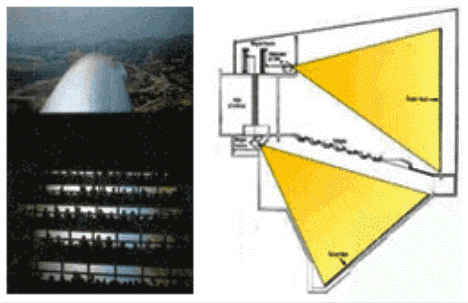
[ 09-02-2005, 06:47 PM: Message edited by: Joseph L. Kleiman ]
Posted by Jeremy Jorgenson (Member # 2989) on 09-02-2005, 10:03 PM:
Robert & Joseph - thanks for the info. I did not see either Apollo 13 or Episode II for their DMR releases.
That magic carpet auditorium looks interesting. I'll have to check it out, next time I'm in France. ![[Big Grin]](biggrin.gif)
Posted by Larry Myers (Member # 738) on 09-15-2005, 01:45 PM:
Sorry to say I am a size doesn't matter kind of guy. All images have a tradeoff of scale vs resolution. This means, you can make up for image size with resolution.
So a 35mm motion picture frame with a resolution of 60 lines pairs per millimeter is exactly the same as a IMAX 15 perf frame at 20 line pairs per millmeter or about a 3 times enlargement or 9 times area.
The problem is, most IMAX frames with an IMAX camera would have a normal resolution of 60 lp/mm. So in order to get a typical 35mm motion picture camera running Super35 to do IMAX type work, the image resolution has to be about 180 lp/mm. Some color aerial recon films will do this but the ASA speed would be around 5 or so. The ASA 50 Vision stocks are good for about 120 lp/mm. Close but no cigar
On the CBS evening news about a month ago, the person of the week was a photographer who installed a 9 inch aerial recon film cassette on a 8x10 studio camera. He was taking color images of landscapes and blowing them up to 4x6 feet as photo art. CBS made a big deal out of clearly seeing in the picture, the eyes of a horse 2 miles away.
A perfect example of scale vs resolution.
Larry
Posted by John Pytlak (Member # 331) on 09-15-2005, 02:35 PM:
quote: Larry Myers
The problem is, most IMAX frames with an IMAX camera would have a normal resolution of 60 lp/mm. So in order to get a typical 35mm motion picture camera running Super35 to do IMAX type work, the image resolution has to be about 180 lp/mm. Some color aerial recon films will do this but the ASA speed would be around 5 or so. The ASA 50 Vision stocks are good for about 120 lp/mm. Close but no cigar
It will be interesting to see how the new Kodak VISION2 50D Color Negative Film 5201 performs! Much finer grain and better sharpness than 5245:
http://www.cinematography.com/index.asp?newsID=8764
quote:
The company is also previewing images recorded with the new KODAK VISION2 50D
5201/7201 color negative film, which is scheduled to be available in all
formats in October. Mayson says the new negative is designed to give
cinematographers more creative latitude while filming high-contrast exterior
scenes in bright daylight as well as shots in mixed color temperatures. The
film is also optimized as a recorder output film.
The new emulsion will be the sixth member of the Kodak VISION2 family of
films, which was introduced in November 2002. The others are KODAK VISION2
500T 5218/7218, KODAK VISION2 100T 5212/7212, KODAK VISION2 200T 5217/7217,
KODAK VISION2 250D 5205/7205, and KODAK VISION2 500T Expression 5229/7229.
"The KODAK VISION2 family of films is designed to provide cinematographers
with a broad palette of options," notes Thierry Perronnet, marketing director
for Kodak's Entertainment Imaging Division covering Europe, Middle East and
Africa. "Kodak remains committed to continued improvement of film technology
through research. We foresee a future of limitless possibilities."
Now imagine Kodak VISION2 50D used for 65mm 15-perf origination!

Posted by Stephen Furley (Member # 1277) on 09-16-2005, 07:26 AM:
I've shot some 7245 in the past; it is a good stock; this will have to be very good if it's even better.
Anybody know where to buy the odd single roll of 16mm stock in london now? Lees in Holborn has gone; Stanley Productions in Wardour Street is all video and digital media now, and FFC Blanx, previously The Film Stock Centre, also in Wardour Street, also seems to have gone. All three places I have used in the past no longer available.
Posted by Hugh McCullough (Member # 1542) on 09-22-2005, 12:18 PM:
Hello Stephen.
16mm film can be obtained from http://www.widescreen-centre.co.uk/16mm_motion_picture_film_stock.php
Hope this is of help
Posted by Scott Norwood (Member # 30) on 09-22-2005, 01:51 PM:
I don't know about the UK, but in the US it is generally cheaper to order film directly from Kodak than to purchase it from retailers. They don't have a minimum order for most products and their overnight shipping is very reasonable, too. Presumably, they have a UK office and distribution mechanism.
Posted by John Pytlak (Member # 331) on 09-26-2005, 08:01 AM:
Ordering motion-picture film from Kodak:
http://www.kodak.com/US/en/motion/products/shoot.jhtml?id=0.1.4.38&lc=en
quote:
When you need it now, Kodak delivers.
1-800-404-2016 - Outside of North America contact your Kodak sales representative.
Kodak customers can now place orders for the most popular KODAK VISION2, KODAK VISION and EASTMAN EXR color negative film stocks 24 hours a day, 365 days a year, by calling the following ShootSaver express delivery service toll-free number after normal business hours.
http://www.kodak.com/US/en/motion/about/wwoffices.jhtml?id=0.1.4.5&lc=en
quote:
Worldwide Kodak Sales Offices:
Argentina
Australia
Austria
Belgium
Brazil
Bulgaria
Canada
Chile
China
Colombia
Czech Republic
Denmark
Arab Republic Of Egypt
Finland
France
Germany
Greece
Hong Kong
Hungary
Iceland
India
Indonesia
Iran
Ireland
Israel
Italy
Japan
Kenya
Korea
Latin American Region
Lebanon
Lithuania
Luxemborg
Malaysia
Mexico
Middle East/Africa Regional Office
Morocco
The Netherlands
New Zealand
Norway
Pakistan
Panama
Paraguay
Peru
Philippines
Poland
Portugal
Romania
Russia
Singapore
Slovak Republic
South Africa
Spain
Sweden
Switzerland
Syria
Taiwan
Thailand
Turkey
Ukraine
United Arab Emirates
United Kingdom
United States
Uruguay
Venezuela
Powered by Infopop Corporation
UBB.classicTM
6.3.1.2