This is topic Classic 50s 3-D converted to IMAX 3-D – a good or a bad idea in forum Large Format Forum at Film-Tech Forum ARCHIVE.
To visit this topic, use this URL:
https://ft-forum.com/ft/cgi-bin/ubb/ultimatebb.cgi?ubb=get_topic;f=14;t=000163
Posted by Ramon Lamarca Marques (Member # 3621) on 04-27-2007, 05:31 PM:
This subject started as a spin off the Harry Potter thread and I thought it could be an interesting topic in itself.
I think that good stereoscopic photography (not the fake 3-D on flat images that Lucas and co are promoting) can be fascinating. A film like Kiss Me Kate, when properly screened, shows what can be done artistically with stereoscopic photography.
These 50s titles have already earned they money back and so the cost would be the conversion of the films (two prints for each of course) into IMAX DMR.
A film like Kiss Me Kate has got the gorgeous music from Cole Porter, brilliant choreography by Bob Fosse and all the perks that used to come from the MGM musicals and this would probably attract many patrons.
A title like Dial M for Murder, because Hitchcock directed it, would surely attract people, especially since so few have seen the stereoscopic version.
I share Frank Angel’s thoughts on this subject and would welcome more thoughts from the experts in the IMAX field.
Even the cartoons produced by Warner and Disney in 3-D could be converted to IMAX 3-D.
Posted by Mark Gulbrandsen (Member # 72) on 04-27-2007, 07:23 PM:
I agree that original steroscopic cinematography is unbeatable in any format. Converting older films to 3-D amounts to the early coloring of black and white movies... its a stupid and gimmicky idea!
Large format aside... Kiss Me Kate is a good example of tremendous quality 3-D... Dial M For Murder is definately not .... Hitch filmed it pretty much as though it were a 2-D film... there is only that part where the arm comes out of the screen at you with the scissors. In fact Dial M was released in majority when 3-D had gone into decline and most theaters showed Dial M in 2-D. Had 3-D lasted longer Hitch would have undoubtdly put it to good use... The Birds in 3-D would be neat.
The best 3-D I've seen from older stuff is by far "House Of Wax". I've seen it both in 2-projector 35mm and in the old side by side 70mm format. Both are outstanding ways to see it, single strip 35mm sucks big. Who can forget the Gillotene, the ping pong paddle sequence, or when the Wax Museum burns down and the entire theater you're watching the film in fills up with smoke.... Its amazing stuff and its what brought the public back to the movies after TV caused a huge decline... Amazingly it was directed by a one eyed director who couldn't see in 3-D.
Mark
Posted by Mark Lensenmayer (Member # 134) on 04-27-2007, 07:37 PM:
I don't think conversion to Imax 3-D would be practical, as that system is extremely expensive to work with. Quite frankly, I don't think you would recover the cost of the conversion and the prints. BUT...
I could see a small market for conversion to a Digital 3-D format. This would be far less costly and easier to work with. You could prepare a whole festival of 3-D material and put it up for an evening or two per film at minimal cost.
I do not believe this would be a commercial success, though. You would get a few of us 3-D maniacs, but that's about all.
Posted by Ramon Lamarca Marques (Member # 3621) on 04-28-2007, 03:39 AM:
quote: Mark Gulbrandsen
Hitch filmed it pretty much as though it were a 2-D film...
Warner Bros forced him to use 3-D, yet stereoscopy reinforces the theatrical aspect of the film.
quote: Mark Lensenmayer
I don't think conversion to Imax 3-D would be practical, as that system is extremely expensive to work with
Is it more expensive than to produce a film in IMAX 3-D about sharks? I suppose Kiss Me Kate would attract more patrons than another documentary with fish floating out of the screen. I do not know.
Posted by Caleb Johnstone-Cowan (Member # 3710) on 04-28-2007, 04:42 AM:
A lot of the IMAX exhibitors are institutions who would probably take a bad shark 3D film over a good 50's re-issue because they only want to show documentary/'edutainment' films.
Are the original prints of these films good enough to withstand conversion to IMAX? I read criticism of many DMR films on here would the same problems be present?
I'd like to see any 3-D reissues out of curiosity. Don't know about presenting digitally though, maybe it's just me but black and white looks way too much like video from playing around with the test clips on the ubiquitous (in the UK)Christie DLP.
Posted by Stephen Furley (Member # 1277) on 04-28-2007, 04:55 AM:
quote: Mark Gulbrandsen
The best 3-D I've seen from older stuff is by far "House Of Wax". I've seen it both in 2-projector 35mm and in the old side by side 70mm format. Both are outstanding ways to see it, single strip 35mm sucks big.
I saw it maybe ten years or so ago, on a two strip print that was fairly new at the time. It's kept permanenty made up on four 6k spools. I've also 'seen', in the sense of looked at a reel of it on the bench, a reel of the 35mm side by side anamorphic format re-release version; that print was very dark for some reason. I've never seen any print projected in this format, but I did once visit the box at the NFT when they had run 'The Stewardesses' in this format the previous evening and they still had the optics there. Even just looking through them there seemed to be a considerable light loss, so I would imagine that the re-issue print of 'house of Wax' would have looked pretty bad. Why the print was so dark in the first place, and whether all prints, or even all reels of the same print, were the same, I don't know.
I didn't know that it had been released in 70mm side by side, but this always struck me as being a good format to release the older Academy ratio 3-D films in. There are more cinemas with 70mm projectors than interlocked pairs of 35mm ones, it's far easier to set up, you don't have to cut the other print to match, or insert slugs , if the odd frame is lost, and since both frames on the print are exposed and processed together they should be better matched in density and colour balance.
I've seen several films in the 35mm 'under and over' widescreen process; I think it looks ok on smaller screens, maybe up to about 8 metres, maybe 10 if you push it, but it's not good on large ones. I don't think any of the films I've seen in the process was much good, but that's a different matter. What would be the best way to do widescreen 3-D on 70mm? There would seem to be two options, 10-perf with two full sized 5-perf frames under and over, or 5-perf with two anamorphic frames side by side. The 10-perf option should be good, but there would be very few places that could run it, could be suitable for a 'special venue' though. Has either of these formats actually been used anywhere. What about two wide frames, under and over, in a standard Imax frame area; has anybody done that?
I've even seen two strip on 16mm, shown on a pair of B+H 609s mechanically interlocked via a timing belt running on pulleys fitted to the ends of the motor shafts. It was somebody's home movie, shot with a pair of Bolex H16s, I don't know how he interlocked them. There were problems due to the length of the belt, it tended to stretch somewhat, so he had to fit a couple of idler rollers on each machine to keep it in place on the pulleys and stop it slipping round a notch, but it worked. Nice bright picture, about six feet wide, from the two carbon arcs!
quote: Mark Gulbrandsen
Amazingly it was directed by a one eyed director who couldn't see in 3-D.
Yes, strange that. I met him briefly once, after an on-stage interview at the NFT.
Posted by Bobby Henderson (Member # 840) on 04-28-2007, 11:39 AM:
I think it would be a waste to blow up old 3D movies to IMAX-3D format. It would probably be better to draft new digital 3D versions of those movies for showings on more normal sized screens.
The more and more I think about it, I believe the entire DMR strategy in blowing up lots of low resolution Hollywood features to IMAX format could ultimately end up killing off most or all native 15/70 production and even kill off the IMAX format itself.
There are some disturbing parallels between what is happening to IMAX and the way 5-perf 70mm was all but transformed into a mere blow-up format for 35mm movies. Once digital sound was developed for 35mm, we saw 5/70 all but disappear. Some bean counter will probably come along with a 2K digital projector outfitted with a 15,000 watt lamp house and say that's just as good as IMAX. And there's probably enough idiots out there who will get bowled over by that "digital" buzzword and believe the claim.
Posted by Fred Georges (Member # 505) on 04-28-2007, 09:21 PM:
"The best 3-D I've seen from older stuff is by far "House Of Wax". I've seen it both in 2-projector 35mm and in the old side by side 70mm format. Both are outstanding ways to see it, single strip 35mm sucks big."
Single strip 35mm (Anamorphic side by side) Can look excellent. Unfortunately it was never commercially presented that way. First you had those awful coke bottle split lenses & polarizers behind a Bausch & Lomb Scope attachement of dubious worth preceded by a generally underpowered lamphouse (Even for Flat!). I ran HOW Single Strip 35mm for a Stereoscopic symposium about 6 years back. My Silver screen (1:37) was 18 ft wide. I used a Kinoton projector & lamphouse with a 4K bulb & the current just about buried. A Schnieder compact anamorphic into a modified Mirror box & polarizer. The image was stunning. Again, you'd never see such an overkill in a commercial theatre but thats what it takes to light those single strip prints up. ![[Big Grin]](biggrin.gif)
Posted by Gordon McLeod (Member # 33) on 04-28-2007, 10:07 PM:
sorry I did the same many times at the Royal in Toronto
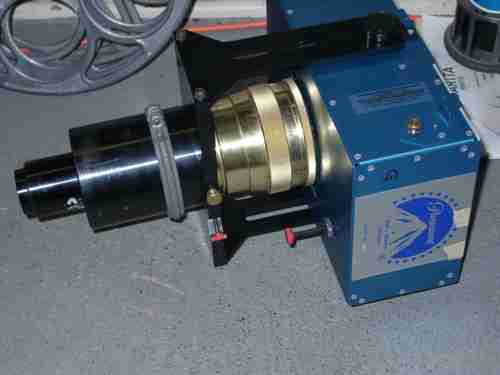

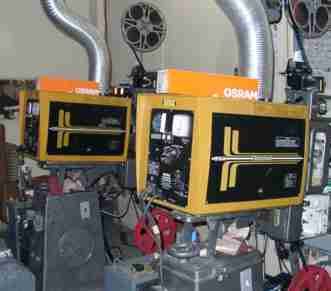
with 2.5K xenon we had a 15' 3d image that had 14 fl measured through 3d glasses on each eye
Some of the stereovisin lens were not that bad
Posted by Fred Georges (Member # 505) on 04-28-2007, 11:41 PM:
Well Gordon, That makes 2 of us. What about the rest of the world?-LoL StereoVisions Mirror boxes were fine if the polarizers weren't burnt. But I never saw one of their split lenses that didn't eat gobs of light & Kill contrast. ![[puke]](graemlins/puke.gif)
Posted by Ramon Lamarca Marques (Member # 3621) on 04-29-2007, 04:48 AM:
quote: Caleb Johnstone-Cowan
Are the original prints of these films good enough to withstand conversion to IMAX?
Columbia has restored or produced new prints of many of its titles and the majority look in very good shape.
quote: Bobby Henderson
The more and more I think about it, I believe the entire DMR strategy in blowing up lots of low resolution Hollywood features to IMAX format could ultimately end up killing off most or all native 15/70 production and even kill off the IMAX format itself.
I agree with this and this is why I said in the old debate on 2k versus 70mm that I thought blow-ups killed 65/70 since they were both presented as the same thing.
Maybe, instead of blowing it up to the full size of the IMAX screen, they could be blown to a smaller size. I still think Kiss Me Kate could look gorgeous on an IMAX screen if a proper job was done. Obviously, it should be explained that it was a film originated in 35mm and not IMAX.
Posted by Stephen Furley (Member # 1277) on 04-29-2007, 05:27 AM:
quote: Bobby Henderson
There are some disturbing parallels between what is happening to IMAX and the way 5-perf 70mm was all but transformed into a mere blow-up format for 35mm movies. Once digital sound was developed for 35mm, we saw 5/70 all but disappear. Some bean counter will probably come along with a 2K digital projector outfitted with a 15,000 watt lamp house and say that's just as good as IMAX. And there's probably enough idiots out there who will get bowled over by that "digital" buzzword and believe the claim.
Yes, I agree.
quote:
Single strip 35mm (Anamorphic side by side) Can look excellent. Unfortunately it was never commercially presented that way. First you had those awful coke bottle split lenses & polarizers behind a Bausch & Lomb Scope attachement of dubious worth preceded by a generally underpowered lamphouse (Even for Flat!). I ran HOW Single Strip 35mm for a Stereoscopic symposium about 6 years back. My Silver screen (1:37) was 18 ft wide. I used a Kinoton projector & lamphouse with a 4K bulb & the current just about buried. A Schnieder compact anamorphic into a modified Mirror box & polarizer. The image was stunning. Again, you'd never see such an overkill in a commercial theatre but thats what it takes to light those single strip prints up. [Big Grin]
That's the problem; it's almost impossible to get enough light on the screen with this system in any normal cinema. Very similar to the 16mm two strip that I saw, and help set up and run; that looked good, but where would you normally be able to find two carbon arcs, running at the maximum current the 609 rectifiers could provide, something like 35A, on a screen of less than two metres? What can be specially set up for a demonstration and what you can reasonably do in a normal cinema, at reasonable cost are rather different things.
Just out of interest, was the print that you had dark, like the odd reel that I saw?
Bob Furmanek always stresses the superiority of the two-strip system, but much as I hate to disagree with Bob, I think that if we're going to see 3-D, on film, back in cinemas it's going to have to be mainly on some sort of single strip format. Peter Apruzzese runs two-strip 3-D from time to time at the Lafayette in Suffern NY, and when I last spoke to him in May last year he was talking about running some of the later single strip under and over widescreen titles. I've never seen 3-D there, but it should look very good. The auditorium is the right shape for it, the projection is almost level, I could see no hot-spotting on his screen, I didn't even realise that it was silver when I first saw it, and the screen size while fairly small is towards the upper end of what would be reasonable for this format. I don't know what lamps he is running, but his screen illumination on normal 2-D films is very bright, and uniform.
Of course, for the later films you generally don't have a choice; they were filmed, and only ever released in, a single-strip format. I still think it's a shame that the 70mm side by side non-anamorphic format wasn't more widely used for re-release of the original '50s Academy ratio two-strip films. For the later widescreen titles there's a third possible 70mm option that I didn't think of yesterday; side by side, as above, but anamorphic. I don't think that's ever been used, but I can't see any reason why it couldn't be. There are plenty of cinemas with 70 mm projectors which haven't run that gauge for years, if ever. It could be worth giving it a try in a few places. You'd probably need a new screen; the few silver ones which are still installed are generally in poor condition.
It's also a shame that the original magnetic stereo tracks for 'House of Wax', and I believe other original '50s 3-D films, and the 1951 Festival of Britain shorts are no longer available.
Posted by Frank Angel (Member # 248) on 04-29-2007, 01:19 PM:
quote: Mark Gulbrandsen
Hitch filmed it pretty much as though it were a 2-D film... there is only that part where the arm comes out of the screen at you with the scissors. In fact Dial M was released in majority when 3-D had gone into decline and most theaters showed Dial M in 2-D.
Yah, but Mark, that is the beauty of DIAL M -- it was filmed as a regular movie....no gimmiky crap being thrown at you, nothing that said, "look, ma, it's 3D." HOUSE was the same way. Both were just really good films with a good story that had the added visual depth -- and that added dimension, like color is a great way to experience a film, IMHO.
If more of the 3D films took this approach, people wouldn't have look at it as a just a fad as much as they did. I mean, let's face it, most of the films that were shot during those four 3D years were no classics; most, in fact, were forgetable. Most were basically "B" movies that relied on the 3D effect to make them entertaining. How much crap being thrown at you by bad actors mouthing corny lines in uninteresting stories can you watch without getting bored?
Had 3D become just another tool like color, rather than an end in itself, and used by really good directors like Hitch, better quality films and maybe more of them might have come out of that era. DIAL M seems to be an example of the better way to use stereography, not the worst. Maybe it was because DeToth DIDN'T see in 3D is why HOUSE works so well -- he wasn't exagerating what he couldn't see!
Posted by Mitchell Dvoskin (Member # 751) on 04-30-2007, 01:47 PM:
quote: "Stephen Furley"
It's also a shame that the original magnetic stereo tracks for 'House of Wax', and I believe other original '50s 3-D films, and the 1951 Festival of Britain shorts are no longer available.
The entire 1951 Festival Of Britain survives in dual print 35mm. The only dual print feature film done in England in the 1950's, The Diamond Wizard has recently been restored, here in the US of A.
Posted by Ramon Lamarca Marques (Member # 3621) on 05-01-2007, 04:12 PM:
quote: Stephen Furley
Bob Furmanek always stresses the superiority of the two-strip system, but much as I hate to disagree with Bob, I think that if we're going to see 3-D, on film, back in cinemas it's going to have to be mainly on some sort of single strip format.
It is an amazing system indeed. This is why I suggested IMAX DMR because of it being a two-strip system it would be closer to the original spirit than any digital or single strip re-release. The Mad Magician has got some charm and nice stereoscopic photography in black and white. As I said, Inferno looks very well in two-strip. I think I was probably lucky enough to see a dye transfer print/s of Inferno, the colours look gorgeous, Technicolor comes out of the screen without 3-D, imagine with 3-D ![[thumbsup]](graemlins/thumbsup.gif)
Posted by Stephen Furley (Member # 1277) on 06-24-2007, 04:36 PM:
quote: Mitchell Dvoskin
The entire 1951 Festival Of Britain survives in dual print 35mm. The only dual print feature film done in England in the 1950's, The Diamond Wizard has recently been restored, here in the US of A.
As of a few years ago the films still survived at the National Film and Television Archive, though at least some of the prints were often to be found in one of the vaults at the National Film Theatre, which is quite appropriate, as it's only a minute or so walk from the site of the original 'Telekinema', where the films were originally shown at the Festival. These are the original 1951 prints, on safety stock. One or two of the prints were no longer projectable, one of them had to be withdrawn from a 3-D festival at the NFT some years ago for this reason, but most are in reasonable condition.
What are no longer avilable are the stereo soundtracks; the films are screened today with the standby optical track carried on one of the prints. Unfortunately, this also applies to many of the slightly later 3-D feature films which were originally released with stereo tracks. The Festival of Britain tracks were only three channel; there was no surround as I believe the Warnerphonic system had. It was however a very early use of stereo sound, probably the first since 'Fantasia', and it would have been interesting to hear it.
As you yourself have said, the films are not very interesting; they were really only a demonstration of the process, but technically they were well done. At least one, 'Royal River', was shot in 2x3-strip Technicolor, which prevented the use of close-ups, but for the subject matter involved, that wasn't too much of a problem. The earliest black and white films were shot with two Newman and Sinclair cameras, pointing at each other, weth 45 degree mirrors. A different rig was used for the later films, but I cannot remember what it was.
I am quite interested in the Festival, though I was born a few years too late to have seen it. It always seems to me to mark the start of the 'modern' era in London. Very little survives today, though the Telekinema lasted until 1957 with the video projection removed, and modified to be able to show nitrate, as the first home of the National Film Theatre. Part of the Shell Centre, as in Shell oil, now stands on the site. I think there may still be a flagstaff on the riverbank, it was still there a few years ago. The only building which survives is the Festival Hall, closed for the last couple of years for refurbishment, but dur to re-open just about now. Everything else, including the Dome of Discovery, and the 'Skylon', was demolished soon after the Festival closed. There have been plans to build a replica Skylon from time to time, but nothing has ever come of them, and probably never will.
Posted by Claude S. Ayakawa (Member # 1401) on 06-25-2007, 12:32 AM:
No one has mentioned it but I think the digital Real D process will be fantastic for reissuing 3-D films of the fifties. Real D was already used for a fifties 3-D film when a Walt Disney Donald Duck cartoon was presented with the Real D engagement of MEET THE ROBINSON'S in 3-D. IT looked great and I thought how wonderful it would be if 3-D feature films from the fifties could be presented this way. Real D presentations of fifties 3-D will be much less expensive than IMAX plus the fact that there are much more Real D venues than IMAX.
Some 3-D films I do not mind seeing in Digital Real D include HOUSE OF WAX, IT CAME FROM OUT OF SPACE, THE CREATURE FROM THE BLACK LAGOON, HONDO, KISS ME KATE, DIAL M FOR MURDER, THE MAZE, ARENA, INFERNO and soooo many others.
-Claude
Posted by Stephen Furley (Member # 1277) on 06-25-2007, 04:33 AM:
I haven't sen Real D, so I can't comment on it yet. There are serious technical problems with all of the film-based 3-D systems I have seen or worked with; it will be interesting to see whether Real D manages to provide a better solution.
As for 'Meet the Robinsons', I ran it, not in 3-D, a couple of weeks ago, and it came in on film despite the fact that we have had digital projection available for four months now. At present there seems to be no pattern as to what comes in on film, or on digital.
Posted by Damien Taylor (Member # 4255) on 06-25-2007, 07:32 AM:
Excuse my naivety, but was House polarized or anaglyph?
Posted by Stephen Furley (Member # 1277) on 06-25-2007, 07:42 AM:
quote: Damien Taylor
Excuse my naivety, but was House polarized or anaglyph?
It was shot in two strip, and originally projected in that format. In some cinemas it was originally presented with a stereo magnetic sound track, but this has now been lost.
Some years later it was re-released in a single strip 35mm format, with two squeezed images side by side.
In more recent times new prints have been made in the original two-strip format, but with only combined optical mono sound. All of these used the polarised system.
Some two-strip films were later re-released in an anaglyph version, 'Pardon my Backfire', for example, but I'm not aware of such a version of 'House of Wax'.
Posted by Ramon Lamarca Marques (Member # 3621) on 07-04-2007, 03:26 PM:
quote: Stephen Furley
Some years later it was re-released in a single strip 35mm format, with two squeezed images side by side
Also 70mm prints single strip were produced
Posted by Larry Myers (Member # 738) on 07-10-2007, 08:06 PM:
About 20 years ago, House of Wax was played on TV in the Washington DC area in color anaglyph. So at least one anaglyph print was made. Talk about eyestrain.
Powered by Infopop Corporation
UBB.classicTM
6.3.1.2