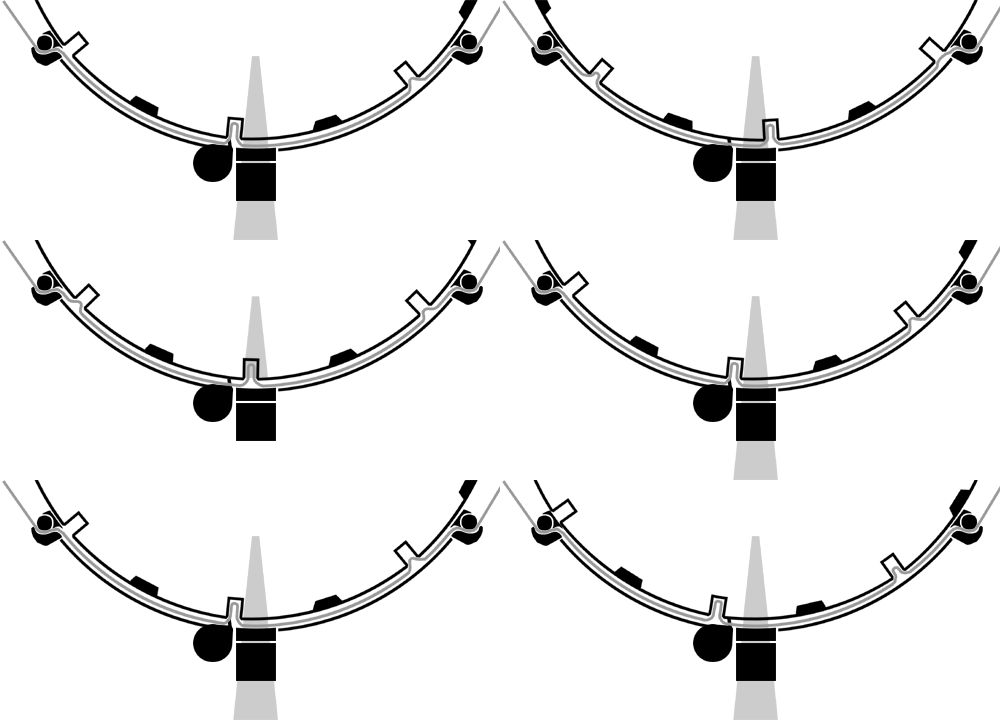
This is topic IMAX Basics in forum Large Format Forum at Film-Tech Forum ARCHIVE.


To visit this topic, use this URL:
https://ft-forum.com/ft/cgi-bin/ubb/ultimatebb.cgi?ubb=get_topic;f=14;t=000191

Posted by Brian Hogan (Member # 940) on 08-06-2001, 10:09 PM:
 
I frequent a web site that tries to explain how stuff works. Its kinda neat and contains pics and vids for many topics. They recently added an article that explains the bare basics of how IMAX works. The article also contains links to some other pages dealing with theatres and projection. Check it out at http://www.howstuffworks.com/imax.htm ... I'm out.
 
Posted by Adam Martin (Member # 641) on 08-07-2001, 01:04 AM:
 
Not that it's a bad article, but it's basically just a fluff piece, made to impress the masses. There are a few issues with the article ...

quote:
IMAX films are shot and printed on huge film stock that is completely unique in the industry.
Wrong. Standard 65mm camera negative and 70mm print stock is used. It's *how* it's used that's unique. It's usually just great Kodak Vision stock.

quote:
A vacuum system sucks each image onto a piece of glass in front of the lens so that the image is oriented perfectly in front of the lens.
And the registration pins might just have something to do with that, too.

quote:
The shutter opens for a longer period of time than on a normal projector in order to let more light through.
Nit picking here, the nature of rolling-loop film movement and registration allows for a more efficient use of light.

quote:
The bulb for the projector is a 15,000-watt, water-cooled xenon unit.
An unmodified classic (2D and Dome) has a 12,000-watt water-cooled lamp; a modified classic (2D and Dome) has a 15,000-watt water-cooled lamp; a GT (3D) has two 15,000-watt water-cooled lamps; and an SR has just a 7,000-watt air-cooled lamp.

quote:
an IMAX projector weighs over 2 tons (2,000 kilograms)
Again, the GT is over 2 tons; the SR is 1300 pounds; don't know the classic off-hand.

quote:
Not only are the films shot on IMAX's 15/70 film stock, ...
Again, Imax doesn't make the film stock.

quote:
For example, the dinosaurs in "T-REX" have five times the detail of the dinosaurs in the Jurassic Park movies. This means that it takes five times more computer power to render each "T-REX" image, and five times the storage space.
Yeah, but the T-Rex is only on-screen for 2 minutes out of 45! Really!

quote:
The camera is immense. It weighs 240 pounds
The 3D camera weighs 240 pounds. There are several lightweight 2D models such as the one used for Everest.

quote:
there are only two IMAX 3-D cameras in the world,
I know Iwerks has 2D cameras ... don't they have 3D cameras, too?

quote:
The camera is also very noisy -- it sounds like a chain saw when it is running.
Blimping does help somewhat, but not completely. I'll give them this one.

quote:
everything is photo-real
That just seems like a really stupid thing to say about something you are photographing.

Okay, I'm done. Now everyone go and search the forums for topics where we've discussed the Imax format for the anti-fluff info.

[ 03-03-2007, 03:11 PM: Message edited by: Adam Martin ]
 
Posted by Brian Hogan (Member # 940) on 08-07-2001, 01:14 AM:
 
yeah, well i knew that just about anyone reading that article from here would have a field day with it. im glad i could help


Posted by Randy Stankey (Member # 64) on 08-07-2001, 05:29 AM:
 
That page is OK but I agree with you. It's mostly fluff. It's nice and all but to somebody who has some knowledge on the subject there's not much that we don't already know.

What I REALLY want to see is a picture of the IMAX projector. Nothing too fancy... just something like, "The film goes in here, through this doohicky, around this thingamabob then comes out here. (Or whatever.)

Is there some kind of patent/trade secret thing that prevents people from showing that?


Posted by Michael Brown (Member # 890) on 08-07-2001, 06:22 AM:
 
Slightly off topic but i thought the SDDS diagram was interesting:

Click Here

(remember to click on the red oval SDDS icon)

with the left and right channels on the walls. interesting


Posted by Tao Yue (Member # 836) on 08-07-2001, 07:17 AM:
 
I believe that diagrams in HowStuffWorks.com are done separately from the articles, so there are often inconsistencies even when the author of the article has communicated with the illustrator.

In this case, it seems like there was absolutely no communication whatsoever -- don't just look at the SDDS -- that diagram was used throughout the movie sound article. Not only doesn't it show the additional screen channels for SDDS; it also seems to believe that Dolby Stereo has only two channels and has completely left out the left and right surrounds. But I suppose we can't expect all illustrators to be experts on motion picture sound.

------------------
Tao Yue
MIT '04: Course VI-2, Electrical Engineering and Computer Science
Projectionist, MIT Lecture Series Committee


Posted by John Walsh (Member # 168) on 08-07-2001, 08:20 AM:
 
Do't forget, though, people going to this are probably not looking for *very* techinal descripions. Also, I think the site is geared for younger people; it's better not to scare them away!
 
Posted by John Pytlak (Member # 331) on 08-07-2001, 11:05 AM:
 
The excellent "classic" technical papers on the birth of the IMAX film system are:

"The Rolling Loop -- A New Concept of Film Transport", by P. R.(Ron) W. Jones, SMPTE Journal, January 1968, pages 21-23

"Film Dynamics of a Rolling-Loop Film-Transport System", by William C. Shaw, SMPTE Journal, September 1970, pages 778-782

"New Large-Screen and Multi-Image Motion-Picture System", by William C. Shaw, SMPTE Journal, September 1970, pages 782-787

Technical achievements like this make you proud to be a member of the SMPTE.

------------------
John P. Pytlak, Senior Technical Specialist
Worldwide Technical Services, Entertainment Imaging
Eastman Kodak Company
Research Labs, Building 69, Room 7419
Rochester, New York, 14650-1922 USA
Tel: 716-477-5325 Cell: 716-781-4036 Fax: 716-722-7243
E-Mail: john.pytlak@kodak.com
Web site: http://www.kodak.com/go/motion


Posted by Brian Hogan (Member # 940) on 08-07-2001, 06:18 PM:
 
john said something about the articles being geared towards younger people. that may be true, but i think they just use very simple and basic explanations for things so its easier to grasp the concept, rather than try to understand all inner workings of everything.

other things he explains on the site can be somewhat more complex. a question was submitted concerning what makes super glue so super ( http://www.howstuffworks.com/question695.htm ). he went into the main chemical makeup and how it reacts to make polymer bonds and what not. i mean, its basic chemisty but if you know nothing about chemistry in the first place, then its a good thing to get a brief explanation.

ok, time to get some chow.


Posted by Joe Redifer (Member # 3) on 08-07-2001, 06:23 PM:
 
Randy-

I don't think that there are patents/whatever preventing people from showing the IMAX projector. Direct your 56k modem to the "VIDEOS" section of this site and click on OMNI THEATER. Be sure to download the big 139 meg Quicktime and you will see the IMAX (actually OMNIMAX) projector in all its glory.


Posted by Mark Gulbrandsen (Member # 72) on 08-07-2001, 11:21 PM:
 
Hey John,
I have always wondered where one can get those back articles that appeared in the old SMPTE journals. The only library I know of that has old journals is in Champaign IL, at U of I Grainger Technical Library. And indeed they have themm that go way way back into the 30's. Any insight would be appreciated.
Mark @ GTS
 
Posted by John Walsh (Member # 168) on 08-07-2001, 11:31 PM:
 
SMPTE is working on scanning issues and making them avaiable as pdf's. Right now, there's only a few, and I think you have to be a member. Big libraries may have issues, but not many.

If it's just a few articles, I can send them to you. I have some issues, but only back to 1945 (SMPE!).


Posted by Randy Stankey (Member # 64) on 08-08-2001, 06:36 AM:
 
Aah! 139 meg over a modem?! That's the reason I haven't seen it!
 
Posted by John Pytlak (Member # 331) on 08-08-2001, 07:34 AM:
 
Mark said: "I have always wondered where one can get those back articles that appeared in the old SMPTE journals"

John Walsh is correct that the SMPTE is in the process of putting articles on their website. For now, they have put indices and more recent articles and presentations "on-line". You can join the SMPTE and subscribe to their library service at:
http://www.smpte.org/membership/

The SMPTE "members only" library is at:
http://www.smpte.org/members_only/

You can work with your local library to get copies of articles published in the SMPTE Journal. Libraries that subscribe to the SMPTE Journal would include film schools (e.g., UCLA, USC) and science/engineering schools that teach film or television technology (e.g., Rochester Institute of Technology).


------------------
John P. Pytlak, Senior Technical Specialist
Worldwide Technical Services, Entertainment Imaging
Eastman Kodak Company
Research Labs, Building 69, Room 7419
Rochester, New York, 14650-1922 USA
Tel: 716-477-5325 Cell: 716-781-4036 Fax: 716-722-7243
E-Mail: john.pytlak@kodak.com
Web site: http://www.kodak.com/go/motion


Posted by Dave Macaulay (Member # 813) on 08-10-2001, 04:19 PM:
 
Adam:
Agreed, facts are confused, this article sounds like the crap spouted by marketing people.

- Only a few very old water cooled Imax/Omnimax systems use 12kW lamps. Since around 1985 or so all have been 15kW. There are a fair number of 4 and 4.5 kW air cooled ones as well, and one or two 7kw (maybe, if they are still running and have never upped to 15kW) aircooled "classic" machines.
There are 2 Imax "Solido" 3-D single case 2-strip cameras with a fixed interocular, dictated by the lens diameters when it was designed. With 1000ft magazines it's probably in the 240 pound range. There can also be a 3D rig with 2 "standard" MK1 Imax cameras at 90 degrees with a 45 degree mirror. This thing weighs a bit more, and has a gyro stabilized mount available that probably weighs as much again. The first 3D Imax film, made for Expo86 in Vancouver, used this one. Imax doesn't seem to want to admit to this movie, it isn't on their film list and I can't even remember the name. Transitions? It had the teddy bear scene, and the robot arm breaking an egg in your lap. The twin rig was used on The Last Buffalo and also Imagine - if that's the one with the little people - as the freedom to mess with interocular was needed for that effect. There was also a 3D rig with the cameras about 6 feet apart for some weird forced shots.
There are many problems with the mirror rig - it takes a LONG time to set up using reticles projected from the cameras onto a screen for alignment. This needs a large dark area, obviously... Plus, the amount of cabling and electronics is a nightmare.

- The author talks about 48fps as if it's a standard feature. Not. There are almost zero 48fps films and only a few more projectors that can show 48. Ontario Place and Hull are the only ones I'm sure of. The cameras get very snarky if expected to run at 48 for long (it's about the limit for the standard camera) and the projectors like it even less. The film is moving twice as fast, and has to be stopped and accelerated again every frame. The inertial energy is proportional to the square of the velocity...

- 20 minutes to reload? Nonsense. The 3D one maybe, but a decent camera operator can do a 2D mag change in about 5 minutes maximum - with a good cleaning thrown in. We can't count the time to reload the mag, an assistant does that in a dark bag during shooting.

- 3 minute rolls? OK, but there are also 2000' (6 minutes...) magazines and Kodak did supply 2000 foot 65mm neg rolls. These were made for the Stones movie, to cut by half the mag changes. Filming theirive show apparently made the effort worthwhile. There are also 300' mags for shots where weight or size is a problem, they were used in the infamous Catch the Sun skydiving shoot that may have financially saved Imax in the early days.

- There are lots more than 2 cameras of course. Camera #2 was the one used trying to parachute but there were about 8 working ones the last time I looked. 2 of these were reserved for only spaceflight though.

- There are at least 2 very different generations of 2D Imax camera, the solido Imax3D ones, plus as the competition's 15/70 models) which we shouldn't call Imax of course).

Plus, it didn't even really tell us how it works!

I have a bunch of photos somewhere, if I get ambitious I will try to find one that shows the front end of a projector. If anyone (Gord?) can scan a threading diagram from a manual that would be excellent!


Posted by Gordon McLeod (Member # 33) on 08-10-2001, 05:18 PM:
 
Actually I scanned the complete manual but it ended up at 26Meg so that was a bit big to email in
In the article on Cinesphere posted a while ago the rotor is clearly visable.
Acording to NFB there are 8 48 FPS machines but where?
Also as to cameras Fries builds a 15 perf (Ultra70) camera as does Iwerks so there is no shortage of cameras (just it appears subject matter)
 
Posted by Adam Martin (Member # 641) on 08-10-2001, 10:54 PM:
 
I see that AIS (the Maverick people) make a 15/70 camera, too.

I am pretty sure that Sony Lincoln Square (NYC) is 48fps-capable.

I mentioned the 12k because the Detroit Science Center just re-opened with a new 15k lamphouse that almost doesn't fit in their doghouse. I forgot about the 4k and had absolutely no idea there was a 7k classic!


Posted by Brad Miller (Member # 2) on 08-11-2001, 01:05 AM:
 
Gord, email the manual to manuals@film-tech.com That account will accept that sized file no problem.
 
Posted by Dave Macaulay (Member # 813) on 08-11-2001, 10:10 AM:
 
Lincoln Square:
This machine is the absolute scariest bugger ever made by Imax while I was there. It was supposed to do everything, including 48fps 3D. It has the world's largest platter unit (2 hours at 48fps if I recall correctly) and that has only been used regularly as a lunch table as far as I know.
Although it does have 48fps cams and the technical possibility to do it, it was never successfully run at 48 during manufacture or testing. The fervent hope was that Sony never actually ask for it to do so. Maybe they did, I pity the techs who had to try and make it work if so. BTW, these cams make it an absolute bugger to thread the lower rotor deck.
In the original design that projector was supposed to do mixed 24/48fps projection, yes that means running 24 and instantly going to 48 for action sequences or whatever and then back to 24 during a show. Only a truly demented marketing stooge with carte blanche to promise anything necessary to get a deal could have made this one up. Naturally it never did it, but I think the contract required it to with something like more money and 6 months notice.

I can't think of where 48fps capable systems might be other than Hull and OP - ?


Posted by Jeffry L. Johnson (Member # 453) on 08-11-2001, 10:39 AM:
 
"Transitions" was the IMAX 3-D film at EXPO 86 in Vancouver.
http://cmm.nfb.ca/E/titleinfo/index.epl?id=16253& expr=${transitions}&sid=7a945a5c5739afda0ab16870b2e6478d&recherche=&coll=onf

"Momentum" was the 48fps IMAX film at EXPO 92 in Seville.
CLICK HERE

The NFB and Giant-Screen Filmmaking http://www.nfb.ca/E/4/2/imax.html


Posted by Adam Martin (Member # 641) on 08-11-2001, 07:04 PM:
 
By popular demand ... (please forgive the crudeness )

The above image is an animated gif, so Joe needs to turn on his animations.

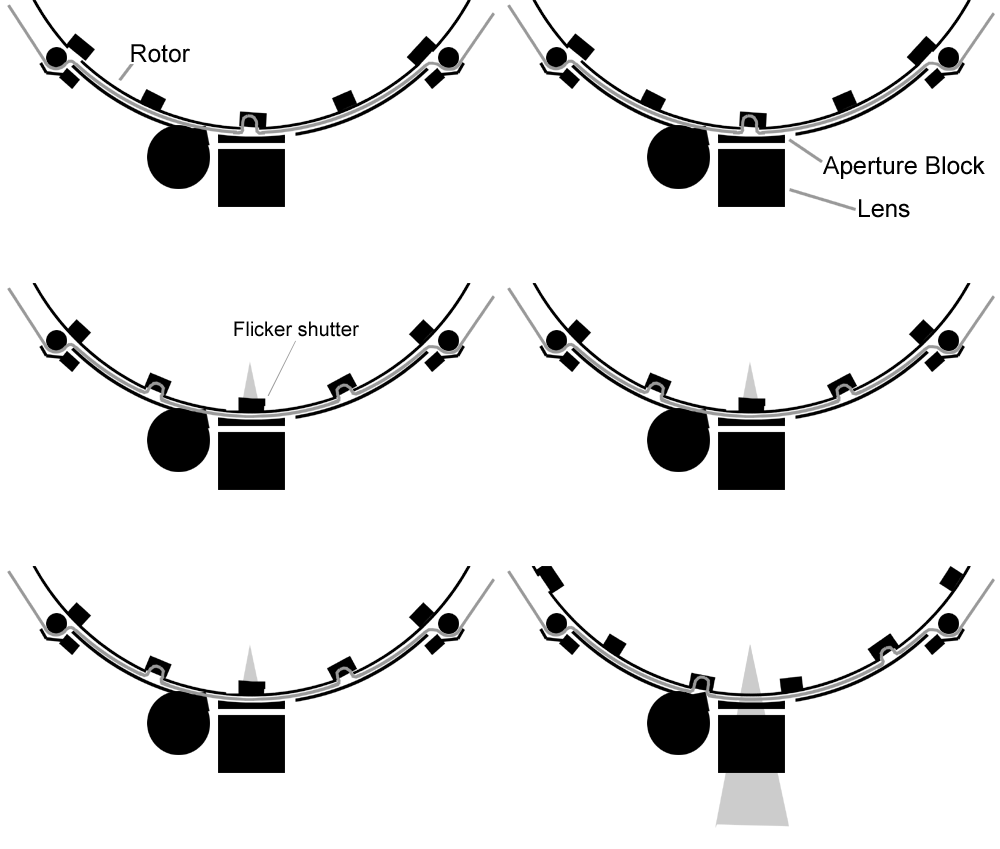
As the film enters the projector at the input sprocket, a burst of air "encourages" the film to form a loop in the rotor gap. The gap is actually a "pocket" in the rotor, so that it also acts as a shutter.

As the loop approaches the aperture block, it increases in size to 15 perfs (1 frame).

As it reaches the aperture block, the cam pins retract and return, "catching" the tail of the loop and decelerating the film. This aligns the perfs with the registration pins as the loop rolls across the face of the field lens, where it is sucked into place against the registration pins and projected.

A flicker shutter passes across the light field and the same frame is projected again (the same effect as the bow-tie shutter in a 35mm projector).

After the next frame is rolled across the field lens, the loop gradually diminishes in size as it exits the projector via the output sprocket.

The film is not moved in an intermittent movement, but is looped and rolled by the rotor through the projector. Imax calls this a "rolling loop". Iwerks calls this a "lateral loop" because it is a horizontally moving loop (and Imax used "rolling loop" first).

Incredibly over-simplified, but there it is.

For GT-3D, take two rotors, stack them on top of each other, and lock them together with a 11.25-degree offset. The right eye projects while the flicker shutter passes the left eye.

For SR-3D, take two projectors and interlock them with a PLC.


Posted by Gordon McLeod (Member # 33) on 08-11-2001, 07:16 PM:
 
Good animation one error though the cam does not register or hold the film but its purepose is to actually decelerate the loop as it approaches the apperture block and the fixed registraton pins.
Its timing is criticle to a stable image and print life as well
 
Posted by Adam Martin (Member # 641) on 08-11-2001, 08:40 PM:
 
Previous post corrected.

Gord: Now that makes more sense than what I was seeing. I was seeing the cam pins as a "holdback" so the loop could enlarge, but now I can see it catching the tail of the loop to allow the film to align with the registration pins on the aperture block. If I pull back the stator and turn the rotor by hand, I see the registration pins are holding back rather than the cam pins.

Wow ... that's two days in a row I learned something new!


Posted by Phil Hill (Member # 371) on 08-12-2001, 01:28 AM:
 
Gordon is absolutely right: The deceleration cam claw's purpose is to slow down the rapidly moving film and gently set it down on the registration pins assisted by the vacuum applied to the boundary of the field flattener.

Contrary to the previous mis-information, Iwerks has both 24 and 48 fps projectors and refers to it's 1570 projector as a "rolling loop" projector, which it is. Iwerks also has several 870 and 1570 cameras in both 2D and 3D configurations as well as underwater housings, helicopter mounts, etc.

The linear speed of the 15 perf, 70mm film at 24fps is 337.5 feet per minute and 675 ft/min at 48fps (Like at Disney's Soarin'). That's about 3.8 and 7.6 miles per hour.

Think about it.... the projector is stopping and projecting and accelerating the film at those rates while projecting a rock-solid image without damage to the film!

A typical 24fps, 40 minute 1570 print is 2.5 miles long and costs about $20,000.

A standard 35mm feature runs about 1.0 mph and the print costs about $1500-$2000.

YIKES!!!!!

>>> Phil


Posted by Jerry Chase (Member # 660) on 08-12-2001, 10:12 AM:
 
Adam, I like your illustration, but one thing missing is an indication of the size of the individual frame of film and what part of the frame gets air blown. It can be inferred, but would be more quickly grasped if detailed. The speed of the system in motion might be a little slower as well, it goes too fast to easily grasp an image mentally and process the sequence.

Brad, is it possible to put Adam's illustration and explanation available for download in "manuals" or "pictures" along with a representative full size three frame segment of the film itself and image of the head?


Posted by Gordon McLeod (Member # 33) on 08-12-2001, 10:15 AM:
 
Yes the lenght is ammazing but so is the wieght (as my back will testify) So just think of the acceleration of the large reels about 250lbs for all access . Speaking of which it is time to go move it and do in another vertabrae
I often felt as part of the benifits package large format theatres should provide should be a on staff chiropractor


Posted by Adam Martin (Member # 641) on 08-12-2001, 11:04 AM:
 
Phil, not mis-information, just a misunderstanding. Actually (according to the Iwerks press release here, the Linear Loop is a technology that came with their acquisition of Pioneer Technology and is the *vertical* loop in the 8/70 projector. My bad. Click here for more on L. Ron Schmidt's linear loop systems for 8/70 and 10/70 projection.

Jerry, one frame is exactly the size of the shuttered rotor gap. The edges of the shutters on the gap match the frame lines. The loop is not a full frame in size until it rolls onto the field lens and then it immediately begins to reduce as it registers and exits the field lens.

As the film passes the input sprocket and enters between the rotor gap and the input stator (the guide on the non-rotor side of the film), a jet of air pushes the film against the stator while the input sprocket feeds film into the loop. (This causes a loop form into the rotor gap rather than a wad of film at nearly 6 feet per second. [There is a reason why we call them film "crashes"]) The air lasts just long enough for the loop to take shape, then the loop enlarges without any further assistance (other than being fed by the input sprocket) as it travels along the rotor.

Also, I have slowed down the animation on the graphic above. You may have to refresh.

Brad, if you want to post it for reference, at least let me do a better looking one on my good computer at home. I may also do one later today for the loop being formed.


Posted by Dave Macaulay (Member # 813) on 08-12-2001, 12:11 PM:
 
The air jet really just helps avoid buckling at a critical point in loop formation. The projector will run without a crash with no air jet action, the print will be damaged though.
The input sprocket feeds continuously and once a loop has formed it just makes it bigger. The leading edge of the moving loop has no actual film motion, it's held stationary by the register pins. The trailing edge is moving at 337.5 ft/min as fed by the sprocket so the film is actually accelerating in the loop. When the cam pins stop this film motion, a fair shock travels through the film column from the pins to the input sprocket area - the deceleration is quite sudden and just slow enough to avoid perf damage at the cam pins. At this time a rotor gap is at the input sprocket, and the angle of the input shoe slot plus the fact there's nowhere else for the film to go means a loop forms.
The dynamics of forming the loop at speed with 70mm film produces a problem though. The edges form a very nice loop, as the film is trapped in the rotor/stator gap and at the sprocket shoe at the edges and they have little choice. The centre is not constrained though, to protect the picture area there is plenty of clearance so it contacts nothing (excluding the field lens) thus the centre of the forming loop can buckle inward because of inertia, air resistance, and just plain orneryness. The air jet just helps minimize this buckling.
If the air jet is maladjusted there is trouble. The usual problem is scratching on the airjet tube itself, showing as horizontal lines at the right of the screen picture. Overpressure or a really bad valve timing location can cause film breaks but it's unusual.
I worked on a projector where the rotary valve had failed (they tend to seize), and the local techs had "fixed" it. They actually did a good job on the valve itself, but they had it timed 180 degrees out so the air pulses were in the back right of the machine not at the input point.
They had run over a hundred passes on the print with no breaks.
Luckily they had "fixed" the lamphouse, and with ~0.5 ft-L the scratches were pretty hard to notice. They managed to "fix" the dubber too, so the sound was from a cassette started manually at some poorly defined time during the show start.
While I was working on the Omnimax system the fixers were deep inside their Spitz starball, poor thing.
This brings up the issue of Showmanship. When does "The Show Must Go On!" end? These guys had done a brilliant job against great odds of staying on screen, but the presentation was a horror.
Their situation was extreme and the consequences of not operating dire, but in a normal theatre where do you draw the line when there's a damaged print or a system failure that cripples the performance (such as bypassing the sound or a fogged/cracked lens)???
What is the customer owed when they buy a ticket? A visible picture and sound good enough to understand the dialogue - or the performance the projection system is supposed to be capable of?
 
Posted by Adam Martin (Member # 641) on 08-12-2001, 08:37 PM:
 
Dave, I had to read that three times before I realized you were telling us that the air was coming out of the wrong rotor gap. Didn't they notice how much *louder* the projector was? Sounds like quite a crew.

With a service contract, I would say that if there is anything endangering the print or significantly hindering the presentation, don't run the show. Without a service contract, I guess it depends on how much money your boss wants to spend/lose.

In the 35mm world, I've had projectors temporarily held together with duct tape, baling wire and vice grips to keep the show on the screen. And I think just about everyone's spun a platter or two by hand for an hour to make it to the end of a show.

If it comes down to the show *can't* go on, the I try to look for another option before cancelling. Switching auditoriums, cancelling a slower movie, swapping prints with a slower complex in the same circuit. Whether or not you like the manager on duty can have an effect, too.


Posted by Adam Martin (Member # 641) on 08-12-2001, 08:41 PM:
 
Oh, and I made a prettier, more detailed animation. Hopefully, it's the final version.

Look above or look below. Either way, make sure you refresh.

Also, keep in mind that the rotor is moving just one frame per gap. On a GT, there are 5 or 6 frames between the input sprocket and the aperture block, depending on how you count it. I think it's the same on an SR, but it's been a while.


Posted by Jerry Chase (Member # 660) on 08-12-2001, 09:11 PM:
 
I still have the illusion that the rotor and the film are travelling at the same speed because there are no frame indications on the grey line you use to represent the film. Also, the cam seems to sit still rather than release the film, and there are no registration pins. Also, what prevents the film from hitting the (sharp?) edge of the rotor gap?

Don't get me wrong, you've got a good illustration for the mechanically inclined, I just wonder if it can be made to show the concept to the lay public by adding just a little more detail. Bravo for taking on the project in any event.


Posted by Gordon McLeod (Member # 33) on 08-12-2001, 09:31 PM:
 
The rotor gaps are actually cuurved.
The rotor speed is determined by the number of gaps whch has changed in the course of history of the machine
 
Posted by Gordon McLeod (Member # 33) on 08-12-2001, 09:46 PM:
 
For those who really want to know how it works here are the 3 main patents on the rolling loop
3,600,073
3,794,415
4,114,996

this is a search engine for the US patent database http://www.uspto.gov/patft/index.html
for the older stuff you need to down load a special TIFF viewer. The one netscape and IE wants you to download isn't free but if you click on the patent offices help button there is a link to a free one


Posted by Phil Hill (Member # 371) on 08-12-2001, 11:06 PM:
 
Dave is correct on the purpose and use of the compressed air jets...to stop buckling of the center of the film and thus damaging the picture area. The jets are located on each rotor segment's leading edge at the loop gap. The air is pulsed at just the right time and for a specific amount of time else it would damage the film by pushing the loop against the trailing edge of the prior segment or collapse the loop. This is what gives the rolling loop the "Choo Choo" sound of a steam train engine when starting.

As far as the linear speed of the film relative to the rotor: The film enters the rotor gap at the input sprocket at a constant speed, at the same time it is stopped at the aperture for projection, and at the same time it is being withdrawn by the exit sprocket at a constant speed.

The loop being formed on the input side of the aperture, and the loop collapsing on the output side makeup the film-speed difference between the constant speed spockets and the stopped (projected) frame.
So the film actually "slides" along the rotor at various speeds between the constant speed sprockets and the frame stopped on the register pins.

Iwerks "Linear Loop" technology is very different than the "Rolling Loop" technology and has it's own patents and Academy Award. Iwerks 1570 projector is the Rolling Loop technology and the Linear Loop is used in the 435, 835, 570, 870, and 1070 formats.

>>> Phil


Posted by Adam Martin (Member # 641) on 08-13-2001, 01:06 AM:
 
Stop breakin' my balls, Jerry!

Use the animation as a "general idea" sort of thing. Here are the patents Gordon mentioned above. These are in .pdf format and you need Adobe Acrobat Reader to view these, but if you've visited the manual warehouse, you already knew that.

3,600,073 Rolling Loop Film Transport Mechanism [18 pages, 1256 KB] August 17, 1971: A rolling loop mechanism for transporting photographic film through a motion picture apparatus.

3,794,415 Rolling Loop Transport Mechanism [7 pages, 395 KB] February 26, 1974: A mechanism for transporting photographic film past an aperture in a projector, camera or other motion picture machine.

4,114,996 Inlet Guide Structure for Rolling Loop Film Transport Mechanism [6 pages, 433 KB] September 19, 1978: Inlet guide structure is provided having complementary outer and inner guides which are adapted to receive film from a drive sprocket of a rolling loop film transport mechanism and to guide the film inwardly towards a path defined between the stator and the rotor of such a mechanism.


Posted by Jerry Chase (Member # 660) on 08-13-2001, 09:12 AM:
 
"Stop breakin' my balls, Jerry!"

I excel at that. Guess that was why I was a D.M., or maybe I learned it from being a D.M. Anyway, I didn't mean to do that and I know you put a lot of work into the animation and should be proud of it.


Posted by Adam Martin (Member # 641) on 08-13-2001, 11:20 AM:
 
That's okay, Jerry. I'm used to working for companies that consider above-and-beyond to be not-good-enough.

Doing the animation was a good thing for me anyway. I learned something new and now I have something to use when I get asked "So, tell me ..." for the millionth time.

Now I just need to print out each frame and make an animation flip-book I can carry around. Come to think of it, we're a 3D theater. An anaglyphic flipbook would rule!


Posted by Stan Gunn (Member # 554) on 08-13-2001, 12:05 PM:
 
The story is told, that it was mentioned to Ron Jones (the inventor of the rolling loop)that there was a need to move wide film at a high speed through a projector and to be able to run the same film many times.
On his way home from his workshop and dureing the evening much thought was given to the problem, the following day at his workshop work was started on a prototype.
Later the same day around lunch time a working model was produced,
this then enabled IMAX to start a dream.

Ron Jones was a cinema engineer of high standing, dureing the early part of the war (ww2) he designed and made 6, 35mm projectors for the army entertainment corp, I have 2 of these machines (all the others have been destroyed)as built with their short bases so they would fit into trucks,they also had AC arcs.These machines still run perfectly.
Not bad for a man from Brisbane Australia

------------------
ALL PARTS FOR VICTOR AND KALART VICTOR 16MM PROJECTORS.
SERVICE TO 35 AND 16MM
PROJECTION EQUIPMENT.


Posted by Gordon McLeod (Member # 33) on 08-13-2001, 06:23 PM:
 
The original rolling loop was 35mm 4 perf. It was later when Imax(then Multiscreen) went lookign for a solution to the problem of the large frame that they read about the jones loop and sought him out
I gather he was amazed that anyone wanted to buy the patent
 
Posted by Dick Vaughan (Member # 540) on 08-14-2001, 03:38 AM:
 
Ron Jones tried to sell his idea to a number of specialised companies who made equipment for scientific and engineering analysis using high speed cameras. Here at the museum we have a black and white 16mm film, which was given to us by Vinten's , showing the 2nd version of his mechanism . Ron had sent it to them in the 60's order to explain his ideas. There is a commentary on it and it may be Ron's voice but we have no confirmation of that.Perhaps we can telecine it sometime in the future and make it available through our web site. But don't hold your breath!
 
Posted by Dave Macaulay (Member # 813) on 08-14-2001, 12:17 PM:
 
The theatre with the ruined print, no light, and cassette hand sync sound was (is?) in a rather poor country where the President funded major capital projects (like Omnimax theatres) in order to (supposedly.. (I hate libel suits...)) skim off as much of the funding as possible. Then, little or no operating funding. The IMAX service contract expired. The staff, government employees, were somewhat resented by the state government stuck with them after the federal project was completed and if they had to close the theatre, they were unemployed.
Desperate situation, no?
I understand their predicament and they did a hell of a job with what they had. They have also stripped the keys (3/4" keys on 2" shafts...) on the main projector elevator drive sprockets and destroyed one sprocket, and had a replacement made by hand that was quite nice. (The interlocks failed and one guy in a side room was holding the 10hp elevator motor contactor in while another watched and yelled when to stop! Needless to say someone didn't stop, and the projector came down rather quickly. Soon there was a design change incorporating a slip clutch in the motor.)

My point about showmanship is more about the "premium" 35MM theatres with stadium seating, digital sound, giant screens etc. We all know that the performance can be quite awful- from sound dropouts, blown channels, maladjusted/flickering/dim light to dirt encrusted prints or a screen decorated with coke and gummi bears. Does anyone ever tell the customers there's a problem? Or, as I expect, quietly deal with the occasional complaint while counting the money?
I was at an AMC show (I only go to the big houses with rear exits because it's easy for me to go in the booth and fix focus or other simple problems) and the operator had to focus severely at startup. I knew the Millennium gate was in to far and would snap into index soon. It did, at the "feature" snipe. I waited to see what happened, as about 200 people sat on their butts. For 10 minutes. I know someone would have complained eventually, of course (hope so anyhow). I went up and focused it. (OK, I turned the sound up a bit too)
This isn't to complain about the operator, AMC, the projector, or anything like that. Just to illustrate that most people don't complain, they will endure a really bad show. BUT they won't be coming back and parting with $11.00 very soon.
"The Show Must Go On" drives people away to the video store.
If told there is a technical problem and the film is dirty, the sound is not 100%, or whatever, I might decide not to go in but I would appreciate that they respect me and want me back, and I would go back. I've only ever seen that kind of notice in changeover houses with a dead machine, letting patrons know there will be breaks between reels.

The crappers have little papers that have the time of the last inspection.
How about ones with "last lamphouse/illumination check" "last A- / B- chain alignment" at the box office window?


Posted by Christopher M. Belch (Member # 846) on 08-14-2001, 03:15 PM:
 
After working in an imax theater for about two years (im currently training to be a projectionist) i have become accustomed to the perfect presentation, or at least something close to it. Now, i am not trying to knock 35 mm, cuz there are some great projectionist out there, they are just becoming hard to find. As dave mentioned, most theater owners couldnt care less about their presentation. A few months ago i watched a 3 foot dust ball on the screen for over an hour until the movie was over, and no projectionist every came to clean it. WHen i complained to the manager, of course it was "sorry, heres your money back, have a nice day." Of course, i had the same problem next time i came back, same get your money back, yet no changes. I think the problem is, it is cheaper to shut up the few people who know the difference and give then their money back than to fix the problem and hire a few more staffers to work the projectors. Even at our imax theater we are constantly under pressure from the operations staff to "hurry the film up, we are running five minutes behind." Thankfully, the technical staff wont give in to the demands, and continues to un the booth for a perfect (or close to it presentation, even if it means falling a few minutes behind schedule. ANd the biggest problem is? Most people dont notice.

(hope i did ok, this is my first post, well actually third, but the other two didnt seem to work.)


Posted by Gordon McLeod (Member # 33) on 08-15-2001, 10:04 AM:
 
Here are some more Rolling loop, Cam unit and Field Flatner patents
4,365,877 4,039,256 5,048,948 5,050,985 5,561,483
2 of these are non IMAX patents
 
Posted by John Pytlak (Member # 331) on 02-28-2002, 12:32 PM:
 
Bumping to the top for background on Ben Wales' questions on 15-perf 70mm projectors.

------------------
John P. Pytlak, Senior Technical Specialist
Worldwide Technical Services, Entertainment Imaging
Research Labs, Building 69, Room 7525A
Rochester, New York, 14650-1922 USA
Tel: +1 585 477 5325 Cell: +1 585 781 4036 Fax: +1 585 722 7243
E-Mail: john.pytlak@kodak.com
Web site: http://www.kodak.com/go/motion


Posted by Tristan Lane (Member # 1169) on 03-02-2002, 12:12 PM:
 
Just for the curious out there:

Spokane's IMAX has a Classic RLP projector running a 4.5 Kw Bulb, But the light output is much better than that of an SR projector. I am not sure if it is because of the horizontal orientation of the bulb compared to the Vertical orientation used in SR projectors. We have system #9. When the worlds fair was held in Spokane in '74 they used System #3 and the theater was located in a location adjacent to the the present location of the theater. We also have the only print of "Man Belongs to Earth" in existence. Currently we are running Beauty and the Beast on an oversized platter with DTS. And the theater Converted to a Mark II platter system to accomodate Fantasia 2000.
I just thought I would give interested people info.


Posted by Tristan Lane (Member # 1169) on 03-02-2002, 04:54 PM:
 
One more thing.

What Dave was saying about the air jets was very understandable. I have one question though: Is the Lack of air pressure at the rotor gaps during ramp up the cause of those Strange scuff marks on the film shortly after the Picture Start frame on the Acad. Leader??? My boss is always talking about how bad it would be to lose air pressure during the show, But I think that vacuum would be more critical. But, I could just imagine how badly the film would be scuffed if the projector was to lose air.
Oh and one more thing, He also says that our machine is capapble of running 48Fps, but I am not sure about that. I can see no marks on the Cam assembly to determine if it truly is capable. Can anyone tell me what to look for???

Thanks!
Tristan


Posted by Adam Martin (Member # 641) on 03-02-2002, 09:19 PM:
 
I think the light output of the SR is so uneven due to the size of the collector. It's only about 12-14 inches in diameter, compared to the GT which is more like 20-24 inches. The advantage of the vertical lamp in the SR is that the light only bounces off of one mirror to get to the aperture, where the 15k lamphouse bounces off of two mirrors.

I've not used a Classic, but both the GT and the SR have air as soon as the rotor starts turning. I don't see why the Classic would be any different, but apparently it is.

Rotors are very unique in that some will scratch film easily without air and some won't. In Tulsa, the SRs didn't; in Dearborn, the GT didn't; here in Grand Rapids, the SRs do. A lot of factors apply here, including booth humidity and the application of PhotoGard.

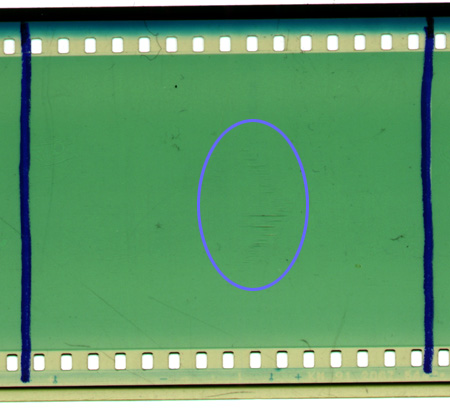
Here's a sample of an air jet scratch. It's in the shape of an arrow pointing away from the direction of film travel (picture is upside down); individual marks can be light to the point of be unnoticeable or heavy enough to dig through the emulsion. The rotor side of the film is rubbed against the air jet when the center of the film is bowed as the loop forms. The edges don't scratch because the stators and rotor segment rails don't let the film go anywhere it's not supposed to be.
Losing air pressure during a show will scare the living crap out of you. It will also severely scratch film on the air jets if you have one of those rotors that scratch film when you turn it by hand. When a GT E-stops, it immediately turns off the rotor air; on an SR, the entire system remains powered until the rotor has stopped.

The vacuum isn't as important as the air jets are (regarding scratches). All the aperture vacuum does is suck the film against the registration pins and hold it against the field flattener to be projected. I have not seen film damaged due to lack of vacuum, though I haven't exactly conducted a scientific study. I have seen an SR run without a field flattener, though the picture was all over the place and it made quite a racket. I wouldn't try that one at home.

Somewhere I saw pictures of a GT-HD projector and seem to remember a bit of extra stuff under the hood. I don't know what changes would be necessary on a Classic, though I'm sure Gordon could answer that one. I think his projector has probably seen other frame rates.


Posted by Tristan Lane (Member # 1169) on 03-03-2002, 11:52 AM:
 

Thanks for the Info.

Got a few other questions about the system.

Does Imax make a Cue detector system that can be retrofitted to the older projectors so that you can place projector stop cues on the film?? I have seen a projector tail out once - not a pretty sight.
Additionally - My supervisor is considering a DDP II system to replace the DTS and Dubber - Would this be a cost-effective way to improve sound quality? Right now, when using DTS - we cannot add trailers to the film unless DTS has put them on the CD along with the feature soundtrack. We had used a D-TAC system in the Boise Imax, and I was very impressed with the Showlist setup.
My concern is this - On a new system, the D-TAC is tied into the automation of the projector and can control show start and ligts etc..... So how easily is the new system adapted to this old Projector with no automation whatsoever?

One more question:
My boss has asked me to find a way to set up a switch to change between the DTS system and the Dubber. Right now we have to go behind the Rack and change some XLR's and the Tach connection. I was thinking about using a bunch of P&B relays to do the job and have them all tied into a toggle switch. But, I am worried that the relays will introduce some Hum into the system. Any suggestions would be appreciated!!

Thanks
Tristan


Posted by Adam Martin (Member # 641) on 03-03-2002, 06:35 PM:
 
By "older projectors" I assume you mean the relay-based systems (as opposed to the PLC-based systems). You should get ahold of Pete or Wayne at the Detroit Science Center. They just upgraded to a DDP-II from an analog sound source and they have a relay-based system. Wayne would be best to tell you how the DDP-II compares to the DTAC with regard to the automation, as he has used both. I do know, however, that they still have to stop the show manually. Personally, I would keep the dubber as a backup to the digital system. Send me a private email and I'll get you the contact info for the DSC.

I haven't used the 15/70 DTS system, so I don't feel qualified to answer that question.


Posted by Tristan Lane (Member # 1169) on 03-08-2002, 09:30 PM:
 

What I am trying to develop is just a basic switch to switch 6 channels of audio from one source to another, but without having to physically move cables from one device to another.
Karen at DTS says that they may have something that will work for us. The main reason for the post was to find out if putting relays on line-level sources could cause hum in the system. Currently we are using a Sound mixing board to switch between sources but there is not enough room on the board to accomodate both the Dubber and the DTS system. We are pushing for the DDP system, but for now we have to find a solution using the existing equipment.

Another imax question. On our old projector (relay based) the rotor air pressure gauge reads 0 psi when the projector is running, but when the dowser is opened, then the pressure jumps up to the normal 60psi. My question is: is this normal for this era of projector, and, would running the projector with the dowser closed damage the film?

Thanks
Tristan


Posted by Adam Martin (Member # 641) on 03-08-2002, 10:32 PM:
 
Sounds to me like the gauge is somehow connected to the dowser piston. Do you have an 8-segment rotor? If so, you will notice a dramatic difference in booth volume between air and no air. No air will be louder, as the film will be slapping around in there recklessly (over-simplified, but you get the idea).
 
Posted by Gordon McLeod (Member # 33) on 03-08-2002, 10:51 PM:
 
FYI Ontario Place Cinesphere still has 2 prints of Man Belongs to Earth
 
Posted by Tristan Lane (Member # 1169) on 03-08-2002, 10:58 PM:
 
Adam,


There is a definate change in sound when the dowser is closed. And there is noticeable marring on the film after the credits, because the dowser is closed at that point. The dowser button on the projector console is not functioning at this point in time, instead we are using the "Dowser Test" toggle on the back of the lamphouse. The problem is supposed to be fixed at next service. I hate to say it but the projector is very problematic. There are a few problems that I have experienced that make starting a show a very nerve-racking time. For instance:
Sometimes at show startup the dowswer will somehow open itself, thus showing Acad. leader on the screen. The only way to shut the dowser is to flip the toggle switch up and then down again. At that point the lamp shuts off for some strange reason. So that causes the need to re-strike the lamp.

And- sometimes in the morning when things are just getting turned on, The "system on" button does not work. It does nothing. The solution is this: I open the MKII reel unit, turn the local disconnect switch off in the bottom the reel unit, and then remove the positive battery cable in the top of the reel unit. I wait a few seconds, replace the terminal, switch the reel unit on via the local disconnect knob, and hope for the best. Usually it takes a repeat of 10 times to get the system to power up. The IMAX techs are stumped by the problem.
I suspect that it is in the E-Stop system somewhere.

Going from SR projectors to the mammoth old beast is a hard change to deal with. Maybe I should quit whining and just deal with it

Let me know if you know of any solutions to the problems
Thx- Tristan


Posted by Tristan Lane (Member # 1169) on 03-08-2002, 11:02 PM:
 
Gordon,

My boss must have been blowing smoke, but if you go to BMZ the only print listed is the one at Spokane.
"Man Belongs to Earth" was the premier show for Expo '74 wasn't it??

Tristan

P.S. The question isn't "What Prints does the Ontario Cinesphere have?" The real question is "What prints does the Ontario Cinesphere not have?" I have seen those picures of your film library- very impressive!


Posted by Adam Martin (Member # 641) on 03-09-2002, 01:20 AM:
 
Hey, Gordon - what's your take on Tristan's rotor air? I don't remember the classic in Detroit doing that, but their projector was up in the doghouse, so I couldn't swear to anything.

Tristan - have you tried a good swift kick?


Posted by Dick Vaughan (Member # 540) on 03-09-2002, 05:33 AM:
 
Tristan

Who is your regular IMAX tech? Have you spoken to them about the air pressure oddities?

Since having the SR 's installed here 3 years ago some of the niceties of what air pressure gauges did what when on ole system 34 have fled from my brain. Be thankful you have an external pressure gauge. There are none on SR projectors.
We had a problem 2 years back when the rotor pressure dropped and film got scratched.No alarm. The only air pressure alarm is on the main supply.


Posted by Gordon McLeod (Member # 33) on 03-09-2002, 06:34 PM:
 
Something is wrong with the airplumbing
The old 4K aircooled classic should have about 52lbs on the rotor and the douser should not effect it
As to prints they are numerous many but in the case of Man belongs to earth the soundtrack was loaned out years ago adn all we have is a music track
When I last visited DKP there was a lot of material fo it there though and I believe I saw some soundtracks and the neg
 
Posted by Tristan Lane (Member # 1169) on 03-09-2002, 06:36 PM:
 

Hello again

We have spoken to the Tech about all the problems listed. The rotor air gauge situation does not seem to be a big concern to him. I am hoping that the problems can be fixed on the next service call.

The SR projectors are equipped with a Rotor air pressure gauge. It is located beneath the projector cover on the left hand side of the projector. Why they decided to put the gauge out of view of the operator is beyond me. I have seen a "Rotor air pressure low" alarm on the system in Boise. The system was installed in '99. I can't imagine that there is an SR projector out there that does not have some sort of warning device to alert the operator of low rotor pressure. Everyone is familiar with the usual beep-beep of the "Air Pressure low" alert that is displayed when the air tank is drained at night. That system will even warn you if you lose 1 of the 3 phases of power supplied to the rectifiers.

-Tristan


Posted by Adam Martin (Member # 641) on 08-05-2002, 09:33 PM:
 
*bump for Paul*
 
Posted by Brad Miller (Member # 2) on 08-05-2002, 09:37 PM:
 
Aha, so THAT's what caused those scratches we saw at the IMAX at Fair Park a week ago. Interestingly enough, they were very bad through the "welcome to the Dallas IMAX" 8 minute intro, and then they plagued the first 10 minutes and the last 10 minutes of the film. The middle of the show was pretty clean though. I was wondering if this could have been caused by rewinding with improper tension, as it only occured at the ends of the roll.
 
Posted by Gordon McLeod (Member # 33) on 08-05-2002, 09:45 PM:
 
What type of reel unit did they have the MK1 with the feed and take up reels opposite each other or the MK2 stacked one above the other
 
Posted by Brad Miller (Member # 2) on 08-05-2002, 10:58 PM:
 
MK2
 
Posted by Adam Martin (Member # 641) on 08-06-2002, 10:39 AM:
 
The air jet scratches will be colored or white, as the emulsion faces the rotor (except on one eye of most 3D films) and should always be in the arrow design pointing to the right side of the screen. Cinch marks from rewinding will be completely random. What Brad describes sounds more like a rewinding issue to me.
 
Posted by Brad Miller (Member # 2) on 08-06-2002, 02:48 PM:
 
These scratches looked exactly like regular black "cinch mark" scratches that could be seen at the ends of reels on 35mm prints, except they were horizontal. That's why I originally thought they were cinch scratches from rewinding. They occupied the entire width (projected height) of the film.
 
Posted by Adam Martin (Member # 641) on 08-07-2002, 08:04 PM:
 
For the sake of keeping all of this info in one neat place, I shall quote myself from another thread:

quote:

Fantasia 2000, Beauty and the Beast, Treasure Planet, Lion King, and (likely) Aladdin are all "letterboxed" as 1.66 on the 1.4 Imax screen. Apollo 13 will probably follow suit.

Apollo will probably be edited to a certain extent, both for content and length (print cost). 140 minutes X 330 ft/min X .66 $/ft = $30,492 per print.

It would also weigh in at about 900 pounds. My forklift will pick up 1,000 pounds, but you won't see me trying it anytime soon!

There are several modifications for the QTRU reel unit: original configuration will hold about 60 minutes on a reel; for $20,000, the "Fantasia" upgrade will hold about 90 minutes on a reel using the bottom two reel arms; and for another $20,000, the "Apollo" upgrade will hold about 120 minutes on a reel using the bottom two reel arms and 90 minutes on the middle two reel arms with the top arm holding about 60.

The MK2 reel unit with 60-inch reels can hold 90 minutes of film.

The SR projectors are capable of doing a single changeover during a show. A multiple changeover version of the software has been promised, but I don't think it has become anything of a reality yet. That means that an SR with an unmodified QT can run 120 minutes without interruption, or 300 minutes with a full blown QT package. When it comes to feature-length 3D films, both projectors run simultaneously, so no changeover is possible.

The GT and Classic are single-projector systems and, obviously, cannot do a changeover without a second projector. They are limited by their reel unit.

There is also a question of sound system capacity. Theaters with dubbers have to upgrade to a digital playback source at some point. Only so much 35mm fullcoat will fit on a reel.

With all that said, Waikiki Imax is a GT 3D system (probably with a QTRU and a MK2). Polynesian opened in 1991 and is 2D only, so my guess is that it is a Classic with a MK1. The Bishop Museum will have an SR dome and a QTRU when it opens in 2004.


Posted by Gordon McLeod (Member # 33) on 08-07-2002, 08:47 PM:
 
Several theatres have place a cinemecanica tower beside the dubber to handle longer lengths of mag

 
Posted by Adam Martin (Member # 641) on 11-28-2002, 12:28 PM:
 
Time to bump up again. [Smile]

Here is a photo of the SR projectors in Grand Rapids. They are motored back from the port window for threading in this view.
 -

Here is a photo of the GT projector in Sacramento. A little bigger. [Smile]
 -

Here is a photo of Gordon threading the Classic in Toronto's Cinesphere. It is Imax projector serial number 1.
 -

The Imax Dome/Omnimax projector is identical to the Classic, except it is mounted on an elevator and run up into the center of the seating area from below. In a dome theater, the projection booth is below the audience since the screen is above.

These are the PPS speakers for the SR system. They are bi-amped. All six channels are the same speaker: L C R LS RS and Top.
 -

These are the PPS speakers for the GT system. They are tri-amped. Again, all six channels are the same speaker.
 -

The sub array for the SR system has six 18-inch speakers. The GT has eight. With the DTAC audio system, there is a discrete sub channel as well as an LF extension from the stage speakers.
 -
 
Posted by Daryl C. W. O'Shea (Member # 1303) on 11-28-2002, 03:04 PM:
 
Bump for Adam's pics... neat!
 
Posted by Tristan Lane (Member # 1169) on 12-28-2002, 02:17 AM:
 
Yet another Bump for one of my friends who was curious about the kind of speakers used in IMAX facilities. (Kudos on the pics Adam)

I especially like replacing speakers in those bad boys. HF seems to be the least accessible. And seems sonics like to cinch down those drywall screws pretty well. Have your cordless handy.

I never responded on the solution to the DTS - Dubber switching dilemma. I ended up using a High Quality Printer switch from the local computer supply store (tried to find a "shielded" model). I used a manual switch because I was concerned that an automatic or electronic switch might produce some random noise in the channels. After a lot of soldering on 25 pin D-subs it was complete. Even had room on the plug to add the SMPTE timcode from the projector and send it to both units through the switch. So far the unit has worked great and I bought a spare just in case.

-T
 
Posted by Michael Brown (Member # 890) on 12-28-2002, 04:20 PM:
 
Interesting. I was overhearing someone trying to explain why IMAX films are only 45 minutes long. They were saying that since IMAX is such high quality, after 45 minutes you would start to feel nauseous because you were seeing so much information.

hmm ????
 
Posted by Adam Martin (Member # 641) on 12-28-2002, 10:01 PM:
 
Because of the speed at which the film travels (about 336 feet/minute), a 45-minute film is about 15,000 feet long. This takes up about as much space on a platter as a feature-length 35mm print. Current cost for 70mm lab work is about 66 cents per foot, making that 45-minute print a $10,000 investment. Double that for a 3D film. And that's just for a single release print.

Combine that with the fact that the format is used mostly for institutional documentaries and such, which translate well as short subjects, and you have a 35-45 minute standard.

Giant sized screens with super-fine focus can be a little overwhelming, and that is a concern, but not the real reason.

With the right equipment and modifications, Imax theaters are now easily able to show up to 150 minutes uninterrupted in single-projector setups and 300 minutes in a two-projector SR setup.
 
Posted by Brad Miller (Member # 2) on 12-28-2002, 10:05 PM:
 
Adam, is there no way to keep a film running continuously via a pair of SR projectors? It would seem once the first platter's worth of film is run through and the changeover has been made that the projector could be pulled back and reel 3 threaded. ...or am I completely wrong here? (I've not had the opportunity to work with IMAX yet.)
 
Posted by Adam Martin (Member # 641) on 12-29-2002, 12:26 AM:
 
The SR changeover was designed to accommodate Fantasia 2000, which was do-able with existing equipment that could handle up to 60 minutes per half. This was achieved with a (not-so) simple software change. Beauty and the Beast was the second feature-length film and was also under the 2 hour limit, as is The Lion King.

The "Fantasia" upgrade for the GT projector involved upgrading (or purchasing, since many GT systems did not have one) the QTRU reel unit to handle up to 90 minutes on one reel, which satisfied the need to run the Disney products without interruption.

The way the SR projectors are tied together as master and slave (only the right projector actually communicates with the PLC and it kind of acts as a proxy for the left projector) currently prohibits a second changeover. In fact, once the first half of a feature-length show comes to a stop on the right projector, it must be left alone until the second half has completed on the left. Otherwise, the system will emergency stop, thinking that a safety switch was opened on a running projector.

With the advent of the QTRU upgrades (now up to 150 minutes because of the DMR product), it is not necessary to make changes on the SR system other than upgrading the reel unit with the longer arms. This is the preferred method anyway, since (eventually ... someday ... no, really) there will be a feature-length 3D film which will require the use of both projectors at the same time. (This was supposed to be Shrek repurposed into 3D, but Dreamworks apparently chickened out after changing their collective mind repeatedly.)

There is supposed to be a "continuous changeover" software upgrade on the drawing board, but with other options already available which also work for the other projectors, the SR software doesn't rank very high on the priority list.

Besides ... if it's longer than 150 minutes, it's a pretty good candidate for an intermission anyway.

Sidebar: The SR system was not designed with a changeover in mind. It was designed as a much-less-expensive-than-the-GT alternative for small Imax Dome theaters and small Imax 3D theaters. Minor "personality glitches" in both the changeover software and the DTAC audio software were still being worked out well into the run of Fantasia.
 
Posted by Adam Martin (Member # 641) on 12-29-2002, 12:54 AM:
 
Those speakers are great fun to work on. There are no less than 19 screws holding each back panel on, then four screws to remove the midrange to gain access to the HF, which has three screws on the cover and then three more holding the diaphragm in. I lost count.

The most fun I ever had was changing an HF diaphragm on the center channel during a showing of Space Station. I got to the midrange (which faces the back of the cabinet and gets really loud when you take that back panel off!) just in time for a shuttle launch. [Eek!] At least I had the sense to take my ear plugs up with me.
 
Posted by Gordon McLeod (Member # 33) on 12-29-2002, 11:58 AM:
 
One of the main reasons for the approximately 40min running time is that most museums (which is where the money is in the Large Format World) want to schedule shows around an approximate 1 hour turn around
 
Posted by Michael Brown (Member # 890) on 12-29-2002, 08:05 PM:
 
quote:
Interesting. I was overhearing someone trying to explain why IMAX films are only 45 minutes long. They were saying that since IMAX is such high quality, after 45 minutes you would start to feel nauseous because you were seeing so much information.

hmm ????

What I was thinking was that if this really was the case, then we would get nauseous in real life after 45 minutes of having our eyes open. Since the picture quality of real life is even better than IMAX! [Big Grin]
 
Posted by System Notices (Member # 2357) on 08-23-2006, 04:02 AM:
 

It has been 1332 days since the last post.


Posted by Cameron Glendinning (Member # 3516) on 08-23-2006, 04:02 AM:
 
Shows on the hour every hour, thats were the money is!!!
Australias 2nd most profitable film ever was ANTARCTICA imax release. Most profitable Crocodile Dundee
 
Posted by System Notices (Member # 2357) on 11-17-2007, 04:11 PM:
 

It has been 451 days since the last post.


Posted by Thomas Pitt (Member # 4322) on 11-17-2007, 04:11 PM:
 
Actually, 45 minutes is about the limit that you can watch an IMAX 3D movie without feeling some form of motion sickness.
You don't get sick in real life because your body and head are moving in the same directions as your vision shifts. But with IMAX, your field of vision is moving around without your body feeling the same movements. Unless you get some kind of motorized seating to throw you around, IMAX 3D films are still likely to induce motion sickness...

It's the exact same reason motion ride simulators make some people [puke] , if the movements of the capsule aren't perfectly in sync with the image movements on screen.
 
Posted by Blaine Young (Member # 3992) on 11-18-2007, 05:28 PM:
 
I seem to recall that 45 minutes was the initial limit of what the IMAX platters would hold. I know that when I saw "Rolling Stones: At the Max" at the Canadian Museum in Hull Quebec in 1992, there was an intermission.

With platter system mods, the time has been incresed. I recall reading that "Superman Returns" at 154 minutes is about as long as they can hold now.
 
Posted by Gordon McLeod (Member # 33) on 11-19-2007, 11:35 AM:
 
I put All Access and a trailor onto a standard 48" MK1 platter and that should be about 70min worth
 
Posted by Kirk Sayers (Member # 4431) on 11-19-2007, 03:23 PM:
 
i work at the CMC Imax/Omni in Hull Qc.we have a converted classic Imax with a 12 gap rotor and were capable of 24&48fps up until 4 yrs ago. The hard spring cam was replaced with a soft one after we noticed that every time we ran Momentum we had a breakdown , shaft coupling shattered,timing belt break,whatever, you name it we had it,so now we cann't run 48 without reinstalling the old cam but that hasen't happened yet(thank the gods). There is a 24/48fps system in Louisianna( i think in Baton Rouge)i met the projectionist at Imax HQ years ago and apparently we lent them our print for the grand openning. To the guy in Vansterdam B.C. the rotor air pressure and air jets start as soon as the projector starts and to whoever asked if your system was capable of 48fps, your shutter segments would be removable(for 48) and the cam unit is completly different than a conventional system. The cam arm moves in two directions,in to engage the perfs then to the side for slowdown and then pulls back for the release, the timing is set by degrees on a radial dial so if this is all unfamiliar to you i doubt you have a 48fps system.
 
Posted by System Notices (Member # 2357) on 07-05-2009, 12:42 AM:
 

It has been 593 days since the last post.


Posted by Jake Spell (Member # 5294) on 07-05-2009, 12:42 AM:
 
quote: Adam Martin
The most fun I ever had was changing an HF diaphragm on the center channel during a showing of Space Station.
Why were you trying to change a speaker during a movie? Why wouldn't you wait until after or cancel the show? Trying to change a speaker on scaffolding behind a screen while the movie is running sounds pretty unsafe and distracting to me.
 
Posted by Tony Bandiera Jr (Member # 2365) on 07-05-2009, 06:09 PM:
 
I've changed drivers during a film before, it's not that unsafe or distracting, you do have to be quiet while on the rigging and try not to let your flashlight beam hit the screen. [Smile]

And if the driver blows after the show started, then that's why I would do it during the show. Why refund an entire house or lose a whole show over a 10-15 minute repair? [Roll Eyes]
 
Posted by Mark Gulbrandsen (Member # 72) on 07-06-2009, 06:20 AM:
 
Thats one very good excuse to be installing baffle walls!!!


Powered by Infopop Corporation
UBB.classicTM 6.3.1.2