This is topic AMC replacing MPX units? in forum Large Format Forum at Film-Tech Forum ARCHIVE.
To visit this topic, use this URL:
https://ft-forum.com/ft/cgi-bin/ubb/ultimatebb.cgi?ubb=get_topic;f=14;t=000197
Posted by Mark Lensenmayer (Member # 134) on 02-26-2009, 12:02 PM:
I notice that a couple of the original AMC IMAX installations are showing the JONAS BROTHERS 3-D, and I understood this was a digital only release since it is only playing 1 week until WATCHMEN opens. Have they switched out the MPX units in Kansas City (Studio 30)and Phoenix (Deer Valley 30)for digital? The Detroit and Columbus MPX locations are not showing JONAS BROTHERS on their Imax Junior screens.
Posted by James. R. Deeter (Member # 837) on 02-26-2009, 01:29 PM:
AMC Olathe and Barrywoods ( KC area ) have installed the IMAX digital MPX which is just dual Christie Digitals so they are able to run the JONAS BROS in 3-D Real D for the one week leading to Watchmen.
Posted by Mark Lensenmayer (Member # 134) on 02-26-2009, 02:02 PM:
I don't believe the Digital system is called MPX...that is the name of the 15/70 film system designed for conventional theatres. I still believe it should be called Imax Jr.
Posted by Mike Olpin (Member # 1115) on 02-27-2009, 12:43 AM:
My old location (the MPX unit behind me on my avatar) was replaced with a dig-IMAX. The tech told the staff working there that it was 4k.
Of course we all know 2k + 2k does not equal 4k, especially when overlapped.
Posted by Dick Vaughan (Member # 540) on 03-06-2009, 03:51 PM:
And if it was being shown in IMAX Digital it wasn't Real D 3D !
Posted by Mark Gulbrandsen (Member # 72) on 03-06-2009, 04:55 PM:
I was told recently by an ex-Imax employee that all MPX machines will be heading to the scrap heap.
Mark
Posted by Mike Olpin (Member # 1115) on 03-07-2009, 02:44 PM:
That's too bad. For all there quirks, it was a nice machine to work on.
Posted by Ken Lackner (Member # 1002) on 03-07-2009, 03:50 PM:
quote: James. R. Deeter
...the IMAX digital MPX which is just dual Christie Digitals....
Two CP2000's may be at the heart of the system, but there is a LOT of proprietary hardware and software that makes it far more than "just" dual Christie digitals.
quote: Mark Lensenmayer
I don't believe the Digital system is called MPX...that is the name of the 15/70 film system designed for conventional theatres. I still believe it should be called Imax Jr.
Regardless of what anyone thinks it should be called, it is called Digital MPX. This, of course, differentiates it from the 15/70 MPX.
Posted by Julio Roberto (Member # 4976) on 03-07-2009, 04:21 PM:
Buzzword is that Imax is using a "pixel shift" of sorts.
They run their own masters of the films at DCI 4K, sending each projector a (different) full 2K picture (i.e. odd pixels, even pixels).
The pixels just "blur" on the screen, sort-of like a poor's man pixel shift.
Propietary software and hardware would be aligment and uniformity tools, as well as contrast enhancements and noise reduction.
Don't know if this is truth, but I'm certainly willing to believe it. Search Imax patents on digital and a pile of them are related to similar technologies.
So I guess we could call it a 3K system ![[Wink]](wink.gif)
Posted by Ken Lackner (Member # 1002) on 03-07-2009, 05:40 PM:
Julio,
I recall hearing that each projector is projecting the identical image, and they are overlaid on one another, thus increasing brightness and contrast, but not resolution. Now perhaps the person who told me this was misinformed, but this is how I understand it to be. I do know that if one projector goes down, you can still run with only the remaining projector, which I don't think would be possible if they each projected a different image; you'd loose half your pixels, whereas this way at least you only loose half the brightness.
Posted by Scott Norwood (Member # 30) on 03-07-2009, 06:14 PM:
So, this system is 4k, at best. A good 35mm scope or Academy print is generally considered to be better than 4k, and a 5/70 image is definitely better than 4k.
I'm confused as to where the Imax part comes in. Can someone please confirm that at least the sound system is up to the usual Imax standards? Is there a minimum screen size?
I have not seen the DLP Imax (or MPX, for that matter), but on paper it sounds as if they could have saved a bunch of R&D costs by installing high-end 5/70 systems with the Imax sound systems, while providing a better product to the moviegoing public.
They could still collect lease payments for the sound equipment and licensing for the brand name, too.
Posted by Mark Gulbrandsen (Member # 72) on 03-07-2009, 08:48 PM:
My Imax friend told me that the MPX projector had by far the best light distribution of all the Imax projectors they built but that there were other problems that plagued the projector including the fact that it was still too darn expensive to operate it. Somehow that Cermax lamp they used was spread to cover the 15/70 aperature... a pretty amazing feat if you know how small the Cermax lamp assemblies are. Wish I had a pix to post of one...
Mark
Posted by Frank Angel (Member # 248) on 03-08-2009, 12:39 AM:
I've seen standard 2K digital projection as well as Digital IMAX and the IMAX image hands down looks much sharper than standard 2K. However they do it, it looks impressive to the point where even cynical, won't-believe-it-if-I-can't-see-it me thought it was better than any digital I have seen so far. Whether it is 4K or not, they've somehow given it an apparent higher rez look without negative video artifacts, than their competiton can get with a 2K system; and "apparent" is all they really need accomplish.
Posted by Julio Roberto (Member # 4976) on 03-08-2009, 07:03 AM:
As I said, look at Imax patents. They all state what we've been saying here: i.e. methods to make 2K projecting arrays "almost look like 4K".
Just a random example:
quote:
Apparatus and techniques for enhancing characteristics of electronic projection systems are detailed. Included among the techniques are both superimposition of sub-images and tiling of superimposed images, the combination of which can be advantageous in improving resolution of projected images. Pre-modulators and polarizing beam splitters also may be used as parts of the innovative systems.
Etc
quote:
U.S. Pat. No. 5,386,253 to Fielding, incorporated herein in its entirety by this reference, discusses exemplary projection systems utilizing one or more spatial light modulators (SLMs). As noted in the Fielding patent: Spatial light modulatordevices include so-called "active matrix" devices, comprising an array of light modulating elements, or "light valves," each of which is controllable by a control signal (usually an electrical signal) to controllably reflect or transmit light inaccordance with the control signal A liquid crystal array is one example of an active matrix device; another example is the deformable mirror device (DMD) developed by Texas Instruments . . . See Fielding, col. 1, II. 13 21. Of course, yet othertypes of light "engines," or sources, exist, and various of them may be used in connection with the inventions described herein.
Regardless of the type of light sources and modulators used, audiences frequently desire to see images high in detail and richness and low in objectionable artifacts. High resolution and image quality in particular facilitates suspension ofdisbelief of an audience as to the reality of the projected images Such quality indeed often is an important factor in the overall success of the motion picture viewing experience among today's audiences.
Producing these high-resolution images is not without added cost, however. Imax Corporation, for example, the intended assignee of this application, utilizes not only specialized cameras and projectors, but also seventy millimeter, fifteenperforation film to increase the resolution and quality of projected images. Conventional electronic projectors (and especially these utilizing SLMs), by contrast generally cannot supply equivalent resolution in projected images. As well suchelectronic projectors frequently fail to furnish the dynamic range and overall brightness of images provided by large-format films. They nonetheless may desirably (or necessarily) be employed to display non-film-based images such as (but not limited to)computer-generated graphics or material captured with electronic cameras.
U.S. Pat. No. 5,490,009 to Venkateswar, et al., also incorporated herein in its entirety by this reference, details techniques purporting to enhance image resolution in systems employing multiple SLMs. According to the Venkateswar patent,sub-images generated by different SLMs are simultaneously displayed such that some sub-images are spatially offset horizontally or vertically from others. This results in partial superposition of the sub-images, with the offset supposedly allowing atwo-SLM system (with each SLM having "x" pixels per row) to provide "a perceived quality approaching that of a system that generates a single image from an SLM having 2(x) pixels per row." See Venkateswar, col. 2. II. 41 43.
U.S. Pat. No. 5,612,753 to Poradish, et al., additionally incorporated herein in its entirety by this reference, discloses alternative techniques for, purportedly, increasing brightness of projected images or extending the projected number ofgray levels. FIG. 1 of the Poradish patent illustrates a projection system in which light from two sources is reflected toward separate lens systems and then focused separately on distinct color wheels. Light from each color wheel thereafter isreflected to an SLM (preferably a DMD) via a total internal reflection (TIR) prism, with each SLM modulating the light and directing it back to the associated TIR prism. As directed, the light is then transmitted by the prisms to lenses for projectiononto a screen. See Poradish, col 3, II. 6 39. In essence, therefore, the Poradish patent contemplates use of dual DMDs present in parallel paths existing from separate light sources to a screen.
While the techniques of the Venkateswar and Poradish patents arguably might enhance the resolution of an image produced by a digital projector, alone either is unlikely to provide resolution consistent with that of large-format film. Enhancedresolution of images produced by digital projection systems thus remains a significant issue for those engaged in development of commercial projection equipment. Absent further advancement in this area, viewing of electronically projected images remainless satisfying to public audiences.
SUMMARY OF THE INVENTION
The present invention seek to provide such advancements by addressing differences of, typically (but not necessarily exclusively electronic. SLM-employing projectors. It further does so in a more comprehensive manner than heretofore considered,attempting to create equipment and techniques capable of providing images of sufficient overall quality that they may be used in venues instead of, or in addition to, traditional large-format film projectors without disturbing audience perception thatthe viewed images are of high quality. As noted above, this perception is a significant aspect of modern-day viewing experiences, at times helping determine overall success among the public of particular motion pictures.
Embodiments of the present invention utilize not only superimposition, but also tiling to effect improvements to resolution of digitally projected images. "Tiling" describes the concept of joining two or more groups of images (or "sub-images")edge to edge, with each sub-image containing only a fraction of the total projected image. Because each sub-image conveys only a fraction of the overall image, its resolution will be greater than if the sub-image conveyed the total image itself.
Again, I don't know exactly what Imax is doing, but most people in the industry are talking like they knew it was a pixel shift from 4K. You "lose" half the pixels, but you start out with twice as much as 2K, so you are back to the max a 2K system can do anyway.
But it's a 2K "supersampled" and thus less objetable aliasing above nyquist, improving the overall MTF. The bandpass filter for 4K can be twice as large as for 2K.
Again, don't know what they are doing or how they are doing it, but a pixel-shift of sorts from a 4K DCI master into 2x2K projectors would make sense to me, as would projecting the two images at slightly different illumination floors as to slightly improve perceived contrast.
Posted by Paul Trimboli (Member # 1509) on 03-08-2009, 07:36 AM:
I saw digital IMAX for the first time yesterday (Space Station 3D as well as a few trailers) and I have to say while over all the picture was good its defiantly not up to the standard that I have come to know from IMAX. The colour and contrast was good but all of that lovely detail that is normally in an IMAX picture was gone. Since IMAX traditionally has longish shots details is really important. There were many scenes where the space station was floating with the earth in the back ground- the solar array had a jagginess to it. There is another scene in that film where 2 men are standing on a balcony and again its a long shot and there was not enough detail in the picture and the 2 mens ended up fuzzy. For a lot of the film (I was sitting a couple of rows in front of the middle row) I could see the grid of pixels. So while the system for the most part is acceptable its defiantly no where near the quality of 15/70 and it worries me that IMAX is putting their name to a system like this. Why not use 2 4k machines and use this image enhancement to give it the look of an 8k system. IMAX has always set the bar much higher so why are they not doing it this time?
Posted by Ken Lackner (Member # 1002) on 03-08-2009, 09:27 AM:
quote:
deformable mirror device (DMD) developed by Texas Instruments
![[Confused]](confused.gif)
Posted by Julio Roberto (Member # 4976) on 03-08-2009, 09:52 AM:
quote:
deformable mirror device (DMD) developed by Texas Instruments
http://www.patentstorm.us/patents/5600383.html
[Link is to a patent abstract describing Texas Instruments Deformable Mirror Devices]
DMD are mems devices. They are the heart of DLP's. Perhaps you were implying the confusion when they changed the name to Digital Mirror Devices???
quote: Paul Trimboli
Why not use 2 4k machines and use this image enhancement
Everybody wished TI could make DLP's of an acceptable size that are 4K. But they can not. About 2.5K is the best they can make under 1.2"
The only other technology that can produce images like that (or better) at good illuminations levels, GLV, is much more "exotic" and still requires a bit of development that nobody is pursuing for the DCinema since it "belongs" to Sony and for them it's much more profitable to do Lcos.
And Lcos, the technology used by Sony and many others that have tried to enter digital cinema business in the past (hughes-jvc) has one problem: it can not really stand the heat from high power lamps in the long term, so they are limited to small-medium screen sizes and significant degradation over long-ish time periods (say, 10 years lifespan).
Cinema needs projectors that can stand 4Kw and 6Kw for many hours a day 365 days a year for no less than 10 years, preferably 15, and still produce images that look almost like it did the first day. Right now, DLP is the only techonology trouble-free and fully developed to allow this.
But only at 2.5K max resolution on sensible (i.e. not too expensive) optical sizes (i.e. size of lens, prisms, mems, etc).
Thus, we are all stuck with 2K that's "good", "cheap" and "bright" or 4K that's "expensive", "ok" and "dark".
If there was a 4K projector of similar performance and price point as 2K today, I don't think anyone in the industry would complain about it
2K is fine and, if done right, conveys all the "information" (resolution/perceived detail) needed for the people sitting in the back rows of most modern movie theaters.
True 4K would do the same for everybody except those sitting in the first couple of rows.
True Imax would do the same for those too
But who knows. Maybe some projector manufacturer will start to do pixel-shift light engines, sort of like it's done for 8K.
http://news.bbc.co.uk/2/hi/technology/7617702.stm
[Link is for a video presentation, after a brief commercial, of UHDTV also known as super-hivision, an 8K TV standard following the SMPTE S2036-1-2007 formats of 3840x2160 pixels and 7680x4320 pixels for Quad-HD and UHDTV and EBU standards]
Of course, no need for that anytime soon, but it's there for our grandchildren to enjoy. In case you wonder, the approved standard is for 22 sound channels ![[Eek!]](eek.gif)
http://www.nhk.or.jp/digital/en/superhivision/
[Link is to a page about japan's NHK super-hivision system, an 8K adquisition and projection system they've been showing off at conventions and fairs for many years now, using pixel-shift and multi imagers tricks to obtain such high resolutions with today's manufacturing capabilities]
Everybody in the industry gives for granted that, once the new crop of cameras shows up later this year as IT improves, 4K will be a given minimun for most productions and that as soon as a 4K projector that meets cinema demands is available for reasonable $$$, the exhibition will quickly move to 4K too. How long that will take, it's anybody's guess.
As a result, what will be projected in digital movie theaters for a while WON'T be too different from what people can get in their homes (1080p), no matter what others may say. In a few specific cases, people will be seeing in their homes even better pictures than in cinemas.
I, for one, am not optimistic that the "4K exhibition part" will happen soon. Not because lack of will. DCI MANDATES servers to decode 4K masters and MANDATES projectors to accept the signal (and allows them to downconvert to 2K). It's just the lack of suitable 4K projection technology at huge light levels that is stopping it.
But I do believe the production part will fully move to 4K very soon. It's already doing it, with over 25% of new productions (for which it makes sense, i.e., non indies) already mastering 4K.
It's not a matter of "showing off" or "producer vanity". It's that they know in the (near-ish) future, their products will lose value if they are not 4K.
Imagine for a second that a new quad-hd tv standard shows up from nowhere and all of the sudden you see quad-hd TV's and quad-hd disc player's for $800 and $200 in stores (don't think it will happen, but pretend it does). Now, if your $100m movie is a 2K master ... what the hell are you going to sell in quad-hd (basically, 4K)?
4K is an assurance of future. A future that may not be too far away, but even if it is, it's a small (nowadays) price to pay for protecting the value of your $100m movie production.
The industry knows that 4K is a significant step up from 35mm once it reaches exhibition, while 2K is basically the same as "3 perf" 35mm, perhaps a bit better, perhaps a bit worse, depending who you ask, but not significantly superior to what we have seen in cinemas for over 50 years.
[ 03-08-2009, 05:25 PM: Message edited by: Julio Roberto ]
Posted by Mark Gulbrandsen (Member # 72) on 03-08-2009, 05:08 PM:
quote: Julio Roberto
The only other technology that can produce images like that (or better) at good illuminations levels, LGV, is much more "exotic" and still requires a bit of development that nobody is pursuing for the DCinema since it "belongs" to Sony and for them it's much more profitable to do Lcos.
Let us not forget our friends at Evans And Sutherland in Salt Lake City that have been building digital projectors of extreme high resolution for a long time now with a completely different technology. When I get back in town I may go over there and see what one of those "high end" projectors is actually capable of. As for adapting it to D-Cinema I don't see why not... Except the cost and compliance issues involved may not be somethng they want to deal with and sales of advanced projection systems for Flight Simulators and Dome Theaters in Museums is still pretty good for them.
BTW: Imax has had the technology to do digital projection filling different areas of the screen from differeent projectors and matched to the pixel and so on for many years... since the 1.3K days I believe. I believe I was told they could go as high as 12K rez. Why they didn't go this route and took the present route no one seems to know but I bet it had to do with practcality and cost reasons.
Mark
Posted by John Wilson (Member # 269) on 03-08-2009, 05:13 PM:
quote: Paul Trimboli
IMAX has always set the bar much higher so why are they not doing it this time?
The fact they are doing it at all should really be the answer to your question.
Posted by Julio Roberto (Member # 4976) on 03-08-2009, 05:25 PM:
quote: Mark Gulbrandsen
Let us not forget our friends at Evans And Sutherland in Salt Lake City that have been building digital projectors of extreme high resolution for a long time now with a completely different technology.
E&S are using GLV technology. What happens is that they obtained a license from the inventor, Silicon Light, for the dome and simulation markets, while Sony purchased the licence for home and digital cinema and just let it sit there. Sony developed a GLV projector and showed it off for a while, never to be heard from it again.
http://www.sony.net/Products/SC-HP/cx_news/vol40/pdf/sideview40.pdf
[Link is to leaflet of Sony's GLV projector used in 2005 expo]
Not sure the terms of the agreement, but I guess Sony would have to receive $$$$ to allow others to continue development for those markets or Silicon Light will have to wait for the deal to expire, hope Sony doesn't renew, and sell it to someone else (i.e. E&S who have been actively developing it to the point of bringing it to the market)
Posted by Paul Linfesty (Member # 214) on 03-08-2009, 11:49 PM:
Interesting that in the LA Times AMC diorectories, the chain is advertising WATCHMEN as being in "The IMAX Experience" at all their recently converted Digital IMAX screens, and yet their Universal City location is specifically advertising "The Original IMAX Experience."
Posted by Ken Lackner (Member # 1002) on 03-09-2009, 06:30 PM:
quote: Julio Roberto
DMD are mems devices. They are the heart of DLP's. Perhaps you were implying the confusion when they changed the name to Digital Mirror Devices???
Exactly. Digital Micromirror Device, actually. Is this one of those cases, like DVD, where the acronym stays the same, and refers to the same product, but what it stands for changes for some reason?
Posted by Mark Lensenmayer (Member # 134) on 03-14-2009, 09:29 AM:
I spoke with a representative of AMC and they are replacing all of the MPX units with Digital. The Columbus unit is scheduled to be replaced before the showing of STAR TREK.
I also got an explanation of the upside down debacle with WATCHMEN. At the Thursday midnight screening, the film broke and some film was damaged. This section must be replaced with blank leader to keep the sound in synch. The operator who inserted the blank leader flipped the film, turning it upside down. By this time, it was well after 2:00AM and it wasn't practical to run the film through. An operator was watching the film to make sure the blank leader went through correctly, and he was as surprised as anyone that it went upside down.
Posted by Mike Olpin (Member # 1115) on 03-15-2009, 08:00 PM:
HA! Had that happen to me once - I threaded spiderman 3 upsidedown. It's a mistake that was never repeated. In my defense, spidey was my first IMAX film - I was still learning!
Posted by Tim Rectanus (Member # 3282) on 04-22-2009, 08:04 AM:
quote: Mark Lensenmayer
At the Thursday midnight screening, the film broke and some film was damaged. This section must be replaced with blank leader to keep the sound in synch. The operator who inserted the blank leader flipped the film, turning it upside down. By this time, it was well after 2:00AM and it wasn't practical to run the film through.
When you (they I mean, my apologies Mark) break film and replace it with a black slug, it isn't deemed a necessity to run it before showing it to the public again? Not only to make sure the film will run through properly but also to make sure the sound is synced up after the damage (that they fixed it correctly.) Is this attitude creeping into the IMAX booths around the world? Or is it already there? Isn't any time you aren't already on screen and have the time to run a previously damaged print, the MOST "practical" time to run it? It is one thing if you break and fix it in the middle of the day but at night, there is no good excuse for not test running it before showing it to the public again. Did they test it before running it for the Midnight show before it "broke" or just go with the "I hope it works" approach to that as well?
Posted by Mike Olpin (Member # 1115) on 04-25-2009, 10:46 PM:
*Sigh. I guess it's been long enough. *
quote: Tim Rectanus
Is this attitude creeping into the IMAX booths around the world?
Yep. MPX allows multiplexes to upgrade their theatres to IMAX. But often times those theatres don't upgrade the most critical component in their booth - the operators. Instead their sloppy "projectionists" who can't even hold a 35mm show together are now tasked with a more maintenance intensive presentation system. What did you expect to happen?
Part of the reason my exodus from Regal was so turbulent is because I opposed and tried to correct some of the bad practices I saw occurring everyday. The MPX (film version) is a terrific machine and a marvel of engineering. If given the same operating conditions as most large IMAX theatres, that is to say a departmentalized IMAX team, professional training, and conscientious operators, the MPX would be a solid performer.
Unfortunately, many multiplex theatres are run by impatient managers who keep the brightest people on the floor and leave monkeys in the booth. Further compounding the problem is the corporate offices constant demand for performance. A show is not allowed to be retested after a repair, because then the auditorium would be dark for another 2 hours. Unacceptable if we're going to out gross the GM's best friend's theatre tonight!
Here are some pictures I took back when I was trying to document the whole thing.

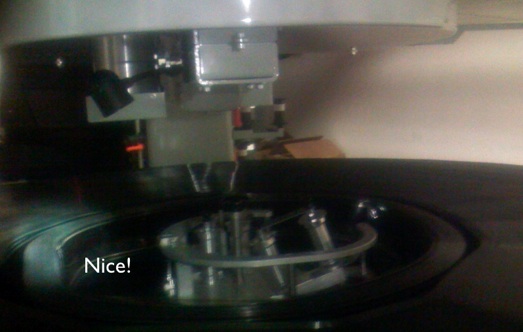
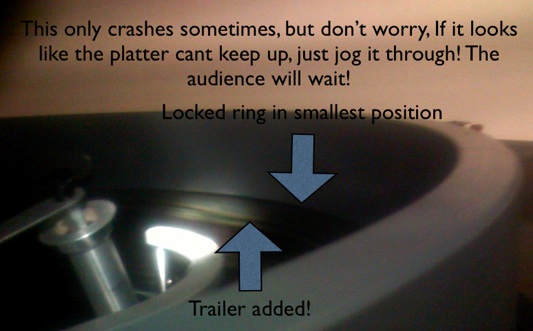
Here is a surprise that was left for me by the previous shift. Nothing in the log, no indication that anything out of the ordinary had occurred that day. Then a few minutes minutes into Harry Potter 5, this enters the projector.

Of course, now they have DigIMAX, so I'm sure they haven't had anymore problems at all. Totally sure.
Powered by Infopop Corporation
UBB.classicTM
6.3.1.2