This is topic Digital Screen Network Problems in forum Digital Cinema Forum at Film-Tech Forum ARCHIVE.
To visit this topic, use this URL:
https://ft-forum.com/ft/cgi-bin/ubb/ultimatebb.cgi?ubb=get_topic;f=16;t=000016
Posted by Amanda Mundin (Member # 3386) on 08-13-2007, 05:26 AM:
We are using the NEC NC800C 2k projector with QuVis Cinema Player and separate RAID storage. This week we had 3 screenings of ‘Brief Encounter’, the first on Tuesday went without a glitch, the second on Thursday about 15 minutes into the film flashing blue lines appeared on the screen, we tried restarting the script, even playing another version of the script but the problem persisted. Half an hour later after we had sent the audience home with refunds we tried again, playing various other content, then tried ‘Brief Encounter’ again and couldn’t get the problem to come back. The following day an engineer came and switched the QuVis for another one hoping to cure the problem. The day after (Saturday) we ran ‘Brief Encounter’ through from start to finish to check it, no problems occurred. On Sunday we ran ‘Brief Encounter’ again to a paying audience, it made it all the way through till about 15mins before the end when the problem arose again, starting with the blue lines and then going to the entire image breaking up, but with a definite blue colour to the break up, after rebooting the QuVis we managed to show the end of the film without further problem.
Has anyone else had problems like these or problems with this equipment, or any other problems with the Digital Screen Network equipment?
Posted by Stephen Furley (Member # 1277) on 08-13-2007, 07:13 AM:
We've got the new player, not the Qvis, I've had just a couple of minor problems. One day I'd run the adverts and trailers on film, changed over to digital for the feature, certificate came up on screen, then a company logo, looked fine, so I turned round to take the adverts reel off the machine to rewind. A few seconds later I realised that there was no sound. I looked at the screen and it had jumped back to the beginning and was showing the certificate again; it then played correctly, as it had done a few hours previously.
Near the beginning of 'Becomming Jane' the picture broke up just for a frame or two, near the bottom of the screen. The same thing happened last week with 'Moliere'; in each case it only happened with one screening, so the problem wasn't with the data on the disk.
A couple of times I've opened a playlist, or whatever you'd call it, for a show, gone to the Maunal playback screen and found that the previous one was still there; quitting the Cinelister software and reloading it seems to cure this.
I wasn't on duty the day it happened, but one film, I think it was 'The Painted Veil', wouldn't load, and we had to request another copy, which worked ok. The faulty copy arrived several days early, so this wasn't too much of a problem.
I've made a couple of 'silly mistakes'; for example, I ran the very first digital show, back in March. It was a Saturday morning show, so there were no adverts or trailers, the whole show was digital. I presssed the Digital 1 button on the Dolby DMA8 Plus. I knew that this also switched the CP-65 over to format 10, but just to be sure I pressed the format 10 button on the CP as well, and didn't notice that this switched the DMA back to 'film' mode, so there was no sound for a few seconds, until I realised what had happened. I was very nervous that first day; I had to take over the shift at short notice due to the projectionist who should have been working it being unavailable, so I had to run that show with about three minutes of instruction between films the previous evening, and about ten minutes to practice in the morning before the show.
I'm having a few problems with certain types of RGB signals going into the Cine IPM 2k, but composite, Y/C, component, DVI and other types of RGB are all ok; I need to look at this again when I've got time, before I need to do it for real.
We had a problem with the airflow; the connection we had put in to serve the digital projector was taking too much of the airflow away from the film projectors, and they were getting rather hot; running with the damper for the digital extract closed half way seems ok, but I sometimes close it completely if we won't be using digital for a while.
It varies a lot, we can go for several weeks without doing a single digital show, then one week in April or May everything except the Saturday morning children's film, and the adverts and trailers reel, was in digital, then nothing else for several weeks. We haven't had much recently, but about half the shows in September will be digital. In total we've clocked up about 290 hours, but a lot of that has been testing, training, trying things out, not actual shows. I would guess somewhere between 150 and 200 hours of actual shows. It seems to be quite random, films which were made on digital, such as 'Meet the Robinsons', and ones which I know other venues have run in digital, such as 'Pan's Labyrinth', have come in on film, others, such as 'Becoming Jane' have come in ofn digital when we were expecting them to be on film. One film came in on both formats.
[ 08-13-2007, 08:29 AM: Message edited by: Stephen Furley ]
Posted by Bernard Tonks (Member # 809) on 08-13-2007, 02:34 PM:
I was told by a service engineer months ago, that Digital Screen Network were replacing QuVis with Doremi servers. Below are reports from a UK website.
I heard a rumour that Arts Alliance are to replace some (maybe all?) of the nasty QuVis digital servers they installed as part of the UKFC digital 'circuit' and replace them with the far more sensible DoReMi servers.
I've been told that our circuit are getting rid of the QuViss and
are to have the Doremi servers installed. Not sure when this will
happen (probably during a busy week when then the kids are off so we lose a screen for the day!
I've heard that it might be in May. The same screen has just received a hard-drive that would not load (failed after 2hrs 30mins of loading) and even when a replacement was sent it took 2hrs 45mins to load.
quote:
It varies a lot, we can go for several weeks without doing a single digital show,
According to a projectionist friend, he always contacts the distributor himself to secure a digital copy.
Posted by Stephen Furley (Member # 1277) on 08-13-2007, 03:05 PM:
quote: Bernard Tonks
I was told by a service engineer months ago, that Digital Screen Network were replacing QuVis with Doremi servers. Below are reports from a UK website.
This is correct; there was something about it in (I think) Cinema Technology a few months back. Found it; it's in the TDP (Training for Digital Projection) supplement dated March 2007. Asked about the reason for the change a AAM person replied:
"AAM wanted to upgrade the network to the latest industry standard, so that its cinemas have the best possible technology providing access to the widest possible range of digital content. The decision making started from the premise that all of the existing QuVIS servers would eventually need to be upgraded to support emerging standards from the SMPTE DC28 Digital Cinema working committees and to work towards DCI compliance. Whilst it would have been perfectly possible to modify the existing QuVIS units, significant hardware changes to the internal circuitry would have been required, and this meant that the complete replacement of the servers was a viable alternative."
It sounds to me like that translates to either:
'We bought the wrong equipment in the first place'
or:
'Things are still developing so fast that the state of the art equipment we installed just a year or so ago is already out of date'
Either way, it sounds like a rather expensive upgrade to have to make so soon. We came quite late in the installation pogramme, so we had the Doremi unit from the start.
Posted by Steve Guttag (Member # 268) on 08-13-2007, 03:40 PM:
Get used to it...this is the digital way...the upgrades are never ending and the cost are always spiraling. Dolby had to upgrade all of the servers they installed for Chicken Little for JPEG2000 when that became the one and only format the studios would release in...and that was around a year's time. It isn't like this stuff has a huge service life to begin with.
Posted by Stephen Furley (Member # 1277) on 08-13-2007, 04:17 PM:
well ok, it's not exactly digital, apart from the NICAM tuner which it contains, and probably some of the servo systems, but my VHS recorder is now over fifteen years old, and while I don't now use it as often as I once did, it's still in perfect working order, and does everything it did when it was new. I spent a small amount on a new pinch roller and clutch after about twelve years. I'd expect something which costs as much as digital cinema equipment does to last at least as long.
As recently as a couple of years ago I didn't think I'd ever get my hands on something as exotic as a digital cinema projector. I have to say that it's very kind of these Arts Alliance people to let me play with, er evaluate, this very expensive equipment at someone else's expense.
Yes, it has advantages, and disadvantages, it's expensive, it's likely to have a fairly short life, if it breaks down my chances of fixing it on the spot are minimal. To be honest, it allows me to do very little that I couldn't do with the existing film and video equipment. There are a few things; for example the ability do download and show a high-quality trailer, which I mentioned in another thread a couple of days ago. Then there's the ability to show live events, like the opera shows from the Met, which some other DSN venues have been screening, though I don't think our cinema is really the place to see opera.
I'm interested in new possibilities such as these, and other things being equal, having film plus digital is better than having just film. Having just digital really isn't an option at present for a non-mainstream venue, and of course, maintaining both systems is more expensive than maintaining just film.
If I was a cinema owner, with perfectly good film equipment there's still no way that I would buy digital, at commercial prices, at the present time. At some point in the future, maybe.
Posted by Brian Guckian (Member # 1678) on 08-13-2007, 06:45 PM:
Sounds like there's a need to ruggedise D-Cinema equipment a bit more. The typical projection room is a hostile environment for sensitive computer equipment.
My experiences with D-cinema have underscored the need for proper ventilation and temperature control - to standards exceeding those needed for film projection. Any time we had problems it was due to excessive (by DC equipment standards) heat build-up.
Plus - greater filtering of the air supply would help too.
Posted by Mark Gulbrandsen (Member # 72) on 08-13-2007, 07:12 PM:
quote: Steve Guttag
Get used to it...this is the digital way...the upgrades are never ending
Well, lets not forget all the upgrades to CP500's and 650's... and automation units. These upgrades concern other aspects of the booth as well. I don't know of a manufacturer that actually charges for firmware upgrades, some are quick to load and some are time consumming.
quote: Steve Guttag
Dolby had to upgrade all of the servers they installed for Chicken Little for JPEG2000 when that became the one and only format the studios would release in...
It was done because among other reasons the on screen image is alot better than MPEG... Lets not forget the scam costs to theater owners to convert to Sound and yes, that was mandatory or shut your doors. Let us not forget Regular tooth sprockets, Cinemascope tooth sprockets, and now VKF sprockets... Vitaphone, Variable density, a half dozen variable area recording systems, Perspecta Sound, 4 track mag, Superscope, Cinemascope, and Todd-AO... just to name a few of the Film based features formats and systems that were expensive but have bitten the dust. Should I name all the projector manufacturers that have also bitten the dust? Ok a just a few... Powers, Brenkert, Blue Seal, Norelco, and now Ballantyne.
quote: Steve Guttag
and the cost are always spiraling.
Actually you are about to see a huge trend in lower cost to purchase and operate Digital projectors. In fact there are digital projectors available now that don't cost any more to operate than their film counterparts do and if compared to the cost of a really good booth are no more expensive to buy. No more $2000.00 750 hour Osram lamps to feed your Barcos or NEC's. There is available now a projector optically efficient enough to light a 45 foot screen to industry specs with no more than a 3kw lamp. Screen sizes up to 45 feet encompass about 85% of the screen in the world.
quote: Steve Guttag
It isn't like this stuff has a huge service life to begin with.
Well considering that this technology is in its infancy right now there are some of the older 2K projectors approaching 10 years old now.... Dolby is claiming 15 years for their server... There are thousands of 2 drawer DTS units(not to mention three drawer units) that are now at 14 years of age and they're not going to die any time soon. All the parts are still available for them. So you're actually hinting that all those 650's that you've been selling are going to have a short service life??? I don't think so nor will Dolby's Servers, they will live long service lives!. Today you're lucky if a new Simplex goes 5 or 6 years without needing any major bearing overhaul, seals, and gaskets. The factory bearings used in them are deplorable. Super Lum-Ex and Super 80 lamphouses whose wiring turns to a brittle crispy mess because of poor design after just a few years...
I think you'll find that over the 100+ year life span of film that there has been all sorts of built in very expensive obsolescence.... Humm... how many CP-50's have you replaced?
Mark
Posted by Bobby Henderson (Member # 840) on 08-13-2007, 07:40 PM:
quote: Mark Gulbrandsen
Well, some of the 2K projectors are approaching 10 years now....
Texas Instruments didn't start shipping their 2K DLP chip until about 3 years ago. From 1999 to 2004, TI was stuck with 1.2K based chips.
The other competing technologies, such as JVC's D-ILA system wasn't quite 2K either. It was more along the lines of standard HDTV resolution. And it seemed to get killed off by TI's lower resolution product.
Posted by Mark Gulbrandsen (Member # 72) on 08-13-2007, 07:45 PM:
quote: Bobby Henderson
Texas Instruments didn't start shipping their 2K DLP chip until about 3 years ago. From 1999 to 2004, TI was stuck with 1.2K based chips.
While they didn't ship any till then there were prototypes working in the field for many years before that.
quote: Bobby Henderson
The other competing technologies, such as JVC's D-ILA system wasn't quite 2K either. It was more along the lines of standard HDTV resolution. And it seemed to get killed off by TI's lower resolution product.
Bobby,
This is why if you're going to claim this stuff here ya need to get to places like Showest to see whats really going on. In fact Kodak demoed a 3K based ILA system about 3 or 4 Showests ago but immediately afterwords abandoned it. JVC Displayed a prototype 3K chip in their display room either that same year or a year before that. ILA is still alive and well at both JVC and Sony with both producing 4K chips. The chips biggest problem is that it can't take much heat... so they offer less lunmens. The biggest advantage is there are no visible pixels or screen door effect and a 10,000 to 1 contrast ratio with the JVC Chips. The chips are based on Liquid crystals not moving mirrors.
Mark
Posted by Scott Norwood (Member # 30) on 08-13-2007, 08:08 PM:
Even though it is relatively old, the CP50 is entirely capable of reproducing current soundtracks and sounds just as good now as it did when it was new. If you have one, there is no "need" to upgrade, unless one wants the features that come with the newer models.
By contrast, you probably won't be able to play current films on a 1.3k DLP system (with MPEG server) from 2001.
Posted by Mark Gulbrandsen (Member # 72) on 08-13-2007, 09:09 PM:
Amanda, Stephen
QVIS servers are not exactly the creame of the crop... If they switch to DOREMI you should have alot less trouble. Too bad they didn't go the Dolby route... ya get what ya pay for with anything you buy be it film or digital.
Scott,
Actually a fully upgraded CP-50 sounds just about as good as the CP-65 does. But have you ever set up a full blown 6 channel CP-50? I have one myself and there was one other I used to service. Setting one up is pretty awkward at best. Few techs could pull it off properly. I'd call it a kludge more than anything else. From a cost standpoint its a waste of $$ to upgrade them... Ya can get a nice used CP-55 with 222SR/A and a 441 card for 600 bucks from Scott Hicks! Oops, did I say 222SR/A... not a very good module are they.
quote: Scott Norwood
By contrast, you probably won't be able to play current films on a 1.3k DLP system (with MPEG server) from 2001.
You could actually scale 2K down to 1.3K but DCI doesn't allow it. If it were up to me it should be allowed.
Mark
Posted by Steve Guttag (Member # 268) on 08-13-2007, 09:23 PM:
quote: Mark Gulbrandsen
Well, lets not forget all the upgrades to CP500's and 650's... and automation units. These upgrades concern other aspects of the booth as well. I don't know of a manufacturer that actually charges for firmware upgrades, some are quick to load and some are time consumming.
Gee, I don't know if you are trying to make my arguement or sabotoge yours. There were virtually zero upgrades to the CP500 to make it operable. In fact, I have CP500s with version 1.2 firmware that have had no problems playing films since the day they went in. In fact, they have been some of the most reliable units with I think 2 power supply failures. In reality, there was version 1.31 that they settled on and then version 1.6x when the SA-TEN came out...the [other] firmwares offered more of a feature enhancement rather than a performance enhancement unless it was to fix a bug. The same goes for the CP650
However, in either case you are not talking about an industry standard...those are mere cinema processors backed by the faith one puts in the manufacturer of those processors. In fact, as Scott points out, the CP50 is still viable due to the company that Dolby is. I could point out to processors that are completely unsupported by current companies. There are also companies that have now left us. As Dolby processors go...the CP500 was rather short lived. The CP55's production life was cut short due to Dolby Digital (which brought about SR as a standard as well). The CP65 was just an evolution of the CP55.
Now with the servers...these are not always software upgrades but hardware upgrades. The standard in broadcast has been that the end user is purchasing a device to perform as it should on the day they bought it...any improvements are to be purchased. QuVis does in fact have an annual maintenence program to cover software upgrades.
Dolby used to have free firmware upgrades but that may come to an end now. They are no longer a private company and have to explain how software development recoups its investment. If you didn't have the most current firmware right now...try to see if you can get it through normal means.
quote: Mark Gulbrandsen
It was done because among other reasons the on screen image is alot better than MPEG
They problably would have done it for the improvement but not necessarily on the time schedule they were forced into and definately not as a no-cost thing if wasn't that MPEG was just obsoleted for DCinema.
Yes the film industry did evolve but not as many of the items you listed were requirements. In almost all instances though, with the exception of the dreaded widescreen 1.85, were improvements to the cinema experience and improved the quality of image or sound. DCinema can't make that claim. It is a mere half resolution of the worst 35mm format and has less contrast ratio as well as color redition. Film has been dumbed down with nasty 2K DIs and miserable release print methods. So yes, you CAN make 35mm look worse but it isn't inherently so.
BTW...Norelco did not die, the merely sold the brand to Kinoton which changed to name. Norelco shavers are available to this day and Kinoton still supports the DP70, as well as others, as you well know.
As for high-priced lamps...projectors already existed that could light a 45' wide screen without nasty priced lamps. The problem remains the life of those lamps for digital projectors is inherently shorter due to the shorter arc as well as the faster peception of the flicker without a shutter.
Even the newer DCinema set ups are nowhere near the cost of film systems and cost/year is significantly higher since the film system, by and large, will outlive the theatre it sits in. The same will not and has not been true of ALL DCinema systems in use today. Christ, all the DLPs are single sourced items (TI). In industry will be truely beholden to just one manufacturer and semi-conductor manufacturers are notorious for having short production lives. Make no mistake...TI's target is the home, not the cinema...the home is where the pot of gold is.
So Mark, please produce any document that states that they have 2K DLP projectors in the 10-year range. Are they in day-to-day use?
Now that said, the AFI has been using the DP50s every day since April 2003 (over 4-years now) and they have been reasonably problem free though there have been some glitches. I'm inclined to think that these projectors were hand made due to the low volume. I think we have had two color boards go flakey (TI made) in the first year or two. They were warranted so they were under 2-years old. To TI's credit the current TI firmware (11.1) can be loaded into the DP50 and the Christie equivalent depsite them being only 1.3K machines.
As to DTS...again it isn't a "standard" the same light that DCinema is shooting for. But DTS has obsoleted the DTS-6...this isn't to say you can't work on it just that it is increasingly more difficult. There are semis on it that are out of production (just like the Zoran chips for the DA20 and CP500). Fortunately, the drives and power supply are the common mode of failure and they are still obtainable (partly due to DTS keeping up with the modern drives and "dumbing" them down to the 1993 standards). This speaks to DTS' integrity though. Likewise Dolby supports their "obsolete" processors though there are somethings that are just going back too far like the CP100 that really is putting a performance hit if you continue to use it.
quote: Mark Gulbrandsen
So you're actually hinting that all those 650's that you've been selling are going to have a short service life???
I don't know how you get to that interpretation but lets go with it. I never claimed that the CP650 would have a short service life but it will be less servicable than any of its analog counterparts. The CP650, arguably Dolby's most prolific processor, has had its bumps. It has already suffered from board obsolesence due to discontinued semis. The Cat 794 board is now gone though the Cat 790 is here (I never quite got the story on that one...how a lower numbered board survived over the later one that was introduced first). Perhaps it was cost since the Cat 794 could to either AES3 or AES-3id. The Cat 790 board only does AES-3id (S/PDIF in consumer speak). If you want AES3, you have to make the jump to the Cat 778 now...which also gives you AES3 outputs.
But again, the CP650's useful service life is the faith you put in the brand...Dolby...not the faith you put in the trend of the day industry...it doesn't care that the industry went from MPEG to JPEG...it playes AES audio (or analog) and those are standardized by people other than this industry (thankfully). The more propritary something is the more volitile it can be. How are SDDS units faring...just getting replacement parts is now a challege for them though there should be no reason they can't be kept going. It should give everyone in this industry pause into putting their money with Sony...that have shown no remorse in canning otherwise viable products...oh well.
Unlike you...we have MANY MANY Simplexes not needing any sort of major bearing overhaul. Likewise...we don't have Strong lamphouses dying due to wiring issues. I will agree that the person that thought that natural wire ties were a good idea in a high UV environment is an idiot (or Stupid to put it in Brad's terms). If you were going to pick on a projector...it would the Christie P-35xxxxxxxx to pick on...just list all of the revisions done that that fine piece since its introduction until the present model(s).
Oddly enough Mark...the CP50 has be VERY enduring...we STILL have them doing their thing. It has been a more recent thing that the switch card (Cat 112) has become noisey in some installations. But when SR hit...talk about a cheap upgrade...slam in two cards and whola...it keeps current. The CP55 was not as fortunate...it needed an outboard unit until the dreaded Cat 222 "SR"/A card came out. The CP55 was also unlucky enough to be in production during the dreaded "STC" while relay era too. And with all that, the CP55 still lives nicely today though next the CP100, I would call it the least desirable processor to have if it isn't already upgraded. While yes the CP45 is nasty...it mainly fails in the EQ department..which can be fixed outboard relatively cheaply. It, unlike the CP55 can handle prologic and 6-channel inputs out of the box.
The CP200...well that was just a blessed unit right from conception on out...I put another one in this year and it will remain in use for a LONG time. It is fully updated, new caps in the PS1Bs (soldered in too) and has surround EX inside the ACC rack. The CP200, updated with Cat 517s remains Dolby's quietest processor. I suspect that with a power supply upgrade, it would be even better.
I am surprised you used sound processors as the source of expensive obsolesence...they generally give one a lot of bang for the buck...even the cheap ones...after all they were cheap! Now sound processes can be expensive...like 4-track but then again it had a nearly 30-year run. Likewise for 70mm which, unlike digital, give the theatre that had it an edge over its competitors and often resulted in exclusive engagements. If exhibitors demanded 70mm today, they would get it (not just one or two guys but as an industry). The exhibitor chose to not book 70mm. You can't blame the technology (still the best even 50 years later).
Steve
Posted by Daryl C. W. O'Shea (Member # 1303) on 08-13-2007, 09:44 PM:
quote: Mark Gulbrandsen
While they didn't ship any till then there were prototypes working in the field for many years before that.
FWIW, the Christie Digital "prototype" that Christie Digital (in Kitchener, just down the road) installed for us in 2000 was only a 1K unit.
Posted by Mark Hajducki (Member # 1732) on 08-14-2007, 12:41 PM:
quote: Stephen Furley
A couple of times I've opened a playlist, or whatever you'd call it, for a show, gone to the Maunal playback screen and found that the previous one was still there; quitting the Cinelister software and reloading it seems to cure this.
Just hitting the stop button should remove the old playlist, on pressing play the current playlist should start.
I think this is a feature to allow you to create/ load a new playlist without interrupting the show currently playing.
-------
I think Arts Alliance want to be informed of any issues affecting playback, even if a reboot 'solves' the problem. Their phone number is on stickers on the equipment.
Posted by Stephen Furley (Member # 1277) on 08-14-2007, 01:02 PM:
quote: Mark Hajducki
Just hitting the stop button should remove the old playlist, on pressing play the current playlist should start.
It usually does; just once or twice it hasn't done, and I've had to restart Cinelister.
Posted by Mark Gulbrandsen (Member # 72) on 08-14-2007, 04:01 PM:
quote: Steve Guttag
It isn't like this stuff has a huge service life to begin with.
Well, you're the one that refered to "Digital" stuff not having a long service life not me. When I sell any digital based product no matter what it is I just make sure the customer unsderstands that before he buys. With D-Cinema you will never see a single system sold by me... only leased. This way the longest the customer is stuck with the gear is 7 years. Leasing D-Cinema stuff is both very practacle and very affordable.
As for CP-50's I am somewhat partial to them myself. Its just that the cost to upgrade them for digital playback is not worth it. If the rest of the industry had a good reason to keep them they'd still be running all over the place... and they're not. The single CP-50 thats still running on one of my service routes is going to stay there running until they upgrade that screen to DTS or SRD or what ever. Since its just analog its fine to remain.
P.S. There are long life Short Gap Xenons available that have a warranty life the same as this company's regular cinema lamps. This not only makes Short Gap lamps affordable they can also be used in film projectors with a rather large offset in power savings in some areas of the country.
Mark
Posted by Gordon McLeod (Member # 33) on 08-14-2007, 04:55 PM:
I have yet to see any of the ultra short gap lamps have the same warranty as their regular gap cousins
Posted by Mark Gulbrandsen (Member # 72) on 08-14-2007, 05:27 PM:
The Christie CDXL Lamps offer basically the same warranty as the CXL Cinema Lamps.
Mark
Posted by John Caswell (Member # 4024) on 08-14-2007, 06:27 PM:
Hi,
In the UK the reason for installing Quvis and then swapping to Doremi was down to the fact that at the time they were working out a suitable 'package' to offer, they wanted a cinema player that could adequately support 2K, and the Quvis did this. AFAIK Arts Alliance didn't really intend to keep the Quvis, they just needed to use these at the time til they had a better option available to them (a la Doremi).
We've now had the Doremis installed at our cinema. Before that, with Quvis, we'd had a few occasions where, for no reason, the film would freeze for a minute or so, or there would be a large amount of pixellation. Usually the soundtrack would continue, and eventually the image would catch up. No cause, just one of those random little things that occur with modern technology.
So far so good with the Doremis though. ![[Wink]](wink.gif)
Posted by Mark Gulbrandsen (Member # 72) on 08-14-2007, 06:41 PM:
There are alot of Doremi's in Salt LAke City and they seem to perform on a par with the Dolby stuff. I just don't know if the longevity of the equipment is going to be as long as Dolby's.
Mark
Posted by John Hawkinson (Member # 1135) on 08-14-2007, 08:27 PM:
"There are alot of Doremi's in Salt LAke City and they seem to perform on a par with the Dolby stuff. I just don't know if the longevity"
Fear not, there'll be an upgrade next year to the "FaSolLa."
One of the huge problems here is that so much of the critical machinery is now in software, and the skills and techniques for debugging it are completely different. And, because of the fundamentally different nature of the beast (intellectual property, etc., etc.), the tools to properly debug this stuff are not just available to projectionists and service technicians...
I guess we can take comfort that this is not a movie-industry -specific problem, and the whole world is suffering...
--jhawk
Posted by Bobby Henderson (Member # 840) on 08-14-2007, 09:45 PM:
quote: Mark Gulbrandsen
This is why if you're going to claim this stuff here ya need to get to places like Showest to see whats really going on. In fact Kodak demoed a 3K based ILA system about 3 or 4 Showests ago but immediately afterwords abandoned it.
Mark, you can say all you want. However, your claim that 2K digital cinema has been around for nearly 10 years is baloney. My own personal background is irrelevant and doesn't make that fact any less true.
Posted by Stephen Furley (Member # 1277) on 08-15-2007, 07:51 AM:
quote: Mark Gulbrandsen
This not only makes Short Gap lamps affordable they can also be used in film projectors with a rather large offset in power savings in some areas of the country.
Mark, I don't understand this; can you explain please.
quote: John Caswell
In the UK the reason for installing Quvis and then swapping to Doremi was down to the fact that at the time they were working out a suitable 'package' to offer, they wanted a cinema player that could adequately support 2K, and the Quvis did this. AFAIK Arts Alliance didn't really intend to keep the Quvis, they just needed to use these at the time til they had a better option available to them (a la Doremi).
I haven't heard this before, and I don't know if it's true, but if it is then it seems to indicate that the DSN scheme was implemented too soon; they would have done better to have installed just a few units as a pilot scheme, and then waited for a few years before going to the full roll-out. Buying something like a couple of hundred of the things, and then replacing them after a year or so doesn't seem to make much sense.
quote: John Hawkinson
One of the huge problems here is that so much of the critical machinery is now in software, and the skills and techniques for debugging it are completely different. And, because of the fundamentally different nature of the beast (intellectual property, etc., etc.), the tools to properly debug this stuff are not just available to projectionists and service technicians...
I guess we can take comfort that this is not a movie-industry -specific problem, and the whole world is suffering...
I agree John. Take the case where the film jumped back to the start after a few seconds; it then played ok, but what if it hadn't? I could have completely powered down and then re-started, but if that didn't fix it, them I'm stuck and we've lost the show. With film projectors it's pretty obvious how they work, and if they don't, why. slipping take-up belts, broken springs, screws which have worked loose, sticking relays etc. are all pretty obvious, and easy to fix in a few minutes.
quote: Mark Gulbrandsen
With D-Cinema you will never see a single system sold by me... only leased. This way the longest the customer is stuck with the gear is 7 years. Leasing D-Cinema stuff is both very practacle and very affordable.
If the equipment is expensive, and its life relatively short, then the cost of leasing is going to be high, otherwise the leasing company won't get their money back over the life of the equipment. On top of this, the leasing company are going to want to make a profit on the exercise, so I can't see how leasing is going to be 'very affordable', compared to buying.
Posted by Mark Gulbrandsen (Member # 72) on 08-15-2007, 06:26 PM:
quote: Stephen Furley
Mark, I don't understand this; can you explain please.
Sure... If you look at the brochure you will see an increase in performance of each short gap lamp over the normal cinema type lamp. This means you can utilize a lower wattage lamp.... say if you're running a 4kw regular cinema lamp you could go to the 3kw short gap. The decrease in power consumption on the west coast means a savings of about 600.00 per year. In other areas its going to vary... here in Bountiful, Utah our power is one of the least expensive in Utah and the nation. Our town has its own power company and we are the only folks in the state that get our power from Glen Canyon Dam... the rest of that power is routed to Phil's house. The increase in price of the short gap lamp is about half of that $600.00 so there is a 300.00 savings in one year. In other cases where you have say a 2kw lamphouse and just need more light you gain an average of 26% more light. Also, these lamps do not bahave like the LTI Helios does... the Helios has a relatively short period where you have alot of extra light. The CDXL lamps are more like an LED... a bit of taper off after a few hundred hours use and then its a very slow drop off until the end of life.
quote: Stephen Furley
If the equipment is expensive, and its life relatively short, then the cost of leasing is going to be high, otherwise the leasing company won't get their money back over the life of the equipment. On top of this, the leasing company are going to want to make a profit on the exercise, so I can't see how leasing is going to be 'very affordable', compared to buying.
Last I checked intererst rate through NEC Leasing was about 7%... the more systems you lease the lower it goes... or should I say its negotiable to a point. That is a very reaosnable interest rate. There are many other leasing companies in the USA that offer similar deals.
BTW: Christie is disconntinuing its 7kw lamphouse and console in favor of just making the 4kw units. You actually get more light on screen with the CDXL45 in the 4kw console that you do running the 7kw lamp in the 7kw console!! The power savings will offset the slightly higher lamp cost by a long shot.
quote: Bobby Henderson
My own personal background is irrelevant
Well, I COULD say something but since I promised Brad that I'd be a gentleman I will refrain from making the comment that immediately came to mind.
Mark
Posted by Bobby Henderson (Member # 840) on 08-17-2007, 10:57 PM:
Meaning that you were completely spit-balling trying to claim that 2K digital cinema has been around for 10 years. Right?
Some trivia doesn't exactly require attendance at a ShoWest or ShoEast convention to know.
Posted by Steve Guttag (Member # 268) on 08-18-2007, 02:02 AM:
The presumption that a shorter arc lamp will immediately increase one's light in one application because it does in another is absolutely false.
I've been doing quite a bit of xenon testing over the last couple of years and coming up with what works best (in terms of quantity of light) really varies on reflector, lens and lamp. I have 4KW lamps that are brighter (on screen) than 5KW lamps...in other sysems the 5KW wins. I've tested 6KW HP lamps in non-HP applications and found they had less light output in standard set ups than Standard 6KW lamps. Barco had Osram design a 6.5KW specific lamp for the DP100/DP90 light engine to yield significantly more light than a 6K or 6K HP.
Right now I'm testing ASL XM4202 lamps (4200 short arcs) and they look promising in a Kinoton application as to have 30% more light (initially though after the first 100 hours of decrease...it seems to stabilize a bit and still out illuminates standard 4K HS lamps).
So in short, it isn't as cut and dried as some are making it out...it really depends on the optical design of the system as to what works most efficient (and that can even include the aperture plate or imager since the size of the opening will affect how large the arc can be).
Steve
Posted by Gordon McLeod (Member # 33) on 08-18-2007, 11:04 AM:
My experience is the same as Steve's one can not just willy nilly swap lamps and expect an increase in light
There are many variables that come into play
Posted by Mark Gulbrandsen (Member # 72) on 08-18-2007, 11:24 AM:
quote: Steve Guttag
So in short, it isn't as cut and dried as some are making it out...it really depends on the optical design of the system as to what works most efficient (and that can even include the aperture plate or imager since the size of the opening will affect how large the arc can be).
Steve,
I think you'll find that the Christie claims to increase in performance as listed in their brochure do hold true when used with Christie SLC and SLH reflectors. D-Cinema aside its doubtful that Christie would be testing their lamps in other than their own film lamphouses.
Mark
Posted by Steve Guttag (Member # 268) on 08-18-2007, 01:26 PM:
Mark,
It is a combination of the reflector, aperture and lens from what I've found. When the CDXL lamps came out...I was one of the first to inquire about their suitability in film systems. They were very non commital then. Anytime you reduce the wattage to achieve the same light is good. Normally when one increases wattage, they increase heat at a greater rate than they increase light output (from the arc itself, not taking into account the optics of the system).
I'm kinda curious about the CDXL-45 myself...it looks most promising like the ASL XM4202. Fortunately, Kinoton now has an "HTP" adapter for their lamphouses/consoles so if they are an improvement, they can be used without too much hassle. I will say that the Christie CXL-40SC is a wonderful match to a Kinoton Universal 2-7K lamphouse with probably the best lumen/watt ratio. The CXL-50SC actually has fewer lumens coming out of the lens in the same equipment. I've heard that the same holds true on the Osram side of things.
Steve
Posted by Amanda Mundin (Member # 3386) on 03-20-2008, 05:24 AM:
NEC NC800C
Bulb has 1200+ hours on it, there should be 500+ hours left on it. Since recently having the power upped to 87% to reach 14footlamberts the bulb has decided to turn itself off 3 times, twice during the middle of a show. Reducing the lamp power down to 79% seems to keep it running ok. There's no image flicker, image on screen looks great. Anybody had anything similar?
Posted by Bill Enos (Member # 440) on 03-20-2008, 09:04 AM:
I've read most of these posts and compared the comments with those of the two techs who set up the recent screening of the "John Adams Mini Series that took place at this theatre. They set up the NEC projector they brought in, then checked out our Barco DP 100 and did all the software/firmware upgrades necessary, changed the 6k bulb that had 3500 hrs. on it set both machines to overlay each other nearly perfectly. Both techs said that even under ideal circumstances with digital you cross your fingers and say a little prayer when you push the button to start. About one minute before show time the power went out for about 7 minutes, it took 15 minutes to reboot both projectors, the servers and all the sundry peripherals and check everything.
I believe digital projection will be fantastic one day but for now it just is not ready for the demands of 8-10 hrs a day 365 a year. It seems to be at the point film projectors were in 1911.
Posted by David Zylstra (Member # 4230) on 03-20-2008, 11:21 AM:
quote: Bill Enos
it just is not ready for the demands of 8-10 hrs a day 365 a year.
Not true in our case . . . . . we have been digital on all our 46 screens for over 2 years, the past year with at least 97% digital runs . . . . so far the Christie CP2000h projector has proven almost as reliable as a 35mm (probably more reliable if you factor in print issues), the server still needs work but is definitely up to the task of the daily grind . . . . . . . I'd say our boot times are about a minute for the Christie and around 5 minutes for the server (but our servers are on a UPS and will only be affected by a sustained power outage).
On the lamp issue - we've seen something similar on the Christies when the power supply starts to go bad (the H ballast), when they start going bad on a higher wattage lamp the circuit breaker blows if the power is too high, then eventually it constantly blows the breaker(our staff has learned the signs of a bad ballast and they now get replaced before we lose shows) . . . . . not exactly the same situation, but similar.
Posted by Pete Naples (Member # 761) on 03-20-2008, 12:15 PM:
One of the Irish sites I service the sound and 35mm equipment told me that they were experiencing a 'worse than 90% failure rate' with their digital equipment. NEC projectors and Doremi servers. ![[Roll Eyes]](rolleyes.gif)
Posted by Darryl Spicer (Member # 711) on 03-20-2008, 12:20 PM:
quote: Bill Enos
About one minute before show time the power went out for about 7 minutes, it took 15 minutes to reboot both projectors, the servers and all the sundry peripherals and check everything.
No Battery backups for the servers and the peripherals?
Posted by David Graham Rose (Member # 1450) on 03-20-2008, 12:59 PM:
Greetings
A the end of the day, failure rate on digital systems will always be high - irrespective of projector/server manufacturer. At the end of the day these devices are merely pc's. How often does one have to hit Cnt-Alt-Del on one's pc!
They are inherently unsuitable, unreliable and costly for the purpose of motion picture exhibition to paying customers.
No doubt theses leasing companies will end up going down the Swannee in a few years time when the whole shebang falls to pieces around them.
And well deserved too!
From a stormy Cambridge
Goodnight.
David
Posted by Pete Naples (Member # 761) on 03-20-2008, 01:22 PM:
I believe one in the Republic of Ireland already did, and were bought up by an arm of RoI's biggest exhibitor.
Posted by Brian Guckian (Member # 1678) on 03-20-2008, 06:17 PM:
quote: Pete Naples
One of the Irish sites I service the sound and 35mm equipment told me that they were experiencing a 'worse than 90% failure rate' with their digital equipment. NEC projectors and Doremi servers.
Damn - I knew someone would find me out eventually ![[Big Grin]](biggrin.gif)
But seriously, I know for a fact that some installs did not have proper HVAC or a suitable room environment. I think part of the problem was the rush to "roll out" the technology - the media were led to believe that "all Irish cinema screens would be digital" by the end of 2005 ![[Confused]](confused.gif)
Posted by Pete Naples (Member # 761) on 03-21-2008, 03:44 AM:
Brian, the HVAC etc in that booth are up to scratch, it was designed with digital in mind.
Posted by Amanda Mundin (Member # 3386) on 03-21-2008, 10:00 AM:
We've probably had 95% success rate with the digital equipment, it's proven to be very reliable apart from a few niggles mentioned here, hopefully it will stay that way.
We don't have any external extract on the NEC projector, we were told we only needed extract if we were to have the Christie CP2000, but we ended up with the NEC NC800C, which isn't built with external extract in mind. I'd be interested to know how many people have fashioned some kind of extract to fit this projector and if people think that that helps in any way?
Posted by Brian Guckian (Member # 1678) on 03-21-2008, 04:15 PM:
quote: Pete Naples
Brian, the HVAC etc in that booth are up to scratch, it was designed with digital in mind.
Sorry Pete, I was thinking of older boxes where the D-Cinema equipment had been recently added. Which makes your comments all the more worrying.
To offer a possible answer to your question Amanda, if the NEC NC800C does not require forced extraction, perhaps another approach could be to ensure overall room temperature is kept to a reasonable level, in line with practice for server rooms in offices, etc.
Posted by David Graham Rose (Member # 1450) on 03-21-2008, 04:26 PM:
Greetings All
Amanda stated that they have a 95% success rate with digital. That's not very good.
Going back to the days when I ran movies in theatres that sat 3000+ cusomers, I never had to have a tally of "failure rate". At the end of the day, if you charge £x for a show, then one is entitled to see that show uninterupted.
Digital is nt ready for a market that demands high standards of presentation. No matter who you are.
POST EDITED TO REMOVE LIBELOUS REFERENCES
Hurrah for the useless masterers!
Goodnight
David
Only my point of view, but I reckon, a valid one.
Mind you, I think those DoReMe servers are poop.
[ 03-22-2008, 02:59 AM: Message edited by: David Graham Rose ]
Posted by Pete Naples (Member # 761) on 03-22-2008, 05:51 AM:
David whilst I agree 100% with your sentiments I don't think that the market demands high standards of presentation, it demands digital it must be good it's digital), cheap and now. On the whole I believe that the standard of digital presentation is good enough for the masses, when it works....
It's only people like you and I that demand high standards of presentation everytime, and we are not in the majority. Hence why I won't set foot in my local cinema, unless I'm on the companies time. There's no DLPs in there either.
Posted by Stephen Furley (Member # 1277) on 12-06-2008, 07:23 PM:
quote: Amanda Mundin
We've probably had 95% success rate with the digital equipment, it's proven to be very reliable apart from a few niggles mentioned here, hopefully it will stay that way.
We don't have any external extract on the NEC projector, we were told we only needed extract if we were to have the Christie CP2000, but we ended up with the NEC NC800C, which isn't built with external extract in mind. I'd be interested to know how many people have fashioned some kind of extract to fit this projector and if people think that that helps in any way
Amanda,
I know you posted this several months ago now, but how are you getting on with the NC800C now. 95% (one problem show in 20) doesn't sound very good, but that was early days, and maybe things have settled down since then. I assume that you've been converted to the Doremi player now; how do you find that compared to the original one?
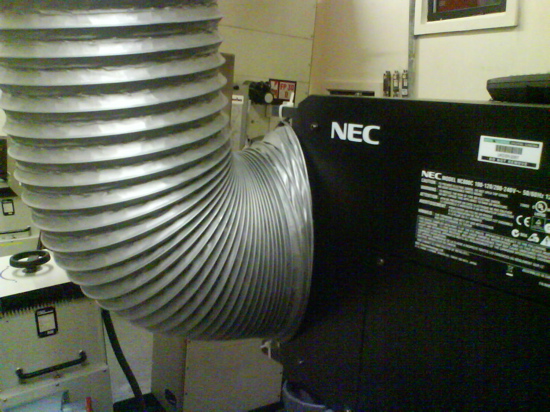
The NEC at Croydon is extracted, and has been since it was first installed. The flexible ducting is just held in place by a couple of cable ties through the mounting brackets, I assume that's what they are, but I'm not sure what was supposed to mount on them, on the corner of the projector, as can be seen in the picture. he wire inside the ducting is bent to wrap around the rear corner of the projector. It's a small, rather cramped projection room, and I think it would get quite unpleasant up there if it wasn't extracted.
I haven't had any problems with the projector, but a couple with the player; one show jumped back to the beginning after a few seconds, for no obvious reason, and another one wouldn't start, and I had to re-boot the system. Both of these are some time ago. I'm aware of one film which wouldn't load, and a new copy had to be obtained. I seldom work at the cinema now, this evening was the first time for several months, but I'm not aware of any serious problems.
Posted by Bill Enos (Member # 440) on 12-07-2008, 09:34 PM:
In the 22 years I've been at this theatre we've done at least 22,880 screenings with our obsolete 55 years old film machines with WITHOUT A SINGLE LOST SHOW. When digital projectors can equal half that it'll be ready for prime time and not until.
Posted by Scott Jentsch (Member # 1681) on 12-08-2008, 08:06 AM:
How did those 55 year old projectors fare in the first couple of years of their implementation?
Were they new technology for the theater at the time?
Did the projectors have any kinks in them that were ironed out by the time you started using them 33 years later?
When you get into digital cinema in a couple of decades (when the digital projectors are just as mature as film projectors were when you started using them), please come back and let us know your thoughts!
Posted by Stephen Furley (Member # 1277) on 12-08-2008, 08:11 AM:
There were a few odd projectors of new design around in the '50s, but most of the ones being built then weren't really much different from those being built in the '20s.
[ 12-08-2008, 10:48 AM: Message edited by: Stephen Furley ]
Posted by Gordon McLeod (Member # 33) on 12-08-2008, 08:49 AM:
quote "when the digital projectors are just as mature as film projectors were when you started using them), please come back and let us know your thoughts! "
I don't think any digital projector has a life span that long
Posted by Bill Enos (Member # 440) on 12-08-2008, 11:36 AM:
Of course by '53 when the present film machines were installed, pretty much all the issues with film had been ironed out. The company that operated this theatre from '32 till '84 left a detailed service record and there is nothing to indicate a lost show due to failure of the present equipment. As I mentioned in an earlier post, I believe digital cinema is at the developmental point that film projection was in 1911, in that equipment failures while not every day ocurances do happen a lot more than they should.
Posted by Todd McCracken (Member # 4718) on 12-09-2008, 11:39 AM:
Well it was anounced that Quvis is closing its doors. I think that may explain the swap outs in the prior post.
[ 12-10-2008, 04:50 PM: Message edited by: Todd McCracken ]
Powered by Infopop Corporation
UBB.classicTM
6.3.1.2