This is topic Dolby 3-D in forum Digital Cinema Forum at Film-Tech Forum ARCHIVE.
To visit this topic, use this URL:
https://ft-forum.com/ft/cgi-bin/ubb/ultimatebb.cgi?ubb=get_topic;f=16;t=000029
Posted by Dennis Benjamin (Member # 1137) on 08-01-2006, 08:10 AM:
http://uk.news.yahoo.com/31072006/80-91/dolby-offer-3-d-cinema-infitec-technology.html
LOS ANGELES (Reuters) - Dolby Laboratories, best known for its movie theatre surround-sound systems, on Monday said it has teamed up with German virtual reality company Infitec GmbH to develop a three-dimensional theatre projection system for theatres.
Dolby will integrate Infitec's 3-D technology, designed by Daimler Chrysler for automotive design, with the digital cinema playback system it developed for movie theatres converting to digital projection systems from 35-millimeter film projectors.
Digital 3-D systems are one tool Hollywood is using to staunch competition from DVDs, the Internet and video games to bring consumers back to theatres.
Last week's 3-D debut of Columbia Pictures' animated movie "Monster House" raked in more than twice the average per-screen box office of the 2-D version, showing that 3-D systems can boost a movie's appeal.
Dolby says its Infitec-based system would be cheaper and more flexible than that of the leading 3-D cinema company, Real D, because it allows a 3-D image to be projected directly onto standard white screens.
Real D's system requires silver screens to boost light on the image. Real D has installed more than 200 screens worldwide and has led the two largest digital 3-D film debuts ever -- the Walt Disney Co's "Chicken Little" and "Monster House".
Existing 3-D systems that use white screens also require theater-goers to wear expensive, battery-charged glasses to view the 3-D images. Dolby said its solution allows theatre patrons to use the inexpensive polarized plastic glasses used by Real D systems.
Tim Partridge, senior vice president and general manager of Dolby's professional division, said the company got serious about designing its own 3-D system during the debut of "Chicken Little".
Dolby worked with Disney and Real D to convert 100 theatres worldwide to digital 3-D systems for the film's run last fall.
"During that roll out we were able to see what an impact 3-D had on the experience," Partridge said. "We learnt about the drawbacks. We stood back and tried to figure out what it would take to have an optimized 3-D system."
Dolby has deployed its digital playback system on 160 theatre screens worldwide. The company expects its 3-D technology to be available by spring of 2007.
Posted by Darryl Spicer (Member # 711) on 08-01-2006, 11:31 AM:
quote: Dennis Benjamin
Dolby said its solution allows theatre patrons to use the inexpensive polarized plastic glasses used by Real D systems.
Something tells me that it will not have that in your face feel that 3-D using a silver screen would have.
Posted by Mark Lensenmayer (Member # 134) on 08-01-2006, 12:44 PM:
By the statement that it can use the Real-D glasses, can we imply that the Dolby system is using circular polarization?
I'll be very anxious to learn more about this.
Posted by Mike Blakesley (Member # 26) on 08-01-2006, 01:04 PM:
Oh boy! Competing systems! A bunch of people are about to get screwed.
Posted by Alexander Smith (Member # 1769) on 08-02-2006, 04:50 AM:
quote: Dennis Benjamin
Dolby says its Infitec-based system would be cheaper and more flexible than that of the leading 3-D cinema company, Real D, because it allows a 3-D image to be projected directly onto standard white screens.
...
quote: Dennis Benjamin
Existing 3-D systems that use white screens also require theater-goers to wear expensive, battery-charged glasses to view the 3-D images. Dolby said its solution allows theatre patrons to use the inexpensive polarized plastic glasses used by Real D systems.
Seems to me that Dolby and Infitec know something we don't.
I understand that the requirement for a silver screen is to
preserve the polarization plane of the light reflected from it.
(Someone jump and tell me I'm wrong...)
Oh, yes. Another FT'er commented that with having competing
systems, then people are going to get screwed. That would be
the cinema owners then... :-)
Alex.
Posted by Lyle Romer (Member # 1266) on 08-02-2006, 08:46 AM:
The press release is a bit misleading. Infitec's 3D technology does not use polarization. They are not breaking the laws of physics. There isn't much detail that I've found but they use some kind of color filtering. From the picture on the website, it looks like one lens is greenish and one is pinkish.
Apparently, part of the technology is to color correct the image for the filtering that they are doing. I have no idea how it will look compared to a polarized system but it will sure be cheaper.
Posted by Paul Trimboli (Member # 1509) on 08-02-2006, 08:54 AM:
If this system is in fact a coloured filter system or Anaglyphic then its not possible for it to be better then a polarised system or shutter glasses style because anaglyphic just does not have the seperation between the L/R channels and so you get ghosting. Now I know in Russia there were a few autostereoscopic theatres built that did not need glasses but the seating area was limited. There have been a few autostereoscopic systems developed that allowed up to a few people to view a screen and it would track their head movements.
Posted by Lyle Romer (Member # 1266) on 08-02-2006, 08:59 AM:
quote: Paul Trimboli
its not possible for it to be better then a polarised system or shutter glasses style because anaglyphic
It seems to be different than anaglyphic. On the website they refer to the technology as "interference filter technology" whatever that means. I found this quote on some other forum:
quote:
I'm not entirely sure exactly how infitec works other than to say that each filter splits the wavelength that our eyes see primary colours at their peak of intensity so that one eye sees only the colour up to the peak and the other eye sees the colour after the peak. I am no expert, so could be misreading the info that I have!
Because of the difference in intensity of red, green and blue wavelengths, the filters cause discolouration. ie. when you look at the projected image through the left eye of the glasses, there is a pinkish tinge to it and through the right eye there is a greenish tinge. The "Infitec hardware" alters the projected image to counteract this.
Posted by Mitchell Dvoskin (Member # 751) on 08-02-2006, 09:03 AM:
From the picture on the website, it looks like one lens is greenish and one is pinkish.
It's called Anaglyph 3D, and it has been around since the 1950's (or maybe earlier). A great deal of unsuccessful work went into attempting to color correct the eyes for color films, but the result was always looked like shit. The problem is that the colored glasses are filtering out a primary color for each eye. There is no way around that. It may be that this new attempt has a better filtering scheme than was used in the past, but I doubt it will look good for live action photography. At present time, polarized or shutter glasses is the only practical 3D that will give a good result.
Posted by Lyle Romer (Member # 1266) on 08-02-2006, 09:13 AM:
Here is the picture:
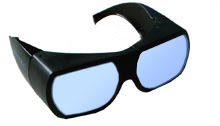
Looks nothing like old anaglyph glasses.
quote: Mitchell Dvoskin
At present time, polarized or shutter glasses is the only practical 3D that will give a good result.
How can you say that if you've never seen this technology in action? I don't know if it looks great or looks like ![[bs]](graemlins/bs.gif) because I've never seen it.
because I've never seen it.
Posted by John Pytlak (Member # 331) on 08-02-2006, 09:46 AM:
quote: Lyle Romer
On the website they refer to the technology as "interference filter technology" whatever that means.
I've heard dichroic filters referred to as "interference filters". Color dichroic filters can have sharper bandpass than dye-based filters.
Posted by Phillip Grace (Member # 2262) on 08-02-2006, 10:18 AM:
Try this link: www.infitec.net/infi_e.html
to Infitech's website. There is a white paper on it which explains the method in detail. It has some very attractive features. I think that the only concern, apart from the usual need for adequate screen luminance, would be the cost of manufacturing passive viewing glasses. The coatings for triple bandpass interference filters could be pretty expensive. Disposable cardboard and plastic viewers as used up to the present time seem to be the most practical solution in a cinema.
Although there is no information on the site to that effect, it should be theoretically possible to utilise the filters with colour photographic film. The whole back catalogue of 3D films would then become available to any cinema.
Posted by Mark Gulbrandsen (Member # 72) on 08-02-2006, 05:09 PM:
After seeing Dolby's phenominal effort in the server end of things I certainly have faith they will also have a winner for 3D. There is nothign wrong with competition at all... it went the same way back in the 50's when 3D was forst installed in theaters. There were a number of competing processes...
Mark
Mark
Posted by Mark J. Marshall (Member # 1409) on 08-03-2006, 11:09 AM:
I'm willing to keep an open mind on this at least until I see it in action. If the colors used are less intense than the anaglyphic colors in the past ("greenish" and "pinkish" instead of RED and GREEN) it might just work. And it probably won't be as headache inducing as the normal colors are either. Anaglyphic still color photos seem to work pretty well when done correctly. It might not take very deep anaglyphic colors to make the brain "see" a 3D image, especially if it's moving. The brain is pretty good at filling in missing pieces on its own sometimes. And with both eyes on the screen at the same time, there won't be any strobing like there is with the current Real D setup.
I'm excited about this. The more people we have experimenting and trying to make this work, the bigger the chance is that this format will finally succeed and become mainstream.
Bring it on, Dolby. I can't wait to see it. Just make sure it doesn't warble like the 650 does! ![[Razz]](tongue.gif)
![[Wink]](wink.gif)
Powered by Infopop Corporation
UBB.classicTM
6.3.1.2