This is topic Will Scope disappear? in forum Digital Cinema Forum at Film-Tech Forum ARCHIVE.
To visit this topic, use this URL:
https://ft-forum.com/ft/cgi-bin/ubb/ultimatebb.cgi?ubb=get_topic;f=16;t=000098
Posted by Ron Curran (Member # 3631) on 03-11-2007, 03:07 AM:
Constant width screens rely on blowing the tiny flat image up to a larger size than the full-frame Scope image. Other threads on this forum have rightly argued that bigger screens really need a 70mm print to get enough light through the apperture. If that is never going to happen, we should, at least, be getting the most out of 35mm.
Many people who speak d and e cinema are not interested in the 2.35 format. One tech told me that 35mm camera film was cropped for the Scope image, so 16x9 was the way of the future. I advised him that he was referring to Super 35, not anamorphic, which prompted the familiar lecture on the rottenness of anamorphic camera lenses.
I gather that dci projection in 2.35 uses less information for Scope images.
So will the replacement of film projection be the final nail in the coffin of Scope?
I would be sad to see that.
Posted by Michael Schaffer (Member # 1204) on 03-11-2007, 04:13 AM:
quote: Ron Curran
I gather that dci projection in 2.35 uses less information for Scope images.
Depends. You can compress the image and use an astigmatic lens to unsqueeze, similar to scope, or you can letter box the image on the chip and then you do have less resolution.
Anamorphic lenses aren't "rotten", it's just a slightly different look than Super 35, with less depth of focus, but if used in the right way by the cinematographer, that doesn't matter that much. It's not "better" or "worse", it's just a different style.
Posted by James Robertson (Member # 888) on 03-11-2007, 05:08 AM:
I understand why Super 35 was developed but I still regard it as a bastard format going by what I see at my local multiplex which I know has good equipment and Schneider lenses. I haven't seen a really SHARP Super 35 image YET and dearly miss the pin sharp Anamorphic Panavision films of yore.
JIM
Posted by Mark Gulbrandsen (Member # 72) on 03-11-2007, 09:23 AM:
quote: James Robertson
I haven't seen a really SHARP Super 35 image YET and dearly miss the pin sharp Anamorphic Panavision films of yore.
Than you never saw True Lies, and if you thought the release prints looked good you shoulda seen the dailies! There are also many other Super 35 films that look awesome, many have been blown up to 70mm, also wasn't Titanic Super 35? The 70mm prints looked dam good! The main reason for the format it because it affords better depth of field... or should I say the wide angle lenses the format uses offer more depth of field than any camera scope lens affords. Also pulling focus on scope is VERY difficult and focus pulls have to be absolutely perfect while on Super 35 there is at least a little leeway. There are also other inherent distortions in scope lenses than many dislike and the weight of them can be exccessive. All in all if Super 35 is done carefully and correctly it can look better than anamorphic scope but the problem lies withhigh speed stocks and the over use of it today... in fact I wonder if many DP's even kow how to light any more... they just run for the high speed stock.
Mark
Posted by Greg Anderson (Member # 235) on 03-11-2007, 09:59 AM:
James Cameron always seemed to be the master of getting the most from Super 35. In fact, I consider his work to be the exception rather than any kind of standard example of how Super 35 can look. One particularly weak Super 35 production was the most recent version of The Italian Job. An early, exterior walk-and-talk scene with Walberg and Sutherland comes to mind. The close-ups looked like an 8mm blow-up. There are many places where The Lord of the Rings looked really washed out in the theatre. Of course, they processed that whole thing through the computer and, sometimes, the washed-out-and-metalic look seems to be very popular for people who like to play with their digital "negative."
To me, the biggest threat to the use of film and to the use of 'Scope cinematography is that so many productions go for a stylized look. They rely too much on digital effects and digital color manipulation. I miss seeing beautiful pictures. And if there's less interest in creating a beautiful look then who needs film? Who needs the richness of a well-shot 'Scope image? It's all just gonna end up being seen on an iPod or cell phone screen anyway.
Posted by Mike Schindler (Member # 1309) on 03-11-2007, 10:37 AM:
At my theater right now, we have 8 movies playing, and only 2 are flat. Since Super 35 has gained popularity, there has been an increasing number of scope movies. I don't think that digital production or presentation will change that. That certainly hasn't been the case so far.
What we're already seeing a lot less of is anamorphic photography, and that's too bad. But I disagree with Greg on stylization being the culprit. Anamorphic photography provides a highly stylized look itself, with all of its beautiful imperfections. It's actually one of the reasons why Cameron refuses to use it, because there is no correlation to those artifacts in human vision. I think the format's impending doom has more to do with laziness and economics.
Posted by Bobby Henderson (Member # 840) on 03-11-2007, 12:57 PM:
quote: Ron Curran
Many people who speak d and e cinema are not interested in the 2.35 format. One tech told me that 35mm camera film was cropped for the Scope image, so 16x9 was the way of the future.
Those guys are being extremely ignorant of the creative side in having multiple framing formats. In fact they're spouting stupidity. Would it make sense for any painter or illustrator to stick to only one aspect ratio for his work?
There is no one single framing format that will serve a movie production to the best of its needs. Some movies are far better composed for the super-wide aspect ratio whereas others may seem more intimate shot flat or even in Academy ratio.
I think "common width" screens are a truly dumb idea, especially for the trends in theatrical aspect ratios over the past few years. I could be wrong, but it certainly seems like a lot more major releases are sent out in 'scope rather than flat.
There's even a lot of movies using the 'scope aspect ratio, such as a lot of small comedies and dramas, that would be better off framed flat. Just as "full screen" releases on DVD look to fill as much of the TV screen as possible, I think lots of productions are merely trying to do the same in commercial theaters when it comes to using Super35 and 'scope prints. My biggest complaint about this is many of those shows do not make the most of the 2.39:1 aspect ratio. Most seem to have bland compositions that try to play it safe for both home and theatrical viewing.
quote: Ron Curran
I gather that dci projection in 2.35 uses less information for Scope images.
'Scope in 2K D-Cinema does indeed have a lower pixel count than flat aspect ratio. But it's also interesting to note that none of the standard theatrical formats use all of the available pixels in the 2048 X 1080 sensor.
Frame formats capable from 2K digital projectors:
Flat: 1998 X 1080 (2,157,840 pixels)
Scope: 2048 X 858 (1,757,184 pixels)
Flat HD: 1920 X 1038 (1,992,960 pixels)
Scope HD: 1920 X 804 (1,543,680 pixels)
quote: Mark Gulbrandsen
There are also many other Super 35 films that look awesome, many have been blown up to 70mm, also wasn't Titanic Super 35? The 70mm prints looked dam good! The main reason for the format it because it affords better depth of field... or should I say the wide angle lenses the format uses offer more depth of field than any camera scope lens affords.
Only a very small percentage of all Super35 movies have blown up to 70mm. And not all looked great in 70mm either. James Cameron's movies, The Abyss in 1989, True Lies in 1994 and Titanic in 1997 are among the very best looking examples of Super35. I thought parts of Backdraft looked great as well (the same DP on The Abyss worked on that one).
However Super35 has a number of drawbacks. When dealing with 70mm, the optical enlargement step from the Super35 camera negative to 70mm must be handled correctly. James Cameron used customized Arri cameras, lots of custom made lenses and lots of different film emulsions to get the most detail out of the frame as possible.
I have seen lots of other Super35 movies that looked like grainy crap on the screen. Steven Soderbergh's remake of Oceans 11 is one that immediately comes to mind. I think Star Trek VI: The Undiscovered Country was the only one of that series to be shot in Super35. It also looked very grainy.
Spherical lenses do indeed have greater depth of field capability than an anamorphic lens in the same focal length and aperture size. However, anamorphic 'scope cinematography uses all of the 4-perf 35mm negative. Super35 uses a little over half the frame. The optical enlargement step will not only amplify grain but it also adds a nasty effect similar to diffraction. The blown up image looks softer. That's why it's so critical for the original photography to have very high image quality.
There's a lot of Super35 shows that appear to be seriously drained of color as well. Anamorphic 'scope photography, especially when its well done, can have very rich color. Again, that's the advantage of being able to use the entire 35mm film frame. Moulin Rouge had some pretty incredible looking shots (even though the movie itself was pretty wacky).
Sometimes the more narrow depth of field in anamorphic photography can add more dramatic "pop" to the image. Subject matter within the focus plane is usually very sharp. The out of focus blur in the background is more dramatic. And you get the oval-shaped "bokeh" happening in the background to gain more of that movie look.
Perhaps the thing I like best about anamorphic 35mm cinematography is it forces the director and director of photography to really use the frame instead of playing it safe with blah composition like most of the movies shot in Super35. In general, I find movies that were shot in 'scope (or in other true widescreen formats like 5/65mm) to have more dynamic compositions. The framing seems to feel right. James Cameron and David Fincher are among very few directors whose Super35 movies seem like they were really composed for the 'scope aspect ratio. Most other movies released in Super35 merely feel like they were severely cropped just to fill the entire width of a movie theater screen.
The advent of digital cinema and preponderance of lower resolution 2K digital intermediates being used is taking away a lot of the advantages in shooting a movie in anamorphic 'scope. The resolution bottleneck also masks a lot of the imperfections of blown up Super35 cinematography as well. Perhaps if Hollywood studios ever get around to using the 4K format more seriously then the advantages of shooting in 'scope will be more obvious again.
Posted by Cameron Glendinning (Member # 3516) on 03-11-2007, 05:13 PM:
I am under the impression that super 35 mm is popular because it is easy to intergrate with modern cgi effects. The depth of field photography in Titanic, was one that took advantage of the Australian "Frazier Lens" for extreme depth of field results. 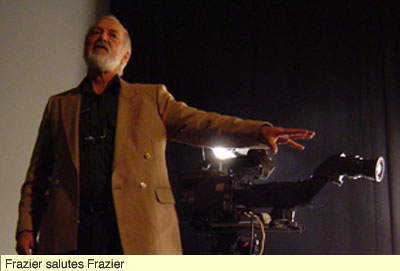
more info
quote: Mark Gulbrandsen
All in all if Super 35 is done carefully and correctly it can look better than anamorphic scope but the problem lies withhigh speed stocks and the over use of it today... in fact I wonder if many DP's even kow how to light any more
Why is it that cinematographers now tend to light at real life levels? I can see that it is quicker on set, but what a trade off with image. Kodaks one billion dollar investment in film stock quality has resulted in a generation of cinematographers who use minimal light levels, why because for the first time in history they can (still very hard for the focus puller), instead of better looking movies than ever before. ![[Eek!]](eek.gif)
Posted by Bobby Henderson (Member # 840) on 03-11-2007, 07:33 PM:
quote: Cameron Glendinning
I am under the impression that super 35 mm is popular because it is easy to intergrate with modern cgi effects.
From one standpoint it is easier to get the CGI footage to match spherically shot imagery. However, it isn't very complicated to get CGI footage to match anamorphic material either. Professional level 3D rendering and animation applications have a variety of different camera settings. For major movie productions, if something is lacking in off the shelf applications like Maya, Softimage or 3D Studio Max they'll custom engineer different components and shaders to solve the problem.
quote: Cameron Glendinning
Why is it that cinematographers now tend to light at real life levels? I can see that it is quicker on set, but what a trade off with image.
There's a variety of reasons. Some want to "run and gun," shooting as fast as possible, either to save money or for a more spontaneous feel. Lots of movies are pretty dark and often very green or earthy looking because of what seems to be a fashion of sorts in cinematography.
Of course, some directors want an image that looks more like normal everyday life. Bright levels of studio quality lighting don't occur naturally in most places. A good director of photography will work hard on masking studio light sources and make any lighting seem like it is only coming from normal everyday appliances, sunlight or moonlight. To do that very well requires a good amount of time and close collaboration with the production designer and set decorator.
It's rare I see a movie with outdoor night photography that actually looks like natural lighting that could occur in the given environment. Very often something like a Musco truck with a giant football stadium light is set in the background to flood the area with intense light. It's pretty easy to spot since no standard street lights can generate that magnitude of candle power.
Posted by Mark Gulbrandsen (Member # 72) on 03-11-2007, 08:08 PM:
quote: Cameron Glendinning
Why is it that cinematographers now tend to light at real life levels?
I can only suspect that its budgetary constraints that dictate this. Since film stock is far less expensive than lots of extra lights cabling and the folks to set em up and tear em back down... and the costly time it takes. These days the budgets can be kept at bay and less lighting used as negative costs escallate. I agree its very backwards to light less as older cinematographers would always use lots of light, fine grain stocks and end up wih a much better looking film overall. Take the day for night scenes in LOA... they look fantastic. Again... there are ALOT of disadvantages to using camera anamorphics in the flexibility of a shoot and for some reason you guys seem to ignore that fact. They are heavy, slower in speed, way less depth of focus and possess their own unique distortions and artifacts.
Today I see most DP's and camera crews as a bunch of spoiled weenies.... at least many of the crews I ran dailies for were. Todays camera equipment has been developed to beyond many peoples wildest dreams... If they had to shoot a film with the 65mm Super Panavision or BNC rangefinder cameras of yesteryear out in the desert or in remote locations for long periods or for years on end most would simply quit and walk away. Indeed there were films made with these cameras that no one would attempt to re-make today. Excepting a very few today the real cameramen that shot great looking films are all gone.
Mark
Posted by Ron Curran (Member # 3631) on 03-11-2007, 10:43 PM:
1.85 images on anamorphic release prints look clean. It has been suggested before that all prints could actually be released this way. It would upset the constant width movement but they can get counseling.
Mark, on a shoot gaffers used to drive me batty with their cutters and scrims while we were trying to shoot as deep as poss. The results always proved them right, though.
Posted by Greg Anderson (Member # 235) on 03-11-2007, 10:58 PM:
With rare exception, I've always gotten along really well with DPs. It was only the rare exception whom I considered to be a spoiled weenie.
While tight budgets and tight schedules could account for many decisions to go with Super 35 instead of 'Scope, I'm not convinced that budgets have dictated the low-light-cinematography that we're noticing. I think it's more of a popular trend... a fad. Certainly, technology is changing much faster than most people would have predicted. I'm anxious to see what the "fad" will be in just a couple of years from now, when the creative people are even more comfortable with whatever the technology offers them.
Posted by Ron Curran (Member # 3631) on 03-12-2007, 02:17 AM:
“Age of Innocence” was the first film I watched with the awareness that it was shot in Super 35 and the image impressed me. I just watched “Dreamgirls” and I do not know whether it was Super or anamorphic but it looked excellent (at least on the print we are projecting).
It is a long time since I have been involved in film or tv shoots. All of my recent experience has been projecting and watching film and electronic images. IMHO very few flat images look as good as the majority of Scope images on a cinema screen. 16x9 images look great on my plasma at home, but so do 2.4 dvds.
Although I prefer 4-perf anamorphic, if I had my druthers, I would ask for Scope printed down from 65mm. At the other extreme, I have seen so many excellent Super 35 films that negate my position. The “no depth of field” argument against anamorphic seems arbitrary in a dramatic context – most of the time you want selective focus.
Bobby, I agree that creative artists should be able to choose their canvas. Unfortunately, they are not always given the full picture.
Posted by James Robertson (Member # 888) on 03-12-2007, 03:21 AM:
Notwithstanding the fact that a FEW really good Super 35 films get to the screen they are few and far between. I repeat- most of them look like shite.
JIm
Posted by Leo Enticknap (Member # 534) on 03-12-2007, 06:46 AM:
In that case you'd really love a Super 16 to 35 'scope blow job. There were a few made here during the lottery funded production boom of the late '90s. The definition and saturation looked broadly similar to that of a projected VHS.
Posted by Christian Appelt (Member # 1067) on 03-12-2007, 11:45 AM:
I agree with Mark about many filmmaker being spoiled brats. Over the years, I found that U.S. movies looked sloppier every year. More and better CGI effects, sure, but in classic studio films, it was an exception to find a second rate shot (totally out of focus for more than a second, overly grainy). Over the years, editors and directors seem to have lost every bit of reluctance to put even totally unacceptable footage into a movie.
Although there is nothing bad in formats and procedures like Super-35, high speed stocks or Digital Intermediate, they certainly have speeded up the degeneration of cinematic craftsmanship.
You can use any lens and are not restricted to Panavision or a few other makes of 'scope lenses? Fine. You don't need much lighting to get an image? Fine. You can alter and fine-tune your images after shooting? Fine with me.
But now we have people who do only minimal lighting, use high speed film ("Film stocks are so good no one notices"), they use Super-35 ("Lenses are so good that you don't need the larger 'scope format") and they put their films through a D.I. process ("We can do grain reduction anyway").
Every week I see some of the results at the theatre: Grainy pictures ("Adds a nice texture"), out-of-focus shots that would have been found on a traditional cutting room floor with actor's eyes totally blurred ("We can get away with that one") and an image that lacks resolution in every long shot. ("2K is more than enough for 35mm"). When the image has no detail, I still can focus my eye on wonderful digital artifacts (hello, Technicolor-Thomson!) that make the silver screen look like a huge first-generation LCD-TV.
Who's to blame? Not the small format, Sergio Leone and James Cameron got great prints (even from smaller TechniScope negs) - because they took care.
BTW, although some Super-35 movies indeed do look fantastic, I always think: How good could it look if the same care and progress in film stocks and optics were applied to shoot it in 65mm? ![[Wink]](wink.gif)
As Mark said, most of today's filmmaker would rather not use a superior imaging system like 65mm because it would restrict their freedom to do every insert close up as a Steadicam shot or do a shot handheld within a minute.
From my experience, many DPs just talk technical nonsense to impress their audience, sometimes contradicting technical and physical laws. They want to look good and sometimes justify whatever poor solution they came up with under budgetary or time restrictions.
Many times when I watch old American films, I feel with certainty that there is no one left who could - with whatever new technology available - recreate certain styles of classic cinematography. Mark mention LOA, but even classic b&w is terra incognita to most DPs. I cringe whenever an new film comes out with director and DP claiming they used vintage technology to create a faithful look of, let's say: film noir . Then I see the usual DI'd color neg, some contrasty lighting to make it look like a woodcut and of course fancy camera moves that don't fit the time & style. ![[puke]](graemlins/puke.gif)
/end of rant/
PS: I don't think everything used to be better back then - two days ago I saw a vintage print of M*A*S*H and just couldn't believe how far even Robert Altman would dare to degrade the cinematic image. I hastily left before MCCABE AND MRS MILLER started... ![[Smile]](smile.gif)
Posted by Bobby Henderson (Member # 840) on 03-12-2007, 04:01 PM:
I think the late 1970's hit a certain "high water-mark" for quality 35mm cinematography. Movies like Apocalypse Now and Days of Heaven still remain as great visual achievements. Days of Heaven wasn't in 'scope, but Néstor Almendros work on that film is among the very best in film history.
These days the "quick and dirty" and "good enough" fashions seem to be preferred. A defensive explanation, "we're going for a documentary look," is often given.
Posted by Greg Anderson (Member # 235) on 03-12-2007, 07:14 PM:
Let's be careful. The Director of Photography for The Abyss and Backdraft has received praise in this thread. Yet that same man also went on to be Director of Photography on the 65mm production of Far and Away. And I would be surprised if Far and Away gets a whole lot of praise here.
Of course, it's a pipe dream to think that 65mm photography will ever make a comeback. It's also unwise to assume that movies would look better if only there was more use of 65mm photography. We've listed some of the visual shortcomings of Super 35 and of 'Scope. Don't forget that 65mm raises its own set of visual disadvantages too.
Posted by Ron Curran (Member # 3631) on 03-12-2007, 07:39 PM:
In the 70s flourish of Australian film production, we saw some magnificent Scope prints – Careful He Might Hear You and The Man From Snowy River come to mind – and I think that they were all shot with Panavision anamorphics and processed at Colorfilm. Can anyone tell me of the deficiencies in those films?
Lenses and film stocks have improved greatly in the last three decades. So we should be seeing knockout images today, consistently.
As a cinema operator, I know that the audience is disappointed when some (not all) features are flat; it is part of the theatrical expectation.
Posted by Bobby Henderson (Member # 840) on 03-13-2007, 12:55 AM:
quote: Greg Anderson
We've listed some of the visual shortcomings of Super 35 and of 'Scope. Don't forget that 65mm raises its own set of visual disadvantages too.
True. However, the current problem is one where movie productions are not making the most of the given shooting format. No one is really, honestly raising the quality bar in cinematography.
Before anyone offers "digital," they need to bite their tongue. Motion picture film methods remain vastly superior in terms of image quality capability compared to that of the best digital video camera systems.
The fashion of dark, gritty and bleached out looking photography is a convenient mask for people either doing the job wrong or doing it on the cheap. In that context, I agree formats like 65mm have no chance of being used. It certainly won't when 35mm isn't being used anywhere near its greatest capabilities. We seen it pushed to the limits of the technology available at the given time with movies like Days of Heaven. It's a shame the same thing isn't happening now.
Posted by Cameron Glendinning (Member # 3516) on 03-14-2007, 07:47 PM:
mmm lets think about the films that didnt look too bad
"Stelth" um proved that cgi and anamorphic can mix in the recent past, but used older scope lenses for compactness and weight issues. I thought it looked very clean and grain free.
quote: Bobby Henderson
Lots of movies are pretty dark and often very green or earthy looking because of what seems to be a fashion of sorts in cinematography
Yes cinematographers seem to be getting away with mixing different color temprature lighting. The green is usually uncorected use of floresent lighting. Once apon a time this was considered bad practice.
The fact that very few people now work with one light work prints. With all rushes footage being lab graded. It is very hard for people to truely understand exposure.
quote: Ron Curran
In the 70s flourish of Australian film production, we saw some magnificent Scope prints – Careful He Might Hear You and The Man From Snowy River come to mind – and I think that they were all shot with Panavision anamorphics and processed at Colorfilm.
Lab Quality is probably another big issue. Colorfilm was exceptional, Crocodile Dundee is another probably more wide seen example. Its fair to say that all labs are not equal.
One lab horror story was "Much Ado About Nothing" This film I saw in London at a old super cinema in the west end, Perfect Lenses, Projection staff and Kodak print of a Kodak negative. The experience perfect (well except for Keanus woodern acting). 3/4 horizens, fine grain stock and unforgetable long stedicam shots. The final shot is almost 4 minutes long
Unfortunatly for the Director of Photography, its U.S release was done on the cheap, printed on Agfa Stock, all the lovely gold highlights turned purple And his hard work was panned by Variety magazine as if it was his intention and fault!
quote: Bobby Henderson
We seen it pushed to the limits of the technology available at the given time with movies like Days of Heaven.
Day like Heaven is one beautiful unforgetably shot film. An easy concept though, all shot during the goldern hour, near sunset. To make the most of the limited shooting time, the production rehearst both the acting and the camera set ups in the morning. Then filmed them in the late afternoon.
Posted by Bobby Henderson (Member # 840) on 03-14-2007, 08:40 PM:
quote: Cameron Glendinning
Yes cinematographers seem to be getting away with mixing different color temprature lighting. The green is usually uncorected use of floresent lighting. Once apon a time this was considered bad practice.
Actually it seems like more of that has been happening in the printing lab. Lately the practice muddying up the visuals has become more common with the use of digital intermediate. I recall the "platinum edition" release of Seven on DVD using the original camera negatives to create a new video transfer. That footage looked more like normal photography, but was then colorized using the computer based tools.
Posted by Ron Curran (Member # 3631) on 03-14-2007, 10:04 PM:
Yes Cameron. Yes Bobby. The problem is that we are being swamped with misinformation.
Certain digital projection advocates are insisting that all movies are now being shot in 16x9. Also, I am being told that no intermediate work is being done at 4k. And that even higher speed printing is being introduced to those labs that are currently producing good prints. When I dispute this, I am told that my info is out of date. They are saying that 2k files look better than film prints of the same movie (OK, occasionally that may be true).
I think that it is 10 years now that the digital people have been trying to kill off film and part of this strategy is to rid our screens of Scope.
Posted by Bobby Henderson (Member # 840) on 03-14-2007, 10:21 PM:
Of course, we all have to keep in mind many of the people touting all the virtues of digital projection, especially those doing it in the press, have vested interests in selling hardware. Many salespeople stretch the truth or just tell outright lies to sell product and make more money for themselves.
quote: Ron Curran
Certain digital projection advocates are insisting that all movies are now being shot in 16x9.
I found that to be pretty funny considering none of the digital projectors have 1.77:1 (16x9) as a standard theatrical framing format. They can show 16x9 material, typically via external sources. But the presets are 2.39:1 and 1.85:1 in the pixel settings I listed a few posts ago.
Sales people aren't big on telling specifics, especially any specifics that risk diluting the strength of their pitch. That's why many comparisons of video to film have been via film done wrong.
Posted by Ron Curran (Member # 3631) on 03-14-2007, 11:14 PM:
Bobby, I forgot to thank you for posting that list. As no techers have disputed you (as they would in a nano-second) I will use it for some homework on specs I have been given regarding a new generation of lower cost dlp projectors.
Powered by Infopop Corporation
UBB.classicTM
6.3.1.2