This is topic 70 vs. DC starring Larry Myres in forum Digital Cinema Forum at Film-Tech Forum ARCHIVE.
To visit this topic, use this URL:
https://ft-forum.com/ft/cgi-bin/ubb/ultimatebb.cgi?ubb=get_topic;f=16;t=000107
Posted by Larry Shaw (Member # 388) on 01-26-2006, 07:37 PM:
For a few months I've been kicking this around in my head.
What the industry is now doing is looking to spend an enormous sum of money to change to DC which is primarily a "save money" scheme...nobody's trumpeting great improvements in quality, except perhaps via less film damage (which could be solved by qualified projectionists). Meanwhile, the boxoffice is doing poorly, and distributors want to reduce the release window which would further reduce ticket sales. DVD's, "Home Theatre", HD and soon BluRay and cheap Plasmas will entice people to stay home and watch on video. I also think that it won't be long after wide use of DC that whiners in the press and elsewhere start talking about "why should we pay more to see shows at theatres, its just a big TV". And of course [despite wishful thinking from encoding suppliers] DC will make illegal duping easier than ever. And I think theatre owners are in for a truly nasty suprise when the real cost of maintaining/upgrading/replacing all this technology starts to be understood.
Now, showing my advanced age, I think back to the 50's when theatres were concerned by competition from <gasp> TV. Utterly different from today, theatres did not rush to buy big TV's; they worked hard (with the studios) to develop technologies to set them apart from TV. We know them, WideScreen 1.85:1, CinemaScope, PanaVision, VistaVision, Cinerama, magnetic stereo etc, etc. And guess what: It worked!
So here's where my head gets confused. Instead of dumping vast sums to convert to a system that, at best, approaches the quality we already can have (Yes, I know about 'real world' 35mm; I also know that the 'real world' will affect DC negatively too when it stops being nurse-maided as it is today)? Why aren't theatres looking to ENHANCE their presentation so they can offer their customers something clearly better than anything they can get at home? And here I'm not thinking about the grossly overpriced Imax, or even formats like 8/70 or Showscan. I'm thinking of good ol' 5 perf 70mm. 5/70 just requires changing to a 35/70 picture head, (a pittance compared to DC) and upgrading the platters. Sound, which used to be the cost and time problem in making mag prints, can now be done with DTS (and presumably Dolby, with some work) bringing 70 print costs way down. The added maintanance of mag heads is no longer an issue. And scratching is less evident due to less magnification.
And what's the result? Instantly we have a dramatically sharper, brighter, steadier image to sell, one that no DC or "HD Home Theatre" can touch. One that can be advertised, as it was in days of yore, as "dramatically sharper, brighter, steadier, with realism that no "Home Theatre" can touch". What a great feeling, to be fighting back against TV instead of bowing to it. And at just a tiny fraction of the cost of the DC colussus.
Does anyone else see this as viable? Or should we just roll over and wait to be told what TV to buy?
Larry Shaw
Posted by Steve Guttag (Member # 268) on 01-26-2006, 08:30 PM:
I believe I have stated this MANY times. 5/70 was Cinema's best overall format. In fact, the full Todd/AO system...6-channels combined with 70mm running at 30fps...it was truely the best system offered that could be done enmass. Every aspect of the show was improved as compared to its standard 35mm counterpart.
I still feel that 5-speakers behind the screen are more essential than 2-surrounds, let alone 3 or 4. With current DTS XD-10s one can have their 5 screen channels, 2-4 surround channels and subwoofer if they so care.
I agree it is high time for Super-High-Definition cinema to come back...in 70mm...it can't be beat with today's digital technology and isn't about to get into the home anytime soon.
The AFI/Silver just ran Hello Dolly in 70mm and did quite well with it and received many thankful emails for the 70mm presentation. Even when they run Lawrence of Arabia in 70mm they can pack them in...I say even since it has been run so many times and is available for the home in many "restored" versions...yet the 70mm show brings em in.
Those that say 70mm is dead really just want to settle for inferior quality. Exhibition needs to be requesting 70mm from the studios though.
Posted by Bobby Henderson (Member # 840) on 01-26-2006, 08:42 PM:
I really wish 70mm could make a comeback, but I think the "genie is getting out of the bottle." Large theater chains like Carmike are now making deals to install thousands of digital video projection systems and have movies beamed to them via satellite.
My opinion Hollywood is now embarked in a slow process of killing itself -or at least giving itself a really bad case of gangrene, which will result in amputations of sorts. They're indeed taking the film out of film and turning it into TV.
We can now look forward to a movie version of Magnum P.I., along with Miami Vice. Those will go on a growing pile of other TV shows made into movies. When the movie is something that used to be a TV show, why not stay at home and watch it on TV? That is if you even want to watch the movie at all.
Add to that all the remakes, especially in the horror genre. You have The Fog, The Hills Have Eyes, When A Stranger Calls, The Texas Chainsaw Massacre, The Amityville Horror, and those are just a few that immediately come to mind. On top of that you have sequels of movies that weren't good enough to be made in the first place. Do we really need Final Destination 3 or Cheaper By the Dozen 2 when their originals sucked? It's as if Hollywood has run out of ideas.
Of course, it's also mildly interesting how just about every major movie studio is now owned by another entity -which also owns TV and cable networks. The movie businesses themselves can fail, but the parent company will still survive.
I believe all the bland, painfully predictable we've seen this same shit 1000 times already kinds of movies are going to wind up biting these movie distributors in the ass. It's going to drive lots of movie fans to other forms of entertainment. The disconnect could possibly invigorate European, Asian and Indian movie industries -but that's somewhat doubtful. I think people will fill the void with more work at home, TV watching and maybe some game playing on Playstation 7.
If that situation comes to pass (and it could), the parent companies of those movie studios will pick apart each movie studio in the same manner the original MGM was dismantled. The TV networks will keep the film libraries. The companies will be sold off to whoever for big bucks and then sold again and again until the value of the studio name brand dies.
I think a lot of movie theaters will have to gut the traditional layouts of their auditoria and convert them into restaurants, sports bars and other venues capable of showing other kinds of programming in addition to movies. They'll be forced to do.
Executives like Robert Iger at Disney will probably eventually get their way and have new movie releases hitting DVD (and iPods) day and date with theatrical releases. An industry wide move like that would kill off most traditional theaters quickly.
Sure, one can make the argument people go to the movies to get out of the house. But they're not going to do it when the general quality of American movies has been back-sliding into homogenized shit. They're not going to pay the premium for that. It will be easier and cheaper to get the HD-quality DVD, which will be available at the same time, and they'll be able to watch it on huge yet affordable TV screens made by near slave labor in China. But that's also assuming those customers will even want to watch the movie at all on that huge screen. They may just fire up the video game console instead, or just watch a TV show, or even (gasp) read a book.
Right now the status quo is somewhat stable. But the paradigm may start changing dramatically before this decade is finished. Those who intend to survive in the theater business for the long haul will have to be ready to adapt to fast, radical changes.
Posted by Floyd Justin Newton (Member # 1316) on 01-26-2006, 09:10 PM:
Bobby--
I agree with the above, except there probably won't be such
a thing as "day/date". It's just going to be DVD. Think about
what Hollywood is doing to itself. It is scribing its own
headstone. It's known as 'self-burial'.
Posted by Mark Gulbrandsen (Member # 72) on 01-26-2006, 09:42 PM:
I agree with all you guys for the most part! However the main ingrediant missing today are the Showmen of yesteryear. Ya can't use the technology of today without some of the showmen of yesteryear(or at least some their traits that made movies special). They are all dead and gone replaced today by the suits and pencil pushers and the likes of Steven Squeelburg and George Pukas ![[puke]](graemlins/puke.gif) . Unfortunately the likes of Michael Todd, Lowell Thomas, Jack Warner, and Spiro Skouras will never be seen again in our time. Bring back any one of these guys and they'd whip the movie industry back into the glorious entertainment it once was.
. Unfortunately the likes of Michael Todd, Lowell Thomas, Jack Warner, and Spiro Skouras will never be seen again in our time. Bring back any one of these guys and they'd whip the movie industry back into the glorious entertainment it once was.
Mark
Posted by Mike Perju (Member # 1482) on 01-26-2006, 11:01 PM:
Already fewer than 1 in 30 people I know actually go to the movies, while two thirds of them regularly download this week's releases. The only thing that has people going to the movies is the fact that it's different, and that some of the downloads look like crap. Once films get released digitally, it will only be a matter of time before every download in crystal clear. Noone in Toronto puts on a real show in any multiplex, and I can't imagine why anyone would bother going out to a poorly maitained multiplex to watch TV. There are no exlusive engagements anywhere, and it only took people 5 years to get over the existence of digital sound. I don't think digital films would make news anywhere, exept for two of my friends letting me know they just downloaded next week's release and that I could borrow it in exchange for a beer.
70mm should make a comeback, exclusive engagements should make a comeback, and possibly together (adding showmanship to the mix would make for a great three-way).
(By the way, if a theater chain would sign a 10 year lease on digital projectors, they should ask themselves how long they realistically expect the machines to last, and if they truly expect whoever is to service them to actually do the work. I hear that asking your mall landlord to fix a leak in the roof - which is clearly their problem - can be a useless endeavour, and "corporate responsability" are two words you that my thesaurus lists as synonimous with "fuck you".)
Posted by Bobby Henderson (Member # 840) on 01-26-2006, 11:17 PM:
quote: Mike Perju
70mm should make a comeback, exclusive engagements should make a comeback, and possibly together (adding showmanship to the mix would make for a great three-way).
The problem is the folks bank-rolling the production are far more interested in getting the movie onto DVD as fast as possible. Unfortunately 70mm release is the exact opposite of that. 70mm is designed to make a movie play in theaters and do so for a long time. Investors don't want any of that because they believe all the money to be made is in home video. The money people also want the movie onto home video as fast as possible so they can pay less in interest payments on the money they borrowed to bank-roll the production. And they only want to pay for marketing costs one time.
Some of that makes sense from a myopic dollars and cents only view. But if you cannibalize the movie theaters out of business you remove the ingredient that legitimizes a movie as a real movie. If it didn't play in a real movie theater than it is nothing more than a mere TV show.
Posted by Monte L Fullmer (Member # 2797) on 01-27-2006, 01:55 AM:
As Mark has said in a way: We need the big directors to make the 70mm releases since they knew how to make a BIG movie.
True, in the olden days, when the marquee was posted the feature was presented in 70mm, that really stood out from the rest of the marquees in the large cities. For the public knew that when a 70mm presentation was on the screen, it was much more sharper and clearer than the 35mm counterparts.
.......Just like when I saw "2001: A Space Odyssey" at the Villa in SLC in 70mm in 1968: no comparison to the 35mm copies that I ran and saw afterwards...sound and picture make the impression.
..unfortunately, it's also the cost factor, marketing and the "new generation of movie-goers (which is the young group now -not the 'adults' of yore..) that the movie industry is gearing itself to nowdays...sad.
-Monte
Posted by Louis Bornwasser (Member # 3063) on 01-27-2006, 11:31 AM:
In terms of boxoffice & quality; Digital Cinema (TV) makes 70mm make sen$e.
Not only is it cheaper, it is remarkably better.
(Upcharge for 70mm if you were building a new cinema: $2000 for the head, $1100 for the lens, 1000 for platter & roller changes. All other parts are the same as a good quality 35mm booth.) Louis
Posted by John T. Hendrickson, Jr (Member # 849) on 01-27-2006, 02:34 PM:
For those of us here, 70mm makes sense. Unfortunately, when it comes to the people who really run the industry, they "follow the money", to quote that famous line.
True, conversion costs are not great for 70mm, as Louis points out. They ARE great for the distributors in terms of shipping and print costs, which the studios are trying mightily to eliminate through digital presentation. That, unfortunately, is the real key: the bottom line.
Anyone who has seen properly projected 70mm understands what a terrific presentation it is. Unfortunately, not enough people have had this experience, and the studios understand that. What the studios also understand is that 70mm isn't going to save them anything in the short run. And besides, who in this industry thinks in terms of the long run these days?
Posted by Scott Norwood (Member # 30) on 01-27-2006, 03:00 PM:
DLP won't save anyone anything in the short run, either. Mastering costs are high, as are equipment costs, and it creates a dual-inventory issue as long as there are still theatres with "only" 35mm capability who will need prints.
Having said that, and as one who loves 70mm as much as anyone (and as one who ran the most recent public 70mm screenings in the Boston area, back in September of 2004), I don't think it will happen. Aside from the Lord of the Rings series, the Star Wars prequals, and maybe a few other titles released over the last few years, relatively few titles really justify shooting and exhibiting in 70mm. Also, there aren't many really big screens or grand theatres (at least in this market) and that, combined with the fact that there aren't many people around who know how to run 70mm without damaging it, will probably be enough to dissuade distributors from even considering 70mm releases, with the possible exception of the IMAX DMR releases.
Personally, I'd be happy with properly made 35mm prints. Too many 35mm prints in general circulation today aren't sharp and aren't steady. For little (if any) extra cost, a huge improvement in theatrical exhibition could be made if printing quality were improved (perhaps along with a return to IB Tech printing). Unfortunately, it's not a very marketable improvement.
Posted by Greg Mueller (Member # 17) on 01-27-2006, 03:37 PM:
"to get out of the house"
I agree with the notion, but to go into a dark room with a crowd of people who have either never been taught manners or have disregarded them, always makes me think twice about going to see a movie.
What happened to manners anyway? ![[Confused]](confused.gif)
Posted by Brian Guckian (Member # 1678) on 01-27-2006, 03:47 PM:
We could have both - 70mm for suitably spectacular material, and D-Cinema for other types of material, especially non-feature programming. (With 35mm continuing as well).
Film needs to be re-positioned as a high-end, high-quality medium in the eyes of the decision-makers, and have its value restored. If you restore value, then people will invest.
Let me expound the theme further. Today I had the insight into how inappropriate the push for digital has been in some quarters.
Imagine if we were told that "All orchestras worldwide are to be digitized to save money. Musical instruments are bulky, archaic and expensive. Digital technology will cut costs and allow wider types of music to be played".
Now think about that and how totally ludicrous it is!
Also, the other day I had to get one of the floor staff where I work to move a print with me. He was new and hadn't been into the projection room before. He took one look at the print and said, "that's so old school".
I call it the "Cinema Paradiso Syndrome". Basically, in the eyes of the average Joe, film is "old". It belongs to the 1950s in Italy.
We need to change that. We know the truth!
Ultimately it's all about perception ![[Wink]](wink.gif)
Posted by Larry Myers (Member # 738) on 01-27-2006, 05:43 PM:
Little known fact. The image quality jump from 1.85 flat to true anamorphic 2.35 is almost the same as the image quality jump from 35mm true anamorphic to 70mm. Very few people really notice the jump difference between 1.85 flat to 2.35 scope. Why would you think people will see the difference between 2.35 scope to 2.2 70mm.
Another point is the addition of new Kodak Vision stock. Many modern 35mm true anamorphic film have resolutions equal to many 70mm features shot in the late 50's, early 1960's with old Eastman tripack
Posted by Bobby Henderson (Member # 840) on 01-27-2006, 06:23 PM:
Larry, I have to disagree with your 1.85/2.39 analogy on 35mm versus 70mm.
Granted, true anamorphic photographed 35mm 'scope prints using the whole 4 perf area of the film frame can look noticeably better than some 1.85:1 shows.
However, that difference is not anywhere near as huge as the difference between 'scope 35mm and true 65mm/70mm material.
A single frame of 5/65 negative or 5/70 print has 250% more image area than a full 4/35 film frame. The difference in image sharpness is like going from blurry vision in need of glasses and razor sharp 20/20 vision.
Whether its Lawrence of Arabia or an art film like Baraka, when you see either in 70mm the level of detail displayed is pretty staggering. It's an even more impressive jump in quality difference than what you see going from 480i NTSC to 1080i HDTV.
About the only thing that is somewhat minor regarding 70mm differences with 35mm has to do with blowups to 70mm from 35mm material. Some show only a marginal improvement on color saturation. Others, if processed to the greatest strengths of the 35mm origination format (true 'scope, super 1.85, super 35), can show a pretty noticeable difference.
Posted by Mark Gulbrandsen (Member # 72) on 01-27-2006, 06:44 PM:
quote: Greg Mueller
What happened to manners anyway?
Well Put! I have to agree that about 1% of the kids I have run into in the last 10 years actually know what the word means.... let alone their parents. PArents seem to have forgotten, lost, or mever knew the meaning of the word discipline. While at GTS I did ALOT of work around all types of schools and for the most part the kids of today really are morons that have no values what so ever. Kids out in the country seem to be better behaved but city kids.... Creeps!
Mark
Posted by Larry Myers (Member # 738) on 01-27-2006, 08:54 PM:
Well it's a simple calculation. Just like 2 is twice 1 and 4 is twice 2. So it's .825 by .447 for a total of .369 sq area flat presentation. Then it's .825 by .715 for a total of .560 sq area for a scope presentation. Last it's 1.913 by .866 for a total of 1.645 sq area for 70mm. So the figure is .369 to .560 then to 1.645. The image resolution increase from flat to scope is 1.5 times and from scope to 70mm is 2.9 times.
My point is, if people can't see any difference from a 1.5 times loss in resolution from scope to flat, why do you think people can tell the difference with three times the increase in resolution from scope to 70mm? Now figure that modern film resolutions are at least twice or 4 times as good today then they were in the late 50's. You can clearly see a modern scope print on Kodak Vision stock might actually be better in image quality then any older 70mm presentation.
Posted by Sam D. Chavez (Member # 1841) on 01-27-2006, 09:05 PM:
There is more to resolution than meets the eye or the logic test in this thread.
There is way less magnification on 70mm than 35mm, do the math and this IMHO is the reason.
70mm always looks better than 35mm even when the film was shot in 35mm as almost all 70mm releases after 1965 were. I won't even try to tell you why, but it's true.
I've even had Dolby engineers tell me the blowup to 70 should look worse because of increased grain size, but it's simply not true.
Posted by Larry Myers (Member # 738) on 01-27-2006, 10:17 PM:
There is way less and then there is way less. Like 5 ft is way less then 20 ft. So just how much way less is 35mm film to 70mm? Well it's two times way less in the horizontal direction and only 1.2 times way less in the vertical position. You could almost duplicate 70mm by running two 35mm projectors side by side much like the old Cinerama presentations running three projectors side by side.
To say 70mm is always better begs the question on just what improvement have been done in the motion picture industry the last 30 years? Why buy a $2000 Super Cinelux when a $10 Kollmorgen will do the same job? Just about every projector in the late 50's used Kollmorgens.
I would say 70mm is never coming back much like old 4x5 speed graphics are never coming back. They are too heavy, uses too much film and are way to hard to handle. Just the facts of life and hard facts they may be.
Posted by Greg Mueller (Member # 17) on 01-27-2006, 11:03 PM:
There was an extended discussion of this topic over on another forum. Looks like nothing was learned.
Posted by Bobby Henderson (Member # 840) on 01-27-2006, 11:17 PM:
quote: Larry Myers
To say 70mm is always better begs the question on just what improvement have been done in the motion picture industry the last 30 years? Why buy a $2000 Super Cinelux when a $10 Kollmorgen will do the same job? Just about every projector in the late 50's used Kollmorgens.
Why is 70mm better? Image Quality! It has a much higher capacity to store image detail than 35mm. Simple as that.
Also, the rationale that reverting to lower standards is okay and somehow negates the quality of 70mm also doesn't wash.
If capacity for image detail wasn't important then all professional portrait and landscape photographers would just use mainstream 35mm film cameras or a $300 digital camera. For some odd reason, they're still using large format film view cameras and some are spending $10K to $50K for high resolution digital backs for their view cameras.
Posted by Brad Miller (Member # 2) on 01-28-2006, 12:02 AM:
Larry, you might want to excuse yourself from posting further on this thread, as I've read threads from you before regarding 35mm vs. 70mm elsewhere on the internet and it was mutual among everyone that you have no idea what you are talking about. (Save yourself the embarassment here.)
I did a comparison between a 70mm Titanic and a 35mm show print of Titanic. It wasn't even freakin' in the same ballpark, and that was shot Super35!
Posted by Sam D. Chavez (Member # 1841) on 01-28-2006, 12:42 AM:
There are really only two things that have dramatically improved in projection technology, and these are lenses and audio. The Simplex XL or any number of other projectors, with the possible exception of the one that starts with a B and the one that is painted a funny green, are capable of projecting a flawless image.
There is no comparison between a Kollmorgen new from the box and either Isco or Schneider standard lenses. Simple as that.
Posted by David Buckley (Member # 2600) on 01-28-2006, 12:58 AM:
quote:
Imagine if we were told that "All orchestras worldwide are to be digitized to save money. Musical instruments are bulky, archaic and expensive. Digital technology will cut costs and allow wider types of music to be played".
Now think about that and how totally ludicrous it is!
That would be why the various muscian's unions are fighting tooth and nail to have the Sinfonia Virtual Orchestra contractually banned, or perhaps more honestly, to crush the company that created it. Its seen as being a tool to sack musicians. Bit like string machines of the late 70s all over again. In the hands of a competent musician cum operator, the Sinfonia is good enough to satisfy most of the people most of the time within the context of musical theatre.
Its in part the same old story: using a Sinfonia a show's producer's dont have to hire as big an orchestra (ie less money), or, on the other side of the coin, you can afford to put on productions where otherwise an adequate orchestra would be unaffordable.
Same old same old, as we say in this part of the world.
I wonder if I'll ever get to see a 70mm presentation again...
Posted by Brad Miller (Member # 2) on 01-28-2006, 01:10 AM:
I've got to disagree with you slightly there Sam. There IS a noticeable difference between different projector models. Put a Kinoton up against anything else on the market and you will see that while the projector isn't quite as important as the lensing used, it DOES make a noticeable improvement in overall sharpness of the image.
And I can say that honestly after comparing an interlocked presentation between a Simplex XL and a Kinoton in identically sized and otherwise equipped houses.
Heck, even adding a heat filter and/or water cooling to a projector without it will improve the image!
Posted by Darryl Spicer (Member # 711) on 01-28-2006, 01:21 AM:
But where the lie has really started is when the people approached the exhibitors and told them that hey if you install this people will come. That's bullshit! The problem in Hollywood is hey let's make this movie, if it's shit we will make up the difference on a quick video release. To much shit not enough quality = shorter video windows and drop in attendance plain and simple. Putting in DLP and I hate to say it 70mm (Based on the types of films today) is not going to increase the attendance on the long term. The whole industry could find its self crumbling from the weight of bad decisions.
Posted by John Koutsoumis (Member # 1855) on 01-28-2006, 03:42 AM:
I agree with Darryl. You can strike and project as many 70mm prints you can poke a stick at but the film itself has be worth seeing. I've seen 70mm a plenty here in Melbourne, both 35 blow-up and 65 origination and of course the difference in both picture and sound is noticeable, even on the opening titles!!Don't know what Larry's on about. With in regards to sound I'm reffering to mag tracks, but that's a whole other debate...
Didn't James Cameron mention that seeing Titanic in 70 is like experiencing a different film all together. I saw it both in 35 and 70 and the latter been truly amazing. On the other hand I sat through all 20 reels of the blasted Kenneth Branagh's
"Hamlet". Gee whiz I don't care if it was shot on 65 and how good it looks... ![[sleep]](graemlins/sleep.gif)
![[bs]](graemlins/bs.gif) . But then that's my opinion. But the 70mm version has done superb business here since it was released in 1997 and it still screens here in Melbourne to this very day. Maybe a distributor or 2 needs to bite the bullet and do a trail with a few 70 prints on a select film and see how it goes. It's the only way to get the ball rolling as far as I can see and starts with both the filmmakers and exhibitors getting behind it. Having recently experienced "The Polar Express" in IMAX 3D, it's worth every penny.
. But then that's my opinion. But the 70mm version has done superb business here since it was released in 1997 and it still screens here in Melbourne to this very day. Maybe a distributor or 2 needs to bite the bullet and do a trail with a few 70 prints on a select film and see how it goes. It's the only way to get the ball rolling as far as I can see and starts with both the filmmakers and exhibitors getting behind it. Having recently experienced "The Polar Express" in IMAX 3D, it's worth every penny.
Posted by Robert Burtcher (Member # 3227) on 01-28-2006, 04:24 AM:
If we ever get the chance to do it, the theatre I work for has most of the equipment to show a film in 70mm. The only items we lack in our building to show a 70mm film are a 70mm DTS reader and a 70mm Christie platter ring.
It's kind of odd, though... You won't find a 35mm Kelmar media cleaner in our booth, yet somehow we have one for 70mm. Kooky. (I have been given the impression that my company, or at least local management, believes PTR rollers are good enough. I have not been specifically told as much, however.)
Knowing what little I know of my company, as well as the state of the industry on 70mm, I highly doubt we ever will get the last little bit of equipment needed to show 70mm, or even the chance to run it.
-----
This post is personal communication, and should not be misconstrued to be posted on behalf of my employer.
[ 03-12-2006, 08:05 AM: Message edited by: Robert Burtcher ]
Posted by Anslem Rayburn (Member # 1267) on 01-28-2006, 04:50 AM:
This entire idea of presentation saving the industry is false. I guarantee you that my theater has the best film presentation in town. I watch movies at my location and the competitor. I refuse to miss a movie I really want to see because the bookers at my theater couldn't secure it for us.
They (the competitor) always have scratched prints. One film I saw there had 2 entire reels (back to back) shifting color. It was actually bad enough for me to complain*. They don't care. I would never run that crap, and have actually stopped a scratched to hell used print (Kinsey) from running. I would rather explain to my guests that the print we received was not good enough for them to view. We lost a show because of it.
But guess which theater won "Best Theater" again? Not mine. Nobody in the general public cares. I'm not going to lower my standards because of it, but it matters very little when the bottom line is the most important thing.
"THEY" have foot traffic, which means higher grosses. "WE" have nothing, except the fact that you know when you come here, you will see a scratch-free performance with good sound. It's not too loud (we even turn the previews down manually), but you can hear the surrounds working, embracing you in full, rich, escape from reality.
*I don't normally complain at the other theater, since they all know me over there and assume I am just trying to be a pain when I do. This is actually the only time I complained to anyone working there, and only because it affected 35+ minutes of the film. Of course, they acted like nobody had complained before, and made me feel that I shoudld just shut-up and go back into my auditorium...
Posted by John Koutsoumis (Member # 1855) on 01-28-2006, 07:05 AM:
quote: Anslem Rayburn
They (the competitor) always have scratched prints.
quote: Anslem Rayburn
But guess which theater won "Best Theater" again? Not mine. Nobody in the general public cares. I'm not going to lower my standards because of it, but it matters very little when the bottom line is the most important thing.
And yet you still patronize their Theatre . That's part of the problem not the solution.
quote: Anslem Rayburn
One film I saw there had 2 entire reels (back to back) shifting color
Sounds more like lab error unless they run changeovers and Carbon-Arc done wrong.
There's a multiplex here mainly dealing with art product that is practically crap from one corner to another in every kind of way but they still pack the place day in day out. It's like the place to be seen and see movies. Some people are strange.
Posted by Larry Myers (Member # 738) on 01-28-2006, 07:46 AM:
It's just my POINT OF VIEW on why 5 perf 70 mm will never be back. I got my very poor training at some of the best photo technical schools in the country. So your right, I don't know what I am talking about. The problem is, many other people involved in the technical part of the motion picture industry have that very same poor training. That fact alone means 70mm will never be back. Enough said.
Posted by Rick Raskin (Member # 1561) on 01-28-2006, 09:28 AM:
There was a time when I'd drive clear across town to see a film in 70mm over a local 35mm presentation. But, and Larry, you know this from living in Northern Virginia, the hassle of traffic these days just doesn't justify the drive. It seems that the majority of the movie going public could care less about which format a film is projected in. They just want to go to the movies. My kids think I'm crazy when I tell them I avoid certain theatres because of sloppy projection. I believe that purists, like us, are so much in the minority, and that theatre attendance would be only marginally affected if 70mm were to resurface on a regular basis. True, the occasional 70mm engagement will pack them in, but I don't think that as a norm 70mm presentations would have that much of an overall affect. At a time when studios are looking to cut costs and move to digital distribution and projection, I doubt that a case could be made to get them to agree to take on the additional costs of 70mm prints. But, one can always hope.
Posted by Greg Mueller (Member # 17) on 01-28-2006, 09:31 AM:
Larry
Go see a 70MM presentation. Its obvious you have not.
The wife and I saw a reissue of Ben Hur in 70MM in Seattle a few years back. It was run on two DP70s. Somewhere along the line, the reel after the chariot race got lost and they substituted a 35mm reel. If you want to see the difference between 35 and 70 it's the best way in the world.
Posted by Larry Myers (Member # 738) on 01-28-2006, 09:58 AM:
Again it's all in the point of view and my POINT OF VIEW. Viewing a movie is more like a giant math equation. The calculus takes into account the camera, the lens, the film size and film stock. Then you have, the printer speed, the print stock, the projector along with the projector lens, the screen, the view distance, the viewer and the viewers eye resolution. (example: does he or she need glasses)?
So with Ben-Hur, where did the 35mm print come from and was it done correctly? We all know that just because a reel is released from the lab doesn't mean it was done correctly.
One of my first jobs was to work on a recon Image Quality Equation. In other words. If you want to ID a person from 1 mile away or maybe 10 miles away, can you input the data and can the computer tell you what equipment will be needed?. The government ended up spending at least 1 million dollars and one year in time to come up with something that actually worked. I know, your tax dollars at work.
Posted by Greg Mueller (Member # 17) on 01-28-2006, 10:09 AM:
So your "expertise" is in static pictures not motion pictures?
I just can't understand why you are still in denial when everyone over at JJ's Forum told you that you are wrong and now everyone here is telling you that you are wrong. At least you must admit that if the vast majority of people see it one way and you don't, then that's good for something.
If everyone in the viewing audience (except you) says 70mm is better, then I guess if I were the manager, I wouldn't worry too much about it.
You think the theater putting on a 70mm reissue would not use the best 35mm replacement reel available? You are grasping at straws.
Posted by Mike Babb (Member # 1379) on 01-28-2006, 10:24 AM:
While you may be able to break down the technology into a math equation, the movie experience is definitely not. This debate is between people who have seen 70mm and most love it, and none will be convinced by math that their experience wasn't good, or as good as they think.
Aside from that, your average booth usher who pops in to thread and start will not be able to handle 70mm if they can't handle 35mm already. I'm all for competent people in the booth but that is not the reality in the field these days and all it takes is one imcompetent person threading one time to ruin the 70mm experience from that point on. I believe that is the main selling point of d-cinema at this point, the perception (and this can only be proven over time) that the last show will be as good as the first show with minimal operator skill needed.
Posted by Bruce Hansen (Member # 281) on 01-28-2006, 10:38 AM:
I have an old trailer that the theater industry was using to try to "stop pay TV" because the industry felt they would be hurt by pay TV. I find it interesting that the theater industry is now trying to become pay TV by installing DC.
I think that people will start thinking, why should I pay so much to watch TV at a theater, when I can just stay home and watch TV. I wonder if this is already happening. People that I talk to, think that theaters are all DC now. Maybe this is one of the reasons that attendance is down.
Posted by Bobby Henderson (Member # 840) on 01-28-2006, 11:13 AM:
quote: Larry Myers
I got my very poor training at some of the best photo technical schools in the country. So your right, I don't know what I am talking about.
quote:
Larry, Go see a 70MM presentation. Its obvious you have not.
I'll second Greg's suspicion.
Consider this: I don't have any projectionist training. My experience of handling film is strictly in the still camera variety. I'm just a big film fan. However, I have seen a lot of films projected in 70mm and in a lot of different theaters. The difference between 70mm and 35mm is very clear. The difference between true 65mm/70mm material and 35mm is astounding.
It doesn't require any special training to be introduced into being able to see the difference. All you have to do is use your eyes.
quote: Rick Raskin
There was a time when I'd drive clear across town to see a film in 70mm over a local 35mm presentation.
I've driven over 200 miles to see movies in 70mm on a good number of occaisions. I drove from Albany, GA up to Atlanta to watch a 70mm showing of "Far and Away." I drove from Lawton down to Dallas to watch "Titanic" in 70mm DTS at the GCC Northpark #1 theater. When I lived in Staten Island, I would glady suffer the 1.5 hour commute in each directon just to get to Manhattan to watch shows in 70mm at theaters like the Ziegfeld.
I think there is a strong public demand for lavish movie theaters boasting high presentation value. Some circuits are trying to deliver on that. Not far from here in Moore, OK, Warren Theaters (based in Wichita, KS) is building an all-THX 20-plex with the largest theaters featuring screens more than large enough to make good use of 70mm. In fact, those screens as well as the Cine Capris screen in Bricktown are so large they actually need 70mm to deliver a properly bright image. Those rooms will also feature premium balcony seating and even a cash bar (you have to be at least 21 years of age to sit up there).
Movie producers and distributors could take advantage of the high end presentation concept. But only if they care about making great movies instead of only fixating on making money. Typical American big business culture. I think that's why Europe and Asia are both kicking our tails. It now seems rare that a large American company will concentrate on the actual product. And then all the business magazines wonder why companies like Apple are so successful.
Posted by Steve Guttag (Member # 268) on 01-28-2006, 12:09 PM:
Larry, you clearly suffer from the fact you have not actually compared the two items (35mm and 70mm) and tried to see how to properly quantify the difference.
You mearly make the assumption that it is all about image area and grain density (why modern stocks are "better").
Look at a 70mm and 35mm print from the same elements on the same projector (minimize the differences)...look at both of them sourced from 65mm camera negative, look at both sourced from 35mm negatives.
Without exception, 70mm will win every time when it is projected. One has to mishandle the negatives at the printing stage to get the 35mm to look better. About the ONLY execption to this rule is a 35mm EK print compared to a 70mm blow-up...and then only in contrast...the EK print will generally have better contrast from the lack of optical process.
And there is the rub...beyond the basic image area are such factors as 35mm "scope" must use an anamorphic lens on both the taking and on the projection...to not think that one will take a performance hit in resolution and contrast (both times) is just to stick ones head in the sand and think that lens technology has reached perfection. Many DPs and Directors are using Super-35 just to get away from the anamorphic artifacts and knowingly are going to increase grain. Titanic, with many night-time scenes had boulder sized grains...it would have been vastly better if shot 65mm.
So back to the release prints...they are all going to go through the IP/IN and print stage...the 70mm print is going to be going with a superior element by the IN...did you take that into account in your calculations? Image stability and resolution is a cumlative thing...each stage multiplies into the final result.
The 70mm print having a much greater "land" area for the gate and such to steady the picture upon projection is going to get the film stopped better for projection than that same projector running 35mm...you didn't take that into account either.
What I'm saying is that you have merely looked at some factors that go into perceived image quality and then tried to make definative statements about it. That is very poor science.
You should have looked emperically at the results of the various processes and had formulas and statistics that backed up those results rather than use your limited resolution information and try to (quite wrongly) pridict the net result.
The statement others have made about you not knowing what you are talking about goes beyond mere opinion...you are speaking from lack of experience, and it shows.
And as to people driving to see a 70mm prsentation...it still happenes...every time the AFI/Silver runs a 70mm show (in the Mid Atlantic area).
70mm has had a near perfect track record for getting MORE than its fair share of the exhibition pie....why would that be any different now? It is the best the cinema industry has to offer in 2006...it is high time that the exhibition industry look back to it rather than mere gimicks of video and 3-D. Video will be fine for the bulk of cinemas but until it can match/beat 70mm, it too is at best, 2nd rate.
70mm has never been cheaper for everyone concerned and it has always delivered.
I maintain that Kodak, whom has the most at stake at film's survival has been quite foolish on many things...one of which is to not seed the studios with 65mm production. They should seed the major studios with about 5 features each (not all are going to be blockbusters). The cost long term would be near zero but the potential long-term gains by reintroducing their best format could be tremendous for all parts of their film divisions.
Posted by Larry Myers (Member # 738) on 01-28-2006, 01:44 PM:
On the other hand, many people tend to think it's a bunch of dumb guys working the projectors in the booth. If not, why would some managers think they can just get the popcorn guy to do the same work. From what I am hearing, the managers may have a point. The last time I looked, motion pictures are made up of a string of still frame images and they go by the general laws of physics. They do NOT go by some pie in the sky magic.
Posted by Brad Miller (Member # 2) on 01-28-2006, 02:14 PM:
I swear, one of these days I am going to get Larry to bring his 35mm projector down (can't remember what kind it was, can you refresh my memory Larry?) and do a direct comparison with moving the same lens back and forth between his machine and a Kinoton so he can learn it's not ALL about the lenses.
If that doesn't work, I'll have to run the same movie side by side in the screening room, one on 35mm and one on 70mm and do random changeovers during a reel.
Posted by Larry Myers (Member # 738) on 01-28-2006, 02:23 PM:
Actually this is how the movie BRAINSTORM was going to work. The recorded BRAINSTORM parts were going to be 70mm Show Scan and the normal day to day movie parts were going to be 35mm flat. The projection equipment would change over between 70mm and 35 flat from scene to scene. The studios put a stop to this by saying it was unworkable and way too complicated for most film handlers.
Posted by Monte L Fullmer (Member # 2797) on 01-28-2006, 02:58 PM:
Do anybody remember when "Arachnophobia" came out in 1990? We know that what a flat print from the begining. Yet BV distributed 70mm releases of this film, which was presented in the 1.85/1 format (having the black bars on each end).
I worked at a 4-plex at the time of this release and was running the 35mm of this film. Then I went to this one cinema that was playing the 70mm release of this (the same release date as we had with ours) just to see the difference and on how they did the blow-up from 35mm and how it would look being presented in 70mm.
The 70mm looked a hundred times better than the 35mm release, but I really couldn't justify the need of such a release since I knew that it was a 35mm release from the beginning, outside of being a special marketing presentation to bring back some of the glitz and glamour of 70mm release prints.
I also remember back in 1981 when Universal also released some "E.T" prints in 70mm as well. And once again, a flat feature blown up for a 1.85/1 presentation in 70mm. And once again, this special release did look better than the 35mm counterpart (even though presented in an auditorium that wasn't the greatest - flat screen, cheesy sound, sloped floor 300 seat auditorium..all of the good ol' early 80's designed mall cinemas...) and probably the same marketing idea: release a hot movie in 70mm to make it a special event - in which this is what drew me to want to see "E.T" over the 35mm counterpart.
I have always looked forward to 70mm releases any day of the week over the 35mm counterparts.
-Monte
Posted by Bobby Henderson (Member # 840) on 01-28-2006, 03:00 PM:
Actually, Douglas Trumbull wanted to shoot all of Brainstorm in Showscan. MGM and the other money people involved shot down the idea. They made him shoot most of the movie in 'scope, with some scenes filmed in 65mm Super Panavision. The experience angered Trumbull enough that he quit the traditional film making business and concentrated on ride film experiences instead.
Of course, film distributors being big on spin and not all that great on fact were more than happy to slap the "Filmed in Super Panavision" phrases on many of the ads for Brainstorm.
It reminds me of those odd stack ads for Close Encounters of the Third Kind where the Super Panavision phase was wrongly used (some of the marketing folks thought that would be okay since some 70mm blowup prints were made).
quote: Monte L Fullmer
The 70mm looked a hundred times better than the 35mm release, but I really couldn't justify the need of such a release since I knew that it was a 35mm release from the beginning, outside of being a special marketing presentation to bring back some of the glitz and glamour of 70mm release prints.
Yes, there was a lot of movies in the late 1980s featuring 70mm blow up prints even though the films had a 1.85:1 aspect ratio. Some of the flat-to-70mm blowups looked really good, especially those made in a Super 1.85 process which was just catching on at the time.
Perhaps the oddest of the bunch was the 50th Anniversary "Fantasia" release. This was one where you pretty much had to see the 70mm version. Not because it was somehow wider or anything like that. The image was still 1.33:1. At least it looked decent. But the 35mm prints had the image reduced down to a tiny window-boxed postage stamp inside the frame. Disney chose to do this to counter those theaters who would have probably not adjusted their projectors to show full frame 35mm. The trade-off of preventing cropping was suck-ass image quality instead. Basically you had the equivalent of giving a theater 16mm print quality on 35mm stock.
I watched the 70mm print of "Fantasia" at the Gramercy Theater on 23rd Street in Manhattan (this theater has long since closed). I remember hearing a lady complain to a friend about the square shape of the image, "we should have gone to the Ziegfeld where they have that Panavision stuff."
![[Roll Eyes]](rolleyes.gif)
Posted by Monte L Fullmer (Member # 2797) on 01-28-2006, 03:04 PM:
..maybe Larry needs to go to an IMAX theatre and see the frame size of 15/70 and the imagery of that format - not on the screen, but a piece of the film itself.
..and put that against a frame of standard 35mm...
Posted by Sean McKinnon (Member # 612) on 01-28-2006, 03:06 PM:
I may just be repeating what Steve already said but viewing one still image is very different than viewing thousands in rapid succesion. Every projector will have some (hopefully minimal) percentage of jitter and weave if you take a very small percentage of J/W and magnify it by 2.5 times or take that same small percentage and magnify it by 1.5 times which image will appear steadier even though the mechanics and actual motion of the film have not changed?
Posted by Monte L Fullmer (Member # 2797) on 01-28-2006, 04:40 PM:
..kinda like buying a 205/55R/16 tire and rim and putting it on a car that takes 185/70R/14 tire and rim .. same diameter?
Posted by Larry Myers (Member # 738) on 01-28-2006, 04:51 PM:
Yes Douglas Trumble, a RIT grad sometime in the mid to late 60's. A little before my time. He was roommates to my work roommate in the mid to late 70's. Seems Doug would send my friend strange little models. One day I asked what's the story about the models sitting on his desk. He said his friend was working some move called Star Wars and these were some of the models.
Mr Trumble's idea of 70mm Show Scan really never got off the ground. I don't know if I agree with you about shooting the whole Brainstorm movie in Show Scan. The bases for the movie was the viewers POP of the Brainstorm sections contrasted with the 1.85 35mm flat screen image. A sure way to sell Show Scan. Without that story line pop, the movie went weak for sure and I believe that is why he quit.
Posted by Greg Mueller (Member # 17) on 01-28-2006, 04:55 PM:
So why was it they were going to use 70MM for some parts Larry?
Posted by Larry Myers (Member # 738) on 01-28-2006, 04:58 PM:
The idea was to POP the image from 24 fps 1.85 35mm flat to 48 fps 70mm Show Scan. Now that is a big difference.
Posted by Greg Mueller (Member # 17) on 01-28-2006, 05:04 PM:
Hey wait...
Since according to you there is no difference between one static picture and a series of static pictures AND there is no difference between 35MM and 70MM......
WHY WOULD THERE BE A DIFFERENCE?
Posted by Thomas Jonsson (Member # 1902) on 01-28-2006, 05:10 PM:
In the late 80´s I ran some 70mm films (E.T., Poltergeist, Alien 2
and some others) at my theater, on two Favorit 70 projectors. The
lenses were some Isco Gottingen from the mid 60´s. The 70mm image
produced on the screen with those old lenses was far better than
what I get with my new Isco lenses (UltraStarHD Plus and the Blue
Star anamorphic attachment)in 35mm Cinemascope today.
Just image what DP 70´s and new Isco lenses could do...
Thomas
Posted by Rick Raskin (Member # 1561) on 01-28-2006, 05:25 PM:
We used to run lots of 35 through those DP70s (called AAIIs in the US) and it seemed such a waste. Pulling 70 those babies would really crank. The picture was rock steady and super sharp.
Posted by Larry Myers (Member # 738) on 01-28-2006, 05:26 PM:
Again it's just dumb guys running the projector so why pay them. I think you missed my whole point about 35mm and 70mm. What I said is "the image loss is about the same between 35mm true scope to 35mm 1.85 flat as it is from 70mm to 35mm true scope."
No one complains about going from 2.35 true scope to 1.85 flat. I would say 99% of the viewers don't know the difference. I am sure it's around 90% from 70mm to 35mm true scope on Kodak Vision Stock. That is, 90% or more of the viewers would not know the difference.
I do think most viewers would be able to pick out the difference between 24 fps 35mm 1.85 flat to 70mm 48 fps Show Scan in a changeover. The whole idea behind Brainstorm.
Posted by Greg Mueller (Member # 17) on 01-28-2006, 05:30 PM:
I doubt the guys running the reissue of Ben Hur doing changeovers on the DP70s were "dumb guys". That's quite a sweeping generalization and pretty insulting
Posted by Mark Gulbrandsen (Member # 72) on 01-28-2006, 05:38 PM:
quote: Larry Myers
Again it's just dumb guys running the projector so why pay them.
Larry,
I take exception to that line and call it an outright insult. I've run dailies film on close to 40 features with out one single failure! In addition to that I have run lots of VistaVision, 5/70, 8/70, and 15/70. Am I just a dumb guy?
Leep in mind that I can also repair all that stuff. I also happen to know some of those guys up in Seattle and they are far from what I would classify as "dumb guys" Most of them can also repair what ever equipment they can operate and then some. I think its time to insist that Larry Vacate the forum.
P.S. Showscan was hardly a failure, still a very viable going concern with many installations around the world. I guess if you knew what you were talking about you'd know that though......
Mark
Posted by Steve Guttag (Member # 268) on 01-28-2006, 06:14 PM:
quote: Larry Myers
What I said is "the image loss is about the same between 35mm true scope to 35mm 1.85 flat as it is from 70mm to 35mm true scope.
And that in and of itself is a wrong statement. It is an over simplificaiton of the difference that is wrong mathematically as well as in practice.
The perceived difference to the average move goer between 35 and 70mm has always been a dramatic one that is backed up with boxoffice receipts.
I agree that for the bulk of the cinemas, 70mm will not work due to unqualified booth personel (and equipment for that matter)...but I would say the same about 35mm too.
This industry needs a premium format that distinguishes it away from other mediums...5/70 is that format...I would take it back up to 30fps too but one thing at a time.
Posted by Larry Myers (Member # 738) on 01-28-2006, 07:14 PM:
Well, why don't you post your math to back up your statements. As far as the dumb guy statements, your right and I must say sorry. It is really made in jest. At least as much jest as posts calling me dumb for my point of view here. Unfortunately, it is a common thought with many theater owners. Anyway, at least as this point, it seems that mailhandlers know about as much about analyzing what's inside mail as film handlers know about analyzing what's inside film
Posted by Greg Mueller (Member # 17) on 01-28-2006, 07:24 PM:
Well why don't you got to a theater and see 70MM?
Posted by Larry Myers (Member # 738) on 01-28-2006, 07:38 PM:
Good point about going to a 70mm theater. Actually I did engoy going to my favorate 70mm theater at Pittsford Plaza 3. A 70mm only theater with a VIC 8. At least I enjoyed it before it closed about 5 years ago. Alien I think had two 70mm prints made. One played full run at the Pittsford Plaza for all the Kodak executives. The Vic 8 is now in some basement over in Webster. If a 70mm print was made, it played at the Pittsford Plaza 3.
Posted by Steve Guttag (Member # 268) on 01-28-2006, 08:49 PM:
quote: Larry Myers
Well, why don't you post your math to back up your statements.
I'm not the guy that made a statement that is clearly wrong by demonstratable fact...you were...hence you don't have your math right and are not taking into account all the variables that go into perceived image quality.
I've pointed out that your analysis does not take into account the whole anamorphic process and the perceivable resolution loss with its use.
I've also pointed out that your analysis did not take into account the negative/internegative process and that the quality difference is a muliplication loss..not linear.
If you shoot something in 35mm and then blow the camera negative up to 65mm for an interpositive...is the 65mm interpositive a better representation of the 35mm negative than a 35mm contact IP? This same line of reasoning could happen where the change is often done...at the Internegative. The 65mm IN will be a step printed pin registered to the 35mm IP. We have a much bigger area to represent the 35mm source from this point on so there are at least two generations, minimum, of improved image area and they multiply the improvement over their 35mm counterparts. The only "hit" to the process and is a wild-card is the optical enlargement process where we are dependant on that for potential image losses....compared to the anamorphic lenses that must be used on 35mm scope...it is much easier to make a good spherical lens than an anamorphic one.
Then there is the projector...I've pointed out why the same projector running 35mm film vs 70mm film will do a better job with the 70mm film.
quote: Larry Myers
...as film handlers know about analyzing what's inside film
It appears you aren't a very good scientist at all...you have not looked at the results of your hypothosis to verify your claims...and in fact, they are wrong. They are wrong not because they didn't start with a reasonable presumption, they are wrong because they were very limited in their presumptions and have lead you to wrong conclusions.
You brought up the "laws of physics" before...have you actually studied physics or were you using it as a catch phrase? That study is still on-going too...using pre-conceived notions to rationalize conclusions have quite literally wasted entire life times of scientists trying to get the world to behave as they think it should be, not the other way around ...to see the world as it is and figure out why it is that way.
You don't have the science and study to back up your statements...you don't even have personal knowledge of seeing the two mediums side by side to draw a conclusion...how can you make the statements? Because of some limited presumption? That isn't science or physics...it is just sloppy.
Posted by Larry Myers (Member # 738) on 01-28-2006, 09:57 PM:
Hey, all you got to do is post the right math to you prove your point. So why not do it? It's as easy as one, two, three. I know! I know! Math, Math, I don't need no stinkin Math. Oh sorry, wrong movie.
Besides, no matter what you or I say, agree or disagree, 70mm is never coming back. In fact, as DVD copys are released at the same time 35mm hits the streets, it will mean death to the theaters and I bet death to film, 35mm or otherwise.
Digital photography has already took a big chunk out of the Rochester economy. The GM thing going on now just about killed the city. Things are really bad for film in general. Things are really bad for Rochester specifically
Posted by Thomas Hauerslev (Member # 566) on 01-28-2006, 11:49 PM:
"They made him shoot most of the movie in 'scope, with some scenes filmed in 65mm Super Panavision"
Actually, all first person scenes were done in 65mm Super Panavision. The rest was flat 1,54:1
There is an image here: http://www.in70mm.com/now_showing/images/brainstorm_small.jpg
Posted by Darryl Spicer (Member # 711) on 01-29-2006, 12:29 AM:
The movie also had the cool expansion of the sound field when you went from the standard shots to the full frame shots. Very cool aspect. One also must not forget that this film almost got canned. Some final scenes had to be reworked after Natalie Woods death during the filming.
Wasn't Doug Trumbles intention from the start with showscan was to film and play back at 60 fps.
Posted by Greg Mueller (Member # 17) on 01-29-2006, 12:41 AM:
Larry you never answered my question. Are you avoiding it?
Posted by Monte L Fullmer (Member # 2797) on 01-29-2006, 02:26 AM:
quote: Bobby Henderson
At least it looked decent. But the 35mm prints had the image reduced down to a tiny window-boxed postage stamp inside the frame
(Sorry, missed this one where I could have replied sooner..)
I ran that 50th anniv. of "Fantasia" in 1990, and we had the full frame release print. With this full frame presentation of 1.33/1, we used a longer flat lens, and added more side maskings, which were of a light material to allow the left/right sound through to the screen, to fit the picture.
Excellent presentation, to say the least. Just too bad it was printed on Eastman stock instead of an dye transfer Technicolor IB stock.
the 1998 release of "the Wizard of Oz" was the "postage stamp" release by Warner Bros .Didn't look bad, but was somewhat inhibited due to the smaller frame being presented on a big screen.
quote: Greg Mueller
why don't you got to a theater and see 70MM?
..especially a 70mm release that is on IB stock...
quote: Darryl Spicer
Some final scenes had to be reworked after Natalie Woods death during the filming.
..yes, that was unfortunate, and the ending of the movie finished rather abruptly to save the feature instead of canning the film alltogether.
"Brainstorm" was excellent in 70mm at the Cottonwood in SLC where I saw it.
quote: Larry Myers
Alien I think had two 70mm prints made.
I saw "Alien" in 70mm at the Centre (the old Centre) in SLC on a flat screen which that theatre had. Machinery were the Bauers U-2's with Strong Futura II's carbon arc lamphouses - and in a well-operated union booth.
Yet, I was wondering if "Alien" was shot in Super35 and blown up for the 70mm release since the imagery just didn't have the clarity as would if the print was shot in 65mm.
thx-Monte
Posted by Brad Miller (Member # 2) on 01-29-2006, 02:53 AM:
quote: Monte L Fullmer
..especially a 70mm release that is on IB stock...
Such a thing does not exist.
Also it needs to be noted that a 70mm blowup with today's film stocks will even blow away the revival 70mm prints of yesteryear that are being ran on special engagements.
Posted by Michael Coate (Member # 757) on 01-29-2006, 03:50 AM:
quote: Larry Myers
Alien I think had two 70mm prints made.
Huh?!? "Alien" had a lot more than two 70mm prints made. (The film had 110, to be exact.)
Posted by Monte L Fullmer (Member # 2797) on 01-29-2006, 03:56 AM:
I think Larry meant the two prints playing in Rochester, NY that were there at the time,but he just didn't make that clear enough - kinda got lost in the quagmire.
-kinda spun me around as well when I read this for I knew of a good number of theatres playing "Alien" in 70mm during that summer of 1979.
Posted by Thomas Jonsson (Member # 1902) on 01-29-2006, 04:58 AM:
I don´t think DVD´s "hitting the streets" the same time as the 35mm
theatrical release will mean the death of film - or theaters for
that matter. It happens more or less allready with downloads on the
internet, and people still go to the theaters. Sweden´s famous
director Ingmar Bergman predicted movie theaters would be gone by
1995. Well, the corpse is still alive and kicking!
Thomas
Posted by David Kilderry (Member # 142) on 01-29-2006, 06:25 AM:
I spent several years in the 1980's at Australia's 2nd busiest theatre complex. For almost the entire time we had at least 1 70mm print screening. All 70mm, except for revivals of 2001 and perhaps part of Brainstorm, were blow-ups.
As the films moved from 70mm to 35mm we had ample opportunity to compare the quality of the projected image. Even on the larger 70mm screens the 70mm blow-ups were sharp, crisp and had presence.
I can think of only one occasion when the 35mm looked better than the 70mm and that was at another theatre in the circuit with 2010. The 70mm print was shedding oxide off the tracks and a 35mm scope print was run and it was sharper.
Larry Shaw of course talks perfect sense. Digital is a cost cutting measure for distributors, who in most cases are the studios. In the countless tests and reports I was involved in at one of the worlds largest cinema chains, a multiplex running all digital costs MORE to operate than one running 35mm film.
Posted by Larry Myers (Member # 738) on 01-29-2006, 08:00 AM:
I think Mark Twain said it best when he was accused of writing stories that read as weak as water. He said sure, most writers write like fine wine. I will have you know that not everyone drinks fine wine but everyone drinks water.
So even if you think 70mm is fine wine. You can't play it everywhere and you can't get the ticket sales to cover your cost.
This might even go for the "same time release" of DVD's. They are more like water then anything before and everyone can play them at their leisure just like drinking a glass of water.
[ 01-29-2006, 10:53 AM: Message edited by: Larry Myers ]
Posted by Thomas Jonsson (Member # 1902) on 01-29-2006, 08:21 AM:
People can eat at home - but they still go to a nice restaurant
now and then.
Thomas
Posted by Robert Throop (Member # 61) on 01-29-2006, 08:45 AM:
quote: Larry Myers
Actually I did engoy going to my favorate 70mm theater at Pittsford Plaza 3. A 70mm only theater with a VIC 8.
Pittsford Plaza had a single Century JJ2 with Cine Focus.
Bob
Posted by David Stambaugh (Member # 1102) on 01-29-2006, 10:31 AM:
"Brainstorm" in 70mm on a 75-foot screen (Edwards Big Newport) was a very memorable experience.
Posted by Larry Myers (Member # 738) on 01-29-2006, 10:49 AM:
If the Pittsford Plaza had a Century JJ then I am being mislead. About 4 years ago I purchased a Holmes 8 from a guy in Webster that worked at Pittsford Plaza. In the basement he had a almost new looking Vic 8 with lots for 70mm films. He gave me a big story on how he got the Vic 8 out of Pittsford Plaza when it closed down. I took him at his word. I have gone to many shows at the Plaza 3 but never been in the booth itself.
Anyway, this guy said every 70mm film he had was faded to red so the Vic is just lead weight. I had asked if he wanted to sell it. He said, no way that 70mm may come back some day and he wanted to be ready for it.
Posted by Darryl Spicer (Member # 711) on 01-29-2006, 11:43 AM:
quote: Monte L Fullmer
Yet, I was wondering if "Alien" was shot in Super35
Alien was shot with anamorphic lenses not the Optical printer method that is used for Super 35. Not all blow ups of features look good on 70MM.
I think the reason it is wrong to release day and date on different formats is because you are cutting in on someones business. When a movie is released the movie theatre exhibitors should have the exclusive right to play the feature and have it the only way to see it. You must have these windows to have fair trade. Like I said before word of mouth spreads better than any advertising. People see it in the theatres. They tell their friends who may or may not go to the movie theatres. They say cool I will have to see that one. Video store gets the DVD/VHS a few months later. Wow! look what we have here. The same guy that saw the same movie in the theatre and told his same friends about the same movie now has that same movie in his hands ready to purchase or rent. You could say that could still happen with day and date but where would the fair trade be. Movie theatres would lose money because their fair trade was infringed on because they would lose return business caused by the ability to rent or purchase the feature. It's a milking process. You milk it all you can at the cinema then you milk it some more on DVD/VHS rentals and sales then you get the last bit of milk out of pay per view and television rights. Then you repeat the process. That my friends is the foundation of the industry and if you screw with it it will send things crumbling down fast.
Posted by David Stambaugh (Member # 1102) on 01-29-2006, 12:09 PM:
quote: Darryl Spicer
That my friends is the foundation of the industry
That is the current foundation of the business. But the content providers (the studios) are questioning whether they're getting maximum return on their marketing dollar by spending millions to promote a movie for its theatrical run, and then turning around a few months later and running another costly marketing campaign for home video release. From their perspective, all they care about is whether "Movie X" nets them $50M in profit from the current release model, but might net $55M by switching to day-and-date. If their bottom line for any given movie is better by releasing day-and-date in theaters and on home video, then I doubt they give a rats ass about how that affects exhibitors.
Of course their day-and-date idea is still just a theory, yet to be proven, and I hope it's proven wrong. ![[Big Grin]](biggrin.gif)
Posted by Bobby Henderson (Member # 840) on 01-29-2006, 12:57 PM:
quote:
Actually, all first person scenes were done in 65mm Super Panavision. The rest was flat 1,54:19
My mistake. Sorry.
quote: Thomas Jonsson
I don´t think DVD´s "hitting the streets" the same time as the 35mm theatrical release will mean the death of film - or theaters for that matter. It happens more or less allready with downloads on the internet, and people still go to the theaters.
I disagree with this notion on two points:
1. Most of the people downloading movies illegally off the Internet are teenage kids that normally don't go to the movies anyway. The general public is NOT downloading movies en masse. I personally know quite a few people with dual layer DVD burners and fast broadband Internet connections who don't have the first clue on how to download movies. When I explain the process involved of downloading a movie or copying an existing DVD, they shrug and say, "that sounds too complicated and takes too much time."
2. Making DVDs of a film available at the same time as its theatrical release will make things A LOT EASIER for the people I just described. They don't have to hang out using BitTorrent or spend a bunch of time RIPping existing DVDs, running utilities to break copy protection and all that stuff. They just go to the video store, or just fire up their pay per view menu and boom. Instantly. It's done. And done for a lot less money than it takes to take the family to the movie theater.
There will be some folks who still insist on seeing movies at commercial movie theaters. However, those folks will be far too few in number to keep 95% of existing movie theaters in business. An industry-wide adoption of collasped release windows will cause most movie theaters to shut down in a pretty short amount of time.
quote: Larry Myers
So even if you think 70mm is fine wine. You can't play it everywhere and you can't get the ticket sales to cover your cost.
That's bullshit.
Brad Miller has described in the past how it really isn't a very complicated process to get a theater enabled to handle 70mm. It's certainly less complicated than installing any D-Cinema system, and it costs a whole lot less.
It has been demonstrated many times that theaters showing a movie in 70mm will have box office grosses quite a bit higher than other theaters playing the show in 35mm. The print pays for itself many times over.
If the process was a money losing option we would not have seen lots of movies in the 1980s placing 100, 200 or even more 70mm Dolby mag prints at $12,000+ per print into the North American market.
With 70mm DTS and other advances in printing, the costs of making 70mm prints could be quite a lot less. The prints could even be made faster as well. You don't have the issue of mag coating, curing and real time sounding that had to occur with mag-coated prints. DTS time code greatly simplifies the process.
IN ADDITION:
Critics against 70mm try to say, "there aren't any theaters worthy of showing a 70mm print." Again, that's bullshit.
The stadium seating theater building craze of the mid to late 1990s and a new trend of building more luxury appointed theaters has seen quite a few giant sized screens badly in need of 70mm projection getting built.
Case in point: Harkins Theatres Cine Capris at the Bricktown 16 in downtown Oklahoma City. This is an auditorium that seats around 700 and boasts a screen 30' tall by 70' wide (currently the largest indoor theatrical screen in OK). That's more than big enough for 5/70. They have a good Kinoton projector in there. But the 35mm stuff is a tad bit dim and soft looking. 70mm would improve things quite a lot.
Another case in point: UA Galaxy 9 in Garland, TX. This theater opened in 1996 with the boasts of having the largest indoor screens in Texas. The two largest auditoriums have screens more than 70' across. Again, they would benefit greatly from 70mm.
Cinemark has built a number of giant sized theatrical screens in various markets. They have a few in the Dallas area to compete with the giant screens at the Galaxy.
The theaters I describe in Oklahoma City and Dallas are not unique. You can find giant sized movie theater screens in lots of areas of the United States. And many of them outstrip the light throwing capabilities of 35mm.
5/70mm prints in those venues would make the attraction of watching a movie on an oversized screen worth it -rather than the current situation of 35mm only: a compromise.
Posted by Mark Gulbrandsen (Member # 72) on 01-29-2006, 01:24 PM:
quote: Bobby Henderson
Brad Miller has described in the past how it really isn't a very complicated process to get a theater enabled to handle 70mm.
We are already doing that! There are close to 100 booths that are capable of running 70mm DTS between Utah and Wyoming. We generally install rebuilt DP-70's, Christie AW-3 platters..... DTS with Panastereo CSP-1200's.... a large number of theatres we have done only need 70mm payout heads, rollers,guidance and to have their dual gauge sprockets put back on to run 70mm. Our DTS reader mounting plate for the DP-70 allows either the 35 or 70mm readers to bolt directly in place, takes less than a minuite to change readers. About an hour per booth would be needed to get any of these up and running "wallpaper", a slow tech might take an hour and a half. BTW: Runing 35mm on a DP-70 makes good sense as 35mm to this machine is almost like running no film at all though it.... just idling so to say. All that generally wears on them are the gate bands after a couple of years.....
quote: Bobby Henderson
With 70mm DTS and other advances in printing, the costs of making 70mm prints could be quite a lot less. The prints could even be made faster as well. You don't have the issue of mag coating, curing and real time sounding that had to occur with mag-coated prints. DTS time code greatly simplifies the process.
You are very correct in this statement. Up to a couple of years ago all large format DTS prints required 2 passes though two dofferent printers... adding many thousands of dollars of extra cost to each print produced.... one pass for picture and another expensive pass just for time code on a completely seperate printing machine. I was informed by Walter Browski that DTS in fact had installed one of it's time code "printers" sucessfully onto a 70mm panel printer for "one pass" 70mm DTS prints. And that this could also be done for 8/70, or 15/70 film formats.
Anyway.... now its time to slide back over to a more important thread here at FT... The Krispy Kreame Thread....... It doesn't take math to show how crappy Krispy Kreame stuff really is...... All you need have is good taste!
Mark
Posted by Larry Myers (Member # 738) on 01-29-2006, 01:40 PM:
Bullshit or not 70mm is really fine wine and most people don't drink fine wine nor do they care to. Don't get me wrong. I like 70mm just like the next guy. The issue is, can it be used to make money and I say not.
I know this is a mind excecise but if you could find an old 65mm camera, I see them on ebay every so often for about $15,000, load it with ASA 400 film. This is about the same resolution and grain as ASA 50 1960's Eastman Color. Place it side by side with a $100,000 35mm Panavision anamorphic camera with the latest ASA 50 Kodak Vision HD stock. Process and print both films exactly the same, you will see 35mm will beat out the 70mm every time.
That is my point of view. I would say it might also be the point of view of some technical people in the industry and that is why 70mm will never be coming back.
Sure you can load ASA 50 Vision stock in a 70mm camera and blow away the 35mm. That's not the point. The point is that you can use a 35mm anamorphic camera and get about the same quality as you did in the early 60's with a 70mm camera.
Now the only reason for a big screen is to pack more people in the theater. Something people just don't want these days.
Again my f**k up point of view but it's my point of view.
Posted by Ben Wales (Member # 92) on 01-29-2006, 02:23 PM:
Although 70mm (5/70) was in decline here in the UK since the 1980's, over the last few years has seen a slight increase with mainly City Screen sites installing 70mm.
Even these days with Digital Cinema comming (they tell us), I belive 70mm still has a future and a good crowd puller, prehaps it could be re-launched as a new format!, when the public get bored of Digital Cinemas and that they can stay home with their own HDTV, even if it is not the same high spec as Digital Cinema.
Posted by Greg Mueller (Member # 17) on 01-29-2006, 02:23 PM:
quote: Larry Myers
Sure you can load ASA 50 Vision stock in a 70mm camera and blow away the 35mm. That's not the point.
YES IT IS
Posted by Monte L Fullmer (Member # 2797) on 01-29-2006, 02:37 PM:
quote: Larry Myers
The point is that you can use a 35mm anamorphic camera and get about the same quality as you did in the early 60's with a 70mm camera.
... and the key word in this sentence is "about."
"About's" aren't a winner. "Is's" are the winner here...as with a 65mm camera.
65mm cameras doesn't distort the images on the negative as does the anamorphic cameras - even though Panavision have massively improved the glass elements from the old B@L days (why the Super35 process is gathering a good head of steam in cinematography...just the labs have to do their work in making the results come out excellent..) .
When dealing with cinematography the right way, there is no room for any 2nd place entries.
I like the pict of Ben standing next to that DP70 (AA-2 to us folks across the pond) - he knows about 70mm presentation.
-Monte
Posted by Thomas Jonsson (Member # 1902) on 01-29-2006, 02:42 PM:
Bobby. I still don´t think DVD releases will be that big a problem.
Ofcourse there will be less attendance to theaters than today, but
I´m pretty sure there will still be enough people who wants to see
a good film at a movie theater. It´s not just watching a movie,
it´s a way to get entertainment with other people.
The death of movie theaters has been predicted since the invention
of radio - and it hasn´t happened yet. I´m sure they´ll be around
for many years to come. Hopefully with a 70mm boom!
Thomas
Posted by Larry Myers (Member # 738) on 01-29-2006, 02:49 PM:
Well if that is the issue then sure load up. Blow away 35mm Panavasion with 70mm. It's apples to apples.
In my point of view that's not the issue. The issue is you get old 70mm quality with the easy production of 35mm.
Lets face it, most 70mm features are older then 1975. Very few features were done after 1975. So if you can load up your 35mm Panavision anamorphic camera with ASA 50 Kodak Vision HD stock and get the same quality as South Pacific shot in the 50's or Sound of Music in the 60's why go 70?
On the other hand, why not use 5 perf 70 Kodak Vision HD to replace IMAX? Can't do it. They are already at the max as far as light with the format to screen ratio with the big screen. Any smaller format and you will have to issue night vision goggles. I know, I am kidding. I am just trying to get my point across.
ABOUT means around. That means plus or minus not less then. Example, you can have two sets of friends aged 28 and 29 or 31 and 32 and you might be 30. Both pairs are about the same age as you.
Posted by Brad Miller (Member # 2) on 01-29-2006, 03:02 PM:
Larry, there are screens with just as big or bigger screens than IMAX uses. Bobby cited some examples above, and believe me they could really benefit from 5/70.
Since Larry has a terrible talent for not being able to communicate clearly, let me reword his point for everyone. What he is saying is that since there are no 70mm prints in production today, he is comparing a 70mm print of a 30 year old movie up against a 2006 movie with a 35mm print that they look the same. So what he is saying is that film stocks have gotten better over the years, so why bother shooting anything higher than 35mm?
Well first Larry, DUH! You must really think everyone here is stupid. We all are well aware that there have been major advances in film stocks. Also your attitude of "good enough" isn't something that will make you very popular with true professionals.
The point to be made here is that a 70mm print struck off of any 35mm shot movie today with today's film stocks will freakin' blow away just about anything that exists...particularly a 35mm print! The goal with these guys is to do better, not just "good enough".
Thanks for reminding me of the Holmes. I had forgotten what projector it was that you had which you claimed on a different discussion that will put out "exactly the same picture quality" as anything else on the market so long as both machines in the comparison are loaded with equally high end lenses. Ya got a lot to learn kiddo! Anyone care to try and explain to him why this is since apparently I can't explain it well enough for him to understand?
Posted by Larry Myers (Member # 738) on 01-29-2006, 04:08 PM:
No, the Holmes 8 was a piece of shit. I purchased it on ebay for $100, played around with it for a month or so and then sold it for maybe $250.
The projector I am using is a factory rebuilt very low time Devry XD 12000 HD with a Super Cinelux compact anamorphic hooked up to a ISCO 60mm Ultra Star HD lens. Projection distance is 12 ft on to a 3.5 by 10 screen with a view distance of 9 ft. Seems to work very well although I have only solar cell mono sound.
My DVD setup is a Panasonic widescreen HDTV with a Sony DVD scanner set on progressive scan with a 800 watt Sony 5.1 surround sound system. It also seems to work well.
And as far as 70mm, you can say all you want. Internet words are cheap. Only time will really tell. I am just kind of hoping you guys are out of a job soon. I also think there might be some technical people in the industry, some people I might evan have gone to school with, that also feel the same. Again time will tell.
Posted by Brad Miller (Member # 2) on 01-29-2006, 04:13 PM:
quote: Larry Myers
Devry XD 12000 HD
Ok fine, you win the prize for working in the letters HD into your posts more than anyone else, ok? ![[Razz]](tongue.gif)
Seriously though, the difference is minimal between those two machines and neither of them could stand up to the quality of the projected image from a Kinoton (among others) using the same lenses, light source, throw distance and screen surface.
Posted by Larry Myers (Member # 738) on 01-29-2006, 04:17 PM:
Well that is the name. Devry XD 12000 HD.
Posted by Greg Mueller (Member # 17) on 01-29-2006, 04:29 PM:
quote: Larry Myers
I am just kind of hoping you guys are out of a job soon.
The feeling is mutual
Think they've made any advancements in motion picture projectors since the Devry was made?
Posted by Brad Miller (Member # 2) on 01-29-2006, 04:32 PM:
Absolutely not! Why improve projectors when we can simply improve on the film stocks themselves and forget about everything else that affects the image.
Besides if it's "HD", then that's all that matters.
Posted by Rick Raskin (Member # 1561) on 01-29-2006, 04:56 PM:
Let's try to get a focus on all this (No Pun Intended).
70mm projection IS better than 35mm.
Larry does have a point: The economics simply won't justify mass releases in 70mm. I wish it weren't so but the distributors want to drive costs even further downward.
I won't even touch the "dumb guy" comment except to say in my projection days I only met one or two, and even they could put on one hell of a show.
Larry, get your butt down to Colonial Williamsburg and see "Story of a Patriot". It was recently restored and guess what, they opted to print it in 70mm.
Imagine that.
Posted by Larry Myers (Member # 738) on 01-29-2006, 04:56 PM:
Well if you use your logic, 4x5 Speed Graphic cameras will soon be coming back. I collect cameras and I have a few of these. They were used from mid 1920's to about early to mid 1960's. You see them alot in the new movie Cinderella Man.
If you use modern film in these cameras, the resulting image blows away any other images taken with any other hand held camera to date. But yet, you don't see these cameras coming back and they never will.
Yes I am sure it's hard to keep that old VistaVision projector in repair. So why not 70mm? Pick up a nice hardly used 70mm projector for $4000 vs a new 35mm something or other for $35,000. Make sense to me.
Oh and that Vic 8 at Pittsford Plaza. It was setup for 70mm only. I understand that is very unusual for a Vic 8.
I also understand that the opening of Gone with the Wind in 1936 used a state of the art modern projector. Although, everyone complained that the image was less then ideal. It was decided to hold off showing it until 2003 in order to use the latest equipment for the best image quality.
Posted by Scott Norwood (Member # 30) on 01-29-2006, 05:19 PM:
What's wrong with the Speed Graphic? I have one and use it regularly. Yes, the image quality does indeed blow away anything that I can do with my 35mm or 2 1/4" cameras. In my office at work, I have a 16x20" print of a photo that I took a couple of years ago with the Speed Graphic and people constantly notice the sharpness and detail of the image. They are generally surprised when I explain that I took it with an old press camera.
Sure, the newspaper guys now are mostly using digital capture because it's faster and cheaper (and the equipment is more portable) than the Speed Graphic, and these attributes are more important than absolute image quality for newspaper work (where the printing quality is usually quite poor, anyway). That doesn't invalidate large-format film as being useful for other purposes where image quality is of greater importance.
Similarly, just because the TV news guys are shooting video instead of IMAX doesn't mean that there aren't valid reasons to make IMAX films.
Posted by Brian Guckian (Member # 1678) on 01-29-2006, 05:25 PM:
Ben Wales said:
quote:
I belive 70mm still has a future and a good crowd puller, perhaps it could be re-launched as a new format!
I was thinking just the same thing...how about...
HIGH DEFINITION FILM ? Or...
HD-70 ?
Posted by Larry Myers (Member # 738) on 01-29-2006, 05:39 PM:
Hey, I love Speed Graphics. I collect them. I think we should lobby Congress to pass a law that every newspaper should go back to them. Help out the Rochester economy. God help them, they really need it.
Posted by Stephen Furley (Member # 1277) on 01-29-2006, 06:02 PM:
quote: Larry Myers
Well if you use your logic, 4x5 Speed Graphic cameras will soon be coming back.
What do you think this is that I'm holding in my photo then? ![[Smile]](smile.gif)
I don't use it that much, but then I don't use any camera much now, I just don't have the time; maybe when I retire.
The SG is still a very practical tool for certain types of work, and there are plenty of them still in use. I wonder how many of todays cameras will still be in use in sixty years time?
About three years ago I had a picture which I took with my Pacemaker printed in a local paper, so it's still just about being used as a press camera! I scanned the negative, and sent it to them electronically. I didn't tell them what it was taken with.
Posted by Monte L Fullmer (Member # 2797) on 01-29-2006, 06:15 PM:
quote: Larry Myers
Oh and that Vic 8 at Pittsford Plaza. It was setup for 70mm only. I understand that is very unusual for a Vic 8.
...interesting to hear that a Vic-8 WAS only set up for 70mm when the machine can do both formats without a hitch and was built to do both. They'd be stupid to just have one format in a house that can be easily set up or two.
Posted by Steve Guttag (Member # 268) on 01-29-2006, 06:24 PM:
People didn't go to 70mm back in the 50s/60s because it was good enough or just better than 35mm...it was simply the best they had to offer.
In 2006, 70mm remains the best the cinema industry has to offer and it has never been cheaper to use and distribute. As far as mass releases...it never got beyond the 100s and normally is less than that. But as it has been pointed out...there are not enough cinemas of high enough quality in the booth to warrant a greater release of 70mm prints to begin with so all is fine.
As to 35mm of today equalling 70mm of the 60s...that still is not the case given the best of both. To help you with the math...Lets normalize 70mm to 1. That is, 70mm is the reference and a 1 being the best achievable...production through release and also presuming that there is no loss in quality at each stage (note, I'm having to lock out a lot of variables already).
So, a 65mm production that is printed to 70mm yields a 1
A 35mm CinemaScope production starts out with a .342 resolution of 70mm...all things being equal (using projection apertures). Now we make a print from the negatives...the 70mm print will still be a 1 but the 35mm print from the 35mm negative drops to a .117 for the 35mm positive print compared to the 70mm print. But it doesn't stop there...you have to take into account the "hit" for the anamorphic lens. Lose about 20% for the taking of the negative and then again for the projection so your final result is .0750 that of the 70mm release or about a 13 fold improvement by the time you get a release print. Add in the whole IN/IP process and the 35mm release print gets even WORSE as compared to the 70mm version.
The case for 70mm release prints is quite evident from the above...the sooner you get even 35mm source material to the 65/70mm process, the more you retain the original image. There will be a hit for the enlargement process but the degredation of the image by retaining it in 35mm vs 70mm outweighs that as lens technology has also improved.
As for Williamsburg...I was involved on their recent renovations...the source negative was indeed VistaVision and there was serious consideration as to projecting it in VistaVision again...however, the cost of the special projectors and maintaining them (remember, the film originally was projected in VistaVision too) was deemed too excessive versus the current 70mm system which they still use (Century JJs, by the way and they are kept up too). The lenses were indeed upgraded to modern Schneider's Super Cinelux 70 and the lamphouses were also upped to 6KW as the screen gain was lowered to achieve a better and more uniform contrast.
Living in Hernden, VA, you will be happy to know that the Library of Congress is going to be opening a facility in Culpepper, VA where 70mm machines will be installed (in addition to 16 and 35mm projection).
No matter how you cut it, 70mm is our best format at the moment and the costs associated with it are rather minimal today...easily recouped with 70mm releases in select venues. The superior negative will also help the quality of all the other formats printed from it...including digital.
Steve
Posted by Bobby Henderson (Member # 840) on 01-29-2006, 06:58 PM:
quote: Larry Myers
I know this is a mind excecise but if you could find an old 65mm camera, I see them on ebay every so often for about $15,000...
I can see you're trying to infer 65mm/70mm is somehow a primitive format. It most certainly is NOT. The 65mm Super Panaflex and Arri765 models are both as sophisticated as the best 35mm motion picture cameras.
quote:
The issue is, can (70mm) be used to make money and I say not.
70mm has been used successful to make quite a bit of money. You say "not." As others have noted, you don't know what you're talking about. You're also laughably presumptive to assume you know what the general public will or will not like.
I say Hollywood can make a lot of money from 70mm, provided if they put forth any effort. Right now they seem more interested in killing their business and shrinking it into a tiny movies made for TV cottage industry. The glory of all things digital will allow that to happen.
quote: Thomas Jonsson
Bobby. I still don´t think DVD releases will be that big a problem. Ofcourse there will be less attendance to theaters than today, but I´m pretty sure there will still be enough people who wants to see a good film at a movie theater.
A lot of movie theater circuits are barely profitable as it is. Many chains have been in and out of bankruptcy. The math is very clear. Day-and-date DVD releases will push most commercial theaters over the edge into liquidation.
quote: Rick Raskin
Larry does have a point: The economics simply won't justify mass releases in 70mm. I wish it weren't so but the distributors want to drive costs even further downward.
I don't think anyone has suggested using 70mm for all prints of a wide release. Most auditoriums do just fine with 35mm. Still, any auditorium will see a very noticeable difference when showing a 70mm print of something originated on 65mm stock. At the very least the big theaters with oversized screens need to be using 70mm prints whether they're blown up from 35mm or originated on 65mm.
quote: Steve Guttag
As to 35mm of today equalling 70mm of the 60s...that still is not the case given the best of both.
Sheesh. All one has to do is watch a good print of "Lawrence of Arabia" (shot on 65mm in the early 1960s). It has sharper, more high resolution image detail than any current movie shot on 35mm. Or better yet, check out a more modern movie like Baraka (shot using Todd-AO cameras, but using more modern film stocks). That movie had some astounding imagery, right from the opening shots of the jagged Himilayan Mountains.
Posted by Larry Myers (Member # 738) on 01-29-2006, 10:04 PM:
This was a very interesting Vic-8 designed to only be used for 70mm. It had no secondary sprockets to load 35mm. I might be wrong, but I don't ever remember Plaza 3 showing anything but 70mm up until it closed. Of course, it all had to be blowups but it was 70mm none the less. Maybe someone from ROCHESTER knows when Plaza 3 closed. I bet it's been more then 5 years now.
So there you have it. A 70mm only theater in the very best UPSCALE part of a PHOTO town "CLOSED". If you can't sell 70mm there, where can you sell it? May 70mm rest in peace. So can you see why I may have my point of view?
[ 01-29-2006, 11:18 PM: Message edited by: Larry Myers ]
Posted by Gordon McLeod (Member # 33) on 01-29-2006, 10:06 PM:
The Webster also could show 70mm with a AA2
The vic 8 upper and lower feed sprockets were only made as dual sprockets
The intermitent was available as a dual 35/70 or 35 only
never saw one that was 70mm only
Posted by Larry Myers (Member # 738) on 01-29-2006, 11:14 PM:
My thinking is it was a custom design to prevent any mistakes. A mistake such as a damaged 70mm print with 35mm sprocket marks down the middle. This would result in the theater being shut down until a new hard to get print could be had.
Posted by Brad Miller (Member # 2) on 01-30-2006, 12:49 AM:
Clearly you have never worked with a dual gauge machine. That kind of damage would be pretty much impossible.
Posted by Larry Myers (Member # 738) on 01-30-2006, 01:07 AM:
Hey Brad it's just my thinking. Whats your idea? What do you think about the Pittsford Plaza 3 closing down? Actually been closed down for the past 5 years.
A real nice clean 70mm only theater in a very upscale part of Rochester. You know the Rochester that lives and breaths photography. A place that at least some people should know the difference in image quality or may care to know.
Thats right CLOSED. No interest. No money to be made. Stay home. Lights out.
Come on Brad, what do ya think?
Posted by John Koutsoumis (Member # 1855) on 01-30-2006, 02:58 AM:
I tell ya what I think. Forget 70 mm the industry should have stayed at 1.37 and 3-strip Technicolor (with the option to shoot straight black and white of course) .
If only the DP's, Actors, Directors, Producers, Studios and Distributors put in the same amount of energy into the argument as you guys do, we actually might get some where. Are they even talking about it??
Posted by Monte L Fullmer (Member # 2797) on 01-30-2006, 03:57 AM:
quote: Larry Myers
A mistake such as a damaged 70mm print with 35mm sprocket marks down the middle. This would result in the theater being shut down until a new hard to get print could be had.
..here's a pict of a V-8 with the double duty sprockets..and one can see how the 35mm sprocket teeth are well inside of the outside rows of the teeth that pulls the 70mm film down.
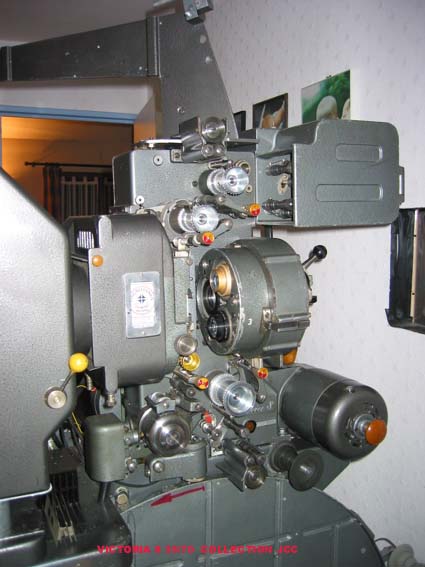
This Vic-8 is inside somebody's home theatre. Obviously, he doesn't care about DC in as much as he cares about 70mm presentations.
.Monte
Posted by Thomas Hauerslev (Member # 566) on 01-30-2006, 04:07 AM:
There is a very good opportunity to see 70mm and Cinerama at the Widescreen Weekend in March in Bradford, England. See other thread for info about titles and dates. The sharpness of the films always blows the audience away, especially those on the first row. A situation which has forced ud to install seat belts
Posted by Brad Miller (Member # 2) on 01-30-2006, 05:32 AM:
What do I think? Well first off, I think that "70mm only" theater was actually a 70mm AND a 35mm theater. Quite often people would go into complexes and say "what's playing on your 70mm screen". It didn't matter how many times or in what way you explained that you were running a 35mm print in there, some people are just flat out ignorant. The reality is that it would've taken more money and specific effort to make that projector NOT be able to run 35mm. Think about it.
I also think you should've heeded my advice on page 2. quote: Brad Miller
Larry, you might want to excuse yourself from posting further on this thread...
...ya can't say I didn't warn ya!
Posted by Mark Lensenmayer (Member # 134) on 01-30-2006, 07:56 AM:
I've seen 70mm and 35mm. 70mm is better, every time.
5/70 won't come back, as the producers don't believe in it. It will be digital all the way, unfortunately.
I can't imagine any theatre owner installing a 70mm only projector. There was never enough 70mm product to sustain a theatre, especially one outside the larger cities. Even the best premiere theaters ran far more 35mm than 70mm. 70mm was for the rare event film, usually a few in the summer and some at Christmas. I just can NOT believe any theater was 70mm only.
Posted by Larry Myers (Member # 738) on 01-30-2006, 08:02 AM:
Tale to two cities.
Let me tell you how bad off Rochester is. Take two very nice NEW 3000 sq ft homes, one in upscale Pittsford Rochester NY, home to many people who run Kodak. The other in Herndon VA, home of many interent companies.
Both sold new for about $250,000 in 1996 or about 10 years ago.
Fast forward today and the Herndon home just sold for $950,000 with $7000 a year in property tax. The Pittsford home hasn't sold and has been on the market for the last 6 month at $235,000 and is taxed at $9000 a year. Thats where film is going. Your right, enough said.
Posted by Louis Bornwasser (Member # 3063) on 01-30-2006, 08:10 AM:
We have had 70mm only theatres in the past. With the demise of 3-strip Cinerama; every Cinerama house was replaced with a JJ-70mm only machine....most of which were rapidly converted to 35/70; the balance being replaced with 35mm only machines (St Louis.)
The main problem 70mm had other than cost is the inability to move the print down to a smaller house unless it, too, is 70mm equipped. Louis
Posted by Mark Gulbrandsen (Member # 72) on 01-30-2006, 08:34 AM:
quote: Louis Bornwasser
every Cinerama house was replaced with a JJ-70mm only machine
For the Cinerama houses I believe that two of the three strip machines were actually converted to straight 70mm so they weren't really JJ's. I've had a half dozen of these machines go through. They are identifiable by a plate that is machined into the trap area to re-locate the dovetail and other components as well as the slot still being in the front of the head casting for the frame counter drive gear. They also do not have any Century name plate on them and the door glass still says Cinerama. Later on its presumed that they were made dual gauge although about half the ones I've had were still straight 70mm with 70mm only sprockets.
Mark
Posted by Greg Mueller (Member # 17) on 01-30-2006, 09:05 AM:
I can think of about a trillion reasons for a business to go under besides whether or not they play 70MM. If you can't Larry, not only do you know nothing about film, but you also know nothing about business.
Posted by Larry Myers (Member # 738) on 01-30-2006, 09:40 AM:
and I take that all the way to the BANK
Oh yes. The Pittsford Plaza complex had three theaters. Plaza 1, Plaza 2, Plaza 3. Plaza 1 and 2 were in the front building. These theaters showed 35mm. The complex had a seperate building in the back called Plaza 3, If Plaza 3 theater was open, somehow the owner got ahold of a 70mm blowup of a new release.
I think Plaza 1 and 2 are still open. I think Plaza 3 is now a DVD rental place. I will be in Rochester all week next week and I will look.
Posted by Greg Mueller (Member # 17) on 01-30-2006, 09:50 AM:
Perhaps you should ask yourself why they used 70mm at all, ever. Do you think there was a reason, or what? Why not just use 8mm? It certainly would have cost less. In fact, why use any larger format in any kind of photography?
Posted by Bobby Henderson (Member # 840) on 01-30-2006, 10:52 AM:
The Pittsford Plaza analogy is really pretty stupid. At best it is half-baked.
The use or lack of use of 70mm prints has no bearing on that theater closing. And it doesn't have a damned thing to do with home values from one market to the next either. Truth be told, most people living in homes worth more than $250,000 don't even go to movie theaters at all. Nearly all the rich people I know don't.
Here's exactly why that theater was shut down, just like any other big single screener, twin or complex with under 6 screens: not enough screens, not enough showtimes.
Doofuses in the film distribution companies want to place prints in the theaters with the most screens. So they pressure the exhibitors to build more theaters with higher numbers of screens, even if the theaters themselves are tiny.
I was extremely underwhelmed by visiting the AMC Odyssey 30 at Grapevine Mills. Went there just once when the place was brand new. Saw "Titanic" in 70mm DTS the same day at the giant Northpark #1 screen. Then drove over to that theater in Grapevine to watch "Amistad" in 35mm SDDS. I swear that room probably didn't have anymore than 40 seats. But that's what they do to pack 30 screens into a mall location. Staggering difference.
Most of the big single screen theaters in Manhattan have been shuttered due to this trend. The 1500 seat Loews Astor Plaza theater closed exactly for that reason. Gotta have more screens, just divide them up into little tiny closets. With that kind of room, why even bother watching a movie there? The screen is small, the room is small and it doesn't seem to be on a scale much larger than an average living room.
The bean counters want more shows per day. But they don't give two shits about the environment in which those shows are presented. They think all showings are equal. And why would they think any different? They play golf in their free time, not watch movies.
On the bright side, there are some circuits trying to put at least 1 or more really big screening rooms into some of those megaplex builds. That bright side would be more appropriately bright if they had 70mm projection capability.
In the end, NO ONE should give a hoot how many screens are in a movie theater complex. You can only watch one movie at a time. The real thing that matters is having the best quality screens with the best quality presentation. People in the movie business who don't believe that should do the rest of us a favor and find a different job.
Posted by Larry Myers (Member # 738) on 01-30-2006, 11:09 AM:
Stupid, yes we are both dumb guys. You, the dumb guy running the projector. Me, the dumb guy for getting into film image technology in the first place. So yes, we are both dumb guys. Although, the dumb guy upstairs running the projector kinda rings a bell with many people. No one gives a shit about a dumb guy fooling around with film image technology.
[ 01-30-2006, 12:32 PM: Message edited by: Larry Myers ]
Posted by David Stambaugh (Member # 1102) on 01-30-2006, 11:31 AM:
This thread is still open? ![[eyes]](graemlins/eyes.gif)
In the peak period for 70mm blowups (mid-80s), one might have thought that the Edwards Big Newport was a 70mm-only theater because they often played many consecutive 70mm engagements. 35mm was relatively rare on that screen at the time. But 35mm did happen.
Posted by John Pytlak (Member # 331) on 01-30-2006, 02:08 PM:
quote: Larry Myers
If the Pittsford Plaza had a Century JJ then I am being mislead. About 4 years ago I purchased a Holmes 8 from a guy in Webster that worked at Pittsford Plaza. In the basement he had a almost new looking Vic 8 with lots for 70mm films. He gave me a big story on how he got the Vic 8 out of Pittsford Plaza when it closed down. I took him at his word. I have gone to many shows at the Plaza 3 but never been in the booth itself.
When General Cinema (GCC) owned the Pittsford Plaza multiplex (across Monroe Avenue from the Loews Pittsford 1-2-3), they had at least one THX-certified auditorium set up for 35mm and 70mm. They played "Dick Tracy" and "Roger Rabbit" in 70mm. I recall all the projectors there were Cinemeccanica (typical of that era GCC), so I assume the 35/70mm machine was a Victoria-8. I think it is still there, after they became an independent and added more screens for a total of 9 today. Brack Bryant is now the chief projectionist there (he was at Loews Southtown), and a long-time IA member.
Yes, the Loews Pittsford 3 had a Century JJ. Lots of 70mm (and 35mm) shows there in the late 70's and the 80's when Jim Doty was manager, and Paul Hartman the chief projectionist. Played all the Star Wars and Indiana Jones series, and Alien. The Loews Pittsford 1-2 is now a women's gym, and the Pittsford 3 is a baby furniture store. ![[Frown]](frown.gif) The theatres closed due to the inefficiencies of running a 3-plex in a multiplex world, and the "stadium" seating competitors that moved into Rochester. The Loews Pittsford 3 didn't show any 70mm prints in its last years (I think "Far and Away" was the last 70mm they had).
The theatres closed due to the inefficiencies of running a 3-plex in a multiplex world, and the "stadium" seating competitors that moved into Rochester. The Loews Pittsford 3 didn't show any 70mm prints in its last years (I think "Far and Away" was the last 70mm they had).
FWIW, the Loews Pittsford 1&2 was originally a single screen, equipped for 35/70mm, and the "Premier" house in Rochester in the early 1970's. Frank Coniglio (BA of the Rochester IATSE local) ruled that booth. The twinning was an abomination.
BTW, I've written about the "Splendor of 70mm":
Splendor of 70mm Part 1
Splendor of 70mm Part 2
Posted by Ben Wales (Member # 92) on 01-30-2006, 04:02 PM:
In 1994 the Dutch Founder of the "70mm Newsletter" prepared a 70mm Promotion Tour to LA, dispite all the hard work and planning, sadly the Studio's did not take this seriously to release films in 70mm, dispite some Cinema Exhibitors were keen to promote.
But as we see today, declining Admissions and the constant re-makes and some realy poor films.
In my view the days of the Mega Amusement Multiplexes are numbered and Digital Cinema will not be the saver!, People are starting to seek a more up-market Cinemas and prehaps a uniquie 70mm and "Big Screen" could see 70mm returning and making a Movie Going a Experience, rather than "Watching DVD's on a Big Screen" as most of public think we are showing.
May be Larry should travel to the like's of Bradford or other 70mm Film Festival's and see how popular they are and why some people travel 1,000 miles to see 70mm.
Posted by Bobby Henderson (Member # 840) on 01-30-2006, 05:45 PM:
quote: Larry Myers
Stupid, yes we are both dumb guys.
Speak for yourself.
Posted by Mark Gulbrandsen (Member # 72) on 01-30-2006, 07:46 PM:
quote: Ben Wales
May be Larry should travel to the like's of Bradford or other 70mm Film Festival's and see how popular they are and why some people travel 1,000 miles to see 70mm.
Yes, and then Larry would get his long needed 70mm education! He might also just notice that it doesn't take math to "see the difference".
Mark
Posted by Larry Myers (Member # 738) on 01-30-2006, 09:01 PM:
Well if you guys really want a comeback in 70mm, their are ways to make it happen. It's seems 65/70mm cameras are kind of cheap these days. If Kodak would get behind offering free or discounted 65/70mm camera rental and film stock and tech advice to second level independent film makers, a quanity of SHORTS could be produced to at least introduce 70mm back into the theaters.
You see this on the cable INHD-2 TV program all the time. The programing is loaded with shorts. Although, it's mostly IMAX shorts. The system will need a tricky logo such as photographed in SUPERHD-70 for the public to at least understand something is going on that's different. I am sure with the old 65/70 camera bodies with modern optics and the very best low speed Kodak Vision film slow speed printed, the image quality would be better then IMAX on a standard size movie screen.
The trouble is, Kodak is in no position to give anything away or underwrite such a venture. It does seem at least right now, that Kodak wants to go in the digital direction. Maybe it's just me but it looks like Kodak has put film on the back burner which even I think is a big mistake.
So between Kodaks new direction which may not work and GM not doing so well, the economy in Rochester really sucks at this time. If you have 3 really nice 35/70 theaters in the best part of a photo town go under, what is one to think?
Posted by John Pytlak (Member # 331) on 01-30-2006, 09:18 PM:
Kodak has provided attractive incentives to producers considering 65mm production. Ask folks like Robert Harris or Ron Howard.
quote: Robert Harris
Having worked out a 35 vs. 65 budget for what was to have been David Lean's final film, the numbers are not all that far off. It worked out to (as I recall) under $500,000. Especially, with a bit of cooperation from Panavision and Kodak, which we had.
2005 was one of the best years ever for 70mm print film sales volume (mostly for IMAX films).
Rochester still is a "photo town":
The Kodak "Theater on the Ridge" has 70mm projectors, and Rochester also supports a 70mm IMAX Theatre (full daily schedule), a 70mm 8-perf Theatre (11 shows weekly), and a 60-foot screen with a Kodak Digital Cinema System.
quote: Larry Myers
The trouble is, Kodak is in no position to give anything away or underwrite such a venture. It does seem at least right now, that Kodak wants to go in the digital direction. Maybe it's just me but it looks like Kodak has put film on the back burner which even I think is a big mistake.
Kodak just announced that 53 percent of Kodak's 2005 revenue was from digital imaging -- the first year that digital provided the majority of revenue. That still leaves 47 percent from FILM -- about $6.7 BILLION. 2005 was one of the best years ever for motion picture film revenue and volume. I'm working on two multi-million dollar film R&D programs, and my colleagues are working on a few others. Doesn't seem like a "back burner" to me.
Posted by Mark Gulbrandsen (Member # 72) on 01-30-2006, 09:24 PM:
quote: Larry Myers
I am sure with the old 65/70 camera bodies with modern optics
That does it. Now we know you haven't done your homework! There are "NEW" bodies available from both Panavision (System 65) and Arriflex (765) and "NEW" lenses. NO need to use the OLD JUNK sitting on collectors shelves... the new stuff IS better! Better movements, better reflex viewing, better glass all around and alot quieter and lighter!
Arri 765 System
Now back to something more important like the doughnut thread ![[thumbsup]](graemlins/thumbsup.gif)
Mark
Posted by Bobby Henderson (Member # 840) on 01-30-2006, 09:47 PM:
I think Larry purposefully overlooked my comments about the new, modern 65mm film cameras from Panavision and Arri. Other companies have also fielded modern 65mm models, but Panavision and Arri are the biggest name plates.
So, seriously, the "old $15,000 camera on E-Bay" line needs to be retired already.
Posted by Monte L Fullmer (Member # 2797) on 01-30-2006, 10:47 PM:
Let's see: 24.5 dBa @ 24fps for the 765 IS pretty quiet for pulling down 65mm film.
..Mark - time for us to get a baker's dozen of them "maple" bars at the Banbury donut shop on 7th E. When a topic grabs 120 plus replies when the originator is trying to sell us on some BS to where we have to get the waders on, it's time for a good dessert.
-Monte
Posted by Larry Myers (Member # 738) on 01-31-2006, 08:40 AM:
OK, so rather then being just dumb guys upstairs running the projector, tell me how YOU think 70mm can be restarted. John Pytlac says things are already started. I say it's not NEAR enough so you will never see it. Although, if John is right, then the answer is, "JUST WAIT IT OUT" (A Rochester thing) and it will start itself. Kinda like the Fast Ferry but we don't want to go there.
Posted by John Pytlak (Member # 331) on 01-31-2006, 12:40 PM:
Even though some here may consider it "format overkill", the recent day-and-date feature film releases in the 70mm 15-perf IMAX format do represent a significant revival of large format presentation. Major distributors like Warner Bros, 20th Century Fox, Columbia, and Disney evidently feel that IMAX can deliver presentation quality and a distribution chain that is more consistent than 70mm 5-perf release through normal distribution channels. The list of features is impressive:
http://www.fromscripttodvd.com/imax_commercial_releases.htm
quote:
2002
Beauty And The Beast — Walt Disney / 1.66:1
Apollo 13: The IMAX Experience — Imagine/Universal / 1.66:1 / DMR
Star Wars: Episode II — The IMAX Experience — Lucasfilm Ltd./20th Century Fox / 1.81:1 / DMR
Treasure Planet — Walt Disney / 1.66:1
The Lion King — Walt Disney / 1.66:1
2003
Ghosts Of The Abyss — Walt Disney / 1.78:1 / 3-D
The Matrix Reloaded: The IMAX Experience — Warner Bros. / 2.39:1 / DMR
The Matrix Revolutions: The IMAX Experience — Warner Bros. / 2.39:1 / DMR
The Young Black Stallion — Walt Disney / 1.44:1
2004
Harry Potter And The Prisoner Of Azkaban — Warner Bros. / 2.39:1 / DMR
Spiderman 2 — Columbia / 2.39:1 / DMR
The Polar Express — Warner Bros. / 2.00:1 / 3-D
2005
Robots — 20th Century Fox / 1.85:1
Aliens Of The Deep — Walt Disney / 1.78:1 / 3-D
Batman Begins — Warner Bros. / 2.39:1 / DMR
Charlie And The Chocolate Factory — Warner Bros. / 1.85:1 / DMR
Harry Potter And The Goblet Of Fire — Warner Bros. / 2.39:1 / DMR
2006
V For Vendetta: The IMAX Experience — Warner Bros. / N/A / DMR
The Ant Bully: An IMAX 3D Experience — Warner Bros. / N/A / DMR
Happy Feet: An IMAX 3D Experience — Warner Bros. / N/A / DMR
Superman Returns: The IMAX Experience — Warner Bros. / N/A / DMR
Poseidon: The IMAX Experience — Warner Bros. / N/A / DMR
The number of 70mm 15-perf prints for some of these releases rivals the number available for many of the 5-perf 70mm releases in the 1960's, 1970's and 1980's.
Convincing distributors to release 70mm 5-perf prints is really a matter of exhibitors convincing them that their large screen theatres are fully ready and competent to show 70mm 5-perf prints with DTS sound, and will deliver boxoffice revenue enough better than a 35mm print to justify the added expense of making the 65mm duplicate negative and 70mm release prints. IMAX made a very good business case for 70mm 15-perf features. Which exhibitors can do that for 70mm 5-perf?
Posted by Larry Myers (Member # 738) on 01-31-2006, 01:02 PM:
I didn't know this thread jumped to IMAX. A wonderful format with already proven results. If it has, then yes, IMAX is great and blows the doors off anything else.
I still think the issue and the general jest of this thread is 35mm 1.85 to 2.35 true scope to 2.20 5 perf 70mm and how does it all fit together at a typical theater.
The bottom line is that the Pittsford Plaza 3, a great 70mm theater, never played IMAX. If the plaza 3 was open today, I am not sure it could play IMAX even with major modifications.
Posted by John Pytlak (Member # 331) on 01-31-2006, 01:51 PM:
IMAX is 70mm, so it is on topic. The discussion is how large format film presentation stacks up against Digital Cinema, and whether it has a place in modern exhibition. The success IMAX has had in presenting day-in-date feature films shows that large format (70mm) presentation does offer something audiences will seek out, just as they did with 5-perf 70mm from 1955 until the early 1990's. Whether it's "format overkill" or smart marketing, the IMAX DMR process is a success.
IMHO, distributors are wary of 70mm 5-perf, not because the format hasn't proven itself, but because of the perception that many of today's large screen multiplex theatres are not properly equipped or competent to show it. For distributors, IMAX is a safer bet.
Loews Pittsford 3 is long gone, but not because 70mm wasn't successful for them during its heyday. Yet today, the Rochester Cinemark Tinseltown IMAX has great success showing feature films using 70mm 15-perf prints. The demand for quality on a huge screen is still there, and 70mm prints deliver it all day and every day of the week.
Posted by Larry Myers (Member # 738) on 01-31-2006, 02:42 PM:
Well I think you can include IMAX is on topic when a director decides to do dual photography like they did in filming Oklahoma. Two cameras side by side. An IMAX camera and a Panavision camera. It would have been great with Batman Begins.
Now if you want to say.
-Hey, 70mm is already in wide use today. Look at all the 70mm film we sold for IMAX and that system is doing great at the theaters. Then I guess everyones problems are over. Really no need to worry. What is it. Oh yes. Don't worry, be happy.
Posted by John Pytlak (Member # 331) on 01-31-2006, 03:44 PM:
It's a different business model today, but the goal of quality large format film presentation is the same. For screens over 60 feet wide, 70mm film is still the best way to fill them.
As I said, the ones that need to convince distributors to provide 70mm 5-perf prints are the exhibitors who have those large screens to fill. They need to have the equipment, and the skilled people to run it and not damage the more expensive prints. For now, IMAX has taken advantage of the need, and offered a turn-key "system". Smart.
Yeah, nothing like 65mm origination. But as others have said, the 35mm to 65mm/70mm blow-ups have a proven track record, ever since "Dr. Zhivago" paved the way. And modern color negative and intermediate stocks allow great quality from 35mm cameras.
Posted by Monte L Fullmer (Member # 2797) on 01-31-2006, 04:05 PM:
Like "passing the gauntlet" - 5/70 to 15/70 with a huge increase of picture area, even though the frame speed is the same, is like analog recording methods to digital recording methods for audio - huge percentage of audio head room that was increased with digital against the analog.
Bottom line is the money - how much money can be made with such improvements and how much is the demand by the public, plus the longetivity and security it is for the developers - they don't want to get caught in the "Edsel" syndrome.
Yes, it's part of the "romantic" era to run and see 5/70, run changeover machines with carbon arc lamps, run big 'roadshow' performances in which all of this was fun....
But, unfortunately, time marches on and we must wake up to face the reality and adjust with the changes that is instore for us in the present and for the future if this business is going to remain with us as long as possible.
And the filmmakers, releasing studios, and the theatre circuits, small and large, "indies" and partnerships will eventually will have to change as well for if they want to survive as well - and this not meaning that they must get ready to change to digital, but to keep their equipment as operational as possible to ensure continued operation until they can make this huge and growing demand for this format change.
Yes, IMAX is a very growing format due to the large screen presentations and the use of the Sonics digital sound processing, which is purely HDD driven-no soundtrak is on the film.
Advantage also with the IMAX with that much larger picture area on the film itself, is that the screen size can even be more bigger along with the usage of much larger xenon lamps that no 5/70 machine can even think of using without melting down - let alone the amount of heat that would be on the 5/70 film itself..
-Monte
Posted by Brian Guckian (Member # 1678) on 01-31-2006, 06:22 PM:
Just as a matter of interest, if one shot on 65mm, could both 5-70 and 15-70 (DMR) prints be derived from the negative?
That would give the Distributor the best of both worlds, and a larger exhibition base than say, IMAX DMR alone.
The other thing that comes up from this debate is, why don't a small group of people on this site get together and form a project team with the specific goal of re-inventing 5-perf 70mm.(I can think of at least 6 people who could participate, including Mr. Myers!)
It can start with the formation of a formal 5-70 venue network (of which there is loose one already, it seems to me). Use Bradford as an opportunity to kick things off.
The work would involve looking at all those things that are currently impeding re-birth of the format - technical, financial and marketing.
I personally think it is a matter of re-packaging and re-positioning the format in the minds of the decision-makers. A name-change is probably essential. Anything with "film" in the title will be perceived as "old". IMAX, for example, works as a a name because it doesn't mention film. Nobody has a problem with it, and it sounds suitably futuristic.
I mentioned "HD-70" earlier, and Larry mentioned "Super HD70", which was better. Another possibility could be "Enhanced Cinema Experience", or "ECX". (Then again, that sounds a bit like THX). Another option is "High Definition Cinema", or "HD-Cinema", or "Cinema-HD". ("Cinema" implies film without actually saying so!).
These are good because there's no "70" in the title, which would prompt people to ask "what does 70 mean?", leading to the reply "70mm film" and thus turning them off.
Thing is to be positive; where there's a will there's a way. I think there could be much to be gained by associating 5-perf 70 as an extension of IMAX DMR production...if it's possible.
Posted by Larry Shaw (Member # 388) on 01-31-2006, 06:45 PM:
Good idea Brian!
That's much more the direction I had hoped this discussion might go when I wrote the initial post. This concept gives theatres a marketable product (just like IMAX) that is not available at home (the theatre's rival) for a very reasonable cost (especially compared to DC and IMAX) and which actually improves presentation in several ways (hopefully improving customer satisfaction and return rates). What a lovely group of features!
Larry
Posted by Larry Myers (Member # 738) on 01-31-2006, 06:53 PM:
Finally a positive idea. Actually a very good idea. It took three days to get but at least we got one. I am a sucker for a good ideas.
Posted by Bobby Henderson (Member # 840) on 01-31-2006, 07:53 PM:
quote: Brian Guckian
Just as a matter of interest, if one shot on 65mm, could both 5-70 and 15-70 (DMR) prints be derived from the negative?
Yes. However, the DMR step would not be neccesary. The only reason for DMR is to take a smaller film gauge image and attempt to create detail that isn't there. Some of the digital manipulation techniques work okay, but others don't. Read my review of The Matrix Reloaded: The IMAX Experience.
In going from 5/65 to 15/70 the only thing needed would be an optical printing step to rotate the 5/65 image 90 degrees and enlarge it slightly for the horizontal 15/70 format. This process would be a lot more simple to do than the DMR process, where the entire movie must be scanned into computer systems, manipulated and then output via laser film recorders. A 5/65 to 15/70 print would look a lot better than any DMR 4/35 to 15/70 print.
quote: Brian Guckian
I personally think it is a matter of re-packaging and re-positioning the format in the minds of the decision-makers. A name-change is probably essential. Anything with "film" in the title will be perceived as "old".
I don't agree with that.
Most people who have any idea at all in how films are made and projected generally have a positive attitude toward film. It isn't "old." It is, however, iconoclastic of the medium.
For instance, what is a better visual icon for movie-making? A loaded Panavision Panaflex film camera or a video camera? When I see video cameras I think "TV show." Sorry, but that's the real deal and it doesn't matter if the video camera is a museum piece tube camera or a brand new digital HD camera with the best CCDs money can buy.
IMAX may have a name that doesn't feature the word "film" in it, or list a film gauge. However, many IMAX theaters I have visited were designed to have the projection booth visible to the public. They could see those "old" film projectors. Those theaters also had comparison displays showing the size of a 15/70 film strip versus that of a 4/35 film strip. Film is very much on display and is central to an IMAX theater concept.
quote: Brian Guckian
These are good because there's no "70" in the title, which would prompt people to ask "what does 70 mean?", leading to the reply "70mm film" and thus turning them off.
Again, I don't really agree. The 5/70 format was pretty successful through its "blow up" age of the 1970s and 1980s. Those big 70mm logos did do a pretty good job of selling the format, even if the public didn't know exactly what it did.
And adding some "HD" stuff to the alphabet soup isn't going to help things. If anything, the "HD" term makes me think "VIDEO". As far as I'm concerned, little if anything video originated can be shown to a much higher degree than what can already be obtained in a well equipped living room.
I think the 70mm term is fine. Perhaps the logos could be retooled. The only way an average viewer is really going to understand the difference between 70mm and 35mm is if they're shown the difference physically. The film strip displays do a pretty good job of that. Most IMAX theaters also educate viewers about the difference of that format. That's something most 5/70 theaters never did. They would just fire up the show without any mention of how that differed from 35.
Posted by David Stambaugh (Member # 1102) on 01-31-2006, 07:58 PM:
I gotta mostly agree with Brian. In 2006 it makes no sense to use the word "film" in marketing the format. Or 70mm for that matter. We may know what it means, but 99.9% of moviegoers don't know and don't care, nor should they. They can appreciate a presentation that's superior to 35mm or D-Cinema though. Re-badging 70mm under some other more "modern" name that omits the use of the word "film" makes a lot of sense to me.
Posted by Bobby Henderson (Member # 840) on 01-31-2006, 08:01 PM:
At the very least, any new term shouldn't be some stupid acronym. We have too many of those already, with THX, all the digital sound formats and other stuff. IMAX at least works like word instead of an alphabet soup acronym.
Posted by Larry Myers (Member # 738) on 01-31-2006, 10:36 PM:
I know I am going to get some flack on this but I must defend film.
Film has a very interesting quality that digital photography doesn't. The pixel size of film varies with the ASA speed where as with a chip, it has a fixed sized pixel regardless of speed.
This means with a very slow speed film (ASA 1), you could image the whole bible on a dime size piece of film. With a very fast film (ASA 1000), your lucky to image one page. Before I go on, I think I will let you guys think about that.
Posted by Mark Gulbrandsen (Member # 72) on 01-31-2006, 11:11 PM:
quote: Larry Myers
Film has a very interesting quality that digital photography doesn't.
Larry,
As much as I love the film look what I think you actually meant to say is that Digital Photography will soon have the same look as film...... I believe this will occur with the use of a "film Look" processing software so a production can save its "Raw Files" much as they do film negatives today.
I believe that Brian hit the nail on the head in regards to 65mm origination.....
Mark
Posted by Monte L Fullmer (Member # 2797) on 01-31-2006, 11:28 PM:
quote: Mark Gulbrandsen
Digital Photography will soon have the same look as film......
Isn't this what Lucas wanted to gain with using digital cameras with his last three SW episodes?
If so, and the digital cameras can be improved with a massive pixel rate capture, then the need to using 65mm can then be used just for the diehards and the IMAX people who want to continue using film since the editing factor with digital can be trimmed considerably when making the final negatives for film and the DVD's for the digital projectors - who themselves had better be improved to match these newly revamped digital cameras.
Mr. Myers had better save some serious cash if he wants to buy an Arri 765 to know what it takes to shoot 5/65mm.
quote: Bobby Henderson
A 5/65 to 15/70 print would look a lot better than any DMR 4/35 to 15/70 print.
then it would be very exciting to see the old famous 70mm releases formatted for IMAX presentations. THEN, it would be grand, once again, to see "presented in 70mm" back on the marquee (even though it wouldn't be an actual 70mm presentation) as it was in they olden days when seeing the "70mm" on the marquee was an extremely special event in itself.
-Monte
Posted by Mike Heenan (Member # 392) on 01-31-2006, 11:59 PM:
Since most films are scanned for the DI at only 2K, how good would say a 70mm print look anyways? Seems like it'd be a waste, to film in 65mm, scan down to 2K and then output to 70mm .
Posted by Larry Myers (Member # 738) on 02-01-2006, 07:21 AM:
Hey, I know what it takes to shoot 5 perf 65/70mm vs 35mm true scope and how much it cost. That why my position of "you will never see it" pulled this thread to 140 comments in several days. That's the problem big problem with me. I all to well understand it and it has to do with bit packing density and dime size film.
Posted by John Walsh (Member # 168) on 02-01-2006, 07:27 AM:
The only problem I see with reinventing 70mm film, is that the studios don't *want* film. They want digital projection because they can control the content, and the theaters, much easier.
Posted by Louis Bornwasser (Member # 3063) on 02-01-2006, 09:57 AM:
Digital Cinema is about a transfer of power from theatre owner to distributor. It is also about the transfer of money from theatre to vendor. The projector is free, but the service/licensing fee is a lot per year; just like any other business computer. Louis
Posted by Bobby Henderson (Member # 840) on 02-01-2006, 12:41 PM:
quote: Monte L Fullmer
If so, and the digital cameras can be improved with a massive pixel rate capture, then the need to using 65mm can then be used just for the diehards and the IMAX people who want to continue using film since the editing factor with digital can be trimmed considerably when making the final negatives for film and the DVD's for the digital projectors - who themselves had better be improved to match these newly revamped digital cameras.
Actually, there are some pretty terrible limitations when it comes to future improvements on digital video camera CCDs.
You can only get so much light onto so large a CCD chip. Pack in too many pixels and you're cutting the amount of light going to each pixel.
Most consumer camcorders have a single CCD only 1/6" to 1/4" in size, if even that. Many "prosumer" video cameras use 1/3" CCDs. When you get up to 1/2" or 2/3" size CCDs, the cost of the camera gets really high. Basically, you must have a great lens pack and a pretty large, expensive CCD to get great color and light levels on your video.
I think it is going to be pretty difficult for electronics companies to scale the resolution of video cameras well above the 1080 HD level.
Not only do you have the issue of getting enough light on each pixel in a CCD imager (which makes it necessary for CCDs to get large in professional use), but there won't be enough of a market to justify the cost of making a CCD with enough pixels to equal 35mm, much less try to content with 65mm. Limitations in broadcast TV formats and consumer video formats impose a performance ceiling against developing video cameras with greater than 1080HD native resolution. In short, not enough money will be there to justify the cost of development.
Other avenues will push the need to make better than 1080HD quality video delivery systems and push the need to shoot films with higher quality imagery. Whether 65mm film is icky for it being analog film -it is by far the very best choice as an originating format for any ultra high resolution motion picture delivery system, whether it is film based or video based projection.
quote: Mike Heenan
Since most films are scanned for the DI at only 2K, how good would say a 70mm print look anyways? Seems like it'd be a waste, to film in 65mm, scan down to 2K and then output to 70mm .
Like I said, the DMR step in 5/70 to 15/70 would be totally unneccesary. No digital intermediate step would be required at all. Just a straight analog optical printer transfer. And the image quality would be well above what any 2K or 4K DI system could achieve.
quote: John Walsh
The only problem I see with reinventing 70mm film, is that the studios don't *want* film. They want digital projection because they can control the content, and the theaters, much easier.
The "can control" part of that is purely an illusion.
They're taking the fragile existence of commercial theaters for granted, foolishly believing they'll survive any move made by distributors -such as collapsing release windows to boost DVD sales and cut marketing costs.
They think by delivering movies in digital form that will cut down on piracy. I think it will facilitate even more efficient, widespread forms of piracy.
Finally, in converting everything over to VIDEO some of the magic of film will be gone -enough that lots of people will view a movie screen more as just a TV screen.
Posted by John Pytlak (Member # 331) on 02-01-2006, 12:56 PM:
Kodak is already a leader in high resolution image sensors:
Kodak Image Sensors
Kodak 39 Megapixel Sensor
quote:
The KODAK KAF-39000 Image Sensor,
featuring 39 million pixels, and the KODAK KAF-31600 Image Sensor, with 31.6 million pixels,
offer professional camera and camera back manufacturers resolution and image detail that was
once unimaginable for digital cameras, allowing photographers to experience a new level of image
quality for portrait, wedding, landscape, fashion, studio and commercial photography.
Of course, 65mm film is even better.
Posted by Floyd Justin Newton (Member # 1316) on 02-01-2006, 01:21 PM:
There you go John.
Posted by Larry Shaw (Member # 388) on 02-01-2006, 02:39 PM:
Louis wrote: quote: Louis Bornwasser
Digital Cinema is about a transfer of power from theatre owner to distributor.
John wrote: quote: John Walsh
They want digital projection because they can control the content, and the theaters, much easier.
If theatres don't like this, perhaps they should embrace somthing like Brian (and I) mentioned quickly before DC is widespread.
Larry
Posted by Max Biela (Member # 1919) on 02-01-2006, 03:51 PM:
I think its a very good idea to found a group of people involved and interested in the 70mm business like the dye track committee. There are many people across Europe/germany that might be interested in this idea too. I think the quality of presentation is the point - 70mm presentations have to be the same everywhere as John already pointed out. As for 70mm prints being more expensive that 35mm: The tickets for the few digital theaters here in Germany are about 1.50$ more expensive than the 35mm. Why not with 70mm?
For those interested in this idea: Perhaps we a need a new forum for planning things like this?
Max
Posted by Brian Guckian (Member # 1678) on 02-01-2006, 05:22 PM:
Great stuff! Glad to see this has gone down well, Larry and...Larry!
NB - forgive me as I was certainly not objectively saying film was "old", etc. - obviously that is patently untrue.
No it is the perception I'm talking about, certainly it seems to be out there, and the task must be to educate those who think that way!
I also acknowledge you can start getting into the realm of "spin" with name changes. etc., and you could end up confusing people. So...whatever works.
Thanks Bobby for clarifying the necessary steps to do 5-65 to 15-70 printing. I should have said that my logic was based on the idea that you'd have to enlarge the 5-65 frame possibly too much to attain the 15-70 frame dimensions, or there could be unacceptable cropping, hence the thinking that DMR might help. But I get the fact that DMR was developed to do enlargements from 35mm and that is its purpose.
Let's keep the ball rolling!
Posted by Bobby Henderson (Member # 840) on 02-01-2006, 08:33 PM:
quote: John Pytlak
Kodak is already a leader in high resolution image sensors
Yes, the KAF-39000 imager is a pretty impressive digital imager. However, that 39 megapixel item is meant for use in digital backs for large format still cameras. Some of these digital backs work a bit like putting a flat bed scanner on a view camera.
Digital still image cameras will continue to pack in more pixels since exposure times, lens types and other factors can afford more flexibility. CMOS chips are a workable solution in still cameras (such chips can be made more affordably and pack more pixels into a smaller space). They haven't been proven to be all that great for video recording.
CCDs still rule the video camera world, but there is more in the way of limitations in trying to go well above a 2 million pixel level on video capture. The pixel count is effectively quadrupled when trying to go to a 4K resolution. And that's only going to approximate 4/35 resolution.
I think it will be a very long time before any digital video camera can come near the native resolution of 5/65mm. The "its good enough" attitude will allow a kind of tyranny of 1080HD standards to keep video camera standards from rising above that for quite awhile.
Posted by Monte L Fullmer (Member # 2797) on 02-01-2006, 08:48 PM:
..would it be then if one was going to make, let's say a camera that can come close to the 5/65 resolution, the optics would have to be able to capture tons of information, a light source on the subject/object massively bright, or just somebody invent a new-fangled chip that that could eventually replace the CCD chip to effective capture motion...a concept far away in the future.
But, just curious, why is the CMOS chip not as effective with motion capture as with the CCD chip?
thx-monte
Posted by Larry Myers (Member # 738) on 02-01-2006, 09:08 PM:
I attended a meeting at Kodak maybe 12 years ago on Photo CD. Remember that? The main Project Manager told me the highest resolution was set to match a Kodachrome 25 slide. The highest resolution was I think, 30 MB. Let me tell you, Kodachrome 25 has very good resolution at about 100 lines pairs per millmeter.
If that is the case, the 35MB chip is getting really close to 65mm quality. A 35mm slide is really VistaVision quality which is not far of from 70mm.
Posted by Bobby Henderson (Member # 840) on 02-01-2006, 11:35 PM:
Global document size, such as 35MB, means very little. What's the pixel dimensions? Bit-depth per channel (8-bits, 12, 16)?
Again, the KAF-39000 CCD imager is not a video camera chip. It's not even for normal D-SLR digital camera use.
The imaging area on the KAF-39000 chip alone measures 36mm X 48mm, which is pretty huge (and very very expensive) for a silicon chip. It's quite a bit larger than any chip found in any video camera. Still cameras and digital backs using this chip run in the $40,000+ price range. And that's not including the tethered hard drives to store the 78MB RAW image files.
Also, if the KAF-39000 chip is going to be measured against a film format like 65mm, why not keep the comparison appropriate and weigh it against a still image film format? In that arena 4' X 5' and 8' X 10' view camera formats are the best in film-based still photography. That's quite a ways above still camera 35mm.
Posted by George Roher (Member # 91) on 02-01-2006, 11:57 PM:
Add my name to the list of people who think 5/70 is still viable.
5/70 with SR Mag is the best format I've ever seen or heard (I have not seen Cinerama).
When the Uptown had "Lawrence" a couple years back, I was going back and forth between the Uptown and a multiplex with digital cinema on one screen. It was painfully obvious that 5/70 mops the floor with digital and 35. The difference was just ridiculous. And the 18-plex I used to work in proved beyond a shadow of a doubt that digital cinema is far from idiot-proof.
I don't think Hollywood is anymore interested in presentation than the theatre chains are. But if a lot more theatres employed people who aren't mentally retarded and Hollywood was open to giving it a shot, 5/70 would be very profitable.
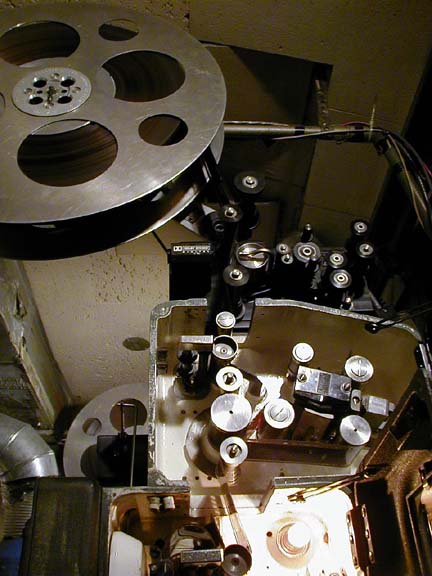
Posted by Monte L Fullmer (Member # 2797) on 02-02-2006, 01:59 AM:
I noticed one thing on this pict of the "JJ" with the CAT-700 reader and the threading path: Doesn't the CAT-700 have those 35/70mm rollers on the outboard parameter of the case and the last 35/70 roller before film heads on down to the machine.
Isn't is supposed to be that the film path goes around the outside parameter rollers, bypassing the reader's film path completely, and then down to the final roller, instead of going straight through in front of the CCD camera and the impedence drum?
..or does it matter which way as long as no scratching is involved....
I have some CAT-700's with those dual gauge rollers mounted on them as well.
(..interesting to note that the mag reader is a dual 35/70mm reader - just has a different threading pattern for the 35mm mag film.)
thx Monte
Posted by Brad Miller (Member # 2) on 02-02-2006, 03:20 AM:
Monte, that is a cat699, not a cat700.
Yes, the cat699 is threaded correctly and as it was intended, but it appears the entry roller in the mag penthouse was skipped over (not exactly smart if the SRD reader isn't precisely aligned). You are also right as long as the film isn't scratching against something most any way of bypassing is fine. I will not get into the emulsion in winding or the fact that the upper loop appears to be large enough to scratch on the 35mm pad roller (if not removed) though.
The JJ has two different mag heads in there and two different paths. That is not a 10 track head the 70mm is passing by, but a 6 track head. The 4 track 35mm head is over to the right side.
Posted by Larry Myers (Member # 738) on 02-02-2006, 09:02 AM:
Again since with film pixel size varies with film speed. It is possible to actually get better detail, or resolution if you will, with an ASA 1 film in a 35mm camera then with an ASA 1000 film in a 8X10 camera. It a mix and match kind of thing. Otherwise, there is no such thing as a mini spy camera.
Detail is measure by the math of these three inputs:
Focal Length
Lens Resolution X Film Resolution/Lens Reso+Film Reso
Distance.
Notice film size is not included.
I mean by detail as in reading the letters a license plate and not how many license plates are in the picture.
Example a picture with 4 license plates does not have twice the detail as a picture of two plates.
-and yes, Kodak has made an ASA 1 film in 35mm from time to time.
You guys will get a rest from me. I will be in Rochester NY (lucky me) for the rest of the week.
Posted by John Pytlak (Member # 331) on 02-02-2006, 09:20 AM:
quote: Larry Myers
Otherwise there is no such thing as spy cameras.
Detail is measure by:
Focal Length
Lens Resolution X Film Resolution/Lens Reso+Film Reso
Distance
I mean by detail as in reading the letters a license plate and not how many license plates are in the picture.
Example a picture with 4 license plates does not have twice the detail as a picture of two plates.
-and yes, Kodak has made an ASA 1 film in 35mm from time to time.
Judging from your past employment history, I suspect you are well aware of some of the capabilities of Kodak's film and sensors for reading license plates from a great distance.
Kodak Aerial Recon Films
quote:
Optimized for Today's Most Demanding Applications
KODAK Aerial Films are formulated to meet specific customer requirements — taking advantage of the unparalled resolution and detail of film, while at the same time enabling customers to keep up with the pace of technology and change. Accordingly, Kodak offers a broad portfolio of aerial imaging films, covering a wide range of applications and uses in and out of the digital workspace.
Kodak Image Sensors Technical Papers
Posted by George Roher (Member # 91) on 02-02-2006, 01:46 PM:
Brad,
I looked at the full uncompressed photo and the entry roller for the Mag penthouse was not skipped over. That's just a crappy photo that has been shrunk and compressed.
Posted by Ben Wales (Member # 92) on 02-02-2006, 05:04 PM:
quote:
The other thing that comes up from this debate is, why don't a small group of people on this site get together and form a project team with the specific goal of re-inventing 5-perf 70mm.(I can think of at least 6 people who could participate, including Mr. Myers!)
That sounds a great idea and I would certainly support.
As for the Imax issue, I understand that here in the UK the 5 Imax Theatres that have updated to DMR Upgrades are now finding only small print runs are being made available and in most cases just one print made available, leaving some Theatres waiting months to secure a print and (if) we see Imax MPX Installations in the UK, what the chances then.
Mind you I think by the time MPX arrives in the UK, most Exhibitors would no longer want to invest in this format due to the high operation costs as we see in Germany, only 4 out of 13 Imax Theatres remain open.
A Cinema/Theatre with a Large screen would justified a 5/70mm, either with DTS or Audio Hard drive, sadly the 6 Track Mag tracks would be costly these times, But the Mag (in my view) Audio on 70mm was at it's best!.
Posted by Bobby Henderson (Member # 840) on 02-02-2006, 05:56 PM:
quote: Larry Myers
Again since with film pixel size varies with film speed. It is possible to actually get better detail, or resolution if you will, with an ASA 1 film in a 35mm camera then with an ASA 1000 film in a 8X10 camera. It a mix and match kind of thing.
Comparing a 35mm negative with an ASA of only 1 versus a giant view camera format sporting 1000 ASA is quite an apples to oranges argument. And that gets back to the complaints of mine and others about your inferrence that there is no real benefits of 70mm and that 35mm is good enough.
Compare the two different film formats against each other using the same modern film stock and same speed rating. 5/70 will beat the crap out of 4/35 every single time.
And even if someone would want to shoot a view camera image using 1000 speed film (um, what would even be the point?), that large chrome would still hold quite a lot more image detail than any video camera ever made could record. The only way the view camera image would fail is if the photographer's setup was crap and he didn't know how to use his equipment properly.
Most photographers who do large format still photography tend to use much slower speed films (not anything near 1000 ASA) with extremely dense emulsions to get the absolute maximum of image detail and color fidelity possible.
Posted by Larry Shaw (Member # 388) on 02-02-2006, 07:08 PM:
Two of the reasons I prefer the 570 concept over IMAX/870/1070 is it is a WIdescreEN (as different from most people's idea of TV as possible) and it physically fits in cinema structures (one doesn't need a entirely new/different shape section of building).
And I think whether or not the word "film" is part of the name is unimportant (except to us geeks); as long as the word is attractive and exciting to average ticket buyers!
Larry Shaw
Posted by Monte L Fullmer (Member # 2797) on 02-03-2006, 02:16 AM:
..then MGM tricks us on the marquee of "Ben-Hur" with "filmed in CAMERA 65"
(little did we know that Camera 65 was that slightly squeezed 1.25/1 to get 2.77/1 on the screen..later to be Ultra Panavision 70)
-Monte
Posted by Thomas Jonsson (Member # 1902) on 02-03-2006, 02:11 PM:
For Ben Wales. On your photo it looks like that DP 70 of yours
has a separate sound reader under the projector head. Is that
the case, or is it something else? No matter what, I guess you
don´t use the original base? Do you have a photo of your set up,
or can you describe it?
Thomas
Posted by Ben Wales (Member # 92) on 02-03-2006, 03:23 PM:
So someone has spotted my Profile Picture as a odd projector!.
Well it was a door from a DP70 resting on a Westrex 5000 35/70mm Projector and is not part of the Westrex outfit.
The door belongs to a complete DP70 setup I have at home and the Westrex 5000 is used for mobile shows.
Posted by Thomas Jonsson (Member # 1902) on 02-04-2006, 04:33 AM:
Thanks, Ben. Yes, it looked a little odd. Can you run 70mm
on your DP 70´s?
Thomas
Posted by Brian Guckian (Member # 1678) on 02-04-2006, 08:38 AM:
Larry Shaw said:
quote:
it physically fits in cinema structures (one doesn't need a entirely new/different shape section of building).
And I think whether or not the word "film" is part of the name is unimportant (except to us geeks); as long as the word is attractive and exciting to average ticket buyers!
Larry, I second all that; BTW I should say that my views are influenced by negative perceptions of film being "old" which I've come across here in Ireland...an instance of generalisation perhaps. Glad to hear that's not the perception in the US, etc. and long may it be so.
[As an aside, I'll be at a seminar in Dublin soon on "The Impact of Digital Cinema" in which I intend to strongly make the case for developing and enhancing film side by side with digital]
Posted by Mark Gulbrandsen (Member # 72) on 02-05-2006, 03:42 PM:
Larry, Brian, et all... Now that you have realized your dream how will you carry it out? I say its just a dream... a good one but one that will unfortunately stay a dream.....
Dream on boys!
Mark
Posted by Brian Guckian (Member # 1678) on 02-06-2006, 09:40 AM:
Mark, sounds like you're just the man to carry this forward!
Posted by Jeremy Sefton-Parke (Member # 3623) on 02-06-2006, 03:18 PM:
It would take a wish at a Blarney Stone to convince the major film studios to film in 5/65 and release in 5/70. The bottom line is always the budget. Everyone on this forum knows full and well the impact of a properly projected 5/70 film on the audience. When "L of A" was re-released in Australia I saw it at the Cremorne Orpheum. The audience, many of whom had never seen a 70mm film, were very impressed.
Bring back 3-strip Cinerama and Kinopanorama [John Steven Lasher has tried on several occasions, but politics and, worse still, lack of proper funding have prevented his launching any large-scale projects].
If Hollywood is a "dream factory", it is not one in 5/70 or 3-strip. Jeremy.
Posted by Bobby Henderson (Member # 840) on 02-06-2006, 03:30 PM:
I wonder how much more it costs to give a 4/35 film the IMAX DMR treatment and blown up to 15/70 versus doing a regular 4/35 to 5/70 blowup. The difference is probably fairly huge -especially when you consider the entire film has to be scanned and digitally processed for the DMR method.
Also, what is the output resolution for DMR? 4K? More? Less?
To shoot an entire 2 hour movie in 65mm will add between $500,000 and $1 million to the budget. That's fairly small when the average major release costs $100 million to produce and tens of millions more to market. Yet 65mm origination would have that very expensive product looking great and holding up well against future film and video formats decades from now.
Us stupid Americans just don't seem very interested in the concept of "long term investment."
Posted by Larry Myers (Member # 738) on 02-06-2006, 03:31 PM:
I am back. I really don't want to get back to what system is better, 5perf 70mm vs 35 anamorphic. I just wanted to point out that you got to look at the whole system to find out what system might be better. A more or less mix and match issue that does exist. It's all in a point of view. I notice in the IMAX camera manual, that instructions are given to police the area of soda cans, cups, butts, half eaten donuts and any other background litter. It points out that all this stuff might not show up on typical 35mm but will cause an expensive reshoot with IMAX. I also read a story in the shooting of How The West Was Won. All the modern buttons had to be replaced on the set costumes because of the higher quality detail with the larger scale of the three cameras. So besides a easier fit of getting cameras, film, processing and release prints, 35mm also means a somewhat easier pre and mid production. Kinda a fact of life.
[ 02-07-2006, 08:05 AM: Message edited by: Larry Myers ]
Posted by Bobby Henderson (Member # 840) on 02-07-2006, 12:09 AM:
I don't buy the argument 5/65mm or any other large format origination process will complicate things.
Crews today have much more sophisticated tools to use in building sets, making costumes and doing other stuff to decorate a set. Add to that all the tools visual effects people, editors and other tech types are able to use in post production.
You could shoot a swash-buckling pirate epic on the open water. It wouldn't wreck the shot if you have a jet contrail plow across the sky. Something like that can be removed pretty easily in post.
Posted by Larry Myers (Member # 738) on 02-07-2006, 08:01 AM:
It's really doesn't matter if you buy something or not since your not in the market. The director along with the production management are the ones who buy. So right now it's easier to use 35mm and let the film stocks control how much quality you may want. That way, if someone leaves a half eaten donut on the window ledge, it doesn't mean a reshoot.
Posted by Bobby Henderson (Member # 840) on 02-07-2006, 09:58 AM:
quote: Larry Myers
It's really doesn't matter if you buy something or not since your not in the market.
Larry, instead of personally insulting me try to disprove the point I made in my last post.
It makes no difference if I am employed or not employed in the movie production business. I am right on the point I made in my last post and have been correct in shooting holes through a bunch of your other anti 5/70 comments. I know what I am talking about and have as much right to post my opinion in here as anyone else.
Posted by Larry Myers (Member # 738) on 02-07-2006, 10:31 AM:
The fact that you can adjust the amount of detail by adjusting the type of film stock used in a 35mm camera disproves your point. This was not so before 1970 or so. Then, most color negative film stocks were about the same in detail capture. So you had to use the same film in both 35mm and 70mm cameras. So it's basically pure optical math. The 70mm wins every time in this case. Not so today. With a wide selection of film stocks, directors can use those film stocks to adjust the amount of detail they may or may not want in those $100,000 35mm Panavision cameras. They can even go so far as getting the same quality performance as those "outdated" (someone elses not my words) 70mm cameras did in the mid 60's.
Posted by Matt Fields (Member # 3211) on 02-07-2006, 10:57 AM:
Isn't this whole issue an economic one? Most would agree that 70 is highest quality way to produce and show a movie.
But quality, like anything else, is something you can get too much of if your not willing to pay the price.
Nothing will happen if both sides (exhibition and distribution) do not mutually benefit.
Distribution, in general, does not currently feel that the additional costs of production can be justified.
Some in exhibition see 70 as a way to combat the increase in home technology and other entertainment options out there. They think 70 would lead to increased revenues through higher attendence and/or ticket price. Perphaps those theatres could offer the studios an economic incentive (higher rent?) to intice the studios to go with 70.
Posted by Bobby Henderson (Member # 840) on 02-07-2006, 11:16 AM:
quote: Larry Myers
The fact that you can adjust the amount of detail by adjusting the type of film stock used in a 35mm camera disproves your point. This was not so before 1970 or so. Then, most color negative film stocks were about the same in detail capture. So you had to use the same film in both 35mm and 70mm cameras. So it's basically pure optical math. The 70mm wins every time in this case. Not so today.
Not so?
Are you assuming 65mm cameras have only 50 speed film in which to work? Or just a tiny number of film stock choices?
Maybe John Pytlak can weigh in on this further. But I'm pretty sure many of Kodak's best motion picture film stocks are available for 65mm. They also fill custom orders as well. If a movie production wants to shoot 65mm and use a certain kind of film stock, I know Kodak will usually work pretty hard to fill the order.
quote: Matt Fields
Distribution, in general, does not currently feel that the additional costs of production can be justified.
I don't think they see the long term investment view on that. Movies like "Lawrence of Arabia" or "2001" visually hold up well against many contemporary movies of today since they were produced in superior formats.
"LOA" will still look good on some new Ultra HiDef video format a decade or two from now because of its 65mm origination. Movies shot on standard HD video equipment won't up-rez quite so gracefully. They'll look pretty soft by comparison.
When a major movie production commonly costs upwards of $200 million to produce and then probably another $50 million or more to market, it would only make sense to "future proof" that product by using higher quality production methods. You sure don't want people seeing the thing 20 years from now and going "yuck, that doesn't look good on my 50 megapixel monitor."
Posted by Larry Myers (Member # 738) on 02-07-2006, 12:04 PM:
In From mid 50's to about 1970 I think about the only film Kodak was selling for motion picture work was Eastman color. It might have been in two speeds. It's much like what was available for still photography at that time. Kodacolor 64 and maybe 200. That 200/400 had a lot of grain and may not have come out until after 1970. There was Ektacolor Pro but this stuff was mostly for white and flesh color balance such as something you would find at a wedding. Otherwise, it was the same as Kodacolor, bad.
In fact, color neg was so bad, we never used it in the U2/SR71 program. I don't think color negative film was ever used in the film life (1957 to late 1980's) of those programs. Kodachrome 10/25 worked much better although processing was a bitch. Later, Kodak came out with better slow speed E-2/4/6 slide films which worked about as well as Kodachrome.
Bottom line, both Eastman color and Kodacolor of the mid 60's were kinda bad in pickup up detail. You were lucky to get out of it a total system performance of 25 lines pairs per millimeter. Today a 100 lines is the norm. A four times improvement with todays film stocks and a four times adjustment for todays 35mm movie cameras.
Posted by Monte L Fullmer (Member # 2797) on 02-07-2006, 12:39 PM:
now..are we comparing still film against movie film?
Posted by Larry Myers (Member # 738) on 02-07-2006, 01:15 PM:
The big difference in movie film is the coatings used to keep the film from scratching as it goes through the camera. It's very easy to use movie film in a still camera. Lots of labs offer this service as they have the lab equipment to scrub off this coating.
You can use still film in a movie camera if you have the correct perfs and are willing to except some scratches.
Generally speaking, film is film and it all works the same way. You could process movie film at home but without this scrubbing equipment, you would just make a mess.
Aerial Recon Film and Motion Picture film are very closely related. That is, under low magnification it tends to look some what soft and with higher magnification, the film tends to look much sharper. It's just the other way around with still film. These are very small measurements and is all part of aim point of the final design of any film.
Posted by Bobby Henderson (Member # 840) on 02-07-2006, 02:00 PM:
quote: Larry Myers
Bottom line, both Eastman color and Kodacolor of the mid 60's were kinda bad in pickup up detail. You were lucky to get out of it a total system performance of 25 lines pairs per millimeter. Today a 100 lines is the norm. A four times improvement with todays film stocks and a four times adjustment for todays 35mm movie cameras.
All of that history does not answer the question at hand: can Kodak provide 65mm-based productions the same quality of motion picture stocks that are available to 35mm? As I said before, John Pytlak will likely be the voice of authority on that one. I am pretty sure the answer is yes.
Posted by Brad Miller (Member # 2) on 02-07-2006, 02:14 PM:
Larry should write the next Wide Screen Movies book, but this time on lenses and film gauges.
I'll bet it would have a nice followup report, just like the original WSM book has.
Posted by Larry Myers (Member # 738) on 02-07-2006, 02:41 PM:
Yes, today Kodak can provide any film in any format. Minimum order is around 1500 sq ft. It might be more now. So yes, you can run the best of the best negative stock in both 70/65mm and 35mm cameras.
It's a simple calculation.
**************1************1
(Focal Length x ASA speed) / Distance
********************____1____*********__1____
35mm camera = 50mm lens x 50 ASA speed / 20 Feet Distance=.050 detail value
**********************___1___*******___1____
70mm camera = 75mm lens x 50 ASA speed / 20 Feet Distance=.075 detail value
.050/.075 = 66% meaning the 70mm camera is 66% better detail then the 35mm camera. An answer I think you want.
This is a way over simplication ball park answer to a very complex algorithmic problem. I am just trying to give you an idea of how this works using the exact same film in both cameras.
[ 02-07-2006, 05:02 PM: Message edited by: Larry Myers ]
Posted by Brad Miller (Member # 2) on 02-07-2006, 03:02 PM:
Honestly Larry, this is what everyone has been trying to tell you for the last 13 pages! 70mm IS better, and not just for reasons of real estate.
You are the one trying to overcomplicate the discussion.
BTW, are you aware that there are OTHER forums here and OTHER threads you could participate in?
Posted by Thomas Jonsson (Member # 1902) on 02-07-2006, 03:18 PM:
There must be someone on this Forum who knows someone on a
major film production company. Why not simply ask what they
think of the idea of 70mm, and get the answer right from the
horse´s mouth? It´s free to ask...
Thomas
Posted by Monte L Fullmer (Member # 2797) on 02-07-2006, 03:27 PM:
..could ask Ron Howard...he shot "Far and Away" in 65mm.
Posted by Larry Myers (Member # 738) on 02-07-2006, 03:43 PM:
I know I should make comments on other threads but since I usually cause discontent, why mix the pot more then I have to.
I am just trying to give some reasons why things are the way they are. Why does it seem 5 perf 70 is really not all the popular but IMAX is taking off? Can we say since Kodak is selling more 70mm film then ever, 5 perf 70 is really popular and we are all mistaken?
What is the point of view for production management. How is the equipment selected? How is the tech advice given?
What I am also saying is. With just several view graphs on image quality, this is enough to convince any director to just go 35mm. I am not saying this is right. This is one of the big problems with todays top collages. They are training real smart people to present their really dumb ideas very well.
I think you have seen this in the last year or two in the evening news. How can all this be countered?
Posted by Brad Miller (Member # 2) on 02-07-2006, 03:53 PM:
Geez Larry, why stir up so much crap on just one thread? In fact, how about you NOT post any more on this thread and spread your wisdom among other threads for a couple of weeks? You have seriously become the troll of this one. (Take note that no one else appears to agree with you here. Also note that you have been a member for over 5 years and yet 43 of your 139 posts have been right here on this very thread! Seriously, what's up?)
Posted by Larry Myers (Member # 738) on 02-07-2006, 04:51 PM:
Ok fine. I am done. It's interesting how you guys know so much about film just by handling it. I guess it's osmosis. So I hope this osmosis gets 5 perf 70mm back in the theaters. Only 80 or so standard run time feature films have ever been produced in 5 perf 65/70 going all the way back to 1930. Some titles are kind of obscure. I will wait and see if any more are produced. Now that I look at it, I can't believe I wasted my breath and fingers on so few films.
[ 02-08-2006, 11:56 AM: Message edited by: Larry Myers ]
Posted by Thomas Hauerslev (Member # 566) on 02-08-2006, 01:31 AM:
Here´s a list of most (major) 65mm films ever filmed. Some recent short subjects have not yet been added.
Posted by Monte L Fullmer (Member # 2797) on 02-08-2006, 03:11 AM:
quote: Larry Myers
It's interesting how you guys know so much about film just by handling it. I guess it's osmosis
No, it's simply called "an art and a skill of film production and presentation." We're 'skilled artists' in this trade - as a painter would be.
We take this within us, not just to be "outside" with this.
Just something that one can't read about and then say they know about it. One must actually work with this medium and the surroundings - good and bad - to gain a testimony about it. Then, you'll fully understand where we come from.
-Monte
Posted by Ramon Lamarca Marques (Member # 3621) on 02-08-2006, 11:19 AM:
I have read this thread with great interest and I thought you might appreciate the opinion of just a member of the audience.
Over the years I have been lucky enough to see 35mm in all its different guises (including nitrate prints) both flat and anamorphic (including VistaVision dye transfer prints), 65mm/70mm films, blow-ups from 35mm to 70mm, three-strip Cinerama both in Eastman and dye transfer, IMAX and even Super 8mm in dye transfer Technicolor. I have also seen 3-D films in dual print interlocked projection, polarised, including dye transfer prints, and anaglyphic single-strip, single-strip polarised, and of course IMAX 3-D. And certainly the difference between them is there, quite obvious to my eyes.
Whoever has seen 65mm negative printed on 70mm on a big screen will have noticed the quality difference as compared to other film gauges.
It is sad that after so many inventions, from which I would herald dye transfer Technicolor as the best ever colour system, and 65mm/70mm prints as the most sharp and clear picture, we are left with cropped 35mm, anamorphic 35mm (poor man's Cinerama) and the menace of 2k digital projection.
2K Digital projection will not bring more audiences as the widescreen revolution or 3-D did in the 50s. It will probably lose some since it does not bring any improvement to the cinema experience, actually for many of us it takes away something very important, film!
I believe that blow-ups contributed to the demise of 70mm. 70mm is truly great when it has been originated on 65mm. When originated on cropped 35mm it has not got as much depth and is a bit grainy. Films were marketed in general as presented in 70mm without making a distinction on the size of the negative and this meant that people forgot how good 70/65mm can be. In Spain it was abused to the point that blow-ups were even made of 35mm films with only optical sound!! I think that any comeback of 70mm should be in a way that makes sure that the negative is going to be large as well, otherwise not enough is achieved in relation to a 35mm print.
It would be important to make sure that 65/70mm films are going to be exhibited on a big screen. On small screens 70mm does not show its full potential. In that sense a certificate like THX for sound should be employed for image to make sure patrons in cinema are going to have excellence in image as well as sound.
One of the reasons why 70mm theatres closed is that they no longer had products to offer. The 70mm film experience is born during the production of the film with a large negative and widescreen cinematography, not just by blowing up any 35mm film.
It would be a good idea to create a proprietary system that could be registered or trademarked to ensure that the film quality remains all along the process from filming to exhibition. The problem is that 65mm printed on 70mm has already been invented and therefore a quality control in such general domain system would be difficult (with blow-up prints blurring the quality of 70mm). There is something that has yet never been done in film and this is 65mm negative with 70mm prints in dye transfer Technicolor. This, as you probably would agree, would be the best system ever used to bring images to the screens. It is clear that Technicolor's dye transfer printing is much better than positive colour printing. One of the reasons why Technicolor never developed its dye transfer colour system for 70mm was probably because of the limited number of 70mm prints released made it more expensive than colour positive prints. If dye transfer Technicolor prints had been made, we would still be enjoying the 70mm prints from the 60s, but instead we have been left with pink prints.
I do not need to tell you about the virtues of 65mm filming on 70mm prints. You know it very well. Not many people have had the chance to see proper screenings of films like Lawrence of Arabia. Imagine this quality with the added benefit of Technicolor dye transfer printing system. It would surely be the best motion picture process ever produced. It would
also have the advantage of being something new, never done before.
Technicolor adds a pictorial quality to films, strengthening the difference from film to digital. Also the stability of the dyes means that the prints can be stored for re-releases for many, many years and from an archival point of view this is a very good thing.
It would be also important to create a sound system, which emphasized the sound behind the screen, since this is an aspect where theatres can make a difference to home cinema. The presence of at least five channels behind the screen can create an impressive and immersive experience, as it was experienced with Cinerama's sound system and the six magnetic tracks of the 70mm films. It would also be interesting to produce a huge range of high and low registers to create a sound quality different to that which can be experienced at home.
I have seen the only print (part of first reel only) of The Red Thin Line by Terrence Malick in dye transfer Technicolor and it looked gorgeous, and that was only 35mm anamorphic, imagine it in 70mm!!!!
65/70mm produces a sense of immersion and participation very similar to that found in IMAX presentations as Mike Todd proved with his rollercoaster images in Todd-AO. This sense of immersion is not found in 35mm or digital.
It would be interesting to encourage directors of photography and film directors to plan and stage their films for the big screen as many did during the 50s and 60s. This tendency was abandoned when many directors like Scorsese feared their films would be massacred in a pan/scan version for video or TV. Now that DVDs preserve the original ratio perhaps is the
time to once again make use of the full canvas that the cinema screen offers.
I think the encouragement of film directors and directors of photography is very important. In that sense 5/70 is more interesting than IMAX since the latter implies cropping the frame for the IMAX release and therefore compromising the cinematography.
I hope that something arises from this thread as the creation of a group as it has been suggested. With the present circumstances only an experience which dwarves home cinema can save theatres from the loses in revenue they are experiencing in countries like Spain and France in 2005 and this will not come from digital projection.
Posted by Brian Guckian (Member # 1678) on 02-08-2006, 06:19 PM:
Awesome Ramon, thank you and well done!
In this thread are all the ideas you could want to move this forward. It's about being totally positive, it's about being completely inspired by what's possible, it's about doing the work.
It's about sitting down and looking at every conceivable way this can be made to happen. We need technical knowledge, but we also need financial and marketing input too. It all goes hand in hand. It's a holistic approach, where everyone makes their contribution in their own particular area of expertise.
Let's make it happen - next step is to round up the usual suspects!
Posted by Michael Barry (Member # 237) on 02-08-2006, 07:44 PM:
Ramon mentioned something very interesting - the idea of combining dye transfer with 70MM prints.
I've always thought that it would be very compelling to have a 65/70MM production - in black and white on real silver nitrate camera negative stock and real black and white print stock. It would be like an Ansel Adams photo on the big screen.
Posted by Monte L Fullmer (Member # 2797) on 02-08-2006, 07:54 PM:
quote: Michael Barry
65/70MM production - in black and white on real silver nitrate camera negative stock and real black and white print stock. It would be like an Ansel Adams photo on the big screen.
.. a little ignorant on this one, but wasn't the movie ""The Longest Day" shot in b/w 65mm, or was this shot in 35mm anamorphic - for I did run the 35mm mag version of this film....
-Monte
Posted by Michael Coate (Member # 757) on 02-08-2006, 08:38 PM:
35mm anamorphic.
There were 70mm blow-up prints made for the 25th anniversary (of the end of WWII, not the film) re-issue.
Posted by Ramon Lamarca Marques (Member # 3621) on 02-09-2006, 10:05 AM:
Thank you for your kind words Brian and Michael.
One of the reasons that are given for not spending a lot of money in 70mm prints is that the colour fades and prints become useless after some years. As I said, with dye transfer Technicolor the colour stays the same for many, many years and this could justify the investment in the prints. This is also very good from the archival point of view. Does anyone know someone with contacts at Technicolor, who is a dye transfer fan?
Put together the dye transfer “fans” and the 65/70 fans and you have a large crowd! Imagine a film like My Fair Lady with the dye transfer treatment!!!!
This world, like or not, praises very much novelty and therefore mixing the two best, 65/70 and dye transfer would allow marketing “this system” as something new, never done before, which would catch the attention, hopefully, of many. The “never done before” tag still attracts people.
As it has been said in the forum, using larger negative is also a long term investment in any future technological developments which can make use of the bigger information contained in a bigger negative.
Obviously 70mm won’t save a turkey and it was completely wrong for Fox to blame Todd-AO for the failure (or not saving) films like Dr Dolittle. However, 70mm/65mm (preferably on dye transfer prints) could help a good film to stay longer in cinemas since it would be a completely different experience from the DVD release. The big question is how much more would cost to get these prints and how much more money would exhibitors, distributors and producers get for that. An accurate reply to this question is what could get 70mm back.
I agree completely with the holistic approach. It is essential to bring cinematographers into the debate. I know Vittorio Storaro has been for many years advocating for the return of 70mm. Cinematographers are the ones who can make the system shine. Many film directors would also be interested in it.
Yes, let’s be positive and try our best. Should we draw a plan of action?
Posted by Larry Myers (Member # 738) on 02-09-2006, 12:32 PM:
I know, I said I am done with this but I do want to add something I forgot.I remembering talking to a Panavision Camera program manager sometime back.
REMEMBER!! These are not my words.
He told me the main reason for the trend to stand down on 70mm blowup presentations was the newly acquired ability to get better sound out of 35mm. Meaning DTS, SDDS and so on. Before all the digital sound on 35mm, the only way to get good quality sound was twin mag strip 70mm. That is the main reason why all the 70mm blowups were being made in the late 70's to early 90's.
Remember, not my words. So don't kill the messenger.
Posted by Bill Gabel (Member # 1105) on 02-09-2006, 12:39 PM:
Larry I've heard that many times from the studio level of people. About now it's cheaper to get that BIG stereo sound in 35mm.
Posted by Frank Angel (Member # 248) on 02-09-2006, 02:41 PM:
Ramon, compliments from Brooklyn as well....you voice what most of us on this forum know and feel about the beauty of what film can, in it's best form, do. Unfortunately most of our culture here in the USA is for faster, cheaper, not better.. Quality is not very often the primary motivation, and even more unfortunately, as companies morph into larger and larger conglomerates, the individual vision that created such Herculean efforts like Mike Todd creating Todd-AO -- think of it; ONE man's vision and tenacity and chutzpa to launch a completely new system who's main purpose was to best what had gone before. That could never happen today. Today's companies are not headed by men of that personal vision. The driving vision today is profit and stock options.
Millions are spent in R&D to see what's the cheapest way we can get an image that is "good enough" (the exact words of a senior vice-president at Disney about 1.3K VIDEO). Walt himself would have turned over in his grave.
Was D-Cinema born out of a need for better presentation? Were people ringing their hands saying, we need to do something about that jitter and weave on the screen...it's just unacceptable quality? Did ANYONE hear either the filmmakers or the movie lovers fret about that? And if so, EK show prints have always been available if anyone really cared.
We are a society where mediocrity seems to thrive and it serves the corporations well to have the dumbing-down and passive majority of the population who will accept whatever crap is fed to them, figuratively and literally. How different it would be if we had audiences that simply walked out of theatres when quality is substandard and demanded our money back. If we accepted nothing less than roadshow quality, the bean-counters would learn very quickly that mediocrity looses money. If the public demanded 70mm from 65neg-quality, Technicolor, roadshow-type presentations and expressed that demand with their wallets, they would get that level of quality. But we are a fast-everything society. The public seems to be perfectly happy with less. Hell, the public is happy as punch and thinks it is actually eating FOOD when it steps up to a McDonnal's fast-food counter. This suits corporate America just fine.
The film companies are interested in neither quality or longevity. They couldn't give a flying cows ass about re-releasing product. In fact, they want to make all the money up front; they can't think long-term. They even get erections when someone says "day-and-date with the video release," and of course if they get their way with video projection, film prints will be totally out of the picture. People with this mentality couldn't care less about what we see on the screen, just as long as they can market it in a way that maximizes the public's perception that they are getting their money's worth. If people walked out of the theatre the first time an ad played before a movie, there would be no ads.
George Orwell was right -- double speak is here. They give us 2K video and tell us it is BETTER than film. You are looking at a white piece of paper and the salesman tells you it's black. You are eating a hamburger with "meat" that is the color and texture and taste of asphalt and they tell you it's food. They herd you into a dank, depressing soul-less closet-size room with about as much architectural character and sophistication as a toilet seat and they call it a theatre. I hate to say it, but it's a world that doesn't appreciate quality, or class or taste, at least not in the numbers that are meaningful to the corporations that run the world. And to spread the blame around, we get only that we demand....and then they give us even little less.
No one is demanding 70mm. Look, they could make 35mm look exponentially better than what it does today with existing technology. Even if films were shot on 65mm with 35mm reduction prints for distribution made at slower printing speeds, it would make a marked improvement. They know how to make 35mm look spectacular....all the technology is there -- they do it all the time when they make EK show prints. They got Technicolor revived....how long did that last? Two releases? So it's not a matter of what can we do to improve presentation quality, it's a matter of if we want to, and by "we" I mean the industry. And by the industry, I mean the people who actually control the money. They are not interested in the few cinematographers or the few directors who might press to shoot a project in 65mm neg; they want to hear from the Lucas's and the Solderbergh's who say video is better than film....and of course much cheaper.
We worship at the alter of cheap, giving homage with the incense of mediority.
And of course there is also the question of artistic quality. One of the reason it's not anyone's great dream to recreate the days of the great roadshow picture is because what films are made today that people would actually want to see in a 70mm re-release two years after it played roadshow first run? BUBBLE? ILLEGALLY BLOND? Let's see, there's the quality of MY FAIR LADY and LAWRENCE OF ARABIA and then there's UNDERWORLD EVOLUTION and CHELSEA WALLS. Before you can return to the highest technical quality, you have to have the artistic excellence that is worthy of that technology. There are very few titles that I would care to see, even in 70mm Technicolor, and especially not have to see it in the crapola assembly-line boxes that pass for theatres in the majority of today's godzilla-plexes (oh yah, there's another one -- GODZILLA -- anyone want to see that in 70mm 5 years from now?)
Let's just be glad that WE experienced the glory that film can be. It is just sad that future generations will never have that same exhilaration and edification that the best of film can give.
[ 02-09-2006, 03:48 PM: Message edited by: Frank Angel ]
Posted by Bobby Henderson (Member # 840) on 02-09-2006, 03:27 PM:
I agree the lack of 65mm production and adequately bright 70mm projection in giant auditoriums is ALL do to with the "its good enough to get by" factor.
That attitude is exactly why GM, Ford and lots of other American based businesses are getting their asses soundly kicked. Their focus was so much more on profit margins and so much less on actual product the public turned on them.
Today GM and Ford could both build a truly fantastic vehicle and most Americans would still believe the product was a piece of shit. That's what that anti-customer anti-product attitude will get you. Eventually, it is going to really fuck up the American film industry. The United States has dominated the motion picture industry for decades. But this corporate governed bland-ness and good enough-ness is creating the opportunity for film makers and producers elsewhere to suddenly start kicking ass. The huge, bloated nature of our megalithical media conglomerates will make them way too slow to even react much less adapt to new trends.
I hate to concur with a corporate raider's point of view, but I think Carl Ichan is right to want to bust up AOL/Time-Warner. However, his motives could simply be to make even more money by piecing apart each entity rather than providing creative liberation.
If the American movie industry was really all about providing the best possible product for audiences and had a long term view on protecting the health of their properties, many major features would be shot in 8/35 and 5/65 formats. But 4/35 cropped whatever way was good enough. And now we're having to make another concession that videotaping movies in a TV format is good enough.
Posted by Ramon Lamarca Marques (Member # 3621) on 02-09-2006, 05:17 PM:
I agree with what you say Frank. It is really depressing but true. I would add that this is not only happening in the USA, in Europe is happening as well. The British Film Institute and the UK Film Council are pushing for digital. The NFT in London is showing films like Singing in the Rain (which should be seen in dye transfer prints) in digital, and what is worse is that they claim it is as good or better than dye transfer!!!! I saw the “digital file” of Robin Hood (Flynn version) to form an opinion on digital and I did not like it, it looked like watching a big telly.
I do not thing the majority of people have got any visual sense at all since many are buying widescreen televisions to see square images deformed to fill the widescreen area. On the other hand, as mentioned before, the widescreen revolution proved that people cared about image.
It has already been said that if cinemas fail to establish a clear difference with home cinema, they will probably disappear. And if they disappear, as it has also been said, there is not going to be any difference between cinema and television and hence the industry will resent that. Maybe everybody will be doing television in the future.
Not many people have seen a proper 65/70mm presentation and perhaps this is the reason they do not ask for them, they do not know what it is. As I said, films where presented in 70mm, regardless of being filmed in 65mm or blow-ups, and this led to confusion as to the quality of the system. Is there enough audience out there for quality cinemas and quality prints? Are studios really interested in keeping theatres?
I am not going to pay £9 for 2K on a small screen, I might as well save and see video at home. I was born in Barcelona and we used to have magnificent theatres there. That was a huge experience, magnificent halls, different styles of architecture (none of the chain-style-corporate decoration), high ceilings, big screens, curtains, 70mm, five speakers behind the screen, ushers… and the pleasure of seeing a film with 1,500 more people.
I think that 65/70 could add some the visual thrill you get with IMAX with a format that suits better the cinematographic language. I believe that IMAX is impressive for documentaries, especially in 3-D, but does not quite suit the narrative of a conventional film. Someone should have, at least, a last try before giving up completely.
I agree with the dislike everybody seems to have in this thread for Mr Lucas, I particularly dislike his abominable idea of converting flat films in 3-D.
Anyway, if someone has ideas like engaging directors of photography, exhibitors, film studios, … I am up for it. Maybe with all these ideas a letter could be written, collect as much signatures as possible and send it to the usual suspects. I know the chances are little but why not try?
Posted by Sam D. Chavez (Member # 1841) on 02-09-2006, 06:09 PM:
Oh Frank, you are even more bleak than I am. I can't disagree. In my early days at Dolby I marvelled at the fact that we were coming up with better and better sound and it was ending up in the bowling alley split theatres of the day. That did get better and the theatres being built today are superior to those 20 years ago, so there is some progress, if you don't count the skill level of those who run them today (and of course what they are paid).
One of the trends I deplore is the ever increasing use of the research preview to tweak a film for max boxoffice, IE., pandering, and the various versions of the same film for different markets. In the not so distant past, once a film was released it was essentially "locked" and artwork or not, the same exact version was seen by everyone from then on.
We can all think of our favorite films and imaginge if they were later changed. Then there is the "Directors Cut". Thank God Michael Cimino(sp) is not allowed to release "Heavens Gate" in a directors cut. Can you imagine how much worse it could be?
"ET" was edited digitally a couple of years back to remove guns from the holsters of the Cops trying to catch him at the the beginning.
Why are the directors cuts always longer? The only exception I know of is the Coen Bros. "Blood Simple" DVD edition which came out some 5 minute shorter because the directors saw an opportunity to tighten the content and make it more suspenseful. Imagine the lack of ego it takes to shorten your own film!
Today's director seems just like a hired hand working for a film making committee.
I've digressed enough. Now I'm depressed.
Posted by Brian Guckian (Member # 1678) on 02-09-2006, 07:36 PM:
Well, things are progressing regardless.
Watch this space
BTW you're not allowed to question the DC agenda. Ramon said:
quote: Ramon Lamarca Marques
The British Film Institute and the UK Film Council are pushing for digital
I voiced concerns about this some time ago - BTW only insofar as it could be copied in Ireland (the UK does what the UK does and best of luck to them, but we tend to blindly copy them) - and got into a whole LOAD of trouble over it. Not nice!
Posted by Carl Martin (Member # 1146) on 02-10-2006, 04:16 AM:
sam, heaven's gate was shown in a director's cut version a couple years ago. good movie, actually, although probably not what the mainstream was looking for. and the dc of blood simple was not just on dvd: it got a release as well.
carl
Posted by Rick Raskin (Member # 1561) on 02-10-2006, 08:23 AM:
quote: Frank Angel
Unfortunately most of our culture here in the USA is for faster, cheaper, not better..
Frank, I couldn't agree more. What you have so eloquently said is worthy of expansion into a book. Might I suggest "The Decline of Western Cinema" as a working title.
And, may I also suggest that the studio and exhibition Shirts remind me of the Ferengi.
Posted by Sam D. Chavez (Member # 1841) on 02-10-2006, 09:00 AM:
I would beg to differ on Heavens Gate as I was forced to see it in a number of versions, but it's a matter of taste I guess.
Thanks for the info on Blood Simple, great film. My point of course is that technology facilitates the release of different versions of a film and I believe taht once a film is released it should be locked down. A sign of the decline of the industry as the previous poster stated.
Posted by Michael Coate (Member # 757) on 02-10-2006, 10:31 AM:
quote: Rick Raskin
What you have so eloquently said is worthy of expansion into a book. Might I suggest "The Decline of Western Cinema" as a working title.
Such a book has been written: "The Moviegoing Experience, 1968-2001." But, be warned. A review.
Posted by Frank Angel (Member # 248) on 02-10-2006, 01:07 PM:
quote: Sam D. Chavez
Oh Frank, you are even more bleak than I am.
Only before I take my morning meds, Sam.
Posted by Ramon Lamarca Marques (Member # 3621) on 02-10-2006, 02:55 PM:
Yes Brian things are progressing regardless.
No, you are not allowed to question the DC agenda. What I particularly dislike is when film institutions say that by showing films in digital people in small cities will get to see more (for instance) Fellini films. You and I know that the main problem is not the prints, the problem is the other expenses related to show a film (like Amarcord) that, as sad as it is, not many people are interested to see. Instead of spending the money in the digital craze they might as well do some promotion of film culture.
I like to see films meant to be seen in 35mm or 70mm in their original medium. But this people with the "digital agenda" will tell you that it is not possible to tell the difference between the two mediums, and this reminds me of the people who say that beer without alcohol tastes the same as normal beer!!!
But I like Brian's attitude. Let's see what can be done. With so many of you related to the exhibition industry and some of you related to the film stock industry, surely at least it should be tried.
Listening to the seven magnetic track of the Cinerama sound I have realised that sound cinema has not progressed that much over the years. It is true that stereophonic sound has become widely available and this is good but they should have built up on the conception of six channels behind the screen, the sound recording of the Cinerama films was great. The use of six channels behind the screen is something that should come back.
No one can deny that everyday more cinemas are closing down and that cinema attendances are going down. This proves that the idea of poor exhibition with poor prints in small multiplexes was a very short-term solution, which is sinking and the big expense of digital will do nothing to save the exhibition field from the decline. On the other hand if digital blurs even more the difference between cinema and telly, the numbers could keep falling. Hence, this is something we can use to back the idea for quality cinema with 65/70 and (hopefully) dye transfer Technicolor.
I do not pretend that anyone pays for my “expensive” taste of good film cinematography. If there aren’t enough of us out there to pay for it, it is then obviously not viable. I just want to know if this is a viable project.
People like the IMAX experience but get tired of documentaries. Why don’t bring the visual impact of IMAX (albeit a bit diminished) with 5/70? Studios should thrill people with images in a way that when they buy the DVD release and see it at home they think it pales in comparison to cinemas. By the way, they are already advertising the release on DVD of King Kong in London (the window period is being shortened everyday more).
And I insist on the idea of drawing a plan of action.
1) How about estimating the cost of adapting cinemas to show 70mm with six channels included? I know that figures have been mentioned, but maybe an itemised list could help.
2) How about contacting someone at DTS to see if they would like the idea?
3) How about Mr Pytlak bringing some ideas?
4) How about contacting someone at Technicolor and finding out if dye transfer prints is a crazy dream or if it would be a possibility. This has never been done and I do not know if they could adapt their 35mm equipment for 70mm but there is no harm in asking, is there?
5) How about getting some cinematographers into the debate and find out their opinion.
6) A 65mm negative is certainly a good investment for the reasons mentioned of being at present the best image recording technique and hence future-proof. With such negatives it seems logical to make a bit of extra expense for excellent presentations.
Let’s hope ideas keep pouring!
Posted by Brian Guckian (Member # 1678) on 02-10-2006, 04:17 PM:
That's great Ramon, and apologies to all for my digression off topic earlier.
Action plan - no problem. Things are happening as we speak, and all your items can be looked at Ramon. No problem.
Just waiting to see the overall level of interest to see what exact form this can take to move forward.
While that's happening it would be great to hear all the negative reasons, i.e. why it won't work. Negative comments are just as valuable from a research point of view than positive ones.
So let's hear it - 20 reasons why it won't work. That'd be great - seriously.
Thank you in advance
Posted by Ramon Lamarca Marques (Member # 3621) on 02-10-2006, 05:23 PM:
Brian, I give you 4 reasons (with 4 solutions, we have to be positive!)
(I follow the hypothesis of dye transfer prints, which is not essential but could add a lot, look at Storaro and his passion for 65mm but also for dye transfer Technicolor) If you get Kodak and Technicolor’s involvement you have two major companies, which always helps.
1) Theatres do not trust producers. In 1953 they were told to install polarised screens and dual projection for 3-D (It was abandoned in less than two years). For Cinemascope they were told to install the 4mag sound system, after a while the majority of the films were released only with optical sound. Then they were told to install big screens for 70mm/65mm screenings, the studios resorted to blow-ups and stopped producing the kind of films suited for these big screens. In the 80s many installed again the silver screen for 3-D, this time single strip, that did not last either. Now they have been told that they have to switch to digital.
Solution: Digital can still be used in smaller screens, 65mm negative would not harm digital screening. 70mm prints (dye transfer preferable) should be used for big screens. An agreement is reached between producers of film stock, studios, distributors and exhibitors of a continuity of the product for a period of at least 5 years.
2) Prints are too expensive.
Solution: If I am not mistaken dye transfer printing gets cheaper when the number of prints increases. Perhaps creating a printing lab in the USA and one in Europe and showing prints in all major cities could make this cost affordable. Also because of the stability of the dyes, perhaps film institutions could purchase prints for their archives and hence help with the cost.
3) No one can tell the difference between a small multiplex with cropped 35mm and a big screen with 70mm/65mm and six channel sound.
Solution: If that statement was true there would be no IMAX theatres in the world.
4) Some people say that the next big thing is George Lucas's fake 3-D and so this is what studios should be investing in.
Solution: I doubt very much that serious film directors and directors of photography would like to have their films tampered by “dimensionalist”. I like stereoscopic photography very much and would not mind having proper stereoscopic films as well as 65/70mm. Studios and film exhibitors should realise that the famous “Vivre la difference” statement could help them to save the business. And so 3-D and 65/70 can co-exist happily in the same multiplex.
[ 02-12-2006, 08:38 AM: Message edited by: Ramon Lamarca Marques ]
Posted by Leo Enticknap (Member # 534) on 02-10-2006, 05:27 PM:
quote: Ramon Lamarca Marques
No, you are not allowed to question the DC agenda.
If it's any consolation, I sure as hell did, in this book.
quote: pp. 227-228 in Leo's book
As things stand, the only people who are persisting with digital projection in its current form and on any significant scale are public sector arts organisations, of which several in European countries are advocating the use of DLP projection for enabling low-budget, specialist and archival re-release films to be shown in arthouse venues, when the cost of striking a 35mm print would be a significant barrier. They are operating in the usually mistaken belief that DLP will, for this market, bring the overall cost of distribution and exhibition down, while pushing the range and technical quality of material shown up.
One particular example is the British Government's film agency, the UK Film Council (UKFC).* In 2003 it announced its 'Digital Screen Network' initiative, a £15 million fund intended to equip up to 250 independent cinemas with DLP projectors. The statement which appeared on UKFC's website, characterised by emotive rhetoric such as 'freeing cinema from the tyranny of 35mm', during the following year demonstrated quite obviously that whoever had thought up the idea had very little technical knowledge; had not addressed fundamental questions of compatibility, standardisation, the cost of encoding and distributing digital media to the venues, the cost of maintenance and rapid equipment obsolescence and much else besides; had not sought the advice of any genuine technical experts (or if they did, had ignored it); and had failed to do the simple sums that would have revealed that UKFC's distribution and exhibition objectives could have been met far more cheaply and efficiently using 35mm.
* In the original manuscript I put this as FCUK, but the editor caught it...
Posted by Thomas Hauerslev (Member # 566) on 02-11-2006, 01:14 AM:
Sam wrote:
======
Why are the directors cuts always longer? The only exception I know of is the Coen Bros. "Blood Simple" DVD edition which came out some 5 minute shorter because the directors saw an opportunity to tighten the content and make it more suspenseful. Imagine the lack of ego it takes to shorten your own film!
====
Here´s a well know large format film that was shortened a bit, when David Lean re-cut his 1989 version of "Lawrence of Arabia". It was shorter than his original 1962 cut.
Posted by Ben Wales (Member # 92) on 02-11-2006, 06:52 PM:
There has been an interesting debate on this subject and I was most interested in Ramon's imput on this and the use of Dye-Transfer 70mm printing.
What we need now, is to make a valued case for 70mm and contact with the Movie Indusrty for some support from both Exhibitors and Production Companies.
Perhaps a major Exhibitor like Mann Theatres in the US could voice their support, like there was 70mm interest with the Belgium owned Kinepolis Cinema Group in the 1990's.
Is anyone on this group planning to attend this year's Widescreen Weekend at Bradford in March?.
It would a be good opportunity to discuss this subject further...
Posted by Leo Enticknap (Member # 534) on 02-12-2006, 04:53 AM:
I'm hoping to make it to South Pacific, depending on workload issues.
Posted by Bobby Henderson (Member # 840) on 02-12-2006, 11:20 AM:
I think the most important task in trying to revive 5/70 projection, or even make a case for it is by making a comprehensive list of key theaters in many markets that can do justice to the format. I would list screen size, seat count, current projector and if conversion to handle 70mm (and 70mm DTS) is needed.
The folks who argue against the use of 5/70 prints always make the claim there aren't any theaters left to even show the format. Of course, this isn't true.
Anyone can list a number of theaters in New York, Los Angeles, Washington DC and a handful of other major markets that have "premiere class" theaters which have shown 70mm well in the past. That's common knowledge.
Then you have some large theaters that have shown 70mm in the past in other markets. It's a more difficult to identify those since many have closed and been replaced with 35mm-only stadium seated multiplex sites. The Northpark 1-2 theater in Dallas' Northpark Mall is a good example of a world class theater demolished to eventually make way for an average stadium seated multiplex. I'm not sure if the Dallas market has any commercial theatrical screens left that can show 70mm. That market used to have lots of such screens.
The most difficult list to compile is that of large auditoriums with very large screens in newer multiplex sites. These are theaters which really need 70mm to achieve a properly bright image. Just about all of these are currently 35mm-only, but could be converted to handle 5/70 prints without much trouble. I would say any stadium seated theater with a screen more than 60' in width would stand to make good use of 70mm.
I know of one screen in Oklahoma City that is 70 wide. I know of four auditoriums in a new 20-plex in Moore, OK that will have 80' wide screens. These theater screens are much larger than Oklahoma City area screens that actually did show 70mm in the past (the GCC Penn Square Mall 10 #1 THX screen and the largest theater at the now closed AMC Memorial Square Road 8). With a conversion in one case, and convincing Warren to install 35/70 projectors in the other case, that would allow 70mm to look better than it ever did in that market.
I'm sure there's lots of other similar cases others can list in their own regions. But the point is this: there is no shortage at all of traditional theatrical movie screens in the United States large enough to need 70mm.
Posted by David Stambaugh (Member # 1102) on 02-12-2006, 11:31 AM:
Don't forget about smaller markets like where I live. I'm 100% sure there are no 70mm-capable screens left here. The old Moyer West 11th Movieland 6 had a 70mm-capable THX screen (built when THX actually meant something) but that place was shut down some time ago (another casualty of the 1999 opening of Cinemark 17 with stadium seating). The largest screens here now are in the 45-foot range. Just because they're "small" doesn't mean 70mm wouldn't be worth the effort. 5/70 on a screen that size should look fantastic.
Posted by Bobby Henderson (Member # 840) on 02-12-2006, 02:41 PM:
Yes, 70mm will look good on just about any movie screen. However, the benefits of 70mm on smaller screens will usually be more noticeable with material shot in 65mm. The gigantic difference of true 65mm/70mm can be seen in any theater regardless of screen size. We're talking about a monumental difference in image detail, sharpness and richness of color.
The gigantic screens I mention really need 70mm prints all the time, regardless if the movie was shot on 65mm or only 35mm. This is one area where 4/35 to 5/70 blowup prints can be very clearly justified.
Posted by Ramon Lamarca Marques (Member # 3621) on 02-12-2006, 03:16 PM:
I am attending the Widescreen Weekend Ben. See you there?
Bobby, as I have already mentioned, I believe that in the end blow-ups did more harm than benefit to 70mm. The normal cinemagoer does not enter the details of film originated in 65mm or 35mm, he/she only sees the 70mm tag, therefore the “wrong” thought that 70mm was only useful for 6mag tracks. The difference between just blow-ups and 65mm originated is huge (as you say). With the blow-ups you do not get the depth of field, the clarity and the immersive sensation that only 65mm can provide. I think exhibitors should be very strict with it, if they allow blow-ups, studios will stop paying for the extra expense of 65mm as they did in the past and we will all lose. I am for a no compromise position. I might be wrong though!
A comeback should be very well-planned for it to stay, otherwise it will not take off or it will fade away soon. And we have not even entered the debate of curved or flat screen!!! It is not about a film now and then, it is about a different way of producing and presenting films and therefore a compromise from all affected parts should exist to give this project a minimum of continuity.
Again, as mentioned, a certificate for the theatre and the print shown is paramount, anything that does not fulfil the criteria should not go under the banner and so it is not only (under my point of view) prints in 70mm, it has to be 65mm negative as well. I wished it could be dye transfer, not only because many people like me (audience) and film directors and directors of photography like it, but also because the prints (which are very expensive) could be archived and hence be an argument against those who say that only digital can last for many years. Positive colour fades, now less than before, but it does. If there is a comeback it should be a big one, one that blows the home cinema experience away, as it used to happen 30 years ago. Producers need to understand that they need to keep cinemas as something different for their own benefit, they need to keep the prestige of cinema as something different to television.
I want films where the cast look like little ants on an I-Pod or a widescreen television!!!!!
And Brian, here you have another problem with a solution.
Problem: How are audiences going to know about better prints and better cinemas when cinema listings nowadays include more than 15 films per multiplex? Exhibitors may think, why bother?
Solution: By creating a proprietary system with quality control and a separate listing on newspapers and entertainment magazines, as IMAX listings are separate in some countries. By making clear this is a different kind of “show” altogether people would have a choice.
And please, do not charge more for admittance. At £9 per ticket in London people do not want to pay more. For auditoriums of 500 seats it is much better to keep the price and get more audience than put prices up and get less. If people make the option of seeing 70mm this should increase the revenue.
Posted by Brian Guckian (Member # 1678) on 02-12-2006, 04:58 PM:
I can be in Bradford, but only on Sunday 12th March (in Belfast the day before, working in Dublin on Monday). How would that suit yourselves Ben and Ramon (and anyone else)?
I've been researching Dye Transfer over the weekend and it only seems to have been used for 35mm 4-perf and VistaVision. I could be wrong, but can't find any references to 65mm / 70mm work.
More great points on this thread, and there's plenty of ideas and information coming together to make a start.
I'm certainly enthused and up for working with people to see if we can make it work.
Posted by Scott Norwood (Member # 30) on 02-12-2006, 05:00 PM:
As far as I know, 8-perf dye-transfer prints were never made of any Vistavision titles, though most were reduced to 4/35 and then printed in dye-transfer. Every piece of VV film that I have seen has been Eastman.
I can definitely recommend the Haines book ("Technicolor Movies") for anyone interested in dye-transfer printing.
Posted by Brian Guckian (Member # 1678) on 02-12-2006, 05:04 PM:
Thanks Scott, yes, I should have been more specific and not given the impression my comment implied 8-perf VistaVision. Thanks for pulling me up there.
BTW, many congratulations to Leo for writing what seems like a marvellous book - no better man! I'll order a copy tomorrow...and get Mr. Haines' work as well!
[ 02-12-2006, 06:44 PM: Message edited by: Brian Guckian ]
Posted by Brad Miller (Member # 2) on 02-12-2006, 05:36 PM:
Bobby, the only theaters left in DFW to my knowledge that even have a 70mm projector are the AMC Glen Lakes and the UA Hulen, both of which would be deadly to a 70mm print entering the building. All of the good 70mm theaters are gone (unless you count my screening room).
If a 5/70 print was to be made available, I would absolutely go in to a couple of locations and equip them with a loaner JJ for the booking though.
Posted by Monte L Fullmer (Member # 2797) on 02-12-2006, 07:41 PM:
quote: Brad Miller
.....have a 70mm projector are the AMC Glen Lakes and the UA Hulen, both of which would be deadly to a 70mm print entering the building....
Ouch..that bad...? Has projection operations degraded that low over there...?
Posted by Matt Fields (Member # 3211) on 02-12-2006, 08:47 PM:
I've never projected a 70 mm print. Is it more difficult to project 70 then 35?
Posted by Monte L Fullmer (Member # 2797) on 02-12-2006, 09:46 PM:
...like playing with a wide , plastic ribbon. Really no difference - same basic loops and frame speed.. Just no optical to thead through since that is bypassed by special rollers.
Posted by Brad Miller (Member # 2) on 02-12-2006, 09:49 PM:
quote: Monte L Fullmer
Ouch..that bad...? Has projection operations degraded that low over there...?
Back in the 80s the Hulen was a good operation. By the 90s they sucked and they have been getting worse as time goes on. That's what happens when a company doesn't keep putting money into a building to do the necessary upkeep.
The AMC Glen Lakes has never put on a good show from day one, nor are they able to. It's a dump and always has been (complete with "SHITS" sound systems!) I ran a special screening of Taxi Driver there probably 10 years ago with a personal print of Martin Scorsese's and spent the entire morning going through the equipment fixing and tuning things so his print wouldn't get damaged and the show could be somewhat respectable. (I remember Ebert commented how surprised he was with the presentation because he had been there before! ![[Eek!]](eek.gif) ) Fortunately that theater about to be shut down in a couple of months when the new AMC Northpark opens.
) Fortunately that theater about to be shut down in a couple of months when the new AMC Northpark opens.
Posted by John Pytlak (Member # 331) on 02-12-2006, 10:24 PM:
Sorry for not replying earlier, but I've been on a business trip to Germany for over a week. And now I'm stranded in an airport hotel in Philly by the Sunday snowstorm after-effects.
Yes, almost all the Kodak color negative films are available in 65mm. Exactly the same films, just slit and perforated to the larger format:
Kodak Catalog for Camera Films
Posted by Bobby Henderson (Member # 840) on 02-12-2006, 11:49 PM:
quote:
Bobby, as I have already mentioned, I believe that in the end blow-ups did more harm than benefit to 70mm. The normal cinemagoer does not enter the details of film originated in 65mm or 35mm, he/she only sees the 70mm tag, therefore the “wrong” thought that 70mm was only useful for 6mag tracks. The difference between just blow-ups and 65mm originated is huge (as you say). With the blow-ups you do not get the depth of field, the clarity and the immersive sensation that only 65mm can provide. I think exhibitors should be very strict with it, if they allow blow-ups, studios will stop paying for the extra expense of 65mm as they did in the past and we will all lose. I am for a no compromise position. I might be wrong though!
In this case, I think you are mistaken.
Basically it's like this: there is no way to get enough projector light through a 4/35 film frame to properly light some of the oversized screens being installed in the most significant mulitplex theaters. We're talking screen sizes that are nearly as big as some IMAX theater screens.
I have seen lots of attempts over the years to use 35mm on giant sized screens, and all come up short. Harkin's Cine Capris in the Bricktown neighborhood of Oklahoma City is just the latest example I've seen. Decent looking 35mm image, but noticeably dim and even soft looking. Harkins didn't skimp on the equipment either. They have a very good Kinoton projector in that booth. The problem is the geometric scale of the screen.
Now it may be a simple matter of only advertising the big "70MM" tag (or whatever new term would be used) when true 65mm origination is used. But these theaters need 70mm prints 100% of the time, whether the prints are advertised or not.
Concerning terminology to use in advertising for true 65mm/70mm, I think using the origination format is probably the best approach. Panavision is a very powerful brand name. Arri is carrying more weight as well. If viewers see something like "Presented in Super Panavision 70" that would mean something more than the generic 70mm term used in the blow up era. Perhaps that term could be updated to something like "Panavision HD-70."
At this point, digital cinema is not a practical alternative either for these huge screens. I'm not aware of any D-Cinema video projector having the light power to properly light a 70' wide screen, much less the necessary image resolution.
Posted by Frank Angel (Member # 248) on 02-13-2006, 02:16 AM:
Bobby, right on all points EXCEPT: quote: Bobby Henderson
Perhaps that term could be updated to something like "Panavision HD-70."
We should never position film in the same arena as video. HD belongs to the video lexicon. I say we need to extricate film from any nomenclature that could be even remotely associated with home video. How about A Motion Picture Film Presented in Ultra-Resolution 70mm?
Posted by Monte L Fullmer (Member # 2797) on 02-13-2006, 02:24 AM:
quote: Bobby Henderson
there is no way to get enough projector light through a 4/35 film frame to properly light some of the oversized screens.....
Maximum bulb size for 35mm is a 7k bulb whereas 70mm can use higher output bulbs due to the much larger aperture size opening and more film area to spread the light through (IMAX can use 15k bulbs) - by using a 'beam spreader' to convert the 'round light' to an oval shaped light to get as much even field of light though the wide film aperture with little waste.
quote: Bobby Henderson
Harkins didn't skimp on the equipment either. They have a very good Kinoton projector in that booth. The problem is the geometric scale of the screen.
..wonder if Harkins would have used glass mirrors instead of metal mirrors if that would help out the light output for those Kinotons......
-Monte
Posted by Carl Martin (Member # 1146) on 02-13-2006, 04:07 AM:
millimeters are too small. how about calling it "7cm"?
bay area theaters i know of that can, in theory, run 70mm:
berkeley: the california, screen 1 (not for long)
oakland: the piedmont, screen 1; the grand lake, screens 1-3.
san francisco: the castro (and they do run it); any others??
san rafael: rafael film center, screen 1(?)
i don't think 35mm ib will happen again, let alone 70mm ib for the first time, but man, that would be something to see.
i got mighty excited when i heard the new world might be made in 70mm. it sure deserved to be. it's a crying shame that didn't happen, and around here it tended to wind up on the crappier screens to boot.
it would be great if something came of this film-tech push for a 70mm revival. i wish i could contribute to it meaningfully, but i don't think i can. unfortunately, "powers that be" seem more interested in dc. ugh.
carl
Posted by Monte L Fullmer (Member # 2797) on 02-13-2006, 04:15 AM:
quote:
millimeters are too small. how about calling it "7cm"?
bay area theaters I know of that can, in theory, run 70mm:
7cm???.. and 3.5cm??? (or, we could do 1 and 3/8ths for 35mm???) Nah, it's just like calling a 350cid V8 engine a 5.7L - just doesn't have the same ring.
The "Coronet" in SFO was definitely a 70mm house - where "Star Wars", in 1977, had it's bay area premiere.
-Monte
Posted by Ramon Lamarca Marques (Member # 3621) on 02-13-2006, 04:46 AM:
Brian,
No, Dye Transfer Technicolor was never used for 70mm printing as I have mentioned before. Therefore, if it was technically feasible this would be an idea to consider, since it would be something new, never done before, and this would attract attention from both audiences and film makers. It would be a good idea to ask Technicolor about the possibilities of adapting their equipment to 70mm and the possible cost of such prints. Technicolor dye transfer is much more expensive unless you order a big number of prints. I have thought about writing to them, but they would probably think “Who is he?” Maybe we could draft such letter and send it or email it to them. Dye transfer was also used for 16mm, Super 8mm and Cinerama (only How The West Was Won, The Fabulous World of the Brothers Grimm and the reissue of This is Cinerama). I will be in Bradford for the whole widescreen weekend, see you there!
Scott,
You are right, 8-perf dye-transfer prints were never made of any Vistavision titles. The majority of VistaVision reduction prints (if not all) were printed in dye-transfer.
Bobby,
I fear I did not express myself properly. I agree absolutely with you that blow-ups are better for huge screens for the light issue you mention. My point is that if studios see that option they will give up using 65mm negative. And I think that getting back 65mm negative is very important. Yes, an option would be to advertise only the tag when 65mm and 70mm print is used.
I believe that small screens are doomed anyway. People are investing a lot of money in home cinema equipment and they will not pay to go to a small cinema. The question then is to find out if a big screen which provides experiences as Cinerama and proper 65mm did in the 50s and 60s would be a viable business. I also believe than digital is a trick from the home cinema business people. They have already managed to put the cinema sound in a home environment, now they are also planning to change the cinema image as well so it can be transferred to the home environment and hence ensuring the selling of more hardware for the home cinema users. And yes… then probably cinemas will disappear (as sad as it is).
Posted by Bernard Tonks (Member # 809) on 02-13-2006, 05:23 AM:
quote: Scott Norwood
As far as I know, 8-perf dye-transfer prints were never made of any Vistavision titles, though most were reduced to 4/35 and then printed in dye-transfer. Every piece of VV film that I have seen has been Eastman.
I can confirm that this was so, at least in the UK. I was among a party of London West End chief projectionists that Technicolor invited to their plant for the day during the early 1970s. The late Bernard Happe headed the tour which included a lecture with screenings, and a buffet lunch.
It was a wonderful experience to see coming from the dark room process, the clear film with the soundtrack, then being printed on with the YCM separates in broad daylight! Then projected x 3 times speed for picture and track quality control, perforations lightly lubricated, and the reels run onto 2” cores and packed.
We did also see the 65/70mm Eastman process. Besides horizontal 8 perf VistaVision, there was also Technicolor’s horizontal 8 perf Technirama. I think 2 perf camera Techniscope from the 1960s was still around then.
Posted by Daryl C. W. O'Shea (Member # 1303) on 02-13-2006, 07:46 AM:
quote: Monte L Fullmer
Nah, it's just like calling a 350cid V8 engine a 5.7L - just doesn't have the same ring.
Why round down when you can round up? 5.8L sounds a lot better!
Oh yeah... film, yadda, yadda, 70mm, yadda, digital film, yadda.
Posted by Brian Guckian (Member # 1678) on 02-13-2006, 07:59 AM:
I've been in contact with UK labs from time to time and can follow up on a lot of queries that need answering.
(Their praises aren't sung often enough BTW! Some truly great people there.)
I'm making the arrangements to be in Bradford on Sunday 12th March as we speak - see everyone there.
Frank said:
quote: Frank Angel
We should never position film in the same arena as video. HD belongs to the video lexicon. I say we need to extricate film from any nomenclature that could be even remotely associated with home video. How about A Motion Picture Film Presented in Ultra-Resolution 70mm?
In hindsight - agreed! In trying to make things relevant to present-day cinemagoers you can fall into the trap of spin and artifice. Sorry I mentioned "HD-70" etc.!
Carl said:
quote: Carl Martin
it would be great if something came of this film-tech push for a 70mm revival. i wish i could contribute to it meaningfully, but i don't think i can. unfortunately, "powers that be" seem more interested in dc. ugh.
EVERYONE who cares and is interested should be able to contribute to this. A way will be found!
Posted by Ramon Lamarca Marques (Member # 3621) on 02-13-2006, 11:08 AM:
Another thing we must found out is if a digital technology which could achieve similar results to 65/70 is likely to appear soon. I have read of tests of 4K taking place and even mentions of 8K in the pipeline. I have also read that the light necessary to bring electronic images with such definition to big screens would burn the machine. I have to acknowledge my ignorance on electronic imaging but it would be interesting to know how likely and how soon such machine can appear because if it is likely to appear soon, then studios will not invest in film.
There is also the problem of the widespread use of digital intermediate. Depending on the quality of the scan for the digital intermediate film loses definition, doesn’t it? I wonder if dye transfer printing could allow the use of computers to control the dying process and therefore help with the colour grading without having to enter the digital domain.
Posted by Larry Myers (Member # 738) on 02-13-2006, 11:32 AM:
My point exactly. In order to go forward you must know where you are now and where you want to go. You also must know where the DC people are at this time and where they are going.
The people in DC are highly trained with most being Electrical Engineers out of some of the top schools in the country. Many have PHd's. If you have ever worked with Electrical Engineers, they kind of have an attitude they know everything about anything otherwise, they would not be Electrical Engineers. There even harder to work with then Image Scientists if you can imagine that.
Posted by David Stambaugh (Member # 1102) on 02-13-2006, 12:51 PM:
I like the name "Panavision HD-70". The public is being conditioned to associate "HD" with quality and that's what matters. The fact that the term "HD" originated with video doesn't bother me. Most filmgoers probably think they're watching video anyway. If "Panavision HD-70" or something like it connotes a high-quality presentation, what's wrong with that?
Posted by Monte L Fullmer (Member # 2797) on 02-13-2006, 01:28 PM:
quote:
5.8L sounds a lot better!
..lol..then,you have Dodge's 360cid V-8....
quote: David Stambaugh
If "Panavision HD-70" or something like it connotes a high-quality presentation, what's wrong with that?
..add the "mm" next to the "70" to give it a better ring...
-
Monte
Posted by Bobby Henderson (Member # 840) on 02-13-2006, 03:11 PM:
quote: Ramon Lamarca Marques
There is also the problem of the widespread use of digital intermediate. Depending on the quality of the scan for the digital intermediate film loses definition, doesn’t it? I wonder if dye transfer printing could allow the use of computers to control the dying process and therefore help with the colour grading without having to enter the digital domain.
Digital film recorders typically use red, blue and green lasers to expose the film and do so on nearly grainless ASA 0.1 stock. The Cineon Lightning 35mm Arri Laser Recorder in use at Kodak's CineSite is one of the best in the world. It takes around 2 seconds to record one 4/35 film frame. As to what printing techniques are used afterward, such as dye transfer printing, I doubt if that will help the brightness issue with 35mm on giant screens.
Although digital intermediate movies are locked into the limits of whatever resolution was used both for work and final render, that still doesn't get away from the limits of 35mm for use on giant screens. A 70mm print of a 2K DI film is still going to look better on a giant screen than any 35mm print of the same source material. The 70mm blow up print will be achieve an appropriate level of brightness and have improved steadiness.
quote: Larry Myers
In order to go forward you must know where you are now and where you want to go. You also must know where the DC people are at this time and where they are going.
2K is the defacto standard for D-Cinema, just a hair above 1080 HDTV quality. Hundreds of new Christie 2K based digital projector systems are now being installed in a number of major theater circuits.
4K seems to be where some folks talk about taking things. Sony has their 4K projector system. But very few digital intermediates are being rendered at 4K. 2K just seems good enough for most folks. CineSite has their "s2K" process which does some line doubling to simulate 4K in the recording process. But it isn't truly native 4K.
Some film recorders can do 8K and 16K levels. Those would be good for large format processes like 5/65mm. However, I think it will be a long time before those standards get much of any use outside of some short large format visual effects shots. I fear there will be a tyranny of 2K for quite some time.
quote: Larry Myers
The people in DC are highly trained with most being Electrical Engineers out of some of the top schools in the country. Many have PHd's.
Unfortunately, those are not the guys who are defining the standards. The business people, MBAs and sales droids are making the key decisions. And "good enough" is definitely in their vocabulary. The scientists and engineers are locked down in the dungeon, safely away from the public -so as not to contaminate the spin of the sales pitch. Can't afford to allow any knowledgeable tech-heads tell the truth to the public about the limits of video projectors and how they really stack up to film.
It will probably be quite a long time, probably decades, before we'll see video projectors that can match image detail levels of 5/65mm, much less even be able to achieve the light ratings of a 70mm projector.
Posted by Daryl C. W. O'Shea (Member # 1303) on 02-13-2006, 03:23 PM:
quote: Larry Myers
If you have ever worked with Electrical Engineers, they kind of have an attitude they know everything about anything otherwise, they would not be Electrical Engineers. There even harder to work with then Image Scientists if you can imagine that.
Electrical engineers, image scientists?! Give John a break. It's bad enough that he had to borrow into a snow drift for the night.
Besides, you must be confusing electrical engineers with civil engineers. Surely one must exist.
More on topic... the presentation technology isn't the problem, it's the people involved who just don't care about the presentation.
Posted by Steve Guttag (Member # 268) on 02-13-2006, 04:58 PM:
quote: Larry Myers
If you have ever worked with Electrical Engineers, they kind of have an attitude they know everything about anything otherwise, they would not be Electrical Engineers.
Well, we do! Actually, it is the PhDs in Physics that actually DO know everything.
Posted by Ramon Lamarca Marques (Member # 3621) on 02-13-2006, 05:10 PM:
quote: Larry Myers
The people in DC are highly trained with most being Electrical Engineers out of some of the top schools in the country. Many have PHd's. If you have ever worked with Electrical Engineers, they kind of have an attitude they know everything about anything otherwise, they would not be Electrical Engineers. There even harder to work with then Image Scientists if you can imagine that.
Knowledge is always useful and there seems to be plenty of knowledge in this forum on both the film and the digital fields. Scientific knowledge is also paramount. However let’s not forget that the difference between digital and film worlds is also an artistic difference. Film is as different to digital as watercolour is to oil of canvas in the painting world (another visual art). It is a matter of taste, as dye transfer Technicolor is also a matter of taste, and taste (luckily) cannot simply be reduced to numbers. However, if the taste proves to be unaffordable there is nothing to do. I like academy ratio and black and white as well (remember that Fritz Lang said that Cinemascope is only useful to film snakes!!!!), but this is not possible any longer since not enough people like it to make it affordable. Producers and exhibitors could have made use of the vast artistic palette, which technologies have provided since films inception. Regrettably this has not been the case, and now it is too late. I like the photochemical process with its imperfections and the image produced by the 24 frames per second. So far I do not like digital, that does not mean that in the future if it improves I may like it. But still, I can’t stand people who just dismiss film on technological grounds and forget the artistic element.
quote: Bobby Henderson
Although digital intermediate movies are locked into the limits of whatever resolution was used both for work and final render, that still doesn't get away from the limits of 35mm for use on giant screens. A 70mm print of a 2K DI film is still going to look better on a giant screen than any 35mm print of the same source material. The 70mm blow up print will be achieve an appropriate level of brightness and have improved steadiness.
Bobby, The problem I was trying to raise here is the futility of using 65mm if it has to be scanned at 2K. I have not denied the advantage of blow-ups for big screens (except the compromise on the framing) but I rather prefer a 35mm dye transfer reduction print than a blow-up print.
On the field of giving more ideas, one of the things that impresses me about Cinerama is the wide horizontal angle coverage. In that sense it would be great if D-150 could be resurrected since a horizontal angle of 150° looks just impressive on a curved screen. Also D-150 screen system could be brought back as to allow for the showing of all film formats, perhaps with the possibility to add control of the depth of the curve to allow for flat screen position as well. This would cost a lot of money but would be great, wouldn’t it?
Posted by Monte L Fullmer (Member # 2797) on 02-13-2006, 05:36 PM:
quote: Steve Guttag
it is the PhDs in Physics that actually DO know everything.
..and I'm sure that Bob Maar has plenty of jokes about these people in his Jokes section .. along with some of the engineers.,...
-Monte
Posted by Bobby Henderson (Member # 840) on 02-13-2006, 05:53 PM:
quote: Ramon Lamarca Marques
The problem I was trying to raise here is the futility of using 65mm if it has to be scanned at 2K.
There wouldn't be any point of shooting in 65mm if the production was going to throw away much of the image detail in a HDTV quality 2K digital intermediate step. The 2K resolution standard is definitely a horrible bottleneck when it comes to anything of better than HDTV quality.
I don't think even 4K digital intermediate is adequate for 65mm source material. Rendering 6K or 8K CGI sequences and digital intermediates would be costly and take up huge amounts of disc space. However, it wouldn't be proportionately as bad a challenge as what effects firms had to do in the early 1990s when workstations and rendering farms had less than 1% of the performance of todays machines.
Many of the performance gains we're seeing in computer hardware are simply being used to make the 2K "good enough to get by" standard even cheaper and faster to use.
Posted by Sam D. Chavez (Member # 1841) on 02-13-2006, 06:02 PM:
To Steve:
You "knew" everything long before you got your degree.
Civil engineers build targets.
Posted by Brian Guckian (Member # 1678) on 02-13-2006, 08:05 PM:
Panavision Premiere 70
70mm Dye Transfer System / Giant Curved Screen / 9-Channel Uncompressed Digital Sound
*** The Ultimate Cinema Experience ***
![[beer]](graemlins/beer.gif)
Posted by Larry Myers (Member # 738) on 02-13-2006, 09:07 PM:
Ok guys, I just got out of Martin Hart's Widescreen Museum. I thought I would review a little about 70mm. Maybe I was missing something everyone else is seeing. Well, he has a review of the new Ben Hur DVD. You can't miss it when you get into the site. It says Ben Hur Special Report New DVD in a large yellow block. You guys really have to look at the review yourself. Unless I am wrong, and it looks like I am always wrong, he has some scans of a flat 70mm print and some scans of this new DVD and the DVD looks MUCH better.
Let the comments begin.
Posted by Monte L Fullmer (Member # 2797) on 02-13-2006, 09:54 PM:
quote: Brian Guckian
70mm Dye Transfer System / Giant Curved Screen / 9-Channel Uncompressed Digital Sound
*** The Ultimate Cinema Experience ***
..forgot in the usage of IMAX's 'rolling loop' technology...if we're going to talk BIG....
..and ship a few of those 14k RPM, 1 Terabyte HDD's for all that "uncompressed digital sound" that would be "Hot swappable" to the Sonics Units.
quote: Larry Myers
and the DVD looks MUCH better.
..have you bought the new "Ben-Hur", 4-disc set to compare to the older WarnerBros release to make an actual "A/B" check for quality comparisons?
-Monte
Posted by Larry Myers (Member # 738) on 02-13-2006, 10:26 PM:
Monte, your just going to have to log on to the Widescreen Museum and take it form there. It's just a simple observation on my part. Someone else like yourself, might have a completely different viewpoint.
Posted by Bobby Henderson (Member # 840) on 02-13-2006, 10:45 PM:
quote: Larry Myers
Unless I am wrong, and it looks like I am always wrong, he has some scans of a flat 70mm print and some scans of this new DVD and the DVD looks MUCH better.
Yeah, that would be logical: A DVD that looked better than its source material.
Actually the comparison at Martin Hart's website is comparing the old DVD release and its video transfer versus the new DVD release and its newer video transfer. It has absolutely nothing to do with a 70mm versus DVD kind of argument (which is pretty ridiculous to even consider in the first place).
Also, I might add it is also pretty ridiculous to draw comparisons of images scanned with an ordinary flatbed scanner and image quality of a DVD. We're not just talking an apples to oranges comparison; it's more like comparing apples to truck transmissions.
Posted by Monte L Fullmer (Member # 2797) on 02-13-2006, 11:02 PM:
I've seen that section of that website a couple of months back on the "Ben-Hur" issue, and was just wondering, to make a fair side by side comparison, if you had both DVD's to make a final approach of the imagery with that what you saw on the website -leaving the comparison of a 70mm presentation completely out of the picture since one can't even think of comparing the two formats on an equal basis. quote: Larry Myers
....and it looks like I am always wrong....
Course, this statement isn't really true since you simply don't REALLY know what is all behind all of this. Thus, how could you be wrong in this tense without having the proper knowledge?
This is why we have these forums to help others by teaching the ones who have questions.
Or,that individual could just be assuming on situations without knowing the actual, rock bottom facts of the situation and needs the actual facts presented to him to make this picture more clearer. Thus, with a clearer picture, that individual has gained the knowledge to move forward..and I've been there before on here in these forums.
Posted by David Stambaugh (Member # 1102) on 02-13-2006, 11:10 PM:
Even if the 70mm print scans are a 100% accurate representation of what the print looked like (highly doubtful), all that proves is they scanned a bad print.
re Image steadiness: Is Steadigate still used in making video transfers from film? Is it available for 65mm/70mm source? [googles it] Looks like there's also Steadi-Film but no mention of formats larger than 35mm.
Posted by Mike Heenan (Member # 392) on 02-13-2006, 11:19 PM:
Plus maybe it was a bad scan as well? That scan (from the LPP print) was darker than the scan from the faded original print.
Posted by Michael Coate (Member # 757) on 02-13-2006, 11:50 PM:
quote: Scott Norwood
I can definitely recommend the Haines book ("Technicolor Movies") for anyone interested in dye-transfer printing.
quote:
[I'll order a copy of ] Mr. Haines' work as well!
Caveat Emptor.
Posted by Brad Miller (Member # 2) on 02-14-2006, 12:00 AM:
Ok everyone, in response as to why I haven't banned Larry Myers for being a retard...seriously, isn't everyone getting just the biggest kick out of his ludicrous statements? Who knew a DVD looked better than a 5/70 print??? WOW! His word is good enough for me. I say we all stop showing films and start running DVD!!!
Posted by Monte L Fullmer (Member # 2797) on 02-14-2006, 12:30 AM:
..cuz he hasn't really caused any reason for such a thing since he's not really been any threat - in speaking ill about the site, forum or anything in that manner.
..but these 18 pages have been very entertaining, to say the least...
Posted by Dan Lyons (Member # 1454) on 02-14-2006, 12:31 AM:
The 70mm clip in question, compared to the dvd on this page:
here
Could that poorly timed clip of 70mm be an answer print? It looks like the edges are a very dark, but transparent green in some places, no mag tracks??
It's very common for newer prints of old films to have poor color timing, due to printing off of old faded elements. I've seen it all too often on numerous brand new reprints of old 35mm films.
Steve Kraus, please chime in with any info since you're credited with those frames.
Still, not a fair comparison at all. Fair would be comparing the Dvds of "My Fair Lady" or "Hello Dolly" to the most recent 70mm prints of those titles. I've been fortunate to see both of those when they played here, simply amazing!
Posted by Monte L Fullmer (Member # 2797) on 02-14-2006, 12:37 AM:
..looks like a very bad scan on that flat 70mm frame. Big trouble with, as mentioned using flat bed scanners - just doesn't do justice of the original.
I noticed that when I first saw this section of the site - bad scan of a strip of film.
the mag tracks are there, especially the inboard ones on each side of the image. Otherwise, the image would be right next to the edge of the sprocketholes. the inboard mag tracks went into the image about 1/16 of an inch on each side.
..and once again, comparing DVD with the actual print...
Posted by John Koutsoumis (Member # 1855) on 02-14-2006, 12:52 AM:
In regards to Ben-Hur, I own a copy of the 4 disc box set. And it looks awesome on a 16:9 display . I have seen Ben-Hur here in Melbourne 3 times in 70mm (flat print). It's a print that Chapel Films Distribution had made for them in 1996 and it's a fine example of poor elements and bad lab work. The print it is an eyesore! The contrast is out of whack, it's dull and it lacks vibrant colours. The word on the street is that it was actually struck from a 35mm dupe but I can't confirm anything. When it first premiered here people walked out for refunds within 10 mins of the overture ending. Don't get me wrong I love the film and it's great Roadshow presentation but until I saw the DVD I didn't realise the true beauty of the colour, settings and landscape. At the same time though so much of the performance detail is lost on the small screen, hence I haven't sat through the whole film on DVD and probably never will. There's only one way to see and that's in 70mm (or 35mm IB Tech print) but until a decent print comes our way here in Australia I won't be seeing this film from start to finish again . I can't stand the 70mm print and the DVD/ ![[dlp]](graemlins/dlp.gif) is way to small to get immersed in the film. It's my #1 film of all time and I have great memories of seeing it the big screen Road Show style.
is way to small to get immersed in the film. It's my #1 film of all time and I have great memories of seeing it the big screen Road Show style.
On a side note when I saw a new 70mm (1.85) print of "Playtime" in 2004, any arguemt for the need of Cinema went right out the window. Amazing!
Posted by Michael Coate (Member # 757) on 02-14-2006, 01:05 AM:
I think this Myers guy is a troll. Does he really think that 18 pages into this thread that he'd slam dunk us with an apples-to-oranges comparison of a DVD frame (its image which has the benefit of modern-day clean-up and other digital trickery) to a 17-year-old print image that may have been struck from 20-year-old duplicate elements? Remember: those re-issues and re-printings of "Ben-Hur" were struck off of a dupe (at a time when intermediate stocks were not of very good quality) because of the decision to have its image converted from anamorphic (2.76:1) to spherical (2.21:1) and possibly to accommodate a large print run for its '69 re-issue.
Posted by Ben Wales (Member # 92) on 02-14-2006, 02:24 AM:
This guy Mr Myers, perhaps he should pressent the "Andy & Larry Show"
Posted by Ramon Lamarca Marques (Member # 3621) on 02-14-2006, 06:21 AM:
Regarding the draft letter to the Technicolor labs, I do not have enough technical knowledge to write it (and English is my third language!). I have only attended one lecture at the NFT about dye transfer printing, read the Haines’s book mentioned here and read some information on the internet. Let’s see if we could draw up a list of questions and then put a letter together.
I think there are some points we could raise to them:
1) Would it be possible to produce 70mm prints with adjustments to the equipment they designed for the re-launch of 35mm dye transfer in the 90s? In the past they produced 16mm and Super 8mm dye transfer prints, so in theory 70mm should be possible as well.
2) I am aware they incorporated computer technology to operate the dye transfer rebirth in the 90s. Would this software allow colour grading from the dying process and hence avoiding the use of digital intermediate for such purpose?
3) How many prints would be needed of a film to make this system cost effective?
Posted by Larry Myers (Member # 738) on 02-14-2006, 06:43 AM:
I am just pointing out something I was looking at on a web site. I had nothing to do with it. I didn't do the scans. You really should take it up with Martin Hart. He did the scans.
If that poor 70mm flat print actually exists and it was actually shown at a theater, no wonder 70mm has had some problems. That is my whole point, there are lots of really poor 70mm prints out there and it doesn't help the cause. Then again, Martin Hart may have done a very poor scan job on that perfect 70mm frame and a very good scan job on the DVD. In that case, I think he should be pressured like I am to correct his mistake.
Again I had nothing to do with the Wide Screen Museum or that scan. It's just very poor 70mm PR to have that evaluation where it is.
Posted by Greg Mueller (Member # 17) on 02-14-2006, 09:23 AM:
Larry, with people like you working for the cia, it's no wonder they botched the report on Iraq
Posted by Larry Myers (Member # 738) on 02-14-2006, 10:21 AM:
Well look at it from my point of view. I know nothing about film and motion pictures. I am just a regular guy going through the Wide Screen Museum and I see several images about the new DVD of Ben Hur. I see scans of the old and new DVD and I see scans of 70mm frames.
The 70mm frames look like trash and the DVD frames are nice and clear. What is a typical dumb guy to think? What are people born after 1986 to think? What about the 15 year olds that will be in their mid 20 in 10 years when DC does come of age?
The Wide Screen Museum has been around for at least 5 years maybe more. At least several 100 scans have been done over the last 5 years, are they all bad? Maybe it's just some are bad. Maybe only one is bad. The most important one of all. A 70mm frame. The one that's lined up with a DVD frame to show image ratio differences and by the way, never mind the bad quality of the 70mm frame. You guys really got to give me a break here.
OBTW: It does seem to me that botched CIA report said THERE WERE NO WMD WEAPONS. Something many people don't want to hear. This group has a lot in common with that group.
[ 02-14-2006, 01:27 PM: Message edited by: Larry Myers ]
Posted by Ramon Lamarca Marques (Member # 3621) on 02-14-2006, 11:19 AM:
This is completely surreal. We are discussing about the subject of digital versus 70mm film presentation and Mr Myers is talking about the scan of a 70mm print compared to the scan of a DVD image from the same film, both of them displayed in his computer screen!!!!! The whole thing is nonsense and I think is damaging the quality of the debate and disturbing the serious issues which are being highlighted here.
I do not think anyone in this forum dislikes information, on the contrary, but the level of ridiculous information and lack of respect from Mr Myers is frankly upsetting.
Posted by Greg Mueller (Member # 17) on 02-14-2006, 12:22 PM:
quote: Larry Myers
Well look at it from my point of view. I know nothing about film and motion pictures.
Duh
Scans
Before the digital age befell us, I and all other astrophotographers used film to shoot the night sky. Then to get them converted to a form that could be displayed on the internet they had to be scanned. During that time I had a scanner that would scan up to a 4x5 image. I was using 6x7 medium format film which is essentially 70mm. I can tell you that the variables involved in scanning are almost infinite. The presets before the scan and the manipulation of the image, post scan, can range from worthless to brilliant, revealing or not revealing details that are in the film. The scanning process is an art. The scan can be manipulated to look very bad or very good depending on the intent and talent of the person doing the scanning. That said all information in the scan IS ALREADY IN THE FILM. It is not created, just "reported".
Posted by Larry Myers (Member # 738) on 02-14-2006, 12:52 PM:
It does seem to me that all this 70mm business is like a religion. The prints are made in Heaven and reviewed by God himself. Then the 70mm film is sent down in cans on the wings of Angles only to be opened by blessed Film Handlers and loaded onto their Holly Projectors. Amen and God save 70mm as only God can.
Posted by Rick Raskin (Member # 1561) on 02-14-2006, 12:54 PM:
I'd give Larry a break on this one. The scans he's talking about do make the DVD image look better. So, what's some bonehead who stumbles into the AWSM going to think when he sees the image? Obviously he'll conclude that digital is better. Don't forget, there is a huge segment of the population out there who has never seen 5/70 and probably could care less. What needs to happen if anyone has any expectation of seeing 5/70 make a comeback, is to always represent the format in the best quality possible. If no, then a disclaimer should be included that states that the source material was not optimal. 5/70 will make a comeback if the public demands quality and boxoffice revenue clearly shows the difference. It may only be in selected markets, but at least it would be a start.
BTW, If you are looking for WMD then look in Syria.
Posted by Bobby Henderson (Member # 840) on 02-14-2006, 01:52 PM:
The problem with Larry's Ben Hur argument is that movie was originally filmed in 65mm!!! Just a little clue: any good looking DVD of that movie was derived from 65mm source material at some point.
On scanning film, unless you have a very expensive drum scanner or another kind of extremely expensive high end film scanner (coupled with the proper knowledge to use it) any scans you make are INVALID to use as items of comparison.
Ordinary flatbed scanners, even ones costing $1000 or $2000, don't capture anywhere near the color fidelity and level of detail boasted by true high end scanners that cost tens of thousands of dollars. This fact alone makes the very zany Ben Hur comparison irrelevant.
quote: Larry Myers
It does seem to me that all this 70mm business is like a religion. The prints are made in Heaven and reviewed by God himself. Then the 70mm film is sent down in cans on the wings of Angles only to be opened by blessed Film Handlers and loaded onto their Holly Projectors. Amen and God save 70mm as only God can.
I had a pretty good laugh over that one.
To accuse the use of "religion" on defending 70mm is hilariously assinine. I would counter that YOU are the one holding to some kind of religion for trying to knock 70mm using one shaky argument after another. I, and many others, have brought up FACT after FACT after FACT -not anything "religious"- to shoot down your arguments.
The latest tactic of digging up so-so quality scans of poor quality print reproductions and making that the basis of an anti-70mm stance is pretty kooky.
Whatever happened to digging up a pristene quality piece of 65mm source material and using that as a measuring bar for how digital cinema, DVD or anything else compares. Oh. I'm sorry. That makes too much logical sense. Of course, 5/65 is going to win everytime in that comparison as well.
Many of seen would-be arguments against film like this before. All the digital cinema fanboys have been saying this kind of bullshit for years, digging up anecdotal stories of bad 35mm presentations and using that as the measuring bar for comparing digital cinema. None of those guys have the guts to compare D-Cinema against 35mm film done right. They sure won't show up to compare D-Cinema against 70mm done right.
Posted by Greg Mueller (Member # 17) on 02-14-2006, 02:18 PM:
quote: Rick Raskin
BTW, If you are looking for WMD then look in Syria.
No doubt about that, but we're getting dangerously close to politics on that topic, so nuff said
quote: Bobby Henderson
Ordinary flatbed scanners, even ones costing $1000 or $2000, don't capture anywhere near the color fidelity and level of detail boasted by true high end scanners that cost tens of thousands of dollars. This fact alone makes the very zany Ben Hur comparison irrelevant.
Yep. The one I had listed at $10k when it was new and it has nowhere near the dynamic range of the film it was trying to reproduce. But then again (as mentioned before) the scans wound up being used for display on the internet which means low rez relative garbage. Then you got the viewer looking at his/her monitor which may or may not be set correctly for viewing
Posted by Larry Myers (Member # 738) on 02-14-2006, 02:38 PM:
Let me say I am NOT trying to say DVD's are better then 65/70mm. I am saying it looks like the Wide Screen Museum is presenting it that way. At least it's presenting it that way to someone who knows little about film. The vary people going to the theaters and paying their money.
FOR THE RECORD. I think DVD's are very close to 35mm 1.85 flat film presentations and NOT 65/70mm presentations. I think 65/70mm is at least 2 or 4 or 6 or 8 times (take your pick) better in image quality then 1.85 35mm flat presentations.
I am just pointing out that 70mm by mistake or not, gets a bad rap even at the Wide Screen Museum.
[ 02-14-2006, 03:52 PM: Message edited by: Larry Myers ]
Posted by David Stambaugh (Member # 1102) on 02-14-2006, 03:52 PM:
quote: Larry Myers
I think DVD's are very close to 35mm 1.85 flat film
Are you saying you believe a 1.85 image on 35mm film is roughly equivalent to 720 x 480 (or 720 x 400) in resolution? How do you figure?
Posted by Larry Myers (Member # 738) on 02-14-2006, 04:07 PM:
I think that's for another topic. I just want to make sure everyone knows I an NOT saying DVD's have the same quality as 65/70mm presentations.
Two things I am saying.
I think true 2.35 scope 35mm with a modern Panavision camera and the best modern Kodak Vision stock is on par or better quality then older (pre 1980's) 65/70mm on Eastman stock.
I think todays very best DVD's are on par in quality with 1.85 35mm flat presentations at least up to about 1995.
Nothing else is inferred period.
Posted by Ben Wales (Member # 92) on 02-14-2006, 04:32 PM:
[Larry Mayers] [I think todays very best DVD's are on par in quality with 1.85 35mm flat presentations at least up to about 1995/QUOTE]
I have never heard so much Tosh on this!!, how can you compare a Domestic DVD to a Cinema Industry Motion Picture like 35mm?.
A DVD on a Domestic TV or (Small Screen) may well look good.
I have seen and demo DVD on large Screens with DLP Projectors and there is no match!.
Let's go back to the Topic about 70mm Vs Dc
Posted by Brian Guckian (Member # 1678) on 02-14-2006, 04:51 PM:
Ramon said:
quote: Ramon Lamarca Marques
Let’s see if we could draw up a list of questions and then put a letter together
I'd be delighted to do so, covering your three points. Also making clear that what we're endeavouring to establish initially is pure technical feasibility ahead of then looking at the financial implications.
BTW how do people feel about the sound issue? Mag is still regarded as the best, but could you derive say, 9 channels (5 stage, 1 sub, 3 surround) from mag? Then there are striping and sounding considerations.
DTS is great, but could a fallback be introduced as per 35mm DTS / optical? (I went to a DTS-70 show once where the player dropped out).
Any potential with Dolby?
I referred to uncompressed 9-channel sound earlier. What would be the best way to deliver this? Via large drives as Monte mentioned (don't know if you were serious or not Monte but it goes into the mix anyway!). Or could the DTS XD-10 or custom variation thereof come in useful?
All this is total off-the-wall, clean-sheet, blue-sky thinking. Having everything up for grabs inevitably means discarding unworkable or uneconomic ideas in the process.
Let's keep at it.
Posted by Larry Myers (Member # 738) on 02-14-2006, 05:15 PM:
I agree, the DVD issue is not for this thread. Although, Martin Hart sure is impressed with that DVD and he is a hard core 65/70mm guy if there ever was one. I am not sure if Ben-Hur was reduced to 35mm 2.75 flat, a small image indeed, it would look much better then that DVD.
[ 02-14-2006, 10:36 PM: Message edited by: Larry Myers ]
Posted by Gordon McLeod (Member # 33) on 02-14-2006, 07:03 PM:
Ben Hur had IB 4 track mag prints with a thick frameline to maintain the UltrPanavision (camera65) aspect ratio
Posted by Bobby Henderson (Member # 840) on 02-14-2006, 09:14 PM:
quote: Ben Wales was the last to post
I think todays very best DVD's are on par in quality with 1.85 35mm flat presentations at least up to about 1995.
Standard 16mm film has significantly more resolution than the standard for DVD. Just about all of what NFL Films shoots every weekend during football season is done on many miles of Super16 film. The stuff usually looks fantastic. A 35mm film frame is a lot bigger than 16mm. Even a cropped down Super35 or Super 1.85 35mm frame has quite a bit more image area than 16mm. The ability of 4/35 to hold image detail far exceeds the capability of any HDTV format. That's one reason why organizations like NATO are pushing for 4K as the standard for digital cinema projection rather than near-HDTV quality 2K.
Sorry for bringing up those points since others called for moving the thread along -I just had to speak my peace on it.
quote: Brian Guckian
BTW how do people feel about the sound issue? Mag is still regarded as the best, but could you derive say, 9 channels (5 stage, 1 sub, 3 surround) from mag? Then there are striping and sounding considerations.
There is little, if any, reason to make mag-striped prints besides having such prints specially struck for the hardware in a very well maintained and equipped theater.
For instance, I think it would be fine to make new mag-coated 6-track Dolby SR 70mm prints of movies like Tron, Baraka or some other true 70mm film.
On the quality front, 6-track Dolby SR mag on a 35mm full coat print-master can exceed the quality of 16-bit 44.1kHz Red Book standard CDs and match or even beat 20-bit 48kHz LPCM as well. But the newest digital audio standards exceed the capabilities of mag coat SR. 24-bit audio at 96kHz or 192kHz has more capability to it than modern electronics can even deliver. The A/D and D/A stages in recording and playback have turned into quality bottlenecks, even with the very best units in existence.
When you get into launching new surround sound channel layouts, there is no point to doing mag-coat. Using a time-coded dual system approach is far more efficient, flexible and cost effective.
A 70mm Dolby SR mag print is going to be really expensive to produce. The magnetic striping process is time consuming and uses a lot of chemicals that I think OSHA is trying to ban (at least in the use of film prints). The mag stipes have to dry/cure and then the audio has to be recorded onto the tracks in real time.
In trying to squeeze more channels of audio onto mag stripes of a film print the space for the first 6 six channels will be squeezed and audio quality will be compromised.
I know some people just have to have the audio put onto the film print. But doing so places a brick wall in front of the potential for improving audio quality and adding more discrete channels of audio.
A DTS XD-10 player right out of the box can play audio in formats as high as 8-channel uncompressed 24-bit 96kHz audio. With some expansion cards, you can jump that up to 10, 12 or more channels of audio. Of course, you still have to feed all those audio channels into a cinema processor. I'm wondering if there is a way for DTS to split a 10 or 12 channel audio stream between two 6-channel cinema processors and crossovers. Or maybe some cinema products manufacturer should wake up and make some scaleable cinema processors that can add on more channels of audio and amplification.
I don't know. I'm sure there are ways to get 9, 10, 12 or more channels of audio into a theater. Tomlinson Holman has demonstrated 10.2 audio. At any rate, a next-gen surround format can be done for 70mm, IMAX, video or whatever. But it will work best as a dual system when film is involved.
Posted by Lyle Romer (Member # 1266) on 02-14-2006, 09:43 PM:
quote: Brian Guckian
Any potential with Dolby?
Dolby patented a method of putting Dolby Digital on 70mm. Basically, it was printed outside the perforations and the dots were elongated by 25%. Basically, the idea is that when the data passes through the reader, it will "look" exactly like 35mm Dolby Digital to the video decoder because the film is running 25% faster.
If 70mm does get another chance, a dual system makes the most sense so that you can do uncompressed, 24-bit, 96kHz on as many channels as you want. Since there wouldn't be analog backup, a redundant system (two timecodes printed, RAID array storage) should probably be implemented.
Unfortunately, unless somebody can come up with a business plan where the studios get paid to shoot in 65mm and release in 70mm so that it ends up being a net profit vs. DC, 70mm will never happen other than IMAX DMR.
Posted by Michael Coate (Member # 757) on 02-14-2006, 10:11 PM:
It would be interesting to hear from the powers that be at New Line regarding their decision to cancel their planned 70mm release of "The New World."
Naturally, I was disappointed by their decision, and was even more disappointed when I observed the film's advertisements in the Los Angeles Times newspaper where I counted nine or ten theaters in which the film was playing that is/was equipped for 70mm that could have screened it in 70mm had prints been made available. One of the venues in L.A. "The New World" played was the main auditorium of Grauman's Chinese, a great place, in my opinion, to see 70mm presentations. (When the projection booth was moved from the main floor to the balcony during the '01 renovation, I wonder if they installed new 35mm-only projectors [and DLP]?)
Posted by Monte L Fullmer (Member # 2797) on 02-14-2006, 11:36 PM:
quote: Bobby Henderson
In trying to squeeze more channels of audio onto mag stripes of a film print the space for the first 6 six channels will be squeezed and audio quality will be compromised
..due to that you need a good 2mm of a "guard band" between each track on the outboard edges of the film. Otherwise, bleeding across the tracks would occur. You reduce the area of the rec/pb heads to add more tracks, then your dynamic range will drop some - why the old 4trk cartridge tapes sounded better than the newer 8trk tapes in the 60's.
-monte
Posted by Bobby Henderson (Member # 840) on 02-14-2006, 11:52 PM:
quote: Lyle Romer
Since there wouldn't be analog backup, a redundant system (two timecodes printed, RAID array storage) should probably be implemented.
For hard disc based audio playback, there is little need for RAID. Most desktop computer hard discs have more than enough speed to handle the playback of just about any audio format. However, it might be nice to have hot-swap capable drives.
When you get into high end computer-based audio production, where many tracks of audio are being manipulated, then a RAID setup makes very good sense.
Posted by William Hooper (Member # 71) on 02-15-2006, 02:35 AM:
quote: Larry Myers
The 70mm frames look like trash and the DVD frames are nice and clear.
Martin Hart has mentioned that he wished he had an expensive drum scanner, but for frame scans he must make do with waiting until the noon sun is right outside his window & taking a photo through the film.
If you look at the scans, you'll see he's having trouble pushing enough light through the 70mm frame, resulting in low contrast & dark picture.
DVD screencaps are easy, & apparently everyone else knows that DVD & VHS video xfers are neccessarily made from prints that are of lower contrast than exhibition prints due to the limitations of the video format.
Posted by Ramon Lamarca Marques (Member # 3621) on 02-15-2006, 06:14 AM:
There should not be any problem nowadays to produce extremely good sound with digital audio. It would also be important that the audio recording process made use of the extra speakers behind the screen with extra provision of microphones to capture the 5 channels behind the screen experience! A pity we no longer have the likes of Herrmann, Korngold, Rosza, North, Newman, … to make use of the sound system. North’s Cleopatra in six mag track was amazing.
I think the main problem in the past has been the lack of synchronization between producers and exhibitors. The examples have been mentioned before, like 3-D in the 50s, 4 mag tracks with Cinemascope, D-150 with only two films, three-strip Cinerama and MGM with only two films, …
The other problem has been the fact that many new technologies have been associated with a single manufacturer that has charged a lot for the use of its product and hence the product has not succeeded. I think this could be the problem with systems like Super Dimension 70 and MaxiVision 48, as good as they may be (I have not seen any demonstration of them) they rely basically on one manufacturer.
What we are trying to devise here (I believe) is a product which involves many manufacturers who would only need to fulfil certain technical requirements (basically sound and image quality). Hence projectors companies, optical companies, film stock companies, sound technology companies, screen companies, and even Technicolor (if possible!!!!). By engaging all these companies the very limited chance to get 70mm back looks a bit more possible, whereas with just a single company developing a new technology this would not be possible.
And also, as said before, a consistency in delivering the product from the studios is essential for a minimum of, let’s say, five or ten years. The problem in the 70s is that the studios decided to stop producing the product 70mm theatres needed, they did not have any product to sell and they closed (I know that I am oversimplifying on the decline of cinema exhibition but I think this was part of the problem).
Yes, many theatres are installing digital, but I am sure they can still allocate one or two auditoriums per multiplex for premium products.
Again, the engagement of all parts is extremely important, and especially cinematographers, who are the ones who could make the system shine.
Posted by Larry Myers (Member # 738) on 02-15-2006, 07:33 AM:
I and everyone else looking at the Wide Screen site really don't care much if Martin Hart had to go to the North Pole to get a scan of that 70mm frame. The bottom line is, how does that 70mm frame look against the DVD capture? I say it just one more nail in the coffin for 70mm.
Actually, these days it's rather easy to get reasonably good scans of Hasselblad 2.25 slides and kind of cheap to. These slides are a little bigger then a typical 70mm movie frame.
Posted by Ramon Lamarca Marques (Member # 3621) on 02-15-2006, 09:16 AM:
I honestly believe that Mr Myers is a saboteur. He has been trying to disrupt this debate from the beginning and I fear he is kind of succeeding. All the important issues about sound and image and presentation get somewhat lost among the huge amount of “noise” Mr Myers is dropping in.
To discuss the scanning quality of pictures posted on an Internet website to justify the “death” of 70mm in this forum is preposterous. I think he knows quite well how to tease everybody and enjoys doing so. I am sure he knows that a big percentage of what he is saying is nonsense. He has said unnecessary and unfair derogative words against projectionists and broken the flow of the debate every time he has had a chance.
Posted by Greg Mueller (Member # 17) on 02-15-2006, 09:32 AM:
Yes Ramon not only here but over at another film BB as well. He comes here and does as you describe then runs over there and does it for a while, then comes back here then goes back there.
His humor quotient has run out
Posted by Larry Myers (Member # 738) on 02-15-2006, 10:23 AM:
Well it's really down to one last thing and that is what the eye sees in resolution. It's common knowledge at least in the printing industry as well as in image science area that the eye sees about 8 to 10 lines pairs per millimeter. A measurement much like dots per inch.
No matter how the image is formed. If the image is much less then 8 l/mm at the eye, it will look fuzzy and if it's more then 8 l/mm it will look sharp.
That 70mm image posted on the Wide Screen site is around 1 line pair per millimeter and the DVD image is about 3 lines pairs per millimeter. The page itself is over 8 lines.
If you know nothing about lp/mm measurements, it's sort of like talking cars and NOT knowing anything about MPG or MPH. A basic unit of measurement to tell you what's going on.
Resolutions of various presentations at the proper view distance
IMAX = 16 lp/mm = Strong very sharp image
70mm = 10 lp/mm = Nice sharp image to just about everyone
35mm True Scope= 10 to 8 lp/mm =Nice sharp image
35mm Super Scope = 6 to 8 lp/mm= Some look good and some don't
35mm Flat= 5 to 7 lp/mm =Some can be somewhat fuzzy
Very Recent DVD's =6 lp/mm =Looking as good as some 35mm Flat
Range
1 lp/mm-----2 lp/mm----4 lp/mm----- 8 lp/mm--16 lp/mm
Very fuzzy**Fuzzy***Somewhat Fuzzy**Sharp**Very Sharp
[ 02-15-2006, 11:40 AM: Message edited by: Larry Myers ]
Posted by Bobby Henderson (Member # 840) on 02-15-2006, 12:13 PM:
quote: Larry Myers
The bottom line is, how does that 70mm frame look against the DVD capture? I say it just one more nail in the coffin for 70mm.
That is a really stupid comment, especially in light of what everyone else has written since the looney DVD vs. 70mm idea was even posed. Did you even read what anyone else has read?
Just a little clue: those images you see on Martin Hart's website are not 70mm frames. They're just low resolution representations of 70mm frames.
quote: Larry Myers
Well it's really down to one last thing and that is what the eye sees in resolution. It's common knowledge at least in the printing industry as well as in image science area that the eye sees about 8 to 10 lines pairs per millimeter.
Um, Larry, exactly from where are you pulling these figures? Out of your ass?
Posted by Larry Myers (Member # 738) on 02-15-2006, 12:25 PM:
The figures are a standard and you can read all about it in the SPSE Handbook of Photographic Science and Engineering ISBN 0-471-81880-1.
Again if you know nothing about this then it like a car expert that knows nothing about MPG or MPH. It's just like saying my Corvette is just amazingly fast. I ask how fast can it go. You come back and say "I said amazingly fast." I say no, I want to know how fast can it go in MPH. You say "what is MPH." Look who's pulling stuff out their ass.
So what is the problem? You think the numbers are wrong. Then what are the right figures? You think the measurements are different. Then what is that measurement? I know, you don't really know what is wrong or right. It's just anything I say must be wrong, well, because I said it.
Posted by Bobby Henderson (Member # 840) on 02-15-2006, 12:44 PM:
I still contend you're pulling this stuff out of your ass. The figures still look invented out of thin air rather than actually being attributable to any published book.
For one thing, DVD imagery is not measured in "line pairs." DVD video is stored within an absolute number of pixels (720 X 480 in the NTSC version).
Also, film stock is film stock. The main difference is size. A 5/70 film frame has 250% more image area than a 4/35 frame. Using the same film stocks it can store more than twice the level of detail. Yet you seem to try to claim they're both nearly the same, and that DVD is nearly equal. Is that to say HDTV is better than 35mm or 70mm?
As to the film types you list with line pair measurements, you conveniently say:
quote: Larry Myers
Resolutions of various presentations at the proper view distance.
How about some specifics, please? Like, how far back is the viewing distance? And how big is the test screen for comparing each format? Also other factors like image brightness, ambient lighting conditions, etc. would also be helpful.
With all of those variables (read: blanks) filled in, your case that DVD is as good as 70mm won't seem quite as convincing to you anymore. I don't think it was convincing to any of the rest of this thread's participants in the first place.
Posted by Larry Myers (Member # 738) on 02-15-2006, 01:19 PM:
Actually is very easy to measure DVD's in lp/mm simply by imaging an resolution target and reading it. Again you really need to read the book. It's the SPSE Handbook of Photographic Science and Engineering ISBN 0-471-81880-1.
View distances generally will be 2.5 times screen height. With IMAX it's a little closer and with DVD's, it's a little more distance.
Most Govt standards call for about 12 footcandles to read a book at a work place. Screen brightness would be somewhere around that. I think about 20 FC falling on the screen would be perfect. Now that I could be wrong on.
Why does it seem it's alway, "hey your wrong" with you but I never get what is right. Please, lets hear what is right.
It's alway wrong wrong wrong, but what's right, right, right. We all want to learn.
And I don't ever remember saying DVD's were as good as 70mm. I thought I had cleared that up but I guess not.
Let me say it again!
I think 35mm True Scope on modern Vision Stock is about as good as old 65/70mm on old Eastman Stock.
I think the NEWEST DVD's are about the same quality as many 35mm 1.85 flat presentation made before 1995.
That 65/70mm film is 2 or 4 or 8 times (take your pick) the resolution as 35mm 1.85 flat film.
That's it period
Film stock is not film stock. First you have new Vision stock and then very old Eastman stock or then just plain old Eastman stock. Then you have ASA 50 stock then ASA 100 stock and even ASA 400 stock. A real mix and match.
SPSE Handbook page 380
Eye Spec:
Aperture f-1.7
Focal Length 17mm
Sensitivity Range .0001 FC Starlight to 10,000 FC Summer Sun
Resolution 10 lp/mm Maximum at retina
Max Sensitivity Equal to Royal X Pan Film at ASA 8180
FC= Foot Candles
Posted by Monte L Fullmer (Member # 2797) on 02-15-2006, 02:16 PM:
quote: Larry Myers
I think 35mm True Scope on modern Vision Stock is about as good as old 65/70mm on old Eastman Stock.
I think the NEWEST DVD's are about the same quality as many 35mm 1.85 flat presentation made before 1995.
....love this one key word here...."think"
..is this word, in these two statements, showing that the statements above are NOT factual and absolute statements, but just guesses?
Posted by Larry Myers (Member # 738) on 02-15-2006, 02:36 PM:
Yes, my word think is my POINT OF VIEW. I could be wrong, I could be right. I have many reasons why I have that position and that position can be supported from my SPSE handbook.
If any one is interested, I can take you through point by point and give the page number of the SPSE handbook that supports my position.
So the first item of question is what is the eye doing? That's on page 380. Shall I list the eye specifications again or will my previous post do it?
Posted by Monte L Fullmer (Member # 2797) on 02-15-2006, 03:32 PM:
No, the previous post is suffice.
But as for the "true scope" thingey against the "65/70mm" thingey, on must take into being is that "scope", not matter what stock it being shot on is, in actuality a distorted image whereas the 65mm is a normal image that is not distorted.
Just that the newer stock came out to best compensate for the distortion - and it helps with better optics for the anamorphic attachments to aid in the compensation results.
Like us poor souls that have to wear glasses, especially with progressive lenses - big time distortion factors there. We see okey, but not as well as we used to before we had to face the usage of corrective glasses.
-Monte
Posted by Larry Myers (Member # 738) on 02-15-2006, 04:07 PM:
It's a matter of understanding magnification. Magnification factors in both directions. If I magnify an 1 inch sq image two times, I get a 2 inch sq image. So a 2 inch sq image is twice the size as an 1 inch sq image. So even though the 2 inch image has 4 times the area, it is only twice the size. Resolution is controlled by magnification/size and light is controlled by area.
The difference between the Horizontal size is 2x times magnification from 35mm to 65/70 but only 1/4x times mag in the vertical. So vertical magnification is really in the noise as far as resolution is concerned.
Now add the fact the 100 is twice the number as 50. All that is needed to make 35mm true scope as good as OLDER 65/70mm is to use a film that has twice the resolution as before. A real easy step with the newest Kodak Vision stock that will do 100 lp/mm on a bad day when up against old and/or older Eastman color that was lucky to do 35 l/mm on a good day.
A 2 inch sq image that is 50 lp/mm with a 100 mm lens is exactly the same detail as an image that is 1 inch sq at 100 lp/mm with a 50mm lens. Both have exactly the same coverage.
So a 50mm lens at 100 lp/mm has the exact same detail as a 100mm lens at 50 lp/mm.
A Panavision 35mm true scope modern results (100 lp/mm) actually mean higher resolution in the vertical and about the same resolution in the horizontal then older 65/70mm cameras.
Bottom line here is using 35mm True Scope in a modern 35mm Panavision camera and with the very newest Kodak Vision stock all slow speed printed will look damn good. In fact, very damn good.
Posted by Ben Wales (Member # 92) on 02-15-2006, 04:38 PM:
Ramon/Brian: Is it worth while for us to compose a list of 70mm equipped Cinemas in the UK as a starter?.
I am working on a list of places I know or visted that can still screen 70mm.
As for Sound, although the 6 Track Mag (in my opinion) was the best sound you could have for Cinema sound, but is too costly in the 21st century to produce and with the advancement in Digital sound is the future.
I was involved with a two screen 70mm venue and screened a 30min 70mm print in DTS and can only could recall only minor Sound problem with the DTS system and I was quite impressed with their 5 screen channel mix on some of the recent restoration prints.
May be one option as a back-up, could be a Digital Hard Drive Audio with a SMPTE Timecode on the print, like the DTS Timecode or a re-designed CDS Digital sound system.
Posted by Ron Curran (Member # 3631) on 02-15-2006, 06:55 PM:
I am old enough to remember the thrill of my first sight of CinemaScope and the first stereophonic sound. Then those fabulous date movies in Todd AO. These EVENTS were why I got into this crazy show business in the first place. We really need that buzz now.
Keep working on the 70mm circuit idea. Remember that the rest of the world would like to join in.
In parallel, consider what can be done in 35mm right now. Many film makers are allergic to anamorphic which is why cropped 35 and Super 35 exist. Hey, is there a market for 4x3 tvs with ply panels nailed over top and bottom of the screen as Widescreen tvs?
Could 35mm negs be supplied with 16mm perfs to get the full scope width? That would satisfy the anti-anamorphic brigade, and a 3-pref pull-down would satisfy the accountants.
A premium format could use the negs at full 1.33 height anamorphic. Still more economical than 65mm.
I believe that there is a move to Super 8 perfs on Super 16 for full width 1.85.
Then make it law for projectionists to use FilmGuard and we have a start.
Posted by Gordon McLeod (Member # 33) on 02-15-2006, 09:46 PM:
Larry is comparing apple to oranges regarding magnification
the large frame size of 70mm will produce a sharper image when projected to the same size as a 35mm scope image because it requires less magnification to produce the same size projected image which is what happens in a theatre
Posted by Monte L Fullmer (Member # 2797) on 02-16-2006, 03:09 AM:
..his two favourite fruit....a FRUIT cocktail...(lol).. quote: Ron Curran
Could 35mm negs be supplied with 16mm perfs to get the full scope width?
..Nope. Film is too big for that size of sprocket holes to maintain even tension, and the sprocket's teeth could easily rip though due to the coverage area would be massively reduced along with the doubled gate tension of that of the regular 16mm gate and trap assemblies. quote: Ron Curran
... and a 3-pref pull-down would satisfy the accountants.
Nope again..this would drastically reduce the resolution quality of the image due to the massive reduction of grains exposed if a 3-perf pulldown was used. - might as well shoot in 16mm if this procedure was used..
-Monte
Posted by Ramon Lamarca Marques (Member # 3621) on 02-16-2006, 06:17 AM:
Ben, certainly it is a good idea to get a list of 70mm equipped cinemas. And also talk to more projectionists and get their input and ideas, the more people that get involved the best. As Brian rightly pointed out this is a holistic approach. If it is just the niche of connoisseurs who know about it, it won’t move out from there.
I know we are not taking about a massive revolutionary business that it is going to make millionaires overnight, I would be satisfied if this proved to be an economic viable project. Investors nowadays do not generally know the business they are investing in, they just want to get their money back as soon as possible and this is one of the reasons the craftsmanship of years ago has disappeared. This is also the reason why I have gone to many cinemas where the ads are shown in “full screen” with bombastic digital sound and the film is shown on a cropped and smaller screen (due to the fact that many screens are designed for the 1:1.85 aspect ratio. Many years ago, ads were shown with dimmed light on (as to say they were not the important thing!), then 1:1.85 films would be shown with lights off, scope films on even a bigger screen on the sides, and 70mm prints on a bigger screen on the sides and top and bottom. This was common sense! Now there isn’t common sense and the way the film product is served in some cinemas would be the same as getting burned food in a restaurant.
I have seen the restored/new prints of: Playtime, My Fair Lady, Lawrence of Arabia, Spartacus, 2001, The Agony and the Ecstasy, The Sound of Music, Dr Dolittle, Hello Dolly, It’s a Mad, Mad, Mad World and Lord Jim. I know I do not need to convince nearly anyone but the difference on a big screen (preferably slightly curved) with 35mm is amazing.
Whoever has experienced the tingling sensation you get with IMAX with the type of rollercoaster, aerial images, knows that 65/70 can produce that sensation as well, whereas 35mm or blow-ups can’t. And this is something it is not possible to get at home either.
My point is that 65/70 projected on a slightly curved and big screen, with some wide angle shots on it, is such a gorgeous and immersive experience that, at present, nothing beats it. It is also a unique product, since it can only be shown and experienced in cinemas. The main problem is that there has not been any continuity of product in the past and these big cinemas with huge screens are no suited at all to show an inferior product like cropped 35mm or 2k digital. It would be like serving fast food in a very expensive restaurant with nice plates and nice cutlery and surroundings.
This is the reason I come back to the holistic appoint Brian has mentioned. It is a huge task, and this is probably the reason it has never been done. It has never been done in the past also because of economic interests and companies fighting each other to get the big slice (as it usually happens). This is why dye transfer Technicolor was murdered. And this is the reason why they are bringing the unfitted 2K to cinemas. Maybe if we devise a project which sounds interesting to cinema exhibitors associations, exhibitors, producers, and film directors and cinematographers, maybe then something can be done.
Posted by Larry Myers (Member # 738) on 02-16-2006, 08:03 AM:
Regarding Gordon McLeod's comments about apples and oranges of magnification. It matters none with magnification. A two times magnification of an apple is exactly the same as two times magnification of an orange.
Two times magnification happens several ways.
One way is simply move closer. If you move from 50 ft to 25 ft everything is magnified two times.
Second way is focal length. If you change a lens from 50mm to 100mm you magnify everything by two times.
Another third way that very few people know about is to simply change film. If you go from 50 lp/mm film to 100 lp/mm film you get twice the detail which allows you to magnify the film twice. Just like moving closer or changing focal length.
So total image detail is controlled by three factors
Distance
Focal Length
Film resolution.
That it. Film size is not in the math and is not a factor.
A 65/70mm camera with a 100mm lens and 50 lp/mm film(a good day with Old Eastman Color)a has exactly the same detail as a 35mm scope camera with a 50mm lens and 100 lp/mm film. (a bad day with the newest Vision stock)
It's kinda a law of Physics.
Posted by Mark Gulbrandsen (Member # 72) on 02-16-2006, 09:22 AM:
quote: Larry Myers
A 65/70mm camera with a 100mm lens and 50 lp/mm film(a good day with Old Eastman Color)a has exactly the same detail as a 35mm scope camera with a 50mm lens and 100 lp/mm film. (a bad day with the newest Vision stock)
Yea but the most modern scope camera lenses won't have 1/4 the depth of field that the 65mm camera lens has at the same T-stop. This is why many perfer to use Super 35 and spherical lenses. I can think of at least one very critical reason why scopes don't have the depth of field....
Now go use your law of physics to explain it.....
Mark
Posted by Lyle Romer (Member # 1266) on 02-16-2006, 09:57 AM:
Those of you on this thread that are pursuing this as a project/product offering should check out SDS-70. They seem to have investment and products to sell. They've been around for several years but I've heard no whispers of anything being produced in the format.
On the 35mm side there's Maxivision. This 3 perf, but larger frame, 24/48 fps, ultra-steady system has also had investment and great reviews but no hint of anybody using it.
I'm not trying to rain on anybody's parade, but unless you can convince the studios that they will make significantly MORE money by using a high quality film format, it's never gonna fly.
Posted by Thomas Jonsson (Member # 1902) on 02-16-2006, 10:16 AM:
All those figures!!! The movie-goers know nothing about it, and
they don´t care. It takes a winning concept to sell the product,
and to educate the customers in a simple, but effective way. "See
it in Super70 Hi-Def Cinema on the largest screen in town". And
it better be something really different from what they´re used to.
Maybe Mike Todd was right from the beginning - large, deep curve screens. THAT would be different from what we have today,(with a
few exceptions). I know deep curve screens are not the perfect
way to project a flat image, but don´t forget the word "SHOW".
I can still remeber the impact it had on me the first time I saw
a 70mm film on a huge, deep curve screen. And deep curve plasma
screens they don´t have at home!
Thomas
Posted by Larry Myers (Member # 738) on 02-16-2006, 10:41 AM:
Actually Mike Todd is right and I am in his camp. I am simply trying to get everyone to understand how these cameras work. That way, if anyone wants to take on the DC people, at least they have a plan.
The DC people are very well trained and know all about the SPSE Handbook. I think the 65/70mm people should have at least the same level playing field.
Now back to Marks' question.
He has a point with the scope lenses having less depth of field. This is mainly due to astigmatism of scope lenses that needs to be focused out. DOF really has a two edges to it. It allows more stuff to be in focus but you really might want that stuff to be out of focus. Like a half eaten donut.
On the other hand, with the larger focal length lenses used on 65/70mm cameras, DOF is also not all that easy to come by.
The trick setup is Super35. Lots of DOF and lots of resolution from the latest film stocks.
Lets see's close but someone will have to give me the exact size. Anyway, magnify that twice I get .880 by 1.850. A 65/70mm frame is .866 by 1.913.
So all you need to do is magnify a Super35 frame twice and you get a 70mm frame. A Super 35 frame at 100 l/mm is exactly the same as a 70mm frame at 50 l/mm. Remember when you magnify something twice, it's in BOTH directions.
A Super 35 camera running 100 lp/mm film with a 50mm lens is doing the exact same work as a 65/70mm camera running 50 l/mm film using a 100mm lens. Trouble is, that very old Eastman Color never did much over 35 lp/mm.
Use the very latest 100 l/mm Vision stock in a Super35 and get the same quality or better then South Pacific shot in 1957 with 65/70 camera using very old Eastman Color at 35 lp/mm.
On paper this works but in practice it doesn't quite make it and I know why.
It has to do with MTF values.
OK everyone is asking. What the hell is MTF.
Posted by Ramon Lamarca Marques (Member # 3621) on 02-16-2006, 10:45 AM:
Anyone can tell the difference on the depth of field from 65/70 to anamorphic 35mm, just by looking at screenings of both types of films. Anyone can understand the light distribution issue with bigger frames, anyone can understand the problem of light going through anamorphic lenses in and out. This is why I think Mr Myers is just trying to tease everybody. It is not possible he cannot understand all these things, after so many explanations. It certainly looks that he wants to distract us from the main point of the forum. Certainly, I cannot see what Mr Myers agenda is, unless it is to have a laugh at anyone or to boycott the forum.
On the Super Dimension 70 and Maxivision fields, I have already mentioned I am aware of them. The main problem with these systems is that studios do not want any new system that it is just related to one developer, they want something in either film or digital with hardware that can be produced by different companies. It would be too risky to create another IMAX, if you know what I mean. The idea in this forum (I believe) goes more in the way of a THX certificate for cinema presentation, where existing hardware can be adapted or improved to give excellent cinema presentation. Good equipment is already there, it just needs to be used!
Just to recap a bit, what does everybody think of?
1) Write a letter to Technicolor about the feasibility of 70mm dye transfer. Do you value the pictorial quality of the colours rendered with dye transfer printing? Do you appreciate the quality of the pure blacks produced with dye transfer printing? Do you appreciate the archival quality and the stability of the colours with dye transfer printing?
2) Maybe John Pytlak can come with ideas on how to lure studios with 65mm cinematography. Also maybe Mr Pytlak can give some idea of how much more expensive a film would be if it used 65mm instead of 70mm.
3) Does anyone know how many systems can use wide lenses, like 150 degrees from D150.
4) Should we write to the American Guild of Cinematographers for their help and involvement? Many cinematographers would like to shot in 65mm.
5) What do you think about the idea of a curved screen (hopefully a multipurpose adjustable screen, which could be flat if necessary as well). I think the curve looks gorgeous for wide angle shots.
6) What do you think about the idea of creating a list of standards for prime cinema exhibition? Would it interest cinema exhibitors?
7) Many films use digital imaging for special effects nowadays, as you know. Obviously 65mm would not be really useful for a film which is going to be mainly shot with actors in front of a blue/green background, to later superimpose everything in digital (like the new Star Wars). But if the digital effects only take a 30% or less of the film, then digital scanning of a digital intermediate at 6K would be the minimum for those sequences, wouldn’t it?
8) What do you think will happen if exhibitors just use 2K digital?
9) Studios certainly need the publicity a cinema release gives a film. Otherwise there is no distinction between a proper film and a direct to video release. Do they see this?
[ 02-16-2006, 01:04 PM: Message edited by: Ramon Lamarca Marques ]
Posted by Larry Myers (Member # 738) on 02-16-2006, 11:43 AM:
Writing a letter like that is like writing a letter to NASCAR saying you want to bring back the old Dodge Hemi Superbirds because they are as wonderfully fast as hell. We know nothing about MPG,MPH,HP Weight Ratios, so on and so on. It's just the bottom line. We must see those Hemi Suberbirds. They are wonderfully FAST and that's what NASCAR is all about.
Gee, where is that trash basket.
Posted by Bill Gabel (Member # 1105) on 02-16-2006, 12:11 PM:
quote:
Many cinematographers would like to shot 65mm.
Yes, they would like to shot 65mm on regular features. But it all comes down to how much more will this add to the production budget. The cost is not the shooting of the project but the post-production end. Right now only a very small percent of film makers can command a studio to shot in 65mm.
Posted by Bobby Henderson (Member # 840) on 02-16-2006, 12:48 PM:
The problem back in the 1970's and today is with film distributors deciding to lower quality standards to save a buck. They figure people will come to the movie theaters regardless of how bad the product looks. This is why movies aren't being shot in 8/35 or 5/65 formats. 4/35 was deemed good enough. Now distributors are trying to say HDTV quality video is good enough, and throwing the "digital" buzzword in there to hoodwink people.
This is a prime reason why I fear for the future of commercial movie theaters. The "good enough" presentation standards and shrinking release windows may eventually keep too many theater customers watching at home since their home systems are just as good.
I also think the distributors know these negative forecasts and probably don't care if they come true. But if they do want to keep commercial theaters alive then items like large format presentations and special venue presentations are going to be key things that do it.
In order for 5/70mm to gain a toe-hold back in the traditional commercial theatrical marketplace, some influential filmmaker is going to have to step up and support the wide gauge. Big event movies are the primary thing that drives adoption of any new film or audio format.
65mm/70mm production hasn't had such movies driving the format in a very long time. Universal put forth a good effort in trying to push 70mm on Far and Away, but the trouble is it was a movie not very many people wanted to see. I guarantee you if The Matrix or Lord of the Rings Trilogy had been shot on 65mm, there would have been a rash of new 70mm projection installations across the country.
Posted by Daryl C. W. O'Shea (Member # 1303) on 02-16-2006, 01:13 PM:
quote: Larry Myers
Writing a letter like that is like writing a letter to NASCAR saying you want to bring back the old Dodge Hemi Superbirds because they are as wonderfully fast as hell. We know nothing about MPG,MPH,HP Weight Ratios, so on and so on. It's just the bottom line. We must see those Hemi Suberbirds. They are wonderfully FAST and that's what NASCAR is all about.
Will this do?
Of course, I know exactly how many MPH it'll go, and couldn't give a flying f*#k (no pun intended) about how many MPG it gets (the fewer the better).
Posted by Monte L Fullmer (Member # 2797) on 02-16-2006, 01:20 PM:
Is that Daytona (Crap..it's a Road Runner...Plymouth's version of the Daytona)loaded with the 440, or the 426Hemi?
Drove one of those back in 1969 when they first came out that had the Hemi..."hang on to your seat Martha, this monster flies! And, when I drop the clutch, I want to see if you can grab that 100 dollar bill on the dash, and if you can, it's yours."
-Monte
Posted by Daryl C. W. O'Shea (Member # 1303) on 02-16-2006, 01:34 PM:
The Hemi engine is sitting in a crate. It's currently got the 440 Super Commando in it.
Posted by Ramon Lamarca Marques (Member # 3621) on 02-16-2006, 01:44 PM:
quote: Larry Myers
Writing a letter like that is like writing a letter to NASCAR
As tempting as it may be, I am not going to start a new sub-debate about cars and dye transfer Technicolor, mainly because I have never been interested in cars. Anyway, I got extremely bored trying to follow your sub-standard debate on sub-standard scanning on the widescreen museum website and I fear that you are going to start talking about engines any of these days.
Well, if you took the time to read the posts, Mr Myers, instead of just annoying people, I have said from the beginning that I am just a member of the audience and that I do not pretend anyone to lose money so I can have dye transfer Technicolor prints from 65mm originated films. Also, I have no economic interest whatsoever in 70mm coming back or not, neither have I Technicolor shares. This letter to Technicolor pretends to use the knowledge of many people in this forum (not you, of course) who have got a lot of knowledge about cinema in terms of production and exhibition. Technicolor dye transfer prints are amazing and many people would like a comeback from them, not only that, as I said, the colour stays the same for many, many, many years, and if you are going to spend a lot of money in a piece of visual art as 65mm printed on 70mm you might as well do it on something that can last many years. Have you read the praising words that Mr Grover Crisp, who has done marvellous restoration work at Columbia, has to say about Technicolor dye transfer printing? You can go and read them on Technicolor’s website. Have you read Vittorio Storaro’s multiple articles on 65mm photography? I think you haven’t. I have enjoyed the marvels of 65mm on many occasions as I have enjoyed dye transfer Technicolor, and so this is first hand experience. Maybe I have got a visual impairment which makes me see much clearly 65mm originated films printed on 70mm than cropped 35mm, who knows? I am sure your book will have an answer to that. And when it comes to Technical knowledge I frankly prefer to listen to opinions from people like Mr Crisp or Mr Storaro than someone like you, fact!!!
Anyway, you really impressed me when you said:
quote: Larry Myers
That 65/70mm film is 2 or 4 or 8 times (take your pick) the resolution as 35mm 1.85 flat film.
Pure science, isn’t it Mr Myers?
Posted by Larry Myers (Member # 738) on 02-16-2006, 02:37 PM:
Actually the take your pick comment is science. Let me tell you why. Another tradeoff is time and resolution. The faster you acquire an image the lower the resolution. It's like this. The longer you look at something, the more information you get. Like looking at a mug shot to try to ID someone. If a cop only gives you 5 seconds to look at a mug shot, you might not get the best look, resolution and detail as if he gave you several minutes.
So goes resolution in printing. The faster something is printed the lower the resolution. The slower something is printed the higher the resolution.
You may ask where is all this new founded resolution going with the newest Vision type films? Before with old Eastman color, you were lucky to get 35 lp/mm so it HAD to be SLOW speed printed. Now that 100 lp/mm is common place, the printers can be turned up. You can now print several generations away from the original negative and you can use those dup negatives to run high speed printers.
The end result is, only the modern slow speed printed SHOW prints are top quality. The rest done on high speed printers are only slightly better then stuff done 20 or more years ago.
All this new founded resolution is being "used up" in making 3500 prints in two weeks.
It's really a take your pick on exactly what you get from the lab. Slow speed, medium speed or high speed.
The prints themselves out of the lab could be as low as 5 lp/mm resolution and you actually can see someting is wrong with it just by looking at it on a light table. It also could be a high of around 100 lp/mm which might be a show print with special handling at the lab. It also could be anything in the middle.
TAKE YOUR PICK
[ 02-16-2006, 05:55 PM: Message edited by: Larry Myers ]
Posted by Ben Wales (Member # 92) on 02-16-2006, 03:57 PM:
I feel that going down the road with a 70mm system like SDS-70 would restrict the viablity of any “commercial” 70mm returning as we have seen in the past, it only works at special venue Theatres and Films produced in their format, what we asking could it be a viable option for film Distbrutors to release and produce some titles on 70mm.
I am guessing at present, we have in the UK about 15 equipped 70mm Cinemas, which is only counts a small potion of the 2,000+ screens in the UK!.
To make a 70mm equipped Cinema a “Big Screen Experience”; we have firstly need to convince both the Exhibitor and the Public, what the advantages of 70mm presentations.
In 2001 Warner Bros released the restored 70mm print of “2001 – A Space Odyssey” and a Cinema Engineer was contracted to check the projection equipment and see the Projection staff at each location screening the print was satisfactory standard.
Perhaps some kind of 70mm Partnership programme with a Cinema and Technical Standards Body could ensure with site inspections at 70mm Cinemas could be devised?.
I am thinking on the lines like the Kodak Screen Check Programme a few years ago or similar, so the paying public will seek them out and visiting a “Higher Quality Cinema Experience”.
Posted by Ramon Lamarca Marques (Member # 3621) on 02-16-2006, 05:42 PM:
quote: Thomas Jonsson
All those figures!!! The movie-goers know nothing about it, and
they don´t care. It takes a winning concept to sell the product,
and to educate the customers in a simple, but effective way. "See
it in Super70 Hi-Def Cinema on the largest screen in town". And
it better be something really different from what they´re used to.
This is true. This is the reason I think that just projection in 70mm would not be enough. As you say, on the largest screen in town. We all are aware of the problems of distorsion in the edges and cropping in the midle a curved screen can cause. I think a compromise with a slightly curved screen would be the best since the curvature accentuates the inmersive experience and it is something different from the flat aspect of the screen television. Those wide angle shots look more impresive on a curve (a matter of taste I suppose).
quote: Larry Myers
So goes resolution in printing. The faster something is printed the lower the resolution. The slower something is printed the higher the resolution.
Thank you for your explanation Mr Myers, now I know a bit more about speed printing.
quote:
I feel that going down the road with a 70mm system like SDS-70 would restrict the viablity of any “commercial” 70mm returning as we have seen in the past, it only works at special venue Theatres and Films produced in their format, what we asking could it be a viable option for film Distbrutors to release and produce some titles on 70mm.
Ben, they claim it could be installed on multiplexes, but their main problem is, as you say and I have said, "their format". This monopoly would not help the revival of 70mm.
quote: Bobby Henderson
I guarantee you if The Matrix or Lord of the Rings Trilogy had been shot on 65mm, there would have been a rash of new 70mm projection installations across the country.
Tue, and this shows they have not learnt the leason. 70mm on its own won't save a bad film, however it can certainly enhance a good film, the question is would it enhance it enough to justify the extra expense? Hollywood thinks that the answer is not. Now, Mr Lucas is going to release Star Wars in fake 3-D and many will follow the craze. Chicken Little has had a very belated 3-D release in London and some newspapers do not even mention the 3-D version.
Posted by Ron Curran (Member # 3631) on 02-16-2006, 05:58 PM:
Unfortunately, our cinema couldn’t join the 70 circuit (building too small) but there are plenty of us to encourage such a move and support with marketing expertise and such.
Thanks for your comments re 35mm Monte. Perhaps I was pushing the envelope too far with the 16mm sprocket question. My prime concern is that 13mm of camera stock width is not image. Super 35 gains back 2mm of that. CS perfs on camera negatives would buy back another 2mm and get closer to Scope aspect without so much cropping. Release prints would still be full frame anamorphic. We ran CS sprockets in projection with hundreds of passes so I assume that the negative could cope with one pass through a camera.
As for the 3 perf pull down in the camera, when the Super 35 image is cropped for Scope the image fits within the 3 perf area. A 4 perf pull down in the camera is wasteful.
So, if some film makers prefer Super 35, can it be improved?
Posted by Stephen Furley (Member # 1277) on 02-16-2006, 06:31 PM:
quote: Ramon Lamarca Marques
1) Write a letter to Technicolor about the feasibility of 70mm dye transfer. Do you value the pictorial quality of the colours rendered with dye transfer printing? Do you appreciate the quality of the pure blacks produced with dye transfer printing? Do you appreciate the archival quality and the stability of the colours with dye transfer printing?
I'm pretty sure they'd tell you the feasibility was nil. A few years ago they tried to bring it back for 35mm, but even that never got beyond a small-scale pilot plant, and only a few films were printed this way. Dye transfer printing has only ever been used on 35mm stock, though 16mm, 8mm and Super-8 prints have been produced this way, in multiple on 35mm stock. To do it with 70mm everything mechanical would have to be designed and built from scratch. How much would that cost? How many 70mm prints would be required? How much use would the equipment get? I suppose it could be built to be convertable for 35 or 70mm, but that would mean loss of production during the time it was set up for 70mm, and again while it was returned to 35mm. How much would each 70mm print cost, prroduced this way.
I can think of a couple of advantages that 70mm would have over 35mm for dye transfer printing: firstly there would be no need for the photographically-printed silver sound track, as there is with 35mm, and secondly, the print would be blown up less on the screen, so the reduced sharpness of the dye transfer print, compared to a chromogenic one would be less noticable.
I think it's a total non-starter for the small number of 70mm prints which would be needed. Using the best quality Eastmancolor, or similar, chromogenic print stock would be the only sensible way to make such prints. Such stocks have improved greatly in the last 50 years.
Posted by Steve Guttag (Member # 268) on 02-16-2006, 09:14 PM:
Having dealt with a fair number of the recent IB Tech prints that came out in the 90s...I can say it isn't always a great thing. There were more problem prints than good ones...weird little red flecks that would appear and such. To my eyes it just wasn't worth all of the fuss as compared to say a vision premier grade of print stock. 70mm on its own will command more than its share of the movie going public. Once a film goes through the whole printing process, 70mm has a substantial benefit over the 35mm process.
Steve
Posted by Stephen Furley (Member # 1277) on 02-17-2006, 04:32 AM:
Something else I forgot to mention of course; the cost of making 65/70mm matricies, which would be considerable, and would have to be shared over just a very small number of prints. Separations would also be necessary, but I assume that these would be made anyway, for preservation purposes.
Posted by Ramon Lamarca Marques (Member # 3621) on 02-17-2006, 05:51 AM:
quote: Stephen Furley
I'm pretty sure they'd tell you the feasibility was nil. A few years ago they tried to bring it back for 35mm, but even that never got beyond a small-scale pilot plant, and only a few films were printed this way. Dye transfer printing has only ever been used on 35mm stock, though 16mm, 8mm and Super-8 prints have been produced this way, in multiple on 35mm stock. To do it with 70mm everything mechanical would have to be designed and built from scratch. How much would that cost? How many 70mm prints would be required? How much use would the equipment get? I suppose it could be built to be convertable for 35 or 70mm, but that would mean loss of production during the time it was set up for 70mm, and again while it was returned to 35mm. How much would each 70mm print cost, prroduced this way.
This is very interesting Stephen. I did not know the 16mm, 8mm and Super 8mm had been produced as multiple on 35mm stock. Yes, most certainly they would not go through the cost of designing new equipment for 70mm gauge, unless they got exclusivity on the printing of the 70mm prints and the number of cinemas and films produced every year was enough to make it a feasible business. Once again, if there isn’t a plan of action for a minimum of, let’s say 5 years, and a minimum of a number of films per year, no one is going to be interested in doing anything, and this includes the exhibitors, the distributors, the studios, the hardware producers, etc. Maybe if there was a serious compromise, Technicolor might be interested. I do not know, just out of curiosity it would be interesting to know the opinion of their technicians it terms of feasibility and advantages.
quote: Stephen Furley
I can think of a couple of advantages that 70mm would have over 35mm for dye transfer printing: firstly there would be no need for the photographically-printed silver sound track, as there is with 35mm, and secondly, the print would be blown up less on the screen, so the reduced sharpness of the dye transfer print, compared to a chromogenic one would be less noticable.
Certainly the alignment of the colour separations should be perfect. When they showed the first reel of the dye transfer print of The Thin Red Line and the NFT in London, everybody was marvelled and the quality of the colours and the perfect blacks. Can you get that with positive printing?
quote: Stephen Furley
I think it's a total non-starter for the small number of 70mm prints which would be needed. Using the best quality Eastmancolor, or similar, chromogenic print stock would be the only sensible way to make such prints. Such stocks have improved greatly in the last 50 years.
How long do chromogenic prints last without losing colour? Also, please, how do you think best quality positive printing prints compare to the last generation of dye transfer Technicolor prints in terms of colour rendition, contrast, sharpness and quality of blacks?
quote: Steve Guttag
Having dealt with a fair number of the recent IB Tech prints that came out in the 90s...I can say it isn't always a great thing. There were more problem prints than good ones...weird little red flecks that would appear and such. To my eyes it just wasn't worth all of the fuss as compared to say a vision premier grade of print stock. 70mm on its own will command more than its share of the movie going public. Once a film goes through the whole printing process, 70mm has a substantial benefit over the 35mm process.
Steve, one of the reasons I was mentioning the dye transfer process was for archival purposes. Detractors of film say colour fades with time and exposure to light. I was thinking that dye transfer printing could preserve the colour integrity for many years. Nowadays many film institutions complain of the lack of prints or the fact that many have lost their colour. Certainly any printing system should be flawless. Again, I do not think it would harm to ask the technicians at Technicolor. I do not recall seeing any amazing chromogenic print recently apart from Amelie some years ago, whereas the very old print of How the West Was Won they show in Bradford still keeps its amazing colours.
Of course, if this becomes more of a hindrance than a benefit for 70mm to come back, I am the first one for dropping the idea. But, as I said, and out of curiosity, I would be interested to find out from Technicolor technicians what they think of the idea. Also, please, how do you think best quality positive printing prints compare to the last generation of dye transfer Technicolor prints in terms of colour rendition, contrast, sharpness and quality of blacks (apart from the problems you mention with the bad prints)?
Posted by Mark Gulbrandsen (Member # 72) on 02-17-2006, 06:45 AM:
quote: Steve Guttag
Having dealt with a fair number of the recent IB Tech prints that came out in the 90s...I can say it isn't always a great thing. There were more problem prints than good ones...weird little red flecks that would appear and such.
Yes! I have also seen some of those problem prints around but I also did see some really amazing I.B. prints like "Rear Window". Although I much like the I.B. process I don't think its the proper way to archive a film as I never believed the colors present in any I.B. print to be true to life.... B&W seps are the real way to go for archiving any film. Also as far as I know all the I.B. printing machinery has now been dismantled and is no longer in service or available for use.
Mark
Posted by Larry Myers (Member # 738) on 02-17-2006, 07:23 AM:
Yes quality vary greatly from print to print. Transfer or no transfer. Until people stop thinking these 35mm prints come from Heaven, there is no real good way to present the case for 70mm.
As far as I am concerned, each 35mm print should be measured for resolution and it should meet a standard. A film handler should be able to reject a print because of poor resolution. In order to reject a print, you got to know what resolution is. The down side to rejecting prints is that print will not be shown in that theater that day. Management will most likely just get another person to show the print.
And there is the problem. The general attitude is, you show what you get. If you do think the prints come from Heaven, this is not a bad policy. On the other side, it really means shut-up and show the dam movie. You got to come back at the studios showing you know exactly what you are doing or, your letters will end up in the trash basket.
Posted by Ramon Lamarca Marques (Member # 3621) on 02-17-2006, 07:57 AM:
quote: Mark Gulbrandsen
Yes! I have also seen some of those problem prints around but I also did see some really amazing I.B. prints like "Rear Window". Although I much like the I.B. process I don't think its the proper way to archive a film as I never believed the colors present in any I.B. print to be true to life.... B&W seps are the real way to go for archiving any film. Also as far as I know all the I.B. printing machinery has now been dismantled and is no longer in service or available for use.
I meant archive in the sense of being able to screen the same print over an important number of years. In many cases studios do not release new prints because they are too expensive and this is the reason why institutions like the British Film Institute have got programmes like the digital screenings. Apart from the new prints/restorations, the only way of seeing old 70mm films is on pink prints and this is really disappointing. They believe that digital screenings are the future and not film. It is very sad for those of us who like film. I prefer the texture of dye transfer printing than digital screenings.
I agree with what you say that IB prints are not true to life and this is something I mentioned when I referred to the pictorial quality of IB prints. Can I say they are better than life??? Again I can see the problem of some film directors and directors of photography liking this quality and others not liking it. I believe Martin Scorsese wanted to give The Aviator a dye transfer look.
Posted by Bobby Henderson (Member # 840) on 02-17-2006, 10:55 AM:
quote: Larry Myers
Yes quality vary greatly from print to print. Transfer or no transfer. Until people stop thinking these 35mm prints come from Heaven, there is no real good way to present the case for 70mm.
35mm print quality is only going vary widely if a bunch of the people at the print lab fell asleep on the job. Typically, the quality levels on sharpness, color, grain or lack thereof, is defined during the movie's production.
Lots of movies just run-and-gun a lot of shots guerilla style and deliberatly do things to grunge up the look of a film. There's little thought of doing that on 35mm. It's simply the standard film gauge to use and each film production will do whatever they feel to it to make it look its best or worst.
OTOH, if 65mm is deliberately chosen a movie production will choose it to shoot the sharpest and most brilliantly colorful motion picture imagery possible.
quote: Larry Myers
As far as I am concerned, each 35mm print should be measured for resolution and it should meet a standard. A film handler should be able to reject a print because of poor resolution. In order to reject a print, you got to know what resolution is.
Are you familiar with the logistics of distruting a print inventory for a major release? Are you aware that studios will, at times, keep making changes to a movie right up until during the week it is released? I'm sure many folks in this forum have at least a couple experiences of receiving prints that were still damp. In such an environment where revisions are made up until the last minute, there would not be time for the lab to take every single print in a 3000+ print inventory and inspect them by hand for "minimum resolution."
By contrast, a limited run of 70mm prints would get more attention in the area of quality control.
Posted by John Pytlak (Member # 331) on 02-17-2006, 01:34 PM:
quote: Larry Myers
The figures are a standard and you can read all about it in the SPSE Handbook of Photographic Science and Engineering ISBN 0-471-81880-1.
The SPSE Handbook of Photographic Science and Engineering was edited by Woodlief Thomas Jr., my first supervisor at Kodak! He sometimes called on me to help in the editing process. ![[Cool]](cool.gif) Many of the chapters were written by Kodak scientists and engineers. Nice to know that the DC folks are finally learning from us film people over 30 years later! Film technology has certainly continued to advance since that book was first published in 1973.
Many of the chapters were written by Kodak scientists and engineers. Nice to know that the DC folks are finally learning from us film people over 30 years later! Film technology has certainly continued to advance since that book was first published in 1973.
Kodak published many technical papers on evaluation of image sharpness over the years. Generally, the simplistic method of looking at resolution targets has long been replaced by analysis using cascaded modulation transfer function (MTF), weighted by viewing distance and normal human visual acuity data. Key Kodak researchers in this area included C.N.(Kelly) Nelson, George C.Higgins, Daan M. Zwick, John C. Norris, Ed M. Crane, Bob Lamberts, etc. (I've had the privilege of being mentored by a few of them).
As far as the sharpness that finally ends up on a typical theatre screen, most can easily see the difference between prints made from a 2K and a 4K digital intermediate, so the sharpness of the printing/projection "system" is certainly more than good enough to maintain that differential. And most of the "films" that used 24P HD cameras fall woefully short of their 35mm film counterparts on the screen, especially visible in the lack of image detail on long shots.
As has often been stated before, sharpness loss in contact printing is due mostly to slippage of the original film relative to the raw stock as the film goes past the printing aperture. Maintaining the proper film perforation pitch relationship is the most important factor in minimizing printer slippage, NOT the printing speed. Release printing is always done by printing a short pitch (BH-1866 perfs) printing negative to a long pitch (KS-1870 perfs) print film, so even the highest speed release printing has minimal slippage.
There is a reason that the SMPTE Projector Alignment films have resolution targets that go out to at least 80 line pairs per millimeter --- because film projection should strive to be good enough to show all the information that is on the film frame. And for 70mm 5-perf, that frame is 48.56 x 22.10 millimeters in size.
[ 02-17-2006, 02:44 PM: Message edited by: John Pytlak ]
Posted by Brian Guckian (Member # 1678) on 02-17-2006, 03:45 PM:
Ben Wales said earlier:
quote: Ben Wales
Ramon/Brian: Is it worth while for us to compose a list of 70mm equipped Cinemas in the UK as a starter?.
I am working on a list of places I know or visted that can still screen 70mm.
Great idea - sounds like you've already done so by now. There's also info on other 70mm venues worldwide on the web. Hard figures are the key for the economic side of the equation.
quote: Ben Wales
Perhaps some kind of 70mm Partnership programme with a Cinema and Technical Standards Body could ensure with site inspections at 70mm Cinemas could be devised?.
Brilliant idea - the key word is "partnership". Also ties in with Ramon's excellent ideas such as writing to industry Guilds and setting out Standards (of which there are several for 5-70, e.g. SMPTE Standards).
Re. letter to Technicolor, I could bring a draft to Bradford and we could agree a final version there. The task initially must be to establish technical feasibility from their end.
Certainly, they may not be able to make the required matrices - ever. Or, it may well be true that it is financially impossible.
But the only way to find out is to ask them. The other important thing I think is to initially omit the financial aspect. We can all argue that it's too expensive to do anything (try living in Ireland!). In fact, it's the return that matters. There's no problem investing STG£3 million in plant, if say the return will be STG£10 million over a period (just using these figures as a totally simplistic example).
To accurately quantify the return, many ideas can be looked at, including, can runs be made much longer for films released in this new format? Can an acceptable premium be placed on the ticket prices? There are whole areas outside the purely technical which will require detailed examination.
And don't forget the possibility that a 65mm shoot could be released both in 5-70 and IMAX. This is a potentially interesting idea, in that there could be a wider release platform available. That is worth studying properly.
I think the whole objective here should be to push forward and investigate every conceivable idea in this area. Creativity and passion can bring forth amazing surprises and breakthroughs, and everyone can get on this train. Already there have been fantastic contributions to this thread.
Posted by Stephen Furley (Member # 1277) on 02-18-2006, 04:22 AM:
quote: Ramon Lamarca Marques
This is very interesting Stephen. I did not know the 16mm, 8mm and Super 8mm had been produced as multiple on 35mm stock.
16mm dye transfer was very common at one time, initially just one up, down the centre of a 35mm strip, with standard 35mm perforations which were used to register the film on a standard pin belt. Later the 16mm prints were made two up on specially perforated film. 8mm was much less common, I've got one example. Super-8 was only three up on 35mm stock, I believe that this was because larger perforations were needed at the edges of the stip for registration during printing.
quote: Ramon Lamarca Marques
Yes, most certainly they would not go through the cost of designing new equipment for 70mm gauge, unless they got exclusivity on the printing of the 70mm prints and the number of cinemas and films produced every year was enough to make it a feasible business. Once again, if there isn’t a plan of action for a minimum of, let’s say 5 years, and a minimum of a number of films per year, no one is going to be interested in doing anything, and this includes the exhibitors, the distributors, the studios, the hardware producers, etc. Maybe if there was a serious compromise, Technicolor might be interested. I do not know, just out of curiosity it would be interesting to know the opinion of their technicians it terms of feasibility and advantages.
I think you're correct here. If you were to offer Technicolor a proposal that was worth their while, then they would be interested. The problem is the scale of the operation which would be necessary to make it worthwhile. Technicolor is in the business of large-scale bulk printing. They would need a large volume of work to make it worthwhile. They would also want a constant volume of such work, not large order one week, and then nothing else for months. If the demand for a service varies considerably then either expensive equipmen sits unused, or customers are unhappy as they are turned away because there is not the capacity to do the work at busy times.
If you were to be able to give Technicolor a guarantee of, say, one feature per week, with several hundred 70mm prints of each, for maybe a ten year period, then there might be a chance that they would be interested, but this is orders of magnitude greater than anything that is likely to happen with 70mm in the foreseeable future. Print runs in single figures, of occasional films, at irregular intervals is about the most that can be hoped for at the moment.
quote: Ramon Lamarca Marques
Certainly the alignment of the colour separations should be perfect. When they showed the first reel of the dye transfer print of The Thin Red Line and the NFT in London, everybody was marvelled and the quality of the colours and the perfect blacks. Can you get that with positive printing?
I was also at that show at the NFT. That reel that they showed did look very good; I seem to remember that they said that it was the only print that was produced; it must have been very expensive. This print was made by Technicolor to show how good the process could look, they obviously took great gare to get the best possible results with it. It certainly looked a lot sharper than the old Technicolor prints did. As others have said, the quality of the new Technicolor prints was varyable, and did not always live up to this standard.
Look at what happened soon after this print was made, I think even before the show at the NFT; Technicor decided not to progress with dye-transfer printing, and the equipment was dismantled. If Technicolor were not able to make a commercial success of the process with 35mm, what chance would there be with the vastly smaller volumes of 70mm?
quote: Ramon Lamarca Marques
How long do chromogenic prints last without losing colour? Also, please, how do you think best quality positive printing prints compare to the last generation of dye transfer Technicolor prints in terms of colour rendition, contrast, sharpness and quality of blacks?
How long is a piece of string? It can vary considerably. Storage conditions can make a big difference, and prints from some labs seem to last much longer than others. Prnts by Rank from the 1960s seem particurly prone to fading; surviving prints of 'Look at Life' were badly faded long ago. Look for a thread entitled 'What are the sound formats on 16mm film?' on this forum, go to the second page, and look at some pictures which I posted of film samples. Compare the ones from 'Moscow to Peking' and 'Electrostatic copying'. There's a vast diffrence between them. The 'Electrostatic copying' film would have been about 25=30 years old at that time. We do know that chromogenic print stocks have improved greatly with regard to fading.
quote: Ramon Lamarca Marques
Of course, if this becomes more of a hindrance than a benefit for 70mm to come back, I am the first one for dropping the idea. But, as I said, and out of curiosity, I would be interested to find out from Technicolor technicians what they think of the idea. Also, please, how do you think best quality positive printing prints compare to the last generation of dye transfer Technicolor prints in terms of colour rendition, contrast, sharpness and quality of blacks (apart from the problems you mention with the bad prints)?
It simply isn't going to happen, whereas chromogenic 70mm prints could. The equipment exists, though used mainly for IMAX at the moment, the film stocks are available. An order could be placed with a lab for a run of 70mm prints today, and could be dilivered quite quickly. If you want a colour 70mm print then it has to be a chromogenic one. Release prints are not acchival elements, they don't have to last forever , and well processes prints on modern stock, stored under good conditions shoud be good for several decades. Damage to the print from bad handling is more of a problem than fading.
Posted by Ramon Lamarca Marques (Member # 3621) on 02-18-2006, 08:41 AM:
quote: Brian Guckian
Great idea - sounds like you've already done so by now. There's also info on other 70mm venues worldwide on the web. Hard figures are the key for the economic side of the equation.
I could do some research in the Spanish speaking market (Spanish being my second language).
When I went to India several years ago I was fascinated by the huge amount of big 70mm theatres they had there, and the 70mm tag was profusely used in India. I have got a book on cinemas of India, which shows the amazing theatres they had there (some still survive). As you probably know, Indian audiences won’t have any Bollywood film unless is in widescreen!!! This reminds me that I saw an amazing print of Lagaan (35mm anamorphic) at the NFT. In India they used to blow-up a lot, as they did in Spain.
quote: Brian Guckian
Brilliant idea - the key word is "partnership". Also ties in with Ramon's excellent ideas such as writing to industry Guilds and setting out Standards (of which there are several for 5-70, e.g. SMPTE Standards).
Yes, this should be tied up as much as possible with marketing the venue, the system and the product. Catchy names always help!!!
quote: Brian Guckian
Re. letter to Technicolor, I could bring a draft to Bradford and we could agree a final version there. The task initially must be to establish technical feasibility from their end.
Certainly, they may not be able to make the required matrices - ever. Or, it may well be true that it is financially impossible.
Dye transfer Technicolor, when properly done, is very cinematic. It stretches out even more the difference between digital projection and film projection, because of the “physicality” of the dyes. Also, many people still relate Technicolor to very good things in cinema (remember those gorgeous musicals at MGM?)
quote: Brian Guckian
To accurately quantify the return, many ideas can be looked at, including, can runs be made much longer for films released in this new format? Can an acceptable premium be placed on the ticket prices? There are whole areas outside the purely technical which will require detailed examination.
I do not know how we can prove that prints may run longer. On one hand you have the evidence that audience’s routines have changed nowadays, and films do not last more than 2 months. On the other hand, people go to IMAX theatres to see documentaries on subjects they are not interested in just because of the thrill of the images. By finding a venue which mixes traditional commercial cinema with special venue kind of presentation one could hope that runs would be made much longer. I do not believe in the premium side. At £10 per ticket in central London, people already think it is too expensive. In Barcelona is nearly half this price and people also think it is expensive. They always come up with the sentence “for this price I get two DVDs”. I think it is much better to keep the same price and use all the available sits in the auditorium. Also, exhibitors could sell it as “get premium quality for the same price”. Think also that in big cities some people may make the effort to travel to go to the premium cinema and hence spending extra on transport. It is about getting people back to cinemas and I do not believe an increase in the tickets will get them back. Some of the old ideas of 70mm should come back. For instance using curtains and closing them after the ads, then slowly fading lights as the music starts to play (I would not play long introductory music as in the past, though, since TV generations cannot wait for that long! But a bit of introductory music whilst the lights dime and the curtains open creates a sense of expectation.)
I also think that cinemas running the premium format should have an exclusivity on at least 1 week in showing the film Some cinemas in central London still have exclusivity for some films, and there is nothing very special about their presentation at the moment. Studios may argue that this could lead to piracy, although I do not think that a 70mm print projected on a big curved screen with the soundtrack stored in a hard drive is going to be easy to pirate, is it?
quote: Brian Guckian
Re. letter to Technicolor, I could bring a draft to Bradford and we could agree a final version there
OK Brian.
quote: Brian Guckian
And don't forget the possibility that a 65mm shoot could be released both in 5-70 and IMAX. This is a potentially interesting idea, in that there could be a wider release platform available. That is worth studying properly.
True Brian, but you have to be careful here. For many years I have been a crusader against pan and scan versions on TV and video releases. As you will probably agree, you cannot compromise the frame, especially when 5/70 is going to make use of the wide picture to impress audiences. Therefore IMAX should have to frame top and bottom to show the full wide image. I do not believe in reframing pictures for different venues, it is artistically unacceptable. I saw Apollo XIII reframed for IMAX and it looked dreadful, I left in the middle of the screening with eye pain and a headache!
quote: Brian Guckian
I think the whole objective here should be to push forward and investigate every conceivable idea in this area. Creativity and passion can bring forth amazing surprises and breakthroughs, and everyone can get on this train. Already there have been fantastic contributions to this thread.
Your optimism is fantastic Brian, and so contagious! I hope Mr Thomas Hauerslev will come with ideas as well, he has done a lot for 70mm and has got a lot of contacts. Mr Pytlak is also essential and I hope he will come up with all the numbers in terms of film resolution, his article in the splendour of 70mm is very inspiring indeed. I know the president of the directors of photography in Spain, who is a Catalan like myself and I am sure he will know many people in the cinematographers world.
quote: Stephen Furley
Super-8 was only three up on 35mm stock, I believe that this was because larger perforations were needed at the edges of the stip for registration during printing.
I saw a vintage Super 8 print in dye transfer of El Cid recently, projected on a big screen, together with other examples of Super 8, and that print is the one which looked better. The colours were all there.
quote: Stephen Furley
If you were to be able to give Technicolor a guarantee of, say, one feature per week, with several hundred 70mm prints of each, for maybe a ten year period, then there might be a chance that they would be interested
Certainly the scale of work would have to be important, not only for Technicolor, but also for cinemas. In that sense, the compromise of creating a product for a minimum number of years and a minimum number of films is important. If this proved to be a successful venture, more cinema exhibitors would join into this type of exhibition. Obviously, not all films are suited for this format though, and care should be taken also in the pre-production phase when deciding which films go that way. Imagine that a film-stock company like Kodak gave some incentives to shot some films in 65mm, they would like to make sure that the film using 65mm was going to show all the benefits of the negative gauge.
We all know the problems of conversion of analog into digital and again digital to analog. I think it would make sense to keep as much film as possible within the analog domain, of course not the sequences with digital effects. I do not know if this would go down well with post-production working habits nowadays, but it seems logical to keep film in the analogic domain as much as possible to preserve its look.
quote: Stephen Furley
I was also at that show at the NFT. That reel that they showed did look very good; I seem to remember that they said that it was the only print that was produced; it must have been very expensive. This print was made by Technicolor to show how good the process could look, they obviously took great gare to get the best possible results with it. It certainly looked a lot sharper than the old Technicolor prints did. As others have said, the quality of the new Technicolor prints was varyable, and did not always live up to this standard.
Yes, it was the only print. Apparently due to release compromises they were no able to have them ready in time, nevertheless Terrence Malick wanted to have a dye transfer print. I think their comeback to dye transfer was not marketed at all, I do not recall reading any article about it here in the UK. No one was probably interested in giving costumers more quality, or maybe they thought people do not like Technicolor dye transfer, although the audiences who came to those dye transfer lectures at the NFT and the speakers did value it very much and regretted its passing.
quote: Stephen Furley
Release prints are not acchival elements, they don't have to last forever
I beg to differ here Stephen. If you want to see a 70mm of Around the World in 80 days (one of the nicest examples of Todd-AO) you can’t. It has disappeared, as simple as that, and we are not likely to ever see it again. Warner do not want to release a new print (too expensive they say) and so the only ones left are the pink ones. This is very sad, I would like to see it again in 70mm with Victor Young’s gorgeous score in six mag track. However, the dye transfer reduction prints still keep their colour.
Posted by Mark Gulbrandsen (Member # 72) on 02-18-2006, 09:32 AM:
quote: Ramon Lamarca Marques
I meant archive in the sense of being able to screen the same print over an important number of years.
I think you would find that if stored properly the new Kodak stocks will last just about as long... basically until the film base disentegrates.
quote: Ramon Lamarca Marques
I believe Martin Scorsese wanted to give The Aviator a dye transfer look.
Although I hold the film "The Aviator" in very high regard I don't think its quite an I.B. look as we know it(better than life). I.B. can have just as many differnt looks just like kodak stocks can..... I simply think that the Director and D.P. achieved the look they were after... there was none of the pitch black or brilliant colors we all associate with I.B. in that film.
Mark
Posted by Stephen Furley (Member # 1277) on 02-19-2006, 06:09 AM:
quote:
I beg to differ here Stephen. If you want to see a 70mm of Around the World in 80 days (one of the nicest examples of Todd-AO) you can’t. It has disappeared, as simple as that, and we are not likely to ever see it again. Warner do not want to release a new print (too expensive they say) and so the only ones left are the pink ones. This is very sad, I would like to see it again in 70mm with Victor Young’s gorgeous score in six mag track. However, the dye transfer reduction prints still keep their colour.
Sorry, but I must beg to differ with you. A release print is not an archival element, or, to put it another way, something which is not replacable should not be sent to cinemas and run through projectors. All sorts of things could happen to a release print. It could be damaged by bad handling, or by an equipment failure; it could be destroyed in a fire or flood at a cinema; it could be lost or stolen in transit, if nitrate or triacetate the base itself could degrade, if nitrate it would be just about unusable for exhibition anyway as there would be almost no cinemas that could still show it, or it could fade. There are many reasons why you must expect to have to replace a print from time to time. Of course, with the exception of the fading, all of these issues will apply equally to any type of print, silver, chromogenic or dye transfer. In the case of the fading, dye transfer traditionally had a much better performance than chromogenic materials. Dye transfer prints are not totally immune to fading, I have a few frames which spent several years on display with a fluorescent lamp behind them, and they have faded. In this case it is the magenta dye which has faded most, as often happens with printing inks on paper, and the image has turned green. Several years exposure to fluorescent light is not a situation that a film print would normally be exposed to, but it does show that dye transfer is not totally stable; it is just much more so than traditional chromogenic materials.
I've found how to copy the image links from my previous post:


The first sample is older than the second, but only by a few years.
We know that modern chromogenic print stocks are considerably better than the old ones. Given that the second sample shown above is on old type stock, and was at least 25 years old at the time, I would say that a print made today on modern stock, if looked after should last at least 40-50 years without noticable fading, possibly longer than that.
I really do feel that this is 'long enough' for a print. What is important is that the true archival elements are preserved in good condition, so that a new print, or negative, or digital transfer or whatever is required can be made when required. If this is done, the cost of a few new 70mm prints every few decades is not that great. What is expensive is when the elements have beed allowed to deteriorate to the extent that a major restoration, if that is indeed possible, rather than simple preservation is required. OK, it's Vista, not 65mm, but 'Vertigo' would be a good example. 80 days looks like being another. In many cases the owners of films don't even seem to know what elements they have in their vaults, nor what condition they are in. This is simpy bad asset management. In the past there was little incentive to look after most old films; they were not perceived as having any great commercial value. Once they had finished their cinema release the odd black and white print for television, in the case of British television on two, and later three channels, was all that might be needed, and given the quality of television, and telecine equipment at that time, nobody would notice if the quality wasn't very good.
Today things have changed; video, many more broadcast channels, several showing only feature films, Laserdisc and, most importantly, DVD have created a vastly greater market for old films, and the quality of the transfers being made has improved greatly. What we do need to ensure is that the elements being preserved are good enough not just for DVDs, but for future digital systems, and for 70mm prints of course.
A release print is not an archival element, and if you find yourself in a situation where that's all you have left, then you're in trouble, because it's not really suitable for duplicatig from, it was never intended for that purpose.
Mention was made at the NFT show of the value of the surviving Technicolor 'reference reels' when reprinting or restoring a film. Of course, if you're going to make new prints then you need to know how they're supposed to look. On more recent films, such reels do not exist of course, and so other means are necessary. This is certainly a place for digital technology. Given properly cillibrated scanning and display equipment an accurate record of the original colours can be preserved for reference purposes when new prints are made.
As to whether Chromogenic print stocks can have the depth of blacks, and intensity of colour that dye transfer ones can, I would say that with the new stocks they can look very similar, if that is the look that is wanted. I ran 'Charlie and the Choclate Factory' yesterday morning, and it struck me that the 'look' of parts of that film were very like some of the old Technicolor prints. Of course, Technicolor doesn't have to look like that; take a look at 'The Great Mr. Handel' sometime for a film that doesn't. I saw an original nitrate dye transfer print of it many years ago. By the way, the BFIs new 35mm print of this film made some years ago was quite badly scratched very soon after it was made; exhibiting prints always carries risk.
Posted by Ramon Lamarca Marques (Member # 3621) on 02-19-2006, 07:12 AM:
Brian, you asked also for the negative aspects. I have given you some, so far with solution. The next ones come without solution.
I think that the art of photography on film (at least in the past) was related to printing the negative onto film, the whole process negative/positive was part of the art, and the feeling of film was preserved. This has gone now when chemically captured images get into the digital domain. I will not deny the advantages that digital postproduction gives. However, I must regret the loss in terms of the film texture and also the fact that with digital it is not so much about capturing reality through film but being able to edit that image afterwards.
Last year at the Widescreen Weekend we were given a very illustrative DVD produced by Kodak where they give accurate information about the benefits of film capture as opposite to digital capture. They did not, however, mentioned any benefits regarding film exhibition as opposed to digital exhibition. They know a lot about the business and they probably reckon that film has lost the battle in terms of exhibition because its costs and because all post production is done nowadays digitally. Once images have entered the digital domain they may remain there as well. Since the idea is to remain in the digital domain, as soon as they can get rid of the analog capture of images the best for them.
As I said, I like very much film-captured images printed onto film, without digital artefacts. But how many of us like it? Not enough, and this is the reason it will not succeed. It is a dying art, what I regret is the happiness with which some people celebrate the dying of this art.
I hope you all prove me wrong, but if the idea is to work digitally with images at any point of the process (like post-production), this will lead eventually to a complete digital process in a not long future.
It irritates me even more that institutions like the NFT are so happy that they are able to show digitally films that were never meant to enter the digital domain. One can argue that a film post-produced digitally may as well remain digital for exhibition, but films like Casablanca, Singing in the Rain, or Gone With The Wind were never meant to touch the digital domain. If people like the British Film Institution or the other Film Institutions in the world have not got the money or do not care about preserving the “film feel” what are just few of us going to do. The NFT uses two auditoriums unfit to show films, NFT2 and NFT3 are atrocious and in NFT1 and NFT3 the screen is so low that I always have to put a jumper on my seat to see the screen (and I am not short). Also in NFT1 70mm presentations are smaller than scope presentations!!! So, what are we going to do? We stand very little chance.
It also upsets me how the producers of hardware lie. They say that digital 3-D can only be shown in cinemas. This is so false! You just need to go to any 3-D forum to find out that digital 3-D is obviously easier to reproduce at home than dual 35mm polarised 3-D. I saw all the films shown in the recent 3-D season at the NFT shown in interlocked polarised and the films looked astonishing. They did not care to promote stereoscopic cinema in the past because of the extra cost of having another projectionist and the extra cost of an extra print and this is the reason it disappeared in the 50s. Single strip processes in the 80s (polarised) looked good as well, but the studios just did not put any interest in it. And now they are trying to come back again with 3-D, for how long? Anyway, as I said, no serious film director is going to agree shooting a film flat to have it “redecorated” with fake 3-D gimmicks.
It is very sad that film is dying such a mediocre death. I wished film had died in full 65mm/70mm form, at its best.
As I said, once you create a digital intermediate you might as well remain in the domain, and they will try and capture images digitally as well. The resolution is not yet there but there is no denial they will get there.
The majority of cinemas in London are unfit to show films, there are plenty of bad conversions. I very rarely go to the pictures nowadays since it is a very sad affair, with small screens, poor presentation, load of munching, crunching, talking, mobile phones, people getting in and out when the film is shown, …
As I said, I hope you prove me wrong.
This is very depressing, sorry. Yesterday I got through different forums on film-tech and I noticed how many projectionist are so enthusiastic about 2k projection and the digital projectors.
I would like to add also that although digital imaging has improved a lot and many things would not be possible without it, I can still tell when something has been added digitally, like in Gladiator. Many filmakers have abused the digital effects ad nauseam, like our friend George Lucas who has got enough lack of taste as to make millions out of rubish like The Phantom Menace.
Anyway, I still keep the positive approach though!
[ 02-19-2006, 11:04 AM: Message edited by: Ramon Lamarca Marques ]
Posted by Thomas Jonsson (Member # 1902) on 02-19-2006, 03:18 PM:
How about countries that do not speak English? Those who are
dubbing their films can use DTS. But the rest... I understand
subtitling a 70mm print is very expensive? I very much doubt any
Swedish distributor is willing to pay for 70mm prints and sub-
titling. They will figure how many 35mm prints they can get at
the same price as one 70mm print.
Besides archive prints at the Swedish Filminstitute, there are
no 70mm prints at all available in this country. Sad, but true.
Another aspect; If the dream come true, and 70mm prints are
released in "large scale", how will the movie-goers react - will
they be aware of the big difference and start turning their
backs on 35mm? "If I can´t see it in 70mm I can as well see it
in DVD at home!" Just a thought...
Thomas
Posted by Ramon Lamarca Marques (Member # 3621) on 02-19-2006, 04:03 PM:
quote: Stephen Furley
Sorry, but I must beg to differ with you. A release print is not an archival element, or, to put it another way, something which is not replacable should not be sent to cinemas and run through projectors
I am wrong, I should have not used the word archive. I should have used the word storage. It is good to have prints available and if they keep their colour and are properly handled the better. It is very expensive to ship prints from the US to Europe as you know, and so if there were more prints stored by the distributors, they could be shown more often. I am sure you remember the good double-bills repertoire cinemas used to screen in the past. If more prints were available and in good condition maybe it would be easier to show them more often.
quote: Stephen Furley
I have a few frames which spent several years on display with a fluorescent lamp behind them, and they have faded
Thank you for posting the samples, I could not find them, my computer is rubbish and it takes me ages to move from page to page. My parents keep 8mm from when I was born (39 years ago!) and the prints keep their colours intact! I wonder what system was used then in Europe. However, stills from the same time have lost their colour completely.
quote: Stephen Furley
A release print is not an archival element, and if you find yourself in a situation where that's all you have left, then you're in trouble, because it's not really suitable for duplicatig from, it was never intended for that purpose.
As I said, I apologise for wrongly using the word archive. I know that release prints are not suitable for duplicating. However, as you know, thank for all those release prints that have been preserved in good conditions, because sometimes this is the only element that has remained of some films.
quote: Thomas Jonsson
How about countries that do not speak English? Those who are
dubbing their films can use DTS. But the rest... I understand
subtitling a 70mm print is very expensive? I very much doubt any
Swedish distributor is willing to pay for 70mm prints and sub-
titling. They will figure how many 35mm prints they can get at
the same price as one 70mm print.
Lucky you, you live in a cultured country where films are not dubbed. I think that both Dolby and DTS have got subtitling systems to be projected onto the screen and so this avoids having to subtitle the print.
Talking about cultured people, I recently saw Memoirs of a Geisha (a film which could have benefit from dye transfer saturated colours and pitch blacks and also from 65mm and 70mm). The print I saw was rather bad and the cinema was a big home cinema, as it happens these days. As accurate as the film may be, the fact that all the characters speak in English put me completely off, it is what I call the Captain Corelli’s syndrome, the stupidity of American Film Makers of making everybody in the world speak English with different accents depending on their country of origin. We all have seen the silliness of seeing German officers in Second World War Films speaking in English with German accent, and saying some German words now and then!!!!
Posted by Steve Guttag (Member # 268) on 02-19-2006, 05:40 PM:
quote: Thomas Jonsson
Another aspect; If the dream come true, and 70mm prints are
released in "large scale", how will the movie-goers react - will
they be aware of the big difference and start turning their
backs on 35mm? "If I can´t see it in 70mm I can as well see it
in DVD at home!" Just a thought...
This is a very good thought actually.
As to 70mm...it delivers on the promise of superior show...it is easily perceived regardless of one's technical experience. It is kind of like seeing HDTV on a relatively large screen vs SD. You don't have to to know the technicalties to realize that HDTV is vastly superior to SDTV.
As to 70mm displacing 35mm...35mm is going to go away as a distribution medium much faster than most people here wish to think. Another factor is that "home theatres" are getting much better much faster than people seem to think. As theatres actively close the gap between home and theatre (commercials that they foolishly think don't keep people away)...use video technology that is identical or marginally better than the home (and actually worse when you consider the home theatre screen size versus movie theatre). Another factor is the release window potentially closing to zero (morons).
About the only thing a theatre will have to offer is the "going out" experience versus the comforts of home (and cost savings). The going out experience is going to need to be better than a parking lot and a building. It better be spectacular or notably better than the home experience (kinda like the restaurant theory...you can cook at home but the whole restaurant experience should be better than the home experience if you expect to stay in business).
In 2006, movie theatre's best format is 70mm (5/70), if Kodak wants to prolong their stay, if movie theatres want to maintain their edge, they need to put forward their best format. Even with that, the number of theatres in the world will be significantly less in the next 10-20 years...home technology/affordability being the driving factor there.
Of course, all of this is moot if Hollywood can't release a movie worth seeing. They are acting like all the scripts that need be written have been.
Posted by Mark Gulbrandsen (Member # 72) on 02-19-2006, 07:27 PM:
quote: Steve Guttag
35mm is going to go away as a distribution medium much faster than most people here wish to think
I have to agree on that one! A new 20 plex going in here is going to be half digitally equipped and half film equipped. Those 10 projectors are being pulled... 5 each from two other all film equipped sites in the same chain and those 10 screens will also be digitally equipped. The new 20 screen location opens this May. So begins the overall decline in picture quality in the Salt Lake Region.
Mark
Posted by David Stambaugh (Member # 1102) on 02-19-2006, 08:09 PM:
Regal is opening a new 15-plex here late this year, directly across the street from their 8-plex which is to be closed. I wonder if they'll move the old 35mm projectors (circa 1995 Simplex) and fill out the other 7 screens with digital. Or is Eugene still considered too small a market to take a big plunge into digital yet. Or do Regal's new builds always get all-new equipment.
Posted by Ramon Lamarca Marques (Member # 3621) on 02-20-2006, 06:09 AM:
Just to recap a bit.
It looks like everybody in this forum like the film medium.
I personally think this is not just a technical issue, it is also an artistic issue. My point being once again the comparison between oil on canvas and watercolour; painters would never consider the difference between the two textures as just a technical issue, whereas people in the film industry wants us to believe that digital and film is just a technological difference, not artistic.
Directors of photography, obviously, also have film in very good regard and would like to use 65mm negative. Digital, so far, has not got the capacity to capture images as good as 65mm negative can. However, it seems pointless to me, as it has been said before, to film in 65mm to then get the film into the digital domain, especially at a lowest resolution than 65mm offers.
The main problem seems to be the creation of a digital intermediate for postproduction purposes. I do not know about the postproduction process but I wonder if it would be possible to create a digital intermediate for editing but once the film was completely edited, cut the positive manually to avoid loosing any quality and not to lose the film feel. Perhaps the sequences with digital effects (if any) could be scanned at the highest resolution and just print out from digital intermediate these sequences. I wonder if the colour grading, if using dye transfer, could be done through computers controlling the dyes and hence being able to do the colour grading from the colour separations instead of having to print from digital. As I said, I have got no idea on postproduction techniques and what I am saying may be nonsense. The idea would be to keep the film quality as much as possible. Also, as Stephen has mentioned and I am also aware of, dye transfer can give different looks, not only the colour saturated with pitch blacks.
We are talking about the directors of photography tools and they are the best suited to talk about it. I believe we could write a letter (another one!!!) to the directors of photography guild. It would be interesting to find out their opinion about the use of 65mm photography in films who can make good use of its advantages, printed on 70mm, avoiding digital intermediate as much as possible, and what would they think, if it was possible, to use the advantages of dye transfer printing for colour grading. Also to ask them about the possibilities of using wide angle lenses, like D-150 for some shots to enhance the film and make it different from other visual mediums.
Posted by Lyle Romer (Member # 1266) on 02-20-2006, 08:12 AM:
quote: Steve Guttag
As theatres actively close the gap between home and theatre (commercials that they foolishly think don't keep people away)
And the thing I find most stupid (which I saw at a Regal a week or two ago) is advertising DVD releases in the pre-show. I remember 10 or 12 years ago, working for GCC, I was shocked when they sent out rolling stock ads for some Sony home theatre system. Brilliant!
Posted by Darryl Spicer (Member # 711) on 02-20-2006, 09:42 AM:
quote: David Stambaugh
Regal is opening a new 15-plex here late this year, directly across the street from their 8-plex which is to be closed. I wonder if they'll move the old 35mm projectors (circa 1995 Simplex) and fill out the other 7 screens with digital. Or is Eugene still considered too small a market to take a big plunge into digital yet. Or do Regal's new builds always get all-new equipment.
My guess is that probably will not happen yet. NCM will be the people dealing with the digital cinema change out and they from what I understand will not be doing anything to theatres until they have done all the required testing and ironing out of any problems associated with their network. This includes making everything DCI compliant and making sure that all security measures are met. How long all this will take I don't know. But from what I have read nothing will be installed until these test phases have been completed. Right now all attention is on finishing up the digital advertising installs. My guess is that we may have at least a year left before we start seeing NCM installing DLP equipment. Maybe sooner maybe later but it will eventually happen.
Posted by Bobby Henderson (Member # 840) on 02-20-2006, 11:01 AM:
quote: Steve Guttag
35mm is going to go away as a distribution medium much faster than most people here wish to think.
The transition is already underway in a good number of places. The Carmike location in my town will have all its 35mm projectors replaced with 2K Christie units by the end of 2007, if not sooner. I expect other circuits to announce full circuit-wide D-Cinema conversions soon (if some others haven't already made such announcements).
quote: Ramon Lamarca Marques
I personally think this is not just a technical issue, it is also an artistic issue.
I happen to think it's mainly a money issue. Video is faster and cheaper. It can be less expensive to videotape a movie rather than film it. Certainly speeding up production is a big advantage. It usually costs more to film a movie on 35mm and distribute thousands of 35mm prints.
As far as artistic differences go, I hardly think there's little art involved on the video end -at least as long as the digital proponents continue to try to make the video they shoot look like film. If video is so great then why not embrace the video look fully? I've seen multimedia exhibits at major art museums that used video footage and didn't try to make it pretend to look like film. There are some storylines where the video look might have a more immediate, documentary-like feel to it.
quote: Ramon Lamarca Marques
However, it seems pointless to me, as it has been said before, to film in 65mm to then get the film into the digital domain, especially at a lowest resolution than 65mm offers.
It's pointless to shoot a movie in 65mm if you only want it to play on current video projection gear and don't care about how it will work on future formats. In the decades to come there will certainly be formats that far exceed the pixel counts of any video formats today. The one constant in all digital technology is change.
If I spend $100 million or $200 million on a major movie production, I would want to shoot it on film in the best formats my budget would allow. I certainly would not want people immediately channel surfing past the movie because it had an unacceptably soft, low resolution image. Many people skip across black and white movies or old movies on cable for this reason. Many avoid buying or renting DVDs of older movies because they look old. Shooting movies on film in larger formats (like VistaVision for 1.85:1 stuff and 65mm for super widescreen material) would enable the show to gracefully transfer to just about any new video format for decades to come.
Posted by Ramon Lamarca Marques (Member # 3621) on 02-20-2006, 11:15 AM:
quote: Bobby Henderson
As far as artistic differences go, I hardly think there's little art involved on the video end -at least as long as the digital proponents continue to try to make the video they shoot look like film. If video is so great then why not embrace the video look fully? I've seen multimedia exhibits at major art museums that used video footage and didn't try to make it pretend to look like film. There are some storylines where the video look might have a more immediate, documentary-like feel to it.
This is what I mean, film – the medium – is a different texture in itself and to lose it is extremely sad. I do not like video texture, although some people may like it. To kill off film is like to ban painters from using oil on canvas anymore (again the same example between oil on canvas and watercolour). Very sad that film institutions show so much disregard for film. We are losing an amazing tool.
quote: Bobby Henderson
It's pointless to shoot a movie in 65mm if you only want it to play on current video projection gear and don't care about how it will work on future formats. In the decades to come there will certainly be formats that far exceed the pixel counts of any video formats today. The one constant in all digital technology is change.
Yes, this is what I am saying, but my question is, how can you convince studios nowadays not to use digital intermediate? I hope it was possible. I am for preserving the film texture as much as possible.
Posted by Bobby Henderson (Member # 840) on 02-20-2006, 01:30 PM:
The studio executives have to flush this baloney out of their heads that "digital equals perfect." You can have fantastic image quality or extremely poor image quality with both extremes being digital based. Just because something is computer based doesn't mean it is without horrible limitations.
The other problem is this "once I buy this gadget I'll never have to buy another again" mindset. Some people have this mindset when they buy a new computer system. Sorry, but ALL digital-based products grow obsolete and become necessary to replace.
Journeyman executive culture in American business is yet another problem. Movie studios and corporations that own movie studios hire and fire executives on a regular basis. Many of these executives come and go from other industries. This puts far too much emphasis on short term gain and long term vision for the health of a movie company's library isn't given much thought. Why should any current movie studio executive give a damn about how a certain movie is going to play on home video formats of 30 years in the future when he may not even have his job a year or two from now?
Believe me, I realize the cost and computing limitations of doing entire movies in 4K resolution for CGI work and digital intermediate work. But once you do a movie in 2K, that limited resolution is locked in. You can't just go in and create new native pixels. Anything added is faked.
Now if the show is some low budget farce loaded with current pop culture references that will be unwatchable 10 or 15 years from now, then the movie makers have my blessing to shoot it on 1080HD video equipment or do whatever makes it only play well on current equipment.
But if the movie is an important piece of work where the creators desire for people to still watch the show 20 or more years from now, then they really need to produce the show with future video standards in mind. Right now most studios aren't doing this. Some may not know any better. Others may be deliberately doing the "good enough" thing to save money for short term gain. Some may not give a damn one way or another.
At any rate, shows produced at near current HDTV standards will be at a bad technical disadvantage years from now. Those movies won't sell well. If anything, it will give Hollywood (if those studios still exist) an excuse to remake current movies 20 years from now (at least those current movies that aren't already remakes themselves).
Posted by Michael Coate (Member # 757) on 02-20-2006, 02:15 PM:
quote: Ramon Lamarca Marques
We are talking about the directors of photography tools and they are the best suited to talk about it. I believe we could write a letter (another one!!!) to the directors of photography guild. It would be interesting to find out their opinion about the use of 65mm photography in films who can make good use of its advantages, printed on 70mm, avoiding digital intermediate as much as possible, and what would they think, if it was possible, to use the advantages of dye transfer printing for colour grading. Also to ask them about the possibilities of using wide angle lenses, like D-150 for some shots to enhance the film and make it different from other visual mediums.
This week I'm scheduled to interview the president of the American Society of Cinematographers (ASC). In addition, next weekend is the ASC's annual awards weekend which includes their big awards dinner and ceremony as well as their "open house" event for which many cinematographers will be present.
I'll be attending both events. Would you like me to bring up to some of the cinematographers the subject of 65/70mm and ask them in what way the format can have a future?
Posted by Ben Wales (Member # 92) on 02-20-2006, 03:10 PM:
The way I can see the Film Industry going will be as some of the recent comments in this discussion is the direct release to the Home TV Market and will in time see the end of Cinemas as we know it today!.
That's seams the way Film Studios want, TV made films on DVD.
No doubt if a proposal was put forward for 70mm released product, the "Bean Counters" will say it is old stuff and the "Paying Public Want Digital Cinema", How can they prove that?, they tell us Digital Cinema is the future!.
A 70mm/HD-70 release would give a film a "Different Experience" on a Large Curve screen, that can not reproduced in a Digital/HDTV Home Cinema.
The 70mm Cinema/Theatre of the future would have to create a Unique Experience, like an Imax Theatre - but better!.
As for the sound issue on 70mm, I would say DTS and perhaps a Digital Audio Hard Drive like the Imax Sonics system for the Ultimate Sound.
Posted by Brian Guckian (Member # 1678) on 02-20-2006, 03:27 PM:
Go for it, Michael!
This is an awesome thread, with incredible contributions, whether positive or negative.
Just to clarify, when I mentioned the possibility of releasing in both 5/70 and 15/70 in NO WAY did I wish to imply the frame would be cropped in 15/70. The image would obviously have to be letterboxed if projected in the latter format.
On post-production matters, there is a way to intelligently cut digitally but still keep in touch with the film texture. Good productions these days have both a non-linear (digital) editing cutting room AND a parallel film cutting room. When a viewable cut is reached, prints of the selected material are ordered up and film editors conform these to create a film workprint for critical viewing.
For sure, many productions are now doing all this via HD, and also printed rushes / dailies have long been in decline. But over here anyway, quality productions are still with film when they get to the later stages of post.
DI is great where SFX have to be carefully integrated into the finished work. But it should ideally be used very carefully, and with knowledge of its limitations. It can certainly get away from the "truth" of the film image if used unnecessarily.
Could existing lab equipment currently used to make IMAX prints be modified to make 5/70 dye transfer prints? Costly though that may be, it may be an awful lot less expensive than having to build plant from scratch.
Posted by Bobby Henderson (Member # 840) on 02-20-2006, 03:32 PM:
quote: Michael Coate
I'll be attending both events. Would you like me to bring up to some of the cinematographers the subject of 65/70mm and ask them in what way the format can have a future?
If I could talk with any of those ASC members, I would ask them about future use of 65mm/70mm production geared toward a number of angles.
First, there is the current problem of a good number of 35mm only movie theaters with giant sized screens badly in need of 70mm. Some of these newer theaters are being built with a very luxury minded design (lush decoration, premium balconies with cash bars, ornate lobbies, etc.). These theaters need more than just HDTV resolution video projectors. This breed of cinemas needs 70mm.
65mm/70mm production would allow for better quality CGI and digital intermediate work at higher resolutions. Such production would allow for a seamless path to IMAX style releases, in addition to 5/70 prints for luxury theaters with giant wide screens. The DMR step for IMAX would be totally unneccesary. And the end result would look far better than any DMR from 35 blowup.
I would ask about the use of 65mm/70mm to "future proof" movie projects so they can gracefully tranfer to much higher resolution video playback formats that are sure to be developed in the future. There is already some current pressure in the computing industry to outstrip HDTV resolution; the 30" displays from Dell and Apple boast 2560 X 1600 native displays.
Basically, there is going to be intense technological pressure for the movie industry to provide higher resolution imagery. The standards of 1080HD and even 4/35 won't be able to hold on indefinitely.
Posted by Mark Gulbrandsen (Member # 72) on 02-20-2006, 04:02 PM:
quote: Ben Wales
As for the sound issue on 70mm, I would say DTS and perhaps a Digital Audio Hard Drive like the Imax Sonics system for the Ultimate Sound.
I can guarantee you that the 70mm theatre of the future won't include any gizmos built by imax! It would be too costly. Let us not forget that DTS already has available a lossless digital playback system and that the XD-10 is also capable of decoding 24 bit 96khz digital audio!! An off the shelf product that can't be ignored.
Mark
Posted by John Pytlak (Member # 331) on 02-20-2006, 04:09 PM:
quote: Brian Guckian
Could existing lab equipment currently used to make IMAX prints be modified to make 5/70 dye transfer prints? Costly though that may be, it may be an awful lot less expensive than having to build plant from scratch.
No. The dye transfer equipment is proprietary and very different than conventional printing and processing.
Posted by Mark Gulbrandsen (Member # 72) on 02-20-2006, 05:00 PM:
Really..... I think I.B. 70mm or 35mm for that matter is a step down from the current Kodak print stock....at least if the Kodak is done right. I.B. no matter how well its done is going to have LESS resolution available in each format doe to fringing effects of mis-registration. Even Dr. Kalmus acknowledged this fact back in the 1960's.
Mark
Posted by Ramon Lamarca Marques (Member # 3621) on 02-20-2006, 05:24 PM:
quote: Michael Coate
This week I'm scheduled to interview the president of the American Society of Cinematographers (ASC). In addition, next weekend is the ASC's annual awards weekend which includes their big awards dinner and ceremony as well as their "open house" event for which many cinematographers will be present.
Some questions:
1) Can wide-angle lenses, like D150, create a Cinerama like awesome experience for modern epic productions?
2) Could they create a list of advantages that 65mm could bring to the cinema experience? Like depth of field, sharpness, detail, brightness, immersive experience? This list could then be showed to producers and exhibitors.
3) Would it be interesting to make a survey amongst the members to find out their opinion on a return to 65mm filming? How about the idea of making 65mm filming the standard medium? This would postpone the transition to digitally acquired images even more!!!
quote: Brian Guckian
Just to clarify, when I mentioned the possibility of releasing in both 5/70 and 15/70 in NO WAY did I wish to imply the frame would be cropped in 15/70. The image would obviously have to be letterboxed if projected in the latter format.
Brian, I did not want to imply that you implied the frame would be cropped. My apologies to you if it sounded like that. It is just that one has to be careful with big corporations’ lack of taste and desire for reframing!
quote: Brian Guckian
On post-production matters, there is a way to intelligently cut digitally but still keep in touch with the film texture. Good productions these days have both a non-linear (digital) editing cutting room AND a parallel film cutting room. When a viewable cut is reached, prints of the selected material are ordered up and film editors conform these to create a film workprint for critical viewing.
I am very happy to read this Brian. There is hope!!! By they way, you will have noticed that I am playing devil’s advocate as well and post some depressing posts now and then. You asked for the negative aspects this idea may encounter and I am trying to give them as well.
quote: Mark Gulbrandsen
Really..... I think I.B. 70mm or 35mm for that matter is a step down from the current Kodak print stock....at least if the Kodak is done right. I.B. no matter how well its done is going to have LESS resolution available in each format doe to fringing effects of mis-registration. Even Dr. Kalmus acknowledged this fact back in the 1960's.
I agree with the problems of misregistration, although the reel of The Red Thin Line I saw looked very, very aligned! And I love Technicolor, specially three-strip films. As I said, I am for dropping the idea if it can be more of a hindrance since there seems to be a lot of debate about the virtues of dye transfer and this uncertainty would not help to put the project ahead, so for me, we can forget about it, I do not know about the others.
Also the advantage is that then we would have Mr Pytlak full involvement , and he could come up with all the necessary numbers to take this project ahead, from negative stock to quality printing in 65/70
Posted by Bobby Henderson (Member # 840) on 02-20-2006, 06:39 PM:
quote: Ben Wales
As for the sound issue on 70mm, I would say DTS and perhaps a Digital Audio Hard Drive like the Imax Sonics system for the Ultimate Sound.
Just to echo some of what Mark already said in his response, the DTS XD-10 would be great to use for 70mm theatrical and 70mm special venue shows. The system has a built-in hard disc drive for storing movies and performing playback.
The DTS-XD10 right out of the box supports up to 8-channel audio playback in a wide range of formats. It will do the standard theatrical DTS format, as well as play the "home" codec of DTS as well (including the 6.1 discrete ES format). The XD-10 also supports lossless surround playback in various bit-depths up to 24-bit 96kHz. The XD-10 is also scaleable in that expansion cards can be added to increase the number of audio channels it can play.
Dolby also has new sound compression formats (Dolby Digital Plus and Dolby TrueHD) which scale far above the capabilities of standard Dolby Digital. However, Dolby (to best of my knowledge) doesn't have any theatrical playback unit to deliver these two formats. Right now they're geared for delivery in the future on HD-disc based movies for home viewing. And they could be incorporated into Dolby Digital Cinema systems as well. However, I haven't read anything on Dolby's website that seems to indicate they'll offer this for 35mm projection systems or 70mm-based special venue systems either.
For now, DTS seems to have the most simple solution for delivering higher standards of audio for film-based shows than anyone else.
Posted by David Stambaugh (Member # 1102) on 02-20-2006, 07:37 PM:
I hate to be the pessimist in this, but I think as soon as you start talking to exhibitors and distributors about 70mm, all they're going to think is Oh Shit! We'd still have to deal with multiple reels of film that costs more to ship than what we have now; all that lab processing with the required chemicals and labor; splicing reels of film together in the theater; retraining our Usher Bs to handle and run 70mm without damaging it; finicky setup of mechanical projectors that wear out and require skilled maintenance, and, what's even worse, SKILLED OPERATORS!
Posted by Bobby Henderson (Member # 840) on 02-20-2006, 08:54 PM:
You might be right. But that pessimism will begat even more pessimism.
Why do I need to go to the movie theater when I can just wait a couple months and watch the movie with equal video-based quality on my HD set at home?
Or, from the point of view of some corporate guys:
Why do we even need these theaters? We have product that is ready to go to video stores right now -since it's all video based now.
Posted by David Stambaugh (Member # 1102) on 02-20-2006, 09:07 PM:
It seems much more likely that we could end up with 2K in "regular" digital cinemas, and 4K will be for "deluxe" digital cinemas. Maybe screen size and number of seats will be determining factors, or just how upscale the place is (or wants to be).
If exhibitors end up with a mix of 2K and 4K projectors, does it require dual inventory of movies? I would guess it probably does. Like, if an exhibitor installs 4K in their large houses and 2K in the smaller ones, can the 4K version of a movie easily move to a 2K house? I.E. can the 2K system can down-res the 4K source?
What are they gonna do on a busy Saturday night when a Greek Wedding is suddenly doing boffo business and they want to move it from the small 2K house to a larger 4K house? Assuming the exhibitor can download the 4K version quickly (because the 2K version can't be moved), do they have to pay more to "rent" it?
For that matter, can the 4K system up-res 2K source? (for better or worse)
Sorry I'm so negative about 5/70 but there's not a chance in hell that it's coming back. Better to expend the effort in making DC as good as it can be, cuz that's where we're all going, whether we like it or not. ![[Shrug]](graemlins/shrug.gif)
Posted by Lyle Romer (Member # 1266) on 02-20-2006, 10:14 PM:
quote: David Stambaugh
If exhibitors end up with a mix of 2K and 4K projectors, does it require dual inventory of movies? I would guess it probably does. Like, if an exhibitor installs 4K in their large houses and 2K in the smaller ones, can the 4K version of a movie easily move to a 2K house? I.E. can the 2K system can down-res the 4K source?
If the equipment is DCI compliant, a 2k system can downconvert a 4k file and a 4k system can upconvert a 2k file. This is why, in my opinion, the specs should be that all "films" are delivered in 4k. Otherwise, I fear that there will never be any product available in 4k becuase it's cheaper to do it in 2k.
Posted by Monte L Fullmer (Member # 2797) on 02-20-2006, 11:04 PM:
..going on the comments of David and Bobby is that of the cost and the home theatre exerience - It all goes back to the thrill of being in the middle of the public and witnessing with the public .. SOMETHING NEW and EXCITING and being a part of that crowd!
...like to see anybody experience all of this sitting in their poofy couches at home....
Yes, I'd like to see 5/70mm come back just for the sake of the thill and excitement of seeing a large venue film on the screen. For what's sorta on a disadvantage is that huge screens over 30ft tall and shooting 35mm on that screen, the image suffers due to the enlargement, than it would look like on a screen only 20 ft tall screen.
5/70mm would fill in these extreme large measurments quite nicely and present the great detail that is encaptured on the emulsion.
-Monte
Posted by Bobby Henderson (Member # 840) on 02-20-2006, 11:35 PM:
quote:
It all goes back to the thrill of being in the middle of the public and witnessing with the public .. SOMETHING NEW and EXCITING and being a part of that crowd!
Only so many people are willing to pay a premium for that crowd experience.
Given the problems of cellphones, jabber-mouth teens, crying babies, feet kicking the back of your seat and other disruptions -I usually prefer to go to movie theaters when the crowd is not nearly so heavy. In fact, I don't mind if I visit a theater on a Tuesday night and I'm the only one in the auditorium.
The real test of the marketability of the getting out of the house experience will happen if studios do away with the window between theatrical and home video release. I think only a small minority of movie fans would continue to insist on seeing a movie on a commercial movie theater screen. It's just going to be simple economics.
Even if the separate release windows are maintained, commercial movie theaters are going to be under some considerable pressure to improve. I think circuits like Warren Theaters have the right idea in building luxury theaters with great atmosphere combined with really high presentation standards. I think that's what it's going to take to compete with HD quality video discs and widescreen televisions that are getting ever larger and more affordable.
The home living room isn't the same as being at the theater, but it's getting pretty damned cool nonetheless.
Posted by Monte L Fullmer (Member # 2797) on 02-21-2006, 12:29 AM:
quote: Bobby Henderson
but it's getting pretty damned cool nonetheless.
..True, very true. Homeowners can set up a system that can actually beat any cinema hands down with their version of presentations ... and not have buzzing celphones, whining children , hearing popcans roll down towards the front of the auditorium making its travel under the seats, and people not shutting up when a quiet scene is playing and inserting those "scene spoilers" since they've seen the flik before.
..just getting "romantic" thoughts of 70mm features getting back on the screen....
-Monte
Posted by Ramon Lamarca Marques (Member # 3621) on 02-21-2006, 06:00 AM:
It seems that 65mm is the best way of capturing images nowadays, isn’t it? And, as it has been said, it is a future-proof system. Is there a good way of convincing studios to switch to 65mm with a good package offer from film-stock producers? Certainly the quality of 65mm would ensure the predominance of film as the best medium to capture images and hence maintain business for the film-stock industries. They should come up with a tempting offer though.
Once you have 65mm captured image it makes more sense to produce 70mm quality prints, even if only for main cities big cinemas. Once exhibitors get the 70mm prints to big cinemas and they market the product well, with good skilled projectionist, maybe then they will realise that it is better to have a good product, pay the projectionist wages and get a 1,000 seats auditorium full, than to have a digital projector and have the auditorium at 25% of its capacity.
One question, when are the 4K projectors going to be available and how expensive are they going to be? Does anyone know how they would compare to excellent film projection of 65/70? I have read on the Internet that some cinemas are already employing 4K projectors.
If 70mm film is still better, it makes sense to keep using it. I hope that in main cities there are enough film lovers to go to the cinemas where film is still shown.
As I mentioned earlier, there is no video texture than cannot be reproduced at home. The market for video image for home use is far bigger than the market for video-cinema exhibition. Have you seen how many “Which Home Cinema?” type magazine you can find in your newsagent? The developments in video image at home are going to move very quickly, because the market is there. The home market is much bigger than the cinema market, therefore the home video market will get much better prices than the cinema video market. BUT WHAT IS MORE IMPORTANT IS, SO FAR NO HOME CINEMA PRODUCT CAN SAY THAT THEY OFFER THE SAME IMAGE AS CINEMAS DO, SINCE FILM IS DIFFERENT IN TEXTURE TO VIDEO. AS SOON AS CINEMAS SHOW VIDEO, HOME CINEMA IS GOING TO BE ADVERTISED IN THE LINE OF: GET THE SAME IMAGE AS YOU GET AT THE PICTURES, AS THEY DID WITH DIGITAL SOUND. AND WHEN THAT HAPPENS, WHO IS GOING TO GO TO THE PICTURES? PEOPLE WHO HAVE INVESTED A LOT IN THEIR HOME CINEMA EQUIPMENT ARE GOING TO WANT TO MAKE USE OF IT. I FEEL THAT DIGITAL IS A BIG TRAP FOR EXHIBITORS AND DISTRIBUTORS.
Cinema exhibitors should aim at the incompatibility with home cinema. This is why I was insisting on those wide-angle scenes, because on telly they look crap and on a big screen they look great. How The West Was Won will never look good on a home cinema system.
I am for Brian’s positive attitude.
Posted by Ben Wales (Member # 92) on 02-21-2006, 10:43 AM:
quote: David Stambaugh
We'd still have to deal with multiple reels of film that costs more to ship than what we have now.
One option would be to ship the prints as a complete, just like a Imax Print are assembled, although the Transit cases are large and can be heavy, but would cut down shipping costs as Carriers charge by the item.
It looks that the DTS-X10 system would be the best system to use on 70mm prints.
One question on the 2k or even the 4K Digital Projector, just how long they will be servicable in the Exhibition Industry and who will have to fund the upgrade of Hardware every few years?.
I have just been reading the book produced in 1996 by the International 70mm Publishers and quote their opening words
"Enhancing The Moviegoing Experience Through Superior 70mm Presentation".
Posted by Bobby Henderson (Member # 840) on 02-21-2006, 10:54 AM:
quote: Ramon Lamarca Marques
Certainly the quality of 65mm would ensure the predominance of film as the best medium to capture images and hence maintain business for the film-stock industries. They should come up with a tempting offer though.
Relatively speaking, it doesn't cost all that much more to shoot a movie in 65mm versus 35mm 'scope. Most IMAX-based productions don't have anywhere near the budget of any mainstream Hollywood release. The main problem is this whole "good enough" attitude.
Imagine if all photography in all those glossy celebrity worship and fashion magazines was shot using ordinary 35mm still cameras. The results wouldn't look nearly as good. Currently much of that photography is done with large format cameras of various types. But if everyone thought standard 35mm was good enough then the same institutionalized tyranny might hold there as well. Thankfully still photography is an extremely competitive business and usually demands the highest quality results. In that arena you're always going to have photographers using the best tools they can find to one-up their rivals.
quote: Ramon Lamarca Marques
One question, when are the 4K projectors going to be available and how expensive are they going to be? Does anyone know how they would compare to excellent film projection of 65/70? I have read on the Internet that some cinemas are already employing 4K projectors.
Sony has a SXRD 4K video projector system it is deploying in a number of theaters. I'm not quite sure if that unit is actually commercially available. I have the impression they're taking the same approach that they did with SDDS in 1993-94 (putting prototype units in some key markets).
As to how 4K compares to 70mm, it doesn't. The 4K resolution level is widely seen by most as an adequate replacement for 4/35mm based film projection. The level of detail that can be captured in 5/65mm film and shown on 5/70mm prints would exceed the capabilities of a 4K projector by a pretty healthy margin.
The main selling advantage of 4K video projection to theaters is the big leap above standard HDTV resolution. 2K is too close to it for comfort.
But even if 4K became the widespread standard of theatrical video projection, there's little way to keep that technology from proliferating into the home in the long run. That is the rub with converting to video projection in commercial movie theaters.
Sure, we won't see 4K over the air TV broadcasts any time soon. But computers, hard drives, monitors, televisions, Internet connections and other pieces of digital infrastructure are on a steady pace to bring that presentation level within reach of consumers, perhaps within a decade.
35mm film and 70mm film are both fundamentally different. They're analog beasts which work in a unique paradigm. Home viewers can't simply install a film projector and get film content without lots of work and money spent.
Posted by Frank Angel (Member # 248) on 02-21-2006, 01:42 PM:
OK, all this is well and good, but you know how you hear that expression, usually leveled at teachers in at universities, that they "live in an ivory tower"? Well, we do something of the sort here. We talk about 70mm quality vs 35mm and 2K vs 4k and in another post, we were just discussing 21 vs 20 vs 19 or even 20 plus 3 frames advance for sound track sync. Then I open up aol (yah, I still use that crap service) and there on the from page is a link to videos from the latest Rolling Stones concert with clips from like 5 or 6 songs. And so, feeling that if these old coots can still hold their own, I at least have a chance, I click on to watch It's Only Rock & Roll. We are we talk about better quality, but the world is will be and evidently is perfectly happy to watch entertainment that is running an image that looks like the worst crap I have ever seen....nickelodian images were clearer and more detailed than this trash. I mean pixilation the size of dominos, total crap....you want to talk about sound sync? It was TOTALLY out of sync, lips NEVER matching the audio, and the piece-o-shit image was MAYBE running 10 fps but worse, not even evenly spaced, it would go fast, then slow, then freeze....it was an abortion. But seems this is perfectly ok for a major internet content supplier to stream this crap as if there is nothing wrong with it. And people seem to accept it as a fact of life. My cynical thinking is, since all these damn comglomerates are all one and same anyway, my suspicion is that they know perfectly well what they are doing....they are PURPOSELY conditioning the public to ACCEPT CRAP. After all, the lower the quality the public is willing to buy, even my small amounts at a time, the cheaper it will cost the suppliers. So as Bobby so aply points out, quote: Bobby Henderson
The main problem is this whole "good enough" attitude.
I think that attitude is purposely being conditioned so 2K will be just fine. Video will be just fine for motion picture exhibition (as long as the exhibitor pays for it) and the studio CEOs' wet-dream will come true -- they don't have to make prints, and if the theatres are run into the ground economically, all they really need is a few theatres in key markets to keep the "movie magic" so they can sell their video crap which is all they want to do in the first place. If they get the all important buzz in the first two weeks, and they can get every news outlet and Inside Hollywood and ET and all the rest of them (which they own -- it's just one huge advertising machine) to pump the top 10 grossing numbers every week, then who cares about quality? And the more they can get the public to accept junk, the quicker it will be that they abandon any technology that costs them a penny more than they can get away with.
So, from that cynical perspective, I ask: will anyone ever be able to convince the bean counters to go back to 70mm? Are we kidding? They want to KILL 35mm!! So what are the chances?
Posted by Bobby Henderson (Member # 840) on 02-21-2006, 04:04 PM:
The chances aren't good, but my opinion is the movie studios need to make steps to preserve quality 35mm projection in many places and bring back 70mm projection in key places. Those spools of analog film and ornate theater palaces of yesterday are the very thing that differentiates Hollywood from ordinary living room entertainment. The movie industry has to build up that image to the public.
If the movie studios don't want to do this then they will be reduced to something that doesn't even rate as much as a cable TV network. This is exactly where they are headed with the all-video pathway. And it will make for a much smaller movie industry with far less money to spend on projects. But they don't realize this because they refuse to have the long term foresight to see it coming.
What can we expect next? Perhaps local TV stations will get rid of their fancy studios, expensive equipment and then rent studio space in a tool shed. Use cheap consumer video cameras, light the set using the headlights of cars the crew drove to work. And then use one of those Karaoke boom boxes they sell at Sam's Club to get the audio! It'll be good enough. That's cuz it's all digital!
Posted by Ben Wales (Member # 92) on 02-21-2006, 04:27 PM:
quote: Bobby Henderson
What can we expect next? Perhaps local TV stations will get rid of their fancy studios, expensive equipment and then rent studio space in a tool shed
Well that seams to be happening here in the UK TV Industry, most of the Independent TV (Terrestrial) Networks are now owned by just a few majors and most of the Local Region studios have been closed with just a small Office Studio in a Industrial Estate.
Reading Bobby's postings has made some interesting comments and more people who feel the same should support any proposal that could be put forward for 70mm Cinemas.
Posted by David Stambaugh (Member # 1102) on 02-21-2006, 06:07 PM:
All this hand-wringing over D-Cinema. Yet I can't recall all that many Film-Tech people actually seeing it and commenting on it here. Of those few who have, I can't recall anyone saying anything negative about it (via an eyewitness report, not a rehashing of the paper technical specs).
I just did a search in Film Handler's Reviews on "DLP". These are some of the positive comments I found:
- Saw it in 2K DLP. Looked very good. You can see my technical comments in the Film Handlers Forum.
- I never expected a digital presentation to look this good.
- My DLP experience was just the opposite [of film]. There was Zero grain, exceptional color balance
- the picture and sound were phenomenal.
- Just saw this today in both DLP and film. What an awesome movie! [no negative comments were made]
So here we have experienced film handlers, who are probably motivated to say that D-Cinema is no good, but they're saying the opposite.
If we just look at the technical specs of D-Cinema and film, film should lose. Yet eyewitnesses are saying otherwise. Doesn't that suggest that current 35mm film is not as good as it could be, or should be? The exact same issue that everyone is ragging on D-Cinema for?
How did the early film people arrive at 24fps projection? That was the slowest speed they could get away with! It was NOT about getting the best image quality.
Posted by Gordon McLeod (Member # 33) on 02-21-2006, 11:45 PM:
okay here is my opinion having set them up and looked at them
they ae as good as super16 and that is it, and if one did a good look through the comments on this site they will note the issues of grey scale and pixelation that have been noted by most siting in the front 1/3 of a theatre
D cinema will not put one more butt in a seat and I doubt if it will entice one more butt to be there as often or more often
I one wants to maintain or increase that ratio of use of seating then
improve content
and improve saleable presentation
improve the "event" experience
Posted by Bobby Henderson (Member # 840) on 02-22-2006, 12:05 AM:
quote: David Stambaugh
Yet I can't recall all that many Film-Tech people actually seeing it and commenting on it here. Of those few who have, I can't recall anyone saying anything negative about it (via an eyewitness report, not a rehashing of the paper technical specs).
One D-Cinema show with negative eye-witness comments that immediately comes to mind is Dinosaur. I know I made posts about it and saw others write comments like "Digital Video = Suck!"
Of course, 2K DLP is a very healthy step above those 1st generation 1.2K DLP projection systems. But how many 1.2K systems are still in service? I haven't seen any ads differentiate between the older 1.2K and 2K systems, much less indicate the odd-ball instance where 4K might be available. But what good is 4K if few or any productions actually render for it?
Basically it's another "ads that confuse" kind of thing.
quote: David Stambaugh
If we just look at the technical specs of D-Cinema and film, film should lose.
That really depends upon whose specs are being used. The D-Cinema folks have typically compared their systems against film done wrong, not film done right.
My problem is 2K has much more to do with the fact it isn't substantially better than what viewers will be able to have in their homes. With ever-shortening release windows and increasing sophistication in home video playback systems it will be more tempting than ever to just wait and rent the video.
One can bring up the fact HD-DVD and Blu-Ray content will be heavily data compressed. But the D-Cinema shows won't? That was one of the big problems with Dinosaur.
Many of these new D-Cinema systems being installed will get their content via satellite feed. That kind of bandwidth is pretty expensive. I'd like to see what the actual bitrates of programming will be for various satellite-fed systems. I would not be surprised if the bitrates are similar to, or even lower than, HD-DVD or Blu-Ray. I would be surprised if the bitrates are substantially above 30Mb/s.
There may even be fairly unequal levels of compression quality between large market theaters that have portable hard drives delivered versus those that have to record a satellite feed.
quote: David Stambaugh
How did the early film people arrive at 24fps projection? That was the slowest speed they could get away with! It was NOT about getting the best image quality.
And all the video folks are copying it! Look at the 24p video cameras being developed. They've done that to try to make the video look more like film.
The original Todd-AO 70mm format tried to get 30fps established in theaters. Showscan doubled that to 60fps. MaxiVision has tried to get 48fps adopted. But all went nowhere because 24fps was good enough. So it's not as though film technology hasn't tried to improve.
Posted by Frank Angel (Member # 248) on 02-22-2006, 03:53 AM:
Well, I know I posted my impressions of the first DLP I saw and I certainly had some major reservations. I saw JURASIC PARK III and I noted all kinds of artifax that were more than just stuff a layman wouldn't notice or care about. There saw blooming in bright scenes on in the white areas of sky, the contrast was all over the place; some scenes it looked good and some it looked like a veil was drapped over the camera lens (the scene in the kid's hidaway was aweful). In one scene where they are all running across the field in a far shot, they texture of the hair on their heads was simply not there....they all looked like they had globs of black putty slopped on their heads. I also said that I saw STAR WARS: REVENGE OF THE SHITS. And I had the luck to see it in a multiplex where it was also playing in 35mm. I saw the DLP and then immediately went in to watch what I could of the 35mm. And I admitted that although I saw some pretty unpleasant things in the DLP presentation, notably a very soft image at times and even a mix of soft and hard in the same shots, with the computer generated stuff looking sharp and the live action looking soft. But this was not much of a test because they both looked equally as bad which I attribute to the film itself.
But David, no one is handwringing over DLP....we are handwringing over that fact that some of us understand it as an economic burdon on exhibtion, and in the long term that HAS to impact distribution as well, but mostly we are handwringing because it represents a slide the industry is taking to lock us into a format that is at best, just OK....not spectacular, and CERTAINLY not a fix for the present industry doledrums. They are asking exhibition to move to this outragiously expensive technology that is NOT going to get more asses out of "home theatres" and back into the cinemas, to wit, the entire discussion here was about 70mm technology because it IS that spectacular format an audience CAN see a marked quality improvement. Whilst video, in the form with which they want to saddle the world, will not ever match, at least not in our life time 70mm presentation.
Back to the evaluations you noted, two things: 1) if memory serves me, most of those comments were made about the Pixar stuff, TOY STORY is one I recall, which is computer generated, and computer generated source played back on a computer & digital construct is not a real measure, unless you only want to show cartoons with those DLP projectors. 2) These are all DLPs practically out of the box. And tweaked. No one has ever described to my satisfaction, how do these nanomirror modules age? They conveniently skip right over that part. Exactly what happens to these DLP modules which being pumped with 7K lamps with no shutters day in and day out? That is alot of light energy, even for the heartiest of man-made materials. But what do these things look like 2, 3, 5 years down the road? Do these nano-mirrors permanently wink out or stay on? Do you get color dots all over the screen of either a steady spec of light "on" or a black dot when they have stopped functioning in the "off" position? And how willing will exhibitors be -- you know, the same ones that won't change the xenon bulbs to 3000 hrs past their useful life because of the cost? Will THESE guys spring for a new nano-mirror module when the first speck of constant "ON" appears on the screen? And when this does happen, not only will this be worse than film because like they are always fond of saying, with video, the last show is the same as the first -- they will be right....the first show WILL be just the same as the last....EQUALLY as marred because those dots will ALWAYS be there thru every show! At least with specks of film dirt, you can clean them off of a 35mm print. Those specks of light and black on a DLP image can't go away except for a very hefty parts and labor fee.
I have NOTHING against new technology if it ADVANCES the artform and all you have to do is read this forum to know that the majority of techies here feel exactly the same. But I WILL wring my hands as you say if a technology is being rammed down our throats that takes us steps BACKWARD instead of forewood. I have said many times before, I don't care if it's a hydrogen plazma fire that lights a modulated lithium substrate of bioprobes if it will give me an image on the screen that is as good or even better than 70mm Todd-AO like I experienced when I was a kid, and that new technology will give me the ability to past that cinematic heritage down to the next generation of audiences. But don't hand me a video display that can't even get me an image as good as the best 35mm and tell me it is good enuf and expect me not to protest.
Posted by Ramon Lamarca Marques (Member # 3621) on 02-22-2006, 06:15 AM:
A first move needs to be done by a company like Kodak. Mr Pytlak could come with loads of ideas here.
1) A company like Kodak should approach film studios with a package deal for 65mm negative for a fixed number of films and a fixed numbers of years. This should certainly be attractive for studios in the sense that they would not need to spend much more money and also interesting for Kodak, they should not lose money either (perhaps not to earn as much). This should also be offered with information of the advantages of 65mm, like for instance, as being future-proof, and excellent as well for future home-cinema systems (as you all know home cinema is a very important business for film producers nowadays). The advantage for Kodak could be that this could help to establish 65mm as the new standard and preserve the use of film negative as a medium for the future (for some years at least!).
2) If an agreement with studios is reached (it should be an important number of films and studios and a minimum of, let’s say, five years or so), then the next step would be to contact exhibitors to promote the use of a premium system. It would be important to establish quality certificate for image and sound.
3) It would be interesting as well to approach DTS and find out about their ideas.
I think that an affordable deal from both the film-stock producers and the studious would be the first important step. If this is reached I doubt very much distributors and exhibitors would miss the opportunity to show a premium product in their main screens.
A lot of marketing is needed. We live in a marketing orientated society. The majority of the times this marketing is used to sell worthless things, in this case the product is sensational and so marketing should not be that difficult.
quote: Frank Angel
No one has ever described to my satisfaction, how do these nanomirror modules age? They conveniently skip right over that part. Exactly what happens to these DLP modules which being pumped with 7K lamps with no shutters day in and day out? That is alot of light energy, even for the heartiest of man-made materials. But what do these things look like 2, 3, 5 years down the road? Do these nano-mirrors permanently wink out or stay on? Do you get color dots all over the screen of either a steady spec of light "on" or a black dot when they have stopped functioning in the "off" position?
This is so true. I thought about it myself, how about the repair and parts replacement cost? How about backup projectors? How many screens have got backup digital projectors? If the mirrors or any other components break, what are they going to show? I think it is easier to diagnose a problem with a film projector than it is with a digital projector. And also, will they care to replace the broken mirrors, or wait until there are enough broken ones to service the machine? And yes, the black spots due to faulty mirrors will be consistently there throughout all the screenings, consistently bad!!! I have read reports of sound being out of synch in some shows showing digital.
In the past, any new technological innovation, like colour, scope, 70mm, stereophonic sound, … were prominently advertised. Digital is not prominently advertised, actually some cinemas show digital without mentioning it. They know there is nothing to boast about it. They know it is not going to bring more people to the cinemas. I think they are going to be happy if people do not notice the loss in quality presentation.
Posted by John Pytlak (Member # 331) on 02-22-2006, 07:07 AM:
quote:
A company like Kodak should approach film studios with a package deal for 65mm negative for a fixed number of films and a fixed numbers of years. This should certainly be attractive for studios in the sense that they would not need to spend much more money and also interesting for Kodak, they should not lose money either (perhaps not to earn as much). This should also be offered with information of the advantages of 65mm, like for instance, as being future-proof, and excellent as well for future home-cinema systems (as you all know home cinema is a very important business for film producers nowadays). The advantage for Kodak could be that this could help to establish 65mm as the new standard and preserve the use of film negative as a medium for the future (for some years at least!).
I'm not privy to the details, but as mentioned before, Kodak has offered incentives to encourage 65mm production and 70mm releases.
More importantly, Kodak continues to invest many millions of dollars annually in making further improvements to FILM production. In the last few years, Kodak has introduced SEVEN new VISION2 Color Negative films, that made significant improvements in the sharpness, grain, color, and tone scale of motion picture film production. And additional new motion-picture films are on the way soon:
KODAK VISION2 Color Negative Films
quote:
Here's the spectral sensitivity and technology to widen your palette of expression. KODAK VISION and VISION2 Color Negative Films deliver excellent grain and sharpness and true speed ratios. You'll find flexibility and long latitude so you can work efficiently without losing the detail or richness of color. And you can depend on Kodak to deliver exacting results.
Posted by Lyle Romer (Member # 1266) on 02-22-2006, 09:11 AM:
quote: David Stambaugh
Saw it in 2K DLP. Looked very good. You can see my technical comments in the Film Handlers Forum.
This quote was from me. For Completeness, here are my comments from the other thread.
quote:
Today I saw Narnia in 2K DLP (Auditorium 17, AMC Pleasure Island). Screen was roughly 32 feet wide (scope) and I was roughly 30 feet back). Here are my comments and I have a question.
The last thing I saw in DLP was Star Wars: EP II in 1.3K DLP. The improvement in picture quality from 1.3K to 2K was unbelievable. 1.3K DLP looked OK but I could easily see the pixel grid and the image wasn't very sharp (obviously the source had a little to do with this but the trailers were the same at the time). Average 35mm projection was clearly better than 1.3K DLP.
2K DLP looked 100 times better than 1.3K. Most of the time it looked much better than average multiplex 35mm. The contrast and colors looked great. Picture detail was very good (much sharper than 1.3K). There were a few "jaggies" on certain size and font text but it was much less noticeable than it was on 1.3K. The only time I noticed any type of grid effect was either on a bright background made of mostly one color or sometimes when a bright object would move around in a dark scene, I could see a "screen" on the bright object. When I did see a screen effect, it was different than the 1.3K. On 1.3K it looked like a pixel grid. Here it looked more like a piece of very thin scrim in front of the image.
Strangely the biggest "artifact" was due to the curved screen. Since there is no aperture plate to cut, the image did not go all the way to the masking as you got towards the edge of the screen.
quote: Bobby Henderson
One can bring up the fact HD-DVD and Blu-Ray content will be heavily data compressed. But the D-Cinema shows won't?
While there is no guarantee against over compression of D-cinema content, the DCI specifies use of JPEG2000. With JPEG2000 there is no motion based, inter-frame compression. Each frame is compressed as if it was a still. This should at least guarantee that there won't be any motion artifacts. Of course you can still get other types of artifacts if you compress each frame too much.
[ 02-22-2006, 11:48 AM: Message edited by: Lyle Romer ]
Posted by David Stambaugh (Member # 1102) on 02-22-2006, 10:31 AM:
D'oh! I misspoke. I said:
quote: David Stambaugh
If we just look at the technical specs of D-Cinema and film, film should lose.
Of course I said that backwards. D-Cinema should lose, not the other way around.
Apologies to everyone. I composed that in a hurry and that statement was a blunder on my part.
Some more random observations...
Any D-Cinema system below 2K is a non-contender and shouldn't be taken seriously when evaluating the format. Those sub-2K systems currently in operation will maybe end up in the dollar theaters in a few years.
If you sit too close to the screen, it doesn't matter whether it's digial or film, the image quality usually suffers. Maybe it suffers more with digital. But you can't disqualify digital solely on that basis.
One of the favorable comments was for "Narnia", presumably originated on film.
I totally agree that 35mm doesn't always look very good on very large screens, and 2K digital will have the same problem (maybe more). How true-4K looks on large screens has not been reported here yet as far as I can recall.
Also also, I have to add the disclaimer (once again) that I haven's seen a D-Cinema show yet so all I can go by is what other people are saying about it.
Posted by Ramon Lamarca Marques (Member # 3621) on 02-22-2006, 11:06 AM:
quote: John Pytlak
I'm not privy to the details, but as mentioned before, Kodak has offered incentives to encourage 65mm production and 70mm releases.
Do you know why studios have not accepted those incentives? Could the incentives be improved? And most importantly, how much improvement could 65mm negative compared to 35mm negative bring to filmmaking? Maybe I am asking too much, but this forum is also for action, isn’t it? Also, do you know the opinion directors of photography have on 65mm negative? The bottom line is the money, isn’t there? Is there a huge difference between 35mm and 65mm in economic terms? Would 65mm be cheaper if there was a bigger demand? So many questions… sorry!
quote:
2K DLP looked 100 times better than 1.3K. Most of the time it looked much better than average multiplex 35mm
This seems to imply that 2K DLP does not look better or looks the same as properly projected 35mm. Since you have seen a good example of 2K DLP, how do you think it compares to 5/70mm originated on 65mm please?
Also, every time I go to a home cinema shop/department I notice an important difference in colour and contrast between the different hardware on exhibition. I suppose this is due to the different settings but it could also be due to the different hardware. Is this likely to happen as well with DLP for cinema use? Is there a standard on how to set the projectors as to avoid showing the same film with different colour and/or contrast, do the different brands of hardware offer exactly the same image or there are differences?
Posted by Bobby Henderson (Member # 840) on 02-22-2006, 11:09 AM:
quote: Ramon Lamarca Marques
It would be interesting as well to approach DTS and find out about their ideas.
DTS has done everything they need to do. And that's been a lot more than Dolby or Sony over the last 15 years.
DTS has timecode readers for 35mm and 70mm film gauges. It's been a long time since I have seen the prices on the readers, but the last time I saw a list the 35mm time code readers cost around $800 and the 70mm versions cost $1300. That's not bad.
The 70mm DTS time code reader can be attached to DTS-6D, DTS-6AD, DTS-6SV and DTS-XD10 players. There are ways to modify an old DTS-6 unit to also accomodate the DTS 70mm time code reader.
Further, with the use of the DTS XD10 the quality of audio channels and number of discrete audio channels can be upped. So far, very few movie productions have taken any advantage of this. It seems that 5.1 is also "good enough."
Those who want surround layouts of 8, 10 or more channels and at higher audio resolutions and less audio compression are having to wait until all this hype over D-Cinema passes. Of course, once most commercial theaters are converted over to video projection there will be little need for any new and improved DTS, Dolby Digital or SDDS processors. You'll just have the 5.1 channel LPCM 20-bit audio track going along with the video stream and that will be all you're going to get.
Perhaps from that standpoint a company like DTS should be doing more to promote quality film presentation. But I have a feeling they're making a lot more money from home theater technology licensing. So in the end there is a possibility they may not care if their theatrical market dries up in the wake of the video conversion in commercial theaters.
quote: Ramon Lamarca Marques
A lot of marketing is needed. We live in a marketing orientated society. The majority of the times this marketing is used to sell worthless things, in this case the product is sensational and so marketing should not be that difficult.
The public has responded well to previous 70mm marketing efforts. The big 70mm logos for stack ads used in the 1980s were pretty cool.
However, the real problem is the mindset amongst film distributors. They feel the audience is going to show up for the movie regardless of whatever format is used. I'm sure there are some who feel they could get away with showing mere DVD 480p video quality in theaters if that was the only choice given to audiences.
I think the only reason why any studios are agreeing to release IMAX versions of movies is because such theaters typically charge a higher ticket price. So the studios think they're making more money. Unfortunately, that may be the only way how things like 5/70 film prints can make their way back into service -by way of large luxury theaters who charge a higher price for admission.
Posted by Larry Myers (Member # 738) on 02-22-2006, 11:26 AM:
I believe the incentives John Pytlak is talking about is 65/70mm film sales period. The incentive is really not directed at anyone. The Imax people pickup the incentive. I bet the incentive is not enough for a 35mm director to say, hey lets use 65/70 5 perf instead because it's only 20% more then 35mm.
Posted by Louis Bornwasser (Member # 3063) on 02-22-2006, 11:31 AM:
Every "test" of Cinema TV I have seen used cartoons or near cartoons (both of which originate in the video medium) against the film version of the same thing. Amazingly, film holds up quite well.
I would like to see a video test of material that originates on film; Gone With the Wind, for example.
I believe that in such a test, film would easily surpass video in the small detail area (i.e. hair, facial features not covered with makeup,) This would explain the "pastiness" I see in fleshtones on video. BTW: I have the same complaint on network TV.
70mm requires a good deal of additional lighting to expose the film compared to 35mm. That is the major expense of originating in 65mm. I have always hoped to originate in 65mm and then print down to 35mm. (We do this in print ads.) Louis
Posted by Bobby Henderson (Member # 840) on 02-22-2006, 11:37 AM:
quote: Larry Myers
I bet the incentive is not enough for a 35mm director to say, hey lets use 65/70 5 perf instead because it's only 20% more then 35mm.
The incentive for a film maker to shoot in 65mm is giving a damn about having his movie look as good as possible.
Your comment of 65mm being "only 20% more than 35mm" is really pretty stupid. With an image area 250% larger than full frame 4/35mm, the quality gain of 5/65mm is going to be A LOT MORE than 20%.
Posted by Lyle Romer (Member # 1266) on 02-22-2006, 12:00 PM:
quote: Ramon Lamarca Marques
This seems to imply that 2K DLP does not look better or looks the same as properly projected 35mm. Since you have seen a good example of 2K DLP, how do you think it compares to 5/70mm originated on 65mm please?
It doesn't. I would say that a 70mm blow-up of something originated on 35mm looks significantly better than 2k DLP. The only 70mm originated films that I've seen in 70mm were "Far and Away" and "Vertigo" (in re-release). From my memory (and it's been a few years) both of these looked far superior to 2k DLP. Keep in mind also that aside from the inherent benefit of the format, the theatres where I saw these still had real projectionists in the booth at the time.
Posted by Kenneth Tiffany (Member # 3643) on 02-22-2006, 12:15 PM:
quote: Bobby Henderson
Your comment of 65mm being "only 20% more than 35mm" is really pretty stupid. With an image area 250% larger than full frame 4/35mm, the quality gain of 5/65mm is going to be A LOT MORE than 20%.
I may be wrong, but I read that as only 20% higher cost to film on 70mm.
Posted by Larry Myers (Member # 738) on 02-22-2006, 12:58 PM:
Hey wait a minute, I am talking incentive here. An incentive is an incentive. So just what kind of incentive would it take? Kind of like cars right now. Big incentives for SUV's. The companies don't make a dime. In fact, they lose $1000's on the deal. They are hoping things come back soon but they never will. I only picked 20% because that's one hell of an incentive ($cost). Twice the film for 20% more cost. As far as area more picture. If you measure, 70mm is just twice the film as 35mm and not 250%. Actually 70mm film came first in the Kodak Number 1 Hawkeye camera. Edison wanted it cut in half for his new motion picture camera. Anyway, the $64,000 question is. What should the incentive be? That is cost incentive and not image quality incentive.
Posted by Lyle Romer (Member # 1266) on 02-22-2006, 01:04 PM:
quote:
70mm is just twice the film as 35mm and not 250%.
The 70mm we are debating here is 5 perf per frame vs. 35mm 4 perf per frame. Therefore, each frame is 25% taller besides the extra width.
With digital sound, you can also use the full width available which I believe would give 5 perf 70mm pretty close to the aspect ratio of scope.
Posted by Larry Myers (Member # 738) on 02-22-2006, 01:11 PM:
and I am talking just film!!! If you take one 500 foot 70mm roll and cut it down the middle, you get TWO 500 ft 35mm rolls. So to go from 35mm to 70mm it takes twice the amount of film. A $ 200 roll of 500 ft of 35mm film should run $400 for the same length of 70mm film.
Posted by David Stambaugh (Member # 1102) on 02-22-2006, 01:18 PM:
Hasn't John Pytlak said many times here that 70mm is roughly double the cost of 35mm?
Posted by Bobby Henderson (Member # 840) on 02-22-2006, 01:45 PM:
I think it was around that, perhaps a tad less.
Regarding the current issue of "incentive," shouldn't there be an incentive on the part of a studio to make sure the movie they produce is being made in a manner where it will have an appropriately long shelf life?
You can take an old CinemaScope movie like The Bridge on the River Kwai and transfer it to any HDTV format -or maybe even 4K based video for that matter. The analog photographic elements of that movie allow that to happen. By contrast, you can't take an old videotaped TV episode of Laugh In and up-rez it to HD. The image detail isn't there to do it.
In 2062, a 100th Anniversary Edition of Lawrence of Arabia could be released on whatever video format is the new rage and LOA would probably look very good on it thanks to its very high resolution original photography.
At some point much sooner, people are going to start laughing at that "digital" buzzword like it means absolutely nothing. Maybe at that point some folks will wake up and realize the virtues of using certain analog methods.
Posted by Louis Bornwasser (Member # 3063) on 02-22-2006, 01:51 PM:
Obviously 70mm should cost 200% of 35mm; but, less obviously, look at the additional length caused by perf #5 and also the additional thickness. So, in essence, if the 200% is correct, we are already getting some form of discount.
As far as cost benefit goes: shouldn't this be figured in terms of usable cost per square inch for each frame? Louis
Posted by Ramon Lamarca Marques (Member # 3621) on 02-22-2006, 03:31 PM:
quote: David Stambaugh
Hasn't John Pytlak said many times here that 70mm is roughly double the cost of 35mm?
Then I do not think the studios will pay the extra money. They prefer to use 35mm and use any kinds of digital tricks to “remaster” the negative for future DVD editions. They probably think, if 35mm can be digitally blown up to be shown on a giant IMAX screen, it is good enough to be shown on any home cinema screen.
We have not yet found the convincing element for the studios, and it is a pity, I hope we will find it. I hope a film-stock company could come with a good package offer, as I mentioned before, this would ensure film supremacy for many years.
We all know how previous home technological innovations have affected cinema exhibition: TV, video, cable TV, DVD, … and now the worst of all is coming, high definition television is coming. And they are doing nothing, on the contrary they are putting the cinema look closer to the home cinema look. People who have stopped going to the pictures won’t come back, and many will stop going when they invest in high definition TV. At least when you watch DVDs at home you do not have to sit through the ads!
Posted by Bill Gabel (Member # 1105) on 02-22-2006, 03:41 PM:
quote: Ramon Lamarca Marques
Then I do not think the studios will pay the extra money.
Yes, that's the case it's all about the cost. It's not the cost on the set, but the cost and time in Post-Production that figures in to the final cost to shoot in 65MM to the final release 70MM print.
Posted by John Pytlak (Member # 331) on 02-22-2006, 04:32 PM:
Yes, the per-foot list price of Kodak 70mm print film is about twice that of 35mm print film. Likewise 65mm negative compared to 35mm negative.
Remember that 65mm and 70mm printing and processing are done on slower machines, and are more labor-intensive at the lab. So the price per foot at the labs may be more than double, due to the reduced efficiency and increased labor costs. You also need to factor in the cost of making the 65mm printing negative and DTS negative, which has to be prorated over the limited number of 70mm prints relative to a big 35mm release.
Evidently IMAX has a viable business case for the feature films that have been released in that format during the last few years, despite the significantly higher cost per print. Distributors value the "system" of print and exhibition quality IMAX can offer on large screens, even in commercial theatres.
Posted by Stephen Furley (Member # 1277) on 02-22-2006, 04:43 PM:
I don't have the figures, but 'Hamlet' managed to shoot on 65mm, and it wasn't a particularly high-budget production.
Posted by Bill Gabel (Member # 1105) on 02-22-2006, 06:27 PM:
Here are the figures for Hamlet (1996)
Production budget: $18 Million
Domestic US Grosses: $4,708,156
Opening Weekend: $90,684 in 70MM in 3 theatres($30,228 average)
Widest release: 93 theatres
Posted by Monte L Fullmer (Member # 2797) on 02-22-2006, 06:28 PM:
quote: John Pytlak
Evidently IMAX has a viable business case for the feature films that have been released in that format during the last few years, despite the significantly higher cost per print. Distributors value the "system" of print and exhibition quality IMAX can offer on large screens, even in commercial theatres.
... called a "successful tradeoff", of sorts. IMAX played the last trump card in their favor and this might be the "rebirth" of the 70mm special engagements.
Just have it done with the right film releases, potiental reisses, plus excellent marketing skills and techniques and IMAX could be smiling all the way to the bank with this "re-incarnation".
-Monte
Posted by Bobby Henderson (Member # 840) on 02-22-2006, 07:49 PM:
I just find it completely strange that studios like Warner Bros. are willing to pay a lot more money to have a film digitally scanned, resampled digitally frame by frame to higher resolutions (at least possibly higher than 2K), manually processed through digital manipulation tools and then laser recorded to 15/70 film.
There is a good number of auditoriums across America with screens getting in the same ballpark of size as an IMAX screen -yet they're stuck with 35mm. With a 5/70 print the shows on these screens could actually look as good or even better than those IMAX DMR blowups. And the damned print wouldn't cost anywhere near as much to make.
Obviously the intent of releasing IMAX DMR prints is that "halo effect" in marketing. Woo-hoo! A 35mm movie blown up to IMAX. That makes it more of a movie. But since I don't live within 200 miles of a IMAX screen showing it, I'll just go watch the video version of it instead.
Posted by John Pytlak (Member # 331) on 02-22-2006, 07:59 PM:
quote: Bobby Henderson
Obviously the intent of releasing IMAX DMR prints is that "halo effect" in marketing.
IMHO, it's not just the marketing. IMAX offers distributors a "system" where there is some expectation of better and more consistent presentation quality because of the elements that are under the control of IMAX to protect their brand reputation. Despite the many good 5-perf 70mm installations and operators that might still exist, distributors seem more wary of trusting that their very expensive 70mm print will be treated and presented well in some theatres.
Posted by Bobby Henderson (Member # 840) on 02-22-2006, 09:01 PM:
Yes, and I agree that not just any theater should be graced with an expensive 5/70 film print. Still, I think it is a greater disservice to the public to saddle important movie theaters in many large markets with 35mm only. The bad theaters and bad film handlers should not dictate what the rest of the industry has to play.
Also, isn't a 70mm DTS print a bit easier to handle than a 70mm Dolby mag print? My understanding is the mag side of 70mm was the most difficult part to manage with that format. With DTS the audio end of the deal should not be any more difficult than any standard 35mm digital sounded show. All that's left is getting crews to handle and thread prints properly. 70mm DTS prints should also be quite a bit less expensive to produce than mag striped prints.
I doubt Harkins Theaters has regular minimum wage flunkies running projection in their huge CineCapris theater in Bricktown by downtown Oklahoma City. That's a 70' X 30' screen, with layers of curtains no less. I forget how many thousands of watts that sound system has. They even have managers greet the audience before every show and provide technical details about the theater. I didn't get that kind of treatment at the Ziegfeld Theater in New York. The CineCapris in Bricktown could do a hell of a lot more justice to showing 70mm than the last theaters that actually showed 70mm in OKC did (the GCC Penn Square Mall 10 and AMC Memorial Square 8). Yet the CineCapris is expected to live with 35mm only -and perhaps have to switch to video projection sometime soon.
That's just one example. Warren Theaters is building an even more ornate all-THX 20-plex in nearby Moore. That 'plex is going to have four auditoriums with screens 80' across!
On top of that, I'm talking about freaking Oklahoma! This is far from being the cosmopolitan capital of the planet. Yet if excellent theaters are being built in this area, there's sure to be great theaters worthy of 70mm being built in many other places as well.
At some point, Hollywood is going to have to cave in and provide movie prints or whatever systems can be devised to throw properly bright and sharp images onto these giant-sized commercial theater screens. A customer shouldn't have to pay $15 for a premium balcony seating ticket and then see dim pictures by Braille.
Posted by Steve Guttag (Member # 268) on 02-22-2006, 09:26 PM:
What incentive? Answered by me very early in this thread...
Kodak should approach the head of the five families...er major studios and offer 65mm negative stock for 5 features of their choosing (5 features per major studio). One of the only stipulations is that 70mm release prints must be made available.
It is called a loss leader to: Get the studios hooked on 65mm photography for improved 70mm releases, 35mm releases and video releases (shoot on better stuff for better performance across the board and into the future), to get the theatres to have SOME 70mm releases which will improve the movie going experience. Kodak stands the most to gain by the reintroduction of 65/70 in the mainstream movie market. The winfall of such a move will not only sell film where it is presently not being sold (70mm features) but also prolong film's exisitance in movie theatres.
35mm's days are numbered and, in my opinion, mainsteam exhibition is going to look radically different in the next decade with far fewer viable screens. About the only thing you are going to be able to offer the public in the not too distant future is something akin to a 70mm roadshow performance. Video just doesn't cut it...the customers will already have that in their homes at a fraction of the cost (and at identical or superior perceived quality) with FEWER commericals at home. After all, the studios are pushing for day and date home release with the theatre.
Now here is the rub...if what I think will happen to exhibition comes true...there won't be enough potential sales in exhibition to drive R&D for vastly improved video technology (The number of potential sales is already VERY small by manufacturing standards). Exhibition will be riding on the coat-tails of Home Theatre for technology improvements.
65/70 technology, on the other hand, will take a long while for home theatre to catch, since it really doesn't have that desire at the moment (1080 in the home will knock most consumers out compared to the NTSC garbage they've be used to...plus the bandwidth issue of moving larger images versus perceieved improvement on home sized screens). Sourceing on 65mm future proofs all productions, regardless of destination better. 70mm theatrical exhibition gives exhibition the edge on the big screen that the consumer CAN'T (for the forseeable future) achieve at home.
In fact, it is the only smart direction exhibition should be looking at this point...then again there won't need to be as many screens, again in my opinion.
Posted by Don Furr (Member # 1469) on 02-22-2006, 09:28 PM:
Double post...sorry
[ 02-23-2006, 08:57 AM: Message edited by: Don Furr ]
Posted by Don Furr (Member # 1469) on 02-22-2006, 09:30 PM:
What the hell is DC going to look like on an 80' screen? Has anyone seen a digital presentation on a really W I D E screen?
What is the largest screen that's seen a 2K?
Don
Posted by Larry Myers (Member # 738) on 02-23-2006, 06:59 AM:
Kodak is not in the financial position to take a LOSS leader on anything. That is how bad Kodak and in general the Town of Rochester is right now. You have no idea just how bad it is until you spend a week there. It's even worse if you spend a week there every 2 months.
Posted by Bernard Tonks (Member # 809) on 02-23-2006, 08:02 AM:
quote: Don Furr
What the hell is DC going to look like on an 80' screen? Has anyone seen a digital presentation on a really W I D E screen?
What is the largest screen that's seen a 2K?
Well in the UK, I seem to remember reading that for the Royal premiere of "The Chronicles of Nania" held at the Royal Albert Hall, the scope screen size was 65 feet. For the one showing, three DLP projectors were installed, two did the showing in parallel to boost the light, the third machine was kept in standby mode.
Posted by Mark Ogden (Member # 43) on 02-23-2006, 08:58 AM:
quote: Don Furr
What the hell is DC going to look like on an 80' screen? Has anyone seen a digital presentation on a really W I D E screen?
I have. I saw Star Wars: Revenge of the Sith last summer in 2K DLP on all 80’ of the Cinerama Dome’s screen in Los Angeles. How did it look? Not great, but no better or worse than 35mm ‘scope that I’ve seen there. The issue is that wide a screen, in all practically, will probably have a fairly deep degree of curvature to it just to maintain adequate focus. This introduces a level of cross reflection on about the last 25 to 30% on either side, which, in addition to the limit-stretching amount of magnification going on in the first place, serves to pretty much wash out contrast.
Of course, a few weeks earlier I saw Lawrence of Arabia there in 70mm (but on not quite the full 80’ sheet). As you can imagine it looked demonstrably better, but that’s just one screen in one theatre showing a classic film that was shot in 65 for 70. You could release Date Movie, Waiting, Big Momma’s House or Friday the 13th Part 12: The Revenge of Brad Miller in Ultra Mega Super Turbo Panavision 70, give me free admission, free popcorn, free soda and have the concession girl come down and service me sexually during the trailers, and I still wouldn’t buy a ticket, even if I could, because A.) I have no desire to see any of these films regardless of what gauge they are being shown in, and B.) frankly, I have to wrack my brains to think of even a handful of commercial screens that still have 70mm capability anywhere near my home in Northern New Jersey, or near my workplace in New York City, and I'm not expecting them to retrofit anytime soon. Anybody think of that?
Of course, I don't spend a lot of time thinking about such a prospect, because I can confidently say that widespread 5/70mm releases are never ever ever ever coming back again, ever. Make yer peace.
Posted by Ramon Lamarca Marques (Member # 3621) on 02-23-2006, 09:08 AM:
quote: John Pytlak
IMHO, it's not just the marketing. IMAX offers distributors a "system" where there is some expectation of better and more consistent presentation quality because of the elements that are under the control of IMAX to protect their brand reputation. Despite the many good 5-perf 70mm installations and operators that might still exist, distributors seem more wary of trusting that their very expensive 70mm print will be treated and presented well in some theatres.
quote: John Pytlak
Evidently IMAX has a viable business case for the feature films that have been released in that format during the last few years, despite the significantly higher cost per print. Distributors value the "system" of print and exhibition quality IMAX can offer on large screens, even in commercial theatres.
IMAX always shows good quality in terms of presentation because it has got product to show. The problem with “conventional” cinemas is that they do not have the continuity of product that IMAX has got. It would be necessary to ensure that there is a continuous product. These premium cinemas should only show premium images, otherwise the public perception of good presentation disappears. It is important to make them stand out and in that sense a brand name, a tag, a certificate, or whatever is necessary, should be used to make people aware of a premium presentation and to market the product. And this is the reason I said that a no compromise attitude should be adopted, everything shown on 70mm should be originated in 65mm. Quality has to be kept consistently if exhibitors want to increase the tickets sold.
I like IMAX 3-D but I am not that keen on OMNIMAX (too distorted) and IMAX 2-D. The problem of IMAX 2-D is that once you have seen IMAX 3-D, it does not look as impressive and for conventional cinema narrative it does not work, the square frame of the IMAX screen does not fit with the wider conventional cinema screen (those close-up become monsters!!!). Not only that, for conventional cinema the IMAX screen is too close to the eyes and instead of immersive experience it becomes intrusive experience. This is my perception though. I much prefer a slightly curved screen with 65/70 for conventional cinema. Also, as it has been said, there are not many IMAX screens around.
Exhibitors would probably invest in staff and equipment if they were promised a continuity of product. It is a vicious circle. An agreement with all the implied parts is the only solution. Please remember that all those 70mm movie palaces of the 60s did not have anything but blow-ups to show in the 80s and 90s, and although blow-ups are better than 35mm they are very, very far from 65/70.
quote: Steve Guttag
Kodak should approach the head of the five families...er major studios and offer 65mm negative stock for 5 features of their choosing (5 features per major studio). One of the only stipulations is that 70mm release prints must be made available.
Yes, absolutely. However, if Kodak is going to make a good offer they should have a say on the 5 features as well. They should be candidates to do well at the box office with elements that could show off the beauty of 65mm. As interesting as Hamlet can be, it was not a good choice to reintroduce 65mm (the images are beautiful though!). The request for 70mm prints is essential.
quote: Steve Guttag
Kodak stands the most to gain by the reintroduction of 65/70 in the mainstream movie market. The winfall of such a move will not only sell film where it is presently not being sold (70mm features) but also prolong film's exisitance in movie theatres.
Yes, I agree with this and it surprises me that nothing has happened yet. Surely Kodak knows more than us about selling their product. I cannot give any opinion since I do not have any information on Kodak and their marketing of 65mm. I suppose the problem with Kodak nowadays is that they have to promote their digital product as well, and promoting the excellence of 65/70 could affect the marketing of their digital department. I am just guessing, I do not know.
quote: Steve Guttag
35mm's days are numbered and, in my opinion, mainsteam exhibition is going to look radically different in the next decade with far fewer viable screens. About the only thing you are going to be able to offer the public in the not too distant future is something akin to a 70mm roadshow performance. Video just doesn't cut it...the customers will already have that in their homes at a fraction of the cost (and at identical or superior perceived quality) with FEWER commericals at home. After all, the studios are pushing for day and date home release with the theatre.
Yes, I agree with this as well. You just need to look at the past to prove your point. I like square images and black and white and in many occasions they suit the narrative of the film very well (film history is full of examples), however, when television appeared in black and white and with square frame people decided that since they were getting this at home they would not pay more to see it at the pictures. So colour was widely used for films, then colour television appeared and cinemas had to use a wider screen, 3-D, stereophonic sound,… to show something different. Now we have widescreen television in high definition and digital sound at home. The new technological improvements in cinema did not appear as a narrative or artistic necessity, they appeared to fight TV. TV will never be able to offer what I call “the Cinerama” experience and this is why I have emphasized so much on the wide angle shots, they just do not fit televisions, they only look good on big screens (actually on big screens they look terrific). Of course, you won’t have the whole film with wide-angles (that was the problem of Cinerama) but having a 20% of them would be enough for people to say Ohhh… and put some subjective camera rollercoaster to give that immersive experience television cannot give and people will say Ohhh again. Producers, distributors and exhibitors need to realise that they need something different to sell, otherwise no one will buy and they will be out of business.
I like very much what Bobby said about the analog beasts!!! This should be used for marketing purposes.
[ 02-23-2006, 12:01 PM: Message edited by: Ramon Lamarca Marques ]
Posted by John Pytlak (Member # 331) on 02-23-2006, 09:55 AM:
quote: Steve Guttag
Kodak should approach the head of the five families...er major studios and offer 65mm negative stock for 5 features of their choosing (5 features per major studio). One of the only stipulations is that 70mm release prints must be made available.
How do you fairly choose which 25 features get 65mm film for the price of 35mm film? If you were a producer already using lots of 65mm color negative for IMAX or other large venue productions, wouldn't you expect a similar "deal"? And what film R&D programs would you cancel to pay for such largesse?
IMHO, 65mm film is fairly priced, and any incentives are negotiated on a picture-by-picture basis.
Posted by Ramon Lamarca Marques (Member # 3621) on 02-23-2006, 11:24 AM:
quote: John Pytlak
How do you fairly choose which 25 features get 65mm film for the price of 35mm film? If you were a producer already using lots of 65mm color negative for IMAX or other large venue productions, wouldn't you expect a similar "deal"?
These should be pictures which have got a well reputed film director, good strong cast and other elements that can show the beauty of film, as I said, a film mainly shot against a blue screen is not the kind of type that would benefit. This is just an example, but imagine a film like The English Patient in 65/70, it would have been gorgeous. There are many films that could benefit from this, mainly epic big productions with strong production values. Commercial films are always going to use more 65mm negative than an IMAX film (although IMAX 3-D uses double!). I understand the problem with IMAX though. You (Kodak) are the ones who can come with ideas, maybe I am talking nonsense but maybe you could have a deal with the studious based on the improved box office results because of 70mm presentations. If films recover more money because of the 70mm the studios pay the full price, if the 70mm presentation does not bring more money they pay a discounted price. You could justify the incentive on the number of films, you may say that you want a minimum of, let’s say, 50 per year, to give a discounted price. This is very difficult and I am not going to find a solution, but maybe talking and discussing we find a solution.
As I said in previous posts, people go to see documentaries about plants to an IMAX theatre paying a high admission ticket just because of the power of images, if you take this power of images, put a big and strong cast, a good film director and a good plot, good soundtrack in a system that blows away any home cinema system, in a good commercial film, it seems logical that the audience will increase.
If 65/70 is well promoted it should increase the audiences numbers and this would benefit Kodak and the studios and the exhibitors and the distributors. Kodak should sit with the studious and agree on an important deal for, let’s say, five years.
Here we are not talking about filming Far and Away and because people did not like the film stop producing 65mm and then show 70mm again some years later in few cinemas with a film so-not commercial as Hamlet. We are talking about a consistent product, we are talking about the comeback of good cinemas and good presentation with the glamour of years gone. It can be done, we are getting ideas, now we need to get the people who could do it.
You are an enthusiast of 65/70 Mr Pytlak and I am sure you have more colleagues in Kodak that are enthusiasts about it, please think, think, think.
Posted by Lyle Romer (Member # 1266) on 02-23-2006, 11:31 AM:
I have a sort of on topic question. Why is 65/70, shot in 65mm and presented in 70mm? I know the release needed the extra space for soundtrack but why create two different gauges? Why not just shoot on 70mm? 35mm releases aren't shot on 30mm or whatever it would be if you took off the soundtrack so the savings in material cost can't be that great.
On the other hand, if there is a saving, with digital sound why not release in 65mm?
Is the extra 5mm between the perfs or on the outside?
Posted by Stephen Furley (Member # 1277) on 02-23-2006, 11:55 AM:
On the outside; see some samples here
In about 1929 there were several experimental wide film systems, using 65, 70 and other gauges. All of these were short-lived. When the idea was revived for Todd-AO it was decided to use 65mm negative film, in which the perforations were the same distance from the edge of the strip as they are on 35mm; think of taking a 35mm strip, slitting it in half, and then inserting an extra 30mm of film in the centre. For release prints 70mm film was used, but with the perforations at the same spacing as on the 65mm stock. An extra 2.5mm was added on each edge, outside the perforations. There were four magnetic stripes, two on each side, a wide one carrying two tracks outside the perforations, and a narrow one carrying a single track inside them; six tracks in all. 'Modern', i.e. not the 1929 stuff, 70mm film never carried a conventional analogue optical track. The extra width outside the perforations on 70mm stock was retained by both CDS and DTS 70mm digital systems, although thety did not actually use it for anything.
The use of 65mm prints with separate interlocked sound must have been considered, as the DP-70 projector was designed for 35, 65 or 70mm film. Some test material was printed on 65mm, a sample is shown on the site I linked to above, and a reel of 65mm material was run at the Bradford widescreen weekend last year.
Posted by David Stambaugh (Member # 1102) on 02-23-2006, 12:05 PM:
This thread has made for interesting reading, and everyone's passion is commendable and understandable. But Kodak could GIVE AWAY the filmstock, and it would not be enough incentive. DTS could GIVE AWAY the 70mm readers and even pay for their installation and I seriously doubt there would be very many takers, if any at all. If someone agreed to pay all the exhibitors' associated costs, including converting the hardware over and hiring and/or training qualified booth people, they might give it some thought, but even then I bet most would decline the offer because it's analog, it's more hassle (read: it's more labor-intensive) and nobody (outside of us) wants it or cares.
5/70 is NOT coming to a theater near you.
Posted by Ramon Lamarca Marques (Member # 3621) on 02-23-2006, 12:13 PM:
quote: David Stambaugh
I bet most would decline the offer because it's analog, it's more hassle (read: it's more labor-intensive) and nobody (outside of us) wants it or cares.
5/70 is NOT coming to a theater near you.
You probably just need one important exhibitor saying yes to 70mm and probably the others will follow suit, they would not risk their competitor putting up a considerably better presentation.
Also give them the example of IMAX, “just” analog and people pay higher prices just for that.
The analog beast is back, 70mm in a theatre near you soon! (and you won’t get that at home)
Posted by David Stambaugh (Member # 1102) on 02-23-2006, 12:16 PM:
Ramon: Nothing would make me happier than to see 70mm make a comeback. I mean that sincerely.
Memo to exhibitors or other industry people who might be following this thread: Don't listen to me. I may be full of
Posted by John Pytlak (Member # 331) on 02-23-2006, 01:32 PM:
quote: David Stambaugh
But Kodak could GIVE AWAY the filmstock, and it would not be enough incentive. DTS could GIVE AWAY the 70mm readers and even pay for their installation and I seriously doubt there would be very many takers, if any at all.
The reality is that the money to provide half-priced 65mm film would have to come from somewhere. The business case for Kodak continuing to invest millions in R&D to develop new and improved motion picture films is a strong one. Providing a 50% film discount for 25 features as an "incentive" for 65mm production is not, especially since film price is only a small part of the format decision.
Posted by John Koutsoumis (Member # 1855) on 02-23-2006, 06:15 PM:
Not only that but how many DP's out there have experience with shooting 65. Not many I would think. Some get it wrong with 35, let alone 65! What about features that will use the D.I process in post-production. I'm sure that there are scanning services for 5/65 but wouldn't that add more cost to the production? Remember the bean counters run the show too. It's being said here before but how about getting better quality 35 prints into Theatres firstly. I see no point in having a few 70mm screenings and then upon seeing a film that not released in 70, still having to put up with shoddy made 35mm prints. If you think about it the 4/35 format should of being abandoned long, long ago.
Posted by Bobby Henderson (Member # 840) on 02-23-2006, 07:50 PM:
Lack of experience shooting 65mm? Blah!
I'll put it this way (perhaps at risk of pissing off a few folks), anyone who is able to list the letters "ASC" after his name in a movie's credits should be able to handle shooting in 65mm and do it well.
Again, I'll bring up the point about the special venue niche field of filmmaking. Those guys work with much smaller budgets, much larger camera gear (like a 300 pound IMAX camera) and still manage to do great work. And many of the guys doing that kind of work don't get "ASC" put after their names.
I flatly refuse to dignify a $100 million+ production any excuse at all for lacking the technical ability to shoot a movie in 5/65mm or VistaVision. Today's feature films are not getting shot in large format simply because the producers and distributors flatly refuse to pay for it. They don't want to do it. Simple as that. It is VERY FEASIBLE to shoot a movie in 65mm. There isn't some elusive magical property a production must find to somehow manage making a movie in 65mm.
All of the decision makers also belive the cattle that makes up our general public is all too happy to accept declining image quality standards. Audiences kept coming to theaters after 1970 when most native 65mm production stopped. I heard lots of crazy "digital is better than film" drink the kool-aid bullshit when those 1/2 HDTV quality 1.2K DLP systems were first deployed.
Hell, I might have been able to buy into the bullshit as well -if I didn't have to deal with computer graphics all the time and know the real comparisons between analog film originals and medium resolution dupes.
quote: John Koutsoumis
It's being said here before but how about getting better quality 35 prints into Theatres firstly. I see no point in having a few 70mm screenings and then upon seeing a film that not released in 70, still having to put up with shoddy made 35mm prints.
I disagree with that ultimatum. There is a growing number of movie theaters with installed screens that spread 70' in width or larger. Any such theater needs 70mm projection ALL THE TIME. 35mm simply is not adequate. No 35mm projector made can get enough light out of the port to properly illuminate a screen of that size. It is physically impossible.
Most 35mm systems are probably going to disappear pretty quick. I have to admit, I was pretty stunned when reading the press release from Carmike Cinemas where they said they will convert ALL of their theaters to 2K DLP Christie units by the end of 2007. If they're going to do a circuit-wide conversion then AMC, Regal and all the other big circuits are probably going to do the same thing as well. By 2010, 35mm projection may be a pretty rare thing.
Since video projection has never been proven to work on giant screens (particularly from a single digital projector) maybe that could be a chance for formats like 70mm to make a resurgence. On the downside, I'm sure the excuse "there aren't any qualified operators" will be the justification to use a video projector to throw an image on a 80' wide screen with pictures dimmer than ever.
Posted by Gordon McLeod (Member # 33) on 02-23-2006, 10:20 PM:
Most 35mm prints nowdays are better than many older prints so I disagree with the comment of shoddy 35mm prints
Posted by John Koutsoumis (Member # 1855) on 02-24-2006, 04:17 AM:
I'm not saying all prints are shoddy but on fair number of occaasions they are. The 2 first Matrix films and the first Harry Potter experiences I had were terrible. Lack of sharpness, poor contrast, excessive grain, poor black levels. I doubt the films looked like this at their "premieres". There are many others too. My feeling is that 35mm prints of major films on most parts don't look as good as they really could. One Multiplex over here
(now closed) I thought was very poor in its on screen presentation, that is until they programmed a season of Hong Kong mainstream films. You would walk into those screenings and see bright, sharp fine looking films, even though some had dark stylistic themes. 2 films from that season that come to mind were "Full Time Killer" and "Running out of Time 2" (I'm not saying all Hong Films look great. Last year I screened Johnny To's "Election" and that was horrible to boot).You can then see a Hollywood film of similar genre and the images were barely acceptable. I know how good 35 can be.
In regards to the big huge screens of course 35 can't cut it. I agree you need 70 for that. Personally I no longer see the big mega-trillion budget films and would like the smaller films to have quality prints too.
I don't know what happened to them since but there was a company here doing trails for DC and there main selling point was that 35mm prints don't have the quality as they really should. Sad But True. I'm all for Film not Digital but I won't go see a film just cause it's in 70mm. That's stupid. There has to be more reason to see it than that.
quote: Bobby Henderson
All of the decision makers also belive the cattle that makes up our general public is all too happy to accept declining image quality standards. Audiences kept coming to theaters after 1970 when most native 65mm production stopped. I heard lots of crazy "digital is better than film" drink the kool-aid bullshit when those 1/2 HDTV quality 1.2K DLP systems were first deployed.
Yeah I have heard that to but a question I have is did the exhibitors voice concern over the decline in 70mm prints in the early/mid 1990's or did they just accept it on the basis that compressed digital audio was superior? Or did even blink at it?
(and yes I know that CDS was a 35 & 70 system).
Posted by Ramon Lamarca Marques (Member # 3621) on 02-24-2006, 06:12 AM:
quote: David Stambaugh
Ramon: Nothing would make me happier than to see 70mm make a comeback. I mean that sincerely.
I am happy to read this David.
I think we have proved that 65mm originated printed on 70mm is much better than current digital projection.
How about if we start a workgroup to bring all these ideas into practice? Maybe we should start a new thread called “65/70mm independent workgroup” or something like this and try to bring as many people into it as possible. The great majority of us are not biased by any economic interest and our interest is just to bring good quality 65/70 filming and screening back. We should look at the different providers of 65mm film stock and their prices, we should look at the different labs and their prices. We should write to the directors of photography guild in different countries and get their input and support. We should write to associations of exhibitors and distributors in many countries. So many things to do… We should get the ball rolling and get as many, many, many people as possible.
Posted by Bobby Henderson (Member # 840) on 02-24-2006, 01:12 PM:
quote: John Koutsoumis
I'm not saying all prints are shoddy but on fair number of occaasions they are. The 2 first Matrix films and the first Harry Potter experiences I had were terrible. Lack of sharpness, poor contrast, excessive grain, poor black levels. I doubt the films looked like this at their "premieres".
I doubt if the print was the problem.
There are two likely culprits for the issues you described. 1.: the theater is running operations on the cheap, turning down lamp power and their projection equipment might be crap in the first place. Not all film projectors and lens packages are created equal. 2.: the theater might have had good equipment but was showing the movie on a screen far too large for 35mm projection.
That issue right there is very likely why IMAX chose to develop that DMR process thing. Throughout the 1990s a decent number of commercial movie theater chains were adding IMAX theaters to their multiplex designs. Previously, you would only see an IMAX theater attached to a museum or major tourist attraction. Many of these commercial theaters were installing regular 35mm projection setups alongside the IMAX gear -so they could show regular movies on that giant screen. Many of those 35mm shows on IMAX screens looked like shit.
Maybe IMAX saw that problem as a threat to the image of their brand. They definitely saw it as an opportunity: show the movies using IMAX projection to make the image properly bright. And throw in a proprietary image enhancement process to also enhance the IMAX bottom line.
quote: John Koutsoumis
Yeah I have heard that to but a question I have is did the exhibitors voice concern over the decline in 70mm prints in the early/mid 1990's or did they just accept it on the basis that compressed digital audio was superior? Or did even blink at it?
Many exhibitors just accepted it. The lure of being able to install 5.1 channel digital surround playback into just about any theater was too big a ground-breaking improvement to stonewall. However, Dolby and Sony made a mistake by not offering any support for the 70mm gauge. Cinema Digital Sound and DTS have both supported 70mm.
Dolby and Sony made their decision not to support 70mm on Dolby Digital and SDDS systems based on the assumption theaters throughout the 70's, 80's and early 90's were only using 70mm prints to get surround sound. In many cases that was true. But they ignored the fact a 35mm projector can throw an image only so large while maintaining a proper amount of brightness, sharpness and color saturation. At some point a 70mm print becomes necessary. I contend that point is hit with screens 60' wide or larger.
In the mid 1990s when the stadium seating theater building boom began, a new trend toward larger screen sizes -with some going gigantic- also began. The UA Galaxy theater in suburban Dallas opened in 1996 with two of its theaters boasting screens wider than 70'. Big banners were hung on the outside of the theater proclaiming, "The Biggest Screens in Texas!" 35mm hasn't been enough to light those screens well. It's interesting the same theater had a 70mm Showscan RideFilm attraction for awhile.
In the end, it was appropriate to split the multi-channel surround element from being exclusive to 70mm. Still, 70mm got a stuidly raw deal from so many thinking the wider gauge was only needed for sound.
quote: Ramon Lamarca Marques
How about if we start a workgroup to bring all these ideas into practice? Maybe we should start a new thread called “65/70mm independent workgroup” or something like this and try to bring as many people into it as possible.
You can have every Film-Tech member participate in such a thread, but we would all be preaching to the choir. It makes little difference to have some kind of "workgroup discussion" here. The topic of 70mm has been raised and discussed many times previous to this thread.
Most FT members know it would not be difficult to get key theaters to where they can play shows in 5/70mm with DTS. The real difficulty is convincing a few people in key positions throughout the motion picture production and exhibition processes that 70mm is worthwhile. I think many of those guys know they really ought to be using 70mm in the largest theaters. But they don't want to spend the money for it and they think most people are happy with the dim pictures they're seeing from 35mm.
Posted by Brian Guckian (Member # 1678) on 02-24-2006, 06:33 PM:
John Koutsoumis said:
quote: John Koutsoumis
I'm all for Film not Digital but I won't go see a film just cause it's in 70mm. That's stupid. There has to be more reason to see it than that.
...which is why I think it's a good idea to really explore the dye transfer possibility that Ramon raised originally and not to dismiss it until one is absolutely sure it can never be done. Sometimes there's just too much instant dismissal of ideas, happens in all walks of life.
Re. a Workgroup, etc., the mechanics of this can be discussed, in that how things are done are just as important as the work itself.
And, why should e.g. Kodak heavily subsidise this? Everyone's trying to make an honest living. That kind of ethic bankrupts everything. It all has to be done fairly and squarely.
Also, to reassure you Mr. Stambaugh, anything and everything is possible. No matter how bad things look, there are always possibilities. They just have to be explored to the nth degree!
Posted by Bobby Henderson (Member # 840) on 02-24-2006, 06:54 PM:
quote: John Koutsoumis
I'm all for Film not Digital but I won't go see a film just cause it's in 70mm. That's stupid. There has to be more reason to see it than that.
Have you ever seen 4 perf 35mm projected onto a 80' wide screen? That kind of thing looks pretty stupid.
Whether the 70mm print is advertised or not, there is more than enough justification to book 70mm prints into such auditoriums. We're talking rooms with around 700 seats. That's more than triple the seating count for most theaters. The 70mm DTS print and the additional 35mm print (either for backup or to play on additional screens) would easily pay itself.
I'm not suggesting placing a freaking 5/70mm blowup print in a 200 seat auditorium for use on a 35' wide screen. There's little point in doing that. However, if a movie is originated in 65mm, then viewers will see a big difference in image quality no matter where the print is shown.
Posted by Steve Guttag (Member # 268) on 02-24-2006, 07:21 PM:
John,
You misunderstood...I didn't say sell the 65mm stock at 1/2-price...I said give it away for those features. The goal is to re-establish film as THE reference and to have that generate future sales. I couldn't see going to less than 3-features each, your odds aren't as good on successful features to show off the format.
As to what to take away from...for such an endevor, just about anywhere from within Kodak, its film future is truely at stake whether they see it or not. Yes, I would ratchet back on R&D briefly to invest in such a venture to sell the product.
quote: John Pytlak
How do you fairly choose which 25 features get 65mm film for the price of 35mm film? If you were a producer already using lots of 65mm color negative for IMAX or other large venue productions, wouldn't you expect a similar "deal"? And what film R&D programs would you cancel to pay for such largesse?
The studios can decide which features best warrant such effort. Remember too, changing the film size requires a different level of talent behind the camera and expense. For sure, having directors that are apt to make use of the format would be ideal and I'll bet they are most apt to request from the studio to use it.
As to IMAX wanting the same deal..sure everyone wants free but they would be out of line. This sort of investment by Kodak is for Kodak to grow a market that presently does not exist. IMAX is already using the product, the market exists. It is no different than HBO giving away its service for 90-days to NEW subscribers and not just giving all of their subscribers free 90-days...they are tyring to pick up a market that presently isnt using their service.
The key here is the word investment...there would truely be no difference in investing in 65/70mm in this sort of manner than developing a new vision super-duper premier 3 stock. Other than the new film stock would be to sell to a continually dwindling market in the name of hanging on to as much of what you have. Developing a 65/70 market is one for which growth is needed and benefits most everyone. It is a superior product, it presently is cheaper than DCinema to own and maintain, it benefits all forms of distribution.
All 65/70mm needs is a little kick to get it going again. 25 or so features would absolutely guarantee you a hit in there somewhere and hopefully many more. With 70mm releases tied to the deal, it wouldn't even be a total give away.
quote: John Pytlak
IMHO, 65mm film is fairly priced, and any incentives are negotiated on a picture-by-picture basis.
No arguement there. It is fairly priced...and nobody in mainstream Hollywood is shooting 5/65 with it. It needs a kick to get it going for it DOES deliver on the promise of being the best by a far stretch.
As odd as it sounds...65/70 can have a future market if developed, 35mm is a format that will be to motion pictures as records are to audio reproduction...not completely absent, but effectively gone from the general public. While 35mm is a ship that is sinking, 70mm is a grand ship that can be revitalized for the forseeable future.
Posted by David Stambaugh (Member # 1102) on 02-24-2006, 07:21 PM:
quote: Bobby Henderson
I'm not suggesting placing a freaking 5/70mm blowup print in a 200 seat auditorium for use on a 35' wide screen.
Why the hell not??!! That means 70mm would never come to Eugene. ![[evil]](graemlins/evil.gif)
Actually, why wouldn't 70mm on a 35' screen in a smallish theater look absolutely spectacular? Would there be issues with the optics or something that would limit the resolution in such a screening situation?
Posted by Steve Guttag (Member # 268) on 02-24-2006, 07:26 PM:
Nope, I've seen 70mm on tiny screens...looks painted on those screens. The smallest commecial screen I've put it on is 26-feet wide...looked notably superior to the 35mm version of the same title on the same size screen in the same complex (True for Star Trek IV, Untouchables...are the ones that come to mind...and that from a mere Simplex PR-3570 using "blow ups"). The Untouchables was noted by it was a 2.35:1 AR on the 70mm relesae prints with thick frame lines (hard matte) to ensure the proper ratio.
Steve
Posted by David Stambaugh (Member # 1102) on 02-24-2006, 07:36 PM:
To promote 70mm only for large screens seems like a flawed strategy. Today's multiplexes need to move movies around to different-sized houses. If 70mm is gonna be a marketing tool that equates to the best possible presentation, then it shouldn't matter what size theater we're talking about. The exhibitor needs to be able to advertise the movie as being presented in "Panavision-70/HD", or whatever it ends up being called, through the entire run of the film in their theater. A movie like "Narnia" needs that 70mm presentation for longer than just the first couple of weeks. It would be criminal if "Narnia" got bumped from 70mm to 35mm just to make room for Big Momma's House 2's opening weekend. Any multiplex committing to 70mm needs it on at least 1 large screen AND 1 small screen.
Speaking of Untouchables in 70mm: Anyone who saw it probably remembers that one crane shot of the city street which looked absolutely incredibly sharp and detailed. It almost looked like that few seconds of film was from a 65mm negative.
Posted by Larry Myers (Member # 738) on 02-24-2006, 08:33 PM:
You will never get Kodak to give away film although, free cameras is another story. Kodak has a history of giving away cameras to sell film. In the end, I think that is where it's at. The free rental of camera equipment just might point a production crew toward 65/70mm.
Then again, I don't think Kodak is in any financial position to give away anything even if it was designed to sell more film.
Posted by Bobby Henderson (Member # 840) on 02-24-2006, 09:22 PM:
You would have to talk to companies like Panavision and Arri for free camera rentals.
When studios are paying actors like Jim Carrey and Adam Sandler $30 million or more to star in a movie with more than $100 in the budget, it seems a little odd the relatively small cost of camera type and film type would be such a sticking point.
quote: David Stambaugh
Actually, why wouldn't 70mm on a 35' screen in a smallish theater look absolutely spectacular? Would there be issues with the optics or something that would limit the resolution in such a screening situation?
It depends on the nature of the print. Once has to concede the fact 35mm high speed printing is better today than it was in the 1980s. I saw lots of 70mm blowups back then (even saw The Untouchables in 70mm at Loews New York Twin). In those days, 70mm prints were not made at high speed. They weren't as sharp in detail as a natively photographed 65mm movie, but the color quality was typically very good and there was hardly any noticeable grain. The 70mm Dolby SR print of Indiana Jones and the Last Crusade shown on the big Loews Astor Plaza screen had richer quality color than the 35mm 'scope counterpart I watched on a 2nd viewing at a UA theater in Staten Island. Super35 blowups to 70mm yield an even bigger visual quality difference.
However, in recent years 35mm 'scope prints have become quite a bit better. I didn't watch Moulin Rouge on the biggest screen. But that true 'scope movie had some pretty damned good cinematography and the 35mm print was pretty rich with color.
But still, those differences are pretty subtle compared to the difference of a movie originally shot in 65mm. I think just about anyone would know the difference between real 65mm material versus 35mm blown up to 70mm once they see the amazing difference.
However, I don't think very many people will spot the difference between a 35mm/70mm blowup and a standard 35mm print if both are shown on an average size to small size screen (especially with today's better quality 35mm prints). That, and the combination of low seat count, doesn't make a good case for booking 70mm DTS blowup prints of 35mm originated films into small to average size auditoriums.
Unfortunately, my feeling is most auditoriums with 400 or fewer seats are going to get converted to video projection. Still, there is no debate about the fact 70mm prints are needed all the time for huge theater screens. It doesn't matter whether the print is a blowup from 35mm or directly duped from 65mm. Those theaters just need the larger gauge regardless.
My hope is that maybe, perhaps in the long run, future technical discussions might be between 4K video projection versus 70mm (with 70mm naturally trouncing the video competition). 35mm will probably be gone, at least in terms of a projection medium.
Posted by John Koutsoumis (Member # 1855) on 02-24-2006, 10:14 PM:
quote: Bobby Henderson
I doubt if the print was the problem.
There are two likely culprits for the issues you described. 1.: the theater is running operations on the cheap, turning down lamp power and their projection equipment might be crap in the first place. Not all film projectors and lens packages are created equal. 2.: the theater might have had good equipment but was showing the movie on a screen far too large for 35mm projection.
I am sure it was the prints. Among many films I saw there in the same auditorium others always looked a lot better. For example "Lord of The Rings 3" and "Terminator 3: Rise of the Machines" looked dazzling on that same screen. Had it being in 70mm they would had to supply you with sunglasses. The Cinema also played host to many years for the Melbourne International Film Festival and many films looked and sounded great. At those Matrix and Harry Potter screenings, I dare say some of the trailers in 1.85 looked brighter and sharper. I know when a cinema has poor standards and this place was not one them. The screen in question was somewhere around 60-65ft wide.
And of course 35 on a 80ft screen looks stupid, i'm not dissputing that. Point I was making was that a film has to be worth seeing in the first place. And these days to me less and less new release films are worth seeing at all... 70mm or not. It will be interesting to see with the quality of current films whether a full roll out of 5/70 or DC will bring more people in.
Bringing back 5/70 is a step in the right direction but it ain't the only factor in having a great night at the movies, There are other issues to address as well. Can you really gurantee that prsentation will be at it's best with 70mm. Many Theatres get it wrong with 35, who's to say they will get it right with 70? A lot of venues have lame average sound, will it be better with 70?
And what about the ads and trailers. I suppose they will have to be digital if the main show is in 70. Will they go back to doing trailers in 70 as they have done in the past?
Got a petition to bring back 5/70 into Cinemas, I'll sign it with passion. I don't need to be convinced I know it's better.
On the same token how about getting better original scripts and Directors with better visions, then the one's that just churn them out and get paid quite a bit of loot to do so. Throw in 70mm and you may just have something to look forward to. I have to admit I have not being to a multiplex since mid august last year and that's strange for someone like me who used to go 2-4 times a week. Even the art house cinemas have been dissapointing. The only screenings I have attended are "2001: A Space Odyssey" in Oct (in 70mm 6-track ) and The Polar Express in IMAX-3D. Lack of good films and poor presentation have kept me away equally. Whether I go see the films or not though I hope that 70 does make it's way back but it's up to the powers that be.
Posted by Bobby Henderson (Member # 840) on 02-24-2006, 10:41 PM:
quote: John Koutsoumis
Point I was making was that a film has to be worth seeing in the first place. And these days to me less and less new release films are worth seeing at all... 70mm or not.
I agree with that point completely. If the endless parade of horror show remakes had any doubt of ending (after The Texas Chainsaw Massacre, The Fog, When A Stranger Calls, etc.) new remakes like The Hills Have Eyes are hitting screens. My eyes rolled when seeing the teaser for The Omen, due for release on 6.6.06 no less.
There's tons of other remakes doubtlessly appropriate for straight-to-video release. The Shaggy D.A. might normally be a good "RIP" indicator for Tim Allen's acting career, but the film company will probably make 3 sequels of it even if the first movie sucks ass.
I don't even know what to think about a Miami Vice blow up from TV.
Still, there are decent movies getting made in between all the remakes and sequels and big screen versions of TV shows. The customers just need to do their homework and choose their movies more carefully. And in some respect, we're getting the movies we deserve. There's apparently enough of us dumbasses out there paying to see the kind of crap we complain about from Hollywood for the studios to keep making even more of it.
Posted by Monte L Fullmer (Member # 2797) on 02-25-2006, 02:09 AM:
..course, with all of this "Hollyrock" whoopla is that they'e gearing these recent releases for, once again, the DVD market and those HiDef screens - both projection and LCD - which are TONS smaller than any physical projected movie screen out there - except in those private screening rooms, even which doesn't take up the whole back yard of being 70ft wide.
Outside of Fox's 'Grandeur' experimental 70 in the silent era, movie screens weren't really that big, and the throw was just a narrow beam of light being the booths were so far away.. in the silent and entering and in the throughout the sound era - even entering into the Dolby Stereo and touching the era of the digital-before the craze of the megaplex and huge screens.
But, with the exception of the Radio City Music hall - with that 100 x 60ft screen and a throw of 185ft (drive-in projection) to get the excellent foot lamberts from those old Peerless Hy-Candescent 13.6mm rotator condensor arcs that they used to have that were beind a battery (5, if I remember the count) of 35/70 XL machines, (which the lamps have been long since gone with the last condensor lens breaking and none were available) and now having xenon consoles (which I don't know the make or model), movie screens were a basic size of between 12 to 16 ft tall and, if constructed right, up to 36 feet long for true anamorphic presentations, which made 35mm presentations look very good.
When the screens got bigger, the 35mm presentations begin to suffer being that the throws are just too close and the demand for huge amounts of light is beyond any logical means for the film size.
-Monte
Posted by Ben Wales (Member # 92) on 02-25-2006, 03:35 AM:
quote: John Koutsoumis
Got a petition to bring back 5/70 into Cinemas, I'll sign it with passion. I don't need to be convinced I know it's better.
A good place to start this campaign is at Film Festivals (World Wide) certainly at 70mm Screenings and gather support within the Industry.
As has been stated on this topic, 5/70mm would be the ideal "Movie Experience" on a Large Screen and would be better value on Printing costs than Imax DMR Prints.
Posted by Michael Coate (Member # 757) on 02-25-2006, 03:35 AM:
quote: David Stambaugh
Speaking of Untouchables in 70mm: Anyone who saw it probably remembers that one crane shot of the city street which looked absolutely incredibly sharp and detailed. It almost looked like that few seconds of film was from a 65mm negative.
Yep...I have great memories of seeing this one in 70mm. I saw it twice (Cinedome in Orange, CA and the National in Westwood Village, CA). What I remember most was wishing for the movie to hurry up and get over. Not because I thought it sucked (I didn't; I liked the movie a lot). I wanted it to get over so I could rush out and buy the soundtrack album. I knew I had to get that soundtrack right there during the opening credits with that fantastic Ennio Morricone score and rich audio quality! (In fact, I bought the soundtrack on both LP and on CD even though I did not yet have a CD player!)
One of the things contributing to the image quality on "The Untouchables" (aside from starting out with a nicely-exposed anamorphic negative) was, as Steve mentioned a few posts ago, was the manner in which it was enlarged to 70. By preserving the full 2.35:1 (2.39:1, 2.40:1, whatever) image -- instead of cropping it to fit the slightly narrower 70mm frame -- and printing a bit of black at the top and bottom, the original image was being enlarged in the blow-up process a lesser amount than other anamorphic and certainly spherical productions.
It would be interesting to screen it today to see if our memory of its look holds up.
Posted by David Kilderry (Member # 142) on 02-25-2006, 06:27 AM:
The local film exchange junked the Melbourne 70mm print of Untouchables last week. It did have thick frame lines, even though I saw the show in 70 at the time I was not aware of this fact.
We had a 70mm theatre here in this state, the Shepparton Capri, that ran 70mm on a screen about 25ft wide. I never saw 70mm on it but it must have sparkled.
David
Posted by Larry Myers (Member # 738) on 02-25-2006, 07:31 AM:
Well OK no free cameras but how about free image quality and resolution.
Again, the films today are at least twice the image quality and resolution as old Eastman. That means a typical 35mm scope original negative has twice the detail or about the same detail as a Cinemascope 55 image done in the 50's. A Cinemascope 55 frame is exactly twice the size as a 35mm scope frame. Twice meaning twice high and twice wide. Since resolution is measurable, a 35mm scope image at 70 lines per millimeter has exactly the same detail as a Cinemascope 55 image at 35 lines per millimeter. About the resolution limit of old Eastman Color.
The new Vision stock doing 70 lp/mm resolution allows you to do several things.
Make a group of 3rd or 5th gen dup negatives to run on high speed printers dumping out 3500 copies in a week or so.
It also allows you to spend a week running 2 or 3 second generation show prints on a slow speed printer for those special viewings. If the screen is small enough and the few select viewers are close enough and the equipment is state of the art, it will look like 70mm.
It's all in the numbers but you guys knew that all along.
Posted by Michael Coate (Member # 757) on 02-25-2006, 11:29 AM:
Larry,
Are you trying to tell us that it has taken thirty sometimes contentious pages for you to clarify that what you're really talking about when you claim current-day 35mm is as good as 70mm from a few decades ago is that you're referring to "show prints" used only in special situations? Not exactly an effective communicator, are you?!
I will essentially agree with you re the show print comment. The last presentation I attended where I thought I was seeing a show print of an anamorphically-originated movie and commenting to myself that at times it looked very much like 70mm was "Pearl Harbor." Saw it at the now-demolished Century Plaza in Los Angeles. Too bad the movie wasn't as good as it looked!
Ever hear of the expression: "A rising tide lifts all ships"? Think about it... Industry technology guru Rob Hummel, who authored sections of the ASC Manual, uses this term to good effect throughout the ASC Manual's chapter on film formats. And I believe it applies significantly to this at times outrageous thread. I also think it highlights the central difference between your "position" and that of the majority of film-techers, particularly those who have posted here. My point: 35mm has significantly improved over the years, but the quality differential between 35mm and 70mm still exists.
[ 02-26-2006, 03:20 AM: Message edited by: Michael Coate ]
Posted by Larry Myers (Member # 738) on 02-25-2006, 12:55 PM:
Yes, I Pearl Harbor show print is a very good example of a 35mm print looking every bit as good as a 70mm print. As far as these 30 pages, yes I have tried to explain this every which way.
and even one more time.
John Pytlak said it himself. Kodak puts a lot of money in R&D of film. I take it he means at least 50 years of R&D. That 50 years of R&D has made vast improvements in the film and processing.
One very big improvement is the increase of resolution numbers and the reduction in RMS grain numbers. The films today ASA for ASA are at least twice as good in resolution with half as much grain.
The studio SPENDS this on the ability to make high speed prints. A high speed 5th generation print from modern film stock is about the same resolution as much older Eastman color printed directly from the negative on slow speed printers.
All one needs to do for a 70mm lookalike show print from 35mm true scope is order a slow speed print directly from the negative. If not from the original neg then from a direct 2nd generation dup negative.
Many trailers are done this way. Newsweek ran a special feature on this about a year or so ago. It was called bait and switch of trailers. Some trailers were made up of special takes or second takes, sent to a earmarked small lab for special processing by highly trained teams using slow speed printers. I have a few Pearl Harbor trailers that look like they were taken directly of the negative and have that 70mm quality about them.
Posted by Bobby Henderson (Member # 840) on 02-25-2006, 04:54 PM:
quote: Michael Coate
What I remember most was wishing for the movie to hurry up and get over. Not because I thought it sucked (I didn't; I liked the movie a lot). I wanted it to get over so I could rush out and buy the soundtrack album.
Yep, I remember being struck immediately with how good the music score to The Untouchables sounded. It sounded excellent on the Loews New York Twin sound system. I, too, bought the soundtrack CD just a day or two after seeing the show. Still have the CD too:
quote: Larry Myers
Yes, I Pearl Harbor show print is a very good example of a 35mm print looking every bit as good as a 70mm print. As far as these 30 pages, yes I have tried to explain this every which way.
You need to clarify your statement to get the point across. You're comparing a new 35mm print from a new movie versus a 70mm print from an old movie. Honestly, that is a very apples to oranges thing.
Michael's expression "a rising tide lifts all ships" is appropo to this discussion. Why not compare a new 70mm print of 65mm material using the NEWEST FILM STOCKS?. Put any 35mm print made today up against that and it will get its ass mercilessly kicked. Newly photographed 65mm material on new 70mm print film will beat ANYTHING on 35mm.
quote: Larry Myers
I have a few Pearl Harbor trailers that look like they were taken directly of the negative and have that 70mm quality about them.
They dont have any new 65mm/70mm quality about them.
Posted by Ramon Lamarca Marques (Member # 3621) on 02-25-2006, 06:36 PM:
quote: Bobby Henderson
You can have every Film-Tech member participate in such a thread, but we would all be preaching to the choir. It makes little difference to have some kind of "workgroup discussion" here. The topic of 70mm has been raised and discussed many times previous to this thread.
Ok, may the workgroup should not be here, but I hope that if there is any kind of iniciative, all the knowledge and experience shown in this thread will be put to good use by all of you supporters of 65/70.
quote: Steve Guttag
As to what to take away from...for such an endevor, just about anywhere from within Kodak, its film future is truely at stake whether they see it or not. Yes, I would ratchet back on R&D briefly to invest in such a venture to sell the product.
Somehow it looks like if Kodak has given up on film presentation, thinks that studios will never again use 65mm and does not even bother puting the case forward for 65mm and just thinks in holding onto 35mm as much as possible. Kodak should go to the filming of the next Bond film and give 65mm negative for the filming of the chase scenes, which should also be shot in 35mm, print the 65mm onto 70mm and scan the 35mm to be shown 2K digital. Then show both of them to a preview audience on a huge slightly curved screen and ask the audience which ones did they like better.
quote: David Stambaugh
Why the hell not??!! That means 70mm would never come to Eugene
Even if they do not produce 70mm for Eugene you can always set up the system and organise 70mm festivals, better than nothing. Although, ideally, everybody should be able to show 70mm. Hopefully if 70mm comes back and is succesfull more exhibitors will join the trend.
quote: Ben Wales
A good place to start this campaign is at Film Festivals (World Wide) certainly at 70mm Screenings and gather support within the Industry.
Kodak could sponsor a new print of a classic 65mm negative film like Cleopatra or Ryan's Daughter and show it in film festivals to show how good the system is.
Posted by Larry Myers (Member # 738) on 02-25-2006, 06:55 PM:
I am not sure if anyone has ever used the latest 65mm Vision stock in a 5 perf system. I am sure Bobby your right, it would be the best of the best and be on par with IMAX. Maybe that's the issue. No one wants to take on IMAX.
Posted by Bobby Henderson (Member # 840) on 02-25-2006, 07:27 PM:
IMAX photography (15/65) and theatrical 5/65 both use the same kind of film. IMAX just uses three times as much of it.
Posted by Thomas Hauerslev (Member # 566) on 02-25-2006, 11:38 PM:
A few years ago in Bradford, during Widescreen Weekend, we had a 70mm Discussion Group with the audience about the future of 70mm.
The group felt there is no future of 70mm – only the past. 70mm is a museum piece. The future is clearly to preserve the past. The future of large format is some form of high definition digital projection.
From my Todd-AO lecture last year:
....Digital projection is now reality and I expect that even 35mm film is replaced within a few years. It is unlikely that 65mm cameras will ever be used again for mainstream films. To please the audience, the trend is to make cell phone versions of popular film and TV shows. So it appears that screens are getting considerably smaller.
Fortunately, most of the [Todd-AO] film legacy is still available in a way Mike Todd never would have imagined. Today you can watch most of the Todd-AO library, in letterbox and wonderful 6-track digital sound on DVD in the comfort of your living room. Which is of course ironic, since the process originally was developed as a “show” to get the audience OUT of their homes and INTO the cinema. Even more ironic is perhaps the fact, that many new movies are often shot with MiniDV cameras and shown on the big screen. And the result is often a celebration of mediocrity with fuzzy, shaky and grainy images – all in the name of ART, of course."
Posted by Bobby Henderson (Member # 840) on 02-26-2006, 12:09 AM:
I would disagree with the term "art" being used for movies shot on MiniDV cameras and then put throught the very pretentious act of adding a photo-chemical step in post production. I'm sorry, but that's just bullshit.
Once most 35mm film projectors are replaced, I'm going to be more fierce in my criticism that the photo-chemcial step applied to video movies is pretentious. Basically, they're throwing in a horrible loss of generation quality to make the show pretend to be what it most definitely is not: a movie shot on film.
It's one thing to shoot a movie on video because the budget is severely limited, there's little time to spare in the editing room and the show has to be screened in theaters with only film projectors.
That's fine. But I see no excuse for showing that degraded version of the show later on DVD and cable release. I can easily tell the movie was shot on video and then run through a film step. The movie would look MUCH BETTER if they had left the video in its original video state. But they have to degrade the quality in some half-assed attempt to fool people. Sorry guys, you're not fooling anyone -at least anyone who cares about a film look.
The only time I can tolerate someone taking videotape footage and applying a film look to it is when they can do it without the crude optical film printer step and make the results look at least pretty darned convincing. Video-based movies like Sin City, the last two Star Wars prequels and everything Pixar has done were much more successful in their methods of mimicking a film look, but I suspect they did a bunch of that using more sophisticated digital image processing tools. Those shows I mentioned aren't absolutely perfect. There are hints of the video look trying to come through in certain passages. But their results are far better than what I typically see with a lot of indie releases.
quote: Thomas Hauerslev
The group felt there is no future of 70mm – only the past. 70mm is a museum piece. The future is clearly to preserve the past. The future of large format is some form of high definition digital projection.
Digital projection in giant screen theaters is the eventual future. But I don't think digital projectors will work in such venues anytime soon.
The first problem is lamp power. What is the highest wattage rating of digital projector lamp houses? 4000 watts? Are there any that reach 7000 watts? The 7K level might throw a decent picture on a 45' or 50' wide screen. What's the wattage rating on most IMAX projectors? 10,000 watts? 12,000? 15,000?
The second and even worse problem is resolution limits. Most agree 2K resolution is really a compromise in quality compared to 4/35 film and that 4K resolution is a more suitable replacement. The average IMAX frame has more than 10 times the image area of a 1.85:1 35mm image. When can we expect to see 40K resolution digital projection, or even 20K for that matter? The first theatrical DLP systems debuted in 1999 at 1.2K resolution. It took six years for the 2K systems to get released.
Lots of people have got to stop drinking this "digital" kool-aid. There's a lot of bullshit flowing into it. One would think enough viewers could get past the "digital" label and observe the bad taste.
I acknowledge the days of standard 35mm projection are now numbered. But it would be a really stupid mistake for Hollywood to stop using 35mm film cameras in making the movies. Large format movies should continue to be produced on 65mm film and shown in 70mm projection.
And with regard to these new, balcony equipped, luxury theaters going up with screens up to 80' in width -one of two things need to happen there. 1.: those higher value screens need to be supplied with 5/70 prints (since 35mm and video projection can't adequate throw a bright enough image on such large screens). Or 2.: exhibitors must be prohibited from building anymore theaters with screen in excess of 50' widths.
Yes, some of the lure with "digital" is showing movies on smaller and smaller screens. However, I'm not going to pay $7 or more to watch a freaking movie on a screen small enough to pass for a damned TV set. Movies on cellphones? If that turns into the best way to show movies, I'm not going to give a shit about movies at all anymore. Regular TV shows will be better.
Posted by Thomas Hauerslev (Member # 566) on 02-26-2006, 02:51 AM:
Bobby, disagree as you like but Dogme95 films are the premium example of videofilming and showing low-grade quality in cinemas with fantastic box office success. Amazingly - the audience likes those films very much - despite poor images and shaky images. And very often, the members of the press too, are enthusiastic happy about the acting and direction. Dogme95 films were genereally shot with handheld MiniDVs and shown in 35mm Academy format - and wins loads of awards!!! To me they are crap, and represent the complete opposite of 70mm and quality.
Incidentally, Thomas Vinterberg is an old colleague of mine from the cinemas where I used to work here in Copenhagen. And as a PS, I did like "Festen/The Celebration" - but I´m waiting for Thomas to re-make "Festen" as a full blown Hollywood musical in the big format ;-)
Posted by Larry Myers (Member # 738) on 02-26-2006, 07:32 AM:
Yes even though IMAX can use Vision stock there is a point when the eye will max out on resolution.
The eye sees about 8 to 10/mm.
Again the graph looks like this
Very Fuzzy*****Fuzzy****Some What Fuzzy****Sharp*****Very Sharp
***1 lP/mm******2 lp/mm****4 lp/mm******8 lp/mm*****16 lp/mm*
It will really max out at 16.
So if you take into account the view distance to screen and screen size of a typical 5 perf 70mm setup, the result image would look close or exactly like IMAX regardless of how much film IMAX uses.
Again a max out condition of the eye. Once you go much past 10 lp/mm at the eye, the eye will max out and just about everything will look the same.
So it's all in eye resolution, view distance, screen size, film resolution, projector lens resolution and in some extent, the projector itself.
Posted by Hillary Charles (Member # 769) on 02-26-2006, 09:09 AM:
quote: Bobby Henderson
Lots of people have got to stop drinking this "digital" kool-aid. There's a lot of bullshit flowing into it. One would think enough viewers could get past the "digital" label and observe the bad taste.
I WISH! In January, I was helping out with my wedding photographer at her booth for the local bridal show. Several times, she'd be asked if she shoots digital. When it was explained that she uses 6x7 film, practically as large as medium format gets, chock full of resolution and detail, the disappointment on the potential customers' faces was palpable.
One of the reasons I chose her as my photographer was the fact that she uses the format she does. But I'm sure she's now losing business because it's not digital. To date, I haven't printed out any digital wedding pictures that approach the level of detail I have in mine. People have been sold a bill of goods with digital that is nearly insurmountable anymore.
I would absolutely LOVE to see 65mm production and 70mm presentation again. I only wish I knew of a way to convince others that it's worth it.
Posted by Thomas Jonsson (Member # 1902) on 02-26-2006, 09:27 AM:
Perhaps beside the point, but since it has been mentioned here that
Carmike are going to replace their 35mm equipment with digital
projectors - are they paying for the projectors themselves, or have
they made some kind of deal with major distributors? Are they going
for all 2k? Are they choosing Barco or Christie? Are they going to
convert also their biggest screens? Questions, questions...
As for 70mm and what films to shoot in the format; someone
mentioned Far and away, and said it wasn´t a good choice since
nobody wanted to see it. Well, nobody knew that until afterwords.
I think the film was well suited for 70mm and I´m sure Ron Howard
expected a big box-office hit, or he would probably not have been
"allowed" to shoot the film in 65mm.
By the way, I saw Far and away at the Imperial in Copenhagen,
when Thomas Hauerslev worked as a projectionist there. Largest
theater in Scandinavia, and definately worth a visit!
Thomas
Posted by Bobby Henderson (Member # 840) on 02-26-2006, 12:06 PM:
quote: Larry Myers
So if you take into account the view distance to screen and screen size of a typical 5 perf 70mm setup, the result image would look close or exactly like IMAX regardless of how much film IMAX uses.
Most people have been taking the difference into account. They have been commenting on the huge difference.
The only way 35mm projection in a movie theater is going to "max out on resolution" if you sit in the very back row of the theater and the screen itself is small. This is definitely not the common viewing case for movie theaters. Movies should not be made in "good enough" standards that satisfy the people in the back row.
You keep throwing out all this numerical spin, but it does absolutely nothing to refute what those of us experienced with watching 70mm see with our own eyes. At times you sound like you're trying to claim we're only imagining the differences we see.
For instance, the 70mm print of Baraka I watched a decade ago in Dallas had a couple trailers of 35mm films run before the show. When Baraka started, with those opening shots of the Himalayan Mountains, the difference in image sharpness and color rendition between the 35mm originated material and 65mm originated material was monumental. And this wasn't a huge movie screen either (it was the UA Cine in Dallas, a theater now closed).
quote: Thomas Hauerslev
Bobby, disagree as you like but Dogme95 films are the premium example of videofilming and showing low-grade quality in cinemas with fantastic box office success. Amazingly - the audience likes those films very much - despite poor images and shaky images. And very often, the members of the press too, are enthusiastic happy about the acting and direction.
Fantastic box office success? I don't think a few film festivals really translate into great box office sucess. I would also contend the crowd there is a biased one. Many of those folks have lots of money tied up in DV cameras and computer editing setups and want to get their own video movies made. So, sure, they're all going to say the format is great and call it "art" and all that other baloney.
Some of those movies might wind up in video stores, with maybe 1 or 2 copies. And those copies normally just sit there. IFC and Sundance Channel play some of those shows, but rarely. Film-based movies dominate the programming time there. Film-originated movies just have a higher standard of acceptable quality. They don't look like a home video.
Posted by Ramon Lamarca Marques (Member # 3621) on 02-26-2006, 02:07 PM:
quote: Thomas Hauerslev
Fortunately, most of the [Todd-AO] film legacy is still available in a way Mike Todd never would have imagined. Today you can watch most of the Todd-AO library, in letterbox and wonderful 6-track digital sound on DVD in the comfort of your living room.
No matter how big is your living room, Todd-AO films are always going to be only a pale image to what they are on the big screen. The main reason being that the films were designed for the big canvas of the cinema screen.
quote:
A few years ago in Bradford, during Widescreen Weekend, we had a 70mm Discussion Group with the audience about the future of 70mm.
The group felt there is no future of 70mm – only the past
This "giving up" attitude helps no one. Keeping the subject of 70mm within a very specialised group helps no one either. Probably a 95% of today's audience has never seen a good 65mm originated printed on 70mm commercial film. They do not know what they are missing. As I said, why do they go to IMAX to see docummentaries about animals, because their interest in animals or because of the images?
quote: Thomas Hauerslev
Bobby, disagree as you like but Dogme95 films are the premium example of videofilming and showing low-grade quality in cinemas with fantastic box office success.
Dogme95 is an example of post-modern stupidity. I have nothing against trying different things with different mediums, but you can clearly see that what they were trying is to attract an audience with a label that looked intellectual.
quote: Hillary Charles
I WISH! In January, I was helping out with my wedding photographer at her booth for the local bridal show. Several times, she'd be asked if she shoots digital.
Luckilly I got my wedding pictures on film, the difference in texture is obvious. Many people have got a particular bad taste, which I feel increases when it comes to organising weddings and anything related to them!
quote: Hillary Charles
I would absolutely LOVE to see 65mm production and 70mm presentation again. I only wish I knew of a way to convince others that it's worth it.
They should preserve the film look at its best since this is something we will never get at home. As it has been said, one High Definition arrives even more people will stop going to the pictures, what are they going to say, come to the pictures where you can see digital images as you can see at home!!!
We should take this subject out, can anyone come with ideas?
[ 03-01-2006, 05:56 PM: Message edited by: Ramon Lamarca Marques ]
Posted by Larry Myers (Member # 738) on 02-26-2006, 02:23 PM:
Well Bobby if you will notice my quote says 5 perf 70mm and not 35mm. In any event lets talk view distance. Eyes are measured by two figures in feet. So a person with 20/20 means that a person can see at 20 ft what most people see at 20 ft. A measurement of 20/40 means that person sees at 20 ft what most people see at 40 ft. This is about the limit in most states for the need of glasses for driving. A person with 20/80 means that person sees at 20 feet what most people see at 80 ft. Generally speaking, a person with this vision needs to have glasses or contacts all the time.
A cross reference to this in lp/mm will be
Super Sharp---16 lp/mm---20/10---Eagle Eye
Sharp----8 lp/mm---20/20---Good Vision
Somewhat Fuzzy---4 lp/mm---20/40---Should Use Glasses
Fuzzy----2 lp/mm---20/80---Must Use Glasses
Very Fuzzy---1 lp/mm---20/160---Legal Blind
So again the typical view distance to a standard theater equipped to do both 35 and 70 is about 3 times screen height. A bigger distance then IMAX which may be as close as 1 screen height. In light of this, I am saying using the most MODERN film stocks in a 65/70mm camera shown in a TYPICAL theater that can do 5 perf 70, the image quality will be very close to MAX OUT at the 3 times the screen height.
Posted by Thomas Jonsson (Member # 1902) on 02-26-2006, 02:29 PM:
Maybe you misunderstand what Thomas Hauerslev is trying to say.
He´s pointing out Dogma films are popular (Blair Wich Project, for
example), doesn´t mean HE thinks it´s good, nor that it IS good.
Just the fact people seem to like the shit. For the record I
personally dislike Dogma films dearly, but the story may be good.
As for 70mm; Thomas Hauerslev is an enthusiast if I ever saw one.
You are aware, I hope, that he is the "father" of in70mm.com and
the story of the DP70 etc, a massive site about 70mm. The "group"
in Bradford are probably as enthusiastic about 70mm as Thomas, or
they wouldn´t be there. If there was the slightest chance for
70mm to come back, I´m sure they´ll all (like me) jump up and
shout YES!!!!
Personally, I hope both for 35mm to stay and a 70mm comeback.
Film is KIng!
Thomas
Posted by Ramon Lamarca Marques (Member # 3621) on 02-26-2006, 04:51 PM:
quote:
As for 70mm; Thomas Hauerslev is an enthusiast if I ever saw one.
You are aware, I hope, that he is the "father" of in70mm.com and
the story of the DP70 etc, a massive site about 70mm. The "group"
in Bradford are probably as enthusiastic about 70mm as Thomas, or
they wouldn´t be there. If there was the slightest chance for
70mm to come back, I´m sure they´ll all (like me) jump up and
shout YES!!!!
Yes, I know about the work Thomas Hauerslev has done for 70mm, this is why I said in an early post that his help is very important. I am also sure that Thomas will agree that a DVD edition of a Todd-AO film has nothing to do with the real experience of seeing it on a curved screen, 70mm film print and five channels of stereophonic sound behind the screen. The beauty of those films is that they will never look good in a living room, no matter how big it is, they will not even look good on a small multiplex screen.
I like the Widescreen Weekend in Bradford very much and I have gone every year since I discovered it, but I also know from friends who have come at some point that the very extreme connoisseur level you find in Bradford can look a bit scary to outsiders who think we are a bit “freaky”. The beauty of 65mm filmed films printed on 70mm should come out of the closet of the few connoisseurs who have had the chance to see any of those beautiful analog beasts (as you can see I like the tag, Bobby ).
In this world of us anything can become trendy the most unexpected day. You just need to make film exhibition a cool thing and masses will go. Get some key people in the cinema industry saying that they like the film medium very much, make it trendy and you will get people going to see what they cannot get at home. It is unbelievable that DVDs come with longer versions of films, and extras a galore. It looks like cinemas show the poor version of the DVD deluxe edition. I am for a unique version of a film but due to the crisis cinema exhibition is experimenting I am for adding extra goodies to the film presentation instead of the DVD presentation. Imagine something like this on a film premiere: “due to the wide angle of some of the scenes in this film, they will only be seen in its cinema exhibition and not in future TV or DVD exhibition. This may sound silly, but I hope you get the gist, people have to experience and made aware that cinema exhibition is offering something they cannot get at home. So far, digital screening cannot provide this, why then, not provide a very good corpus of 65/70 for the pleasure of the audiences, the gain of businesses and the heritage of film history. Maybe 70mm comeback is very doubtful, but not as doubtful as cinema exhibition can be unless they do something.
Bring in the ideas!!!
Posted by John Koutsoumis (Member # 1855) on 02-26-2006, 05:31 PM:
quote:
And as a PS, I did like "Festen/The Celebration" - but I´m waiting for Thomas to re-make "Festen" as a full blown Hollywood musical in the big format ;-)
"Festen" in my opinion is the best film made in the low-grade digital format and the only "Dogma95" film worth seeing. The format suits the film very well. It's like in the style of someone capturing the whole event as one would approach a wedding video. It's very well made. Of course you could do it on film but the fact that it was done the way it was gives it the right feel.
Posted by Lyle Romer (Member # 1266) on 02-27-2006, 11:27 AM:
The issue of screen illumination has come up several time on this thread. Christie claims in their specifications that their CP2000 DLP projector can light a screen up to 75 feet wide.
quote:
Light output meets SMPTE standard 14fL (film 16fL open gate) for screens 23m (up to 75ft width)
I don't know if it's true or not (never personally seen it done), but if it is, I would say that DLP can do better than 35mm in that respect. 70mm can handle an even bigger screen but how many screens are there worldwide wider than 75 ft?
Resolution is a whole different animal, but I'm just commenting on illumination here.
Posted by John Pytlak (Member # 331) on 02-27-2006, 01:00 PM:
You always need to ask what type of screen (i.e., the "gain"), and how consistently that projector can meet the standard over a period of time. If you can only get the needed uniformity and luminance with a new lamp, running slightly over the specified current, and right after the projector has been aligned, it's not the "real world".
The rated spec is one thing, what it can do on a daily basis in your theatre is another. Your purchase specification contract can state the end result that must be met. (e.g., Projection system fully meets the requirements of Standard SMPTE 196M over the rated life of the lamp operating at normal current.)
It's possible to "hot spot" a 35mm projector to get 16 footlamberts at the center of a 75-foot high gain screen. Does it have good uniformity, and can you maintain that output from day-to-day without damaging film? Probably not.
Posted by Scott Jentsch (Member # 1681) on 02-27-2006, 02:34 PM:
I had the good fortune to see Far and Away in 70mm back in 1992. I was blown away by how visually stunning the movie was, especially during the beginning flyover of the Ireland coast. Of course, the widescreen format really helped during the land race scene as well.
It remains the only first-run theatrical experience that I have ever attended where the audience applauded afterwards.
I've managed to see a few other 70mm presentations, including Ben Hur at the Paradise Theater in Milwaukee before it closed, and the Vertigo re-release and Cliffhanger in 70mm blowup at McClurg Court in Chicago.
So, if 70mm is so darn good (and I don't contend that it isn't), then it's up to impassioned individuals to take it upon themselves to evangelize that fact and support its use and exhibition. Resources need to be available to filmmakers, theater owners, and consumers alike to spread the word and encourage its adoption.
Are there any resources like that?
The idea of a travelling 70mm show would be an excellent way to show people the improvement that can be had with 70mm. If 35mm blowups to 70mm are still better than 35mm, then showing examples of each would be an effective demonstration as well. Lacking a travelling show, perhaps impassioned individuals or groups could finance the installation of 70mm projectors in some theaters around the country and then finance the creation of blow-up prints of current movies for those theaters to use.
Anyone game for that?
I'd be willing to help with the resources side of things. If someone can help with compiling good, solid information, I will host it on The BigScreen Cinema Guide and make it available to the public.
So, I'm willing to pitch in what I can. Is there anyone else who is willing to put the words here into action? Or is this just a verbal exercise that doesn't stand the proverbial snowball's chances of becoming something?
--
Ironically, soon after seeing Far and Away in 70mm, it was used in a demonstration of home theater technology at the Chicago CES. With the theatrical experience still very fresh in my mind, seeing it displayed on a 6' wide screen, powered by a Vidikron 3-tube CRT and a Pioneer LD player (don't remember the sound system, but it might have been M&K), in one of those Theo Kalomirakis dream theater rooms, was the beginning of my passion about home theater. From that point on, I was hooked. I am just now approaching the experience that I had in that demonstration, but I am drawing the line at gold accents and red velvet...
Posted by Thomas Jonsson (Member # 1902) on 02-27-2006, 03:33 PM:
Since most European countries have their openings of american films
weeks or even months after the US premieres, the used 70mm prints
could be sold at a reasonable price. Using DTS subtitling the
prints could then be sold to a third country and so on. Could
make the print cost much cheaper for all involved.
Thomas
Posted by John Pytlak (Member # 331) on 02-27-2006, 04:06 PM:
I recall rumors that some European exhibitors were able to arrange for 70mm prints by actually paying to have the prints made for use in their theatres. Kinopolis, and the Oslo Spektrum come to mind:
http://www.in70mm.com/newsletter/1996/47/id4/spektrum.htm
quote:
The Norwegian people are often said to be somewhat strange and crazy, and "You are crazy!" was 20th Century Fox first response when they were confronted with Oslo Municipal Cinemas' idea: to arrange a gigantic screening of "ID4" on a 40 (forty) meter/131 feet screen for an audience of 4500 spectators! The screen was to be installed at the Oslo Spectrum - a large combined concert hall and indoor sports arena in the very heart of Oslo, Norway.
After some negotiations and discussions with 20th Century Fox, Oslo Municipal Cinemas at last received a hesitating "Yes" to the project.
Posted by Ramon Lamarca Marques (Member # 3621) on 02-28-2006, 05:29 AM:
quote: Scott Jentsch
So, if 70mm is so darn good (and I don't contend that it isn't), then it's up to impassioned individuals to take it upon themselves to evangelize that fact and support its use and exhibition. Resources need to be available to filmmakers, theater owners, and consumers alike to spread the word and encourage its adoption.
Are there any resources like that?
Any action should be well-planned. Avoiding mistakes is important. We have a very good forum here to discuss possible actions and get ideas from everybody. I personally do not think that the travelling 70mm show is a good idea, it could suggest the idea of some nostalgic people trying to show how great the past was, and it is much important to give an idea of present and future. If you show an old film, as brilliant as Lawrence of Arabia, some audiences will still think that the whole thing is old-fashioned because the film screened is old (as sad as it is this is reality)
As I said countless times, people go to IMAX theatres to see 45min films on the life of insects. As you all know, not all those people who go to the IMAX theatre are interested in the life of insects, they go because of the power of the images. Images can be very powerful on 65/70, you just need a filmmaker which makes good use of images, like Alfred Hitchcock to make the system shine. So, yes, it has been proved, audiences like good quality images which provide depth of field, sharp images and immersive experiences.
I think the best plan of action, and it has already been said here is to get film-stock companies, film camera and film projection companies, lenses companies, directors of photography, film directors, producers, exhibitors and distributors together in a big meeting to discuss all the possibilities. This should include lectures from Film stock companies about the advantages of the system, also from directors of photography giving their opinion on the 65/70. I am sure there are many exhibitors who would like to have a premium product like this one.
As I said the blow-up subject is a dangerous one. Only the best will do and the best is 65/70, which is much, much better than a blow-up. Of course, cinemas can show blow-ups if they need to, but let’s not get confused. A very important thing is to get the quality of 65mm negative, this is what could led to the revolution in cinema exhibition quality. If you give them the chance, studios will only blow-up from 35mm as they did in the past and this misses the point of what we are trying here, which is bringing high quality negative as well, on 65mm negative.
quote: Scott Jentsch
I'd be willing to help with the resources side of things. If someone can help with compiling good, solid information, I will host it on The BigScreen Cinema Guide and make it available to the public.
So, I'm willing to pitch in what I can. Is there anyone else who is willing to put the words here into action? Or is this just a verbal exercise that doesn't stand the proverbial snowball's chances of becoming something?
We could centrally make a compilation of things said on this thread for your magazine. We all want 65/70 back and I think we are all ready for action!
quote: Thomas Jonsson
Since most European countries have their openings of american films
weeks or even months after the US premieres, the used 70mm prints
could be sold at a reasonable price. Using DTS subtitling the
prints could then be sold to a third country and so on. Could
make the print cost much cheaper for all involved.
Thomas
Very good idea Thomas! And also different DTS discs could be used for different languages. Of course, it would be paramount to check the prints before sending them over to check they were in pristine condition.
quote:
I recall rumors that some European exhibitors were able to arrange for 70mm prints by actually paying to have the prints made for use in their theatres. Kinopolis, and the Oslo Spektrum come to mind:
Dear John, I apologise if I am a bit of a nuisance, but I really would like you to share more ideas with us.
We all have experienced the beauty of 65mm printed on 70mm. Could you please explain to us in technical terms why 65mm produces much more depth of field than 35mm? Could you please explain to us how much more resolution 65mm negative has got in comparison to 35mm and the reason for this? Could you please explain in technical terms why 65/70 produces an immersive sensation (you are in the picture) whereas blow-ups and 35mm do not. Could you explain to us if a 35mm reduction print from 65mm negative would look better than a 2K digital screening of the same negative?
Many thanks for your help. Also, perhaps you could help with names of people or companies who could be interested in taking this project ahead.
[ 02-28-2006, 06:55 AM: Message edited by: Ramon Lamarca Marques ]
Posted by Larry Myers (Member # 738) on 02-28-2006, 06:55 AM:
I will give my two cents on why.
Actually the 65/70mm system is easer to produce in a photographic sense then say a blowup from Super35 to 70mm. The reason is that the resolution of light coming into the lens with the 65/70 system is around 2000 lines pairs per millimeters. The lens when set at f-8 will reduce that down to about 250 lines pairs per millimeter. Old Eastman color captures about 35 lines off that lens. Most slow speed modern films will capture much more at about 100 lines. All that is needed now is to contact that 65mm negative onto a 70mm print stock. Contact printing does a good job in transferring an image
So generally speaking, film only captures from 2 to 5% of the original scene.
Blowups have the same problem. Take a 100 lp/mm Super35 image on Vision stock. You need to blow it up two times to 70mm. If you go by the same camera photographic process, five percent of 100 isn't much. So the copy lenses must be very high quality. Much better then a camera lens. It must be fully corrected and must do at least 1500 lp/mm or better. These are very expensive costing in the range of $200,000 to $500,000.
These kind of lenses are used to make microchips. A microchip is made by first doing a 10 ft by 10 ft line drawing. Then photograph that drawing using a copy camera and reduce it down to a 5x5 inch negative. That 5x5 inch negative is then photographed again down to a 2mm x2mm image to be burned in on a waffer.
All the detail of that original 10 ft by 10 ft line drawing is retained on that small 2mm by 2mm image thanks to very high quality $500,000 copy lenses.
Presto you have computers.
Posted by Brian Guckian (Member # 1678) on 02-28-2006, 07:48 AM:
Just to recap on Scott's post again;
quote: Scott Jentsch
I'd be willing to help with the resources side of things. If someone can help with compiling good, solid information, I will host it on The BigScreen Cinema Guide and make it available to the public.
So, I'm willing to pitch in what I can. Is there anyone else who is willing to put the words here into action? Or is this just a verbal exercise that doesn't stand the proverbial snowball's chances of becoming something?
Many thanks for that concrete offer of help Scott, it will be taken up!
Posted by John Pytlak (Member # 331) on 02-28-2006, 07:58 AM:
quote: Ramon Lamarca Marques
Could you please explain to us in technical terms why 65mm produces much more depth of field than 35mm?
Actually, at the same f/stop, a larger format (like 65mm) actually has LESS depth of field. One of the issues cinematographers constantly DISLIKE about digital cameras with small CCDs is that they have too much depth of field, so you can't use shallow focus to direct the audience's attention.
quote: Ramon Lamarca Marques
Could you please explain to us how much more resolution 65mm negative has got in comparison to 35mm and the reason for this?
In simple terms, the film itself has the same resolution, there's just more of it in a larger format. If you have three times the frame size, you have three times the information.
quote: Ramon Lamarca Marques
Could you please explain in technical terms why 65/70 produces an immersive sensation (you are in the picture) whereas blow-ups and 35mm do not.
The much sharper image of a large format like 65mm allows you to sit closer, allowing a more immersive experience. With a smaller format, there is less sharpness and more graininess, so most people prefer to sit further away from the screen, making for a less immersive experience. I find that I can enjoy a well-photographed 35mm film as close as about 2 image heights from the screen before the graininess starts to be noticeable. With a film originated on 65mm, much closer viewing distances are possible.
quote: Ramon Lamarca Marques
Could you explain to us if a 35mm reduction print from 65mm negative would look better than a 2K digital screening of the same negative?
Almost all cinematographers agree that a 2K digital image falls short of a 4K scan, or a well done 35mm print. That's why the Digital Cinema specifications include 4K presentation. A 35mm reduction print made from a 65mm negative has excellent image quality --- compare 35mm prints of movies shot with 65mm film like "West Side Story", "The Sound of Music", "My Fair Lady", "Hello Dolly", "Patton", etc. to their 35-mm originated contemporaries, and you will see the difference. IMHO, the added image quality of these 65mm productions often can even be seen in the DVD release.
quote: Ramon Lamarca Marques
Many thanks for your help. Also, perhaps you could help with names of people or companies who could be interested in taking this project ahead.
For 70mm prints, the "pull" has to come from exhibition. Theatres with huge screens need to convince distributors that the added cost of providing a 70mm print for large auditoriums with screens over 60 feet wide is a worthwhile investment. They need to assure that they have well-maintained equipment and skilled operators that will not damage that expensive print. And they need to have 70mm capability on some of their smaller screens, so they can move that 70mm print to a smaller house as the picture plays out its engagement.
The decision to originate in 65mm is driven by the filmmaker, usually the director and cinematographer. They need to convince the production company that the added cost for film, processing and post-production will result in superior image quality that helps make the film more successful. Examples of visionary showmen that come to mind are Michael Todd, Robert Wise, Darryl Zanuck, Stanley Kubrick, Ron Howard, etc.
Posted by Louis Bornwasser (Member # 3063) on 02-28-2006, 08:04 AM:
In the 1950's Fox (in relation to Cinemascope) determined that the "best seat" is 1.5 times the width of scope.
Some new theatres have this behind the rear row. Louis
Posted by John Pytlak (Member # 331) on 02-28-2006, 08:44 AM:
quote: Louis Bornwasser
In the 1950's Fox (in relation to Cinemascope) determined that the "best seat" is 1.5 times the width of scope.
For the original CinemaScope aspect ratio of 2.55:1, that works out to 1.5 x 2.55 = 3.825 times the image height. Fortunately, the much finer grain and better sharpness of modern 35mm films allow a much closer seating distance today. As I said, I find 2 times the image height is about as close as I want to sit for a 35mm presentation.
Posted by Larry Myers (Member # 738) on 02-28-2006, 10:38 AM:
Yes 70mm has 3 times more information but NOT three times the resolution. An example of this. Say you photograph a group of licence plates all lined up in many rows. If a 35mm frame has 10 of these plates, the 70mm frame will have 30 plates to read.
Now think of resolution. Now you have a judgment on if you can actually read those plates. If you can't read the 10 plates on 35mm film, you will not be able to read 30 plates on the 70mm film. So even if you have more information it's just more of the same information.
Now say it just a magnification factor. That is the 35mm frame has 10 plates and the 70mm frame still has those same 10 plates. Only now, the plates are bigger in scale. If the image/film resolution is the same in both 35mm and 70mm, then the plates in the 70mm will be clearer by 1.5 times. So it's 3 times the area but only 1.5 times the resolution. This would be the same as moving from 20 feet to read a licence plate to moving 5 feet closer to read it.
Again only three inputs to detail.
FOCAL LENGTH
FILM TYPE/LENS TYPE
DISTANCE
The bottom line is human vision has a very small input/output. It doesn's take much less then 8 lp/mm for the eye to start to detect fuzzy images. On the other hand, anything much over 10 lp/mm is lost in sharpness noise.
It's just like 20/20 vision. Move back to 30 ft and all the eye chart rows start to drop out and are unreadable. Move in to 15 ft and you can read all the rows on the complete chart.
Same with screen view distance and screen height. One times screen height is very close and the eye is not very forgiving. More the 3 time screen height and everything looks sharp. A very small band indeed.
Posted by John Pytlak (Member # 331) on 02-28-2006, 12:43 PM:
quote: Larry Myers
Say you photograph a group of licence plates all lined up in many rows. If a 35mm frame has 10 of these plates, the 70mm frame will have 30 plates to read.
But usually, the image would be composed to have the same 10 license plates across it, regardless of the format. So the 10 plates would be much more readable when using 65mm negative, since you have moved in, and the image of each plate on the film is larger.
Posted by Larry Myers (Member # 738) on 02-28-2006, 01:34 PM:
That is correct.
Two possible ways we can look at the systems. One, that both the 35mm and the 70mm cameras have the same focal length lens. In that case, you get more licence plates with the 70mm camera. The image detail would be the same but you get more coverage. I think Bat Wispers might have been done this way with both a 35mm camera and 70mm camera having the same focal length lens or close to the same focal length lens.
The second way is that the 35mm camera has a 40mm lens and the 70mm camera has a 60mm lens. That way, the image with both cameras would be the same size and both would have exactly the same number of plates. If the film is the same and the distance is the same, then the scale is 1.5 times larger so the image quality or detail will be 1.5 times greater with the 70mm camera.
The first way is for coverage and the second way is for detail.
[ 02-28-2006, 03:10 PM: Message edited by: Larry Myers ]
Posted by Ben Wales (Member # 92) on 02-28-2006, 02:57 PM:
quote: John Pytlak
For 70mm prints, the "pull" has to come from exhibition. Theatres with huge screens need to convince distributors that the added cost of providing a 70mm print for large auditoriums with screens over 60 feet wide is a worthwhile investment. They need to assure that they have well-maintained equipment and skilled operators that will not damage that expensive print. And they need to have 70mm capability on some of their smaller screens, so they can move that 70mm print to a smaller house as the picture plays out its engagement
This almost the same point I made in one of my ealier posting on this subject, to convince the Studios and Distributors, the 70mm screens will have to be perfect in both Technical and Personnel and giving the right Customer Experience.
Posted by Monte L Fullmer (Member # 2797) on 02-28-2006, 03:23 PM:
So, what does Larry think about the new 5.7Hemi against the older 392 and the 426 Hemis?
Posted by Larry Myers (Member # 738) on 02-28-2006, 03:50 PM:
Actually I have two Challenger RT's. A 1970 440/4 Convertible and a 1971 440 hardtop. Not Hemis but they run nicely none the less. Same issue with these cars. Nothing beats a $200,000 1971 426 Hemi Cuda but then again at 4000 lbs these really never went much faster then 13.4 second 1/4 at 103mph stock. A new 2006 $40,000 400hp 3000 lbs stripper Corvette if there is such a thing as a stripper, does low 12's all day long. The 71 is for sale if anyone is interested.
Posted by Monte L Fullmer (Member # 2797) on 02-28-2006, 04:05 PM:
..but no Chargers (not that POS 2006 one), Daytonas, or Vipers in your collection?
Posted by Larry Myers (Member # 738) on 02-28-2006, 04:27 PM:
No new iron. Unless you want to call a 03 Chevy 2500HD truck with a Corvette motor new iron. I am kinda into guns, cameras and cars. Although my formal training is only in cameras.
Posted by Ramon Lamarca Marques (Member # 3621) on 02-28-2006, 05:55 PM:
quote: John Pytlak
Actually, at the same f/stop, a larger format (like 65mm) actually has LESS depth of field. One of the issues cinematographers constantly DISLIKE about digital cameras with small CCDs is that they have too much depth of field, so you can't use shallow focus to direct the audience's attention.
Many thanks for all the info John. I used the wrong word here when referring to depth of field. What I meant is that 35mm scope films look flatter than 65mm films. Is this because of the anamorphic lens? People refer to 65mm films as being nearly 3-D, of course they are not, but this depth is what I meant when talking about the advantages of 65mm. 65mm printed on 70mm looks less "flat" that 35mm scope. Since I do not have the terminology perhaps you could help me and put the right words to what I am trying to explain. Thanks
quote: John Pytlak
With a film originated on 65mm, much closer viewing distances are possible.
Since cinemas are smaller nowadays, it seems that 65mm printed on 70mm would provide a much better view and an immersive sensation in many of nowadays screens.
quote: John Pytlak
IMHO, the added image quality of these 65mm productions often can even be seen in the DVD release.
You could certainly see this in the video release of Branagh's Hamlet.
quote: John Pytlak
But usually, the image would be composed to have the same 10 license plates across it, regardless of the format. So the 10 plates would be much more readable when using 65mm negative, since you have moved in, and the image of each plate on the film is larger.
Excellent John, this is the $1,000,000 answer we had been strugling to find. Now we have the explanation for the x3 times information.
quote: John Pytlak
For 70mm prints, the "pull" has to come from exhibition.
Yes, but they will say that they won't adapt their premises unless there is consistency in the offering. As I said, only the best will do and in that sense it is not only 70mm prints, it is 65mm negative. You agree on the different quality of 65/70 to 35/70 don't you John? So exhibitors have to sit down with distributors, producers and directors of photography. The aim would be to organise such a meeting.
quote: John Pytlak
The decision to originate in 65mm is driven by the filmmaker, usually the director and cinematographer. They need to convince the production company that the added cost for film, processing and post-production will result in superior image quality that helps make the film more successful. Examples of visionary showmen that come to mind are Michael Todd, Robert Wise, Darryl Zanuck, Stanley Kubrick, Ron Howard, etc.
And David Lean. But then they will think that there are no theatres with 70mm and gave up their ideas. Someone has to end up with this lack of communication between the parts. Any ideas?
John, could Kodak organise a metting or seminar about this subject with all the major parts (producers, distributors, exhibitors, directors of photography, film directors). If Kodak gives its reputation to such initiative surely it would generate interest. An idea would be to ask a very good director of photography like Vitorio Storaro and a film director like Spielberg to film a short film that shows the advantages of 65mm printed on 70mm. And then ask them to shoot the same short at the same time using 35mm cameras. The idea would be to show the 65mm negative on a huge screen using 70mm print and the 35mm negative on the same screen using 2K digital projection (the standard nowadays). John, do you think this would be possible? Thanks once again.
Posted by Bobby Henderson (Member # 840) on 02-28-2006, 06:54 PM:
quote: Ramon Lamarca Marques
Yes, but they will say that they won't adapt their premises unless there is consistency in the offering. As I said, only the best will do and in that sense it is not only 70mm prints, it is 65mm negative.
This is the area where I strongly criticize theater operators on the 70mm issue. It makes absolutely no sense whatsoever to build a theater auditorium with a 60', 70' or even 80' wide screen and then install a projector that can only play 35mm.
How much more does a decent 35/70 "universal" film projector cost above one that can only do 4/35? I know there are a number of different models available. Since there are a number of theaters installing them for whatever reason (perhaps to be able to play revival prints, etc.) the price premium can't be all that huge. The difference is likely minor in comparison to the cost of a new digital cinema projector.
I also don't agree with the assertion that everything shown on the screen must be originated from 65mm. That kind of ultimatum is just plain counterproductive. In the best years of the classic 70mm era, not all that many films were shot in 65mm. If we saw a great rebirth of interest in 65mm/70mm production that matched the output of the 1960's, there still would be nowhere near enough 65mm originated titles to keep a theater playing 70mm prints all the time.
The simple fact is any theater with a huge screen and several hundred seats in the room needs 70mm prints of all movies it shows regardless of how they were originated.
I think movies that are shot in 65mm need to have their 70mm print bookings hyped up a great deal above those filmed in 35mm or videotaped.
quote: Lyle Romer
The issue of screen illumination has come up several time on this thread. Christie claims in their specifications that their CP2000 DLP projector can light a screen up to 75 feet wide.
In addition to the questions John Pylak asked regarding that claim, I would also like to list the Chrisite CP2000 DLP projector's lamp specifications:
CP2000H: 4.5/6.0kW Xenon arc lamp depending on screen size
(specifications claim up to 75ft/23m screen width)
CP2000i: 2.0kW/3.0kW Xenon arc lamp depending on screen size
(specifications claim up to 50ft/15m screen width)
Basically, that DLP model has a bulb max of 6,000 watts. That doesn't sound like quite enough lamp power to properly illuminate a huge 75' screen. I'm not sure I would want to even show 2K DLP on a screen that big anyway. Every pixel would be close to 1/2" X 1/2". That's large enough to plainly visible for many of the seats in the auditorium.
I've seen a good number of 35mm setups with 7,000 watt bulbs projecting to screens 70' or even 80' in width. And the 7K lamp just wasn't bright enough. Some contend you can't even get that amount of light power out of the 35mm gate and that 1K to 3K of that is just bled off as heat. Are the DLP gates and lenses bigger?
Most giant screen IMAX projectors are using liquid cooled lamps 12K to 18K in strength. A quick search revealed the Henry Ford IMAX Theater in Dearborn, MI actually uses TWO 15K lamps in its lamp house! That's 30K of power!
Posted by Larry Myers (Member # 738) on 02-28-2006, 08:44 PM:
Well now here is a question. Is anyone actually making new 35/70 projectors and how much do they cost?
Posted by Steve Guttag (Member # 268) on 02-28-2006, 09:26 PM:
Bobby,
A couple of things...DLP projectors do not have a shutter that, depending on projector model, throws away about 50% of the light. In fact, the mirrors of a DLP are pretty good about reflecting the light without significant loss. The trickiest part being splitting the light into the three primary colors without wasting it.
However, that said, with the 1.3K DLPs, one needed about 50% higher xenon size as compared to film...and that was with a more light efficient 5:4 imager. The 2K DLPs are said to be much more efficient though with better light engine designs...that I CAN believe.
As for 70mm projectors...Both Simplex and Century projectors (Strong International) are listed as "POA" which stands for "Price on Application"...which translates to "we are not saying no, but don't expect them fast and the price will be based on a 1-off basis"
Simplex 35/70s are probably easier to build since they are almost 90% the same as the current 35mm projector with spacers. The Century JJ also would be easy to build since the gear side is identical to the current Century 35mm projector.
Since only the projector head need be made now (not a penthouse) the 35/70 versions of these two projectors should be quite reasonable. If a chain were to buy any quantity of them, you'd see them back in "production" pretty fast...they just are not that different from what they are making now.
Now as for other companies...Kinoton has several 5/70 machines in their current machine line-up...including the FP75E, FP75ES, MP75E. Since they are in the "E" line, they are NOT cheap, less expensive than Video but a good chunck of change none the less. Kinoton doesn't require one to buy what they don't need so one may omit the COMMAG head (effectively the penthouse) and even the "frictions" aka reel spindles (but why would you want to? After all Reel-to-reel is the best).
Century and Simplex would definately be the less expensive way to go and in many cases one could merely change their projector head out for the 35/70 version, leaving the soundhead still wired and mounted to the console/pedestal...very fast and cheap changeoout. Kinoton would require a complete reinstallation since it a completely different projector (kinda like the AA2).
Posted by Sam D. Chavez (Member # 1841) on 02-28-2006, 09:56 PM:
Cost of the projector would be fairly trivial since there are plenty of used JJ's laying in the woods. There are also a number 0f 35/70 Simplex and even Ballantyne's around. To show you how good 70mm looks, it even looks marvelous projected from a Ballantyne.
Posted by Bobby Henderson (Member # 840) on 03-01-2006, 12:19 AM:
Good stuff about the DLP projectors, Steve.
However, it still sounds to me like a 6K lamp in a Christie 3-chip 2K DLP unit is not going to be powerful enough to properly illuminate a 75' wide screen. I guess I'll believe it when I see it.
quote: Sam D. Chavez
Cost of the projector would be fairly trivial since there are plenty of used JJ's laying in the woods. There are also a number 0f 35/70 Simplex and even Ballantyne's around.
I hadn't really thought about the used equipment angle; however, I can recall new theaters opening in the Dallas area and putting in a used 70mm projector on 1 screen as a sort of "just in case" measure (Loews Keystone Park seems to be popping up in my memory regarding that issue).
How hard would it be to track down such equipment and get it ready for regular use?
Does anyone know how much work THX Theater Alignment Program is doing these days to evaluate theaters? Is anyone else doing anything along those lines? It would seem such evaluations would reveal trends about whether or not giant screened theaters are showing bright enough pictures with 35mm-only setups.
Basically, I don't think it would be very difficult for theaters to do an inventory on screen size (along with seating count) for 1st run theaters. A list could be built to identify theaters where 70mm would be highly appropriate, both in terms of screen size and seating count. That is unless such an inventory already exists. It may just be a simple matter of trading information between exhibitors and film distributors.
If I was operating a theater circuit and had a few auditoriums with giant screens, high seating counts, plush decor and more -I would certainly be doing all I could to tell distributors about those technically superior screens and lobbying hard to get the best prints I could get. If some folks in Sweden could convince Fox to supply them with 1-off 70mm DTS prints of a decent number of movies -to play in a sports stadium of all places, why would it be ridiculous at all to have 70mm prints made to play in a theater with 700 seats and a 80' wide screen? At least from my perspective such a request would be pretty reasonable.
Posted by Monte L Fullmer (Member # 2797) on 03-01-2006, 01:40 AM:
..course, we can't forget about the Bauer U2,35/70mm and the Philips Norelco DP-70/AA-2 machines.
Mark can fill you in on the Norelco's ... "SWEET MACHINES!"
quote: Steve Guttag
Simplex 35/70s are probably easier to build since they are almost 90% the same as the current 35mm projector with spacers. The Century JJ also would be easy to build since the gear side is identical to the current Century 35mm projector.
..which draws a question, Steve: would both of these units that you mentioned above, have some sort of stronger reinforcements in the gear train to handle the pulldown weight of the wider film?
One would think that with sprockets being wider, that the longer shaft length would have some torque issues on the gear train...
thx-Monte
-Monte
Posted by Thomas Hauerslev (Member # 566) on 03-01-2006, 07:24 AM:
quote: Ramon Lamarca Marques:
"Could you please explain in technical terms why 65/70 produces an immersive sensation (you are in the picture) whereas blow-ups and 35mm do not."
quote: John Pytlack:
"The much sharper image of a large format like 65mm allows you to sit closer, allowing a more immersive experience. With a smaller format, there is less sharpness and more graininess, so most people prefer to sit further away from the screen, making for a less immersive experience. I find that I can enjoy a well-photographed 35mm film as close as about 2 image heights from the screen before the graininess starts to be noticeable. With a film originated on 65mm, much closer viewing distances are possible."
An image does not have to be particularly large to be immersive. If you sit close enough to the screen, you will experience a sensation im "immersiveness", even if the screen is not larger than 60 centimeters (two feet). It is all about the angle of view.
"Angle of view" was one of the key points with Cinerama and Todd-AO, when they first came out with the curved screen and extreme wide angle lenses. The "First Person Experience" which is done
so well in Cinerama, in theory, only works well from 1 single seat in the theatre, when you sit in the center of the circle of the screen. The viewer experience the action, as if the person is in the film, because the angle of view (146 degrees) is very close to human vision. If you move back in the cinema, you will not get the same sensation. You have to be close to the screen to be "in the movie". You are not in the movie with IMAX, it´s just BIG.
Another reason why 70mm looks so good, even from blow ups is, that scratches often appears smaller and image stability is better compared to sub-standard guages (35mm and below). The "computer" on top of your head does not have to "image correct" as much with 70mm, and more "RAM" in your mind is therefore available to decode image information. It´s less distractive to see 70mm, because the bit rate is considerably higher.
Posted by Ramon Lamarca Marques (Member # 3621) on 03-01-2006, 08:16 AM:
quote: Bobby Henderson
I also don't agree with the assertion that everything shown on the screen must be originated from 65mm. That kind of ultimatum is just plain counterproductive. In the best years of the classic 70mm era, not all that many films were shot in 65mm. If we saw a great rebirth of interest in 65mm/70mm production that matched the output of the 1960's, there still would be nowhere near enough 65mm originated titles to keep a theater playing 70mm prints all the time.
I am certainly no one to give ultimatums but I know that studios, distributors and exhibitors will cheat when they can. I have already said that they stopped 65mm production because they thought they could get away with 70mm blow ups. I have already mentioned what producers, distributors, and exhibitors used to do in the 70s and 80s. They used to say presented in 70mm regardless of the negative used.
I think the main point of 70mm vs digital is a premium film presentation. A premium presentation can bring audiences back to cinemas and this premium presentation requires 65mm negative. Blow ups produced for the main screens won’t be enough and it can be counterproductive for the return of 65mm. I have seen many 70mm blow ups and they pale in comparison to 65mm productions. I am much more interested in 65mm originated film than blow-ups. I am not particularly interested in a return of blow ups, whereas I am certainly interested in a return of 65mm films. Yes, certainly, blow-ups serve big screens, but unless you clearly make a difference between them and proper 65mm originated films, you are risking killing the chance of 65mm production coming back. Not only that, some people are against some of the blow-ups of the 70s and 80s because of the compromise in the framing. Of course, blow-ups can be shown but they should not be advertised as “presented in 70mmm”, if you do that you will confuse audiences and jeopardise the return of 65mm productions. I can see all the distributors and exhibitors being greedy and using the “presented in 70mm” tag regardless of being originated in 65mm or 35mm and not making any distinction between the negative as they did not in the past. Why should they be different now? Not even the National Film Theatre states the difference in its film programmes, so how do you expect distributors and exhibitors pointing out the difference? 70mm blow-ups are certainly better but audiences would probably say, what’s all the fuss? since there isn’t such a huge leap, whereas with 65mm the difference is enormous. We have to avoid the mistakes done in the past and protect the brand of 65mm negative. Maybe something like “a 65/70 presentation”. As always, I might be wrong though.
Also this leads me to comment on the blow-up of Out of Africa I saw last year in Bradford, the print looked “flat” in comparison to the 65mm productions. I suppose this is because of the much less information a cropped 35mm frame has in comparison to the 65mm frame. This is what I was tried to convey in a previous post, the depth sensation of the 65mm negative, although I wrongly said depth of field. This different look is because of the information issue you mentioned John, isn’t it?
quote: Thomas Hauerslev
"Angle of view" was one of the key points with Cinerama and Todd-AO, when they first came out with the curved screen and extreme wide angle lenses. The "First Person Experience" which is done
quote: Thomas Hauerslev
You are not in the movie with IMAX, it´s just BIG.
Thanks for this Thomas, very illustrative indeed. This is why I was claiming for wide angle lenses. I am sure you will elaborate more in Bradford this year when you talk about D-150 lenses. Are they still available? Could they be produced?
As Thomas Jonsson said in an earlier post, you'd better give audiences something big, big and amazing if you want them back. Something like d-150, or Todd-AO, a Cinerama like experience could bring them back.
Posted by Bobby Henderson (Member # 840) on 03-01-2006, 09:21 AM:
quote: Ramon Lamarca Marques
I am not particularly interested in a return of blow ups, whereas I am certainly interested in a return of 65mm films. Yes, certainly, blow-ups serve big screens, but unless you clearly make a difference between them and proper 65mm originated films, you are risking killing the chance of 65mm production coming back.
If you try to enforce some sort of rule that 70mm prints will not be allowed unless the source image is from 65mm then that would also make necessary a rule no theater should get built ever again with a screen more than 50' or 60' in width.
There is no way any movie theater will only ever be able to show 70mm movies originated in 65mm. One of the key sticking points against a 70mm projection install is a steady supply of 70mm prints. The only way to make that supply steady is by allowing 35mm/70mm blowups.
The only way 65mm production can ever have a chance coming back into the picture is by having an infrastructure of 70mm put into place. That infrastructure is only going to get put into place if theaters have lots of 70mm prints coming into the booth. All of those prints in the beginning would have to be blow up prints.
35mm-only theaters with oversized screens represent the most urgent need for 70mm projection. If those installations can occur based on fulfilling minimum standards of brightness on giant sized screens, then there will be a good number of 70mm capable theaters in lots of key markets. This is a very practical, valid case for 70mm installation.
Such an installed base of 70mm projection would be the key thing to seed interest in shooting projects in 65mm. No director in his right mind is going to shoot a movie in 65mm without having a good number of theaters across this country to show the film in 70mm. It's not going to be enough for that director's 65mm vision to only be realized in Manhattan, Westwood and downtown Washington D.C. And likewise, no theater operator is going to go through the trouble of putting in 70mm if they're only going to get one or two 70mm prints per year, if even that many.
Exhibitors have already been through that crap before in the 1980s. If you had a 70mm capable theater in Manhattan or the Westwood part of LA, then you would probably be able to get 70mm prints on a steady basis. But lots of theaters around the country were lucky if they got anymore than a couple or so 70mm prints per year, if even that. Quite a few 70mm installations would go years on end without seeing a print.
In a nutshell, like it or not, you have to bring back 35mm/70mm blowup prints and do so on a frequent basis. That's the only thing that can lay any foundation at all for filmmakers going the next step: actually shooting a movie in 65mm.
Posted by Ramon Lamarca Marques (Member # 3621) on 03-01-2006, 11:24 AM:
quote: Bobby Henderson
If you try to enforce some sort of rule that 70mm prints will not be allowed unless the source image is from 65mm then that would also make necessary a rule no theater should get built ever again with a screen more than 50' or 60' in width.
I have never said that Bobby. I am not banning blow-ups. I said that I am personally not interested in blow-ups. I have also pointed out the risks that blow-ups pose for the real thing 65mm/70mm.
quote: Bobby Henderson
There is no way any movie theater will only ever be able to show 70mm movies originated in 65mm. One of the key sticking points against a 70mm projection install is a steady supply of 70mm prints. The only way to make that supply steady is by allowing 35mm/70mm blowups.
You always say in this forum that we should not be negative. Yes, there is a way. As we have mentioned before by having an agreement between producers, exhibitors and distributors and probably film-stock suppliers for a minimum of years, which ensures consistency and continuity of a product. You are not considering what I have said about the risk of allowing blow-ups, this could mean not getting 65mm production back again. This is a very great risk, huge. You can always blow-up, however, you cannot go back and shoot the same film in 65mm. If you are going to create a revolution in exhibition, which is certainly needed, you might as well do it well.
quote: Bobby Henderson
The only way 65mm production can ever have a chance coming back into the picture is by having an infrastructure of 70mm put into place. That infrastructure is only going to get put into place if theaters have lots of 70mm prints coming into the booth. All of those prints in the beginning would have to be blow up prints.
Not even with blow-ups are theatres going to have a guarantee, distributors gave up in the past and might as well give up now. The only way you can have a guarantee is with an important agreement and if you are going to get that agreement do it well and get the gorgeous 65mm. Also the point of premiere presentation is to try and make films last longer in cinemas. I doubt films will last the two years on screen they used to do, but we should look at longer cinema presentation.
quote: Bobby Henderson
35mm-only theaters with oversized screens represent the most urgent need for 70mm projection. If those installations can occur based on fulfilling minimum standards of brightness on giant sized screens, then there will be a good number of 70mm capable theaters in lots of key markets. This is a very practical, valid case for 70mm installation.
Again, as I said, we risk people getting the wrong idea about 70mm and by the time you get the real thing 65mm/70mm people have already formed their minds. 70mm has been absent from the screens for a long time now. If it has to come back better do it in a way that blows every ones mind. We want people to go to the cinemas and coming out saying a big Ohhhhhhhhh.
quote: Bobby Henderson
In a nutshell, like it or not, you have to bring back 35mm/70mm blowup prints and do so on a frequent basis. That's the only thing that can lay any foundation at all for filmmakers going the next step: actually shooting a movie in 65mm.
As I said and for the reasons explained 35/70 can become a trip over instead of an intermediate step. I am for skipping this step and going for a thorough plan of action. The ideas are here, we just need to polish them and get more, and more, and more, and more people.
Posted by Scott Jentsch (Member # 1681) on 03-01-2006, 11:45 AM:
quote: Bobby Henderson
Basically, I don't think it would be very difficult for theaters to do an inventory on screen size (along with seating count) for 1st run theaters. A list could be built to identify theaters where 70mm would be highly appropriate, both in terms of screen size and seating count. That is unless such an inventory already exists. It may just be a simple matter of trading information between exhibitors and film distributors.
We tried to do this in the early days of The BigScreen Cinema Guide, using personal observations and some input from theaters. Some remnants of that effort still remain:
http://www.bigscreen.com/Marquee.php?theater=HartfordTheaters&view=info
(scroll down to the bottom of the page)
But it was a near-impossible task and as the information became more and more outdated, I just started removing the info rather than have inaccurate data or trying to keep up with updates myself.
quote: Bobby Henderson
Does anyone know how much work THX Theater Alignment Program is doing these days to evaluate theaters? Is anyone else doing anything along those lines? It would seem such evaluations would reveal trends about whether or not giant screened theaters are showing bright enough pictures with 35mm-only setups.
I think TAP is dead. No mention of it on THX's site, a Google search doesn't reference anything beyond historical references. Plus, I haven't seen the TAP logo in the credits of a movie in a very long time.
My personal experience with TAP has been that it never realized its potential. If it were done today, maybe they would just slap a "beta" label on it, so that they could let it whither on the vine and no one would be surprised. My complaints about TAP-monitored presentations always fell on deaf ears (to my knowledge), and my application to be a TAP evaluator was never answered.
I'm a fan of THX, but this is one case where I feel someone there really dropped the ball. A half-hearted effort is worse than no effort at all, IMO, since it disappoints those who buy into its premise and then see nothing come of it. Future efforts by others to accomplish similar goals are then harder to make successful.
Posted by Louis Bornwasser (Member # 3063) on 03-01-2006, 12:35 PM:
THX/TAP/LucasFilm/Geo. Lucas haven't been worth a damn since Tom Holman left. Excellent work was done then; coinciding with the last major 70mm releases.
I speak as a "first-generation" TAP engineer. Louis
Posted by Brian Guckian (Member # 1678) on 03-01-2006, 05:18 PM:
Bobby said:
quote: Bobby Henderson
There is no way any movie theater will only ever be able to show 70mm movies originated in 65mm. One of the key sticking points against a 70mm projection install is a steady supply of 70mm prints. The only way to make that supply steady is by allowing 35mm/70mm blowups.
The only way 65mm production can ever have a chance coming back into the picture is by having an infrastructure of 70mm put into place. That infrastructure is only going to get put into place if theaters have lots of 70mm prints coming into the booth. All of those prints in the beginning would have to be blow up prints.
Yet more interesting areas that are opening up here...The task is how to re-integrate 5-70 into modern theatres. Up until recently you could have done say, large-screen 35mm / 70mm on the one machine and using different screen sizes in the one auditorium. There is flexibility in the viewing angle requirements, so you could use close to the lower limit for Scope 35mm (thus perhaps avoiding the over-enlargment problems Bobby has been referring to) and then go to the upper limit for 70mm.
But now the situation is complicated by DC. That is, if the supply of 35mm prints dwindles, would a dual 35/70 machine remain viable? Using it just for re-born 70mm on its own may not be viable either - it's hard to know, because using a re-conditioned head with no penthouse would possibly offset the reduced income from such 70mm-only installations.
BTW if this did work and took off, there would be a market opportunity for re-conditioning and re-building 70mm heads and accessories...
Posted by Bobby Henderson (Member # 840) on 03-01-2006, 06:00 PM:
quote: Ramon Lamarca Marques
You are not considering what I have said about the risk of allowing blow-ups, this could mean not getting 65mm production back again.
Yes, I have considered your point -and I don't believe it makes any sense.
First, consider history. The drop off of 65mm film releases in 1970 did not occur due to the arrival of 35mm/70mm blowups. 35mm/70mm blowups had been around well before 1970 and have been used on films like Dr. Zhivago. The end of the classic 70mm era was brought about by a variety of other reasons.
Next, I don't think you're considering the point few if any exhibitors are going to install any 70mm projectors to just have them sit and wait for whenever a filmmaker finally gets a wild hair to shoot a movie in 65mm. It simply is not going to happen that way.
But exhibitors will concede their huge 80' screens just can't get lit up to an acceptably bright level using 35mm or video projectors. They will install 70mm to overcome that issue, but only if they are given at least some kind of supply of 70mm prints. That supply is mainly going to come from blow-up prints.
Filmmakers and producers will only consider using 65mm if there is a good number of 70mm-equipped theaters across the country capable of showing it. Attacking this brightness issue in giant-screened 35mm auditoriums is a very practical way of restoring some of that infrastructure -maybe enough to get filmmakers to consider 65mm more seriously.
quote: Ramon Lamarca Marques
Again, as I said, we risk people getting the wrong idea about 70mm and by the time you get the real thing 65mm/70mm people have already formed their minds.
There isn't any "risk" with using 35mm/70mm blowups because average people don't understand any of this stuff anyway.
quote: Ramon Lamarca Marques
As I said and for the reasons explained 35/70 can become a trip over instead of an intermediate step. I am for skipping this step and going for a thorough plan of action.
I disagree with that completely.
My plan has specifics to it and I believe it would work. My plan identifies a real, tangible problem in giant screened 35mm-only theaters and gets 70mm in there to solve it. That's the only practical way to get over this chicken versus egg problem that has 70mm stuck in a coma. 70mm will remain on life support (or just quietly die) if we have to just write letters trying to get filmmakers to shoot something in 65mm when there's hardly any theaters that can show a 70mm print!
quote:
We tried to do this in the early days of The BigScreen Cinema Guide, using personal observations and some input from theaters. Some remnants of that effort still remain:
I find that to be a pretty sad statement about the movie industry. Film distributors pay checkers to go into just about every theater on this continent to make sure they're playing the right movie trailers and other stuff like that.
But they can't compile a simple inventory of seat count and screen size for all the theaters in which they book their prints. Frankly I think that's pretty screwy -especially with how fanatically anal-rententive distributors and exhibitors are about other details of operation.
Posted by Monte L Fullmer (Member # 2797) on 03-01-2006, 06:53 PM:
....it's all about the "supply and demand" for such a special thing....and the cost to make it worth it.
Sadly, I really think that IMAX is the "new kid on the block" in this day and age, and 5/70mm has sadly been replaced by that "kid".
-Monte
Posted by Matt Fields (Member # 3211) on 03-01-2006, 09:56 PM:
quote: Bobby Henderson
But they can't compile a simple inventory of seat count and screen size for all the theaters in which they book their prints. Frankly I think that's pretty screwy -especially with how fanatically anal-rententive distributors and exhibitors are about other details of operation.
Distibutors do know how approx. how many seats you have. That is how they determine your house allowance, but I don't remember any asking about screen size.
Some studios also ask for sound system information (DTS, stereo, Dolby Digital, ect.) when you fill out your initial contracts and paperwork.
Posted by Ramon Lamarca Marques (Member # 3621) on 03-02-2006, 06:05 AM:
quote: Bobby Henderson
Yes, I have considered your point -and I don't believe it makes any sense.
If you look at my different posts, what I am talking is about creating a new way of cinema exhibition, one that is significantly better to what we have now. The idea is to bring back the excellence of systems as Todd-AO. We need to find something that gets the image power of IMAX and the advantages of commercial cinema with a consistent output.
quote: Bobby Henderson
First, consider history. The drop off of 65mm film releases in 1970 did not occur due to the arrival of 35mm/70mm blowups. 35mm/70mm blowups had been around well before 1970 and have been used on films like Dr. Zhivago. The end of the classic 70mm era was brought about by a variety of other reasons.
Yes, I think it did. David Lean wanted to shoot Dr Zhivago in 65mm but MGM said it was too expensive, nevertheless David Lean framed the film for 70mm release. As you know Dr Zhivago was released in many cinemas as “presented in 70mm”.
Studios decided to put the emphasis in the sound aspect, six mag, and forgot about the image quality. Money was the reason they stopped producing 65mm and also the fact they thought they could get away with blow-ups. I suppose the technical demands of 65mm filming also played a role but I suspect the main reason was money.
quote: Bobby Henderson
Next, I don't think you're considering the point few if any exhibitors are going to install any 70mm projectors to just have them sit and wait for whenever a filmmaker finally gets a wild hair to shoot a movie in 65mm. It simply is not going to happen that way.
Yes, I am considering it. This is the reason I am talking about a global agreement on product and facilities available. Many exhibitors would install 70mm if they saw how good 65mm on 70mm looks and were assured by agreement of a supply of the product. Few of them will install 70mm to just get blow-ups and the promise that then maybe filmmakers and producers will release 65mm tittles.
quote: Bobby Henderson
There isn't any "risk" with using 35mm/70mm blowups because average people don't understand any of this stuff anyway.
The majority of people who like 70mm are not particularly keen on blow-ups. Film “experts” dislike blow-ups because of the framing compromise (so you would need to place the adequate black frames as in the example given of The Untouchables). Distributors and exhibitors are going to try and make the maximum profit of the 70mm tag and hence they will advertise the blow-ups as the return of 70mm, you can see a lot of bombastic marketing for just blow-ups, audiences will not be that impressed and then when you release the real 65mm they will not be bothered. If you are going to market the 70mm brand wait until you have the right product and do not waste the name on only blow-ups.
quote:
My plan has specifics to it and I believe it would work. My plan identifies a real, tangible problem in giant screened 35mm-only theaters and gets 70mm in there to solve it. That's the only practical way to get over this chicken versus egg problem that has 70mm stuck in a coma. 70mm will remain on life support (or just quietly die) if we have to just write letters trying to get filmmakers to shoot something in 65mm when there's hardly any theaters that can show a 70mm print!
Ok, I have to respectfully say that I am not interested in your plan. The chicken versus egg problem could be solved with the mentioned agreement between exhibitors, distributors and producers. Writing letters to filmmakers will do nothing, I agree, what I am trying to say is that we should do all the hard work that no one is bothered to do, collate information, and then show it to the different parts involved.
Also you will have all the digital PR people saying that 70mm (based on blow-up presentations) is not that good and blah, blah, blah.
Blow-ups are not improvement enough for the expense they require. Good use of all the advantages that 65mm photography offers and conceiving films for the big canvas of the cinema screen and not the TV screen is what is needed to bring audiences back, not blow-ups.
Anyway, as always, I might be wrong. Blow-ups do not interest me. I will not go as far as you did and say that your plan is nonsense. As it has been said, film-stock producers could offer a better deal if studios signed a compromise to produce a minimum number of 65mm per year for a minimum number of years with 70mm prints. In that agreement we should include distributors and exhibitors. Unless they work together nothing will be achieved. Unity is what is needed and a plan of action.
Also, there is an important question we have not looked into properly and this is: Why did they stop 65mm production when they had all those magnificent cinema palaces to show the beauty of the system.
There are two possible answers I can think of:
a) The system was too expensive and it was not recovering its cost. If this is the reason I do not believe there is any chance of 65mm production coming back.
b) They thought that people would not see the difference between 65mm and blow-ups. This then would be the reason they stopped blowing up when digital sound arrived and the screen sizes diminished.
If the second answer is correct we stand a chance to bring back 65mm production, if the first one is the correct I do not think we stand a chance.
Exhibitors have invested in very expensive 2K digital projectors because they have been assured they will get the product. The same path should follow for 70mm installations with an agreement on 65mm production.
I feel passionate about 65/70 but not about blow-ups. I will follow the path of 65mm film production to encourage improvement of image quality.
Posted by Brian Guckian (Member # 1678) on 03-02-2006, 10:14 AM:
The key is to give people something completely different, therefore a radical approach is appropriate IMHO, including dye transfer, D-150, etc. Everything is (and should be) on the table.
Another thing that is coming up is to make this work across a variety of distribution formats and exhibition conditions. 65mm origination would even benefit material projected in !!!
A multi-purpose approach will bring great gains, including economic. Lots to play for!
Posted by Bobby Henderson (Member # 840) on 03-02-2006, 11:09 AM:
There is a number of large problems with trying to revive curved screen processes like D-150 or the original Todd-AO design.
The biggest problem is construction cost. It would be very complicated to retrofit a lot of existing theaters to be able to use such a screen. Most new auditoriums really don't have the physical depth available for it. In most cases you would have to build an entirely new auditorium for that.
The next problem is IMAX. That's the real big-screen format now. Going to a bunch of trouble to build a fancy curved screen theater that may or may not ever show anything in 70mm is a non-starter businesswise compared to IMAX. You can proclaim D-150, Todd-AO or whatever out there in the marketing but a lot of folks are just going to say, "well it ain't as big as IMAX."
That's the trouble that will be invited by insisting on such an all or nothing "radical" approach to reviving 5/70. In my opinion the only shot 70mm has at coming back to commercial theaters is by way of a gradual transition. And that transition would have to occur first in existing giant-screen theaters under-lit by 35mm. If you don't start by addressing that legitimate problem the other hopes for 70mm are going to go unrealized.
quote: Ramon Lamarca Marques
The majority of people who like 70mm are not particularly keen on blow-ups.
Just how many people do you think really know what 70mm is in the first place? It's a pretty small number.
quote: Ramon Lamarca Marques
Ok, I have to respectfully say that I am not interested in your plan. The chicken versus egg problem could be solved with the mentioned agreement between exhibitors, distributors and producers.
At least I have a plan.
Exactly how are you going to get distributors, exhibitors and film producers on the same page? Ever heard of the term "herding cats?" That description would be very apt there.
Basically, there is very little chance of getting filmmakers to start shooting movies in 65mm, distributors to bankroll the projects and exhibitors to build brand new curved screen 70mm theaters all at the same time. That is simply asking far too much of too many separate parties that often have different motives -and doing so all at once.
quote: Ramon Lamarca Marques
Studios decided to put the emphasis in the sound aspect, six mag, and forgot about the image quality. Money was the reason they stopped producing 65mm and also the fact they thought they could get away with blow-ups.
That's wrong.
After 1970, the use of 70mm dropped off a great deal -not over the cost of 65mm. The real blame goes to the change in what movies people wanted to see.
70mm was often tied to musicals or overlong costume epic period pieces. Lots of people got sick of that. Some of those movies were pretty silly or just downright bad. On top of that, 70mm was hardly ever used on anything MODERN. Outside of 2001: A Space Odyssey can you name any 70mm movies made during that time that were contemporary? I can't. Chaning politics, the Vietnam War and other social issues brought about more grungy movies that seemed socially aware. The thing that hurt 70mm was the fact no one making those new kinds of movies was intereted in using large format film.
Credit George Lucas and Dolby for bringing 70mm back in the late 1970's. Sure, lots of 35mm movies used 70mm just to take advantage of the sound format. But it did put in a fairly large installed base of 70mm-equipped theaters that were able to show 65mm originted movies like Far and Away in full blown 70mm. Unfortunately, a lot of those 1200 or so 70mm-equipped theaters are now gone.
Posted by Ramon Lamarca Marques (Member # 3621) on 03-02-2006, 11:47 AM:
quote: Bobby Henderson
That's wrong.
After 1970, the use of 70mm dropped off a great deal -not over the cost of 65mm. The real blame goes to the change in what movies people wanted to see.
70mm was often tied to musicals or overlong costume epic period pieces. Lots of people got sick of that. Some of those movies were pretty silly or just downright bad. On top of that, 70mm was hardly ever used on anything MODERN. Outside of 2001: A Space Odyssey can you name any 70mm movies made during that time that were contemporary? I can't. Chaning politics, the Vietnam War and other social issues brought about more grungy movies that seemed socially aware. The thing that hurt 70mm was the fact no one making those new kinds of movies was intereted in using large format film.
Ok. I have thought this myself in the past, the change in audience’s taste and the grungy movies you mention influenced. I have myself always thought about the example of Easy Rider and the change in audiences taste. However, I believe the money aspect was also there as mentioned with Dr Zhivago. If David Lean could not get 65mm for a big project like Dr Zhivago, how were other filmmakers going to get 65mm for a non-epic project? So probably, it was the stupidity of the studious of linking 70mm to epics that killed 65mm. I think that probably Coppola would have used 65mm for Apocalypse Now, wouldn’t he? But would the studious have paid, no!
quote: Bobby Henderson
There is a number of large problems with trying to revive curved screen processes like D-150 or the original Todd-AO design.
The biggest problem is construction cost. It would be very complicated to retrofit a lot of existing theaters to be able to use such a screen. Most new auditoriums really don't have the physical depth available for it. In most cases you would have to build an entirely new auditorium for that.
The next problem is IMAX. That's the real big-screen format now. Going to a bunch of trouble to build a fancy curved screen theater that may or may not ever show anything in 70mm is a non-starter businesswise compared to IMAX. You can proclaim D-150, Todd-AO or whatever out there in the marketing but a lot of folks are just going to say, "well it ain't as big as IMAX."
That's the trouble that will be invited by insisting on such an all or nothing "radical" approach to reviving 5/70. In my opinion the only shot 70mm has at coming back to commercial theaters is by way of a gradual transition. And that transition would have to occur first in existing giant-screen theaters under-lit by 35mm. If you don't start by addressing that legitimate problem the other hopes for 70mm are going to go unrealized.
Ok, that’s a good point. But let’s look at possibilities, maybe a not so curved screen would be a good compromise. And wide-angle shoots really make a difference between cinema and home cinema exhibition. I do not want to be radical for the sake of it. I have said I like black and white and academy ratio with optical sound. I am just saying that you need to bring the uaohhh factor. This can be done with a better sound system, with slightly curved screens, and using the best from the past 65mm experience. 65mm will benefit cinema exhibition from the beginning, both for 70mm prints, 35mm and even digital. As Thomas Harlauslev has said, IMAX is big, it has also been said in this thread that cinemas are Widescreen/IMAX is square and this is very, very, important. Actually widescreen cinema on a huge cinema screen is a much pleasant experience for many people than the massive square IMAX screen and also cinematographers no longer shoot in square ratio. But IMAX could use this 65mm negative films as well as it has been said, with framing top and bottom.
I think producers, exhibitors and distributors will have to learn to agree together, otherwise the whole thing will collapse.
Posted by John Pytlak (Member # 331) on 03-02-2006, 12:34 PM:
Much as I would like to encourage 65mm production for feature films again, I agree with Bobby that the most likely way to get 70mm prints back into theatres that need them for their huge screens is to start with selected 35mm productions that need the "big screen" treatment, and for exhibitors to convince distributors that there's a good business case for 70mm prints in large auditoriums with large screens.
However, if 70mm prints on huge screens are anticipated, the production company should do all that is possible to minimize grain and maximize sharpness for the 35mm format (e.g., anamorphic origination, avoid underexposing the film, use 4K post-production, etc.).
Posted by Louis Bornwasser (Member # 3063) on 03-02-2006, 12:58 PM:
John: would not all "downstream" release formats (35mm, video, dvd) benefit from 65mm origination? We are on the verge of home-high def dvd. 65mm origination would yield the "highest" possible quality source material. Louis
Posted by Scott Jentsch (Member # 1681) on 03-02-2006, 01:14 PM:
Wouldn't the first step in this process be to convince exhibitors that their big screens need to be equipped with projectors capable of lighting those big screens? If there are projectors out there that can be retrofitted, or ordered, with the necessary equipment to show both 35mm and 70mm, that would seem to be a very good piece of information to have out there for the decision makers to know about.
If a theater with a 75ft screen has 70mm capability, they then will need to order 70mm prints for that screen. That demand would be a measure of how much real-world demand there is for 70mm prints, which should in turn create a ripple effect through the content chain. Without the demand from exhibitors, no one else in that chain has much of a reason to pay attention.
The second step, I would imagine, is to educate the content side of the equation that sourcing in 65mm is going to create benefits for everyone involved. Even if the end result is going to be digital cinema projection, 65mm at the head end is going to result in a better product, right?
I would think that having a larger (higher resolution) source to draw from would be future-proofing the investment in creating a movie. Sure, today the best digital projection is 4k, but what about 10 years from now? If I'm going to be scanning a photo, I'd much rather start with an 8x10 than a 2x3 wallet sized photo (assuming a high quality 8x10, of course). Put into film terms, I'd rather scan a 4x5 negative than something from an APS or 110 camera.
I don't see the great fault in providing for 35mm blowups to 70mm. In fact, that's part of the discussion, isn't it? How to get a large screen properly lit with a good quality image. If 35>70 blowups are a way to start that train moving, I think it's worth encouraging.
Just like Fox tried to pass off their 480p broadcasts as "HD" they didn't last long in the face of real HD 720 & 1080 broadcasts from the other networks. They are now broadcasting in 720p. I would equate that transition to a similar one that 35mm blowups would take.
Initial releases will be 35>70 blowups. But then, the hope would be that at least the larger productions would chuck a few extra bucks to shoot in 65mm (we need to quantify what this extra cost would be) and dedicate to using good post-production tools (what tools?) to make a full 70mm presentation possible. That 65mm source can be used to create 35mm prints and digital cinema files, right?
Sure, you're not going to get low-cost movies to shoot in 65mm and probably never will. But those movies can be blown up to 70mm and shown in those big houses if they need to be.
The key is to differentiate the blowups from the "purebreds" easily. It shouldn't be hard for consumers to understand or diminish the overall positive message that you want to impress people with, but there should be a way to pick out the 35>70 blowups from the 65>70 presentations.
Just as experienced HDTV viewers can pick out upconverted material from the real thing, people will figure it out on their own. But at least initially, it's only right to set expectations properly for those who care and not confuse those who don't.
Posted by David Stambaugh (Member # 1102) on 03-02-2006, 01:26 PM:
The 35 ==>>70 blowup is the way to get this started (if it's gonna happen at all).
The blowups need a catchy name and logo that exhibitors can use in their advertising.
Exhibitors will be making a mistake if they don't also equip the multiplex with a small house that can also show 70mm, in addition to their largest screen. They're so quick to move prints these days, they need the flexibility of continuing the 70mm marketing when the print gets moved after the 2nd weekend.
Posted by Bobby Henderson (Member # 840) on 03-02-2006, 02:10 PM:
quote: Ramon Lamarca Marques
Ok. I have thought this myself in the past, the change in audience’s taste and the grungy movies you mention influenced. I have myself always thought about the example of Easy Rider and the change in audiences taste. However, I believe the money aspect was also there as mentioned with Dr Zhivago.
I'm not sure when the first 35mm/70mm blowups occurred, but I doubt Dr. Zhivago was the first. For a number of years after that release a good number of films were shot in 65mm. A decent number were even released in 1970, but after Ryan's Daughter activity suddently dropped off to near nothing -including 70mm blow-up activity.
The dawn of the multiplex era happened during this time as well. Numerous shoe-box sized screens built in cookie-cutter fashion replaced a great deal of palacial single screeners during that period. That factor alone probably did more to kill 65mm production than anything else.
quote: David Stambaugh
Exhibitors will be making a mistake if they don't also equip the multiplex with a small house that can also show 70mm, in addition to their largest screen.
I agree with that, at least in terms of the current situation in how most booths are equipped. A few years from now the situation may be radically different. Most auditoriums will probably have only video-based projection. You may only see 35mm projectors in larger auditoriums. With that in mind, the only thing necessary to ship to the theater would be the 70mm print. If the same movie shows on other smaller auditoriums the theater would just download the movie via satellite to their servers. Still, mainly for the sake of any "true 70mm" 65mm filmed shows, it would be good to have at least a couple or so theaters with film projector capability to show that print.
Posted by Larry Myers (Member # 738) on 03-02-2006, 03:43 PM:
As for the shoe box screens. It matters not to each viewer if the screen is 80 ft wide viewed at 90 ft or or 8 ft wide viewed at 9ft. The screen will look exactly the same size. It's kind of like the moon and the sun. They look exactly the same size from the viewers point of view on earth.
So if you have 4 viewers on a 8 ft wide screen or 800 viewers on a 80 foot wide screen, it will matter not to the viewer. It might be a bid deal for the theater owner as far as ticket sales but the viewer could care less.
Posted by Lyle Romer (Member # 1266) on 03-02-2006, 04:40 PM:
quote: Larry Myers
It matters not to each viewer if the screen is 80 ft wide viewed at 90 ft or or 8 ft wide viewed at 9ft. The screen will look exactly the same size.
I disagree with that somewhat. Yes from a % field of view standpoint this is true but it isn't really true from a perception standpoint. I always sit in a spot in the auditorium where the screen (regardless of size) fills the same part of my field of view. However, when I am in an auditorium with a big screen (over 40 feet), it feels like a "bigger" experince. In auditoriums with very small screens, no matter how much field of view it takes up, it's just not the same experience.
I think this is because you see other things in your peripheral vision (like seats) that it gives you a point of reference for size.
Posted by Bill Gabel (Member # 1105) on 03-02-2006, 04:43 PM:
quote: Bobby Henderson
I'm not sure when the first 35mm/70mm blowups occurred.
Depending on sources it was either "Taras Bulba" (UA) or "The Cardinal" (Columbia) both released in 1963.
Posted by Ramon Lamarca Marques (Member # 3621) on 03-02-2006, 05:06 PM:
quote: John Pytlak
Much as I would like to encourage 65mm production for feature films again
John, what are the likely oposition arguments for not using 65mm from the studios? What could you do in Kodak to encourage 65mm production? Could seminars be organised for directors of photography? Could examples of restored prints be shown to exhibitors? Could a deal be struck for purchase of 35mm and 70mm negative which satisfies both Kodak and the studios?
quote: John Pytlak
(e.g., anamorphic origination, avoid underexposing the film, use 4K post-production, etc.).
John: Is digital production avoidable when there are no digital effects to insert? Don’t you think that digital post-production interferes with the “film look”? I have nothing against people wanting to get other looks, but how about cinematographers who want to keep the film look, is this possible nowadays? And, what would be the minimum scan resolution to do justice to 65mm negative?
quote: Scott Jentsch
The key is to differentiate the blowups from the "purebreds" easily. It shouldn't be hard for consumers to understand or diminish the overall positive message that you want to impress people with, but there should be a way to pick out the 35>70 blowups from the 65>70 presentations.
This is a very interesting point. Actually the numbers itself could be used. Nowadays everybody likes to use “versions” one could be the big screen experience version 35.70 and the other the big screen experience version 65.70 .
quote: Bobby Henderson
The dawn of the multiplex era happened during this time as well. Numerous shoe-box sized screens built in cookie-cutter fashion replaced a great deal of palacial single screeners during that period. That factor alone probably did more to kill 65mm production than anything else.
Palatial single screeners are the most valuable and most expensive piece of cinema hardware, and the saddest thing of all is that we cannot recover them. When Lawrence of Arabia was re-released in 70mm in Barcelona in the 80s it was in one of those magnificent cinemas. The print was shown in V.O. with subtitles (unheard of for a big cinema in Barcelona) and the shows were fully booked. I remember taking many friends of mine who were marvelled at the beauty of the image, the big slightly curved screen, the curtains, … The lights started to dim with the curtains closed, then only some lights beneath the curtains were left on and the intro music started, after the intro music finished the curtains opened!!!! That was showmanship, what a presentation, those were the times when screens would be framed for 35mm presentation as to use the biggest area for the 70mm presentations. If they had provided more 65mm films those cinemas would have survived.
quote: Larry Myers
So if you have 4 viewers on a 8 ft wide screen or 800 viewers on a 80 foot wide screen, it will matter not to the viewer. It might be a bid deal for the theater owner as far as ticket sales but the viewer could care less.
I personally could not care less about this theory, which obviously does not apply to my perception of screens. Shoeboxes multiplexes are crap, killjoys, and have done a lot of damage to cinema exhibition. It was a short-term solution. They have got no future at all and they might as well demolish them. Now when the video projectors are installed they have got even less sense. Why pay £8 for one of those small, badly decorated and full of popcorn mini screeners to get a video projection when you can get a video projection at home without the popcorn?
Posted by Larry Myers (Member # 738) on 03-02-2006, 05:30 PM:
Again it's all in the numbers and these are text book numbers. It all has to do with visually geometrical relationships between film resolution, screen size, view distance. Again text book stuff.
So let me get this correct. You want to call a meeting together of experts in the motion picture industry and tell them 70mm is way cool stuff and why don't you people give us some more?
That's dumb guy stuff right out of the projection booth. They are all going to come back and say hey, just take the film out of the can and load the projector. We would really just like to see the damn movie.
I do admit though, there are a few technical reasons why an image may look better blown up very large and viewed from a greater distance. This is in contrast to a much smaller image viewed at a closer distance. The reason is the Modulation Transfer Function or MTF designed into movie film. Anyone know what this is?
[ 03-02-2006, 08:17 PM: Message edited by: Larry Myers ]
Posted by Ron Curran (Member # 3631) on 03-02-2006, 08:05 PM:
The DC sales force promises extra revenue to offset the gigantic cost; showing football finals, for instance. In our State we have massive clubs in every town; they make their money like casinos, with alcohol and gaming. They show all the big sporting events in their auditoriums and it will be petty cash to them to go 2K digital and oh, pity the local cinema closed coz it can’t get film any more. No matter, you can watch it at the club with a beer.
The best DC demo I have seen was a Sony on a 60 foot screen, but the source material was film – large format, including IMAX.
Posted by Bobby Henderson (Member # 840) on 03-02-2006, 09:02 PM:
quote: Larry Myers
It matters not to each viewer if the screen is 80 ft wide viewed at 90 ft or or 8 ft wide viewed at 9ft. The screen will look exactly the same size.
That's not quite so. Brightness is a major factor. If I watch a 35mm print on a 70' screen it is going to look noticeably more dim than the same print shown on a smaller screen and from a proportionately similar viewing distance.
quote: Ron Curran
The DC sales force promises extra revenue to offset the gigantic cost; showing football finals, for instance.
I don't know the details about the deal AccessIT and Christie made with Carmike Cinemas. But it doesn't sound like Carmike is having to foot the entire bill for installing 2400+ 3-chip 2K DLP video projection systems. If the film distributors pay the entire cost of projector installations, their investment can pay for itself in about 5 years. Consider how many 35mm prints any given 1st run theater projector will play per year -at a cost of $1000 to $3000 per print. I just wish they were going with 4K on this.
Posted by Thomas Hauerslev (Member # 566) on 03-03-2006, 01:35 AM:
Blow ups started in 1963 with "The Cardinal" - if it wasn´t for blow-ups, the 70mm format would never have been so popular among audience and film makers. The process is nearly as old as Todd-AO and the number of titles premiered as "blow ups" outnumbers 65mm films many times.
A list of blow-ups year by year 1963 - 2001
Chronological list of all 65mm originated movies
A list of films in 70mm Dolby Stereo
All other film lists in my in70mm.com Library
Posted by Ramon Lamarca Marques (Member # 3621) on 03-03-2006, 06:29 AM:
Larry, you have been so rude in the past and you continue being that way that sometimes I cannot help but use your sarcastic tone.
You have been proven wrong in the past. I do not know the intricacies of many technical aspects of film but it seems that you apply the principles wrong, like with the frame space of a 65mm negative which stores three times more information and hence the increase in image quality. And let’s not mention the comparison of the Ben-Hur scans!!!
Also you do not mention anything about film presentation. Regardless of the small screen size, the majority of shoeboxes cinemas are to film exhibition what fast food chains are to food, execrable! Granted, some of the old cinema palaces had bad seats as well but the good ones were amazing. Going to the pictures was a thrill, an event. Whoever is over 35 years old has experienced this thrill. These big palaces gave more thrill than any IMAX presentation. Also they used to have magnificent displays outside the cinema advertising the film. It was a completely different thing.
Your rudeness and disregard for film projectionist has got no justification.
I am not a film projectionist, but I would certainly trust much more film projectionist than you. The majority of them know very much about film projection, as it is obvious from their statements on this website. Not only that, this is their job, and the good ones are going to know about it, aren’t they?
I still do not know what is your point and doubt if anyone will. It has been proven that 65/70 is much, much, much, much better that 2k digital projection and that 35mm projection. So what is your point now? What is your objective?
I am just a member of the audience who used to enjoy going to the pictures and I am giving my input. I am not a technician and I may be wrong. Not only that, obviously, not everybody will feel the cinema experience as I do, this is just normal. Have you ever gone to the pictures with your friends and find out that you do not agree where to sit, front, middle, rear? We are all different individuals and I do not know if your book mentions that. But I have been going to the pictures for 39 years and I know many people who go to the pictures as well.
For some bizarre reason I was able to spot pan and scan on telly (one of the biggest abominations of this world) at a tender age. Not only that, I used to be able to spot if a film shown on TV had been filmed in Metrocolor, Colour by DeLuxe, three-strip Technicolor or the extremely ugly Eastman colour that was used in Spain during the 60s and 70s.
The “experts” who deal with the business of cinema exhibition must have done something wrong, because this is an extremely failing business. It has been going down for many years, and it does not look this is going to stop with the arrival of high definition television.
Films last so little nowadays that sometimes it is not possible to see them in your vicinity. Also the majority of local multiplexes show the same films, which are usually very bad films.
Somehow I understand the digital phenomena. Businesses are going so bad for film exhibition in theatres that they might as well try and save as much as possible.
People certainly go to the pubs to see sport events, they will not go to the pictures for it. DC promoters have also mentioned that they will broadcast music concerts, I doubt anyone will go to that. I like music very much and if I want to listen to a concert I go there, especially if it is a classical music concert, since you do not get the digital intermediate in between, acoustic straight to your ear! If it is a Jazz concert, either I go there and enjoy the real thing or buy a DVD and watch it at home as many times as I want. If people do not go to theatres to see pictures they will even go less to see telly, the proposal of alternative material is just preposterous.
I have also seen some nice blow-ups, the nicest one being Pathfinder, a very beautiful film with amazing photography. The print I saw was done at the Technicolor labs and it was very nice. However, I doubt blow-ups will really solve the problem of cinema exhibition, since they will only be used for the big screens and the quality of the negative remains the same. Basically I do not think there is change enough for distributors to consider it. Anyway, I have exposed my points and I won’t repeat myself. This is the reason why I am insisting on something revolutionary, for cinemas to subsist they need a unique product, something that cannot be experienced at home. This is why I insist on the Cinerama experience. Cinemas have not had an exclusive product for many years, this is the reason they are doing so bad. They have nothing to sell.
Posted by Larry Myers (Member # 738) on 03-03-2006, 08:49 AM:
Well it works like this.
A 2 inch by 2 inch image is TWICE the size of an 1 inch by 1 inch image. Each side is MAGNIFIED 2 times. That means twice the resolution and 4 times the area for light. One image is 1 sq inch and the other is 4 sq inches.
If the 2 inch by 2 inch image is 40 lines per millimeter resolution with a 80mm lens, then the the 1 inch by 1 inch image needs to be 80 line per millmeter with a 40mm lens for both images to have the exact same detail.
So the jump from 35mm true scope to 70mm is 1.5 times and not 3 times. If 35mm to 70 mm jump was three times, the 70mm image would need to be 12 perf high and we all know that's not correct. The jump to Cinemascope 55 from 35mm true scope is only 2 times with it's 8 perf high image.
And as far as screen size. Size is size. The sun is way brighter then the moon but yet, both appear the same size from our point of view on earth.
Again text book stuff.
Posted by Bobby Henderson (Member # 840) on 03-03-2006, 09:21 AM:
Anyone can massage and data-mine numbers to try to spin whatever argument they're trying to support.
Regardless of what any numbers say, 5 perf 65mm motion picture quality has a much higher potential of image quality than 4-perf 35mm. Simple as that. Many of the participants in this thread have seen the gigantic difference. Any numbers thrown out there will not refute that.
Posted by David Stambaugh (Member # 1102) on 03-03-2006, 10:25 AM:
I don't even know what Larry's point is any more. Seems as though he just likes to throw numbers around.
Size does matter in film presentation. That includes the size of each frame of projected image, the size (scale) of the screen, the "size" of the sound system, room acoustics, etc. Field of vision is not everything. I can sit 4 feet from my widescreen TV and it will fill my field of vision. Does that mean the experience is the same as seeing a movie on a 60' screen?
Posted by John Pytlak (Member # 331) on 03-03-2006, 10:50 AM:
IMHO, experiencing "The Sound of Music" or "Titanic" in a good 70mm theatre far surpasses the "home theatre" experience. Over the last forty years, my most memorable and enjoyable movie-going experiences have been with 70mm presentations.
Posted by Lyle Romer (Member # 1266) on 03-03-2006, 10:56 AM:
OK, here goes nothing:
Dimensions are in inches unless otherwise stated.
The 'scope projector aperture is 0.838x0.700 (0.5866 sq inches)
The flat projector aperture is 0.825x0.466 (0.3675 sq inches)
The 70mm projector aperture is 1.912x0.87 (1.66344 sq inches)
If 70mm was 1:2.4 (possible with digital sound) it would be 2.088x0.87 (1.81656 sq inches)
70mm in 1:1.85 is 1.6095x.87 (1.400265 sq inches)
Therefore, GIVEN THE SAME FILM TECHNOLOGY AND SAME FRAME COMPOSITION:
For the flat, 1:1.85 ratio, 70mm has 3.81 times the image area of 35mm which means it has 3.81 times the resolution and will let 3.81 times as much light through.
For 'scope 1:2.4 ratio (with digital sound 70mm can show the full width), 70mm has 3.1 times the image area of 35mm true 'scope which means it has 3.1 times the resolution and will let 3.1 times as much light through.
If you want to go with the standard 70mm 1:2.2 ratio, 70mm has 2.84 times the image are of 35mm true 'scope which means it has 2.84 times the resolution and will let 2.84 times as much light through.
In conclusion, given equivalent film technology and frame composition, it is abundantly clear that for any aspect ratio 70mm film will have significantly more image detail on the release print and have significantly greater light efficiency than 35mm.
Posted by David Stambaugh (Member # 1102) on 03-03-2006, 11:19 AM:
John, you are correct (of course!). I can recall so many memorable 70mm presentations, practically all of them blowups too. For many years, the Edwards Big Newport ran 70mm almost exclusively, one engagement after another, and they were often great filmgoing experiences. "Amadeus", Star Wars trilogy, Star Treks 2 and 3, and on and on. They shrewdly installed 70mm in the 2nd and 3rd houses too, which were much smaller, just so they could have that 70mm logo as a draw, and of course, so they could move prints around if necessary, based on what was selling the most tickets, and not have to drop the 70mm presentation.
I'm very pessimistic about the prospects for a 70mm revival (no matter how the prints are originated). But damn, it would be a helluva good thing for movie theaters if they could bring back that magic. Cuz 70mm brings magic to the screen more often than not.
Posted by Bobby Henderson (Member # 840) on 03-03-2006, 01:12 PM:
I already loved movies when I was a kid. But 70mm is the thing that made me very interested in the technical side. 70mm is the thing that made me take notice of a stellar presenation quality and the big differences between watching movies at home on TV versus seeing them in really good theaters.
Posted by Monte L Fullmer (Member # 2797) on 03-03-2006, 01:34 PM:
..and I also agree with John with all of the 70mm presentations that I've seen - 2001:a Space Odyssey - Ryan's Daughter - TRON - Logan's Run - The three Indiana Jones releases (blown up 35mm relases) - Brainstorm - Alien - the first three Star Wars.
Then what's really interesting is that I ran all of these in the 35mm format and the difference is obvious that 70mm presentation outshines any 35mm presesntation.
I'd like to see what kind of numbers Larry can produce in comparing 15/70 against the 5/70 (and,even toss 8/70 in there)..
-Monte
Posted by Mike Heenan (Member # 392) on 03-03-2006, 05:29 PM:
Since many movies are edited digitally, and printed from a far off negative from the original, how good could a film these days look on 70mm? I think they're outputted onto film at 2k for 35mm, it seems that they'd need to output it at 4k for 70mm?
Posted by Jeffry L. Johnson (Member # 453) on 03-03-2006, 09:28 PM:
Relative Projected Image Areas
1057.3 IMAX
634.2 Cinerama (2.895)
625.0 Cinerama (2.853)
334.9 65-mm Negative and 70-mm Positive
220.2 Technirama Negative AR 2.35:1
194.9 VistaVision Negative AR 1.85:1
124.2 35-mm Full Aperture Negative
121.2 35-mm CinemaScope AR 2.35:1
100.0 35-mm Academy Standard AR 1.37:1
95.1 35-mm TV Transmitted Area
83.0 35-mm Wide-Screen AR 1.66:1
74.3 35-mm Wide-Screen AR 1.85:1
60.2 Techniscope Negative AR 2.35:1
21.8 16-mm Standard
20.5 16-mm TV Transmitted Area
15.4 9.5-mm
6.6 Super-8
4.4 8-mm
From "Film Dimensions and Physical Characteristics" entry of "The Focal Encyclopedia of Film & Television Techniques", (c)1969, SBN 8038-2268-5.
Posted by Bobby Henderson (Member # 840) on 03-03-2006, 09:51 PM:
quote: Mike Heenan
Since many movies are edited digitally, and printed from a far off negative from the original, how good could a film these days look on 70mm? I think they're outputted onto film at 2k for 35mm, it seems that they'd need to output it at 4k for 70mm?
The brightness issue in giant screened traditional theaters would be solved with 70mm regardless of origination format -even 2K digital intermediate.
However, to take advantage of the high resolution potential of 70mm, any digital processes would have to work well above the 4K level. Many feel 4K digital intermediate and video projection systems are the best way to work as a replacement for 35mm distribution methods. 70mm is another ball of wax.
Not every movie is processed digitally -at least in terms of digital intermediate where every frame is rendered.
Posted by Michael Coate (Member # 757) on 03-04-2006, 03:11 AM:
quote: Larry Myers
And as far as screen size. Size is size. The sun is way brighter then the moon but yet, both appear the same size from our point of view on earth.
??!!##%% What an idiot.
Posted by Ben Wales (Member # 92) on 03-04-2006, 04:47 AM:
quote: Larry Myers
And as far as screen size. Size is size. The sun is way brighter then the moon but yet, both appear the same size from our point of view on earth.
Some would say that Larry lives on the Moon
Posted by Steve Guttag (Member # 268) on 03-04-2006, 12:18 PM:
You all seem to just miss Larry's point, Larry just misses the rest.
70mm film does NOT have more resolution (his point) it just is not magnified (everyone elses point). That is, if the current state of the art can resolve say 100 lines/mm (just a round number for an example), then it matters not how much of the film you use, that is the resolution of the film. Larry's examples are stupid since one will compose a shot based on what they want to see in the frame, not how big the frame is...that is, whether composed for Scope or for 70mm, aside from the depth of field, the images will look nearly identical in terms of what subjects are in the frame. However, the 65mm negative will have more detail since it has more storage space for the same information...thus the effective resolution is higher for the 65mm source
As such, if some one is holding say a news paper and you snap a CinemaScope picture of the person holding the newspaper and then do the same with 65mm camera, if you want to read the detail on that newspaper, the 65mm negative will be notably clearer. Larry has even noted this as a potential detraction for 65mm photography since when the detail will be in focus, one has to ensure that it is correct detail (anyone that has worked on sets for live-stage knows that you only put in the level of detail to "sell" it to the audience, not to the level that if one were on stage they would notice that the detail is not there).
Larry's arguments start to fall apart before the image leaves the camera and is processed. All forms of perforating film result in some amount of skew (perforations are not in perfect alignment), in the camera, 65mm will magnify this problem less as well since any such skew represents a smaller fraction of the overall image area.
At each step, through the process of making the release print (duplication, opticals, digitization...etc) the original image can only loose detail or have fake detail added. 65/70 has more area to store the same information that the 35/35 process has, the 65/70 process will have a more faithful reproduction of the original camera negative at EACH step. However, the losses don't stop there...any slippage of the film in say a contact print, or mis-registration in a step-printing is magnified MORE on 35mm since, all being equal, such slippage or mis registration constitutes more of the total image.
The final step in any film's process is the actual projection of the film. This is by far the hardest step. The film must but run at the proper speed unlike when it is being duplicated. The film must be exposed 2-3 times with the film swelling towards the light source, advanced at a great rate of acceleration, stopped just in time for it to be exposed to the light source again. Given the same size screen and throw, the 70mm version will have less radiant engergy placed on the film per square inch and the magnification will be substantially less. That alone will give the 70mm image a substantial edge. However, 70mm generally has more contact area on its runners than 35mm and as such can stop the film better in the gate than 35mm (on the same projector) further giving 70mm an edge in picture steadiness, which contributes to overall resolution.
Therefore, you could shoot the same image (still) with resolution targets with the same lens and same film with just the difference being the film size and the 65/70 WILL be substantially steadier and sharper than the 35/35 version of it. Yes, even using Larry's license plate example (where 70mm has more plates since it is using the same lens), the 70mm will have more resolution, not because there are more grains/mm, but because the film is actually steadier in the camera, in the duplicater and in the projector than the 35mm version.
This is another reason why a 1960s 65/70 feature WILL compare very favorably to a modern CinemaScope film with the best stocks in terms of detail (and will be notably steadier than the CinemaScope version). Because the image steadiness degredation is a multiplying factor, the loss is not linear but parabolic.
It is simple math and it is a fact. The only point in the "blow up" process where you take a hit is in the optical part where it is converted from a 35mm to 65mm. How bad the loss is dependant on the equipment used. Normally it seems to show up in reduced contrast. If the enlargement process is done poorly one can notice a softening of the image since it is indeed out of focus on the film. Even with 35mm origination, for all but "EK" prints, the greatest potential for the highest projected resolution is 70mm (between 35 and 70mm (or digital for that matter).
Posted by Ramon Lamarca Marques (Member # 3621) on 03-04-2006, 01:44 PM:
Thanks Steve, I had already understood this from Mr Pytlak's explanations but your explanation helps me to understand it even more. It is good to see the amount of data that has appeared on the latest posts.
By the way, John and everybody, if you can go and see the new print of Hello Dolly, go, it is amazing! Not only shows how good 65mm origination is but also how important is to conceive a film from the very beginning as to be a 65/70 feature. This is why I insist so much in 65mm and to make the maxium use of all its adavantages. This is what really can bring people back to theatres, the conception from the beginning of a very cinematic experience. Lord Jim, although a very bleak film, has got some amazing photography in 65mm. And, as it has been mentioned in this forum, Playtime is another beatiful example of 65mm origination. Jacques Tati did not want the film to be released in 35mm in the USA but he lost the battle. Playtime can only be understood in 70mm and if you ever see the marvelous restored print you will understand why.
I really wish 65mm comes back and as far as possible there is no use of digital intermediate (apart from the sfx scenes of course).
Posted by Michael Coate (Member # 757) on 03-04-2006, 08:17 PM:
OK... Here's a brief report from having attended last week's ASC events. First, if anyone is curious to see some of the folks who were present at the events, please visit the From Script To DVD website where we have posted a Photo Gallery. You might find that many of the folks who have worked on a number of your favorite films were present. (One of the cinematographers featured in the gallery was the DP of a well-known 65mm-originated movie. Let's see who can be first to spot him!)
Spoke to a few DPs at the event. In general, most DPs say they'd be interested in an opportunity to shoot a project in 65mm. But in my estimation, no one really seems interested in pushing to make it happen. Most seem content with the current production pipeline and cite the expense issue and size of the equipment as a turn-off. I was disappointed that Emmanuel Lubezki was not present; I had numerous question for him re "The New World," which I think can be described as the most recent attempt to revive 70mm.
Regarding blow-ups, Bill & I spoke with Stephen Burum, ASC about his films, a few of which were blown up to 70. I was disappointed, but not too surprised, to hear him, as others have on past occasions, reiterate the industry-wide attitude that films were blown up to 70 just for the improved sound quality and now that we have digital sound 70 isn't needed. When pressed, Burum did opine that he feels there is a subtle improvement in picture quality blowing up, but also pointed out that his experience working on "Apocalypse Now" (second unit) and seeing the finished film in 70mm blow-up form led him to desire having his scope blow-ups retain their 2.35:1 ratio. (His films printed in this fashion were "The Untouchables," "Casualties Of War" and "Hoffa.") He even described how he had designed a logo to emphasize and distinguish these "original ratio" blow-ups from standard, slightly-cropped blow-ups. Apparently, the labs and studios were uninterested in utilizing the logo to promote their product. (Kinda reminds me of Dolby and the studios and exhibitors never desiring to distinguish the single-surround "42" format from the split-surround "43" format.)
(Anyone detect the irony in Burum's "Apocalypse Now" commentary considering all the fussing that film's cinematographer, Vittorio Storaro, AIC, ASC has made regarding his 2.00:1 preference?)
Posted by Brian Guckian (Member # 1678) on 03-04-2006, 09:11 PM:
Wow!! A rollcall of legendary lensers there, looks and sounds like an amazing event. Thanks for asking the questions, pity the response was a little lukewarm, but those are important points cited re. the expense of 65mm, and the size of the equipment.
Stephen Burum ASC's comments re. blow-ups are also invaluable; preserving any aspect ratio on projection must be sacrosanct and the logo idea was great.
It all adds to the mix - must have been amazing talking to all those heroes Michael!
Posted by Thomas Jonsson (Member # 1902) on 03-05-2006, 05:15 AM:
As for aspect ratio, in my opnion 2,2:1 is better than 2,39:1.
Scope might look "letterbox", compared to the 70mm ratio. For
example, I use a common height screen, but many people beleive
the 1,85:1 format is actually higher than the scope format.
If films are to be shot with blow-ups to 70mm in mind, why not
simply consider the cropping when filming?
Thomas
Posted by Jeffry L. Johnson (Member # 453) on 03-05-2006, 09:43 AM:
Format: NTSC
Pixels (Horizontal): 437
Pixels (Vertical): 483
Total Pixels (HxV): 0.2 M
Viewable Pixels (Horizontal): 350
Viewable Pixels (Vertical): 338
Total Viewable Pixels (HxV): 0.1 M
Field/Frame rate/sec: 30
Bandwidth (Mbytes/sec): 11
Percentage of IMAX HD: 0.3%
Format: HDTV
Pixels (Horizontal): 1030
Pixels (Vertical): 1035
Total Pixels (HxV): 1.1 M
Viewable Pixels (Horizontal): 1030
Viewable Pixels (Vertical): 686
Total Viewable Pixels (HxV): 0.7 M
Field/Frame rate/sec: 30
Bandwidth (Mbytes/sec): 64
Percentage of IMAX HD: 2.0%
Format: 35 mm / 4 perf
Film Dimensions, Horizontal (mm): 20.1
Film Dimensions, Vertical (mm): 15.2
Film Dimensions, Area (mm^2): 306
Pixels (Horizontal): 3216
Pixels (Vertical): 2432
Total Pixels (HxV): 7.8 M
Viewable Pixels (Horizontal): 1608
Viewable Pixels (Vertical): 1216
Total Viewable Pixels (HxV): 2.0 M
Field/Frame rate/sec: 24
Bandwidth (Mbytes/sec): 141
Percentage of IMAX HD: 4.5%
Format: 70 mm / 5 perf [Showscan]
Film Dimensions, Horizontal (mm): 48.6
Film Dimensions, Vertical (mm): 22.1
Film Dimensions, Area (mm^2): 1074
Pixels (Horizontal): 7776
Pixels (Vertical): 3536
Total Pixels (HxV): 27.5 M
Viewable Pixels (Horizontal): 3888
Viewable Pixels (Vertical): 1768
Total Viewable Pixels (HxV): 6.9 M
Field/Frame rate/sec: 60
Bandwidth (Mbytes/sec): 1237
Percentage of IMAX HD: 39.8%
Format: 70 mm / 8 perf
Film Dimensions, Horizontal (mm): 48.6
Film Dimensions, Vertical (mm): 36.3
Film Dimensions, Area (mm^2): 1764
Pixels (Horizontal): 7776
Pixels (Vertical): 5808
Total Pixels (HxV): 45.2 M
Viewable Pixels (Horizontal): 3888
Viewable Pixels (Vertical): 2904
Total Viewable Pixels (HxV): 11.3 M
Field/Frame rate/sec: 24
Bandwidth (Mbytes/sec): 813
Percentage of IMAX HD: 26.1%
Format: 70 mm / 8 perf
Film Dimensions, Horizontal (mm): 48.6
Film Dimensions, Vertical (mm): 36.3
Film Dimensions, Area (mm^2): 1764
Pixels (Horizontal): 7776
Pixels (Vertical): 5808
Total Pixels (HxV): 45.2 M
Viewable Pixels (Horizontal): 3888
Viewable Pixels (Vertical): 2904
Total Viewable Pixels (HxV): 11.3 M
Field/Frame rate/sec: 30
Bandwidth (Mbytes/sec): 1016
Percentage of IMAX HD: 32.7%
Format: 70 mm / 15 perf IMAX(R)
Film Dimensions, Horizontal (mm): 69.6
Film Dimensions, Vertical (mm): 48.5
Film Dimensions, Area (mm^2): 3376
Pixels (Horizontal): 11136
Pixels (Vertical): 7760
Total Pixels (HxV): 86.4 M
Viewable Pixels (Horizontal): 5568
Viewable Pixels (Vertical): 3880
Total Viewable Pixels (HxV): 21.6 M
Field/Frame rate/sec: 24
Bandwidth (Mbytes/sec): 1555
Percentage of IMAX HD: 50%
Format: 70 mm / 15 perf IMAX(R) HD
Film Dimensions, Horizontal (mm): 69.6
Film Dimensions, Vertical (mm): 48.5
Film Dimensions, Area (mm^2): 3376
Pixels (Horizontal): 11136
Pixels (Vertical): 7760
Total Pixels (HxV): 86.4 M
Viewable Pixels (Horizontal): 5568
Viewable Pixels (Vertical): 3880
Total Viewable Pixels (HxV): 21.6 M
Field/Frame rate/sec: 48
Bandwidth (Mbytes/sec): 3111
Percentage of IMAX HD: 100%
Taken from Appendix 1 of SMPTE Preprint No. 135-22: IMAX HD -- A High Definition Motion Picture System (1993).
Posted by Monte L Fullmer (Member # 2797) on 03-05-2006, 03:48 PM:
quote: Thomas Jonsson
If films are to be shot with blow-ups to 70mm in mind, why not
simply consider the cropping when filming?
..and take away the basis of filming in anamporphic - the wide grandeur picture?
Initial filming were done in full frame without the soundtrack area and presented in a 2.66/1 ratio with the sound coming from separate magnetic dubbers - which I've heard that "the Robe" - the first feature filmed in the new anamorphic process by FOX for the roadshow releases - used this special ratio.
Then, for inital theatre release, was the reduction of 2.55/1 due to the addition of the thin inner mag tracks for channels 2(center) and 4(surround) and the larger outer tracks for 2(left) and 3 (right), but still no optical track was printed on the stock.
But, most cinemas couldn't afford the magnetic setup, thus another reduction took place with 2.35/1 by adding the optical track and placing the center channel magnetic track in this space as well.
Thus cinemas who had no magnetic units, would have to turn the faders up to compensate the reduction of the optical track area that was halfway covered by the magnetic track.
Cinerama, coming out in 1952 really had an impact on the initial releases of wide screen presentations. Fox wanted the widescreen look, but using only one machine. Thus CinemaScope was their version of Cinerama..nicknamed "a poor man's Cinerama".
..a process that almost all of the existing theatres could adapt to without too much complication - outside of either bringing the screen out from the narrow width stage and placing that screen in front of the stage within new screen framework, or if stage was wide enough to simply add the wider screen and introduce adjustable maskings for both lens formats.
But, the big challenge was to construct new theatres that can accomodate the two formats in a complete form.
It was a wide screen war in the 50's - who can come out with the system that can sell and endure.
Posted by Ron Curran (Member # 3631) on 03-05-2006, 04:36 PM:
Steve raises an intriguing point. We are dealing with mechanical, chemical, optical and electrical factors. Clawing at a thin strip of plastic with holes in it was never ideal. A long time ago in a galaxy far away (actually, Brisbane Australia, just down the street from Ron Jones who made IMAX transport possible) a bloke invented a projection system of contra-rotating prisms. Film moved continuously without being jerked to a halt and the frames were sent through the lens from the prism. It eliminated the shutter and most of the dark time. My misgivings were that prisms were optically imperfect. Prisms have improved in twenty years but now we have a new kid on the block – those millions of magic mirrors that make DC possible. Perhaps such a system could be examined again. Further, if a system could be devised that reclaimed most of those wasteful holes for image we might really get somewhere.
Posted by Stephen Furley (Member # 1277) on 03-05-2006, 04:46 PM:
quote: Jeffry L. Johnson
Relative Projected Image Areas
1057.3 IMAX
634.2 Cinerama (2.895)
625.0 Cinerama (2.853)
334.9 65-mm Negative and 70-mm Positive
220.2 Technirama Negative AR 2.35:1
194.9 VistaVision Negative AR 1.85:1
124.2 35-mm Full Aperture Negative
121.2 35-mm CinemaScope AR 2.35:1
100.0 35-mm Academy Standard AR 1.37:1
95.1 35-mm TV Transmitted Area
83.0 35-mm Wide-Screen AR 1.66:1
74.3 35-mm Wide-Screen AR 1.85:1
60.2 Techniscope Negative AR 2.35:1
21.8 16-mm Standard
20.5 16-mm TV Transmitted Area
15.4 9.5-mm
6.6 Super-8
4.4 8-mm
They missed out the 55.625mm 8-perf negative format of Cinemascope-55. Looking up the frame sizes of this and 35mm Academy in the Widescreen Museum, converting to milimetres to make life easier, and doing the calculation I make is about 451; about one third larger than 65mm Todd-AO. A lot of people don't realise how much bigger 55mm was than 65mm. Has anybody got the figures for 8-70?
quote:
Format: 35 mm / 4 perf
Film Dimensions, Horizontal (mm): 20.1
Film Dimensions, Vertical (mm): 15.2
Film Dimensions, Area (mm^2): 306
Pixels (Horizontal): 3216
Pixels (Vertical): 2432
Total Pixels (HxV): 7.8 M
Viewable Pixels (Horizontal): 1608
Viewable Pixels (Vertical): 1216
Total Viewable Pixels (HxV): 2.0 M
Field/Frame rate/sec: 24
Bandwidth (Mbytes/sec): 141
Percentage of IMAX HD: 4.5%
Where do the SMPTE get these figures from? Film doesn't have pixels, and film grain cannot be directly compared to them. Pixels have a regular shape shape and spacing, with hard edges. Film grains are irregular, and can overlap. What type of film are they talking about. Why not quote a figure significantly higher, or lower, than this? It seems to me that a wide range of figures could be equally valid, or invalid.
Posted by Larry Myers (Member # 738) on 03-05-2006, 05:31 PM:
I just know if you go walking into a meeting with Motion Picture types and say 70mm is 3 times the resolution, you will be thrown out. It is NOT three times the resolution. It is 1.5 times the resolution and 3 times the area.
Both area and resolution are really two different things.
Again a 2 inch by 2 inch image is twice the size as an 1 inch by 1 inch image. Yet a 2 by 2 inch image is 4 times the area but only 2 times the resolution of that 1 inch image.
It's a very simple principle.
You can do this test at home. Twenty feet will be the standard distance. It comes from standard 20/20 vision measuremants. The first 20 feet is your actual vision and the second 20 feet is the general population vision.
So if someone has 20/40 vision, that means you can see at 20 feet what most people can see at 40 ft.
Take a 1 ft by 1 ft piece of printed paper and view it at 20 ft standard distance. Now view it at 10 ft. At 10 ft, the paper looks to be twice the size then when viewed at 20 ft and you now see twice the detail. Back off from 10 ft to 40 ft. The paper appears 1/2 the size it did at 20 ft and now you only see 1/2 the detail as 20 ft distance.
This is called magnification. Resolution and magnification go hand in hand.
So when you magnify a 1 inch by 1 inch piece of film by 2 times it now becomes 2 inches by 2 inches. That is 2 times on one side and two times on the other side. Again twice the resolution and four times the area.
So the real difference in viewing is like walking from 20 ft to 15 ft to get a closer look at something. On the other hand, 1.85 flat from true scope is like going from 20 ft to about 27 ft to look at that same object vs 35mm true scope.
IMAX would be like walking to about 5 ft to see that same paper. Eight millimeter film would be like going 60 ft back again looking at that same piece of printed paper.
If you don't get it then 70mm be just like it is now. That is, off and on with mostly off since 1929 and it will continue that way for at least another 30 or so years.
[ 03-05-2006, 06:38 PM: Message edited by: Larry Myers ]
Posted by Ramon Lamarca Marques (Member # 3621) on 03-05-2006, 05:53 PM:
quote: Michael Coate
In general, most DPs say they'd be interested in an opportunity to shoot a project in 65mm. But in my estimation, no one really seems interested in pushing to make it happen.
I suppose they do not want to take on the responsibility of promoting the extra expense of 65mm since if the film did poorly they would get the blame for the extra expense (an unfair blame of course). They have a job to think of and I suppose they have to accommodate to what studios say. But I bet that if studios said they were commencing 65mm productions there would be a cue of cinematographers and film directors willing to get a project in 65mm. It is too much a responsibility for a film director or a cinematographer, but if the idea gets rolling, I bet they would be enthusiastic.
quote: Michael Coate
Regarding blow-ups, Bill & I spoke with Stephen Burum, ASC about his films, a few of which were blown up to 70. I was disappointed, but not too surprised, to hear him, as others have on past occasions, reiterate the industry-wide attitude that films were blown up to 70 just for the improved sound quality and now that we have digital sound 70 isn't needed. When pressed, Burum did opine that he feels there is a subtle improvement in picture quality blowing up, but also pointed out that his experience working on "Apocalypse Now" (second unit) and seeing the finished film in 70mm blow-up form led him to desire having his scope blow-ups retain their 2.35:1 ratio.
It does not surprise me, cinematographers will always want to preserve a unique framing for their films, which is legitimate and understandable. I have already said I detest the non-sense of several framings for a film. Also it raises the aspect that blow-ups, apart from the advantage they have on very big screens, would receive a rather cold reception, and this is the worst that could happen to any rebirth of 70mm.
quote: Monte L Fullmer
..and take away the basis of filming in anamporphic - the wide grandeur picture?
You have a very good point here, many people like the wider screen. Probably the use of anamorphic 65mm like Camera 65 would solve the problem. Not all films require the widest of the screens and both systems could be used. I read a very interesting article on www.in70mm.com about a cinema, which had the perfect screen, with masking for all formats and also with control of the depth of the curve. This leads me to the subject of retrofitting. Thomas Hauerslev mentioned something very interesting about the first person experience you get with Cinerama and Todd-AO, and part of this experience comes with a curved screen. How much would it cost to retrofit big cinemas to allow for a big screen, with all the masking for all possible formats and control of the depth of the curve?
Yes, retrofitting is probably costly, but this goes with the idea of brining a premiere cinema/film presentation, which is miles away from any home cinema experience. If audiences notice that some cinemas are adapting to offer something unique, maybe this will raise awareness and expectation. What do you think?
Posted by Bobby Henderson (Member # 840) on 03-05-2006, 09:12 PM:
I agree it's a bit disappointing to hear some of the lukewarm comments from ASC members regarding 70mm.
Regarding size of equipment, the Panavision Panaflex System 65 camera and Arri 765 camera are both not much larger in size and weight than the 35mm models from Panavision and Arri.
Stephen Burum has a decent point about the limits of 35/70 blow-ups and their general purpose in the 1980s. Most of those prints definitely were made to take advantage of the sound format.
However, the issue of using 35mm on giant theatrical screens is a very legitimate problem. The growing trend of larger "destination multiplex" theaters with some giant sized auditoriums and a slant toward a luxury movie going experience really demands giving 70mm blow ups from 35mm and even 65mm origination some serious second looks. Currently these huge theaters have little way of showing a properly bright image.
65mm origination is the only current method of filmmaking feasible to use in creating movies that will still look great decades from now and stand up to the much higher resolution video storage and playback processes that will be around by that time. Such methods will enable that higher quality product to deliver more returns on investment for a longer amount of time.
Posted by Louis Bornwasser (Member # 3063) on 03-05-2006, 09:58 PM:
The frustration shown here is that "we do know how" but we are not allowed to. Louis
Posted by Larry Myers (Member # 738) on 03-06-2006, 07:17 AM:
One last point with Area vs Resolution.
Take four images
1 inch by 1 inch
2 inches by 2 inches
4 inches by 4 inches
8 inches by 8 inches
The 1 inch image has 1 sq inch of area
The 2 inch image has 4 sq inches of area
The 4 inch image has 16 sq inches of area
The 8 inch image has 64 sq inches of area
The 8 inch image does not have 64 times the resolution. It has the sq root of 64 times resolution or 8 times the 1 inch image.
The 4 inch image is sq root of 16 or 4 times resolution.
The 2 inch image is the sq root 4 or 2 times resolution.
With 70mm at 3 times area of 35mm true scope will be the sq root of 3 or 1.732 times resolution to be exact.
Posted by Mark Hajducki (Member # 1732) on 03-06-2006, 08:01 AM:
quote: Larry Myers
The 8 inch image does not have 64 times the resolution.
It will have 64 times as much information (if each dot/grain/pixel... is considered a unit of information)
quote: Larry Myers
will be the sq root of 3 or 1.732 times resolution to be exact.
Since the square root of 3 is irrational it cannot be expressed exactly as a decimal number.
Posted by Larry Myers (Member # 738) on 03-06-2006, 08:04 AM:
And your comment is exactly why 70mm is where it is today. And yes the sq root of 3 goes on and on at 1.7320508 and so on.
So the real issue, the way I see it, is almost the same as when Columbus tried to get his funding to go to India in 1491. Most learned people knew the world was round and India was more then 10,000 miles away. Columbus position was the world is much smaller. That he could get there in a week or two going about 250 miles a day with the Westward fall winds. Of course the learned men were right and Columbus was wrong. If you read the court notes, no one thought the world was flat so that was not part of the issue. The big issue for that day was, just how big around is the world?
Same with 70mm. Just how much better is it and is it worth the extra cost to go there? I say NO from my learned position. But then again you guys might be right and wrong at the same time just like Columbus. I just wanted to point out what the motion picture industry's learned positions might be.
Posted by Mike Heenan (Member # 392) on 03-06-2006, 09:07 AM:
Posted by Thomas Jonsson (Member # 1902) on 03-06-2006, 10:16 AM:
Monte. I didn´t mean CS films should stop being produced. What
I meant was to have in mind not to put all the action on the
left or right edges of the frame. After all, the cropping we´re
talking about sideways is only 5%, and that´s within the limits
for THX.
And besides, the camera is moving quite a lot, so there can´t be
that many opportunities to "compose" exactly for the 2,35 format.
As for the talk of all those different formats, adjustable curve
of the screen and so on - that´s OK for movie museums and likes.
Try talk producers and exhibitors into using 70mm on the largest
screens, even blow-ups would be a big improvement. Then throw in
filming in 65mm and top it with adjustable curved screens and see
what happens.
I love the idea of 65/70mm, but that simply is asking too much.
They won´t buy it. I think Bobby Henderson is right - blow-ups
is a big improvement, and realistic. If that works, and the
crowds are coming in, producers might see the potential of 70mm
and start filming in 65mm.
Why not suggest a "test". Pick out, say, ten screens suitable
for a mind-blowing presentation and a really attractive movie.
Install the best 70mm equipment (DP70?) and first class prints.
If those screens give way much more dollars at the boxoffice
than any 35mm or DC theater, then you might have a very good
chance for the re-birth of 70mm.
Thomas
Posted by Larry Myers (Member # 738) on 03-06-2006, 11:07 AM:
Is that the dumb guy sleeping in the booth?
Posted by Ramon Lamarca Marques (Member # 3621) on 03-06-2006, 11:17 AM:
quote: Thomas Jonsson
I love the idea of 65/70mm, but that simply is asking too much.
So far we are only talking so there is no harm. I can think of very few screens here in London that would benefit from blow-ups and very few in Barcelona, the two cities I know. 65mm would really bring a general improvement in cinema exhibition since reduction prints and even digital screenings would benefit from it. Blow-ups would benefit very few screens here in Europe. If you add the cold response blow-ups get from directors of photography and cinema buffs (the framing thing and the misconception on just advantages for sound) you can do more harm than good to the 70mm tag. I am not against to blow-ups, I am just suggesting that perhaps it would be better to say nothing to audiences, just project the blow-up print where is needed for light reasons.
Regarding 65mm originated printed on 70mm I have seen a very interesting French short called “Fanny’s Wedding” printed on 70mm and originated on different film negatives for narrative purposes and the 65mm negative shows its beauty and perfection in a very clear way and it is also clear the difference between blow-up and 65mm originated which was very obvious to my eyes. Anyone who has seen a proper print of 65mm originated film knows that if anything is going to save cinema exhibition, this is the answer. I am toying with the idea of curved screens and wide angle lenses since this is something that can also make an important statement about the difference between home cinema and cinema exhibition. There is nothing wrong in doing some research. It is pointless to throw the towel before even starting! There are many people out there, not only in this forum who would like a return of 65mm originated.
And Mr Myers, people with technical knowledge have already proven what many of us have experienced at the pictures, and that is that 65/70 is perfect for cinema narrative, spectacular, beautiful and there is nothing at present that can beat it. We like it very much and your silliness in trying to disprove our taste is preposterous, your insulting manners discredit even more your already discredited points.
Posted by Larry Myers (Member # 738) on 03-06-2006, 12:16 PM:
Sure my points have been discredited by the group. But then again, my points are text book points.
In order to get your way you must change the text books on image quality to read that the AREA is the bases for resolution and NOT the MAGNIFICATION factor. So right now we have booth people thinking area is the factor in resolution and detail. I am saying it's the sq root of that area that is the factor in resolution and detail. Area is for light and sq root of that area is for detail.
My text book said it yesterday, it says it today and it will say it in the future unless the group changes it.
That's why I am using the Columbus story as an example. Everyone walking the streets at that time thought the world was flat. Anyone who had an education knew otherwise. Both groups thought each other as dumb asses. So be it.
Posted by Thomas Jonsson (Member # 1902) on 03-06-2006, 12:28 PM:
Ramon, I love the idea of 65/70mm. But I feel a slow start is
better than no start at all. When I first saw "Dr Zjivago" in
70mm I actually thought it was shot on 65mm film. It wasn´t until
years later I found out it was a blow-up. I went to that particular
theater to see it because it was "shown in 70mm/6-track stereo".
That was the point - the selling argument.
I beleive you´re absolutely right about curved screens, and why not
deep curved screens! All the time. If theaters could show 35mm
films on the curve in the 50´s and 60´s, there should be no
problems with todays first class Isco´s and Schneider´s.
When I had my theater rebuilt a couple of years ago, I decided
to go for a curved screen. Its appr. 17 x 40 feet, with a depth
of 4 feet. Works beautifully with my Isco lenses (the red with
a BlueStar anamorphic). And, what´s most important, the custo-
mers love it. They ask if we get special prints, if it´s 70mm
and so on. People come from far away to see films here,
especially films like StarWars, Lord of the Ring etc. The image
may not be perfect (curved screens do produce distrortion), but
it does have an impact on the audience. It´s "show".
Thomas
Posted by Scott Jentsch (Member # 1681) on 03-06-2006, 12:51 PM:
This thread started out interesting, but it's now decaying into tedium...
Nonetheless, there are some points raised since I came last that I'd like to address.
quote: Ramon Lamarca Marques
This is the reason why I am insisting on something revolutionary, for cinemas to subsist they need a unique product, something that cannot be experienced at home. This is why I insist on the Cinerama experience. Cinemas have not had an exclusive product for many years, this is the reason they are doing so bad. They have nothing to sell.
Theaters already have a product that cannot be experienced at home. However, it's not the movie. People have proven that they can get the movie now if they really want it (bootleg DVD's, downloads, etc.) or wait 121 days for it to show up at Best Buy for $14.99 (tomorrow's release of HP4).
What theaters have that people want is the movie-going experience. They want to go out, have fun, and enjoy a movie.
I wish I would have saved the comment where I first heard it, but it goes something to the effect of "Theaters shouldn't be selling the movie, they should be selling the experience."
Just like I can buy all the ingredients and cook myself a major dinner, there are times when I'd much rather leave the cooking and cleaning to someone else and go to a restaurant. In addtion to the offloading of the work, there is the prospect that the quality of the result should be better because I'm leaving it up to professionals.
How many theaters are delivering a better movie experience than I can create in my own home? That's the real competition here. Home theater technology is advancing to the point where it's not that difficult and not that expensive to get a really good quality product at home. It's the experience that matters, and as long as theaters can deliver a better total experience, there will always be business for them.
That said, how many theaters are delivering on that challenge? How many multiplexes are filled with more shoeboxes than mega-screens? I watched Final Destination 3 in a theater that probably had no more than 80 seats in it. The sound was good, but the picture was smallish (probably 20-23 ft). I bought soda and popcorn, and had to serve myself the soda. I asked for no butter "flavoring" but got it anyway and didn't feel like confronting the concession person about it.
The vertical masking incorrectly adjusted right before the movie started, and then readjusted itself to the correct position once the credits started rolling and the house lights brightened. Bringing it to the attention of the staff after the movie just resulted in being told it was fine because someone on staff came in during the credits and it looked fine.
I think wishing for 65mm origination makes for great discussion, I think it makes a lot of sense for future-proofing and archiving, and I'd love to see it happen. But even if it did, and 70mm prints were struck, you'd still have to have theaters capable of projecting it competently. Do you think that a theater that can't figure out the masking is going to be able to handle, much less care about, 70mm projection? Maybe I'm cynical, but I can't imagine it.
quote: Steve Guttag
At each step, through the process of making the release print (duplication, opticals, digitization...etc) the original image can only loose detail or have fake detail added. 65/70 has more area to store the same information that the 35/35 process has, the 65/70 process will have a more faithful reproduction of the original camera negative at EACH step. However, the losses don't stop there...any slippage of the film in say a contact print, or mis-registration in a step-printing is magnified MORE on 35mm since, all being equal, such slippage or mis registration constitutes more of the total image.
I didn't include all of Steve's comments about how each step in the filming, printing, and projection process can diminish the final product, but that text could be used as the basis statement for end-to-end digital moviemaking.
Granted, the resolution of Digital Cinema hasn't surpassed the resolution of 35mm film. But it will, and in short order. Look how far things have progressed in just the last 4-5 years. Film technology is just not making the same strides that digital technology is, and film will eventually lose the race if that scenario continues. It's already losing the race, and it still has theoretical resolution advantages, because of the other aspects of digital creation, post-processing, and projection that make the total package very attractive.
It is this total package that film projection is up against, not just resolution. 70mm can probably wipe the floor with Digital Cinema for a long time to come, but the numbers of theaters capable of projecting 70mm are small and dwindling with every passing year.
From the sounds of it, some very good DP's do not even have 65mm on their radar, and don't care to take up the good fight. While that should not stop anyone from advocating its use, it certainly diminishes the hope for a total 65/70 production path. That leaves 35/70 blowups. I agree that big screens need more light, and they need a better image to project. If a blow-up to 70mm does that, then I'm all for it. But getting equipment into theater locations that count every popcorn kernel is going to be a tough road indeed.
35mm projection is dying. Once the economics are figured out, digital projection will sweep through theaters faster than CD's killed cassette tapes and vinyl records. 70mm would probably really help the big screens, but the same theaters that are shooting a 35mm image to a 75' wide screen are probably going to do the same thing with digital cinema, regardless if it's the right thing to do.
Resolution matters, but so does illumination and image stability. The damn picture has to be in focus and it needs to sit still! I'd rather not serve my own soda, but if it means that I'll actually get the soda I wanted, I'm willing to do that, even if it means cheapening my movie experience. At least that's something I can control. But I can't go into the booth and fix jump and weave or incorrect masking, and I shouldn't have to struggle with staff that doesn't understand the situation.
Then I might as well just stay home and do it myself. Which is the real point of all this discussion, right? 70mm has the potential to deliver a better movie-going experience, but the other factors also have to be there for anything like that to really succeed, don't they?
Posted by Ramon Lamarca Marques (Member # 3621) on 03-06-2006, 05:59 PM:
quote: Thomas Jonsson
When I had my theater rebuilt a couple of years ago, I decided
to go for a curved screen. Its appr. 17 x 40 feet, with a depth
of 4 feet. Works beautifully with my Isco lenses (the red with
a BlueStar anamorphic). And, what´s most important, the custo-
mers love it. They ask if we get special prints, if it´s 70mm
and so on. People come from far away to see films here,
especially films like StarWars, Lord of the Ring etc. The image
may not be perfect (curved screens do produce distrortion), but
it does have an impact on the audience. It´s "show".
More exhibitors should have your attitude Thomas
Certainly the curve is a compromise. Todd-AO lenses were designed to work with the curve and in that sense the distortion is reduced. There is also the problem of the cropping in the center. But the overall result can be amazing. I saw Hello Dolly last year in Bradford on the curve and together with How The West Was Won was one of the most terrific experiences I have had at the pictures. This is what I meant about having a unique product. Cinemas no longer have these products, you cannot put the two films I have mentioned on the cage of home cinema, they cannot breath there, they need the big screen to show its full potential. Many films nowadays are designed to look good on DVD. And home cinema screens and big screens are two worlds apart. Look at directors who used widescreen at its best like Nicholas Ray or Vincent Minelli, their films deserve the big screen treatment.
At the end of the day it is a matter of personal taste. Omnimax has got a terrible problem of distortion on the sides, which I find unbearable, but Todd-AO has an excellent overall result on the curve and this helps the immersive experience.
Many years ago, when video appeared, I remember friends of mine, saying I can see this film at home when it comes out on video. People seem to reserve their money for cinema tickets only when they can get something exceptional in terms of experience.
quote: Scott Jentsch
I wish I would have saved the comment where I first heard it, but it goes something to the effect of "Theaters shouldn't be selling the movie, they should be selling the experience."
Yes, but 65/70 helps enourmously to get that experience.
Posted by Michael Coate (Member # 757) on 03-07-2006, 01:12 AM:
quote:
When I first saw "Dr Zhivago" in
70mm I actually thought it was shot on 65mm film. It wasn´t until
years later I found out it was a blow-up.
Lots of people thought this. And I think this illustrates the validy of blow-ups as an acceptable presentation method.
After having somehow survived these nearly 40 pages of discussion, I find it unfortunate that too many people (many of them right here in this group) think of 35>70mm blow-ups only in terms of being inferior to 65mm-originated presentations (a glass half-empty style of thinking). On the other hand, some folks (including myself) have a more positive view by considering blow-ups to be superior to conventional 35mm projection formats (a glass half-full scenario). I mean, once a decision is made to shoot a particular project in 35mm, then at that point why bother comparing it to 65mm; it's a given it'll never match that type of quality. But at least 35mm, when blown up to 70mm, has a chance to be given first-class treatment during the presentation stage where the resulting image can take on some of the visual characteristics of real 70mm (brightness, steadiness, etc.), plus you have an opportunity to increase the movie's perceived prestige or "marquee value" by turning it into an event. (And I have no doubt that this "marquee value" concept was a factor in many of the '70s, '80s & '90s blow-ups, rather than always being done for an improvement in sound.)
BTW, it seems everyone is quick to harp on MGM or director David Lean for deciding to shoot "Doctor Zhivago" in 35mm and settling for a blow-up, when I believe it was actually cinematographer Freddie Young who made that suggestion.
Posted by Larry Myers (Member # 738) on 03-07-2006, 07:42 AM:
and why do you think Freddie Young made that suggestion? I say it's because somewhere some place he attended a cinema photography class that said the resolution jump from true scope to 65/70mm is not 3 times like most people think. Rather, it's the sq root of 3 times or 1.7320508 times.
A mid level blow-up might even be less of a jump in resolution.
So rather then lug all that heavy equipment around, he pipes up saying "Hey I got an idea, I attended this class....."
Posted by Ramon Lamarca Marques (Member # 3621) on 03-07-2006, 09:28 AM:
quote: Larry Myers
So rather then lug all that heavy equipment around, he pipes up saying "Hey I got an idea, I attended this class....."
Mr Myers,
I have somewhat been able to cope with all your absurdity, but to attribute your thoughts to Mr Freddie Young is completely out of order. Mr Young was an advocate of 65/70 and you just need to look at his work on Lawrence of Arabia, Ryan’s daughter, and Lord Jim, to understand that. It has already been said that David Lean wanted to produce Nostromo in 65mm. How much more evidence do you want?
MGM did not want to put the extra money for 65mm production and David Lean and Freddie Young decided to frame the film for 70mm release. Everybody knows how both David Lean and Freddie Young liked 65/70.
Posted by Bobby Henderson (Member # 840) on 03-07-2006, 10:20 AM:
quote: Scott Jentsch
I think wishing for 65mm origination makes for great discussion, I think it makes a lot of sense for future-proofing and archiving, and I'd love to see it happen. But even if it did, and 70mm prints were struck, you'd still have to have theaters capable of projecting it competently. Do you think that a theater that can't figure out the masking is going to be able to handle, much less care about, 70mm projection? Maybe I'm cynical, but I can't imagine it.
I firmly believe major "destination" movie theaters should have absolutely no trouble at all on delivering on that experience. To clarify my point further about where 70mm should play -it should not be for just any movie theater. Ultimately video projection is going to be the norm in most movie theaters and actual film projection will only be found in the largest theaters. The really big "destination" movie theater sites need 70mm in those huge, cavernous rooms they have been building lately.
Now, if a movie theater company can't get qualified people or train people to be qualified to handle 70mm or even 35mm for a 700 seat room with a 80' X 35' screen, then they have some much deeper problems in their entire business model. Shit, running 70mm isn't exactly like performing heart surgery! I refuse to give any major movie theater site with giant rooms any slack at all for being unable to handle 70mm. That's a pathetic cop out. If they can't currently handle such operation, they need to find a way -or consider doing something else for a living!
quote: Scott Jentsch
Granted, the resolution of Digital Cinema hasn't surpassed the resolution of 35mm film. But it will, and in short order. Look how far things have progressed in just the last 4-5 years.
Actually I don't call what's happened between 1999 and 2005 exactly progress. The technology merely went from a puny 1280 X 1024 pixel specification common to any 17" computer monitor to a 2K specification not much larger than a standard "1080p" HDTV monitor.
Basically, I think it's going to be a long time before 4K becomes the de facto standard. I think it will be an even longer amount of time before video processes can ever get into the neighborhood of 70mm.
The computing and electronics companies won't have much of any incentive to develop imager chips that extend well above the 2K level for a long time. That's because they want to sell the same imager parts in consumer electronics. And even that area has been frustratingly slow in some regards. HDTV has been around for about a decade, but only now are some HDTV sets actually hitting the full 1920 X 1080 pixel specification -but nearly all of those sets have no capability to input a 1080p signal. When you dig into the features and specifications of just about any HDTV set in existence there's all sorts of compromise and cut backs happening all over the place.
Business people rather than scientists and engineers are driving the development more than ever. And they want to do as little has humanly possible and sell as much of the old shit as they can. There's more profit in that. The fact 2K has remained the standard for CGI and digital intermediate work is valid evidence of this foot dragging. 4K is very feasible. Computing technology is more than powerful enough to handle that and do so at faster speeds than 2K was being produced just a few years ago. But 2K is "good enough" and more profitable for all those greedy suits. Screw raising the quality bar.
Posted by Larry Myers (Member # 738) on 03-07-2006, 10:40 AM:
Hey, I was just going on the quip if true that Freddie Young suggested filming in 35mm true scope rather then 65/70mm. If that's not true, then I take it back.
Posted by Scott Jentsch (Member # 1681) on 03-07-2006, 11:18 AM:
OK, so let's recap, shall we?
I'm going to throw up some points, and let's see where we stand on them so that we can get some clarity to the situation. I'm bound to mess some of this up, so I need help filling in the blanks and correcting the errors.
Problem: It's difficult to project a high quality image to a very large screen.
This is primarily due to
1) illumination challenges in bulbs used in 35mm projectors shooting through 35mm film
2) 35mm film does not have enough color saturation when projected so large.
Question: How large of a screen are we talking about?
In the TAP guidelines (I. Film Presentation, B. Viewing Conditions and Image Quality, 1. Screen illumination), screen luminance should be 16fL +/- 2fL at the center, and not less than 75% and not more than 90% at edges of the screen (5% in from each edge). No portion of the screen should be less than 10fL. It references ANSI/SMPTE 196M-1995 and SMPTE RP98-1995
What size of screen and/or what wattage of bulb creates this scenario? What are the conditions that should make a cinema consider installing a 70mm projector (assuming the prints were available)?
Solution: Install a 70mm projector and run 70mm prints.
Why:
The larger print area provides a larger image source to be projected, therefore providing more clarity and it allows more light to be projected through the film, which increases screen brightness.
How much does it cost?
According to a post by Louis Bornwasser on 1/27/2006, the increased cost would be approximately $4,100 ($2,000 for the head, $1,100 for the lens, and $1,000 for platter and roller changes).
What about running 35mm prints?
Some projectors are capable of running both 35mm and 70mm.
Questions: What projectors? What's required to do this? Are some projectors "70mm-ready"? How hard is it to switch between handling the two formats?
There hasn't been a 70mm film made in years!
While the best case scenario is that a film is made in 65mm from the start, there are real gains to be had by taking a 35mm source and blowing it up to 70mm. The duplication process for 70mm produces a much more stable and higher quality result, than the duplication process for 35mm. The sooner a 35mm film is converted to 70mm, the better.
Because of this, 35mm blown-up to 70mm will still look better than 35mm projected onto a large screen.
The ideal condition, of course, is for filmmakers to create in 65mm to begin with. This provides a large negative that can be used for a variety of end results, whether that end result is a 70mm presentation, a 35mm presentation, or 2K/4K digital cinema presentation.
Having a high quality source to work with will ensure that the best results can be had now, and especially as digital cinema resolutions continue to increase in the future. The need for high quality source material will only become more important.
What movies have been created in 65mm?
Needed: a link to a list of movies created in 65mm
What movies have been created in 35mm and then presented in 70mm (blow-ups)?
Needed: a link to a list of 35mm movies blown-up to 70mm
What theaters are currently capable of presenting 70mm?
Needed: a link to a list of 70mm-equipped theaters
Posted by Larry Myers (Member # 738) on 03-07-2006, 11:58 AM:
I think we talked about this before.
Only about 80 OK maybe 100 65/70 5 perf full length features have ever been produced since 1929. About 1/4 of those were done between 1929 and 1932.
Now does anyone know how many 35mm full length features have been produced since 1929?
When you look at the two production numbers, it's not a good record at all for 65/70 5 perf.
Posted by Monte L Fullmer (Member # 2797) on 03-07-2006, 01:42 PM:
I'm gonna chime in on the positive side of the blow-up factor: Yes, the 70 releases of the 35mm normal releases do look very good - like the first three Star Wars, the three Indiana Jones movies,,,"E.T.", just to name a few.
I knew that these were originally shot in anamorphic, or Super35, but the lab's magical tricks in doing an excellent duping process for these blow-up releases was excellent in my book.
Who cares about the flipping numbers, the eye proves it all.
-Monte
Posted by Scott Jentsch (Member # 1681) on 03-07-2006, 02:51 PM:
My questions aren't an attempt to get out the measuring stick, per se, but rather an attempt to collect facts that can be used for a persuasive document that provides real information to interested parties. I don't particularly care how many 35mm movies have been produced, because it doesn't pertain to what I'm looking for.
Maybe I should provide examples for more clarity:
65mm origination/70mm presentation:
http://www.imdb.com/SearchTechnical?OFM:65%20mm
35mm origination/70mm presentation (aka blow-up):
http://www.imdb.com/SearchTechnical?PFM:70%20mm
(this link is only for 70mm print format, not 35mm origination and 70mm print format)
A search on IMDb Pro reports that 300 movies were shot in 35mm and presented in 70mm. However, that includes IMAX DMR movies, which probably don't count, right?
On a tangential note, can a DMR-equipped theater play a standard 70mm film?
The last blow-up appears to be Pearl Harbor in 2001, which was the one-time print for the Tokyo Dome, Japan. The last wide release looks to be Armageddon in 1998.
quote: Bobby Henderson
I firmly believe major "destination" movie theaters should have absolutely no trouble at all on delivering on that experience. To clarify my point further about where 70mm should play -it should not be for just any movie theater. Ultimately video projection is going to be the norm in most movie theaters and actual film projection will only be found in the largest theaters. The really big "destination" movie theater sites need 70mm in those huge, cavernous rooms they have been building lately.
Bobby,
I agree with you in that I think that if there is any chance that 70mm presentations could be done again, it would be in those large auditoriums that need the benefits that 70mm can provide.
I've been in the Marcus Westown Ultrascreen many times, and the 75' screen must be too big for their setup. I don't know if it's a throw-distance issue, a lens issue, or what, but the picture quality is poor. Poor contrast, jump, and weave. It might be poor focus as well, but it's hard to know when the picture is jumping around so much that watching text on the screen makes you want to grab the Dramamine.
Even though it's the biggest screen in SE Wisconsin, I'll not go back because of repeated problems observed over the course of a couple of years. (Last time I was there was for Sahara in April 2005)
They're building a replacement for that location a few blocks away, so perhaps they'll correct whatever is wrong with that setup. I'd love to see them install a 70mm projector there, but I can't imagine it, even though they probably have a few sitting around from other locations in the area.
With a source of facts like I'm trying to collect (with the help of fine folks here), there is a source of information that can be referenced in discussions and by the curious.
It's a long shot, but I think it's worth trying. It may tilting at windmills, but I don't mind putting in the time to create the info if it means that there is real information out there for both people in the industry and movie fans alike to read.
Posted by John Pytlak (Member # 331) on 03-07-2006, 02:56 PM:
Again, a 35mm blow-up can look superb. Just need to stick to the basics:
1. Ideally use anamorphic origination (largest image area)
2. Use slower, finer-grained films whenever possible
3. Avoid underexposure (makes grain more visible)
4. Use at least 4K for digital intermediate or VFX
5. Use the latest generation of films (e.g., KODAK VISION2 films) which have significantly less graininess
Posted by Ben Wales (Member # 92) on 03-07-2006, 04:01 PM:
I have been involved in recent years with at least two venues that have commissioned Films shot on Super 35mm and the results Blown up to 70mm, I did ask the question why not on Video or 35mm?.
They wanted the Superior Picture Quality and the "Big Screen" experience, Currently, I know at least two venues in the UK are considering installing 70mm.
Like Imax DMR, it's the brand name that sales the product and the "Cinema Going Experience", which you will not get in a normal Cinema.
And as John from Kodak states, new and improved Film Stocks, Blow-ups on 70mm will work and still be better Quality and with a good marketing stategy for 70mm presentation would have the public seeking out these venues as they do now for 70mm Film Festivals.
Posted by Larry Myers (Member # 738) on 03-07-2006, 04:35 PM:
John are you saying that optical blowup are't used anymore? Are you saying the setup now is to scan each 35mm image, do whatever image processing that's needed and laser write to 65mm negative?
Posted by Bobby Henderson (Member # 840) on 03-07-2006, 06:02 PM:
Most movies do not use a digital intermediate step.
John is simply pointing out in the case a digital intermediate is used and 70mm blowups may be possible in the print inventory then the 4K standard is recommended. Rendering at 2K may result in a picture that looks soft or worse yields evidence of a pixel grid on the very sharp 70mm print.
And I have seen laughable evidence of that pixel grid a number of times. Probably the worst I've seen is the title work on the IMAX print of Fantasia 2000. The stair-stepping pixels were clear as a brick wall on that computer generated letter. Pretty shocking that was allowed to slide.
Posted by Michael Coate (Member # 757) on 03-07-2006, 07:31 PM:
quote: Scott Jentsch
Maybe I should provide examples for more clarity:
65mm origination/70mm presentation:
http://www.imdb.com/SearchTechnical?OFM:65%20mm
35mm origination/70mm presentation (aka blow-up):
http://www.imdb.com/SearchTechnical?PFM:70%20mm
IMDb =
Posted by John Pytlak (Member # 331) on 03-07-2006, 07:35 PM:
quote: Larry Myers
John are you saying that optical blowup are't used anymore? Are you saying the setup now is to scan each 35mm image, do whatever image processing that's needed and laser write to 65mm negative?
Optical blow-ups are certainly still done, but a 4K or higher digital intermediate is certainly another option when huge screens are likely. I suspect we are at the point where a majority of major feature films use a DI, and certainly for any VFX.
Posted by Larry Myers (Member # 738) on 03-07-2006, 08:35 PM:
I guess I am the center of attention here. Lucky me.
Posted by Monte L Fullmer (Member # 2797) on 03-08-2006, 12:26 AM:
..are we blushing?
Posted by Thomas Hauerslev (Member # 566) on 03-08-2006, 01:38 AM:
Read what Freddie wrote to me in 1995 about 70mm
Posted by Thomas Hauerslev (Member # 566) on 03-08-2006, 01:39 AM:
Read what Freddie wrote to me in 1995 about 70mm
Posted by Ron Curran (Member # 3631) on 03-08-2006, 02:00 AM:
OK, a rave across several platforms. Sue me.
The Australian widescreen introduction was entirely different to the US experience. Television transmission did not start till 1956. CinemaScope hit our major capitals in December 1953, Cinerama and 70mm projection in 1958.
Without the competition of television, cinema ticket sales in this country had declined 20% form 1945 to 1951.
The weirdest aspect of the 65mm blow-up craze was the advertisements proclaiming “On the giant 70mm screen!” how close would you have to sit?
Apart from that, one of the nails in the coffin of event films was greed. Distributors classified too many films in our contracts as “hard ticket” product to get a percentage of a higher ticket price.
We exhibitors did not regard yet another Pink Panther movie as equivalent to Doctor Zhivago and the audience certainly didn’t see the value. Overkill!
Then it became difficult for us to even differentiate between cropped and full screen, mono and stereo. The disappearance of CinemaScope as a saleable brand and the uncertainty of receiving a mag print (or, later, a Dolby A print) meant that we could not prepare the audience for a theatrical experience. Some bookers would give us the relevant information but others were like our wives “If you don’t know, I’m not going to tell you.”
I may be alone but I hate cropped 35 intensely. As a teenager and before hard matting, I used to seek out cinemas that showed Academy Format to see a crisp, bright image.
Our current debate regarding film size and DC reminds me of the fierce battle that raged between standard and Super 8. Supporters of the former praised their camera’s pressure plate as a gift from God and condemned the cartridge’s plastic plate as the destroyer of quality images. They should have changed to Single 8 and left the rest of us in peace. To think that they almost swayed me … till I changed to a Nikon camera. It was similar to my experience of changing from Kowa (quite good) to Isco and Schneider projection lenses.
Excellent films like Out of Africa were shot in Technovision whatever that was – just flat to us. Theatres had a spy network to trade secret copy numbers of popular titles. That number was the good print, the only one left with acceptable image quality or the only mag or Dolby A copy. We re-ran Chariots of Fire twice with a mono track, an insult to the film and an unjustified reflection on the cinema. Even today we have to cross our fingers and hope that we get discs or that the digital dots on the print will play. This hit and miss attitude to quality has helped to diminish the theatrical experience.
Was the audience so cheated so often that they turned away?
Checking that my nostalgia meter is functioning on Mild, I proceed.
As a cinema operator, it is gratifying, yet frustrating to see The Robe on DVD in clear 2.55 with directional stereo. Imagine if Fox had commissioned a restoration for theatrical release to follow the success of The Passion of the Christ.
The industry could learn much from the success of Mel Gibson’s effort. He MARKETED the hell out of his film (excuse the expression); he made it an EVENT, so it stood head and shoulders above the ordinary releases of the year. Unfortunately, the film was almost as violent as the clergy who were demanding it, but I digress.
About 20 years ago, we had a less auspicious marketing phenomenon in this country. A local adventurer filmed his staged adventures with a Bolex, four-walled theatres and marketed it for all it wasn’t worth. If he couldn’t get a theatre in a town, he hired a hall, a club, a bus shelter or a storm water drain and packed ‘em in.
Almost sublime to ridiculous.
Don’t take any risks, 3,000 screens today, home cinema tomorrow is not marketing.
Did they put something in the water last year? Downunder, we suffered because the sequels and re-makes from Hollywood had to fill screens 14-20 in the shopping centres while local film makers were navel gazing. “It’s the pictures that got smaller.”
It is no use just being negative about the size of the negative. That is a small part of the problem. More than one contributor to this forum has pointed out that the cost of film stock is negligible in a production where you are paying $60 million for a couple of actors and a director and $3.50 to the writer. The caterers probably cost more than the stock.
As far as I can tell, all of the people on this forum agree that the big theatrical event is what is missing from the formula. It has nothing to do with numbers. It has everything to do with passion. Excite the market and you excite the box office. We know the tools. A good story. A good crew. A talented cast. A cinema-quality negative (65mm, 5/35CS anamorphic, Maxivision48, whatever). Platform release. Solid marketing. Excellent presentation. Realistic window. All of these elements exist. It won’t be a studio that makes the move. It will be a Mike Todd, a Mel Gibson or even some character checking this forum (where are you, Ramon?). Watch the skies.
DC will eventually be WOW enough but our industry doesn’t have the time to wait. Our one point something K projector shows a great image when the new lamps go in ($1,200 a pair) but within a month or two the picture is unacceptable. I can’t remember a 35mm presentation being that shabby near the end of a Xenon’s life.
Now, about that window. The kids won’t wait. They will get it on their Ipod before film prints are made no matter how many inconveniences we establish for the rest of us. They are yesterday’s target market. If you create an event, they will come, along with the rest of the crowd. Our little cinema gets the best of them. The rest of them go to the mall and they are welcome to them. They don’t bother downloading Memoirs of a Geisha, Joyeux Noel or Capote.
Maybe our situation is unique but we know there is an audience for good films and it includes all age groups. They want more quality and less crap and they expect us to honour that. They also want showbiz, because they can get straight movies at home.
Good night and good luck.
Posted by Mike Blakesley (Member # 26) on 03-08-2006, 02:44 AM:
quote: Larry Myers
I guess I am the center of attention here. Lucky me.
Yes, Larry "Myres," superstar.
Posted by Phil Hill (Member # 371) on 03-08-2006, 03:36 AM:
I'd be careful Mike, keep in mind he might be related to or the re-incarnation of Michael Myers!
As anyone in the professional world knows, it's all about MTF and NOT the static resolving power/line-pairs/film-grain resolution when talking about motion picture images and lenses. The dynamics of the Spatial Frequency and projected image stability are totally different from those of a still image.
Posted by Larry Myers (Member # 738) on 03-08-2006, 06:21 AM:
Yes, yes, I talked about MTF when we first started out and that is the key. MTF is a system performance measurement that takes into account the total system from film manufacture to the film finally being viewed by the observer.
MTF=Modulation Transfer Function. It has to do with contrast levels at different magnifications and resolutions. Still camera films are designed to give maximum contrast at low magnifications. The highest MTF film for lowest magnifications sold by Kodak is Verichrome Pan B&W ASA 125. This film was designed for plastic lenses used in box cameras and the small wallet size B7W prints you got at the drug store using a 2 by 2 inch negative mostly from about 1952 to about 1965. Remember those?
On the other hand aerial recon and motion picture film have higher MTF contrast values at higher magnification values and lower contrast values at low magnifications. This stuff would not work in a Kodak Box Camera with a plastic lens. You would get a very low contrast fuzzy image even with 70mm.
I could do another 40 pages on MTF alone.
At first I was trying to keep it simple. To remind everyone. I love 70mm just like the next person. All I am trying to do is give the technical point of view that might exist throughout the Motion Picture Industry. Because of this viewpoint, only 100 full length features have been done with 65/70mm since 1929. A very poor record indeed.
[ 03-08-2006, 11:55 AM: Message edited by: Larry Myers ]
Posted by John Koutsoumis (Member # 1855) on 03-08-2006, 08:23 AM:
quote: Ron Curran
I may be alone but I hate cropped 35 intensely. As a teenager and before hard matting, I used to seek out cinemas that showed Academy Format to see a crisp, bright image.
Ron I agree about the cropping but to see a film in the incorrect aspect ratio... that's fairly silly and an insult to the Director and the DP. And it was also the reverse with some theatres screening re-runs of Academy format films in like 1.75 to cash in on the " presented in widescreen" jargon.
Talk about stupid ![[thumbsdown]](graemlins/thumbsdown.gif) .
.
quote: Ron Curran
The disappearance of CinemaScope as a saleable brand..
Well they did stop using those particular lenses. As long as you had permission to do so what's wrong with using "Panavision". Keep in mind also a number of scope films are not shot anamorphic.
Posted by Cory Isemann (Member # 2517) on 03-08-2006, 08:32 AM:
quote: Miss Martha!
I'd be careful Mike, keep in mind he might be related to or the re-incarnation of Michael Myers!
Nah, just related somehow to Andy Summers of THX fame.
[ 03-08-2006, 09:49 AM: Message edited by: Cory Isemann ]
Posted by Ian Bailey (Member # 1752) on 03-08-2006, 09:10 AM:
I agree Ron-Good Product and Good Marketing overcomes most of the problems.
Ya can't turn a Sow's Ear into a Silk Purse!!
Crap product is still crap no matter how you show it.
If the product and the marketing was consistently good then I'm all for 70mm - forget DC!! But I think the question of which way where heading has already been answered by someone sitting in a shiny new office,not by someone lurking around in a dark and noisy Bio Box.....
Ian
Posted by Ben Wales (Member # 92) on 03-08-2006, 11:51 AM:
quote: Larry Myers
Is that the dumb guy sleeping in the booth?
Well quote Larry about this as I just recived a message on a 70mm screening last weekend at a local Art House Cinema (I left the name out) and it was sadly a negative and he went away disappointed, this is NOT the Experience we would want the public to see.
I did see this print a year ago at the Rex Cinema and it was perfect as well the Presentation.
"Had a sad experience last Sunday. Took the missus to see "Lawrence Of Arabia" in 70mm at the Harbour lights, as she'd only seen the 35.
There was a fair number in there, mostly grey heads taking younger people to see, talking shop, cinerama etc. A row of students down the front.
First mistake - the house lights dim, and they don't have the red spots on the screen anymore.
So after about 4 minutes of the overture the students are looking about in bewilderment at the black film running through in darkness.
You can't help being embaressed, so I tell the missus to look out for the cue strips passing centre screen for the lights and (non- existant) tabs.
There they go, and the picture fades up out of focus.
Your man instantly presses the button and it comes in ok. Well sort of.
The far left and right are ok, but all across the centre is out, with a little white halo around everything.
You just know it will remain like this throughout, as nobody will check it, and it did. Same for pt 2, with music in darkness again.
Somebody humped all those reels, joined and broke them down again and the result was softer than the average 35. The old dad, who told his son/daughter how sharp the picture would be, was let down.
The students will be off to buy their hi-def ready TV, wondering what the fuss was about.
Think I will keep an eye on the Rex but don't fancy the journey
to Berkhamsted.
What does that red button marked 'focus' do? Usually you can rock though to find the optimum. I don't see how you can with one push button.
If it is like some old slide projectors that had a p.e.c. and a light on the film surface, it obviously need setting up.
In any case this reprint is now abt 12 years old and must be a bit buckled, so the centre won't be in the same plane as the skids. I would need some opera glasses to see from the box but that's no excuse for not checking. Think we should take over? - perhaps not!! The Rex looks nice on the web.
I might go if they have a 70 in the summer".
Posted by Ramon Lamarca Marques (Member # 3621) on 03-08-2006, 12:57 PM:
quote: Ron Curran
It won’t be a studio that makes the move. It will be a Mike Todd, a Mel Gibson or even some character checking this forum (where are you, Ramon?).
Thanks for this Ron, very kind of you.
I also dislike cropped 35mm.
As I said before, I think that the mixture of passion and knowledge you can find in this forum and some other places on the internet are valid enough to at least have a go at trying to get back 65/70 productions.
I am off to Bradford to four days of widescreen cinema. I am looking forward to seeing the new restored print of South Pacific in Todd-AO on the curve and also Carroll Baker in Cinerama!
Posted by Brian Guckian (Member # 1678) on 03-08-2006, 05:13 PM:
...and indeed, for anyone who has been following this with enthusiasm and who can get to Bradford please note the following:
**** 65MM WORKSHOP ****
SUNDAY 12th MARCH
PICTUREVILLE, BRADFORD
PLEASE MEET IN FOYER AT 5PM
The Workshop will be facilitated by Ramon and myself, and there is more information on Thomas Hauerslev's website www.in70mm.com
Our thanks to the Widescreen Weekend for supporting this, and also to Thomas for all his help in the last week
I'll also post this in the Bradford Widescreen Weekend thread. See you there!
Posted by Bobby Henderson (Member # 840) on 03-08-2006, 07:20 PM:
quote: John Koutsoumis
Well they did stop using those particular lenses. As long as you had permission to do so what's wrong with using "Panavision". Keep in mind also a number of scope films are not shot anamorphic.
The "CinemaScope" and "Panavision" brand names are primarily photographic processes, and not really tied to projection. As far as I know, Panavision doesn't make lenses for movie theater film projectors. Schneider is probably the most highly regarded in that area, but I've certainly never seen anything like "SchneiderScope" blown up on a marquee. If any kind of 'scope branding was going to occur at a lot of better quality theaters that would be the only accurate thing to list.
In the 1950's CinemaScope was indeed both a photographic process and projection process as well. If my memory of CS history is correct, Bausch and Lomb was contracted to make CinemaScope anamorphic lenses for different makes of 35mm cameras and anamorphic expansion lenses for movie theater projectors. With movies like The Robe and Rebel Without A Cause the CinemaScope brand was proper to display on lots of marquees.
But then there was a proliferation of other anamorphic and cropped spherical 35mm widescreen processes. That added an element of confusion to the marketing. Then Panavision appeared on the scene with better quality lenses. Ultimately Panavision's anamorphic 35mm and 65mm processes grew to dominate widescreen movie making by the early to mid 1960s.
Today I'm not sure if any advantage would be gained in advertising that a movie is widescreen. It seems like most movies released these days are cropped Super35, with a few being true anamorphic 35mm widescreen productions. The flat 1.85:1 show is a pretty rare thing anymore, unless you visit art theaters regularly -and even there, the 'scope format is popular even on grungy videotaped shows.
The huge number of Super35 shows make me think the movie industry is doing a sort of pan and scan method in reverse. They make the movie in a compromised format so the home video product can be made in "foolscreen" format without chopping off half the picture. But they also want to fill all of a movie theater screen too. At least anamorphic 35mm forces a film production to shoot the movie specifically for that widescreen process rather than stage the compositions safe and bland for Super35.
Even if there is some ad value for putting "widescreen" on the marquee, the term would probably have to be left at just that: A generic term. Perhaps "In Panavision" could fly if Panavision agreed to it, and if they were entirely consistent in how the term could be used. I think the "Filmed in Panavision" term should only ever be used on movies shot in the anamorphic Panavision process. I flatly disagree with it being used on any Super35 spherical work. And it is downright wrong to use on any spherical 1.85:1 productions -as was seen with movies like Who Framed Roger Rabbit or TV episodes of Seinfeld.
Even if a "In Panavision" thing can fly, theaters would have to then accomodate "Arriscope," "Technovision" and other terms that may come up from other productions using non-Panavision branded equipment.
I think the situation would be easier and more logical concerning 70mm-based productions. The marketing model used by Universal on Far and Away seems like one that makes sense. Except, the "Panavision Super 70" thing seemed stragely out of order. "Super Panavision 70" just makes more sense.
Posted by Michael Coate (Member # 757) on 03-08-2006, 08:25 PM:
quote: Bobby Henderson
The flat 1.85:1 show is a pretty rare thing anymore
Even though scope releases have risen dramatically in the past decade, I do believe 1.85 releases are still the majority.
quote: Bobby Henderson
I think the "Filmed in Panavision" term should only ever be used on movies shot in the anamorphic Panavision process. I flatly disagree with it being used on any Super35 spherical work. And it is downright wrong to use on any spherical 1.85:1 productions -as was seen with movies like Who Framed Roger Rabbit or TV episodes of Seinfeld.
I agree. Another example of this situation getting entirely out of hand is United Artists' practice during the '70s, '80s & '90s of placing the Panavision logo on the promotional material of all of their films that used Panavision equipment, regardless of how they were shot. Even the Super-16mm originated "Leaving Las Vegas" had the misleading logo.
Posted by Larry Myers (Member # 738) on 03-08-2006, 09:09 PM:
Gee, I though FOX sold the rights of CinemaScope to Panavision. Panavision did make anamorphic projection lenses one called the Super Panatar and the other Ultra Panatar. You see these on Ebay now and again for about $50.
Posted by Michael Coate (Member # 757) on 03-08-2006, 10:23 PM:
quote: Thomas Hauerslev
Blow ups started in 1963 with "The Cardinal"
quote: Bill Gabel
Depending on sources it was either "Taras Bulba" (UA) or "The Cardinal" (Columbia) both released in 1963.
There is a "wild card" title to consider: Columbia's "Bye Bye Birdie" (released April 1963). This may have been released as a blow-up in France prior to the U.S. release of "The Cardinal." And in the U.S. it may have been an unpromoted blow-up test release, with "The Cardinal" (released December 1963) being the first official blow-up.
The first blow-up released in the U.S. to be clearly and unambiguously promoted as being presented in 70mm was "Becket" (1964). While there's no question "The Cardinal" had 70mm prints in major market engagements, it was promoted in the misleading manner of "Photographed by Leon Shamroy in Panavision 70." Up till that time, the term "Panavision 70" was used for what we now refer to as "Super Panavision 70" and was used on "Exodus" (1960) and "West Side Story" (1961).
Posted by Bobby Henderson (Member # 840) on 03-08-2006, 11:16 PM:
quote: Michael Coate
Even though scope releases have risen dramatically in the past decade, I do believe 1.85 releases are still the majority.
That's likely, although I should have phrased it "major releases that play most theaters are often in 'scope." Currently, the two first run theaters in my town are playing about 50-50 on 'scope versus flat films. But there's lots of times where nearly every screen is showing a 'scope movie. Sometimes all of them are 'scope.
Posted by Monte L Fullmer (Member # 2797) on 03-09-2006, 03:01 AM:
quote: Larry Myers
"I though FOX sold the rights of CinemaScope to Panavision......."
Nope, Fox didn't sell the trademark rights for "CinemaScope" off - that's their one and only precious 'baby'.
FOX had Bauch & Lomb create the anamorphic attachments from the original design that they had.
But in the mid 60's Panavision came out with far better camera anamorphics that had an adustable diopter lens to get rid of that slight center squeeze syndrome on closeup shots that B&L lenses couldn't remove along with far batter glass elements than B&L could had.
Thus, FOX dropped the B&L lenses for the Panavision cameras and lenses, (the Sand Pebbles was the first film made using Panavision equipment, in 1966 <if I remember>) thus they couldn't use the "CinemaScope" trademark anymore when using Panavision equipment.
But, tons of cinemas STILL use the B&L CinemaScope Attachment I and II for their projectors..
-Monte
Posted by Ben Wales (Member # 92) on 03-09-2006, 05:05 AM:
quote: Brian Guckian
SUNDAY 12th MARCH
PICTUREVILLE, BRADFORD
PLEASE MEET IN FOYER AT 5PM
I will be there to give my support.....
Posted by John Pytlak (Member # 331) on 03-09-2006, 07:27 AM:
quote: Monte L Fullmer
But, tons of cinemas STILL use the B&L CinemaScope Attachment I and II for their projectors..
Even though much better quality modern anamorphic projection lenses are available today.
Posted by Larry Myers (Member # 738) on 03-09-2006, 07:48 AM:
I was reading a story in American Cinematographer about the first Panavision film. It goes on to say that Fox sold Cinemascope rights to Panavision. At that point, all Cinemascope pictures were labeled Panavision thereafter with the first picture being Sand Pebbles. Again it's only something I read. Freedom of the press means it could be right or it could be wrong.
Now on lenses. How bad do you think the old B&L Cinemascope lenses really were? How much better are the modern lenses. Do they really make a difference and if so how much of a difference? Is it worth $2000 to upgrade to a modern lens?
Posted by Sam D. Chavez (Member # 1841) on 03-09-2006, 10:47 AM:
Scope lenses from Isco and Schneider made within the last 15 years or so are vastly superior to the originals in terns of chromatic abberation (sic), color accuracy, geometric distortion and just about every other parameter one can think of. Bear in mind that the B & L lenses are now 50 years old and the glue has discolored, etc,. while modern lenses are assembled with no glue.
There are a lot of used very good lenses around for a cost around $500. Just stay away from the Sankor, Kowa and all off-brand lenses, particularly in this difficult to make type of lens.
Posted by Larry Myers (Member # 738) on 03-09-2006, 12:19 PM:
Now if that is so. That is, Isco and Schneider being VASTLY SUPERIOR then older equipment, does that mean anything shown before 1990 as being vastly inferior. You can't have it both ways. It has to be a fastly superior lens system today or a vastly inferior system before 1990. So which is it?
This all goes back to the question is 70mm 5 perf needed today? If you got a vastly superior lens system for 35mm today then it looks like you got a not so good 35mm lens system before about 1990. Maybe that what's on the "people who pay the bills" minds when you talk 70mm today.
Posted by Bernard Tonks (Member # 809) on 03-09-2006, 12:36 PM:
quote: Monte L Fullmer
Nope, Fox didn't sell the trademark rights for "CinemaScope" off - that's their one and only precious 'baby'.
In the early days, Fox also used the trademark “RegalScope” for B+W anamorphic prints.
Fox could not use B & L anamorphic lenses in their London flagship Carlton Theatre, due to the severe projection rake of 32 degrees. Delrama (from Holland) mirror type anamorphic attachments were installed. The top Delrama mirror was air cooled to eliminate expansion and contraction from the 70 amp Peerless arc lamps, the projectors were water cooled. The Carlton had one the finest CinemaScope presentations in the West End of London.
Posted by Monte L Fullmer (Member # 2797) on 03-09-2006, 12:45 PM:
quote: Sam D. Chavez
Scope lenses from Isco and Schneider made within the last 15 years or so are vastly superior
.. Ain't that the blessed truth....
Yep, seen a few of those old B & L's all discolored with the glue all bubbly inbetween the elements.
Larry,you CAN have it both ways since the camera anamorphics are GATHERING light from a source. Why the B & L lenses get tired is from all of the heat from the lamphouses -carbon and xenon- heating up the elements inside day in and day out.
Glue doesn't last forever.
You need to be a film operator to understand all of this along with playing with SLR cameras.
quote: Bernard Tonks
70 amp Peerless arc lamps, the projectors were water cooled
these would be 9mm positive rods then. Biggest size for the non-rotating copper clad rods. Interesting, that the machine had to be water cooled with the use of this size rod. I can see it they were the big 13.6mm rotators, but not that small of rod.
-Monte
Posted by Bobby Henderson (Member # 840) on 03-09-2006, 01:03 PM:
quote: Larry Myers
Now if that is so. That is, Isco and Schneider being VASTLY SUPERIOR then older equipment, does that mean anything shown before 1990 as being vastly inferior. You can't have it both ways.
First, film projector lenses are very different things from film camera lenses.
You're also mistating the quality of the old lenses versus the new in clunky absolute terms. Others have said the old B&L lenses were pretty good, but not great and issues like that glue thing would turn into bigger problems over the years. Lens production design is much more sophisticated now, and the newer lenses will last a longer amount of time.
You're also assuming an "all lenses were the same" notion -at least that's the tense of your post. Lots of extremely expensive custom lenses have been made for film cameras over the decades. Some custom lenses have been made in the past for important movie theaters too.
The situation today is that ISCO and Schneider can make a lot more lenses of consistently high quality for a lot more movie theaters.
So, yes, we are going to have it both ways.
quote: Larry Myers
This all goes back to the question is 70mm 5 perf needed today?
No it doesn't. You're assuming the advances in projector lenses is only happening for 35mm projectors.
Also it seems you have already forgotten (or just ignored) many legitimate reasons for 70mm listed on the past 40 pages. Many of these points have been repeated many times -like the undeniable fact 70mm is the ONLY kind of projection that can throw an adequately bright image onto a 60' or larger screen. That reason alone is enough to fully justify 70mm.
I'm 100% convinced you're just trolling. It's likely you could not give two shits about the issues between video projection, 35mm projection and 70mm projection. Basically, you're just posting over and over again to annoy people.
Posted by Bernard Tonks (Member # 809) on 03-09-2006, 03:02 PM:
quote: Monte L Fullmer
these would be 9mm positive rods then. Biggest size for the non-rotating copper clad rods. Interesting, that the machine had to be water cooled with the use of this size rod. I can see it they were the big 13.6mm rotators, but not that small of rod.
That is correct Monte, the positive rods were 9mm non-rotating copper clad supplied from two generators alternating weekly. The three projectors were water cooled mainly because of the heat on the top Delrama silver coated mirror which also had to be air cooled. Nice cool projectors with absolutely no focus drift on long runs throughout.
At the Columbia Theatre, Shaftsbury Avenue, where I worked freelance for 9 months after my Carlton days. The Scottish brand Peerless arc lamps also used the above 9mm carbons run at 75 amps with the Philips DP 70 projectors for 35/70mm. The 8mm negative rod was fed at a sloping angle, which I have never seen before on a Peerless.
Posted by Larry Myers (Member # 738) on 03-09-2006, 03:53 PM:
So are you saying that the older B&L lenses were Vastly Superior in there day just like todays lenses but because of ware and tear over the years, they are now not so good? Or, are you saying Vastly Superior means just a bit better. Or is it like cars. A 2006 Corvette is Vastly Superior to the 1966 427 Corvette but that 66 Corvette is also Vastly Superior to any piece of shit car they build today. That way, you have both ways. Just trying to understand projection lingo.
Posted by Sam D. Chavez (Member # 1841) on 03-09-2006, 05:10 PM:
Larry,
You are either an idiot, or merely pedantic. Either way, it's extremely annoying to people who debate issues on this forum to increase or share their knowledge base.
The original B & L projection lenses were made as well as the science and manufacturing allowed at the time. Today's best lenses are superior in the ways I outlined. I do not appreciate your mocking tone.
My last words on this topic is "Bite Me". You are wasting everyone's time and I advise all concerned to quit posting on this topic. It will have the effect of turning out the lights and leaving this jerk in the dark. "The Guest Who Wouldn't Leave".
Posted by Bobby Henderson (Member # 840) on 03-09-2006, 06:25 PM:
Perhaps we should just vote to close the thread. I vote yes. All the positive aspects of using 70mm have been repeated many times already.
Posted by Larry Myers (Member # 738) on 03-09-2006, 06:41 PM:
I also vote yes on closing the thread since we seem to be getting into religious views rather then actual facts. I guess I question the scientific discription of Vastly Superior.
It's like the question:
Can God make a rock big enough so he can't move it?
I ask the question:
Can man make 35mm good enough that it can't be better then 70mm.
Posted by David Stambaugh (Member # 1102) on 03-09-2006, 06:52 PM:
I vote Yes on closing this thread. It's the merciful thing to do.
Posted by John Koutsoumis (Member # 1855) on 03-09-2006, 07:03 PM:
Edit: Sorry while I was typing this the votes closing the thread came up and i agree but i thought leave this here anyway.
Here is a qoute from widescreenmuseum.com
quote:
20th Century Fox secured world rights to Anamorphoscope, (with the exception of France and its possessions) and Chrétien's small inventory of lenses. They immediately put them to use in Hollywood by resuming pre-production on The Robe, which had been halted while the old Chrétien lenses, were being evaluated. When the film finally went before the cameras it was simultaneously shot in the standard Academy format for release in theatres not equipped for anamorphic projection in addition to the anamorphic lenses, though the resounding popularity of both CinemaScope and The Robe made it unnecessary for the standard version ever to be shown in a theatre. The size of the original anamorphic adapters limited photography to the use of only 50mm and longer prime lenses. Fox contracted with Bausch & Lomb optical company to produce additional anamorphic adapter lenses.
It's funny how with H.Chretien's c.1927 design (a.k.a CinemaScope) and many others of that early cinema period;
Veriscope, Panoramica, Natural Vision, Magnafilm to name a few, never saw the light of day for normal production and then a few decades later a tiny little predator called Television comes along and changed history. Personally I think the industry was fine with 1.37 and 3-strip Technicolor and B&W but I suppose things have to change but then they have gone backwards again. 65 and 8/35 dumped for continued use of the 4/35 which now looks set to be dumped for Digital. The Moviemaking Gods must be crazy.
Altough I am young (24) at least I've had a chance to see some the best of 70mm (apart from 30fps Todd-AO) and original Technicolor prints of films raging from 1955-1972. My next goal is to experience "Nitrate Technicolor" and if all plans go well that won't to long a'coming.
Sadly looks like you guys are alone on the frontline of the 70mm battle with little or no reinforcements. Larry Myres is staggering around in No Mans Land, you should use him for target practice.
Posted by Steve Guttag (Member # 268) on 03-09-2006, 07:26 PM:
Screw it, I can't go with the crowd...
As to vastly superior...that is an accurate term.
The B&L lenses were actaully very good lenses for their day and have done quite well up till much more recently.
The ISCO Ultra MC anamorphic lens was the first to give it a run for the money in the late 1970s...both are 4-element designs and seem to put out similar performance with the ISCO having multi-coatings and air-gapped elements. The ISCO Ultra MC was superior but not vastly superior and certainly potentially more long lasting.
The ISCO Ultra-Star Anamorphic lens is a 5-element lens that improved on chromatic abberations as well as improve corner-to-corner sharpness. It would be more superior to B&L than the ISCO Ultra MC anamorphic and is easily perceivable to the untrained eye.
The ISCO Blue-Star is a 6-element anamorphic that is notably superior to the Ultra-Star anamorphic. At this point, we have evolved the anamorphic lens 3-generations from the B&L era (which for ISCO was their Kiptar series).
The Blue-Star is the best anamorphic lens going today, period and the best thing to happen to Scope projection. Not many exhibitors use it since it is a full-sized anamorphic (There are three integrated anamorphics with Blue Star attachments but they are special order items only).
The Schneider lenses are still only 4-element anamorphics and have a notable pincushion to them as well as expansion at something other than 2:1. That said, their ES line of integrated anamorphics do reasonably well with short EF lenses. Which is another thing that B&L didn't have nor have to contend with...very short EF lenses for scope.
Can man make a scope system with as good optics as for 70mm with similar technology? Nope. Anamorphic attachments always introduce degredation in the picture, in the form of geometric distortions, astigmatism. Run some target film with a prime lens, note the resolution, put an anamorphic on and not the resolution difference...the Blue star is the closest to not taking an anamorphic "hit" to the resolution.
70mm does not suffer from this it is 35mm's superior in most respects for a better picture.
Posted by Larry Myers (Member # 738) on 03-09-2006, 08:39 PM:
Actually I have done some bench testing with todays Anamorphics and I do agree they are VASTLY SUPERIOR and that's my issue with 70mm. Because of todays VASTLY SUPERIOR 35mm scope lenses and the VASTLY SUPERIOR Kodak Vision stock, I am saying 70mm is not needed. I also think that is the general thinking of people in the motion picture industry. All because of the word "VASTLY SUPERIOR" and the word "35mm" being used in the same sentence.
BTW: The only way I could truly focus the Super Cinelux Compact Anamorphic I am using is by the bench. I need exactly 12 ft. I tried to get it right by eye or the use of scale but no good. I finally used a 100x microscope with a resolution target 12 ft away. I found out the focus point is very tight so that is why I could not get it by eye. No depth of focus on this baby. Now it works perfect. The black bars are very black with no color fringing what so ever. With the ISCO MC anamorphic, when it was in focus the bars were a low contrast green. If I put it out of focus just a little, the bars went black with higher contrast but the image was out of focus. Talk about MTF measurements with this baby. Lets me tell you.....
Posted by Mike Heenan (Member # 392) on 03-10-2006, 12:22 AM:
Posted by Steve Guttag (Member # 268) on 03-10-2006, 12:29 AM:
Taking 70mm lens history...you you have the Super Cinephores (B&L) Kollmorgen SNAPLITES and ISCO Kiptikon lenses of the 50s/60s. B&L and Kollmorgen dropped out and ISCO developed the Ultra series of lenses in the 70s...then ISCO and Schneider split apart with Schneider bringing out the Super Cinelux designs in the 80s (damn near identical to ISCO's versions if you ask me). ISCO also modernized their Kiptikon lenses into Ultra MCs (Still available on special order with deep curve correction or flat field).
In the late 80s into the early 90s both ISCO and Schneider developed the next generation of 5/70 lenes and yet again into the late '90s still new lens designs came out for 70mm though they are primarily for special venue with 8 and 10 perf 70mm and for odd shaped screens.
Thus, even 70mm lenes of today are Vastly Superior to the 70mm lenses of the 50s and 60s...70mm's heyday.
While 35mm has indeed improved...it has made no ground on 70mm.
You can't get around the laws of physics nor the absolutes of the real world. You like to quote numbers out of a book but they are not practical numbers. They don't relate to either the projection process nor the evolution of the image from the camera through final release print.
A 65/70 film shot in the 60s will look better and run steadier on a 70mm machine today than a brand spaking new 35mm true-scope, as you like to call it, by many orders of magnitude.
You can't seem to grasp this because you look at the numbers of capturing the image and what the human eye can perceive...but those numbers only relate to a perfect piece of film that was shot in the camera...they don't take into acount how the image is degraded through the process of making a release print and then onto projection.
As the saying goes with money...it isn't what you make, it is what you keep. In terms of resolution, steadiness, color saturation and such, each step in the duplication process for a typical 35mm release print takes away from all of those. 70mm does so at a lesser rate...at least in terms of resolution and steadiness. The sooner you get the image onto large gauge film (preferably in the camera itself) the better the final result.
If you ever compared a release print to an EK print the differences are astounding...a 70mm blow up gives that EK print look to the masses. If shot in 65mm, it would look even better and stand up better in the long run.
In the late '80s DuArt did a nifty experiement on what happens to film as it goes through duplication and they presented it at an SMPTE conference in LA (which I attended)...they showed how the image changed as it was duplicated and duplicated...with the small 35mm gauge, and taking into account the manufacturing tolerences of making, slitting, perforating, projecting the film, the smaller you are the worse the final result and all of the improvements in optics and print stocks won't change that..those sorts of improvements help the camera negative most and progressively less the rest of the chain (when it comes to resolution and steadiness).
Posted by Monte L Fullmer (Member # 2797) on 03-10-2006, 04:06 AM:
quote: Larry Myers
Just trying to understand projection lingo.
FINALLY, an interest in what we do in the booth, instead of trying to figure it out from looking from the outside - like looking though a big store window and trying to understand on what goes on.
All he needs to do is "zip the lip" for a while and LISTEN what others have to say, be a bit more opened minded and patient about what the conversations of others are trying to tell him instead of trying to be the center of attention and giving us impressions that he really knows how it all works with just guesses and mathematical figures.
quote: Larry Myers
Can man make 35mm good enough that it can't be better then 70mm.
.. (.love to see Larry take that 440cid motor that's in one of his cars, and make IT better - just by using stock parts and no .040 overboring, no fancy carburetion/injection/blowers/turbocharging/exhaust scavaging performed .. nothing. )
Why try to outdo something that has proved itself very well in a direct sense? Why not try to take another avenue in achieving the same goal?
Why is it so important anywho to do such a feat in making 35mm better than 70mm when the elements of performing such a feat are simply not there.
Let it rest!
Yet, I can agree with Steve, yet I can agree with others...and, if Brad wanted this topic closed, he would have done it 39 pages ago..."It's Entertainment".
I'd vote on leaving it up to Brad on this one.
-monte
Posted by Larry Myers (Member # 738) on 03-10-2006, 07:54 AM:
And I am still on my kick asking the question. Is 35mm true scope as good as 70mm was decades ago? With Vastly Superior lenses and Vastly Superior films available today, I say the answer is YES.
Is 5 perf 70mm also better today following that same Vastly Superior improvement? Again the answer is yes. Actually the results would be very close to IMAX done decades ago.
The $64000 question is. Is it worth it to lug around all the extra weght to do a feature film in 70mm that will look like IMAX done 35 years ago when you can just lug around all the modern, nicely designed, light weight, latest 35mm Panivision cameras and get the same quality as 70mm done 35 years ago? I say NO.
Posted by Mark Gulbrandsen (Member # 72) on 03-10-2006, 08:27 AM:
All you guys are wrong.... Everything should go back to Technirama and VistaVision.... the two best formats ever!
Mark
Posted by Kenneth Tiffany (Member # 3643) on 03-10-2006, 09:39 AM:
You know IMAX is 70mm right?
Posted by Rick Raskin (Member # 1561) on 03-10-2006, 09:41 AM:
I've enjoyed reading the technical jousting in this thread but I must comment one last time before this thread closes. There is no question in my mind that 70mm is the best format for projection, but the argument (albeit a good one) to return to it just doesen't hold water. There are us purists who will travel great distances to see a presentation in 70mm but we are vastly in the minority. The general public can't tell the difference between crap and roses and really could care less. The film mavens are severely conscious of the bottom line and they will compromise quality for the quick buck. After all, the public won't know or care. As I said in an earlier post, my kids think I'm crazy when I seek out optimal presentation. Sorry guys, but the almighty dollar wins on this one.
Posted by John Pytlak (Member # 331) on 03-10-2006, 09:44 AM:
I think most lens manufacturers would not use the word "glue" to describe cemented lens elements. In the past,Canada Balsam was used, but modern UV-cured polymers are now in use:
http://www.answers.com/topic/canada-balsam
quote:
Canada balsam
n.
A viscous, yellowish, transparent resin obtained from the balsam fir and used as a cement for glass lenses and for mounting specimens on microscopic slides.
http://www.newportglass.com/amiscitm.htm
quote:
CANADA BALSAM: USE AS A LENS CEMENT - BEING REPLACED BY UV CEMENTS IN OPTICAL LABS
http://www.skgrimes.com/popsci/pops/
quote:
This article is entertaining and shows some of the basic principles; I use modern methods of cleaning, centering and cementing lenses, including Ultra-violet curing lens cement which is reliable and easy to use. Although amateurs can have good success on lenses which otherwise would be valueless I recommend you take advantage of my experience in this area when you want to be able to rely on the results.
Posted by Larry Myers (Member # 738) on 03-10-2006, 11:15 AM:
Yes I think everyone knows IMAX is 70mm. In fact, there has been some direction in this thread that 70mm is in use more today then in any time in it's history so why worry. That 70mm use is really not dead. I think though, the main thrust of this thread is 65/70mm 5 perf and not 70mm IMAX. It's slim pickings with 65/70mm 5 perf.
Posted by Steve Guttag (Member # 268) on 03-10-2006, 02:08 PM:
quote: Larry Myers
Is 35mm true scope as good as 70mm was decades ago? With Vastly Superior lenses and Vastly Superior films available today, I say the answer is YES.
If you are talking about release prints in both cases...the answer is definately no. The modern true scope film will be softer and shakier and have an appearance of less detail. Lighting style have changed radically since the 60s though so there are other factors at play.
You would need to basically use Eastman stock to shoot some sort of target film...run it through the duplication process to obtain a 70mm release version of that film. Then do the same thing with 35mm anamorphic photography (shoot the same target) and then compare the pictures on the same projector. There is no question the older 65/70 film will win pretty easily in both resolution and steadiness from the theatre point of view.
If you are talking about just the negative as viewed under a microscope, then I could see the newer scope film having the edge. It might very well even hold up as far as the first generation print (EK) (I'd say that the modern 35mm print would win that one too except in steadiness). Once the added duplications come about (we are then two generations removed, minimum from the O-neg) the modern 35mm print looses everytime.
This applies just to a static image though...all is not as clear with the other artifacts like lens-flare astigmatism and such.
As to the added bulk of 65mm photography, I can't speak to its hassle anymore than you can speak to 70mm projection vs 35mm projection. From what I understand, the 65mm cameras developed in the 80s by both Arri and Panavision significantly reduced their bulk to remove that as a major sticking point. There are other issues like the finer detail of 65mm photography and even the increased light and reduced depth of field. Clearly, many factors come into play.
A big flaw in your argument though is that you seem to hold '60s era 70mm prints as the standard that all others are to be judged. Once that perceived level of excellence, then one need no more.
What a crap way to limit oneself. By definition, that was only "state-of-the-art" for the '60s. With the vast improvements in film stock and lenses for 65/70 photography, the bar has been raised, like it or not. The quality of 35mm release prints are unsatisfactory on all but the smallest screens. The steadiness and grains are not that great. Remember to, since you like the '60s era 70mm prints as your bench mark, release prints were often struck off of the O-neg...something that is not done today to preserve the negative. You are starting in the hole there already.
quote: Rick Raskin
There are us purists who will travel great distances to see a presentation in 70mm but we are vastly in the minority. The general public can't tell the difference between crap and roses and really could care less. The film mavens are severely conscious of the bottom line and they will compromise quality for the quick buck. After all, the public won't know or care. As I said in an earlier post, my kids think I'm crazy when I seek out optimal presentation. Sorry guys, but the almighty dollar wins on this one.
Sorry for the long quote but a lot of info was in there. Rick is right and he is very wrong. That is, the new generation does not seem to be quality conscience. 70mm offers quality. The current generation seems all concerned about price AND about convienence. 35mm isn't going to help there and Video is the death knell. Why, because once you put in video, you are essentially offering the public the SAME show with less resolution (in the theatre), more hassle more cost and nowadays, more commercials. Theatres will have ZERO product to offer that the consumer doesn't already have and in better quality (it takes a whole lot less resolution to look impressive in the home versus in a big theatre...just read Larry's comments on page...well all of them).
The exhibitor's best crack at maintaining some sort of market is 70mm in this day and age. It is a show that can not be achieved in the home and it is VASTLY superior to what the public has for a choice. It more closely simulates the restaurant analogy where everyone has a kitchen but they go out. They go out for many reasons. A primary one is for a perceived improved experience. If a restaurant opened as the "Swanson Diner Restaurant" where they literally opened the box, plopped in the over (or better yet, Microwave) and served it to you in the tray...it would close immediately...people already have that at home for less cost and less hassle. This is seemingly the market plan for the modern cinema as it currently is heading.
70mm (or whatever future technology that keeps the cinema considerably above the home quality) plus the environment is what can allow theatres to survive. Advertisements hurt the industry for they take away from the perceived improvement to the show. It wont be long when advertisers look at the declining attendance in the theatres and say they are not going to pay as much (or even look at theatres as good advertising venues) and then where will some exhibitors be? Probably closed.
One last thing about 70mm and its draw on the main stream public...it has NEVER not pulled in MORE than its market share of the revenue...someone out there seems to be noticing it in numbers and I see it on the various reissues too...people still come to see Lawrence of Arabia, Hello Dolly, Patton, 2001, Ben Hur...all films that people probably HAVE in their video collection.
Too many people here dismiss the power of this format way too easily...unfortunately, so does Hollywood. Then again, Hollywood is so dumb they pay actors millions of $$$ just to act...what a waste of money. Nobody is worth that much...Doctors that save peoples lives don't make that kind of money yet somehow actors are valued by the studios in that manner. 30-million dollar actors don't make a bad movie good (like 70mm, they can make a good movie better) but nobody is worth that kind of money on a movie (or really in any field).
Better to re-evaluate the exhibition biz and make it profitable just in the showing of the movie on ticket sales alone and cut back on the "talent" and concentrate on putting out a quality product in the best manner possible in all of the forms the media is available...and in 2006, that remains 70mm (bring this back on topic).
Posted by Brad Miller (Member # 2) on 03-10-2006, 02:56 PM:
Great post Steve, but it's going to fall on Larry's deaf ears just like all of the other posts stating this basic angle.
Posted by Rick Raskin (Member # 1561) on 03-10-2006, 03:24 PM:
quote: Steve Guttag
Better to re-evaluate the exhibition biz and make it profitable just in the showing of the movie on ticket sales alone
You'll get no argument from me. If I remember correctly, it took "Star Wars" to get the dust off of the balcony seats at the Uptown. It was an event movie that everyone had to see and it was initially showing (in the DC area) only at that theatre. Also, I remember the initial release was 35mm FLAT, but that didn't seem to matter. Folks came out in droves. What's needed today? As Steve said, you have to give them an experience they can't get at home. Roxy did it in the 1920s by creating an environment that one couldn't possibly experience at home and by giving the royal treatment to everyone who walked in the front doors. Create such and environment today (of which 70mm or some other super sharp projection technique would be a part) and the exhibition business would be heading in the right direction. A careful reading of "Rant on Stupid Customers" in the Ground Floor Forum could help shed light on some of the issues (cell phones, etc.)that need to be addressed if the business is truly going to reinvent itself. And, by reinventing itself, I don't mean video. I hope these discussions will get someone of authority thinking beyond the quick buck.
Posted by Larry Myers (Member # 738) on 03-10-2006, 03:36 PM:
Well if something is vastly superior but still not good enough then I am at a loss. I think they made a movie about that very thing. I think it was called Catch 22.
Posted by Bobby Henderson (Member # 840) on 03-10-2006, 03:56 PM:
quote:
There is no question in my mind that 70mm is the best format for projection, but the argument (albeit a good one) to return to it just doesn't hold water.
As an advertising gimmick, 70mm is hard to sell these days.
As a method of projecting movies onto giant screens more than 60' in width, 70mm is the only method available that can do it correctly.
The averge viewer may not know about 70mm or even care at all if he saw a big 1980's style logo on the marquee. But it is a fact most moviegoers do enjoy movies shown on really huge screens. The bigger the better. That's why companies like Warren Theatres and Harkins are building new multiplex sites with really huge screens.
I'm not convinced a 7000 watt bulb in a custom 35mm lamphouse can show an adequately bright image (especially when some projectionists have told me you can only get about 4000 watts worth of real light out of such a lamphouse and anything extra is mostly bled away as heat).
I'm also not convinced a 6000 watt lamp in a new 2K 3-chip DLP video projector will do an adequate job of delivering properly bright images on giant sized screens either.
70mm is the only choice in that regard. Movie theater companies are building new theaters with screens that seem to get larger and larger. 60' is huge. But some circuits have to top that with a 70' screen, or 80'.
Are these movie theater companies acting irresponsibly by building such huge screens? I'm not sure. But they need to at least support the capability for showing 70mm in such theaters by installing the basic infrastructure for it (35mm/70mm projectors, DTS 70mm readers, etc.). As long as they build the theaters as 35mm only, they give every distributor an easy way out not to support 70mm.
The whole thing has degenerated into a chicken versus egg scenario. Distributors won't make any 5/70 prints because there's hardly any 70mm equippped theaters anymore. Exhibitors won't install 70mm capable projectors because distributors aren't making any 5/70 prints. Yet these big theaters are getting built with little capability for showing film done right in rooms of that size.
Basically, do they intend to solve the problem -or will they just stop building such huge theater screens? I'm hoping for the former not the latter. But I'm not very optimistic.
quote: Larry Myers
Well if something is vastly superior but still not good enough then I am at a loss.
It does seem obvious you don't understand the concept of a standards bar being raised on everything, not just one particular item. What passes for good or great is usually a constantly moving target rising higher and higher over the years.
You can keep bringing up some new 35mm print stock offered by Kodak. We can keep reminding you how Kodak can offer that same new emulsion on a film strip twice as wide. For some stupid reason you think 70mm is stuck with only 1960's technology.
Posted by Ron Curran (Member # 3631) on 03-10-2006, 04:52 PM:
The "Cut-the-crap" guide to 65mm film making.
1. Get Clint Eastwood to direct. One or two takes on 65 is cheaper than 8-10 takes on 35.
2. Send the bean counters back to school to learn that a $30 mill opening weekend of a $100 mill pic on 3,000 prints should not greenlight the sequel.
3. Give studio heads a ticket to see their latest movie on the biggest screen in the country instead of in a private screening room.
Posted by Bobby Henderson (Member # 840) on 03-10-2006, 05:45 PM:
Ron, your last point on that list is an excellent one.
Many industry people do not watch their product in the condition 99.999999% of customers will see it - in a regular movie theater. Most distribution executives don't do it. Most filmmakers don't do it either. Some will watch a top quality EK print in a private screening room. Others will watch a DVD screener at home. That insulates all of those folks in a bubble away from the reality of how their product is seen.
I think most filmmakers and industry executives would probably enjoy watching a movie in a huge theater with an adults-only balcony featuring a full cash bar and food service. But I strongly doubt they would like seeing how dim their high speed printed 35mm print looks when shown on a 60' to 80' wide screen. If they looked at it objectively they would see the problem and want to do something to solve it.
Posted by Larry Myers (Member # 738) on 03-10-2006, 06:17 PM:
Yes if it's a 80 ft screen, 70mm is the way to go. Lets face it, 70mm has three times the area as 35mm scope and this means it takes three times less light to run 70mm or 3 times more light to run scope on the same size screen. If you think a 800 seat theater with an 80 ft screen is the cats meow then fine. Now me, I am not into that at all.
I still say area is for light and magnification is for resolution. So 70mm is still 3 times the area but only 1.7320508 times the resolution vs 35mm ture scope.
Posted by Steve Guttag (Member # 268) on 03-10-2006, 09:17 PM:
quote: Rick Raskin
If I remember correctly, it took "Star Wars" to get the dust off of the balcony seats at the Uptown. It was an event movie that everyone had to see and it was initially showing (in the DC area) only at that theatre. Also, I remember the initial release was 35mm FLAT, but that didn't seem to matter. Folks came out in droves. What's needed today? As Steve said, you have to give them an experience they can't get at home.
You remember incorrectly...it was shown 35mm "true scope" (I think that was on the marquee ) The balcony in the Uptown has routinely been filled throughout its life...it is a special theatre.
However, when they received a 70mm print it got a resurgance in business like it was a new film again ("Now in 70mm" I believe the newspaper ads ran).
quote: Larry Myers
Well if something is vastly superior but still not good enough then I am at a loss.
Yes you are at a loss. Lets take it to something like special effects. Compare the effects of say the Buck Rogers serials and then on Star Wars...the Star Wars effects were VASTLY superior but by 1980, they were "not good enough." The quality was improved to allow the asteriod sequence to be the experience it was as well as many other effects.
When ones quality standards are raised, what was once good enough is no more. Your quality standards seem to be stuck a level 40-years ago. The quality available in 2006 is much higher that that. What kind of gas milage did you get in 1960? I'll bet it is vastly superior now but in terms of how much to run a car today, it is not good enough.
Bobby...running a 7KW lamp on 35mm is certainly doable with the right equipment...glass reflector and IR filters. We've done it many times without damage. In fact, we've run 5KW on 16mm without damage.
The problem with the smaller gauge films is that they are not efficient enough and almost by definition if you are in that wattage range, the picture won't look very good on 35mm...it is not good enough. For me, 35mm loses its edge once the picture gets to about 30-feet wide sitting about 2-screen heights back.
quote: Ron Curran
3. Give studio heads a ticket to see their latest movie on the biggest screen in the country instead of in a private screening room.
This is certainly key. Most of my Hollywood friends do live in the bubble of not seeing their films as they look in a conventional theatre...the EK prints and small screens shield them from their final results. If they saw their films in a conventional theatre they would most likely rethink the value of 70mm, especially for blow-ups....just to retain the look they saw when they approved the film.
quote: Larry Myers
So 70mm is still 3 times the area but only 1.7320508 times the resolution vs 35mm ture scope.
You are correct only as far as the negative is concerned...for resolution you are wrong. It is closer to 3 for the positive print and more like 9 times better for a release print and closer to 16 times steadier once the factors of projection/printing are taken into account.
Posted by Monte L Fullmer (Member # 2797) on 03-11-2006, 03:32 AM:
Resolution is like air density - the amount of water particles per given square measured area of air.
If a full size airplane, single engine and piston powered with a two bladed prop diameter of 6 feet attached to the engine, the engine needs the propeller to swing around close to 2000 RPM to that airplane's speed of a little over 80mph on takeoff - on a calm morning.
Then, we take that same airplane, make a radio controlled version of this same airplane, put on a 10cc, two-stroke engine, spinning that same two bladed propeller, which is now reduced to 5 inches in diameter, the engine needs to swing that propeller around almost 5000 to 7000 RPM to pull that RC airplane off the ground at almost the same 80mph takeoff.
All of this is due to the size of one of the propeller's blade - 3ft against 2.5 inches, which is cutting through the set amount of water particles in the air to give something for the blades to work on to pull the aircraft through the air.
.
Going back to our computer CRT monitors: which looked good when displaying a picture with the display factor of the simple 640x480 pixels - a 15inch .39 pitch monitor, or a 15inch .26 pitch monitor.
-Monte
Posted by Larry Myers (Member # 738) on 03-11-2006, 06:49 AM:
Believing that 70mm is 9 times better or 16 times steadier then 35mm is like believing the earth is flat. With image quality, it matters not if it's a negative, print, projected or viewed, it's all the same. If anything, the image quality is reduced as you go through each stage. Anyway, 70mm is 3 times the area of 35mm and 1.732 times the resolution of 35mm and printing or projecting does NOT make it better. It's easy to look this up in any optical book that explains resolution and magnification.
There is a flat earth society around even today. The general principle is that if you look outside, you will see the earth is flat.
These type of people are held in real high regard in the scientific and engineering community NOT.
Posted by Mark Gulbrandsen (Member # 72) on 03-11-2006, 07:59 AM:
quote: Larry Myers
The general principle is that if you look outside, you will see the earth is flat.
As I type sitting here looking east out the window of my study the earth in about a mile goes to an elevation of over 9,000 feet.... I guess that blows their general principal.
Mark
Posted by Larry Myers (Member # 738) on 03-11-2006, 09:15 AM:
Since I also can see the 2700 ft Blue Ridge and the Shenandoah River from my weekend home in West Virginia, I know exactly what you mean. Although, I do think you get my jest. Gee, someone wrote a song about this place. Let me see. Oh yes. It starts with "Take me home to where I belong." Before anyone ribs me. It's kind of a movie star hangout around here and with very good reason.
Posted by Steve Guttag (Member # 268) on 03-11-2006, 09:39 AM:
quote: Larry Myers
Believing that 70mm is 9 times better or 16 times steadier then 35mm is like believing the earth is flat. With image quality, it matters not if it's a negative, print, projected or viewed, it's all the same.
Ah, now we are getting somewhere...that statement is so wrong.
Each piece of film along the way has the same resolving power within it, yes but what can be resolved through the printing and projection process is not the same. To believe so is to stick ones head in the sand and presume a perfect world.
Any slippage on the contact printer, any mis-registration on the step printer, any unsteadiness of the projector all take away from the final effective resolution of the product. Furthermore, when you duplicate an image you do not get a 100% duplication, you loose resolution at each step (its one of the things that digital has going for it over film...digital can yield and exact copy, film can not...its a fact).
The numbers say that 65/70mm release prints will appear nearly 15 times better than the same print that was 35/35 true scope using the same film stocks throughout.
Posted by Mark Gulbrandsen (Member # 72) on 03-11-2006, 10:06 AM:
Keep going Steve, You might actually get him to see the light!
MArk
Posted by Steve Guttag (Member # 268) on 03-11-2006, 10:22 AM:
I'm in Eye-Oh-Way for the next couple of days...what else do I have to do? It isn't even Corn season!
Posted by Michael Coate (Member # 757) on 03-11-2006, 10:46 AM:
quote: Steve Guttag
However, when they received a 70mm print it got a resurgance in business like it was a new film again ("Now in 70mm" I believe the newspaper ads ran).
Elaborating on your comment, it went something like this:
quote:
35mm release on May 25, 1977; 70mm began Dec. 16, 1977
Washington, DC: [RKO Stanley-Warner] Uptown
"Now In Dolby Stereophonic And 70mm At The Uptown Theatre"
"You Have Never Seen Anything Until You've Seen...Star Wars In 70mm With Full 6 Track Magnetic Dolby Stereophonic Sound!"
Posted by Larry Myers (Member # 738) on 03-11-2006, 11:08 AM:
Ahh but it's really not much different, if any difference in printing aerial recon film on roller transport printers. Actually, it's harder because you don't have perfs. Some of the major aerial recon systems used 70mm. One major system that used 70mm was on the declassified KH-4. We used 70mm Kodachrome in it from time to time. The only real problem with this is it needed to be cut down to 35mm for processing. I asked why we just don't just use Eastman Color Negative. The answer was, the stuff had way high grain and low resolution. Kodachrome was much better results running around 100 lp/mm with very fine grain. With Eastman Color, you were lucky to get 30 lp/mm out of it on a good day.
We had one person assigned as resolution transfer engineer. It was his job to see to it that after the dup process, everything that was on the original was also on the dup. The process was exactly the same with 10 inch wide film. So the process is the same and the results are the same regardless of film size.
[ 03-11-2006, 08:28 PM: Message edited by: Larry Myers ]
Posted by Jeffry L. Johnson (Member # 453) on 03-11-2006, 11:26 AM:
quote: Stephen Furley
Where do the SMPTE get these figures from? Film doesn't have pixels, and film grain cannot be directly compared to them. Pixels have a regular shape shape and spacing, with hard edges. Film grains are irregular, and can overlap. What type of film are they talking about. Why not quote a figure significantly higher, or lower, than this? It seems to me that a wide range of figures could be equally valid, or invalid.
This was from a paper presented by IMAX staff at the 1993 SMPTE Conference.
quote: Jeffry L. Johnson
Taken from Appendix 1 of SMPTE Preprint No. 135-22: IMAX HD -- A High Definition Motion Picture System (1993).
Posted by Bobby Henderson (Member # 840) on 03-11-2006, 01:02 PM:
I also thought the pixels ratings from that SMPTE paper were pretty weird.
When one considers how so many digital technology proponents are trying to come up with ways how to spin a low resolution image into being a higher rez image (things like "wobbulation" etc.) they are being inconsistent and unfair to the analog film formats. Hewlett Packard is currently selling one model of HDTV monitor as "1080p" when it really isn't -the monitor uses wobbulation to create a faux 1080p image.
The irregular, organic spacing of film grain creates a smooth spatial consistency that puts still hard-edged digital techniques like wobbulation to shame. So if all the digital fanboys want to pass wobbulation off as something that creates more native pixels then they need to treat film in the same manner.
Posted by Rick Raskin (Member # 1561) on 03-11-2006, 01:42 PM:
quote: Steve Guttag
it is a special theatre
By today's standards, very special indeed. With all due respect, my comment about dust in the balcony came from buzz around the Union Hall back in the day. I was alarmed to see the local listings recently begin referring to it as "AMC LOEWS UPTOWN 1". I hope there is nothing sinister lurking in the wings.
Posted by John Walsh (Member # 168) on 03-12-2006, 11:20 AM:
Since this topic has gone on for so long, I figure I just have to throw in a comment ....
It doesn't matter how many license plates fit in a 70mm frame, in IMHO the studios will never ever accept 70mm. They don't even want to pay for good 35mm prints. I'm sorry to say, and sad to say, any talk about reinventing 70mm for the average theater is a complete waste of time. In fact, forget ideas about improving the image or the sound at all, because the studios have already demonstrated they have no interest.
Here's my not-very-well-thought-out idea and I admit it sucks, but it's one of the few things that *might* work: Convince the studios that the existing film distribution infrastructure is cheaper than replacing it with a digital one.
How? I don't know. Hey, I told you it was not-very-well-thought out. But money is the only thing the studios are interested in, so that's the starting point.
How would I start? Back to basics: Have a clean theater and good presentation. Take good care of prints. Do those silly, but fun promotions theaters used to do in the 60's and 70's.
Next, here's where it get tough. I feel there are too many screens in the USA, by about 15%. Gotta get rid of them. A lifeboat can only hold so many people until it sinks and everyone dies. So, theaters that are dumps have to go, and the only way is an aggressive champaign 'outing' them. A controlling body like NATO would be good to organize this. Less screens mean remaining theaters can operate well. Studios will make a little less because thay can't play tough with terms, but that hopefully will be offset by increases because the public might return.
Now, don't read 'absolutes' into my statements above. I can't write all of the conditions, exceptions, etc. into this posting. But, you think things are bad now? I think it will get much worse. Sadly, hard times call for hard decisions.
Posted by Louis Bornwasser (Member # 3063) on 03-12-2006, 12:44 PM:
John; I LIKE your thoughts...let me add a few:
I think I am seeing that good theatres circuits seem to be improving and bad ones seem to be getting worse.
What about "a sliding scale" for film rental based on unbiased quality checks? Louis
Posted by Frank Angel (Member # 248) on 03-12-2006, 01:57 PM:
John is right on the money....and money is what it is all about in the first place. If DVD/ppv/cable releases could garner the same profit margins as theatrical runs, the studios would be overjoyed to simply do without theatres altogether. They are not in the "theatre" business....they are in the pipeline to the audience business and if that pipeline happens to work without needing to deal with theatres as one of the outlets, it would just be a pimple on the ass that they wouldn't have to deal with.
So exhibitors had better wake up to that fact and clean up their act. Closing grind houses is an almost essential step toward a goal where theatres can offer a presentation so alluring that there will be a large enough public demand for the theatrical experience that the home theatre experience wouldn't threaten. This has ALWAYS been the case. Back in the 1970s when multiplexes began, most of them were not new builds but were single screens that were twined and then tripled and on and on until they were turning restrooms into "cinemas" -- horrid abortions that was the beginning of the "I can't stand going to the movies." syndrome. I remember writing a diatribe to BoxOffice mag lamenting the loss of decent theatres and more especially decent presentation. While exhibition has improved and the newest builds are quite impressive, the "wow" factor simply isn't there for the majority of theatres. And the proof of this is that when I was a kid, I never ever heard anyone say they hated going to the theatre. Today, that is a universal lament. The reason for this is many layered and complex, but the bottom line is, theatres haven't figured out what it is they need to do to remove that stigma, other than knashing their teeth and wrending their garments. And the thing that proves to me that they still haven't a clue about what makes their business tick is their seeming reluctance to fight digital tooth and nail. Embracing mediocrity is not going to cause an upturn in their business. It took 10 years for them to install stereo sound, and it took another 10 years of feet dragging and moaning to get $700 reverse scan red readers in place, yet putting in $100,000 projectors and junking their existing investment in film projectors seems not to even cause them to wince. Problem is, if digital does dominate the industry, it may cause crappy houses to close and maybe there will be a weeding out of marginal operations, but the down side is that whatever screens are left will be stuck using a format that is inherently inferior that what is already in place. And this is NOT the direction that will save exhibition.
Posted by Mark Gulbrandsen (Member # 72) on 03-12-2006, 02:24 PM:
quote: John Walsh
Here's my not-very-well-thought-out idea and I admit it sucks, but it's one of the few things that *might* work: Convince the studios that the existing film distribution infrastructure is cheaper than replacing it with a digital one.
That won't work at all. John's premise's are good but he is a bit off the mark in reality land. This whole thing is all about print cost! Indeed Digital Projection WILL BE LESS EXPENSIVE for Distribution to pick up the tab on over about a 5 year period as they will only have to pick up the tab one time. Over that 5 year period there will be no more 1200.00 print orders by the thousands... costing Millions of dollars. Those "print order" monies will be diverted to pay off the cost of D-Cinema in about that 5 year period. Then all they do is stamp out 50 cent Blue Ray disks by the thousands for us to download onto our servers. By that time the D-Cinema conversion costs will all have been paid off and the Distributers will live happily ever after..... and have less expense for the remainder of Cinema or till the next conversion to what ever viewing medium takes place.
Unfortunately the reality of it all is pretty obvious.
Mark
Posted by Monte L Fullmer (Member # 2797) on 03-12-2006, 02:53 PM:
..and what's kinda obvious that the bulk of us that post in these forums are getting "old."
"OLD", in a way that we've almost seen and experienced it all - almost from the beginnings, - to the "art of presentation days and where being a projectionist was a honest trade and paid very well" - to the entry of the megaplexes, "usherBEES", high school kiddie, minumum wage operations, and now with the entry of DC - so Hollyrock can have that control once again in the area of domination of American entertainment
Thus, being and getting "old" to where we all are frustrated in what is coming upon us and seeing what the future in this business is in store for us, yet we all, deep insde, KNOW what it SHOULD be like and how it SHOULD be operated.
...and with "being old", this is bugging the crap out of all of us...and we really don't know what to do, yet we know that there is a whole lot that we can't do about it since we "oldsters" are eventually getting completely pushed out of the picture by the "new generation."
Yet with being "old", we still love the 70mm releases - either with the 65mm original process or with 35mm blowups...we can only keep this love in our hearts and try to share this with others with our tales and experiences of this "old" format - why all of the 70mm revivals floating around the world..to keep the spirit and the "old" hearts alive.
We "oldsters" know now that we have to accept IMAX and thank goodness,this format can come in trying its best to revive this love of the large format presentations of old and show DC cinemaa that large format 15/70 film presentations are what seeing the film on the big screen is all about: "Entertainment up the MAX!"
thx-Monte
Posted by Steve Guttag (Member # 268) on 03-12-2006, 03:43 PM:
Actually John is quite wrong...I see an increase in a rather stupid format...the IMAX DMR release. Stupid in that the IMAX DMR doesn't really use that format to its advantage but instead reduces the frame size to one that is not too much larger than 5/70. 5/70 offers all of the advantages of IMAX DMR at a fraction of the cost. The studios seem to be shelling out for IMAX...it shouldn't be THAT hard of a sell to instead go for 5/70...far less costly.
Posted by Mark Gulbrandsen (Member # 72) on 03-12-2006, 05:04 PM:
I absolutely agree Steve! Dummest of all the dumb formats in existance and a large film waster. If they were going to do it right it would be anamorphic and use the full width of the frame, probably something near a 2.0 squeeze or there abouts. But remember you're dealing with dummies running Hollywood today, don't expect them to understand anything. FAce it though... compared to even a general 35mm release DMR is a pin head of profit.
Mark
Posted by Bobby Henderson (Member # 840) on 03-12-2006, 05:21 PM:
quote: John Walsh
I'm sorry to say, and sad to say, any talk about reinventing 70mm for the average theater is a complete waste of time.
I don't think anyone is advocating putting 70mm into "average" theaters. 2K HDTV quality video projection is going to take over there.
The theaters I mention are extremely far from average. An auditorium with several hundred seats and a giant screen 70' or 80' in width clearly needs 70mm film prints. There is a clear case for providing them with such prints. That's because presentation quality definitely suffers without such prints. 35mm and video projection aren't up to the job. Those kinds of theaters draw viewers from considerable distances. Some command premium prices (like those offering balcony seating with cash bars, food service, etc.). Frankly, any film distributor feeling such a theater is not worthy of a 70mm print is being a crazy cheapskate. 70mm projection will improve the marketability of such theaters. And that's also how you can whittle down that screen count.
Posted by Ron Curran (Member # 3631) on 03-12-2006, 08:40 PM:
Back in the good old days in Oz, the studios owned, or had a major stake, in the chains. If they thought that a 70mm film could roadshow in their theatres, they made it. Although Cinerama and ToddAO were pioneered outside the studio system, the studios caught on quickly.
That is what is making this idea so hard to get traction. Studios are on one side and exhibitors are on the other. And the poor film makers are in the wilderness.
As a relative newcomer to this site, I can see that John Walsh is right, Monte Fulmer is right, Bobby Henderson is right, Frank Angel is right and even poor, wounded Larry Myres is right. I am probably the only one who is wrong.
Take a break. There are no points to be won here. Read back through 40+ pages and you will find more agreement than disagreement on the basic question. Get a prop ready together. Take it to Showest and talk to as many of the big guys as you possibly can.
At least you will demonstrate to them that you care.
Posted by Bobby Henderson (Member # 840) on 03-12-2006, 11:15 PM:
I did a little shooting in 70mm earlier Sunday.

Bang Bang.
Posted by Thomas Jonsson (Member # 1902) on 03-13-2006, 07:35 AM:
As for the talk of studios paying for the first rollout of Digital
projectors; no one knows for how long such a machine will last. It
will definately not last the 30 to 50 years of a 35mm machine.
Is 5 to 8 years a good guess? Then WHO is going to pay for the next
digital projector? The studios? Then they have saved NOTHING on
print costs. All that has happened, is loads of good 35mm equipment
has been thrown away. For nothing. Sounds like a BAD idea.
No, improved 35mm, and 70mm for large screens is the way to go!
Thomas
Posted by Steve Guttag (Member # 268) on 03-13-2006, 07:53 AM:
Forget about the replacement costs of the DCinema projectors...lets talk about the upkeep costs. When a board fails in the DCinema projector...what is its repair costs? Do these companies have an RXO program like Dolby? Are the repair costs affordable and what are the response times? The prices I've seen on these boards are staggering (exceed the cost of a film projector for just one board).
There will need to be a fixed "extended warranty" price such that an exhibitor pays a fixed and affordable price for next day replacement board costs.
Posted by Mark Gulbrandsen (Member # 72) on 03-13-2006, 08:16 AM:
An example is the aux input board on the Christie that costs an extra $7,300.00 on top of the already high price tag of the projector. Without it you can't do the pre-show stuff!
MArk
Posted by Ramon Lamarca Marques (Member # 3621) on 03-13-2006, 04:40 PM:
I am back from Bradford and I am glad that you have not closed this forum. Needless to say I have experienced once more the beauty of 65/70 films.
It is curious that in Bradford I gave the same example as Steve Guttag has given in this forum about a restaurant serving pre-cooked food bought in a supermarket to its customers. This example, I believe, explains it all.
I had the chance to see Batman begins on the IMAX screen and I have to say that it was a rather unpleasant experience. Although I value the fact that they have managed to show 35mm on their screen (well, a fraction of their screen) I noticed that there was not enough information on the negative as to be blown up to such proportion. Not only that, the film has not been designed to be shown on a huge screen and hence all the fighting scenes did not look good since they were mainly done with close shoots that caused more dizziness that awe. And this is the problem with blow-ups, it is not about blowing images, it is about creating a product for the big screen, and cinematographers and film directors knew that in the 50s and 60s.
Another thing that still amazes me is the terrific use of the 6 magnetic track recordings on the 50s and 60s productions. Those engineers were genius. Also film music composers had a strong knowledge of the orchestra and how to combine the timbre of the different instruments to create a startling effect. Those films had a powerful and at the same time subtle sound design, nowadays it is more of big bangs everywhere.
It was interesting to see the 70mm trailer of Far and Away and see director Ron Howard praising 65/70 and making a point about the difference between 65/70 and 35mm and what he calls “just blow-ups.
I was disappointed and somewhat saddened to find some people attending the widescreen weekend considering 65/70 as something from the past and digital being the future. They basically reduce the discussion to a simple technological race, and this is not right, this is basically missing completely the point about what art is about. Film is a completely different texture from digital, digital captured and projected images will never look the same as film. As I said before, this is like the painters who use oil on canvas telling the painters who use watercolour that their “technology” is better.
Images captured on film can be extremely beautiful, especially when you have a large negative, you can say that you can improve on this “technology” and this has in fact happened over the years with film, but I do not think that digital is an improvement on film, since it is more of a replacement.
Preserving the film experience can indeed be a very marketable idea, since film cannot be experienced at home. I am also sure that there are film directors and directors of photography who would like to continue producing their work, or part of it, on film. As I have said before you only need some reputed film directors endorsing the film texture and its value as an artistic tool to generate interest in audiences. This is the reason why I have emphasized from the beginning that this should be something done very well, and doing it very well implies using 65mm negative. It would need proper marketing trying to keep the market of audiences who like film and good film presentation and trying to bring back audiences who have given up on cinemas. It has been mentioned that someone like Clint Eastwood would be very good to bring 65/70 back and I agree.
There are obviously many factors that may led to the artists (directors of photography and film directors) abandoning film for digital, but it is very sad that they have to do so for economic reasons.
Posted by Ben Wales (Member # 92) on 03-14-2006, 12:04 PM:
Although I can agree what Ramon is saying, but sadly we are being for forced to expect this new Medium Digital Cinema and the only way to see it in the future will be Digital.
I too was at this year's Bradford Widscreen Film Festival and quoteing the Artistic Director.
"Our World is Changing, Film is Changing. Festivals are Changing, It is Progress and is Unstoppable"
"As the world of Film movies ever onward and upward, embracing new technology and develpments, there will come a time when the word FILM will itself become redundant as more and more Movie makers switch to Digital, and Film itself become a museum piece, what price the "Film Maker", the "Projectionist" and the concept of "Film" festival itself?.
Only time will tell...Film is Dying, if we wish to avoid dying with it then our only option is to adapt,adjust and acclimatise"
My view on this statement, would the future of these "Film/Screening festivals Fail and Die as there would no longer a "Cinema Experience" and as it proved last weekend at Bradford the "Old 70mm Film" on big screens had the largest crowd puller to this Film Festival - (A future Vision)would these people still support something that would be just Digital pictures?.....
Posted by Bobby Henderson (Member # 840) on 03-14-2006, 12:30 PM:
I agree things are changing. I disagree on labeling it as "progress."
Posted by John Pytlak (Member # 331) on 03-14-2006, 12:33 PM:
quote: Ben Wales
Only time will tell...Film is Dying, if we wish to avoid dying with it then our only option is to adapt,adjust and acclimatise"
As Mark Twain once said: "Rumors of my death have been greatly exaggerated".
Kodak motion picture film enjoyed one of its best years ever in 2005, with record volumes of film used. The color print film market continued to grow, with well over 10 BILLION feet of 35mm print film used worldwide. Digital cinema screens are still less than 1% of worldwide theatre screens.
Kodak Entertainment Imaging continues to invest $Millions in film R&D. I personally am working on two major film development programs, and my colleagues are working on several others.
Kodak also is a leader in digital imaging, including Digital Cinema and Digital Mastering of feature films.
Posted by Larry Myers (Member # 738) on 03-14-2006, 02:39 PM:
Although, you would not guess this by taking a short drive around Kodak Park.
Posted by Mike Blakesley (Member # 26) on 03-14-2006, 02:59 PM:
quote: John Pytlak
Kodak motion picture film enjoyed one of its best years ever in 2005, with record volumes of film used.
But isn't that partly (if not mostly) due to seventy bazillion prints made for some blockbuster openings?
Posted by John Pytlak (Member # 331) on 03-14-2006, 03:13 PM:
quote: Larry Myers
Although, you would not guess this by taking a short drive around Kodak Park.
Some of those old buildings dated back to the early 1900's. Modern base making machines and sensitizing machines replaced the old low productivity ones years ago. Things like film cans, cores, packaging, labels, raw chemicals, polyester granules, etc. are now often outsourced, rather than made within Kodak. Modern inventory control has dramatically reduced the need and cost of warehouse space -- motion picture print film is often loaded directly on the trucks going to the labs right after slitting and perforating, and is being shown by theatres within days of sensitizing.
quote: Mike Blakesley
But isn't that partly (if not mostly) due to seventy bazillion prints made for some blockbuster openings?
Sure, the move to more "day in date" release patterns has helped. But the vast majority of theatres are still showing film prints, and volumes have been GROWING for years.
Posted by Manny Knowles (Member # 1171) on 03-17-2006, 07:09 PM:
Ugh!
Not this again!
I've said this over and over...
1. The primary benefit for doing 35-to-70mm blowups was for discrete multichannel audio. Digital sound has given that capability to 35mm.
2. The exhibition industry can't "do" 35mm right. Why should anyone expect them to get 70mm right?
It's that simple.
C'mon guys, let's be REAL about this. It ain't gonna happen.
I know. I know... I'm an insensitive prick!
Posted by Michael Coate (Member # 757) on 03-17-2006, 08:23 PM:
quote: Manny Knowles
The primary benefit for doing 35-to-70mm blowups was for discrete multichannel audio. Digital sound has given that capability to 35mm.
At the time blow-ups were introduced (1963) a viable discrete multichannel audio format did exist: 4-track mag stereo on 35mm. And the difference between 4-track 35mm and 6-track 70mm was not as great as the difference between either of those mag formats compared with optical mono. In my opinion, high-quality, discrete multichannel digital sound on 35mm simply gives studio decision makers an excuse not to spend more money than they think is needed.
As has been stated previously here by several of us -- but apparently bears repeating -- are the reasons for a blow-up.
In no particular order:
1) Improvement in image quality
2) Improvement in audio quality
3) Marquee Value
Consider:
Were films like "Dead Poets Society," "Gorillas In The Mist," "The Two Jakes," "In Country," "Manhunter," "The Money Pit," "Adventures In Babysitting," and so many others blown up solely for their sound?
James Cameron's last three feature films were released simultaneously in 35mm and 70mm even though discrete multichannel digital sound was available on some or all of those films' 35mm prints.
Posted by Louis Bornwasser (Member # 3063) on 03-18-2006, 08:41 AM:
The "right" reason for 70mm/65mm is picture. Sound was used in the past to justify really horrible 70mm DeLuxe prints. I know, I did a world premiere of Superman 2 at the Uptown and had 4 prints in 70mm. To get all channels to work, I had to disregard color. The cape was purple, violet, anything BUT red. Louis
Posted by David Stambaugh (Member # 1102) on 03-18-2006, 11:15 AM:
Re Superman 2 in 70mm, I saw it at the Edwards Big Newport and the thing that sticks out in my mind is Superman's red cape was pink on that print.
Posted by Manny Knowles (Member # 1171) on 03-18-2006, 12:14 PM:
quote: Michael Coate
As has been stated previously here by several of us
And, of course, the fact that it's been stated previously by several of you makes the statement correct..?
What-EVER!
The fact of the matter is that the exhibition industry -- including many Film-Tech members -- has had its hand to play in the demise of quality 35mm presentation. But instead of some honest-to-goodness soul-searching and, yes, a little bit of owning up to this, we get the scenario of the bad carpenter blaming his tools.
Is this the biggest case of projection denial or what?
The handwriting is on the wall, people. The job of projectionist is going bye-bye. Distributors aren't going to do anything to complicate daily operations.
Since repetition is the theme of this thread...I think what *I* had to say bears repeating:
Do 35mm right.
As for the laundry list...
quote: Michael Coate
In no particular order:
1) Improvement in image quality
2) Improvement in audio quality
3) Marquee Value
1) Improved 35mm stocks, improved lenses
2) Digital audio
3) See my #2...and this applies to image as well now.
Perhaps if theatres were willing to underwrite the cost of striking and shipping all of these 70mm prints..? Maybe the "marquee value" would make it a worthwhile investment.
Posted by Bobby Henderson (Member # 840) on 03-18-2006, 01:04 PM:
I agree many theaters aren't even handling 35mm right. But the problem of theaters not handling 35mm right is no justification to ban 70mm. Some exhibitors are building huge theaters where 35mm projection, even done right, is totally insufficient for projecting a properly bright, steady image. A theater with a 60', 70' or 80' wide screen absolutely needs 70mm projection capability. There is no other alternative. 35mm will not work. Video will not work.
Now, if exhibitors can't clean up their act with regard to presentation quality -and want to insist on using that as an excuse to refuse 70mm- then they just need to quit and find something else to do for a living.
The "good enough to get by" attitude is stinkingly widespread in American business culture. It is the main reason why we are getting our asses kicked in the "global marketplace." If theaters cannot aspire to higher standards of presentation quality then they are simply not going to last. Home theater keeps making big strides forward. Other forms of entertainment (such as video gaming) are carving out ever larger shares of the average person's leisure time.
With all those factors weighed in, I have a hard attitude toward that "we can't handle 70mm" thing.
Posted by Manny Knowles (Member # 1171) on 03-18-2006, 01:10 PM:
I'm all for improved presentation.
I'm just saying that, for now anyway, there's a lot of room for improvement with the current model. I'm also saying that DLP represents an improvement in many instances. I'm all for improvement.
In the absence of regular 70mm releases, I think that building those huge theatres -- and equipping them with 35mm gear -- counts toward doing 35mm wrong.
Posted by Brad Miller (Member # 2) on 03-18-2006, 01:25 PM:
Lots of new theaters don't even set up for interlock capability anymore. Even if they have the capability, most projectionists couldn't handle it...and that's a lot easier than running 5/70mm properly.
5/70 is dead, even though I feel it is the stupidest thing this industry has ever done. This IMAX DDR nonsense is just stupid and a tremendous waste of real estate on the filmstock. 5/70 is the ideal format for normal movies, with 35mm being a good second choice for small theaters and multiplexes.
Posted by Ron Curran (Member # 3631) on 03-18-2006, 08:02 PM:
Should Manny Knowles' post be copied to the IMPROVE 35 thread?
Posted by David Stambaugh (Member # 1102) on 03-18-2006, 08:40 PM:
I said this 3 years ago (in a thread that I can't seem to link to):
quote:
Rather than talking about 70mm (which just isn't realistically going to happen in mainstream cinemas), I would ask them if it might not be more productive to work closely with exhibitors and printing labs to upgrade the 35mm experience in existing cinemas. There is MUCH that can be done. Instead of spending $150K on a new projector for every screen, what if they instead invest in film cleaners and Film-Guard? And make sure there's adequate illumination. Replace bad optics if necessary. Install optical-quality glass in the ports, not to mention cleaning the port glass regularly. And get labs to squeeze more resolution into release prints and raise image quality to the theoretical maximum that 35mm is capable of. This would be a hell of a lot less expensive for exhibitors, while significantly improving the quality of on-screen presentation across thousands of screens, without making their current technology obsolete.
Posted by Michael Coate (Member # 757) on 03-18-2006, 10:58 PM:
quote: Louis Bornwasser
Sound was used in the past to justify really horrible 70mm DeLuxe prints. I know, I did a world premiere of Superman 2 at the Uptown and had 4 prints in 70mm. To get all channels to work, I had to disregard color. The cape was purple, violet, anything BUT red.
Louis,
I doubt the image quality on the 70mm prints of "Superman II" was entirely the result of having been enlarged to 70mm. Sure, some films simply didn't look great in their enlarged form, but in the case of the "Superman" movies, there were lots of color problems throughout that I imagine were more the result of less-than-stellar optical compositing. I'm not even certain Warner Bros. was using DeLuxe for their 70s back then.
Also, would you mind clarifying your statement, "To get all channels to work, I had to disregard color."?
[Minor nitpick: The world premieres of "Superman I" and "III" were held in Washington, DC, but "II" premiered outside the U.S. in 1980 with Warner Bros. delaying its U.S. release until the summer of '81. So, it appears you worked the U.S. premiere not the world premiere.]
quote:
And, of course, the fact that it's been stated previously by several of you makes the statement correct..?
What-EVER!
In this case, yes. Jeez, I didn't realize I was on your shit list, Manny.
Posted by Ron Curran (Member # 3631) on 03-19-2006, 12:51 AM:
Some films have been shot using a variety of cameras and film stocks without destroying the look. Perhaps this doesn’t happen so much now with digital intermediate.
For instance, the Indianna Jones films used VistaVision cameras for some shots, Nikon still cameras for stop motion and 35mm movie cameras for the bulk of the film. The films were released on 70mm and 35mm prints.
As far as shooting 65mm, there could be a case for second unit to shoot scenes that would benefit from the extra fidelity, while the bulk of the picture was shot in 35. If 70mm prints were to be made, would it be a problem if those knockout scenes looked better than the rest of the film? Depending on the subject matter, there would possibly be no jarring comparison.
Remember Stanley Kubrick saying that, in the wide shots showing the Spartacus and Roman forces, each person would have been bigger than a grain of 35mm? Relevant, though a slight exaggeration.
This might be a way to encourage some 65mm camera work without committing the whole production and frightening the accountants too much. The producers might even want to see how those scenes looked with 70mm projection on a BIG screen.
Posted by Mark J. Marshall (Member # 1409) on 03-19-2006, 01:03 AM:
At least some of the goofy color problems in the Superman movies were a result of trying all sorts of tricks to effectively blue screen a man in a blue suit. They talk about this ...somewhere. Maybe it was the Superman I DVD commentary or some of the behind the scenes DVD stuff. I forget.
Posted by Monte L Fullmer (Member # 2797) on 03-19-2006, 02:32 AM:
..after seeing Disney/Pixar's "CARS" in DC at the ShoWest screening at the Paris that Tuesday night, and saw how fantastic that picture looked on that big FLAT screen (even though the presentation was in CinemaScope..) - crisp and clear, no picture weave, no light flicker, no shutter strobing..and no cuemarks and spice joints (lol) - in a house that can easily hold a thousand plus, I can easily say that DC is the way to go in the future of the cinema and really sad to agree with Brad that 5/70 is dead as can be.
-Monte
Posted by Bobby Henderson (Member # 840) on 03-19-2006, 02:53 AM:
That video projection screening of "Cars" at ShoWest, I'm sure, was likely presented under very optimum conditions. First, we're talking about a computer generated movie -the best kind of feature for showing off digital projection. Video projection has a more difficult time dealing with regular live action movies. The hardware in the screening room is probably top of the line stuff, all carefully set up. The movie was probably encoded and presented at a pretty high bandwidth as well.
I have strong doubts that all digital cinema setups will offer identical quality. Theaters that have to record their movies in pretty highly data compressed form via satellite will probably not have the same picture quality as those that have a bunch of DVD-R discs or hard drives hand delivered and installed in the theater's media server.
Regardless of the compromises that will likely occur, video projection is going to replace 35mm in most theaters.
Posted by Frank Angel (Member # 248) on 03-19-2006, 08:36 AM:
quote: Bobby Henderson
First, we're talking about a computer generated movie -the best kind of feature for showing off digital projection. Video projection has a more difficult time dealing with regular live action movies.
How right you are. I saw JURASSIC PARK III and it had all kinds of ugly stuff going on....lack of detail in dark areas made long shots of actors running across a field look like they had globs of black paint on the top of their heads instead of hair; contrast was all over the map, most scenes looked ok, but some were so badly contrast-starved that it looked like there was a scrim over the lens. Then there was this weird thing going on --shots of the sky bloomed with blocks of white squares in the middle of the blue, similar to what used to happen if video plumbicon tubes were overdriven. Clearly this was example of DLP in the REAL world, not the super-tweaked stuff that happens at SMPTE or ShowEast/West demos, with their bevy of 8 to 10 techies hovering around the equipment and of course, those nano-modules are fresh out of the box and not units that have been in use day in and day out for a few years of having 7500w of light energy pumping at them (and without the benefit of a shutter giving them a rest 24 times a second). But here's the proof of what Bobby's saying -- at this screening that I am talking about, they ran a preview of TOY STORY before the feature and no question about it, computer-generated images really do show off Deee Cinema....which is great, if all you want your theatre to book are Pixar cartoons.
Posted by Lyle Romer (Member # 1266) on 03-19-2006, 10:12 PM:
quote: Bobby Henderson
Theaters that have to record their movies in pretty highly data compressed form via satellite
I don't think the compression will be all that heavy. In a dts release touting their JPEG2000 Variable Bitrate Encoder they were making the point that their encoder could encode at 150 Mbps the same quality of image that a constant bit rate encoder can encode at 250 Mbps. I doubt they pulled these bit rates to compare out of thin air so I assume that the 250 Mbps number is something realistic for use. I can only assume that they are talking 2k material here. Since HDTV is considered good quality with an MPEG-2 bitrate of 20 Mbps, it seems that D-cinema should have an order of magnitude higher bit rate.
I do think that compression ratio and quality should be explicit in the DCI spec so that the distributors can't decide to save money down the road by lowering the picture quality.
Posted by Bobby Henderson (Member # 840) on 03-19-2006, 11:46 PM:
That compression rate will be a critical factor on image quality. However, I do not put it past some bean counters out there to skimp on data rates to save a buck on satellite bandwidth fees and just hide behind the "DIGITAL" term to hoodwink customers.
HD-DVD movies will have a bitrate of anywhere between 15Mb/s and 30Mb/s. The folks behind Blu-Ray are talking more about that 30Mb/s rate being near the norm. D-VHS also operates around that level.
Now, if the D-Cinema folks actually use bitrates around 150Mb/s to 250Mb/s on the 2K video stream then it should look noticeably better than HD-DVD and Blu-Ray content, especially in any side by side comparison. However, the temptation is definitely there for the bean counters to decide it will be more profitable dropping that 2K stream down much closer to 30Mb/s or even less. They will be tempted by that "good enough to get by" thing.
Posted by Frank Angel (Member # 248) on 03-20-2006, 12:39 AM:
And that's one of the issues that I see with DC -- the quality can vary widely, much more so than with film. There is no way a ticket-buying public will know 1) what level projection is being used -- 1.2K, 2K, 4K or even the "pre-show" consumer projector. And then, 2) who knows at what bitrate the stream it will be pumped into the projector.
At least with film, the image rez was a given across the board. Sure, keeping bulbs burning long after they should be replaced is a "cost cutting" temptation in 35mm projection that can impair the quality between 35mm theatres, but that temptation will still exist with DC. And hey, doesn't Regal refer to their preshow infrastructer as their "beta test" for DC -- that is going to be too tempting for some bean counters to look at as "good enough" for some of the lower performing screens. Yet the customer will still pay the $10.50 per ticket no matter what the video quality is -- especially the bitrate being used -- in any given cinema. But damn...that low quality, people-with-globs-of-paint-for-hair-on-their-heads video image won't have JITTER, which we all know is the one thing that people site as the cause of why they don't go to the movies any more.
Posted by Lyle Romer (Member # 1266) on 03-20-2006, 08:27 AM:
Regarding compression, I found the following in the DCI spec. This is pretty much all greek to me. Can anybody that understands it tell if this prevents the bean counters from deciding to run at lower bit rates?
Based on reading this, it seems that 4k would be delivered at a much higher compression ratio than 2k. Am I reading that correctly? If so, how much better will a 4k image really look if it is compressed 4 times as much?
quote:
4.4. Codestream Specification
All codestreams shall fully conform with [ISO 15444-1:2004/PDAM 1 (soon to be Amendment
1)], as more fully constrained as follows:
• All image frames shall be untiled. More precisely, the entire image shall be encoded as a
single tile.
• The image and tile origins shall both be at (0, 0).
• There shall be no more than 5 wavelet transform levels for 2K content and no more than
6 wavelet transform levels for 4K content. There shall be no less than one wavelet
transform level for 4K content. Additionally, every color component of every frame of a
distribution shall have the same number of wavelet transform levels.
• Codeblocks shall be of size 32x32.
• The codeblock coding style shall be SPcod, SPcoc = 0b00000000.
• All precinct sizes at all resolutions shall be 256x256, except the lowest frequency
subband, which shall have a precinct size of 128x128.
• There shall be no region of interest, i.e., Region of interest (RGN) marker segments are
disallowed.
• Coding style Default (COD), Coding style Component (COC), Quantization Default
(QCD), and Quantization Component (QCC) marker segments shall appear only in the
main header.
• Packed Packet headers, Main header (PPM) and Packed Packet headers, Tile-part
header (PPT) marker segments are forbidden.
• The progression order for a 2K distribution shall be Component-Position-Resolution-
Layer (CPRL). Progression Order Change (POC) marker segments are forbidden in 2K
distributions.
• For a 4K distribution, there shall be exactly one POC marker segment in the main
header. Other POC marker segments are forbidden. The POC marker segment shall
specify exactly two progressions having the following parameters:
o First progression:
RSpoc = 0, CSpoc = 0, LYEpoc = L, REpoc = D, CEpoc = 3, Ppoc = 4
o Second progression:
RSpoc = D, CSpoc = 0, LYEpoc = L, REpoc = D+1, CEpoc = 3, Ppoc = 4
o In the above, D is the number of wavelet transform levels and L is the number of
quality layers. The constant 3 specifies the number of color components, and the
constant 4 specifies CPRL progression.
Note: This POC marker segment ensures that all 2K data precede all 4K data. Within
each portion (2K, 4K), all data for color component 0 precede all data for color
component 1, which in turn precede all data for color component 2.
DCI Digital Cinema System Spec v1.0a.doc Page 25
• Each compressed frame of a 2K distribution shall have exactly 3 tile parts. Each tile part
shall contain all data from one color component.
• Each compressed frame of a 4K distribution shall have exactly 6 tile parts. Each of the
first 3 tile parts shall contain all data necessary to decompress one 2K color component.
Each of the next 3 tile parts shall contain all additional data necessary to decompress
one 4K color component. The resulting compliant codestream structure is diagramed in
Table 7. Assuming D wavelet transform levels (D+1 resolutions), the box labeled
2K_i (i = 0, 1, 2) contains all JPEG 2000 packets for color component i, resolutions 0
through D-1. The box labeled 4K_i (i = 0, 1, 2) contains all JPEG 2000 packets for color
component i, resolution D.
Main
Header
Tile-part
Header
2K_0 Tile-part
Header
2K_1 Tile-part
Header
2K_2 Tile-part
Header
4K_0 Tile-part
Header
4K_1 Tile-part
Header
4K_2
Table 7: Codestream Structure
• Tile-part Lengths, Main header (TLM) marker segments shall be required in all frames of
all distributions.
Note: This facilitates extraction of color components and resolutions (2K vs. 4K).
• Distribution masters shall have exactly one quality layer.
• For a frame rate of 24 FPS, a 2K distribution shall have a maximum of 1,302,083 bytes
per frame (aggregate of all three color components). Additionally, it shall have a
maximum of 1,041,666 bytes per color component per frame.
Note: For information purposes only, this yields a maximum of 250 Mbits/sec total and a
maximum of 200 Mbits/sec per color component.
• For a frame rate of 48 FPS, a 2K distribution shall have a maximum of 651,041 bytes per
frame (aggregate of all three color components). Additionally, it shall have a maximum of
520,833 bytes per color component per frame.
Note: For information purposes only, this yields a maximum of 250 Mbits/sec total and a
maximum of 200 Mbits/sec per color component.
• A 4K distribution shall have a maximum of 1,302,083 bytes per frame (aggregate of all
three color components). Additionally, the 2K portion of each frame shall satisfy the 24
FPS 2K distribution requirements as stated above.
Note: For information purposes only, this yields a maximum of 250 Mbits/sec total and a
maximum of 200 Mbits/sec per color component.
Posted by Mark J. Marshall (Member # 1409) on 03-20-2006, 03:22 PM:
Since Kodak says that the picture area of 35mm film has a resolution of 4K, why not store the digital data there ala Dolby Digital and send it out to theaters that way? Then you'd get:
4096 x 4096 x 24 fps = 402,653,184, or approx 402 Mb/s.
That should more than suffice.
Imagine what the storage capacity would be if they used 5 perf 70mm... or even better, 15 perf 70mm. Holy cow, I can't even imagine it.
Posted by John Pytlak (Member # 331) on 03-20-2006, 03:32 PM:
The SMPTE DC28 Committee is setting the standards for the Digital Cinema Distribution Master (DCDM) at this very moment (they are meeting in Los Angeles this week). It's not just a matter of the number of pixels per frame, but also of how many bits are needed to capture the full color and tone scale of the image, and how those bits will be encoded and compressed to a bit rate that is practical, yet still delivers excellent image quality.
Kodak engineers (I'm not one of them) are very active participants on the SMPTE DC28 Committee.
Posted by Manny Knowles (Member # 1171) on 03-20-2006, 03:40 PM:
quote: Mark J. Marshall
why not store the digital data there ala Dolby Digital and send it out to theaters that way?
Shipping costs, maybe?
Posted by Bill Gabel (Member # 1105) on 03-20-2006, 03:47 PM:
quote: Michael Coate
I'm not even certain Warner Bros. was using DeLuxe for their 70s back then.
Warner Bros. used Technicolor for their 70MM prints during that time. During that time I handled 70MM prints of "Divine Madness", "Sharky's Machine", "Superman II" and "Wolfen" and they were all done by Technicolor.
Posted by Bobby Henderson (Member # 840) on 03-20-2006, 04:07 PM:
Warner Bros. was having Technicolor handle many of their 70mm prints right into the early 1990s. I remember watching a 70mm print of Berdardo Bertolucci's The Sheltering Sky at the Paris theater in Manhattan. I stayed through the credits and a big Technicolor logo thingie was on the tail end of it.
Posted by Larry Myers (Member # 738) on 03-20-2006, 05:00 PM:
I remember a meeting at Kodak sometime in the early 90's about Photo CD. Remember that? The big point of the meeting was that a Kodachrome 25 slide needed 32 MB to completely capture all information possible. This translated into a 25 by 40 inch print.
That 4K or 16MB would be about right for a 1/2 still frame or movie frame. Although, that value would be typical of a modern original negative or show print resolution. A high speed print would be less then half that or about 8MB. So 2K is really not good enough for 35mm movie frame, 3K is about right and would match anything printed today. I would say 4K would be better then a typical high speed print and about the same as a 35mm show print.
Posted by Mark J. Marshall (Member # 1409) on 03-20-2006, 05:14 PM:
Manny, I think I was being sarcastic. But maybe not. I never really know for sure.
Posted by Bobby Henderson (Member # 840) on 03-20-2006, 05:55 PM:
quote: Lyle Romer
Regarding compression, I found the following in the DCI spec. This is pretty much all greek to me. Can anybody that understands it tell if this prevents the bean counters from deciding to run at lower bit rates?
No. Those standards do not prevent bean counters from running "distribution" 2K and 4K video streams at lower rates. Those standards specified maximum bitrates in explict numbers. They did no such thing for stating minimum bitrates. The closest they came to that was specifying a maximum number of wavelet transforms allowed and a maximum number of tiles. The fewer the number of tiles the image is divided into and the fewer number of coding transforms allowed the better.
Still the language gives a little wiggle room. From the "high road" that wiggle room would equate to improving codecs needing less bits to resolve video detail. In the more obvious and nearer term low road, bean counters can push bit depths down as low as possible while trying (or not trying) to comply with those standards.
Posted by Lyle Romer (Member # 1266) on 03-21-2006, 10:41 AM:
quote: John Pytlak
The SMPTE DC28 Committee is setting the standards for the Digital Cinema Distribution Master (DCDM) at this very moment (they are meeting in Los Angeles this week). It's not just a matter of the number of pixels per frame, but also of how many bits are needed to capture the full color and tone scale of the image, and how those bits will be encoded and compressed to a bit rate that is practical, yet still delivers excellent image quality.
Based on your knowlege of the committee, are you confident that the specification will guarantee a certain level of quality and be "bean counter" proof?
quote: Larry Myers
I would say 4K would be better then a typical high speed print and about the same as a 35mm show print.
Based on my viewing of "Narnia" in 2k DLP, I would share the opinion with Larry that 4k D-Cinema would probably look better than high speed printed 35mm film. I can't remember who it was but somebody had commented about the Sony 4k demo last year and said the image quality looked as good as dailies he had run.
If TI could somehow be convinced to make a 4k DLP chip with the same pixel size as the 2k chip, it should be able to light a pretty large screen (twice the reflecting area).
There needs to be a push for 4k D-Cinema (Kodak was pushing it at the beginning but stopped for some reason). While 4k D-Cinema will not look quite as good as 65mm originated material shown in 70mm, it will look better than typical 35mm originated, high speed printed 35mm presented material. When the latter is "done right" it looks pretty darn good so 4k D-cinema (if compression isn't over done) should look phenomenal.
Posted by John Pytlak (Member # 331) on 03-21-2006, 11:06 AM:
Standards recognize "good practice", not "ideal practice". In other words, they should allow and encourage the best quality possible, yet still be practical to implement. In the real world, economic considerations (i.e., the "bean counters") are part of the process, but in my experience, do not dictate the process.
IMHO, the advocacy of Kodak and cinematographers (the ASC) had a significant role in including 4K Digital Cinema in the DCI and DC28 specifications.
Posted by Lyle Romer (Member # 1266) on 03-21-2006, 02:32 PM:
Other than Sony (who doesn't exactly have a great track record with cinema equipment), nobody seems to be driving the availiblity of 4k projectors. It is good that all DCI compliant equipment has to handle 4k files but there doesn't seem to be any incentive to distibute 4k files if nobody has 4k projectors.
Since DLP seems to have become the defacto standard, it seems like the only way to ever have a 4k projector is to convince TI to develop a 4k DLP chip. Unfortunately, the more 2k installs that happen, the less incentive for TI to do that becuase the potential total sales of a 4k chip are continuously decreasing.
It seems that the only way to get 4k would be to align four 2k projectors and have a server that can output the right part of the picture to each one. Obviously this would be ridiculously expensive (but would provide one heck of a bright image).
Posted by Steve Guttag (Member # 268) on 03-22-2006, 03:54 AM:
Economics are what will keep TI out of the 4K and above projector range. Believe it or not, what is financially fueling the DLP market is NOT DCinema or even the AV projectors...it is the HOME market. That has always been TI's goal...that is where the real money is and the real quantity.
With under 50,000 screens in the US (I've heard numbers closer to 38,000 but lets pick a round number). Even if TI received 100% of the DCinema market...how long would it take TI to recover the $100-million for another revision of the DLP chip set? The 100-mil has been their average investment on upping the DLP image quality. Can it be done? Sure. I doubt that is where their focus is at the moment...it is on trying to get that multi-BILLION home market and that market is currently trying to settle into 2K resolution...where they are now.
DLP is not a certainty as a dominate entity for the home market...LCDs get better every year, LCOS is inherently cheaper than DLP and provides three-chip solutions for less money than single chip DLP. Whereas this is an emerging technology that is constantly changing, nothing is definate. However...if TI "looses" the home market, It wouldn't surprise me if they close or sell off the DLP division
Posted by Lyle Romer (Member # 1266) on 03-22-2006, 08:28 AM:
quote: Steve Guttag
how long would it take TI to recover the $100-million for another revision of the DLP chip set?
Assuming they sell 50,000 4k projector sets, 3 chips each (150,000) 4k chips they could charge $700 per chip extra to recoup the investment of doing 4k.
The sony sxrd system seems to have 2 problems:
1) Projecors are made by sony (they don't seem to sell sxrd devices to to 3rd parties like Barco or Christie).
2) I can't find it anymore but the largest of the two projectors (using two 2kw xenon bulbs) can only light a 40-45 foot screen). This is fine for probably 90% of theatres but they need to design a projector that can take bigger lamps and do an 80 foot screen.
Posted by Bobby Henderson (Member # 840) on 03-22-2006, 08:45 AM:
Large computer monitors and large TV sets that double as computer monitors will be the main forces driving the development of different 4K imagers and devices of even higher resolution. Broadcast HDTV will not be the force demanding improvement. 2K levels are good enough for that. 30" monitors from Apple and Dell already support native resolutions far above any HDTV standard.
The spinning micromirror methods used in TI DLP chips make it far more difficult to pack more native pixels into an imager chip. I am very skeptical we'll even see a 4K DLP chip. I think other technologies will supercede DLP and put it out of business in the long term.
On the production front, Hollywood studios could be using 4K methods on digital intermediate and CGI production. Looking at the situation from a proportionate view, computer hardware power and storage capacity is even better now for 4K use than it was for 2K use in 2000. 4K is feasible to produce. Instead, Hollywood is definitely going the "good enough" route using current computing power to do 2K work even faster and cheaper than ever before.
I also think 2K is hanging on because many people involved with movie production have their vision fogged with the whole "digital" buzzword, thinking that all the digital stuff is perfect and that no further improvement is needed. They're not looking past that bullshit, meaningless "digital" word and actually examining the numbers and quality issues which clearly show not all digital stuff is the same.
The really peculiar thing about this is many video production people have long known about things like bitrates and bit depths of various video formats.
Posted by Ramon Lamarca Marques (Member # 3621) on 03-22-2006, 10:58 AM:
quote: Steve Guttag
Economics are what will keep TI out of the 4K and above projector range. Believe it or not, what is financially fueling the DLP market is NOT DCinema or even the AV projectors...it is the HOME market. That has always been TI's goal...that is where the real money is and the real quantity.
When the DLP projectors started being installed a while ago I also thought that this was a clear attempt to remove cinema exhibition of its uniqueness (film cannot be reproduced at home, digital/video can) so home cinema products could be sold as the same experience you get at the pictures. I just cannot understand how exhibitors have not been able to spot something as obvious as this.
Posted by Matt Fields (Member # 3211) on 03-22-2006, 04:42 PM:
99.9999% of moviegoers don't care if they see film or .
Posted by Scott Jentsch (Member # 1681) on 03-24-2006, 06:25 PM:
quote: Ramon Lamarca Marques
When the DLP projectors started being installed a while ago I also thought that this was a clear attempt to remove cinema exhibition of its uniqueness (film cannot be reproduced at home, digital/video can) so home cinema products could be sold as the same experience you get at the pictures. I just cannot understand how exhibitors have not been able to spot something as obvious as this.
I've heard this said several times, and I still don't buy it. Just because the technology is the same, I don't see how that translates into an identical experience. That would be akin to saying that projecting 8mm at home is the same as projecting 35mm in a movie theater, and therefore because both are film, it will be the same experience.
Theaters have the ability to jump on the marketing momentum that can surround something like digital cinema, and use people's familiarity with the home version to their advantage.
The key for movie theaters is to use that momentum to propel themselves far ahead of the experience that people can get in their home. At the theater, people can enjoy the following advantages:
- A night out
- A much bigger screen
- Everything taken care for them in a professional and friendly manner
- Enjoying a good movie in a social atmosphere
In other words, don't sell the movie alone. Don't sell the technology alone. Don't sell the concessions alone.
Sell the entire movie-going experience as a package of all the above.
The correllations to a nice restaurant are very easy to draw, as people can buy food themselves, cook it themselves, and serve it themselves, all in the comfort of their own homes. But good restaurants are always busy almost every night of the week.
Posted by Steve Guttag (Member # 268) on 03-24-2006, 07:13 PM:
Scott, the flaw in your arguement is that theatres are going to be presenting essentially the SAME thing in the theatre as one can have at home...however due to the much larger screen, the theatre experience will be perceived as inferior to the home experience.
To use the restaurant analogy...would you or anyone go the "Swanson TV Dinner" restaurant if they actually just opened the package, slapped it into the oven/microwave and served it to you on the same tray as you could have done all yourself at home? The answer is NO!
The home is much more convienient and a whole lot cheaper...two big items the current generation seems to value above all else.
As for going out...yup people will still want to do that but just not at the theatre...it won't beat the home experience...not unless some heretofor unseen technology emerges for the theatre in the digital area.
If the studios get their stupid way, they will release movies to the home and theatre at the same time too.
Exhibitors should be pushing for 70mm...those that plan to be around in the next decade or so...it is something you can't get at home and it improves the movie going experience...and remember...it has ALWAYS delivered more than its fair share of the pie. But no...everyone has written off 70mm as a thing of the past...just like profits.
Posted by Bobby Henderson (Member # 840) on 03-24-2006, 07:13 PM:
quote: Scott Jentsch
Just because the technology is the same, I don't see how that translates into an identical experience. That would be akin to saying that projecting 8mm at home is the same as projecting 35mm in a movie theater, and therefore because both are film, it will be the same experience.
There is a huge difference between image quality of 8mm and 35mm material.
The difference in image detail between home HDTV and that of "D-Cinema" is pretty slight. With regard to first generation video setups, the home 1080i format can actually show more detail.
Like it or not, many HDTV monitors, HD-DVD/Blu-Ray players and other new pieces of home theater gear are indeed going to be sold under the banner of "just as good as the theater." And in broad numerical terms, they're not going to be far off the mark. The differences between the home and the theater -at least on the surface- are not much different.
One can bring up JPEG2000 and the much higher bitrate bandwidths of D-Cinema playback (if those 150Mb/s to 250Mb/s rates are actually used in most places -we'll see about that). But home viewers will be saying, "my Blu-Ray player shows movies in 1080p, 1920 X 1080 native pixels, and it looks just as good at the theater."
quote: Scott Jentsch
The correllations to a nice restaurant are very easy to draw, as people can buy food themselves, cook it themselves, and serve it themselves, all in the comfort of their own homes. But good restaurants are always busy almost every night of the week.
Yes. I think the restaurant analogy is quite appropriate.
To be fair, most theaters are failing very miserably in delivering on that concept.
First thing. We're not getting restaurant quality food in the current product. All of the remakes, sequels of shitty films, TV show send-ups, horror movie re-imagings, etc., make me think the restaurant is bringing us chicken pot pie TV dinners with some ramen noodles on the side!
Normally when you visit a restaurant serving bad food, you don't go back. Unfortunately one doesn't have that choice when it comes to theatrical releases. You're getting the same chicken pot pie product everywhere!
This really bad trend in corporate movie studio regurge release has cut waaay back on the number of times I visit a theater in a year. It has also dramatically reduced the number of DVDs I buy as well. If I'm watching any dramatic shows these days, I'm usually checking out some original show on cable. The writing is often better and more interesting.
Second thing: restaurants also depend on proper atmosphere. This is an area where most theater operators are failing, and doing so in several areas.
Cleanliness is one. That issue speaks for itself.
Presentation quality doesn't seem to mean very much. I'm not convinced "digital cinema" is going to help things either. The main ingredient in good presentation quality is a staff that gives a shit. It takes frequent observation and routine maintenance to keep any projection system showing movies properly. Lots of things can even go wrong in a video-based projection setup. And you still have to re-tune that sound system every once in awhile. Unless the film distributors and D-Cinema equipment providers take over A LOT of the work, the generally shitty quality of movie presentation industry-wide is not going to improve. And I'm not even sure leaving it up to distributors and equipment providers are going to help either.
Some theaters are starting to jump on the elegance of decor angle. Curtains, chandeliers, big comfy seats, balconies, ornate sconce lights, lots of neon outside and more are getting incorporated into some new builds. Who wants to pay $50+ to take their family to a movie in an ordinary box-shaped building with atmosphere no more remarkable than the high school auditorium?
Ultimately, home theater standards are leaping forward and will continue to leap even farther forward in the future. It will not be stopped. Commercial theaters have to find some way to keep pace and stay ahead of those home theater advances. Right now I'm not convinced they're doing it.
Posted by Ramon Lamarca Marques (Member # 3621) on 03-25-2006, 03:45 PM:
quote: Scott Jentsch
I've heard this said several times, and I still don't buy it. Just because the technology is the same, I don't see how that translates into an identical experience.
I am not saying they are identical. I am saying they will sell the home cinema digital stuff as the theatre experience, based on the use of digital technology in theatres.
Do you remember when theatres used to advertise screenings as presented in Dolby digital? How many of them are doing this now? None. The reason being that dolby digital has become a domestic experience and there is no point in advertising it, it has lost its appeal. The same will happen with DLP, as soon as people get their DLP projectors at home, the brand will lose any appeal. The word digital is one of the most common words you can find nowadays. However, 65mm originated 70mm printed film will always belong to the theatres, you will never get that at home, therefore it is a hugely marketable nomenclature now and in many years to come.
Posted by Scott Jentsch (Member # 1681) on 03-27-2006, 03:54 PM:
quote: Bobby Henderson
There is a huge difference between image quality of 8mm and 35mm material.
You're exactly right, and that's the point I was hoping to make. Just because the technology is somewhat similar, that doesn't mean that the experience will be the same. Film is film is film doesn't fly any further than digital is digital is digital.
It's up to the theaters to be better at delivering the total package than the home. I hope this doesn't offend anyone, but any theater incapable of competing with that doesn't deserve to stay in business any more than a restaurant delivering a poor experience deserves to keep its doors open.
quote: Bobby Henderson
The difference in image detail between home HDTV and that of "D-Cinema" is pretty slight. With regard to first generation video setups, the home 1080i format can actually show more detail.
Strange as it may sound, this can work to the theaters' advantage, or it can be their worst nightmare. In my home theater, the image doesn't jump around, lose focus, or have the sound dropout every 20 minutes. When I go to the theater, I should expect that level of quality at a bare minimum, and better, since I'm paying handsomely for the experience.
Digital Cinema has potential to get rid of jump and weave, no sound dropouts at the reel splices (yeah, I know it shouldn't happen, but it does), and a host of other advantages over film. Will there be other issues? Most likely. But that's par for the course in any business. If it were easy, everyone would be doing it.
Home theater is setting a bar movie theaters need to live up to, not the other way around. Those that aren't up to the challenge will die.
quote: Ramon Lamarca Marques
Do you remember when theatres used to advertise screenings as presented in Dolby digital? How many of them are doing this now? None. The reason being that dolby digital has become a domestic experience and there is no point in advertising it, it has lost its appeal. The same will happen with DLP, as soon as people get their DLP projectors at home, the brand will lose any appeal. The word digital is one of the most common words you can find nowadays.
In my personal experience, the move away from advertising digital sound came more because of the fact that theaters didn't want to hassle with adding the trailers, and that they thought people didn't care about the difference between DTS and Dolby Digital. Now the assumption is that movies are presented in digital sound, even if they may not be.
The BigScreen Cinema Guide still allows for the distinction between the formats. Some theaters take advantage of it, many don't. I even support the notation of Dolby-EX and DTS-ES, but I can't remember the last time anyone used it.
As a movie fan, I want to see the digital trailer. Sure, the DTS ones were really unimaginative, but the Dolby Train was very cool, and even the less inspired ones were fun. When I go to a THX theater I want and expect to see a THX trailer. This to me is part of the "show" and I'm disappointed when the theaters can't be bothered to add the trailers.
I'm setting up my home theater to run a "pre-show" trailer before the movie starts. A second DVD player cue'd up with the trailer starts after the lights dim, and then the movie begins on the primary DVD player cue'd up at the beginning fade-in of the movie. All this will be initiated by a simple press of a button on my touchscreen remote. Movie theaters can't seem to figure out how to put on as good a show, which is really sad, but it speaks to this whole issue of showmanship.
quote: Ramon Lamarca Marques
However, 65mm originated 70mm printed film will always belong to the theatres, you will never get that at home, therefore it is a hugely marketable nomenclature now and in many years to come.
I admit to getting excited when the thread popped up a couple of weeks ago. However, as time passed and the conversation degraded into what it did, I came to the realization that 70mm is gone and won't be coming back into significance. To do so would take a concerted effort on the part of theater chains to make a committment of money and resources, and I see no signs of them being willing to do either.
I believe in its benefits and I volunteered my resources to any real effort to inform and educate, and there isn't even enough interest to get that far.
What I saw on the Bally's and Paris' 55 foot screens at Showest was better than anything I can get here in the Milwaukee area. Only one screen in the entire metropolitan area is bigger at 75', and that has constantly disappointed me. Bigger is not better, better is better.
Digital Cinema at 2K and above is better than 35mm film in the real world. I'm sure there are exceptions where some excellent projectionists are making their profession proud, but I for one am looking forward to introduction of digital cinema in this area.
Posted by Ramon Lamarca Marques (Member # 3621) on 03-27-2006, 04:24 PM:
quote: Scott Jentsch
I believe in its benefits and I volunteered my resources to any real effort to inform and educate, and there isn't even enough interest to get that far.
Dear Scott and all. There is interest. It seemed a good idea to create a platform on the internet exclusively dedicated to the subject of the return of 65/70 pictures opened to anyone with ideas. Anyone can participate and we can keep this as a work in progress. Links can, of course, be created with other websites. Please, any individual's contributions and ideas count. This is the link: www.in70mm.com/workshop/index.htm
Posted by Aaron Haney (Member # 747) on 03-30-2006, 06:30 PM:
quote: Scott Jentsch
You're exactly right, and that's the point I was hoping to make. Just because the technology is somewhat similar, that doesn't mean that the experience will be the same. Film is film is film doesn't fly any further than digital is digital is digital.
Ah, but the point here is that 2K is 2K is 2K. And that's exactly what we're going to have. 2K at home, and 2K at the theater.
The situation already exists with sound. In fact, you can frequently get a better encoded sountrack at home via DVD as compared to the soundtrack being used as the source at the theater. Dolby Digital on 35mm has a compression ratio of roughly 12:1, but on DVD it can be a lot less.
Posted by Bobby Henderson (Member # 840) on 03-30-2006, 10:45 PM:
While it must be prefaced home theater systems vary to an extreme on levels of quality (from really crappy to downright great), the audio tracks found on DVD discs do indeed have higher bitrates than their theatrical counterparts. I don't think the compression ratio differences between home and theatrical are huge, but differences are there.
Theatrical Dolby Digital runs at 320kb/s. Most DVDs have 5.1 tracks running at 448kb/s, but some are dropped down to 384kb/s. Home DD 5.1 can be run well under 300kb/s, but such tracks are very rare.
In the case of DTS, the theatrical version runs at 820kb/s, but uses a different compression format than the home version. Most home DTS tracks run at 754kb/s. It's tough to find DVDs with "full bitrate" 1509kb/s data rates. The DTS-ES 6.1 discrete format has been used exclusively on DVD, even though the new DTS-XD10 cinema player can decode and play such tracks.
Surround sound capability is going to get even better in the home with the arrival of Dolby Digital Plus, Dolby True HD and DTS-HD aboard new HD-disc formats. Those formats can boast more discrete channels, larger bit depths, larger bit rates and even lossless compression.
Commercial cinemas are going to have to work hard illustrating the differences between their breed of video playback versus that of the home. Just on pixel count, the home HD setup looks like a near match. That's one of the main reasons why adoption of 4K in commercial cinema video playback is so important. I don't think it's going to be enough to throw out "JPEG 2000 compression," "150Mb/s-250Mb/s data rate" or "only 3 tiles per frame!" Most people will just be stuck at that "digital" term, using it as a double edged sword back at the cinemas who first tried to gain a marketing advantage from it.
Posted by Ron Curran (Member # 3631) on 03-30-2006, 11:21 PM:
... and, I have never had a Dolby Digital track fail on my home theatre system, whereas it sometimes does at our cinema if the print is not nearly new.
Posted by Bobby Henderson (Member # 840) on 03-31-2006, 09:15 AM:
Ah, but Ron, how many times have you had a DVD glitch or completely freeze up in the player for various reasons?
I've seen a good number of rental DVDs exhibit playback problems toward the end (thanks to the filthy pigs who rented and ruined the disc prior to my viewing).
Some bad DVD player designs have also marred things. My first standalone DVD player was a Sony BVP-S530D model (single disc unit, built-in DD decoder with 5.1 analog output). A little over a year after owning this player it started showing a pretty bad lip-synch error and then the player's performance got worse. Some new dual layer discs would lock up the player at the layer change (Criterion's The Rock was really bad about that). I ordered a 5-disc Pioneer DVD changer to replace the Sony unit.
Sony's Playstation 3 may be the schiznit when it is finally released near year's end. But my memories of the problems with that Sony DVD player will make me greatly hesitate on making a purchase. I may just get a Pioneer Blu-Ray player instead. I'll probably waste too much time playing video games anyway.
Posted by David Graham Rose (Member # 1450) on 03-31-2006, 11:57 AM:
Greetings All
I believe that there is absolutely no need at all for 4K DLP. Total Fwibble. 2K from a dear old Dolby server with uncompressed DD audio is more than adequate for theatre use.
Yours
David
Posted by Ron Curran (Member # 3631) on 04-02-2006, 01:43 AM:
quote:
Bobby Henderson
Ah, but Ron, how many times have you had a DVD glitch or completely freeze up in the player for various reasons?
The only time I have experienced a glitch with DVD playback was with a copy supplied by a distributor for screening at the cinema. You can't get a more embarrassing event than that.
The point is that the cinema experience should be better than the home experience. Due to indifference it just often is not.
I am still impressed by the quality of HD TV and DVDs on my home plasma but I am often sad about the quality of image and sound at the cinema when we have no control over the prints being supplied.
Posted by Scott Jentsch (Member # 1681) on 04-04-2006, 08:29 AM:
Maybe the plus side to all this is that the technologies are going to be similar enough that marketing the technology will be the wrong way to go.
Perhaps the best way to go, then, would be to embrace the fact that these technologies should help theaters deliver a great presentation from the technical side of things, and allow their staff to concentrate on the customer service side of the movie experience.
How does this apply to the original intent of this thread? It goes toward the ability of a theater to put a great presentation together and using the right equipment for the task. For really big screens, maybe 70mm is necessary, or maybe stacking two digital cinema projectors to achieve the necessary brightness.
Given that there are few things to hang a marketing hat on in regards to technology, it would be a mistake to try and market going to the movies using a technology angle. Many people don't care about the technology that makes things happen.
Those who do care about the technology side of things are going to see through any false attempts to trumpet technological differences that don't contribute to a better experience. I care about whether a movie is in DTS vs. Dolby Digital because, in my experience, DTS has been more reliable. But it would be a mistake for a theater to say that its presentation is going to be better than home theater by saying that it has DTS, because I have a system at home that is capable of delivering more discrete channels of sound than the theater can. At the very minimum, it's a tie, and you don't want to market yourself as being the same as something else. (It can be used as a differentiator between one theater and the theater down the road if that theater doesn't have the same performance capability, however.)
Seeing the 2K presentations at Showest made me want to see more movies in the movie theater. That's the feeling every theater should want its patrons to have after seeing a movie in their establishment. Keep them coming back for more!
Posted by Patrick de Groot (Member # 858) on 04-04-2006, 12:47 PM:
I see some reactions in the following style: it (DC) is the same as they can get at home. That's plain wrong. Pixel count isn't everything you know. There is a big difference between a DC projector and a (whatever brand or type) beamer. The difference is even bigger when comparing plasma or lcd (ugh!) panels to digital cinema.
In my opinion the cinema standard must be 4K.
However I still think that someone who is thinking about placing a DC projector should instead buy some Kinoton F25E 35mm projectors (for example)...
Posted by John Pytlak (Member # 331) on 04-04-2006, 12:53 PM:
quote:
That's the feeling every theater should want its patrons to have after seeing a movie in their establishment. Keep them coming back for more!
Deja vu! "Keep them coming back" was the theme for four issues of Kodak "Film Notes for Reel People" that I helped write back in 1984:
http://www.film-tech.com/warehouse/wareview.php?id=963&category=2
http://www.film-tech.com/warehouse/wareview.php?id=964&category=2
http://www.film-tech.com/warehouse/wareview.php?id=965&category=2
http://www.film-tech.com/warehouse/wareview.php?id=966&category=2
Posted by Ramon Lamarca Marques (Member # 3621) on 04-04-2006, 05:35 PM:
quote: Scott Jentsch
Perhaps the best way to go, then, would be to embrace the fact that these technologies should help theaters deliver a great presentation from the technical side of things, and allow their staff to concentrate on the customer service side of the movie experience.
I do not think this is what many theatres are doing nowadays with many cinemas being already poorly staffed. Not long ago I had two very bad experiences with two cinema “managers”, one who did not know the difference between video screening and film screening and the other one who did not know that you cannot screen an anaglyphic 3-D film if the print has faded.
quote: Scott Jentsch
Given that there are few things to hang a marketing hat on in regards to technology, it would be a mistake to try and market going to the movies using a technology angle. Many people don't care about the technology that makes things happen.
People used to care back in the 50s, otherwise how do you explain the success of VistaVision, 3-D, Cinerama, Todd-AO, stereophonic sound, …
I think that 65/70 with 9 channels of uncompressed sound is still a very marketable thing. The five channels behind a slightly big curved screen when the recording has been properly done (like those technicians at Todd-AO used to do) are amazing, how many channels can you put behind a home cinema screen? They knew how to record an orchestra properly in those days.
quote: Scott Jentsch
Those who do care about the technology side of things are going to see through any false attempts to trumpet technological differences that don't contribute to a better experience.
65/70 contributes enormously to a better experience.
One of the main problems I have with digital is that it pretends to finish with film, which is something I like very much. If digital came as an extra tool I would be happy with it but since it wants to take away something I like I am not happy. Cinema studios and exhibitors should make use of the different textures available and market them properly. This forum and others have proven that there are audiences for digital and for film. At the end of the day I think it is down to personal taste. Some people like stereoscopic photography some others don’t (or can’t see it because of eye problems), some people prefer big screens, some people prefer medium screens, some like digital, some like film, some like dye transfer Technicolor, why not cater for all these tastes? Why not educate audiences on the huge amount of textures cinemas can offer? Why reduce everything to 2K? Isn’t that boring? At least in the past you had more variety.
I really do hope that film continues in both the capture and the exhibition, but as I said a long while ago, I reckon this is a very expensive taste and unless there are enough of us who would pay for film it won’t continue. I am positive though.
Posted by Bobby Henderson (Member # 840) on 04-04-2006, 08:07 PM:
quote: Patrick de Groot
I see some reactions in the following style: it (DC) is the same as they can get at home. That's plain wrong. Pixel count isn't everything you know. There is a big difference between a DC projector and a (whatever brand or type) beamer. The difference is even bigger when comparing plasma or lcd (ugh!) panels to digital cinema.
Good luck on convincing average people about those points.
Even today, many people with HDTV sets at home feel they already get a better presentation at home just watching heavily data compressed 480p DVD movies.
Pixel count may not be everything, but it is a huge part of the picture. Sure, a Christie CP2000 2K 3-chip DLP projector is going to have a lot more lamp power than any TV set. But then it has to light up a much larger screen. Such a projector is not needed at all for any kind of home viewing setup; that would be overkill.
I've seen a lot of plasma and even LCD type TV sets that do look very good for closer, living room style viewing. Many better models are using 3 imagers, not just 1, for resolving the picture. I recently saw a 60" Sony SXRD TV for under $5000 that looked great. The area turning me off about current models is most lack support for 1080p signal inputs from devices like Blu-Ray players or a Playstation3 game console, and don't support native 1920 X 1080 pixel display for doubling the screen's use as a computer monitor.
In the end, the only clear distinction digital cinema will have above home theater on technology is the quality of the video signal itself. HD-DVD will be heavily compressed. Blu-Ray won't have compression quite as severe, but its data rate will run anywhere between 10% and 20% of the bandwidth used by commercial video projectors. And that's only so long as the content providers stick to the D-Cinema spec of 150Mb/s-250Mb/s. I would not put it past movie distributors to squeeze data rates down to levels much closer to Blu-Ray to economize on satellite bandwidth fees.
To put it simply, there is no simple way theaters can say "our digital video is better than what you can watch at home." They're just going to get drawn into a destructive numbers game, one in which home theater is only going to keep up relentless improvement.
I think 70mm on giant commercial screens and more use of large format special venue programming is a good way for commercial theaters to maintain a clear message of technical superiority over home theater. Of course, the "restaurant angle" of providing quality atmosphere and quality product should be in place in all movie theaters. Right now that certainly isn't the case and it is encouraging more people to stay at home. The crappy, regurged product is encouraging people to find other forms of entertainment.
Posted by Mike Blakesley (Member # 26) on 04-05-2006, 01:06 AM:
quote: Bobby Henderson
our digital video is better than what you can watch at home."
I think any use of the word "VIDEO" would be the worst mistake the cinema industry could make. That word should be banned from this industry. "Digital cinema" sounds kind of classy and high-tech. "Digital video" sounds cheap.
If the subject comes up, owners and managers should train themselves to explain to people that "it's NOT video, it's Digital Cinema" and insert plenty of industry-approved buzzwords.
Posted by Carl Martin (Member # 1146) on 04-05-2006, 05:54 AM:
but it IS video. don't lie to your customers.
Posted by Larry Myers (Member # 738) on 04-05-2006, 07:29 AM:
It was the same issue when I was in school. It was drummed into us that an image is worth money and a photograph is not. Images are for winners and photographs are for losers. I kid you not. All in a word and a rose by a different name.
Posted by Matt Fields (Member # 3211) on 04-05-2006, 08:08 AM:
Deleted.
Posted by Paul Mayer (Member # 355) on 04-05-2006, 12:14 PM:
In a couple of weeks I'll get to see the latest UHDV (Ultra High Definition Video) format that NHK's been developing for future large venue applications. Presently it's 7680x4320 resolution at 60fps with 16:9AR and 22.2 channel sound. Last year's 18-minute clip took up 3.5TB of space and was served over 16 channels at 24Gb/s.
Once they get it down to film-like prices I'm sure it will be some flavor of UHDV that we'll be seeing and hearing in tomorrow's first-run theaters, not this barely acceptable 2k stuff. Nor film either, 70mm or otherwise.
[Correction edit: The UHDV demo is not 3D. NHK Research Labs will also be showing a 3D HDTV demo right next door.]
[ 04-07-2006, 12:42 AM: Message edited by: Paul Mayer ]
Posted by Bobby Henderson (Member # 840) on 04-05-2006, 01:25 PM:
quote: Mike Blakesley
I think any use of the word "VIDEO" would be the worst mistake the cinema industry could make. That word should be banned from this industry.
I haven't seen any commerical theater ever use the "video" term when it comes to marketing "digital cinema." I agree it's not a good idea for them to use that term, but then I'm not sure "digital cinema" is all that great either.
Video is a word I use to describe what these systems are playing and that's because it is indeed video. The projector certainly isn't showing "film," and the term "digital film" is just a stupid sounding lie.
I'll especially use the term "video" when a movie is videotaped using HDTV cameras, or even worse NTSC-level video cameras -which has been done on quite a few smaller budget projects. I'll even consider calling it video even if the material was transferred over to reels of film. It was still electronically originated.
I believe it is downright pretentious for anyone to videotape a show and try to call it "digital film" or some other nonsense like that. If the fans of the electronic video format think it is so great, then I think they should embrace that "video" term rather than try calling it something which it is not. Video is not film.
The "digital cinema" term doesn't mean much either. So many things are digital these days that the buzzword "digital" really doesn't mean much. That term tells me very little with regard to audio and picture quality. Just because something is digital doesn't mean its great. Heavy degrees of lossy data compression certainly speak to that, as does various levels of native resolution in the material.
Posted by Monte L Fullmer (Member # 2797) on 04-05-2006, 10:26 PM:
quote:
four issues of Kodak "Film Notes for Reel People" that I helped write back in 1984:
..when these issues were released back in the early and mid 80's, It's almost like running down to the corner drug store and waiting for the newest "Superman" comic to be issued on the shelves - these were definitely informative for the novice and experienced booth operator. .. Thx John on your input on these issues..I still have a bunch of them. - monte
Posted by Per Hauberg (Member # 529) on 04-06-2006, 07:07 PM:
Sorry for getting onto this tread so late.
I guess, I've said, what I've got to say about 70mm during the last 5-6 years, and as the tread allready is 50 percent reissue and about 40 percent one mans war against the rest of Film-Tech or vice versa, I'll not repete myself here.
I do wish for 70mm to come back, but I don't believe in it anymore. "Look for it only in books. It's a civilisation, gone with the wind" (quote: the trailer for the worst thing ever happened to 70mm)
The only reason, film producers and distributors of today want to go digital, is that they believe, they'll save real big money by doing it. -Not because, films will be better. They know, they won't - and they couldn't care less. It's money - and like closing the cinema window versus the dvd - it's money THIS quarter - not even looking at the budget a year forward anymore, because in a year, those suits, making the descisions of today, are no longer in the movie business, -they are selling automobiles or laundry machines or whatever - just making $$.
As for blow-ups, now we are back in time: Think back to Doktor Zivago, -one of the first blow-ups - Very few could see the difference. -Not that I would in any way talk against using 65mm negative again, but to point out, that 35mm neg with the right cinematographer and the right lab care could open the possibility for 70mm presentation of other than bigbigbudget productions. And as it has allready been mentioned, DTS makes the distribution print affordable, compared with the magnetic sound track of yesterday. And therefore, as the tread originally opened: It would not only be a better way to improve the cinema experience, it would be much cheaper that what we are facing right now.
But - as it has also been mentioned allready: If just someone would see to, the 35mm prints were made as good as they can really be today. So many prints are made from 3rd (or more) generation internegatives in such a hurry, that they really show the audiences, that dvd is better. That's about to be even more dangerous for business that the fact, that the stories, the filmmakers have to tell, are so bad. Just to have something coming up, they've got to make remake after remake. I know, I'm beginning to get old, but when they do remakes of film, I've been running myself, I feel, they are turning upside down once too often. I really don't feel, its been so long, since I last ran "The Poseidon Adventure", and shortly, it's there again, - this time without Leslie Nielsen as the skipper, Gene Hackman as the priest, Ernest Borgnine, Shelly Winthers and so on. No newcommers can do it better (or just as good). Someone ought to be able to make the special efects somewhat better, though... And what about "Springtime for Hitler" Nathan the Lame instead of Zero Mostel, -Mathew Broderick instead of Gene Wilder. Holy merde ! -Sorry - derailed tread !
My two DP70's will be 46 years of age this summer - and I still don't want to replace them, because "Nobody does it better" - But I would be more than willin' to buy a couple of dts readers (ok, two couples, then) and a pair of new Isco's - rather than investing (lend) money into an oversize television., which will be outdated in four years or so.
BTW, Monte (post of jan., 29th) Look again on that picture of Mr Wales and his "DP70" - and then watch once more at the basement
To Digital Cinema - May it be strangeled in birth !
Per (Grumphy old man)
Posted by Thomas Jonsson (Member # 1902) on 04-07-2006, 03:25 PM:
YES!!! Finally. Nice to hear the voice of Denmark!
Happy anniversary with your beauties, Per!
Thomas
Posted by Per Hauberg (Member # 529) on 04-07-2006, 04:55 PM:
HI, Thomas - and thanks.
Have ran very low profile for quite some time after stupid booth stunt. A bit of film on the floor made me lie down with all 280 pounds on a turned-over foot. -No replacement available for booth - no rest for the foot - three months to recover - and it's still not good.... But i'm beginning to surface !
Per
Posted by Thomas Jonsson (Member # 1902) on 04-08-2006, 10:22 AM:
That´s too bad, Per. Hope you recover soon. Perhaps a Tuborg or
two will ease the pain...
So the 70mm situation is as bad in Denmark as it is in Sweden?
Do you have any prints at all available in Denmark, except for
archive prints?
Thomas
Posted by Per Hauberg (Member # 529) on 04-10-2006, 08:57 AM:
I believe, "Out of Africa" adn "Hook" are still there.
I've not ran either of them since summer 1999 - no audience interest and very worn prints.
The End !
Oh no: "Titanic" 70mm / dts - but I'm not that crazy - to invest in four dts readers + an ekstra unit to run one film - for reissue.
Posted by John Hawkinson (Member # 1135) on 04-10-2006, 08:50 PM:
Four?
--jhawk
Posted by David Stambaugh (Member # 1102) on 04-10-2006, 08:58 PM:
Doesn't DTS recommend 2 readers for 70mm, 1 primary and 1 backup? If they're on changeovers...
Posted by Gordon McLeod (Member # 33) on 04-11-2006, 09:53 AM:
I usually don't put in the back up reader on 70 dts and the large timecode is very robust and never had it miss a beat
Posted by Brian Guckian (Member # 1678) on 04-11-2006, 06:40 PM:
Just letting everyone know we've added a Work Topics section to the 65/70mm Online Workshop homepage, as kindly hosted by Thomas Hauerslev:
http://www.in70mm.com/workshop/index.htm
In terms of contributions, what we'd like to get are articles on any of the different topics...we'll convert each heading to a weblink to the received material, as it comes in.
(Now you're almost back in action Mr. Hauberg you are very welcome to join our contributors!)
Our motto on this is "Suspend Your Disbelief"
Posted by Per Hauberg (Member # 529) on 04-13-2006, 07:48 PM:
Yup: Two projectors with two readers each. As my kind (but maybe a bit too sales-minded tech put it: Titanic with one reader is going over the Atlantic without a spare-motor... Hmm
And I first brought platters in the mid-ninetees. -No reason to chose the 70mm version even at that time, so two projectors it is !
The sad fact is, that where You guys in english-speaking territories may have a small chance to ever see (and run) a 70mm print again, we are most surely out, because of that very expensive subtitling, we need, if a film is about to do serious business in Denmark.
Per
Posted by Brian Guckian (Member # 1678) on 04-15-2006, 05:20 AM:
Great point Per, we'll add it to the list!
Sounds like an ideal opportunity to apply e.g. the DTS 35mm subtitling system to 70mm...
Posted by Michael Coate (Member # 757) on 05-13-2006, 09:48 PM:
I'm surprised to see nothing on film-tech regarding the American Cinematheque's recent 70mm festival in Los Angeles. Surely Jeff Joseph and myself weren't the only film-techers to make it to the fest, no?
To recap, the fest included a (faded) 1968 re-issue 30fps print of "Around The World In Eighty Days" + a NEW print of "The Miracle Of Todd-AO"
NEW print of "South Pacific" + original (faded) print of same
"Patton" (2001 print)
"Brainstorm"
"The Road Warrior" (not sure why this was programed)
I was there with lobby display board in tow for everything except "The Road Warrior." I'm glad I had a chance to see "South Pacific" which I had never before seen. But...remind me to never again sit through it *twice* in the same day!
It's too bad our forum stars like Larry Myers couldn't attend. I would've liked to hear his explanation as to why the new prints of "Patton" and "South Pacific" look *better* than the last few contemporary movies I've seen.
New print of "Cleopatra" on May 15!!!
Posted by Larry Myers (Member # 738) on 05-14-2006, 11:58 AM:
Since my name was brought up I thought I would make a few comments. It's all in a point of view. If we look on the other 70mm thread, some people think 70/8 perf is crap and somewhat grainy. Well if they think 70/8perf is crap, I wonder what they think of 70/5 perf?
Again, todays film is a fluid mix and match of resolution, scale , equipment, lenses, print generations and a whole cornucopia of other technical stuff.
The big issue with this thread is the modern use of 70/5 perf and why there is not more of it? Again, a whole cornucopia of reasons from film cost to view quality and anything in the middle.
There is no technical reason Pearl Harbor done on 35mm true scope with Kodak Vision stock could not look the same a South Pacific done on old 65/70 Eastman Tripack. In fact, a few SHOW PRINTS of Pearl Harbor did just that. Too bad these show prints were intermixed with high speed prints so not everyone can or will agree.
[ 05-14-2006, 04:52 PM: Message edited by: Larry Myers ]
Posted by Thomas Jonsson (Member # 1902) on 05-14-2006, 02:31 PM:
Michael, what was the reason for showing a faded
print of South Pacific? Do you know?
Thomas
Posted by Frank Angel (Member # 248) on 05-14-2006, 03:31 PM:
And what was the sound format on tne new print? DTS or mag? If DTS, possibly the reason for the faded print was to compare the sound quality?
Posted by Bill Gabel (Member # 1105) on 05-15-2006, 10:08 AM:
The restored print of "South Pacific" was the 151 minute version. The other print was an original Road Show version that runs 171 minutes. It was a rare screening to show what was cut out of the film before it went into general release which is the 151 minute running time.
Posted by Michael Coate (Member # 757) on 05-15-2006, 01:28 PM:
quote: Frank Angel
And what was the sound format on tne new print? DTS or mag?
DTS.
Posted by John Pytlak (Member # 331) on 05-15-2006, 01:45 PM:
Is any lab in the feature film striping business anymore?
What was the last NEWLY STRIPED 70mm print anyone has received? Branaugh's "Hamlet"?
AFAIK, the cost of properly capturing and recycling the volatile organic compound (VOC) emissions is just not economically feasible for the relatively small volumes of coating.
Posted by Michael Coate (Member # 757) on 05-15-2006, 02:02 PM:
quote: John Pytlak
What was the last NEWLY STRIPED 70mm print anyone has received? Branaugh's "Hamlet"?
"Hamlet" was probably the last new contemporary first-run title to have a run of 70mm-mag prints. And a lot, too, for what was essentially an art flick.
Since "Hamlet," there were (very) small runs of the following:
2001: A Space Odyssey
Baraka
Lawrence Of Arabia
Sleeping Beauty
Tron
Posted by John Pytlak (Member # 331) on 05-15-2006, 03:13 PM:
Control of VOC emissions from striping operations is similar to the paint and coating industry:
http://www.p2pays.org/ref/01/00777/backgr.htm
quote:
The major components of solvent-borne paints and coatings are solvents, binders, pigments, and additives. In paint, the combination of the binder and solvent is referred to as the paint "vehicle." Pigment and additives are dispersed within the vehicle (IHWRIC, p. 2). The amount of each constituent varies with the particular paint, but solvents traditionally make up about 60% of the total formulation. Typical solvents include toluene, xylene, MEK, and MIBK. Binders account for 30%, pigments for 7 to 8%, and additives for 2 to 3% (KSBEAP, p. 4). Environmental issues surrounding paints usually center around solvents and heavy metals used in the pigments. Binders and other additives can also affect the toxicity of the paint depending on the specific characteristics of the paint.
Posted by Daniel Alt (Member # 2303) on 05-20-2006, 10:25 PM:
Been a while since I posted, but I had go 'hmp' reading the post about VOCs. My current job is in a VOC testing lab. I see every one of those compounds every day.
Unfortunately, not because someone in my area is making 70mm prints, however.
Posted by Paul H. Rayton (Member # 1817) on 05-21-2006, 12:06 AM:
Yes, it is possible to have mag tracks applied to prints these days -- and even have it done in the Los Angeles area. Yes, the rules on VOCs have cut back many operations, but American Film and Tape is still "out here", in the L.A. area, but comfortably out of the major metropolitan area, up north near Magic Mountain in Valencia (possibly the air pollution rules are less strict in that area, since it is so far out of the city center). You can contact them at 818-885-6641. Fax is 818-885-6217.
Actually, when I spoke with him most recently, about 8 months ago, I had an even more quixotic project in mind: re-doing some 35mm stuff in 4-track mag. He agreed that he could (given the right payment, and set-up time) also stripe that. Only problem was the special perforations of the film, which would have required a special order to get a batch of that kind of stock. That issue (perf problem) kind of put the wet blanket on the new 4-track prints discussion, because even a minimum special order would be a huge cost, and with such a very limited market, probably prohibitive. But it can be done!
Posted by Steve Guttag (Member # 268) on 05-21-2006, 10:28 AM:
Hey...FWIW...the AFI/Silver is set up for 4-track magnetic presentations...so make those prints!
Posted by Gordon McLeod (Member # 33) on 05-21-2006, 03:20 PM:
I have 4 screens in the GTA that can also run 4 track mag
Posted by Frank Angel (Member # 248) on 05-21-2006, 03:49 PM:
Come to Brooklyn...we run 4trk all the time.
There was a time when Samuel Goldwyn had very nice Roadshow mag prints of OKLAHOMA and SOUTH PACIFIC. Only thing is, they were actually not 4trk, but 3trk (LCR). The kicker is that Goldwin evidently ran into the same problem as you discovered, i.e., Foxhole stock was not readily available. So they just did 3 stripes on standard, large sprockethole stock. You had to do some adjusting of levels, but otherwise it worked very well.
There is an issue in long runs of this type of print that the larger perf will be running over a part of one of the heads, causing addition abrasive wear on it. We only played these two prints for five shows over one weekend, so it wasn't an issue. I suppose if you had to run them for an extended engagement, that wear thing might be cause for concern, but for short runs, it's a way around the Fox hole issue.
Posted by Thomas Hauerslev (Member # 566) on 05-23-2006, 05:34 AM:
New 70mm of "Lord Jim" was also 6-track Dolby SR magnetic stereo
Powered by Infopop Corporation
UBB.classicTM
6.3.1.2