I saw Episode II in DLP at the Century Orleans 18 in Las Vegas. The screen was ~54 feet wide (based on ceiling tiles) and I sat about 1 screen height back (which was the first row of true stadium seating) like I normally do. I'll start with the good.
The Good:
-Very sharp focus
-No Dirt (obviously)
-No Jump and Weave (obviously)
-The sound was great (although the THX "storm" trailer sounds better on my T2 DVD at home but this could be due to the mix or theatre volume setting)
The Bad:
-Color seems a little off
-The screen was way underlit to the point that it was almost created eye strain to watch some of the darker scenes.
-Hello pixels. The stair-stepping on titles (including the DLP logo) was a little annoying). Also, during certain scenes I could clearly see verticle lines between each pixel. This was evident from the very beginning when the starwars logo disappeared into the distance, it seemed to have flickering verticle black lines in it.
Overall, it looked better than I thought, was grossly underlit and the lack of resolution in the photography was very evident at some points (the grass when Anakin and Padme were in the field stands out in my memory). I'd like to see the Kodak Digital Cinema system in action to compare and see if these problems still exist. I would say that if the quality bar is raised and the industry doesn't just settle for "this is good enough" then digital cinema should be able to surpass the quality of 35mm within a few years. I'm very afraid that the industry will settle on current technology which is not as good as properly projected 35mm (although, it's a lot closer than I thought it would be).
quote:
Of course, the DLP projection had the problem with crushed blacks (dark grey, actually)
That was one of the things which made the DLP show I saw so irritating: the masking at the sides was so much darker than the adjacent picture when it was supposed to be black.
quote:
, but the brightness was there.
I'm trying hard to think of something comparable. Even the worst educational & industrial 16mm shows I've seen were better - even when the brightness was down, they were usually sharper black & white prints which are more easily "read". The only thing that comes close would be some showings of 8mm movies I've seen. I'm not joking. That thing gave me a headache.
quote:
I'm trying hard to think of something comparable. Even the worst educational & industrial 16mm shows I've seen were better - even when the brightness was down, they were usually sharper black & white prints which are more easily "read". The only thing that comes close would be some showings of 8mm movies I've seen. I'm not joking. That thing gave me a headache.
You *are* joking, or at least exaggerating, aren't you? If not, then there was something seriously wrong with what you saw. 16mm, at its best, can look pretty god, but at its worst, can be really dire; surely the digital presentation you saw wasn't this bad, was it. From what I've seen, I would say that it's at least equal to a *good* 16mm presentation; but very much more expensive. It is not equal to 35mm, and nowhere near good 70mm.
I did once see super 8 projected on a screen of about thirty feet, using an Elmo GS1200 xenon projector. The picture was very dim, but in resolution terms, didn't look as bad as I exppected. It was a very good print, and the lack of brightness probably helped in this respect.
You *are* joking, or at least exaggerating, aren't you? If not, then there was something seriously wrong with what you saw.
Exactly my point. If there is such a difference in screen illuminitation at this early point in the game, imagine the widespread quality differences if implemented on a nationwide basis. Digital is already proving itself to be lacking consistancy of presentation, especially when theatres shortchange on lamps and adjustments. Even in the same theatre, the first days showings may look quite different than the last day's.
quote:
You *are* joking, or at least exaggerating, aren't you?
No, that's what it was comparable to. I'm not saying that it looked like 8mm projected +/- 40 feet wide, but the low resolution, dim picture was like the mush I remember seeing when over at some other folks houses when they ran dark, poorly shot 8mm on cheap projectors.
And because Stephen was so impertinent & reckless to imply that I might be indulging in hyperbole, I will now torment him with this photograph from the first day on the archaeology site.
Please read the FAQ on submitting pictures.
I have seen DLP twice, firstly at a normal screening at the Odeon Leicester Square, where the screen brightness seemed somewhat less than normal, and the definition was not as good as 35mm, and then, some time later, at a technical demonstration at the National Film Theatre, where various extracts were shown, on film and digital, derived from both digital and film original material. This time the brightness was better, the screen is considerably smaller, but the resolution was still not as good as film, though it did look better than I expected, from the published resolution of the system. During the NFT event the show was stopped for a couple of minutes for technicians from the suppliers of the system to tweak it, so I believe that what I was seeing that day was the best that the system is capable of.
My assessment of it at the end of the day is that all four possible combinations of film and digital origination and projection looked different, and I think I would be able to tell which I was looking at in each case. Of course, there are further complications when a film source is transferred to digital, and then back to film for presentation. Also, just about any manipulation of the image would be possible while it was in digital form.
I do not consider the digital projection system, as it existed at that time to be equal to good 35mm, and certainly nowhere near as good as 70mm. Some people point out that it is better than bad 35mm, which may be true, but I don't see the point in that argument; I don't choose to watch bad 35mm shows, only good ones, therefore, the compasison is irrelevant to me.
I have seen 16 mm shows from the very worst to the very best. At its best, a print direct from a 7245 camera neg run on a Kinoton projector with several kilowatts of lamp behind in on a good screen, and with stereo sep-mag sound it can look surprisingly good, not as good as 35mm, but certainly not bad, as long as the screen is not too large. I would say that you can get a reasonably bright image up to about 7 or 8 metres.
The DLP which I saw at the NFT was at least as good as the best 16mm which I have seen, and was brighter. It was certainly very far removed from being equal to the worst.
If you are being serious, and the picture you saw was as bad as you say, then something was wrong, and I find this worrying. As I said previously, I am pretty sure that what I saw is the best that the system is capable of, therefore, another show might not be as good, but, at the moment, the equipment is almost brand new and I would expect that the manufacturers, suppliers and promoters of this system would want it to be seen in the best possible light (pardon the pun) and that the equipment might therefore be maintained to a better standard than might be the case in a few years time. If things are as bad now as you say they are, then I can see no point at all in going to a cinema to see a film, you would be better off watching it at home. If that happens, then there won't be any cinemas.
David
I saw Episode:2 at the Centry Orleans 18 back in june, it was the first time I had watched a movie in digital. It was different. Im not saying different as in better, it was just different. One thing I really noticed was no film grain and the second big difference were that some of the effects looked dramaticly better than from the 35mm version. The color (to me) looked better than the film version but I have still seen better presentations from 35mm.The screen illumination looked fine and the focus was always sharp. DLP is the way to see Episode:2 but i dont agree with using DLP from a 35mm source.
The flaws I noticed were from the DLP technology itself.Jagged edges were noticeable on some closeup scenes amd almost all title art had the jagged edges. I wonder if using 3 seperate lenses would make a difference instead of using one.

So many questions.
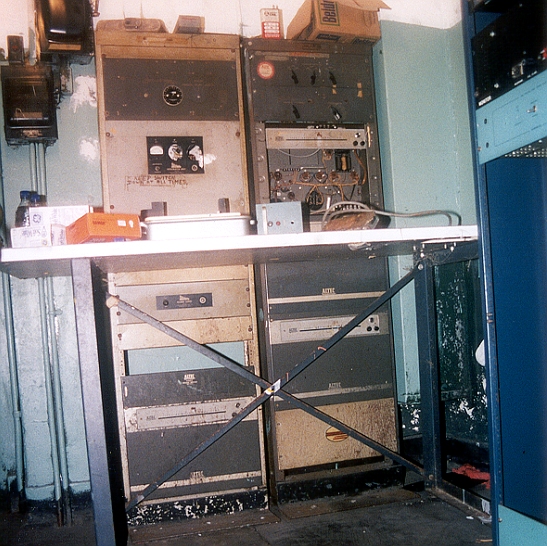
Is that an original Perspecta integrator I see before me, in the left hand rack, near the top, with its power supply in the same rack, just below the bench?
quote:
Is that an original Perspecta integrator I see before me, in the left hand rack, near the top, with its power supply in the same rack, just below the bench?
Come, let me clutch at thee!
Broo hoo ha ha ha!
![[fu]](graemlins/fu.gif) who are in my opinion trying to kill the cinema experience, but there were many complaints about the low image quality of that film. So if Digital is not good enough, just degrade the film experience until nobody knows the difference any more!
who are in my opinion trying to kill the cinema experience, but there were many complaints about the low image quality of that film. So if Digital is not good enough, just degrade the film experience until nobody knows the difference any more!It has been 1569 days since the last post.
quote: Geoff JonesThis is one of the stupidest things to find wrong with a
Despite all the money sunk into fancy new digital projectors (which are out-of-date now that 4k is here), large portions of the picture were projected off of the screen onto the maskings, on all four sides. (This was most distracting on the right.)
![[dlp]](graemlins/dlp.gif) presentation. (Not ragging on you Geoff) Cropping and "digital" masking are incredibly simple to set up on DLP, and rarely change afterwards.
presentation. (Not ragging on you Geoff) Cropping and "digital" masking are incredibly simple to set up on DLP, and rarely change afterwards.![[joe]](graemlins/joe.gif) has told me similar stories of meddling personnel "fixing" audio settings after they had already been fixed. I can do that at home. Digital just seems like it would be a bit like Paris Hilton. No soul.
has told me similar stories of meddling personnel "fixing" audio settings after they had already been fixed. I can do that at home. Digital just seems like it would be a bit like Paris Hilton. No soul.![[thumbsdown]](graemlins/thumbsdown.gif)
quote: Sean McKinnonRoger Ebert wrote an article about that exact thing a few years ago. I think it might be archived here somewhere...wonder if it's still on his website?
I think that I am more emotionally affected by a film presentation than DLP.
quote:
Possibly the most important yet least quantifiable point that concerns film lovers is primarily emotional. Roger Ebert, the film critic I know who seems to have given all this the most thought, was telling anyone in Cannes who would listen that, although there is only sketchy science to back him up, film and electronic images reach different parts of the brain and therefore affect human beings in different ways. Very roughly speaking, film creates an alpha state of reverie due to its imperceptible flickering, therefore creating a more emotional and intense reaction Television, by contrast, creates a beta state that is constant and more hypnotic, which is why people can sit in front of the TV screen for hours at a stretch.
The hidden danger to the industry, therefore, is that, while digital projection will soon look just as rich and sharp and beautiful as 35mm film, its emotional and imaginative impact over the long term will not be the same. I am very aware that, whenever there has been a perceived threat to the theatrical motion picture business, the doomsayers have been proven wrong and that audiences have always demonstrated their need to share a communal entertainment experience with strangers. The difference this time is that, without even knowing what's happening, audiences might gradually absorb that the digital images they're watching in theaters are no different than what they see at home, that they're actually just watching TV with more people. And that could be the end of movies as we know them.
![[Big Grin]](biggrin.gif)
![[thumbsup]](graemlins/thumbsup.gif) Put me on the list for some of those Greystones when they are pulled out!! Not sure what we'll do for remotes though... let Louis work that out. But I warn you his remotes will be as large as a Chevy S-10 van.
Put me on the list for some of those Greystones when they are pulled out!! Not sure what we'll do for remotes though... let Louis work that out. But I warn you his remotes will be as large as a Chevy S-10 van.quote: Bobby HendersonPoorly produced video content finds its way onto cinema screens via 35mm film prints as well; so does well produced video content. One of the advantages claimed for the Digital Screen Network in the uk is the ability to screen 'alternative content', which does not exist on film. Given the three options for screening video originated material in cinemas, conversion to film, video projectors or digital cinema projectors, then the digital option can be a good choice.
Finally, another complaint I have with digital projection is not really a complaint about the projection itself. It's a complaint about the potential for the technology to allow poorly produced video content onto the screen.