
B) There is so much talk about studio's installing TI's DLP projectors into their theatres. I have to ask, WHY??? Why not go with the solid-state D-ILA from JVC (which, btw, can support the full 1080p res and will soon have QUXGA res (4K by 2K) which is getting very close to film-quality res. Intstead you are using millions of tiny mirrors with large gaps between the mirrors (which means less gets reflected) at a lower res than true 1080p.
Correct me if I am wrong, but what is the big deal going with TI when JVC requires less light and provides a larger res?
Like you, many (most?) film-techers are wondering the same thing. Why such a big rush? I'm far from an expert, but from what I've read, I think the reasons include: 1) TI-based 1280x1024 DLP systems are available now; 2) They more or less work; 3) The DLP proponents want to seed the market with as many units as possible to establish DLP as the benchmark and beat the competition; 4) It seems as though theaters are not paying for the DLP hardware -- they may be getting DLP for free right now or at least they are heavily subsidized for being early adopters. This goes back to seeding the market. 5) And of course the proponents say DLP & 1280x1024 is "good enough" and there's no need for higher resolution.
Have you read about Kodak's digital system? It's D-ILA and seems to have a lot of promise: Kodak Digital
Hmm, if there are higher res telecline machines wouldn't it be best to store the film digitally so there is little chance of the film degrading? Figure 6000K Silver Atoms, doesn't seem like it would be that hard to get all of that into digital form for long-term storage.
------------------
- Nick Catalano
Dennis
This is a long-term major problem for all digital archiving including films.
Even if a physical storage medium carrying digital data survives over time without damage, it remains essentially useless without a) hardware to read it and b) documentation of the file format of its contents. One of the disadvantages of the rapid advances in computer technology is that hardware becomes obsolete very quickly, including storage devices. Think about how hard it would be to find something to read 8" floppy disks (a common format 20 years ago); this should give some idea of how hard it might be to find a DLT drive in twenty years.
The file format issue is also critical, since digital data will still be useless without the knowledge needed to write software which is capable of interpreting the data and turning it into pictures, sound, etc. This is why the use of proprietary (and, almost by definition, undocumented) file formats and, worse, encryption schemes to store information of long-term significance (e.g. movies, photographs, music, etc.) scares me. It's safe to assume that whatever hardware and software is being used to encode the data will not exist in the medium-term future (20 years or so), and we will need both talented programmers and file-format documentation in order to make any sense out of whatever digital data may survive from the present time. These data will then need to be converted to suit whatever type of display device is in use in the future; conversion often causes degredation in digital images, and will definitely cause degradation if lossy compression techniques are used at any stage.
All of these issues are serious and are mostly avoided by using standard 16mm and 35mm film formats. The format is essentially self-documenting (you can hold it up to a light source and see an image; an optical soundtrack is a depiction of the sound waveform) and the guages have been standardized for years (and won't change anytime soon). Further, it is very simple to convert film to nearly any display or storage format which might be needed in the future, with minimal quality loss. Film also has the advantage that it degrades slowly in easily identifiable stages, so that, with care (a big assumption, admittedly), it can be preserved before it is lost completely. By contrast, most digital formats will degrade suddenly and go straight from giving great quality to a complete loss of information.
No matter what happens with DLP on the exhibition side, I sincerely hope that filmmakers and photographers have the foresight to preserve physical copies of their work on film for the long-term future, as it is the only format which has proven itself to be recoverable a full century after it was produced. Contrast this with the many reels of 7-track and 9-track computer tape of data which NASA collected in the 1960s and 1970s which are all but unusable today due to either tape degradation or (more significantly) the lack of hardware and software capable of reading the data stored on them. The same situation exists with 2" quad videotape--a common format through the 1970s--which is very difficulat and expensive to view today on the limited number of machines which still exist in working order.
Maybe John P. can give some insight on the long-term storage characteristics of film. The good thing is that most of the major historical issues with film storage (nitrate decomposition, vinegar syndrome, and color fading) seem to have been significantly reduced in the current generation of film stocks.
Note that I'm saying all this as one who works with computers and data storage on a daily basis. I do attempt to ensure long-term data stability by using standard tape formats (dump and tar, mostly), standard physical media with a history of long-term (which, in the computer industry, generally means more than a year or two) storage ability (DLT tape), and regularly attempting to read older tapes to ensure readability. Having said that, I'd be amazed if tonight's backup tapes will be readable in ten years.
The digital-storage proponents like to perpetuate a lovely myth that as long as someone makes bit-for-bit copies of the recording every few years, digital storage is "perfect." The problem is that a) this doesn't happen (look at all the nitrate film that we still have that has yet to be preserved--and that is a format which has not been manufactured for fifty years) and b) file formats change and information is almost always lost (or new information is artifically introduced) in the conversion.
No, film isn't perfect, but it is a mature format which has a proven record of archival stability under a wide range of conditions. Note that I'm not saying that we _shouldn't_ store films and photographs electronically _in_ _addition_ to storing the film, just that this should be considered a supplement and not a replacement for film storage.
That said, I do question the longevity of CD-R's given their dye-based technology. I've toyed with the idea of someday, once I've accumulated a vast number of digital photographs, having someone write them out to 35mm film, either color negative (subject to fading but at a very low and predictable rate) or B&W color separations.
I dunno, it isn't a top priority in my life to change the way film is archived.
quote:
The problem of disappearing playback hardware is one that is often cited but really seems rather silly.
quote:
That said, I do question the longevity of CD-R's given their dye-based technology.
Printed CDs will last about as long as the disc itself stays whole. They don't degrade the same way that CD-Rs do...
Not only are there many storage formats to use (all with their advantages and disadvantages --and reliability problems on long term storage and data recovery), but then you have consider HOW the data will be stored.
For instance, there's lots of stock image banks like Corbis, PhotoDisc and others. They all have their opinions on what is an appropriate resolution for "high res" archival quality. There are differences in opinion on what image res is good enough. Some think 2K is just fine while others like myself point out a 35mm 4-perf frame can hold over 12 million pixels of real image detail. How far do you go in devoting data space per frame for archival?
On top of that, you have other issues in how the film image is digitally aquired. Some archival places prefer to make a well balanced high res drum scan and then do nothing to the image. Others may want to "correct" the color or adjust sharpness, etc.
Anyway, the whole business of digitally archiving films opens up many cans worms, to use an old cliché. Many people, including myself, believe the film stock itself is the real piece of archival media.
Decades from now the original data tapes of "Star Wars: AOTC" may be lost. To counter, some analog 70mm film prints of other movies like "2001" may be in good condition and able to be used for some super high res home video format of that age. I think Hollywood should be shooting its movies on VistaVision and 70mm film formats if they truly want to future proof their product for much more highly advanced formats of home digital entertainment.
AOTC costs $18,000 in tapes, it would have cost something like $3.2 million (or was it 6.2) if they shot it in film.
Consider that AOTC cost $US120M to make WITHOUT film. So what if they saved $US2M?
Kenneth Branaugh's 'Hamlet' was filmed and released in 70MM and the budget was $US18M!!!!!!!!
...and which do you suppose might look better?
BTW, welcome to Film-Tech...
There are newer D-ILA based projectors out there, but I haven't been able to compare them side-by-side. I'd love to check the Kodak system, but for some reason you have to go to Rochester to see it. TI is also rumored to have an HD resolution chip in the works.
Personally, I don't care which technology gets used, as long as it looks great.
I'm sorry, but I chuckle at folks blowing $7,000 to $20,000 on flat screen TVs thinking they've got the best possible thing when they only deliver at best a little over 50% of a 1080i HDTV image. That's DLP for you. Impressive contrast ratio, whatever that means. Native pixels however --the low number sucks much ass.
As to an earlier comment about "a better digital alternative to film" --there is none. At least not from a standpoint of image quality. 5-perf 65mm/70mm is the highest reference standard of any theatrical exhibition process (not including special venue, which is mostly even larger formats of 70mm). Anything digital sucks compared to 70mm. When a videotape process and digital projection system is invented which can show at least 4,000 X 9,000 native pixels of real data, then we can talk about there being a real digital alternative to 5/70. Until then 70mm is the highest quality thing going even though it is icky analog.
A release print made with KODAK VISION Premier Color Print Film 2393 from a well exposed negative can have black densities well above 4.0, or over a 10,000:1 brightness range on the print itself:
http://www.kodak.com/US/plugins/acrobat/en/motion/products/curves/2393Char.pdf
Standard SMPTE 196M specifies "Screen luminance due to stray light shall be less than 0.16% (600:1 theater screen contrast ratio) for review rooms and primary theaters. For all other theaters, the luminance due to stray light shall be less than 0.25% (400:1) theatre screen contrast ratio)." So stray light from the projection optics and port glass, as well as the ambient light in the theatre, tend to reduce the contrast ratio considerably from that available on the film itself:
http://www.kodak.com/country/US/en/motion/newsletters/reel/december99/pytlak.shtml
------------------
John P. Pytlak, Senior Technical Specialist
Worldwide Technical Services, Entertainment Imaging
Research Labs, Building 69, Room 7525A
Rochester, New York, 14650-1922 USA
Tel: +1 585 477 5325 Cell: +1 585 781 4036 Fax: +1 585 722 7243
e-mail: john.pytlak@kodak.com
Web site: http://www.kodak.com/go/motion
Did the engineers decide it was a POS, or are they licking their wounds?
Just curious....
Frank
PS -- Ever try to play a 2 inch quad video tape recorded only as short a time ago as the 60s? Good luck.
------------------
John P. Pytlak, Senior Technical Specialist
Worldwide Technical Services, Entertainment Imaging
Research Labs, Building 69, Room 7525A
Rochester, New York, 14650-1922 USA
Tel: +1 585 477 5325 Cell: +1 585 781 4036 Fax: +1 585 722 7243
e-mail: john.pytlak@kodak.com
Web site: http://www.kodak.com/go/motion
Could you expand on what "Laser-rot" is?
Thanks
Paul
It is caused by corrosion of the aluminum data surface of the disc, usually making the disc unplayable. Here is a site with a good picture of a CD with Laser Rot: http://www.rdrop.com/~half/General/CDRot/CDRot.html
I have read reports of it affecting DVDs as well.
-Aaron
CDs and DVDs are less-susceptible to laser-rot due to their small size and surface area, reduced tendency to warp, and improved mfg. techniques. But they're not immune.
[oops - I got pulled away from the computer in the middle of writing my post, came back and finished, then discovered Aaron had already answered the question]
Evans
------------------
Evans A Criswell
Huntsville-Decatur Movie Theatre Information Site
Although it's claimed that CDs and DVDs can also "rot", I've never run into one that wouldn't play because of it. I have the very first issue of the Springsteen "Born To Run" CD (circa 1982?), which still plays fine. Most of my CD collection was purchased before about 1990, and they all still play OK. CDs and DVDs might be more likely to conceal a minor "rot" problem with their digital error correction, but even a minor "rot" problem will be easily discernible in the analog video output of a LaserDisc.
Also the type of plastic used in LDs was hygroscopic--it absorbed moisture! The plastic used in CDs and DVDs is different and doesn't have this characteristic.
Paul
I was not aware of this happening. Now that I am aware of it, I am somewhat shocked! Luckly, I don't have that large of a collection, and just by the sound of things, it is not going to get much larger.
Back to S-VHS and the best quality of tape for me....
I wonder if this was a "known problem" with the disks. I am glad this thread came back to life. Maybe we found something out that was not supposed be generally known.
In the case of "American Beauty", I just went over to Wal-Mart and got another copy for $14. Universal offered to replace the thing, but I didn't feel like waiting 4 months for the trade. I may send my copy of "The Crow" in for a replacement movie disc since I can't simply buy another 2 disc set for real cheap.
The thing that really worries me about all this rot is other DVDs in my collection now out of print rotting. I'll be really upset if my Criterion "Robocop" DVD rots. Same goes for my 2 disc DTS DVD version of "Dances With Wolves". The 2 disc version of "Fight Club" is being phased out and replaced with a single disc pan and scan version.
I suspect some DVD replication plants getting cheap on their materials or quality control procedures. Even if my DVD costs less than an ordinary music CD to purchase, I still want the thing to last as long as the CDs in my collection.
I suspect "The Rock" will have a difficult time playing the final chapter, but I have not tried it yet.
Check this out:
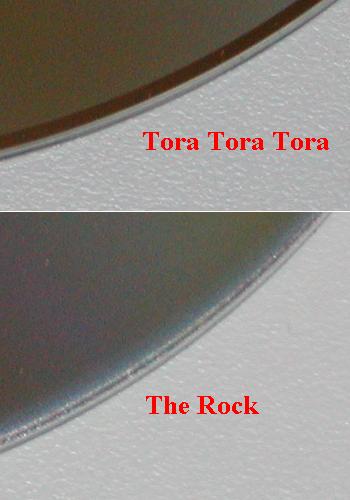
Bobby said:
quote:
"I suspect some DVD replication plants getting cheap on their materials or quality control procedures."
...And Paul Mayer said:
quote:
"Depends on who did the pressing--some pressing facilities were worse than others in this regard."
Gentlemen, I believe you both are right on target.
And as far as never seeing any problems with CDs -- I have hundreds of them and so far see no major problems, but then again, perhaps that is because the consumer players don't have digital quality numbers in the display like they do on Dolby Digital Cinema processors; we might not be so content with their stability if we could see that CDs which started off playing at 7-9 are now playing at 3-4.
Frank
PS -- Just an aside: the reason why I had to replace the Pioneer players each time was because once they crashed, even the Pioneer owned and operated repair center out in NJ couldn't repair them. My second model was kept for 6 months until they finally just said, we have to send you a new replace, but only a model LOWER on the quality level because the newer ones had features my broken one didn't, and, gee, they couldn't replace it with a "better" model.
So even when that format was in its prime, the technology was so dense that the manufacturer itself couldn't deal with repairing it. Imagine that scenario once the technology has been obsolete for a decade or two.
Even if the medium itself hasn't degraded, what about the equipment needed to retrieve it? When I realized the predicament I would be facing 10 years from now with my Laserdisc library and a player that might die before I do, I though, I'd better buy a second player and just keep it in storage until the current one crashes. To late -- no more new players to be bought any longer.
I doubt that will ever happen with CDs or DVDs because of their penetration of the planet (Laserdiscs never caught on in any major way), but the stability issues still remain to be seen.
-Aaron
=TMP=
Was'nt the topic on this thread about DLP?
Normally, If I botch a burn job, I usually scratch the surface with a sharp object or take a scissors and cut them in half.
I mention this because there was one time I tried to break one apart. They will break in a violent SNAP and plastic schrapnel flys all over the place, and some of the shards can very eassily embed themselves into your skin - clear on down to the bone! I was very lucky. It is very dangerous. Don't break a disk, you might not be so lucky.
quote:
The 2 disc version of "Fight Club" is being phased out and replaced with a single disc pan and scan version.
Actually, the specs on the back of the single disc version state that it is Anamorphcic widecreen 2.40. It looks like the single disc is the same as disc 1 of the SE.
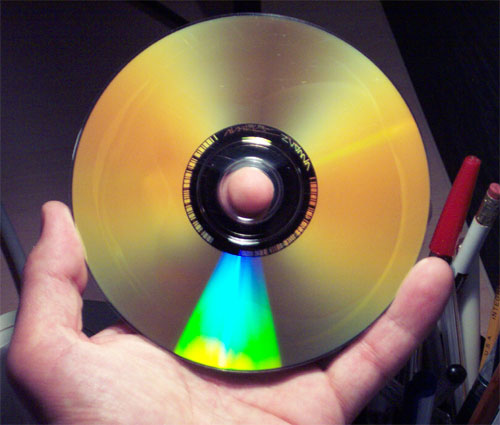
As you can see, even in this low res image, it appears like the bonding glue between data layers has given way forming this liquidy looking gunk near the edges. If you want to see higher res versions of this, e-mail me and I'll send you a copy of the high res image (800K file size for the JPEG).
To address an earlier question about the thread getting off topic, it really isn't off topic. In the push for making all things digital, some folks are excited about archiving films in digital form. Some of us have been making the argument that certain analog formats, like film, might actually be more stable. Dead disc and tape storage formats are one warning for the digital archiving mess. The situation with storage media degrading is an even worse factor. The talk of laser rot and DVD rot is just another example.
One could have problems with the CMY layers in a color film strip. Yet one can still project the thing, or digitize the film frames and color correct the images and output to another film strip using a laser film recorder. When the bonding layers give way on a RSDL DVD disc, your disc is toast. There's no restoring that. Harm the right point on a CD-ROM and all your data will be destroyed. When magnetic tapes develop "tape sweat" or turn to vinegar or dry out, they're going to be screwed up bad --especially if digital data was stored on them.