This is topic DCinema equipment lifespan - why so short? in forum Digital Cinema Forum at Film-Tech Forum ARCHIVE.
To visit this topic, use this URL:
https://ft-forum.com/ft/cgi-bin/ubb/ultimatebb.cgi?ubb=get_topic;f=16;t=000187
Posted by Matt Fields (Member # 3211) on 04-04-2008, 02:14 PM:
I have heard that the expected lifespan of the current Digital Cinema equipment is 8-10 years and then the equipment becomes "obsolete". Why is that? What is expected to replace the current generation of projectors/servers?
Posted by Alan Gouger (Member # 543) on 04-04-2008, 02:33 PM:
I think in reality it is half that more like 4 or 5 years. The technology is still in its infancy. Early adapters pay the price to be on the cutting edge and in most cases turn out to be the beta testers the manufactures learn from advancing the technology for the next model.
Posted by Darryl Spicer (Member # 711) on 04-04-2008, 02:42 PM:
quote: Matt Fields
Why is that?
It's computer based electronics. Obsoleting is a given fact and the quicker they developed the technology the quicker it will need to be upgraded.
Posted by Ron Funderburg (Member # 4561) on 04-04-2008, 04:18 PM:
At this point the projector specific hardware improvements will slow down. Software upgrades will remain as the fastest element of change. The the servers are going to last as long as the software updates will function on them. That doesn't mean that they will be best, of course, you always run the risk of a computer being out of date right out of the box. That is why computers are so much fun!
Posted by Mark Gulbrandsen (Member # 72) on 04-05-2008, 07:17 AM:
quote: Darryl Spicer
It's computer based electronics. Obsoleting is a given fact and the quicker they developed the technology the quicker it will need to be upgraded.
I always laugh at that answer... thats definately hogwash. Look at all the DTS 6's out there that are now going on 15 years old... they did not need to be upgraded just because newer DTS units appeared on the market. They continue to run just fine and they still get support from DTS and or Quality Presentations. No one can actually claim any lifespan YET for any piece of digital cinema gear... it is all to new. Dolby however has stated in their training classes a MINIMUM lifespan of 15 years for their server system. One of the major factors in obsoleting equipment is that improved gear is developed at a pretty fast rate... but like the DTS 6 that doesn't mean that everypone will adopt the newest latest piece of gear every time it emerges. In fact theater owners in general don't adopt any new equipment until the very last ounce of use is had from it... that could take decades! Another factor that DOES HELP slow this down is the standards that are in place. So in 15 years whats a server or a projector even going to look like? What resolution will we be using? How will we be storing films and on what type of media? What ever it is and what ever it looks like then we may very well still have the same standards we have today... Standards are much slower to develop than a tortise crawls.
Mark
Posted by Ron Funderburg (Member # 4561) on 04-05-2008, 12:34 PM:
Mark you are 100% correct!
As I stated as long as your hardware can take any software update and operate it properly there is no need to change that hardware. In fact most computer advances have to do with speed or memory. If the computer system works properly and is fast enough you don't need to update it just because something faster comes along.
I used the same computer for video editing for 7 or 8 years. The only reason I changed recently was the new software wouldn't work properly on the old hardware.
Posted by Darryl Spicer (Member # 711) on 04-05-2008, 02:18 PM:
quote: Mark Gulbrandsen
I always laugh at that answer... thats definately hogwash. Look at all the DTS 6's out there that are now going on 15 years old... they did not need to be upgraded just because newer DTS units appeared on the market. They continue to run just fine and they still get support from DTS and or Quality Presentations. No one can actually claim any lifespan YET for any piece of digital cinema gear... it is all to new. Dolby however has stated in their training classes a MINIMUM lifespan of 15 years for their server system. One of the major factors in obsoleting equipment is that improved gear is developed at a pretty fast rate... but like the DTS 6 that doesn't mean that everypone will adopt the newest latest piece of gear every time it emerges. In fact theater owners in general don't adopt any new equipment until the very last ounce of use is had from it... that could take decades! Another factor that DOES HELP slow this down is the standards that are in place. So in 15 years whats a server or a projector even going to look like? What resolution will we be using? How will we be storing films and on what type of media? What ever it is and what ever it looks like then we may very well still have the same standards we have today... Standards are much slower to develop than a tortise crawls.
When it comes to DTS the technology never really changed for it. As long as you could upgrade the drives and the firmware you didn't have to replace the unit. However, Supposedly DTS no longer supports the DTS 6 so in their mind it is obsolete. Obsolete doesn't mean you quit using it. But if future software doesn't take the older stuff into account it will then become useless. Look at the computer wave in the 90's. Shit was changing so fast that manufacturers didn't have time to change the literature in the box. Computer motherboards became strained and to the point of no longer being upgradeable. Operating systems where ever changing. I read on here somewhere where Access/IT was going to be changing out Doremi servers at Carmike locations to a DCI compliant unit...What does that tell you.
The big thing is that we are making a big change in technology here. We are making things computer based. You know that you can take a 35mm and run it for 30+ years so long as you have the parts. Now we are going to be using equipment that the manufacturers are saying only has a lifespan of 15 years. In 15 years who is going to be paying to replace all the equipment.
Film Companies.....nope they already payed for the first wave they will want all the savings by then.
Granted there will be a life span of some degree. But there will still be a point of obsoleting that will happen because of a technology change of some kind that will cause problems with what we have now.
Posted by Ron Funderburg (Member # 4561) on 04-05-2008, 03:17 PM:
So on a side note where does digital need to be in order to do the quality of 70MM on a big (75 foot or larger) screen? Can we expect that digital will get there in the near future.
Sony boast that the new 4K projectors pixel (at 15feet wide picture) is only the size of the L on the word Liberty on the quarter! They also say they can project a good (well they say great) picture 75 feet wide is that true or hype. Can you do this through software updates or is it hardware?
Posted by Lyle Romer (Member # 1266) on 04-05-2008, 04:44 PM:
4k probably gets you right about the quality of 35mm film done right (with respect to resolution, contrast is still not there with DLP or Sony SXRD).
To get to 70mm quality you probably would have to get to 8k.
For IMAX quality you'd probably need around 12k.
Posted by Mark Gulbrandsen (Member # 72) on 04-05-2008, 07:01 PM:
quote: Darryl Spicer
When it comes to DTS the technology never really changed for it. As long as you could upgrade the drives and the firmware you didn't have to replace the unit
Yes! And D-Cinema technology will closley parallel it for the next upteen years because THERE ARE STANDARDS IN PLACE. And for that matter the DTS time code itself underwent some major changes but those changes could be accomodated through simple software upgrades... just like the switch from MPEG to JPEG was accomodated in D-Cinema. D-Cinema equipment will also parallel DTS in replacing drives and upgrading software to add new features and improve old features. Who knows... we may be replacing 2K light engines with 4 K or even 8K some day... It will more or less be one and the same thing. Anything computer based is more or less along these lines.
BTW Darryl, What theater other than local single screeners do you know of that has lasted for 30 years??? I don't know of a single location that has reached that age before its torn down or re-built. So how long film gear lasts is irrelevant to the entire issue.
Posted by Darryl Spicer (Member # 711) on 04-05-2008, 07:33 PM:
quote: Mark Gulbrandsen
BTW Darryl, What theater other than local single screeners do you know of that has lasted for 30 years??? I don't know of a single location that has reached that age before its torn down or re-built. So how long film gear lasts is irrelevant to the entire issue.
We had a theatre here that OPENED in 1976 and CLOSED in 2006. The theatre was a six screen theatre that was built by a family owned company called Mid-States Theatres. This company was then sold to a company called Sack theatres that when they combined changed thier name to USA Cinemas who then ran into money problems (Charles Goldwater was president at the time name ring a bell) and sold the company to Loews Theatres and we know where they went back and fourth with name changes. around 2001 or so, maybe sooner I can't remember. Loews sold off all the theatres in Ohio and Louisville, Ky to National Amusement. The lexinton theatres National Amusment didn't want so after a few years running the locations they shut them down. The remaining theatre was the six screen that reopened by an independent about a year later. The existing equipment was still in the building it was not removed. The building has since been demolished but the equipment was removed. The big fact of the mater is that the equipment that was in the building was the original equipment that was used in a couple of other locations that Loews had in town that they shut down. Those locations were built in the late 60's early 70's. So by the time it was all said and done the equipment being used was over 30 years old in a 6 screen theatre.
Posted by Tim Reed (Member # 137) on 04-05-2008, 07:54 PM:
Not to speak out of turn here, but I know of several multis in Lexington that are over 30 years old.
EDIT: I should've hit refresh before I got back to my desk and posted! Those are the ones I was thinking of, Darryl! Southpark (1976), Fayette Mall (1972-73), and Turfland Mall (1968).
Posted by Scott Norwood (Member # 30) on 04-05-2008, 07:59 PM:
Has the SMPTE standard for ![[dlp]](graemlins/dlp.gif) been completed yet? My understanding is that this still hasn't happened and that the DCI spec is incomplete (especially WRT 3D, variable frame rates, etc.).
been completed yet? My understanding is that this still hasn't happened and that the DCI spec is incomplete (especially WRT 3D, variable frame rates, etc.).
Also, there are a number of 30+ year old multiplexes (some are converted singles or twins) in this area. Tim used to service one (originally a twin, now a 5-plex, opened in 1975). In any case, film and some sound equipment still has value when a theatre closes. It may get re-installed at another location, used for parts, or sold to another theatre through a dealer. How many 30-year-old computers have any value at all?
Posted by Darryl Spicer (Member # 711) on 04-05-2008, 08:01 PM:
Tim,
There is only the Kentucky with it's second screen that is over 30 years old now. all the Mall screens are shut down now. The oldest builds in town that are more than two screens are 18 years old.
Posted by Tim Reed (Member # 137) on 04-05-2008, 08:04 PM:
Okay, thanks Darryl. It's been many years since I've been around there for more than a few days visit. ![[Smile]](smile.gif) I guess if we want to get technical, the Sky-Vue D/I is a twin, and it opened in 1948.
I guess if we want to get technical, the Sky-Vue D/I is a twin, and it opened in 1948.
Yes, Scott... Chestnut Hill! ![[Wink]](wink.gif) There are plenty of locations out there over 30 years old.
There are plenty of locations out there over 30 years old.
I guess Mark's just talkin' out his ![[Moon]](graemlins/moon.gif) again...
again... ![[Roll Eyes]](rolleyes.gif)
Posted by Steve Guttag (Member # 268) on 04-05-2008, 10:02 PM:
There are no DCinema standards YET...SMPTE is working on them in the former DC28 (soon to be 21DC, I think) committee. 3D is not on the standard path yet with either DCI nor SMPTE.
As to Dolby...they can't say how long their stuff will be usable at all...15 years....bah! The reason they made it so modular is to stave off early obsolesence but there are factors way beyond their control that could affect the long-term support of such fast-changing technology. Heck, it isn't too big a secret that Dolby almost pulled the plug on their DCinema stuff back a couple of months! They are a public company now and investors want to see fast returns on their investments. I'm glad they didn't...their server technology (player technology, really) seems to be the slickest though some of their choices have me scratching my head a bit).
They have already lived through the MPEG to JPEG thing and that was a total loss to Dolby. The Promise drive thing tab was picked up by Tecnicolor, I believe. To not think that this technology is in a volitile state is just plain foolish. We are in a VERY small industry and our numbers just don't make a dent in most semiconductor or software manufacturer's spreadsheet.
Lastly, anyone that thinks even the DLP technology will be with us in 15-years just isn't looking at that technology globally...some sort of huge upturn better happen in that market or DLP may be a thing of the past.
Steve
Posted by Anslem Rayburn (Member # 1267) on 04-06-2008, 01:20 AM:
quote: Mark Gulbrandsen
No one can actually claim any lifespan YET for any piece of digital cinema gear... it is all to new.
We have a Technicolor Digital Cinema setup that was installed just before Star Wars Episode II. It has been obsolete for almost 2 years. We can't play product or receive support for it anymore.
So, it was installed roughly May 10, 2002 and the last movie we were able to play on it was (I believe) Cars in June 2006.
I will claim a lifespan of 4 years on our setup, although I understand that doesn't mean it will translate into 4 years on newer, higher resolution equipment.
Posted by Mark Gulbrandsen (Member # 72) on 04-06-2008, 09:59 AM:
Anslem.. Not quite... the format used on that gear IS obsolete... The equipment however is not, especially the projector which in smart hands could still be utilized for other things. In my book when a piece of gear is obsolete it can no longer be repaired... Then it becomes a piece of waste.
Mark
Posted by Ron Funderburg (Member # 4561) on 04-06-2008, 10:27 AM:
The definition of obsolete is
1 a: no longer in use or no longer useful <an obsolete word> b: of a kind or style no longer current : old-fashioned <an obsolete technology>
2of a plant or animal part : indistinct or imperfect as compared with a corresponding part in related organisms :
To me when parts are no longer readily available then something is obsolete.
Posted by Louis Bornwasser (Member # 3063) on 04-06-2008, 10:48 AM:
If the purpose of the projector is to play films and the studios won't or can't provide them, it is de facto obsolete; see the Disney letter.
ALL existing machines will either be removed or modified when DCI is completely available in a new machine.
As stated before, Who will pay for this? Thank God for Dolby! Louis
Posted by Ron Funderburg (Member # 4561) on 04-06-2008, 10:56 AM:
It would be a good thing if Studio's would actually see what theaters run good shows, no scratches, no bad sound, who does a good presentation and who doesn't. The truth is they don't do it now so I'm not sure they will do more than ask "Did you upgrade your equipment to be compliant?"
In the history of Cinema the studios haven't really checked that much on if a theater does a good job, or has good sound or anything other than if the figures they turn in are right. So what would make it different now?
Maybe they will do more on this than they have on other things in the past!
Posted by Bobby Henderson (Member # 840) on 04-06-2008, 02:17 PM:
Like it or not, any piece of equipment that uses components like hard disc drives, RAM, various types of CPUs, DSPs and other types of chips ALL has a limited life span.
The problem is all about spare parts. Every one of those items I listed and every custom based circuit board using various computing technologies is all eventually phased out of production. Just about any electronics company is forced to move on to other things and stop support for items over 10 years old. That's because no electronics company on this planet makes all of the parts for their products.
DTS-6 and DTS-6D machines may be able to stay in service for a good number of years to come, but a lot of that continued life span may depend on cannibalizing parts out of other DTS players taken out of service for D-cinema conversion.
I'll provide another example. Electronic variable message centers. Just since 1990, the sign industry has gone through 4 generations of products. Any business with a "flip type" time/temperature sign or message center is very lucky if the device still even works. No one makes parts for those things anymore, even though lots of these kinds of systems were sold brand new up until the late 1990s. Message centers using 5-watt wedge based incandescent lamps are hardly supported anymore either. The only way to get a replacement part is by finding a still working component in another device no longer in service. Good luck on that. Everything has gone to LED. But even there, nothing is safe. LED signs made several years ago have completely different components with boards and chips no one makes anymore. If something breaks, that 7 year old sign is just dead. Gotta buy a new one.
Of course, there's the example of personal computers. Once a Mac or PC gets about 5 years old you start having problems finding certain replacement parts for it, such as RAM or hard discs. At some point if something breaks you're just stuck with the situation of having to replace the device. The life span of notebooks is even shorter than that. If the hard drive fails in my current notebook, the damned thing will be turned into a door stop.
And that comes back to the situation with D-cinema systems. A theater can probably get at least 10 years of life from such a system. But I don't think they're going to be running too many years beyond that. Those systems use so many different components, all of which will only be manufactured and supported for a limited number of years. After 10 years, any computing device is really an antique of sorts.
Posted by Anslem Rayburn (Member # 1267) on 04-06-2008, 02:47 PM:
quote: Mark Gulbrandsen
Anslem.. Not quite... the format used on that gear IS obsolete... The equipment however is not, especially the projector which in smart hands could still be utilized for other things. In my book when a piece of gear is obsolete it can no longer be repaired... Then it becomes a piece of waste.
I respectfully disagree. We are a movie theater, and we got the equipment to show movies on. Whether we can use it for anything else is moot, it no longer serves it's intended purpose. If the thing runs for 100 years, it doesn't matter if we can't use it for what it was purchased after 4 years.
We are looking at doing some other things with it, and would love to make it work for something, but that's a different story.
Posted by Hillary Charles (Member # 769) on 04-06-2008, 03:03 PM:
There is an analogy in radio. My husband has had to junk $6,000+ dedicated satelite receivers because the networks changed carrier width, digital signal encoding, or sampling rates. After only a few years.
The receiver units still work perfectly (technically), but the signals they are designed to receive are no longer there. The units are obsolete. However, if one is sharp enough, they don't have to buy any doorstops. ![[Big Grin]](biggrin.gif)
[ 04-06-2008, 06:56 PM: Message edited by: Hillary Charles ]
Posted by Mark Gulbrandsen (Member # 72) on 04-07-2008, 08:52 AM:
Hillary,
This still doesn't show that they are obsolete. Only in the terms of his use of them. They may still work just fine for some other satellite reception purpose in another environment.
Mark
Posted by Scott Norwood (Member # 30) on 04-07-2008, 09:50 AM:
So, if bread is discontinued, my toaster doesn't become obsolete? Because, obviously, someone can find a use for a device that produces heat for a few minutes and then pops up whatever is inside it, right?
![[Confused]](confused.gif)
Let me guess...if gasoline is discontinued, cars don't become obsolete, either?
Posted by Mark Gulbrandsen (Member # 72) on 04-07-2008, 10:52 AM:
Scott... Nice try... I make my own bread.... don't you?
Mark
Posted by Ron Funderburg (Member # 4561) on 04-07-2008, 02:04 PM:
Mark, if Anslem's projector cannot be used for its intended purpose it may not be technically obsolete but has no value for the owner. So the question to you is what other purpose can bring in constant and consistent income other than movies, what purpose can have as many times and as many people as movies?
Well Mark what?
Since you make your own bread do they have to make their own movies?
Posted by Hillary Charles (Member # 769) on 04-07-2008, 03:28 PM:
Mark,
If the old receivers are still usable, John will GLADLY sell them to you for HALF PRICE! A bargain you should jump at! ![[thumbsup]](graemlins/thumbsup.gif)
Hill
Posted by Ron Funderburg (Member # 4561) on 04-07-2008, 05:49 PM:
Steve said: quote: Steve Guttag
Lastly, anyone that thinks even the DLP technology will be with us in 15-years just isn't looking at that technology globally...some sort of huge upturn better happen in that market or DLP may be a thing of the past.
Steve, don't you think the true market for DLP is the home market? I may have been pioneered for theaters but the real market potential is home theater, TV's and Projection TV that is where they put advertising bucks anyway. "It's the mirrors"
There is always far more potential in the home market than their is the movie theater proper! Or am I full of it?
Posted by Darryl Spicer (Member # 711) on 04-07-2008, 06:08 PM:
quote: Scott Norwood
Let me guess...if gasoline is discontinued, cars don't become obsolete, either?
Hmmmmm on that one as long as you could convert it to a different technology to run it (electric/solar, propane, or a good ol' horse to pull it) you could still use it.
Posted by Gordon McLeod (Member # 33) on 04-07-2008, 07:39 PM:
quote " quote: Scott NorwoodLet me guess...if gasoline is discontinued, cars don't become obsolete, either?
Hmmmmm on that one as long as you could convert it to a different technology to run it (electric/solar, propane, or a good ol' horse to pull it) you could still use it."
or cut a hole in the floor and be Fred Flintstone
Posted by Tim Reed (Member # 137) on 04-07-2008, 07:45 PM:
quote:
the format used on that gear IS obsolete... The equipment however is not,
Oh, please, Mark! You are grabbing at straws on this one.
It's not emasculating to admit you're wrong about something, ya know.
Posted by Mark Gulbrandsen (Member # 72) on 04-07-2008, 07:56 PM:
quote: Ron Funderburg
Steve, don't you think the true market for DLP is the home market? I may have been pioneered for theaters but the real market potential is home theater, TV's and Projection TV that is where they put advertising bucks anyway. "It's the mirrors"
There is always far more potential in the home market than their is the movie theater proper! Or am I full of it?
Ron,
The advent of the lower priced flat panel has put a dent in the consumer DLP market. However it's actually Steve thats full of it or himself. He has yet to present any hard evedence that TI would ever discontinue the DLP chip. Come on Steve... lets see your evedence... PLease quote the TI guy that told you that or present the P&L figures on the D-Cinema division that show they are going to send it south. Personally they could and may ship the whole consumer thing to the junk yard but I find it very doubtful that they will discontinue manufacturing the larger DLP chips.
T.I. is also the sort of company that does alot of other smallish semiconductor designs and runs for entities like NASA and companies that build Space Satellites... If you think these guys are building satellites and engine control computers with "off the shelf parts" you are truely a lost soul. And of course there is always that corner of a company like T.I. who does top secret designs for outfits like the CIA and the like.
Hillery,
If I were a Ham Radio Operater they would probably be very useful to me... however I have no interest in Ham Radio... Believe me... I'm a ham all the way WITHOUT the radios ![[Cool]](cool.gif) . Like I need another hobby. Interestingly many Hams purchase those old cool Broadcast Tramsmitters that are also NOT OBSOLETE to convert to the 2 meter and other Ham bands.
. Like I need another hobby. Interestingly many Hams purchase those old cool Broadcast Tramsmitters that are also NOT OBSOLETE to convert to the 2 meter and other Ham bands.
If gasoline disappeared tommrrow people would adapt quickly anmd most if not all internal combustion vehicles in use would still be in use. Actually all the cars and alot of the trucks and all of the busses that the City of Salt Lake City runs operate on natural gas. My wife's boss's car(Honda Civic) also runs on natural gas. He says it costs him about 12 bucks to fill it up and it runs for three weeeks... he drives 21 miles each way 5 days a week.
No it's yous guys that are grabbng at straws or should I say babbling. I still haven't seen one thing presented here that I would consider obsolete. Not even a Model A is actually obsolete... you can still get all the parts for them and there are many on the roads today. Silent movies are not obsolete just because someone added sound and there was a format called Todd-AO... many of these formats are still shown today and hundreds are being reestored and they still play on today's projectors.
Mark
Posted by Gordon McLeod (Member # 33) on 04-07-2008, 08:20 PM:
Mark said "Actually all the cars and alot of the trucks and all of the busses that the City of Salt Lake City run operate on natural gas"
yes this topic is full of natural gas
Posted by Darryl Spicer (Member # 711) on 04-07-2008, 08:25 PM:
Remember lets not confuse obsolete with extinct.
How many people have one of these they still use on a regular basis for all their needs.
Telegraph
In 1844 Samuel Morse posed an open question STOP
.-- .... .- — / .... .- — .... / --. --- -.. / .-- .-. --- ..- --. .... — / STOP Translation: What hath God wrought STOP Instant communication, it turns out STOP Telegraph service survived onslaughts from the telephone and fax machine until Western Union cut the wire in 2006, unable to compete with Internet messaging STOP
Posted by Anslem Rayburn (Member # 1267) on 04-08-2008, 12:53 AM:
Really, if something is bought for a specific purpose, and it can no longer serve that purpose, it is obsolete. What is a 16 screen theater outfitted with digital cinema gear today going to do if, in say 4 years, their particular projectors are no longer supported by the studios? Those projectors will have to be replaced with new ones if they are going to remain a movie theater, aren't they?
They might be able to re-purpose them for another use, but if they don't replace them, they won't be able to show movies and would cease to be a movie theater. I would call that equipment obsolete.
quote: Mark Gulbrandsen
Not even a Model A is actually obsolete... you can still get all the parts for them and there are many on the roads today. Silent movies are not obsolete just because someone added sound and there was a format called Todd-AO... many of these formats are still shown today and hundreds are being reestored and they still play on today's projectors.
But I can't get anything to show on my digital projector, not even old movies that I showed on it previously. And without significant hardware additions, we can't show anything on it at all. Those hardware additions to allow different inputs was many thousands of dollars last time we talked to anyone about it, making it cheaper to buy an off the shelf projector and using it for video games, pre-show, or DVD movies.
Posted by Tristan Lane (Member # 1169) on 04-08-2008, 02:51 AM:
Perhaps the title of this thread should be changed.
So far, it is really hard to judge the life-span of d-cinema equipment. Since the discussion has moved more into the territory of equipment becoming obsolete more quickly than film equipment I feel the title is misleading.
The basic d-cinema technology has proven to be equally as reliable as "new model" film equipment when looked at from a new installation standpoint. All newly installed equipment has it's aches and pains, be it film or digital. I can vouch for plenty of Apogee or Cine-X35 projectors that required a lot of attention after installation. The same holds true with D-cinema servers or projectors. Any new designs or technology have bugs that can only be found after years of constant use.
This doesn't mean that a huge portion of costly equipment has become obsolete due to the progression of technology. Those of you that are surprised by this fact and use it as proof that "film rules" are either afraid of it, or refuse to accept it as film's replacement. I agree that the current technology doesn't surpass, nor does it even compare to the quality of a well made print projected in a proper manner. But let's be realistic, this doesn't happen in 99% of the multiplexes out there. To the customer, Digital picture looks much better than the crappy presentation they are used to enduring.
If D-cinema has progressed this far in 5 years, imagine the possibilities of what could be possible 5 years from now.
quote: Anslem Rayburn
Those hardware additions to allow different inputs was many thousands of dollars last time we talked to anyone about it, making it cheaper to buy an off the shelf projector and using it for video games, pre-show, or DVD movies
That's correct. Whether it's a Barco or a Christie if it's older than three or four years, it probably needs extensive upgrades to the Formatter interface in order to play anything worthwhile. If you are still sitting on a 1.3k projector that forget about it. It's no longer worth putting any money into.
Posted by Hillary Charles (Member # 769) on 04-08-2008, 05:18 AM:
quote: Mark Gulbrandsen
Hillery,
If I were a Ham Radio Operater they would probably be very useful to me... however I have no interest in Ham Radio... Believe me... I'm a ham all the way WITHOUT the radios . Like I need another hobby. Interestingly many Hams purchase those old cool Broadcast Tramsmitters that are also NOT OBSOLETE to convert to the 2 meter and other Ham bands.
Mark,
We're not talking transmitters here. My husband (and I) are well aware of the usefulness of old transmitters, provided tubes and components are available. The Chinese broadcast tubes are highly reliable, but I agree, that would not obsolete them.
We're talking single components to put in a rack. The SINGLE task of which is to receive a specific DIGITAL satellite signal. EVERY TIME that signal changes, there is ABSOLUTELY NO USE for the old box. The network sells another box designed specifically for the new signal.
We know someone into ham radio, and these are of NO USE to him. They are purpose built. The purpose is over. Though everything inside is okay, they are obsolete. It's not like you just change a crystal and suddenly you're talking to Antarctica.
My husband gets the trades. Don't you think that if ANYONE was buying them for ANY reason, he'd want to sell them and get some of his money back? NOBODY WANTS THEM! They are obsolete!
Again, if you're so sure there's a use for them. he'll be glad to sell them to you at half price. You can flip them and make a tidy profit.
Hillary
Posted by Martin McCaffery (Member # 37) on 04-08-2008, 10:54 AM:
I think the proper analogy is not cars and gasoline, I think it is film and projectors. For about 100 years we've had a fairly stable standard of 35mm for film. There have been minor changes and improvements over the years, but 35mm film basically played in a 35mm projector.
How many standards of digital have we had in the last 5 years, and how many will we have in the next 5? Digital clearly is not going to be backwards compatible, and it is pretty clear studios are not going to maintain multiple resolutions of digital films (though how tough would that be really?), so all the risk and expense is being put on the theatres. Maybe the multiplexes can afford to eat it, but not the indies, and certainly not small single screens like mine.
And then there is the rest of the world.
Given a choice between installing film right now or installing digital, I'd go with film every time based completely on its record of stability. You can always install digital later if really needed. Why would anyone without millions to burn rush into buy something that will be, yes, obsolete before it is even paid off? Digital seems to equal disposable.
Posted by Frank Angel (Member # 248) on 04-08-2008, 01:20 PM:
quote: Tristan Lane
the current technology doesn't surpass, nor does it even compare to the quality of a well made print projected in a proper manner. But let's be realistic, this doesn't happen in 99% of the multiplexes out there. To the customer, Digital picture looks much better than the crappy presentation they are used to enduring.
That's pure fabrication. 99% ? -- what statistical study are you quoting to come up with that number? By far the reason patrons hate going to theatres can be reduced to a few very susinct complaints, NONE of which are complaints about image jitter or scratches! The complaints are always about high ticket prices, absurdly high concession prices, rude or even roudy patrons coupled with no managament supervision of the rooms, dirty rooms (floors mostly), screen ads and the general inconvenience of going out to the theatre compaired to saying home and poping in a DVD. Very low on any list you can site are complaints about technical issues. In fact, most of the problems related with image resolution and weave are lab problems that could easily be resolved if there were truly any motivation or desire by the studios to do so. The mere fact that the studios want to move to a technology that everyone who is honest, including you, admit
quote: Tristan Lane
the current technology doesn't surpass, nor does it even compare to the quality of a well made print projected in a proper manner.
....is ample proof that the issue was never that we need to give the patron something BETTER on the screen. Digital in terms of image and sound quality don't give the patron anything that film can't give them now. In fact, customers couldn't tell you if they were watching film or digital unless they were told, with the exception of the minority of those very poorly run, marginal theatres, which I contend don't represent the bulk of today's theatres. These are not the primary reason why so many people will tell you, and in no uncertain terms, that they hate going to the movies. Repeate: they hate going to the movies. There hasn't been a time in the 100 year history of cinema up until the advent of the mulitplex that such a sentiment could be found in the general populous. And yet during all that time when such a sentiment was unheard of, FILM was what was being run. Anyone who does logical troubleshooting will tell you, film isn't the problem.
The only conclusion I can come to is that digital is not going to make the slightest dent in the complaints patrons have about why they would rather wait for the DVD or cable or even PPV. D-Cinema WON'T fix that.
D-Cinema may certainly be the new technology that is inevitable only because forces that have nothing to do with giving the patron improved image quality have conspired to make it so. But there is nothing inevitable about changing the mass public's distaste for theatres or prying people away from the ever-growing Home Theatre threat.
Home Theatre and studios quick-releasing movies on hi-def DVD is a bigger threat than television in the 50s ever was. And when exhibition is looking to regain those patrons who they lost to Home Theatre, D-Cinema, my friends, is no CinemaScope.
Posted by Lyle Romer (Member # 1266) on 04-08-2008, 03:33 PM:
quote: Frank Angel
Digital in terms of image and sound quality don't give the patron anything that film can't give them now.
Not true. D-cinema comes with discrete uncompressed 24-bit digital sound at at least 48 kHz sampling rate (it supports 96 kHz). None of the existing digital sound systems provide that and in a room with high quality speakers and amps you can hear the difference.
Posted by Bobby Henderson (Member # 840) on 04-08-2008, 04:03 PM:
quote: Tristan Lane
I agree that the current technology doesn't surpass, nor does it even compare to the quality of a well made print projected in a proper manner. But let's be realistic, this doesn't happen in 99% of the multiplexes out there. To the customer, Digital picture looks much better than the crappy presentation they are used to enduring.
Sorry Tristan, but that simply isn't true.
The fact of the matter is most customers don't know shit about what is going on in the projection booth. They don't know if what they're watching is "digital" or film or even freaking video tape!
Most customers have no clue as to what sort of technology is being used up in the projection booth. Before digital projectors became common at all many people had the notion the movie was playing via some sort of video tape or disc and that it could be stopped and rewound. The lack of knowledge on the part of the general public is indeed that bad and the movie industry in general has done very little to solve the problem.
Another fact: most people don't give a shit about what sort of gear is being used in the booth.
I really wish this was not true, but it is. This is why shitty movie theaters inside shopping malls very often pull in much larger crowds than a much better quality standalone theater a few miles farther down the road.
The movie theater industry has to do a much better job of educating the public about the advantages of seeing a movie in a commercial movie theater. And they have to strive to deliver the best possible movie-going experience to the customer. Too many people getting into high definition TV and Blu-ray vomit out all this "my home theater is better than a commercial theater" bile. Something has to be there to refute it. I'd rather watch a movie in a really good quality movie theater. However, I'll take watching the movie on Blu-ray at home rather than wasting my money seeing the show at a shitty movie theater.
quote: Lyle Romer
Not true. D-cinema comes with discrete uncompressed 24-bit digital sound at at least 48 kHz sampling rate (it supports 96 kHz). None of the existing digital sound systems provide that and in a room with high quality speakers and amps you can hear the difference.
Not every D-cinema audio track runs at 24-bit resolution. You can have 16-bit and 20-bit audio streams thrown in as well.
DTS, when using the DTS-XD10 processor, can play surround audio equal to or even better than anything offered by digital cinema. The system can play discrete surround at levels up to 24-bit 192 kHz resolution. Basically it can do everything that DTS-HD Master Audio can do on Blu-ray. On top of that, it can be expanded to play audio formats in 10, 12 or more discrete channels.
Unfortunately, very few uncompressed surround discs have been sent out to such theaters.
It should also be noted that IMAX theaters play audio in uncompressed 6 track digital sound.
Posted by Tim Reed (Member # 137) on 04-08-2008, 07:28 PM:
quote: Darryl Spicer
.-- .... .- — / .... .- — .... / --. --- -.. / .-- .-. --- ..- --. .... — /
I'm an Amateur Radio licensee (W3HR), and a CW (Morse code) afficianado. The above is the obsolete American Morse Code, aka, the old "railroad" code. ![[Razz]](tongue.gif)
While hams around the world use International Morse Code, there ARE some railroad code operators out there who have their own nets and do some truly vintage operating - just for FUN. But try sending a distress call in American Morse and see how useful it is! Other hams would being saying, "What the heck does "SEES" mean?"
My point to this is: does the American code still work? Indeed it does. Is it obsolete? Definitely.
Posted by Mike Blakesley (Member # 26) on 04-08-2008, 08:35 PM:
quote: Bobby Henderson
The lack of knowledge on the part of the general public is indeed that bad and the movie industry in general has done very little to solve the problem.
Bobby - you explain the reason for the industry's inaction in your very next sentence:
quote: Bobby Henderson
most people don't give a shit about what sort of gear is being used in the booth.
Posted by Bobby Henderson (Member # 840) on 04-08-2008, 09:44 PM:
That's true. Average viewers don't give a damn about what's up in the booth. That is until they upgrade their home entertainment system to do HDTV and stuff like Blu-ray. Then suddenly they're experts on what great things their home system can do and what movie theaters cannot do.
There's no shortage of ignorant, inaccurate statements about presumed home theater superiority over real movie theaters made in various online forums. Many of these folks are just guessing as to how movies are produced and shown in theaters. From that shaky viewpoint, they pass judgment against all movie theaters anyway and even take the stupidly destructive stance that movie theaters aren't needed. "I'll watch all my movies at home!" They don't realize that a movie is not a legitimate movie unless it was shown in commercial movie theaters. Without movie theaters there will be no movie industry. Movie studios would be reduced to mere video production studios selling low budget straight-to-video shit and clamoring for limited amounts of space on various cable and broadcast networks to show their best stuff. The epic, big budget movies that make new formats like Blu-ray really fun would be history.
With that being said, I strongly believe the major Hollywood studios should be doing a LOT more about educating the public to the benefits of seeing movies in good quality movie theaters and be more actively involved in elevating the quality of the movie-going experience. Converting every theater in the country to D-cinema is still a cost cutting measure. It doesn't address many other issues that are still nagging problems.
Posted by Frank Angel (Member # 248) on 04-08-2008, 10:06 PM:
quote: Lyle Romer
Not true. D-cinema comes with discrete uncompressed 24-bit digital sound at at least 48 kHz sampling rate (it supports 96 kHz). None of the existing digital sound systems provide that and in a room with high quality speakers and amps you can hear the difference.
Point being missed again. It is not 24-bit digital at 48 or 96 or 192 kHz that will be the marketing magic bullet against Home Theatre. As I said, there is no evidence that movie patrons held this negativity about theatres when for decades they only could listen to Dolby SR analog (or even Dolby A), even when it was less that perfectly aligned. The attributes of 24 bit uncompressed isn't what will get them back into the theatre because the lack of it isn't what drove them out. They would be perfectly happy listening to analog SR if only their feet didn't stick to the floor and there were vigilent ushers ousting annoying, rude a-holes.
The public's negative perception is about the whole movie-going experience, not some nuance of sound or picture. This is not difficult to grasp. And I repeat -- D-Cinema will not be the cure-all that will reverse that dissatisfaction. If exhibition doesn't change allot more than just what machinery is up in the booth, their problem will persist. In fact, it may get worse for one very real economic reason: they will have invested so much capital in the digital conversions that there will be precious little monetary resources left to fix what really needs fixing. Anyone wanna bet they won't be hiring additional ushers, well-paid managers and assistant managers and extra cleaning staff, all at higher, respectable living wages after they've just installed 1000 D-Cinema systems? All this time exhibtion has been worshiping at the altar of D-Cinema because secretly the REAL reason why they were salavating was that it represented a way for them to GET RID of staff, not increase it; reduce payroll, not give raises. It has nothing to do with any altruistic desire for better presentation for the customer. Just like the reason they all bought into automation before testing to see what long-term impact it would have on presentation was not because they though automation would give the patron better picture or sound, but because their greedy eyes glistened like cubic zarconias at the prospect of being able to run more screens with fewer bodies and pay those bodies less.
They are making the same mistake again.
Posted by Tristan Lane (Member # 1169) on 04-09-2008, 01:54 AM:
I figured my post would be inflame some of the die-hard film fans here. You can blame high ticket prices and high concessions prices for declining attendance all you want, but the last time I checked attendance was a cyclical thing and was purely based on the quality of the product coming out of Hollywood. I never said that Digital Cinema would be the magic bullet to bring the masses back to the cinema. I don't even think there really is a problem. The alarmists would claim otherwise, but I've heard stories about the decline in attendance after VHS, and that lasted but a few years.
To further explain my way of thinking:
Most current release prints are pure garbage as is the presentation coming from most minimum wage operated booths. No where in my post did I mention anything about scratches or dirt or blotches. Properly operated booths don't have these problems. Customer DO "give a shit" what is in the booth. That is why customers choose Stadium, Digimax, Cine-Capri, THX or whatever buzzword works to put butts in seats. I've read plenty of reviews on theaters who market their presentation as digital, and most customers claim notice a difference when compared to the theater running film down the street. And ironically, they DO focus on scratches, blotches, or jitter.
quote:
By far the reason patrons hate going to theatres can be reduced to a few very susinct complaints, NONE of which are complaints about image jitter or scratches!
Frank, In response: your quote is also fabrication. I've personally seen comment cards and e-mailed complaints that specifically pointed out bad presentation and scratched prints. You'd be surprised how many of these types of comments come in. Techs for large corporate chains are made aware of these comments so that they can look into the issue and ensure that it is addressed.
quote: Frank Angel
The only conclusion I can come to is that digital is not going to make the slightest dent in the complaints patrons have about why they would rather wait for the DVD or cable or even PPV. D-Cinema WON'T fix that.
And I never said it would, so why are you implying that I was? But, If it does reduce the amount of presentation related complaints, than what is the harm? And what does that say about current run-of-the mill film presentation?
quote:
The fact of the matter is most customers don't know shit about what is going on in the projection booth. They don't know if what they're watching is "digital" or film or even freaking video tape!
Bobby, You are speaking from your own personal perspective on the matter. I would strongly disagree. Some customers even make it a point to comment on the fact that digital looks better than film.
For crying out loud, why does this always have to become a stupid debate?
My thought is: Either accept that fact that digital projection will replace film, and in time will become much better than film, or become jaded in your idea that film is superior. It reminds me of the people who insist that LP's are better than CD's..... You may be right, but the masses still prefers CD's (or MP3's in this day in age).
Posted by Scott Norwood (Member # 30) on 04-09-2008, 05:32 AM:
quote: Tristan Lane
My thought is: Either accept that fact that digital projection will replace film, and in time will become much better than film, or become jaded in your idea that film is superior.
At this point, I have two issues with
- implementation at this time is premature: the current generation of DLP systems is demonstrably inferior to properly designed 35mm systems, the cost is demonstrably higher than a top-quality 35mm system, there is no standard format, and long-term maintenance issues and general viability are unknowns
- film (all formats) is a unique medium and has certain qualities (flicker, mechanical nature, ability to run at different speeds, ability to be manipulated in processing, etc.) which cannot and probably will never be duplicated by any digital system; therefore, I believe that it is important that film be used for screenings of older films which were originally intended to be exhibited on film and that film remain an option for new films where the filmmaker desires that the end product be exhibited on film
Otherwise, if digital projection can be standardized, can provide an experience that is demonstrably superior to the best 35mm systems, can be made less expensive and proven to be reliable, and if the filmmakers (err...motion picture producer and director) want their product to be exhibited on it, then I have no problem with digital projection, provided that various film formats remain as options for filmmakers who prefer to shoot and/or exhibit in that format.
Posted by Mark Gulbrandsen (Member # 72) on 04-09-2008, 07:02 AM:
So far Tristian is the only person here that really knows what he is talking about. I see exactly what he is talking about happen here in Salt Lake City and with our customers that have installed D-Cinema. Folks(not the kiddies) DO care about scratches, jitter, blotches and dirt, THX, 24 bit digital and the like once thay have seen how clean and heard how good a digital presentation is. If these systems get people back in the seats of movie theaters... which is exactly what I see happenning in SLC where we have a lot of D-Cinema and a couple of the buisiest multiplex's in the country... I also get this sort of report from our customers in lcations where we have installed D-Cinema systems. There are many of you who will not accept the systems as they stand and frankly you only stand to be the loosers in the end. There is not going to be an 8K or 12K system for the average theater in our lifetimes that will be implemented on any scale. Implementation of the existing formats is already a done thing, in place, and happenning now and you're goin to have to live with it like it or not. Its a good thing none of you were around for early color movies... you'd be griping about them. You'd be griping about the join lines in Cinerama or the distortion and poor focus of 70mm Cinerama. My suggestion is that if you don't like it then go find another field to work in. The main thing in this industry is to sell tickets and put people in seats. Just like the Redstone Rocket that launched John Glenn both 70mm and soon 35mm will be dead issues and a curiosity pieces from yesteryear just like B&W TV is today and NTSC TV will be early next year.
As for equipment longivity. NO ONE HERE, not even the manufacturers of the gear can answer that. All you can do is post stupid speculative posts sounding like a bunch of soap opera actors. And for the most part why would any of you really care how long it lasts... none of you are paying for the equipment out of your pockets anyway. Wall street has funded the majority of this conversion!
BTW: All the D-Cinema systems we've installed have run with zero trouble and have been running every day since they were installed. Managers can choose to allow the systems to run on their own from internal schedules or they can run them manually either locally or by remote client. Once content is ingested they typically spend 5 minutes bulding up a show and there is no tear down. Shows still do need to be previewed though if possible. So needless to say all the management involved that are runing these systems also love them.
Oh, and the best feature of D-Cinema is that it will flush out the cheapskate-greedy theater operator who runs the local dump that never gets cleaned and in many cases stinks. Usually he is bilking the till all for himself... these folks will also thank god become a thing of the past .
Mark
Posted by Ron Funderburg (Member # 4561) on 04-09-2008, 11:08 AM:
Really, Mark, you must learn to govern your passions; they will be your undoing. No one is saying Digital isn't happening and most here are concerned about two things, the cost and if they will be able to retain their jobs. Surely you should be able to understand that.
The cost of the systems do actually affect those in the industry, the more spent on them the less there is to spend on employees, or service techs. Perhaps they will be so reliable that no service techs will be needed ever again and wouldn't that be nice for you?
I would think you could understand the concern of a projectionist that is worried about weather he will be employed after it goes digital. From what you say I guess we will need no one at all at a movie theater from this point on we can just have vending machines and automated robots to clean up.
Posted by Bobby Henderson (Member # 840) on 04-09-2008, 11:22 AM:
quote: Mark Gulbrandsen
So far Tristian is the only person here that really knows what he is talking about.
quote: Mark Gulbrandsen
I see exactly what he is talking about happen here in Salt Lake City and with our customers that have installed D-Cinema. Folks(not the kiddies) DO care about scratches, jitter, blotches and dirt, THX, 24 bit digital and the like once thay have seen how clean and heard how good a digital presentation is.
They don't care enough about it enough to drive just a few miles farther to a theater that puts forth better presentation quality and an overall better movie going experience. "Let's just go to the mall, it's closer and I can get some shopping done."
The Carmike 8 here in Lawton is all D-cinema equipped and has very good sound/image quality. It had good show quality even before the D-cinema conversion. Still, the crappy 12-plex in Central Mall generates more traffic. If most people truly cared about presentation quality by voting so with their dollars that mall theater would no longer be in operation.
That's not an isolated experience for where I live. I've seen it in so many other places across this nation. In New York City, it was all I could do to twist the arms of friends to go into Manhattan and see a certain movie in 70mm at a premiere-class 1000 seat theater. Most were just hell bent to stay on Staten Island and see the movie at an unremarkable multiplex.
quote: Mark Gulbrandsen
As for equipment longivity. NO ONE HERE, not even the manufacturers of the gear can answer that.
I know enough about computing equipment that NO ONE HERE or anywhere else can rightly get away with a claim that any d-cinema system made today will last 20 years or more. Christie might be able to do a number of things to squeeze that much life out of a CP2000 projector. A Dolby or DoReMi server will be lucky to last half that long. Same goes for the big SAN servers being installed in many d-cinema theaters. They are not immune to the cycle of ever changing standards for computing technology.
Try buying a new RAM module or hard disc for a PC that is over 10 years old. It's not totally impossible, but it isn't easy (or cheap) either. Imagine trying to do the same thing for a 10 year old media server. Compound that problem by needing the replacement part immediately. Someone trying to keep a 10 year old PC alive likely isn't dealing with a time sensitive, mission critical task of keeping movies playing on a commercial movie theater screen.
quote: Mark Gulbrandsen
Oh, and the best feature of D-Cinema is that it will flush out the cheapskate-greedy theater operator who runs the local dump that never gets cleaned and in many cases stinks.
That assumes the major chains aren't providing a watered down movie-going experience and are making sure all maintenance issues at the theater site are all promptly addressed.
D-cinema merely provides a solution to projection quality problems. It doesn't do anything to address how good or bad a movie theater is maintained. It hardly even addresses the issue of poor quality sound -which I believe is an even more widespread problem than poor image quality. You can throw a 24 bit 96 kHz 8 channel LPCM track at a theater sound system, but it's still going to sound like crap if the audio system has blown speaker drivers and the EQ is way the hell out of whack.
Warren Theaters is one of very few theater operations in the world that is striving to address EVERY issue. The fans of digital cinema will be happy to know they're installing d-cinema in all their theaters. They're also paying attention to every other aspect in the theater as well. The lobby, the auditoriums and even the bathrooms are luxurious in appearance. IMHO, most movie theaters should be doing what Bill Warren is doing with his theaters.
The Moore Monthly magazine published an interview with Bill Warren and included some photos from his theaters. There's a couple of inaccuracies about technical things but it is an interesting article.
http://www.warrentheatres.com/Moore.pdf
Posted by Ron Funderburg (Member # 4561) on 04-09-2008, 11:38 AM:
Well put Bobby and for the most part the D-Cinema has little to do with the customer it has everything to do with saving money for the Studio.
Of course Bill Warren has more money than God! You will pay a premium to go this theaters but I'm sure the experience will be worth it. I just hope it doesn't leave me only the 12 to 18 market here.
Posted by Lyle Romer (Member # 1266) on 04-09-2008, 12:03 PM:
Is Warren really doing new builds with sloped floors?
Posted by Ron Funderburg (Member # 4561) on 04-09-2008, 12:16 PM:
Lyle the answer to your question is no all theaters are listed as Stadium Seat on the website. So my questions is where did you get the idea that he built theaters with sloped floors?
They do have 2 that have balcony's and therefore would be balcony seating which is generally stair stepped. And of course in the 1920's and 30's Stair stepped is what we call Stadium today. As I haven't been in the balcony at the warren yet I can't say if it is a stair step or not!
Posted by Mark Gulbrandsen (Member # 72) on 04-09-2008, 01:58 PM:
Ron,
I hope I will have less maintainance work to do and in theory that should happen. I've watched D-Cinema reliability increase beyond belief. In my case though it'll be my kidneys that preclude me from working, not any lack of services needed.
Bobby... I wish I could say that the two buisiest theater in Salt Lake City were part of shopping malls but that's not the case. We do have one verybusytheater located at an outdoor type shopping facility though. All of our customers new builds in the last 10 years have been free standing buildings. Mall space is way too expensive these days... Even for Carmike!
Mark
Posted by Bobby Henderson (Member # 840) on 04-09-2008, 01:58 PM:
I haven't been to the Moore Warren (yet), but am pretty certain the two largest auditoriums have traditional sloped floors. It would be difficult to implement today's concept of "stadium seating" into a room with a balcony -at least not unless you wanted the ceiling really really high.
Even though many people dislike traditional sloped floor theaters, I have the opinion such theaters typically yield better sound quality.
Posted by Bruce Hansen (Member # 281) on 04-09-2008, 05:34 PM:
quote:
Topic: DCinema equipment lifespan - why so short?
Remember when the 2K projectors came out, and the studios would not let theaters use the 1.2K projectors any more? Well, the 4K projectors are now being intalled in theaters. Will the same thing happen to the 2K projectors?
Posted by Bobby Henderson (Member # 840) on 04-09-2008, 05:48 PM:
I doubt it.
There's two reasons why 2K will stick around for quite a while.
1. Too many movie theaters have 2K systems installed already. It wasn't hard pulling the plug on 1.2K gear since very few theaters had the equipment. It would create quite a big uproar to throw thousands of 2K systems out of service.
2. Far too few movies are having digital intermediates and CGI processed in 4K resolution. Despite monumental gains in the performance of computing technology Hollywood seems only interested in applying those advances to processing 2K even faster and cheaper. 2K is fairly near the 1080p HDTV standard. And Hollywood seems to be gearing its releases for home video anyway. Maybe if the studios woke up and realized if they worked harder to improve the quality of movies and theaters in every aspect they would make a lot more money. Theaters would do much better. People would see more movies in theaters. And then having enjoyed the experience to a higher degree there it would translate to increased home video sales. I guess the "suits" can't seem to figure out that one.
Posted by Ron Funderburg (Member # 4561) on 04-09-2008, 06:29 PM:
Bobby all actual auditoriums say they are stadium seating, unless when it say playing in the balcony it means the auditoriums with a balcony. They only list 12 shows on 14 screens and then two are repeated as playing in the Balcony. I would guess they use the walk in the back and move down the stair step's like you did in The COOPER theaters! They generally call that a modified stadium. It doesn't rise up in the room.
Of course I haven't been over yet so I also can't say for certain. One of the owners here did go the grand opening but I didn't get that specific on what it was like.
A slopped floor is better on sound but if the whole floor is carpet it isn't as important and from the article and pictures it looked like the floors were carpet around the seats. That is wonderful in some ways and a nightmare in others!
Jeanette and I are planning on going over and catching a mat pretty soon. I don't know what movies we will be seeing or what auditorium they will be in.
As for sound curved walls helps a lot! The round auditorium of the old Cooper's had wonderful sound.
Posted by Lyle Romer (Member # 1266) on 04-09-2008, 08:20 PM:
quote: Bobby Henderson
Maybe if the studios woke up and realized if they worked harder to improve the quality of movies and theaters in every aspect they would make a lot more money. Theaters would do much better. People would see more movies in theaters. And then having enjoyed the experience to a higher degree there it would translate to increased home video sales. I guess the "suits" can't seem to figure out that one.
THANK YOU!!!! Maybe somebody from the studios will read this and steal it as their own idea. There is a lot more opportunity to "double dip" if more people see and enjoy movies in a theater. If they had an enjoyable experience the same person that already paid to see it will buy the DVD when it comes out. Also, the more that see it in a theater the more "word of mouth" advertising there will be for the DVD release.
Posted by Mark Gulbrandsen (Member # 72) on 04-10-2008, 10:33 AM:
quote: Bobby Henderson
Maybe if the studios woke up and realized if they worked harder to improve the quality of movies and theaters in every aspect they would make a lot more money. Theaters would do much better. People would see more movies in theaters. And then having enjoyed the experience to a higher degree there it would translate to increased home video sales. I guess the "suits" can't seem to figure out that one.
You guys are really smokin gobs of that I-15 stuff big time! The reality is very definate... the studios could care less about movie theaters... they would much rather go direct to video and save all the distribution ( and personel involved) costs completely. Wake up... Smell the skunk, because it isn't going away!
Posted by Lyle Romer (Member # 1266) on 04-10-2008, 10:55 AM:
We know what they DO care about, Bobby was commenting on what they SHOULD care about. If they would take the time to think about it, they might realize that if they did more business in the theatrical realease it would translate to even more revenue from their precious home video release and they would have already gotten more up front from the theatrical run.
Posted by Darryl Spicer (Member # 711) on 04-10-2008, 12:54 PM:
quote:
the studios could care less about movie theaters... they would much rather go direct to video and save all the distribution ( and personnel involved) costs completely.
If that's the case then why waste time making deals to help pay back the money to finance the conversion. Just say fuck it we don't care about you. We don't care that your industry makes us billions of dollars in box office revenue a year.
Posted by Ron Funderburg (Member # 4561) on 04-10-2008, 01:15 PM:
Mark could be right if ever once the studio's had made a big profit on a direct to video release. They haven't even with the extremely reduced cost of direct to video they have to show anywhere near the profit from a blockbuster wide release film shows only on that portion.
Mark said quote: Mark Gulbrandsen
I hope I will have less maintainance work to do and in theory that should happen. I've watched D-Cinema reliability increase beyond belief. In my case though it'll be my kidneys that preclude me from working, not any lack of services needed.
Again Mark you miss the point of what I said just as chose not answer the question if a projector can't be used to run movies what alternative use will give them the same income with the same amount of use.
The point was that people are worried about their jobs and feeding their family. From your answer I garner you don't understand their concerns or just don't care if they can feed their family or not. The fact remains that people are worried about keeping their jobs and nothing you say every addresses this at all.
We may as well do away with the hourly staff, & management staff perhaps keep the cleaning staff. We can just set up automated ticketing, vending machines and when the theater is full one of the customers can walk to the screen and push play oh way that is called home theater.
Why is it that you can't empathize or sympathize or comprehend the fear of not being able to support your family?
[ 04-10-2008, 06:33 PM: Message edited by: Ron Funderburg ]
Posted by Bobby Henderson (Member # 840) on 04-10-2008, 06:26 PM:
quote: Mark Gulbrandsen
You guys are really smokin gobs of that I-15 stuff big time! The reality is very definate... the studios could care less about movie theaters... they would much rather go direct to video and save all the distribution ( and personel involved) costs completely.
Does that mean you're actively looking for a new job? Just have to wonder if all movie theaters are doomed. Why bother wasting another moment of one's life in a business that has no future? Talk about "smoking gobs of I-15 stuff!" But then I'm not the one who lives near I-15.
I'll say it again. If there are no movie theaters there will be no movie industry.
A movie industry that tries to exist only in a straight to video model is doomed. Without theaters, any movie will only be yet another thing I can only watch on my TV. Those movies will have to compete with all the other stuff I can spend my time watching on my TV.
Without theaters any movie will lose its sense of prestige of being a real movie rather than just another damned TV show. Major releases won't be able to stand above the mountainous piles of forgettable straight to video shit. Seeing that problem, distributors won't be able to spend what they currently do on movie productions. Say goodbye to all those epic summer movies. Oh well, they're getting a great head start on making movies "smaller" by continuing the switch to shooting with video cameras.
Movie distributors would be reduced to the status of mere video production companies and would be left trying to compete for network and cable broadcast air time. Movie companies like Touchstone Pictures would be folded into ABC-TV and completely disappear. Why should a media company with one major TV network and its product development pipeline keep another one around in the form of a movie distributor? It's a waste of money.
The United States' dominance of the movie industry worldwide may disappear. Most of what we see in our movie theaters and on video store shelves is American product. That could change radically.
If movie theaters in the United States go out of business, that in no way at all means movie theaters in other countries will disappear. Countries like China and India could start flooding the American market with bigger budget content than some video production company that used to be a movie studio would be able to finance. Hell, we may even see lots of American actors going overseas to get work. The world's biggest movie premieres could be happening in Mumbai instead of Los Angeles. All of that is a possibility.
Porn is able to work as an entirely direct to video-based industry. But it does so for a number of different reasons, such as very limited lines of product delivery.
Posted by Mark Gulbrandsen (Member # 72) on 04-10-2008, 08:57 PM:
Bobby, Couldn't tell ya but I will be retiring at age 60 anyway.
Mark
Posted by Brad Allen (Member # 470) on 04-11-2008, 12:37 AM:
quote: Bobby Henderson
they pass judgment against all movie theaters anyway and even take the stupidly destructive stance that movie theaters aren't needed. "I'll watch all my movies at home!" They don't realize that a movie is not a legitimate movie unless it was shown in commercial movie theaters. Without movie theaters there will be no movie industry. Movie studios would be reduced to mere video production studios selling low budget straight-to-video shit and clamoring for limited amounts of space on various cable and broadcast networks to show their best stuff. The epic, big budget movies that make new formats like Blu-ray really fun would be history.
I disagree, I think as Hd tv's take further hold, and as the film co's take advantage of new product delivery platforms, theatres are going to suffer. It's obvious the film co's are training the younger customers to accept watching it anywhere but a theatre. I was setting at a restaurant the other night waiting to be seated, out of 50 people in the waiting area there was about 20 between the ages of 15 and 21, 100% of that group was watching video on their cellphones the entire 45 min's I waited to be seated. It was so noisy they couldn't even hear what they were watching.
quote:
The reality is very definate... the studios could care less about movie theaters... they would much rather go direct to video and save all the distribution ( and personel involved) costs completely. Wake up... Smell the skunk, because it isn't going away!
I agree completely. And I don't believe that day is all that far off. 10 years?
Posted by Darryl Spicer (Member # 711) on 04-11-2008, 02:52 AM:
quote: Brad Allen
out of 50 people in the waiting area there was about 20 between the ages of 15 and 21, 100% of that group was watching video on their cellphones the entire 45 min's I waited to be seated. It was so noisy they couldn't even hear what they were watching.
I see the same thing while people are sitting in the auditorium waiting for their movie to start.
Posted by Lyle Romer (Member # 1266) on 04-11-2008, 04:16 AM:
Actually, paid cell phone video did not take off like they expected. People might be watching free clips and things but in the US the cell carriers are not getting the expected revenue from paid video.
Different story in Japan but in the US it doesn't seem like teens even want to watch movies on a 2" screen.
Posted by Ron Funderburg (Member # 4561) on 04-12-2008, 03:09 PM:
Brad the young people were still there to watch a movie, the cell phone thing was just to kill time. And were they watching video or text messaging most of them are text messaging here not watching anything.
Kids have always been nosy even when I was a kid!
Posted by Scott Jentsch (Member # 1681) on 04-15-2008, 10:38 AM:
quote: Bobby Henderson
I'll say it again. If there are no movie theaters there will be no movie industry.
With all due respect, this is just a matter of perception. Effective marketing and time can change perception to whatever the people paying the money want it to be.
How many people thought 10 years ago that it wasn't real news if it wasn't published in a newspaper or on a TV station? Now, blogs are breaking news and covering topics and events just as much as traditional media (and sometimes, more effectively). Yeah, there's dross out there, but there's dross on the airwaves and in print as well.
Movie theaters are very fortunate in that the movie studios continue to hold onto the standard release process. Without exclusive access to movies, I think it would be very difficult for movie theaters to compete with the other ways that people are able to enjoy movies.
Currently, only low-profile, low-budget, non-blockbuster movies go straight to home video. What would happen if a studio decided to forgo the theatrical release on a major movie and go straight to home video? Maybe the first one wouldn't do all that well, who knows.
The studio could still structure the release so that they would have the traditional home video release afterwards. For example, the movie would be available on PPV and VOD for two weeks, then maybe a higher priced Blu-ray edition for another couple of weeks. Once the sales of those die down, the standard Blu-ray and DVD release at regular prices.
Everyone can scoff at direct-to-video releases when it's stuff like Wild Things 4 and The Architect, but what happens when it's something big like Iron Man or Harry Potter?
My point is not to be doom and gloom about movie theaters, but to say that the movie industry is doomed if not for movie theaters is just not looking at things with a wider perspective.
I think movie theaters should see going to digital cinema as an opportunity to provide their customers with entertainment and an experience that they can't get at home.
So what if the equipment won't still be used in 50 years? Welcome to the realities of just about every other business out there! To theaters, I say: Run the numbers, know your price, and jump in when you're willing to. Every theater needs to balance the cost of adopting something new with the risk of missing a critical opportunity.
The days of being able to purchase a piece of equipment and use it for decades is over. That may be putting things too harsh, but I don't think it's too far off the mark, either.
Posted by Tristan Lane (Member # 1169) on 04-16-2008, 02:34 AM:
Scott,
Your comments are spot-on. If we all adopted the "doom and gloom" attitude towards our industry, it would leave us all wondering why we still work in it.
Instead, why not accept change and adapt to it as much as we all can so that our services can continue to be valued and demanded?
Posted by Mike Blakesley (Member # 26) on 04-16-2008, 01:16 PM:
quote: Scott Jentsch
Movie theaters are very fortunate in that the movie studios continue to hold onto the standard release process.
Because it works, that's why they stay with it. A straight-to-video release is seen as cheap, a cash-in, a last-ditch effort to wring money out of a title. Whereas a theatrical release is seen as an EVENT and drives the whole chain of events that follows.
Just because some people are content to watch a movie on an iPod or on a crappy TV set at home, that doesn't make that the way a movie should be enjoyed, marketing notwithstanding.
TV can't conjure up "event" status the way a movie release can. The exceptions are things like finale episodes where there are years of buildup. And the bottom line still remains that most people just wanna get out of the house from time to time.
quote:
So what if the equipment won't still be used in 50 years? Welcome to the realities of just about every other business out there!
You're right on that point, for sure. Hell, almost nothing that was in my theatre even 20 years ago is still there. We've replaced the guts of the lamphouse, the sound system (all but the speakers), the popcorn machine, ice machine, pop machine, seats, and the screen. Pretty much everything except the projector/soundhead and the platter. However, I think digital cinema equipment needs to have a longer lifespan than most other types of computer-based equipment if it's going to be viable.
Posted by Bobby Henderson (Member # 840) on 04-16-2008, 02:11 PM:
quote: Scott Jentsch
With all due respect, this is just a matter of perception. Effective marketing and time can change perception to whatever the people paying the money want it to be.
Visibility in advertising and the perception people have of movies that play in theaters are two major factors that cannot be discounted in what makes movie marketing effective.
Theatrical movie releases enjoy a much greater, unique level of visibility than any movie made for television or direct to video distribution. Because they have a unique venue of commercial movie theaters, that gains those movies a much greater sense of legitimacy. That sense of legitimacy creates more marketing opportunities, like web sites that carry movie trailers. Apple rarely carries anything TV/video related in its movie trailer site.
Movies made with theatrical release in mind can afford larger production and marketing budgets. The same model doesn't work for anything strictly for home viewing. Investors aren't going to pony up $150 million+ for production and another $50 million+ in marketing for a movie made only for home video release. Without the traditional theatrical packaging the movie won't seem as worthy of a big budget much less be seen as likely to pay a return on the investment.
quote: Tristan Lane
If we all adopted the "doom and gloom" attitude towards our industry, it would leave us all wondering why we still work in it. Instead, why not accept change and adapt to it as much as we all can so that our services can continue to be valued and demanded?
Exactly how would a movie theater be able to "adapt" if it suddenly has no more product it can sell?
If movie studios chose to release movies both in theaters and on video at the same time it would be a deliberate act to shut down the movie theater business. They might as well just release the show to home video only. Very simple math is involved.
With day and date releases far too few film fans would still choose to see the movie in the theater -far too few to keep theaters in business. Most people would choose to save a lot of money and rent the video if it was already available. A family would still be saving money if they bought a copy of the video to watch numerous times versus seeing the movie only one time at a theater. The current economic situation where high food, fuel and utilities prices are squeezing the finances of many would only amplify the negative effect one would see from day and date release lunacy.
Posted by Tristan Lane (Member # 1169) on 04-16-2008, 04:12 PM:
quote: Bobby Henderson
Exactly how would a movie theater be able to "adapt" if it suddenly has no more product it can sell?
Bobby, Re-check the title of this thread. I was not referring to the product, or your idea that product might become non-existent. I was referring to d-cinema equipment and the changes it represesents to our industry.
I continue to think that you are picking apart everyone's posts in order to start a debate. This thread is for the discussion of d-cinema product. If you want to continue discussing the end-all of movie theaters, perhaps another thread should be started.
Posted by Mark Gulbrandsen (Member # 72) on 04-16-2008, 07:08 PM:
quote: Tristan Lane
I continue to think that you are picking apart everyone's posts in order to start a debate. This thread is for the discussion of d-cinema product. If you want to continue discussing the end-all of movie theaters, perhaps another thread should be started.
Tristian... You unfortunately got caught.... Bobby is like a giant walking typing soap opera. He doesn't work in the field and knows absolutely nothing about D-Cinema at all. Personally I'm not sure why Brad allows people outside the industry to post here. I think all of us should go over to the Sign Forum where Bobby hangs out and start picking that apart ! After we're all sign experts aren't we????
Mark
Posted by Bobby Henderson (Member # 840) on 04-16-2008, 07:45 PM:
quote: Tristan Lane
Bobby, Re-check the title of this thread. I was not referring to the product, or your idea that product might become non-existent.
Tristan, try clarifying the proper context of your comments more clearly.
You posted in the middle of a discussion tangent of this thread about the continued existence of movie theaters themselves. Not in a portion of the discussion regarding the long term viability of any digitial projector or other piece of d-cinema equipment.
quote: Mark Gulbrandsen
Tristian... You unfortunately got caught.... Bobby is like a giant walking typing soap opera. He doesn't work in the field and knows absolutely nothing about D-Cinema at all.
That's about as stupid a statement as suggesting someone needs to take their car to an ASE certified mechanic to fill it with gasoline.
You know my understanding of D-cinema is well above the pedestrian level. The fact of the matter is you love trolling even more.
BTW, your knowledge on these topics is not quite perfect either, despite the fact you install and setup these systems. I thought Dolby 3D was supposed to totally kill "Real Dumb." That worked out about as well as HD-DVD killing "Blew-Ray."
quote: Mark Gulbrandsen
Personally I'm not sure why Brad allows people outside the industry to post here.
Mark, maybe you need to start your own forum -for installers of digital cinema equipment only.
quote:
I think all of us should go over to the Sign Forum where Bobby hangs out and start picking that apart! After we're all sign experts aren't we????
Be my guest. There's no shortage of amateur hacks working in the sign industry and graphic design industry in general. Having a job in a given industry does not automatically translate into one having expertise in that industry. You'll find plenty of no talent idiots posting in Signs 101, the Adobe Forums, Typophile or other forums I visit once in awhile. The arrival of more people with varying levels of knowledge won't make any difference.
But you'll be disappointed to find I don't spend a ton of time in those forums and don't have a lot of posts to pick apart. I've spent a lot more time discussing topics here than any other forum.
Posted by David Stambaugh (Member # 1102) on 04-16-2008, 08:53 PM:
quote: Mark Gulbrandsen
Personally I'm not sure why Brad allows people outside the industry to post here.
![[uhoh]](graemlins/uhoh.gif) Oh crap! Does it count if I support the exhibition industry by seeing lots of movies and mentioning when they're out of focus or scratched? Or when they look and sound good? I mean I think I have close to 1300 credits on my Regal Crown Card now. Shouldn't that qualify me as an Honorary Film-Techer?
Oh crap! Does it count if I support the exhibition industry by seeing lots of movies and mentioning when they're out of focus or scratched? Or when they look and sound good? I mean I think I have close to 1300 credits on my Regal Crown Card now. Shouldn't that qualify me as an Honorary Film-Techer?
Bobby, I know you're reading this. You are very knowledgeable and a tireless pundit, but in my best Simon Cowell "If I'm being honest" voice I have to say I avoid engaging or challenging you even when I disagree, because you don't seem to welcome such a dialog. I would lose the war of words in most cases anyway, and I don't have time or motivation to research and fact-check everything I might say, or what you say.
I can however state as fact that "The movie was scratched" or "It was out of focus" or "It sounded KlipschTacular®" and who's going to challenge me?
Regarding the topic raised in this thread, the major exhibitors are not run by morons (someone will jump in and say otherwise though). If they think now's the time to jump in to D-Cinema, it means they've crunched the numbers etc. and the fact that the equipment might last perhaps 7-10 years, vs. decades for a 35mm projector, is not deterring them from making the switch. End of story. We'll know in 7-10 years if they made the correct decision. D-Cinema hardware obsolescence is just 1 piece of exhibitors' very difficult business puzzle anyway.
Posted by Anslem Rayburn (Member # 1267) on 04-17-2008, 01:29 AM:
quote: Mark Gulbrandsen
Personally I'm not sure why Brad allows people outside the industry to post here.
I can't answer for Mr. Miller, but I like reading posts from people from different industries here because they bring insight, a different view, etc. As a technician, you may not care what anyone outside the theater industry thinks, but I guarantee you as a manager I care what people outside the industry think. Just because you may not agree with someone doesn't mean they should just go away, and it doesn't mean they don't know what they are talking about. I work at a movie theater, it doesn't mean I don't know anything about other fields. You seem to know a lot about different fields that are not related to the theater industry, should we discredit that knowledge because of your chosen profession?
Posted by Darryl Spicer (Member # 711) on 04-17-2008, 03:48 AM:
Everyone just needs to remember this rule please:
RULE #1 Personal attacks These forums are moderated in the respect solely toward personal attacks. Everyone is welcome to participate in any capacity until the point comes at which other members are being singled out and directly insulted. This does not mean you cannot post a negative report on a product, service or customer support. All this refers to is the tone of the post if made toward a specific member of the forums. Disagreements are a daily occurence on the forums and will not be moderated, but personally attacking another member will not be tolerated. Please note "attacking" another member includes making discriminatory comments based upon skin color and/or sexual preference. Discriminatory comments are moderated at the exclusive decision of the Admin and Moderators, so make sure your post reads properly. If you are unsure if your post will "read" poorly toward another, please consider using smileys to assist in expressing the tone of your post or re-word it before posting, or refrain from posting it completely.
The bottom line is to please be polite, mature and professional towards the other members or you will be removed from the forums, regardless of your knowledge or stature in the industry. This includes sending harrasing emails to other members and comments made in the chat room. When in doubt, please do as your mother told you and keep your comments to yourself. Non-members, or members which we have not heard a peep from in ages, are of course fair game.
Posted by Mike Blakesley (Member # 26) on 04-17-2008, 11:46 AM:
quote: Anslem Rayburn
I like reading posts from people from different industries here because they bring insight, a different view, etc.
Same here. Such posts also can give us the viewpoint from the standpoint of a customer, and raise points that we insiders might not notice.
I enjoy a good spirited debate. The other good thing about the varied walks of life represented here, is that you can ask just about ANY question (cinema related or not) and get an answer to it.
As for Bobby - he's not in the industry, but knows more about it than about 99% of the public. And, his input about graphics, fonts, and such has been valuable. I'm one of those "amateur hacks" who does most of his own graphics work because I usually can't afford to hire a pro (although I think I'm a little better than the average schmuck). I know my work has been improved by reading Bobby's posts.
Posted by Ron Funderburg (Member # 4561) on 04-17-2008, 12:15 PM:
Mark, Bobby answers questions asked of him and will tell you when he doesn't know the answer. Far different than others on here.
Posted by Mark Gulbrandsen (Member # 72) on 04-17-2008, 08:09 PM:
Guys you can agree with me or not however if you go back to the main page and read the little paragraph that you "agree to" every time you come here you'll find that it says... "The Film Tech Forums are for various members related to the Cinema Industry" and so on....
In the past various members have left F-T when they have left the industry and tells me that there are some people that read that paragraph and understand it the same way I have all these years.
It's in Black and White (With a blue background)for those of you still using your TRS-80 amber monitor.
I don't think I need say any more than what is contained in that paragraph.
Oh and Bobby... I never said Dolby 3-D would wipe out Real-D... I did say many times in different threads that Dolby is technically superior and it very definately is. It is in fact an almost impossible system for many theaters to be able to support due to the cost of the glasses and the need for a washing/sterilizing machine.
Mark
Posted by Bobby Henderson (Member # 840) on 04-17-2008, 10:49 PM:
quote: Mark Gulbrandsen
Oh and Bobby... I never said Dolby 3-D would wipe out Real-D... I did say many times in different threads that Dolby is technically superior and it very definately is.
You've rarely ever phrased it in an objective tone. It's always been the emotionally charged "Real-Dumb" remarks with implications that any theater management buying that system was making a very stupid decision. You picked sides and cheer leaded hard for it, the same way you did with HD-DVD.
Dolby 3D isn't without its limits. It only works with a Dolby Digital Cinema system, correct? Real-D works with a variety of d-cinema systems, including Dolby's. Dolby 3D requires expensive glasses and a industrial level dish washing system installed in the theater -a point you're only talking about now. Real-D glasses are disposable. You don't need ushers posted at the exits to keep customers from walking off with them. Neither Real-D or Dolby 3D work on giant sized screens (yet). That's one area where IMAX-3D still has an advantage.
quote: Mark Gulbrandsen
In the past various members have left F-T when they have left the industry and tells me that there are some people that read that paragraph and understand it the same way I have all these years.
There's lots of people in these forums who have not left F-T after leaving jobs in the movie theater industry or other industries relating to film.
Brad knew who I was and that I was not a movie theater employee when I submitted my request to join this forum 7 years ago. Obviously Brad used his discretion to approve my membership and that of others who don't work for movie theaters.
BTW, it might bear some repeating: Mark, you're not a moderator. It is not up to you who visits these forums. If you want to play God over an Internet forum, please start your own and ban people however you see fit.
Posted by Steve Guttag (Member # 268) on 04-18-2008, 07:07 AM:
As to giant sized screens...I'm pretty sure either Real-D or Dolby can now do a dual-projector digital 3-D...when I was at Dolby this past February, Dolby showed a dual-projector mode for the system. This would allow for larger screen image.
Remember too...DCinema 3-D is looking for light levels in the 3.5 - 5.0 fL MAX. In fact, that has been stressed....that beyond 5.0fL ones colors will over-saturate and not look as the filmmaker intended.
As for the discussion on who should post on these forums...that is for Brad Miller to decide and by extension, his moderators and that is it...end of story. These forums have never been about a democracy to decide what goes on.
Then again, posts such as:
quote: David Stambaugh
Regarding the topic raised in this thread, the major exhibitors are not run by morons (someone will jump in and say otherwise though).
From a non-industry person does show one's ignorance...just look at the majors and their bankruptcy status...their systematic method of lowering the movie going experience (always starting in the projection room), adding ads and other "preshow entertainment" crap to further alienate patrons...and the list goes on...by and large, the majors got big by buying successful smaller operations, not by themselves doing anything that was particularly good for movies.
Steve
Posted by Scott Norwood (Member # 30) on 04-18-2008, 08:07 AM:
quote: Steve Guttag
From a non-industry person does show one's ignorance...just look at the majors and their bankruptcy status...their systematic method of lowering the movie going experience (always starting in the projection room), adding ads and other "preshow entertainment" crap to further alienate patrons...and the list goes on...by and large, the majors got big by buying successful smaller operations, not by themselves doing anything that was particularly good for movies.
Agreed, completely. Digital or not, it seems that AMC, Regal, etc. are well along the path to self-destruction. I'd be surprised if, in ten years, their combined screen count is even half of what it is today. Some of this does relate to overall movie quality and release patterns designed primarily to benefit the film distributors, but none of the major cinema chains is doing anything to actually make people want to go to the movies. (Cupholders and stadium seating don't count.)
Posted by Mark Gulbrandsen (Member # 72) on 04-18-2008, 09:02 AM:
I agree too! I can't conme up with a reason to go to any of the area Cinemarks or Carmikes at all. We have only one AMC here in this area and the biggest most sucessful chain is Megaplex Theaters who is about 80% digitally equipped as I write this... Now their concession stand at all but the Jordon COmmons location is absolutely nothing special... the Gateway location concession is pathetic to say the least and I agree with Scott about the Stadium and cup holders part.... doesn't matter a bit. So what could the sucess be from there?
On the other hand one of our Wyoming customers who is as large as Megaplex actually does far better at concessions and is the largest most sucessful chain in the neighboring state, they do double to triple the buisness of all the competing Carmikes. They have but a few digital screens however the number of tickets they sell is staggering vs. the population base. At one location I think the whole town aattends something like 8 times a year! They do the typical video pre-screen show too so I am going to say that is in the same realm as cupholders and stadium... doesn't matter... Personally, I never pay attention to pre-screen and I doubt I could tell you what ads were played at any given show I attend. So what makes these 2 indies more sucessful than the local large chains?
Re: Dolby Digital 3-D... They can't give em away unfortunatley. This is one thing Dolby completely blew! It's not adaptable to all D-Cinema projectors and not adaptable to the one that is now the most popular selling. Glasses even at discount rates are still too expensive... an average exhibitor is still going to have 30 grand wrapped up just in glasses! The washing/sterilizing machine is at least another 5 grand minimum and you have to figure a few pair of glasses per show are going to head out the door with patrons. The extra help needed to collect glasses as shows let out also adds to the yearly operating expense of the system. All in all as technically superior as Dolby 3-D is they are being left behind in the 3-D realm by every other server manufacturer. I can't think of a server available except the Dolby that can't do 2 projector 3-D and two projector is where the 3-D future is for Hollywood as studios demand higher 3-D light levels its the only way to get it.
Mark
Posted by Bobby Henderson (Member # 840) on 04-18-2008, 09:19 AM:
quote: Scott Norwood
Agreed, completely. Digital or not, it seems that AMC, Regal, etc. are well along the path to self-destruction. I'd be surprised if, in ten years, their combined screen count is even half of what it is today.
Unfortunately, the way large business is run in the United States corporate management is more and more often seen as a generic thing. A fellow who is CEO of a soft drink company can be hired to manage a computing company. That method is often used instead of promoting within to find the most qualified person who has made a life-time career of working for that company.
The stereotypical "bean counter" only understands numbers; he doesn't understand the product his company is selling. IMHO, plenty of "bean counters," "suits" or whatever don't get it when it comes to running theaters. I wonder if some of these guys like movies at all.
quote: Steve Guttag
As to giant sized screens...I'm pretty sure either Real-D or Dolby can now do a dual-projector digital 3-D...when I was at Dolby this past February, Dolby showed a dual-projector mode for the system. This would allow for larger screen image.
I should have clarified the limits I spoke of regarding screen size applied to single projector systems. The dual projector systems Dolby and RealD have must be a new thing. I'm not quite sure why a branded dual projection system would be needed other than to have more precise control of how the 48fps content is handled and a reliable source for the 3D glasses.
I also read RealD was working to improve its "ghost-busting" system. Does anyone know how much progress they have made on that?
Posted by Ron Funderburg (Member # 4561) on 04-18-2008, 10:44 AM:
It was stated either in this thread or another thread that the D-Cinema will save on labor cost. What a load of horse hockey is that! How can D-Cinema save any money on labor, eliminate a projectionist right? Well lets look at that with a cold eye on dollars and cents.
Lets say that between all the individuals working in the booth the company will put oh maybe $50,000 a year in salary and related employee taxes. That is a generous amount considering what most of the people in this industry make it cost between 70,000 and 100,000 (or maybe more) to outfit each theater with D-Cinema plus it will cost the theater up to 6,000 a year per unit in maintenance.
We will go in the conservative side on the cost and say each of 16 screens cost no more than 75,000 to install that brings either a loan or cash out lay to 1.2 million dollars. Then still being conservative we will say that it cost no more than $3,000 to maintain the equipment each year.
If you have said equipment on lease where the company that is financing the deal is making no profit at all that will make a year of payment over 7 years of $171,428.57. And that has no interest on it at all, no profit for the lease company and still you have $3,000 in maintenance cost to add to that so you have $174,428.57 in early cost not counting the cost of whoever is doing the actually daily operation of the system.
Where is the savings in this? By the end of the 7 years do you own the equipment in this? You are still years from saving one dollar on employee's and for sure you will have to replace all that equipment before you save a dime on eliminated wages.
Is there a way D-Cinema creates extra income to offset its cost? Does it create more show times in a day? The money savings for a theater just isn't there it makes no Dollars or Cents on a spread sheet to go digital.
Any line of argument for D-Cinema saving money is absurd because if the theater is having to pay for the equipment that simply isn't true.
Clearly no one in the industry is looking at this as having a cost savings anywhere but the Studios.
Okay Mark now you tell me how eliminating minimum wage jobs to $10.00 per hour jobs will pay for the millions of dollars pumped out to change over. I'm sure you will argue that people will flock to the theater because it is Digital but that just isn't so. It is not support by the national figures the Digital thaters have no larger take of the business than non-digital houses. I'm sure you can smoke enough of that particular weed you claim everyone else uses to make it so in your mind but that isn't reality.
D-Cinema has to little gain for to much cost under the current set up to be truly viable. It is Cinerama and Todd-AO with out the gain of quality. I see a lot of bankruptcy in the future if they don't come up with an economical way to convert.
Posted by David Zylstra (Member # 4230) on 04-18-2008, 11:20 AM:
There is savings when you choose AccessIT or TDC as your "deployment agency" - i.e. there are minimal upfront costs (I have not seen numbers on the exhibitor investment numbers under the latest VPF deal, but I liken it to the '90s conversion to digital sound - in some cases you could spend 6,000-10,000 per screen to install Dolby Digital or SDDS).
The maintenance number of $6,000 per screen is at least double the highest number I've heard out of any exhibitor who has contacted a deployment agency (don't forget that somewhere Carmike published their per screen costs that were lower than $3,000 per screen - it was posted somewhere on this site).
I can say that in our case with our 2 18 screen complexes that used to run 2 booth staffers on several shifts over the week, now we run only 1 per shift . . . . . labor savings has covered maybe 50-75% of our ongoing maintenance contract.
Any location that already has a manager run booth will not see any savings - just a reduction in the amount of physical booth work.
Don't forget that if an exhibitor is buying his own equipment he does not have to pay for a maintenance contract - only question is how much will long term repairs cost compared to having a maintenance contract.
Posted by Ron Funderburg (Member # 4561) on 04-18-2008, 11:32 AM:
Who is paying for the equipment then?
What does the equipment cost? No where have I seen a cost factor for digital cinema being anywhere near as low as 10,000 per screen from anyone.
Looking at the CBG-NATO AcessIT press release really doesn't give you any idea of a transition period on this. It also doesn't give you any idea of the cost related the change over. Also it doesn't cover new construction at all the owners will bear that cost all on their own.
So I'm asking again who is paying for the equipment, not NATO or the CBG they are brokering the deal not paying for it. AcessIt is in it to make money. The film companies are only giving Virtual Print Fees which are not that much and paid to the AcessIT so in the end the theater is going to pay for the equipment either up front on in the long run. The equipment cost are staggering so where is this savings from people at a low in end of pay scale?
Does it get rid of a CEO or two? If not I see no money savings from the help being cut out of the equation.
Posted by Darryl Spicer (Member # 711) on 04-18-2008, 01:07 PM:
Hasn't this been brought up before that a lot of the installs going on are leased equipment. With DCIP they want to get investor backing to raise the money and work out deals with the film companies to help pay back the investors. How all this is going to work is out of my knowledge of the situation. In order for the investors to invest they have to be assured that they will get a return on the investment. The biggest exhibitor expense will be making things compatible where needed. Screens for 3-D, Making sound systems full 5.1 compatible Getting more racks to hold all the equipment that was in the consoles, Any ventilation needs.
There will be some savings on payroll maybe or that money can be diverted to theater maintenance issues. Someone still has to clean the port holes and remove the cob webs. (For those who do, that is.)
Posted by Ron Funderburg (Member # 4561) on 04-18-2008, 01:53 PM:
No where does it say that it will be free for any of the equipment to the theaters and new theaters are not covered at all it is up to builders and owners to foot all those expenses their selves.
Investors are paid from what the theater pays either in interest or or the mark up (which is actually interest) in the leases. NATO's goal was never to make it free to the theater and Hollywood never said they would do more than a token payment VPF Virtual Print Fees are less than 2,000 a screen they are based on one print for each screen from what I read.
No where is their any indication what the 600 outfits and 8000 screens are paying per unit on anything out there. This deal that has been worked out is to have company that administers the finance, purchase and placement of equipment. But in the end it is still the theater that is pay for their the equipment.
Actually Hollywood is funding less of the purchase of one piece of equipment than Detroit gives in rebates for the purchase of individual cars!
Posted by David Zylstra (Member # 4230) on 04-18-2008, 02:26 PM:
Unfortunately I cannot quote exact numbers since by contract we are bound to confidentiality. Also, I cannot divulge what prices my dealer has quoted me because it might be less than what he would quote to someone else (or what other dealers may quote, of course it may be higher).
I will say this - we were part of the first wave of AccessIT's rollout; per screen our up front costs were slightly more than the addition of digital sound was in the 90's, per screen we did have to do some modification since we had to do 100% dual systems(i.e. a few extra portholes, some platforms to get the digital projector high enough to shoot out of our OSA ports, etc) and our ongoing maintenance costs are in the range of Carmike's published expenses. Note that our expenditures were paid to Christie and not to AccessIT - so it can be said that our projectors were free and we paid for Christie to install everything (including most of the infrastructure).
To get their funding I'm very sure AccessIT had to prove to the people loaning them money that their 4,000(?) screen initial rollout showed profit from guaranteed VPF payments over the life of the loan repayment.
Here is what I've heard about the latest AccessIT VPF deal from public sources:
Converting existing locations will carry some form of exhibitor investment, only those who inquire about signing up for phase 2 will know the number.
Using AccessIT for new buildings carries a higher exhibitor investment rumored to be equal to the list price of new 35mm equipment.
The exhibitor investment may vary depending on the server chosen (they now have GDC and Dolby in addition to the DoReMi).
The best way to get firm, true pricing is to: 1) call your equipment dealer and ask for a quote; 2) call AccessIT and start the negotiation to be in phase 2; 3) if you are part of CBG wait for them to publish the pricing; or 4) call Technicolor Digital Cinema and start the negotiation to be included in their rollout.
Posted by Ron Funderburg (Member # 4561) on 04-18-2008, 04:44 PM:
Shanks David for the actual information of a useful nature. Something from someone who is actually doing it. I thank you and will make an effort to research it further.
On a different matter Mark said quote: Mark Gulbrandsen
Guys you can agree with me or not however if you go back to the main page and read the little paragraph that you "agree to" every time you come here you'll find that it says... "The Film Tech Forums are for various members related to the Cinema Industry" and so on....
Mark, you do realize that Poster for film, web sties for movies, web sites for theaters, print ad's, and title sequences are done by graphic artist? Or did you think they sprung forth from the fertile fields of California? Come on Mark graphic artist have been a part of the theater industry longer than popcorn! So how do you know that Bobby doesn't do work for a theater or a movie company? Do you do his taxes?
Posted by Mark Gulbrandsen (Member # 72) on 04-18-2008, 05:57 PM:
quote: David Zylstra
The maintenance number of $6,000 per screen is at least double the highest number I've heard out of any exhibitor who has contacted a deployment agency (don't forget that somewhere Carmike published their per screen costs that were lower than $3,000 per screen - it was posted somewhere on this site).
Carmike is at $2500.00 per screen per year with a ten year contract on that. Now thats a giant payout of money at the beginning of each year for 2500 screens of digital and no way does it cost that much to maintain EACH screen in a complex. Even if that included lamps it's still over double what it should really be... As the equipment grows ever more reliable I think maintainance prices should really be dropping but from these vendors thats highly unlikely! ONe of our customers that has about 130 screens said if they had to pay that kind of service contract fee they'd close the entire chain down and just sell off the real estate.
quote: Ron Funderburg
What does the equipment cost? No where have I seen a cost factor for digital cinema being anywhere near as low as 10,000 per screen from anyone.
CBG was aiming for 8,000 to 10,000 per screen exhibitor cost last I heard. I don't think any actual exhibitor price per screen has been nailed in stone yet. The other thing an exhibitor has to consider on the CBG deal is what equipment he will get stuck with in the long haul, yes there's going to be a list to pick from but what if you pick the stuff that say parts are hard to get or servicing it is a real pain ion the ass. Its at this point that the exhibitor will begin to feel like he's been screwed and the large advantage of dealing with a knowledgable dealer instead could actually pay off. Very definately being stuck with certain brands of D-Cinema gear for a ten year or longer period could make an exhibitors life VERY miserable!
Mark
Posted by David Stambaugh (Member # 1102) on 04-18-2008, 06:10 PM:
Wasn't the 90s bankruptcy thing caused by over-expansion? I mean exhibitors thought hey, if we build more screens, they will come. Edwards was building theaters on practically every street corner. Well it turned out the pool of consumers willing to pay $15 for a movie and a bag of popcorn is somewhat finite after all, especially given the rising tide of other entertainment options. Exhibitors learned a painful lesson on that issue.
Gosh if only exhibitors would return to single-screen sloped-floor 1200-seat theaters, with curtains, no pre-show advertising except for maybe 2-3 trailers, and changeovers (no platters). The Blackberry-carrying Youtube/Myspace generation would embrace this "new" concept with open arms and willingly pay $20 to watch "Zombie Strippers" under such perfect viewing conditions.
Note that I did NOT say exhibitors are doing the right thing by converting to digital. All I said is THEY think they're doing the right thing. I haven't seen the numbers but they have. Presumably they have a business case to back their decision. We'll know for sure in 7-10 years. Of course they probably had a business case for the 90s wave of expansion too and we all know what happened with that.
Posted by Mark Gulbrandsen (Member # 72) on 04-18-2008, 07:23 PM:
Dave,
I can tell you that in the case of Cineplex they built too small... typically 6 to 8 screens only and too close to the nearest competition... sometimes across the street or right down the street. And Cineplex was not an operation to write home about any great aspect either. They had three really great locations... Century City, The Uptown in DC and McClurg Court in Chicago... all are gone now or more or less gone. Only one Cineplex (Now AMC) remaines here in SLC out of about a dozen or more locationns. IN Boise Edwards came in and plopped a 24 screen with an IMAX (Monte worked there) and literally squashed Cineplex in a weekend. I'm sure that happened at other locations in the country as well... but of course the domino effect also caught up with the Edwards boys and they went under too. I tihnk in the end it'll be just AMC and no one else.
Mark
Posted by Ron Funderburg (Member # 4561) on 04-18-2008, 07:39 PM:
Mark, please tell me you don't mean that AMC will be the only people in the movie exhibition business in the future? That is just a crazy statement!
Posted by David Zylstra (Member # 4230) on 04-18-2008, 07:58 PM:
quote: Mark Gulbrandsen
Carmike is at $2500.00 per screen per year with a ten year contract on that. Now thats a giant payout of money at the beginning of each year for 2500 screens of digital and no way does it cost that much to maintain EACH screen in a complex. Even if that included lamps it's still over double what it should really be...
I thought they were slightly lower, but I could be wrong.
The maintenance also includes all parts except consumables like filters and lamps, they even do lamp changes; but I heard Carmike started changing their own lamps for some reason (unconfirmed rumor) so maybe they got a reduction.
I can tell you that with the number of bad ballasts and DoReMis that have been changed out in the past 2 years they have spent a lot on parts.
With the amount we pay per year I have no qualms about having my staff call for service for every little thing that is wrong.
I do agree about the high costs - I don't understand why they are charging so much and it should be about $1,000 less (I do hear that the Barco maintenance for TDC sites costs more than Christie).
Posted by Mike Blakesley (Member # 26) on 04-18-2008, 08:02 PM:
quote:
Mark, please tell me you don't mean that AMC will be the only people in the movie exhibition business in the future? That is just a crazy statement!
I think he's referring to the Salt Lake City area. Well, looking at his post again, maybe not. At any rate, we're not for sale. So it'll be AMC...and me!
Posted by Tristan Lane (Member # 1169) on 04-18-2008, 08:14 PM:
Edwards made very good choices in the beginning of their expansion. Many of their megaplexes opened to very high grosses. Irvine Spectrum set records. Long Beach 26 and Boise 21 were at the top of the list every weekend. Most of the sites built in that era were well thought and the theaters themselves were quality built.
Rumor has it that when Sr. passed away, Jr. and his family began an aggressive expansion into markets that were already saturated with competition, or were nearby old Edwards locations. Although almost every large chain filed under Chapter 11 protection, most emerged with stronger numbers. One thing to remember was that Edwards wasn't "Bought out" by Regal. All three chains were picked up by an Investor and merged into one entity. Regal's administration and corporate structure were chosen to preside over all three circuits. The acquisition of Hoyt's and Signature followed after that.
BOT:
For the theater chain organizations that already have a paid staff on hand to handle projector repair and maint will save money by eliminating labor involved with day to day projection. I doubt that Regal or AMC would pay for 3rd party support when they already have a good service organization in house.
Posted by David Stambaugh (Member # 1102) on 04-18-2008, 10:11 PM:
Edwards was a pioneer in some ways, and then they kind of ran it into the ground.
quote: Tristan Lane
All three chains were picked up by an Investor and merged into one entity.
You must be referring to Philip Anschutz? I think Anschutz is the majority owner of Regal, has been for a long time. When Regal/Anschutz bought the remains of Edwards and UA and folded them into Regal Entertainment Group, that was probably mostly his doing, but it was officially a Regal business acquisition.
Someone correct me if I have that wrong. I'm not in the business you know. I just read a lot.
When Cinemark 17 opened here in 1999, it killed several other smaller multiplexes. Regal's 8-screen held on until 2007 but just barely. That was replaced with an all-new 15-screen. As it is now, I suspect the Eugene-Springfield market has too many screens for both Regal and Cinemark to do well here. There are 32 first-run screens, 34 if you count the Bijou Art Cinemas, plus a 12-screen Cinemark discount house. I suspect Cinemark 17 has taken a BIG hit with the opening of the new Regal 15.
Posted by Louis Bornwasser (Member # 3063) on 04-19-2008, 05:49 AM:
As a bean-counter myself, the numbers still don't crunch. Louis
Posted by Mark Gulbrandsen (Member # 72) on 04-19-2008, 07:42 AM:
quote: Tristan Lane
Rumor has it that when Sr. passed away, Jr. and his family began an aggressive expansion into markets that were already saturated with competition, or were nearby old Edwards locations.
I agree that Sr. was a trend setter and he did a great job at picking good locations. The "kids" no doubt got carried away and you are correct in saying they built theaters in poor areas and too close to already existing locations. Nampa Idaho is a good example where they dropped in a 16 screen just a dozen miles from the 21 screen in Boise stopping all traffic com ing fomr the west that was going to the 21 screen location. Idaho Falls is another poor performing location... the town is not large enough to support it and there are already more than a half dozen independent screens. Although the indie sites are pretty pathetic at best the 16 Edwards didn't do alot to change the grosses of the indies sites once the newness wore off and folks realized they didn't want to pay the high ticket prices at Edwards.
Yes Ron.... I mean in the end say 20 to 30 years from now it will probably be some outfit like AMC left standing. They seem to have stayed the most solvent of the chains all along. And since they stopped building those stupid 30 screen locations they seem to be on the ball with well chosen sites and well designed and functional buildings.
Mark
Posted by Ron Funderburg (Member # 4561) on 04-19-2008, 11:39 AM:
Louis, I tend to agree with you on it not having the numbers work well for the theater. It may work on the initial set up but what happens when the equipment wears out or becomes incompatible with the technology. My understanding is that the less expensive is only for the initial conversation.
Mark is right when the local theater will put out of business (well he said greedy local owners but we know the greed is in the big corporate world he just has them for clients and therefore can't tell the truth). So what you have is the billionaire greedy owners the only ones still in the game, them and Mark.
Posted by Mike Blakesley (Member # 26) on 04-19-2008, 01:06 PM:
quote: Ron Funderburg
Mark is right when the local theater will put out of business
Well, I'm glad to see that you and Mark finally agree on something. Now where's that poster board -- gotta get started on those "going out of business" signs.
Posted by Ron Funderburg (Member # 4561) on 04-19-2008, 03:23 PM:
I actually don't agree with him on that unless the local owners are forced to chose between overpriced, low quality out put digital equipment, or not being in business.
If what is being said is accurate that the initial cost is no more than 6 to 10,000 a screen and new screens the local owner will be able to make the transition. The big challenge is when you have to replace those screens.
Mike, I guess all that savings you get from the less use of the $10.00 an hour employee can go in to a saving account and maybe you can save enough for the inevitable upgrades you will have!
Now don't get me wrong Mark is q very knowledgeable individual; however, he looks at the world through digital glasses and is incapable of seeing anything that doesn't have visible pixels!!
Posted by Mike Blakesley (Member # 26) on 04-19-2008, 03:52 PM:
quote: Ron Funderburg
I guess all that savings you get from the less use of the $10.00 an hour employee can go in to a saving account
Gonna have to save it somewhere else...I do most of my own film work.
I expect by the time it comes around to having to replace the first batches of digital equipment from the major rollout, the price will have come down substantially. At last that's my fervent hope.
I'm curious how much the pieces and parts of this equipment actually cost to manufacture. (Not counting research and development costs.) Once those R&D costs are paid off, it could start to get cheaper to make this equipment. Also, the Chinese'll probably jump on the bandwagon with some cheapie projectors, the same way they've done with seats.
Posted by Bobby Henderson (Member # 840) on 04-19-2008, 04:00 PM:
quote: Ron Funderburg
I actually don't agree with him on that unless the local owners are forced to chose between overpriced, low quality out put digital equipment, or not being in business.
I think that description of 2K d-cinema is painted with a little too broad a brush stroke.
35mm film projection does have the capability to look better than 2K digital cinema. But only if you have equipment that is good enough to offer that capability and if it is set up and maintained correctly.
Countless thousands of 35mm film based movie theaters fail in those variables of equipment quality, set up and maintenance.
Drive down to Lawton to see an example of this at work.
The Carmike 8 in Lawton has all eight screens equipped with the standard 2K Christie/AccessIT package. Dickinson Theaters' 12-plex at Central Mall is running 35mm film only. The projection quality at the Carmike theater is quite a lot better.
The problem is the folks who used to own Central Mall paid for that 12-plex to get built. And they cut every damned corner possible. I can't even tell what cheap-ass brand of film projector they put in that theater, only that I've been told they were made in the Czech republic or something of that sort. Nonetheless, the projection quality is not very good at all. You never really get a good, sharp level of focus. And as small as those screens are, one would think the picture could be brighter.
Dickinson later bought back this theater, but haven't really made any improvements.
When the Carmike 8 was running film, their projection quality was very good. The imagery was appropriately bright and sharp. If the movie was the slightest bit grainy you would see the grain in the image without any problem. The Simplex 35 projectors and Strong X90 consoles they were using are all still up in the booth. 2 are still in service with Christie DLP projectors installed alongside. I'm no projection expert, but I do know enough that Schneider Super Cinelux lenses are not cheap and are generally held in pretty high regard. Finally, the manager at the Carmike 8 has always stayed on top of maintenance issues with the sound and projection there. He has managed the place since it opened in 1994.
The Central Mall 12 doesn't handle film as well as the Carmike 8 did. If Dickinson changed to digital projection there (and installed 5.1 surround on 10 of the 12 theaters that need it) it would be a big improvement.
At the Carmike, digital had a slight trade off. I think the image quality is a little bit softer or not quite as detailed as the film projection was there. But it is totally steady. No sideweave or anything like that. And that sound quality is a bit improved by way of using uncompressed LPCM rather than lossy DTS.
Oh, forgot to mention this: if the movie is like so many these days -rendered in digital intermediate at only 2K of resolution you will not see anything more in terms of detail by showing it in film.
Posted by Mark Gulbrandsen (Member # 72) on 04-20-2008, 07:47 AM:
quote: Ron Funderburg
well he said greedy local owners but we know the greed is in the big corporate world he just has them for clients and therefore can't tell the truth)
By local I mean small town. Actually we service both greedy local owners AND the greedy Chains... Ha! On a ratio there are many more greedy "local" theater owners that bilk every dime out of a theater and put nothing or very little back into it. It is these owners that D-Cinema will hopefully finish off once and for all!
quote: Ron Funderburg
I actually don't agree with him on that unless the local owners are forced to chose between overpriced, low quality out put digital equipment, or not being in business.
Eventually thats what it will boil down to. D-Cinema isn't all that bad really. Everyone thats installed it in this area loves it and wishes it had come along ten years ago. I tend to agree since it would have kept presentation quality a bit higher than it's fallen to these days...
Mark
Posted by Ron Funderburg (Member # 4561) on 04-20-2008, 11:18 AM:
I know far more small town local owners that are good for their community than there are large chains. Local owners tend to not be rich, they don't drive expensive cars, or spend their money on vice they give to their church and community. They tend to treat their employees better than the big chains.
The local owner more often than not, is involved in the community development, the chamber of commerce and supports the schools and the youth organizations. Maybe you just work for lousy people or maybe you are just blind to things. I don't know but you judge group by a few then that is called bigotry!
As a former local owner I am offended. Your attitude is typical of a small minded individual. Your post here show a total lack of concern for anyone but yourself and that is usually the sure sing of greedy individual!
You remind me of several techs I have known over the years. Charge twice the government rate for millage and often an hourly rate for travel time tacked on top of that. They rush in and do a half assed job of fixing the list (only not really getting it done usually). They bitch and moan all the time about their work load (which they charge a very hefty hourly rate on). Often they used my phone to call and talk someone somewhere through a problem and still charged me for the time. Then they rush off never bothering to really see if they fixed anything. I have dealt with these types of tech's for a long time Mark and unfortunately you do nothing to improve the perception of this type of tech.
These comments are only directed at Mark his attitude is typical of those other tech's I have dealt with over the years that were just plain lousy people!!!
Posted by Bobby Henderson (Member # 840) on 04-20-2008, 12:29 PM:
Theaters are theaters. The quality of any location is largely determined by the quality of management working at the place. It's not fair at all to lump all chain theaters into one group and all small town independents into another group. The reality is just not that simple.
Carmike Cinemas on the whole earned a pretty bad reputation over the years. However certain managers that actually cared about how their location was run managed to lift their theaters above the usual average. IMHO, the Carmike location in Lawton is a good example of that.
When Carmike decided to convert nearly all of their first run theaters to digital projection they made a smart move overall. A number of maintenance issues with projection (and possibly audio) were taken out of the hands of theater managers -whether they were paying attention to those issues or not. Presentation quality, circuit wide, is better. It may not be quite as good as 35mm film done right, but the quality is noticeably better than it was in the past.
Some small town, independent theater operators are progressively minded. I was impressed to find THX-certified theaters in tiny towns like Cordele, Oklahoma and Canadian, Texas (out in the panhandle). I don't know how that was able to happen considering the cost. Maybe the owners of those two theaters have a lot of oil money to throw around or something. Or maybe it still balanced out based on what they were earning at the box office and concessions counter.
Warren Theaters is not a big chain at all either. Bill Warren owns and operates three theaters in Wichita, Kansas and now has a new one in Moore, Oklahoma. His theaters are designed and equipped far better than the typical multiplex locations from any major national chain.
quote: Ron Funderburg
Local owners tend to not be rich, they don't drive expensive cars, or spend their money on vice they give to their church and community. They tend to treat their employees better than the big chains.
The local owner more often than not, is involved in the community development, the chamber of commerce and supports the schools and the youth organizations.
Those are very generalized statements. I've seen plenty of exceptions to them. The Carmike manager here in Lawton is involved in the community and his church. He's a good guy and many of his former employees come back to visit him. One of his former employees, a guy named T.W. Shannon, is running for a seat in the Oklahoma State House of Representatives.
Posted by James Westbrook (Member # 3690) on 04-20-2008, 04:21 PM:
A lot of small-town theatre owners also own a business that is not theatre-related. The owner of the theatre in Graham, Texas is a dentist. The theatre is not the main source of their income, usually. What may be "greed" is simply the owner does not want the theatre to become a "money pit" but still wants to keep it open.
Posted by Mark Gulbrandsen (Member # 72) on 04-20-2008, 07:35 PM:
Ron, Clearly... you have taken on too much fuel for the flight! I think you should dump some of that load along the way . Please show me where I said ALL local theater owners are greedy. I said "We service greedy local owners"... now no matter how much you may want to believe that there are no local greedy owners there are very definately many of them out there. Until you have been in and walked in my shoes you have no general idea what the owners I do work for are like... you only know the one you work for. I don't personally know any owner that attends church as thats none of my buisness... however some of them may very well attend and some of them do run films and create local programs in cooperation with local schools and other kids groups... but they still make money doing so. Large chains do all this stuff to in many areas of the country as well. I had lots of great customers back in the midwest and I have alot of great customers out in this neck of the woods. I have also been subjected to many, many greedy theater owners in small towns both out here and back in the midwest that bilk every dime out of the theater until its so dirty or run down that the health department won't allow it to open. This was somewhat common in Chicago and one reason why many Chicago area theaters are gone.
As for the quality of my work I simply let the theater owners speak for that and the amount of work is always proportionate to the quality of work done... Indeed we have way more work than many. If you need any instant refrences as to the quality of the work I do just look up my name on IMDB...
Mark
Posted by Tristan Lane (Member # 1169) on 04-21-2008, 02:54 AM:
I feel that the subject matter being discussed is controversial and very personal to many people on these forums. I'm guessing that when platters were adopted on a wide spread basis, the same type of debates took place. Any big change within an industry presents a challenge to many people.
For the sake of everyone who would like to gain something from the discussion that started this thread, lets all try to avoid taking pot-shots at one another's abilities, knowledge, experience, or quality of workmanship. We all possess experience that has shaped our opinions and feelings on certain subjects. Everyone's comments are worth something, whether another agrees or not. Many comments carry a certain bias that leans towards their personal feelings. Regardless, they still add to the discussion. Many of us only know each other by reading posts on this forum, and that can mean a lot. Based on recent comments, it is my observation that some members are now taking this personal, and feel the need to call others into question. Why?
Inflammitory comments regarding another technician's skills, abilities or workmanship based simply on what your have read in this thread (and disagree with) is totally uncalled for.
Could we please get back on topic?
Posted by Bobby Henderson (Member # 840) on 04-21-2008, 10:06 AM:
quote: Tristan Lane
I feel that the subject matter being discussed is controversial and very personal to many people on these forums. I'm guessing that when platters were adopted on a wide spread basis, the same type of debates took place.
That's correct. The platter versus change-over topic has been "spirited" at times.
Posted by Steve Guttag (Member # 268) on 04-21-2008, 11:14 AM:
quote: Tristan Lane
I'm guessing that when platters were adopted on a wide spread basis
When in the hell did this happen?!?!?
Posted by Ron Funderburg (Member # 4561) on 04-21-2008, 01:06 PM:
To be honest I haven't worked a major chain in many a year and some are good some are bad. And Bobby is right it always boils down to the local Manager! But he can't give away, or participate with out some form of agreement from above since it is their money.
Mark my fear is not that greedy owners are driven out (I wish for some of them to be gone as well) but my fear is that the local theater will cease to exisit. In any form. My reaction to is based on repeated reference to "Local Greedy Theater Owners" on in one post of yours have seen any refference to chains being Greedy and believe me there is no lack of greed in chains. That is to be expected due the nature of ownership of a chain. Largely publicly held companys with a preceived need to show high profit margins from an industry that has a tradition of being a small profit margin industry (at least on the exhibition side).
Bobby and Steve the platter issues may or may not have been discussed here. I didn't feel the platter was a movie to get rid of projectionist, though I'm sure some of the greedy tried to use it that way.
I worked at a twin in the early 1970's we eventually changed to hour reels but trying to keep change over's right and on time with 2 auditoriums and 20 inminute reels was a nightmare at times. I can't see how anyone could run 3 or 4 screens in a single location with 20 minute reels and go beyond 3 or 4 and I'm not sure it would be possible to do so with hour reels.
I don't think anyone has ever thought of having 4 projectionist in a 4 screen just because you have 4 auditoriums, well other than the old projectionist union.
Mike like you I do all the build up and much of the projection so not sure that digtial would ever save a dime in this location.
Digital does nothing to ensure clean auditoriums, a well trained staff or that the staff can control any un-rulely element in the crowd. These are the biggest problems that drive people away, sticky floors is one of the biggest turns off to me in a theater, I think it is the same across the country. Just becuase any theater puts in digital does not mean they will serve the community well.
Mark maybe I overreacted to your comments but I can tell you being busy in doesn't enusre anyone is a good tech it may just mean he is all that a person is willing to pay. When I owned my own theaters I didn't keep bad techs for any length of time. Any tech that charged me a full day but spent a good portion on the phone with other theaters didn't come back.
Posted by Mike Blakesley (Member # 26) on 04-21-2008, 02:50 PM:
quote: Ron Funderburg
Mark maybe I overreacted to your comments but I can tell you being busy in doesn't enusre anyone is a good tech it may just mean he is all that a person is willing to pay.
Why don't you quit dumping on Mark when you have never experienced him working for you? He HAS done work for me so I can tell you he's a good tech, not a slacker, and he has great taste in French Fries too.
Posted by Bobby Henderson (Member # 840) on 04-21-2008, 02:57 PM:
quote: Ron Funderburg
Bobby and Steve the platter issues may or may not have been discussed here.
Oh, they've certainly been discussed.
Some people dislike platters because they have the opinion platters can damage film. Others defend the use of platters, adding that if you have good quality equipment that is properly maintained and practice good film handling procedures there should be no problem with using platters.
From what I have observed of such discussions, it's clear to me that film projection systems just need to be of good quality, be properly maintained and film just needs to be handled correctly in the first place. When the job isn't done right film prints get damaged.
That's about as diplomatic as I think I can put it, but I've never really gotten embroiled in the platters versus changeover debate in the first place. Throw out some DTS versus Dolby Digital stuff and I'm there!
Posted by Mark Gulbrandsen (Member # 72) on 04-21-2008, 07:43 PM:
quote: Ron Funderburg
but my fear is that the local theater will cease to exisit.
I admit that there are some local theaters that if they did not sign up for the CBG may be facing the end of the line. It also depends on just how savvy the owners are financially... not just how much money they have in the bank... I'm talking creative financing and creative buisness operation. So local theaters are not all doomed just because of digital, they just really need to get their act together if they are to survive. Indeed... not get the act together JUST upstairs... also in every aspect downstairs... and in the basement too.
Bobby is 100% correct in his statement... you need decent equipment AND proper maintainance. That decent equipment not need be brand new either... I still consider the Super Simplex a decent projector and there are still a couple dozen we attend to... some in large theaters! Good training and decently paid employees sure help immensley so that they stay more than three weeks.
Mike... I'm bring Speedway a 5 pound bag of krinkle cuts for sure next time I'm up there!!!
Posted by Martin McCaffery (Member # 37) on 04-21-2008, 08:17 PM:
quote: Ron Funderburg
I didn't feel the platter was a movie to get rid of projectionist, though I'm sure some of the greedy tried to use it that way.
Well, the manufacturers certainly did. I don't remember which one, but I remember the ads in Boxoffice with the headline "Now you can leave the booth unattended."
Posted by Tristan Lane (Member # 1169) on 04-21-2008, 08:46 PM:
The platter paved the way for the modern multiplex.
Digital cinema will end up eliminating projection booths at many future theaters. It will also allow for much more interesting theater design since the space required for a projector will be reduced more and more over time.
Posted by Bobby Henderson (Member # 840) on 04-21-2008, 10:30 PM:
I don't agree with that. Projection booths are still going to be necessary.
A Christie CP2000 isn't huge, but the footprint it requires is not much different from a 35mm film projector. You still need at least one sound rack the size of a refrigerator to hold a cinema processor, crossover and all those amplifiers. And then you need another booth rack alongside to hold your digital cinema server, UPS battery backups, etc.
Add to that all the other gear that's going to be added to the booth if you're running a multiplex. A SAN server rack bigger than any of the sound racks may be involved. Additional digital pre-show equipment may be thrown in for good measure.g
All in all there's too much equipment to fit into small spaces or be incorporated into the lobby. The equipment may demand more electrical power and will certainly demand better ventilation.
The projection booth is one of the few private areas in a multiplex. There are advantages to having a management office up in the booth.
Posted by David Stambaugh (Member # 1102) on 04-21-2008, 10:54 PM:
I don't see how projection booths could possibly be eliminated. All that equipment Bobby listed etc. Existing booths may be a little less crowded, and maybe new ones will be a little smaller. But you still have requirements for a lot of power, you're generating heat and noise, and you want all that expensive hardware to be secured to the extent possible. Even if there were a 50' direct-view flat panel (or array of panels) for theaters that eliminated projectors, you'd still have all the server hardware and audio equpment.
Posted by Mark Gulbrandsen (Member # 72) on 04-22-2008, 07:31 AM:
quote: Bobby Henderson
A Christie CP2000 isn't huge, but the footprint it requires is not much different from a 35mm film projector. You still need at least one sound rack the size of a refrigerator to hold a cinema processor, crossover and all those amplifiers. And then you need another booth rack alongside to hold your digital cinema server, UPS battery backups, etc.
Actually Server and audio will all fit into one rack unless a huge sound system is involved. With the Christie ZX base there is what amounts to a 4 foot rack in the back side of the base. Since all Christie projector's DCP is at the rear of the projector having the server and all other ancillary stuff located there makes the install really nice and clean... and very convenient. There is even room for the NA-10 at the bottom!
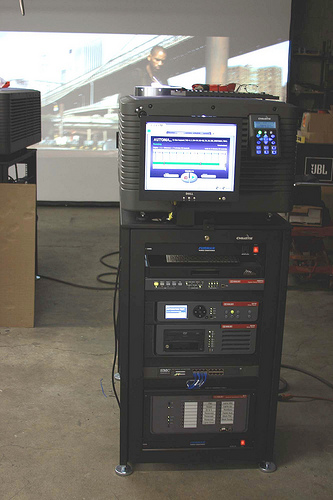
One of the more idiotic ideas I've heard about is a Chineese seat salesman also trying to sell BARCO digital projectors. His idea... er some other guys idea is to hang the projector from a hoist in the auditorium itself so the technician could lower it down to work on it. Now thats one of the dustiest/dirtiest places in any given theater and the hoist would have to be man- rated since the projector would be hanging over people sitting in the room. Not to mention the blower noise the projector generates... HAving been involved in much stage work when I was at GTS I can say that man rated hoists of any capacity are extremely expensive to buy and install. They also have to be installed by a certified rigger who is competant at this type of work in order for liability insurance to have any meaning or effect if something goes wrong.
Anyway we have worked out one scenerio for a customer doing digital that just involves an 8 foot wide hallway instead of a large wide booth type of affair. The 8 foot hallway is ALOT less expensive than 14 man rated lifts installed! There are no platters and such and assuming CP-2000 projectors or ZX's its just wide enough at 8 feet to meet code. A little wider would be better but is not necessary.
Another serious consideration to take into account is the fire control system in the booth. Does one want a typical water pressure fire extinguishing system or something else similar to halon? Water needless to say isn't good for electronics. Sure it may all be covered by insurance but how long will that take to process and then replace the waterlogged gear??? Alot of lost revenue could be involved there while the theater is shut down for many weeks.
Mark
Posted by Kenneth Wuepper (Member # 1174) on 04-22-2008, 10:09 AM:
Mark,
How long can you safely operate that projector without the additional venting stack connected and operating?
KEN
Posted by Mark Gulbrandsen (Member # 72) on 04-22-2008, 01:25 PM:
Not very long with a 3kw running in it. We actually had a blower sitting on top... I pulled it off for the photo.
Mark
Posted by Darryl Spicer (Member # 711) on 04-22-2008, 01:59 PM:
I will agree, projection booths won't and shouldn't disappear. If anything for security and safety issues, but they will get smaller as Mark suggested in his above post about the eight foot wide hallway. Hell some booths I have been in were not much bigger than that. I had a couple of booth boxes that were barely eight feet with a platter in it. You could only get to one side of the platter it was so close to the wall.
Posted by Ron Funderburg (Member # 4561) on 04-22-2008, 05:44 PM:
I agree the booths will get smaller, they can be more logically set up (but then they can be more logicaly set up with film usually) but still you will need some kind of on site tech (for want of a better term) to check equipment, to maintain the equipment, and to do any emergency work needed.
As I have said before things will change but things will be somewhat the same.
There has to be ways to help the other than 600 owners that didn't get in on the first wave. As of this date standards have only been outlined not solidified! Small town American should be able to have their local theaters weather the current owners is savy or not!
What happens when someone new enters the business how does he get a break on new equipment or is just SOL as well. I guess then the people that enter in the business in 10 years or 20 years should have made their movie before they were out of diapers.
Posted by Louis Bornwasser (Member # 3063) on 04-22-2008, 06:09 PM:
Digital is now and will be a rich man's game.
If I can eliminate the booth, then all equipment can be put in one place in an I.T. environment. That is who will be cashing the paycheck, anyway. Architectural savings and the lack of a second floor will help pay the bills.
I am, of course, assuming that PROJECTION will pass into history being replaced by some form of illuminated screen.
Posted by Steve Guttag (Member # 268) on 04-22-2008, 07:01 PM:
The realities are right now that the server need not be next to the projector (or screen)...amplifiers need not be in the booth either.
So long as projectors are being used, then there will need to be a booth of sorts for sound isolation and perhaps some controlled air (humidity and cleanliness), if for no other theatre operation reason.
Tristan, as for platters paving the way for the modern multiplex...they were no more essential than anything else...it was AUTOMATION that allowed for people to oversee more things...this is not true of projection. In fact, an automated 2-projector/changeover multiplex requires less human intervention than the same plex running on platters.
The facts are, the platters were not brought about for the improvement of the booth, but to "eliminate the projectionist" as I have seen in old publications.
Please don't make this a reels/platter thread as there are about 4584 of those already (just do a search on my name). If you knew how many times I've heard that the platter elimintated the need for a projectionist...regardless of whether you feel it did or didn't...in the mindset of many exhibitors it did. They are the ones that systematically lowered the quality of the booth to its present state (in general...not that EVERY show sucks...but most certainly do).
Steve
Posted by Mark Gulbrandsen (Member # 72) on 04-22-2008, 07:17 PM:
quote: Louis Bornwasser
Digital is now and will be a rich man's game.
I don't quite agree with that statement Louis... When you take into account the labor savings in a large multiplex the cost of Digital is just about an even trade off for the labor over 15 years which also just so happens to be the average life of a multiplex. Daily operational cost for an average size screen... not over 40 feet wide is about the same for a film projector rnning a 3kw lamp. So no big deal there.
As for the small town guy... many I know are pretty saavy financially, many do it as a side line not as their main source of living. So I'm not too worried about them existing... they will. Really.. its up to the individual theater owner(s) to prepare themselves for digital... it's not going to come along delivered on a silver platter to anyone. There IS still plenty of time to prepare.
Steve,
Actually Dolby does reccomend a maximum cable length for the HDSDI connections although I don't remember off hand what it is... they prefer the server I believe within 50 feet of the projector... 50 feet of cable is what's provided in the cabling kit they sell. So at least with Dolby stuff placing it near each projector seems to be Dolby's preference. Perhaps the output buffers on the HDSDI line are not all too capable... who knows. If a system ONLY involves just data transmission as some upcomming servers do then you're just limited by the ethernet system you choose to have installed.
USL's idea of one "IT" room for data servers and then a data line going to a decoder contained in each projector or within the projector's base is probably the more flexible of the concepts going right now. I sincerely hope they can get DCI to accept this novel idea!! I believe the DTS D-Cinema system is also capable of doing things in a similar fashion. Will know next week when we get our first one in although we are not setting it up in a remote location from the projectors... just with a remote client station.
Mark
Posted by Bobby Henderson (Member # 840) on 04-22-2008, 11:48 PM:
Just about any data cable standard has a recommended maximum allowable length. With the kind of bandwidth HD-SDI supports it makes sense for the length to have a certain limit.
Firewire 800 never gained the popularity it should have earned, but future versions of Firewire could hold a lot of promise for many different uses -such as digital cinema. The S1600 and S3200 versions can support 1.6Gb/sec or 3.2Gb/sec speeds over 9 pin connectors and support cables up to 100 meters in length (without having any repeaters along the way). I think there's another version that incorporates a RJ45 connection.
Posted by Tristan Lane (Member # 1169) on 04-23-2008, 01:13 AM:
quote: Mark Gulbrandsen
USL's idea of one "IT" room for data servers and then a data line going to a decoder contained in each projector or within the projector's base.
If you think about it, Dolby's system is based on the same idea. The Show Player is the media block, and the Show Store is the media storage. The only connection between the two is a dedicated ethernet connection. The Show store streams the data over ethernet to the Player where it's decoded and then sent to the projector. What's to say that you couldn't place a rack of show store's in a central location? This would reduce the amount of space needed nearby the projector.
I really like USL's concept of using an off the shelf Dell server to provide the media storage and handling, while placing a compact decoder at the projector. It also seems fair to say that this could end up being the most flexible system since the destination of the media could be changed on the fly (so they say) and sent do a different house. In essence it would eliminate "transfer time" between screens since the media block just receives a different composition from the server array. It also promises to be much more reliable because should one server fail, a redundant backup is stored on another server and the data is pulled from there. At ShoWest the USL rep said that it would probably be possible for this to happen very quickly so that only a short interruption in playback would occur during a failure. There's speculation amongst people that over long distances there could be problems with data loss between the server and media block, but Fiber would resolve that issue.
Strange, I was just having a conversation with someone today about this.
Posted by Mark Gulbrandsen (Member # 72) on 04-23-2008, 08:08 AM:
quote: Tristan Lane
I really like USL's concept of using an off the shelf Dell server to provide the media storage and handling, while placing a compact decoder at the projector.
DTS also uses Dell as the base for all their servers and the nice thing is that the Poweredges are rock solid servers with an extremely good reputation... and you get Dell's 24 hour turnaround service included!. I think they're using the Poweredge 2950 as the projector server and the 6950 as the show library both Linux based.... I'll post some pics next wek when it arrives and we get it set up. Something leads me to believe that DTS and USL are collaborating on the server thing... I;m not sure who's JPEG 2000 board DTS is using at this point but it wouldn't surprise me if USL was building it for them.
Re: Dolby... Yes you could locacte them seperately if you wanted to. It just doesn't remain as flexible in my mind as the USL idea does.
As much as I love the Dolby Server one thing I really dislike is the Dolby Show Player sucking in all the booth dust and the technician cannot open it every couple of years to blow it clean again... It too needs an intake filter! Many are just going to fill up with dust eventually causing component failure. Or just having to return it to Dolby just because a fan dies or something simple seems rediclous. The Dells are 100% repairable in the field.
Bobby... I've never followed Firewire specs myself but I can almost guarantee you that D-Cinema will stay Ethernet... some of the systems here in SLC are already running on fibre based ethernet systems. As fibre ethernet cards drop in price people will lean in that direction. The fibre cable is already substantially less expensive than cat 5e copper. The connectors are about 10 bucks each though...
Mark
Posted by Louis Bornwasser (Member # 3063) on 04-23-2008, 09:19 AM:
The field repairable units are defacto-non DCI compliant since internal "changes" related to piracy are unstopable. Louis
Posted by Steve Guttag (Member # 268) on 04-23-2008, 09:23 AM:
It would make sense if USL is supplying DTS (or anyone) their JPEG2000 board. Jack told me that they designed it specifically so it could be ported to others. It was a large expense getting it going and the more of them they sell (via them or others) the better the return on the investment.
As to Dolby and the 50-foot thing...believe it or not, at the traning seminar I attended, the Dolby people claimed that their system ran best with a 50-foot cable and hence that is the length they supplied...they claimed to have inferior results from shorter cables!!!!! That only means to me that they are not adhering to ANSI/SMPTE 292 as HDSDI should be able to travel on Belden 1694/1695 up to 100-meters or so and there should not be any minimum requirements. In fact, I know some receiving devices that have problems with cables over 15-feet even though the sending device is in spec. 50-feet is going to have a very measurable drop off in the signal, period. In the many, many HDSDI cables I've made, I've never had a "too short" problem.
As for fiber...it definately seems to be the wave of the future. In some ways I'm pleased as I see WAY TOO many poorly made Cat5 (RJ45) cables with crap connectors or poorly made connections...even many store-bought cables seem to cheap out too much. Cat5 seems to have people in the mindset that "anybody can do it." There is just enough success at it to keep the theory going.
I'm surprised that fiber costs less than Cat 5 (for the cable) though...Cat5 is damn near free as it is...even WITH the copper hikes.
The problems with fibre are the cost of their connectors, the overhead of the equipment to really do fibre right, and stripping that micro-miniature sleeve off of the fiber core itself. I don't doubt that it will become easier/cheaper as it becomes the standard of "wiring" in the future though...it has already been dropping in price and there are now both cold and hot methods.
Steve
Posted by David Stambaugh (Member # 1102) on 04-23-2008, 10:52 AM:
"I am not in the industry"
Dell servers have been amazingly reliable for us where I work. I have one that's been running W2K Server since Aug. 2002 and it has never crashed, not once. Filled with Quantum Atlas SCSI drives that have been spinning all this time, lost 1 drive along the way but that's not Dell's fault. Have several other Dell servers from el-cheapo models they practically gave away, on up, and all have given extraordinarily reliable service.
Beware no-name Ethernet patch cables. I bought a bunch of cheap Cat 6 patch cables a while back, and it turned into a nightmare. The ends were apparently over-crimped such that the gold fingers were not making good contact with the panel. I ended up throwing them all in the garbage. If you deal with Ethernet patch cables a lot, get yourself a professional-grade AMP crimping tool and buy AMP RJ45 ends and you won't go wrong making your own cables. (Actually I guess AMP is now Tyco). I've tried no-name RJ45 ends and they don't work well with the AMP crimping tool.
Fiber is awesome, except for the part about terminating the ends yourself.
Posted by Ron Funderburg (Member # 4561) on 04-23-2008, 12:02 PM:
I guess the owners stance has now changed on their view of Digital. They have asked me to research how to get them in to digital. They talked to AccessIT at Showest and weren't very impressed with what they were told. The cost quoted to them were a lot higher than numbers that have been thrown around elsewhere.
Of course they are not in CBG or any other group at this time. The dollar amounts discussed included a yearly upgrade insurance fee, a maintenance fee that is well over 3 times the amount claimed here for, a percentage of pre-show slide advertising and a percentage of on screen with minimums that are rather high as well. The cost per auditorium was more than double what Mark has stated as being a goal.
I guess I'm asking if there are other groups out there doing this so we can find a group to get in with.
Posted by Bobby Henderson (Member # 840) on 04-23-2008, 02:43 PM:
quote: Steve Guttag
The problems with fibre are the cost of their connectors, the overhead of the equipment to really do fibre right, and stripping that micro-miniature sleeve off of the fiber core itself. I don't doubt that it will become easier/cheaper as it becomes the standard of "wiring" in the future though...it has already been dropping in price and there are now both cold and hot methods.
The connectors and fragile nature of cable are two big drawbacks of fibre optic cable (not to mention the cost).
We use fiber optic cable on certain LED electronic variable message center installations. It's very reliable and safer to use as a hard line connection between the host computer and message center. No worries about lightning electrifying the cable. It's also a lot faster than various wireless transmission methods.
Although Firewire doesn't deliver those 1.6Gb/s and 3.2Gb/s speeds just yet, they will eventually and even move up to 6.4Gb/s speed. The cables are simple enough for any person to handle.
Posted by David Zylstra (Member # 4230) on 04-23-2008, 03:17 PM:
Ron - I did hear that the phase 2 deployments would carry a higher exhibitor investment and VPFs for advertising/alternate content, but I did not hear about the upgrade insurance fees . . . . . I did hear from other sources that Christie maintenance might be higher than phase 1, but I didn't think it would be that high - good information for all to know though.
I know Technicolor is doing rollouts and a dealer friend of mine checked into them for one of his customers - they were close to the costs of the original AccessIT deal but with slightly higher yearly maintenance. I'm not sure who to contact for them though or what their current deal is.
I'm not sure if DCIP is locked in to just Regal, AMC and Cinemark - I heard a rumor that their talks with the studios might be stalled at the moment (total absolute rumor)
Depending on which size projector you need I think the numbers are starting to work in favor of buying equipment outright for new buildings (the new Christie M is rumored to be in the $40,000 range) - the only caveat with buying is DCI compliancy and who is responsible to upgrade any software/hardware to be DCI compliant. (I've heard that TI is a long way away from having a system that will pass FIPS certification for DCI compliancy). Long term maintenace might also be an issue with buying (i.e. 10 years out what will the costs be?).
Posted by Ron Funderburg (Member # 4561) on 04-23-2008, 03:53 PM:
David, the owner I talked to had spoken to AcessIT at Showest prior to the announcement of deal with NATO. He likewise signed a contract not to divulge details thus the rather cryptic way I had to word things.
We are trying to get figure out how to talk to Technicolor as well, which we feel might be a better deal for the smallness of our situation. We are 17 screens all together at this point and certainly don't represent any real buying power!
I have suggested we join other independents in a purchase group. Of course he is an insurance person and works on his main business more than this. The other two owners are lawyers and don't have time for research so this falls to me.
All the agreements not reveal information make it rather hard to discuss things in any detail.
I think what turned him to thinking we may have to do this was a statement from a film rep to the effect that the minute that they didn't need US prints for other markets film would dropped in the US market.
Now Technicolor and Deluxe have plants in Europe and Asia I also assume for Africa, maybe not. As far as I know the only place US prints are used beside here is Latin America and South America. So if digital makes inroads there then film would die quickly here.
Also it probable isn't called upgrade insurance it is probable an upgrade fee or upgrade fund payment but since he is an insurance man that is what he told me.
It is sort of strange all the secrecy's about the cost, I mean cars even expensive ones have the cost right on the stickers or you ask the dealer and he tells you. They don't say well let me see for you the price is x it might be y for another person.
Posted by Steve Guttag (Member # 268) on 04-23-2008, 04:40 PM:
It is odd that you choose cars as your price out in the open example...I mean, in the States, except for Saturn...there is sticker price and then there is what you can get it for. Depending on the market, a savy buyer can get a great deal or there are times when dealers can get "additional dealer markups."
Note, there ARE list prices for all of this but that isn't what people want to know...they want to know the bottom-line (their actual costs...tax, tags, title, dealer prep...etc). Well that is often a variable. One of the variables is definately the quantity of the machines you are buying.
Because the profit margins are VERY tight on DCinema equipment (compare a DCinema 2K projector to a 2K A/V projector in price)...it takes quantity of sales to make an even tighter profit margin worth while. Fortunately, there are three manufacturers competing for the same sales so some money might be better than none. However, at the end of the day, they would all like to make as much as possible on each sale.
Steve
Posted by Ron Funderburg (Member # 4561) on 04-23-2008, 06:48 PM:
Well, Steve, everyone would like to make as much as they can on every sale.
Yes there is always the a list and bottom line price but having to sign an agreement to not tell anyone anything specific about a deal is a bit odd to me. No one has ever made me sign a contract to talk to them about a car and what the asking price is or the bottom line. No one has ever made me sign a contract on DTS just to find the cost on it either.
I don't' recall every buying furniture and the salesman (or woman) telling me but you have to sign an agreement to not tell what the ottoman cost. I mean this is approaching the point that you suspect that maybe you are getting the short end of the deal and they don't want you to know that the guy that has the exact same number of screens and same equipment has a better deal.
Posted by David Zylstra (Member # 4230) on 04-23-2008, 06:53 PM:
quote: Ron Funderburg
He likewise signed a contract not to divulge details thus the rather cryptic way I had to word things.
I completely understand - I do the same thing since we have confidentiality clauses in our contracts (especially in regards to pricing) and I try to talk in generalities or numbers that have been made public by others.
So far I've only been given ballpark numbers from our dealer on pricing for digital projectors - but we are not ready to build yet and we won't waste time on firming up pricing until we know how many buildings and screens we are doing since there could be some discounts for committing to 40 screens in a year's time as opposed to only buying 1 unit.
I'd suggest calling your current projection supplier and ask for pricing as well as calling a few others for comparison (in case you think you are not getting good pricing). I think the reluctance to post any pricing information here is that some dealers may give some customers a slightly better price due to past relationships or volume. I'd suggest calling Louis B or Mark G's companies for pricing if you don't already have a good relationship with a dealer (I've heard good things about both their companies).
Posted by Ron Funderburg (Member # 4561) on 04-23-2008, 07:36 PM:
I have emailed the dealer we normally use and have made a tentative contact email to Louis though I didn't make a specific request from him yet though I plan to.
Posted by Louis Bornwasser (Member # 3063) on 04-23-2008, 07:49 PM:
Beware any deal that "won't stand the light of the day." Louis
Posted by Mark Gulbrandsen (Member # 72) on 04-23-2008, 10:46 PM:
quote: Steve Guttag
the Dolby people claimed that their system ran best with a 50-foot cable and hence that is the length they supplied...
Actually for all the Dolby Servers I've installed I made up custom HDSDI cables and they are not over 6 feet in length... no problems with this length. I know of a number of other installs with very short lengths too. From what you've said and if thats what they claim it tells me the output buffer is definately not up to standards.
I wasn't implying that today is the time for fibre although we are very close to it.. I'd say in a year or two it'll be overall as cheap and will replace copper in most situations... and yes... price the fibre cable. It is really dirt cheap. The connectors are high priced but not out of range of anyone. Its the fibre NIC's for the server and other connections involved that are expensive... now in the 100.00 price range for a 3-Com gigabyte 32/64 bit PCIx card. The price is way down from just two years ago though! I found 40 meter full duplex pre-made fibre cables on the net for 48.00 each with connectors installed... pretty inexpensive!
Posted by Ron Funderburg (Member # 4561) on 04-23-2008, 10:59 PM:
Funny thing is the phone companies were the pioneers in the fiber optic world and abandoned it because plain old copper could carry more data quicker!
Posted by Mark Gulbrandsen (Member # 72) on 04-23-2008, 11:10 PM:
Ron,
The problem isn't multiplexing a gazillion things onto the copper... the phone company is great at doing that! The problem is speed limitations of copper and distance... fibre is a gazillion times faster and can go way way further unaided. The fibre speed is only limited by the speed at which the lasers them selves can be modulated. The common fastest fibre ethernet system that exists now is the 10 gigabit of whihc the standard came to be in 2002. 10 gigabit will mean really fast movie transfers and very short load times... but we are probably 7 or so years away before the 10 gb system may be affordable. BTW: the technology for 10gb over copper does exist but its limit is similar to 1000 base ethernet or 330 feet. The switches and optical NIC cards are still very expensive.
Mark
Posted by Steven J Hart (Member # 2340) on 04-24-2008, 07:24 AM:
quote:
Funny thing is the phone companies were the pioneers in the fiber optic world and abandoned it because plain old copper could carry more data quicker!
That is funny - 'cause my local phone provider is just completing a project installing fiber into every home, every business in town. They plan to retire their copper system within a few years. The copper terminates inside our theater with a box sporting 3 modular phone type jacks and 6 ethernet ports. Maybe someday the distributors will be able to send encrypted DC content directly to the theater without hard disks.
Steve
Posted by Mark Gulbrandsen (Member # 72) on 04-24-2008, 08:12 AM:
Doesn't surprise me at all Stephen, they are doing the same thing in my town right now. hat conversion will definately clear up my slow popke DSL service once and for all but its about a year from being completed.
Those that don't know about gigabit ethernet there is a good listing of the different systems over at Wikipedia. UNder the "See Also" links at the boottom of the Wikipedia page also see the links to 10 gig ethernet and 100 gig ethernet.
Mark
Posted by Jason Burroughs (Member # 68) on 04-24-2008, 08:57 AM:
Mark,
Actually the distance limitation for 10gig on copper is more like 30 meters unless you go with very expensive Cat6a, or the yet to be approved Cat7.
Both of these are shielded cables and are difficult (though not impossible) to terminate, and the connectors are more expensive.
Like you said, fiber is the way of the future. 10gig on 50micron XG (laser optimized) is very common. Also fiber is FAR more durable and reliable than copper, in addition to being completely immune to RFI. Connectors are somewhat pricey, but comming down, and is easily terminated with pre-polished connectors. Termination with pre-polished connectors is faster than copper IMHO. In addition the cost of copper is only going to go UP.
100gig is on single mode fiber using a 1500nm. lightwave.
[ 04-29-2008, 02:05 PM: Message edited by: Jason Burroughs ]
Posted by Ron Funderburg (Member # 4561) on 04-24-2008, 12:57 PM:
Let me restate this! Several years back several Rural cooperative's removed the fiber optics from the phone poll between towns in their service areas.
The reason stated (other than they have to keep their profit margin at or under 10%) was that fiber optic did not preform well on poll set ups. 45 mile an hour straight winds with gust to 70 miles per hour were snapping the fibers inside the cables and phone and data service then terminated from either side of the break to the other side was terminated.
So they removed all the between town fiber and replaced it with large twisted copper cable. Now if they bury it they will probable go back to the fiber. One of friends that worked for one of the cooperatives felt (his opinion) that the cable gave better service for internet.
Posted by Mark Gulbrandsen (Member # 72) on 04-24-2008, 02:28 PM:
Man, I can't believe they actually hung the fibr stuff... Even in rural Utah and the desert its all hurried. I wonder if your phone company ever thought to try that.
Mark
Posted by Ron Funderburg (Member # 4561) on 04-24-2008, 03:07 PM:
Mark you must remember they are a cooperative and as such have to keep the profit margin at 10% or less. They do a lot of dumb things with most cooperative phone companies to use up the funds and then re-do them later. The problem they have in that area with burying them (no longer live there) that there are just hundreds and hundreds of miles on polls already.
Their internet service kicks hell out of anything I have had around here but the 6 months I lived in town and had cable out in the country right now not even AT&T provides service so you use either satellite or wireless. We are on wireless now it is way better than the satellite was.
but in the boonies of the OK panhandle you had ADSL (and top of the speed ADSL) at a lot less cost at nearly every farm. I lived out of town and never had a problem.
They did bury the phone cables in our area just before we moved I suspect that they switched to fiber when they did that. Of course you have to watch out for the prairie dogs, molls and other underground vermin in the area they love to chew on anything that they can!
Posted by Mark Gulbrandsen (Member # 72) on 04-24-2008, 08:00 PM:
Ron,
Or they coulda scrapped out the poles and burried the cable. Dismantling the pole system would have kept their profits way down... perhaps at a loss instead. At any rate they will be forced to use fibre and bury it in the very near future... With the soaring price of copper and high labor and length of time it takes to pole mount any type of cable it just won't make sense any longer. They may even get such a high scrap payment out of the old copper stuff that it would pay for the fibre. A lineman friend once told me that they can bury 10 times the amount of cable that can be strung on poles in a days work shift.
Mark
Posted by Ron Funderburg (Member # 4561) on 04-25-2008, 09:45 AM:
We travel back often and the panhandle is still covered with polls for telephone. Don't know when they will switch or that they aren't switching or haven't switched. I don't live there just travel there. They will do whatever they need to do it is a far better company about taking care of customers than any other communication company I have seen.
Then again if you live in a cooperative area and have their service you own the company which makes you the boss as well as the customers. I just got a payment from them I think I have one year left before they have paid me for all that owe me but I guess this could be the last one. It is smaller than the others were so it is probable the last year it was a partial year.
Posted by Tim Reed (Member # 137) on 04-26-2008, 11:01 AM:
Haha! Ron, until I saw Mark's last post, I thought you were talking about some sort of computer polling! ![[rofl]](graemlins/rofl.gif) And I couldn't make heads nor tails of what the heck you were talking about.
And I couldn't make heads nor tails of what the heck you were talking about.
It's POLE, guy, not "poll".
Posted by Ron Funderburg (Member # 4561) on 04-26-2008, 11:28 AM:
Sorry Tim! To two and too pole, poll, loan, Lone the English language is strewn with sound a likes that have no where the same meaning. Then there the words that are spelled the same and have different a lot of land, or a lot of candy. All in all the spoken word is far easier for me than the written one. I know dumb excuse.
It gets worse in my house, my wife was born in England, grew up in Taiwan, Malaysia, and Australia and uses words terms that it has taken 10 years to get use.
Posted by Tim Reed (Member # 137) on 04-26-2008, 03:42 PM:
Powered by Infopop Corporation
UBB.classicTM
6.3.1.2