This is topic Major studios in deal to convert to digital movie projection in forum Digital Cinema Forum at Film-Tech Forum ARCHIVE.
To visit this topic, use this URL:
https://ft-forum.com/ft/cgi-bin/ubb/ultimatebb.cgi?ubb=get_topic;f=16;t=000260
Posted by Laurie Higgins (Member # 4843) on 10-08-2008, 08:26 PM:
LA Times, Oct. 2, 2008
Major studios in deal to convert to digital movie projection
The agreement to help defray the cost of the $1-billion switch ends protracted squabbling with theater chains over who would pay for it.
Digital cinema took a major leap forward as five Hollywood studios pledged their support -- and their cash -- to a $1-billion plan to convert old-fashioned 35-mm film projectors to more modern technology in thousands of theaters throughout North America.
A consortium of major theater chains announced the deal Wednesday, signaling an end to the protracted squabbling over who would pay to convert 20,000 screens to digital projection. The deal announcement was timed to coincide with ShowEast, a major trade show for theater owners and the studios that opens Oct. 13 in Orlando, Fla.
"It's the first tangible, major step towards a very widespread conversion to digital projection in the United States and Canada," said Travis Reid, chief executive of Digital Cinema Implementation Partners, a joint venture owned by theater giants AMC Entertainment Inc., Cinemark Holdings Inc. and Regal Entertainment Group.
Until recently, News Corp.'s 20th Century Fox and Viacom Inc.'s Paramount Pictures had been the sole studios signed on to help finance the conversion. With Wednesday's announcement, Walt Disney Motion Pictures, Universal Studios and Lionsgate Films added their backing. People close to the situation say the two remaining major studios, Warner Bros. and Sony Pictures, are in discussions.
The five studios agreed to help defray the estimated $70,000-per-screen cost of the digital conversion by paying the theater consortium a "virtual print fee" of $800 to $1,000 per film, per screen. That amount is less than the estimated $1,100 to $2,100 it costs studios now to strike and distribute a film print.
These financial commitments -- along with the promise to supply theaters with digital "films" -- were the critical mass the consortium sought to raise $1 billion on debt markets, in a financing package led by JPMorgan Chase & Co. and to be paid over eight to 10 years. The chaos on Wall Street, however, makes uncertain how quickly the funds can be raised.
"We still hope and believe it's achievable to finalize the financing in the fourth quarter of this year," Reid said.
Julian Levin, executive vice president of digital exhibition for 20th Century Fox, acknowledged that the recent turmoil in the credit markets is cause for concern.
"I'm hopeful that the financial climate will get stabilized, [and credit] will loosen up a little so that the funds can flow and become available for the conversion," Levin said.
The studios have pushed for the change for nearly a decade. Digital projection would eventually save the industry as much as an estimated $3 billion a year on the cost of making and distributing films, a process that is little changed since the days of silent-film stars Mary Pickford and Buster Keaton.
"That's a no-brainer money savings," said Lloyd Walmsley, an analyst with Thomas Weisel Partners.
Digital projection would also hasten the deployment of 3-D in theaters.
Studio executives have embraced the technology, saying it offers a new viewing experience that's compelling enough to coax people out of their living rooms and staunch declining theater attendance. Indeed, Walt Disney Co., 20th Century Fox and DreamWorks Animation SKG each have committed to releasing upcoming animated films in 3-D.
Three-dimensional movies, such as Disney's recent "Hannah Montana & Miley Cyrus: Best of Both Worlds Concert," brought in $31.1 million its opening weekend -- and it was released only in 3-D. Theaters can also charge a premium for tickets, something they have so far been able to do only at the concession stand. Nonetheless, some dismiss the technology, first popularized with in the 1950s with the spear-in-your-eye jungle flick "Bwana Devil" as cinematic novelty.
"Simply put, it's not a gimmick," said Chuck Viane, president of domestic distribution for Walt Disney Studios. "It is truly a medium by which filmmakers can bring life to their movies and enhance the actual experience."
Posted by Mike Blakesley (Member # 26) on 10-08-2008, 09:36 PM:
I still wish somebody would explain why a studio can't pay a "virtual print fee" for an independent theatre. Why do you have to be a gigantic chain to make that happen? It's just a matter of bookkeeping, and they are already processing individual theatres' film rentals, so what is the #$%& problem?
I obviously don't expect to get the same kind of "deal" the big guys get - but to be shut-out completely is just unfair.
Posted by Joe Redifer (Member # 3) on 10-08-2008, 11:30 PM:
Sorry Mike, but everyone hates independent theaters with a passion. Your failure is the goal. You'll just have to go out of business. Bye!
I agree, it really sucks for independents. You probably won't find THIS issue brought up in a rag like Box Office.
Posted by Mark Ogden (Member # 43) on 10-09-2008, 03:16 AM:
Mike: Have a look at this (pdf file) and then at this.
Posted by Tristan Lane (Member # 1169) on 10-09-2008, 11:53 AM:
Mike,
Why do you get the idea that you are shut out? AccessIT was happy to offer our independent 8 screen theater the deal. I would go strait to Christie/AIX and speak with someone there about conversion (if you are truly looking to)
I also thought that you were a member of CBG. Didn't they strike a deal with AccessIT as well?
Posted by Todd McCracken (Member # 4718) on 10-09-2008, 01:49 PM:
The contact at AccessIT for this would be Diane Anselmo. Feel free to give the NOC a call at 1-888-367-2360 if you would like to be put in touch with her.
Posted by Frank Angel (Member # 248) on 10-09-2008, 02:01 PM:
quote: Laurie Higgins
"Simply put, it's not a gimmick," said Chuck Viane, president of domestic distribution for Walt Disney Studios. "It is truly a medium by which filmmakers can bring life to their movies and enhance the actual experience."
Simply put, the Mouse should think before it speaks. Another one of their execs also made a pronouncement that proved to be totally wrong (Cook said that 1.3K digital was "good enough" -- clearly he knew not of what he spoke). And so is this statement. Simply put, 3D is a gimmick. As much as I love 3D, it seems that it is not a natural way people like to watch movies. And someone needs to remind Viane that 0the 3D novelty made THE HOUSE OF WAX a huge blockbuster hit in its day, much like HANNA MONTANNA and I would even bet money that pulled in a lot more total number of people than HM.
As much as those 50's 3D titles were wildly successful, that didn't turn out to be the good yardstick by which you could have predicted how much staying power 3D would have. The hard fact is that inspite of its initial popularity, 3D was dead in a matter of just a few years. Imagine how really screwed all those exhibitors must have felt after they were left looking at their silver screens and selsyn motors once it was clear that the studios and the public were finished with 3D.
Today the economic stakes are much higher with these digital installs. To say that 3D is the reason to invest in them seems foolish. Not that there would be other reasons an exhibitor should consider investing in digital, but 3D alone is questionable.
Also, let's not forget that we are in an economical situation at this moment in time where squeezing that estimated 1 BILLION dollars out of banks may be a lot harder than anyone thinks, no matter how much the studios drool over the prospect of an all digital world.
Posted by Mike Blakesley (Member # 26) on 10-10-2008, 01:31 AM:
quote: Tristan Lane
Why do you get the idea that you are shut out? AccessIT was happy to offer our independent 8 screen theater the deal. I would go strait to Christie/AIX and speak with someone there about conversion (if you are truly looking to)
I'd just never heard of any indies being offered the VPF deal before. Maybe it's just because only the chains get any coverage in the media. CBG did make a deal with AccessIT but there's been scarce news as to the timeline of when things are going to happen.
There has been talk of used equipment for smaller exhibs, which I hate the thought of. The idea of buying a piece of equipment that has been operated by teenagers in a Carmike for 6 shows a day is not a pleasant thought.
I expect there'll be news after ShowEast. But if it's possible for an indie to work a deal for VPFs, I'd definitely be up for considering that. How come my friendly dealer (hint, hint Mark) hasn't been in touch about this!? ![[Wink]](wink.gif)
Posted by Monte L Fullmer (Member # 2797) on 10-10-2008, 04:30 AM:
quote: Mike Blakesley
The idea of buying a piece of equipment that has been operated by teenagers in a Carmike for 6 shows a day is not a pleasant thought.
I wouldn't worry on that one. When it's time to do the purchase, I'd ask for two things: 1)a full history on that unit and, 2) request a full shakedown to ensure 1000% operational quality since it's gonna be the largest investment you've ever taken.
If your requests can't be made in full, then it just wasn't the time to move forward yet with this new venture.
You'll be okey in either choice since you know you have excellent service from CLACO in the past and you know that aint gonna change any.
quote:
hasn't been in touch about this!?
...just keeping neutral until someone asks...
-Monte
Posted by Mark Gulbrandsen (Member # 72) on 10-10-2008, 09:21 AM:
quote:
I expect there'll be news after ShowEast. But if it's possible for an indie to work a deal for VPFs, I'd definitely be up for considering that. How come my friendly dealer (hint, hint Mark) hasn't been in touch about this!?
There is no interest by the studios to do the VPF's on a per theater basis. I will reiterate... the AIX deal is not really a very good deal IF YOU READ BETWEEN THE LINES!!! Some of our indie operators are either just purchasing or leasing their own gear. Dolby is doing a direct lease for gear as well but you are required to purchase the 3-D part of it. Any single screen theater making decent numbers can certainly afford a $1200 a month lease for say 5 years... then for a small percentage of the value of the gear at that time you can purchase the gear or continue on with a new lease and get all new gear if you're nervous about obsolescence... ALso remember that Christie does sell extended warranties on their gear in 2 year additional increments up to an additional 4 years max.
There are 30 films being released in digital 3-D over the next 2 years including reissues of all the Toy Stories and many new productions! 3-D sites typically make anywhere from three to 14 times the gross of their 2-D counterparts ![[thumbsup]](graemlins/thumbsup.gif) .
.
Mark
Posted by Steve Guttag (Member # 268) on 10-10-2008, 06:19 PM:
With Access IT's dwindling stock prices...it isn't the theatres that should be worried about affording the equipment!
This is what it has been looking like...even before the current banking woes:
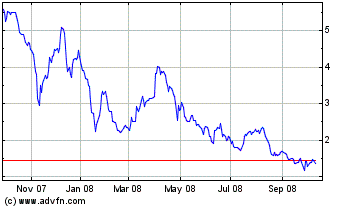
I remain skeptical about how all of this will turn out given the current financial situations...banks don't even want to lend banks money.
While I believe that 3D is once again a fad that will come and then go...it is true that those that want to see the stuff in 3D will pass by a 2D theatre (film or digital). It makes sense, for the moment, to have a representative number of 3D screens available while the trend is upon us. It isn't like these 3D theatres can't also play normal 2D features too so the investment will be mostly paying for itself on every show.
Steve
Posted by Frank Angel (Member # 248) on 10-11-2008, 02:27 PM:
So not only will we be stuck with 2K level digital, but with silver screens for 2D presentation.....just one compromise after another.
Posted by Steve Guttag (Member # 268) on 10-11-2008, 02:47 PM:
Frank,
You can always use Dolby Digital...keep your white screen.
3D has always been about compromises....nothing new there.
Steve
Posted by Mark Gulbrandsen (Member # 72) on 10-11-2008, 04:44 PM:
quote: Steve Guttag
3D has always been about compromises....nothing new there.
Not for much longer... the new T.I. chips are being demoed at Showeast and will be shipping in Christie ZX's by November and CP-2000's by December. That will allow a much higher light levels and resolution to hit the screen. Look for 30+ movies to be released in 3-D over the next two years.
Mark
Posted by Steve Guttag (Member # 268) on 10-12-2008, 07:21 AM:
Bullshit Mark....3D remains about compromises.....it is still a fad/gimmick. It does not really add anything to movie except a novelty.
If you go with Real-D or other Silver Screen requirement, you necessarily compromise the image for both 2D and 3D as you will never have uniform illumination. If you have enough brightness for 2D, then you don't on 3D.
Of the 3D systems I've seen...Dolby has the best chance, IF, all movies are in 3D. You can get the light levels right, if they are timed that way though at the moment you are not supposed to go above 5fL. However, 3D is such a light hog (and the new 1.2" chip set won't do anything about that...it just stops DLP's contribution to the light loss). There is still going to be a nearly 10:1 difference between 2D and 3D light levels (how much extra light the 3D system needs to put out versus the 2D system) in order have each system properly balanced and no lamp can do that on the fly.
Shoot, Dolby even recommends high-gain screens (1.7ish)...so much for light uniformity. I rarely if ever go above 1.3 gain and only then with Stewart Screens (Ultramatte 130)...not many conventional theatres use (or can afford) Stewart screens. The exception for me is if I am allowed to curve the screen...then I'll use a 1.5-1.8 gain screen with the curve designed to even out the light. I recently measured a typical theatre grade screen with a 1.4 gain....HORRIBLE light distribution. Conversely...I just completed a screening room (film and digital)...screen gain was 1.0....VERY good light distribution...film or digital.
Steve
Posted by Gordon McLeod (Member # 33) on 10-12-2008, 08:09 AM:
quote steve "it is true that those that want to see the stuff in 3D will pass by a 2D theatre (film or digital). It makes sense, for the moment"
Yes I usually pass up the 35mm theatre for the one that is showing it in 70mm ![[Smile]](smile.gif)
In the current ecconomy I see far more theates being converted to retail rather than spending non recoverable money for digital
Posted by Steve Guttag (Member # 268) on 10-12-2008, 08:55 AM:
Oh no Gordon...you are wrong on that one...FIRST they will convert to digital...then they will go to retail...except nobody can afford to buy things at retail either.
Steve
Posted by Brian Guckian (Member # 1678) on 10-12-2008, 01:23 PM:
quote: Frank Angel
As much as those 50's 3D titles were wildly successful, that didn't turn out to be the good yardstick by which you could have predicted how much staying power 3D would have. The hard fact is that inspite of its initial popularity, 3D was dead in a matter of just a few years
Gentlemen, one word...(adopts unfathomably deep voice):
A V A T A R
Wherein Cameron has pushed the envelope of the format from gimmick to serious artistic medium (so they're saying) ![[Razz]](tongue.gif)
Posted by Mark Gulbrandsen (Member # 72) on 10-12-2008, 02:38 PM:
quote: Steve Guttag
it is still a fad/gimmick. It does not really add anything to movie except a novelty.
I certainly don't see this time round as a fad... there are way too many companies involved in it for the long term. T.I. has spent millions making the full DLP chip happen, THE DLP that you predicted would disappear sometime soon... Either of the 3-D systems are so easy to implement and at least with Dolby 3-D there isn't any compromise with color... I've never considered anything that required a silver screen to be very viable in the everyday movie biz... and hence don't consider the Real-D System a viable 3-D system for every day theaters many reasons both technically and economically...
quote: Steve Guttag
Shoot, Dolby even recommends high-gain screens (1.7ish)...so much for light uniformity.
Sure.... to keep lamp sizes within realistic limits. However do not forget that the screen in Dolby's screening room is a 1.0 gain ... brand new in fact... and it works just fine with their 3-D system. The use of the full DLP brings matte white more into play for smaller screens.
All in all I certainly see this as being a very similar fad as 70mm 6 track was... in fact I'll go so far to say that 3-D is replacing 70mm 6 track as the format of the future. It isn't going to be all movies but it'll be there for special releases just like 70mm used to be. Just because you don't like it and it doesn't meet your specs doesn't mean the general public doesn't like it.
Having seen many 3-D clips at Dolby's screening room last week of both old, present, and upcomming stuff as well as the PACE demo film I'd say we are in for a very interesting and fun ride!
Mark
Posted by Tony Bandiera Jr (Member # 2365) on 10-12-2008, 03:51 PM:
Great, now we get to see the ![[bs]](graemlins/bs.gif) movies so light on story that they would float away in 3D and
movies so light on story that they would float away in 3D and ![[dlp]](graemlins/dlp.gif) !!!
!!!
Until Hollywood grows a pair of bollocks and starts making movies with substance in story and acting this whole industry is going down the crapper soon.
I am so glad that I'm getting near retirement so I don't have to endure the much longer...
Posted by Bobby Henderson (Member # 840) on 10-12-2008, 04:50 PM:
Any movie presentation format that does something different will be dependent on popular movies to survive. I think that is what ultimately killed the use of 65mm photography by 1970. Too many bad movies were associated with it. Far and Away wasn't a very good movie either. If it had been a major hit, we may have seen more movies filmed in 65mm afterward. The success of The Dark Knight is leading at least one more other movies to copy the gimmick of filming certain parts in IMAX. I would prefer to see an entire movie filmed in IMAX, or just 5-perf 65mm.
Once a certain process becomes popular enough, just about any movie will use it. Back in the early 1990s most movies merely had stereo prints. Today, it's very rare for any movie to be released without a 5.1 digital audio mix.
Most movie productions now use digital intermediate instead of old fashioned photo-chemical color timing. The use of DI makes it easier to supply digital cinema equipped movie theaters with JPEG2000 movie files and create AVC or VC1 copies to use on Blu-ray.
3D will only survive if hit movies make use of it. Back in the 1980s most movies that used 3D were pretty bad quality movies. There weren't any blockbusters using 3D back then. Odds are different with digital 3D. There's a lot of movies planned for 3D release. At least some are bound to be big hits.
As to which system is more practical, the install numbers suggest Real-D as being the one most theater companies prefer. Dolby 3D doesn't need a silver screen. But the theater has to buy and maintain those glasses. It cannot be cheap from both the equipment and labor standpoint to clean those glasses for every show. And the theater is going to lose a certain amount of glasses to customers.
The biggest problem I see with either 3D system is they don't work on large theater screens (unlike IMAX 3D).
Posted by Mark Gulbrandsen (Member # 72) on 10-12-2008, 05:12 PM:
quote: Bobby Henderson
The biggest problem I see with either 3D system is they don't work on large theater screens (unlike IMAX 3D).
Actually they can work on much larger screens but the 3-D exaggeration effect really comes into play on close ups. There is also a light level problem but a stacked system can deal with that problem.... and in one of three ways too!
With the ability to do an outright purchase and have no yearly contract obligations and the price reduction on the Dolby glasses to a low of about 27 bucks and the cycle number having gone way up to somethng like 450 cycles(they now claim) the Dolby works out to like 20 cents per cycle including cleaning and so on. Real-D is still at .75 cents a set of cheapo plastic glasses... so you do the math and decide which one is the cheaper. Also, any complex that installs Real-D cannot by contract install anyone elses 3-D system for a ten year period.
Mark
Posted by Tony Bandiera Jr (Member # 2365) on 10-12-2008, 07:31 PM:
quote: Mark Gulbrandsen
Also, any complex that installs Real-D cannot by contract install anyone elses 3-D system for a ten year period.
Mark, that statement is one reason why I am so opposed to this whole mess. It's a throwback to the days of monopolies and the idea that I cannot choose to install someone else's equipment is counter to good business practice.
It's like saying that if I buy Christie PG-35's I cannot install a Century JJ or Norelco AA in my largest house to have 70mm capability.
Again, like I stated in another thread in regards to some theatres signing up for Sony's 4k machine, anyone dumb enough to lock themselves into an exclusive contract deserves to get ![[sex]](graemlins/sex.gif)
Posted by Mark Gulbrandsen (Member # 72) on 10-12-2008, 10:01 PM:
Exactly Tony! That was my point.. its easy to see that Dolby is the clear winner on the 3-D front... and with no strings attached.
Mark
Posted by Bobby Henderson (Member # 840) on 10-12-2008, 10:55 PM:
I wouldn't be declaring Dolby the 3D winner until they're actually outdoing Real-D in installation numbers. Real-D is making deals with Cinemark, Regal and others with orders numbering in the hundreds or even well over a thousand. Dolby needs to make similar deals and announcements with other theater companies.
quote: Mark Gulbrandsen
With the ability to do an outright purchase and have no yearly contract obligations and the price reduction on the Dolby glasses to a low of about 27 bucks and the cycle number having gone way up to somethng like 450 cycles(they now claim) the Dolby works out to like 20 cents per cycle including cleaning and so on. Real-D is still at .75 cents a set of cheapo plastic glasses... so you do the math and decide which one is the cheaper.
You're leaving out a couple of factors.
The theater has to install whatever kind of sanitizing / cleaning equipment is needed for cleaning the glasses. If the theater has to install something along the lines of an industrial quality dish washing system not every location will have the space available for that gear.
Worse yet, you need theater employees standing at the exits to collect the glasses at the end of each show. That isn't much to ask at large theater locations. The average 8 or 10 screen complex is going to be run with minimal staff. Those places may need at least another person or two on payroll for the collecting and cleaning glasses duty. That's going to add up a significant amount of cost, perhaps enough to sour the theater's attitude on the deal.
Posted by David Zylstra (Member # 4230) on 10-12-2008, 11:48 PM:
quote: Mark Gulbrandsen
its easy to see that Dolby is the clear winner on the 3-D front
My jury is out for 3-5 years before I declare who wins, many factors have to play out before I decide the winner (in my own opinion, of course) - i.e. 100% compatibility with ALL servers/projectors, who pays for the disposable glasses, removing any 3D upcharge from film rent, consistent number of yearly 3D releases, how many more 3D display products come out, cost effectiveness of scaling to multiple screens, etc.
quote: Mark Gulbrandsen
so you do the math and decide which one is the cheaper.
I did and at our moderately attended 10 screen my estimates show that RealD shows profit in year 2, Dolby shows profit in year 3 (but does not catch up to RealD in accumulated profit until year 6). When I add a second 3D screen RealD shows profit in year 3 but Dolby takes until year 6 to show profit.
quote: Mark Gulbrandsen
Also, any complex that installs Real-D cannot by contract install anyone elses 3-D system for a ten year period.
That's only true if the exhibitor signs a 10 year contract.
quote: Bobby Henderson
3D will only survive if hit movies make use of it.
Exactly! Hopefully we will see more if/when DCIP gets Regal and Cinemark's digital projectors installed.
I wonder how the current financial "crisis" will affect DCIP and AccessIT's ability to get the financing they need.
Posted by Louis Bornwasser (Member # 3063) on 10-13-2008, 06:04 AM:
Never overlook the "cheap" factor. I'm talking about initial start up costs. Quality is not now, nor ever will be, a factor. Louis
Posted by Lyle Romer (Member # 1266) on 10-13-2008, 08:04 AM:
We are changing from Dolby 3D to Real-D at an 8 plex due to the rate we lose glasses. Customers seem to have been conditioned by Real-D that they are entitled to keep the glasses. Even one extra staff member isn't enough to get them all back every show.
If Dolby came up with disposable glasses or sub $10 glasses then the issue would go away but even at $27 Real-D works out better especially when at least one studio charges film rental on a Dolby 3D upcharge (warner).
Posted by Bobby Henderson (Member # 840) on 10-13-2008, 09:55 AM:
quote: David Zylstra
My jury is out for 3-5 years before I declare who wins, many factors have to play out before I decide the winner (in my own opinion, of course) - i.e. 100% compatibility with ALL servers/projectors
I'm pretty sure Dolby 3D works only with the Dolby Digital Cinema system. Real-D works with a variety of servers, including Dolby Digital cinema servers.
Posted by Mark Gulbrandsen (Member # 72) on 10-13-2008, 04:05 PM:
David,
I don't think you've looked at Dolby's pricing lately and its obvious you have also not looked into Dolby Direct where you end up getting the gear at Dolby Distributer cost... but I'm certainly not pushing you to go around your dealer! You have a contract with Real-D and you're stuck with them at what ever sites you've installed it for the duration of your contract. How one can ever declare any profit from Real-D is beyond me since you never actually "own" the equipment. Weather the yearly RD fees are burried in your Access-IT program or not the fact stands that no one can own outright any Real-D systems. They are simply not for sale. The 20 cent per cycle cost for the Dolby glasses was including cleaning the glasses and amortizing the washing machine to wash them... the doorway detectors... and the electricity... and the labor to collect them. And you don't have to purchase a room full of glasses to get them at that low 20 cent price as you would have to with Real-D glasses where you'd have to buy upwards of 50K pairs at once!
If you take the cost of one pair of glasses... at 27.95 and divide that by 400 cycles that works out to just under 7 cents per cycle on just the set of glasses so I think you can see the 20 cent figure including the machine, power and labor is well in line. Several of my customers have done the math and it clears out way ahead of Real-D's glasses cost.
Then take the huge disadvantage of Real-D's need for a silver screen that typically costs you 4 to 6 times the price of a mid-gain screen and they have about 1/4 the life span. Another really big disadvantage! Also realize that no chain is going to replace those silver screens.. they will hang for the same duration the normal white screens are up! Yucko!
All in all Real-D doesn't make any sense at all... You're always paying for it in some way or other weather you realize it or not, The quality is lousy because of the directional characteristics of the silver screen, and in the end you have nothing to show... you don't own it! All thats happened is Real-D has made gobs of $$ off of you.
Those who loose glasses can be the only ones to blame, you probably also don't have any ushers that actually help your patrons find seats or correct theater screens, you probably have a very low quality-shoestring type of operation. Really, its no big deal to install the detectors at the doorways nor are they expensive... the part that sets your alarm off is built into every pair of Dolby Glasses.
Mark
Posted by James. R. Deeter (Member # 837) on 10-13-2008, 05:34 PM:
Who orders 50,000 pairs of Real D glasses at once ???
We never have although I'd love to have that kind of attendance per film ![[Big Grin]](biggrin.gif)
Posted by Mark Gulbrandsen (Member # 72) on 10-13-2008, 06:34 PM:
James, My point was that you'd have to order that many to get a low enough price to be able to compete with the per cuycle pricing of the Dolby glasses.
Posted by David Stambaugh (Member # 1102) on 10-13-2008, 06:37 PM:
I'd love to see the math comparing *all* the costs. I find it Real hard to believe that Dolby's expensive glasses and all the attendant hassle of collecting them, installing and operating the sanitizing sytem and purchasing supplies for it and water and electricity, calling a plumber when the drain clogs up, perhaps lost shows if the dishwasher breaks down, the inevitable loss/theft, etc., works out as a better deal than Real D's 70 cents per pair, which you get to mark up 4x and you're done with them.
Posted by Mark Gulbrandsen (Member # 72) on 10-13-2008, 08:33 PM:
Everyone's forgetting that you also charge extra for Dolby 3-D or is everyopne here offering it for free. Basically you can charge the same "extra" as would be charged for Real-D or what ever the show you are running allows you to charge.
Mark
Posted by James. R. Deeter (Member # 837) on 10-14-2008, 01:28 PM:
and when you upcharge, the Real D glasses are free ! No added expense at all.
Posted by Mark Gulbrandsen (Member # 72) on 10-14-2008, 11:40 PM:
quote: James. R. Deeter
and when you upcharge, the Real D glasses are free ! No added expense at all.
James,
Thats a Duh Ahh thing. Of course its a wash on the cost of the glasses... my point being that the theaters have to buy the glasses and front the cost no matter what the system. they eventually get that cost back when they sell all the glasses or in the case of Dolby's they get through the rated number of cycles(re-uses). The big difference is that to get down to the cost per cycle of the Dolby Glasses the theater would have to front alot of $$$$ to buy a ton of Real-D glasses. Normal cost for Real-D glasses is about .75 per set while the cost per set of Dolbys if you look at it per cycle since they are reusable is 20 cents. The color quality in the picture is also miles ahead of Real-D!!
Mark
Posted by Lyle Romer (Member # 1266) on 10-15-2008, 09:16 AM:
quote: Mark Gulbrandsen
Those who loose glasses can be the only ones to blame, you probably also don't have any ushers that actually help your patrons find seats or correct theater screens, you probably have a very low quality-shoestring type of operation. Really, its no big deal to install the detectors at the doorways nor are they expensive... the part that sets your alarm off is built into every pair of Dolby Glasses.
Mark, Please don't asssume things you don't know. First of all there are two issues lost glasses and broken glassses. You see, kids like to play with the glasses also and break off the arms.
Second, let's think about labor for a second. In the NY market an usher (including workers comp insurance, disability insurance, employer share of FICA) is $8.00+ per hour. You need an extra usher for glasses collection which is 2 hours at least per show. That's $16+. If I have a half full show of 100 people, that is .16 per person just to deal with the glasses.
But the big cost is the glasses themselves. Sure, if a pair really lasted 400 cycles the numbers work out great. One issues is that you need to have at minimum enough glasses for your whole seating capacity. So for most shows, you have glasses sitting there that you are not using. Even if you prevented the losing glasses, you'll still get 1 or 2 broken pairs a week if it's busy. That makes it very hard to get to 400 cycles.
If Dolby had disposeable glasses for $1 they would be the better system hands down. Even the non-disposable if they were under $10 would be a pretty easy sell. But a cost of almost $30 every time some snot nosed kid decides it's fun to bend the glasses until they break is not very palatable.
Also, the main goal of 3D in my eyes is to get more people in the door for concession sales. The 3D upcharge itself is not going to be a huge profit driver with either system.
Next time you are in NY let me know and you can go check out the low quality-shoestring operation with no ushers. I think you'll be surprised and maybe you will stop making assumptions.
Posted by David Zylstra (Member # 4230) on 10-15-2008, 10:01 AM:
quote: Mark Gulbrandsen
The big difference is that to get down to the cost per cycle of the Dolby Glasses the theater would have to front alot of $$$$ to buy a ton of Real-D glasses.
A better apples to apples comparison here would be between Dolby's glasses at $27 to the re-usable RealD glasses at $3-$5 - there may be a difference in life cycle, but you can buy 5 or more pairs of re-usable polarized glasses for 1 of Dolby.
Each system out there has its technical issues, only question is which issue are you willing to accept.
Posted by Mark Gulbrandsen (Member # 72) on 10-15-2008, 01:03 PM:
David,
I have three customers that have researched it and will say you're very wrong based on the deals they would have gotten from Real-D. One customer is installing three Dolby systems. Second it doesn't take a whole fleet of people to take care of the glasses, face it... it's a dishwasher and it's automatic! It is generally some ushers secondary job... It takes alot less labor and time than you obviously think it does. Here in SLC over three locations since the emergence of Dolby 3-D they've had one broken pair(a lens popped out) and they lost one pair. Thirdly, it's also about quality...3-D suffers badly as it is... why make it worse with something like Real-D... the Dolby glasses have curved lenses of high quality, no need for a silver screen, and excellent coloremetry.
I guess those that really don't give a crap about quality will be the ones using Real-D.
Mark
Posted by Scott Norwood (Member # 30) on 10-15-2008, 01:24 PM:
I have not seen the Dolby 3D system. I have seen Real-D once ("Chicken Little"). I also do not have great 3D vision.
Is one system better than the other, cost aside?
How does the 2-projector DLP system work? Does it use regular linear polarizers and cardboard glasses like 35mm 2-strip 3D?
Posted by Mike Blakesley (Member # 26) on 10-15-2008, 01:27 PM:
I remember when 3-D was a big deal in the '80s. I wanted to get it - because a lot of movies were coming out - but we couldn't afford it. So we lived without it, and the fad died, so I figured we'd saved a ton of money.
Now the situation is repeating itself but slightly different because the movies are definitely more high-profile this time. I would like to get 3-D again, but we still can't afford it, so we get to wait until it shakes down to the point where either there is only one major player, making the 'which-system' decision easy, OR the fad dies out again. Maybe both will happen.
Sometimes it's nice to be a small exhibitor. You guys have fun sorting this out, all right?
Posted by Mark Gulbrandsen (Member # 72) on 10-15-2008, 02:18 PM:
Scott... here you decide...
Real-D:
Re-Occuring lease fees every year
Needs silver screen... directional and poor coloremitry.
10 bit color.
Cheap glasses with non-optical quality flat polarizer filters
D-Screen in front of lens can get askew and cause ghosting.
Glasses are non standard polarizer type neither linear nor circular...
Dolby 3-D:
You buy it you own it and the price IS reasonable.
Optical grade glasses even in the new less expensive version
Only needs a white screen to work but a gain screen helps even more. 10 bit color.
Color wheel mounts in light path of projector... usually in front of integrator rod. Nothing to go askew.
Cleaning machine similar to Dishwasher needed to sterilize glasses. New style glasses are re-usable for over 400 cycles.
You need to go see both before you decide which looks best. I've seen both many times and for me its a hands down Dolby win.
Dual Projector:
Need to be stacked to keep lenses as close to each other as possible... side by side doesn't work well.
Server puts out seperate "left eye" - "Right Eye" data one eye per HDSDI link. One eye's data feeds each machine. Color is only 10 bit. Can be either linear polarized, circular polarized or dual active Dolby 3-D.
Mark
Posted by James. R. Deeter (Member # 837) on 10-15-2008, 02:48 PM:
Mark, my point is that by upcharging for the 3-D ticket, we have never ever had to pay for any glasses from Real-D. We never have received any invoice and we get box after box of glasses anytime we run a 3-D movie in the Real-D system.
Posted by Mark Gulbrandsen (Member # 72) on 10-15-2008, 03:57 PM:
James,
In case you were not aware nothing is free... these are "for profit" companies!! I can guarantee you that you are paying and that it's Real-D thats hauling off your profit... one way or another... of course you do not pay directly when you order your glasses but... you're paying as either as part of your yearly contract or from the percentage that Real-D gets off each ticket sold. Hey that last one... thats another real disadvantage!
Mark
Posted by David Stambaugh (Member # 1102) on 10-15-2008, 05:16 PM:
quote: Mark Gulbrandsen
of course you do not pay directly when you order your glasses
I must have missed something along the way because I was under the impression from previous posts that exhibitors had to buy the Real-D glasses for somewhere around 75 cents a pair. If they in fact pay a license fee to Real-D of 75 cents per ticket, but are not invoiced for glasses, that seems like an important distinction.
Is Real-D still selling lots of new installs? And what about Dolby?
Posted by Mark J. Marshall (Member # 1409) on 10-15-2008, 05:27 PM:
quote: Mark Gulbrandsen
Color wheel mounts in light path of projector... usually in front of integrator rod. Nothing to go askew.
![[Confused]](confused.gif)
Can you elaborate a little on that, or point to a page that can? I'm still a little unclear on how the Dolby system works. It sounded like sort of an anaglyphic-type (color based) system originally. Although it sounded like the colors used were much easier on the eyes, which sounded kind of cool. Now it sounds like that's the case, except it's also field sequential in nature. Is that true?
Posted by Mark Gulbrandsen (Member # 72) on 10-15-2008, 06:01 PM:
Mark,
I will get a few pics next week when I do the installs. Basically the color wheel mounts in the light path. The wheel is servo driven and refrenced to a signal available on all projectors GPIO port(at least something is standardized!). The wheel although it looks colored more closly resembles a lamphouse heat filter. The differeing sections divide the light into different left eye-right eye color frequencies and the DLP chips are normally triple flashed with a little bit of dark time to act as a buffer. The cool thing is Dolby's will actually work at three different flash frequencies... But it gives the least artifacts and headaches(none actually) at triple flash. Double flash is rarely done... only in some instances if one needs more light. The actual output light itself is measured with the aid of special test patterns and a calibrated set of filters similar to the filters in the glasses and color space ends up being precisely exact. The wheel automatically drops in or out of the light path as needed for 2-D or 3-D based on how your automation is set. BTW... There are something like 30 thin layers of coating on that glass wheel! The coatings themselves have to be very precisely layered for the actual system to work. Real-D material Ghost busted or not will also play back on the Dolby system just fine, but the Dolby doesn't require any ghost busting at all and since it is based on color frequency division the 3-D effect is exactly the same from every point in a given room. You can even stand right at the screen!!
Mark
Posted by Brian Guckian (Member # 1678) on 10-16-2008, 10:25 AM:
An interesting footnote BTW is that whereas cost and handling issues with the glasses is seen as a problem right now, James Cameron and others have put forward the idea that people would buy their own glasses as a lifestyle accessory, much like a pair of expensive sunglasses. That gets over the cost issue as the item is then re-positioned as a personal accessory which one just brings to the cinema whenever one wants to see a 3-D title.
Also bearing in mind the step-change advances that have been made on the production side that have established 3-D as a new story-telling medium in its own right - viz. changing the interocular distance as the equivalent of changing the focal plane in 2-D production, and manipulating the point of convergence to similarly allow the filmmaker to direct the audience's attention.
IMHO a more legit artistic and commercial use for digital projection technology than trying to "replace" 35mm...and it's more or less self-financing as well
Posted by Frank Angel (Member # 248) on 10-16-2008, 10:34 AM:
If the public doesn't tire of 3D and it does extend beyond the gimmick time-frame, theatres would be smart to sell the glasses as accessories in their lobbies. Smart manufacturers could produce "desiger" varieties so that they could be desirable in an of themselves. Could be nice money here.
As an aside, I never could figure out why theatres didn't devote more of that lobby space into merchandising boutques -- all that stuff that specialty stores with movie themes could easily be sold by the theatres themselves.
Powered by Infopop Corporation
UBB.classicTM
6.3.1.2