This is topic 3D spinning disk in forum Digital Cinema Forum at Film-Tech Forum ARCHIVE.
To visit this topic, use this URL:
https://ft-forum.com/ft/cgi-bin/ubb/ultimatebb.cgi?ubb=get_topic;f=16;t=000273
Posted by Jonathan Bodge (Member # 4072) on 11-16-2008, 04:27 PM:
I saw in a booth here in Connecticut a "Master Image" spinning disk 3d rig that sits in front of the video projector lens. Any of you seen the results with this apparatus at Showeast?
Posted by Mark Gulbrandsen (Member # 72) on 11-16-2008, 05:48 PM:
Yep, Its good but no better than any other single projector 3-D system... Two projectors still provide far better results. I'm puttn one of these in next month so I could report back then! Its also very expensive but utilizes CP glasses....
Posted by Jonathan Bodge (Member # 4072) on 11-19-2008, 06:33 PM:
I am anxious to get Marks reviews on this, I also find it somewhat humorous that in this whole wide world he's the only one who responded...can't be too popular.
Posted by Mark Gulbrandsen (Member # 72) on 11-19-2008, 07:23 PM:
JOnathan, Its quite expensive! In the mid 30's. I still feel the Dolby 3-D system is the better way to go in spite of the 7 grand dishwasher.
Mark
Posted by Frank Angel (Member # 248) on 11-19-2008, 09:31 PM:
Mark, is that dishwasher required by Dolby or can the theatre go with a more conventional washer. Surely there are commercial restaurant washers that can clean as well as whatever this uber expensive unit can do.
Posted by Tristan Lane (Member # 1169) on 11-19-2008, 09:46 PM:
Any commercial low-temp dishwasher will work.
Hell, you can use a standard undercounter low-temp dishwasher to sanitize the glasses as long as you use the proper chemicals.
We use our bar glassware dishwasher to santize the glasses. I've seen these on Craigslist for as low as 500 bucks. I DO recommend a booster heater (as dolby does) so that you avoid spotting.
Posted by Mark Gulbrandsen (Member # 72) on 11-19-2008, 10:11 PM:
Frank, I was told that there is actually a theater in Spokane doing it all by hand in a triple basin sink... but still using the proper chemicals so it meets health standards.
This dishwasher is very similar to what Dolby reccomends right down to the three chemical metering units on top.
I was told by one of our customers that the key to the whole thing is to have a 50 gallon hot water heater for what ever dish washer you use and as Tristian mentioned the proper chemicals... they should cost you under 200 bucks for the three 5 gallon pails total. They will last a very long time. The dishwasher Dolby reccomends only usees 1.5 gallons of water per cycle.
Tristian... if you could specify a model number on that dishwasher it would be greatly appreciated.
Posted by Tristan Lane (Member # 1169) on 11-20-2008, 01:13 AM:
The exact model we use is an ADS Dishmachine ET-AF
Instawares link is here
This unit is listed at 3000. Street price is less than that. I picked up a used one that I have for parts for 400.00 from a reastaurant nearby that was closing.
Any low-temp 3-chemical unit will work. As long as the water is at 160 degrees or better, spotting shouldn't be a problem if you use the rinse agent and have soft water. The chemicals specified by Dolby are a detergent, rinse-aid, and sanitizer. All traditional low-temp restaurant units use similar chemicals.
Edit: I might also add that many restaurants out there lease their dishwashers for a monthly rate and price-per-load fee with chemicals and maintenence included.
I think IN3 (the active glasses 3D company) was actually marketing a residential grade "modified" Fisher & Paykel dishwasher for sanitizing their activie glasses.
Posted by Mark Gulbrandsen (Member # 72) on 02-05-2009, 06:31 PM:
This week I installed the Master Image 3-D system along with a tech from Master Image. All went pretty well except that the DP-100 was a very early unit and it required a new card cage backplane. The Master Image needs the pulse from GPIO-1 to sync and the old backplane wasn't intended to output this pulse... pre 3-D days of 2K stuff! However, and for you people that preach the obsolescence of D-Cinema gear... BARCO graciously supplied the new backplane free of charge. Once the backplane was installed and the BARCO re-assembled (no small task), the Master Image synced right up and worked beautifully.
Build quality of the Master Image is very high and the spinning disk drive motor is direct drive and utilizes a brushless servo drive system of very high quality.
How does it compare to other 3-D systems??? I have to completely take back what I said in my post above... This is NOT EQUAL to other single projector 3-D systems... it is FAR SUPERIOR... Simply put, this is THE BEST single projector 3-D I have seen to date and also the brightest. We acheived 5.7 fl with just a 4kw cinema type lamp (not a short gap) running at about 80%. I know there are downsides to Silver Screens which this system does require but the upside of the super high quality 3-D easily makes for putting up with the silver suurface. We hung a new type Hurley "washable" silver screen at this location in preperation for this install late last year. This screen has been tested by Master Image's technical staff whom themselves are involved with testing every toher 3-D system out there for DCIP.. in short they are way overqualified to do this sort of testing. Their conclusion was very positive and even Coke spills on this screen won't damage it's surface.
So combine the new Hurley Washable Silver Surface with the Master Image 3-D system in front of a full frame triple flash projector and you'd have one killer 3-D system that easily knocks the socks off the rest of em. This one certainly does.
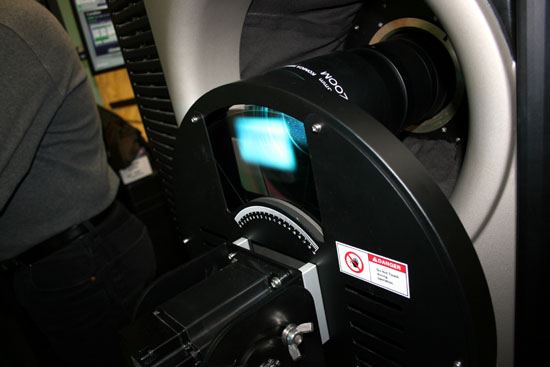
Mark
Posted by Julio Roberto (Member # 4976) on 02-06-2009, 09:09 AM:
Glad to hear a decent alternative to R€al-d exists that can use inexpensive polarized glasses.
I would imagine the ghosting to be about the same (or better) than Real-D as well. Dolby would still be champion here, but at a significant light loss and worse colour space.
And the Master Image would be cheaper too.
I would recommend this system for those not willing to go the dual-projection route until Dolby glasses come down to a price point that the profits truly offsets the inconvinience and risk.
Thanks for your report, Mark!!!!
Posted by Mark J. Marshall (Member # 1409) on 02-06-2009, 09:55 AM:
What does the spinning disk do exactly? Is it basically performing the same functions as that z-screen thing and alternating between circular polarization directions?
Posted by Julio Roberto (Member # 4976) on 02-06-2009, 11:03 AM:
quote: Mark J. Marshall
What does the spinning disk do exactly? Is it basically performing the same functions as that z-screen thing and alternating between circular polarization directions?
No more, no less ![[Smile]](smile.gif) Just a left and right circular polarizer mounted on a disc made to spin in synch with the projector so that 144 times a second the top part covers the image area in either left or right direction.
Just a left and right circular polarizer mounted on a disc made to spin in synch with the projector so that 144 times a second the top part covers the image area in either left or right direction.
And yes. It spins FAST.
How noisy is it (i.e. the engine), Mark? Obviously less than a 35m projector ![[Wink]](wink.gif) ... but just wondering if it sounds like a high speed fan or it's actually really quiet.
... but just wondering if it sounds like a high speed fan or it's actually really quiet.
Posted by Monte L Fullmer (Member # 2797) on 02-06-2009, 01:17 PM:
Have a peek on this product here.
Yet, kinda funny: First - we return to the "sound on disk" format being DTS. Second - we return to the front shutter of an old Powers 6B projector ...
..I find that a bit amusing.. ![[Big Grin]](biggrin.gif)
-Monte
Posted by Mark Gulbrandsen (Member # 72) on 02-06-2009, 03:46 PM:
quote: Julio Roberto
And yes. It spins FAST.
4320 RPM! Don't get the fingys caught in this! It sounds like a small window fan set to low speed. The disk does a LR-LR-LR polarization... as long as you have the disk on properly... or turn your glasses upside down!
It can be set to automatically sense the 72hz square wave on GPO 1. So with a BARCO for instance you can add the GPO function into the macro just for the 3-D channels. So when you go to a 2-D channel the disk stops spinning. In normal mode the disk spins fast when it gets the 72 hz wave and it slows to about half speed when it doesn't get the signal. There is an elevation mechanism to drop the disk below the height of the lens when it's not in use... but alas that part is not automatic and it moves quite slowly. There are internal limit switches to set the up/down range. Personally mounting it on a small 3 foot track system would be the way to go... and inexpensive... as you could roll it out of the way in about 5 seconds.
I now do really believe this is the best quality and most practical way to go for 3-D!
Mark
Posted by Monte L Fullmer (Member # 2797) on 02-07-2009, 02:35 AM:
On the front end of that unit, for safety protection, one could almost fabricate a set of "blinders" on each side and top of that opening..like a shroud of sorts..
Posted by Steve Guttag (Member # 268) on 02-07-2009, 10:41 AM:
FWIW...I recently did a Dolby 3D on a curved gain screen (originally about 1.5 but it now measures about 1.1. The screen is about 38-feet wide (scope, side movable masking)...After calibration...CDXL-45 lamp...5.5fL on "Flat" The projector...CP2000-SB with HighBrightness lens.
And Mark will be pleased that the Coraline people are starting to push the 3D brightness spec up a bit. They want from 4.5-5.5 rather than the traditional 3-5fL. I set it for 5.0fL and things actually looked pretty good. It didn't have a dark feel to the image that much...maybe a bit on "bright" scenes. The movie was clearly timed for this as things looked natural...well natural for a claymation movie with a gloomy story!
Steve
Posted by Mark Gulbrandsen (Member # 72) on 02-07-2009, 11:12 AM:
Actually Steve most of the 3-D stuff does look good up to about 7fl as mixed after which the colors and blacks do indeed become gradually washed out looking. I've found D-Cinema black level to be more relevant to the theater's ambient lighting than to any set specs or operating light levels though. You would have loved to spend the last few days with the person from Master Image that I did... He did all the 3-D testing and specs for DCI and the studios. You'd learn alot!
I however had to run 6kw CDXL's at 90 to 100% to get near the same light level you did and we have all the Dolby's here on 1.8 gain screens except for one which is on the new Harkness 2.0 white surface. I think our customer who leased the Dolby stuff is glad they are just leased as they are not SB projectors, but they do have the high brightness lenses! Another fact that not all digital projectors give the same results. With your SB and the Master Image you'd probably be running with a CDXL-30 at just about 80% level!
Studios want to see light levels up to the 9 to 10 fl region in the very near future... the new triple flash stuff makes that level very realistic to achieve.
BTW: You may have been better off with the CDXL-60 lamp as its only about $50.00 more and would give you tons of headroom... The CDXL's tend to fall off quickly and the headroom for the CLO is very advantageous over the 1000(+10%)hour life of the CDXL-60.
Posted by Steve Guttag (Member # 268) on 02-07-2009, 02:46 PM:
That is one thing I did have...a triple-flash projector so yes, I had a light advantage there.
As for the CDXL-60 will likely do that as the CDXL-45s are used up.
As for the CDXL-45 having fast fall off in light...not so...I've never seen a lamp like it...almost no fall off in over 1000-hours...it lumen output is about the equivalent of 5800-watts...the CDXL-60 has the lumen output of about 6600-watts. The CDXL60SB has me a bit interested...that sucker has a reflector inside the lamp! Overall, I've found the light fall off on the CDXL to be much slower than for "Cinema" lamps.
As for 3D...I'd much prefer keeping the filtering before the lens...anything after the lens becomes part of the optical system like the lens. You may be happy with it now but lets see over time. I also much prefer having it all work seemlessly and without operator intervention...Dolby's solution can have one go from 2D JPEG to 3D MPEG on the same show, if desired but in the case of mixed programming.
I also hate silver screens...I don't like their look for either 2D or 3D. I'm also not the biggest fan of 3D to begin with.
Enjoy you technology of the day.
Steve
Posted by Julio Roberto (Member # 4976) on 02-07-2009, 05:26 PM:
I vote for a dual-projection passive Infitec (Dolby) system as the "best quality" solution, but pbbly too expensive to be practical and not w/o problems (i.e. colometry, gain screen).
I see 1 projector Dolby basically tied with Master Image as a "practical solution". They both "flash". Dolby loses more light and needs colour correction. Master Image (or RealD, for that matter) adds filters in front of the optical path (instead of Dolby which does it at the light source) and needs a silver screen (although the material from Dalite is almost no-gain and lacks silver weird-saturated images).
But Master Image (or RealD) suffer from (much) more ghosting than Dolby. Also, glasses for Master Image (or RealD) are basically give-aways and not the (holy) $$$$ of Dolby.
I would pbbly recommend a dual-projection passive linear polarized system on a special (non silver) screen formulation for best image with low cost. Virtually nothing for the filters or the glasses and only having an extra projector, which is not all that costly as they can be two small-ish projectors with reasonable lamps rather than a big-bright one on the biggest bulbs.
If you subtract the cost of Dolby (or RealD or Master Image) plus the 6kw lamps + big-ass projectors ... the economics of two "4kw projectors" (2x4kw=8kw) plus $200 for filters (and very cheap glasses) is not too bad. Sure running/maintaining 2 projectors/bulbs is not cheap, but we are talking the "best quality" (reasonable) option, not the cheapest one. But owning two projectors can also have its advantages. I.e. if 3D completely dissapears for whatever reason, you are not left with a "worthless" expensive filter wheel by Dolby. You could just sell the second "extra" projector or use it in another screen or as a spare.
Reasonable (7-8fl) light levels can be obtained which would be hard with a single projector. Remember in dual-projetion an additional 7% of the light is not lost due to blanking interval plus the filters can be much brighter than a Z-screen or a circular one, while having significant (75%) less ghosting at the same time. So, generally speaking (i.e. not exactly, but you get the point), two 4kw projectors would yield the brightness, compared to RealD, of about 4kw+4kw+7%+5%=9kw while having 75% less ghosting (but the audience must be advised to keep their heads straight ... alternatively you could use circular polarization to avoid that and lose about 3% of the light plus obtain perhaps only 5% less ghosting than RealD z-screen, instead of 75%).
The screen itself pbbly has to be changed anyway for any of the systems, be silver/special for Master Image/ReadD/Dual polarized or high-gain white for Dolby/Dual-Infitec.
Posted by Mark Gulbrandsen (Member # 72) on 02-07-2009, 06:49 PM:
quote: Julio Roberto
plus $200 for filters
Show me decent CP filters large enough to properly dissipate heat that cost only $200.00... they don't exist... try more like $1200.00 a filter for 11X14 inch AR Glass size which is the minimum size the CP filter manunfacturer we used reccomended for 4kw D-Cinema and up.
Steve,
On the CDXL lamps you will see very inconsistant life spans on lamps above 3kw. I've been through quite a few of the CDXL lamps 4.5K and up so far and the larger lamps life spans are very inconsistant sometimes making warranty +10% and sometmies not. While the 3kw and down are very consistant. One thing Christie wants you do to on the larger lamps is that once they are installed you should never touch it till you change it out... I.E., no swap outs for 2-D! Repeatable arc positioning on the existing crater is near impossible.
The Master Image does integrate more or less seamlessly in Auto mode although I agree on the use of the acrylic disk... at some point they'll have to be replaced. They are relatively inexpensive though and you get two with each unit. I think that ultimately you'll also see fading of the Dolby filter wheel just as you see with IR filters. They are made in very similar ways and the Dolby wheel is going to be far more critical of the fading as to how good the 3-D works! I was told that replacement filter wheels are over a grand. The Master Image filter has to be in front of the lens as the polarizers can't take the heat given off in the optical path of any projector. You also need to check out the new Hurley Silver surface. Its quite different then any other silver I've worked with... its more gray looking then silver and there is none of that "haze" one sees with regular "sprayed" silver surfaces, unfortunately we have received one screen from Hurley that is defective.
Mark
Posted by Steve Guttag (Member # 268) on 02-07-2009, 07:08 PM:
My experience with the CDXL-45 has been rather uniform, actually. I find the lamp to be nothing short of incredible in its light and stability. At the moment, the CXL-30SC is my worst performer in terms of stability of the Christie line.
Another thing I found...rotate the CDXL-45 at 600-700 hours...it will get even more stable. And I normally HATE rotating lamps!
I don't know what to say...these are my findings thus far.
Steve
Posted by Julio Roberto (Member # 4976) on 02-07-2009, 07:24 PM:
quote: Mark Gulbrandsen
Show me decent CP filters large enough to properly dissipate heat that cost only $200.00... they don't exist... try more like $1200.00 a filter for 11X14 inch AR Glass size which is the minimum size the CP filter manunfacturer we used reccomended for 4kw D-Cinema and up.
Here there is a linear plastic 8.5" x 15" for $37 retail
http://www.edmundoptics.com/onlinecatalog/displayproduct.cfm?productID=1912
You can laminate it in glass if you want. If you want them circular, just add a $10 retarder film.
If you want to buy them already made glass circular, I've seen them in 8x8 for $120, don't quite remember where. Here is a place with all kinds, including a 6x6 inches circular glass PAIR for $465. This is for a PAIR of them, circular, glass, and for use in projection.
http://www.berezin.com/3d/filterholder.htm
First one I found with google. FAR LESS if you go straight to a polarizer manufacturer. I used to purchase full sheets (something like 4 by 2 feet) from Polaroid for like $100.
Here are acrylic, circular, 11"x15" for around $150. They also do glass, if you want, but acrylic is just as good for this use, as it's being used in the Master Image you love so much. This is full retail.
http://www.apioptics.com/circular-polarizers-spec.html
Here is a glass, AR, circular polarizer, aprox. 11"x15", 3M manufactured one for $182. Made for high resolution monitors, so it must be good optical quality. Basically satisfies your requirements, although not for the intended use, but shows it can be (easily) sold retail at those price levels.
http://www.officemax.com/omax/catalog/sku.jsp?skuId=20367381&cm_mmc=GBa se-_-Technology-_-Computer_Accessories-_-Glare_Screens_Privacy_Filters&ci_src=14110944&ci_sku=20367381
Remember in the 80's a small piece of polarizer in front of mirror boxes, prismatic adapters or even in front of split lenses (i.e. less than 3x3 inches) was taking all the heat from the (say around 3K, dual-blade shuttered) projection lamps.
Sure they suffered, but replacing them every couple of years was a good quality assurance method and at $50 or so for a pair of small linear, a good choice.
For 4KW digital, I'd say use anything glassed over 6"x8" and just change them regardless of usage every so many years. $200 each could do just fine if you know where to find them or purchase quantity from manufacturer. I just meant my $200 figure as a generic thing, plus I was referring to linear (thus the 75% improvement in extintion ratio). But you could go anywhere from $10 for a small piece of plastic linear to $1000 for a large piece of glass circular, of course.
11x14 is overkill for 4kw, but good if you want them to last for 100 years Not even RealD's zscreen is that large size, it's more delicate, retains more light (heats) than a passive filter and it's used with projectors up to 7Kw all over the country ... not even Imax 15kw used filters that big of a size ...
http://www.youtube.com/watch?v=AKr7yS9Rx6I
... still, I could do circular, glass, 11x14 for $200 easy. It's just not your average standard product that I can point to a web site with a price on it. I would have to custom make it (my cost pbbly $30-$125, depending on materials used) or custom order it to have it made for me (pbbly at quotes of less than $350 each if I order a pair).
But to be honest, this is not entirely true. Depending on the manufacturing process used in the polarizer, this would either quickly degrade with time if light is shined through it (noticeable in just a few years, useless, less than 60% as effective in as little as 3 years), or almost not at all, even if subjected to large luminous flux . Projection zscreens are made with a wire grid polarizer, so they are not anywhere nearly as delicate as those made with organic materials, iodine or dyes and can survive easily huge fluxes in small(ish) sizes.
My advice: just get a reasonable (say start at 6x8, go up to 10x12) inexpensive filter and replace it "often". Also, circular retains more light than linear due to the two optical surfaces, so it needs a bit larger area to "suffer" the same as linear. About 4-8% more, depending on manufacturing process used.
Or use a wire grid polarizer and you can have a small size and still have it last "forever". Add a retarder if you want it circular (retarders absorv very very little light ... any reasonalbe size, even the size of the lens, would cope with the flux w/o problems after the polarizer).
And at $1200 for a 11"x14" circular filter it's way too expensive ... for that price you could almost purchase a whole zscreen 13"x17" ACTIVE ZSCREEN, which includes a high quality glass circular polarizer that "alternates right and left" to cover a 21" diagonal high resolution monitor, including two pairs of quality fashion circular glasses, power supply, monitor interface, etc .... at full retail ...
http://reald-corporate.com/scientific/zscreen.asp
Honestly, a zscreen can be manufactured for PEANUTS and polarizers, specially linear, for peanut's shells. But as I've said before, manufacturing COST and selling prices are entirely different things.
I would be very surprised if the filters in the Dolby wheel don't degrade with time in the highest lamped models (where they'll be mostly used). It will depend on the manufacturing materials used, so it is NOT necessary for them to degrade, but somehow I feel they didn't go the exotic materials route.
I would also feel that the Master Image filter would degrade, but not nearly as much. They probably made the right choice of use inexpensive iodine filters and just have the wheel changed every so often. My totally wild guess: every 2-4 years of daily use on high power projectors. Since 3D movies are not a daily thing yet and not all projectors are 6Kw ... pbbly less often.
How much is the retail for the Master wheel, Mark?
For once, the Dolby baby receives the raw light and heat, absorbs around 73% of it, doesn't benefit from the 7% "black period", lives inside the "heat case". RealD-zscreen/Master-disc receive the light after it's gone through the whole optical system and lens, retains only about 58% of the (remaining) light, benefits for a 7% dark period rest, and spreads the flux over a larger lighted area while cooler outside in the booth or rotating like the Master.
[EDITED to add more websites were similar products can be bought at those price levels plus add more rant ... please, re-read the whole thing ]
[ 02-07-2009, 10:23 PM: Message edited by: Julio Roberto ]
Posted by Mark Gulbrandsen (Member # 72) on 02-07-2009, 10:07 PM:
quote: Julio Roberto
but somehow I feel they didn't go the exotic materials route.
Actually the Dolby Wheel is THE most exotic of the 3-D filters made! It has over 30 vaccum deposited layers of two different segments on the disk.
quote: Julio Roberto
I would also feel that the Master Image filter would degrade, but not nearly as much. They probably made the right choice of use inexpensive iodine filters and just have the wheel changed every so often. My totally wild guess: every 2-4 years of daily use on high power projectors. Since 3D movies are not a daily thing yet and not all projectors are 6Kw ... pbbly less often.
4 to 5 years is probably right but the degrading would be from cleaning the filter wheel, and these theaters do run 3-D all day long 7 days a week, no 2-D generally. The only thing that'll kill the MI filter wheel is if it stops spinning in the light beam.
The filters we use on dual projection 3-D systems are the highest quality available. The manufacturer we get them from is also the manufacturer of the film. They manufacture the film thats in the Z screen, and the Z Screen is not true circular by the way... its more eliptical than circular. R-D glasses won't work properly with CP filters although you do see a little 3-D.
Sorry but you can't make filters this large that are polished to quarter wave, have AR on them and peoperly laminated to just over 4mm total thickness unless you have similar factory conditions. The reason for largish filters is to spread the heat over a large area so the filters have a very long life, the glass also helps greatly to not only filter the remaining UV and IR light but also absorbs the heat before the plastic filters do. We expect a 5 year plus life fomr these filters.
Posted by Julio Roberto (Member # 4976) on 02-07-2009, 10:11 PM:
quote: Mark Gulbrandsen
Actually the Dolby Wheel is THE most exotic of the 3-D filters made! It has over 30 vaccum deposited layers of two different segments on the disk
Yeah, but interference filters can be manufactured in many ways, from polymers to vacuum deposited metals, so I was wondering what materials Infitec used for Dolby filters to gauge how much they would resist heat/flux.
I once purchase a very expensive optical product that degraded beyond usability with just aprox. equivalency of 350w xenon in only a year. Infitec has been used internally by Barco and others for years, so I know they can take around 2Kw ... but wonder if they really can take 6kw even if spinning for "ever" or would need replacement ...
Posted by Mark Gulbrandsen (Member # 72) on 02-07-2009, 10:28 PM:
quote: Julio Roberto
but wonder if they really can take 6kw even if spinning for "ever" or would need replacement ...
The dolby wheel is made of layer upon layer of vaccum deposited metals. We'll know within a couple of years time if they degrade and how fast and how badly. It will also be VERY IMPORTANT to maintain the UV filter that is the first optical flat in the light path.
Posted by Julio Roberto (Member # 4976) on 02-07-2009, 10:40 PM:
quote:
Sorry but you can't make filters that are polished to quarter wave, have AR on them and just 4mm total thickness unless you have similar factory conditions. The reason for largish filters is to spread the heat over a large area so the filters have a very long life, the glass also helps greatly to not only filter the remaining UV and IR light but also absorbs the heat before the plastic filters do.
I can source 1/8 wave AR optical glass and laminate thin films on them with necessary precission with the result of slightly over 4mm total thickness for circular if I needed to. Easier to let a polarizer manufacturer do it (as you did with Colorlink), since it's their bread-and-butter and setting up for it is not worth it unless I make a couple hundreds run.
I agree and recommend glass for the reasons you mention (additional light loss, but greater UV and IR rejection and heat spreading/absortion of additional mass, plus durability and easy cleaning), but such large size is not necessary for 4Kw, but it never hurts to go over-specs than under-specs.
We've already gone thru RealD being circular or not. All retarded polarization is elliptical, with circular being one of the cases for it. The only difference is how you align the retarder and the polarizer. You align fast/slow axis perfectly perpendicular with the polarizer and you get perfect circular. You rotate the retarder a bit ... you get elliptical ... a bit more ... more elliptical ... a bit more ... until you are back to were you started
It just means that RealD decided, for whatever technical or marketing reasons, not to align the active retarder and the polarizer to 90º, but 45º or another in-between angle. So the only problem is that the manufacturer of the glasses (colorlink) for RealD compatible systems would have to rotate the retarder to the correct angle to make the CP filter work with their Zscreen.
[ 02-07-2009, 11:44 PM: Message edited by: Julio Roberto ]
Posted by Matt Fields (Member # 3211) on 02-07-2009, 11:52 PM:
With Master Image, does the exhibitor pay for the disposable glasses? If so, how much do they cost?
Posted by Julio Roberto (Member # 4976) on 02-08-2009, 12:42 AM:
Regular standard Circular polarized paper glasses can be bought in the open market for less than $0.40 each in small quantities. I hope Master Image made the polarizing filters standard circular.
Alternatively, you can buy "theme park style" or "dolby style" reuseable plastic circular polarizing glasses for less than $4 in small quantities. You could collect them, wash them, and re-use them. If they get stolen or lost or broken, not too big of a deal ... certainly not as bad as with Dolby or Xpand
If you commision a huge run from a chinese manufacturer, certainly less than half, even 1/4th, of those prices quoted.
For those that would use a dual-projection linear polarized system, the advantages with respect to circular would be:
-Better extintion, less ghosting. About 75% improvement.
-Better transmission, more light. About 4% improvement.
-Lower filter projection costs. $200 should easily do it.
-Lower glasses cost (i.e. 30-50% less than quoted above).
Main dissadvantage: cost of two projectors (but they could be two smaller models, as the light output is more than "doubled") and the audience needs to keep their heads aligned with the screen. Those sitting too far in the corners of a wide theater or those tilting their heads towards their shoulders would quickly start seeing a lot of ghosting.
For those that think that linear is "not acceptable", please remember that most Imax 3D theaters have always been linear, same as 3D in the 50's and the 80's and all current multimillion attractions in theme parks. A little on-screen advertising reminding people not to tilt their heads is usually sufficient.
Posted by Barry Martin (Member # 1376) on 02-08-2009, 01:40 AM:
Mark, which tech were you working with and at which location did you install MI? Just curious, as I am currently employed with Bow Tie Cinemas in Hartford, CT and we had an MI 3D system put in a couple months ago. The tech I met was very friendly and was very open to answering all my questions, which were numerous. I am the first to admit I know next to nothing about digital projection as the last few theaters I worked in did not yet have digital, so his sharing time with me was most appreciated.
They did have to make a trip out to replace the motor that raises/lowers the wheel. As he explained it, they were actually putting BACK the original motors because there was an issue with the "new and improved" motors burning out.
In regards to the quality of the 3D, I whole-heartedly agree this is the best system I have seen so far. I have not had the opportunity to see the Dolby setup, but I have watched a few features in ours and could not be happier with the setup, be it 2D or 3D. I had actually been a bit unhappy about us getting digital put in at first, just because I have preferred film for so long. But once I saw this running I was hooked.
As far as the raising/lowering of the spinner goes, we did not have an issue when running Bolt as there are plenty of trailers for 3D kids movies coming out. When Bloody Valentine came out the only trailer that was supposed to be placed and was in 3D was Coraline. As it is we do not run any ads (a Bow Tie thing), so there is typically only 5-10 minutes of previews and then the feature starts. Considering most people are used to having 15-20 minutes of extra time to be late to a movie, running only Coraline for previews and starting the feature 3 minutes after showtime was a bit of a problem.
So we setup the playlist on the Doremi to start a 2D show, play the 2D trailers we had been directed to play, then set in a "black" pattern and set the cue to start the 3D show with Coraline's trailer and the feature.
This works pretty well, and has a strange little side-effect of making the 2D trailers seem to stick out a little from the screen. I would prefer to have a track system as you mentioned, but this is a 17 screen with one person running the booth at all times so I doubt that could happen.
The one thing I am trying to work out (without having to use my technician if possible) is hooking a Blu-Ray into the digital projector/sound system. We have had occasions in the past where a local festival or school wants to rent an auditorium and then had to bring their own digital projector running off a laptop since they had no 35mm copy. The projector itself is not much of an issue as there is a DVI input, but I cannot for the life of me figure out where I could get a cable that goes from the digital coaxial or optical to the I/O on the processor. I certainly don't want to use the RCA left/right I have for the non-sync and just do stereo. Eventually we are planning on using this house as a DVD screening room for off-peak hours. Any idea where I can find what I'm looking for?
Posted by Mark Gulbrandsen (Member # 72) on 02-08-2009, 08:04 AM:
quote: Matt Fields
With Master Image, does the exhibitor pay for the disposable glasses? If so, how much do they cost?
They are available from M.I., or I believe the normal Distribution method. They are large style polorizer filters in plastic frames and fit easily over your eye glasses. I don't know about the price... You'd have to contact M.I. to find out... I do know they are very inexpensive though.
quote:
(as you did with Colorlink),
No, we didn't use Colorlink... we used the xcompany that makes the polorizer film they use. There are but two polorizer film manufacturers in the States. A couple of other manufactuyrers use the silver deposited method and the filters they produce are not very large but can take tremendous heat levels. You could use 1/8 wave but it just jacks the price up more. Past about 1/4 wave flatness there is diminishing return... just like throwing money in the campfire because the entire filter assembly is so thin.
quote: Barry Martin
Mark, which tech were you working with and at which location did you install MI?
I worked with Paul. The M.I. unit is at Movies 3 in Rawlins, WY. and he did mention your theater to me. If it was Paul you worked with then you also know he more or less developed alot of Imax's 3-D stuff and then went on to do work for DCI. Paul has very likely forgotten more about 3-D than all of us here combined will ever know! Yes, we swapped out the up/down motor here too. The new motor is far smoother and much quieter... the gear ratio is much higher... so it takes quite a bit longer to go up/down as you know. That was why a track system came to mind. One could just leave the unit in the up position and in about 2 seconds just roll it off to the side for 2-D... a simple rod type plunger could lock it in place at both positions very accurately. I think however you'll find yourself in a more or less constant 3-D mode for the next two years or so.
Yes, its reccomended to run 2-D first then the "Put On Your 3-D Glasses Now" tag then the 3-D stuff. What D-projector do you have there? You may need an image scaler to make it work correctly.
Mark
Posted by Julio Roberto (Member # 4976) on 02-08-2009, 09:28 AM:
quote: Mark Gulbrandsen
No, we didn't use Colorlink... we used the xcompany that makes the polorizer film they use. There are but two polorizer film manufacturers in the States. A couple of other manufactuyrers use the silver deposited method and the filters they produce are not very large but can take tremendous heat levels.
Oh, I assumed, since you said you were using the company that did "RealD's". My mistake, sorry. But, unless half a dozen have closed recently, there are more than 2 manufacturers of film polarizer in the US, although indeed lately 90% of them are in Asia.
If you used iodine polarizers, they will indeed inmediately degrade if they ever reach 90ºc. If you used dyes, a bit more, like 110ºc, which, of course, they will never ever reach .
http://www.apioptics.com/3d-projection-filters.html
But, besides metal deposited wire grids or reflective types, there are other dichroic, inexpensive, commercially available film polarizers that are virtually "indestructable" and basically inmune to the browning or fading or yellowing or decay of iodine or dye based ones and don't need some of the optical stack that colorlink's uses for the glass lamination. Actually they are so stable and inert to enviroment and luminous flux they don't need lamination at all.
Similar to this one by 3M, currently the largest US sheet film polarizer manufacturer:
http://solutions.3m.com/KEPolarizer/
As you know, LCD and Lcos projectors, such as Sony's DCinema projector, use polarizers basically the size of their imaging chip/prism assembly (i.e. 1"x1") and still take all the continous luminous flux for years (of each primary color, but still like the equivalent to >1Kw xenon, in less than an square inch i.e.)
Of course, always important to keep UV/IR filters/dichroic reflectors in shape on high-power projectors to protect the rest of the optical system from unnecessary wear.
Posted by Mark Gulbrandsen (Member # 72) on 02-08-2009, 10:46 AM:
quote: Julio Roberto
Oh, I assumed, since you said you were using the company that did "RealD's".
No, You miss understood. The company that made ours also makes the film that is used in the Z-Screen. The Z-Screen is indeed assembled by Colorlink!! Far as I know they don't make any filters but buy or farm them out to other entities that specialize in that.
Mark
Posted by Julio Roberto (Member # 4976) on 02-08-2009, 12:19 PM:
quote:
No, You miss understood. The company that made ours also makes the film that is used in the Z-Screen. The Z-Screen is indeed assembled by Colorlink!!
Once again, sorry. I did missunderstood when you said you got it from the same people that made the zscreen I thought you meant colorlink rather than one of colorlink's suppliers.
Posted by Matt Fields (Member # 3211) on 02-09-2009, 06:51 AM:
Mark-
What is the "normal Distribution method" for the glasses?
Posted by Julio Roberto (Member # 4976) on 02-09-2009, 07:05 AM:
I'm sure Mark will answer, but I'm guessing he may be referring as to how traditionally the film's distributors had provided the glasses for the movie, generally always free of charge to the theaters, as they were able to purchase very large quantities for all the runs in all the theaters in the country or even abroad for all the (3D) movies they distributed during the year. At such quantities the cost was so low that it didn't matter.
You may ask the distributor to obtain circular polarized glasses for you and supply them with the movie. Unfortunately, since the most used systems TODAY rely in other methods of distribution (i.e. RealD supplies glasses on an royalty agreement direct with them and you purchase Dolby's through distributors directly), they may be not so inclined to support such business models with Master Image or Dual Projection setups.
But it's worth a try and if distributors weren't pig-headed about it and so in love with RealD ... they would work on the principle of "The client (the theaters) is alway right" and move the industry away from the "monopoly" realD was meant to be.
Posted by Matt Fields (Member # 3211) on 02-09-2009, 08:27 AM:
I have already installed a Dolby system (Very happy with it), I just wondered what the business model for Master Image was.
One of the appeals of the Dolby system is that the glasses, in the long run, are not very expensive, at least compared to the Real D fees.
Posted by Mark Gulbrandsen (Member # 72) on 02-09-2009, 09:35 AM:
The model is that you can buy it outright or lease it. The lease is so much down... very reasonable amount but don't remember exactly how much... it won't break your bank! Then so much a month and if memory serves me about .45 per ticket. The typical 3-D surcharge easily covers the costs. I do know that glasses are .75 each in 3500 quantity because thats how many our customer ordered to get going. Higher quantities brings em down even more. The lease runs 5 years after which it's yours to keep. You can also VERY EASILY MOVE THE UNIT AROUND TO OTHER SCREENS! Or even move it to another location. All that you need is a silver screen at any of the "other" locations.
Posted by Julio Roberto (Member # 4976) on 02-09-2009, 02:27 PM:
Mark,
I just got a quote from a supplier to custom make circular projection filters we talked about.
4.2mm, glass, AR, circular, 6"x6", quantity of 5 minimun order, with a frame in acrylic to help mount them, $95 each.
2.2mm glass would be $85.
You could buy the whole raw glass panel, 707x721mm (aprox. 28x29 inches) for $150 square meter (aprox. $60 for the panel) and cut it, seal it and frame it yourself.
Shipping would be extra, of course, from china.
As you can see, no need for them to be too expensive. Factor 50% discounts if you order large-ish quantities.
Circular paper glasses $0.50/ea for 2000 pieces. Plastic "theme park style" (reusable) $0.75/ea for 720 pieces.
Once again, shipping and custom taxes etc from china extra.
I won't even bother quoting prices for linear (instead of circular) polarizer filters or glasses. They are ridicuosly low. Almost half those of circular.
Posted by Mark Gulbrandsen (Member # 72) on 02-09-2009, 08:45 PM:
Sorry Julio, I buy as little as I can from China. My motto is "Be American - Buy American!
Posted by Julio Roberto (Member # 4976) on 02-09-2009, 09:11 PM:
quote:
Sorry Julio, I buy as little as I can from China. My motto is "Be American - Buy American!
Your secret is safe with me, Mark . We won't tell that to Master Image, NEC, Barco, Dolby/Infitec, Cinemeccanica, Prevost, Harkness, Sony, Konica, Schneider, Isco, Osram, Irem ...
Doesn't Christie make most of the stuff in Canada?
Just kidding ![[beer]](graemlins/beer.gif)
PD: I know some non-US companies have factories set up in the USA as well ... I'm just joking around, that's all. We don't pre-judge here in Europe and believe in the free market, so we don't mind buying american (or korean or european or chinese, for that matter). Whatever is good and priced right. Or bad but dirt-cheap. Or expensive but incredibly good. Unfortunately most of our stuff around here in Europe is good-but-not-great and priced like if it was made out of gold.
Posted by Mark Gulbrandsen (Member # 72) on 02-09-2009, 09:55 PM:
Julio... To make it clearer the only country I have a problem with is China.
Mark
Posted by David Stambaugh (Member # 1102) on 02-09-2009, 10:10 PM:
quote:
My motto is "Be American - Buy American!
But drive a Land Rover??!!
Posted by Julio Roberto (Member # 4976) on 02-09-2009, 10:12 PM:
quote: Mark Gulbrandsen
To make it clearer the only country I have a problem with is China.
We all do
Unfortunately (for us, good for them), they'll be the #1 economic and military power in about 20 years, so we better all get used to them ![[Cool]](cool.gif)
Posted by Mark Gulbrandsen (Member # 72) on 02-09-2009, 10:24 PM:
Don't know Julio... they're economic status pretty much parallels ours.. they are also having big economic troubles in China but you don't hear about most of it since the majority of it is suppressed.
Yes, a Land Rover... at least they are our closest Ally. Its been a pretty good Rover too! Ditto for the Hummer.
Mark
Powered by Infopop Corporation
UBB.classicTM
6.3.1.2