This is topic Imax Digital in forum Digital Cinema Forum at Film-Tech Forum ARCHIVE.
To visit this topic, use this URL:
https://ft-forum.com/ft/cgi-bin/ubb/ultimatebb.cgi?ubb=get_topic;f=16;t=000331
Posted by Mark Lensenmayer (Member # 134) on 08-16-2008, 07:46 PM:
Has anyone seen one of the new Imax digital systems yet? Any comments?
Posted by Joe Redifer (Member # 3) on 08-18-2008, 11:22 AM:
IMAX.... digital? I don't see the point. That sounds really pathetic. I guess someone is desperately trying to survive.
Posted by Frank Angel (Member # 248) on 08-19-2008, 10:49 AM:
or die a slow death.
Posted by Stephen Furley (Member # 1277) on 08-19-2008, 11:01 AM:
If I remember correctly Imax was introduced for Expo '70, so it's now lasted for 38 years, which is longer than just about any other large format except possibly 65/70mm 5-perf, but that has pretty much gone and come back several times, wheras IMAX has been with us continuously since it was introduced. It's also been around for over a third of the total history of moving images on film.
Posted by Joe Redifer (Member # 3) on 08-19-2008, 05:19 PM:
OK.
Posted by Mark J. Marshall (Member # 1409) on 08-19-2008, 07:18 PM:
And yet it seems to be self destructing for some reason.
Posted by Jon Miller (Member # 163) on 08-19-2008, 07:42 PM:
The IMAX folks are just cheapening their brand, pure and simple.
Whomever thinks a stacked pair of digital projectors can even remotely approach the nearly limitless resolution of a 15/70 film frame needs a good slap upside the head. ![[Smile]](smile.gif)
Posted by Mark Gulbrandsen (Member # 72) on 08-19-2008, 08:19 PM:
quote: Stephen Furley
It's also been around for over a third of the total history of moving images on film.
Geez, you make me feel like a dinosaur ![[Eek!]](eek.gif) .
.
Posted by Frank Angel (Member # 248) on 08-20-2008, 01:01 AM:
quote: Stephen Furley
it's now lasted for 38 years, which is longer than just about any other large format except possibly 65/70mm 5-perf, but that has pretty much gone and come back several times, wheras IMAX has been with us continuously since it was introduced. It's also been around for over a third of the total history of moving images on film.
Which makes it all the more sad to see it so degraded. Seems like IMAX will really be nothing more than any other digital theatre if all they will be showing Hollywood titles on a biggish screen. Their stacked 2K or combined or melded or however it is that they've got those projectors configured, isn't going to give them any more resolution than any other digital system in any other non-IMAX theatres, will it? They are starting with the same 35mm negative, so how does having 2 projectors magically give them more resolution than all the other digital prints that non-IMAX theatres will be running? Even if they used the Sony 4Ks like they originally proposed, they are STILL STARTING WITH THE SAME NEGATIVE. The laws of physics still apply -- you can't make something from nothing.
As far as I can see, the only thing left of that original, superlative company that debuted in EXPO 70, is the name. And that name soon will become indistinguishable from any other stadium seat theatre showing digital prints.
My friend said when he saw DARK NIGHT in the Louisville KY IMAX theatre, the screen was NOT an IMAX screen as he had expected it to be, driving as he did from Lexington. He expected a huge, near square wall of screen in front of him. But instead, he said it looked like any other wide screen theatre -- "It was like CinemaScope." he kept insisting, "not like IMAX."
Even the IMAX shot sequences looked indistinguishable from the rest of the movie. He thought they put him in the wrong theatre.
How fast do you think word of disappointment like that will spread? They've sealed their fate....now would be the time to sell your IMAX stock.
Posted by Joe Redifer (Member # 3) on 08-20-2008, 01:34 AM:
Anything IMAX Digital related certainly does not deserve to be in the LARGE FORMAT forum.
I wonder if IMAX will still keep their high prices while at the same time offering the same or worse digital imagery as every other theater out there. If anyone who works for IMAX corporate is reading this... guess what? You're a retard!
Posted by Bobby Henderson (Member # 840) on 08-20-2008, 10:22 AM:
The people running IMAX have definitely lost sight of the company's original mission: delivering the biggest, sharpest, most high resolution movie going experience possible.
Instead, it looks like the company is just trying to slap its brand name on as much stuff as possible in the mindset of selling stock -regardless of what that mindset does to undermine the public image of the IMAX brand. For the last few years the IMAX company has been making a series of mistakes that have been lessening the relevance of the IMAX brand.
To get something straight, a movie is only a real IMAX movie when it has been shot on 15-perf 65mm film. Anything else really isn't IMAX and should not be called IMAX. An IMAX movie presentation has to be huge.
No movie shot on 35mm or freaking digital video should ever have "The IMAX Experience" tied to its name. The Dark Knight is the only possibly worthy exception out of the bunch of DMR blow up movies only because at least some of its footage was shot in 15/65.
IMAX should have at least mandated some standards for the kinds of movies they would blow up via DMR. When they agreed to blow up HDTV quality video footage to 15/70 prints any credibility the DMR process ever could have had was lost.
All of those DMR blow ups of Hollywood feature films may have helped open a few more IMAX-branded theaters. But most of those new theaters, especially any of them tied to a commercial movie theater multiplex, are playing mostly non-IMAX quality product. It's usually just DMR blow-up content shown on a big screen -if the new IMAX theater even has a big screen.
The MPX thing was a cost cutting step down to allow smaller, cheaper structures to be built. Unfortunately that undermines the customer's initial impression when entering an IMAX theater. Full sized IMAX theaters have a scale to them unlike any commercial theater auditorium.
Now that IMAX is going "digital," I think the company could be sealing its fate or at least sealing the fate of the 15/70 film format.
They're putting pairs of 2K digital projectors into what only amounts to ordinary stadium seated auditoriums with standard shaped movie theater screens. That's not IMAX. It's just glorified d-cinema. There's little the company will have to differentiate itself from lots of regular 2K d-cinema installations. Why should customers pay a $3 to $5 ticket premium for something like that when nothing is really being added to the movie-going experience? Hell, I see digital 3D as something more worthy of a price premium than "IMAX Digital".
Posted by Mark J. Marshall (Member # 1409) on 08-20-2008, 10:43 AM:
quote: Joe Redifer
Anything IMAX Digital related certainly does not deserve to be in the LARGE FORMAT forum.
I think there is a HUGE point to be made there.
quote: Large Format Forum Definition
Forum exclusively for discussion of 8/70 and 15/70 format films.
quote: Straight To Video Forum Definition
Discussion forum for D-Cinema and all things video.
This needs to go to the Straight To Video forum.
Posted by Tristan Lane (Member # 1169) on 08-20-2008, 07:27 PM:
38 Years later, and IMAX is removing almost every aspect of their technology that made them so successful and created a great brand name.
How can it be called IMAX when there will be no 15/70 and no Rolling Loop Projector???
Posted by Mark Gulbrandsen (Member # 72) on 08-20-2008, 08:29 PM:
quote:
Forum exclusively for discussion of 8/70 and 15/70 format films.
Since these two formats will be the first film systems to see the death knell this part of the forum will follow closly behind. 8/70 can already be considered dead for the most part. As the days wear on with these now obsolete film systems the term Large Format will begin to take on a new meaning whereas any super large screen or theater specifically built for such will be considered a large format theater... like it or not ![[Big Grin]](biggrin.gif) .
.
Mark
Posted by Bobby Henderson (Member # 840) on 08-20-2008, 08:56 PM:
quote: Mark Gulbrandsen
As the days wear on with these now obsolete film systems the term Large Format will begin to take on a new meaning whereas any super large screen or theater specifically built for such will be considered a large format theater... like it or not
The term "large format" will just cease to be used. To suggest anything digital is "large format" is even more silly than trying to suggest digital is somehow "film."
So-called large format theaters are already taking on a new meaning: whoopie freaking doo. It's a big, moderately blurry image wanting in detail shown on a huge screen. IMAX Digital theaters will just bring the screens down to an ordinary size. The dual 2K imagery won't be worth any price premium. All the continued steps backward will eventually encourage more people to just watch movies at home on their HDTV screens.
Posted by Mark Gulbrandsen (Member # 72) on 08-20-2008, 10:18 PM:
I guess to someone like yourself that has very narrow foresight that might seem true. There are however other ways digital to approximate that large format 15/70 image at it's present resolution capability.
Mark
Posted by Joe Redifer (Member # 3) on 08-21-2008, 12:08 AM:
But they sure ain't doin' it. What they are approximating is HDTV.
Posted by Mark J. Marshall (Member # 1409) on 08-21-2008, 07:33 AM:
quote: The Other Mark
I guess to someone like yourself that has very narrow foresight...
That's pretty funny comin' from the Bleww-Ray guy.
Posted by Mark Lensenmayer (Member # 134) on 08-21-2008, 08:16 AM:
I'm guessing that these AMC theatres are running the Imax Junior Digital equipment, since they are not showing DARK KNIGHT.
Baltimore Area - Columbia 14
New Jersey South - Hamilton 24
Philadelphia Area - Cherry Hill 24, Neshamity 24
Washington DC Area - Hoffman 22 (No Imax listed after 8/21?), Potomac Mills 18
Note that these are likely to be installed in one of the large rooms at these locations, not new builds. Screens probably in the 50' width range. Do NOT expect the full-size IMAX EXPERIENCE.
Posted by Mark Gulbrandsen (Member # 72) on 08-21-2008, 08:27 AM:
quote: Mark J. Marshall
That's pretty funny comin' from the Bleww-Ray guy.
Ahhhh, but you are forgetting that I owned both formats from very nearly their beginning as well as an HDTV since they could first be bought not long before the SLC Winter Olympics.
Mark
Posted by Bobby Henderson (Member # 840) on 08-21-2008, 11:28 AM:
quote: Mark Gulbrandsen
I guess to someone like yourself that has very narrow foresight that might seem true.
"Narrow foresight" huh? "Purist" would be a more accurate label.
At least I'm not trying to lie to myself by thinking a pair of 2K digital projectors is a worthy substitute for 15-perf 70mm. I think you're hopelessly biased on this issue over the possible money making prospects of installing or maintaining some digital projectors. If you honestly looked at the issue objectively you would have to agree dual 2K digital is a big step down from 15/70.
quote: Mark Lensenmayer
Note that these are likely to be installed in one of the large rooms at these locations, not new builds. Screens probably in the 50' width range. Do NOT expect the full-size IMAX EXPERIENCE.
Not to worry, that "IMAX" brand name will be slapped all over it though. They could call it "IMAX-D" with the "D" standing for "diet."
Posted by Mark Gulbrandsen (Member # 72) on 08-21-2008, 02:19 PM:
quote: Bobby Henderson
"Narrow foresight" huh?
Yep! My vision of a 15/70 er large format replacement via digital would have AT LEAST a quad set of DMD's per color channel,each covering 25% of the screen. Mount em all on one custom prism assembly or just as 4 seperate light engine assemblies on one chassis... what ever... But yes my vision obviously goes way beyond yours. Imax originally consodered something similar to this... they could have done the development and gown down this very high quality road but they are holding on by a mere thread and they certainly don't have the capital to outlay for this type of development. Be a film purist if you want... I'd rather look towards the future, the future is where it'll be happenning.
Mark
Posted by Joe Redifer (Member # 3) on 08-21-2008, 04:18 PM:
Mark, are you saying that IMAX Digital is, indeed.... special? As in worth the extra IMAX price? I just want to be clear on this.
Posted by Mark Gulbrandsen (Member # 72) on 08-21-2008, 07:25 PM:
quote: Joe Redifer
Mark, are you saying that IMAX Digital is, indeed.... special? As in worth the extra IMAX price? I just want to be clear on this.
Well, some confused folks in this thread seem to think so and I'm glad you brought it up. For the record definately no! Weather these "film" folks like it or not the days are numbered for IMax film systems period. What I envision for a digital system in the post above could definately be something special and although the cost would be high initially for the development as the Imax film system was I have no doubt that Imax has made a really, really bad mistake by not carrying the development of it's digital system to at least the level I envision or beyond. All I know for sure is that they had custom lenses made for these sites... Schneider originally worked with Imax on the optics but Imax later on went some place else where they got em cheaper, they are also definately using CP-2000SB projectors and GDC servers(Korean Made).
Mark
Posted by Frank Angel (Member # 248) on 08-22-2008, 01:49 PM:
quote:
Schneider originally worked with Imax on the optics but Imax later on went some place else where they got em cheaper,
Schneider/ISCO, where else is there to go for state-of-the-art quality lenses? "Custom" Sankors?
Posted by Adam Martin (Member # 641) on 08-22-2008, 08:45 PM:
Hughes Optical (now Elcan Optical) in Canada manufactured the lenses for Imax film applications.
Posted by James. R. Deeter (Member # 837) on 08-25-2008, 04:22 PM:
For our next IMAX screen, I was told the lenses would be coming from a German company ( Schneider ? ) which is causing the delay in the first place ( because of the size of auditorium )
Posted by Michael Marini (Member # 3490) on 08-29-2008, 04:22 PM:
Weekdays Weekend Week
Space Station 3D - IMX
Wk Week Weekend
Gross % Mon % Tues % Wed % Thur % Week
Gross % Cume
1 07/18/2008 606 - 12 - 23 - 57 - 23 - 721 - 721
2 07/25/2008 230 -24 12 0 23 0 58 2 0 - 323 -18 741
3 08/01/2008 191 -17 0 - 19 -17 0 - 23 - 233 -17 974
4 08/08/2008 132 -31 0 - 0 - 22 - 21 -9 175 -29 1,149
5 08/15/2008 196 87 0 - 0 - 0 - 0 - 196 87 1,345
6 08/22/2008 52 17 19 - 0 - 12 - 12 - 95 17 1,440
1,407 - 43 - 65 - 149 - 79 -( 1,743 6 weeks total gross)
Hoffman 22 + IMAX
2400 Mill Rd
Alexandria, VA 22304
Circuit/Theatre Id: AMC / 337V
Circuit Website: www.amctheatres.com
Owner:
Owner Website:
Booking X-Ref No: 990723
# of Screens: 23
Is Open: Yes
Date Open:
Date Closed:
Is Reporting: Yes 07/17/2008
Is Drive-In: No
Is Temp Closed: No
Reopen Date:
Boxoffice Recording:
Name:
DMA: Washington DC
Branch: DC
Area: Washington, D.C.
Zone: Alexandria, Va.
Posted by Joe Tommassello (Member # 4632) on 09-02-2008, 01:57 PM:
Can't anyone here answer a simple question or two?
quote: Mark Lensenmayer
Has anyone seen one of the new Imax digital systems yet? Any comments?
Apparently Mark, the answer is no.
Posted by Fred Tucker (Member # 4482) on 10-05-2008, 06:00 PM:
Well I have seen an Imax digital installed & yes I have operated one. First look it is quite impressive! Second and third look & it still is. The theatre that I work at has Imax in one direction in the booth and a strong 1060 right behind it, so if you stand in the aisle between the two you can essentially see the same movie side by side. The only thing that I could knock on the Imax projector was that in a bright scene i could see the paint lines from the silver screen, which isnt IMAX's fault. The 3D technology from what little I have seen beats the pants off of Real D, admitedly I have not seen Dolby's 3D or a true 35mm 3D to compare it too.
Posted by Andres Briano (Member # 4621) on 10-06-2008, 07:16 AM:
quote: "Ask me about Trajan"
They could call it "IMAX-D" with the "D" standing for "diet."
Unfortunately, Imax´s CEO has destroyed all hopes for that. For me, that would be the way to go.
IMAX: "Think Big PROBLEMS" (Used with kind permission from cinemamap)
Posted by Tristan Lane (Member # 1169) on 10-07-2008, 12:05 PM:
quote:
Well I have seen an Imax digital installed & yes I have operated one. First look it is quite impressive!
Did you see this presentation in a true large-format IMAX house, or a reconditioned multiplex theater? I ask simply because of the screen size. Is the digital presentation filling 100% of the screen area like 15/70 did?
I don't see how 2K could manage to look good on a full-size IMAX screen (GT or SR size)
Posted by Fred Tucker (Member # 4482) on 10-07-2008, 08:36 PM:
Screen was 56' x 34'. It most deffinately is not a 15/70 but it is 4k resloution & Imax states that a DMR blow up is 7k (third hand info). 12,000 watts woth of light goes a LONG way in providing a great picture. IMO in beats 35mm film & 2k DLP in picture quality and brightness.
Posted by Tristan Lane (Member # 1169) on 10-08-2008, 11:53 AM:
quote: Fred Tucker
but it is 4k resloution
Are you sure? I thought that the IMAX digital system was utilizing 2 2K projectors.
Even with 2 2K projectors, it's no surprise that it looked good on a 34 x 56 screen. That screen size is no where close to a true IMAX large format screen.
Posted by Fred Tucker (Member # 4482) on 10-13-2008, 04:22 AM:
It is 2 2k projectors side by side to make 4k resolution. There is a camera between the two portglasses that lines everything up.
Posted by Joe Redifer (Member # 3) on 10-13-2008, 04:45 AM:
Two 2Ks can only "double" the resolution in one dimension only, either height or width, not both. That's not even as good as a real 4k projector. Epic fail.






Posted by Cameron Glendinning (Member # 3516) on 10-13-2008, 06:34 AM:
quote: Fred Tucker
Screen was 56' x 34'
Now thats pretty much a 16 x 9 sort of shape, if 2 projectors are next to each other, wouldnt it be more a 32 x 9 sort of shape if stiched. Is it possible that the projectors are simply 2k left eye, right eye configeration? not 3k or 4k etc
Posted by Dick Vaughan (Member # 540) on 10-13-2008, 03:20 PM:
As I've said before IMAX digital has a 1.9:1 aspect ratio.
the two projectors are effectively superimposed but with pixel off set to fill in the gaps.
Posted by Tristan Lane (Member # 1169) on 10-13-2008, 08:15 PM:
Superimposed?
So the effective resolution of the system still sits at 2K. The only advantage being the ability to projecto dual projector 3D.
quote: Fred Tucker
There is a camera between the two portglasses that lines everything up.
Huh? Are you saying that this system actively adjusts the picture alignment?
Posted by Cameron Glendinning (Member # 3516) on 10-14-2008, 03:52 AM:
Thankyou Dick, thats very interesting.
Posted by Fred Tucker (Member # 4482) on 10-16-2008, 02:27 AM:
Yes the system actively adjusts for alignment. Every morning when you turn the power on it goes through calibration sequence. Kind of a necessity since you have to move a projector to change the lamp and then move it back into perfect alignment. Its all automatic, just log in and press power up. Really sensitive too, have to dim the lights in the auditorium, if any "extra" light is on the screen the calibration fails and it goes back to the previous days calibration.
After some debaing with technicians I hve to agree that this is still 2k, the pixels are stacked ontop of one another and no interlaced to fill in the gaps. Or so I have been told. All I know is it puts the butts in the seats, looks good on screen and has been trouble free thus far. SHould I ever have trouble, IMAX has great tech support and since it uses Christie projectors there are local techs available.
Posted by Frank Angel (Member # 248) on 10-16-2008, 07:57 AM:
So they abandoned the deal with Sony 4K units?
2K IMAX.....geeez.
Posted by Lyle Romer (Member # 1266) on 10-16-2008, 10:19 AM:
The big question is why the need for the two projectors (for 2D) on a 56 foot screen when Christie makes a projector that can light a 75 foot screen?
If IMAX really wanted to make IMAX digital, they should have used their alignment technology for an array of four 4k (or 16 2k) projectors to make an 8k picture. They could utilize much cheaper individual projectors becuase each projector would not need that much light output since the screen is divided up.
I guess 16 $25,000 projectors get's a bit pricey at $400,000 but is it that much more than an IMAX film projector? Plus with the digital projectors, triple-flash 3D can be done so there is no need for more projectors for 3D.
To match the quality of true IMAX 15/70 you'd really probably need to make it a 12k image but the 36 2k projectors you'd need would get prohibitively expensive and I don't think would fit in the booth. 9 4k projectors would at least be feasible. I guess to get the full IMAX height, you'd need 3 more projectors for height though (and then not utilize some of the available pixels). Still from an engineering standpoint, 12 projectors mounted in an array would work. If combined with automatic alignment and calibration software you'd be able to reproduce the quality (except maybe the contrast) of real IMAX using available digital technology.
Posted by Fred Tucker (Member # 4482) on 10-17-2008, 07:54 AM:
IMAX asked me the other day for 3 positices and 3 negatives about the system. What I said to them was:
Best 3:
1.) Digital projector system that we are familiar with already & local technicians are available via Christie.
2.) Fantastic bass & crystal clear sound. I would buy a ticket and wear a blindfold if it was a concert.
3.) Multi level user access of the SMS prevents booth personnel from playing around, granted being the projection manager I can see instances where this may be a problem with changing lamps or when the Internet is down and IMAX is unable to remote access.
Worst 3:
1.) In 2D mode what is point of running 2 projectors if the image is stacked pixel on top of pixel and not filling in the gaps. (Correct me if I am wrong) Lots of bulb hours wasted here if its not really necessary, last I checked Christie made a CP2000 that could light a 75' screen and we have a 56' screen. I could see doing this IF the pixels were staggered to project 4k but that is impossible as you could only fill either horizontally or vertically but not both.
2.) Bass while fantastic bleeds into the auditorium next door, more sound insulation needed. Having to run at -3dB to accommodate thereby lessening the experience.
3.) Why not Sony 4k like was initially rumored? Better picture quality and with pixel on pixel stacking like you currently have plenty of light. Granted when IMAX was still in R&D the Sony 4k projectors were probably a lamp design increasing maintenance costs even higher.
Extra.) Why not stack the units on top of one another? Christie has the base (or at least Sanyo makes one for Christie) facilitating easier lamp changes.
THe reply I got back was that 2 projectors are used inoreder to improve contrast. Personally when I cover a projector lens with a folder I do not see a difference other than maybe 2 fl dimmer. The tech I have been dealing with has no clue why R&D did not end up with a stacked system, but he knows one was built for research. He also states that he would have referred to see Sony 4k used bt they simply were not ready.
Posted by Mark Gulbrandsen (Member # 72) on 10-17-2008, 08:30 AM:
quote: Fred Tucker
Why not stack the units on top of one another? Christie has the base (or at least Sanyo makes one for Christie) facilitating easier lamp changes.
Actually Christie stopped supplying the stacking rack. They said it was a conflict of interest with Real-D. Stacking racks are easy to fabricate out of off the shelf alumnium extrusion. I am in the process of building one at the moment, its not too difficult.
The idea of running multiple projectors to fill a giant screen would still have been the best route for them to go. You can adjust the scan areas opnn these projectors to the exact pixel! Also Coloremitry, and brightness would not have been an issue either.
Sony is doing just that with the their new 3-D projector where they are using the 4K chips to project 2-2K squeezed images... then put back on the screen with a lens not unlike the Stereovision 3-D lens.
Mark
Posted by Joe Redifer (Member # 3) on 10-17-2008, 11:14 AM:
Just imagine the cost of stacking 4 or 16 projectors to make one high resolution image. OK, now imagine in a few years (won't be that long) when a single projector is released which is capable of doing the same thing if not better. Doh!
Posted by Lyle Romer (Member # 1266) on 10-17-2008, 11:33 AM:
And therein lies the issue with rushed changeovers. IMAX could have waited a few years and come out with a true digital IMAX. Instead, they just started changing over to regular 2K digital projection and calling it IMAX. This will destroy the brand because people will start to wonder what they are paying for.
Posted by Mark Gulbrandsen (Member # 72) on 10-17-2008, 04:37 PM:
quote:
OK, now imagine in a few years (won't be that long) when a single projector is released which is capable of doing the same thing if not better. Doh!
Probably not in my lifetime! More than likely not in yours...
quote: Lyle Romer
This will destroy the brand because people will start to wonder what they are paying for.
That'll be fine with me then I can sell the remaining film theaters our 2K systems to fill their large format screens. ![[thumbsup]](graemlins/thumbsup.gif)
Mark
Posted by Joe Redifer (Member # 3) on 10-17-2008, 08:06 PM:
quote: Mark Gulbrandsen
Probably not in my lifetime! More than likely not in yours...
Probably not, I eat too many cheeseburgers!
Posted by Mark Gulbrandsen (Member # 72) on 10-17-2008, 11:04 PM:
quote: Joe Redifer
I eat too many cheeseburgers
I guess we should nickname you Whimpy! Really though... Cheesburgers are good!
Posted by Fred Tucker (Member # 4482) on 10-18-2008, 09:23 PM:
quote: Mark Gulbrandsen
Actually Christie stopped supplying the stacking rack. They said it was a conflict of interest with Real-D. Stacking racks are easy to fabricate out of off the shelf alumnium extrusion. I am in the process of building one at the moment, its not too difficult.
According to my Chrstie CSE the rack is still available from Sanyo.
I received a reply back from IMAX saying that 2 projectors are used in 2D to increase the contrast, personally I dont see a difference in contrast just brighness (about 2-3fL) when only one projector is used (Christie tech doesnt see it either). Also said they had built stacked projectors in the past but did not know why this setup wasn't. Last but not least, Sony 4K was not ready in time... not sure I believe that one since AMC has been testing & installing them for 6 months or so.
Posted by Brian Michael Weidemann (Member # 2243) on 10-20-2008, 05:08 AM:
If you're doubling up on the brightness of the brights (and get even the slightest boost to the footlamberts), how are you not also increasing contrast? Are the blacks getting brighter, too? I think if one projector is shining no light in one spot, two projectors shining no light in the same spot will be just as dark. Right? And so the difference, or contrast, between the light and dark will be greater. Right?
Posted by Fred Tucker (Member # 4482) on 10-20-2008, 06:34 AM:
I see your point but personally I dont see a difference nor did any of the 3 technicians that were with me when I did the testing. Bsides even if it is black, the light is still there, the pixel doesnt turn off on the CCD just because it is projecting a black pixel. (Feel free to correct me if I am wrong.)
The CP2000 already has vey impressive contrast & the IMAX projectors ae modified on top of that to get it a little better making the difference between one projector or two rather negligible.
Posted by Mark J. Marshall (Member # 1409) on 10-20-2008, 08:31 AM:
What are the stacked projectors projecting? Is one doing the left side of the screen and the other the right? Or one the top and the other the bottom? Or what?
Posted by Steve Guttag (Member # 268) on 10-20-2008, 09:18 AM:
Brian,
Your theory works on the concept that black is black...it isn't from DLPs or most any other device that uses a lens. Lens flare and light leakage from the source device will always have a non-black black. In fact real constrast ratios from DLPs are on the order of only 500:1 or so...don't be fooled by the sequential contrast BS (all black or all white that gets you into the 2000+:1 range).
As such, your constrast ratio will not rise as you "twin stack" a projection system. All ships rise with the same tide so while the whites get brighter, the blacks get brighter too. Contrast ratio will likely remain constant.
Steve
Posted by Tristan Lane (Member # 1169) on 10-20-2008, 01:41 PM:
quote: Mark J. Marshall
What are the stacked projectors projecting? Is one doing the left side of the screen and the other the right? Or one the top and the other the bottom? Or what?
Dick Vaughn said earlier in the thread that the images from both projectors were superimposed. Meaning, they were both projecting the same area.
Posted by Mark Lensenmayer (Member # 134) on 10-27-2008, 10:32 AM:
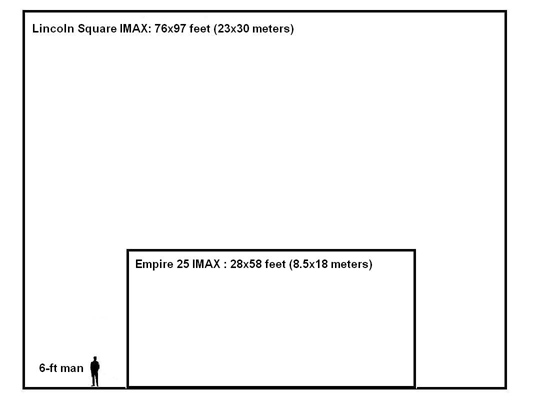
James Hyder, publisher of the Large Format Examiner, has posted a review and comment on the Imax digital system seen at the AMC Empire 25 in NYC. His comments (and a VERY revealing graphic) are very interesting.
At this time, the article is on the front page of the site. No login is needed.
Large Format Examiner
Posted by Mark Gulbrandsen (Member # 72) on 10-28-2008, 09:03 AM:
Is this the revealing graphic you mentioned? Its not revealing anyting we didn't know...
Posted by Mark J. Marshall (Member # 1409) on 10-28-2008, 09:23 AM:
I think the Lincoln Square IMAX should hang that picture in their box office window. Or make a giant full sized poster out of it for their lobby.
Posted by Mark Lensenmayer (Member # 134) on 10-28-2008, 09:38 AM:
That's the graphic, Mark. Thanks for grabbing it.
In my opinion, the only TRUE "Imax Experience" is in an "Imax Classic" location. The newer locations offer excellent sound but the image is not much better or larger than a normal large room.
BATMAN on the smaller screen showed almost NO difference between the IMAX-filmed sections and the normal sections. Maybe a foot at the bottom and about 2-3 feet at the top, but NOT enough for the average person to notice.
The only advantage I see with the new systems is that the 3-D will look much better than the polarized systems due to the increased brightness. Unfortunately, only a very few filmmakers understand how to properly use the 3-D systems.
Posted by Joseph L. Kleiman (Member # 3097) on 10-28-2008, 01:25 PM:
I was going to address this to Mark, but realized that there's three of you in a row. This is what IMAX had to say in their press release:
quote:
In other words, scenes shot in 35mm will appear in IMAX DMR (letterbox), while scenes shot with IMAX's cameras on 15/70mm film will expand vertically to fill the entire IMAX screen, which can be up to eight stories tall, for an all-encompassing IMAX Experience.
So, if you get only one foot in each direction on an MPX, the film is still expanding vertically to fill the entire screen.
Posted by Mark Gulbrandsen (Member # 72) on 10-28-2008, 03:17 PM:
Joe,
Then it appears all they've done is bring back MagnaScope. That was a very short lived process and to myself would be something very annoying... I'd probably ask for my money back.
Posted by Joseph L. Kleiman (Member # 3097) on 10-28-2008, 03:23 PM:
It'll be interesting to see what happens when Transformers 2 comes out in IMAX digital. Not only will the IMAX sourced footage be extremely cropped, but the resolution will be severly downrezzed to about 4K.
Posted by Bobby Henderson (Member # 840) on 10-28-2008, 06:21 PM:
It's not even 4K. More like half that pixel count.
A true 4K image measures 4096 X 2160 pixels. A pair of Christie 2K digital projectors will show something along the lines of 2160 X 2048 -if even that.
Posted by Dick Vaughan (Member # 540) on 10-29-2008, 05:15 AM:
The new IMAX digital systems use polarisers just like the classic 1570 film systems
Posted by Mark J. Marshall (Member # 1409) on 10-29-2008, 06:06 AM:
Are the eyes projected in sync (one projector does the left eye, the other does the right eye), or do both projectors alternate the eyes like Real-D?
Posted by Joseph L. Kleiman (Member # 3097) on 10-29-2008, 07:28 AM:
From what I and a bunch of postproduction guys (I won't mention names other than to say that their names appear on the credits of most LF productions during the past two decades) could figure out at the digital demo in NY during GSCA, the projectors seem to offset each other by half a pixel for 2D and then realign for 3D. After the demo, we all went to see STOMP, which turned out to be a much better 3D experience.
Quick question to Mark L: Did you see NASCAR at the MPX in Columbus?
Posted by Mark Lensenmayer (Member # 134) on 10-29-2008, 10:40 AM:
Joe K,
Yes, I did see NASCAR the day it opened at the AMC Easton. Presentation has gotten better there...lots of dirt issues at first, with spots sticking on the field flattener. Haven't seen that for quite awhile, though.
Posted by Tristan Lane (Member # 1169) on 10-29-2008, 11:49 AM:
quote: Mark J. Marshall
Are the eyes projected in sync (one projector does the left eye, the other does the right eye), or do both projectors alternate the eyes like Real-D?
I don't see why they would alternate given the fact that TWO projectors are being used.
Posted by Mark J. Marshall (Member # 1409) on 10-29-2008, 01:25 PM:
Because the second projector is being used to increase the resolution on the screen, so the options are:
1) Use one projector for one eye and the other for the other eye - which results in better 3D, but lower resolution for each eye; or
2) Flash the eyes sequentially like RealD, which results in better resolution and worse 3D.
I was just wondering what compromise they went for.
Posted by Stephen Furley (Member # 1277) on 10-29-2008, 02:02 PM:
Dick,
Do you intend to install digital in the bradford Imax, and if so will it be in addition to film, or replacing it?
While I'm in Bradford I'll have to pop into the bookshop tomorrow.
Posted by Joseph L. Kleiman (Member # 3097) on 10-29-2008, 03:44 PM:
Mark L,
They showed the trailer for NASCAR at the GSCA demo. It was horribly cropped, so much so so that the top of the WB logo was missing. Had I been a Warner executive in the audience that day, I would have been furious. You didn't have that issue with the MPX version, did you?
Posted by Tristan Lane (Member # 1169) on 10-29-2008, 08:09 PM:
quote: Mark J. Marshall
Because the second projector is being used to increase the resolution on the screen
I don't believe the goal of two projector digital IMAX had much to do with resolution. It was said that it was to increase contrast, and brightness (screen door effect is also reduced in 2D, but not 3D) Since the images are superimposed, I doubt the source material is anything more than 2K. If the source were better, it would still only be slightly better than a standard 2K theatrical release in regards to resolution and contrast. Im sure the 3D effect itself looks great because of dual projector.
Posted by Mark Lensenmayer (Member # 134) on 10-29-2008, 08:33 PM:
I saw NASCAR 3D in an IMAX CLASSIC theatre (Marcus Crosswoods) and an IMAX JR. (Easton). If I recall correctly, the film was originally cropped from the full Imax screen, much as the early IMAX releases such as the Matrix films. I don't recall the logo being off the screen in the MPX version. I think it fit into a 1:1.85 ratio, but I can't totally guarantee it.
Posted by Mark J. Marshall (Member # 1409) on 10-29-2008, 09:33 PM:
quote: Tristan Lane
Im sure the 3D effect itself looks great because of dual projector.
I'm sure you might be correct.
Posted by Tristan Lane (Member # 1169) on 10-30-2008, 12:29 AM:
quote: Mark J. Marshall
I'm sure you might be correct.
You may be right in your assumption that I might be correct.
In all fairness.... It wasn't until recently seeing non sequential digital projector 3D that I've noticed "something" better about it. So... you might be right about the whole eye sync issue, but I'm not fessing up to anything! And I don't see anything visually to indicate a left eye/right eye lag issue. But I will admit that the non sequential 3D caused less eye strain and looked more natural. ![[evil]](graemlins/evil.gif)
Posted by Fred Tucker (Member # 4482) on 11-01-2008, 09:39 PM:
I have only seen a couple of D trailers so far on my digital IMAX, the 3D is far more impressive then RealD. It is more realistic and the 3D effect comes out much much further.
quote: Bobby Henderson
It's not even 4K. More like half that pixel count.
A true 4K image measures 4096 X 2160 pixels. A pair of Christie 2K digital projectors will show something along the lines of 2160 X 2048 -if even that.
Actually it would be a fourth since the pixels are stacked on top of pixel. IMAX says multiple projectors are used to increase brightness & contrast. Brightness is true but contrast is ![[bs]](graemlins/bs.gif) !
!
Posted by Mark Gulbrandsen (Member # 72) on 11-02-2008, 09:02 PM:
In order for this to work they'd have to be doing an alternating even/odd frame thing... overlaping pixels would normally cause a big drop in resolution. In order to do the even odd thing which would be similar to 2-projector 3-D they may also have to run the DMD's at high flash rate.
Mark
Posted by Fred Tucker (Member # 4482) on 11-03-2008, 11:59 PM:
Mark,
Are you saying that they are double flashing to increase resolution? If you are then I'm afrid you're incorrect on this one. Eagle Eye content is infact 4k but any and all data beyond 2k resolution is thrown out by the Doremi server, per IMAX. I asked that question specifically to our represenative and ended up talking with one of their engineers. Both projectors (while in 2D mode) are playing the exact same content at the exact same time & in the exact same place.
Posted by Cameron Glendinning (Member # 3516) on 11-04-2008, 02:41 AM:
quote:
Brightness is true but contrast is !
Quick question
Are the ports and len's crystal clean? the reason I ask is that with film or digital basics like these can also be contrast killers.
Posted by Mark Gulbrandsen (Member # 72) on 11-04-2008, 08:27 AM:
quote: Fred Tucker
If you are then I'm afrid you're incorrect on this one.
Either flashing or alternating projectors... I don't see any other way they could be doing it... without ending up with a ghost or smeared image that would more or less lower the resolution. Think about it..... if they were not doing this then the image would look somewhat like a blured 3-D image... not as bad but none the less slightly blurred.
Mark
Posted by Mark J. Marshall (Member # 1409) on 11-04-2008, 11:20 AM:
How exactly do you "throw out any data above 2K resolution"? Is there some resampling going on on the server or something?
Posted by Dick Vaughan (Member # 540) on 11-05-2008, 03:20 AM:
AFAIK when the Odeon Guildford ran Spidey 3 on both the Sony 4k and Christie CP2000 they ran the same 4k DCP
Posted by Mark J. Marshall (Member # 1409) on 11-05-2008, 07:20 AM:
I'm not doubting it's possible, I'm just wondering what it means.
Posted by Chris Slycord (Member # 4239) on 11-05-2008, 08:28 AM:
quote: Cameron Glendinning
Quick question
Are the ports and len's crystal clean? the reason I ask is that with film or digital basics like these can also be contrast killers.
I don't think he was saying that the contrast that they got out of the system was bad. I believe he was saying that IMAX's claim that multiple projectors increased contrast was untrue (the is "bs").
Posted by Fred Tucker (Member # 4482) on 11-05-2008, 10:35 AM:
Chris is right, the contrast is very good but equal to my other DLP house which does not carry the IMAX name.
In case anyone is wondering, the lenses are minolta & the port glasses are neumade. All cleaned on a daily basis with distilled water & lens tissue per IMAX.
Madagascar 2 came in for IMAX today, it is 2k content!
Mark, I see what your saying but IMAX says same image, exact same time and exact same place, pixel on top of pixel. I agree since there is no loss of image quality (atleast to the human eye) when one porojector's lens is covered. Granted it may have a slight loss that is not perceptible to myself or any of the other techs that were around when I performed this test but if thats the case then chances are no one is going to ever notice the differece.
Posted by Edwin Schwing (Member # 1270) on 12-04-2008, 01:35 AM:
IMAX is like K-Mart.
A name you know, a name you trust...
But when you see it, it's crap!
Posted by Chris Slycord (Member # 4239) on 12-04-2008, 07:21 AM:
There's a difference that K-Mart never had a good reputation to begin with.
Posted by Edwin Schwing (Member # 1270) on 12-05-2008, 09:13 AM:
Maybe not K-Mart, but how about S. S. Kresge.
http://en.wikipedia.org/wiki/Sebastian_S._Kresge
E
Posted by Frank Angel (Member # 248) on 12-15-2008, 04:28 AM:
You all know I have never bought into the "digital must be good because it is digital" hype and have always been highly skeptical of all nonsense in those press releases about the digital conversion, but boys and girls, I just saw THE DAY THE EARTH STOOD STILL in IMAX digital, and I must say, if this is the way people will be watching films in the future, then I admit it, this changes my mind about digital.
Now mind you, this was not a "real" IMAX theatre with a full-sise IMAX screen. My guess is that it was about 50-55ft width with a slight curve and for this reason I was not evaluating it against what I know the original, full-size IMAX image looks like. But looking at this presentation against film presentation on the same size screen, i.e., against film in a similar size multiplex room, this digital show had one spectular image; there's no other way to describe it. Brightness, contrast, color saturation and apparant resolution looked better than multiplex film presentation, and not marginally better, but hands down better. Really, it put all my fears to rest that the conversion to digital would short-change or compromise presentation for future generations. If all digital presentation can mimic the quality of that IMAX show, then I have crossed to the other side of the isle.
The only anomily I saw in this presentation was that fast horizontal movements still have that slight strobe effect -- a kind of stuttery look that I find annoying, but that's just me --I can see the jump when they do drop frames to shorten the run time of films on TV and it drives me crazy, yet others don't know what I am talking about when I point it out, so evidently this isn't a big deal to most people. But other than that, everything else about the look of the image was striking. Yah, it may be 2K, but I can tell you, you'd be hard pressed in a blind test to tell if you were watching digital or 70mm. I know that up till now, I would consider that heresy coming from my mouth, but that was my honest feeling throughout the entire film. Bottom line, I was very impressed.
I don't know if it is the fact that they use 2 projectors that somehow makes the apparent resolution look so good -- it certainly accounted for the high brightness, but how they could get that crisp, crystal clear, razor sharp look using just 2K (my assumption, based on what you all have said about IMAX digital) is a mystery, but it WAS that good.
Even the fact that it was a silver screen wasn't as bad as I expected; truly I only noticed the hotspot when the entire screen went to white; when the picture was normal, it was barely detectible, even with me looking for it; I am sure most in the audience weren't distracted by it.
What WAS distracting was a light somewhere in the theatre that cast light on the very left corner of the screen. THAT was distracting, not fault of the digital system of course, but something the managment should have tended to. There were no cleaners to annoy me as I sat thru the credit crawl, so that made up for it.
I still feel that since our classic films will be waiting a long time to be transfered to digital prints, if they ever are, film will still be around for quite some time for the prep and art houses which for the most part can't afford digital conversion anyway, but this is going to be the way to go as film prints age and deteriorate more and more.
I am now convinced that the fear I once had that future generations would never be able to experience the richness of a LAWRENCE OF ARABIA on 70mm film the way we saw it in first run 70mm, is unfounded. If this is what it would look like in digital, at least IMAX's version of digital, then mission accomplished.
For the longest time I thought, if digital presentation was going to be what I saw in those early days of JURASSIC PARK and STAR WARS, then saying it was a viable replacement for film would have been akin to me going over to the Dark Side. But that is simply no longer the case as this IMAX presentation has been a revelation to me as to what digital is capable of looking like, and I assume it can only improve from here. Now it really is just a matter of the economics that will allow us to afford the technology.
PS -- Sound was spectacular as well, but that was expected.
Posted by Mark Gulbrandsen (Member # 72) on 12-15-2008, 03:22 PM:
Little by little the skeptics get convinced!! All they need see is a top notch digital presentation to see what it is capable of.
Mark
Posted by Tristan Lane (Member # 1169) on 12-15-2008, 04:52 PM:
Hell just froze over.
Posted by Gordon McLeod (Member # 33) on 12-15-2008, 06:55 PM:
nope it will thaw soon
Posted by Julio Roberto (Member # 4976) on 12-15-2008, 07:29 PM:
quote: Tristan Lane
Hell just froze over.
Must have been the ice age coming. I meant, the global warming coming. Oh, well, whatever is coming this week.
I haven't seen or read much about IMAX digital, so all this maybe just me rambling or downright wrong. I've certainly seen my share of all traditional IMAX large format presentations (omnimax, different 3D systems, 48fps, magic carpet, etc).
I've always said that 2K is usually "enough" for most people to watch a satisfying image. What happens is that you are starting with the "bare minimun" to have a "great show", so no compromises after that can be made.
Imax probably digitally "panned-and-scanned" (or whatever) the movie to the aspect ratio of their theaters, matched perfectly to the aspect ratio of the imaging devices (micromirrors).
Lawrence being a 70mm film probably had an aspect ratio to begin with of 2.20 ... a better match to the DMD (DLP) chips than either scope at 2.40-ish or flat.
IMAX probably had access to the master material and made sure it fit (cropped a little or whatever it is doing with the lenses) as well as possible and had the absolute highest data rate possible under the server (very maxed DCI specification or maybe even higher).
Couple that to well designed illumination (lamp/lens/screen/2-projectors) and Lawerence breathtaking imaginering, with lots of light and depth of field, in any format (almost looks good even on youtube ![[Wink]](wink.gif) ) and there. Heck, they probably even fine tuned the screen perforation.
) and there. Heck, they probably even fine tuned the screen perforation.
A great presentation. Certainly more than good enough for the average Joe and even pretty good to professionals.
The problem is when compromises and shortcuts start happening to the bare-minimun 2K system.
You start by cropping the image to adjust for aspect ratio, throwing away tons of resolution,"forcing" lamps to fill huge screens with minimun illumination levels, using whatever lenses the projector's manufacturer can save a buck with, using adapters or zooms to fill the screen when the aspect ratio changes (eating even more light, producing internal reflections). Put that projector off-the-screen-center with a significant keystoning or lens shifting, use a high gain screen with no regard to the theater architecture (i.e. curved screen, etc), etc, etc, and what do you have?
What you get at the end is an image with less resolution and "pizzaz" than the $300 HD LCD monitor you are typing this in (I hope it's a true 1920x1200 16:10 24" by now ).
Whenever I watch IMAX (tranferred) films in my HD TV (from HD-DVD or Blu-ray) I go .... Wow ... And it's only 1920x1080 4:2:2 with a guaranteed color space and depth (8 bit color) that is not all that great.
Because IMAX had a great, breathtaking image to begin with. With an aspect ratio they fiddled with to fully fill my HD monitor (instead of wasting resolution on huge black bars on top and below like an scope film), filmed with very high depth of field that makes you able to see every single detail in the frame in focus, and transferred with care using efficient codecs and high bit rates (instead of many HD discs using MPEG2 for compression rather than AVC or VC-1), etc.
In another words, IMAX has always been "the best that we can be with what we got". What they got now is a dual 2K system with two projectors with almost the same specs as a DCI one.
So I suspect they are doing "2K right". Current DCI projectors, i.e., can physically have a higher contrast ratio than mandated by DCI (about 2500:1 instead of 2000:1), so in a way they are underused in that area.
Now. If we could all start with a 4K image, then we wouldn't have to worry that much about "doing it right". In other words, using a zoom or whatever plus cropping could still result in enough pixels on the screen to at least surpass your home HD TV when watching Smallville (1.78 ratio) on blu-ray.
And if a theater wants to fill a 60+ foot screen with digital, they better start thinking of using good screen/lens/lamp design and use 2 projectors. Even more so if they are thinking of using 3D.
2K is good enough when done right. But not when done wrong.
4K is better (duh) and allows more practical choices (read shortcuts/compromises) to the theater owner to go unnoticed.
But most people will not be able to notice a difference between 2K done right (with its limitations of size/light/aspect ratios/etc) and 4K done "normal" (i.e. a few minor compromises made).
You can't pretend that using 2K on a (traditional) IMAX-size screen is enough. But it's perfectly fine for your average multiplex.
To me, 2K is good enough but 4K should have been the starting point for professional theater application for not other reason that 2K is basically what the average Joe has at home (and lets not argue about bit depth, color subsampling, compression, etc, shall we? ... after all, theaters punch small holes in their screens allowing the information and light in those places to go bye-bye, etc).
4K is not necessary, but it's something that will come sooner than later to theaters (oops, I forgot Sony), so 2K seems to me like a stop-gap for early adopters.
Or not so early. It looks like TI has no intentions to provide cheap 4K for a long time. And then even 4K DCI is an illusion as the specs calls for a compression rate for 4K images that is almost 4 times greater than 2K (to allow current servers to keep the same bandwith usage), pbbly cancelling much of the advantage of 4K resolution.
Oh well. We better get over it. Digital will come one day and it'll be whatever Hollywood and manufacturers want it to be. And it won't be horrible, but it will leave as wondering how pretty it could've been if they did it right instead of playing the milk-the-money game.
There is hope, though. We'll see what is announced at NAB in a few months.
http://www.reduser.net/forum/showthread.php?t=7390
But it's clear that for the next year or so we are stuck with 2K TI or 4K Sony SRX, so there.
I'd hate to be a theater owner today ![[Confused]](confused.gif)
http://www.youtube.com/watch?v=G9-6MPv2pw0
[ 12-15-2008, 09:24 PM: Message edited by: Julio Roberto ]
Posted by Frank Angel (Member # 248) on 12-15-2008, 11:14 PM:
Just to clarify, I have no idea if LAWRENCE has been tranfered to D-Cinema in any format -- 2K or 4K or any K. I only used LOR as a reference because it was the benchmark that I've always had in my head, that if a new technology came along which was supposed to replace film, I felt it had to at least be able to reproduct our cinema heritage to the same level as film did when I first experienced the great classics as a kid. I've always said I am not married to any technology -- I don't love film because it's film, I love film because it was able to give me those incredibly memorable experiences that I was lucky enough to have as a kid and which burned into my brain so intensely that it has been my life career; if another technology was to come along to replace film, then surely we shouldn't be satisfied if it was not capable of giving future generations what we had. If we accepted that, it would be like if someone made it so the only way all future generations could see a Monet painting would be as a lithograph reproduction rather than the actual painting.
My first experiences with digital -- first 1.3K = and next the early 2Ks = ![[dlp]](graemlins/dlp.gif) that were used for the STAR WARS releasr -- certainly couldn't match a 70mm presention of LOR. But this 2x2K IMAX I think could. How that can be possible is the mystery someone else here will have to explain because in theory it shouldn't look that good coming from a 2K scan and using 2K projectors (doubling or even quadrupling the projectors shouldn't increase resolution, right? -- if you start with 2K source, you have to end up with 2K display -- it;s impossible to make information out of nothing). All I can tell you is as nauseous as that horrid 1.3K JURASSIC PARK made me, this IMAX stunned me with how razor sharp it looked. If it was trickery, then so be it, but I would be happy to show LOR or any of the other great 70mm classics to an audience and not feel I'd cheated them or had to apologize.
that were used for the STAR WARS releasr -- certainly couldn't match a 70mm presention of LOR. But this 2x2K IMAX I think could. How that can be possible is the mystery someone else here will have to explain because in theory it shouldn't look that good coming from a 2K scan and using 2K projectors (doubling or even quadrupling the projectors shouldn't increase resolution, right? -- if you start with 2K source, you have to end up with 2K display -- it;s impossible to make information out of nothing). All I can tell you is as nauseous as that horrid 1.3K JURASSIC PARK made me, this IMAX stunned me with how razor sharp it looked. If it was trickery, then so be it, but I would be happy to show LOR or any of the other great 70mm classics to an audience and not feel I'd cheated them or had to apologize.
Now mind you, I am saying that for me, this IMAX 2x2K presentation would be more than acceptable as a replacement display system for conventional motion pictures, i.e., as the DCinema systems in regular theatres. I am not saying that this would work as a replacement for a traditional IMAX type screen. that remains to be seen. So if this is what corporate IMAX is saying hence forth will be the IMAX "Experience," then I think IMAX will just be the equivilent of what 70mm houses used to be -- high end, better venues to see movies. IMAX will be to regular multiplexes what 70mm was to 35mm theatres in the 60s and 70s. Could this IMAX system blow up and still look great on their REAL IMAX screen? That remains to be seen, but for conventional size presentation....HOT DAMN it looked good!
Now all they have to do is figure out in this economy, who can afford to put this in theatres.
Posted by Steve Guttag (Member # 268) on 12-16-2008, 10:52 AM:
Now Frank...all you need to do is compare a 70mm print to a 2K or even a 4K digital image and you'll see the detail gone in the digital. Digital is certainly hyper-sharp...but it does throw away data in doing so...depth cues are squashed or eliminated...something that I think 4K and beyond will bring back.
I think the layperson will see decent improvement in a 4K projector over a 2K projector...even with 2K content, depending on how the 4K projector creates the 4K image from 2K...this improvement will be noticed more by the folks nearest the screen. Note, I've done a 4K/2K shootout using the same 2K content (both motion and stills)...the 4K (SXRD) did not do poorly at all...it had its magenta blob in the image (lower right) as I hear many SXRDs do but in terms of image crispness and lack visible pixels...the Sony 4K looked better to most people in the test and some of these people study and present images for a living.
Steve
Posted by Joe Tommassello (Member # 4632) on 12-17-2008, 03:53 PM:
Interesting the IMAX Digital is getting such a good review. I saw the 15/70 DTESS at King of Prussia PA on Saturday and thought it was the least impressive IMAX title I have ever seen...and I have seen at least a dozen or so of the DMR titles. Maybe they are putting most of their efforts into making the digital presentations look best from this point forward. Perhaps the IMAX experience as we have known it is soon to be a thing of the past.
Posted by Julio Roberto (Member # 4976) on 12-20-2008, 12:16 PM:
Not all reviews are that good.
Some people notice the pixel pattern right on.
http://www.lfexaminer.com/editorial200810.htm
Quote from the article:
"Using two high-powered digital projectors, the IMAX digital system projects an image that is bright, with good contrast and slightly better resolution than other digital projectors. But every IMAX digital theater I’ve been in has also had a noticeable “screen door effect,” that is, a visible dark grid pattern separating the pixels. It is particularly noticeable in lighter image areas, and is less visible the farther you are from the screen. But even with my 53-year-old eyes, I was able to see it from the front half of most of the five theaters I’ve been in. If you move back to eliminate the pattern, your field of view becomes narrower, and hence no different than an ordinary movie theater.
At the New York demonstration, I was seated in the fourth row next to a long-time IMAX theater manager. I had not said anything to him about my perceptions of the IMAX digital theaters I had already seen. But the moment the first image came up on the screen — it was the MPAA rating card for the first trailer — I heard a gasp as he noticed the screen door pattern that made the card’s white-on-green text look “jaggy.” He later confirmed being stunned at how obvious and distracting the pattern was.
Although many people I spoke with after the demo shared this reaction, to my surprise not everyone found the pattern as noticeable or distracting as I had. Some didn’t see it, others did, but didn’t mind it as much.
But for me it is clearly the biggest reason to say, “This is not IMAX.” I grant that the image is bright and contrasty, and has good color. And it only took hearing a shuttle launch in Space Station 3D to know that the new sound system is fully up to IMAX standards. I might even be willing to compromise on the aspect ratio.
But IMAX — real IMAX — presents reality. Not reality as seen through a screen door."
----- End of quote
This is obvious. As we all know, "physics" can't be cheated. And 2K is not enough resolution to seamlessly fill really large screens with enough resolution to compete with large format films.
I'll say it again. 2K is fine for a small multiplex and for most people it's just great. But this industry is shooting itself in the foot because it could have easily done 4K (DCI+servers+Sony supports it ... only TI is still doing 2K) and 2K is basically what people have in their homes (or will have in the next 5 years).
Sony did the math.
http://pro.sony.com/bbsccms/static/files/mkt/digitalcinema/Why_4K_WP_Final.pdf
Hollywood is quickly moving fully to 4K, as new digital cameras and workflows reduce the cost to almost nothing. Heck, there is even talk of domestic A/V going 4K in a couple of years ...
Not to mention a 28k camera for $53.000 with a monster sensor that would probably surpass (or rival) IMAX. Doing the math, a single sensor has more pixels than BOTH human eyes have BOTH rods and cone detectors (261,352,000 vs 126,000,000 x 2 eyes = 252,000,00).
http://red.cachefly.net/14/mysterium.jpg
http://red.cachefly.net/14/list2.jpg
What we need is a $50k total cost system close to 4K in quality and that can work reliably for a long time at high brightness levels with modest 2-4Kw lamps. But there is not such thing yet.
Oh, wait. There is. It's called a 35mm film projector
http://www.cnet.com.au/projectors/0,239035440,339290009,00.htm
[ 12-20-2008, 02:53 PM: Message edited by: Julio Roberto ]
Posted by Bobby Henderson (Member # 840) on 12-20-2008, 08:24 PM:
35mm is not well suited to really large traditional movie theater screens. However, 5-perf 70mm projectors work just fine for big traditional theater screens. 5/70 can throw a much brighter image than 4/35.
Hell, IMAX would get a lot more bang for their buck, and at least preserve some credibility by promoting the 5/70 format for large screen multiplex solutions. Doing some high priced dual projector design without the adequate resolution for the big screen seems like a non-starter.
I design a lot of billboards. People who view them are doing so from a significant distance, usually while speeding in their cars. And all the billboards I design have a significantly higher pixel count than mere 2K or HDTV resolution. Think 18 pixels per inch at full size. It's pretty coarse resolution, but on a 48' wide X 14' tall billboard you get an image of 10368 X 3024 pixels.
Posted by Scott Norwood (Member # 30) on 12-20-2008, 10:02 PM:
This is off-topic, but I'm curious. How are billboards actually made? Are they painted? Big photographic prints? Inkjet prints? Offset prints? Something else?
I've never seen one up close.
Posted by Bobby Henderson (Member # 840) on 12-20-2008, 10:20 PM:
Most billboards are "grand format" digital printed now. The printers are often 16' in width. Some are even wider than that. Most billboard prints are output on flex face material, similar to the plastic stuff you see stretched on certain lighted awnings. The finished print is simply stretched over the billboard face structure. This takes a lot less time than gluing a bunch of paper printed panels on a billboard face.
Viewed up close, a billboard print won't look all that great. The printer's RIP will do a lot of interpolation work to hide any jaggies. However, if your design is mostly vector based graphics it will be nicely sharp viewed up close. Hint to amateurs: stop stupidly using Photoshop to design your logos and use Illustrator instead.
The new trend is replacing "static" printed billboards with LED-based boards that can change ads every 8 seconds or so. These boards don't feature nearly as high a level of resolution as a grand format static print. It just depends on how much money you want to spend for RGB LED clusters. LED displays are often measured in mm pitch from one RGB cluster center to the next. 20mm pitch is pretty common for LED boards. You can build boards in pitches of 8mm or even tighter than that.
Posted by Julio Roberto (Member # 4976) on 12-20-2008, 10:48 PM:
Just an interesting quote from some random people . They are talking about perforated screens:
"... I should tell you about the world of electronic cinema, where the issue of holes in the screen is once again being addressed. The Digital Cinema Initiatives, LLC (DCI) did a presentation where a 4K-image source from an animated feature was projected by a 4K projector on a screen that was about 50 feet wide. That same image was downconverted to 2K and projected by a 2K projector. On the perforated screen, you couldn’t tell the difference between the two images. Put up a solid screen, and the differences were significant. Put up a solid screen on the 2K projector, and it looked seriously better than on the perforated screen. The quick lesson in all of this is that image detail passes through the holes in the screen and never comes back to the audience. Who would have ever thought such a thing possible? ..."
And then:
"Several years ago, (Joe) Kane ran tests using the JVC D-VHS D-Theater HD tape format at a peak video bit rate of 24 Mbits/sec and saw that a perforated home theater screen masked the difference between MPEG-2 and WMV encoding and hid image details, while on a non-perforated screen. The difference was obvious to all observers. The Digital Cinema Initiative ran similar tests at the University of Southern California processing laboratory in Hollywood and found that a perforated movie screen mostly masked the difference between 2K and 4K projected images, yet the difference was obvious with a non-perforated screen." From the SMPTE Journal, Issue: 2008 01/02 January/February, Section Meetings Report, Washington, D.C.- October 2007.
Posted by Bobby Henderson (Member # 840) on 12-20-2008, 10:57 PM:
Oh man. I sense a conspiracy working to bring back the famed Torus screen! AMC buys some Sony 4K projectors. Now they may have a legitimate reason to install solid screens and stick the speakers above and below it...
...or someone could redesign the perforated screens where the holes are significantly smaller and adjust the pitch of those smaller holes so speakers can still project audio through them.
Posted by Julio Roberto (Member # 4976) on 12-20-2008, 11:04 PM:
Well, if you do the math, 2K is close (but not quite there) to the limit of resolution people can see from a reasonable distance from the screen (i.e. back rows in most traditional movie theaters).
It's only those sitting somewhat close to the screen that could really perceive an increased resolution.
And those sitting close to the screen can see the perforations
Where have I heard before that, against logic, most people claim to be unable to tell the difference between a 4K (Sony) and a 2K (TI)? .... Oh, yeah, EVERYWHERE. What do they have in common?
I wonder if digital IMAX's secret for wonderful images (I have yet to see them) that reportly look of "higher resolution than 2K" while using "plain old" 2K projectors could come from a fine tuned micro perforation pattern ... (© hush, hush™).
Posted by Fred Tucker (Member # 4482) on 12-20-2008, 11:32 PM:
I cant remember the screen manufacturer but it is either Harkness or MDI. The perforations are the same size if not larger than any of the other perforated screens that is at the theatre. The preforations are however spaced a little further apart then the others.
While on the subject of screens what is up with the plastic grommets? We tore two out just rigging things before the final stretch. Had to fold the screen over and install new brass all the way around.
Posted by Bobby Henderson (Member # 840) on 12-21-2008, 02:00 AM:
quote: Julio Roberto
Well, if you do the math, 2K is close (but not quite there) to the limit of resolution people can see from a reasonable distance from the screen (i.e. back rows in most traditional movie theaters).
You would be surprised what kinds of details you can see from a significant distance. There's a lot of push and pull in there, but not so much that you can get away with HDTV quality on a screen that's trying to fill a great deal of the viewer's peripheral vision.
In a good sized living room, the differences between 1080p and 720p become difficult to distinguish when the HDTV monitor is some unit 40" or smaller and you're watching it from around 10' or more in distance. It's a lot more to ask with a screen that displays the image on a much larger scale.
quote: Julio Roberto
I wonder if digital IMAX's secret for wonderful images (I have yet to see them) that reportly look of "higher resolution than 2K" while using "plain old" 2K projectors could come from a fine tuned micro perforation pattern ...
I'm thinking it's a lot of bullshit.
I'm certainly not willing to sign off on some process either 2K or not much above it for giant screen use without seeing it for myself. Even not having experienced "IMAX Digital" yet I sort of know what to expect from doing a good bit of giant sized image design work myself. Since I've already seen a good bit of 2K D-cinema content, I can easily say that pixel grid is plainly visible when sitting in the first few rows of a modest sized auditorium. And I'm talking about something under 200 seats.
IMAX had better keep its 15/65 cameras and 15/70 projectors running or its business will be dead. This whole "digital" deal is some tangent that really isn't going to do them any favors.
Powered by Infopop Corporation
UBB.classicTM
6.3.1.2