This is topic The future of film ... according to (a guy at) Arri in forum Digital Cinema Forum at Film-Tech Forum ARCHIVE.
To visit this topic, use this URL:
https://ft-forum.com/ft/cgi-bin/ubb/ultimatebb.cgi?ubb=get_topic;f=16;t=000406
Posted by Julio Roberto (Member # 4976) on 07-09-2009, 09:30 PM:
Arri has been in the "film business" for almost 100 years. They should know a thing or two about it.
They interviewed this guy, Chief Technology Officer at Arri, with enfasis on the film stuff, but he kept pushing Arri's digital offerings.
When asked how long he thought film will be around, he said definitely 5 to 10 years. But he also said bluntly that film will be "gone in 20 years".
Also, he says their digital cameras offer the SAME QUALITY of images as film, although at first he (wrongly) says that film offers more dynamic range than digital (this is no longer true, as some digital sensors offer not only noticeably larger dynamic range than film but higher sensibility and lower noise as well).
He mentions how film is grainer and how, for some reason, people like the grain and feel the image is more "organic". My take on this is that for whatever reason people don't like the ultra-clean look of video (too perfect for them?). Not a big problem, as grain can be added in post-production if needed.
I don't want to get into arguments here but, if one wanted, you could shoot digital nowadays and make it look 100.00% exactly the same as film. But if you did that, why the hell shoot digital video? Shoot film if you want a film "look" or shoot digital if you want a range of options on your final look. Including the film look, if you needed it.
Unfortunately, some people shooting digital either choose a very non-filmic look (again, on purpose, as otherwise they would go straight to film if "film look" was their primary reason du jour) or use the cheapest possible digital because they are low-budget and trying to save on a quick-and-dirty product, often producing inferior results, not unlike using 16mm to save money. 16mm is still film, but "inferior" to 35mm generally and those using 16mm usually have low production values and little $$$ to spend on a top Director of Photography, good lighting, etc.
http://www.macvideo.tv/camera-technology/interviews/index.cfm?articleId=115977
Posted by Scott Norwood (Member # 30) on 07-09-2009, 11:51 PM:
Wow...the editing in that video is truly horrible.
The interviewer also seems to be unclear on the fact that "Arri" refers to the company and that "Arriflex" refers to the cameras that Arri makes.
Posted by James B Gardiner (Member # 5151) on 07-10-2009, 07:14 AM:
I agree with you Julian,
I personally think that FILM is pushed by those in positions of power as it is more likely to keep them there.
There excuses are based on lazyness and being frightened by that they don;t understand. But in general, they cannot be bothered to learn the new digital technology.
Like digital sound was loved by the cinema goer as it was more realistic, so is the crystal clear pictures. Grain is nothing but an artistic choice. If you prefer it and consider it organic, great. The young kids most likely consider it noise.
Tho in general film can look better then digital, Digital does look better then film on a wider exhibition basis. But then there is 4K being forced upon us by Sony, and TI being dragged in, even tho they have stated, 2K was good enough.
James
Posted by Mike Schulz (Member # 4297) on 07-10-2009, 08:07 AM:
It is all about money. Period. Digital will eventually be cheaper for the big budget films once the technology gets better. As for exhibition, digital will slash a huge portion of the post-production costs once the major portion of screens are equipped. Sending out 6500 hard drives is much cheaper than striking and delivering 6500 prints and once they get all of the kinks out of the satellite delivery systems, it will save even more money. It has been a slow process getting all of the exhibitors on board because the technology is still new, it is relatively expensive. Inevitably, all first run screens will be digital. It might be 5 years or it might be 10 but one thing is for sure, it will happen.
As for all of the "experts" and CFO's of these bleeding edge companies, of course they are going to talk about how much better digital is than film. It is in their best interest to get theatres equipped as soon as possible and the best way to do that is to spread bullshit. Now I am not saying that digital is crap in every regard but I will say that the current technology is definitely not up to the quality standards of film.
I do believe that eventually the look of digital will get there. They will have to figure out ways to get the projectors to more or less mimic the characteristics of projected film. The current generation of projectors have to be calibrated perfectly for each individual show and then depend on the DCP not looking like crap which is the biggest problem I have seen so far.
How many multiplex chain theatres calibrate their digital projectors often? How many use the recommended lamps? How many milk said lamps for as long as they can before replacing them? With film projectors in this environemt you pretty much only have to worry about whether the lamp is flickering or not. In the digital world there are many other factors to make or break your presentation. For example: Take a good looking 35mm print that is playing in house #2. Tomorrow you move that print to house #5. Guess what? That print looks exactly the same on both screens. In the digital world you have to factor in color calibration. The cinema where I work has 8 digital screens all of which still have 35mm projectors in place so we remain equipped to run either format if one fails. I don't know how many times I have walked back and forth between digital presentations on different screens of the same movie and they both look different. Supposedly all of our screens are properly calibrated which should be true since we have technicians in our booth weekly doing maintenance on our projectors. To me that is a HUGE fundamental problem that I don't think digital can ever overcome.
Why are we wasting time with a new technology that is almost in every way inferior to what we have used for nearly 100 years? Oh yeah, I forgot... MONEY.
I really can't wait for the day that the digital technology gets to where it needs to be but for now 35mm kicks its ass in almost every way.
Posted by Scott Norwood (Member # 30) on 07-10-2009, 08:23 AM:
The guy in the video was talking about acquisition, not exhibition, however. He seemed to be pretty astute, and the general message that I got was that he doesn't really care whether people buy film cameras or digital cameras, since his company manufactures both types, as well as film scanners, film recorders, lighting equipment, lenses, and other production hardware.
I'm willing to bet that the per-unit profit margin is higher on film cameras, but that the digital cameras are expected to have a shorter service life, and will need to be upgraded or replaced more frequently. (The camera in the picture of me is a 1960s-vintage Arriflex 16BL, which is perfectly usable 40 years after it was manufactured.)
Posted by Bobby Henderson (Member # 840) on 07-10-2009, 08:54 AM:
quote: Julio Roberto
Also, he says their digital cameras offer the SAME QUALITY of images as film, although at first he (wrongly) says that film offers more dynamic range than digital (this is no longer true, as some digital sensors offer not only noticeably larger dynamic range than film but higher sensibility and lower noise as well).
If video cameras really were better than film in every measure there wouldn't be any of the soupy, smeary, unsightly CRAP all too irrefutably visible in electronically shot movies like Public Enemies, Get Smart and quite a few others.
Video camera technology just is not there yet. All we're getting from the guys at Arri and any other company selling video cameras is a sales pitch.
Film photography still has greater resolution as well as better color balance, contrast and black levels in its CMY subtractive color model.
The only area where video is any better than film is color gamma range. The additive RGB color model is wider in dynamic range than any subtractive model. However, we don't ever see any of that in "digital movies" because the assholes who want to replace every film camera with a video camera don't have the balls to allow video to look like video.
If you want that full RGB additive synthesis model to shine through, as well as the properly balanced color curve of it, then you can't squash it through a bunch of pretentious film look filters. Further, if the "film look" processing isn't done just exactly right, that switch from RGB to CMY color intensities will result in a drab looking mess that still looks like video, just shitty looking video.
The same RGB to CMY problems exist in translating digital still camera images to CMYK mode for print publishing. Just clicking Image>Mode>CMYK in Photoshop can make a good looking RGB digital camera photo suddenly look like shit. Much of the highest quality photography in magazine & book publishing is still shot on film. The imagery, sometimes in the form of large format chromes, can be acquired using drum scanners that process the images in the CMYK model.
Here's the even more important factor: in areas where film fails to photograph the image it fails gracefully. Video just gets the shot all screwed up to hell. If you underexpose a film shot you still have clearly discrete film images. A video camera doesn't manage that so well. The CCD or CMOS imager chokes on that low light source struggling to see what's out there. That can create a data traffic jams that results in a smeary mess. This is easily seen in low light settings and very visible in light challenged scenes with lots of movement. Try compensating by boosting the gain and you end up with clearly visible red and green pixel noise in the black areas of the image (watch certain scenes of The Lookout to see the Panavision Genesis camera fail in that regard).
The funny thing is if the video fans had the courage to allow video to stay looking like video those motion artifacts wouldn't be quite so distracting. We're used to seeing stuff like that with video that's allowed to stay looking like video. When it's trying to pretend to look like film the motion artifacts become distracting.
CCD and CMOS imagers will eventually improve to match and surpass native resolution of 4-perf 35mm film as well as increase processing speed and sensitivity levels. I don't know when that will happen, but it's obvious to me the technology just isn't there currently.
Posted by Julio Roberto (Member # 4976) on 07-10-2009, 11:17 AM:
Bobby,
We agree to dissagree once more ![[Wink]](wink.gif) . With just about every single point.
. With just about every single point.
Specially video failing over film in underexposed situations were, precisely, they hold the advantage over film, which degrades better-looking in highlights but worse looking (grain) when underexposed. The amount of noise ("random colored pixels") in digital is, usually, far less than the amount of noise (random dark blotchs of grains) in film. Visit some astronomy sites and figure why they are using digital over film to shoot the (dark) skies nowadays. They have nice comparisons with film.
So, in this point, I have the absolute opposite view from you.
On the rest of them, I also don't share most of it, but at least the opinion is not radically opposited.
Or maybe it is. You are mixing and matching several points, some of which I don't think are (that) relevant to the comparison.
Let me point you out to this gentleman, with his charts to prove it. Let's talk about resolution.
He is comparing FULL FRAME film (which is quite larger than academy or super-35 frame, which is at the same time larger than 1.85 cropped frame, which is further screwed up once you account for the generational copies inter-positive, inter-negative, needed for an exhibition print, which is then further screwed by the inherent wow-and-flutter of mechanical projection) and let me extract one sentence:
http://www.normankoren.com/Tutorials/MTF7.html
quote:
The handwriting is on the wall for film. 16 megapixel sensors (10 for the X3 sensor, if they can produce it) have resolution challenging medium format film. Large users of film have already switched to digital. Film sales are rapidly dropping. Film production lines will shut down as sales drop. Variety will decrease and prices will increase. Traditionalists will complain, but the quality of digital images will carry the day. At 16 megapixels, many traditional view camera applications are migrating to digital, where they can take advantage of Canon and Nikon tilt-shift lenses that turn 35mm/digital cameras into baby view cameras.
And he is talking about 16mpx cameras and MEDIUM film format. The camera I just got for myself, i.e, is 21.1Mpx, and here we are talking about S35 35mm frames at best.
There are many myths in the film-vs-current-moderm-digital-sensors, like the above mentioned resolution and the bothersome dynamic range being superior in film which, until recently, was true, but not anymore, at all beyond the shadow of doubt to anyone who wants to see the data.
The ONLY advantage of film over digital, nowadays, is the handling of OVEREXPOSED areas. All the rest: resolution, gamut, fidelity, sensitivity, noise, underexposed handling (crushing blacks or lack of detail or excessive noise in dark areas), dynamic range, motion rendering, etc, are surpassed, sometimes appreciably, by digital, but mostly just matched.
Now: I'm not saying that there are tons of digital products out there that (cleanly, easily) match-or-surpass film, and MOST OF THEM DON'T. I'm saying that it's no longer impossible to make them and the digital sensors to do them exist in the market and the products are starting to appear.
Also, I'm not saying that most current digital motion pictures or photographs made in the past years clearly surpass film-based ones in terms of quality. Most clearly don't. But this has more to do with the creators of such images than with the technology to create them being necessarily, substantially, "inferior".
But no point on having this argument right now. Let's just wait about 1, perhaps 2 more years, and then you'll be able to see with your own eyes in (hopefully) 4K projectors at the theatre the images we are talking about here and then become convinced yourself, first-hand, w/o theoretical arguments, which has the edge: 2010-digital-video vs 2010-35mm-motion-picture-film.
Although to be honest, the comparison is gonna be hard as I'm pretty sure you won't be able to see film that hasn't been scanned, digitally manipulated (graded, color-corrected, screwed with) and then printed-out again, so I guess it will still have to be a theoretical comparison or will have to be watched right after an 80's revival film-festival.
Posted by Scott Norwood (Member # 30) on 07-10-2009, 11:26 AM:
Important distinction: negative film (the type normally used for motion pictures) is more tolerant of overexposure than underexposure, while reversal film (the type used for slides and, historically, for 16mm TV news film) is more tolerant of underexposure.
In general, overexposing color negative film slightly (by 1/2-2/3 of a stop) will decrease grain and improve shadow detail.
If we are going to discuss image "quality," then we need to define what that means. Is it resolution? Color depth? Ability to reproduce motion? Subjective opinions from audience surveys? And are we measuring the original image as formed in the caera, or are we measuring an answer print or release print or a projected D-cinema image? All but the first involve processes that happen outside of the camera itself which can affect image quality.
And are we talking about ideal conditions or real-world conditons?
Also worth noting is that not everyone necessarily wants an image with the highest possible resolution. Some films are (intentionally) shot with older lenses, diffusion filters, on 16mm, on SD video, etc., and these are legitimate aesthetic choices.
Posted by Julio Roberto (Member # 4976) on 07-10-2009, 11:44 AM:
Yeah, I agree, Scott.
Ideally, this doesn't need to become another long, boring, theoretical thread about film-vs-digital.
They are both good. Which one is "better" (and what "better" means) is not that important.
I just wanted to point out that even Arri, the biggest player in film-adquisition together with Panavision, is pbbly considering film a dying medium some 10+ years from now and that they consider current (2009-2010) digital video adquisition "just as good" for motion picture use.
I kind-of-wanted to dismiss the notion that digital (adquisition) MUST be "vastly" inferior nowadays to film, specially since some sensors exist that are actually appreciably superior in most of the parameters that could measure image "quality".
That's all.
Now film is still great and, if you are after a film look, it may end up being cheaper and better to use film. I certainly would consider (and even favor it) for some uses. But that's not to say that shooting digital would necessarily produce an inferior quality image. Not any more.
Posted by Greg Anderson (Member # 235) on 07-10-2009, 11:51 AM:
quote: Scott Norwood
Wow...the editing in that video is truly horrible.
The looks suspiciously like the Arri NAB booth, which means that this video was shot three months ago. And don't any of these young whipper-snappers shooting video today know about the concept of "crossing the line" when you set up your cameras?
This video seems to underscore the whole problem with high-quality, low-cost gear today. You can put great tools into the hands of people who have no idea what they're doing. But, as with all things digital, some people seem to think that great gear solves every problem, no matter who's using it.
Posted by Bobby Henderson (Member # 840) on 07-10-2009, 12:55 PM:
quote:
We agree to dissagree once more [Wink]. With just about every single point.
Julio, you must be putting on a blind fold when watching movies that were shot with video cameras.
If what you're claiming about video is true, there should be absolutely no problems in image quality with movies like Public Enemies, etc. None of those very real, VERY VISIBLE problems should be present at all. Actually, with what you're claiming, new high water mark standards in image quality should be newly achieved with electronic cameras versus film cameras.
With video produced movies such as Collateral or Miami Vice we should be seeing image quality far better than the cinematography in Heat -particularly in the night scenes if what you're claiming in your huge passages of text is true.
The funny thing is the film-based stuff STILL LOOKS BETTER. Paste in 100 pages worth of white papers about video cameras if you like. It won't change anything.
Posted by Steve Guttag (Member # 268) on 07-10-2009, 02:49 PM:
The problem with Julio's arguements is it is in the theoretical as far as movie aquisiton is concerned.
They are not shooting with the latest most anything...they are shooting, by and large in 2K...a resolution that is visibly vastly inferior to 35mm 1.85 film...even to the untrained eye.
I don't have any doubt that digital will surpass film and that in some respects it already does.
I've yet to see, in a motion picture film, video ever look superior to film...in fact, just the opposite, if there is a DI involved, then the film output suffers from that weak link...it isn't film's fault...the the film maker for using such an inferior format such as a 2K DI.
If you actually look at any digitally shot movies in low-light...the noise is incredible...much worse than the grain that I've seen on 35mm film.
When the DIs get up to 4K and beyond, things will actually start to look better on film too. So long as 2K DIs are the rule, the images are going to suffer.
Same goes for 2K projection...on a small enough screen (under 20-feet), 2K isn't too bad but it most certainly falls apart above that...the detail is not in the image to fill the voids between the pixels...35mm film, on the other hand, can capably do well beyond that...30-35 feet wide though it is getting pretty rough too. 70mm looks fantastic on most any size screen and I've seen nothing in digital that is coming close to it...too bad the studios are not shooting with it.
4K...will be a vast improvement in digital though...I can see its potential though all of my viewings have had their share of color issues (Sony, ya know). The image though is certainly notably sharper and holds up better on larger screens (40' wide or so).
Steve
Posted by Julio Roberto (Member # 4976) on 07-10-2009, 03:51 PM:
Steve:
So you can no longer say you haven't seen digital motion captured images in low light (underexposed) conditions that match (or surpass) film, here are a few dozen examples of such shots done with a $2300 digital camera by Canon.
MANY OF THE SHOTS are done at f1.8, f2.4 and even f4.0 by non-professionals. ALL THE SHOTS ARE DONE AT 30fps (even when they say 25p, they've been shot at 30p and then converted). Imagine what can be done at 24fps and with wider apertures. Also, realize these are compressed at least twice before they reach you and most compressors don't work too well with low light levels as they tend to make blocks of grey with little detail ... well, blocks of grey with no detail.
But, indeed, I was talking more from a theoretical point of view (which will likely become a practical reality in a year or two), rather than a comparison to movies shot last year (or before).
http://vimeo.com/5206854
http://vimeo.com/4244785
http://vimeo.com/5152602
http://vimeo.com/5241766
http://vimeo.com/5291026
http://vimeo.com/4434571
http://vimeo.com/5459652
Actually, just click here and choose any random 10 or 20 clips and see for yourself.
http://vimeo.com/videos/search:canon+mark++night/sort:likes/format:thumbnail
Now this is not an expensive uber-duber camera that is brand new. It's been in the market for some 9 months and it's under $2400. This camera has a rating in photo mode that can equate to over 20.000 ASA in a theoretical film stock.
And these are UNDEREXPOSED and extreme examples to show not-horrible low light performance. You usually don't see an underexposed movie shot on film because ... well, if you have the money to rent the equipment and make a film, you pbbly had some money for proper lighting and a DP who knew what he was doing.
When shooting video, it can be made to behave as a low-grain stock of several thousand ASA's
Now, please, people, stop saying that "you have never seen low light shadow detail from a digital camera that wasn't riddled with noise and looked butt-ugly", so we can put the end to one myth that digital MUST be inferior to film in low light (when the opposite is true as no film stock has a sensitivity of well over 3000 ASA with little noise-equivalent=grain at 30fps). If you must insist, I can spend a few hours looking around and selecting 10 or 20 clips for you to erase that notion for good.
Again, I'm not saying that bad digital low-light products don't exist or that good low-light performing film products don't exist. I'm saying it's wrong to say that film is always, necessarily, superior to digital in low-light performance and that no products that outperform film exist in the digital realm.
We'll have to resort to white papers and charts to debunk the other myths: that film MUST have a wider dynamic range and that film MUST have higher resolution than digital. Specially film when used for motion picture which most of the time is 1.85 cropped, academy or S35 aperture at best usually, and must be duplicated to a release print and mechanically projected to be seen.
Again, believe what you want, those two premises are NO LONGER true, although indeed they are USUALLY the case for the time being.
But, again, no point on arguing about this (once more) right now. Let's just wait for a year or two and see if any of the new digital adquisition products showing up ends up in the hands of a half-decent talent team and we can start seeing all-digital movies equal-or-better than film in most quality measurements on the (silver, 3d, of course) screen by ourselves and, thus, no need for theoretical arguments anymore.
Posted by Mark Gulbrandsen (Member # 72) on 07-10-2009, 08:38 PM:
Julio,
This is nothing new... I've been touting the exact same thing here for at least three years now!!! The good news is that there is almost a digital camera ready to replace 65mm cameras... same rez as 65mm neg stock, and same aspect ratio and so on and so forth...
Mark
Posted by James B Gardiner (Member # 5151) on 07-10-2009, 11:13 PM:
My turn.
To ad to Julio's points.
The camera he is talking about is the Canon 5DmkII.
Currently this camera is making a mess of the digital film camera industry. I know Sony, JVC etc are all running scared.
They are literately selling 5x what they expected on this product. It's sucess has changed the industry completely.
This camera makes all there 50-100K kit all seem obsolete. Tho , there is more to a camera then a sensor. (But strangely many people cannot see past that. Ie form factor, the package etc.)
Now, Nikon will likely bring out a competitor at the November show for Pro still cameras. And.. the Nikon has even BETTER low light performance then the canon.
In the Stills world, Film is totally been abandoned apart for the niche areas where some aspects of film still produce desired results that digital cannot. However, this is not common, and a very expensive way forward.
This will of course happen in the motion film area too. I am a little surprised it has taken longer then it has, however, as I have said, there is more to taking a shot then the camera, its the camera man too. This is a generation thing more then anything else.
I have noticed that film-tech seems to be an ivory tower with man holding onto the romance of film. Personally I don;t care. I am a computer tech that has drifted into the doing digital side of exhibition. I just observe and based on what I see, make conclusions.
Film is simply out of date.
I like to compare it to DJing (For which I did for 10 years when I was a younger lad) evolved from vinyl records to CD's or other forms of digital playback..
At the end of the day, the punters on the dance floor didn't really care if it was vinyl or CD, the story that was the track was shared and they enjoyed it.
Tho the debate between DJ's was heated and went on for years. Today, the top DJ's basically never use vinyl any more.
WHY, well as I like to point out, what sounds better is not really the issue here. The main reason they don;t use vinyl is because vinyl has limitations. While digital has Blue sky. The DJ's, though the use of digital, have created new playing styles and performance possibilities. Impossible with vinyl.
This holds true for Film as well. Film is dead to me as.. it simply cannot evolve anymore. But once we are digital, the sky is the limit. Night shots that are impossible using film. etc.
One of my favorite would be a new standard of 60fps for cinema. Can be easily converted down to any common distribution format in use today, and would make a film screen, using clean digital images, look like a window into the world that the film creates. Something film grain, scratches and gate movement can never do.. (60fps for film is possible, but like 70mm unrealistic anymore. too $$$$$$$)
So, to me. Film, please leave the building, its time to ignite the booster and leave orbit, and you don;t have a ticket.)
To finish of, I would like to also visit the definition of what make one better then the other.
If we want to talk about which can be better.
Many of you say, film looks better.... if your looking at an answer print compared to 2k. But then again, apple with apples, there are 8k digital systems out there. That would even arguably compare with 70mm.
If we talk about the typical image a widely distributed film presents on screen compared to 2K.
A typical 2K system will ALWAYS look better due to the massive lossy process the film has to go through.
So which is better. What is possible or what is typical??
Please take this into consideration.
James
Posted by Steve Guttag (Member # 268) on 07-10-2009, 11:48 PM:
James, I do....I'm merely judging based on what I see on the screen...regardless of what got it there. And yes, I'm priviledged...I get to see some grades of prints that most others never get to see but I also see the common release print too.
I've definitely seen digital from the editing stage on out...and I haven't seen digital come close yet...not on a finished feature...show it to me and I'll be with you.
Remember too, just like with film, digital has to go through its projection aspect with the limitations in the medium (file size) and the projection technology.
The worst thing I've seen with film in recent years was the 2K DI...it has really ruined the image...lowered the bar a bit....I'm hopng that 4K will raise it back up some.
As for audio...while the dynamics of DJing dictate what people want/need best...that has nothing to do with the quality of the recordings on the digital vs analog. That is, on the whole, I don't hear any marked superior recordings in digital world than I did in the analog world...in fact, I'll go as far to say as they seem to be worse...sure they are technically more complex than analog could have ever provided but the end results just don't seem to have it.
For me...the biggest thing I've seen from digital is to get rid of the annoying shutter flicker of film (3-wing shutters can do tha for film too). Also, I wish they would loose the 24fps crap.
When I see the digital image look as good or superior to the film image, I'll be right there with you. But I have not seen it yet in a theatre or screening room other than things like flicker and color consistancy (that is another thing I don't like about film...no two rolls/processing seem to identically match...let alone two projectors/lamphouses).
I'll give digital its credits where it earns them and likewise film. But just because digital opens up this new world of digital manipulation to do things that can't be done in the analog world mean that they are necessarily better or help with the story (if there even is one!)...I definitely have not heard it in audio recordings and, for the most part, have not seen it in film shows beyond adding some effects here and there much the same as matte paintings could augment movies in lieu of impossible sets.
Steve
Posted by Cameron Glendinning (Member # 3516) on 07-12-2009, 01:07 AM:
quote: James B Gardiner
I personally think that FILM is pushed by those in positions of power as it is more likely to keep them there.
There excuses are based on lazyness and being frightened by that they don;t understand. But in general, they cannot be bothered to learn the new digital technology.
James again more conspiricy theories, Do you really live in the same Australia that I do? The country that pioneered high budget digital film production with the final Star Wars films and Superman returns etc?. A country that the government film making bodies will only finance short films shot with digital cameras?
The digital revolution is happening but your expections are before the technology is in place. Having started my career as a cinecamera assistant at ABC television, I know several of the people that are involved and there is a lot of issues with this new technology that we simply would not expect. From new post production work flows from the red raw codec, to issues with digital viewfinders and special effects shots on Superman Returns.
quote: James B Gardiner
Grain is nothing but an artistic choice. If you prefer it and consider it organic, great. The young kids most likely consider it noise.
Grain is more a product of high speed films and decreasing lighting budgets in an attempt to speed up production. If one was to light with care as was done in the past I am sure grain would not be a issue with the few vision diserning young kids you like to hang with. It is this same low lighting that creats the rather crappy video look of "Public Enemy" from what I have seen in its trailer.
quote: James B Gardiner
I have noticed that film-tech seems to be an ivory tower with man holding onto the romance of film. Personally I don;t care. I am a computer tech that has drifted into the doing digital side of exhibition. I just observe and based on what I see, make conclusions.
James have you ever seen film projected in a Film Guard(by film tech) equiped cinema? If you had then you may understand why we are passionate on this particular website about what film can be in the year 2009, ie dust and scratch free presentation but you really have to see it to believe it. It does cost a lot less than a 2k projector! Just click on the products <<<<<<< just under forums button.
quote: James B Gardiner
A typical 2K system will ALWAYS look better due to the massive lossy process the film has to go through.
Why is it that on a DI print you don't see the the flyscreen that the typical 2k system features?
I personally think that cinema must evolve in the near future into a vastly better experience than it is today now that home has 1080p to simply remain relevent.
I look forward to this technology that will create a better bigger more immersive cinema experience, not something good enough like 2k/1080p. I am sure it will not be to many more years that we will have to wait as cinema continues to evolve.
Posted by Julio Roberto (Member # 4976) on 07-22-2009, 07:19 AM:
Speaking on the subject of grain, now that I can see it up-close-and-personal on many blu-ray transfers thanks to the high definition, I've come to dislike it quite a bit.
Distracting as hell to see constanly dancing black dots all over the movie on MANY "classic" modern transfers, specially with "night" scenes (lately, I've been bothered by it on Blade Runner and The Matrix 2 blu-discs).
Anyway, the point of this post was this article in Los Angeles Times:
http://www.latimes.com/business/la-fi-ct-panavision20-2009jul20,0,5682188.story
quote:
Panavision's future is in need of focus
The camera maker's bright past has been overshadowed by heavy debt, CEO shake-ups and decreasing demand for its equipment as many filmmakers switch to digital technology.
When producer John Wells was preparing to shoot his crime drama "Southland," he chose a digital camera that few had heard of a few years ago. The Red One was inexpensive, easy to use and enthusiastically endorsed by his friend and director Steven Soderbergh, who used it to film his two-part movie last year about Che Guevara.
Wells was so taken with the Red camera that he even used it to film the final six episodes of "ER." That was a blow to Panavision Inc., the movie camera rental company whose roots go back more than half a century in Hollywood and which had provided cameras for hundreds of episodes during the hospital drama's 15-year run.
"Panavision was completely in shock," recalled Arthur Albert, cinematographer for "ER." "It was like a slap in the face."
...
Once known for its stable management, Panavision in recent years has more resembled the revolving executive suite door of a Hollywood studio, with four chief executives in the last six years. The most recent, William M. Campbell, lasted less than three months on the job.
"Anybody who uses Panavision equipment has to be concerned," said Richard Crudo, past president of the American Society of Cinematographers. "Our biggest concern is that something disastrous might happen and suddenly they're not with us any longer. That would be a major blow to the industry."
....
In response to the slowdown, Panavision laid off about 200 employees, reducing its total workforce to 1,200. It plans to consolidate offices, currently split between Woodland Hills and Hollywood, into a location in Burbank this year.
....
But demand for film cameras has steadily declined in recent years. Although filmmakers still debate the merits of shooting on 35-millimeter film versus shooting digitally, the switch to digital equipment has been dramatic, especially in television, where studios have been pressuring producers to cut costs. Virtually all the TV pilots were shot digitally this year.
...
"Suddenly the camera that nobody has access to, everybody has access to," said Brook Willard, a digital imaging technician who works with the Red camera and served as an advisor on "Southland" and "ER."
...
Bevins acknowledged that Panavision needs to more quickly adapt to the changing marketplace. To that end, the company recently acquired 15 Sony digital cameras for $35 million and is developing a new line of digital cameras.
Due to panavision too little-too late moves into the digital domain, they may end up the way Polaroid and others (Kodak?) may go in the (distant?) future.
Another film-player that is living on borrowed time is Nikon, and actually may survive thanks to sensors provided by third parties (Sony), a good line of lenses and a loyal customer base and reputation, but which digital expertise was way too low to (theoretically) keep it as a major player in the new era.
And this is the BEGINNING of the digital revolution. Far better and MUCH MORE AFFORDABLE (even) equipment is scheduled to appear this year (and the next and the next), further diminishing the advantages of film over digital adqusition.
2009 is the year of the BEGINNING of the death of film as an adquisition medium for motion pictures. How long it takes for it to (virtually) die is anybody's guess, but the writing is on the wall for sure.
Now theatrical exhibition is the only "stronghold" for film-based moving images. And the way it's going with the pitiful DCI conversion process, film will be with us for quite a bit longer.
Posted by Bobby Henderson (Member # 840) on 07-22-2009, 10:42 AM:
quote: Julio Roberto
Speaking on the subject of grain, now that I can see it up-close-and-personal on many blu-ray transfers thanks to the high definition, I've come to dislike it quite a bit.
I don't find visible film grain distracting. I'm used to seeing visible film grain because I've been picky with regard to where I pay to see movies for more than 20 years. If a theater's film projection setup is properly maintained the imagery will be bright and sharp enough for the viewer to see grain, unless a very fine grained film stock or large format film stock was chosen to make the image effectively grainless.
If visible grain is present on the original camera negative, I want it visible on the Blu-ray movie version as well. The grain makes up the detail in the image. If you try to get rid of the grain you absolutely will destroy detail in the process.
Using filters to smooth out grain can make visual items like fabric weave disappear. Skin textures get smoothed out to a waxy looking appearance. The contrasty "pop" in the image vanishes and you end up with an overall soft looking piece of junk. To make matters worse, the studios will then try to re-sharpen the soft image so viewers are stuck looking at visible halos and ringing along object edges.
Let's also not forget this fact: digital cameras do not always shoot grain free images. Video noise can pop up, especially in low light settings. Think that natural film grain is distracting? Try looking at a bunch of visible red and green pixels dancing in the shadows. Several parts of The Lookout, shot with the Panavision Genesis video camera, have that problem. Miami Vice, also shot on video, was noise city.
Yet another factor to consider: "grain" is sometimes added artificially. That was the case with 300. Much of the Battlestar Galactica TV series was shot with digital video cameras. Noise was present in some of the imagery and the producers chose to add a lot more.
quote: Julio Roberto
2009 is the year of the BEGINNING of the death of film as an adquisition medium for motion pictures. How long it takes for it to (virtually) die is anybody's guess, but the writing is on the wall for sure.
You obviously sound like you're rooting for film photography to vanish.
Posted by Julio Roberto (Member # 4976) on 07-22-2009, 12:50 PM:
quote: Bobby Henderson
You obviously sound like you're rooting for film photography to vanish.
I wouldn't call it "rooting", just being realistic. If I had a choice, I would choose for film to continue existing alongside digital.
I *do* consider digital somewhat more "democratic", as "anyone" can shoot/edit in their homes while with film, specially after the (virtual) dissapearance of super8, you had to rely on film-labs and what-not messy cycles to get stuff on the "big screen".
With digital, you could (somewhat) cheaply shoot your own short or commercials and put them up in "thousands" of big screens. It's feasible to create a DCI Package on one's laptop with a cheap digital camera/software. Or will be soon.
With film, it's a more convoluted process that involves labs, digital sound licenses and whatnot to get the same level of accomplishment. Not to mention financial risk.
So yeah, I like digital's flexibility and "democracy". I find film a bit "elitist" but do not wish for its dissapearance, as it has its virtues and is just as good (or better at times), result-wise, as digital.
Unfortunately, the market is likely gonna get rid of one of them. ![[Roll Eyes]](rolleyes.gif)
One line from that article that summarises Panavision status quite well:
quote:
"We've decided to redouble our efforts to develop product for the digital marketplace," he said. "We can't rent what people don't want."
Posted by Scott Norwood (Member # 30) on 07-22-2009, 01:12 PM:
A drawn-on-film animated short can be made for a budget of approximately $2 (cost of a couple of Sharpies). Try that with anything digital!
Posted by Julio Roberto (Member # 4976) on 07-22-2009, 01:16 PM:
quote:
A drawn-on-film animated short can be made for a budget of approximately $2 (cost of a couple of Sharpies). Try that with anything digital!
Are you serious? Where are you going to find so much free blank leader? And some pulse to draw the soundtrack and do 1000 copies
You can do a "hand drawn" "CGI" DCP (theoretically as well), or a slide-show type of thing, with a $100 used laptop (and some "borrowed" software, eventually freeware will surface) ....
Including cost of sound and internet-distributable 1000 copies ....
Sort of. ![[beer]](graemlins/beer.gif)
Again, I'm not saying that digital is 100% here TODAY and that film sucks TODAY. I'm saying that pbbly soon digital will match/surpass film and that pbbly soon digital will be cheaper than film for many/most uses.
Posted by Scott Norwood (Member # 30) on 07-22-2009, 01:23 PM:
I was half-joking, but look at some of Norman Mclaren's work. More recently, look at Barbel Neubauer. People actually do this stuff (I've shown some of it).
Clear film can be made by bleaching old trailers and then rinsing in Photo-Flo solution.
High-volume distribution still requires contact printing by a lab, however, as would adding a soundtrack.
Posted by Bobby Henderson (Member # 840) on 07-22-2009, 03:36 PM:
quote: Julio Roberto
I *do* consider digital somewhat more "democratic", as "anyone" can shoot/edit in their homes while with film, specially after the (virtual) dissapearance of super8, you had to rely on film-labs and what-not messy cycles to get stuff on the "big screen".
There is a long established joke in Hollywood that film stock is the cheapest ingredient in a movie production. Eliminating film doesn't do much to allow movie making to somehow become more "democratic" and accessible to many more people. It takes a whole lot more than just a good camera to make any kind of movie or video piece that's worth watching at all.
quote: Julio Roberto
With film, it's a more convoluted process that involves labs, digital sound licenses and whatnot to get the same level of accomplishment. Not to mention financial risk.
Nearly all the same issues, including financial risk, are in place even if you shoot on video. You may not have to develop any film. However, you'll have to cough up some serious dough for "film look" processing, color grading and overall digital intermediate work. Plenty of movies shot in "digital" still have to work through a digital intermediate stage.
In terms of sound production absolutely nothing changes by shooting on video. The same audio work flow remains. I hope you don't think you can do professional work using top mic audio from the camera. All the same post production looping, foley, mixing, encoding, etc. still has to be done. And you'll probably still be stuck paying Dolby and/or DTS licensing fees too, after all DVD is far from a dead format and lossless/uncompressed 5.1 formats probably will never get use on HD broadcast/cable either.
Also, this whole notion of somehow being "democratic" with the creative process annoys the hell out of me. It takes a lot more than just acquiring a piece of equipment like a video camera or a software application like Photoshop for anyone to pass themselves off as some sort of artist or "filmmaker."
I can go buy a set of the same golf clubs Tiger Woods uses. That won't help me play golf like Tiger Woods. Not one bit.
Posted by Julio Roberto (Member # 4976) on 07-22-2009, 04:30 PM:
quote: Bobby Henderson
I can go buy a set of the same golf clubs Tiger Woods uses. That won't help me play golf like Tiger Woods. Not one bit.
Sure, Bobby.
But until now, even if you played as good as Tiger, Panavision/Arri/Kodak/Labs/etc were the only makers of the golf clubs. And they were priced at say $20.000/week rental.
Now, the same clubs are available at $200/week.
Sure you still "need" all the other stuff. Maybe (i.e. not-so much if your movie is the Blair Witch). But at least, now, the clubs are more "democratic" and available.
Having the clubs won't make you a Tiger. But if you are a Tiger and you only have $200 in your pocket, now you finally can play some golf while before you had to beg for somebody to donate $20.000/week for you to play.
All other expenses remain the same. But it's a "myth" that film stock is the cheapest part of a production (in the way that the stock implies transportation/development/color timing/neg cutting/sound printing/possitive printing/replication .... or nowadays film-scanning/DI manipulation/film-out printing).
You are just cutting off the film->to->digital->and->back->to->film cost (around $100.000 and up) and you are switching $20.000/week camera packages for $2000/week camera packages, let's say.
All the rest can be as cheap or as expensive as it has always been.
Except distribution as well. You swap $1000 print/transportation/digital sound licence/disposal for a $10 hard drive rental.
What also bothers me are those that say that film is so easy, so cheap, so convinient and that digital doesn't save or add any flexibility to it and then would never dream to shoot a short or a commercial due to film's up-front high cost and soon will be editing out slides advertisements for theatres out of their Photoshops directly into JPEG2K DCI packages for virtually no cost in materials.
Bobby, do you remember the time when the only way to get signage were through really expensive offset printers, optical cameras/scanners, etc, and how now with a few thousand $$$ you can have Photoshop based home system and large format digital printer that can approximate (or surpass) the capability of used-to-be-million-dollar-machinery?
Same desktop graphics digital revolution thing, but with motion pictures. Now, with cheap computers/software/scanners/printers, a lot of people can afford a SHOT at becoming a player in the graphics art. Good or bad. And soon, a lot of people are gonna be able to afford a SHOT at becoming a filmaker, good or bad, but with some cheaper tools to help along that used to be available only to the "elite" before.
Posted by Bobby Henderson (Member # 840) on 07-23-2009, 10:56 PM:
quote: Julio Roberto
Having the clubs won't make you a Tiger. But if you are a Tiger and you only have $200 in your pocket, now you finally can play some golf while before you had to beg for somebody to donate $20.000/week for you to play.
In the end, unless you have a lot more than $200 in funding coming in (often from other investors), you're probably only going to end up with a cheap, nearly unwatchable home movie.
If you have a lot of talent and a lot of time to do every production task yourself you can put together an interesting short feature. But that sort of thing is not really commercially viable. Such projects are usually only done either for fun or to stick on a reel in the effort of getting an actual feature project off the ground.
Julio, you talk about digital cameras like the Red One. Do you really think that sort of camera system is truly "democratic" and accessible to anyone on any budget? There is a lot more involved with the Red camera than just the core block part of it. The lens packs that attach to it often cost a LOT more than the imaging block itself. What do you do about streaming and storing the data? What about the sound? What about the lighting? Oh, and by the way, what exactly is the amateur budding "filmmaker" intending to film in the first place? Does he have any actual lights, sets, costumes, production design or even something like a decent script? Who is he paying to step in front of the camera? His brother or baby?
If shooting video was really so "democratic" why is the infrastructure of so many TV stations pretty much unchanged? Why is it that a national network's video quality looks 10,000 times better than the $600 camcorder you pick up at Best Buy? Both are "digital" right? Since they're both "digital" they both should have the same quality, right?
quote: Julio Roberto
All other expenses remain the same. But it's a "myth" that film stock is the cheapest part of a production (in the way that the stock implies transportation/development/color timing/neg cutting/sound printing/possitive printing/replication .... or nowadays film-scanning/DI manipulation/film-out printing).
By far the biggest cost for any legitimate movie production is talent. The actors cost a LOT more than anything else. Sets cost a fortune to build. Shooting on location at various places costs a lot. You need people to handle all the permits. Then you need others to handle all the legal clearance crap, such a song that happens to be playing in the background over a take you cannot afford to lose. The list goes on and on and on. Film really is a minor cost. And that especially goes for any major studio production.
quote: Julio Roberto
You are just cutting off the film->to->digital->and->back->to->film cost (around $100.000 and up) and you are switching $20.000/week camera packages for $2000/week camera packages, let's say.
Yeah, let's say. You're making up hypothetical figures.
In the overall scheme of a major studio feature production or even a significant independent production the difference you're throwing out is very minor when compared to the overall production budget.
quote: Julio Roberto
You swap $1000 print/transportation/digital sound licence/disposal for a $10 hard drive rental.
Cite some actual sources for your price claims. A virtual print fee costs more than just $10.
quote: Julio Roberto
What also bothers me are those that say that film is so easy, so cheap, so convinient and that digital doesn't save or add any flexibility to it and then would never dream to shoot a short or a commercial due to film's up-front high cost and soon will be editing out slides advertisements for theatres out of their Photoshops directly into JPEG2K DCI packages for virtually no cost in materials.
No one is saying film is cheap. The thing I won't agree on is that digital is cheap either. It's only convenient and only convenient at a cost of harming visual quality.
I just saw the trailer on TV for The Goods and that comedy movie has the "this was shot on video" look pasted all over it. Just like Public Enemies, that new comedy visually looks like shit. I hope it turns out to be really funny. Because the movie makers (I refuse to use the term "filmmakers") sacrificed quite a lot for the digital convenience. I hope all the extra takes they could have shot turned out some comedy gold. It's just too bad they ran the video through the CMY/film look computer filters to muddy up otherwise probably decent looking RGB 6 o'clock news looking video footage.
quote: Julio Roberto
Bobby, do you remember the time when the only way to get signage were through really expensive offset printers, optical cameras/scanners, etc, and how now with a few thousand $$$ you can have Photoshop based home system and large format digital printer that can approximate (or surpass) the capability of used-to-be-million-dollar-machinery?
Signage only via offset printers? What? Exactly what is your expertise in sign manufacturing?
This analogy only bolsters my earlier point. Only a half-wit who didn't quite think through his business plan would be retarded enough to believe he could run a sign business only with a computer running Photoshop and whatever inkjet printer he could afford. But there are many who try! There is a whole lot more to the sign business and outdoor advertising industry (lately called "out of home" or the gay sounding "OOH" acronym) than a mere computer hooked up to an over-sized printer.
Let's take some amateur who got a copy of Photoshop (warez as usual via the torrent-du-jour of the moment) and shelled out $3000 for the cheapest large format HP Designjet printer he could find. Customer calls up:
Customer: "Yeah, I need a sign."
Wannabe sign guy: "We make signs!"
Customer: "I need something that lights up at night."
Wannabe sign guy: "Um, I can't build lighted cabinets. Gotta order them."
Customer: "I'm really thinking of channel letters. With neon."
Wannabe sign guy: "We really have to order that kind of stuff."
Customer: "I'm also interested in those LED jumbotron things."
Wannabe sign guy: "Uh, we. Uh. We don't do that."
Customer: "Why not?"
Wannabe sign guy: "The LED signs are too complicated for us to set up and repair."
Customer: "Can you install the signs you order?"
Wannabe sign guy: "We have to hire out a crane truck operator."
Customer: "You don't have your own crane trucks?"
Wannabe sign guy: "Uh, no. No we don't."
Customer: "Can you repair existing neon?"
Wannabe sign guy: "I have to order that."
Customer: "Do you know how to install neon?"
Wannabe sign guy: "I don't know anything about electrical wiring."
Customer: "So I take it you have no electrician's license."
Wannabe sign guy: "I changed out a light socket in shop class."
Customer: "What kind of signs can you actually make?"
Wannabe sign guy: "I can print you a pimped out banner!"
Customer: "Pimped out, huh? What formal training do you have?"
Wannabe sign guy: "I have a copy of Photoshop."
Customer: "Do you have an actual business location?"
Wannabe sign guy: "Yeah, my garage!"
Customer: "Goodbye."
Wannabe sign guy: "Wait! I'm cheaper than anyone else!" Hello? Hello!?"
quote:
Same desktop graphics digital revolution thing, but with motion pictures. Now, with cheap computers/software/scanners/printers, a lot of people can afford a SHOT at becoming a player in the graphics art. Good or bad. And soon, a lot of people are gonna be able to afford a SHOT at becoming a filmmaker, good or bad, but with some cheaper tools to help along that used to be available only to the "elite" before.
The vast majority of people out there need to keep their day jobs.
The situation with talent for writing, general storytelling, artistic talent, overall creative talent, etc. really isn't any different than the talent for singing. But we know terrible singing when we hear it. Too bad we're stupid about almost everything else. American Idol and other similar TV shows get big ratings off people tuning in so they can laugh at people who foolishly believe they can sing when they really don't have the talent for it at all.
The label "elite," which is often applied to those who do have the talent and dedication to succeed at a certain creative pursuit, is more than off putting. It's only a statement for people with no talent to somehow prop up themselves so they can act like they are on the same level as those who would have succeeded anyway regardless of whether the movies were being shot on film or video.
Posted by Julio Roberto (Member # 4976) on 07-24-2009, 02:45 AM:
Well, we once again agree to disagree
I never said, if you read my posts, that you could do a full feature film like Transformers for "dirt cheap". But at least you can try (and surely fail), while before even that was out of the question.
To randomly answer some of your issues (no point in long discussions since we disagree in the fundamentals, it seems), if you do your own DCP on the desktop for a theoretical short or 2-minutes commercial, and you are doing your own "in my garage" distribution, you could "rent out" a hard drive for $10 (i.e. buy a new 200GB hard drive for $40 and re-use it or re-sell it on ebay after your own home-distribution is done). If you are a big studio distributing a movie through a recognized large distributor, they may get nailed whatever they can be nailed for replication etc.
About signage: I was talking mostly about posters and such, referring to images printed offset for posters, i.e. (with "old traditional film-based separation/matrixing) or vinly cut signes (in old expensive plotters, i.e.)
20 years ago, only very expensive machinery could do large formats. Nowadays, small plotters and flexible-surface "large format" printers are far more affordeable to allow tiling etc to approximate (sometimes surpass) "professional" results that used to command hundreds of K of $$$$ machinery. All this in a "desktop" w/o resorting to (purely) photographic processes for printing plates, etc.
Even with LED signage etc, digital is changing the scope as costs are reduced in large panels etc at a rate that makes feasible displays that before, perhaps, required the rental of hundreds-of-k's projectors as an alternative, etc.
My point: Digital will make/is making shooting (small stuff) with a quality level that (very much so) challenges a market (35mm film) that until now was (mostly) available to "elite" only and at (mostly) affordable price points.
A camera BETTER than the RED one is about to come out (in a few months) at HALF the price of the RED, i.e.
DCI currently puts 2.1 megapixels 1998x1080 on (virtually) all the "professional cinema" screen. Even with film-theatres, this MAX resolution is retained, as film has gone through a film-out process after a 2K DI. Even more, many film-printers only put 1828 X 988 pixels RESIZED from the 1998x1080 DI into an 1.85 film area. Account that film being random-spot analog is not gonna be able to capture all that detail, plus it's gonna go through at least a one-generation replication loss for an exhibition print, and we are talking at perhaps as little as 1.7 megapixel equivalent in virtually all theatrically film-based motion pictures exhibited in the past 5+ years.
The camera I'm shooting my daughter's birthday this Sunday has a 21.1 (bayer) sensor, which still equates on a worse case scenario to a 7 megapixel "full rgb". It does 12bits (and more, with full uncompressed raw, albeit in photo mode, of course, up to 4fps). This camera is ARTIFICIALLY limited by the manufacturer, but even when shooting video at a HIGHER rate than "theatrical film" (30 fps), it still utilizes a matrix of full 2 megapixels-rgb (by skipping two lines out of three vertically from the 7Mp-rgb, 21.1mp bayer), just as many as DCI/current film process puts on the screen AT BEST.
In "short", I'm shooting in my home for around $3000 at (about) the same quality level as I, a non professional with a limited budget for lenses etc, could've only obtained until recently renting a 35mm film camera, buying film stock, lighting for around 500ASA (instead of my camera well over 1500 equivalent), setting the speed to 30fps and sending the stock I exposed out for processing/scanning, and then using the digital files to edit in Adobe Premiere, let's say.
Yes. I think there has been a digital revolution in many aspects of our lives, like Desktop Editing (with i.e. inexpensive laser printers), graphics artistry, and now (or soon) with motion picture adquisition (digital), delivery (internet, cheap drives/memory cards/BD-r) and exhibition (cheap LCD TV's, projectors, DCP packages, e-cinema).
If you think that digital hasn't changed the landscape for these industries, hasn't "democratized them" and taking them out of the EXCLUSIVE hands of the elite, and that we still have to spend the same as we always have for those things, well, as I said, we just agree to disagree. No big deal. ![[thumbsup]](graemlins/thumbsup.gif) But I still remember the times when a half decent video projector was a $25.000+ investment and it sucked compared to today's $3000 High Definition ones which, finally, can (somewhat) compete with "elite" 35mm results.
But I still remember the times when a half decent video projector was a $25.000+ investment and it sucked compared to today's $3000 High Definition ones which, finally, can (somewhat) compete with "elite" 35mm results.
I do fully understand and TOTALLY AGREE with your point that, having this possibility of doing any of those things (playing golf, develop singages, shoot movies) for "relatively cheap" has NOTHING TO DO with the true-quality of the final product, or even the overall cost of the things needed (training/etc) as someone with lots of talent can take a crappy super 8 camera and turn out an amazing film for peanuts while all the money in the world in digital/film/Imax equipment couldn't buy Michael Bay talent Still, with the right budget and the Imax cameras, he can get millions to watch his film. I don't think he could've done that with a mini-DV Sony camcorder (just kidding), which until recently, was all we could afford under (say) $20.000/week.
And the guy shooting that awesome film in Super 8 could've probably done a little better could he afford a (theoretical) 16mm one that was even cheaper and use the money saved with the cheaper rental for lighting/better actors/whatever.
Posted by Lyle Romer (Member # 1266) on 07-24-2009, 08:51 AM:
quote: Julio Roberto
A camera BETTER than the RED one is about to come out (in a few months) at HALF the price of the RED, i.e.
Who is making this camera? The new RED EPIC cameras which look to be the professional line are pretty expensive and as far as I can ascertain still use bayer pattern sensors.
I thought I saw something a while ago that Panavision (if they don't go belly up) was working on a 4k ribbon sensor. Has anybody heard anything about that.
Finally, why do so many digital movie cameras insist on using Super35 sized sensors? I understand part of it is economics due to all the lenses out there. But, can't you get a much better performing sensor if you make it bigger? Also, why don't they make the image sensor match DCI resolution. i.e. a 4k camera should have a 2160x4096 sensor and either crop to the right ratio in post or have a camera setting that outputs 2160x3996 for flat and 1716x4096 for scope. Why have slightly more or slightly less pixels and then have to resize for release?
Posted by Julio Roberto (Member # 4976) on 07-24-2009, 09:40 AM:
quote: Lyle Romer
Who is making this camera?
RED is one of the players (Sony, Canon, Nikon and Panasonic will have something to offer soon to).
RED Scarlett body will cost $9750 and have a new(er) generation 6K (bayer) FF35 sensor *BETTER* than RED one's 4K (4.5K bayer) and which sold for $17500.
Also, if you can live with 5K bayer, which still is more than RED one's 4K and has a better dynamic range, there is a cheaper Scarlet model with S35 sensor for $7000.
http://www.red.com/epic_scarlet/
It seems that perhaps there could be a (small, gradual, long term) move from the S35 sized sensors to FF35 sized ones, which can also use S35 lenses on crop factors besides taking advantage of FF35 lenses for which there is also a broad and inexpensive market offering.
The thing about pixel count etc comes from the way most cameras capture color (with a single sensor) as oppossed to the way DCI projectors puts them on the screen (with 3 "overlapping" imaging chips).
Although Bayer can be proven to offer FAR better results than worse-case-scenario, EASILY and MATHEMATICALLY PROVEN approaching those of true photosite count, one has to assume a worse case and divide the number of photosites by 3 (one for each primary color r-g-b).
Thus, a 6K bayer sensor, like (almost) the one in my Canon 5D Mk2, with 21.1 million photosites in a ff35 format (1.5:1 aspect ratio) 5616 x 3744 photosites matrix, could give, at worse, a result similar to "true" DCI 2K specs 1998x1080. At best, it will give results similar to "true" DCI 6K projection (if such thing existed). Generally speaking, it can be agreed that it could give a result equivalent to between 3K and 4K for most situations (i.e. at least statistically 50% of the time).
At some point, in the very near future, they could start doing whatever they want with sensor designs, like rgb stripes and whatnot, although (smart) bayer is better for most situations (proven not only mathematically, but experimentally through the shooting of resolution color charts in both dimensions of 2D space simultaneously, and yes, this means diagonally too), as at worse it will give the results of almost 1/3 an rgb stripe and at best it will (almost) triple the amount of captured spatial luminance detail, while nicely preserving the color to over 50% or theoretical resolution, thanks to smart de-bayering beating the odds of purely 50% color resolution-per-dimension chance of capturing true-color-detail.
Here we are again. Debating and picking on cameras which output can easily surpass in resolution (equivalent to about 2.7K) what movie theatres have been putting on the screen for the past +5 years, or which George Lucas used for the later Star Wars, or Robert Rodriguez for Spy Kids, all for under (say) $30k and we are still complaining
And soon, this will be 20% "better" and 40% cheaper and we'll still be picking about some other stuff like wavelet raw compression or avchd and whatnot, I'm sure.
For me, the short version is: I don't care if film or DCI or whatever is better than a (theoretical) high-end "domestic" camera at (say) $5000 price point or not (there is a 3K-bayer $3750-complete model by Red), or if DCI is better than blu-ray or not. The thing is that the quality is SIMILAR and perfectly comparable for non-professional uses, like home viewing blu-ray discs or video-taping? birthday's parties.
One would hope that with the price tag of DCI etc, it would at least (try to) hold an edge over domestic/semi-pro offers at 1/5 (or less) the price.
Posted by Geena Phillips (Member # 3726) on 07-24-2009, 11:19 AM:
This seems relevant:
"[The transistor] is a toy. It will never beat the vacuum tube."
-- chief engineer for Hytron, RCA's manufacturer for vacuum tubes, quoted in the 1950s.
When RCA unloaded Hytron in 1961, it was an empty shell.
Posted by Martin McCaffery (Member # 37) on 07-24-2009, 12:14 PM:
Gotta agree mostly with Bobby, but the one place digital absoulutely makes things more "democratic" is documentary filmmaking. For better or worse, digital rules there and anyone who can get a camera thinks he/she is a documentarian.
Posted by Greg Anderson (Member # 235) on 07-24-2009, 05:54 PM:
quote: Steve Guttag
...on the whole, I don't hear any marked superior recordings in digital world than I did in the analog world...in fact, I'll go as far to say as they seem to be worse...sure they are technically more complex than analog could have ever provided but the end results just don't seem to have it.
A big part of the problem these days is that songs seem to be optimized for earbuds. Furthermore, they seem to be optimized for people who are listening to music while riding their bikes in heavy traffic.
On a related note, it seems like movies are optimized for iPods. They may-or-may-not look great in a theatre but, let's face it, any given movie will have 99% of its screenings on flat LCD panels, most of which aren't very big. So, that's just one of the reasons I'm struggling to find the point of nursing film along.
quote: Martin McCaffery
...anyone who can get a camera thinks he/she is a documentarian.
The cream will always rise to the top. You can't make anybody watch your show if they don't want to.
Posted by Bobby Henderson (Member # 840) on 07-24-2009, 06:39 PM:
quote: Julio Roberto
I never said, if you read my posts, that you could do a full feature film like Transformers for "dirt cheap". But at least you can try (and surely fail), while before even that was out of the question.
The only thing different is the camera and what is being used to record the image. Everything else is way out of the price range for any "hobbyist" who just wants to experient. Honestly, even there a fully equipped Red One setup will cost too much for an ambitious amateur to rent (much less all the other gear he has to rent as well).
There's already lots of amateur video-making happening. Most of what is being produced is YouTube oriented material, with the vast majority of that being utter time-wasting crap. None of those people care about renting a Red camera or any other camera system that is trying to replace high end motion picture film cameras. The amateurs are perfectly happy using a sub-$1000 consumer level camera.
quote: Julio Roberto
About signage: I was talking mostly about posters and such, referring to images printed offset for posters, i.e. (with "old traditional film-based separation/matrixing) or vinly cut signes (in old expensive plotters, i.e.)
Most large format printing is still done on really expensive machines. We have a 54" Roland VersaCAMM in my studio that cost $25,000. Add in a Seal laminator for $8000. The ECO-solvent inks, vinyls and laminates cost a LOT. This isn't the sort of thing someone just does out of their garage. We have to outsource the printing for certain projects, such as ordering a giant-sized billboard face. We don't need to spend $500,000+ on a grand format printer. We especially don't need to do that when we are spending hundreds of thousands of dollars on LED-based billboards.
Some large format printers are more affordable, but you trade lower price for serious limitations. The cheaper printers cannot print as good or as fast as the more expensive models. Some of the cheapest printers lack good RIP hardware/software. In a production oriented environment you have to turn around jobs fast. Going with a cheaper printer can ultimately cost you down the road when you cannot finish projects for clients fast enough.
And that gets back to why the situation in motion picture production will not become "democratic" even if everything goes to video. The professional production work flow is still going to be too expensive for amateurs to afford.
Desktop video production is painfully slow compared to the capability of high end turn key systems from companies like Autodesk and Avid. Lots of people have been talking for years about how ordinary computers were going to replace high end video editing suites. That hasn't happened and I don't think it's going to happen very soon at all either.
I'm looking forward to buying a Canon EOS 5D Mark II camera body, but I'm going to get one for its still photography capabilities. I'll probably have some fun messing around with its 1080p video recording. But it is a serious turn off not being able to manually set aperture and exposure. It really limits a lot of creative possibilities.
***********
On another topic:
quote: Greg Anderson
A big part of the problem these days is that songs seem to be optimized for earbuds. Furthermore, they seem to be optimized for people who are listening to music while riding their bikes in heavy traffic.
The issue here is most rock/pop music is POORLY MASTERED. The mixers, engineers, etc. just make the mix sound as loud as possible. Take a recent CD release and load it into an audio editing program, preferably one where you can see a graphical representation of the wave form. Chances are you'll see the peaks of the waveform just freaking clipped all to hell. Load in a 20 year old disc. Chances are much better you'll have a waveform with the peaks left intact. The disc doesn't play nearly as loud, but it actually has more audio detail to it.
Posted by Mark Ogden (Member # 43) on 07-24-2009, 06:52 PM:
Deleted. I double posted an article that Julio put up earlier.
Posted by Mike Blakesley (Member # 26) on 07-24-2009, 10:47 PM:
quote:
e issue here is most rock/pop music is POORLY MASTERED.
Yep. We went from the era where all CDs were made from old LP masters (which had been tweaked to sound good on record players) to this new era where everything is tweaked to sound good on boomboxes, car stereos and crappy headphones. This is progress?
These kids today don't know what they're missing out on -- those big-ass speakers and systems of the '70s and '80s. I used to sell a lot of that stuff -- Pioneer, Technics, Marantz, Akai, lots of the big names. My friend Darren still has a set of four-foot-tall Marantz speakers I sold him back in the late '70s and they still sound excellent.
Posted by Julio Roberto (Member # 4976) on 07-25-2009, 05:45 AM:
quote: Bobby Henderson
camera body, but I'm going to get one for its still photography capabilities. I'll probably have some fun messing around with its 1080p video recording. But it is a serious turn off not being able to manually set aperture and exposure. It really limits a lot of creative possibilities.
Canon added that possibility on the official firmware update about a month ago. So one less turn off ![[Smile]](smile.gif) All the cameras already come with it. Mine (about 3 weeks old) already came with manual (and automatic, of course) video exposure/aperture controls.
All the cameras already come with it. Mine (about 3 weeks old) already came with manual (and automatic, of course) video exposure/aperture controls.
Also, aficionado firmware has added things like zebra stripes, auto audio gain off (or set gain manually, fixed or auto), etc, etc.
As I said, this camera is very artificially limited by the manufacturer as to not compete too much against their far more expensive "professional" cameras. Even then, it still surpasses a lot of them at a fraction of the price and it will do more so in the future with un-official firmware updates.
Honestly, I know a thing or two about the A/V market and, if manufacturers wanted (i.e. if they had the will and competition, like small brands like RED did), we could easily be shooting similarly to 4K-level quality with a home-camera and 4K-resolution 55" flat screen TV's in our houses for $5000 for both.
Of course, they'll make us buy several years of upgrades and won't add all the capabilities until another manufacturer forces them to or the market actually demands it. I.e., there is not point on offering a $3000 55" 4K LCD tv when there is no use for it yet and the market is happy buying $2500 2K 55" LED-LCD tv's today.
Posted by Bobby Henderson (Member # 840) on 07-25-2009, 11:23 AM:
The EOS 5D Mark II is still missing a few key things found on other dedicated video cameras. It can't shoot 24p frame rates and it doesn't look like Canon will ever offer it either. Canon is supposedly reserving variable frame rate recording for the next version of the EOS 1D. While the EOS 5D Mark II records 1080p at a fairly healthy bit rate around 40Mb/s it cannot output a raw, uncompressed HD stream. Not many HD cameras can do that. I think the camera would need HD-SDI connections and other internal capabilities to make that happen.
I think Canon goofed up a bit by not incorporating a flip out LCD monitor on the back of the camera (like what you could get on some of their PowerShot cameras). Most dedicated video cameras have a side swivel LCD monitor that allows for hand holding video at a lot of different shooting angles. At least one after-market video assist monitor is available for the EOS 5D Mark II, but it costs over $900. Hopefully some others will come available at different price points. And that might happen considering the demand for the camera body. Just about any retailer offering the EOS 5D Mark II has it listed as out of stock and back ordered.
Posted by Steve Guttag (Member # 268) on 07-25-2009, 11:43 AM:
quote: Greg Anderson
On a related note, it seems like movies are optimized for iPods. They may-or-may-not look great in a theatre but, let's face it, any given movie will have 99% of its screenings on flat LCD panels, most of which aren't very big. So, that's just one of the reasons I'm struggling to find the point of nursing film along.
Recordings, be they movies, audio, pictures, paintings....etc are FOREVER (though some may not really be worthy of that)...as such, to merely record for the medium of the day is extremely short sighted and furthermore stupid.
I've always maintained that one should record on the best medium of the day so that as technology improves, you have more to work with when you migrate it to the medium of tomorrow.
LCD displays are a relatively new thing for displays and often look far worse than that which they replaced. However, things other than quality influenced their popularity. It is also reasonable to presume that they will continue to improve (in just the last 5 years they have improved by leaps and bounds...and going back 10 or 20 years isn't even worth comparing)...it is also reasonable to presume that they too will be replaced as a popular display device as technology leads us in a different direction.
As for film...so long as it delivers a superior result (capture and/or display) then it is my medium of choice...where it does not meet those criteria, then I'll go for the better method. Its pretty simple really. The fact that one technique may be harder than another should be a factor unless it is really prohibitive (at the professional level). People are generally lazy folks and often gravitate towards easy, not quality.
Steve
Posted by Bobby Henderson (Member # 840) on 07-25-2009, 12:31 PM:
Indeed. If image quality was really important to studio executives they would be filming all their major projects in VistaVision (for flat ratio) and 5-perf 65mm (for super wide ratio). A 50 year old movie shot on 5/65mm like South Pacific ends up looking fantastic on everything from Blu-ray to big screen film presentations.
Easy and cheap are too big driving factors. The spin is put into play by throwing in that damned "digital" buzzword to justify the cheap and easy compromises. "Digital" tries to suggest quality is being improved when the reverse is really happening.
At least some movie makers get it. Parts of The International, mainly certain exterior shots and the end shot of movie, were filmed using the Arri 765 65mm camera system. The film wasn't shown anywhere in 70mm, but the director went that route anyway because he wanted to squeeze out every bit of detail in certain shots even if they would only be shown in 35mm.
Posted by Jarret Chessell (Member # 5077) on 07-25-2009, 01:28 PM:
I agree about some of the older film formats. I love how ben-hur looks on regular DVD, and I believe they used 65mm in order to make sure the film could be converted to any future aspect ratio. (I forget what the actual aspect of ben-hur was, but it wasn't 2.35)
Posted by Julio Roberto (Member # 4976) on 07-25-2009, 02:23 PM:
I wouldn't hesitate to shoot film today for a second if the budget and conditions allowed (which is often the case).
Even if I decided or preferred to shoot digital for a project, I would try as hard as possible to do a archival neg print out for the "future", if the budget and conditions allowed (i.e. not worth it if I'm doing chapter 384 of a stupid Telenovela soap).
I wish film would stay with us alongside digital, but I don't think it's gonna happen and, as soon as digital improves a tiny bit more and lowers the price another bit, then I think the whole "film" (chemical) industry will slowly virtually die.
Put it this way: I'm not buying Kodak or Panavison stock any time soon, as I don't think their main industry focus thriving and with a brilliant future, even if they'll still be doing ok for a few more years at least.
Posted by Bobby Henderson (Member # 840) on 07-25-2009, 03:24 PM:
quote: Jarret Chessell
I forget what the actual aspect of ben-hur was, but it wasn't 2.35
Ben Hur had a 2.76:1 aspect ratio. The stated format was MGM Camera 65. But I think it is what became the Ultra Panavision 70 format. I'm not sure if anamorphic lenses were used on Ben Hur or if the image was simply cropped to the 2.76:1 ratio.
Posted by Mark Gulbrandsen (Member # 72) on 07-25-2009, 03:27 PM:
quote: Bobby Henderson
If image quality was really important to studio executives they would be filming all their major projects in VistaVision (for flat ratio) and 5-perf 65mm (for super wide ratio).
Not to fret... there is a digital camera in development that will approximate a 65mm image in terms of CCD imaging area, 65mm resolution, and aspect ratio... the camera is supposed to be very near release. I hard to imagine the amount of data a camera like that will generate!!
Mark
Posted by Greg Anderson (Member # 235) on 07-25-2009, 04:06 PM:
quote: Steve Guttag
I've always maintained that one should record on the best medium of the day so that as technology improves, you have more to work with when you migrate it to the medium of tomorrow.
"Best" is subjective. It's also a moving target, moreso today than at any point in the past several decades. Today, there are only a couple of reasons to shoot a feature film in IMAX or 5-perf 65mm but a thousand reasons not to. Then there's the whole issue of the conflict between "art" and "business." It seems that feature film producers are and always were playing a game of take-the-money-and-run. Consider Lawrence of Arabia. Despite everything they did right in 1962 making this unqualified classic, the film was almost lost forever less than 27 years after it was made. If the average producer in Hollywood is interested in the long-term survival of individual, popular movies, it must be a fairly recent development. Hollywood has always been amazingly short-sighted.
Within a few years, digital technology should surpass film in every respect, including long-term archiving. (Imagine how easy it would be to store all of that digital material on redundant systems, especially as storage capacities increase and prices continue to drop.) Hollywood might actually improve its interest in archiving in spite of itself. If you like old movies, digital technology is already your friend.
Posted by Bobby Henderson (Member # 840) on 07-25-2009, 04:30 PM:
We're still moving backward in quality in certain respect. Just look at Michael Mann's recent work. His 3 most recent movies look like utter shit in terms of visual quality compared to movies he made 15-20 years ago. But hey. "Digital" is perfect, so my eyes must be playing tricks on me or something. Maybe I haven't drank the Kool-Aid™.
A digital camera that equals 5-perf 65mm resolution? That would have to be something along the lines of a 16,000 X 8,000 pixel camera, if not even higher in resolution.
As it stands, the top end capability of certain digital cameras, like the 4K capability of certain Red models, is going largely unused. The mere 2K standard is still the de facto standard. Nearly all digital intermediately are still produced in 2K resolution. Most Hollywood features shot electronically are only recorded in 1080p HD or 2K resolution. As long as cost cutting and doing things quickly are the main interests I don't see much chance of any major Hollywood production doing something like an all 8K or 16K work flow anytime soon at all.
Posted by Steve Guttag (Member # 268) on 07-25-2009, 04:32 PM:
Greg,
In the past, it was true they didn't value their assets (except Disney)...they did indeed live for "today." However as home video has become predominte, their assets now have a whole new life and the desire of a studio to keep that asset safe has never been higher (and has always been high for Disney).
There are actually very few reasons for not shooting in 5/65, really. I don't think the production folks of today have the chops of those of yesteryear. Their creativity is certainly there but recognizing quality instead of gadgetry is another thing.
Steve
Posted by Bobby Henderson (Member # 840) on 07-25-2009, 05:07 PM:
I see the same problems in graphic design. Very few people care about observing some of the fundamentals in producing work that meets professional standards.
Next time you see a vehicle that is fully wrapped in large format print graphics try walking up within a few feet of it. Chances are good you'll be able to see all sorts of laugh inspiring flaws in the vehicle wrap (imagery that is soft and fuzzy from being artificially blown up from low resolution, visible pixel grids, clipped colors from out of gamut RGB colors transferred to CMYK, etc.).
When "analog" ruled more people observed the rules and did more to plan and think through projects. With no "undo button" and more time required to produce the work the workers were more careful with their decisions. Today many are just lazy and do half ass work. They can't even observe what's right or wrong with an image and merely hide behind buzzwords like "digital" or brand names like "Photoshop" to somehow legitimize the poor quality.
Posted by Julio Roberto (Member # 4976) on 07-25-2009, 07:33 PM:
Bobby,
Don't base your sole opinion of digital=bad based on a few movies that have, probably on purpose, gone for a look that can be better described as "shitty".
Remember the Star Wars, Spy Kids, etc, etc, etc done digitally that looked fine.
And even Stanley Kubrik photograhped a film which image quality SUCKED, proving that film, done incorrectly, can suck butt too.
http://www.youtube.com/watch?v=mKZhzpBl5g4&fmt=18
(it's not a bad transfer, it's the original photography that was awful, badly exposed left and right)
Also, that it doesn't look like film does not equal to it looks bad. It may look bad to you, like maybe Cinematography Oscar and ASC prize winner Slumdog Millonaire, but that doesn't mean that is "inferior", just that you prefer the look of film.
A 35mm photograph of the Mona Lisa is without a doubt, mathematically and proven a better representation (closer to reality) of the Gioconda than a painting by Da Vinci. You are entitled to think the painting is so much better, full of life, organic and appealing while the photograph is lifeless, dull, ugly, limited in dynamic range and with visible grain. Nobody is gonna blame you for liking the painting better.
But to say that the photograph, just because maybe it turned out maybe a little overexposed and has a little grain (like all 35mm photographs) is SO much worse, so inferior to the oil painting (when it's actually objectively superior) and such piece of crap is just not right.
You don't like it and prefer the painting? Fine. But the photograph is also a good representation objectively.
You CAN make digital look just about the same as film, almost EXACTLY like film even, but then it would be stupid to shoot digital when film is still available (for that look) and still price-competitive.
There are digital cameras that FAR, FAR, FAR surpass Imax or medium format film resolution. Of course, they are not very fast and used by Nasa and the Air Force for aerial recognition.
There are digital cameras that FAR, FAR, FAR surpass 35/70mm film in shooting speed, being able to capture at over 6.1 MILLION FRAMES PER SECOND.
There are digital cameras that surpass 500ISO film stock in dynamic range, though barely.
There are digital cameras that surpass 3200ISO film stock in sensitivity, by a lot (all the way to the infrared spectrum to boot).
There are currently digital cameras with sensor size and aspect ratio of 70mm film (but not its resolution) capable of up to 140 frames per second:
http://www.visionresearch.com/uploads/docs/Products/DS_phantom65.pdf
But the camera Mark is probably talking about, is scheduled to hit the market spring 2010, is the EPIC 617 PRO, which has a resolution of 28K (bayer) and shoots up to 30fps with more pixels (261,352,000) than ALL CONES AND RODS on the retina of BOTH eyes of the average human being added together (126,000,000 x 2 eyes = 252,000,000).
As you can see, it doesn't even matter if it has more or less resolution than an Imax or 70mm frame (I don't care to bother to calculate it), but it captures more information than any human could ever possibly see without substantial magnification. It could cover your entire field of view, and still there would be at least 2 photosites giving information to each one of your retina's photoreceptors.
And it RETAILS for $53.000
Digital currently doesn't "annihilate" 35mm film for motion picture use, so I can understand people liking it, using it, and preferring it without being idiots (at all).
But the point here is that soon this is bound to change. So no point on betting on "next year's" (or 5 years from now, whatever) losing horse and claiming it's so far ahead in the race that it's actually unreacheable, on the rise, attracting new jockeys, and playing strong for the next many many years.
It's a dying, losing horse. Only question, is how many more years it has to live and remain competitive. The Chief Techical Director at Arri says 5 to 10, but definitely not 20. I tend to agree.
Posted by Scott Norwood (Member # 30) on 07-25-2009, 09:18 PM:
Stupid (?) question for those who understand digital acquisition better than I do: a broadcast-quality color television (video) camera has three sensors (tubes or chips), one for each primary color (red/green/blue). Why, then, do digital still cameras and the "cinema-style" digital video cameras that are discussed here use a single image sensor? Which concept is better, and why don't all electronic color cameras use the same approach?
Posted by Mark Gulbrandsen (Member # 72) on 07-25-2009, 09:51 PM:
Ya know Scott I've wondered that same thing myself for a while now but I think it boils down to the amount if data one would have to record. It's already very high and add the output from two more sensors to the existing data rate specs and you might pass out. If there are other reasons I don't know at this point in time what they are.
Also, With digital cameras becoming so inexpensive relatively I can certainly see the end in sight for both Panavision AND Arri!!! Productions(and many DPs) will just buy the gear rather then pay the millions in rental they pay today..
Mark
Posted by Bobby Henderson (Member # 840) on 07-25-2009, 09:59 PM:
quote: Julio Roberto
Don't base your sole opinion of digital=bad based on a few movies that have, probably on purpose, gone for a look that can be better described as "shitty".
Remember the Star Wars, Spy Kids, etc, etc, etc done digitally that looked fine.
I'm not dismissing video across the board, but this whole "we have to switch everything to digital only as soon as possible" stuff is closed minded and destructive in terms of pursuing the best image quality and overall future proofing an expensive movie production for how movies will be shown in the future.
Star Wars: The Revenge of the Sith looked pretty good, certainly better than the soft looking Attack of the Clones -where the 2K CGI footage was noticeably sharper than the not quite full HD live action stuff. Despite the stylized black and white look, Sin City is one of my favorite "all digital" movies. The Spy Kids movies looked more obviously video sourced. Same goes for that Desperado sequel.
It seems more often than not when digital cameras are involved they're going to be showing off that muddy "this was shot on video" look. I don't have nearly as many complaints when movies are shot on film. I agree that some film-based movies have botched cinematography. But when film is shot well it tends to look fantastic.
The upcoming "digital" movie The Goods looks as bad or even worse than the stuff from Public Enemies. I can forgive that sort of thing if it is something like a Jackass installment, Borat or a documentary shot on a shoe string budget. But when the movie is a big project with name above the title actors the crew can manage to take some extra time and shoot the movie on film to gain better image quality.
The last all "digital" movie I watched that I thought looked pretty decent was Knowing, which was shot with Red cameras. Knowing was a little soft looking in some respects but did a good job hiding the video sourced look without making the imagery look muddy.
quote: Julio Roberto
Also, that it doesn't look like film does not equal to it looks bad. It may look bad to you, like maybe Cinematography Oscar and ASC prize winner Slumdog Millonaire, but that doesn't mean that is "inferior", just that you prefer the look of film.
The cinematography of Slumdog Millionaire looked terrible. Another all "digital" movie, The Curious Case of Benjamin Button, which was also nominated for the Best Cinematography Oscar, looked 1000 times better. Far better compositions, better lighting/color schemes and it hid its video-sourced look far better.
quote: Julio Roberto
You CAN make digital look just about the same as film, almost EXACTLY like film even, but then it would be stupid to shoot digital when film is still available (for that look) and still price-competitive.
Video can be made to look like film if the scene is shot and lighted in the right manner and treated in the right manner in post production. That costs more money. Obviously some movie productions are not going to quite that much trouble.
Honestly, I would have more respect for the fans of digital-only movie making if they had the balls to leave the video looking like video. Digital projectors are RGB based. HDTV monitors are RGB based. One of the biggest strengths of video over film is its wider RGB gamut range. Why not use that? Why mute down the color signal to make video look like something that it isn't?
quote: Julio Roberto
There are digital cameras that FAR, FAR, FAR surpass Imax or medium format film resolution. Of course, they are not very fast and used by Nasa and the Air Force for aerial recognition.
Which cameras are these? Given some of the military people I know very well, I also know that most military aerial photography done for recon purposes is huge compositions of many image tiles.
CCD and CMOS imaging chips cost a LOT of money to design and manufacture. Just look at the gigantic steps commercial companies like Intel have to make to move to a more advanced chip manufacturing process, such as 32 nanometer production. Chip replication plants have to produce parts by the thousands or millions for the effort to even be worth doing at all. The military does spend quite a lot on custom optics for everything from satellite cameras to sniper scopes. Those items can be custom made just a few pieces at a time.
quote: Julio Roberto
But the camera Mark is probably talking about, is scheduled to hit the market spring 2010, is the EPIC 617 PRO, which has a resolution of 28K (bayer) and shoots up to 30fps with more pixels (261,352,000) than ALL CONES AND RODS on the retina of BOTH eyes of the average human being added together (126,000,000 x 2 eyes = 252,000,000).
Provided the company can deliver such a camera how is the company going to accommodate the immense bandwidth and data storage needs of that kind of resolution? Just in normal 8-bit per channel RGB color mode one single frame uncompressed would require 784MB of storage. Multiply that by 30 and you have a 23.5 GB per second requirement in bandwidth, just for 8-bit per channel operation. None of the HD-SDI standards can handle that.
Better question yet, how will this company convince a Hollywood studio to do a 28K digital intermediate when they're only doing 2K for the most part now? Same goes for CGI work. Still mostly 2K only. Michael Bay made a big deal about rendering 4K CGI for the IMAX shots in the latest Transformers movie. Hell, most productions won't even use 4K much of the time even though 4K is feasible to do and companies like Red have cameras that can shoot in that resolution.
There is a lot of stuff in "digital" that costs a huge amount of money. Just because something is "digital" doesn't mean it will be affordable and accessible to budding amateur movie makers everywhere. The major studios aren't using the top end capabilities of the technology.
*******
Another thing:
quote: Scott Norwood
Stupid (?) question for those who understand digital acquisition better than I do: a broadcast-quality color television (video) camera has three sensors (tubes or chips), one for each primary color (red/green/blue). Why, then, do digital still cameras and the "cinema-style" digital video cameras that are discussed here use a single image sensor? Which concept is better, and why don't all electronic color cameras use the same approach?
3 chip CCD cameras require a prism to reflect the video image onto each chip. The prism itself can degrade some of the image quality. If you can remove that element somehow you can get a more pure image. For a very long time that was impossible to do well at all.
Previous single chip video cameras had what amounted to a grayscale sensor. The CCD or CMOS chip used filters to artificially create a full color image. Colors were not as brilliant or true as what one would see from a 3 chip camera. This was especially true for older standard definition video cameras.
Recently, certain digital camera models like the Panavision Genesis, Arri D20 and others have basically put what amounts to 3 chip function onto a single chip die. The newest sensors can pack in so many pixels it's easier to just have some defined for red only, green only and blue only function. No more need for the prism in the optical chain.
Posted by Julio Roberto (Member # 4976) on 07-25-2009, 10:16 PM:
Cameras for aerial recognition and military applications are custom made.
Just check out publication by the society of optical engineering to find papers on them everynow and then, or scan optical news on the web to read the announcements every time some company lands a contract.
Don't recall now who landed a contract for one that was outrageous, based on a line array. I did say it was a CAMERA that had far more resolution than 35/70/Imax film, but slower (scan). I didn't say it was based on a 2D sensor array. Most of the highest resolution (density) aerial/satellite/space/military are based on 1, 2 or 3 line sensors.
But 2D sensors are also used, similar to cameras for the same purpose available commercially by people like Rolleimetric (60Mpx) or even Kodak (50+) or Dalsa (111 Mpx, shipped in 2006).
http://www.engadget.com/2006/06/19/dalsa-ships-111-megapixel-ccd/
Don't worry about storing/moving/editing 28K. It can, of course, be done and doesn't pose too much of a problem. Capture is to on-board flash media, after being compressed, of course. Data rate is 500Mb/s, so it's perfectly doable with a RAID of 4 Compact Flash cards.
You DON'T shoot a whole movie with a 28K camera, as that would be kind-of like shooting one with IMAX. It's unnecessary. You just use it for VFX plates and specialty uses.
But Bobby, we can just agree to disagree and continue the argument a year from now. For you, currently or in the very near future (coming months) there aren't/won't be any digital products that match (substantially) 35mm film for motion picture use and shooting film should continue to be the best option for quite some time.
For me, while shooting/editing/projecting 35mm film is a very valid option today, there are digital alternatives in the market, or there will be in the very near future (coming 6-12 months), that perfectly match or surpass film for motion picture use.
Time will tell
There are many reasons to use a single sensor in cameras over using 3. Mostly has to do with the available lenses being designed for projecting on a flat 2D surface at a relatively short distance, which gets tricky when you have to fit a prism and 3 sensors in the path. Not to mention potential light loss, etc.
Price is another reason.
Posted by Bobby Henderson (Member # 840) on 07-25-2009, 10:32 PM:
quote: Julio Roberto
Cameras for aerial recognition and military applications are custom made.
That doesn't necessarily translate into every part being custom made. Plenty of pieces of military hardware will use commonly available pieces of hardware, but those elements get put into a different, customized use with other parts that are custom made. For example, the armory at the US Marines scout/sniper school makes custom M40A1 sniper rifles for their shooters. The original model used a Remington hunting rifle platform. Everything else on the rifle (the barrel, receiver, etc.) was custom made.
The recon camera body, its lens system, software and certain electronics is probably all custom made. But that doesn't automatically mean the chip sensor is custom made. The military and well funded astronomers both have optical glass lenses made which make the highest end commercially available Canon, Nikon or Zeiss glass look like a joke by comparison. Both the military and astronomers use imaging systems that don't use the traditional optical route at all. The most powerful telescopes are radio telescopes that don't rely on visible light. The military has lots of stuff that works in that vain.
Posted by Julio Roberto (Member # 4976) on 07-25-2009, 10:53 PM:
Well, I can only quote the article I pointed previously:
quote:
Don't expect to see one of these in a commercial DSLR anytime soon (especially now that Mamiya has left the game), but a division of DALSA Semiconductor has successfully manufactured and delivered a 111 megapixel image sensor that's only been topped on these pages by the 500 megapixel monster inside Fermilab's Dark Energy Camera. Putting even the highest-resolution bacteria-based cam to shame, the new 4-inch-square CCD features an array of 10,560 x 10,560 pixels, and was developed in conjunction with Semiconductor Technology Associates to aid the U.S. Naval Observatory's Astrometry Department in precisely determining the position and motion of celestial objects. While you probably can't afford to hire DALSA to build another one of these just for you, there's at least one option on the market that will give you the hundred-plus megapixel bragging rights you seek without breaking the bank: Better Light's 144 megapixel E-HS medium format backing, which, while technically only capturing 48 megapixels per color (and taking at least 66 seconds to do so), should still be enough to impress even your EOS 1Ds Mark II-sporting friends.
Buy in the open market the Better Light's SUPER 10K-HS 10,200 x 13,600 RGB pixels (416 Megapixel, $22.995), and you can claim higher resolution than 70mm (65mm) 5-perf film .
If you are heavy into astronomical/scientific/aerial recognition, you can ask them to make a better one just for you for $2 million instead of $22.000. I'm sure they'll come up with something a bit better ![[Big Grin]](biggrin.gif) .
.
Posted by Bobby Henderson (Member # 840) on 07-26-2009, 01:36 AM:
quote:
Buy in the open market the Better Light's SUPER 10K-HS 10,200 x 13,600 RGB pixels (416 Megapixel, $22.995), and you can claim higher resolution than 70mm (65mm) 5-perf film :Wink:.
First of all, what is allowing you to arrive at a certain judgment of the resolution of 5-perf 70mm film? IMHO, you're underestimating. The 8K treatment of material from Baraka and The Dark Knight isn't squeezing out every nook and cranny of detail in those negatives. Film scanning equipment has had 16000 line top end capability since the early 1990s for such purposes -even if it went largely unused.
Next thing. Check that one little text blurb about that sensor from Better Light. A 66 second time for image acquisition? It sounds like you're throwing out the specs for very SLOW digital camera back sensors. Such items have been available for a long time, but are high priced, slow and very limited in function. They only work for static, still life photographs. Not anything in motion. Digital camera backs work in the same principal as a flatbed scanner. They cannot move the bits anywhere near fast enough for the sensor to output all of the data at once. Which also means the sensor is totally useless for anything like full motion video.
Posted by Carl Martin (Member # 1146) on 07-26-2009, 02:14 AM:
quote:
even Stanley Kubrik photograhped a film which image quality SUCKED.... (it's not a bad transfer, it's the original photography that was awful, badly exposed left and right)
the bootleg video of fear and desire is a notoriously bad transfer. true, the original film imagery isn't up to his usual standards and does appear to have exposure issues, but let's not judge it by what's on youtube.
Posted by Lyle Romer (Member # 1266) on 07-26-2009, 10:39 AM:
To get more of a film look from new digital cameras why don't they use CMY sensors instead of RGB. Wouldn't this help to capture more film-like images?
Posted by Bobby Henderson (Member # 840) on 07-26-2009, 11:29 AM:
It's not that easy. A simple in-camera conversion from RGB to CMY would result in imagery that just doesn't look very good.
All electronic cameras record light, which means they're stuck recording what they "see" in additive synthesis RGB mode. Film cameras record in subtractive synthesis because they're recording the imagery onto a physical object. The two color models are different like apples to oranges.
In full color printing the change from RGB to CMYK must be handled carefully and the output device (the printer) has to be involved in the equation. Otherwise the output will end up looking crappy.
Posted by Julio Roberto (Member # 4976) on 07-26-2009, 11:30 AM:
Bobby,
I DID say in my original post, the digital sensors that far surpass resolution of film were slow. I was making a point that every single aspect of adquisition with 35mm film (resolution, dynamic range, gamut, sensibility, noise) CAN be surpassed with digital, albeit with specialized cameras in each parameter, but nothing really preventing from a camera combining most of those benefits from appearing "soon" in the market.
There are digital CAMERAS that surpass film in every aspect. Just not ONE single camera that has all the virtues together.
Yet.
If your main point is that "there is currently no digital camera that can clearly surpass 35mm film for motion picture adqusition in most quality aspects", I concur.
If your main point is that "there aren't any digital cameras that surpass 35mm film in just about any aspect", I disagree.
If your point is "film is not only MUCH better than digital for motion picture adquisition but will continue to be so for a significant period of time (several years) and it can always beat digital in most aspects relating to quality", I once again disagree.
Not to repeat myself, but film is fine, but not the "absolute unchallenged king of the game by far in the motion picture world" that you seem to believe. And soon, it will be left behind. It's my opinion we can count on it. Nothing more. I could be wrong. I have been wrong before.
I'm not going to debate the resolution of (each color layer) of 65mm negative film exposed under motion on a (pin registered) gate, or the optimal (fixed grid spatial) scanning resolution to capture the detail it may (or may not, depending on manufacturing defect and random chemical particle clustering) have embedded on it. But even if we obviate the generation resolution loss, etc, I have the feeling you are OVERstimating film resolution by between a factor of 2 and a factor of 8.
Just my opinion. The debate is not worth it of my interest at this point, since 65mm film is hardly used today and expectation of it being (significanly) used in the future is small.
To match or surpass the (true) resolution of 35mm film can be a subject of interest, as that's a technology I currently use and which is being replaced by something new.
The wonderful and always perfect miracle of "digital"
Posted by Steve Guttag (Member # 268) on 07-26-2009, 02:26 PM:
And when I see it in the theatre...I'll be right there with you.
Posted by Mark Ogden (Member # 43) on 07-26-2009, 07:40 PM:
quote:
3 chip CCD cameras require a prism to reflect the video image onto each chip. The prism itself can degrade some of the image quality. If you can remove that element somehow you can get a more pure image. For a very long time that was impossible to do well at all.
Recently, certain digital camera models like the Panavision Genesis, Arri D20 and others have basically put what amounts to 3 chip function onto a single chip die. The newest sensors can pack in so many pixels it's easier to just have some defined for red only, green only and blue only function. No more need for the prism in the optical chain.
That's neither the reason or the philosophy behind single chip cameras. The original idea behind single chip was to allow the camera to use lenses engineered for film cameras, be they Panavision, Cooke, or what have you. In order to do this, the surface of the imager must be have the same, precise location relative to the rear of the lens that the film stock would have. If the prism is in the way, the surface of the ccds are pushed back too far, and it becomes impossible to achieve back focus. That's the only design reason single chip started. Now, of course, as the imagers grow progressively larger a la the Red cameras, single chip makes economic AND design sense, as the optical head block would start to become unwieldy and prohibitively expensive. But there is no other real technical reason for it, image wise.
Modern optic blocks are engineered so well that the loss of light from the prism is negligible. The Sony F23 CineAlta, for instance, is basically 99% the same camera as the 1500 series broadcast camera, except that it has a wide-band prism specially designed for 4:4:4 that is so sensitive that passes colors that would be out-of-gamut for broadcast. No degradation going on there.
Posted by Mark Gulbrandsen (Member # 72) on 07-26-2009, 07:42 PM:
quote: Bobby Henderson
It's not that easy. A simple in-camera conversion from RGB to CMY would result in imagery that just doesn't look very good.
Actually I disagree with that assumption. Using powerful DSPs it wold actually be quite easy to shift RGB to CMY. It could also be done very acccurately as well. DSP's uses are limitless and the result wold be nothing ore than a small plun in encoder board to get the resuly... This has been done in the fom of an NTSC encoder that takes in seperate RGB signals in just about every TV camera analog and digital since the very first days of color TV. Acomplishing this in camera would be very similar.
Mark
Posted by Scott Norwood (Member # 30) on 07-26-2009, 08:03 PM:
Thanks, Mark. That explanation for the single-chip design makes perfect sense.
Posted by Julio Roberto (Member # 4976) on 07-27-2009, 02:09 AM:
Yeap. Quoting myself from the middle of the previous page:
quote: Julio Roberto
There are many reasons to use a single sensor in cameras over using 3. Mostly has to do with the available lenses being designed for projecting on a flat 2D surface at a relatively short distance, which gets tricky when you have to fit a prism and 3 sensors in the path. Not to mention potential light loss, etc.
Price is another reason.
Available lenses and lens designs don't quite fit a 3 large-size sensor+prism design in the optical path. Idially, brand new lenses should be design to take full advantage of 3 chips designs, which opens a whole new can of worms.
Better stick with what works and is available and try to mimic it with digital (i.e. a aprox. 35mm sized sensor design on a flat 2D surface mimicking 35mm film cameras).
3-Chips are a good way to produce great imaging blocks. They i.e. potentially triple the resolution, potentially triple the light gathering surface, which can improve sensitibity as they can also be optimized for low noise at working wavelength, altough the prims loses a tiny bit of it along the way, they also allow for more flexible and better filter/microlens designs (no more Bayer), etc, etc.
So they can be absolutely great, but pbbly quite more expensive, harder to manufacture and "inconvinient" (i.e. they are larger/heavier, more prone to alignment potential issues, to some optical distortions/reflections/polarization artifacts, would likely require totally new lens designs optimized for them to optimize their performance, etc)
2D sensors have been manufactured (and you can buy cameras with them) very similar to the way film works, like overlapping layers that are sensitive to different light wavelenths, a lá direct imaging chips like the Foveon:
http://www.foveon.com/article.php?a=67
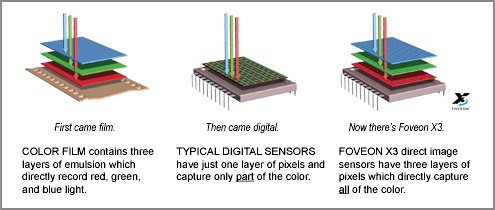
quote:
Finally, Foveon has combined the best of what both film and digital have to offer. This is accomplished by the innovative design of the three layer Foveon X3 direct image sensor. Similar to the layers of chemical emulsion used in color film, Foveon X3 image sensors have three layers of pixels. The layers of pixels are embedded in silicon to take advantage of the fact that red, green, and blue light penetrate silicon to different depths – forming the first and only image sensor that captures full color at every point in the captured image.
As I said, there is no reason whatsoever why a digital, with some small restrictions, can not be CURRENTLY made to look almost exactly like a 35mm film the kind we've been seen on theatre screens for the past +5 years. And soon, even those small restrictions will dissapear. Damm, we see it with still photo cameras where I don't think anybody questions digital can produce results almost indistinguishable from 35mm cameras. What makes it so hard to believe that the same thing could be done but at 24 frames per second instead of 4fps?
But, once again, if your goal is to make a movie that looks exactly like it has been shot in Kodak's Vision3 stock ... well, it would be wise to shoot it on Kodak's Vision3, as it would pbbly end up being around the same price for the time being and pbbly getting better results.
A large part of my whole point on these posts is to combat the notion the digital MUST be inferior to film and that it CAN NOT EVER be made better than film. That is not so. Digital COULD be made, if a manufacturer wanted, to surpass film for motion picture adquisition, not only to barely match it like we are seeing TODAY.
A different story is if currently it's harder or easier or more expensive or even feasible under a budget of many million dollars to get custom-made equipment to do so or how long it will take the market to make such products affordably available. Some, like me, think this won't take long at all. Others, that it won't happen for a long time (say >15 years).
Posted by Steve Guttag (Member # 268) on 07-27-2009, 06:26 AM:
I don't think anyone is saying digital CAN'T exceed film...just that it currently doesn't when looking at the end-product. Going beyond the capture format...one has to get it all of the way through to exhibition where the projectors themselves don't have the color/contrast or, in most cases, the resolution of 35mm, let alone 70mm film.
Steve
Posted by Mark Gulbrandsen (Member # 72) on 07-27-2009, 07:56 AM:
While cameras will quickly surpass films capabilities we may not see the end results for decades because of the stagnant development in the projction end of things. D-Cinema projection of what ever sort is going to be very slow to upgrade and the exhibitors will be even slower to install any newer equipment as it does become available because it costs money. As I mentioned the only changes you may see in the near future is that DPs and film production companiess will simply own their own gear and the rental giants like Panavision and Arri will very likely disappear. This has already quietly started with the Red Cam and several others.
Mark
Posted by Julio Roberto (Member # 4976) on 07-27-2009, 08:49 AM:
While I agree, let's not forget that TODAY, when there is virutally no "market demand" for it, you could buy not one but TWO commercial projectors that put 8K resolution on the screen with contrast and gamut and brightness (for small/medium sized standard cinema screens) to compete with film: the laser-based Evans and Sutherland and the Lcos based JVC 8K.
That is TODAY, available off-the-shelf. There are also the "experimental" ones by NHK used for demostrantions for the last so-many years.
If a manufacturer had customers willing to pay for it, I'm sure a say 16K projector could be CURRENTLY manufactured with available technology (i.e. basically just stack up a bunch of chips).
So the point is: if you want very high resolution TODAY and "sensible" prices, buy an Imax. But don't say that "Imax" is irrevocally superior to digital because a digital product could be "easily" made to leave Imax in the dust if it was ever necessary (Imax is a resolution-wasting format in my opinion, BTW, and it was only made that way because of availability of off-the-self 70mm format and the necessary space to provide a reasonable aspect ratio, but the same practical end result can be done with 70/8pef).
Again, I have the feeling that some people are grossly overestimating the (true, noise free) resolution of film, but let's not enter into that pointless discussion just yet, at least until 8K adquisition and 8K projection becomes the norm at some point in the future. Meanwhile, we can all agree that a 70mm carefully made answer print can certainly compare (or surpass) 4K projection. An 8K projector, though, it's another matter open to discussion, but quite pointless right now, altough 8K digital products exist today, and even a 28K (bayer) off-the-shelf adquisition product is expected in less than a year under $60k.
Posted by Greg Anderson (Member # 235) on 07-27-2009, 06:53 PM:
Does anyone happen to know (Mark Gulbrandsen) if the digital projectors currently running in my local cinema could handle higher frame rates without expensive overhauls? While I can appreciate all of these arguments about how many K of resolution is required to surpass film, I'm reminded that increased frame rates can make a huge difference too. It seems that only digital can increase the frame rates in a practical manner. Can we please, please, please get beyond the 24 frames per second bottleneck?
Then again, I wonder if all of this increased resolution and frame rate will be regarded as "hyper-realism" and how many filmmakers will cling to stylized 24-frame shooting because they think of it as art. If we really did have a Showscan-style format (with high frame rates and 65mm resolution) would actors be bothered that you could see every last flaw in their beautiful faces? Would art directors rebel because they couldn't get away with cheaply-made sets and props that didn't hold up under scrutiny?
I just want to make one other point. Most of the anti-digital attitudes on these forums are a reaction to too much hype or to people who just use the technology badly. I don't like blaming a certain kind of technology for the way some people use it. The technology itself is fine. Why do people have so much passion about digital vs. analog when it comes to motion pictures but not still photography?
Posted by Julio Roberto (Member # 4976) on 07-27-2009, 07:00 PM:
All current DCI certified projectors MUST include support for a 48fps frame rate.
After all, that's exactly what they do with 3D films, although in that case, they swap each one of those frames three times with the one after it to help illusion of simultaneous images in 3D.
But, of course, they wouldn't need to triple swap-flash and still take the 48fps "as is". It's actually "much harder" to triple flash than not.
So, I guess, the short answer is: All DCI projectors and servers are already capable of 48fps off the shelf (from a hardware point of view although some very minor firmware tweak may be needed for proper, non-3D support)
Current Sony Lcos projectors have a limit (for non DCI content) of 60fps.
Current DLP based projectors have a limit of 144fps.
Several of current digital cameras close to 4K-level resolution can do over 60fps. Many can do up to 200fps at 2K-level resolutions.
Posted by Knut Erik Evensen (Member # 4379) on 07-27-2009, 07:08 PM:
On the subject of what guys at Arri says about the future of film:
"“What do we really mean when we say 2K and 4K resolution?” asks Dr. Hans Kiening, head of the Image Analysis Department at ARRI, Inc. He asked that question both in a written report and during a recent presentation for members of the American Society of Cinematographers."
Excerpt
The written report
Posted by Julio Roberto (Member # 4976) on 07-27-2009, 07:32 PM:
No matter how many reports by people that have actually tested it and are even BIG PLAYERS on the film market like Arri or Panavision, some people would still just not believe that a 1.85 native film, shot and processed in film only, when projected on the screen, has AT BEST a resolution of a little over 2K (say 2.2K).
They just don't "buy it".
A lot of people just confuse the optimal scanning resolution to (try to) obtain that "2.2K-at-best detail", which may very well be 4.4K, with the true resolution of film, without realizing that half the information in there is noise and it's only there to minimize the chance of aliasing by OVERsampling.
Fixed grids digital vs random order analog don't compare like apple-to-apples, so we can't confuse TRUE resolution of analog film expressed in "points" with digital difficulty to capture THE SAME resolution directly in "pixels" (i.e. on a CGI generated digital movie) from said film.
But a few people would just not ever give in the notion that, generally speaking, a well made 4K image (captured by say a 6K bayer camera like RED's $9750 scarlet), can easily contain significantly more true-resolution than a 1.85 35mm release print. They will NEVER believe it, so no point on showing proof after proof, measurement after measurement, test after test, and white paper after white paper.
So no point on even trying to convince them that 8K-digital (captured i.e. on a 20k bayer) can have more resolution than a 70mm (1.912" x 0.87") release print either ...
Even for cinema applications, anything above 4K would only produce any noticeable advantage to the public sitting in the first 3 rows or so of most theatres, so there is not even a need for 8K at all which, nonetheless, I'm sure will happen at some point in the not-too-distant (but not too close either ) future.
We'll leave the Imax discussion for later. Unless Imax dissapears, in which case, there won't be any need to talk about it anymore, except to feel nostalgic about the glory days of film's peak achivements ...
Posted by Darryl Spicer (Member # 711) on 07-27-2009, 08:28 PM:
Frame rate for film....wasn't that more to do with Shutter flicker....By increasing the frame rate you got rid of the flicker? With digital you have no shutter. I can watch a 2-D projected image at 24fps and I do not see any flicker on digital since there is no shutter to cause it. If you filmed something at 60 frames instead of 24 wouldn't you need more storage space on what you are playing back on since there is more frames of information?
Posted by Steve Guttag (Member # 268) on 07-27-2009, 10:11 PM:
Darryl,
The frame rate increase captures motion better. Certainly you have seen the strobe of a pan that went just a little too fast. The camera does not have your brain to make sense of it all...it is just a sequecne of exposures for the camera. At the frame rate increases, things like rain starts to look like actual drops falling rather than just streaks.
I would LOVE it if 24 can go away...at least to 30fps and I'm all for going to higher. Mike Todd on got that right (With 70mm) over half a Century ago...it would be nice if we could catch up.
As for the 1.85 frame being only 2.2K or there abouts...it all depends on the the processing/printing and source material. It certainly can far exceed that.
Also, Arri is claiming the OCN has a limit of about 100 l/mm...yet you can buy and project NTAV target that has 100 l/mm targets and see the lines very distinctly (at least with a Kinoton FP38E using ISCO lenses). The upper limit of the negative must be somewhere above 100 l/mm.
I can certainly attest that an EK print (printed off OCN) pretty well slams ANYTHING printed off of a 2K DI...including a Digital show...it isn't even close, really. Super35 scope images being the worst having the least amount of information to start with (in height).
It should also be noted that there isn't any real reason that the current release print NEEDS to be as bad as some of them are...it isn't even the speed at which they are made that really kills them...it often is in the creation of the INs themselves where the degredation comes in.
Steve
Posted by Mark Gulbrandsen (Member # 72) on 07-27-2009, 10:55 PM:
Darryl,
One of the best examples of variable shutter applications is to CCD TV cameras... both SD and HD. They use a form of electronic shutter that approximates a mechanical shutter and most cameras have numerous "shutter speed" settings. It works by clocking out the data from the CCD shift registers at different frequencies effectively making the camera capable of eliminating at least some blur akin to how higher shutter speeds on a camera can freeze motion.
This can if used properly effectively elmininate image strobing like Steve's picket fence even when filming at 24fps.
Posted by Bobby Henderson (Member # 840) on 07-27-2009, 11:41 PM:
quote: Mark Gulbrandsen
Using powerful DSPs it wold actually be quite easy to shift RGB to CMY.
If that was really the case graphic artists would already have that capability with applications like Adobe Photoshop and Adobe Lightroom. The problem is that 1-button sort of thing to switch wide gamut RGB to CMYK gracefully doesn't really exist.
Any automatic, DSP controlled method in-camera will be affecting the image on a global basis. That alone can be bad.
Granted, there's lots of fancy filters and edge detection software out there, but even the best of it is not nearly as accurate as it should be. For one example, raster to vector auto-tracing schemes have had well over 20 years of development and even to this very day they all still mostly suck. Adobe Illustrator's Live Trace and Live Paint features are about as good as that technology can get. For the most accurate work you have to digitize the anchor points by hand.
There is a great deal of graphics and image manipulation work that requires human intervention and decision making where specific parts of the image must be isolated and changed separately from other parts of the image. It is takes a human brain to distinguish what parts of the image to change and other parts to leave alone or reserve for a different set of changes. Computers really do not understand how to do that accurately. Even the red eye removal tools in many software packages, including Photoshop, do not work well. You get better results retouching the image by hand.
One particular area where I've seen computers continue to fail with their automatic routines is the simple ability to detect the precise centerline of a letter form in order to create raised "prismatic" style or downward carved letters. Nothing auto-generated in the computer delivers a correct result. The areas where the letter strokes join get rounded and bowled out to something that looks laughably bad. To get a proper result, you must hand build an accurate 3D computer model. Or you have to carve the letters by hand out of any number of materials (wood, HDU, foam, etc.). Likewise, Photoshop's inner bevel filter gives off an equally bad looking effect. I chuckle every time I see it used on movie title graphics. It wouldn't be so laughable if the graphics people just applied a minor bevel instead of trying to deepen it all the way to the center of the letter stroke.
quote: Mark Gulbrandsen
As I mentioned the only changes you may see in the near future is that DPs and film production companiess will simply own their own gear and the rental giants like Panavision and Arri will very likely disappear. This has already quietly started with the Red Cam and several others.
I think it will be a pretty sad day if companies like Panavision and Arri go under because a lot of expertise will vanish with those companies. If enough experience and know-how leaves for bigger and better things it will increase the downward pressure on photographic quality into the amateur hour zone -similar to what has polluted the graphic arts industry for a couple of decades.
Some sort of camera equipment rental system will have to stay in business because it takes a lot more to fully equip something like a Red camera than just buying the imaging block and a basic starter lens. All the other gear it takes to fully complete the camera setup can cost a fortune. At least some of that equipment will have to be rented.
A regular retail outfit is good at merely renting out one part at a time. It's easy enough to contact lensrentals.com to book a 400mm f/2.8L lens to shoot super telephoto stills of a football game. More has to be thrown into the rental package when it comes to shooting a movie.
Posted by Darryl Spicer (Member # 711) on 07-27-2009, 11:53 PM:
quote: Steve Guttag
Darryl,
The frame rate increase captures motion better. Certainly you have seen the strobe of a pan that went just a little too fast. The camera does not have your brain to make sense of it all...it is just a sequecne of exposures for the camera. At the frame rate increases, things like rain starts to look like actual drops falling rather than just streaks.
I would LOVE it if 24 can go away...at least to 30fps and I'm all for going to higher. Mike Todd on got that right (With 70mm) over half a Century ago...it would be nice if we could catch up.
quote: Mark Gulbrandsen
Darryl,
One of the best examples of variable shutter applications is to CCD TV cameras... both SD and HD. They use a form of electronic shutter that approximates a mechanical shutter and most cameras have numerous "shutter speed" settings. It works by clocking out the data from the CCD shift registers at different frequencies effectively making the camera capable of eliminating at least some blur akin to how higher shutter speeds on a camera can freeze motion.
This can if used properly effectively elmininate image strobing like Steve's picket fence even when filming at 24fps.
Thanks guys for that bit of clarification. Yes I have seen some of the strobe effect on fast pans. Maybe some day they will get those frame rates up.....
Posted by Bobby Henderson (Member # 840) on 07-31-2009, 05:53 PM:
Bumping this thread.
A couple pages back I wrote:
quote: Bobby Henderson
Just about any retailer offering the EOS 5D Mark II has it listed as out of stock and back ordered.
Apparently Canon has finally got its act together to a certain extent and produced more EOS 5D Mark II camera bodies. Various retailers like B&H Photo, Adorama, etc. have limited quantities in stock.
Unfortunately the "kit" including the EF 24-105mm f/4L IS USM lens is still nowhere to be found (you save $200-$400 versus buying the same L-series lens by itself).
I went ahead and placed my order for the camera body. I'll worry about image stabilized lenses later. Actually, I'll probably get the 135mm f/2.0 L-series prime as my next lens purchase.
Incidentally, Nikon recently introduced its latest high end full frame FX-format D-SLR camera body, the D3x, boasting a 24 million pixel sensor. However, I don't think it shoots video. Yours for $7999. Maybe that new camera is lighting a fire under Canon's collective butt.
Posted by Mark Gulbrandsen (Member # 72) on 08-03-2009, 09:24 AM:
Bobby,
I would never buy another Canon Camera ever! And I used to work for them. Just wait till you have to have something serviced. Their service division has gone to shit and they charge a flat fee of 300 bucks to repair a DSLR camera body. I recently had a camcorder serviced by them and had to send it back three times... it's charge circuit still doesn't work right. Geez, you don't even want to know what it costs to repair a stabilized lens if you drop it! Call them and ask! There's now no more debate over sensors between brands because almost all current DSLRs use CMOS type sensors. I recently tested a rental Nikon D300 and it blows my Canon clear out of the water in many aspects but especially in metering. The optics are also much much higher quality and it is imediately apparent in the first image you view. My next camera will very definitely be a Nikon... oh and they have far more reasonable service rates then Canon if you do ever need service.
Canon has somewhat gone down hill over the years since I worked there... not sure why really. But JD Powers has ranked Nikon's DSLRs highest in customer satisfaction for some reason or other... I'd have to say because Nikon is just higher quality overall.
Mark
Posted by Julio Roberto (Member # 4976) on 08-04-2009, 05:17 AM:
Canon is pbbly a quite miss-managed operation. With so many branches (photocopies, printers, semiconductors, optics, photography, video) etc, there's bound to be issues.
I'm no fan of Canon (or Nikon, or any brand, really), but it has always struck me of why Canon isn't a much bigger significant player than it is.
After all, they are the only company in the world that basically makes ALL the important parts of their cameras, from optics to sensors, and not only that, but they also make the machinery to actually make the parts.
I.e. Canon is one of the top sellers of sensor and other semiconductors manufacturing machinery, including the sophisticated optics and stepper motors needed for semiconductor photolitography manufacturing equipment.
http://www.encyclopedia.com/doc/1G1-99123410.html
quote:
Canon, Inc. is one of the world's leading manufacturers of advanced step-and-repeat and step-and-scan photolithography systems used to manufacture semiconductor devices, flat panel displays and thin film heads.
Investing for your future
For several decades Canon has been in the forefront of optical technology development. Overall, Canon invests more than $1B in R&D annually. In 2001 alone, Canon registered 1,877 patents. And for each of the past seven years, Canon has placed within the top three US companies in total patents registered.
All the rest, like Nikon, depend on either third party manufacturing of their sensors (Sony) or, even Sony, depends on third party manufacturers for the actual machinery to make the sensors.
Only Canon does it all. Semiconductors (DIGIC dsp image processors), sensors (CMOS and CCD), optics (TV camera lenses, semiconductors), precission motors (scaners, photocopies), camera bodies (from their old 35mm division) ... AND also a lot of the machinery to actually make all those things. If Samsung and others weren't more competitive, they could even make their own memory chips ... RAM and flash.
Part of the problem could be the billions they lost on their bet for the "next generation" flat panel TV's based on SED technology, which is great, but pbbly will never compete with LCD in terms of price/performance and will have to be a (big) write-off on Canon's balance sheet.
From wikipedia
quote:
Canon is a manufacturer of business and consumer imaging products which includes printers, scanners, binoculars, compact digital cameras, film and digital SLR cameras, and lenses.
The Business Solutions division offers print and document solutions for small and medium businesses, large corporations and governments. These include multi-functional printers, black and white and color office printers, large format printers, scanners, black and white and color production printers, as well as software to support these products.
Lesser known Canon products include medical, optical and broadcast products, including ophthalmic and x-ray devices, broadcast lenses, semiconductors, digital microfilm scanners, and Handy Terminal Solutions.
Nikon, on the other side, it's a much smaller player with a focus on their customers, in spite of being at times number 2 in steppers for the semiconductor industry, over Canon, and although technologically they are worlds behind (sort of like Panavision and Arri in a digital world), their optics are renowned and their will to achieve top notch products is undeniable.
Posted by Mark Gulbrandsen (Member # 72) on 08-04-2009, 09:45 AM:
quote: Julio Roberto
Nikon, on the other side, it's a much smaller player with a focus on their customers, in spite of being at times number 2 in steppers for the semiconductor industry, over Canon, and although technologically they are worlds behind (sort of like Panavision and Arri in a digital world), their optics are renowned and their will to achieve top notch products is undeniable.
I don't quite agree with that. The camera bodies Nikon produces are more or less indestructable. There are still alot more old F series Nikon bodies around than there are Canon F1 series. Canon produced more of it's automatic A series cameras then did Nikon produce automatic cameras. To me that says alot and alot as to what market each company was targeting at the time. Even today at any major sporting event you'll find alot more news photographers toting the heavier Nikon cameras around than you'll find them toting Canon cameras. Canon used to have the best telephotos you could buy... the 300mm f2.8 flourite and so on but today Nikon and others, even the smaller Asian lens manufacturers such as Tamron and several others have had the flourite advantage now for well over a decade. The other interesting fact is the lack of Canon lenses in use in Hollywood while Nikor lens sets can be found with almost every special effects camera.
As for sensors that is a very debatable point as to who makes the best. Sony has been making CCD sensors far longer then all the others combined and they have eliminated many of the side effects that early CCD sensors suffed such as the smearing problem when shooting into bright light. Then there is Kodak who is also a world leader in CCD sensor design and manufacturing. And then Canon who probably produces far less sensors then either of the other two. So who's are best? That I can't answer for sure and in reality no one may know. One thing I am sure is that each manufacturers sensors probably has it's own set of advantages.
Mark
Posted by Steve Guttag (Member # 268) on 08-04-2009, 08:08 PM:
Hey, I own a Nikon F2a (25th Anniversary Edition) and a Canon AE-1
Posted by Mike Blakesley (Member # 26) on 08-04-2009, 09:12 PM:
Me, my wife, three of my sisters and my mom all have Canon cameras and they are excellent! But, never had to deal with the service dept. For these inexpensive-ish consumer cameras, would be better off just getting a new one if (when) one of these breaks.
Posted by Mark Gulbrandsen (Member # 72) on 08-04-2009, 11:16 PM:
I agree Mike... I have a box full of old pocket digital cameras on a closet shelf... five or six in the box so far but then my cameras do take a beating and get VERY dusty.
The thing that irks me about Canon is the service fee. My EOS Rebel has a tiny pin that pops up when the flash releases to activate the flash mode.Many digital and film EOS cameras have this pin. This pin is underneath the flash itself and you don't normally see it. Many cameras have had this pin stick and then when the flash pops up you get an error on the camera's display and the camera essentially locks up. I was lucky enough to find a good camera repair shop in Bozeman, MT that knew what my problem was. He told me to put a few drops of alcohol on the pin and try to work it free. Well, it did free up and has been working fine ever since. Fact is that Canon factory service would have charged me 300 bucks just to free the pin!!
Mark
Posted by Bobby Henderson (Member # 840) on 08-08-2009, 02:05 AM:
I haven't had to deal with Canon's service dept. (knock on wood). The big, legit bitch-fest I heard about Canon in recent years was how it handled its rebate program. A true nightmare. I was thankful I got an instant $50 rebate when I purchased a new Speedlight a few weeks ago.
With the usual Nikon versus Canon contest set aside this one thing is certain: The Canon EOS-5D Mark II has received excellent reviews overall from sites like dpreview, macworld, dv.com and more. The camera is not any piece of junk despite what any die-hard Nikon fan with the zero sum "Canon must die" game in mind can say.
I received mine a couple days ago and am pretty impressed and very happy with it. It puts my Rebel XTi to shame, and I liked that camera. Although the EOS-5D Mark II isn't as big as a Canon EOS-1Ds Mark III or Nikon D3x it still makes the Rebel XTi look pretty small by comparison.
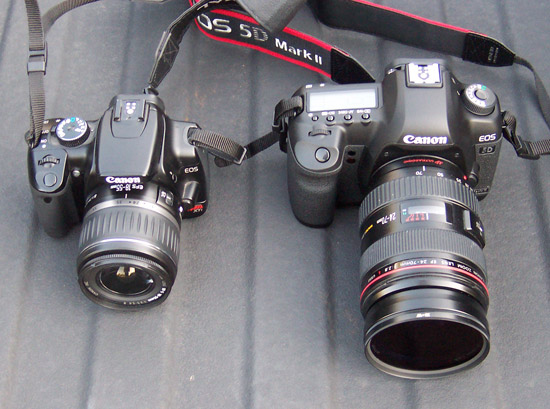
The EOS-5D Mark II feels almost twice as heavy as the Rebel XTi too. It took a little getting used to the new controls on the camera, but I got used to them and spoiled by them pretty quick (after reading the instruction manual). The menu functions are pretty slick.
The EOS-5D Mark II has been criticized for not having as fast a frame rate of the EOS-50D or one of the top of the line EOS-1D bodies. It's fast enough for my needs (landscape photography, product photography, portraits, etc.). But I'm not getting paid to stand on the sidelines of an NFL game either. The 5D Mark II has a 9-point autofocus system, which seems grossly inferior to what you get in an EOS 1D body or certain Nikon bodies. However, it is not the same 9-point system I had in my Rebel XTi either. Six invisible assist points are added. Certain points, particularly the center point, have greater sensitivity when a lens featuring a f/2.8 or larger aperture is used. Truth be told, much of the time I focus off the center point and then simply recompose for the shot I want, 999,087,007 focus points lacking be damned. I'll bet a lot of other shooters do the same thing whether they want to admit to it or not.
The camera body I received must have been manufactured perhaps only a month before I received it. It already had the latest 1.1.0 firmware installed. Out of the box it could do the 1080p/30 HD thing in full manual mode. You can even change the aperture, shutter speed, etc. while you're shooting a video clip (although the changes will be abrupt and noticeable). An image stabilized lens is definitely recommended for any handheld HD video shooting. However, I didn't do too bad with a handheld test shot using a non-stabilized 24-70mm f/2.8L lens. I think the weight of the camera body, lens and a 580EX II Speedlight helped damp out some of the camera shake. Still, get a tripod for that sort of thing.
One thing that arrived in the package that wasn't up to date: the software. The EOS Utility, Digital Photo Professional application and Canon RAW codec plug-in had newer versions available at the Canon web site. I really do not understand why Canon insists on installing Microsoft NET framework 2.0 to run its software when the NET crap is up to version 3.5. Why does it need any MS NET crap at all? I'm just pulling photos off the camera and editing RAW imagery (as an alternative to editing RAW images using Photoshop). Why does MS need to be involved in that?
Anyway, I have no ill will toward Canon gear. I got a lot of good use out of an old Canon F-1 body when I was in art school. That body was originally owned by Pulitzer prize winning photojournalist Bill Foley -a friend of my father's from days in Beirut. Foley sold that one to my dad after my father's own F-1 got stolen during a move from Virginia to New York City.
Posted by Julio Roberto (Member # 4976) on 08-09-2009, 08:20 PM:
Bobby,
Welcome to the club of happy 5d MKII owners
I got mine with the 24-105 estabilized lens about 1 1/2 month ago. It also came already with the new firmware from the factory.
Of course, no camera is perfect and there is always better ones coming out all the time.
But for around $2.3K for the body, this camera is a good buy.
In Europe it carries a 2 year warranty by law (like all electronic products), although I purchased mine from the USA (cheaper, only place I got availability, as the sucker is sold out everywhere more often than not since it came to market almost a year ago).
Anyway, can't wait for what the 6D Mark III will bring in the future
Posted by Mark Ogden (Member # 43) on 09-02-2009, 08:38 AM:
In case anyone's interested, this is a list that's been going around the industry of what episodic television shows are shooting what for the 2009 - 2010 season. This was compiled over a few months, some of these shows are closed/dark/between cycles already.
35mm Film (3-perf except where noted):
“24”
30 Rock
Beastly
Big Love
Boardwalk Empire
Breaking Bad
Brothers and Sisters (Started on HD, now 35mm)
Castle
The Closer
Cold Case
Copper
Criminal Minds
CSI: Crime Scene Investigation
Desperate Housewives
Entourage
Flashpoint
Fringe
Ghost Whisperer (said to be shooting 2-perf)
Glee
Grey's Anatomy
Heroes
House
Hung
Kings
Lost
Mad Men
The Mentalist
Nip/Tuck
Private Practice
True Blood
Two and a Half Men
16mm Film:
The Border
Burn Notice
Chuck
Crash
Degrassi
Eastbound and Down
Eastwick
Friday Night Lights
Greek
Heartland
In Plain Sight
Lincoln Heights
Men of a Certain Age
The Middle
Monk
One Tree Hill
Psych
Saving Grace
Scrubs
Digital Acquisition (cameras where known):
Accidentally On Purpose
The Beautiful Life
Brotherhood
Brothers
Bones - Sony F35
Bored To Death
Californication - F23
Caprica – F950
Cold Case – present day scenes on F35, some flashback scenes 35mm
Community - D21
Cougar Town
Criminal Minds
CSI: NY - F35
CSI: Miami
Damages - F23
Day One
Defying Gravity - F35
Dexter - F23
Dollhouse- now being shot on Panasonic 3700
Flash Forward
The Forgotten
The Good Wife
Gossip Girl - F23
Hank
Human Target
In Treatment - Sony 950s
Law & Order - Genesis
Law & Order: Criminal Intent
Law & Order: Special Victims Unit
Leverage - Red One & Sony EX1
Medium - Genesis
Melrose Place
Mercy
Modern Family
Murderland - F35
NCIS
NCIS: Los Angeles
Numbers - Genesis
Nurse Jackie - D21
The Office – Sony ?
Parenthood
Past Life
Royal Pains - F23
The Sarah Silverman Program - Red One
Sherri
Sons Of Anarchy
Southland – Red 1, Iconix
Supernatural - D21
Three Rivers
Trauma
The Tudors
Ugly Betty - switched to digital from 35mm
V - D21
Vampire Diaries
Weeds – F950
White Collar
Posted by Julio Roberto (Member # 4976) on 09-02-2009, 09:41 AM:
Film still has, at least, 1 or 2 years of very good health. Nobody is denying that.
What will happen after that period of time, when the new crop of electronic 4K cameras at much lower prices show up, doesn't take too much to imagine.
Most people agree that film will NOT "mostly dissapear" for some 5 years, if not longer, and will remain a strong contender.
But the writing is on the wall. Film is NOT a thriving industry with good outlook. Certainly not in the long run and it's even bleak and uncertain in the short term.
Also, several episodes of some of the shows listed in that list as "film" have actually been done on digital cameras, such as the show "24" ...
Also, it's normal for some shows that started many seasons back on film to remain with the same look, equipment and crew, since, as they say in spanish, ... better "bad-but-trusted" than "good-and-uncertain"...
Posted by Martin McCaffery (Member # 37) on 09-02-2009, 09:52 AM:
Interesting that a "dead" format, like 16mm is still in active use, on what appear to be mostly basic cable shows. How about in the rest of the world?
Posted by Julio Roberto (Member # 4976) on 09-02-2009, 09:57 AM:
TV shows in Spain are almost exclusively shot on video.
Standard definition at that, mind you.
S-16mm has always been "big" in TV production in the US, and remains very much an option there.
US shows often enjoy much larger budgets and world-wide distribution than, say, french/german/norwegian TV comedies/soaps/shows, so they can afford stuff like 35mm instead of plain old betacam ...
Posted by Brian Guckian (Member # 1678) on 09-02-2009, 11:17 AM:
Super-16 is still in use in the UK TV market.
Film remains the right choice for quality (note: ) television production.
Even Super-16 shows look richer and have more depth to their images.
You could readily see the difference when ER employed RED for its last season - the image was certainly a lot flatter. It was good - but not up to the standard of 35mm.
Also, with film you have an archivable negative...
Powered by Infopop Corporation
UBB.classicTM
6.3.1.2