This is topic Christie Opens New China Manufacturing Facility in forum Digital Cinema Forum at Film-Tech Forum ARCHIVE.
To visit this topic, use this URL:
https://ft-forum.com/ft/cgi-bin/ubb/ultimatebb.cgi?ubb=get_topic;f=16;t=000594
Posted by Brendan Penny (Member # 5041) on 06-17-2010, 09:20 PM:
"Christie®, the world leader in digital cinema projection, announced the opening of a new manufacturing facility in Shenzhen, China to meet the growing global demand for digital cinema projectors to screen 2D and 3D movies. The new facility will significantly expand the company’s production capabilities, with the Christie Solaria™ projectors scheduled to roll off the assembly line in July.
Production will begin with the Christie CP2220 and the Christie CP2210, with the Christie CP2230 to follow. The Shenzhen factory will initially feed the Asia Pacific market, freeing up capacity at Christie’s North American plant to increase supply to the rest of the world."
I cannot tell you how excited I am to know that we will soon be getting projectors made in China down here. Awesome. Can't hardly contain my excitement....
Posted by Joe Redifer (Member # 3) on 06-17-2010, 11:24 PM:
Dude that so totally rocks. As everyone knows, China makes only the highest quality products each and every time. They could teach us a thing or two about how to treat and pay workers, too! Oh wait, nevermind. Wrong country.
I hope to be reading about striking Christie workers in China very soon. ![[Wink]](wink.gif)
Posted by Michael Hossen (Member # 4274) on 06-17-2010, 11:43 PM:
Don't worry Joe, in the US you'll still be getting the good units... Until Christie get greedy, which is when their workers will start jumping off the roof.
Posted by Ian Parfrey (Member # 5122) on 06-18-2010, 04:06 AM:
Any guesses on the longevity of these units?
Posted by Mark Gulbrandsen (Member # 72) on 06-18-2010, 08:30 AM:
Christie has no choice but to do this as NEC's pricing is anywhere form 10k to 15k less per equivelent model. You watch... The Canadian plant will soon be a thing of the past... BTW: The build quality on the NECs is every bit as good as the Christie stuff... Watch for Barco to not be left out of this as well.
Posted by Mike Blakesley (Member # 26) on 06-18-2010, 11:33 AM:
Not the same by far, but for what it's worth, Lionel Trains sent all their manufacturing to China about 8 years ago and the product is much better than the most recent stuff they were making in the U.S.
I'm all for American pride, but competition is competition.
Posted by Scott Norwood (Member # 30) on 06-18-2010, 12:03 PM:
Will the ![[dlp]](graemlins/dlp.gif) projectors leak as much oil as the Chinese-made film projectors?
projectors leak as much oil as the Chinese-made film projectors?
Posted by David Stambaugh (Member # 1102) on 06-18-2010, 02:11 PM:
Oh great now I'm defending Chinese manufacturers.
Chinese companies (contract manufacturers etc) are perfectly capable of making anything you want to any level of quality you want. If they do the Christie projectors to a lesser quality level than their US-made counterparts, it's probably under Christie's orders, to save money.
Posted by Martin McCaffery (Member # 37) on 06-18-2010, 02:57 PM:
I'm sure many on this list are old enough to remember when Made In Japan was a sign of second rate workmanship.
As soon as the Chinese factories start cranking out quality products and demanding a premium for them, the money will flow to next country that will work for nothing.
Which often seems to be Alabama;>
Posted by Bobby Henderson (Member # 840) on 06-18-2010, 07:42 PM:
China has a good racket going for industrial output: a state-controlled press, next to nothing in terms of labor and environmental safety and an execution rate of roughly 1000 people per month -many of which are executed for reasons that have nothing to do with stuff like capital crimes against other people (murder, rape, etc.).
I suppose one can get pretty good quality output from workers who are desperately poor, starving and scared to death of complaining about anything. Yeah, the United States needs to be the same way. Damned lazy Americans and their freedom and having clean water and other crap like that.
![[Roll Eyes]](rolleyes.gif)
Posted by Steve Guttag (Member # 268) on 06-18-2010, 10:09 PM:
I don't know if NEC has an "equivalent" to Christie (or Barco) model. NEC has three models, Christie has three models but light/lumen do not match up...in the middle the imagers don't even match up.
For instance...the NC2000C does not match up with the CP2220...while they are both "middle" projectors...the NC2000 typically tops out at a mere 11900 lumens, UNLESS you go with the super short life lamp and then you can get 17,000 lumens...but only 650-hours of life on a 4K lamp...it is very expensive to run. The CP2220 can hit 18,500 lumens on just a 3K lamp and get over 1000-hours on that lamp. Cost/hour, Christie is far cheaper for both the lamp and the electricity to run it.
I don't know why you think the "build quality" is so great on the NEC. I don't think it stands up nearly as well as the other two. Since you claim it is much better on series 2s than series 1s...I'd hate to see a series 1!
Don't get me wrong...the NEC will put out a DLP image...most folks will think it is just great (from downstairs)....but it is like an econo-car...it will get you there but you won't enjoy it as much as other cars. On the up-side...NEC does have TWO SETS of HDSDI inputs...which for alternative content/rentals will be quite handy.
As for "made in China" You can have it...I'm pretty disgusted with "made in China." While some claim that China can make things to any level of quality...I'm starting to find that they seem to find a way to short cut that in everything that I've had to deal with.
I deal with a widely known A/V product company that has more recently started to use China as a manufacturing origin over their own in-house manufacturing. There has been a VERY notable decline in reliability of those products. In fact, ALL of my returns have had a "made in China" badge. When questioned, the company replies "Yes we have some products made in China but they are designed here and made to our specifications so there should be no quality difference." To which I just responded..."then why am I pulling a relatively new item, Made in China" and replacing it with the same model, though older by several years, Made in USA that still works? If it happened just once...well things happen...but lately...if it is made in China, there is some degree of crap in it. Or in the case of toys...Lead or some other heavy metal (what was in the Happy Meal toys?).
Posted by Mark Gulbrandsen (Member # 72) on 06-19-2010, 01:33 AM:
Indeed the build quality is every bit as good as the others. In several aspects such as light engine removal they are even better. They use Ushio manufactured reflectors and Sanrex rectifiers and ignitors, same as Christie. Those that know my background will agree that I have more experience than most here with the insides of hi tech equipment. I absolutely would never touch a Series One NEC for anything... They are literal rats nests although they certainly do run reliably and have made their way into many prominent installations. As for your lumens ratings I also believe you are missing
something. I've had great luck with the NC-2000 and Dolby 3-D on a number of mid sized screens. For 2-D it's a very economical solution that allows the use of most HS series cinema lamps. There are many lamps available that fit the NC-2000 including a new lamp comming out very soon.
In regards to China... Weather it's good or bad is another entire debate but better get used to it. They will soon be producing most of the industrial and consumer type goods the world uses.
Mark
Posted by Steve Guttag (Member # 268) on 06-19-2010, 07:15 AM:
I'm not missing anything on the NEC lumen ratings...for I get them from NEC...and I've confirmed them in the field!
There is indeed a new lamp due out in July...yet another 4K lamp! This will split the difference between a 17,000 lumen 650-hour lamp and the 11,900 1500-hour lamp. It will be a 14,000-lumen 1000-hour lamp. Compared to the Christie CP2220 running just the CDXL-30 (no SD) which will have 15,000 lumens...every time you compare, it loses. Also note, the Christie can also use "standard" lamps (HTP) for 2K and 3K wattages.
Part of the NC2000's problem is its power supply that tops out at about 138A...which is NOT a full 4000-watts.
The build quality is not near what a Barco is and I don't think it is as good as Christie, either. For service, Barco has had the others beat for some time...at least on the DP1200-DP2000 (and now the DP2K series)...VERY modular. I do like how open the NEC is, once inside. The light engine does look to be easy to swap (like a Barco).
NEC does have the others beat on showing the coolant level...they are the only ones that allow you to see it without having to open anything and they use their light loss....err light-leak to light up the vile. I have always disliked that one has to remove covers to check that.
How has the NEC software been working for you? Can you set colors with it? Hopefully, the latest software update has fixed that minor glitch.
Man...I wish DCI would standardize the naming of things. Barco has Macros, Christie has Channels and NEC has Titles and they all use them slightly differently!
Barco and NEC use PCFs...Christie doesn't...
And then there are the test targets...one never knows what you are going to get. NEC gives you precious little, Barco gives you quite a bit (and the only good focus target)...Christie often has good framing targets.
Posted by David Stambaugh (Member # 1102) on 06-19-2010, 11:39 AM:
Chinese-made products for brands like Sony, Apple, etc. are built to the highest quality standards. The brand owner is responsible for accepting or rejecting the final build quality. They're in charge. Now if some company's amps are being made in China and have a high(er) failure rate than their US-made counterparts, it's that company's fault for not exercising proper quality control procedures over their Chinese contract manufacturer. Or else they've chosen to build to a certain price point and have accepted the fact that they will see higher failure rates.
That's my story and I'm sticking to it. ![[Big Grin]](biggrin.gif)
Posted by Steve Guttag (Member # 268) on 06-19-2010, 11:42 AM:
It is true that it is the company's brand that is one the problems...but the fact remains...when I see junk...it almost always has the "China" label. It is also impossible to check every thing in every run to see if short cuts were made. While China is cheap, they have proven to me that they are an unreliable country to source things from. Unfortunately, as Mark has said...that is where everyone is going because they are so cheap.
Steve
Posted by David Stambaugh (Member # 1102) on 06-19-2010, 11:48 AM:
I'm not claiming "Made in China" always means High Quality. Far from it. Ask me about the Chinese-made office chairs my company keeps buying because they think it's a better value. It's CRAP. Chairs that literally fall apart inside a year? Heaven forbid that we'd spend more for Herman Miller furniture that will last for a decade or longer.
Posted by Steve Guttag (Member # 268) on 06-19-2010, 01:02 PM:
quote: David Stambaugh
I'm not claiming "Made in China" always means High Quality.
I never said you did. Nor do I mean to imply that ALL Chinese made things are junk. I, however, don't trust them to not alter things and that I have found the junk I come across nowadays to always be from China.
Posted by Mark Gulbrandsen (Member # 72) on 06-19-2010, 03:18 PM:
Not to fear the good ole USA has also produced way more than it's share of crap products compared to the rest of the world! Automotive, electronics(especially some televisions and radios of the 60s,70s and 80s) as well as countless horrible automobiles and the fast food we all eat and die by! Any country (including Alabama) can and does produce crap.
As for the NEC stuff it is excellent stuff and offers quite a number of advantages. No projector out there is perfect for every installation... use it for what it can do and you'll be fine just like any other piece of gear. IMHO you stand the same chance in all aspects with any of the new generation 2 machines... they ARE designs that are approved by T.I. anyways. Many of the boards all come from the one source... T.I.! For many the less expensive NEC is an excellent option and it is a big money saver especially when installing them in large plexs. The matching EPRAD bases not only blow away every other D-Cinema base option out there today but they too also make installation faster and wiring a breeze. If one needs more light just go to the NC-3200 which is still priced way way under it's other counterparts.
No software issues here so far. The setup software works fine and is quite fast. I can't answer for series one although there are lots of them in the SLC area and I've heard no complaints in regards to color correction issues. You simply can not work with any of this gear and expect to not have any software issues at all!
EPRAD has advanced through a bunch of generations of eCNA software(like 60). Many of the generatins relating to additional functions and built in requests for some of the chains. The eCNA system is cheap and it works very reliably. It also offers automatic fader control for most existing cinema processors. Few other off the shelf automations can offer that. If you use the EPRAD base the auditorium interface board mounts in a slide out panel to facilitate wiring and the automation unit itself is mounted angled on the rear of the pedestal in plain sight... no need to stoop over to use it in a normal verticle mount rack. You can also control any screen from any automation.
Manufacturers can call their inputs what ever they want to... I still call them channels and they all set up as macros in very similar ways. I think if you asked around you could probably aquire other test targets and load them in just as we always have in the past. I don't see why not... I still use a pattern off the server to size the image cut the plates anyway. Dolby reccomended this in class and I've just always done it this way. Focus and other setup procedures can be carried out with the supplied internal targets. I have not seen a single projector that did not have at least Framing, Convergence, Safe Image Area, and at least a half dozen others I will probably never use. I would personally like to see one loaded in each projector to check lens resolution and other parameters in regard to rez. and contrast to at least verify lens performance of each system. Zoom lenses are critical pieces of gear to properly set up and calibrate.
Generation 2 is still very new so it may be some time for every bell and whistle to show up but I suspect it'll be ther in a year or so as requests come in for the stuff.
Oh yea, and I'm still waitin for T.I. to close down the DLP plant. Seems more like DLP is finally seeing the light!
Mark
Posted by Ken Lackner (Member # 1002) on 06-19-2010, 04:26 PM:
Any country including Alabama?? I must've fallen asleep that day in history class.
Posted by David Stambaugh (Member # 1102) on 06-19-2010, 06:41 PM:
quote: Steve Guttag
I have found the junk I come across nowadays to always be from China.
Well it seems like 95% of our manufactured goods come from China now so it follows there would be some junk in there. Just sayin'.
I went to Target today to get a Fathers Day card and guess where some of the cards are printed?
I recently bought a Sony digital camera and was surprised to find it labeled "Made in Japan".
Brand names are really global now. I was looking at new washing machines. A Bosch (ostensibly a German brand) was made in Korea. Maytag, a brand I associate with USA, was made in Germany.
Posted by Mark Gulbrandsen (Member # 72) on 06-19-2010, 07:46 PM:
Ken... Alabama has always been another country... So is Utah County for that matter... Where have you been all these years?
Dave is correct that many brands are global now and to be honest if you dig deep enough you will more than likely find parts in many different products that are made in many different countries. White man no longer rules... Thank god!
Mark
Posted by Aaron Mehocic (Member # 15) on 06-19-2010, 08:55 PM:
Yes, but what we are talking about here is what an economist would call Export-Led Growth. "White man", according to Mark, came up with this idea after World War II and we all know the reasons why. Bottom line: Its a great concept - as long as you don't have to fight the guy who gets all your factories (That is one of the reasons why China has MFN [Most Favored Nation] status).
In my lectures, I am a big proponent for Import Substitution. This is where a nation places high tariffs on imports to the point where nobody wants to send their product there. In the meantime, small start-ups develop meeting the needs of the domestic consumer with their products. These start-ups then perfect the product and go to market with it. After enough home-based companies are up and running the tariffs are removed, and foreign-made goods can now compete fairly along side domestic products. The consumer then decides who's product they want to purchase and QUALITY not QUANTITY rules the marketplace.
The United States did this very thing after the War of 1812 and the legacy of this action is still with us today in the form of DuPont Chemical and Remington Arms. Of course, this same form of protectionism was the basis of the Smoot-Hawley Tariff of 1930 and as we are all aware that was a meaningless piece of legislation since most foreign imports dried up anyway shortly after the October, 1929 Stock Market crash. In truth, if Import Substitution was attempted today by the United States along these same proportions as explained here . . . the current economic downturn would be yearned for as "Happy Days".
Posted by Brendan Penny (Member # 5041) on 06-19-2010, 09:32 PM:
Quality issues aside. The driving factor on this is $$. Says a lot about a company when they are prepared to exploit workers in another continent.
Could have opened up a new facility in North America and help your own economy and country. But no, we will sleep better at night knowing that our projectors are manufactured by children who work 16 hours a day for $10.
And I blame the governments for breaking down tariffs that support this structure and ensure that nothing can be made competitively locally.
The biggest protest one has is choice. Demand that your Christie projectors do not come out of China.
Posted by Ian Parfrey (Member # 5122) on 06-20-2010, 12:28 AM:
Welcome to the Global Economy.
As Mark says, you had better get used to it because as long as the almighty $ is King, then that's how it's going to be.
Posted by Steve Guttag (Member # 268) on 06-20-2010, 09:36 AM:
Yes Mark, any group of most anything has its share of crap and gold...USA included, for sure. I do come from an era where Japan = Junk and watched that change to the point where Japan = Great and the USA stuff was more suspect. This notion was highlighted in the film Back to the Future when Doc Brown noted all of the electronics were made in Japan.
However, China = Junk seemingly is holding on. Furthermore, this business of substituting materials, putting lead in paint, cadmium into drinking cups...etc...they are not just isolated problems...they take shortcuts and there is no denying that buying from there is little different to exploiting slave labor. There is not great mystery...they are not more efficient/smarter. They don't have the environmental, labor and other laws that most civilized nations have. It is like going to the Olympics and running a 100m dash but putting hurtles up on every country buy China....who do you think would win? It is time we stop "protecting" China's industry...Protectionism is supposed to be bad.
The NEC stuff is "okay" and offers very few advantages. At present, other than initial cost (yes it is notably less expensive) it has four (4) HDSDI spigots. Few will take advantage of that but some of my clients definitely would.
quote: Mark Gulbrandsen
For many the less expensive NEC is an excellent option and it is a big money saver especially when installing them in large plexs.
It all depends...IF you can get the light you need on a standard cinema lamps...then yes, they will be cheap solution. If you are needing over 10,000 lumens...then no...the lamp costs will get you over other DLP solutions. Depending on how long you plan on keeping the unit, the lamp costs will not only erase the installation cost advantage, but you will spend more on the long haul in both electricity and the lamp itself.
quote: Mark Gulbrandsen
The matching EPRAD bases not only blow away every other D-Cinema base option out there today but they too also make installation faster and wiring a breeze.
Define "blow away." EPRAD does have several base solutions (and Strong has one too that has some nifty features). One thing the Christie and Barco pedestals have going for them is size...they are easier to move into a booth up a narrow stairway. Cost...at least the Barco pedestal is a bit cheaper than the others. I do like that EPRAD makes several so one can decide just what features are important and get the pedestal that fits their needs best. The documentation on them is interesting but last I checked, they lacked dimensions...which sometimes is the critical factor. The Strong pedestal can have the racking configured many ways and the breakers they use if you get the Power distribution option are genuine Square-D QOs. It makes for a nice transition from a Console as it is a 3-phase panel, even if you only need single phase.
quote:
No software issues here so far. The setup software works fine and is quite fast. I can't answer for series one although there are lots of them in the SLC area and I've heard no complaints in regards to color correction issues. You simply can not work with any of this gear and expect to not have any software issues at all!
I have only worked with the series 2 NEC so I can't comment on the series 1 software (appears to be the same)...mine refused to take color correction numbers...I had to back door it in using the TI software (ICP Enigma). There was a new version posted on 6/14/10...so that might have the fix in it. As for software issues...that was the only non-functional part...but the besides that NEC's DCC software is a bit on the weak side overall. It isn't as slow as Christie's web based ones but all are way far behind Barco's Communicator. I don't know if I've ever had a non-functioning part of Barco's software, going back to DCine Communicator (1.3K projectors through the DP100). If you want to do special venue stuff, Barco's software is going to let you do it and overall is the best laid out that I've used. It is also the best functionality.
As for the eCNA...if you have an eCNA-200 from the film installations...you are in luck...it will give you most/all of the eCNA 10/eCNA-5 capabilities. All of those relays are addressable via commands (a bit cryptic commands but they all follow the same flow... CMD,OUT,0,<relay function,N,?? so you can get direct control. Or, if you choose, you can have it run a program just like from film and merely have your DCinema system send "cues" back to the eCNA to step it through the program. It will be the fastest most pain free DCinema installation for that. It will then also show up on your status monitors just like the film theatres. If you know the eCNA-200, you'll be okay with the eCNA-10 and, for Gods sakes, use the Web interface for the programming. the eCNA-5 also looks to be a nifty, real low cost, set of "hands" for your DCinema player. Ins/Outs on it. Probably all most will need to control lighting and masking.
As for test targets...NEC definitely has the lamest set that comes with it. I don't think I ever found a "framing" target on the NC2000 and it definitely didn't have a focus target. Like with the series ones, I'm starting to acquire ones for series 2s that I'm carrying with me so I can always have my preferred targets. Series 1 machines used ".tga" files, series 2 use ".png" files. I guess one can even make their own as they are just graphics files. One could also convert their .TGAs to .PNGs. But how hard would it have been to have a focus and framing target already loaded? I too use a server based framing chart when I do the screen files. I carry them around on our "CRU" drive and make sure they (and other) targets we might need are loaded on the servers I'm aligning. I agree that the server based targets are the ones to use for critical alignments. I do like the "Framing2" target from the DLP projectors since it has all of the various non-DCinema lines/dims on it for setting up alternative content. Of course, I carry a generator for that too but for quick set ups, it is quite the handy target.
Yes, resolution targets would be nice though I'm sure the thought is...the resolution is fixed (they are pixels). One thing I'm seeing is that the various projectors have varying degrees of color smear. That is...Blue may have a smeared appearance or Red even multiple colors. It isn't model specific, either. I've had my best and worst on the same model. I have noted that Christie has the LEAST amount of this...and thus far, NEC the most.
I agree, there ought to be a way of qualifying lenses too. I don't think they are all created equal (they were not in film). There are several brands out there and I don't think they all do equal jobs on all models. I wish Schneider would make some zooms to give the others a run for the money. They are making some fixed focal length lenses including one for Curved screens (finally).
Steve
Posted by David Stambaugh (Member # 1102) on 06-20-2010, 11:25 AM:
Chinese companies are hardly alone in taking shortcuts. Just ask BP, Toyota, and Peanut Corp. of America how the shortcut strategy worked out for them.
If Christie's Chinese-made projectors turn out to be inferior, it will be Christie's fault for not imposing proper quality control measures.
Posted by Brad Miller (Member # 2) on 06-20-2010, 11:52 AM:
I really hope people out there can comprehend the logic and intelligence in Steve's comment here. Buying NEC for anything but a very small screen is about the stupidest thing anyone can do. It is infuriating how many stupid people are out there in the industry that can't do simple elementary school math and realize the NEC in most all situations COSTS THEM MORE. There is FAR more than simply basing a decision on the initial price tag. Yeah the price is cheaper, but just how much more will it COST you? I'm not just picking on this specific example of NEC's projector...just think about other digital cinema equipment such as servers.
quote: Mark Gulbrandsen
For many the less expensive NEC is an excellent option and it is a big money saver especially when installing them in large plexs.
quote: Steve Guttag
It all depends...IF you can get the light you need on a standard cinema lamps...then yes, they will be cheap solution. If you are needing over 10,000 lumens...then no...the lamp costs will get you over other DLP solutions. Depending on how long you plan on keeping the unit, the lamp costs will not only erase the installation cost advantage, but you will spend more on the long haul in both electricity and the lamp itself.
On a different, but similar note, bear in mind when it comes to digital cinema, there is bribing going on and a lot of under the table money being passed along to people responsible for making purchasing decisions. I've heard this from multiple people who it has been offered to now, to the tune of tens of thousands payable cash direct to the person who helps push a purchasing decision. The smarter crowd can analyze the companies out there and figure out which of the companies NEED to resort to that tactic.
Whatever happened to the notion of building a better product to increase sales???
Posted by Steve Guttag (Member # 268) on 06-20-2010, 12:40 PM:
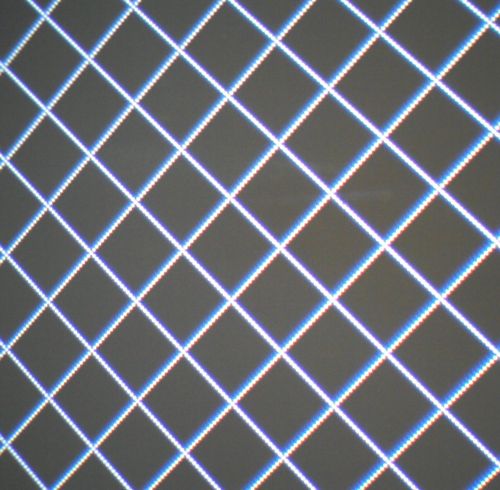
This is an picture I took of a recent DLP installation...note the blue smearing. Note that it isn't uniform either with more smearing in the lower right corner. This is before convergence was tweaked but still the blue smear was pervasive. With actual picture, you are less likely to notice it but it comes off of overall picture quality. I do think it is very Patriotic in color, if you are from a country with Red white and blue colors!
Steve
Posted by Mark Gulbrandsen (Member # 72) on 06-20-2010, 03:36 PM:
Yea Steve, Reminds me on the Christies that one of the colors does not focus as well as the other two... it is either red or blue but it can not focus properly because of design contstraints in the prism block itself... so they told us in training class. I have not seen this problem in either Barco or NEC. Apparently they got the prism design down pat.
And Brad... Calling folks here stupid is about as lame as I've ever seen you get. Its no wonder so many have vacated this web site. There is a place and a job out there that each manufacturers projector can handle with ease!
Mark
Posted by Brad Miller (Member # 2) on 06-20-2010, 04:50 PM:
Mark, I am calling the people who CHOOSE the NEC projector for anything but small screens stupid...or if you don't like that term, how about foolish? This isn't an opinion. Just look at the hard data. It is fact.
Want more facts? You can order an NEC projector today and have it in your hands next week. To get a Christie or a Barco you will be waiting months due to the high demand for them. That alone speaks for the majority of the industry's level of intelligence in this matter...and that means that most of the industry isn't stupid, foolish or whatever word makes you happy.
Steve's comments are dead on target, as usual. You on the other hand change your opinion wildly depending on who you are working for or what sort of equipment or deal you are currently installing. You are doing a disservice to anyone that still listens to you because you don't tell the whole picture. Steve on the other hand, pointed out the good and the bad points of the NEC projector, and backed it up not only with his own findings, but with the spec sheets from the manufacturers as well. Seriously, give it up.
Posted by Steve Guttag (Member # 268) on 06-20-2010, 06:23 PM:
Mark...the image posted...from an NEC NC2000C. Thus far, Christie has given me the least amount of smearing of the units I've installed (SB, M and ZX). I have a DP2000 that has too much Red smear, in my opinion. I have a Barco DP2K-20C that is darn near perfect yet I have another one that has some smear...if it is an intrinsic design issue, it should be more consistent.
Though I have seen green smear...it is, by far, the cleanest of the three colors. There is probably something to Barco having a green focus pattern in addition to the normal full color focus pattern.
Please note, I'm not trying to pick on NEC just judging it on the facts and noting where it is strong and where it is weak. It is definitely weak on light as compared to the other two. I just completed an NEC NC2000C that is doing the job asked of it and it is living up to expectations. However, it was designed in what light it could deliver. I found it a more difficult installation than Barco (or Christie). I think the software is quite weak for the NEC and could stand much improvement. There is, no doubt, a bit of being used to the others, particularly Barco. But there can be any denying, the lamp alignment is flimsy, and the software will mislead one in optimizing the alignment so it should be avoided.
I will do my best to get the most out of an NEC as I would with a Christie or Barco however I do think there are limitations imposed by the projector/software...that said, except for studio screening rooms, I don't think the movie going public will notice.
Steve
Posted by Mark Gulbrandsen (Member # 72) on 06-20-2010, 08:04 PM:
Steve-Brad,
I know you'renot nit picking Steve. But I guess neither of you read my post. I said "use it for what it can do and you'll be fine just like any other piece of gear." Of course it isn't going to do a 40 foot wide screen with Dolby 3-D! All of my 3-D installs of this projector have been on ~30 foot wide 1.4 gain screens and this has left plenty of head room with the standard 4kw lamp. This will also allow for operatin in 2-D with either a 2kw or 3kw standard cinema lamp. There have been zero operating problems so far with the projector.
You would have to ask Rodney Dye about the mis-focus and which color but it is. He elaborated on it when he stopped by the shop one day. It is a design issue with the pr
ism and not being able to get that color chip in the exact plane it needs to be in. Back when we assembled projectors in the shop when I was working for CLACO I saw the same mis-focus on each ZX that went through the shop, he also pointed it out. You would in theory see it on every CP-2000 since they use the same light engine. When aligning each chip at the factory in it's proper focal plane they also have to take into account to some extent the chromatic abberation of both the prism and the average of all the lenses and set the focal point of the chips that way. Technicolor had to do a similar thing in it's three strip cameras but it was done by altering the glass mix for the camera lenses so all three primary colors landed in their proper focal planes. DLP of course is just the reverse. This is one of the main reasons why I would like to see well designed resolution patterns in each projector. HDTV has some decent patterns for checking this and they may well be very applicable to this situation. The problem in your photo may have nothing at all to do with the actual projector and may lie in the lens... or it could also be the other way around. There is no way at the moment to actually tell although Century Precision no dout has a properly set up lens projector in a darkroom in which any DLP lens could be tested for resolution at any point in it's zoom or focus range.
On the base thing... I never cared for the Strong bases... the ones with the car jack for elevation. The EPRAD bases for the most part come built to your specs and are ot cheap! You can have the sub panel installed for what you need or just get a basic sub panel. The tilt point on the pedestals is at the nodal point of the optical system of the projector which is really nice. Racks are removable and can be wired sitting on the bench then installed in the pedestal after it has been moved onto the site. There have been several minor changes to the pedestals since I installed my first one and all these have just made it easier to dael with. I dislike the BARCO peds because of the hard to find European hardware required and the Christie peds are just way to basic. Many dealers don't even bother with the mid sized Christie ped and they make their own or adapt others. I don't see why the EPRAD peds might not also be adaptable to some of the BARCOs and Christies as long a the projector foot print is with in the shelf size.
To me the software is a non-issie and it just amounts again to learning it and also using the right projector for the right job. I agree a Barco wold be better for jobs involving lots of modified formats or needing to modify on the fly. It IS the easiest software to operate! I however believe a good tech can be just as proficient at operating all the others and achieve more or less the same result. As technicians we have to be able to run any software involved in our day to day jobs in a fairly efficient manner... there IS a learning curve with all the software out there. The more you use it the easier it gets.
Mark
Posted by Steve Guttag (Member # 268) on 06-21-2010, 08:57 AM:
Wait...the "standard" 4K lamp for the NC1200 is the NC-16LP402...aka DXL-40SCN. It is just an 11900 lumen system...if you had a 30-foot wide 1.4 gain screen...when everything is new...balls to the wall, with Dolby 3D...you, at best, are going to get about 3.26fL...by the end of the life...2.5fL. Now if you use the high brightness lamp then 4.7 when new and 3.7 when towards the end of life. And that life comes at 650 hours...
Steve
Posted by Mark Gulbrandsen (Member # 72) on 06-21-2010, 05:47 PM:
You're right Steve, it was the high brightness 650 hour lamp, I remember setting the lamp expiry warning to 600 hours! I measured these levels with the Minolta CS-200 and verified later on with very similar f.l. readings from my Spectra. Both meters are in calibration. More likely the Harkness 1.4 gain screen was higher than 1.4 or the projector was doing a bit more, possibly both. The lens used was the 2.4 to 3.9 ratio and the throw was about 90 feet to the 30 foot wide screen. The screen would need to be near 1.68 gain to get what I did and this wouldn't surprise me a bit. I did not have the time to calculate the gain of this particuluar Harkness due to installation time constraints but I will measure it in a couple of months when I go back. Lamp was running ~100% or about 115 equivelent amps in flat, no where near the top end of that lamp. One beef I have with the NEC is that percetage means absolutely nothing. They need to change that to amps! Even theater managers and the lesser but still evil booth monger can deal in amps!
I did install one NEC 2000 and Dolby 3-D on a 14 year old 32 foot wide matte white Harkness screen back right after Showest and I got what you calculated I should be getting with the 1.4 gainer. About 3.25 fl. This customer is getting a new screen very shortly to improve the light level. In his case he has a properly curved frame and is getting a 1.8 gainer. No customers have complained about the low light level. It is too low for me! This was installed with the Phillips LTI Helios short gap 4kw lamp. Oddly no lumens spec exists for this lamp at least on the Phillips LTI web site.
Mark
Posted by Steve Guttag (Member # 268) on 06-21-2010, 07:34 PM:
The NC2000C tops out at 138A. When running the high brightness lamp at 100%, you are at 138A. Hooking up the DCC software can confirm this. Also, I'm pretty sure you can get this information by scrolling down the menus into the "Lamp" section.
Steve
Posted by Mark Gulbrandsen (Member # 72) on 06-22-2010, 09:46 PM:
Steve...
A current rating on this rectifier by iself is more or less meaningless. The XDC-4000N in the NC-2000 will actually go as high as 4160 watts. The operating voltage of these lamps is higher ~29 volts indicitive that the rectifier in the NC-2000 is constant voltage. The top end of this lamp is 130 amps. 29 X 130 = 4160 watts. I don't happen to have the lamp specs handy for the 16LP410 or the 402 but they are probably operated under similar conditions. It may also be very possible that the power supply is programmable based on the lamp selected.
FYI: There is a major software update just out (Service Pack 1). It adds about 12 other lamps to the memory list. I just did an update on one tonight. It a very straight foreword upgrade to do and everything is done from the update page in the DCC software. The built in checker also compares the software that is presently loaded into the projector versus what you have in the update package... Pretty nifty!
Posted by Steve Guttag (Member # 268) on 06-23-2010, 02:18 AM:
Yeah...there is one that came out on the 14th of June.
As for the lamps...YOU can supply the information on the lamps and yes they do take into account current and wattage (and with that voltage can be derived).
It is good to know that they supplied some more lamp types as I had to manually key in the Ushio models (same as NEC but with Ushio numbers...I rather have the same lamp model that is on the box listed rather than say a DXL-40SCN is the same as...yadda, yadda, yadda.
Now here is a new one for me with NEC...So does the service update help the unit from being so easily confused? That is, if you tell it, at the start of the show, to strike the lamp, run Macro003 (3D Flat, in my case)...that will lock up the projector and require reboot!!!. You can't give it two instructions at once. If you separate the instructions by 5 seconds or so...it will ignore the second instruction if it isn't done with the first. No buffer in there?
Also, on the software update...I didn't find any list of bug fixes, features added. That is something both other manufacturers provide with their updates. I DON'T update just for updating's sake...if things are running well and what the update is supposed to do isn't needed/desired...I'll wait until a feature comes out or a fix is made or a compatibility is required.
Posted by Mark Gulbrandsen (Member # 72) on 06-23-2010, 12:14 PM:
Both NEC and Strong highly reccomend doing the update. It is a major one and is worth having the list of lamps alone! This alows booth personell to safely change to a different wattage lamp much more readily. You can't depend on them to enter a whole list of lamp specifications accurately. It does also fix other bugs as well and I will find out some more on that. One of the fixes is for the ICP which itself has also been slightly modified for compliance. It does not fix the cue issue. That has to do with the computing power available. The reason for that issue is during title select the lens is also doing it's move when the macro or title is selected and this consumes the most processing power of all the functions going on. If you can leave out the title select from the cue macro it is less of an issue. Also, are you using cue macros or just seperate cues... cue macros work much more efficiently. It works much better if you use macros. The title will go back to the last one used on power up. I use 30 seconds of black and have a Start cue in the server for each of the different formats. That cue includes lamp on and title select. I set the douser to open at power up as it's totally unnecessary... so is the key lock which can also be disabled. The key lock might be nice for location work though as a safety from other prying fingers.
Posted by Steve Guttag (Member # 268) on 06-23-2010, 11:29 PM:
The Key lock can sort of be disabled. It will always be keylocked when it powers up...but if you disable the keylock...it won't relock itself after that (until the next power cycle).
So the NEC can handle multiple cues eh? The hits keep on a comin'. It is so graceful that it locks up! Thanks for confirming the problem. I have worked around it but I was hoping that it was something that software would fix....I guess not.
I agree that the end users will not key in the different lamp specs...which is why I keyed them in myself (for the lamps they will be using.
I'll be updating one tomorrow.
Steve
Posted by Mark Gulbrandsen (Member # 72) on 06-24-2010, 11:42 AM:
Steve,
If you can get away without doing a title select in the macro then you can throw what ever you want at it. The simple cues take little computing power to accomplish. It's just the lens positioning function that comsumes the computing power on that board... it is moving the lens six different ways. I can imagine a future software update will alleviate at least some of this. Like the ZX and M it's just a little bit slow and needs time to process the commands, although IMHO it should have some sort of buffer to store them until it can complete all the commands you have put in. It's a minor problem once you know how to deal with it, every manufacturer's projector has some different issues to this very day! We just have to learn how to deal with them efficiently.
If you do the upgrade don't be in a rush but you'll fnd it very easy to do. About as easy or easier than the BARCO. Expect about a 5 min re-boot the first time you bring the projector back up. The NC-2000's I've installed normally boot up in about 45 seconds... thats dam fast! Once in a while I've noticed that it does a long boot... especially if the server is left off. It is merely waiting for the server to boot for DLP Comm and the Decryption Certificate... you will see these warnings briefly post on the side LCD screen. However, it will contuinue to boot up eventually even if it doesn't see those. Takes about ~4:30 to complete, just like a Christie. This long boot only happens once every so often, probably because the server has been left off or because the Decryption certificate has expired. The DFC 100 for instance HAS TO SEE a valid 3-D license at least once every 24 hours or it will not boot up. If that ever happens to you just plug your laptop to the usb and open the DFC set up program... it will immediately dafault to standby and you can manually operate it.
Mark
Posted by Pietro Clarici (Member # 4937) on 06-24-2010, 12:07 PM:
quote: Mark Gulbrandsen
If you can get away without doing a title select in the macro then you can throw what ever you want at it
True, and - at least on Doremi servers - you can always program a macro to have a delay of your choosing between one command and the next. For example: dowser close - title select - wait 40 sec (zooming from Flat to Scope or viceversa) - dowser open. You link that to 40 sec of Black or Black 3D pattern, and it works fine. It takes time and that's why we tend to avoid creating playlists with different aspect ratios, but it can be done.
And title selection isn't the only cpu-intensive operation: on lamp strike, it takes approximately 20 seconds for the projector to register the next command. When I was setting up my fist macro, I put "dowser open" immediately after "lamp on", and the dowser never opened. It took me a while to realize that I had to delay the second command for the macro to work.
Posted by Steve Guttag (Member # 268) on 06-24-2010, 04:40 PM:
Yeah...I found that the Lamp On set you back just shy of 16-seconds before you could issue it another command. It seems like this update did fix the crashing issue but it now just ignores subsequent commands until it finishes.
So you have a 16 second delay from lamp strike until your next command...for me it WILL be a Macro to ensure the projector is always set properly for the movie to be shown...since that command follows with the movie itself...and that can be upwards of 20-seconds...so this movie is going to be starting upwards of 1-minute late, every show? All because the projector can "deal" with normal start up requests?
I have told them to omit the douser close at the end of the show since that is really superfluous if the lamp is being turned off/on. I do have them issue a douser open after the first clip starts to ensure it is open but nothing to close it.
As for boot ups...Barco has the others spanked...they are pretty darn fast nowadays. Also, starting with the Series 2 machines, their lens shifts are also very fast. Barco can have everything built into the Macro, if you want so you don't have multiple commands, if you don't want to. I have noted that sending multiple requests at the SAME time can leave you without something being executed...at least on the DP2000s. Have not had the problem on the DP2K-20Cs but most of my customers know not to do that anymore and there is little need since it takes a little bit of time for the lights to dim and all.
The software update, for me, just added the Ushio DXL lamps...which I had already added.
As for updates. The NEC is a very clunky one...you check what you need to update....update those one at a time. Check again, change modes, update those, reboot, change modes reboot again. It is all manual too...there is no "update" button and it all just happens...no you have to go through it step by step. I can see advantages but for most, just like "Express Install" works on most programs, having an "express update" would be welcomed.
As for updating Barco...there is the "update button" and you merely point it at the update package. On the later series 1s and the series 2s you do have the DC Toolset that is "awkward" in my opinion (unnecessarily complicated and a second program to have). However, doing updates just requires selecting the package and pressing update.
Steve
Posted by Mark Gulbrandsen (Member # 72) on 06-24-2010, 08:32 PM:
When updating an older DP 100 the auto update killed the switch mode power supplies. The only aspect of the update that did not work was that. The power supplies can be revived but only after installing them one at a time in anothermachine and down grading just the switch mode stuff. Hence I prefer NOT to just let a firmware package auto install itself. One system at a time is much more logical and if you have introduced a problem it will be just one section and you'll know right away which one is bad. Hence you can see why I appreciate the NEC updated. Not only does it tell you if the different software packages are compatable with each other it also
verifies each load.
On the start macros we just run them during 30 seconds of black. No need to start late... Just start the show one minute or 30 seconds earlier to allow the system to go on screen. He'll, they don't fire the space shuttle engines and leave... Start sequence begins about 45 seconds before the engines fire. Then they run for about 7 seconds while they are verified by the on board computers.
Mark
Posted by Steve Guttag (Member # 268) on 06-25-2010, 07:00 AM:
Okay...so you found one instance where an "update" did harm. Note, there is no reason why an auto update wouldn't flag an incompatibility between a package and a system every bit as efficiently as the NEC manual one. The problem was in whom ever approved the update and didn't see the ramifications of what some of the updates would do. That was Barco's fault, not the concept of the update and how it was performed.
Note, I never ran into this, myself, but I do see how it can happen. My solution is to not update "just because." I want to know what the update is suppose to bring (Features) and what it is supposed to fix. If I'm not experiencing the problems it is supposed to fix or the features will not be utilized...I pass on the update until one comes along that offers something.
Shoot, I had some early CP500s that were running on firmware 1.2 their entire lives because they NEVER had a problem and the customer would not have benefited one nit for a new feature. They never glitched either. Yet I know of many that updated to 1.61 at some point and experienced the memory dump from a power surge...one plex had all but two screens go down because the rest dumped.
Barco and Christie provide a list of what the update package does and they both seem to keep available older packages too. On the NEC update...you get nothing. You don't know WHAT it is supposed to be updating. Since I was getting a projector that would crash almost every show, the update could at least help...and it did.
As for starting upwards of a minute earlier...that is silly. The start time is the start time...with digital everything, the lights should start dimming at the start time and the show should begin by the time they dim down. Even old antique film systems can do that! There is simply no excuse for the projectors to not be able to due multiple things. The starting of the lamp should be handled by its own system...same with the lens, douser...etc. But even a basic computer can handle multiple tasks better than this. More importantly, the END USER should not have to think for the projector on how the projector operates. They should just have to operate it. If it needs time to do a function, it should at least cue up the request and get to it once it completes an earlier task. That sort of buffer has only been with computers for about well...ever...think keyboards...they depend on such a buffer. And since there not too many requests that the outside world will be requesting at start up...it need not be a very large buffer! Or you could take the Barco approach and have the option of putting EVERYTHING in the Macro so you only make one request and it will execute everything...whatever. But the end user should not have to factor in extra time for each request or risk "confusing" the projector.
Steve
Posted by Mark Gulbrandsen (Member # 72) on 06-25-2010, 09:22 PM:
quote: Steve Guttag
My solution is to not update "just because."
Depends on what's on the fix list and in the case of auto update I would want to know more about what it does or does not... In the case of the DP-1-00 we were taking it from MPEG to JPEG so it was not a matter of do I do it or not, we had to do it... I also did a second one in Seattle that was still MPEG and I skipped the SMPS upgrade and no troubles with that one.
Mark
Powered by Infopop Corporation
UBB.classicTM
6.3.1.2