This is topic Will 4K be the next 70mm? in forum Digital Cinema Forum at Film-Tech Forum ARCHIVE.
To visit this topic, use this URL:
https://ft-forum.com/ft/cgi-bin/ubb/ultimatebb.cgi?ubb=get_topic;f=16;t=000659
Posted by Demetris Thoupis (Member # 833) on 09-17-2010, 01:43 PM:
I dont like being nostalgic. I only had the pleasure of watching only a couple of 70mm presentations and that is something really woth watching. Do you think that 4K will be the equivalent of 70mm ? Me I hope not for I would love to see the 70mm rising up again although I doubt it will happen and many will say that I should keep dreaming.
Demetris
Posted by Greg Anderson (Member # 235) on 09-17-2010, 05:39 PM:
I've seen 4K and I've seen 8K presentations. Good stuff. Honest! But the technology is only as strong as the skills of the people who use it. That said, the last big movie to be shot in 65mm was, what? Far and Away? The D.P. was one of the hot-shots of Hollywood at the time but he couldn't nail the skill set for 70mm. The chances of a lot of guys successfully shooting with 65mm today are far lower than the chances of a lot of guys doing great stuff with 4K or 8K.
Besides, I happen to like deep focus (which seems to be the opposite of how film die-hards feel). Super Panavision always had a problem with deep focus unless you over-lit the movie. And there was an awful lot of unnatural-looking lighting in the 1960s anyway.
On another note, I wonder what percentage of us at Film-Tech have actually worked with 70mm prints. It's not horrible, for sure, but it's still not as easy as 35mm. And there's no such thing as a "minor" breakdown with 70mm. As much as I enjoyed the showmanship opportunity I was glad that only one of our six systems was 70mm.
Posted by Steve Guttag (Member # 268) on 09-17-2010, 06:59 PM:
I've worked with A LOT of 70mm film and equipment...I never considered it any harder than 35mm...just fatter.
No, 4K is not the equivalent of 70mm. 4K is the equivalent of 35mm 1.85:1 in resolution (give or take). Where as 70mm's frame is over twice the width of 35mm's and about double 1.85's height..it will take more than 8K to capture 65/70mm 5-perf and three times that for IMAX.
I think at 4K, you are at least not asking people to take a step back for digital (perhaps on contrast ratio and color space on EK prints but not on release prints). The exception being CinemaScope...which if shot anamorphically is closer to 5-6K in resolution.
I wouldn't call digital deep-focus...yes the pixels are sharp but the depth of image is compressed. I'm hoping that as pixel count goes up, the depth of the image increases (without the stupid glasses and trickery).
I've yet to see, personally, anything digital that compares favorably to 70mm (unless you got a bad 70mm print).
Steve
Posted by Louis Bornwasser (Member # 3063) on 09-19-2010, 10:08 AM:
I've always thought that 70mm failed because of expense, not difficulty or quality.
And 70mm is cheaper than digital. Louis
Posted by Manny Knowles (Member # 1171) on 09-19-2010, 10:22 AM:
But "digital" as a marketing buzzword packs more of a punch.
And, Louis, do you mean cheaper to shoot 65mm or to distribute 70mm?
Either way, I'm not so sure it's cheaper than digital...
Posted by Lyle Romer (Member # 1266) on 09-19-2010, 12:00 PM:
quote: Steve Guttag
No, 4K is not the equivalent of 70mm. 4K is the equivalent of 35mm 1.85:1 in resolution (give or take). Where as 70mm's frame is over twice the width of 35mm's and about double 1.85's height..it will take more than 8K to capture 65/70mm 5-perf and three times that for IMAX.
You are absolutely correct that 70mm film (and 35mm anamorphic) has higher resolving power than 4K digital. However, not all that resolving power makes it to the screen in a release print. Also, depending on how far back you are sitting, your eye can only resolve so much anyway.
For anybody sitting more than 1.6 screen heights back, they won't be able to see anything more than 4k resolution anyway. I think once you hit 4k resolution, color reproduction, contrast and dynamic range become far more important. If a 4k projection system can produce these measures as well as film can (at least release print quality film) then 4k digital will for all intents and purposes look just as good to the vast majority of the audience as 70mm. Additionally there is the benefit of not having to worry about dirt and scratches (irrelevant for film done right) and there is abosolutely no jump or weave which helps with percieved resolution.
Posted by Martin McCaffery (Member # 37) on 09-19-2010, 12:28 PM:
quote: Greg Anderson
I wonder what percentage of us at Film-Tech have actually worked with 70mm prints.
It's been over 25 years, but when I was a relief projectionist with 224 in DC I worked plenty of 70mm on many different machines (Bauer U2,Century JJ, Phillips AA) never found them particularly difficult. The muscle memory in the fingers could take awhile to catchup. I remember one day I had to do a 35mm show at one theatre, a 16mm at another and 70mm at a third (it was a long day).
The real reason 70mm died is no one wanted to carry those cans upstairs.
Posted by Manny Knowles (Member # 1171) on 09-19-2010, 12:35 PM:
I believe that, from the studio standpoint, the only real reason 70mm remained an option was because of its sound capability.
The studios abandoned the 65mm taking format long before they ditched the 70mm projection format. Honestly, most of the 70mm screenings I have seen are of 35mm blowups. And, boy, is it obvious!
But some of those soundtracks sound like they could've been mixed last week!
Posted by Tony Bandiera Jr (Member # 2365) on 09-19-2010, 01:01 PM:
I agree with Manny, a good 70mm mix is far superior to ANY digital soundtrack in use today.
A big problem is today's directors and sound mixers are too fixated on the "more is better" school, piling on so much crap the soundtracks essentially never shut up.
Listen to any of the films prior to say 1990 and you'll notice the restraint used in the tracks which makes them compliment, rather than override, the visuals.
As for 70mm, one of the main factors killing it, according to those from the studios I spoke with, the cost of the prints, coupled with some chains/theatres that consistently damaged the prints, led to the demise of 70mm.
Posted by Manny Knowles (Member # 1171) on 09-19-2010, 01:05 PM:
When I lived in Michigan, I caught 70mm releases of WILLOW and DIE HARD and both were damaged within the first month of release.
WILLOW had mag. dropouts throughout the climax (the Witch's demise).
DIE HARD had print damage and missing footage, probably in the first reel.
Posted by Tony Bandiera Jr (Member # 2365) on 09-19-2010, 01:14 PM:
LOL Manny, do you remember the Gateway 5 in La Mirada?
I saw "Amadeus" there in 70mm..and they had a dropout that brought unintentional laughs..it was during the scene where Saleri was talking about Mozart's compositions, it was right after the line "...a single note, hanging there unwavering".
Oops.
I told the manager about it and two days later they had a replacement reel.
That theatre was opened by SRO and they knew how to do film right..the presentations were always bright, clean prints, in focus and started on time. They even had waterfall curtains (!) that they used to do curtain calls between trailers and the feature!!
But when SRO went under and a certain chain took over it all went to shit in a very short time.
Posted by Manny Knowles (Member # 1171) on 09-19-2010, 01:30 PM:
Yikes, Tony! This was the 80's -- a loooong time ago!
I'm pretty sure they were both United Artists "The Movies at..." ??
I don't remember which suburb. I want to say Farmington Hills, but I'm not even sure that's a real place in Michigan.
Posted by Tony Bandiera Jr (Member # 2365) on 09-19-2010, 02:01 PM:
Yep it was a long time ago, and yep it was the 80's.
But the Gateway 5 was in So. Calif., just off the 5 freeway.
I take it you were in Michigan back then? ![[Smile]](smile.gif)
SRO was an independent chain which had great theatres, excellent staffing and quality presentations. I think they went under due to over-expansion.
Posted by Brad Miller (Member # 2) on 09-19-2010, 02:48 PM:
Let me say first that I LOOOOOOOOVE 70mm! My fondest memories of running film were at the GCC Northpark in Dallas where we ran lots and lots of it. Given a choice, I will still to this day take a 70mm print over a 35mm print (assuming they are both in equal condition).
With that being said I'm curious to a bit more details on Steve's numbers. Steve, are those numbers based upon resolution in film TODAY or back in the 80s?
Digital sound on 35mm is what killed 70mm, although I do agree carrying those damned things up the stairs wasn't much fun.
Still though I have to point out that since most 70mm prints were actually blowups, and of those we're talking mostly 80s, that is the basis of my post. With that being said, lets take a blowup from the 80s. Comparing that to a 35mm print of the same title (from the same printing), the 70mm blows it away. Its not even funny how much better the 70mm is. (If Joe was comparing it, he would probably use an analogy of a high bitrate blu-ray vs. a 3 generation "EP" VHS dub.)
BUT...compare that 70mm print from the 80s against a general release print made at a Technicolor lab (not the crappy Deluxe high speed prints from Canada) over the last 10 years and suddenly the 70mm print isn't so special due to technology advances in printing and filmstocks. I've seen regular release prints over the last decade that are superior visually to the 70mm blowups from the 80s. I can make that statement fairly because I have the capability of side-by-side comparisons today, whereas most of the people on the internet do that comparison based from their memory 20+ years ago, which is not fair nor accurate at all.
We also have to consider what happens when we take an 80s 70mm print and compare it to a recent 35mm re-print of the same title. Its sad but true, the 35mm reprint made within the last several years HAS A SHARPER IMAGE than the 70mm original print! This is no joke. Welcome to reality.
Then we get into sound. I am in the camp that 70mm mag sound was phenomenal and better than digital sound today...BUT the trick is finding a print that doesn't have mag damage! Once the tracks have wear or damage to them from an incompetent operator (or setup tech), the print is junk. All it takes is one pass.
From there we can compare sound mixes. I would imagine a mix such as Star Trek from 2009 or Inception as being even better on SR 70mm mag...but can anyone really find a mix from the 80s that was better than those recent examples of great sound mixing???
It is because of this that I am often surprised that people flock to 70mm revivals featuring blowups. Sure its worth the trip to go see something SHOT in large format like Baraka or Lawrence of Arabia (if you can stay awake), but when I see 70mm prints such as Ghostbusters being in a 70mm revival all I can do is laugh, because that is NOT 70mm in a good light.
Lets concentrate on the Ghostbusters example for a minute. The grain on that is ABSURD! There is simply no reason for it to look sooooooo shitty, but it does. I've ran many high speed 35mm prints from the 80s with the older technology lab work and filmstocks of the day that looked better than Ghostbusters in 70mm...and this is all assuming that the print being shown is in mint condition...which if we all wake up and come back to reality, is not. Most of the 70mm prints out there have wear and print damage. It doesn't take us back to those glory days. Back then 70mm was the best available. Today, we can and have achieved better results.
If only we could see what 70mm was capable of TODAY! Now THAT would be something to see!!!
Contrary to popular belief, 70mm is not just bigger. It has different tolerances on loop sizes, twisting (if platters), mag sound carries its own set of problems making sure everything is degaussed, etc...but gate tension is especially critical. For example, I've never come across a Century JJ machine that had optimal 70mm gate tension just by switching over from 35mm. It has ALWAYS been too much. (That isn't to say there aren't machines that magically are.) On single lens JJs a suitable sized allen wrench can be used to prevent the gate from fully closing at the stopping point needed, but on a turret JJ...well, that's just a pain in the ass to realign.
Most people also don't acknowledge that 70mm is not 70mm. There are different thicknesses of 70mm. One specific match that comes to mind was when we ran Brainstorm. That print was thinner (or thicker, I can't recall) than the other feature we were running as a double feature. Had we not made the proper adjustment to the trap before we ran the "thicker" print, we would have put unnecessary stress and possibly wear onto the print.
Enter 70mm dts...no more mag sound wear concerns, but also no more mag sound for the purists! At the same time we were treated to polyester film base, but if we look back at the example of Titanic in 70mm, the late John Pytlak was sent around the country to personally screen all of the prints 5 months into the run and the GCC Northpark in Dallas was his last stop. He said that most of the prints had bad wear on them that there were only 2 prints prior to ours he had seen which were acceptable (he noted those did have wear, dirt and scratches on them, but weren't too bad). He proclaimed that our print was absolutely flawless, which it was...and for the purists, that was running off of a platter.
Fast forward to TODAY. Does anyone here actually think 70mm has a chance in hell of being presented and the prints NOT be destroyed by incompetent operators???
Nope.
The "glory days" of 70mm are over, but I have to ask, when 4K comes out and a direct comparison is made given all of the technical improvements in filmstock and such...will it be lower, equal or better than regular 70mm blowups? How about films shot in 65mm such as Lawrence of Arabia (with the technology they had at the time vs. today)? A lot of that will depend on what care is taken in how current movies are shot and handled in post production. Time will tell.
Posted by Manny Knowles (Member # 1171) on 09-19-2010, 04:36 PM:
And let's not forget to add that even if a film is shot on 65mm, any film print may well come from a digital intermediate. In which case, a digital presentation would be closer to the distribution master than a film print.
Posted by Ramon Lamarca Marques (Member # 3621) on 09-20-2010, 05:18 PM:
quote: Greg Anderson
That said, the last big movie to be shot in 65mm was, what? Far and Away?
No, it was Hamlet, and now it would be Samsara. If they release that on 70mm without digital intermediate work it could show how good film is nowadays.
quote: Brad Miller
The "glory days" of 70mm are over
But why? The Dark Knight did very well on IMAX and all the IMAX blow-ups are doing extremelly well in IMAX (real one), at least in London. Inception, which has a huge percentage of footage in VistaVision or 65mm would look much better had they edited it on 65mm instead of 35mm. The Imax blow-up is from the 35mm reduction, which is ludicrous, having so much large negative footage. With all the success of 70mm in IMAX, why don't they release 5/70mm for big screens?
quote: Lyle Romer
If a 4k projection system can produce these measures as well as film can (at least release print quality film) then 4k digital will for all intents and purposes look just as good to the vast majority of the audience as 70mm. Additionally there is the benefit of not having to worry about dirt and scratches (irrelevant for film done right) and there is abosolutely no jump or weave which helps with percieved resolution.
The problem is 4K DLP will give you a look that is too close to video. As I said in another post, Avatar digitally looks like Toy Story in the jungle, whereas on IMAX 15/70 the real action images and the animated ones merge much better and suspension of belief is also easier.
Honestly, with 65 mm photography and high scanning tools, prints on 70 mm would look like nothing home cinema can provide yet there is no interest in promoting that. After the false promises (i.e. 3-D is only for cinemas) I would imagine exhibitors won't trust distributors anymore and too much has been spent on digital which is obsolete (i.e. 2K) to go back to film now, which is a pity.
Posted by Carsten Kurz (Member # 5396) on 09-20-2010, 06:00 PM:
Who will pay the price for the few 70mm prints that will be needed? Where will cinemas buy 70mm projectors? The economics are just against it.
- Carsten
Posted by Bobby Henderson (Member # 840) on 09-20-2010, 06:26 PM:
4K is not equal in resolution to 5-perf 65mm photographed material.
I agree the "glory days" of 70mm are history not to be repeated. Sadly so. This is unfortunate because 70mm is the only projection format capable of doing the job right on really large movie theater screens.
During the stadium seated theater building craze in the 1990s quite a few theaters were built with at least 1 or more houses featuring really large screens -screens frankly too damned big for 35mm to light properly. Nevertheless most theater chains built and equipped such theaters 35mm only.
Aside from the image resolution advantage of 65mm negatives 70mm trounces 35mm on two big areas: brightness and steadiness of image. Both are extremely important for any theaters with giant-sized screens.
5/70mm projection is throwing light through a hole 250% larger than full frame 4/35mm projection. The difference is even larger when comparing cropped 1.85:1 35mm imagery. A 35mm projector can throw only so much light onto only so large a screen. The image just gets dim when the screen is too huge. Lots of people gripe about how dim digital 3D can be. Where are the complaints about dim 35mm projection on giant sized theater screens?
A 5/70mm projected image will have superior steadiness to 35mm on the same screen. The 35mm image will be magnified to a much greater extreme and any issues with film movement in the gate will be magnified by that greater extreme.
Digital projection has a rock steady image. Unfortunately its native resolution and brightness/contrast levels aren't satisfactory for a giant size screen. 4K projection of native 4K material would be an improvement, but only with adequate brightness levels.
Theaters could give customers much better show quality by using 70mm projection, but it's clear both the theater chains and movie distributors are done with 70mm. I don't know if much else can be done to improve 35mm, so it's on its way out from many theaters as well.
In the end that leaves us waiting for technology to improve. It's obvious the movie industry needs to make 4K the de-facto standard for digital intermediate use rather than the 2K format that stubbornly reigns supreme.
A lot of development activity has been going on in the CMOS imaging chip area. Panavision, Red, Arri and even companies like Canon and Nikon are involved. Hopefully that will help 4K take over as the minimum standard and possibly push image quality levels much higher. But you have issues of bandwidth, data storage, etc.
And then there's another factor that will get in the way of the drive toward really high resolution digital imagery: age conscious actors.
I think that's another reason why 5-perf 65mm photography never made a proper resurgence. With today's technology in lenses, film stocks, etc. 65mm negatives could capture an immense level of image detail. And that also means revealing lots of subtle details of aging in an actor's face. These folks already spend a ton of money on plastic surgery, dental procedures, etc.
I've heard some say production design budgets would be significantly greater in a 70mm based movie, but that's a bunch of baloney -especially if the DP uses the more narrow depth of field of 70mm to selectively focus the important parts of the image. No, I think aging actors is the bigger road block. You have to keep the actor's face in focus. Subtle flaws and all.
quote: Ramon Lamarca Marques
The problem is 4K DLP will give you a look that is too close to video. As I said in another post, Avatar digitally looks like Toy Story in the jungle, whereas on IMAX 15/70 the real action images and the animated ones merge much better and suspension of belief is also easier.
I'm sorry, but this just doesn't make any sense to me.
First of all, the image origination format (film or video) does much more to determine whether a movie looks like film or video. Some movies shot on video have pulled off the film look rather well while while others have failed miserably.
Avatar was shot on video in 1080p HDTV resolution. I don't see what film-based IMAX would add to this other than making the roughly 2K image look evenly bright on a giant-sized screen. The 3D imagery doesn't have the native resolution to be worthy of IMAX branding. I saw all I needed to see of Avatar watching it in digital 3D on a modest sized movie theater screen.
After watching the huge blurriness known as Superman Returns I swore I would never again waste money on an IMAX 3D show sourced from 1080p HD footage. Tron Legacy was shot in similar twin-camera 3D 1080p quality levels. There's no need to see that kind of resolution limited imagery blown up on a screen a big as a 5 story tall building. Hell, I might as well take a person's thumbnail avatar image from a forum and blow it up on a 14' X 48' billboard. The artwork is "digital" so therefore it should be "perfect." Ugh.
Posted by Mark Ogden (Member # 43) on 09-20-2010, 07:24 PM:
quote: Bobby Henderson
And then there's another factor that will get in the way of the drive toward really high resolution digital imagery: age conscious actors.
Not a real issue. Any good DI colorist can isolate, track and smooth out flesh tone area skin imperfections by making an alpha channel key on an adjustment layer. Different boxes have different toolsets for this, but they all at the very least have smoothing/blur/degrain options on a hue specific level, and the amount of subtle aging clean-up that is possible is pretty amazing. In fact, you actually hope for higher-resolution/low compression native material, the more you start with, the easier it is to pull off a good effect an still maintain the sense of sharp focus. Really, a competent camera engineer can even do this on-set, provided he is shooting in the realm of traditional baseband camera output (as opposed to strictly data). The only real struggle is to be judicious; inevitably, the director or the talent person or their agent wants the max out, and people wind up looking like they were shot thru a layer of Vaseline.
Posted by Bobby Henderson (Member # 840) on 09-20-2010, 08:58 PM:
Blu-ray disc releases like Patton and Predator have received very heated criticism because of grain/noise reduction done to the point where actors' faces looked like rubber. The new "Sapphire Series" Blu-ray release of American Beauty is getting some criticism over arguably soft looking imagery which is mostly the result of how the movie was shot.
Viewer expectations are pretty high on how imagery should look on Blu-ray. Of course, Blu-ray isn't the same thing as a movie presentation in a commercial theater, but the choices made in post production definitely affect both products. So the choices on how deliberately soft a movie is photographed or softened in post production must be made very carefully. That's going to be difficult to do in the usual post production rush.
Posted by Stephen Furley (Member # 1277) on 09-21-2010, 11:11 AM:
quote: Carsten Kurz
Who will pay the price for the few 70mm prints that will be needed? Where will cinemas buy 70mm projectors? The economics are just against it.
There are a lot of cinemas with 70mm capable projectors in them that haven't shown 70mm in decades, and others which have never shown 70mm, and were never fully-equipped to do so, but did have dual-gauge projectors. Most of these would need some work doing before they could run 70mm now, but how much work will vary from just an allignment of the sound system to replacing just about everything except the projectors themselves.
Posted by Ramon Lamarca Marques (Member # 3621) on 09-21-2010, 03:36 PM:
quote:
quote: Ramon Lamarca Marques
--------------------------------------------------------------------------------
The problem is 4K DLP will give you a look that is too close to video. As I said in another post, Avatar digitally looks like Toy Story in the jungle, whereas on IMAX 15/70 the real action images and the animated ones merge much better and suspension of belief is also easier.
--------------------------------------------------------------------------------
I'm sorry, but this just doesn't make any sense to me.
I was not referring to resolution, although I have to say I was impressed how good it looked from such a low-resolution source. You can tell the poor resolution of those digital films when looking at the stills they distribute for promotion.
The reason Avatar is worth the price of admission in (real) IMAX 3-D is because Cameron may be a childish screenwriter but knows how to direct a film from the visual point of view. The slow editing and long shots allow the viewer to enjoy the images in 3-D. Also the fact that Avatar is mostly a quite square film fits nicely the IMAX screen. The resolution was not perfect, I never said it was, but to be able to observe so many details on the IMAX screen and immerse so much in the film was a delight. Also with the IMAX screen there are less of the frame issues associated with 3-D in smaller screens.
My point is that digital when transferred to film does not look like your ordinary Playstation (as it does when viewed on a digital cinema) but it gets some of the film qualities by means of projection, like the softness of the image as compared to DLP projection. I could not detect any flicker but I bet that a bit of subtle flicker psychologically helps the suspension of belief.
It was one of the best cinematic experiences I have had in years and I did not like the story at all and when I have seen the film electronically from Blu-ray I have not liked the look either.
Posted by Carsten Kurz (Member # 5396) on 09-21-2010, 06:13 PM:
quote: Stephen Furley
There are a lot of cinemas with 70mm capable projectors in them that haven't shown 70mm in decades, and others which have never shown 70mm, and were never fully-equipped to do so, but did have dual-gauge projectors. Most of these would need some work doing before they could run 70mm now, but how much work will vary from just an allignment of the sound system to replacing just about everything except the projectors themselves.
Well then, what kept these cinemas from showing 70mm in the past, and why should they start with it now? Because 'digital is not as good'?
What about the economics of the prints?
- Carsten
Posted by Ramon Lamarca Marques (Member # 3621) on 09-21-2010, 06:21 PM:
quote: Carsten Kurz
Well then, what kept these cinemas from showing 70mm in the past, and why should they start with it now? Because 'digital is not as good'?
What about the economics of the prints?
- Carsten
How about the economics of the IMAX prints of The Dark Knight, was it worth the investment? Would IMAX theatres (the real ones) have got the same audiences had they shown the cheaper 2K files on their big screen. Certainly it is difficult to find the balance and whilst there is no real point in seeing It's complicated on 15/70 prints if they had invested some money in producing 5/70 prints for Inception for selected cinemas probably those prints would have been worth the investment. They should get Nolan to direct a film in 65mm with limited release in 5/70.
Posted by Carsten Kurz (Member # 5396) on 09-22-2010, 04:02 PM:
Well, IMAX really should know about the economics of 70mm - they are doing it for 40 years now. And they give up on it. What does that tell us?
- Carsten
Posted by Bobby Henderson (Member # 840) on 09-22-2010, 04:07 PM:
quote: Ramon Lamarca Marques
The reason Avatar is worth the price of admission in (real) IMAX 3-D is because Cameron may be a childish screenwriter but knows how to direct a film from the visual point of view. The slow editing and long shots allow the viewer to enjoy the images in 3-D.
Those are subjective factors that have nothing to do with the choices of shooting a movie on video or film as well as projecting via video or film.
quote: Ramon Lamarca Marques
Also the fact that Avatar is mostly a quite square film fits nicely the IMAX screen. The resolution was not perfect, I never said it was, but to be able to observe so many details on the IMAX screen and immerse so much in the film was a delight. Also with the IMAX screen there are less of the frame issues associated with 3-D in smaller screens.
Again, the IMAX version of Avatar didn't show a whole lot of extra image detail above what people could see in a proper 2K digital presentation. The source image is only HDTV quality in terms of native resolution. The only real benefit IMAX viewers saw was the frame opened up to 1.77:1 ratio (which is still considerably more rectagular than an IMAX film frame).
quote: Ramon Lamarca Marques
My point is that digital when transferred to film does not look like your ordinary Playstation (as it does when viewed on a digital cinema) but it gets some of the film qualities by means of projection, like the softness of the image as compared to DLP projection.
The softness you're seeing is due to a source image of limited resolution being blown up far past acceptable levels onto a gigantic screen. IMAX' DMR process has to use a lot of interpolation and blurring tricks to hide the pixel grid of that video-source image. In the end the finished results are one huge, blurry image.
Do you know the uncomfortable feeling of what it's like to try to read something on a sheet of paper held too close to your face? Your eyes try to focus on it but the object is too close. Watching a video-sourced image in IMAX gives me some of the same sensation. I see a huge image covering much of my periphreal view, but the image is blurry and seemingly out of focus.
As to the criticism of digital cinema, I don't agree with the dismissal that it looks like an "ordinary playstation." Digital projection doesn't dictate at all whether a movie looks like video or film. The origination format used when the movie is photographed does. Movies shot on film and projected digitally still retain the film look.
Digital projection has the advantage of showing a perfectly steady image with less flicker than film projection. Perhaps the lack of those flaws make the image seem a bit artificial. Digital projection is not as good as film in terms of deep black levels. It shouldn't be used on really big screens either because it runs into the same problems I see with IMAX blow-ups of video imagery: not enough native pixels in the source image.
Given the fact most movies are still put through a 2K resolution digital intermediate in post production, I think the acts of making IMAX-based film prints from those images and paying the premium to see an IMAX DMR blow up of such images is a waste of money.
quote: Carsten Kurz
Well, IMAX really should know about the economics of 70mm - they are doing it for 40 years now. And they give up on it. What does that tell us?
I think IMAX saw some growth potential in using the "digital" buzz word to get the IMAX brand plastered on hundreds of more theater screens.
70mm showings, both in terms of IMAX and traditional 5-perf 70mm, have attracted bigger audiences and made the large format prints profitable.
Posted by Ramon Lamarca Marques (Member # 3621) on 09-22-2010, 05:33 PM:
quote: Bobby Henderson
Those are subjective factors that have nothing to do with the choices of shooting a movie on video or film as well as projecting via video or film.
I am sorry but I am not sure I understand it correctly but what I meant is that Avatar, because of the way it is filmed is a pleasure to see on a big screen and that on a small screen I would have not bothered. Fast editing is unwatchable on the IMAX screen but films like Avatar are wonderful on it.
quote: Bobby Henderson
Again, the IMAX version of Avatar didn't show a whole lot of extra image detail above what people could see in a proper 2K digital presentation. The source image is only HDTV quality in terms of native resolution. The only real benefit IMAX viewers saw was the frame opened up to 1.77:1 ratio (which is still considerably more rectagular than an IMAX film frame).
Yes, but even with the lack of resolution, the amazing landscapes can be enjoyed better on a big screen than a small one. I know I am being subjective but I liked it and many more people liked it. Had it had more resolution I would have enjoyed it better but if I have to choose between the Imax screen and a multiplex screen I prefer the Imax screen and also it has the extra brightness needed for 3-D, which lacks in single 3-D systems.
quote: Bobby Henderson
The softness you're seeing is due to a source image of limited resolution being blown up far past acceptable levels onto a gigantic screen. IMAX' DMR process has to use a lot of interpolation and blurring tricks to hide the pixel grid of that video-source image. In the end the finished results are one huge, blurry image.
Do you know the uncomfortable feeling of what it's like to try to read something on a sheet of paper held too close to your face? Your eyes try to focus on it but the object is too close. Watching a video-sourced image in IMAX gives me some of the same sensation. I see a huge image covering much of my periphreal view, but the image is blurry and seemingly out of focus.
I do not know how Superman Returns looked on Imax but Avatar looked good on Imax. I do not know what they did with the images but it did look good, not blurred and I did not experience any tiredness. It would be good to hear more opinions of people who saw the Imax version. Let me insist that I would have preferred more resolution but some scenes were breathtaking. As to the softness, I like how film can achieve resolution (i.e. 65/70) and yet keep a soft (as opposed to harsh) look, which I have not seen in digital projection. Maybe I am not using the correct word but I dislike very much the way edges look on digital or the way lights and shadows look on digital (i.e. strong light or different degrees of dark) and I am sure there is a technical reason for it and maybe laser projection will bring a different look.
quote: Bobby Henderson
As to the criticism of digital cinema, I don't agree with the dismissal that it looks like an "ordinary playstation." Digital projection doesn't dictate at all whether a movie looks like video or film. The origination format used when the movie is photographed does. Movies shot on film and projected digitally still retain the film look.
Digital projection has the advantage of showing a perfectly steady image with less flicker than film projection. Perhaps the lack of those flaws make the image seem a bit artificial. Digital projection is not as good as film in terms of deep black levels. It shouldn't be used on really big screens either because it runs into the same problems I see with IMAX blow-ups of video imagery: not enough native pixels in the source image.
I agree, I was exagerating, but I personally do not like DLP projection but I have only seen 2K projection, it looks quite artificial to me (although close-ups look great) and when static objects are shown it looks like the projector is on still mode, which to me does not replicate reality at all.
Many things are subjective in life, although there are certain parameters that can be used to measure quality. Wilder and Hitchcock did not like Technicolor at all and other directors liked it. Technicolor was perfect for the MGM musicals but probably not as good for someone looking for a more natural look. Fritz Lang thought widescreen was only good to film snakes and Max Ophuls did not like it either yet Nicholas Ray did marvels with it.
I like seeing nitrate black and white films on the rare occasions they are shown in London and to me they are visual treats, although to many people they would have no interest nowadays, very subjective indeed.
quote: Carsten Kurz
Well, IMAX really should know about the economics of 70mm - they are doing it for 40 years now. And they give up on it. What does that tell us?
- Carsten
They seem to know as much of the economics of film exhibition as Cinerama did. Get a good product, make audiences associate the name with the product, cheapen the product but keep the name, result: bankruptcy!
Posted by Greg Anderson (Member # 235) on 09-23-2010, 09:12 AM:
The thing about Far and Away is that you had a big American star, a big American director, a big American studio and a cinematographer who did some daring stuff leading up to this project. It was released with a lot of fanfare at the start of the summer season. It was the first big Hollywood movie to use 65mm since Panavision and Arriflex both introduced new cameras for the task. This truly looked like a brand new era for 70mm at a time when you could still expect the summer's big hits to stay on the same screens for three months at a time.
But then, that same year, Dolby Digital sound was officially introduced on 35mm. The likes of Spielberg and Cameron chose not to use 65mm for their next big projects and in 1993 the mass roll-out of DTS (mostly four-track but still digital) pretty-well closed the window on 70mm again.
So, yes, Hamlet in 70mm was released after all that but I didn't consider that release to be a serious effort to revitalize 70mm. And it didn't have a very wide release either.
Posted by Martin McCaffery (Member # 37) on 09-23-2010, 09:39 AM:
And Hamlet was over 4 hours long, making it the longest English language movie ever commercially released.
We can't show 70mm here, but the 35mm looked real good. But damn, it was long.
Posted by Victor Liorentas (Member # 5272) on 09-23-2010, 10:13 AM:
In fact Cameron would continue to use 70mm for True Lies And Titanic!
Posted by Bobby Henderson (Member # 840) on 09-23-2010, 11:29 AM:
quote: Martin McCaffery
And Hamlet was over 4 hours long, making it the longest English language movie ever commercially released.
I don't know what English language movie has the longest run time, but I know Hamlet doesn't hold the record. One movie that comes to mind is Little Dorrit (1988), based on the Charles Dickens novel. Alec Guiness was nominated for a Best Supporting Actor Oscar. The movie had a run time of 357 minutes -nearly 6 hours.
It's frustrating that Hamlet didn't play in more 70mm-equipped theaters. I seem to remember its New York engagement playing only at the Paris theater. I don't know if any Dallas area theater ever showed it in 70mm.
quote:
In fact Cameron would continue to use 70mm for True Lies And Titanic!
Unfortunately those were blow-ups from 35mm sources.
Several movies were released with 70mm blow-up prints in the 1992-1993 time frame after the introduction of Dolby Digital. Sony had 70mm blow-up prints of Cliffhanger. Because SDDS was in its test phases Sony used 70mm blow-up prints on the The Last Action Hero, In the Line of Fire and Geronimo: An American Legend. I remember 70mm blow-up prints being made for movies like Short Cuts and Gettysburgh.
Baraka, boasting real 65mm/70mm imagery, toured the United States from one theater to the next during that time period.
I recall at least a couple theaters showed 70mm blow-up prints of The Wild Bunch when its late 1990s restoration was released. Unfortunately the Northpark theater in Dallas didn't get a 70mm print, just 35mm Dolby Digital instead.
In the late 1990s it seemed like most of the 70mm blow-up prints being made were special one-off blow-ups in 70mm DTS for the Spektrum stadium in Sweden. The site had a giant sized screen far too large for 35mm projection. Movies like Independence Day and several others had 70mm DTS prints made for that venue.
Since then it seems like the only new 5-perf 70mm prints being made have been for older movies and for special screenings at certain theaters in Los Angeles or New York. IMAX and its DMR thing took over everywhere else and now IMAX is undermining it with IMAX Digital and the confusing way it is branding it.
Posted by Greg Anderson (Member # 235) on 09-23-2010, 11:59 AM:
Like Bobby said, all of James Cameron's 70mm prints were blow-ups (except for the special venue Terminator thing). So my point, really, was that after Panavision and Arriflex went out of their way to make new 65mm cameras around the year 1990 only one Hollywood production actually used them to make a whole movie. D'oh! Even the Mormon church did better than that! (They made two movies using the Arriflex 765 cameras and those movies were shown at a special venue in Salt Lake City.)
Posted by Victor Liorentas (Member # 5272) on 09-23-2010, 05:31 PM:
Yes i know True Lies & Titanic were blow ups but it is noteworthy that Cameron had 70mm prints made as late as 1997!
Posted by Bobby Henderson (Member # 840) on 09-23-2010, 10:01 PM:
As I mentioned earlier, 70mm prints serve more than just the purpose of showing a higher resolution image than 35mm or digital can deliver. 70mm prints can be projected on much larger screens with steadiness far superior to that of 35mm and brightness/contrast that trounces digital. I'm glad Cameron did the arm twisting necessary to get 70mm blow-up prints made of True Lies and Titanic.
In the United States alone there are dozens of traditional theater screens across the country that really need to be using 5-perf 70mm projection instead of 35mm or digital. But they're not doing that and the images projected on those giant screens are frankly unacceptable looking as a result.
When it comes to 35mm or digital projection I'll choose a modest sized screen/auditorium over a giant sized one. The movie will look better.
Posted by Victor Liorentas (Member # 5272) on 09-23-2010, 10:37 PM:
YES i agree Bobby!
I was hoping for some 70mm prints of Inception and even The International but i guess the will to push for this is near dead.
I do keep hoping for it though.
Posted by Martin McCaffery (Member # 37) on 09-23-2010, 10:57 PM:
quote: Bobby Henderson
I don't know what English language movie has the longest run time, but I know Hamlet doesn't hold the record. One movie that comes to mind is Little Dorrit (1988)
At least in this country, Little Dorrit was released in two parts. We ran both. I'm relying on Variety at the time of Hamlet's release for the claim as the longest running English language film commercially released.
Posted by Bobby Henderson (Member # 840) on 09-23-2010, 11:11 PM:
quote: Victor Liorentas
I was hoping for some 70mm prints of Inception and even The International but i guess the will to push for this is near dead.
That would have been great considering both movies used 65mm cameras on at least a couple or more scenes. Inception used 5/65mm considerably more than The International.
Posted by Ramon Lamarca Marques (Member # 3621) on 09-25-2010, 06:14 AM:
In a recent interview for a film magazine from Spain Nolan discusses all the formats they considered for Inception, including 3-D and Showscan. He says he does not like to have to use glasses to see 3-D and that he prefers a captivating and bright image (thus implying 3-D is too dark). He then says that he is extremely happy of being able to release the film on 35mm prints with a bright projection and the best image quality possible. His interview was translated into Spanish and I am now translating it again into English so things are probably lost in translation. Nevertheless in the context of the interview it seems that Nolan currently prefers 35mm projection to digital 2K 2-D or digital 3-D projection. Why would he mention 35mm otherwise? He ignores 5/70mm projection maybe because he thinks it is not feasible? And curiously he does not mention IMAX blow-ups either.
Ideally, it would be good to have non-widescreen 3-D films on the IMAX 15/70 screens and widescreen films shot using 65mm or VistaVision on 5/70 mm on Todd-AO like screens (perhaps with less curve).
Posted by Greg Anderson (Member # 235) on 09-28-2010, 03:55 PM:
quote: Ramon Lamarca Marques
Ideally, it would be good to have non-widescreen 3-D films on the IMAX 15/70 screens and widescreen films shot using 65mm or VistaVision on 5/70 mm on Todd-AO like screens (perhaps with less curve).
That's easy for us to say but is it true? If so, why won't Hollywood believe it? We used to rely on Cameron, Zemeckis, Spielberg and Lucas to insist on the best, state-of-the-art technology to shoot their films. Why haven't they used Super Panavision 70? If Chris Nolan is the only visionary making movies today who dares to use large format cameras (and has the power to demand that the studio support him) why won't he shoot a whole movie in a large format?
I'm not trying to be a troll here but, really, I think it makes us look like the ignorant ones when we make these declarations about what the experts should be doing when none of them will do it. What we say sounds like pure speculation. Can we have some facts? Why won't anyone shoot a whole movie in 65mm?
It would appear that the answer to the original question of this thread will be (by forfeit)... Yes.
Posted by Ramon Lamarca Marques (Member # 3621) on 09-28-2010, 05:10 PM:
quote: Greg Anderson
I'm not trying to be a troll here but, really, I think it makes us look like the ignorant ones when we make these declarations about what the experts should be doing when none of them will do it.
David Lean wanted to film Doctor Zhivago in 65mm but the producers said no. Who was the expert, Lean or the producers?
Posted by Greg Anderson (Member # 235) on 09-28-2010, 05:47 PM:
Yes, according to what I've read, Lean was assured that 'Scope would look just as good with blow-up release prints. So he agreed to do it and wasn't happy with the results. So he went back to Super Panavision 70 for his next movie. (Then, 14 years later, he ended his directing career with 35mm 1.85. Ouch!)
But that was over 40 years ago. David Lean wasn't even the only director using large formats in the 1960s. The likes of Cameron, Spielberg etc. have seen all of those movies. They have enough power to use whatever equipment they want without worrying about some other producer's objection. What do they know about large formats that we don't know?
Posted by Ramon Lamarca Marques (Member # 3621) on 09-28-2010, 06:25 PM:
quote:
Yes, according to what I've read, Lean was assured that 'Scope would look just as good with blow-up release prints. So he agreed to do it and wasn't happy with the results. So he went back to Super Panavision 70 for his next movie. (Then, 14 years later, he ended his directing career with 35mm 1.85. Ouch!)
But had he done Nostromo it would have been in 70mm, or at least this is what he wanted to do from the original correspondence I have seen reproduced. But you know what, again the producers were saying no to him and this is probably what the producers keep saying nowadays.
Posted by Jonathan Goeldner (Member # 4854) on 10-13-2010, 09:48 PM:
there's a rumour that Ron Frick's 'Samsara' might not go out in 70mm form even though it was shot that way - apparently it sounds like the printing/distribution might be cost prohibitive - hope this is bogus, since 4K digital projection wouldn't cut it in my opinion
Posted by Carsten Kurz (Member # 5396) on 10-14-2010, 08:37 AM:
Isn't it strange that the economics of D-Cinema are so important and clearly downhill, while for 70mm economics seem to be completely irrelevant and a 'just do it' factor?
- Carsten
Posted by Jonathan Goeldner (Member # 4854) on 10-14-2010, 07:18 PM:
sadly I wish Nolan and Tom Tykwer had filmed ALL of 'Inception' and 'The Internationalist' in 65mm - ![[Frown]](frown.gif)
Posted by Tom Petrov (Member # 1534) on 10-15-2010, 03:23 AM:
IMHO, 70mm was a gigantic FAIL.
Only hardcore-people in the exhibition side seem to really care about 70mm these day...I guess its kind of nostalgic more than anything.
I can't see a mom and her two kids ponying up a few extra dollars per ticket for a showing of the latest kids movie on 70mm.
35mm is still the ultimate format as it is supported by filmmakers, exhibitors and fans.
If 70mm was so important, wouldn't we see Tarantino, Eastwood, Spielberg, Cameron, Allen, etc using supporting and using the format? Actually, have any of these filmmakers actually used the format for one of their films?
Posted by Bobby Henderson (Member # 840) on 10-15-2010, 10:06 AM:
If 70mm was such a "gigantic fail" there would be no Hollywood movies being "DMR" blown up to IMAX.
There is absolutely no dispute about the technical superiority of 70mm over 35mm and especially over "digital." The 65mm/70mm process is the highest quality movie-making format currently in existence.
The real "gigantic fail" is the inability of Hollywood studios and theater chains to do their loyal customers the service of making and showing movies in the best manner possible. Instead, their standard is the business-friendly "good enough" standard.
Average people don't know their shit when it comes to making any sort of informed, educated choice on which movie presentation format is better. 70mm is the best movie presentation format. Nothing else is as good. Anyone who says otherwise is throwing bias in over terms of cost, ease of operation or just plain ignorance. In terms of image quality (sharpness, detail, brightness and contrast) 70mm beats everything else.
Posted by Tom Petrov (Member # 1534) on 10-15-2010, 11:25 AM:
quote: Bobby Henderson
If 70mm was such a "gigantic fail" there would be no Hollywood movies being "DMR" blown up to IMAX.
IMAX is a bit of a fail as well, true IMAX (documentary)films never did all that well to become relevant and now IMAX has expanded there theatres to be included with the major chains. IMAX has resorted to using "Hollywood" movies to plug their product. Yes, the documentaries are playing in my local IMAX Cinesphere and one of them is a documentary which one of the 1997 award of for best documentary.
Hollywood blowups are just another way to charge more. When every theatre in the area has one or two IMAX presentations showing the latest film, then we can talk about success or not.
What is in right now and what is doing well is Digital 3D
quote: Bobby Henderson
There is absolutely no dispute about the technical superiority of 70mm over 35mm and especially over "digital." The 65mm/70mm process is the highest quality movie-making format currently in existence.
Meh, thats great that is superior but nobody really films with it, nobody really shows it anymore. Pretty much nobody supports it.
quote: Bobby Henderson
The real "gigantic fail" is the inability of Hollywood studios and theater chains to do their loyal customers the service of making and showing movies in the best manner possible. Instead, their standard is the business-friendly "good enough" standard.
No. Hollywood tried that, so did the theatre chains, they made movies, adverstised them and charged more a point. 70mm FAILED...plain and simple.
quote: Bobby Henderson
70mm is the best movie presentation format
Customers don't care if it is a better way of presenting a movie. You have to consider cost of making, printing and transporting the film as well.
Posted by Bobby Henderson (Member # 840) on 10-15-2010, 01:13 PM:
quote: Tom Petrov
IMAX is a bit of a fail as well, true IMAX (documentary)films never did all that well to become relevant and now IMAX has expanded there theatres to be included with the major chains. IMAX has resorted to using "Hollywood" movies to plug their product.
The content of a movie or documentary is irrelevant to the technical merits of a film or video format. I don't see anyone crowing about 35mm or digital because a certain hit movie used the process. At the same time it is pretty stupid to blame the 70mm format over a 65mm photographed movie that wasn't so good -like Ryan's Daughter or Far and Away. 70mm didn't goof up those movies. The movies would have been equally bad or even worse if they had been shot in 35mm.
quote: Tom Petrov
Meh, thats great that is superior but nobody really films with it, nobody really shows it anymore. Pretty much nobody supports it.
Nevertheless 70mm is superior. The notion that the format is poorly supported only works as a statement for how pathetic our "good enough" ethic has made us anymore.
quote: Tom Petrov
No. Hollywood tried that, so did the theatre chains, they made movies, adverstised them and charged more a point. 70mm FAILED...plain and simple.
Bullshit. Hollywood and the theater chains did an incompetent job in trying to market 70mm to the public. I have followed and studied how Hollywood and theaters have goofed up this stuff for a long time. Both groups suck at explaining anything technical or even just better to the general public. The only group that sucks even more than this is the press. They can't get their facts and figures straight is articles or ads. It's a good thing these bozos aren't working in another technology industry such as computers. We would probably still be dinking by with early 1990s era CPUs because they're "good enough."
quote: Tom Petrov
Customers don't care if it is a better way of presenting a movie. You have to consider cost of making, printing and transporting the film as well.
Again, bullshit. First, the customers don't even know the difference. The vast majority have never seen real 65mm/70mm material before. That totally disqualifies this notion that audiences somehow prefer 35mm over 70mm. That's absolutely crazy.
As to cost, give me a break! That's hypocrisy. Hollywood and the exhibition industry are spending a fortune on video projection and 3D systems that don't work very well at all. And they're still shelling out a lot of money for IMAX 3D dual 15/70 prints to blow up a HDTV camera photographed movie when the same money could have bought 6 5-perf 70mm prints.
Yeah, a 70mm print isn't cheap, but with no need to do mag striping anymore they don't have to cost a hell of a lot more than a 35mm print. A 70mm projector is less expensive than a digital projector, but can properly illuminate a much larger screen than either 35mm or digital can manage.
Posted by Rick Raskin (Member # 1561) on 10-15-2010, 02:47 PM:
quote: Bobby Henderson
The vast majority have never seen real 65mm/70mm material before.
And therein lies the problem.
My Kids (adults now) could care less about the mode.
Posted by Martin McCaffery (Member # 37) on 10-15-2010, 02:52 PM:
quote: Bobby Henderson
Yeah, a 70mm print isn't cheap, but with no need to do mag striping anymore they don't have to cost a hell of a lot more than a 35mm print.
And compared to the cost of a $100million movie it is inconsequential. It never ceases to amaze me that studios will spend (squander) millions of dollars to get a film on the screen, but start cutting corners when it comes to what it looks like on the screen.
Posted by Victor Liorentas (Member # 5272) on 10-15-2010, 08:31 PM:
How could 70mm 6-track Dolby Stereo compete with Digital soundtracks on 35mm and the demise of theater palaces with truly huge screens?
The brilliant idea was 70mm blow ups only benefit the audience in the multi channel sound department and now we have digital sound on film!Thats all we need! NOT ![[Mad]](mad.gif)
True 70mm and blow ups had the bean counters foolishly deciding its fate!In the 90s the direction was quantity over quality and 70mm was WRONGLY retired!
Posted by Ron Curran (Member # 3631) on 10-15-2010, 09:04 PM:
Absolutely agree that 70mm was killed by the very people who should have supported it.
I used to wonder how many people thought “Presented on the giant 70mm screen!” meant that the image would be about 3 inches wide. That promotional line for was to acknowledge the substitution of blow-ups for 65mm origination.
Any good marketer will tell you that names are better than numbers, so 70 was not the hook that Super Panavision or Todd AO were.
The promotion of Big Screen to cover all formats almost killed 2.35 full-width presentation. Common width screens and Digital Cinema could deliver the final blow.
The 2.35 full-width format is not promoted any more. It is sometimes difficult to find out what format was chosen until you look at the print.
Full-frame, full-width presentation could be a winner for cinemas as most home formats letterbox or crop these productions.
However, it needs a name. Although not accurate, CinemaScope would do. I heard that Fox doesn’t own it anymore. Cinemavision would be just as good.
Be that as it may, 70mm is still the best.
Posted by Ramon Lamarca Marques (Member # 3621) on 10-16-2010, 11:01 AM:
quote: Tom Petrov
If 70mm was so important, wouldn't we see Tarantino, Eastwood, Spielberg, Cameron, Allen, etc using supporting and using the format? Actually, have any of these filmmakers actually used the format for one of their films?
Allen using 65mm! This is one of the funniest posts ever. Allen does not even use stereo and if I am not mistaken he has only filmed two pictures in anamorphic. Nevertheless he makes nice use of black and white, when he is allowed to use it by the producers (see how producers have a lot to say about formats). Anyways, Woody’s films do not need 70mm
Posted by Bobby Henderson (Member # 840) on 10-16-2010, 01:58 PM:
quote: Victor Liorentas
How could 70mm 6-track Dolby Stereo compete with Digital soundtracks on 35mm and the demise of theater palaces with truly huge screens?
Back in the early 1990s most existing theaters were of the 1970-1990 shoe box multiplex design. In that environment many 70mm-equipped theaters were indeed equipped that way mainly for the surround sound side of things. When 35mm digital came along 70mm became irrelevant in many of those places. 70mm was really most useful in the biggest flagship theaters in the biggest cities.
Then stadium seated theaters came along in 1995 and laid waste to both 70's-80's era shoebox multiplex theaters and the big flagship theaters. Virtually all of these new stadium seated theaters were equipped 35mm-only. Lately they've been switching to digital projection.
More than a few of these new stadium seated theaters have featured at least 1 or more auditoriums boasting giant sized screens -screens too damned big for 35mm or digital to handle. This is an area where 70mm is very necessary, yet has been ignored for more than a decade. The UA Galaxy theater in metro Dallas opened in 1996 with huge banners boasting "the biggest screens in Texas!" Cinemark copied the approach in some of its theaters. Harkins has its "Cine Capris" screens. Warren Theaters got into the act. None of these screens has been able to deliver fully satisfactory image quality using 35mm and digital methods. They need to be using 70mm at least until something as good or better can be developed.
Posted by Tom Petrov (Member # 1534) on 10-17-2010, 01:13 AM:
Does anyone know the actual cost to produce a 70mm theatrical print?
I heard $14,000 for one print, and that info came from my T2 Special Edition Laserdisc, I am going off memory so I would have to check the actual disc as it has been many, many years.
Posted by Ramon Lamarca Marques (Member # 3621) on 10-17-2010, 05:17 AM:
quote: Tom Petrov
Does anyone know the actual cost to produce a 70mm theatrical print?
I heard $14,000 for one print, and that info came from my T2 Special Edition Laserdisc, I am going off memory so I would have to check the actual disc as it has been many, many years.
As Bobby says, 15/70 prints are much more expensive and yet they seem to be profitable since they seem to be releasing more and more films on this format these days. There are also all the costs associated to blowing up the films. Films like Inception would have looked much better if they had not been downgraded from their larger negative to 35mm and if they had been shown on widescreen screens, instead of the IMAX screen. Some people who have seen 4k from 65mm material (from the 60s) say it looks very good. I prefer film but it would be good if 4K could be much better than 2K. It would be great if Samsara could be shown on 70mm with DTS in selected theatres. I wonder if they could do optical prints for IMAX 15/70 without all the digital manipulation inherent to DMR.
Posted by Tom Petrov (Member # 1534) on 10-17-2010, 10:54 AM:
quote: Ramon Lamarca Marques
As Bobby says, 15/70 prints are much more expensive and yet they seem to be profitable since they seem to be releasing more and more films on this format these days.
"A 70mm Imax print can cost from $22,000 per print for a 2-D film to $45,000 per print for a 3-D title. According to Gelfond,"
big screen IMAX
Posted by Bobby Henderson (Member # 840) on 10-17-2010, 11:02 AM:
The $14,000 figure on those prints of Terminator 2: Judgment Day were correct. However, that figure was the price of 70mm Dolby SR magnetic striped prints. The mag stripe process added a great deal of cost to a print for the extra steps involved. The mag coated print had to be sounded in real time.
70mm prints are no longer mag coated. The audio is either DTS via time code or one of the IMAX audio processes. That should deliver a significant cost reduction. At the right volumes 5-perf 70mm prints shouldn't cost more than 2 to 3 times the cost of a 35mm print.
Posted by Greg Anderson (Member # 235) on 10-17-2010, 06:55 PM:
I wouldn't say 70mm was a gigantic fail... mostly because I'm not up-to-speed with the new, hip, incorrect grammar. Furthermore, I wouldn't call 70mm a failure either. I would compare 70mm to the laserdisc format. For a time it was the best you could get but then the easier-to-use format came along and almost instantly won the battle. (I'm talking about exhibition, I suppose, since there was never much of a question that shooting in 65mm died many years before 70mm printing went away.)
We are quite an eccentric bunch here. In other discussions, we have defended LP records as superior to CDs... but only if you put a ton of effort and skill and some top-of-the-line equipment into the equation. Still, it seems the members of this forum really get excited about the effort, skill and equipment.
Meanwhile, we've mostly accepted the idea that our 20-megapixel DSLR experiences are far superior to shooting stills with 35mm film. That's why it's a bit puzzling to see that the same advocates for DSLR cameras are so pessimistic about the potential future of digital motion picture technology.
As for me, I've experienced 8K with 22.2-channel surround sound at 60 frames per second. You lose the outdated aesthetic of that 24 fps flicker and all I can say about that is good riddance. It's like looking through a giant window and seeing a live event... crystal clear and rock steady. I try to imagine what it would have been like if the dream sequences in Inception were shot that way while the other scenes could have been shot the way we all saw them. The audiences who don't know the nuts-and-bolts of cinematography would have found the digital stuff breathtaking and the "normal" stuff unremarkable. You could call the format "Stinky Diapervision" and audiences would still ask for more.
Film is dead.
Posted by Tom Petrov (Member # 1534) on 10-17-2010, 09:49 PM:
quote: Bobby Henderson
The $14,000 figure on those prints of Terminator 2: Judgment Day were correct. However, that figure was the price of 70mm Dolby SR magnetic striped prints. The mag stripe process added a great deal of cost to a print for the extra steps involved. The mag coated print had to be sounded in real time.
70mm prints are no longer mag coated. The audio is either DTS via time code or one of the IMAX audio processes. That should deliver a significant cost reduction. At the right volumes 5-perf 70mm prints shouldn't cost more than 2 to 3 times the cost of a 35mm print.
Even without no mag soundtrack there is no chance of success. Lets say a print costs $8000, average theatre runs and opening week grosses make the cost way to high to be worth it. Factor in a projectionist, shipping, etc...no chance!
Can anyone confirm this...can 70mm be played off a platter or would you need a change-over?
Posted by Geoff Jones (Member # 3668) on 10-17-2010, 10:33 PM:
8k at 60fps sounds very exciting.
To bad so many theatres have sunk thousands into 2k.
Posted by Bobby Henderson (Member # 840) on 10-17-2010, 11:24 PM:
quote:
Even without no mag soundtrack there is no chance of success. Lets say a print costs $8000, average theatre runs and opening week grosses make the cost way to high to be worth it. Factor in a projectionist, shipping, etc...no chance!
$8000 per print would be a bit on the high side for 5-perf 70mm prints produced in a reasonable volume (dozens to a couple hundred prints).
Back when 5-perf 70mm prints were more commonly used, it was a common occurrence for those 70mm engagements to make quite a bit more money than 35mm shows. IMAX show regularly get bigger shares of the total audience. I don't remember the figure, but The Dark Knight did very well with its IMAX prints.
quote: Tom Petrov
Can anyone confirm this...can 70mm be played off a platter or would you need a change-over?
That's kind of a rookie question to ask. 5/70 prints can be run from a platter. However, my understanding is certain distributors prefer it if the theater has a changeover setup. IMAX prints are run from platters. Big ones.
Posted by Tom Petrov (Member # 1534) on 10-17-2010, 11:57 PM:
quote: Bobby Henderson
That's kind of a rookie question to ask. 5/70 prints can be run from a platter. However, my understanding is certain distributors prefer it if the theater has a changeover setup. IMAX prints are run from platters. Big ones.
I have been so far removed from the projection booth. I have never seen a 70mm platter, was always change-over in my day
quote: Bobby Henderson
Back when 5-perf 70mm prints were more commonly used, it was a common occurrence for those 70mm engagements to make quite a bit more money than 35mm shows.
You can't look at the past "when" 70mm was used. Times have changed, movies played a lot longer when 70mm was relevant.
quote: Bobby Henderson
IMAX show regularly get bigger shares of the total audience. I don't remember the figure, but The Dark Knight did very well with its IMAX prints.
Dark Knight made about $50million worldwide on IMAX screens, $950 mil came from 35/D projection. IMAX is pretty insignificant the overall picture as most of the money is coming from non-IMAX theatres....that is where the money is. For the record, we should be discussing 70mm grosses and not IMAX grosses as they are not exactly one in the same.
quote: Bobby Henderson
$8000 per print would be a bit on the high side for 5-perf 70mm prints produced in a reasonable volume (dozens to a couple hundred prints).
I highly doubt a 70mm film print is less than 12k, most likely it is very close to 14k, plus being in low volume. Fact of the matter, is that you really don't know, but I would estimate it is closer to 14k than it is to 10k
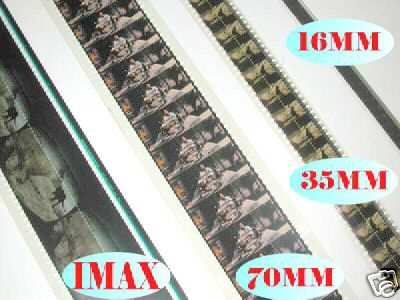
Posted by Joe Redifer (Member # 3) on 10-18-2010, 12:53 AM:
That little graphic is way too small. Nice scratch on the 35mm, by the way. Even the IMAX is scratched. For reference, a DLP chip should be laid next to those.
Posted by Steve Guttag (Member # 268) on 10-18-2010, 06:25 AM:
Unless something has changed...Kodak has priced 70mm print stock at 2X 35mm. Since 70mm is 25% longer you have 1.25x2 the cost or 2.5 the cost of 35mm for the raw print costs. I do not know what the premium is on on printing.
However...$14K sounds very high for a non-mag striped print. It is likely far less than $10K and reasonable would be to use the 2.5x figure for printing as well.
Posted by Brian Guckian (Member # 1678) on 10-18-2010, 12:27 PM:
Just on the 70mm print cost question, with a DTS (now DDE) track a 2-hour feature comes in at roughly $ 9000. This information is relatively recent and makes for an interesting comparison with e.g. the $ 22,000 cited earlier for a 15-70 2D print.
It should also be taken into account that with 70mm, print volumes would typically be less than for 35mm, yet may still attract a certain level of discount.
To "Roadshow" a major title (shot on 65mm) via a limited number of 70mm prints would be a relatively small investment in terms of overall P&A spend and could recoup that in terms of higher admissions etc.
It should also be noted that the 65mm format greatly benefits 4K and 2K presentation, and facilitates high-quality release across all current theatrical and domestic formats, including, incidentally, 15-70.
Posted by Tom Petrov (Member # 1534) on 10-18-2010, 03:39 PM:
quote: Greg Anderson
I wouldn't say 70mm was a gigantic fail... mostly because I'm not up-to-speed with the new, hip, incorrect grammar. Furthermore, I wouldn't call 70mm a failure either.
I guess my gigantic "fail" comments were a bit harsh. But it failed nonetheless.
quote: Greg Anderson
I would compare 70mm to the laserdisc format. For a time it was the best you could get but then the easier-to-use format came along and almost instantly won the battle. (I'm talking about exhibition, I suppose, since there was never much of a question that shooting in 65mm died many years before 70mm printing went away.)
I was going to compare it to laserdisc as well. Laserdisc did ok, and don't get me wrong, I love laserdisc and have well over 700 titles, but not many people cared during the early 90's. Blockbuster and VHS tapes were HUGE...then DVD came out.
quote: Greg Anderson
Film is dead.
Film is done. If you are not installing a digital projector in your new theater builds, then you are out to lunch.
quote: Brian Guckian
To "Roadshow" a major title (shot on 65mm) via a limited number of 70mm prints would be a relatively small investment in terms of overall P&A spend and could recoup that in terms of higher admissions etc.
Are you kidding me? What year is it? Roadshowing a picture is done. People are not going to migrate to the one larger theater in the city to see a 70mm show...the theater owner will do much better by just showing a kids movie in Digital 3D
Posted by Bobby Henderson (Member # 840) on 10-18-2010, 06:00 PM:
quote: Tom Petrov
Are you kidding me? What year is it? Roadshowing a picture is done. People are not going to migrate to the one larger theater in the city to see a 70mm show...the theater owner will do much better by just showing a kids movie in Digital 3D
Shit, with that attitude why should anyone bother going to a movie theater at all? The average stadium seated multiplex theater is very unremarkable and the audiences are unruly. 2K digital cinema is hardly showing any better picture quality than one can see at home using Blu-ray and a good HDTV set.
Tom, I suspect you have never seen a native 5/65mm movie projected in 70mm in a "flagship class" theater. The way you dismiss the roadshow movie-going experience raises a giant red flag. I wonder if you're crapping all over 70mm just to stir the point and get some angry exchanges going.
I used to drive considerable distances, 100-200 miles or even more, to watch movies projected in 70mm in great quality theaters. And that was the whole trip. Drive down to Dallas to see a movie at Northpark #1. Maybe have dinner afterward and then drive home.
In the D-cinema and digital 3D age, I have not gone out of my way at all to see a movie shown in "digital." These days if I happen to see a movie at a theater in metro Oklahoma City, Dallas-Fort Worth, Denver, Austin, etc. I'm usually visiting friends or relatives there. The movie going thing is a secondary priority.
Posted by Ramon Lamarca Marques (Member # 3621) on 10-18-2010, 06:45 PM:
quote: Tom Petrov
Are you kidding me? What year is it? Roadshowing a picture is done. People are not going to migrate to the one larger theater in the city to see a 70mm show...the theater owner will do much better by just showing a kids movie in Digital 3D
Are you sure? Well, in London audiences are travelling long distances to see 15/70mm at the London BFI Imax. These screenings of 35mm films blown-up and shown letterboxed are much inferior to 5/65mm printed on 5/70mm on large widescreen slightly curved screens with 5 channels behind the screen and yet people go because it is something out of the ordinary, like roadshow. If there is a future for cinema exhibition is roadshows, the ordinary screenings are now a home domain. The amazing thing about film done well is that, unlike video, it can only be experienced in theatres. I have, so far, never seen a video projection that has satisfied me as much as film done well. As to cinema chains in the UK, there is a trend towards new auditoriums with big, massive screens, a pity that they are only showing 2k digital.
Posted by Tom Petrov (Member # 1534) on 10-19-2010, 12:24 AM:
quote: Bobby Henderson
Shit, with that attitude why should anyone bother going to a movie theater at all? The average stadium seated multiplex theater is very unremarkable and the audiences are unruly. 2K digital cinema is hardly showing any better picture quality than one can see at home using Blu-ray and a good HDTV set.
Tom, I suspect you have never seen a native 5/65mm movie projected in 70mm in a "flagship class" theater. The way you dismiss the roadshow movie-going experience raises a giant red flag. I wonder if you're crapping all over 70mm just to stir the point and get some angry exchanges going.
I used to drive considerable distances, 100-200 miles or even more, to watch movies projected in 70mm in great quality theaters. And that was the whole trip. Drive down to Dallas to see a movie at Northpark #1. Maybe have dinner afterward and then drive home.
In the D-cinema and digital 3D age, I have not gone out of my way at all to see a movie shown in "digital." These days if I happen to see a movie at a theater in metro Oklahoma City, Dallas-Fort Worth, Denver, Austin, etc. I'm usually visiting friends or relatives there. The movie going thing is a secondary priority.
I took a 1 hr train ride into Toronto to see "Hereafter" in Digital. I was skeptical at first, but I left convinced that Digital is the way to go.
I wrote my comments in another thread in this forum.
Posted by Joe Redifer (Member # 3) on 10-19-2010, 12:37 AM:
You didn't take a one hour train ride to see the movie in digital, you took the trip to see the movie, period. You said you couldn't wait to see it. The format didn't matter, the movie did. If everyone around you had the movie and was playing it in 35mm, you would not have taken the one hour train trip to see it in digital.
Posted by Tom Petrov (Member # 1534) on 10-19-2010, 12:38 AM:
quote: Joe Redifer
You didn't take a one hour train ride to see the movie in digital, you took the trip to see the movie, period. You said you couldn't wait to see it. The format didn't matter, the movie did.
I had no choice but to see it in digital. I was trying to hold off until this Friday as my local independant would likely play it in film.
But yes, I couldn't wait to see the movie, going forward I won;t hesitate to see the movie in Digital if in fact that is the format it is playing in.
Posted by Tony Bandiera Jr (Member # 2365) on 10-20-2010, 02:30 PM:
I am amused by the postings of someone registered in 2003 with only 74 posts making such authoritative and bold statements. ![[Razz]](tongue.gif)
There have been naysayers since 1998 claiming that film is dead, and yet here we are 12 years later and there are still far more film venues than DLP venues. And that's how it will be for the next 12 years with the current economic climate.
Yes, even I will admit film is on its way out, but I don't ever see it going completely away. Even if it is confined to specialty uses only, film will be around "forever".
As some have pointed out before, think for a minute about archival uses..we can project and save film from over 100 years ago..do you honestly think that 100 years from now someone will be able to replay DLP content, even if they have the key? The technology will so rapidly outgrow the current standard (hell it's already happening with 2k-4k, next will be 8k and 16k) that no one will be able to (or want to, as it would be cost-prohibitive) reproduce today's D-Crapema content.
As an analogy, who here knows of ANYONE or anyplace that can read data from the old 5 1/4 inch floppy discs? ![[Eek!]](eek.gif)
Posted by Martin McCaffery (Member # 37) on 10-20-2010, 03:03 PM:
Just to followup, a couple of years ago Variety did a piece on film preservation in the digital era. The studios were noticing signs of decay in their digital backups in as little as nine months.
Add to that and the need to constantly make new copies of digital sources everytime the technology upgraded and the studios came to the conclusion that the best way to preserve their films was with B&W separations on film.
It seems that after a generation of two of upgrading digital sources, the studios may just turn all of their rep back to 35mm for release to specialty houses.
That may make too much sense, but we can always hope. ![[Wink]](wink.gif)
Posted by Greg Anderson (Member # 235) on 10-20-2010, 05:00 PM:
I realize it is too harsh and flippant to say "film is dead." In the moment I just couldn't find the right words. I think it's better to say that "film is history."
When today's version of "Hollywood" makes something which is worth preserving for more than nine months then I'm sure the technology will exist to do it.
EDIT: Does anyone know if other, "superior" formats like Cinerama ever offered a good profit margin for the theaters? Did the theaters charge a premium to customers because of the format? How much did the theater owners worry about keeping up with the formats Hollywood was throwing at them?
Posted by Rick Raskin (Member # 1561) on 10-21-2010, 04:11 PM:
quote: Tony Bandiera Jr
As an analogy, who here knows of ANYONE or anyplace that can read data from the old 5 1/4 inch floppy discs?
I went to the trouble to mount a 5 1/4 floppy and found that what I had saved then was of no interest or value now.
Much like the "D-Crapema" Tony discussed earlier.
Posted by Gordon McLeod (Member # 33) on 10-21-2010, 05:27 PM:
i still have 5 1/4 drive in my older os2 machine along with a jazz and zip drive
Posted by Victor Liorentas (Member # 5272) on 10-21-2010, 11:07 PM:
I have a bunch of S-VHS tapes with until recently nothing to play them on!
They really don't make a S-VHS machine that will play all 400 lines anymore.
D-VHS has the same problem but digital stuff seems to change every minute so...
I will stick to film till they pry it from my cold dead hands!
Posted by Greg Anderson (Member # 235) on 10-22-2010, 10:05 AM:
This week I bothered to watch the 1996 Hamlet on DVD since I never bothered to see it on film (because it was not available in 70mm in Salt Lake City). Now I'm convinced that this movie was deliberately designed to kill 70mm. It would be a perfect cure for insomnia if not for Branagh's often loud over-acting. The people who made this movie declared it an "epic" before shooting the first frame. The whole thing smacks of a desperate effort to be important... and it just fails.
If I took a state-of-the-art photo of a pile of dung would that make it worth seeing?
Posted by Tom Petrov (Member # 1534) on 10-22-2010, 03:10 PM:
quote: Greg Anderson
This week I bothered to watch the 1996 Hamlet on DVD since I never bothered to see it on film (because it was not available in 70mm in Salt Lake City). Now I'm convinced that this movie was deliberately designed to kill 70mm. It would be a perfect cure for insomnia if not for Branagh's often loud over-acting. The people who made this movie declared it an "epic" before shooting the first frame. The whole thing smacks of a desperate effort to be important... and it just fails.
If I took a state-of-the-art photo of a pile of dung would that make it worth seeing?
Hamlet....lol. Meh! Budget $18 mil, gross $4.4 mil. We played in at Sherway Cinemas back in 1996....its was 35mm
quote:
I realize it is too harsh and flippant to say "film is dead." In the moment I just couldn't find the right words. I think it's better to say that "film is history."
When today's version of "Hollywood" makes something which is worth preserving for more than nine months then I'm sure the technology will exist to do it. [Smile]
I guess "dead" is too harsh.
If anyone realistically thinks that digital will fail, is not up to date on industry trends. The film method of distribution is obsolete, there is so much money to be made in other methods, eventually we will see direct download at the actual movie theatre with no shipping hard drives involved.
Very soon, the blu-ray/dvd disc will be second rate as directed internet downloading will be the preferred and number one method for home video.
So yeah, maybe "dead" was wrong, "Dying", "stage 4", "Terminal" is a better choice....films lovers should make the best of how long is left.
Posted by Martin McCaffery (Member # 37) on 10-22-2010, 03:57 PM:
quote: Greg Anderson
If I took a state-of-the-art photo of a pile of dung would that make it worth seeing?
I guess it would depend on the lighting
Posted by Mike Blakesley (Member # 26) on 10-22-2010, 05:30 PM:
quote: Tom Petrov
"Terminal" is a better choice....films lovers should make the best of how long is left.
For what it's worth, I considered myself a fairly die-hard film guy, but after four digital months I can't exactly say I miss it.
Posted by Joe Redifer (Member # 3) on 10-22-2010, 08:09 PM:
quote: Tom Petrov
"Terminal" is a better choice....films lovers should make the best of how long is left.
That's why I still work part-time as a projectionist. Once everything is digital, I think this industry will just be too boring to work in. There is nothing tremendously special about an all-digital complex for whatever reason. Anything can be done by just about anybody, there is no cool innovation like platter arrays and all of that. Good for the industry? Perhaps. Fun? Nah.
The only thing I would find really cool is a theater without any staff at all, period. Crap would be bought at pre-stocked vending machines, you'd buy a cup and fill it yourself. Online ticketing or machines at the theater to purchase them, etc. The only reason I can think of to have any staff would be to clean auditoriums. There is no other reason for other staff or managers, etc. They are useless.
Posted by Scott Norwood (Member # 30) on 10-22-2010, 09:53 PM:
In twenty years, people will look back on this period (probably from about 2005-2015) as being a golden age for moving image formats. Right now, film is still readily available (and if Lucas or Spielberg wanted to release something in 70mm, I guarantee that AMC and Regal would be installing it and also refurbishing existing 70mm equipment in olrder theatres). Both super-8 and 15/70 Imax are in worldwide daily use. Meanwhile, video projection (from both analog and digital formats) and D-cinema are now at the point that the quality is no longer embarrassing, and can even be quite good. Heck, even a $1k HD handycam from Best Buy is good enough to produce a watchable image for a cinema-size screen under the right conditions.
A few years from now, we will never again have this many readily accessible ways to photograph and exhibit moving images for mainstream features. Sure, film will be with us for forever (even if it's made in someone's basement and developed in a bathtub), but it will eventually be a specialty format, and not a conveniently available product.
What does this have to do with anything? Not much, but I really wish that this golden age of formats could also be a golden age for quality movies, but that doesn't seem to be the case at the moment.
In any case, I do feel strongly that older films (say, pre-mid-2000s) that were originally photographed and intended to be exhibited on film should be shown on film, and that distributors have an ethical responsibility to maintain quality prints in circulation of these titles. Newer titles, of course, may have been intended to be exhibited in any of a variety of formats, and the director's wishes should dictate the exhibition format whenever possible.
Posted by Martin McCaffery (Member # 37) on 10-22-2010, 10:11 PM:
quote: Scott Norwood
distributors have an ethical responsibility
ROTFLMFAO
"Distributors" and "ethics", two words that are hilarious together
Posted by Tom Petrov (Member # 1534) on 10-23-2010, 03:13 AM:
quote: Scott Norwood
In twenty years, people will look back on this period (probably from about 2005-2015) as being a golden age for moving image formats.
20 years from now, people will look back at this era as the digital revolution. Films are being made and increasingly shown on digital format. The movie chains are marketing digital as well.
quote:
Right now, film is still readily available [/QUOTE
Film is still readily available because the film network is just so massive. It has been the same for 100 years. However, every time a new multiplex opens up, digital takes over.
[QUOTE] (and if Lucas or Spielberg wanted to release something in 70mm, I guarantee that AMC and Regal would be installing it and also refurbishing existing 70mm equipment nt and developed in a bathtub),
See the fact is that George Lucas and Spielberg are not endorsing 70mm. Lucas in fact supports digital, Speilberg is slow to adopt. I don't think Lucas or Spielberg have ever shot in 70mm, perhaps someone can verify this.
What is important to note is that filmakers like Lucas and Cameron have gone digital. I believe Tim Burton has as well.
quote:
I do feel strongly that older films (say, pre-mid-2000s) that were originally photographed and intended to be exhibited on film should be shown on film,
I kind of agree with this, but after seeing "Hereafter" which was shot on film and shown to me on digital (not sure what k it really was, I think it was 4k tho) I kind prefer digital.
Posted by Gordon McLeod (Member # 33) on 10-23-2010, 03:11 PM:
Tom Hamlet did play the Odeon York Toronto Sherway did not get a print even though it had 3 "70mm equiped" screens due mainly to management refusing to guarantee no print damage during the lockout that happened then
Posted by Tom Petrov (Member # 1534) on 10-23-2010, 03:28 PM:
quote: Gordon McLeod
Tom Hamlet did play the Odeon York Toronto Sherway did not get a print even though it had 3 "70mm equiped" screens due mainly to management refusing to guarantee no print damage during the lockout that happened then
Gord.
Sherway did get a print. Its was 35mm, I built the print myself which ran in Cinema #5 (or Cinema #7 after the renovation to 13 screens) and the sound was SDDS. It came in four cans (4reels each) if I remember correctly. We had an intermission for Hamlet
Posted by Gordon McLeod (Member # 33) on 10-23-2010, 04:55 PM:
i meant a 70mm print i am familiar with sherway all too well did many a THX recert there in its early days
Posted by Ron Curran (Member # 3631) on 10-23-2010, 09:04 PM:
Spielberg/Lucas did shoot 70mm for the Raiders series, although not with 65mm cameras. Motor drive 35mm still cameras (Nikons, from memory) were used as stop-motion devices for effects shots. The exposed area is similar to VistaVision.
My memory is a little hazy but I think a VistaVision camera was also used for some shots.
Posted by Tom Petrov (Member # 1534) on 10-23-2010, 09:53 PM:
quote: Gordon McLeod
i meant a 70mm print i am familiar with sherway all too well did many a THX recert there in its early days
You're right. We didn't get a 70mm print at Sherway. I actually don't think the theatre ever showed a 70mm print.
Theatre 1,3,5 (3,5,7 after the renovation) were the THX Theaters. I don't know if you remember but there were never any subwoofers in those theatres until the Episode I certification in 1999. Theatres 8,9,10,11 were added after the reno and those were sub equipped while the largest theatres were still with out the subs until 1999.
Those were some very fine auditoriums back then.
Posted by Gordon McLeod (Member # 33) on 10-24-2010, 09:29 AM:
actually when it opened it had kintek self powered subs they probably failed over the years and were not replaced
after garth got short of cash they dropped the THX certification of all but Canada Sq and The York in the GDA and THX pulled there cards in many cases and 3rd party crossover cards were used in the frames
Posted by Tom Petrov (Member # 1534) on 10-24-2010, 11:50 AM:
quote: Gordon McLeod
actually when it opened it had kintek self powered subs they probably failed over the years and were not replaced
after garth got short of cash they dropped the THX certification of all but Canada Sq and The York in the GDA and THX pulled there cards in many cases and 3rd party crossover cards were used in the frames
Well I could be wrong, but I remember having a discussion with Joe Calvano, Eddie, Bill Burrows and even Keith from Best. Never did they have subs until Episode I. This wass always a hot top and discussion while we were there.
Posted by Greg Anderson (Member # 235) on 10-24-2010, 06:22 PM:
The guys at Industrial Light and Magic used VistaVision for a long time. I remember seeing some behind-the-scenes footage from the first Jurassic Park movie. There was, indeed, a computer-controlled VistaVision camera shooting the background plate for the shot when the T-Rex gets inside the building at the end of the show.
But did Lucas or Spielberg ever shoot in a large format for non-effects shots? I don't think so.
Posted by Tony Bandiera Jr (Member # 2365) on 10-25-2010, 12:50 PM:
quote: Ron Curran
Spielberg/Lucas did shoot 70mm for the Raiders series, although not with 65mm cameras. Motor drive 35mm still cameras (Nikons, from memory) were used as stop-motion devices for effects shots. The exposed area is similar to VistaVision.
My memory is a little hazy but I think a VistaVision camera was also used for some shots.
Ron, IIRC both "Raiders" and "Temple of Doom" were both shot with Panavision 65mm (camera size for 70mm production) cameras. I will look at the "Making of" books which show the cameras and again IIRC Panavision's large format cameras say "Panaflex 65" or some such on them.
Effects were done with Vistavision 35mm cameras, never heard any mention of 35mm still cameras being used for the stop motion EFX.
Posted by Greg Anderson (Member # 235) on 10-25-2010, 01:05 PM:
The modified Nikon SLR cameras were used for stop-motion effects photography of the mine car chase sequence in Indiana Jones and the Temple of Doom.
I'm gonna say there's no way they did principal photography with 65mm on these movies. Watch Raiders of the Lost Ark (the actual movie without even needing behind-the-scenes stuff) and the anamorphic optical artifacts are obvious all over that movie.
Posted by Tom Petrov (Member # 1534) on 10-25-2010, 01:13 PM:
quote: Greg Anderson
I'm gonna say there's no way they did principal photography with 65mm on these movies. Watch Raiders of the Lost Ark (the actual movie without even needing behind-the-scenes stuff) and the anamorphic optical artifacts are obvious all over that movie.
You are right. They did you 65mm to shoot Raiders. Speilberg has never used it for principal photography.
Posted by Steve Guttag (Member # 268) on 10-30-2010, 04:09 PM:
Oh Tom, Tom Tom...I don't quite know what to make of you.
You post an item like
quote: Tom Petrov
IMHO, 70mm was a gigantic FAIL.
And I'm thinkin'..."is he just plain retarded, or is he stupid just plain ignorant or perhaps he is just trying to get some people to flame"
It has to be one of them because it isn't a matter of "opinion," humble or otherwise... the 5/70 process was a gigantic success by most any measure. I differentiate 5/70 from 8/70 or 15/70 as they go for different markets and only 8/70 could remotely be called a fail though it did serve its place for a period of time. In fact 8/70 could have done better had the studios embraced it a bit more and not pull back on it like they did...but I digress.
The 5/70 format...coming out in 1954 has had over a 50-year run and is still a current format for both taking and projecting though certainly not like in its heyday nor in projecting like in its reincarnation of the 80s/90s as a projection format, primarily.
Just about (though not quite all) every major projector manufacturer had a 70mm projector in their line up and they are still available new to this day. Both Arri and Panavision have 65mm available for production. The film is still available as is processing.
The success of 70mm releases (either from 65mm origination or as 35mm blow ups) is documented. A typical 70mm take is 5 times that of its 35mm competitor...historically. Even when a theatre shows some tired old 70mm title, like Lawrence of Arabia, people continue to line up for it...even in this day and age.
On the technical side, it advanced the motion picture experience in almost all respects and took almost nothing away. It remains, to this day, the best origination format as well as presentation format in terms of resolution, color, contrast, longevity. To put it in perspective, 65/70 has almost 16-times the current 2K DCP image in terms of resolution. And there in lies one of its problems with "modern" film makers.
If you are going to shoot in 65mm...you have to think about it for EVERY stage in your production. All of your special effects, all of your scenery all of your make up...EVERYTHING has to have that resolution in mind...or it will show. The increase in time and money to have EVERYTHING in the work flow has a compounding affect.
Then there is the photography itself...a DP that is used to composing for 35mm or even Video will have to change everything when shooting on 65mm. It takes more light to light up that bigger aperture...all of your depth of fields change as all of your lenses are different. It isn't a simple matter of choosing the 65mm camera today...everything in the production changes with that one decision.
As such, any director that would otherwise want to shoot in 65mm will face a mountain from the studio and production on it due to the ramifications. I remember talking to Ron Howard after a screening of Backdraft about his then upcoming production of Far and Away and complimenting him on choosing to shoot in 65mmm (the screening of Backdraft was in 70mm)...he made some remark about with the star power (Tom Cruise) and his success, he was able to force the issue. Note, Ron Howard was already a pretty darn successful director before Backdraft! Some speculate that had Far and Away been a better story that 70mm would have had a rebirth. And it wasn't that Far and Away was a flop...it just wasn't the next Star Wars...it wasn't the format's fault...it never is...It has always been about the story. The technicalities are there to help tell the story; not to replace it.
As a release format 70mm always delivered and has never really been properly replaced. It was, mistakenly, thought that 70mm allowed only superior sound...when in fact, it allowed larger screens to have brighter, steadier pictures...even with 35mm origination. No, 70mm from 35mm won't look like 65mm origination but it will get rid of projection specific problems like steady pictures and getting the light to the screen. When hasn't 70mm not delivered as a release format? No matter which picture, the 70mm theatres took far more of their share than the 35mm theatres did on the same title.
As for the current crop of directors...what makes you think they are as good as the people of yesteryear? James Cameron can't even figure out how to shoot in CinemaScope and instead ponies up grain ridden Super-35 (and now digital) images. Mind you, he is the best at Super-35 that I have seen but if he learned to shoot in 65mm, it would be that much better. I really don't think the current crop can cut it with 65mm. Mostly from a lack of desire to improve the picture versus putting that effort into some non-special effect.
But back on topic...70mm a fail...not in any sense...it might have run its course due to whatever reason (I hope not) but its success story is well documented, it is your comment that fails.
As for 4K being the next 70mm...that would be impossible. 4K is the next 35mm. 2K is merely a stepping stone to get there. 35mm 1.85 already has about 4K of resolution...CinemaScope having yet more. Digital still has a ways to go to catch up to 70mm. I also note that whenever one has put out a 4K demo...they keep going to The Sound of Music as an example...a film shot on 65mm back in the 1960s...all of those advances in film stock that even allowed Super-35 to have any use also applies to 65mm stocks. The 5/70 format remains the best that we have offered yet to the regular movie audience.
Posted by Tony Bandiera Jr (Member # 2365) on 10-30-2010, 05:22 PM:
Steve, Tom knows everything, thinks theatres with no masking are ok, knows for sure that AMC ETX setups are Sony 4k, had to ASK if 70mm could be run off a platter, and has no intention of ever listening to any of us with experiences or knowledge that doesn't match his. ![[Roll Eyes]](rolleyes.gif)
Hell, he can't even phrase his response right on whether Raider's was shot in 65mm, as he says one thing and means another. :
quote:
(Greg Anderson said :I'm gonna say there's no way they did principal photography with 65mm on these movies. Watch Raiders of the Lost Ark (the actual movie without even needing behind-the-scenes stuff) and the anamorphic optical artifacts are obvious all over that movie.)
Tom's response:
You are right. They did you 65mm to shoot Raiders. Speilberg has never used it for principal photography.
You said it best right here:
quote: Steve Guttag
And I'm thinkin'..."is he just plain retarded, or is he stupid just plain ignorant or perhaps he is just trying to get some people to flame"
All of the above.
He had registered here all the way back in 2003 and doubled his post count in the last month, mainly in this thread and THIS THREAD, where he has gained zero credibility.
He's entitled to his opinions as much as anybody here, but his motives for what he says don't seem to be in the spirit of contributing or learning anything of substance.
And even though Steve and I don't always agree on everything (like twisting speaker wire ![[Big Grin]](biggrin.gif) ) Steve has summed up the 70mm format's virtues spot-on.
) Steve has summed up the 70mm format's virtues spot-on.
A closed mind, like a closed room, grows useless, dead and stale quickly.
And Tom I don't care if you like me or not, but you need to listen to Steve, Brad, Joe, Chris S, etc. as I have learned a LOT from them over the years I have been on this board.
The best folks in this industry always listen to what others have to say and are willing to change their mind or methods if their ideas are wrong. (Like me in regards to D-Cinema.)
Posted by Tom Petrov (Member # 1534) on 10-31-2010, 12:27 AM:
quote:
Steve, Tom knows everything, thinks theatres with no masking are ok, knows for sure that AMC ETX setups are Sony 4k, had to ASK if 70mm could be run off a platter, and has no intention of ever listening to any of us with experiences or knowledge that doesn't match his. [Roll Eyes]
Hell, he can't even phrase his response right on whether Raider's was shot in 65mm, as he says one thing and means another. :
quote: (Greg Anderson said :I'm gonna say there's no way they did principal photography with 65mm on these movies. Watch Raiders of the Lost Ark (the actual movie without even needing behind-the-scenes stuff) and the anamorphic optical artifacts are obvious all over that movie.)
Tom's response:
You are right. They did you 65mm to shoot Raiders. Speilberg has never used it for principal photography.
You said it best right here:
quote: Steve Guttag And I'm thinkin'..."is he just plain retarded, or is he stupid just plain ignorant or perhaps he is just trying to get some people to flame"
All of the above.
He had registered here all the way back in 2003 and doubled his post count in the last month, mainly in this thread and THIS THREAD, where he has gained zero credibility.
He's entitled to his opinions as much as anybody here, but his motives for what he says don't seem to be in the spirit of contributing or learning anything of substance.
And even though Steve and I don't always agree on everything (like twisting speaker wire [Big Grin] ) Steve has summed up the 70mm format's virtues spot-on.
A closed mind, like a closed room, grows useless, dead and stale quickly.
And Tom I don't care if you like me or not, but you need to listen to Steve, Brad, Joe, Chris S, etc. as I have learned a LOT from them over the years I have been on this board.
The best folks in this industry always listen to what others have to say and are willing to change their mind or methods if their ideas are wrong. (Like me in regards to D-Cinema.)
Wow! You are sensitive.
I will lay off the anti-70mm chat
Posted by Manny Knowles (Member # 1171) on 10-31-2010, 01:37 AM:
i've got pictures of spielberg shooting raiders and temple of doom with a panavision 35mm camera -- i'd be surprised to learn that budget-conscious george would spring for 65mm -- and spielberg prefers the 1.85 ratio
yes they used a modified nikon to shoot the mine shaft miniatures but, as pointed out, this is really the vistavision format
yes, vistavision yields a larger image than standard 4-perf 35mm, but it's technically not 70mm
Posted by Christian Appelt (Member # 1067) on 10-31-2010, 09:57 AM:
Greg and Manny are right - TEMPLE OF DOOM was shot in 35mm Panavision, not in 65mm.
Visual effects scenes were filmed and composited in 8-perf Vistavision because this was ILM's in-house large format to compensate for losses in multi-generation optical printing. (IIRC, the decision was made before STAR WARS based on the availability of different film stocks in 35mm, 65mm would have been Special Order every time. It has been discussed in detail in older issues of CINEFEX.)
I saw one of the TEMPLE OF DOOM 70mm blowup prints just a few weeks ago, and anamorphic origination can be seen all through the film.
People often claimed that some older 35-to-70 blowups (DR ZHIVAGO, THE CARDINAL) were shot in 65mm because they looked at set photos and didn't believe a huge beast like a Mitchell BNC could shoot anything smaller than "70mm".
Posted by Tony Bandiera Jr (Member # 2365) on 10-31-2010, 01:20 PM:
Greg, Manny and Christian are right..I did go back to those "making of" books and the cameras are clearly Panavision 35mm. I stand corrected. DOH!
Shows I'm not right every time.
Posted by Mark Gulbrandsen (Member # 72) on 10-31-2010, 01:55 PM:
Actually all of the footage that was combined with any special effect was originated in VistaVision. almost 90% of Who Framed Roger Rabbit was shot in VistaVision exclusively.
On many of the Raiders and Star Wars films they had to conbine live action and effects shots and many times the effect for a given shot existed before the live shot did! That was partly the reason for the Empireflex and other computer motion controled VV cameras.
quote: Tom Petrov
IMHO, 70mm was a gigantic FAIL.
Tom is partly correct!
It was a grand sucess until the chains got rid of competant operators... the few that there were by the time 70mm came back again... Once manager-operators were put in charge of running 70mm it was indeed a huge failure! I've heard so many disaster stories from industry people at Dolby, Technicolor, Studio bookers, etc, about 70mm prints being ruined on their first showings... then the 35mm back up being substituted for the rest of the months long run. Most locations were never charged for the damaged prints and got away with the crime.
quote: Gordon McLeod
3rd party crossover cards were used in the frames
Interestingly, the third party cards actually worked better... at least the C.E. cards did.
Mark
Posted by Tom Petrov (Member # 1534) on 10-31-2010, 03:08 PM:
quote: Tony Bandiera Jr
knows for sure that AMC ETX setups are Sony 4k
AMC
A movie-lover's dream come true, this new state-of-the-art theatre is the first all-digital theatre in the area and is equipped with Sony® 4K digital cinema projectors, capable of producing images with more than four times the resolution of HDTV. As if all-digital screens weren't enough, two auditoriums at AMC Yonge & Dundas 24 boast screens that are more than three stories high and 55 feet wide, helping showcase highly anticipated films such as Paramount Pictures' "Stop-Loss" and Sony Pictures' "21.
At least the AMC in Toronto is Sony 4k
Posted by James Westbrook (Member # 3690) on 10-31-2010, 04:03 PM:
If the surface area is more than 3 stories high, this translates to about a 40 foot by 55 foot screen, indicating this may be "common width".
Posted by Claude S. Ayakawa (Member # 1401) on 10-31-2010, 04:46 PM:
Sadly what Gorden reported about Incompetent projectionist running and ruining 70mm prints during their first run is true. It happened here during the 1st week of the first Batman movie starring Michael Keaton as Batman and Jack Nickelson as the Joker.
The film opened in 70mm at the Waikiki #3 and during the middle of the first week,, the Honolulu Advertiser reported the first reel of the movie was very badly damaged and a back up 35mm print had to be substituted until Warner Brothers replaced the damaged reel three weeks later. I did get to see the movie in 70mm at that time. I was not so lucky when a 70mm print of WHO FRAMED ROGER RABBIT was damaged at the Kapiolani Theatre and the movie played the remainder of it's run in 35mm and that is what I saw. For some reason, the 70mm print of GETTYSBURG had a slight sound track problem when it played at the Cinerama and o one know haw it had happened. I did get to see it in 70 before the show was moved over to the Kuhio a week later in 35mm.
I loved 70mm films and if I knew in advance a Honolulu theatre was not going to play it in that format , I always made an effort to see them on the mainland if I was traveling at the time.
-Claude
Posted by Joe Redifer (Member # 3) on 10-31-2010, 06:53 PM:
There's no way it is 40 feet high unless they plan on showing 1.66 or narrower movies. If it is that high, then that is wasted screen real estate because it will never be used. But anyway, a "story" is considered 10 feet high in general terms.
I know Sony projectors have had a very difficult time filling the screens at the Regal Colorado Mills theaters. Even the techs from Japan couldn't quite do it. Not sure why they couldn't just put a different lens on there. But when they put digital into their big house, they had to move the Christie in there and install the Sony in the smaller auditorium because it simply couldn't fill the screen. It doesn't even fill the screen all the way in the smaller auditorium. It's pathetic. A good friend of mine works at an all-digital AMC theater with Sonys and he hates them with a passion, says the Christie projector and Dolby servers, etc are much, much better than the slipshod way that Sony does things.
Posted by Manny Knowles (Member # 1171) on 10-31-2010, 09:11 PM:
quote: Christian Appelt
TEMPLE OF DOOM was shot in 35mm Panavision, not in 65mm.
Visual effects scenes were filmed and composited in 8-perf Vistavision because this was ILM's in-house large format to compensate for losses in multi-generation optical printing. (IIRC, the decision was made before STAR WARS based on the availability of different film stocks in 35mm, 65mm would have been Special Order every time. It has been discussed in detail in older issues of CINEFEX.)
George selected VistaVision as the large-format for ILM opticals because 65mm was too expensive -- the existing cameras still in high demand for effects work. VistaVision was an abandoned format. The dormant equipment was available and cheap, so they went with it.
I've read this explanation a few times. I'm pretty sure the topic is covered in "Skywalking" and also in the original ILM coffee table book "The Art of Special Effects" (there was a followup to cover the transition to CGI). I'd check, but those books are back home in The Bahamas.
Fun Trivia -- ILMers referred to VistaVision as "lazy eights" because it was 8-perfs laying sideways.
Posted by Ian Parfrey (Member # 5122) on 10-31-2010, 10:02 PM:
...and some of the cameras were referred to as "Empires".
Posted by Bobby Henderson (Member # 840) on 10-31-2010, 11:05 PM:
quote: AMC Sales Blurb
A movie-lover's dream come true, this new state-of-the-art theatre is the first all-digital theatre in the area and is equipped with Sony® 4K digital cinema projectors, capable of producing images with more than four times the resolution of HDTV.
Let's underscore the phrase "CAPABLE of producing images with" blah blah blah. A 4K projector that is fed mostly with native 2K content is hardly 4K at all. Aw, but who cares about things like important details?
It's just like the laughable nonsense that exists in tens of millions of homes across the United States (and probably much of the rest of the developed world). They have widescreen HD-capable TV sets that are being fed only with SD-quality video, often 4:3 ratio and artificially stretched. Yet many of these folks probably think they're watching shows in high definition based solely on the TV hardware.
Posted by Manny Knowles (Member # 1171) on 10-31-2010, 11:21 PM:
very true bobby -- i predict the next generation of kids who grow up watching a stretched version of sesame street will not see any difference between a circle and an oval, or a square and a rectangle
Posted by Greg Anderson (Member # 235) on 10-31-2010, 11:42 PM:
quote: Tony Bandiera Jr
Greg, Manny and Christian are right
I'll try not to let that go to my head. To me, the history of 70mm is a sad story. I was a teenaged projectionist in 1983 with about 8 months of experience in the booth when we got a new 70mm system in order to show Return of the Jedi. I was a whiz with 35mm and I stand behind my 35mm performance with full confidence and no regrets. And I was expected to make the jump to 70mm without any problems. Well, that didn't happen. I just didn't have the skills. I had no way of knowing, for example, about the tension adjustments on the JJ projector (of which Brad has written). The biggest breakdown (and it was a big disaster) happened when I had the night off but, still, it could have easily happened while I was there.
So the problems with 70mm over the years make me sad. But to me it's more sad to think about people who still expect 70mm to make a comeback someday. You can argue about it for 8 pages on a web site but let's be realistic: This wonderful 70mm revival will never happen! Our efforts will be better spent promoting the future which is, like it or not, higher-resolution digital presentations with higher frame rates than that awful, ugly, jittery 24 fps. And digital solves one of 70mm's major problems: The inexperienced operator can switch to a higher-quality projection system without needing any additional skills or experience than they needed with the standard-quality system.
Posted by Tom Petrov (Member # 1534) on 11-01-2010, 12:06 AM:
quote: Bobby Henderson
A 4K projector that is fed mostly with native 2K content is hardly 4K at all. Aw, but who cares about things like important details?
Didn't they blow up 35mm for 70mm showings?
quote:
So the problems with 70mm over the years make me sad. But to me it's more sad to think about people who still expect 70mm to make a comeback someday. You can argue about it for 8 pages on a web site but let's be realistic: This wonderful 70mm revival will never happen! Our efforts will be better spent promoting the future which is, like it or not, higher-resolution digital presentations with higher frame rates than that awful, ugly, jittery 24 fps. And digital solves one of 70mm's major problems: The inexperienced operator can switch to a higher-quality projection system without needing any additional skills or experience than they needed with the standard-quality system.
This is why I maintain that 70mm is a fail. High print cost, expensive production, you need an experienced operator that costs money per hour and you must have a long theatrical run to get your money back. 35mm is much more efficient and profitable
Also the biggest hurdle is without filmaker support, you have no chance.If James Cameron and George Lucas support digital, then RIP for 70mm. .
You are right, it will never, ever comeback.
Posted by Manny Knowles (Member # 1171) on 11-01-2010, 05:04 AM:
quote: Tom Petrov
Didn't they blow up 35mm for 70mm showings?
Yes they did. Mainly because 70mm offered a better way to do sound. But if you re-read Steve's post you will find there were benefits beyond that.
quote: Tom Petrov
This is why I maintain that 70mm is a fail. High print cost, expensive production, you need an experienced operator that costs money per hour and you must have a long theatrical run to get your money back. 35mm is much more efficient and profitable
You're forgetting that 35mm requires an experienced operator too. Just because kids are doing it does not mean they're doing it right. Long theatrical runs aren't bad for business. The cinema operators stand to make more money if the movie has a life beyond just the first or second weekends because, with time, the theatre retains a greater share of the box-office receipts. It's not fair that the studios flood the market with 3000+ prints the way they do now. It kills the movie when everyone can see it in the first weekend -- because they're never sold out anymore, or they may be sold out but another showtime is available in 15 minutes. Nowadays, a movie doesn't have to be any good. By the time word spreads that a movie is bad, everyone's already seen it.
quote: Tom Petrov
Also the biggest hurdle is without filmaker support, you have no chance.If James Cameron and George Lucas support digital, then RIP for 70mm. .
James Cameron and George Lucas aren't the only powerful filmmakers. To go with an obvious example, Steven Spielberg can pretty much do whatever he wants. As long as his films continue to make money, the studios won't have a problem keeping him happy -- even if that means a few hundred 70mm prints. If those 70mm prints can be proven to outsell the other formats, a comeback is completely possible.
Do not forget -- MONEY drives the industry. SAVING money isn't the only issue. MAKING money is all that matters. Sometimes you have to spend money to make money. If saving money was the only thing that mattered, the studios would choose to go with a lesser quality of everything (picture, sound, writing, acting, music, etc). And, they migrate to WHATEVER sells more tickets (Sound, Color, 70mm, Stereo, THX, Digital, 3D).
Which brings me to my last point:
Never say "never." I'm sure there are those who thought they'd seen the last of 3D.
Posted by Greg Anderson (Member # 235) on 11-01-2010, 07:59 AM:
But Spielberg doesn't support 65mm production either. The next, big, epic "event" movies are going to be sequels to Avatar and Peter Jsckson's Hobbitt stuff. The "best" way to see those movies "the way they were meant to be seen" will be digital 3D. Perhaps Mr. Nolan will try something in 65mm for the next Batman movie but I doubt it will be as successful as The Dark Knight (which was never a "fun" movie to watch). Will that be enough to launch a trend? Some of us hope so but I don't buy it.
I know guys who worked on one of those 65mm movies produced by the Mormon Church. Principal photography was in the Spring of 1999 (so anything could have happened since then). He told me that, essentially, the Arrixflex 765 cameras they used had barely been used between 1990 (when the guys from the church used them for their first big-format movie) and 1999. They had suffered from neglect a bit and weren't as nice to use as they should have been. So I question the idea that a potential filmmaker could just call up Panavision or Arriflex and get a 65mm package very easily. Those cameras likely would need a lot of maintenance before they're ready for the field, unlike a 35mm package which would be out-the-door immediately. So, that's just another potential, realistic concern for a producer. You don't want a camera to shut down your production when you're already spending a ton of money per day on actors, crew, locations, etc. that will just sit there costing you more while you're waiting for the camera to work. (We can argue that it's not a realistic fear but it's easy to see why producers would be afraid.)
Posted by Manny Knowles (Member # 1171) on 11-01-2010, 08:57 AM:
Greg, I think you missed my point which was *IF* Spielberg wanted to... or if *ANYONE* with sufficient clout wanted to... blah blah blah.
And, don't you think Arri and Panavision would bend over backwards to impress such a hot-shot director? I'm telling you -- those cameras wouldn't know what hit them! They'd be like new. "Like a Virgin," as Madonna would say.
And the time it would take to rehab those cameras is totally within the realm of possibility -- Hollywood filmmakers don't rush into production -- there'd be plenty of time to get those camera packages together. Do you think Stanley Kubrick worked with "off the rack" camera equipment? (He didn't.)
"Surely, you can't be serious..."
Are you really equating the Hollywood clout factor of some Mormon filmmakers with that of Spielberg, Jackson (etc)..?
Posted by Mark Gulbrandsen (Member # 72) on 11-01-2010, 09:41 AM:
Manny... What packages... Only just a few 65mm cameras exist at each company! Dream on though...
Mark
Posted by Bobby Henderson (Member # 840) on 11-01-2010, 10:01 AM:
quote:
This wonderful 70mm revival will never happen!
Most of us don't believe it's going to happen. A big reason why these threads generate a lot of pages is because many of us just aren't going to tolerate it when someone makes the extremely dumb-assed claim that 2K digital or 4K digital is somehow equal to 70mm. It isn't! Those "digital" formats are NEVER going to be as good as 70mm.
70mm may not ever make a comeback, but Hollywood movie studios and movie theater companies should not be let off the hook for dropping the standards of production and presentation quality to a permanently lower level. 35mm isn't as good as 70mm. Digital sure as hell isn't as good either. Movie fans are stuck with lesser quality imagery because the "filmmakers" and theaters are more concerned with using systems that are faster and easier than something using something better.
Video ("digital") production and projection will have to improve to much higher standards in numerous areas before it could ever honestly pass itself off as being equal or superior to 70mm. IMHO, it still hasn't matched 35mm.
On the production side new video cameras with native 8K or 16K resolution (and appropriate lens systems to match) would be necessary. Digital intermediate use and CGI renderings would need to match those resolution levels. Right now 2K is still the de facto standard and many of those "2K" projects are really rendered natively in 1080p and blown up slightly to 2K. My understanding is most DI systems with 4K capability won't let you edit in color at 4K resolution; you have to do color work on lower resolution "proxy" footage and then apply the changes to the 4K data. 8K DI work has been used in a handful of cases, mostly on 65mm/70mm film material for a few Blu-ray projects.
Companies like Red, Panavision and Canon can keep on developing new CCD and CMOS imagers as much as they like. It's a bigger step to build full camera systems and lens packages around those new chips and a more difficult step above that to get movie productions to actually originate across the board in that higher resolution. A movie production that uses a Red camera to shoot in 4K, but then dump the footage down to 2K in post is only a 2K movie in the end.
Digital projection has a couple serious drawbacks: unsatisfactory contrast and brightness. 4K just doesn't seem to be ready for giant sized screen use with the complaints I've seen about brightness levels. No digital system has black levels that match that of film. 70mm can be used on really huge screens and deliver unmatched levels of brightness along with superior contrast.
There may never be a 70mm revival, but nothing as good as 70mm is coming along anytime soon.
Posted by Greg Anderson (Member # 235) on 11-01-2010, 01:34 PM:
...And I'm just saying that, given the other factors we've discussed beyond brightness, contrast and pixel count, the standard of "as good as 70mm" can be quite subjective.
Also, I'm not comfortable accusing Arriflex of not giving top-notch service to someone just because they're not a Hollywood studio. I can only guess that the Mormons paid full price for what they got.
Posted by Tom Petrov (Member # 1534) on 11-01-2010, 01:39 PM:
quote:
James Cameron and George Lucas aren't the only powerful filmmakers. To go with an obvious example, Steven Spielberg can pretty much do whatever he wants. As long as his films continue to make money, the studios won't have a problem keeping him happy --
My point is. Lucas and Cameron have gone/embraced digital. The time is soon for Speilberg, I believe his next movie is digital 3D. You must have filmaker support before you will ever get exhibitor/audience support.
quote: Manny Knowles
even if that means a few hundred 70mm prints. If those 70mm prints can be proven to outsell the other formats, a comeback is completely possible.
Which makes no sense, if you need a much longer run time (at least 3-4 more weeks), then whats the point.
quote: Bobby Henderson
Most of us don't believe it's going to happen. A big reason why these threads generate a lot of pages is because many of us just aren't going to tolerate it when someone makes the extremely dumb-assed claim that 2K digital or 4K digital is somehow equal to 70mm. It isn't! Those "digital" formats are NEVER going to be as good as 70mm.
70mm may not ever make a comeback, but Hollywood movie studios and movie theater companies should not be let off the hook for dropping the standards of production and presentation quality to a permanently lower level. 35mm isn't as good as 70mm. Digital sure as hell isn't as good either. Movie fans are stuck with lesser quality imagery because the "filmmakers" and theaters are more concerned with using systems that are faster and easier than something using something better.
Video ("digital") production and projection will have to improve to much higher standards in numerous areas before it could ever honestly pass itself off as being equal or superior to 70mm. IMHO, it still hasn't matched 35mm.
On the production side new video cameras with native 8K or 16K resolution (and appropriate lens systems to match) would be necessary. Digital intermediate use and CGI renderings would need to match those resolution levels. Right now 2K is still the de facto standard and many of those "2K" projects are really rendered natively in 1080p and blown up slightly to 2K. My understanding is most DI systems with 4K capability won't let you edit in color at 4K resolution; you have to do color work on lower resolution "proxy" footage and then apply the changes to the 4K data. 8K DI work has been used in a handful of cases, mostly on 65mm/70mm film material for a few Blu-ray projects.
Companies like Red, Panavision and Canon can keep on developing new CCD and CMOS imagers as much as they like. It's a bigger step to build full camera systems and lens packages around those new chips and a more difficult step above that to get movie productions to actually originate across the board in that higher resolution. A movie production that uses a Red camera to shoot in 4K, but then dump the footage down to 2K in post is only a 2K movie in the end.
Digital projection has a couple serious drawbacks: unsatisfactory contrast and brightness. 4K just doesn't seem to be ready for giant sized screen use with the complaints I've seen about brightness levels. No digital system has black levels that match that of film. 70mm can be used on really huge screens and deliver unmatched levels of brightness along with superior contrast.
There may never be a 70mm revival, but nothing as good as 70mm is coming along anytime soon.
You call people dumb all day for making there point but the people going to movies are spending money on what they want, and that is digital. These people are the opinions that matter the most.
Posted by Bobby Henderson (Member # 840) on 11-01-2010, 01:50 PM:
quote: Tom Petrov
You call people dumb all day for making there point but the people going to movies are spending money on what they want, and that is digital. These people are the opinions that matter the most.
The general public, by and large, doesn't know any better about the difference between film and "digital." They're not "voting" for digital. There has been a long running joke about the movie theater industry and its customers in particular: if you put out lawn chairs and projected the movie on a bed sheet people would still pay to see the movie anyway.
It's stupid to assume the public knows about the nuts and bolts details of what technology is used in a projection booth much less expect them to make a buying choice based on that technology. At best the theater can only try to put across a basic idea of what their new system does and hope that impresses the customer.
Even though the customers may not know (and can't honestly be expected to know) where a new technology such as "digital" or 3D is succeeding or failing, the damned movie distributors and movie theater operators sure as hell do know the difference. They know full well when they're delivering a product with no compromises in quality versus something merely good enough. The standard of good enough is what we have now. The "digital" buzz word doesn't make it any better. It just adds a pretentious layer of marketing bullshit to the equation.
Posted by Tom Petrov (Member # 1534) on 11-01-2010, 01:55 PM:
quote: Bobby Henderson
The general public, by and large, doesn't know any better about the difference between film and "digital." They're not "voting" for digital. There has been a long running joke about the movie theater industry and its customers in particular: if you put out lawn chairs and projected the movie on a bed sheet people would still pay to see the movie anyway.
It's stupid to assume the public knows about the nuts and bolts details of what technology is used in a projection booth much less expect them to make a buying choice based on that technology. At best the theater can only try to put across a basic idea of what their new system does and hope that impresses the customer.
Even though the customers may not know (and can't honestly be expected to know) where a new technology such as "digital" or 3D is succeeding or failing, the damned movie distributors and movie theater operators sure as hell do know the difference. They know full well when they're delivering a product with no compromises in quality versus something merely good enough. The standard of good enough is what we have now. The "digital" buzz word doesn't make it any better. It just adds a pretentious layer of marketing bullshit to the equation.
Well, this is were I disagree. The consumer full well knows the difference between 35mm film-vs-digital. They are choosing digital.. I am ready to choose digital over film if need be. ( I would not of said this until I saw Hereafter in ETC) They can even tell the difference between 35mm and IMAX as most of my friends will tell me they noticed the difference in The Dark Knight.
Everyone I know in my circle of friends, tells me that digital is more clear and more sharp.
As for the movie companies, are you kidding me? They know exactly what the consumer wants, and it is not 70mm.
UltraAVX (which sucks BTW), ETC, digital 3D, Dbox, is what the consumer wants, and the movie companies/chains are giving it to them.
Posted by Bobby Henderson (Member # 840) on 11-01-2010, 02:12 PM:
quote: Tom Petrov
Well, this is were I disagree. The consumer full well knows the difference between 35mm film-vs-digital.
No they don't. And you have never offered any proof, just your own opinion of "digital" after seeing it in a couple recent movies. All you're doing is repeating the same nonsense over and over just to keep this thread going.
Posted by Mike Blakesley (Member # 26) on 11-01-2010, 02:14 PM:
quote: Bobby Henderson
There has been a long running joke about the movie theater industry and its customers in particular: if you put out lawn chairs and projected the movie on a bed sheet people would still pay to see the movie anyway.
Once when we were in the middle of getting new seats, we only had 30 seats and a vast expanse of bare linoleum for one night. We got an unexpected big group of high school kids. Every one of them sat ON THE FLOOR for the duration of the movie. The next night the word got around and we had people showing up with lawn chairs, bean bags, etc. and they had a great time. A couple days later the new seats were in and I heard a couple of people saying "Awwww, we can't sit on the floor!"
So we thought, why are we spending all this money on new seats? Should have just taken ALL the seats out!
Posted by Tom Petrov (Member # 1534) on 11-01-2010, 02:16 PM:
quote: Bobby Henderson
No they don't. And you have never offered any proof, just your own opinion of "digital" after seeing it in a couple recent movies. All you're doing is repeating the same nonsense over and over just to keep this thread going.
Well I disagree again. Everyone I have talked to about this issue can tell the difference. Good or bad, they can tell it, and the biggest difference they can tell is that digital is more clear.
Posted by Bobby Henderson (Member # 840) on 11-01-2010, 02:20 PM:
The judgment standard of "everyone I've talked to" is hardly scientific at all. It's just another way of saying "I know a lot of people agree with my opinion, but I want it to sound more like fact than what it really is: just an opinion."
Posted by Victor Liorentas (Member # 5272) on 11-01-2010, 02:37 PM:
With the 2k DI brick wall of most films i can still see more detail in a decent 35mm print projected on well maintained equipment! It is uncanny how more clear and sharp it is with depth and resolution to boot!
If its 4k or a pre DI print forget it,35mm blows DCinema away entirely!
Posted by Manny Knowles (Member # 1171) on 11-01-2010, 02:37 PM:
quote: Mark Gulbrandsen
Manny... What packages... Only just a few 65mm cameras exist at each company! Dream on though...
Mark...THOSE camera packages. The few YOU just referred to! quote: Greg Anderson
Also, I'm not comfortable accusing Arriflex of not giving top-notch service to someone just because they're not a Hollywood studio. I can only guess that the Mormons paid full price for what they got.
I'm comfortable throwing it out there as a possibility that I'm not comfortable ruling out.
Posted by Mark Gulbrandsen (Member # 72) on 11-01-2010, 06:04 PM:
It's a super thought Manny . But no large production would ever get completion insurance with just a few cameras available for what is fast becomming an obscure format.
Posted by Tony Bandiera Jr (Member # 2365) on 11-01-2010, 06:04 PM:
quote: Bobby Henderson
No they don't. And you have never offered any proof, just your own opinion of "digital" after seeing it in a couple recent movies. All you're doing is repeating the same nonsense over and over just to keep this thread going. ....and: The judgment standard of "everyone I've talked to" is hardly scientific at all. It's just another way of saying "I know a lot of people agree with my opinion, but I want it to sound more like fact than what it really is: just an opinion."
Thank you Bobby, couldn't have said it better. Some people are just trolls who like to cause contention and stir the pot. I don't even bother to read it anymore.
quote: Mike Blakesley
Once when we were in the middle of getting new seats, we only had 30 seats and a vast expanse of bare linoleum for one night. We got an unexpected big group of high school kids. Every one of them sat ON THE FLOOR for the duration of the movie. The next night the word got around and we had people showing up with lawn chairs, bean bags, etc. and they had a great time. A couple days later the new seats were in and I heard a couple of people saying "Awwww, we can't sit on the floor!"
So we thought, why are we spending all this money on new seats? Should have just taken ALL the seats out!
LOL great story!! Some years back I did a rental for an outdoor film, the first year we had 1500 people, the next over 3,000 and the last year I did it was around 4800. People loved the idea of a movie "in the park" and it was a huge success. I was projecting 35mm with a 300' throw and 40' wide screen. (All were films already out on video.) Loads of fun. After those first three years, the operators went to another a/v company who did DLP on a screen only 22' wide (and 4:3 aspect ratio) and the people who came out were pissed!! The first time drew a huge crowd (who didn't know better) but each year after attendance plummeted to the point they are now lucky to draw over 800 people.
Sad thing was that this a/v company charged them just as much as I did and "sponsored" the rest of their fees.
And why did the operators go to DLP? Because they wanted to project their home-made sponsor's trailer instead of the custom-printed sponsor's credit rolls I had gotten made for them. (Generic white lettering on black background, all they were willing to co-pay for.)
I don't think they're doing it anymore.
quote: Victor Liorentas
With the 2k DI brick wall of most films i can still see more detail in a decent 35mm print projected on well maintained equipment! It is uncanny how more clear and sharp it is with depth and resolution to boot!
If its 4k or a pre DI print forget it, 35mm blows DCinema away entirely!
Now that sums it up quite nicely.
Posted by Mark Gulbrandsen (Member # 72) on 11-01-2010, 06:13 PM:
It's a super thought Manny and something I'd love to see happen. But no large production would ever get completion insurance with just a few production type cameras available for what is fast becomming an obscure format. When I worked on Back Draft I remember the editors saying that Ron Howard would love to film his next production (Far And Away) completely in 65mm but that there were not enough cameras they could depend on. They could also not get 70mm dailies back quick enough to view... So they did what they could in 65mm. Other lesser productions (Such as Hamlet) surely could do camera origination in 65mm where some down time for camera repairs would matter little. But on huge fast paced productions it's just not feesable. A great alternative and possibly an even better one would be to shoot entirely in VistaVision format. You'd have nearly the same rez, more film stocks to choose from and a greater plethora of gear available. There are over 100 VV cameras still in use world wide plus many sitting idle... including the one sitting on my Book case! And most importantly there are lots of camera people that know VV equipment already. I thought that the 70mm blow up of Vertigo looked incredible... and that was shot with old negative stock in the late 50's...
Mark
Posted by Joe Redifer (Member # 3) on 11-01-2010, 06:20 PM:
quote: Tom Petrov
The consumer full well knows the difference between 35mm film-vs-digital.
I think you need to step back for a bit and look at your comments. I honestly believe that you don't realize how stupid and inexperienced you sound when saying things like this. It makes it extremely difficult for people to take what you are saying with any amount of seriousness.
Bottom line: The consumer thinks that digital = better. This is what they have been taught to believe since the compact disc was introduced. That's where their "knowledge" ends. Sad to say, that's where their concern about the exhibition format usually ends as well. They have no clue on how to differentiate between analog and digital. I've had people request that I rewind movies because they were late. When I tell them "no" they become confused and say things like "Aren't you just using some kind of fancy DVD or whatnot?" This also happens when I give people a booth tour and they see the projectors. They express amazement that it's not some kind of disc or whatever. I'm sure many people who actually work in the exhibition industry have similar stories. This alone proves that the customer has no clue and usually no concern about the format. There are indeed some educated customers out there, like Bobby for instance, but the rule of thumb about the general public is as I've laid it out.
Posted by Tom Petrov (Member # 1534) on 11-01-2010, 06:25 PM:
quote:
I think you need to step back for a bit and look at your comments. I honestly believe that you don't realize how stupid and inexperienced you sound when saying things like this. It makes it extremely difficult for people to take what you are saying with any amount of seriousness.
Bottom line: The consumer only thinks that digital = better. This is what they have been taught to believe since the compact disc was introduced. That's where their "knowledge" ends. Sad to say, that's where their concern about the exhibition format usually ends as well. I've had people request that I rewind movies because they were late. When I tell them "no" they become confused and say things like "Aren't you just using some kind of fancy DVD or whatnot?" I'm sure many people who actually work in the exhibition industry have similar stories. This alone proves that the customer has no clue and usually no concern about the format. There are indeed some educated customers out there, like Bobby for instance, but the rule of thumb about the general public is as I've laid it out.
If you don't think the consumer can tell the difference, then keep believing that. From the conversations I have had, the consumer can tell the difference.
Better or worse, there is a difference, and don't discount the people who are paying for the ticket. They are smarter than you think.
After all, if 35mm was superior to digital, then consumers would choose the film version and vice versa
Posted by Joe Redifer (Member # 3) on 11-01-2010, 07:42 PM:
Customers do not ask for digital or film at the box office nor do theater showtimes denote either format unless it is in 3D. They take what they are given. Very few customers are educated enough to notice the difference on a level which they can explain.
I really do believe that you are a troll and not "stupid retarded" like Steve suggested, mainly because it would be impossible to have that low of an intelligence level and still be able to use a web browser. But then again, comments on your average Youtube video prove otherwise so I could be wrong.
Posted by James Westbrook (Member # 3690) on 11-01-2010, 07:59 PM:
Occasionally I have a customer who is curious on "what goes on upstairs" with how the projectors work. I take them upstairs.
For obvious reasons, the customer is not so impressed with the Barcos but almost always gravitate toward the Simplexes. The only ones fascinated about the Barcos are the computer nerds. I get a ton of questions about film projection, scant little about digital.
Those tours are going to be less interesting in a couple of years...
Posted by Manny Knowles (Member # 1171) on 11-01-2010, 08:37 PM:
Joe -- sorry to disagree but I can attest to the fact that in Los Angeles and Florida theatres do split out the showtimes so as to indicate "Digital Cinema" or "DLP"
I can't say that they ALL do it (especially in Florida) and I know that you can't judge what's going on in the rest of the country based on what's happening L.A.
All I'm saying is that I've seen theatres make the distinction in their advertisements. So it does happen somewhere, sometimes.
Posted by Joe Redifer (Member # 3) on 11-01-2010, 09:05 PM:
I'm sure some do but I'm sure that most likely do not.
Posted by Bobby Henderson (Member # 840) on 11-01-2010, 09:56 PM:
I still look up things for "ads that confuse" from time to time. Some stack ads for the New York Times and Los Angeles Times may denote digital showings (along with the alphabet soup of DD, DTS, SDDS showings). Most newspapers don't do any of that crap anymore. Usually 3D, IMAX/Fake IMAX is all most theaters are listing these days.
quote: Tom Petrov
If you don't think the consumer can tell the difference, then keep believing that. From the conversations I have had, the consumer can tell the difference.
Again, you could just be making up that crap. "From the conversations I've had," yeah, whatever. You previously read or ignored comments from seasoned veterans of showing 70mm that 70mm engagements typically drew much larger crowds than other theaters showing the same movie in 35mm. Back when I lived in New York City I almost always watched any movie exclusively in Manhattan, even if it was only in 35mm. The theaters were run a lot better. And it was even better still when the show was in 70mm. Staten Island had a few decent theaters, but I preferred to ride the ferry and subway to see the show in a much better way. I have a lot of ticket stubs of 70mm shows from the Ziegfeld theater.
quote: Tom Petrov
Better or worse, there is a difference, and don't discount the people who are paying for the ticket. They are smarter than you think.
Really?
Tom, I have every reason to be a digital fanboy like you. My day job is doing computer graphics work. I have a significant amount of money tied up in digital cameras, computers, software, etc.
I've been doing this kind of work for more than 20 years and my experience in dealing with hundreds upon hundreds of customers makes me conclude the average person doesn't know shit when the word "digital" is involved. They have no idea about the concepts of raster versus vector when it comes to reproducing logos and other kinds of graphics. They have no idea about aspect ratio, which explains why I get billboard "designs" from customers composed on letter sized paper in portrait orientation but they want the fucker on a 10' X 30' or 14' X 48' landscape board! They have no idea about native resolution since they often in their first attempt provide web page low res quality digital images instead of high resolution original camera images. On top of that, the US Army believes Microsoft PowerPoint is the only computer graphics application that has ever been developed. The trouble is PowerPoint is not and never will be a real computer graphics application. It's just a damned slide show application. Nothing more.
Anyway, Tom, you think the customers know their stuff on "digital." I'm here to tell you they really do not.
quote: Tom Petrov
After all, if 35mm was superior to digital, then consumers would choose the film version and vice versa
And this comment shows you really don't know what you're talking about when judging the two formats on an informed, fair basis.
Right now 35mm isn't going to do as good because damned near every movie made by Hollywood studios and most others is bottlenecked through a fucked up HDTV-quality production pipeline. So any comparisons of digital versus 35mm right now are totally moot. That's because the original source image is compromised from the get go. Laser recording the HDTV quality image to 35mm film isn't going to make it 35mm quality. You're only ever going to have the native detail rendered from the digital intermediate, and more and more often that's a lot less than what the camera recorded!
A lot of "digital" productions would love to claim they're 4K but various factors disqualify them on the claim. If anything anywhere at all in the production pipeline is dumbed down to cheaper/faster 2K then the movie is only ever going to be 2K or even just 1080p. When you down-sample and destroy 75% of those native pixels you're never ever going to get them back. So 2K it is! And that goes for damned near every Hollywood studio "film" being made these days, even a lot of the ones shot in "4K Red Digital Cinema." It ain't 4K unless 4K is maintained 100% all the way. All CGI visual effects/animation/rendering in 4K. All DI work in 4K. All node-based compositing in 4K. Zero 2K. Very few movies are delivering that. Instead 2K is the faster, more affordable, more stock holder friendly standard. Besides, the customers are assholes and idiots! What do they know!? The movie is going to be out on Blu-ray in a few weeks and that's a hair under 2K resolution anyway!
Posted by Tony Bandiera Jr (Member # 2365) on 11-01-2010, 10:31 PM:
Bobby, don't waste anymore time on Tom's trolling. But if you want another good laugh, go check out THIS GEM.
And Bobby is absolutely right..when it comes to digital -originated films (or images), ANY break from the chain in resolution WILL leave the net output no better than the lowest-res step in the chain.
You can shoot a film on 16mm and blow it up to 35mm or 70mm, but guess what? It'll have no more resolution that the 16mm camera original.
Or for an audio analogy, take the output of an AM radio and re-transmit it on FM and it'll still have all the lack of fidelity of AM.
Posted by Tom Petrov (Member # 1534) on 11-01-2010, 10:40 PM:
quote: Joe Redifer
Customers do not ask for digital or film at the box office nor do theater showtimes denote either format unless it is in 3D. They take what they are given. Very few customers are educated enough to notice the difference on a level which they can explain.
I really do believe that you are a troll and not "stupid retarded" like Steve suggested, mainly because it would be impossible to have that low of an intelligence level and still be able to use a web browser. But then again, comments on your average Youtube video prove otherwise so I could be wrong.
Every theatre in my area be it Cineplex, AMC, Empire Theatre, and even the small indie Encore denote film vs digital..
Posted by Joe Redifer (Member # 3) on 11-01-2010, 11:01 PM:
Oh really? A quick browsing of the AMC and Cineplex web sites for the Toronto area only denote 3D showings in digital. The Empire website is awful and I can't even find showtimes when I select "showtimes" and select a theater.
You are WRONG. Otherwise, prove it with screenshots/links and not just words.
Posted by Tom Petrov (Member # 1534) on 11-01-2010, 11:03 PM:
quote: Joe Redifer
Oh really? A quick browsing of the AMC and Cineplex web sites for the Toronto area only denote 3D showings in digital. The Empire website is awful and I can't even find showtimes when I select "showtimes" and select a theater.
You are WRONG. Otherwise, prove it with screenshots/links and not just words.
Look carefully. It says "Digital Presentation" AMC YandD 24 I
It would be assumed that it shown in film if there is no "digital presentation" logo.
Oakville Cineplex Odeon Oakville Location
Posted by Joe Redifer (Member # 3) on 11-01-2010, 11:16 PM:
You win this round, Tom Petrov. (I never made it down to the final theater which is the Y&D)
Posted by Tom Petrov (Member # 1534) on 11-01-2010, 11:20 PM:
quote: Joe Redifer
You win this round, Tom Petrov. (I never made it down to the final theater which is the Y&D)
If winning is important then you are taking this the wrong way. I am not trying to cause trouble on here or win, I am just expressing my opinion like everyone else.
Posted by Joe Redifer (Member # 3) on 11-01-2010, 11:22 PM:
Since this seems to be the only theater in the Toronto area that denotes non-3D digital presentations, I assume everyone goes there? Because not everyone goes to the all-digital AMC here.
Posted by Tom Petrov (Member # 1534) on 11-01-2010, 11:27 PM:
quote: Joe Redifer
Since this seems to be the only theater in the Toronto area that denotes non-3D digital presentations, I assume everyone goes there? Because not everyone goes to the all-digital AMC here.
The other AMC Theatres in Toronto are not yet Digital. Many are still using film. Yonge and Dundas 24 is all 4k theatres in all 24 cinemas from the press release.
Cineplex is the same way. Almost anything new is exclusively digital while some are mixed. Empire theatres is finally on board with Digital in auditoriums in select theatres.
Posted by Joe Redifer (Member # 3) on 11-01-2010, 11:33 PM:
Yeah, so like I asked, does everyone go to the digital theaters with only a few trickling to the film theaters? The customers have chosen digital, after all.
By the way, why do you capitalize "digital"? It is not a proper noun (ie: trademarked format like DTS, etc)
Posted by Tom Petrov (Member # 1534) on 11-01-2010, 11:41 PM:
quote: Joe Redifer
Yeah, so like I asked, does everyone go to the digital theaters with only a few trickling to the film theaters? The customers have chosen digital, after all.
If digital was no good, then customers would reject digital. End of story!
In any case, my last three movies were on film because I actually like going to specific theatres and they happened to be playing the movies in film although two of the theatres also shown digital presentations.
Tonight I saw "Buried" in film. It was fine in film. Needed sharper masking but the theatre is really old (1980s)
Last week I saw "Red" which had a misplice in reel 4/5 which the theatre management have not fixed since it opened 5 days earlier. (I really love this theatre in downtown Hamilton)
Also last week "Never Let ME Go"...horrible theatre design, good projection. A little grainy.
Posted by Bobby Henderson (Member # 840) on 11-02-2010, 10:17 AM:
Here in Lawton we have a local example of plenty of customers not choosing "Digital."
The Showplex Cinemas' Central Mall 12 (formerly run by Dickinson Theaters) is the most visited theater in Lawton Fort Sill. It is NOT the best theater in town. Its screens are small, the booth hardware and sound systems are low rent, only 2 auditoriums have DTS while the others are running some form of optical stereo or mono. The theater's concept of stadium seating is pretty funny; you have a few rows of rising seats in the rear with most of the seats up front mounted to a flat floor. Last December the theater had one digital projector installed along with Real-D to show Avatar.
Additionally, seeing a movie in the Central Mall 12 is an experience comparable to torture with all the unruly patrons in the place. Lots of noisy teens who compulsively play with their phones can be found in this theater.
The Carmike 8 is a much better complex. All 8 screens are equipped with Chrisite 2K CP2000 projectors. Three are equipped with Real-D systems. 2 still have 35mm in service. Screens #4 and #5 were originally built for THX certification. All 8 screens have 5.1 surround systems featuring better amps, speakers, etc. The Carmike 8's screens are significantly bigger than the mall theater's screens; the auditoriums have higher seating capacity as well. The theater's seating was converted to stadium style seating a few years ago; the slope runs for all rows unlike the Central Mall theater. On top of that, the theater has a manager who actually gives a damn about keeping things maintained and he has managed the theater since it opened in 1994.
The Carmike 8 on Lawton's west side is "all digital" and was that way before hardly any theaters in Oklahoma City or Tulsa had much of anything digital at all. Nevertheless, the Central Mall 12 theater here in Lawton is the most visited theater in town only because it is in the mall.
A decent number of people here in town have insisted on driving to Lawton's west side to see movies at the Carmike location for its better show quality, but that's been the case well before its digital projectors were installed. Not enough people seem to care about the technical superiority to knock the Central Mall 12 out of its top spot on audience attendance.
Posted by Victor Liorentas (Member # 5272) on 11-02-2010, 11:37 AM:
In London the top grossing plex is a 12 screen Silvercity built by Famous Players but now owned by Cineplex Odeon.
It opened in 1999 and has boasted stadium seating wall to wall giant curved screens.
In 2009 Cineplex built a new all digital 11 plex at the other end of town which after the grand opening hype dropped well below the Silvercity numbers for attendance because the location of Silvercity is better and the screens are bigger.
4 of the 12 screens are now digital but it is not the selling point,location and screen size have kept this puppy on top!
Everyone i talk to is clueless regarding film vs digital!
The presentation at the new all digital 11 plex is a disappointment over all.I was ready to hate it from the get go but wow does it suck! Screens are curved wrong,projectors keystone from being off center,pictures are dark,sloppy masking,bloated sound with one note bass and sound leaking into other auditoriums! I have not been in every auditorium but it is not what i expected from a new flagship digital miracle!
Posted by Jake Spell (Member # 5294) on 11-02-2010, 09:48 PM:
quote: Bobby Henderson
A decent number of people here in town have insisted on driving to Lawton's west side to see movies at the Carmike location for its better show quality
This has to be the first time this statement has ever been made. Carmike seemed to hate anything to do with maintenance around here, not managements fault, they simply wouldn't pay for ANYTHING!!!
Posted by Mike Blakesley (Member # 26) on 11-03-2010, 12:52 AM:
Jake - there are Carmikes around the country which are well-maintained and well-run. Bobby lives in such an area, and Film-Techer Dustin Mitchell works at a well-run Carmike too.
Posted by Jonathan Goeldner (Member # 4854) on 03-14-2011, 05:06 PM:
apparently the first 4K DLP commercial release is Battle: Los Angeles playing as such at the Galaxy Cinemas Waterloo
"Cypress, Calif—Mar 10, 2011
Epic Action Movie Lined Up for World’s First 4K DLP Cinema Projection
Cineplex Entertainment debuts 4K screening with Christie Solaria 4K DLP cinema projector
Cineplex Entertainment (“Cineplex”) (TSX: CGX) will debut a world-first showing of a movie in 4K DLP® cinema for moviegoers this week at Galaxy Cinemas Waterloo, using the new Christie® CP4200 platform. "
- D-Cinema Today
Posted by Tom Petrov (Member # 1534) on 03-14-2011, 09:29 PM:
I thought 4K presentations were here and there. Wasn't True Grit or Social Network 4K?
Posted by Mark Ogden (Member # 43) on 03-14-2011, 09:46 PM:
quote: Jonathan Goeldner
Cineplex Entertainment (“Cineplex”) (TSX: CGX) will debut a world-first showing of a movie in 4K DLP® cinema for moviegoers this week
Crock of ![[bs]](graemlins/bs.gif) . There have been on-and-off 4K screenings for years. The DaVinci Code ran in 4K at both the Arclight and the AMC Century City in Los Angeles as early as 2006.
. There have been on-and-off 4K screenings for years. The DaVinci Code ran in 4K at both the Arclight and the AMC Century City in Los Angeles as early as 2006.
Posted by Daniel Schulz (Member # 1881) on 03-14-2011, 10:10 PM:
Those earlier commercial 4K screenings were Sony's SXRD, not DLP. No idea if this is in fact the first commercial 4K DLP, but it's at least plausible.
Posted by Jonathan Goeldner (Member # 4854) on 03-14-2011, 10:23 PM:
there was an industry screening of 'North By Northwest' in 4K DLP (to showcase the technology), but this is the first news I've read that a commercial release of a film (in 4K DLP hard-drive form) has been made available to the public to view first hand.
Posted by Chris Slycord (Member # 4239) on 03-15-2011, 12:49 PM:
quote: Mark Ogden
Crock of . There have been on-and-off 4K screenings for years. The DaVinci Code ran in 4K at both the Arclight and the AMC Century City in Los Angeles as early as 2006.
None of those you refer to, though, were DLP, for what it's worth.
Posted by Joe Redifer (Member # 3) on 03-15-2011, 02:27 PM:
Took 'em long enough.
Posted by Carsten Kurz (Member # 5396) on 03-15-2011, 06:49 PM:
They were trying to show the remastered 'Taxi Driver' in 4k during Berlinale in February on Barco 4k DLP. Unfortunately, they ended up with issues around the IMB and couldn't show it in 4k, only 2k. Should have gone with Sony, it seems.
- Carsten
Posted by Jonathan Goeldner (Member # 4854) on 03-15-2011, 07:37 PM:
^ speaking of which:
in regards to next week's two-night screening of TAXI DRIVER - it seems to be a Sony 4K "exclusive", since the intent and purpose of the screening is to showcase and demonstrate the 4K restoration/presentation without downrezzing it to 2K
Posted by Bobby Henderson (Member # 840) on 03-15-2011, 10:53 PM:
quote: Carsten Kurz
They were trying to show the remastered 'Taxi Driver' in 4k during Berlinale in February on Barco 4k DLP. Unfortunately, they ended up with issues around the IMB and couldn't show it in 4k, only 2k.
I wonder if it was a bandwidth issue (hardware couldn't handle it). While it's possible to compress down 4K imagery within the 250Mb/sec DCI limit using JPEG2000 (it that spec still current or did they raise the bandwidth ceiling?) when the imagery is decompressed for the projector it will require 4 times the bandwidth or 4 times the pixel count of 2K. A setup only designed for uncompressed 2K bandwidth just isn't going to handle 4K.
Posted by Tom Petrov (Member # 1534) on 03-15-2011, 11:45 PM:
quote: Jonathan Goeldner
in regards to next week's two-night screening of TAXI DRIVER - it seems to be a Sony 4K "exclusive", since the intent and purpose of the screening is to showcase and demonstrate the 4K restoration/presentation without downrezzing it to 2K
What is really odd is that in Toronto, the TIFF Lightbox just printed a new print of Taxi Driver. Over in Waterloo, they just watched a brand new print of Back to The Future.
There is new 35mm prints of these movies out there.
Posted by Carsten Kurz (Member # 5396) on 03-16-2011, 08:02 AM:
quote: Bobby Henderson
I wonder if it was a bandwidth issue (hardware couldn't handle it). While it's possible to compress down 4K imagery within the 250Mb/sec DCI limit using JPEG2000 (it that spec still current or did they raise the bandwidth ceiling?) when the imagery is decompressed for the projector it will require 4 times the bandwidth or 4 times the pixel count of 2K. A setup only designed for uncompressed 2K bandwidth just isn't going to handle 4K.
Well, they would have been really stupid if they'd planned to show it in 4k but did not consider this. The guys who did the remaster brought their own DCP and Barco was supplying their 4k DLP with a Doremi ShowVault. But this so far only works with an integrated MediaBlock in the Barco and a PCIe connection from the show vault.
And it seems it was just too early to try this in front of an audience.
Why this turned out so late with no other options to fix it, I don't know. But it was because they used this new connection method for 4k that is there to overcome the bandwith issues (compressed data transfer).
And since the event was sponsored by Barco, they obviously couldn't get a Sony machine in instead of the Barco.
- Carsten
Posted by Jonathan Goeldner (Member # 4854) on 03-16-2011, 01:05 PM:
quote:
Tom Petrov:
What is really odd is that in Toronto, the TIFF Lightbox just printed a new print of Taxi Driver. Over in Waterloo, they just watched a brand new print of Back to The Future.
There is new 35mm prints of these movies out there.
correct, Sony also struck new 35mm prints (for archival purpose and distribution) from the new restoration, said new print is opening tomorrow at NYC's Film Forum.
Posted by Carsten Kurz (Member # 5396) on 03-17-2011, 08:08 PM:
http://www.dcinematoday.com/dc/PR.aspx?newsID=2199
(DLP 4k vs 70mm shootout)
- Carsten
Posted by Joe Redifer (Member # 3) on 03-17-2011, 08:48 PM:
That seems very unfair to me. 4K should be competing with 35mm.
Posted by Christian Appelt (Member # 1067) on 03-18-2011, 06:17 PM:
Great shoot out, really. They could have scanned real Todd-AO like CLEOPATRA, THE AGONY AND THE ECSTASY or BARAKA (all available in new prints) or some Technirama 8-perf negative stuff. And I don't see why 70mm projection should be unsteady and dirty, unless someone chooses to present it that way. Even 50 year old Todd-AO or Technirama-70 films like THE GOLDEN HEAD or SCENT OF MYSTERY look better than todays's digital projection and many IMAX films.
Posted by Victor Liorentas (Member # 5272) on 03-18-2011, 08:24 PM:
I think the fix is in!
4k is good 1:85.1 nevermind anything more!
Posted by Scott Jentsch (Member # 1681) on 03-20-2011, 01:21 PM:
From the dcinematoday article:
quote:
The split-screen demonstration was revealing, accentuating the anomalies of film-based projection such as noticeable vibration and dirt, effectively lowering the perceived resolution of the image, while the digital version featured excellent color depth, a cleaner picture, and greater image stability.
These negative characteristics of almost all film presentations that I see in theaters are what make "film as projected" not as good as "digital as projected." Those film presentations are all 35mm, as I haven't seen a 70mm presentation in so many years, I don't even remember when or what it was anymore.
When you're used to a rock-solid image coming from a digital projector, jump and weave really ruin a film presentation.
I found it interesting that not only was the 4K digital presentation better because of the lack of "vibration" and dirt, they also gave it high marks for color depth. I would think that would be one place where 70mm should smoke digital cinema, if anywhere.
I would have been very concerned about throwing an 80 foot wide image with a digital projector, based on what people have said on this site, but that doesn't seem to have been a problem. If I did my math right, throwing 33,000 lumens at a 3459 sq. ft (80 * 43.24 ft) screen with a gain of 1.0 would result in 29.97 foot lamberts, which I would think would be quite enough to illuminate the screen satisfactorily.
Here's the link for the projector they used:
http://www.barco.com/en/digitalcinema/product/2310/specs
Posted by Brian Guckian (Member # 1678) on 03-20-2011, 06:33 PM:
The press release indicates that the shootout was actually between 4K DLP and IMAX, and the assertion made is that the 4K DLP presentation, of material scanned at 11K resolution, was essentially better than IMAX.
No comment!
Posted by Joe Redifer (Member # 3) on 03-20-2011, 07:02 PM:
Of course it was, silly. It was digital!
Posted by Jeffry L. Johnson (Member # 453) on 03-21-2011, 02:16 PM:
Howard Hall: Galveston Digital Symposium
quote:
New Technology Report from DCS Advisory Board Member, Howard Hall:
Galveston Digital Symposium
The following observations on 2K, 4K, and 3D Large Screen Digital
Projection are a DCS member content contribution from Howard Hall, the
noted Underwater Filmmaker/Cinematographer/Photographer and Author
after attending last month?s Galveston Digital Symposium:
On January 24 I joined 127 other Giant Screen professionals at the
Moody Gardens Theater to see the debut of the Barco 4K 3D projector
system and to view a split screen 4K projection versus IMAX 70mm
projection comparison. The Moody Gardens giant screen is 72 feet by 53
feet.
During the two-day event we saw only digital projections (aside from
the 4K versus 70mm ?shootout?). Most of the films were projected in 2K
on the Barco 4K capable projectors. The 2K projections were shown via
both single and two projector systems demonstrating a variety of
glasses including Dolby, active, circular polarized, and linear
polarized glasses.
I learned little from the 2K projections other than the differences in
glasses technologies. I was very surprised at how effective the Dolby
notched filter anaglyph glasses were. These totally occluded the
opposite eye allowing no ghosting. This combined with the ability to
work with any screen surface made this a compelling choice. Glasses
cost about $10. The available Dolby glasses are too small for giant
screen viewing however. I am sure there is some color shift present
when using the Dolby system, but if so I didn?t notice it.
The linear polarized glasses produced the most ghosting which was made
more significant when tilting one?s head to the side. Circular
polarized glasses were better. Both had more ghosting than Dolby. The
active shutter glasses may have produced the best image, but were
darker than the others. Active glasses have other well-known
maintenance disadvantages when used in commercial venues. Both Dolby
and circular polarized systems can be used on single projector system
via a spinning filter wheel. They can be used on duel projector
systems via discrete filters.
The 2K projections produced a significantly degraded giant screen
experience. Although there was no direct comparison with 70mm, the
difference was obvious and visceral.
The 4K projections were another story. We saw a RED Cinema demo reel
that was stunning. My impression was that it looked as sharp as any
70mm projection. The image ?seemed? to fill the giant screen and had
excellent contrast, resolution, and saturation. It wasn?t until the
lights came back up that I noticed that the top of the screen had not
been used.
The ?shootout? between 70mm and 4K was most interesting. We saw two
clips projected via split screen then we saw the clips projected
alternately. The first 70mm clip from ?Pulse? was printed in the
traditional way via negative, interpositive, and duplicate negative.
The second 70mm clip (from Wild Ocean) was made in the more modern way
via 11K scan from negative, then a 4K down-conversion, then film-out
to 70mm. The digital projections were made via 11K scan and then 4K
down-conversion. The 4K file of Wild Ocean was the file used for the
film-out.
Just comparing the two 70mm clips was enlightening. The ?Pulse? clip
was significantly better than the film-out version of Wild Ocean.
Scanning and film-out of Wild Ocean had been necessary because so many
different formats in addition to 70mm were used in original image
capture (we saw only 70mm original capture examples). Andrew Orin from
FotoKem who made the film prints, estimated that even the ?Pulse? clip
had degraded to between 5.5 and 6K via the printing process (assuming
original camera negative is about 11K).
In my opinion the split screen comparison showed that 4K projection is
equal to or better than 70mm projection in all respects save one. The
digital images appeared as sharp or sharper, they appeared to have
more contrast in addition to equal or better resolution, and the color
saturation and fidelity was equal or better. These differences were
minor and debatable when the two ?Pulse? clips were compared. The
differences were dramatic when Wild Ocean was up.
The only remaining advantage to the 70mm projection was that the 4K
projection was 16x9 and did not fill the vertical axis of the screen.
That the bottom of the 4K screen image was missing was of no
consequence to me since audience heads occlude the 70mm image at the
bottom and to me this may be viewed as a distraction. The top of the
screen is another story however. Some of the experiential effect is
lost with the 4K projection though I confess I did not miss it much.
This was the only disadvantage to 4K digital capture and projection
that I could see and was but one point when scored against the myriad
disadvantages, both financial and logistical, of shooting and
projection in 70mm.
When the audience was asked which image they liked best, the
overwhelming response was that they preferred the digital projection.
As an IMAX 70mm veteran, I found that quite astounding.
I recognize that the 16x9 aspect ratio will be much more problematic
for giant screen dome theaters. Also Moody Gardens has a modestly
sized IMAX screen. Digital light levels may be problematic on the very
largest IMAX giant screens some of which are up to 100 feet wide.
Posted by Bobby Henderson (Member # 840) on 03-21-2011, 02:34 PM:
Um, I'm sorry if this is a dumb question, but why did they down-sample the Wild Ocean scan from 11K to 4K before outputting it to 70mm? Why not just do the film out thing using the original 11K resolution?
Any idiot can figure 4K digital projection is going beat a film print sourced from 4K material due to generational loss suffered in the film printing process. The "shootout" might have been more interesting (and not as flattering to 4K projection) if the 70mm print had been showing the detail it was capable of showing rather than be dumbed down to something closer to 35mm blow-up standards.
This is yet another digital projection comparison where the folks doing the comparison routinely fail to compare the digital stuff against film done right.
Posted by Joe Redifer (Member # 3) on 03-21-2011, 02:35 PM:
Wow, Jeffry, you might want to go back in and replace the question marks with quotation marks. -1 for not proofreading before posting!
But anyway:
quote:
The second 70mm clip (from Wild Ocean) was made in the more modern way via 11K scan from negative, then a 4K down-conversion, then film-out to 70mm. The digital projections were made via 11K scan and then 4K down-conversion. The 4K file of Wild Ocean was the file used for the film-out.
That right there is very important. The IMAX film was compromised to begin with. They were comparing native 4K with 4K printed onto IMAX film. Not a fair comparison but rather an idiotic comparison. Who thinks of this stuff?
Posted by Bobby Henderson (Member # 840) on 03-21-2011, 02:56 PM:
It's funny how so many people have little understanding about the strengths and weaknesses of analog and digital "assets."
On a somewhat frequent basis customers will bring me large color prints of photographs to use in a job. I ask about the camera negative. They respond it was shot in digital. OK, where's the original camera file? They ask, "what's wrong with the print; isn't it big enough?" Then I have to explain about the limited color dynamic range in all printed/reflective art, generational loss that occurs in printing, etc. and that it would just be best if they provided the original camera file. The end product would just look a lot better.
Posted by Scott Jentsch (Member # 1681) on 03-21-2011, 07:49 PM:
The reason for the 4K source for the film-out version of Wild Ocean is in Howard Hall's report:
quote:
Just comparing the two 70mm clips was enlightening. The "Pulse" clip was significantly better than the film-out version of Wild Ocean. Scanning and film-out of Wild Ocean had been necessary because so many different formats in addition to 70mm were used in original image capture (we saw only 70mm original capture examples). Andrew Orin from FotoKem who made the film prints, estimated that even the "Pulse" clip had degraded to between 5.5 and 6K via the printing process (assuming original camera negative is about 11K).
He does mention that Pulse looked better than Wild Ocean, but it would have been nice if they had just used the 70mm negative as the source for the 70mm film presentation of Wild Ocean.
If one dismisses the observations of the 4K film of Wild Ocean vs. the 4K digital presentation of Wild Ocean, and just focuses on the Pulse clips instead, one could infer from the comments made in the press release and from Howard Hall's report that the 4K presentation of Pulse was still equal to, or better than, the 70mm film presentation of Pulse.
Would that be accurate, or is that a stretch?
I know that in our minds, we can't imagine how this could be true. It's not supposed to work that way. However, maybe this is the start of the empirical evidence that 70mm film isn't all that it's cracked up to be in the face of the newer technology.
We know that there is a difference between the ideal maximum performance of film and the practical real-world performance of film after being printed and projected, so maybe technology has finally caught up to the Grand Dame of theatrical exhibition?
Either that, or people haven't seen enough 70mm to make an accurate comparison between two samples that are very very good, but still somewhat different from each other?
I would think that Howard Hall, being a Cinematographer on a considerable number of IMAX documentaries, would be able to assess what he saw with the sharp eye of experience in the field. Therefore, I am inclined to give his report quite a bit of credence.
Posted by Manny Knowles (Member # 1171) on 03-21-2011, 07:53 PM:
I agree with what you guys are saying about fair comparisons and all.
While the point of these comparisons might very well be to make digital look better than film by any means necessary it is, in a way, a very fair comparison because any "real" film we get nowadays will be off a DI and not a direct (i.e. film-based) descendant of the OCN. So it's arguable that they are, in a very practical sense, comparing apples to apples.
The only way the public will see a true film to digital comparison (OCN versus DI versus DCP) will be if a disinterested party -- or a "film interested" party makes it happen.
But to make it all truly fair and square, I'd like to see the test include real-world presentations of the samples, presented at real theatres and operated by one of their projectionists.
I believe -- based on my observations -- that when digital is installed in a movie theatre, the presentation value goes up. The amount of improvement depends mostly on how good the film presentations were to begin with. A careful film projectionist is likely to put on an even better digital show. I know this is true in my case because, finally, I'm not at the mercy of the quality of my particular print -- especially where a repertory title is concerned.
A mediocre film projectionist, or a cinema with poorly maintained film equipment will be helped even more by digital because the difference in technology removes many of the opportunities for error.
_____________________
BTW -- Upon re-reading this thread, I found this amusing:
10/15/2010:
quote: Tom Petrov
IMHO, 70mm was a gigantic FAIL.
<top of page 4 in this thread>
Especially in light of this thread:
2001: A Space Odyssey (Presented in 70MM)
12/21/2010
quote:
Just what I thought, the screen size is not the difference
I remember an projectionist friend of my saying "70mm has less to do with the screen size, and more to do with what is inside the frame", that was 14 years ago.
and then:
quote:
The only thing I was not happy with on the evening is that there was no buzz or marketing of the evening. Nowhere on the building, marquee, ticket counter did it say 70mm. Even on my ticket it did not say "presented in 70mm"
...and, of course...
70MM ad thread
I feel like an eight year old again -- believing in trolls!
Posted by Joe Redifer (Member # 3) on 03-21-2011, 09:15 PM:
I agree that common movies won't be made with a better-than-4K DI. But at that point, why even bother with the comparison? What are you comparing? OF COURSE the native 4K will be better. It is incredibly idiotic to think otherwise. I wouldn't bother with the expense and trouble of setting up a split-screen comparison just to see how much it lost in the generational process in going to film. They could have done it at 11K but chose not to. So making digital look better than film is exactly what they were trying to do.
And oranges taste way better than apples. Oranges are therefore better than apples.
Posted by Manny Knowles (Member # 1171) on 03-21-2011, 10:14 PM:
quote: Joe Redifer
I agree that common movies won't be made with a better-than-4K DI. But at that point, why even bother with the comparison? What are you comparing?
Exactly my point!
And I love apples AND oranges...and other fruits, too. (Let your filthy mind wander...)
Posted by Bobby Henderson (Member # 840) on 03-24-2011, 12:16 AM:
Production realities involving the use of digital intermediate is one thing. Making broad comparisons between film formats and digital is another. IMHO, if someone is going to compare digital to film they ought to be doing the comparison against "film done right." So many variables are involved that it's too easy for results to be unfairly weighted either way. Apples versus oranges does indeed become an end result.
Outputting 4K to 70mm is hardly any better than blowing up 35mm material onto a 70mm print. In so many digital versus film comparisons, even starting way back with the clearly inferior 1.2K resolution systems, the "tests" were baked at least a little to make digital look better. Honestly those shows were more on the side of product marketing demonstrations for digital projectors than they were impartial tests. If 1.2K was better than film back in 1999 why did things jump to 2K and then 4K?
Another possible head-scratcher in this digital versus film situation was the Pulse and Wild Ocean source footage was originated on film. Why not shoot identical footage of the same scenes on film and video and then do all film and all video workflows and presentations to have a pure film versus video comparison? The differences would be interesting to see.
Posted by Brian Guckian (Member # 1678) on 03-24-2011, 11:22 AM:
quote: Scott Jentsch
If one dismisses the observations of the 4K film of Wild Ocean vs. the 4K digital presentation of Wild Ocean, and just focuses on the Pulse clips instead, one could infer from the comments made in the press release and from Howard Hall's report that the 4K presentation of Pulse was still equal to, or better than, the 70mm film presentation of Pulse.
Exactly - it's a key passage in the report.
But - note this other crucial point:
the 4K projection was 16x9 and did not fill the vertical axis of the screen
Given that the screen size was 72ft x 53ft to begin with (itself somewhat small for IMAX) then the effective screen size for the 4K projection of Pulse was 72ft x 41ft, approx., or about three-quarters the full height of the screen.
Really the fair comparator here should be with something like IMAX DMR, and not full-frame IMAX.
Posted by Ramon Lamarca Marques (Member # 3621) on 04-05-2011, 03:47 PM:
quote:
Andrew Orin from
FotoKem who made the film prints, estimated that even the ?Pulse? clip
had degraded to between 5.5 and 6K via the printing process (assuming
original camera negative is about 11K).
I did not know there was so much loss. How much is lost from 35mm camera negative? Is the 35mm camera negative about 4K or more? Then, what is the resulting resolution on the prints, assuming there is no digital intermediate?
Another question, would it be possible to print the scanned image at 11K directly onto IMAX film? If that was possible the IMAX film would look much, much, much better than 4K, wouldn't it?
Posted by Jonathan Goeldner (Member # 4854) on 04-29-2011, 09:47 PM:
tonight at the Gruman's Chinese Theater, there is a digital presentation of 'Spartacus' via 4K DLP (Barco) (as DCinema notes) - tell me this looks superior to the less than spectacular Universal bluray release??
Turner Classic Movies selects Barco's 4K to show restored films at the TCM Classic Film Festival
Barco has been selected as the exclusive 4K digital cinema projector supplier for the 2011 TCM Classic Film Festival, bringing to the big screen digitally-restored classic films like Citizen Kane, The Godfather and Breakfast at Tiffany's. With more than 70 screenings planned and dozens of movie celebrities in attendance, Barco joins a highly celebrated event to honor the classic era of American and European cinema.
Barco, a worldwide leader in digital cinema, is partnering with Turner Classic Movies (TCM) to present some of the most iconic films of the 20th Century, projecting them in dazzling DLP Cinema® Enhanced 4K resolution to entertain classic film aficionados and a new generation of movie goers. Barco's DP4K-32B will be showing films that have been painstakingly digitally restored to their original glory.
“Turner Classic Movies believes in the highest standards in presentation, and Barco's unparalleled technology allows us to show these renowned classics in their most pristine form,” said Genevieve McGillicuddy, managing director of the TCM Classic Film Festival and senior director of brand activation for TCM. “We're proud to work with Barco in presenting these films as they were meant to be seen.”
The flagship model among Barco's fully DCI-compliant line of digital cinema projectors, the DP4K-32B features Texas Instruments' 1.38” DLP Cinema® chip to achieve stunning images in 4K resolution (4,096 x 2,160). Its ultra brightness and vibrant color accuracy produces razor-sharp images to offer a premium viewing experience. The DP4K-32B's efficient optical design and patented DMD cooling system result in exceptionally long lifetime and the lowest total cost of ownership.
“We are honored that TCM has chosen Barco to help celebrate these internationally-acclaimed classics,” commented Patrick Lee, VP Digital Cinema for Barco North America. “Their choice of digital cinema projectors speaks volumes about their dedication to upholding the highest standards in presentation. We both admire and respect their commitment to restoring such an important part of motion picture history.”
The TCM Classic Film Festival runs April 28-May 1, 2011 in Hollywood, California. Screenings and events will be held at Grauman's Chinese Theatre, the Chinese 6 Multiplex, the Egyptian Theatre, the Hollywood Roosevelt Hotel and the Music Box Theatre, which is celebrating its 75th anniversary."
~~~
other digital projected "films" include:
- Taxi Driver
- To Kill A Mockingbird
- That's Entertainment
- Fantasia
- Streetcar Named Desire
- Outlaw Josey Wales
- Goldfinger
- An American in Paris
Posted by Ramon Lamarca Marques (Member # 3621) on 04-30-2011, 07:35 AM:
quote:
“We're proud to work with Barco in presenting these films as they were meant to be seen.”
So films from the 40s, 50s, 60s and 70s were meant to be seen digitally. It is a shame really. The only way I like to see those films is on film and it is a pity that we will no longer be able to do that in the future. How come there is no one out there that understands the importance of showing these classic films on their original medium? Am I the only one who likes to see classic films on film? Isn’t there a business model to show film prints of these classic films anymore?
Posted by Jonathan Goeldner (Member # 4854) on 04-30-2011, 11:49 AM:
well the remaining 57 films at the Turner Classic Movie Film Festival are 35mm ... and 1 DVD
Posted by Manny Knowles (Member # 1171) on 04-30-2011, 12:35 PM:
I love seeing (and showing) films on film when the print is in good condition.
But you're kidding yourself if you think watching an abused print is closer to the musical truth.
Yes, I'd honestly prefer digital (even a Bluray) over a worn-out print.
Posted by Ramon Lamarca Marques (Member # 3621) on 04-30-2011, 01:33 PM:
quote: Manny Knowles
I love seeing (and showing) films on film when the print is in good condition.
But you're kidding yourself if you think watching an abused print is closer to the musical truth.
Yes, I'd honestly prefer digital (even a Bluray) over a worn-out print.
I never said an abused print is closer to the original experience. Why digital is always compared to film done badly?
Luckily I have the chance, at least once per year at the Bradford Widescreen Weekend, of seeing film done very well, and frankly this is my preference.
I also prefer to see a vintage print in fairly good condition of a classic film than an over-polished digital version.
What I mean is that films that were never meant to enter the binary domain of zeros and ones should be preserved in the analogue domain as much as possible. It is an ethical standpoint and also from the point of view of the viewer I always prefer a good 35 or 70mm print than its digital surrogate.
I am referring to films produced in the 20th Century only, I assume that nowadays films are created and exhibited in a digital environment.
Moreover, I think specialised cinemas should team up together to procure new film prints of these classic films. Digital’s ubiquity will remove the charm specialised theatres had, which made many of us to travel miles to see those precious new prints. Would I travel the same distance for a screening of a Blu-ray or a digital file? Frankly not. As film screenings become rarer and rarer, I think many of us will seek those places that do film properly and I would hope that there is a business model to keep some cinemas showing classic films on film, at least in big cities.
Posted by Carsten Kurz (Member # 5396) on 04-30-2011, 01:38 PM:
quote: Ramon Lamarca Marques
Why digital is always compared to film done badly?
Because film IS done badly so often, and even if you want and can make it right, you're always stuck with the print you get. Keeping your machines in good condition can be accomplished with 35mm and digital. But a bad print just spoils the experience even on the best 35mm machine.
I wish we all had good 35mm prints all the time. Unfortunately, I just see too many used up or cheaply made prints.
- Carsten
Posted by Manny Knowles (Member # 1171) on 04-30-2011, 01:42 PM:
My response exactly.
quote: Ramon Lamarca Marques
What I mean is that films that were never meant to enter the binary domain of zeros and ones should be preserved in the analogue domain as much as possible.
I wouldn't presume to know what the intent of the inventors was.
Technologically, the industry has a long history of being on the cutting-edge, often abandoning old technology completely in favor of the new.
Are you not happy that they are being preserved at all? Is it "film or nothing" with you?
Posted by Ramon Lamarca Marques (Member # 3621) on 04-30-2011, 01:47 PM:
quote: Carsten Kurz
Because film IS done badly so often, and even if you want and can make it right, you're always stuck with the print you get. Keeping your machines in good condition can be accomplished with 35mm and digital. But a bad print just spoils the experience even on the best 35mm machine.
I wish we all had good 35mm prints all the time. Unfortunately, I just see too many used up or cheaply made prints.
As I said, I suppose that specialised theatres could team up to produce new prints by competent companies as Fotokem and adhere to strict rules when handling the prints. I have seen some of these prints produced by Fotokem and frankly they are gorgeous. People seek to replicate traditional experiences, some of us like myself because we prefer them and some others because its rarity or nostalgia. I think there must be a financial value in showing classic films in good prints on film. The big chains would not be interested but independent cinemas? Why not?
Posted by Manny Knowles (Member # 1171) on 04-30-2011, 01:49 PM:
I personally know of a theatre that recently inquired about underwriting/commissioning a new print of a movie from the 80s and the studio was not interested -- regardless of who was paying.
Posted by Ramon Lamarca Marques (Member # 3621) on 04-30-2011, 01:58 PM:
quote: Manny Knowles
I wouldn't presume to know what the intent of the inventors was.
Technologically, the industry has a long history of being on the cutting-edge, often abandoning old technology completely in favor of the new.
No, I do not presume to know and please note I am not talking about the future, I am talking about the cinema heritage. Nevertheless, the fact that directors as Christopher Nolan, Steven Spielberg or Quentin Tarantino do not like their films shown digitally tells me that, hopefully, I am not talking nonsense. And yes, there are some other film directors that prefer their films shown digitally.
I know that the industry has changed technology, yet the invention of colour does not mean that film directors won’t use black and white anymore. Black and white is beautiful and can help some stories enormously, I think. I wish we could replicate film heritage completely and new nitrate prints and dye transfer prints were still produced but I know this is impossible. But, at least, if classic films are re-released in new 35mm and 70mm (I would personally re-release Technirama and VistaVision films in 70mm) we would keep part of the cinema experience of the past intact, including a dedicated projectionists.
To me the mystique of seeing classic films the old way is very important and makes the experience all the better when I know the film is running in the booth and I do not mind some scratches now and then.
quote: Manny Knowles
Are you not happy that they are being preserved at all? Is it "film or nothing" with you?
Of course I am happy they are being preserved. Nevertheless if we are talking about electronic presentations I will have them at home, amongst other things because I prefer the look provided by 'plasma' monitors than 'DLP' technology, albeit I know that the DLP technology at the pictures will be better than my plasma at home. I do not know, I seem to accept electronic images better when seen on a monitor. I have a friend who prefers some DVDs to Blu-rays, because he finds the Blu-rays extremelly sharp and lacking the film look and I know what he means.
quote: Manny Knowles
I personally know of a theatre that recently inquired about underwriting/commissioning a new print of a movie from the 80s and the studio was not interested -- regardless of who was paying.
What you say about this studio is shocking. Well, it is all about money. There is a cinema palace in Barcelona, 1,800 seats that was in the verge of closing down when a film director came up with the idea of resurrecting the big cinema experience with titles from the 70s, 80s and 90s in 35mm. These are monthly screenings but so far all but one of the screenings have been sold out events, and they are doing it on a Thursday evening. Audiences, especially younger audiences, are amazed at seeing these films for the first time on a big screen and on an auditorium that only has one screen, with showmanship presentation, curtains, lights, … Many people have asked if they were showing DVDs or proper prints and so some people are interested in film being shown. We are talking about films like Jaws that are mainly limited to the TV circuit nowadays and all of the sudden in a city a cinema brings in 1,800 paying patrons. If this is repeated in other cities, wouldn’t it be worth new prints? For instance, there are no screenable prints of Superman, wouldn’t it be worth producing new ones if it is going to bring this extra revenue? You can produce 2K prints and show it everywhere or/and also produce 35mm and show them in specialised theatres marketing well that you are showing film. I know which screening I would choose.
Posted by Manny Knowles (Member # 1171) on 04-30-2011, 02:20 PM:
quote: Ramon Lamarca Marques
the invention of colour does not mean that film directors won’t use black and white anymore.
Umm...for the most part, it does. For every major contemporary release that uses black-and-white, there are over a thousand that don't.
Sure. Spielberg can make "Schindler's List" in B/W. But that's a rare case. Go read that article in the industry news forum that talks about how film studios are deliberately pursuing younger/untried directors because they believe they will be easier to control. Directors of today and tomorrow are gonna make whatever the suits tell 'em to make. And that's actually nothing new. It's a shame I have to point out the obvious but I'd say color is going to remain a given.
Here's my current opinion of the situation: Digitally-restored and digitally-presented film does not "look digital." Assuming that it's "digital done right" then it will simply look like "film done right" to me. In fact, I would argue it will look better -- especially since the restoration print will have come from a DI and, thus, will be (at least) one generation removed from the restoration original. I honestly believe that level of excellence only offends some of us because we feel threatened by it. That is to say, we could never put on THAT GOOD of a show (with film) and so, in a sense, we are becoming irrelevant (or less relevant). Either that or it's just pure nostalgic "film hugging." Either way, it is an emotional response and not an intellectual one.
There I said it.
Let the flames begin! ![[evil]](graemlins/evil.gif)
Posted by Greg Anderson (Member # 235) on 04-30-2011, 02:32 PM:
The way movies were "meant to be seen" is the way that earns the most money the most quickly. The producers, directors, actors, etc. don't care what happens to the movie in 50 years, when they won't be around to enjoy the fruits of their labors anyway. What the fans want may be a different story but, then again, the fans only want to pay $10 for what they'll get.
I've been using up my free time for the past several months "restoring" pictures from the parents' slide collection. I am SO glad I can do this digitally. Imagine the waste of time and money if I had insisted on keeping all of this stuff on the medium of film.
Posted by Manny Knowles (Member # 1171) on 04-30-2011, 02:33 PM:
quote: Greg Anderson
The way movies were "meant to be seen" is the way that earns the most money the most quickly.
Even better than my answer. I don't think there's any arguing with this.
Posted by Ramon Lamarca Marques (Member # 3621) on 04-30-2011, 04:36 PM:
quote: Manny Knowles
Umm...for the most part, it does. For every major contemporary release that uses black-and-white, there are over a thousand that don't.
True, but in many cases this is because the producers do not want to risk their investment, it is not an artistic but a financial decision.
quote: Manny Knowles
Here's my current opinion of the situation: Digitally-restored and digitally-presented film does not "look digital."
To me it looks like film projected digitally and frankly I prefer film projected on film. I know, nearly all is subjective in this world.
quote: Manny Knowles
In fact, I would argue it will look better -- especially since the restoration print will have come from a DI and, thus, will be (at least) one generation removed from the restoration original
Hopefully there are still films that do not need restoration or that can have a photochemical restoration only. In any case since the majority of digital projectors are 2K and restorations are usually done at 4K or even greater a 35mm print will keep more resolution of the restoration than the 2K screening and will keep some of the charm of film projected.
Posted by Manny Knowles (Member # 1171) on 04-30-2011, 08:28 PM:
quote: Ramon Lamarca Marques
True, but in many cases this is because the producers do not want to risk their investment, it is not an artistic but a financial decision.
You don't seem to "get" that this is so often the case -- more often than not -- dating back to the dawn of cinema. But you're also ignoring the rather large hints that they always wanted color -- look at their painstaking efforts to hand tint their prints. They always anticipated sound, etc. I don't think the filmmakers of yesterday would be offended by digital restorations/screenings. They might wonder why we're watching the originals at all, instead of remaking them with the newer technology. I say this because they often remade their films when new technologies came along.
quote: Ramon Lamarca Marques
To me it looks like film projected digitally
C'mon. Be honest. You can tell because it looks "too good" doesn't it? You want to see the jump and the weave and you want to bask in the glow of splices and scratches. I get it. You love film - even if it's "film done wrong." There's really no point arguing with you. I totally get it.
quote: Ramon Lamarca Marques
In any case since the majority of digital projectors are 2K and restorations are usually done at 4K or even greater a 35mm print will keep more resolution of the restoration than the 2K screening and will keep some of the charm of film projected.
Fear not, my friend -- Those projectors can and will be upgraded to 4K and then they'll outmatch the film print generated off a 4K DI. Especially since, the prints are going to be beaten all to hell in a matter of....oh, hell...they're trashed already.
Here, look:
A previous user obviously cared enough to try and clean the print.
This is the sort of thing that really lets you know you're watching FILM !!!
Posted by Steve Guttag (Member # 268) on 04-30-2011, 09:16 PM:
Manny, I know you are drinking the digital kool-aid and all and really do love the digital look...BUT I really DO find it inferior to the film look (both done right). 2K digital, in particular just looks bad to me...the film print would have to be pretty badly beaten (and I've seen more than a few that would qualify as that) before I would take a 2K version (or BluRay) over the film print.
When I see a 2K digital, I see a hyper-flat image that has less detail than the film version...unless the film version came off of a 2K DI...the worst thing to hit film distribution.
4K DIs will go a long way to improving the digital look though I have yet to see any real good 4K shows.
You want to know what looks REALLY bad...a Sony 4K with a Real D lens...oh my what a turd of an image that is. First, they take a 4K imager and drop it to a 2K effective resolution...IF the tech got the two images perfectly super imposed...if not...then not so much 2K. The image colors were pastel and when a picket fence came up on the screen...you can see the Morie pretty badly.
All the same, I'm looking forward to 4K as then we will finally start to have something that has the resolution of 1.85 on 35mm...not that of CinemaScope or 1.37 but at least we are in the same ballpark. While I like the colors better on film, I like the color uniformity better on digital. Mind you, most cinemas will probably not upgrade to 4K until their 2K systems have run their life and 4K is the standard. Then again, I'm working on a project that will likely have a 4K projector on a screen that is under 20-feet wide!
-Steve
Posted by Manny Knowles (Member # 1171) on 04-30-2011, 09:55 PM:
I prefer a DCP to a beat up print -- of which, there are far too many. -- or a print off of a DI.
It's great to show a beautiful print when one comes along. I still get the rush from running a show like that.
But c'mon. That's not what is typical. Too often, it's down-right frustrating to have great gear and your heart in the right place...and then get a crappy print like the one pictured above.
Posted by Ramon Lamarca Marques (Member # 3621) on 05-01-2011, 07:25 AM:
quote: Manny Knowles
You don't seem to "get" that this is so often the case -- more often than not -- dating back to the dawn of cinema. But you're also ignoring the rather large hints that they always wanted color -- look at their painstaking efforts to hand tint their prints. They always anticipated sound, etc. I don't think the filmmakers of yesterday would be offended by digital restorations/screenings. They might wonder why we're watching the originals at all, instead of remaking them with the newer technology. I say this because they often remade their films when new technologies came along.
Not only I get it but also I fully know it and I have known it for a long time. Yet you use an ambiguous term when you refer to filmmakers. Who are the makers, the directors or the producers? Billy Wilder disliked very much the Technicolor hues and preferred black and white, Woody Allen would have used more black and white had it not been because of the producers, Fritz Lang was forced to use Cinemascope which he thought only good to film snakes and Hitchcock never used anamorphic even when outside Paramount production values and did not like stereophonic sound because it meant different versions of his sound mix. And how about Chaplin’s dislike of sound? You do not get much more filmmaker than him. We all know about the different essays written about how dramatically cinema as an art changed because of sound. And, as to remakes, well Billy Wilder (again) wasn’t very happy with the remake of Sabrina, who can blame him? And the remake of Psycho, just because new generations are ignorant about the beauty of black and white. There are remakes that can even better the original, A Star is Born, Mason/Garland’s version, but there are many, many, that are just exercises in lack of imagination from both the producers and the audiences. You were recommending in a previous post not to presume and now you are presuming that the filmmaker would be wondering why we are still watching those old films. So you probably do not understand what all the fuss is about finding missing footage for Metropolis, why just not reshoot the whole thing with CGI and 3-D and, of course, colour?
quote: Manny Knowles
C'mon. Be honest. You can tell because it looks "too good" doesn't it? You want to see the jump and the weave and you want to bask in the glow of splices and scratches. I get it. You love film - even if it's "film done wrong." There's really no point arguing with you. I totally get it.
2K looking too good? Not to me. I can see pixelation sometimes, I do not like how shadow and light look on black and white films and the general flat look of digital I do not like it either. Some minor jump and weave on film done right doesn’t disturb me and I would accept that this is because I have always seen films with a bit of jump and weave and therefore it feels natural to me. Actually the extreme stillness of digital can distract me, for instance when there are long static shots of things that do not move it makes me think that someone is doing a powerpoint presentation in the middle of the film or that the projector has got stuck, again this is probably because I have grown up watching film. So, you have concluded that I love film even if it is “film done wrong”, well it is your prerogative to believe this as it is your prerogative to believe that a DCP is better than a good 35mm print.
quote: Manny Knowles
Fear not, my friend -- Those projectors can and will be upgraded to 4K and then they'll outmatch the film print generated off a 4K DI. Especially since, the prints are going to be beaten all to hell in a matter of....oh, hell...they're trashed already.
Scanning resolution is already greater than 4K and whilst it may not be used for new releases is already used for restorations, those that are beyond photochemical repair, and then film will be better. Moreover, those prints are usually only handled by proper projectionists and are not damaged.
I recently saw Ben Wales’s 70mm print of Dersu Uzala, which is an original print from the 70s (Russian colour does not fade) and I was amazed, the quality was outstanding. After seeing these beautiful images (with technology from several decades ago) to go back to the true feel and look of a Playstation on a 2K Super Digital Cinema? Frankly not, not in a lifetime.
Posted by Steve Guttag (Member # 268) on 05-01-2011, 09:04 AM:
Manny also seems to miss that when things were done as technology came out...the technology almost always improved the image/sound and was often HARDER than what came before it. Digital has not been about better, it has been about cheaper/easier on the production side. It is what happened to the recording industry all over again. It isn't like the music has gotten any better with the new technology...in fact, with MP3, it has gotten much worse.
It is likely that the film makers of yore would scoff at the distribution prints coming from such a poor duplication system to make them look so bad. Once upon a time, what we call an EK print was what standard release prints look like. Why not make a digital protection copy and a film protection copy and then make better release prints? Is the line of thinking...lets put out an inferior product for today's audiences so that we might have a better version for tomorrow's when the movie will be of less value to the masses?
As has been pointed out...the transition to sound was not a completely happy one though I agree, mostly desired. First sound movies are marked by very limited camera movements. Then the issue of looped audio, which never looks really in sync. There are definite areas where the movie industry has steadily improved the overall experience. The argument that digital also does this is predicated on the fact that the film work-flow has been deliberately worsened and, in fact, uses digital as the bottleneck to lower the quality. If digital was being used properly, they should be scanning the OCN at a higher resolution than the film can represent, work on it at that resolution and then print the INs directly from said High-resoltuion. At that point, you have almost the same as the OCN doing the printing and you also improve the high-speed printing process.
As for film motion...I don't consider that a good or acceptable trait of film and prefer digital, in that respect. However, the point made is valid. That is when digital gets a freeze frame, it looks "stuck" not merely a suspended frame. Also, the way digital deals with near black is very annoying (either the noise in the dark levels or the odd pixelations). Digital also can not seem to deal with credit scrolls and is subject to Moiré, depending on content...where film is impervious.
-Steve
Posted by Ramon Lamarca Marques (Member # 3621) on 05-03-2011, 05:18 PM:
I have just seen this article from Leonard Maltin, which I think is quite relevant to the recent debate.
Leonard Maltin
I just wish both film and digital could coexist and certainly keep film projection in specialised cinemas for 20th Century titles.
I have been checking several forums, and as I thought, an important number of people who like to attend the screenings of classic films prefer to see them on film and see this as an essential part of the original experience. There are also interesting reflection on the AMIA website about seeing film projected.
Posted by Tom Petrov (Member # 1534) on 05-03-2011, 09:11 PM:
quote: Ramon Lamarca Marques
(I would personally re-release Technirama and VistaVision films in 70mm)
Well Ramon, I don't think there is much a business case here. Toronto's Film Festival circuit recently paid for a brand new 70MM print of 2001: A Space Odyssey. They used the best projectionist in town....well lets just say the movie did ok at TIFF. And this was with a $3 surcharge for 70MM movies.
In defense of the decision, using this print over and over again for a number of years would likely help pay it off. Rumors are that the new print cost $30,000
Posted by Gordon McLeod (Member # 33) on 05-04-2011, 10:10 AM:
They did not pay for a print the print is the same one that is being circuited around north america already please check your facts
Posted by Paul Gordon (Member # 3320) on 05-04-2011, 10:45 AM:
According to TIFF and Warner they did make a new print that TIFF gets to hold onto for a certain allotted time.
Posted by Gordon McLeod (Member # 33) on 05-04-2011, 12:40 PM:
Well then i am wrong but the last i heard from the us was it was a dts print that was used from the us
Posted by Tom Petrov (Member # 1534) on 05-04-2011, 03:16 PM:
The TIFF print is brand new.
Posted by Ramon Lamarca Marques (Member # 3621) on 05-04-2011, 03:43 PM:
Tom, I had heard about this new print of 2001 being produced.
I am sure showing classic films on pristine 35/70mm prints is not a massive business, not at all! But it would be good if it could be a viable one. Most of these classic films have already made their money back and so any extra revenue should be welcomed by the studios.
As I mentioned, I have been doing a bit of surfing on the net and finding about other people who also like to see classic films on the big screen and I was gladly surprised to find out that the majority of them prefer to see them on film with many saying they had (rightly) asked for their money back for a (non-advertised as such) Blu-ray screening. The business of showing classic films relies very much, in my opinion, in showing film prints. There is no need to produce many prints since there is no need for a simultaneous release. Those prints can be circulated and I would imagine that if they are properly handled will last many years.
I think the main problem with issuing new prints of classic films, especially 70mm prints is the risk of prints being trashed by careless or inexperienced projectionists. I am sure that with the increase of digital screens there are plenty of good projectionists available. The same way that staff in museums that handle precious work of art are properly trained and monitored, there should be strict rules as to who can screen those prints.
Cleopatra, a film mentioned in another thread, is still attracting audiences because of the gorgeous 70mm print. I think the film has other merits but although I have seen it twice in 70mm (mag sound rules!) after seeing it on DVD I would not have gone to see it on 2K DLP.
Let’s take a film like The Red Shoes, no one would stop going to see it because they are showing an original dye transfer Technicolor print, however, some of us will not go if what they are showing is a 2K digital print and so digital screenings of classic films could affect the exhibition side.
What I am trying to say is that there must be a solution to preserve both film heritage and film exhibition heritage without having to lose money, just by keeping strict rules as to who can handle the prints and maximising the fact that real film is being shown, as film screenings become rarer they will become more precious and if the prints are produced without recurring to digital bottlenecks it would be a feast for the eyes to see film every now and then.
Imagine a film like Ryan’s daughter, do you need plenty of 2K hard drives being distributed to many cinemas simultaneously? I do not think so. I think it makes more sense to produce a good 70mm print and circulate it around the world.
Posted by Bobby Henderson (Member # 840) on 05-04-2011, 04:39 PM:
quote: Steve Guttag
If digital was being used properly, they should be scanning the OCN at a higher resolution than the film can represent, work on it at that resolution and then print the INs directly from said High-resoltuion. At that point, you have almost the same as the OCN doing the printing and you also improve the high-speed printing process.
I'm all in favor of this approach, but there are two problems.
#1. 2K provides the most functions in specialized DI software. You're able to work in full color at deep bit depths and turn on a lot of other bells and whistles in the software. At 4K some of that disappears. In 6K or 8K levels you may not even be able to work in full color; you would have to work in lower resolution "proxy" imagery for color preview and then see individual color channels at full resolution. Render times increase geometrically as one jumps from 2K to 4K to 8K.
#2. The studio guys signing the checks really don't want to pay extra for that quality level. They would prefer to keep doing as much of the post production work as possible in 2K resolution. It's faster, cheaper and pretty close to HDTV standards, the way the bean counters who dream of day and date release to theaters and video think movies should look. It conforms to their business model.
Honestly, I don't think movie studios collectively are very serious at all about moving up to 4K based production on a widespread basis. Sony is the only one making a legitimate effort, but that's tied into pushing Sony-branded 4K digital projeciton gear.
If we see further erosion of the theatrical release window and the closure of many movie theaters I guarantee 4K production efforts would be abandoned in favor of doing everything in 2K.
quote: Steve Guttag
As for film motion...I don't consider that a good or acceptable trait of film and prefer digital, in that respect.
Digital projection is nice in that it can throw a completely steady image. The black levels and other factors aren't as good. When it comes to capturing motion, film beats the hell out of video. CCD/CMOS latency is one of the factors that makes video look so much like video.
quote: Steve Guttag
Digital also can not seem to deal with credit scrolls and is subject to Moiré, depending on content...where film is impervious.
Type and graphics will do more to reveal an image's limited level of native resolution than photographic material. This is why I use vector-based imagery for type, logos and other graphical items in my layouts whenever possible.
The folks doing the title work need to take a hint from people in TV production. You have to properly anti-alias type and graphics if you're going to convert into a pixel-based format. I have seen these kinds of goofs even on some film prints. The end titles to Fantasia 2000 in IMAX had extremely visible pixel edges. It was as if they rendered the titles in HDTV resolution (or less), didn't do anything to anti-alias the type and blew it up straight to 15-perf 70mm.
Posted by Tom Petrov (Member # 1534) on 05-04-2011, 05:16 PM:
quote: Ramon Lamarca Marques
I have been doing a bit of surfing on the net and finding about other people who also like to see classic films on the big screen
Well I would generally agree with this. I also compare it to fact of making money, you need movies to bring people in to buy popcorn, soda, candy, slushies etc etc....Classic films are not going to do this, especially with the young crowd.
Not only that. Some venue like TIFF will not allowed any food into certain screenings.
Showing movies is about making money
TIFF Lightbox perhaps has the best presentation in the GTA and they show traditional movies on "film"....trouble is, they are not doing all that well at the box office.
Posted by Manny Knowles (Member # 1171) on 05-05-2011, 01:56 AM:
quote: Ramon Lamarca Marques
Not only I get it but also I fully know it and I have known it for a long time. Yet you use an ambiguous term when you refer to filmmakers. Who are the makers, the directors or the producers?
Anyone who had anything to do with the movie and who would care if it looked like shit on-screen. How's that? Specific enough for you? ![[fu]](graemlins/fu.gif)
quote: Ramon Lamarca Marques
Billy Wilder disliked very much the Technicolor hues and preferred black and white, Woody Allen would have used more black and white had it not been because of the producers, Fritz Lang was forced to use Cinemascope which he thought only good to film snakes and Hitchcock never used anamorphic even when outside Paramount production values and did not like stereophonic sound because it meant different versions of his sound mix. And how about Chaplin’s dislike of sound? You do not get much more filmmaker than him.
All of them would prefer the DCP if the alternative was a beat up film print that looked like shit.
quote: Ramon Lamarca Marques
Some minor jump and weave on film done right doesn’t disturb me and I would accept that this is because I have always seen films with a bit of jump and weave and therefore it feels natural to me.
As I suspected, you're part of your own problem: You are miscalibrated...and apparently too set in your ways to be intellectual about this. Enjoy your symptom.
quote: Ramon Lamarca Marques
So, you have concluded that I love film even if it is “film done wrong”, well it is your prerogative to believe this as it is your prerogative to believe that a DCP is better than a good 35mm print.
Indeed I have. You're hopeless.
quote: Ramon Lamarca Marques
I recently saw Ben Wales’s 70mm print of Dersu Uzala, which is an original print from the 70s (Russian colour does not fade) and I was amazed, the quality was outstanding. After seeing these beautiful images (with technology from several decades ago) to go back to the true feel and look of a Playstation on a 2K Super Digital Cinema? Frankly not, not in a lifetime.
Like I said, film is great when it works. Even so, I suppose you'd be in 7th heaven even if it was faded, dirty, splicey and scratched. Just so long as it's film, right?
quote: Steve Guttag
Manny also seems to miss that when things were done as technology came out...the technology almost always improved the image/sound and was often HARDER than what came before it. Digital has not been about better, it has been about cheaper/easier on the production side. It is what happened to the recording industry all over again. It isn't like the music has gotten any better with the new technology...in fact, with MP3, it has gotten much worse.
Not exactly a fair comparison, but anyway...
Most (probably all) of the MP3's in my collection sound better than the vinyl records and cassette tapes in my collection. The records and tapes have seen better days, just like so many of the film prints I've been hissing about. They may not be examples of audio perfection but they outperform the analog alternatives. I'm not saying that "good enough" is ideal. Just that better is better. That's all.
And here's why it's not apples to apples, Steve -- CD's are just too inconvenient to deal with. Portability and ease of purchase are strong reasons in favor of MP3's for me. That's not an issue for me as far as film versus digital.
And, once again for the record -- I've always been in favor of originating on film. But if they're going to make film prints from a DI instead of cutting the OCN, then I don't see the point.
Posted by Bobby Henderson (Member # 840) on 05-05-2011, 09:20 AM:
I'll go out of my way to see a movie projected from 35mm or 70mm film if the post production used film done right methods, the film prints were made properly and the movie theater was reliable at showing film in film done right standards. Unfortunately this sort of thing is hardly possible anymore.
If the movie was post produced with a digital intermediate I'd rather watch it via digital projection. The finished product in post is a 2K digital file. Transferring it to film gains nothing and actually degrades image quality further.
2K has been a compromise, a bottleneck in quality and very stubborn at sticking around because it is faster and cheaper to produce than 4K. I'm very skeptical many movie theaters will upgrade 2K based projection gear to 4K, especially when very few movies are fully produced at 4K resolution. 4K will only become the standard when theaters can no longer buy 2K based equipment and parts. Even then the movies themselves may still be largely produced at only 2K resolution. It's almost the same as HDTV and the movies are practically being made for TV rather than movie theaters anymore.
Posted by Tom Petrov (Member # 1534) on 05-05-2011, 09:27 AM:
quote: Bobby Henderson
'll go out of my way to see a movie projected from 35mm or 70mm film if the post production
I would too. I just recently made the trip to see "Water for Elephants" because it was in 35mm. However, the majority of people could care less what it is shown on...There are very few folks who will travel to see a 35mm film.
Then, there are very few people who care what 2k or 4k is
Posted by Bobby Henderson (Member # 840) on 05-05-2011, 10:09 AM:
Those people are probably just as happy watching movies on their TV sets at home as they are seeing them in the theaters. It's just a whole lot cheaper to watch at home. With Blu-ray, you have a reasonably close similarity with 2K quality in the theater.
Posted by Tom Petrov (Member # 1534) on 05-05-2011, 10:26 AM:
People also want to go the movies for things like the screen size, other people in the theatre and for the simple fact of getting out of the house. There is a social aspect of going to the movies with hundreds of others in the theatre.
It's pretty clear that most moviegoers do not really care all that much about resolution....most people do not care...neither do most producers. Sometimes just getting a theatre to show their movie is hard enough
Posted by Ramon Lamarca Marques (Member # 3621) on 05-05-2011, 06:04 PM:
quote: Manny Knowles
Anyone who had anything to do with the movie and who would care if it looked like shit on-screen. How's that? Specific enough for you?
Manny, there was no need to make this a personal issue. You can keep your , you need it more than me.
You are spreading blatant lies by saying I like scratched and faded prints, shame on you for manipulating the debate.
I will reiterate it once more. I am not talking about the future of cinema production and exhibition. I am talking about the history of cinema in the 20th Century, both in terms of how the films were made and how they were presented. What’s wrong with you? Why can’t you understand that some of us like to experience those old films as they were originally shown?
I am comparing a 2K DCP with a properly produced and projected 35mm or 70mm print. You are the only one who is comparing the 2K DCP with a trashed film print.
Isn’t it funny how DCP body snatchers are unable to use the word film without accompanying it with words like scratches, jump, wave, faded, trashed, …
As I said, I prefer to see a 4K restoration on a 35mm print than the DCP on a 2K DLP projector. No restoration of a classic film will be done at lower than 4K and so, unless you have a 4K projector, you are better off with a 35mm. I saw the 35mm print of the 4K restoration of The Sand Pebbles and the print was beautiful. I would always choose the print if there is, at least, a 4K DI because of the element of the mechanical projection that adds to the original experience.
When I mentioned that I would accept some minor motion when seeing classic films I did not say it is a good quality of film projection, I said it does not disturb me and I assumed that it is probably because I am used to it. But in any case, part of the experience of seeing those old films is that element of motion inherent to film projection. I insist, however, that the stillness of digital projection does not help some static shots (in my opinion).
You call me hopeless for wanting to see classic films on proper film prints on the big screen. You also seem to forget that Christopher Nolan, who probably is also hopeless to your eyes, insisted that all premieres of Inception were in 35mm, at least in Europe, and NOT in 2K DCP. I have read a recent interview with Christopher Nolan where he says that 35mm projection is the best. Tarantino and Spielberg are also advocates of film screenings.
This is an interesting debate and there was no need whatsoever to be nasty.
Posted by Victor Liorentas (Member # 5272) on 05-05-2011, 06:52 PM:
Before dlp was invented and perfected to its 2k level of quality,no one said anything bad about film done right or wrong really.It was more about the incompetent operators or bad lab work.
Film projection was magic,movies could be powerful and stunning and film was the only way to do it!
With dlp and sxrd we suddenly have those who choose to wax poetic about how horrible film is and it must be abolished!
Digital instantly solves many of films downsides but unless it all moves to 4k,higher frame rates and brighter cost effective lamps it will remain a pale static imitation of the magic of film!
I don't really think the present model of theaters deserves to survive! It mostly sucks! The pathetic greed mentality of the studios and most chains makes me want to ![[puke]](graemlins/puke.gif)
Posted by Steve Guttag (Member # 268) on 05-05-2011, 08:29 PM:
Light wise...Digital is now starting to win on a watt/lumen ratio. Cost is likely to drop as digital becomes the norm and the quantity of lamps made for digital exceed those for film.
-Steve
Posted by Manny Knowles (Member # 1171) on 05-06-2011, 12:09 AM:
quote: Ramon Lamarca Marques
This is an interesting debate and there was no need whatsoever to be nasty.
I dunno -- you got a little stupid with the whole "what is a filmmaker" maneuver. I don't have patience for quibblers.
Posted by Ramon Lamarca Marques (Member # 3621) on 05-06-2011, 03:39 PM:
quote: Manny Knowles
I dunno -- you got a little stupid with the whole "what is a filmmaker" maneuver. I don't have patience for quibblers
A little stupid? There we go, unnecessary name-calling again, what should I call you?
I think it was relevant to talk about the distinction between film directors and film producers since many people would consider both as filmmakers. I am sure many people would agree that producers like Arthur Freed or Darryl Zanuck were filmmakers on their own right. It was relevant because we were talking about the issue of black and white not being used very much. What I was trying to convey is that although some film directors would gladly use old technologies or techniques (i.e. black and white), film producers would not be happy about that. It has happened a lot in cinema history, as I said Fritz Lang did not like scope but was forced to use it by MGM, Max Ophuls apparently did not like it either but had to use it for Lola Montes. Many film directors in the 80s, i.e. Sydney Pollack, abandoned anamorphic photography because they knew the producers and TV channels would ruin their films on the VHS and TV pan and scan versions.
And you call me a little stupid for talking about this. Frankly if you cannot talk about cinema history and cinema technology history in the film-tech forum where can you?
Posted by Tom Petrov (Member # 1534) on 05-06-2011, 03:57 PM:
Ramon, I get what you are saying about filmakers using and advocating film and such....but those directors who are talking are far and in between.
I wonder if Christopher Nolan would be using 70mm like he did for Dark Knight or Inception if he had actually had a flop. As far as I know, Stanley Kubrick never used 70mm again after 2001 which was very successful.
I think it would actually be an advantage for a director to advocate or use digital in the filming process, the movie studios are more likely going to give you financing if you follow this route.
During the fall, I saw two movies back to back on the same day, one was filmed with the Red camera and presented on 35mm and the other was filmed on 16mm/hand held digital and show on on digital. It really made no difference to me what it was filmed on or shown. I enjoyed both
I also wonder what Clint Eastwood was thinking when "Hereafer" which he filmed on 35mm was shown for a full week exclusive engagement in three digital cinemas at the AMC 24 Toronto.
Or Terry Gilliam loving the digital camera for The Social Network
Posted by Victor Liorentas (Member # 5272) on 05-06-2011, 04:20 PM:
The Social Network was directed by David Fincher.
Posted by Steve Guttag (Member # 268) on 05-06-2011, 04:44 PM:
Heck, Stanley Kubrick used MONO on Full Metal Jacket too. Film makers do not necessarily embrace the newest thing.
-Steve
Posted by Tom Petrov (Member # 1534) on 05-06-2011, 05:38 PM:
quote: Victor Liorentas
The Social Network was directed by David Fincher.
Sorry, my bad there.
Posted by Ramon Lamarca Marques (Member # 3621) on 05-07-2011, 07:51 AM:
Brian Guckian has reminded me of this very relevant Film-Tech Topic that proves that with proper handling new prints of classic films could last very long: http://www.film-tech.com/cgi-bin/ubb/f1/t007816/p1.html
quote: Tom Petrov
Ramon, I get what you are saying about filmakers using and advocating film and such....but those directors who are talking are far and in between.
I know Tom, this is why I am referring only to classic titles presented on film. I would hope this should be achievable.
Also, as for the film directors who still prefer film over digital and whilst this is still financially possible (hopefully for some years to come) I would hope that major cities retain film screening facilities to show these films.
It is my believe that premiere cinemas in major cities should be able to handle properly different formats. This is something that separates proper cinemas from home cinema, their ability to handle different media, 35mm, 70mm, digital, 3-D both interlocked/single strip 35mm and digital, and (one can only wish although this is very difficult) nitrate! We are lucky that they show nitrate prints in London from time to time. They should be proud of this and market it correctly, being pedagogic about the different supports that have brought images to the screen throughout the years.
There are many of us, within this forum and in many others that appreciate very much film done right and it would be good to keep it going, albeit on a limited basis for classic films that are reprinted.
Posted by Carsten Kurz (Member # 5396) on 05-07-2011, 09:10 AM:
Ramon, just pause two seconds and think how you can assure that prints are handled properly. I can't see it. Then think how much easier this is with digital from the viewpoint of the distries. DCP/harddisc destroyed, lost, whatever - don't care, send out a new harddisc. With 4k releases, they will not even accept the quality aspect anymore.
Sorry Ramon, nothing but wishful thinking.
- Carsten
Posted by Ramon Lamarca Marques (Member # 3621) on 05-07-2011, 09:35 AM:
quote: Carsten Kurz
Ramon, just pause two seconds and think how you can assure that prints are handled properly. I can't see it. Then think how much easier this is with digital from the viewpoint of the distries. DCP/harddisc destroyed, lost, whatever - don't care, send out a new harddisc. With 4k releases, they will not even accept the quality aspect anymore.
Sorry Ramon, nothing but wishful thinking.
Carsten, I know that many things in cinema and life in general are wishful thinking. Many, many populations that had cinemas do not have cinemas anymore, there is no business case anymore (even with digital) to have a cinema open there. For me to find an acceptable cinema screen where to see movies it can take me a lot of travelling (I live in the outskirts of London), why? Most multiplexes have truly crappy small cinemas and just one or two good screens and many do not tell you where your film is being shown and so my desire to see a film on a big screen with a quality greater than 2K is certainly wishful thinking.
I read somewhere that even Youtube has capacity for 4K.
I was not talking about current distribution practices, I was talking about specialised cinemas in big markets where there is an audience for classic films shown on film.
You ask about ensuring that the prints are handled properly. Well, you need to setup a strict set of rules and also a strict monitoring system, in this forum we have the experts but I would imagine using changeovers only, film-guard, … I am sure there are many good unemployed projectionists these days that could do a good job. What I would like is for film exhibition of 20th century films to continue. I think the expertise and knowledge to do it is out there, with plenty of that expertise within this forum. I honestly think that as film exhibition becomes rarer, cinema events like showing film properly may have an audience. It requires proper marketing of the experience though and the digital advocates have done a lot of malicious damage to film calling it obsolete and dreadful and by nature defective.
As to today’s exhibition? I am not an expert and it would be arrogant to predict anything, as a consumer I dread the current multiplexes and the low bar of 2K, I was there during cinema’s exhibition heydays and this downfall is just sad. Digital could have helped (it still can) bring back something like Cinerama. Imagine the huge curved screen with three 4K digital projectors in perfect synch! And also, with digital cheapness, you could even film two versions at the same time, one in 16:9 for TV and the other in digital Cinerama and so cinema can have a unique product. You could also keep your film projectors for some releases in 70mm like Inception, some 3-D, … the business case, maybe, in big cities, is to have something totally different to home cinema.
By the way, true Cinerama still cannot be replicated at home, although the smilebox process is not bad!
Posted by Tom Petrov (Member # 1534) on 05-07-2011, 11:08 AM:
quote: Ramon Lamarca Marques
I was talking about specialised cinemas in big markets where there is an audience for classic films shown on film.
Ramon, there is no market for specializied cinemas. You must have new product to successfully make it. Movie exhibition is about playing new movies which drives people to your theatre, from there you sell them food.
Take a look at the Bell Lightbox in Toronto. Toronto is a major film market and the Lightbox is a state-of-the-art cinema in heart of the entertainment district in downtown Toronto. It is perhaps the best theatre for presentation in the GTA, but they are not doing well playing old classic films...I saw 2001 there in 70mm and I was stunned. With that being said, the balcony was not open, cinema 4-5 were open that day and cimena 2 was playing Nightmare Before Christmas in Dolby 3D.
Today they are showing Incdencies. Tiff cannot get Hollywood stuff because they are right in the middle between the Paramount and AMC 24.
Another theatre look closely at is the Carlton. They started off playing independent films, they are now showing Fast Five and other mainstream stuff.
quote:
Well, you need to setup a strict set of rules and also a strict monitoring system, in this forum we have the experts but I would imagine using changeovers only, film-guard,
quote: Ramon Lamarca Marques
for some releases in 70mm like Inception
Ramon, you are not thinking logically here. Suppose I run a 70mm theatre and show Inception in 70mm. I have get a print which costs about $15,000. How long will it take till I break even?
I forgot to add in, the projectionist wage doing change-over, the shipping costs to the theatre.....
Posted by Ramon Lamarca Marques (Member # 3621) on 05-07-2011, 03:48 PM:
quote: Tom Petrov
Ramon, you are not thinking logically here. Suppose I run a 70mm theatre and show Inception in 70mm. I have get a print which costs about $15,000. How long will it take till I break even?
Tom, there are many films like Inception being shown in 15/70 in many cities, which is much more expensive and there is still a business case and so I suppose there could be a business case for some select titles in 5/70 in some markets and big cinemas.
The print in 15/70 of Avatar in London lasted much, much, much longer than the traditional cinema prints, to the point that it was still being shown when the Blu-ray was released. Something very similar happened with the 15/70 of The Dark Knight. What I am trying to say is that there may be a market in big cities for top-nocht product.
quote: Tom Petrov
Ramon, there is no market for specializied cinemas. You must have new product to successfully make it. Movie exhibition is about playing new movies which drives people to your theatre, from there you sell them food.
Maybe not, as you say, but perhaps there is a market for unique cinemas (old ones, big style) to revive the old cinema experience. I am saying this because one of these few cinemas still existing, in Barcelona (where I am from), is showing films from the 70s, 80s and 90s once per month to sold out audiences. The feedback from audiences, especially young ones, is extremelly positive, both with regards to the quality of the films and also in seeing films on a huge cinema. Yes, it is once per month, but it is ideas like this what can bring audiences back. This would not work in a small cinema, of course. Films shown, for example, are Jaws, Alien, Indiana Jones and the Temple of Doom, The Thing (John Carpenter).
Posted by Tom Petrov (Member # 1534) on 05-07-2011, 04:05 PM:
quote: Ramon Lamarca Marques
Tom, there are many films like Inception being shown in 15/70 in many cities, which is much more expensive and there is still a business case and so I suppose there could be a business case for some select titles in 5/70 in some markets and big cinemas
Inception and Avatar are both one-offs. For these two very successful movies, there is also a 15/70 print like Sucker Punch which has tanked at theatres. TRON Legacy had a 15/70 but theatres were stuck with these prints for 2 months after.....playing to empty theatres.
In contrast. Coliseum Mississauga ran TRON/I am Four/Sucker Punch and African Cats in 15/70 since December. AMC 16 close by ran Tron/Green Hornet/Sanctum/I am Four/Sucker Punch/Fast Five/ and now Thor....Amc never had the print cost and played many more opening movies.
You need a long successful run to make a 15/70 worthwhile
Posted by Ramon Lamarca Marques (Member # 3621) on 05-07-2011, 04:43 PM:
quote: Tom Petrov
You need a long successful run to make a 15/70 worthwhile
Certainly, I agree. Also, not all films need to be shown in 15/70, Borat would gain nothing in 15/70 Yet films that have a strong visual element gain by being shown in above average conditions. With Avatar, although the original resolution of the image is very low, I thought IMAX provided an amazing experience because of the way the film was shot. Moreover, whenever I see the film on an electronic device it has a videogame look that was somewhat softened on the 15/70 version and to me this helped me to immerse in the film.
Also, what I would like to say is that there may be different models for different films and cities. It has always been like this in cinema exhibition history. Big cities have had always the best because it has been financially sound to do so. Nowadays there is nothing like Todd-AO or Cinerama for big cities anymore. In the past we used to have special presentations for special films and this added to the excitement, now all presentations are the same.
In any case, as I said, current exhibition practices is a very difficult subject. My interest, being passionate about film history but also about film technology history, is to keep that experience alive, at least in some major markets.
Posted by Victor Liorentas (Member # 5272) on 05-09-2011, 12:17 AM:
I feel the same way Ramon!
Posted by Ramon Lamarca Marques (Member # 3621) on 05-09-2011, 05:23 PM:
quote:
I feel the same way Ramon!
Thank you Victor
I have just read a post from someone who went to see the 4K DCP of Taxi Driver and it was screened in 2.40:1, the image was obviously cropped. Some people also report blurred and dark images and cropping during the end credits. To be fair, some people also praise the 4K version very much.
It is interesting to read about the different views and to see how many people seek the 35mm prints screened of the restoration. It is clear that there are very polarised views about it. In the past everybody would glow if there was a good new print of a classic film, now with the DCP releases there is no unanimity as to the preferred format. I hope that, at least in some cities, we will be given the option for a long while.
Posted by Jonathan Goeldner (Member # 4854) on 08-18-2011, 09:42 AM:
I read that Ron Fricke's latest 70mm shot film 'Samsara' is having it's world premier at the Toronto Film Festival - but in 4K digital projection, not 70mm -
I'm assuming the theatrical rollout will happen in 2012 and it's still up in the air if 70mm prints will be struck.
I'm hoping at least, the film will be released in 4K DLP and 4K LCoS (Sony)
Powered by Infopop Corporation
UBB.classicTM
6.3.1.2