This is topic Kodak introducing Laser Projection in forum Digital Cinema Forum at Film-Tech Forum ARCHIVE.
To visit this topic, use this URL:
https://ft-forum.com/ft/cgi-bin/ubb/ultimatebb.cgi?ubb=get_topic;f=16;t=000660
Posted by John Rizzo (Member # 1289) on 09-17-2010, 05:55 PM:
Does this mean theaters will have to Trash their DLPs????
Demonstrations of KODAK Laser Projection Technology will take place September 30, October 7, and October 15. Request an invite at http://motion.kodak....nology/Contact/
Eastman Kodak Company announced today that it has developed revolutionary laser projection technology that delivers both 2D and bright 3D images within today's stringent technical standards for digital motion picture presentation. Kodak is currently demonstrating a prototype projector incorporating the KODAK Laser Projection Technology to key industry leaders.
"So far, reaction has been tremendous," said Les Moore, Kodak's chief operating officer for Digital Cinema. "In addition to producing a wide range of colors, the KODAK Laser Projection Technology offers wide dynamic range, deep blacks, and a bright 3D image display. I think people see this technology as a potential game-changer for digital projection."
According to Moore, the KODAK Laser Projection Technology is a key ingredient to potential improvements in digital cinema picture quality for future movie-goers. This technology offers the potential for a reduction in total cost of ownership through a cost-conscious design, combined with the efficiencies gained through using laser illumination systems including, lower energy consumption and the anticipated long lifetime of lasers.
Kodak is currently in discussions with potential licensing partners to commercialize a projector product using the KODAK Laser Projection Technology.
Kodak has invited industry participants to a series of demonstrations of the projector at the company's in-house theater, Theater on the Ridge, located in Rochester, NY. For more information about Kodak's 3D laser projector and technology demonstrations, please visit http://www.kodak.com...aserprojection.
"Kodak continues to be a leader in the entertainment industry," said Kim Snyder, president, Entertainment Imaging, Kodak. "We're driving revolutionary improvements in digital cinema projection technology that can significantly improve the theatrical experience for the moviegoer - especially in 3D - the range of available tones and colors for the creative community, and the cost of ownership for the exhibitor."
Posted by Lyle Romer (Member # 1266) on 09-17-2010, 07:51 PM:
I guess this probably should be in straight to video but....
Does anybody know if the projector they are demonstrating is 4k? Also, what refresh rate do they use? I assume it is a scanned display so it doesn't display the entire frame simultaneously like DLP or SXRD.
Also, what do they mean by 3D built in? Does that mean they switch the polarity of the lasers between frames? If so, I guess that eliminates the light loss of filtering the polarity. You still have the loss in the glasses.
Anyway, at least from what I can find details are a little bit sketchy right now but I'm interested to learn more.
Posted by Mark Gulbrandsen (Member # 72) on 09-17-2010, 10:13 PM:
Now you all know the reason that Kodak abandoned their D-Cinema server.
There has been mention of another laser based light engine mentioned on Linkedin recently that is operational. I can almost bet that Imax is going to blow right past 4K DLP and go directly to the laser based system.
BTW... Sony built a few prototype laser based projectors a number of years back and reports are that it looked pretty good. No mention of what the rez was on that system.
Mark
Posted by Monte L Fullmer (Member # 2797) on 09-18-2010, 12:49 AM:
Let's try it this way since those links were nonfunctioning...
Linky-Linky
quote:
ROCHESTER, NEW YORK, September 16 - Eastman Kodak Company announced today that it has developed revolutionary laser projection technology that delivers both 2D and bright 3D images within today's stringent technical standards for digital motion picture presentation. Kodak is currently demonstrating a prototype projector incorporating the KODAK Laser Projection Technology to key industry leaders.
"So far, reaction has been tremendous," said Les Moore, Kodak's chief operating officer for Digital Cinema. "In addition to producing a wide range of colors, the KODAK Laser Projection Technology offers wide dynamic range, deep blacks, and a bright 3D image display. I think people see this technology as a potential game-changer for digital projection."
According to Moore, the KODAK Laser Projection Technology is a key ingredient to potential improvements in digital cinema picture quality for future movie-goers. This technology offers the potential for a reduction in total cost of ownership through a cost-conscious design, combined with the efficiencies gained through using laser illumination systems including, lower energy consumption and the anticipated long lifetime of lasers.
Kodak is currently in discussions with potential licensing partners to commercialize a projector product using the KODAK Laser Projection Technology.
Kodak has invited industry participants to a series of demonstrations of the projector at the company's in-house theater, Theater on the Ridge, located in Rochester, NY. For more information about Kodak's 3D laser projector and technology demonstrations, please visit www.kodak.com/go/laserprojection.
"Kodak continues to be a leader in the entertainment industry," said Kim Snyder, president, Entertainment Imaging, Kodak. "We're driving revolutionary improvements in digital cinema projection technology that can significantly improve the theatrical experience for the moviegoer - especially in 3D - the range of available tones and colors for the creative community, and the cost of ownership for the exhibitor."
About Kodak's Entertainment Imaging
Kodak's Entertainment Imaging Division is the world-class leader in providing film, digital and hybrid motion imaging products, services, and technology for the television, feature film, commercial, music video, documentary, and exhibition industries. For more information on Kodak's motion picture division, visit www.kodak.com/go/motion, with links to ongoing podcasts and blogs on products and services from Kodak.
-Monte
Posted by Stephen Furley (Member # 1277) on 09-18-2010, 07:26 AM:
There was a laser projection system at Expo 70; wasn't the first IMAX there as well? I don't know a great deal about it, but it was featured on the 'Tomorrow's World' television programme at the time, and in a book which they published. Main problems then were said to be low brightness and short life of the suitable lasers which were available at that time. How far the technology has progressed in 40 years I don't know, but it's not a new idea.
Posted by Frank Angel (Member # 248) on 09-18-2010, 05:17 PM:
Well, if this allows 3D to have bright, rich color images, that surely will be a game-changer for those directors who say they don't like to shoot 3D because of the dim presentation.
And if they can turn out a projector with this technology that is cheaper than DLP based units and saves $$ on the light source compared to conventional engines, then that REALLY will impact the direction of digital.
Posted by Martin McCaffery (Member # 37) on 09-19-2010, 10:02 AM:
And if they can multi-purpose the lasers to zap chattering idiots in the audience and numbskulls with their cell phone, then I'll be one of the first to sign on! ![[evil]](graemlins/evil.gif)
Posted by Mike Olpin (Member # 1115) on 09-19-2010, 10:32 AM:
Mitsubishi has a laser based projection television. It's hella expensive, but supposedly looks amazing and never needs a new bulb.
http://laservuetv.com/
Could you imagine the implications of any commercial projection system that doesn't need regular bulbs changes???
Posted by Tony Bandiera Jr (Member # 2365) on 09-19-2010, 12:54 PM:
Great, now we have yet another projection system entering the fray. ![[Roll Eyes]](rolleyes.gif)
I have no doubt that Kodak can do it right, but what about the rated lifetime on the lasers? How easy is it to change/repair them or whatever "light engine/imager" is used? What about power consumption/cooling requirements as opposed to ![[dlp]](graemlins/dlp.gif) ?
?
How much is this marvel of technology gonna cost?
What resolution can it support?
And what about the theatres that already have DLPs?
I've said it before, this industry seems hell-bent on self-destruction.
Posted by Manny Knowles (Member # 1171) on 09-19-2010, 01:00 PM:
What's the screen count for digital now? Does anybody have data on what % saturation we're at now??
Posted by Frank Angel (Member # 248) on 09-19-2010, 01:15 PM:
quote: Tony Bandiera Jr
And what about the theatres that already have DLPs?
Seems like some chains may have jumped on that digital roll-out just a wee-bit too soon, eh? It will be interesting to see which of those gun-ho digevangelists hot shots that headed the rush to the 2K DLP intalls has to go up to the corporate penthouse and commit Hari-Kari.
Posted by Carsten Kurz (Member # 5396) on 09-19-2010, 03:00 PM:
Well, did 70mm render all 35mm screens obsolete? Did DLP render 35mm obsolete?
'Laser Projektion' may be nice as a marketing keyword if everyone around has digital or 4k, but then early DLP adopters already had the chance for large 3D related profits.
Aside from that - laser projector designs are not new, there are a few companies making them. First there has to be a manufacturer that is able to kickstart them into the cinema market. That can take years. Will DLP sales be on hold during that period? Certainly not. With a limited number of screens worldwide - any fundamental investment in the D-Cinema market carries quite a risk.
A large part of that market is already agreed upon for the next 2 years.
Currently I only see a chance for additional players in that market if they are able to reduce initial cost fundamentally to get the smaller houses into the boat.
- Carsten
Posted by Steve Guttag (Member # 268) on 09-19-2010, 05:19 PM:
Right now...there are about 10,000-11,000 screens out of 37,000 (USA figures only) digital but that is changing...by 2012, based on commitments of some of the big boys...that should increase to about 15,000 screens, give or take a thousand. Independents will likely contribute to that number as we have only installed in independent screens, thus far. So as a percentage...we are around 25% now and going to be closer to 50% within 2-years...if things continue at their present pace.
As for lasers...that would help LCOS the best as it would give them a significant light advantage.
Steve
Posted by Alan Gouger (Member # 543) on 09-30-2010, 11:48 AM:
This projector is DLP based. Here are some pictures.
http://www.heise.de/newsticker/bilderstrecke/bilderstrecke_1099449.html?back=1099359
Posted by Monte L Fullmer (Member # 2797) on 09-30-2010, 12:51 PM:
The two picts from the site above....
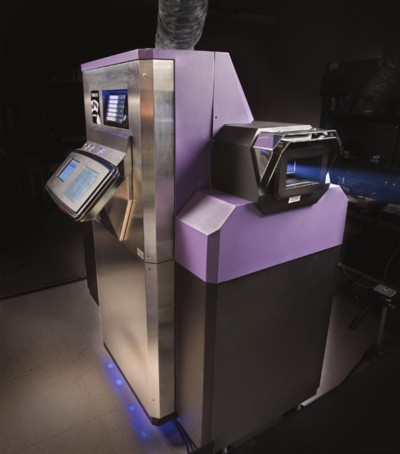
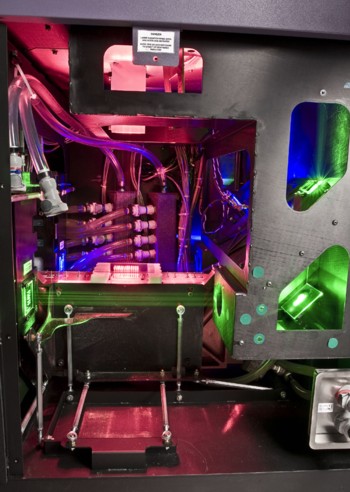
Posted by Alan Gouger (Member # 543) on 09-30-2010, 01:22 PM:
I have not read the details ( is this a scanning laser ) but will this be able to draw a 235:1 image so no need for add on lens outside its primary.
Posted by Monte L Fullmer (Member # 2797) on 09-30-2010, 03:27 PM:
...and if the unit has macros for the resolution settings, no anamorphic attachments are not needed anyway - like with most DCI units that are presently in operation.
Posted by Demetris Thoupis (Member # 833) on 09-30-2010, 05:12 PM:
In reality no format uses the full dmd chip. Flat has more resolution than scope which really is a shame. When the screen is wider than 12 meters it is best to use an anamorphic attachment so the scope image used the full dmd chip gaining light output as well as resolution. As far as I know though Barco Series 2 removed the anamorphic support (image squeezing on the full chip) although that can easily be enabled with a mere software/firmware upgrade.
I thought that laser projection can ne better suited on the lcd chips like Clos or Dila.
Demetris
Posted by Lyle Romer (Member # 1266) on 09-30-2010, 06:14 PM:
If this Kodak thing is just a laser light source instead of xenon bulb for DLP, how does it get better contrast? Isn't contrast a function of the imager itself or does having the perfectly polarized light source help the imager deflect the unwanted light better?
Posted by Sam D. Chavez (Member # 1841) on 09-30-2010, 07:24 PM:
Someone who is supposed to know tells me it is six different color lasers pointed into the integrator rod and then into the DLP.
Posted by Alan Gouger (Member # 543) on 09-30-2010, 09:53 PM:
Lasers can be very efficient but 6 of them, ouch. I wonder what it cost to run this thing. I hope the technology trickles down to a 110V 15amp consumer version.
Posted by Carsten Kurz (Member # 5396) on 10-01-2010, 03:52 AM:
Maybe it uses a DMD, but not the usual style?
Usually the contrast limiting factor in DLP is scattered light in various parts of the optical path, also reflections on optical surfaces (Prisms, etc.).
Simple home cinema or presentation DLPs can reach 1:1000 or 1:2000. HighEnd home cinema machines can get to 1:8000. Seems that Kodak found a way to do it even better.
I heard that a state-of-the-art DLP chip (home cinema DarkChip4) can be quoted with a 'native' contrast ratio of about 1:12.000.
Interesting they boast 40.000 Lumens output options.
Nice for 3D. Although I'm curious which 3D systems would be compatible with it.
- Carsten
Posted by Carsten Kurz (Member # 5396) on 10-02-2010, 05:20 PM:
This is about six years old:
http://www.insightmedia.info/news/Kodak%27sGEMS.htm
If the Kodak Cinema Laserprojector is based on this technology, then it seems to be a hybrid 'DLP'+Scanning system, not necessarily based on TIs DLP technology.
- Carsten
Posted by Mark Gulbrandsen (Member # 72) on 10-04-2010, 08:11 PM:
Lest everyone not forget that Kodak has abandoned every single piece of cinema gear it has ever shown a prototype of! It's got to be hellova expensive! Lasers still require replacement and operate on extremely high voltages. It doesn't quite make the DCI color spec but it is more linear although probably eventually will make the spec if the devlopers are persistant and have the funds to continue. I'd hate to imagine the cost of the thing... but I can certainly see Imax skipping right past all the upcomming 4K DLP gear and going right to this.
Mark
Posted by Carsten Kurz (Member # 5396) on 10-05-2010, 03:31 AM:
http://www.outlookseries.com/N8/Financial/3649_Brian_Bonnick_IMAX_Laser_Light_Engines_LLE_Closes_$13M_Series_B-Round_Brian_Bonnick.htm
If KODAK doesn't make it, there are a few other players already in that market.
Sony has produced compact semiconductor RGB Laser modules for home-cinema and cinema use.
One aspect of Laser sources is very small 'Étendue', which allows a maximum of light input on the imager - no mirrors needed.
Then, it is 'cold light', the imagers are easier to cool than with IR-burdened Xenon. You simply can not throw 12kW Xenon at a DLP or SXRD, same as with 35mm.
The small Étendue also makes it possible to easily 'stack' light sources for higher brightness, or to switch them on and off partially, e.g. between 2D and 3D.
And then, after everybody is 'Digital' '4k' or '3D', selling your screen with 'Laser Projection' is another benefit ;-)
- Carsten
Posted by Alan Gouger (Member # 543) on 10-05-2010, 01:15 PM:
Laser does have some benefits & there seams to be no shortage of company press release supporting the format with several test beds showing proto types but fact is none of these companies have crossed the finish line having brought to market a working laser Projector minus the little mico pocket projectors and rear projection. It is getting old every time I see the mention another company has been or is working on laser or demoed the platform. I am enthusiastic for the technology & hope to enjoy Laser at some point during my lifetime but Im getting old, someone better hurry up if they want my money.
Posted by Carsten Kurz (Member # 5396) on 10-06-2010, 04:51 PM:
Well, that happens all the time. You're either too old or too young. Or just right.
- Carsten
Posted by Tom Bert (Member # 5719) on 10-08-2010, 01:38 AM:
Some of the questions popping up:
- Will laser require replacing my freshly installed DP -again-? No! Laser modules will most probably be compatible with the existing light (rod) interface and -simply- replace lamps. What will happen is that your lamp is going to be pulled out and a large optical fibre will be put on the entrance of your engine. The engine and its components (a.o. DLP) will remain to exist.
- What is improvement in lifetime, cost and WPE when using lasers? Current values lie at ~40kHrs, ~€50/W (and ~10W needed /1000lm) and 20%... but this is bound to ramp up quickly if the technology catches on.
Powered by Infopop Corporation
UBB.classicTM
6.3.1.2