This is topic Article on small town Digital conversion in forum Digital Cinema Forum at Film-Tech Forum ARCHIVE.
To visit this topic, use this URL:
https://ft-forum.com/ft/cgi-bin/ubb/ultimatebb.cgi?ubb=get_topic;f=16;t=000802
Posted by Steven J Hart (Member # 2340) on 05-10-2011, 08:25 AM:
Article from Grand Forks Herald
RYAN BAKKEN: Rocky future for the Roxy?
Sometimes, progress stinks.
That’s the case in Langdon, N.D., which is threatened by the loss of its movie theater unless community members rally.
Again.
The first rally was necessary in 1995, when the Roxy Theater closed after almost 60 years. But the Northern Lights Art Council organized a community fundraising campaign that secured $68,000 for new projection equipment, new seats, a new roof and other improvements. The Roxy reopened after a three-year hiatus.
Now, it’s on life support again. Box office receipts and popcorn sales aren’t to blame. Other than one year, the Roxy has turned a modest profit despite bargain ticket prices of $6 for adults and $4 for children. The four-figure annual profits always go toward improvements.
The blame instead goes to progress. Starting in 2013, studios will stop supplying movies on 35 millimeter film. So, the Roxy will need to buy a projection system for that newfangled digital.
The cost is $70,000.
“Basically, we either switch to digital or close some time in the next two years because we won’t be able to get product,” said Steve Hart, the theater manager since the 1998 reopening.
The nonprofit NLAC again is taking the town’s temperature for donations to salvage the operation, which offers movies four nights a week.
If residents respond again, quality of life and nostalgia will be their motivators. For quite a while, smaller communities have used public money to subsidize cafes and grocery stores that provide convenience. Recently, similar help has been given to maintain entertainment options for young and old in shrinking burgs with fewer things to do.
The Roxy, with its old-school marquee and quaint inside, also provides memories. “We have great-grandparents who remember going to the movies there as kids,” Hart said.
Small town movie theaters certainly have their charm, especially those kept alive by grassroots efforts. The Roxy, Cando’s Audi, Park River’s Lyric and the Rockford in New Rockford were part of feel-good features in 2010 produced by the New York Times and NBC Nightly News. The theme of both stories was about small towns preserving their way of life.
The problem is a shrinking customer base. Recent census numbers show Cavalier County lost 17.3 percent of its population from 10 years ago, falling below 4,000 people. About half live in Langdon. Given that trend, what’s the future of small-town theaters?
Langdon likely will soon provide one answer.
Posted by Mark Gulbrandsen (Member # 72) on 05-10-2011, 12:07 PM:
A. It doesn't cost 65,000 dollars to buy a system.
B. you may have longer than the end of 2013. 2013 was not given as a definate date. Just a forecast based on the present rate of conversion to digital.
C. Isn't N.D. a state that is pretty well off? Seems to me you have one of the lowest unemployment rates in the US. Now is the time to apply for grants, etc. so you don't have to buy a system out of pocket.
Mark
Posted by Gordon McLeod (Member # 33) on 05-10-2011, 01:25 PM:
You know i don't think it is as much of an issue as you think i know of several theatres that have decomissioned and sold there d cinema and gone back to film because of booking restrictions and operating cost
Posted by Louis Bornwasser (Member # 3063) on 05-10-2011, 02:00 PM:
John Fithian has repeated given "end 2012" as the end of film by 3 studios. He lies. Louis
Posted by Mike Blakesley (Member # 26) on 05-10-2011, 02:30 PM:
That's not quite true...I saw him at the CinemaCon. Both in his "state of the industry" speech and at the CBG meeting he did say the end of film COULD come by the end of 2013 "according to our best guess" but he never said it was anything definite about that date. He never said anything about 3 studios as far as I remember.
Posted by Brad Miller (Member # 2) on 05-10-2011, 02:53 PM:
quote: Mark Gulbrandsen
It doesn't cost 65,000 dollars to buy a system.
Not for a small screen that can use a baby projector...and if you don't care what the brand and/or reliability is...and if you don't care what the actual operating costs are, of course not.
There is FAR MORE to this equation than the mere "purchase price". Digital cinema is not a matter of how much the price is, but how much it will cost you. Today's decision can easily turn into tomorrow's nightmare.
Posted by Mark Gulbrandsen (Member # 72) on 05-10-2011, 08:25 PM:
His present 2013 date was based merely on the present rate of conversion. Folks, like it or not it is progrressing far faster then most of you might care to know. And it is progressing faster in Europe than it is here in the States...
As for reliability of the presently available equipment... from what I've seen in the last year the reliability level IS THE SAME between all three manufacturers. Problem level on new gear is basically so close to zero as to not even matter. If you live in dirty-dusty-greasy environment then a projector whose entire air intake is filtered is very important.
@Gord... Re:Booking.... There have already been locations here turned down for 35mm film prints because there was a shortage of them. Kings Speech is a prime example, some Warners and some Disney stuff as well. I know for all my customers that have digital installed booking films has been much, much easier. May not be true of the Artsy Fartsy film world yet but they are not lagging far behind either because DCP's are far less expensive to produce.
Posted by Mike Blakesley (Member # 26) on 05-10-2011, 09:19 PM:
Got a copy here of Fithian's exact remarks from the convention, as follows:
"...based on our assessment of the roll-out schedule and our conversations with our distribution partners, I believe that film prints could be unavailable as early as the end of 2013. Simply put, if you don't make the decision to get on the digital train soon, you will be making the decision to get out of the business."
(Me again) Re: Booking: I can tell you for sure that we've had less trouble getting movies since our conversion. There have been several off-break films where there were no 35MM available but there were digital prints; and we've had at least one instance so far where we got a 3-D print on the break but our neighboring theatre could not get a 35MM booked on the break.
One thing to consider (which I never even dreamed would be a problem), is that even with digital there is still a "set" number of digital prints. Stupid as that is, that's the way it is. Once that number of prints is reached by whatever means, that's it -- you can't get a print, same as with film.
Another thing is the studios don't make any allowance for the higher 3D ticket prices when insisting that you keep a print over. For example, "Rio" would have normally been a 2-week booking for us, but the 3D prices pushed our second-week gross high enough that Fox wanted us to keep it another week. That third week was pretty soft (although we played the movie in 2-D that week and advertised it as such, so we picked up a few non-3-D fans that we would have missed otherwise).
I'm hoping that the studios will eventually wake up to the fact that we and they could make more money if they would address these issues. We'd love to play a movie on the break every week, thereby increasing our grosses and our film rental paid, but we can't play everything for 2 or 3 or 4 weeks.
Posted by Martin McCaffery (Member # 37) on 05-10-2011, 09:29 PM:
quote: Mike Blakesley
I believe that film prints could be unavailable as early as the end of 2013
Seems to me he is saying not that film will be dead at the end of 2013, but that there will some movies that will not be released on film. At least in the art film biz, there are always prints unavailable.
I'm not familiar enough with his other statements to know what he really means to say.
Posted by Brad Miller (Member # 2) on 05-10-2011, 10:58 PM:
quote: Mark Gulbrandsen
from what I've seen in the last year the reliability level IS THE SAME between all three manufacturers.
Everything new works well, but you and I both know there are some designs out there that are doomed to have earlier failures than their competitors.
As far as dirty environments, Barco pretty much has everyone beat there.
Posted by Tom Petrov (Member # 1534) on 05-11-2011, 02:54 AM:
quote: Martin McCaffery
Seems to me he is saying not that film will be dead at the end of 2013, but that there will some movies that will not be released on film. At least in the art film biz, there are always prints unavailable.
I think you are right. And the most important thing is that, if stuidos make only a few 35mm prints, then major players will get those prints over a small player like the Roxy. I know of one guy who can't get certain independent film prints in a certain market because Cineplex has so much market share that they will get their hands on them first and then hang on to them for a very long time.
quote: Mike Blakesley
I'm hoping that the studios will eventually wake up to the fact that we and they could make more money if they would address these issues. We'd love to play a movie on the break every week, thereby increasing our grosses and our film rental paid, but we can't play everything for 2 or 3 or 4 weeks.
Hey Mike. I am looking at your cinema, is your theatre always second run? Or do you play first runs films some of the time?
BTW-nice theatre.
Posted by Mark Gulbrandsen (Member # 72) on 05-11-2011, 08:11 AM:
Actually Brad it is NEC that has the other two beat as per the filtering. They filter all incomming air with Hepa filters. Hepa filters do a much beter job than the metal screen filters BARCO uses...
Mark
Posted by Adam Fraser (Member # 1074) on 05-11-2011, 09:17 AM:
Mike is spot an as usual. The only reason we will be converting in the next 1-2 years is due to the availability of prints, and maybe a little bit for the 3D aspect.
This past year we have been turned down for several films we would have never been turned down for in the past, and its only going to get worse.
Posted by Mike Blakesley (Member # 26) on 05-11-2011, 11:02 AM:
Tom - thanks for the compliment. We play around 8 to 12 movies on the break each year -- the rest, usually 3 to 5 weeks after break.
Posted by Martin McCaffery (Member # 37) on 05-11-2011, 11:14 AM:
quote: Tom Petrov
I know of one guy who can't get certain independent film prints in a certain market because Cineplex has so much market share that they will get their hands on them first and then hang on to them for a very long time.
This has always been a problem in the Art/Indie biz, it has nothing to do with digital. Even if we will do better with a certain art title, the distribs would rather show it in the multi-plex first. Every art theatre in the US faces this problem. Unless the art biz is going to start treating their product like major releases (not likely) with thousands of screens playing the film, it will still be a problem if digital takes over.
Posted by Brad Miller (Member # 2) on 05-11-2011, 11:57 AM:
quote: Mark Gulbrandsen
Actually Brad it is NEC that has the other two beat as per the filtering. They filter all incomming air with Hepa filters. Hepa filters do a much beter job than the metal screen filters BARCO uses...
Mark, Barco has the sealed light engine. Much more important.
Posted by Mark Gulbrandsen (Member # 72) on 05-11-2011, 07:20 PM:
Thats what one has to do when one does not have adaquate filtering in the first place. I can actually repair an NEC Light Engine IN THE FIELD... Which is much more important than it being sealed...
Posted by Chris Slycord (Member # 4239) on 05-11-2011, 07:23 PM:
It's a bit off-topic but there's no such thing as a HEPA filter. HEPA certifies filtration systems. Just taking a filter from one of those and sticking it in something else doesn't make it "HEPA" and it's even worse that lots of companies sell what they call "HEPA-type filters" which just means that they maybe cloned a filter from a real filtration system and more likely made a piece-of-shit copy.
Posted by Mark Gulbrandsen (Member # 72) on 05-11-2011, 07:37 PM:
HEPA to me means that it is able to remove down to pollen sized particles and thats fine bby me. I don't give a crap who HEPA is or what they do at dinner time. Both Christie and NEC claim their HEPA filters work well and my experience has shown that this has prooven to be true. BARCO uses a single layer fine mesh metal screen in which the size of the holes in the screen determine the size particle that can get past. Any one know how large the holes in the BARCO filter screen are? My experience has shown that the HEPAs on both the Christies and NECs work much better than the metal mesh... and all mt customers with Christie, BARCO and NEC are in a desert type condition so it's pretty brutal as far as dust goes.
People can argue projectors all day long but they fail to see that they are all T.I. approved designs and are all ultimately very similar to each other circuit wise. You will see different types of integrator rods,power supplies and GUI between the user and the T.I.software amongst the three companies but the basic projectors are all T.I. and they all still work more or less the same. Even the implementation of how the modules and PCB's are made has to be approved by T.I. before they can be produced. That is all part of how T.I. has made this product become so reliable...
Mark
Posted by Sam D. Chavez (Member # 1841) on 05-11-2011, 07:38 PM:
I want to hear more about these field repairable light engines.
I have vivid memories of visiting the Christie plant and seeing techs in surgical garb in an air filtered room like something out of Intel.
I don't know anybody with a shop like that.
Posted by Mark Gulbrandsen (Member # 72) on 05-11-2011, 08:11 PM:
Sam... Tim at Strong showed some of us that were interested during training class how it is done. There is also a training class that is board level at NEC in Itasca, IL. next week... perhaps you should go to it, it may also cover this. You can convert an older engine to triple flash or you can also send it to T im and he'll do it on his bench and then put it in a projector and burn it in and converge it before sending it back. NEC uses a very unique pressure type pin that makes contact with the pads on the efib or ffib boards. They do this because it can be extremely expensive in some countries to send in an entire light engine... and will you actually get the old one back or not?? Brazil is tough and I know you know some other countries that are as well. I have pictures of him doing this procedure in training class and watching him do this was optional for those that wanted to. Needless to say this sort of thing is right down my alley so I watched. Replacing the DMD's in the field.... probably not but you would have to ask Tim on that to be sure...
BTW: I remember it being said in Christie class that they are not field repairable. However, Rodney once told me he had done it in the field himself...
Mark
Posted by Chris Slycord (Member # 4239) on 05-11-2011, 10:35 PM:
quote: Mark Gulbrandsen
HEPA to me means that it is able to remove down to pollen sized particles and thats fine bby me. I don't give a crap who HEPA is or what they do at dinner time.
Touchy, are we? My comment wasn't necessarily geared toward you and more geared toward the over-use of the "HEPA filter" phrase with respect to a lot of products.
Although I admit I was wrong. The government does, in fact, rate filters as being HEPA but the distinction is that a lot of companies use a one of these filters but skimp on the design so that not all the air actually hits it.
On the other hand, I'd expect the companies you're referring to to have designed them properly...
Posted by Monte L Fullmer (Member # 2797) on 05-11-2011, 11:39 PM:
quote: Mark Gulbrandsen
Any one know how large the holes in the BARCO filter screen are?
... the holes are close in size in thread density to a red shop rag .. and these three filters (two small ones on the light engine side and the big one in front) are super easy to clean - you take them out and take a canister vacuum to them on the input side to clean the screens and return them to their places.
The dust particles themselves looks more finer than flour making these filters stopping decent fine particles.
Luckily, the filters and mesh are made of stainless steel for durability, for if made with aluminum, the mesh would tear rather easily.
Posted by Jake Spell (Member # 5294) on 05-12-2011, 12:44 AM:
Im fairly certain that those filters catch much smaller particles than the hole size because as air passes through it it will build up a slight charge and attract the dust to the filter surface. Way cheaper than replacing filters every so often, esp. HEPA rated filters
Posted by Brad Miller (Member # 2) on 05-12-2011, 02:08 AM:
quote: Mark Gulbrandsen
Thats what one has to do when one does not have adaquate filtering in the first place. I can actually repair an NEC Light Engine IN THE FIELD... Which is much more important than it being sealed...
No need to argue this with you, I respectfully disagree as I am sure many others will too.
Be sure to send us a video of you doing this repair in a booth somewhere. I'm sure that I am not the only person here who would like to see it.
Posted by Mark Gulbrandsen (Member # 72) on 05-12-2011, 04:58 PM:
Should the need ever arise that I have to I will be glad to post a video can find the pics of them doing it at Strong I'll also post those. The socket arrangememt DMD to ffib board is somewhat like the socket for a current Intel CPU except there are many many more spring pins...
@ Jake... That is a charasteric of almost all air filters... paper or metal. Just wait till you have to buy one of those!! It's cost will make replacable hepa filters easily embracable Which is most likely why the other manufacturers went that route.
Posted by Carsten Kurz (Member # 5396) on 05-12-2011, 05:32 PM:
Well I'm sure that Barco and Kinoton made an informed decision towards the combination of a washable metal filter with a sealed light engine.
Just like Christie and NEC did for their filters.
We recently had a discussion on another forum about the cost for christie filters. One cinema just paid the equivalent of 1067US$ for 4 sets.
Yes, thats 265US$ per set.
- Carsten
Posted by Mark Gulbrandsen (Member # 72) on 05-12-2011, 07:27 PM:
Geez... Time for them to find a new supplier, they got shafted on that! They don't cost any where near that much over here and if you buy in quantity they become as inexpensive as a decent home furnace filter.
Posted by Steve Guttag (Member # 268) on 05-12-2011, 10:48 PM:
Barco has had the metal mesh filter on the Series-0 machines, went to the HEPA filters on Series-1s (.98") and then back to the metal mesh. I tend to agree that the HEPA filters seem to stop more dirt and I do like that NEC put filters on the lamp intakes.
Then again, the custom filters for the NEC and Christie projectors are relatively expensive and do add to the overall operating costs. Barco's are washable (recommended once for every 30-days of OPERATING time).
And back to the subject (as presented in the title).
We just converted the ELKINS CINEMA in Elkins, WV to all digital this week. Barco projectors, Dolby servers.
Next week, Upshur Cinema...Buckhannon, WV.
-Steve
Posted by Mark Gulbrandsen (Member # 72) on 05-13-2011, 11:30 AM:
Steve... Be sure to try the moonshine while you're in that area!!
Posted by Bill Enos (Member # 440) on 05-13-2011, 03:40 PM:
HEPA filters are too expensive and probably provide more filtration than is required for this application. Our booth is fairly dusty for reasons we can't control, so far the metal mesh filters on our DP100 have provided excellent protection, fan blades and machine interiors are dust free, with occasional cleaning of filters, actually a dirty filter filters better than a clean filter until the dirt works its way to the back of the filter. Air flow might suffer though.
Posted by Mark Gulbrandsen (Member # 72) on 05-13-2011, 07:24 PM:
I don't feel a set of 60.00 filters once a year is too high a price to protect the insides of a 65,000+ projector. It also saves on labor down the road from not having to dismantle the entire lamphouse and rectifier for a through cleaning. This is 2011, not 1963!!
Mark
Posted by Steve Guttag (Member # 268) on 05-15-2011, 11:17 AM:
I find that the HEPA style filters need to be changed more than once/year and that they are typically more than $60/change once all are added up.
As to dirt in machines...I've seen a fair amount of dirt get past a mesh type over time...particularly the drywall dust of a new construction. You may not see it at first until you shine a flashlight at the mirror or other glass part...you'll see it then...I've impoved light output by over 10% by just cleaning dust off of things that otherwise looked pretty clean.
-Steve
Posted by Mark Gulbrandsen (Member # 72) on 05-15-2011, 01:45 PM:
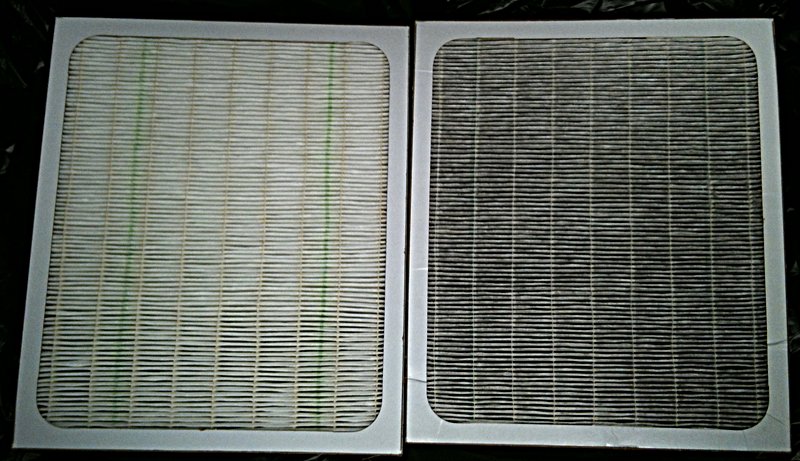
NEC specs are 2K hours on the electronics filters (4 filters) and with every lamp change on the lamphouse air intake filters (2 filters). NEC now sells them seperately to facilitate keeping the costs down... in other words you don't need an entire filter kit just to change the lamphouse. Quantity orders GREATLY reduce the cost per filter change. My experience so far has shown this to hold true even in the dusty desert conditions we have here. In new construction thats not true and it will see more filter changes until the construction dist settles down. At least it isn't ending up inside the projector or rectifier!! With Christie we go about 3 months to a year depending on the location and the time of year. I'd say 6 months is average. In spring the desert is full of fluff and pollen and dust from things blooming. Below is a ZX filter after just three months operation, about 60% plugged.
Posted by Steve Guttag (Member # 268) on 05-21-2011, 10:10 AM:
Add the Upshur Cinema 6 in Buckhannon, WV to the list of small town theatres that have gone all DCinema (Barco projectors, Dolby players, Cindigm TMS/LMS).
-Steve
Posted by Mike Frese (Member # 4361) on 05-21-2011, 03:22 PM:
Steve,
I certainly agree that this town is a small town. It does look like based on what they are playing that they should have qualified for VPFs; are they using VPFs?
Posted by Aaron Mehocic (Member # 15) on 05-21-2011, 07:23 PM:
quote: Mike Blakesley
I'm hoping that the studios will eventually wake up to the fact that we and they could make more money if they would address these issues.
As most of who have been in this business for a long time will already note, it seems the last adults to run studios retired in the early 1990's.
Posted by Steve Guttag (Member # 268) on 05-21-2011, 10:11 PM:
Mike,
If you see a Cinedigm TMS/LMS system, odds are they are on the VPF plan...I don't know why anyone would use theirs otherwise. While it does have some nifty features, it is a bit restrictive (they are not burger king, you will have it their way!) and commissioning the TCC has proven to be a bit of a challenge.
But to answer your question more directly...yes they are receiving VPFs. I can just about guarantee you that had there not been a VPF deal out there, they would still be running film.
-Steve
Posted by Mike Frese (Member # 4361) on 05-21-2011, 10:47 PM:
Thanks Steve,
I was thinking the same thing too when I saw the Cinedigm as the lms.
Maybe we need to re-define the definition of small town to a theater not being full time 1st run.
Posted by Steve Guttag (Member # 268) on 05-21-2011, 11:01 PM:
Mike...the size of the town and sub-run are not necessarily connected...as my examples have shown.
I would say that if you want to explore what sub-run theatres are doing that you start a thread on Sub-Run theatres and DCinema. Certainly, Elkins and Buckhannon WV are "small towns." The biggest town near them that people may have heard is Clarksburg, WV. The next nearest town that folks have a higher chance of knowing is Morgantown, WV but one is driving a bit to get there.
-Steve
Posted by Mike Frese (Member # 4361) on 05-22-2011, 12:36 AM:
Steve,
Two things make the conversion much easier if not a slam dunk: 1) Getting the VPF as a 1st run, & 2) having 4 or more screens to achieve some booth labor savings after going 100% digital. Yes it is a challenge getting the financing lined up in the first place, but those two factors should get pretty close to paying for the conversion.
The theater in the article that this thread is based on has neither of those factors. They are seasonal 1st run on the low side. So no need to start a new thread. There is probably a thousand or more theaters like this with little hope. I guess their only hope would be was if they had joined NATO/CBG before their deadline (which I hear now was extended by a couple of years with very little notice).
Posted by Mike Blakesley (Member # 26) on 05-22-2011, 12:44 PM:
Being in CBG does not help a single screen get VPFs (yet) because it's impossible to meet the 85% quota for first run movies, unless you want to miss a ton of playable films by opening marginal crap on the break and playing said titles for 2 or 3 weeks.
Posted by Mike Frese (Member # 4361) on 05-22-2011, 01:08 PM:
Mike,
What about getting the VPFs when playing movies 3-4 weeks old? I know a exhibitor who is on that plan and is happy with it. The only negative that I am aware of with that plan is having to spend extra money upfront for a LMS.
Posted by Frank Angel (Member # 248) on 05-23-2011, 03:23 AM:
Can those filters be washed? Also, my understanding is that to be a HEPA filter, it must conform to specific specs. Would it be possible to install a HEPA filter from a 3rd party that was the size of the plastic form that NEC uses? Surely NEC doesn't manufacture the HEPAs. I've seen some sizedable HEPAs for other air cleaning systems like vacuum cleaners that could be cut down and made to fit and they don't cost $60.
Posted by Steve Guttag (Member # 268) on 05-23-2011, 06:01 AM:
No, you can't wash the HEPA style filters. Note, it isn't that they cost $60 each...the whole SET of them (something like 6 filters, in all) cost a little more than that. Strong is having them made to size to keep the cost down.
Note, Barco is now making a retrofit kit for the DP1200-DP2000 to switch them from HEPA style to wire-mesh.
-Steve
Posted by Carsten Kurz (Member # 5396) on 05-23-2011, 04:20 PM:
Does anyone know the typical price for a set of filters for series-II Christies?
- Carsten
Posted by Mark Gulbrandsen (Member # 72) on 05-23-2011, 04:27 PM:
quote: Mike Blakesley
Being in CBG does not help a single screen get VPFs (yet) because it's impossible to meet the 85% quota for first run movies, unless you want to miss a ton of playable films by opening marginal crap on the break and playing said titles for 2 or 3 weeks.
There is a program for sub run... you should talk to Al at the Vali.
Mark
Posted by Mike Blakesley (Member # 26) on 05-23-2011, 05:30 PM:
Al isn't a single screen.
Posted by Mike Frese (Member # 4361) on 05-23-2011, 10:42 PM:
quote: Mark Gulbrandsen
There is a program for sub run... you should talk to Al at the Vali.
Mark,
Maybe you can invite Al to this forum to discuss what he can.
Mike,
I am surprised that you are not using the CBG-VPF deal as I thought you were a pretty big supporter of Nato/etc. I would be interested in why you have not signed up for it (as would many others I am sure).
Powered by Infopop Corporation
UBB.classicTM
6.3.1.2