This is topic Article on Light issues with Digital in forum Digital Cinema Forum at Film-Tech Forum ARCHIVE.
To visit this topic, use this URL:
https://ft-forum.com/ft/cgi-bin/ubb/ultimatebb.cgi?ubb=get_topic;f=16;t=000806
Posted by Mike Frese (Member # 4361) on 05-22-2011, 09:50 AM:
http://www.boston.com/ae/movies/articles/2011/05/22/misuse_of_3_d_digital_lens_leaves_2_d_movies_in_the_dark/
As if rising ticket prices and chatterbox patrons weren’t enough, moviegoers in the Boston area are being left in the dark thanks to the regular misuse of the lenses on new digital projection equipment at many of the region’s major theater chains. But almost no one at the theaters or their corporate headquarters is willing to talk about it.
A walk through the AMC Loews Boston Common on Tremont Street one evening in mid-April illustrates the problem: gloomy, underlit images on eight of the multiplex’s 19 screens (theaters 5, 8, 9, 10, 11, 13, 15, and 18, to be specific). These are the auditoriums using new digital projectors that are transforming the movie exhibition business, machines that entirely do away with celluloid. The “film’’ comes in the form of a software file, and the projector pumps it onto the screen at high intensity.
Why, then, do so many of the movies look so terrible? This particular night “Limitless,’’ “Win Win,’’ and “Source Code’’ all seemed strikingly dim and drained of colors. “Jane Eyre,’’ a film shot using candles and other available light, appeared to be playing in a crypt. A visit to the Regal Fenway two weeks later turned up similar issues: “Water for Elephants’’ and “Madea’s Big Happy Family’’ were playing in brightly lit 35mm prints and, across the hall, in drastically darker digital versions.
The uniting factor is a fleet of 4K digital projectors made by Sony — or, rather, the 3-D lenses that many theater managers have made a practice of leaving on the projectors when playing a 2-D film. Though the issue is widespread, affecting screenings at AMC, National Amusements, and Regal cinemas, executives at all these major movie theater chains, and at the corporate offices of the projector’s manufacturer, have refused to directly acknowledge or comment on how and why it’s happening. Asked where his company stands on the matter, Dan Huerta, vice president of sight and sound for AMC, the second-biggest chain in the US, said only that “We don’t really have any official or unofficial policy to not change the lens.’’
A description of the problem comes from one of several Boston-area projectionists who spoke anonymously due to concerns about his job. We’ll call him Deep Focus. He explains that for 3-D showings a special lens is installed in front of a Sony digital projector that rapidly alternates the two polarized images needed for the 3-D effect to work.
“When you’re running a 2-D film, that polarization device has to be taken out of the image path. If they’re not doing that, it’s crazy, because you’ve got a big polarizer that absorbs 50 percent of the light.’’
They’re not doing that, and there’s an easy way to tell. If you’re in a theater playing a digital print (the marquee at the ticket booth should have a “D’’ next to the film’s name), look back at the projection booth.
If you see two beams of light, one stacked on top of the other, that’s a Sony with the 3-D lens still in place. If there’s a single beam, it’s either a Sony with the 3-D lens removed or a different brand of digital projector, such as Christie or Barco.
The difference can be extreme. Chapin Cutler, a cofounder of the high-end specialty projection company Boston Light & Sound, estimates that a film projected through a Sony with the 3-D lens in place and other adjustments not made can be as much as 85 percent darker than a properly projected film.
That’s dark enough for Hollywood director Peter Farrelly to complain loudly when his comedy “Hall Pass’’ had its promotional screening in two of the Common’s theaters prior to opening this past February. Farrelly went from one screening where the 3-D lens had been removed to a second in which the lens was still on, and he couldn’t believe his eyes.
“I walked into the room and I could barely see, and my stomach dropped,’’ the filmmaker said. “The first screening looked spectacular and the second was so dark, it was daytime versus nighttime. If they’re doing this for a big screening, I can’t imagine what they do for regular customers. That’s no way to see a movie.’’
So why aren’t theater personnel simply removing the 3-D lenses? The answer is that it takes time, it costs money, and it requires technical know-how above the level of the average multiplex employee. James Bond, a Chicago-based projection guru who serves as technical expert for Roger Ebert’s Ebertfest, said issues with the Sonys are more than mechanical. Opening the projector alone involves security clearances and Internet passwords, “and if you don’t do it right, the machine will shut down on you.’’ The result, in his view, is that often the lens change isn’t made and “audiences are getting shortchanged.’’
After multiple requests, Sony declined through a spokesman to respond to questions about its digital projection equipment. Executives at the major theatrical chains are equally unwilling to discuss the matter. When contacted for this article, a spokesman for Regal, the nation’s largest multiplex operator, e-mailed the following statement: “Patron response has been overwhelmingly positive toward digital cinema and all of the associated entertainment options provided by this technology.’’
A spokeswoman for Norwood-based National Amusements, the ninth-largest chain in the country, responded to detailed questions by saying “We are not experiencing any issues with the Sony 4K systems.’’
If they talk about it at all, the chains claim that individual multiplex managers are the ones to decide whether to switch out the 3-D lens for 2-D showings. Dan Huerta, Vice President of Sight and Sound for AMC, the second-biggest chain in the US, said, “Obviously, if we know there’s a 2-D movie that’s going to be shown through a 3-D lens, we would have to make sure that the manager or a technical person could make the call.’’
Yet some theater employees scoff at that notion. “I can tell you who’s not [making the call], and it’s not the manager,’’ said one projectionist who has worked at a number of area theaters, including the Common, and who also preferred to remain anonymous. This man — let’s call him the Phantom Projectionist — believes that unspoken AMC corporate policy is to keep 3-D lenses on for 2-D showings.
“If we knew a house would be opening ‘Harry Potter’ and it wasn’t going to be 3-D,’’ he said, “I would ask them to swap the lens out and it would either go nowhere or come back with a negative from the regional technician, usually with the impression that it came from above.’’
Digital projection can look excellent when presented correctly. Go into Theater 14 at the Common, newly outfitted with a Christie 4K projector, and you’ll see a picture that is bright and crisp, if somewhat colder than celluloid. (You’ll also hear a busted sound channel that makes the actors sound tinny and faraway— but that’s a different article.)
Digital is the future — the Common plans to be all-digital by July — if only because it saves studios millions of dollars a year on processing film prints. Why, then, did Regal and AMC sign contracts in early 2009 — and National Amusements in June 2010 — with Sony, the one manufacturer whose projectors feature the external 3-D lens that’s too expensive and difficult to easily remove for 2-D showings?
The reason appears to be a basic business quid pro quo. Sony provides projectors to the chains for free in exchange for the theaters dedicating part of their preshow ads to Sony products. Unfortunately, the 3-D boom took off in late 2009 and Sony had to come up with a retrofitted solution. Said the Phantom Projectionist, “To me it feels like they’re serving people pigeon burgers and telling them its grade-A beef.’’
But what if audiences don’t notice or don’t care that they’re eating pigeon burgers? When queried by a reporter, moviegoers exiting showings at the Common recently were hard-pressed to pinpoint problems with what they’d just seen.
An older couple leaving the under-illuminated 7:15 “Win Win’’ showing thought the film looked fine; another patron praised its “creative lighting.’’ Walking out of the 7:05 showing of “Source Code,’’ Gerry Jurrens, 62, of Kingston, N.J., admitted that “in some places it seemed a little grainy, but it still looks better than what I’ve got at home.’’
Educating audiences and overcoming this inertia can be difficult. Boston Light & Sound’s Cutler said, “We have a tendency to walk in the door, we’ve paid our money, bought our popcorn, and we want to sit down and watch something. We’re loath to get up and leave because we’ve put that much effort in.’’
Still, the basic benchmarks of quality are easy to spot. In the opinion of the anonymous Deep Focus, “You should have a good, bright, clear, sharp picture and clean sound. That’s really it. It should be very easy to run a good show off digital and it stuns me that the chains can’t even manage to do that.’’
Herb Nipson agrees, and with four decades experience as a Boston-area projectionist he’s worth listening to. “I think audiences have to be a lot more proactive now,’’ he said, “because audiences are the only group that has any real concern for the quality of the image. They’re the only ones watching it.’’
Ty Burr can be reached at tburr@globe.com.
Posted by Victor Liorentas (Member # 5272) on 05-22-2011, 11:47 AM:
In my visits to digital booths i always see this problem! Oh did i say problem? What problem? Everything is just fine,it's supposed to stay in place like that,it works fine so we just leave it there!
Whatever!
Multiplexes like this deserve a solar flare to take out all their equipment instantly! ![[Big Grin]](biggrin.gif)
It would be just fine!
Posted by Brad Miller (Member # 2) on 05-22-2011, 11:56 AM:
That's just pathetic. I didn't realize the problem was so widespread. NONE of our digital screens have EVER had this problem.
People are going to start staying home and wait for VOD if this sort of nonsense continues.
Posted by Steve Guttag (Member # 268) on 05-22-2011, 11:59 AM:
It is also sad that the anonymous projectionists hurt their case by adding inaccuracies.
Unlike other Real-D solutions, the Sony one does NOT alternate the image between the two eyes...both are projected 100% of the time. I have found if they are not perfectly converged, they will significantly lower the perceived resolution on a 2D image too.
Now the light loss is definitely there since the polarizers are definitely still in place.
Another problem that is not identified but is definitely a cause of dark perceived images are the use of high-gain screens. And in particular, Silver screens with Real-D cinemas. Now some are thinking..."but wait a minute, I though gain screens are supposed to INCREASE light, not decrease it." Yes, that is true but there is the physics of light. A screen does NOT increase light, per-say. It reflects more of the light back but at the decrease in dispersion. This is why gain screens hot-spot. The hot spot is not necessarily in the middle either. It all depends on where the projector is in relation to the screen and where you are sitting in relation to the screen.
I recently made a measurement on a typical silver screen (Severtson, I believe...nominal gain of 2.2). The brightest target was 14.0fL (not centered when I had the PSA in the middle of the room). The darkest target was 2.6fL! For those unfamiliar with the PSA, it takes 45 light readings at once with the screen evenly divided up. The nominal light over all 45 targets was...8.28fL!!!
So the average light that the audience sees on 2D, on a silver screen is only about 1/2 as bright as it should be (and it is uneven, depending on where they are sitting and where the projector is located). Hence, a silver screen or other high gain, if the installer targets 14fL in the middle will look dark. If you have a silver screen (or other high gain) you need to get the center brightness OVER spec so that the nominal brightness is IN SPEC or the image will appear DARK.
Another annoyance to some...if you use a gain higher than 1.0 (matte white), you also need to start curving the screen if you want to even it out a bit and avoid the huge range like in my example (14.0 vs 2.6). Note, DCI spec is the sides/corners are to be 85% of center. So if your corners are less than 11.9fL when your center is 14.0fL, you are not DCI compliant. In short, no silver screen theatres are DCI compliant (unless they have the dreaded Torus screens and that they are increased in their curvature in both directions to deal with the higher gain/lower dispersion of the silver screen versus the pearl screen they were designed for.
If the center brightness was targeted closer to 22fL on silver screens (2D) they would not appear as dark. Can a typical Sony system do this? I don't know, they are not known for their uber-brightness.
Note, for 3D similar principles apply. 5.0fL center is typically the nominal target (4.5-5.5fL) though it is not as codified as 2D is. Going for a center brightness of 8fL will significantly improve the perceived brightness of the overall picture. Note, these movies are color timed for 5.0fL and will become over-saturated at the higher brightness in the center (but will have a fighting chance at the other areas of the screen). Another issue is Real-D itself, it has the greatest likelihood of ghosting of all of the 3Ds so running things high may show off its limitations.
Dolby and Xpan-D can and should use white screens with as LOW a gain as possible to achieve the desired light but they are only 10% (actually closer to 8-10%, depending on the system, color correction...etc) or 18% respectively. So often, you are running a very bright lamp to hit spec. And if you have fixed height (movable side masking) you should really be using an anamorphic lens...it is the only way you are going to really be DCI compliant anyway on 2D or 3D for light.
-Steve
Posted by Mike Blakesley (Member # 26) on 05-22-2011, 08:54 PM:
I don't see why anybody would put in a 3-D system that requires a person to change-out lenses, when one of the intents of the digital projection is to reduce personnel needed in the booth. Seems sorta counter-intuitive and also accident-prone.
Posted by Jonathan Goeldner (Member # 4854) on 05-22-2011, 09:02 PM:
I have a real major problem with the Christie Dual-projector unit that is used over at AMC's Tysons Corner ETX screen - it's seems way overlit. Granted that enough light has to brighten up the large screen - as a result, white lettering (subtitles) seem soft and unfocused (evident in 'Battle Los Angeles' and 'Fast Five') - even scenes when a single light source is on the screen it seems unnaturally hazy and blooms. I've never seen this problem over on the Cinemark Egyptian XD screen (Barco) since the manager told me that the projector's light output can be altered for non-3D/3D features.
Posted by Joe Redifer (Member # 3) on 05-22-2011, 09:17 PM:
This is all over Facebook (nobody in this thread has yet participated in those discussions). That makes me glad as people need to see and be aware of this shit. It seems theater operators find new ways to mess anything up.
quote: Brad Miller
NONE of our digital screens have EVER had this problem.
Of course not. You have very high presentation values which seems to be extraordinarily rare these days.
Posted by Jonathan Goeldner (Member # 4854) on 05-22-2011, 09:20 PM:
^ which Facebook discussion thread?
Posted by Jerome Holmes (Member # 5013) on 05-22-2011, 09:27 PM:
I was disappointed to see the another theatre in our chain not moving the 3d polalizor out of the image path on a non 3d movie. Broke my heart a little.
Posted by Mike Frese (Member # 4361) on 05-22-2011, 10:24 PM:
quote: Mike Blakesley
I don't see why anybody would put in a 3-D system that requires a person to change-out lenses, when one of the intents of the digital projection is to reduce personnel needed in the booth. Seems sorta counter-intuitive and also accident-prone.
You would only have to change the lens once a week if even that. Pretty simple to do it seems to me. Unless you are splitting a screen.
Pretty sad to hear our leaders (solely by size) do such a poor job as in some ways we all get dragged down to some extent.
Posted by Brad Miller (Member # 2) on 05-23-2011, 12:05 AM:
Jonathan, it sounds like the AMC dual projection system is not properly aligned.
Posted by Steve Guttag (Member # 268) on 05-23-2011, 05:54 AM:
It is actually in the DCI spec that any auxiliary lens has to be able to move in/out automatically. Real-D is only compliant IF someone also has the Strong (because I don't know of anyone else making one) motor kit for Real-D. With a Sony system, I don't know how they can automatically switch between the two.
It is amazing how DCI spec is so often quoted when it comes to VPF deals yet it is only certain parts of the spec that folks seem to harp on...clearly, technical presentation qualities are NOT the areas that folks give a crap about...it is the security in the spec that is of concern.
As for the dual Christie projection issues...I agree with Brad...it sounds more like a mis-calibration than any intrinsic problem with the Christie projectors, or their brightness. If they are no longer focused properly, you are going to see that first in text and an image will not "bloom" on a DLP like it would on a CRT based display. I have found that most projectors do NOT hold their lens settings particularly well over time and need to be reset, periodically, if you want the everything to remain looking good.
-Steve
Posted by Dave Macaulay (Member # 813) on 05-23-2011, 08:13 AM:
What 3D does Sony have the requires the use of passwords and opening the projector to remove it??? The description seems to be a Real-D XL... it just slides aside??
I have only seen the Real-D left in for a 2D show when the screen is running mixed programs (I have a problem with this but have to live with it: it degrades the 2D show but ruins a 3D show if left out, and with real-world staffing levels this WILL be forgotten). The light level, in my opinion, was not up to snuff but OK: without the glasses you gain a bit. The colors are a bit off too, but nobody complains (a poor measure of acceptability!!).
For an all-2D schedule we stress in training that the Z-screen or XL MUST be moved aside. I haven't found one left in for a 2D run so far.
Posted by Paul Mayer (Member # 355) on 05-23-2011, 10:32 AM:
The Sony RealD 3D unit is a twin-lens affair that bolts on in place of the standard 2D lens. It is not like any of the XLs or XLWs where there is a set of rails that the unit slides upon.
And yes, to do a swap between 2D and 3D on a Sony requires a technician, logging in as a "Super", and a few minutes to re-calbibrate either the 2D or the 3D lens(es) and save those settings in the appropriate screen/lens files. Also, the projector has to be switched between 2D and 3D function modes. I don't remember having to actually open up the panels, since one can gain access to the service technician menus through the serial port on the back of the projector.
I imagine that re-shooting the colors is necessary too - not sure about that since I've not personally run into a situation where a theater routinely swaps these lenses. The theaters I've seen doing 3D on a Sony just use the "3D for 2D" settings that use both lenses for the 2D image. Painstaking physical alignment of the 3D lenses is especially required when in this mode, since the image will look soft with even small overlay errors between the two lenses.
Posted by Frank Cox (Member # 6258) on 05-23-2011, 02:56 PM:
The "techie" website Slashdot has posted the Boston Globe article for discussion here.
Posted by Chase Pickett (Member # 5975) on 05-23-2011, 03:30 PM:
I've been harping on about this as we have 4 Sony's. As of right now, the best we can do about the light output is to move the polarizing lenses out of the way, recalibrate, and cross check. I really do prefer the Real-D XL with a Christie rather than the XLS with the Sony.
Posted by Joe Redifer (Member # 3) on 05-23-2011, 03:59 PM:
quote: Jonathan Goeldner
which Facebook discussion thread?
Just links to the article from various member with the resulting comments. At least 5 on my Facebook Friends have posted the article so far and a couple have 50 or more comments.
Posted by Carsten Kurz (Member # 5396) on 05-23-2011, 04:02 PM:
I have recently watched the lens swap on a Sony 320 and checked the timing on it. An experienced technician can do it within 5min. The projector does not need to be opened. But it has to be a trained technician, and he needs to have a higher access level to the machine to do the convergence and reconfig. It's not that you need higher skills in shooting colours or so. But definitly more than the ordinary push-button type projectionist has to offer.
Now, do we expect to have the required staff level at a cinema at any time a lens change is needed?
Also: The Sony 2D lens is not cheap. I would think that there could be a few chains that actually didn't buy the normal zoom lens at all, predicting that these machines would only show 3D, or 2D only rarely.
Brightness is one thing - another is 4k pixel pitch and 4k DCP resolution.
Sony was advertizing their machines as the only 4k machines until 4k DLP came out only recently. Now then, how often are we cheated on the 4k?
We had issues here in germany when people were traveling quite a distance to watch some of the first 4k DCP showings on Sony - only to find out then that the 3D lens had been left in place. Now, concerning 4k that means lens convergence issues + reduced brightness + rescaling to fit 4k to the under/over 3D pixel mapping of the Sony.
Not really what you would expect on a screen being advertized as the 4k revolution...
A lens swap every 4 weeks when the program changes - no big deal. But now with digital, cinemas may switch the programing multiple times a day. How likely is it that the lens is swapped just between two showings, or for a late night screening?
Maybe Sony should at least make the polarizing filters extractable to reduce the light loss. Should go without significant adjustment procedures. A lens slider would be the best solution.
BTW - there are rumours that Sony might adopt the Panavision 3D system for their 3D lens as an alternative to RealD. That would at least solve the silver screen issues.
- Carsten
Posted by Jonathan Goeldner (Member # 4854) on 05-23-2011, 08:48 PM:
@ Brad and Steve:
I talked with the senior manager over at Tysons Corner this afternoon, and he noted that it's a luminence/light output issue, that IS manually controllable - apparently some of the managers are not on the same page on that this problem is immediately fixable - but it's sort of an issue of the projectionist, he or she should know not to set the projector to the '3D' brighter setting for non-3D movies. 'Rio' looked great because the glasses fixed the problems, maybe I should just bring some 3D glasses for the non-3D movies ![[Wink]](wink.gif)
Posted by Brad Miller (Member # 2) on 05-24-2011, 01:02 AM:
#2 and #4. Too funny.
Download pdf here.
Posted by Eric Burrel (Member # 4882) on 05-24-2011, 01:54 PM:
Right now I'm feeling really lucky our theatre got converted with Christies instead of Sonys. From what I understand, all the theatres our projectors came from were upgraded to Sonys.
Posted by Carsten Kurz (Member # 5396) on 05-24-2011, 02:05 PM:
This is not a Sony issue, but a projectionist/booth manager issue. Making up a 35mm print takes more time than swapping the lens on a Sony. So WHY should one blame the Sonys machines here?
- Carsten
Posted by Chase Pickett (Member # 5975) on 05-24-2011, 02:20 PM:
Maybe because they chose to design it in such a way that made it way less user friendly than a Christie or Barco. Not to mention, their useless "ingest port." I'm more knowledgeable than your normal button pushing projectionist, yet I cannot even change the lens. Why? because of the damn password for the "Super" log in, that I cannot have for some reason. My theater has started being converted from Sony to Christie, and I could not be happier. -Chase
Posted by Tony Bandiera Jr (Member # 2365) on 05-24-2011, 02:40 PM:
Been a long time since I posted a D-Crapema(tm) comment so now's a perfect time. ![[evil]](graemlins/evil.gif)
This whole debacle was sold to the owners as a "Perfect presentation, every time" without the pesky projectionist overhead.
So what did they get? (Especially with the boobs in bed with Sony)
- Increased lamp costs
- Operational issues such as the one in this thread
- The requirement to have regular, higher cost technician attention
- And still the very easy ability to totally screw up the presentation.
Yeah this is a great thing for the industry.. ![[Roll Eyes]](rolleyes.gif)
The ONE and ONLY system I would trust to sell to any of my clients is Brads. ![[thumbsup]](graemlins/thumbsup.gif)
![[beer]](graemlins/beer.gif)
Posted by Martin McCaffery (Member # 37) on 05-24-2011, 02:50 PM:
This is from a NATO article I was sent but don't have a link for. Interviewing the owner of the Big Sky DI in Midland TX:
quote:
Even a small amount of ambient light can have a serious impact on a drive-in screen, he says, something he knows all too well because there is a baseball field not far from the Big Sky and when the lights are on there for night games the image on his screens was affected.
“Now that we’re digital, that’s not an issue,” he says. Furlow says with 35mm projection the best he could get was about 7,000 lumens on his screens. With his digital projectors he’s getting more than 30,000 lumens. Now his patrons can enjoy even the darkest scenes in a movie. He says he also always had serious problems getting the picture focused when he was running 35mm projectors. He says he would usually settle on getting the center in focus but it was noticeable to him, especially when the credits rolled. “Now it’s in perfect focus,” he says.
Now maybe he just talks funny, but we usually talk about lumens coming out of the video projector not on the screen. Anyone want to venture a guess as to his before and after foot lamberts?
Posted by Darryl Spicer (Member # 711) on 05-24-2011, 03:18 PM:
before about 4 fl
after about 15 fl
Thats just a wild guess.
Posted by Robert Throop (Member # 61) on 05-24-2011, 03:33 PM:
If he only had 7000 screen lumens with film he had a pretty pathetic setup for a drive in
Posted by Tony Bandiera Jr (Member # 2365) on 05-26-2011, 08:24 PM:
Here's a link from Roger Ebert's blog, an entry titled "The Dying of the Light" : LINKY
Full quote attempt follows: (All bolds added by me, as well as comments in ().) quote:
The dying of the light
By Roger Ebert on May 24, 2011 9:46 PM | 167 Comments
Do you remember what a movie should look like? Do you notice when one doesn't look right? Do you feel the vague sense that something is missing? I do. I know in my bones how a movie should look. I have been trained by the best projection in the world, at film festivals and in expert screening rooms. When I see a film that looks wrong, I want to get up and complain to the manager and ask that the projectionist be informed. But these days the projectionist is tending a dozen digital projectors, and I will be told, "That's how it's supposed to look. It came that way from the studio."
The most common flaw is that the picture is not bright enough. I've been seeing that for a long time. In the years before digital projectors, the problem was often that tight-fisted theater owners weren't setting the Xenon bulbs in their projectors at the correct wattage, in the mistaken belief that dialing them down would extend the life of the expensive bulbs.
Not true. If you ran a 3000W bulb at 2000W, you'd extend its life by all of 2.3 percent. Yet when Martin Scorsese used people around the country to actually check theater brightness, he found most of the theaters involved were showing an underlit image. An Eastman Kodak spokesman told me in the late 1990s: "The irony is that their only real achievement is to cheat the customers."
That was then. This is now. Driven by a mania to abandon celluloid in favor of digital, increasing numbers of chains are installing 3D-ready digital projectors. As everyone can tell simply by taking off their 3D glasses, the process noticeably reduces the visible light from the screen. I got emails from readers saying the night scenes in "Pirates of the Caribbean" were so dim they were annoying.
Ah, but what if you saw the movie in 2D? As it happens, a lot of people did; Gitesh Pandya of BoxOfficeGuru.com reported: "less than half of the Pirates weekend gross came from 3D screens, with more opting for the 2D version." He attributes that to moviegoers being "cautious with their dollars." After the weekend, David Poland of MovieCityNews.com ran the numbers and determined 60% of sales were in 2D and 40% in 3D: "Not only is this a clear rejection of 3D on a major movie, but given how distribution is currently designed, it makes you wonder whether Disney cost themselves a lot of gross by putting their film on too high a percentage of 3D screens."
There may have been a reason consumers shied away from 3D. An expertly written article by Ty Burr in the Boston Globe reports that some 3D projectors, particularly those made by Sony, produce "gloomy, underlit" images of 2D films. His article must have hit a nerve; and I've seen it posted and referred to all over the web. The newspaper found dark images on eight of the 19 screens at the high-end AMC Loews Boston Common on Tremont Street.
Burr wrote: "This particular night 'Limitless,' 'Win Win,' and 'Source Code' all seemed strikingly dim and drained of colors. 'Jane Eyre,' a film shot using candles and other available light, appeared to be playing in a crypt. A visit to the Regal Fenway two weeks later turned up similar issues: 'Water for Elephants' and 'Madea's Big Happy Family' were playing in brightly lit 35mm prints and, across the hall, in drastically darker digital versions." His observations indicated the problems centered on Sony projectors: "Digital projection can look excellent when presented correctly. Go into Theater 14 at the Common, newly outfitted with a Christie 4K projector, and you'll see a picture that is bright and crisp, if somewhat colder than celluloid."
He says there is a reason for this: "Many theater managers have made a practice of leaving the 3D lenses on the projectors when playing a 2D film." The result is explained by an anonymous projectionist: "For 3D showings a special lens is installed in front of a Sony digital projector that rapidly alternates the two polarized images needed for the 3D effect to work. When you're running a 2D film, that polarization device has to be taken out of the image path. If they're not doing that, it's crazy, because you've got a big polarizer that absorbs 50 percent of the light.''
Fifty percent! It can be worse than that. I quote: "Chapin Cutler, a cofounder of the high-end specialty projection company Boston Light & Sound, estimates that a film projected through a Sony with the 3D lens in place and other adjustments not made can be as much as 85 percent darker than a properly projected film." Your best bet is apparently to (1) find a theater that doesn't use digital at all, (2) doesn't use Sony projectors, or (3) still projects light through celluloid the traditional way.
Digital projectors have been force-fed to theaters by an industry hungry for the premium prices it can charge for 3D films. As I've been arguing for a long time, this amounts to charging you more for an inferior picture. The winners are the manufacturers of the expensive machines, and the film distributors. The hapless theaters still depend on concession sales to such a degree that a modern American theater can be described as a value-added popcorn stand.
I have an email from a Hollywood professional who writes me: "During the last awards season, I went to an Industry screening of 'The Social Network' at Sony Studios, in their James Stewart facility -- what they said was their best screening room. The movie looked dark and muddy; truly awful. Then I looked back and saw that the picture was emanating from a twin-lens rig. After the show, I complained to the projectionist about the image. He explained that the process of shifting both the lens and changing the silver screen to a white matter screen, which they were equipped to do, was too time-consuming. So he told me that his supervisor authorized showing the movie to Academy voters through the 3D lens, which looked like shit. And this is at Sony Studios. Just imagine how bad it is in the real world. It is as if the Industry is courting self-destruction." (Bingo!!-Tony)
Sony refused to comment on the Boston Globe article.(Big surprise right?-Tony) At my recent Ebertfest, one seasoned director called the projection in the 90-year old Virginia Theater in Urbana-Champaign "the best I've ever seen." That's because we use two of the best projectionists in the nation, James Bond, who consults on high-level projection facilities, and Steve Kraus, of Chicago's Lake Street Screening Room.
Ty Burr writes: "So why aren't theater personnel simply removing the 3-D lenses? The answer is that it takes time, it costs money, and it requires technical know-how above the level of the average multiplex employee. James Bond, a Chicago-based projection guru who serves as technical expert for Roger Ebert's Ebertfest, said issues with the Sonys are more than mechanical. Opening the projector alone involves security clearances and Internet passwords, 'and if you don't do it right, the machine will shut down on you.' The result, in his view, is that 'often the lens change isn't made and audiences are getting shortchanged'."
The problem isn't with all digital projectors, and seems most common with the new Sony 4K projectors, which has lenses too difficult to adjust for most of the (semi-skilled) multiplex projectionists. It is possible to project a high-quality digital image, and I've often seen that done. But only if theaters insist on it, and manufacturers like Sony make changes allowing their lenses to be changed as needed.
The movie industry feels under threat these days from DVDs, cable movies on demand, a dozen streaming services like Netflix, Hulu, Fandor and Mubi, and competition from video games. Decades ago, it felt a similar danger from radio (it introduced talkies) and television (it introduced wide-screen). The irony today is that it hopes to rescue itself with 3D, which is not an improvement but a step back in quality. The fact that more people wanted to see "Pirates" in 2D than 3D is stunning. The fact that 3D projectors in some theaters are producing murky and dim 2D pictures makes me very unhappy.
I began by asking if you notice, really notice, what a movie looks like. I have a feeling many people don't. They buy their ticket, they get their popcorn and they obediently watch what is shown to them. But at some level there is a difference. They feel it in their guts. The film should have a brightness, a crispness and sparkle that makes an impact. It should look like a movie! -- not a mediocre big-screen television.
When people don't have a good time at the movies, they're slower to come back. I can't tell you how many comments on my blog have informed me that the writers enjoy a "better picture" at home on their big-screen TVs with Blu-ray discs. This should not be true. Nobody at Ebertfest confused the experience with sitting at home and watching a video. A movie should leap out and zap you, not recede into itself and get lost in dimness.
I despair. This is a case of Hollywood selling its birthright for a message of pottage. If as much attention were paid to exhibition as to marketing, that would be an investment in the future. People would fall back in love with the movies. Short-sighted, technically illiterate penny-pinchers are wounding a great art form.

What can you personally do to be sure you see an ideal picture? Matthew Humpries at Geek.com writes:
• The title of the movie listed by the theater will have a "D" after it if it is being shown on a digital projector
• If you are in a D movie, look at the projector window when seated. If you see two stacked beams of light it is a Sony projector with the 3D lens still on.
• A single beam of light means no 3D lens, or a different make of projector that doesn't have the issue
• If you see the two beams, then get up and go complain. You paid good money to see the movie, so make a fuss until they either give you back that money or remove the lens. Seeing as that's an involved and time-consuming process, expect a refund.
Here is the Boston Globe article by Ty Burr.
Images on this page darkened for effect.(Images removed by me TB)
Posted by Sam D. Chavez (Member # 1841) on 05-26-2011, 09:23 PM:
About time I'd say.
There is no reason for any cinema equipped with Barco, Christie or NEC to be underlighted.
The Sony is the only one that has a problem with light and then only really because the lens changeover to 2D is somewhat involved.
No real reason this should be so difficult; it was just lack of attention to the details during the design.
If pressure mounts, I'm sure the cinemas involved will step up and change out the lenses for 2D engagements, all 6,000 of them.
We might get somewhere back to cinema done right instead of Cinema Done Wrong
Posted by Brad Miller (Member # 2) on 05-26-2011, 09:58 PM:
There were a few things that bugged me about this article.
quote:
In the years before digital projectors, the problem was often that tight-fisted theater owners weren't setting the Xenon bulbs in their projectors at the correct wattage, in the mistaken belief that dialing them down would extend the life of the expensive bulbs.
Actually that IS true. It is certainly more than the 2.3% claimed in the retort.
quote:
I quote: "Chapin Cutler, a cofounder of the high-end specialty projection company Boston Light & Sound, estimates that a film projected through a Sony with the 3D lens in place and other adjustments not made can be as much as 85 percent darker than a properly projected film."
Actually, it can be up to 90% (or worse if the optical path is not kept clean).
quote:
The title of the movie listed by the theater will have a "D" after it if it is being shown on a digital projector
Bullshit. That's just how THAT theater designates the difference between digital and 35mm.
quote: Sam D. Chavez
There is no reason for any cinema equipped with Barco, Christie or NEC to be underlighted.
Sure there is. The manufacturer-provided lens calculators are often inaccurate. They fail to take into account things like color correction or port window loss and give a false impression of actual brightness, and foolish people making the purchasing decisions (or salesmen looking to line their pockets with more frequent bulb change commission) don't give enough "overhead" when spec'ing out a projector for a room.
quote: Sam D. Chavez
The Sony is the only one that has a problem with light and then only really because the lens changeover to 2D is somewhat involved. No real reason this should be so difficult; it was just lack of attention to the details during the design.
I love how so many people have seemingly forgotten about SDDS. WHY are people still surprised that the Sony digital projectors suck?
Posted by Monte L Fullmer (Member # 2797) on 05-26-2011, 10:09 PM:
(I know of a local twin still fussing with SDDS and using those 2000 readers...)
..sounds like someone wants to keep 35mm as the standard presentation medium.
Gee, we all should go back to carbon arc lamphouses and changeover booths to get the best presentations possible...and say "hooey" to 3D.
Posted by Frank Cox (Member # 6258) on 05-26-2011, 10:24 PM:
More discussion of this issue on Techdirt.
Posted by Monte L Fullmer (Member # 2797) on 05-26-2011, 10:36 PM:
Linky quote:
Sony's Insane Fear Of 'Piracy' Means Many Movies Now Suck In Digital Theaters
from the ridiculous dept.
Nina Paley alerted us to an article from the Boston Globe that's been getting some attention about how many theaters are showing digital projections of regular "2D" movies that look really bad because projectionists don't remove 3D lenses. Basically, lots of theaters are using digital projectors, which were supposed to be a huge boon for the theater industry. It's easier than shipping and loading film. It can often present a crisper picture. In general it provides plenty of benefits. Those same projects can show 3D movies, but if you try to show a 2D movie via the 3D lenses, you can lose a ton of light. In some cases, the films are being projected 85% darker due to this. In other words, it's making the theater experience dreadful.
You might just think the issue is lazy projectionists who don't want to change lenses. While that might play a part... the bigger issue appears to be Sony's insane fear of digital infringement:
So why aren’t theater personnel simply removing the 3-D lenses? The answer is that it takes time, it costs money, and it requires technical know-how above the level of the average multiplex employee. James Bond, a Chicago-based projection guru who serves as technical expert for Roger Ebert's Ebertfest, said issues with the Sonys are more than mechanical. Opening the projector alone involves security clearances and Internet passwords, "and if you don't do it right, the machine will shut down on you.'" The result, in his view, is that often the lens change isn't made and "audiences are getting shortchanged.'"
Yes, the projector requires you to get security clearances and internet passwords just to change a lens... or it shuts down on you. Why? Because of the fear of the dreaded "piracy." Of course, all this really does, in the long run, is drive more such "piracy" by making people question why they should go to the theater for a crappy movie-going experience.
* Oh, and yes, it's pretty freaking cool that Roger Ebert's projectionist is named James Bond.
Gee, if they really want light, they need to put Technilight reflectors in their machines....
My thing is how many of these articles comes to the surface without factual proof to defend them?
Posted by Joe Redifer (Member # 3) on 05-26-2011, 10:42 PM:
AMC is freaking out about the article, don't let them fool you. They are very concerned about it. In fact, some AMCs have been removing their Sonys and installing Christies. Perhaps there is some hope for AMC. They must have hired someone new at the corporate level who knows what they are doing. Not sure how that person slipped by their screening process.
Posted by Monte L Fullmer (Member # 2797) on 05-26-2011, 10:55 PM:
..esp when the AMC gurus found out that the new 4K DLP chip can handle the heat...so they can really get the light out to the screens with bigger bulbs.
Posted by Sam D. Chavez (Member # 1841) on 05-26-2011, 11:22 PM:
Ok Brad, there is no "good' or inherent reason for NEC, Barco and Christie to come out underlighted, and at worst, nowhere near the loss between 2 and 3D found on a Sony two lens system.
Posted by Chase Pickett (Member # 5975) on 05-26-2011, 11:40 PM:
It's true. Our Sony digital projectors are being replaced by Christie projectors, and being bumped down to our smaller screens. Where a 4200w bulb in the Sony will almost match the brightness of a 2k in our 35mm equipment. In 2D with the XLS still installed. Still 700 warrantied hours out of the Phillips 4200w bulb sucks.
Posted by Brad Miller (Member # 2) on 05-27-2011, 12:06 AM:
quote: Sam D. Chavez
Ok Brad, there is no "good' or inherent reason for NEC, Barco and Christie to come out underlighted, and at worst, nowhere near the loss between 2 and 3D found on a Sony two lens system.
Sorry Sam. Guttag wasn't around to perform his usual clarifications, so I stepped in temporarily and did what I could. ![[Razz]](tongue.gif)
Posted by Martin McCaffery (Member # 37) on 05-27-2011, 08:08 AM:
quote:
the bigger issue appears to be Sony's insane fear of digital infringement:
Umm shouldn't that be the STUDIOS' insane fear of digital infringement.
Sony's crappy design, yes, but the studios' insanity.
Posted by Louis Bornwasser (Member # 3063) on 05-27-2011, 12:46 PM:
Martin: Don't you think there is enough insanity to loan some out to everyone? Louis
Posted by William T. Parr (Member # 677) on 05-27-2011, 01:54 PM:
quote: Joe Redifer
You have very high presentation values
What the hell is that?
Posted by Joe Redifer (Member # 3) on 05-27-2011, 06:46 PM:
I meant for his theaters, not himself.
Posted by Monte L Fullmer (Member # 2797) on 05-27-2011, 11:04 PM:
Now, it seems that other writers have "taken up arms" to support this crazy story in writing their own versions of this one story.
Oh,oh ... looks like a mud slinging, red and blue election campaign of the purists and manufacturers with making 35mm still the way to show movies and digital getting the rap for something false.
Remember when Wells did his 1938 radio broadcast of "The War of the Worlds?" - and how that stirred up the Eastern part of the nation? .. This could have a similar impact of sorts.
Posted by Steve Guttag (Member # 268) on 05-28-2011, 11:37 AM:
Yes, yes, I've been away (been on my own digital installation tour).
As to light on digital...Brad is right, there is the typical misleading from the manufacturers on how much light one needs. They all want to sell projectors so their lumen outputs are, as one company put it "sales lumens." Least you think it is mere deception, it isn't that the projector can't put that amount out but it likely requires NO color correction, no port glass, the fastest lens in the line up set to the most efficient light setting. Then there are the projector calculators out there...they are out there to SELL PROJECTORS so they will often tell you that you don't need such a big projector/lamp. Note, this is not confined to DCinema...EVERYONE does it right down to the LCD projectors (with contrast ratio too). TVs did it before that...ever measured a "20" TV...well it is on the diagonal and doesn't include the mask...etc.
The hope is, they all are about equally deceptive so you can compare them.
I've been collecting data on lighting up screens digitally and have posted some earlier in this thread. I converted two complexes recently...one was all flat-screens and the other all curved screens. Holding off what one feels about the look of curved screens, just looking at the light...it is AMAZING what they do for silver screens to give them a fighting chance at a relatively even illumination.
On a year old Severtson sliver screen (gain measured to 2.0) With the center target at 22fL, the sides were only down to 21.5!!! The worst corner was 11.6fL. Bottom was 13.6fL and top was 11.6fL. This was without the 3D apparatus in place and the lamp all of the way down. The screen curve was one I designed about 6-years ago for a pearl screen and it is cylindrically curved with a radius that is about 2/3rds the throw. The numbers pretty much tell the shape and material of the screen and the the projection angle was downward (brighter targets at the bottom than the top). The fact that the sides are just about the same as center really gives this screen a brighter feel to it (in 3D when the numbers are in spec...another peeve with 3D is that one REALLY should change their lamp DOWN when showing 2D). The average light over the entire screen was 16.76fL. This is one where we are actually going to go down on the lamp for 3D and 2D because the screen allowed the image to exceed expectations of light uniformity.
As I collect data on the different screen types/shapes with 2D and 3D I'm hoping to find a better target for 3D light specs because the current 3.5-5.5 on a silver or other high-gain screen doesn't work. As discussed before, on a flat screen the average light is so low as to always have it appear dark. On these curved silver screens, the problem is MUCH less. Note, you still get a good fall-off on the top and bottom on a cylindrically curved screen. With white light, you will see what looks like a bright "band" of light from side to side in the middle of the screen that clearly falls of as you go up/down. You still get a bit of the "sunrise" effect as you sit closer to the screen too.
DCI is clearly a set of selectively enforced rules. There is a requirement for automatic lens changes if one is used (projectors are to be able to change formats unattended)...clearly their's can't and must "compromise" and use the wrong lens. Which would be like projecting through a color wheel or polarizer 100% of the time and using the wrong color space...which I have no doubt is done more times that I care to speculate.
As for light...Sony is no match for any of the DLPs. Though an NC2000C is no brighter running a 4K lamp than a Sony R320 running a 4K lamp. But even with NEC, one CAN go to the NC3200 and get considerably brighter. Sony has no where to go. Likewise, with Barco and Christie, Sony is only about as bright as their "medium" sized projectors.
-Steve
Posted by Ken Lackner (Member # 1002) on 05-28-2011, 02:33 PM:
I feel the need to chime in here.
quote: Steve Guttag
Clearly their's can't and must "compromise" and use the wrong lens. Which would be like projecting through a color wheel or polarizer 100% of the time and using the wrong color space.
Not necessarily. I think what so many people who contributed the original article and commented on it here and elsewhere fail to realize is that as long as the installer calibrated the 2D luminance and MCGD with the 3D lens and polarizers in place, there is no reason for the brightness and colors to be incorrect on screen. On a Sony projector, there are 3D functions (what Christie calls Channels and NEC and Barco call Macros), and "2D for 3D mode" functions. The later are how 2D content is played with the 3D lens installed. The installer would measure luminance and colors through the polarizers (but not the glasses, of course), and save these settings to the 2D for 3D functions.
True, a Sony projector can only light up to a certain sized screen, and there is no larger model available as there is with NEC or Barco. For that reason, even exhibitors that are "all" Sony still need to use DLP projectors for their very large screens. But as long as the screen size is within spec for what the Sony can light, there is no reason 2D content can't be played through a 3D lens and look proper.
If the Sony projector can't properly light a certain screen with the largest available lamp at 100%, then it's time to consider DLP for that screen.
Whether the exhibitor chooses to install a 2D lens and save money on lamp power, that's up to them.
Posted by Victor Liorentas (Member # 5272) on 05-28-2011, 03:40 PM:
We will still have Z screens being left in place in non Sony booths due to lack of concern!Out of sight ,out of mind because most managers do not want to be bothered!
Titles are often moved to different screens at the drop of a hat confusing 2d and 3d even further!
What about the spinning disc Master Image wheel?Can it be moved out of place or is it a problem in 2d?
Posted by Mark Gulbrandsen (Member # 72) on 05-28-2011, 04:31 PM:
quote: Ken Lackner
True, a Sony projector can only light up to a certain sized screen, and there is no larger model available as there is with NEC or Barco.
There is a limitation on Sony's because the light passes through the imager chips... Hence they are exposed to way more heat than a DLP chip is (it reflects light). The more light you try to pass though the Sony light engine the hotter the imagers will get and eventually they will fail (turn brown). Even the every day Sony projectors green chips will all fail eventually. Green accounts for about 54% of the visible light spectrum and hence the green chip is normally running much hotter than red and blue are.
quote: Victor Liorentas
What about the spinning disc Master Image wheel?Can it be moved out of place or is it a problem in 2d?
Yes! And it can even be automated to do so as long as your projector's down tilt angle is above the height of the Master Image with the wheel lowered all the way down. Lately I have installed quite a few Real-D X-L units and I find the Master Image even with the brand new higher efficiency filter wheel looks murkey compared to the X-L attachment. SOme people criticize the X-L's alignment but it is way far superior to a dual projector 3-D system and can be gotten dead on in the center third of the screen and well with in specs at the outside. I had one that was dead on all the way around... probably more a combination of everything like tilt angle and screen curvature being just right.
Mark
Posted by Ken Lackner (Member # 1002) on 05-28-2011, 04:35 PM:
Mark,
I understand the limitations of the Sony display technology, and these components are replaced at regular intervals. I was simply addressing the concern of running 2D content through the 3D lens.
Posted by Mark Gulbrandsen (Member # 72) on 05-28-2011, 04:37 PM:
Sorry Ken! I now included your quote that I was referring to... Oh, and replacing that chip is pretty expensive "normal maintainance" that has to be done on those Sony's.
Posted by Frank Angel (Member # 248) on 05-28-2011, 06:13 PM:
quote:
We will still have Z screens being left in place in non Sony booths due to lack of concern!Out of sight ,out of mind because most managers do not want to be bothered!
I simply can't understand this. How is it possible that pictures can look dark and mirky and manager's are not concerned? It's like running flat picture and no one is concerned that the anamorphic lens is not changed out. It's absurd. And if people just keep opting more and more for their home theatres, then exhibitors deserve what they get.
They are bitching and moaning about VOD and how that is going to hurt them, well, how about putting a properly lit image on the screen and being "CONCERNED" about it. Guess they are reaping their wet dream about not needing anyone in the booth and to have all run on autopilot.
Posted by Chris Slycord (Member # 4239) on 05-28-2011, 06:44 PM:
quote: Frank Angel
How is it possible that pictures can look dark and mirky and manager's are not concerned?
The mentality of the managers at many theaters is "If no one complained, then the show went fine." ![[uhoh]](graemlins/uhoh.gif)
Posted by Monte L Fullmer (Member # 2797) on 05-28-2011, 06:49 PM:
...or, "it's not my job. I'm a manager-not a projectionist."
Simply, doing booth work for a manager is below their calibre and they usually don't feel the dollar worth as, "what's it in for me to do more?"
Thus, they do little as possible and only the minimum required.
-Monte
Posted by Steve Guttag (Member # 268) on 05-28-2011, 07:50 PM:
As to Sony...when running 2D content you are super-imposing to images and it will NOT be perfect you are going to lower the effective resolution if they are not in perfect alignment over the entire screen. In 3D mode, this is not as much of an issue as each eye is seeing a different image and the slight misalignment is not perceptible as far as the eye is concerned and insignificant compared to the separation of the actual left/right eye images. As I've said, I've seen Morie issues exaggerated when things like a picket fence are on screen. Just correcting the color/light is not good enough it is inferior and not within DCI spec (no visible artifacts allowed).
As for Real-D XL...yes, it is easy to get the center 1/3rd but that is not good enough...again resolution is lowered if ANY misalignment is encountered though I agree one will never get a 2-projector system to have their lenses as close together as the XL box BUT they are not the same thing. Real-D XL is putting the SAME image out of both and any mis-alignment comes off of resolution. In a dual projector set up, any misalignment has zero effect on resolution but possible effect on headaches/eye strain if it is substantial. The better correlation is Sony's Real-D lens versus 2-projector...they are both using separate lenses for each eye.
You are only going to get near 100% alignment on the Real-D XL on a flat screen...but, as my studies are showing, your light distribution sucks with Silver screens on anything but a curved screen. I've gotten Real-D Z-screens to look pretty decent on curved silver screens now. Now, that said, I have a Real-D XL on a curved screen (R = about 2/3 throw) and while it was a pain to align, the customer is pleased with the results though I can see where the convergence of the two images is less than perfect. Again, it comes off of resolution...it isn't like you are going to see two distinct images on screen.
Strong makes a motor kit to motorize either the Z screen or the XL...not too horribly priced either. There is no reason for the 3D stuff to remain in place during a 2D show.
-Steve
Posted by Nathan Tarpley (Member # 4476) on 05-28-2011, 09:10 PM:
LCoS is NOT a transmissive imager, it is reflective, just like DLP. With LCoS, the reflective layer is fixed as opposed to the rotating reflective surfaces of DLP. Light is either allowed pass to the reflective layer or blocked by the grid of twisting liquid crystal cells. It IS true, however, that LCoS cannot sink as much heat as DLP, and has certainly proven to be less reliable, but more so with the blue imager rather than the green.
Something that is not talked about enough: There are 8.8 million of these cells in a Sony imager........when are we going to see that many mirrors with DLP? Will 4k DLP and the 1/4 sized mirrors prove to be less reliable as well? Why the continuing delays in delivery?
Also, how is 3D to be achieved with a 4k DLP engine? Triple flash? Wouldn't the kind of bandwith required to triple flash 4k be astronomical? Are we in a situation were if an exhibitor wants 3D he or she is locked in to 2k?
I'd be very curious to know these answers if anyone has any insight.
Posted by Steve Guttag (Member # 268) on 05-28-2011, 09:27 PM:
Note, the triple flash is not done at the server level...all that is required to send in the form of data is just the 4K content. The flashing is done on the formatter boards directly so the bandwidth should not be an issue, persay. Unlike with 2K, 3D was in the design with the 4K systems. To the best of my knowledge, the 4K DLPs are shipping in quantity. The delivery issues is waiting in line behind others, like Carmike that are getting bunches of them.
-Steve
Posted by Michael McGovern (Member # 4807) on 05-29-2011, 11:07 PM:
Sadly if you patronize a Regal theater, this isn't a problem that will be resolved anytime soon, if ever. They recently changed their policy back to preferring that minimum wage floor staff run the booth rather than management, and even then only booth techs are given access to do anything with the digital projectors except for bulb and filter changes. Swapping out a 2D and 3D lens is not something that they would ever permit anyone but a tech to do, and given the fact that 2D is all of a sudden outperforming 3D, they've recently had us rotating 2D and 3D versions of the same movie every other show.
Posted by Monte L Fullmer (Member # 2797) on 05-30-2011, 01:46 AM:
How hard is it to slide an XL unit out of the way for 2D presentations .. even the "Z" screen can slide out of the way quite easily and a tech doesn't need to do that.
This is getting a bit on the silly side on this "lens changing" issue when there really isn't a lens that needs to be changed out in the first place....unless you got TECH35mm
Posted by Chase Pickett (Member # 5975) on 05-30-2011, 04:35 AM:
Monte, The sony requires a lens change...
Posted by Steve Guttag (Member # 268) on 05-30-2011, 08:15 AM:
Monte...the name is deceiving. It is an XL-S (S for Sony) but has no relation to the XL you are thinking of.
It looks like:
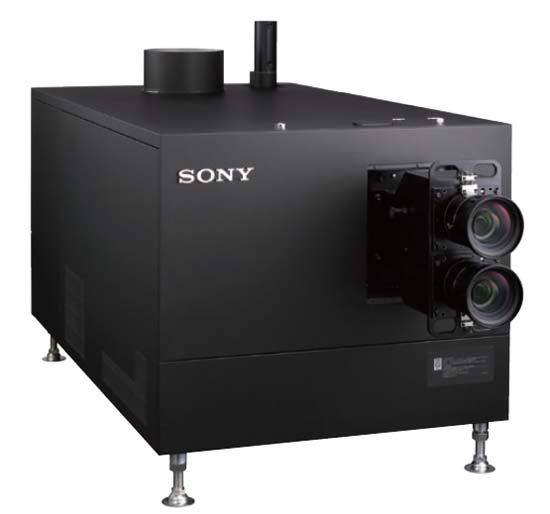
As opposed to the normal Sony 2D appearance:
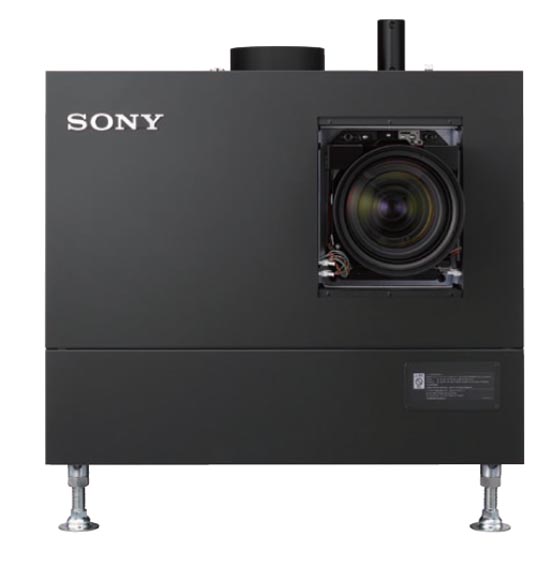
Can you now see why it is an issue to make the switch? They are big, heavy and expensive. So few people seemed to be able to get Anamorphic "Scope" lenses on film aligned properly...what are the odds that the average booth person of today is going to get these bad-boys swapped out perfectly?
-Steve
Posted by Monte L Fullmer (Member # 2797) on 05-30-2011, 02:56 PM:
I know, I've seen Techs do this lens changeout/alignment with the Sonys and it's a feat and a half to do this task.
For an average booth individual, it would be an overwhelming experience to do this task whereas experienced and trained individuals could prob change/align these units out in their sleep.
Thus, when a booth has a twin lens Sony installed, it prob stays there for good.
Yet, I've seen 2D presentations shot through a twin lens Sony unit and, to me, the picture looks real good (course, having a silver screen prob helps on the matter as well..), thus I can't see what the whoop is all about of needing to switch out lenses on these Sonys per format.
Be kinda hard for bookings to solely book 3D only content in these Sony twin lens houses if presentation is really the issue here in which the public prob don't know the difference anyway.
-Monte
Posted by Ken Lackner (Member # 1002) on 05-30-2011, 03:26 PM:
quote: Monte L Fullmer
Yet, I've seen 2D presentations shot through a twin lens Sony unit and, to me, the picture looks real good (course, having a silver screen prob helps on the matter as well..), thus I can't see what the whoop is all about of needing to switch out lenses on these Sonys per format.
Thank. You. My point, exactly.
Posted by Monte L Fullmer (Member # 2797) on 05-30-2011, 03:48 PM:
Okey, time to quit playing "dumb" ..
We all know that 2k chips resolution runs at 2048x1080 (wow, "HD" quality)
2k flat uses most of the chip with a resolution of 1998x1080 to keep within the "HD" standard.
but...when we head to "scope", things suddenly changes:
Scope (2.39:1) doesn't use all of the height of the chip but only 858 pixels high while using the full width of 2048, thus the HD standard isn't accomplished (course, this is a standard image in the chip, not compressed to use the adapters on front of the lens..)
..and why the triple flash when doing 3D: to send out both images from that one same chip.
Okey, we head to Sony's LCoS setup. Now, we are playing in 4k mode.
Flat (1.85:1) from the Sony single lens uses 3996x2160 if the file is a 4k file, otherwise it uses the same 1998x1080 - both are well into the HD standards.
Scope (this is where Sony wins) is at 4096 -the full width of their chip, but goes over the HD standard with a 1714 pixel height.
Now, to the twin lens: Since the chip is large enough to handle two, 2k resolutions stacked above one another, each lens has its own image to fire through its assigned lens. Thus with 3D, there is no triple flash, but an assigned image per each lens. With this, it's like going back to the old "over/under" of film 3D and to the current Tech3D over/under process, but just done digitally.
Someone ought to cut and paste this and return it to those writers ... 2D looks fine firing through a twin lens setup cuz each lens has it's own image to project.
"Whew"...gotta get back to work .... -Monte
Posted by Steve Guttag (Member # 268) on 05-30-2011, 03:50 PM:
Ken/Monte...care to tour around and really check to the 2D performance on the XL-S lens? That is run some resolution targets/cross-hatch and see just how unscathed the 2D image becomes. Then measure the light of the typical 2D show through them...see if the light really is up to the proper 2D version. To say it looks pretty impressive from the booth vantage point isn't really a fine gauge. I can say from the theatre vantage point, I've seen them look horrible.
-Steve
Posted by Monte L Fullmer (Member # 2797) on 05-30-2011, 04:26 PM:
Oh can agree fully, Steve.
Prob why Sony first shot out of the gate with 4k, so the picture (single lens) can look better when seated more closer to the screen than with 2k where it looks the best about mid-house using the twin lens - as with the rest of the other 2k units out there.
True, you get close to the screen on a 2k movie and it's not the best to witness. Film can look better than digital at this range.
Posted by Dominic Espinosa (Member # 2122) on 05-30-2011, 04:57 PM:
Monte is totally correct.
I'm personally offended by all the technical inaccuracies in the article and will be posting my response to it soon, with pictures as well once I've taken readings with the light meter.
The biggest point I can think to make is that with the Sony projector the lens change takes my operators about 10 minutes including alignment and resetting the security.
And for everyone who complains they don't have access, all you need is the super login. Ask your FSE for the password. It's not top-secret and they're not going to think twice about giving it to you. You SHOULD know it.
I'll be along in a couple of days with details and pictures of my own to demonstrate the nearly imperceptable difference between 3D lens with light fitlers, without, and 2D lens on the R220...
Posted by Monte L Fullmer (Member # 2797) on 05-30-2011, 06:06 PM:
(...lol...now you know why 5/70mm presentations is still the talk of the town - it look pretty on the screen no matter where you sat..)
Sadly though, some locations were not given the option of doing the lens change on their R220/R320 units. Thus it was just easier to do the twin lens install than the single lens install.
It all goes back to the K.I.S.S. booths (can you imagine seeing a tween kid handle a Sony single lens changeover from the twin lens setup? Give him a quarter when he drops the thing or fubars up on the alignments/super settings....) so minimal can go wrong.
Posted by Dominic Espinosa (Member # 2122) on 05-31-2011, 02:00 AM:
Hence why Regals policy is keep the 3D lens on and simply move the light filters.
Our policy is leave them on as well. We only swap them around because we have a back-ordered 3D lens for a screen that's upgrading.
I for one cannot perceive a difference.
When the lens is installed correctly and the installation is done correctly, the 3D lens does not need re-adjustment. The convergence stays perfect as does focus and alignment.
The only conceivable reason from a practical standpoint for bothering is that you aren't showing true 4K when you happen to have a 4K DCP on your hands.
HOWEVER the audience doesn't notice that difference anyhow because it looks good either way.
Posted by Dominic Espinosa (Member # 2122) on 06-06-2011, 12:21 AM:
Counting the days till my light meter arrives...
IN the mean time, we're getting the first wave of complaints from "educated" customers. Some delightfully following Eberts advice and asking for refunds.
My favorite was one for Cave of Forgotten Dreams this week. They felt it was far too dim and MUST be because the lazy projectionist didn't take the 3D lens off.
Well, it's in a 35mm house with a month old 3K lamp on a screen that's almost too small. In fact it is overlit. Maybe it's because it was shot with consumer-grade equipment IN A FRIGGIN CAVE!!??
Posted by Monte L Fullmer (Member # 2797) on 06-06-2011, 12:29 AM:
..and what's funny is that thing hanging on the front end of the twin lens SONY is just the polarizers ... and they are clear in themselves..
I'm waiting for REG and others to make a one-sheet that explains the true facts on all of this and get the story straight that one has to write up about without knowing the facts!
Brother, what an eccentric problem that Ebert created...
Posted by Kevin Fairchild (Member # 4985) on 06-06-2011, 01:02 AM:
Here is a screenshot from Sony's website.
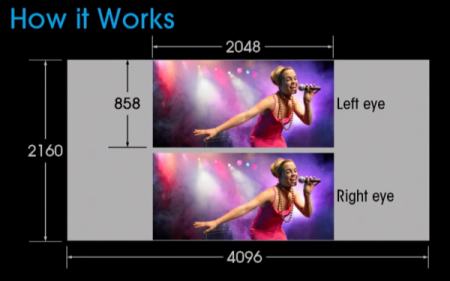
Even if the polarizers are removed, you are still only using half of the possible light on 2D movies.
Posted by Steve Guttag (Member # 268) on 06-06-2011, 06:08 AM:
And what if it is a Flat movie? 1587 x 858? Yeah, no quality difference there either (instead of 1998 x 1080). Or, are they so good they can withstand a zero space between pixels on aligning the two flat images (each 1080 tall) and how does one reconverge the pictures between Scope and Flat? I hear that the Sony lenses are not motorized. I don't have first hand knowledge setting them up but I do have first hand knowledge seeing the results in a "typical" theatre.
And since all Sony 3Ds are on a silver screen, if you set your light to 14fL in the middle for 2D it will STILL be too dim, unless your screen is curved (a bit). because of the distribution. The 14fL only applies when your distribution has the sides/corners at 85% of the center...which isn't going to happen on a flat silver screen.
So, for a flat movie on a Sony with the 3D lens in place, you have a scaled (down) image with less resolution, and under-lit. If alignment is off in the two images converging EXACTLY, then resolution drops further. It is an indefensible position. You are short-changing the customer by delivering an inferior image and it is NOT DCI compliant.
-Steve
Posted by Monte L Fullmer (Member # 2797) on 06-06-2011, 03:54 PM:
Now, here's the interesting thing: Sony, when using 2K information, has a scaler inside that scales up the content to fit their 4K chip in single lens, 2D mode.
But still, training a booth personnel on how to do a lens change on a Sony could add up to problems that isn't needed in the first place - guess, you call it a tradeoff of sorts.
Posted by Jake Spell (Member # 5294) on 06-06-2011, 04:18 PM:
Alright, I finally got to see a movie on the glorious SONY 4k projector. It was the latest X-Men movie, 2D movie with the 3D lens and polarizers in place.
The preshow crap looked very dim and washed out on the silver screen with the house lights up, previews weren't much better. Once the actual movie started it was bright enough, in the center, but dim around the edges. I also noticed the splothchyness of the silver screen and the BAD hot spot(no curve). It seem to be properly aligned since the picture was nice and sharp. Overall I was not impressed and find it obvious why people dont go see movies in theaters anymore.
Posted by Monte L Fullmer (Member # 2797) on 06-06-2011, 05:20 PM:
..dim on the edges is prob due to the usage of the silver screen which is very directional with light - why it's best to sit high and center so most of the total reflection returns back.
And to add: would you know if this SONY had a recent bulb change? For when a high wattage digital bulb accrue some hours, they will begin to lose their color and brilliance quite easily - why of the mandated bulb changes prior to warranty.
We can definitely tell that large flat panel TV's have dominated entertainment viewing making it an unfair comparison to projected digital presentations.
Posted by Jake Spell (Member # 5294) on 06-06-2011, 05:27 PM:
It was completly the silver screen, thats why I hate silver screens. Splotchy and that great big hot spot. I was back 4/5 and almost dead center, maybe one or two seats off. Screen was about 20 ft wide, common height
Posted by Monte L Fullmer (Member # 2797) on 06-06-2011, 05:42 PM:
..another problem that can add to this equation is that of the bulb alignment itself being of the X,Y and Z settings - in which you have to do twice to get the highest meter reading value of light output per each setting.
It's not like doing the "looney tunes" rings and getting rid of the cathode "blisters" on the screen for the coarse focus, then doing the fine focus with lens in place on 35mm units to get the even field of light.
And if any of these factors aren't set correctly with digital, it can look horrible, esp with doing 3D.
And this could be some possible issues with all of this with either weak training, or "get it done quick and don't care how it looks" training - making this a whole new set of presentation problems in store.
-...sorry on the rant. - Monte
Posted by Monte L Fullmer (Member # 2797) on 06-09-2011, 11:06 PM:
...and now this - someone now is picking on AMC:
Linky-linky
quote:
June 8, 2011
Mr. Gerardo “Gerry” I. Lopez, CEO and President AMC Entertainment, Inc.,
106 West 14th Street, Kansas City, Missouri 64105
Hello Gerry,
Would it upset you to discover someone sabotaging your theaters by representing them in a manner that isn’t in your best interest? I'm guessing yes.
If a major movie studio invests tens of millions of dollars and many months or years creating a product which ends up dark and/or out of focus on one of your screens, should the studio be upset? You bet.
The food chain starts at "action" and ends at the multiplex. If what the director wanted and got -- and shipped to the theater -- doesn't show up on the screen, it is either the fault of the exhibitor or a bumbling lab technician.
According to your company perspectives, “AMC Theatres has changed the way people watch movies by transforming the experience into an adventure.“ I was at one of your complexes the other morning and, sure as it‘s summer at the movies, the adventure continues.
My week kicked off in the back end of your Fashion Valley depot. Auditorium 15 is a small, mundanely efficient bunker where just two weeks earlier I witnessed a sparkling digital presentation of The Tree of Life. By now, it’s certain that someone has brought to your attention Ty Burr’s Boston Globe piece concerning illumination problems in AMC theatres resulting from a misuse of 3D lenses on Sony 4K projectors. While the "foot Lamberts" appeared to meet industry standards, Monday morning’s presentation was anything but brilliant.
As a former theatre manager, I know full well that it’s not the audience's job to spend precious movie-going time in search of an attendant to fix a focus problem. The second the white credits hit the black background, something appeared out of whack. I flagged a security guard who said he’d get right on it. Five minutes later, the same guard assured me the problem was reported.
Tick-tock, tick-tock…
Seven minutes in, I’m out of my seat and half out of my mind. I am an ineffectual theatre manager’s worst nightmare. Don’t expect me to be chipper when I am forced to leave my stadium seat for the third time and jaunt from the back end of a multiplex, up the temporarily out-of-service escalator to the main floor to find the manager on duty. Make that managers. There were two of them.
“It’s digital,” I’m told. “We can’t focus. It’s all internal.”
I was not sure about this until the following day when I was introduced to “George Kaplan“ (he asks that I not use his real name), a budding journalist and former projectionist who is well-versed in AMC booth procedure. All I know is this: once I was blind and now I can see. George was at Monday morning’s Fashion Valley fiasco and assured me that I was not alone in my disdain for the fuzzy presentation.
George set me straight: Once a Sony 4K projector is calibrated, there is no way to adjust the focus. He pointed me in the direction of the Alamo Drafthouse blog: “When the (3D) image leaves the lens of the projector, it passes through a polarizing filter in front of the lens.” The projectionist failed to remove the polarizing filters from in front of the lens for 2D screenings, thus accounting for the focus problem.
Here is something even more troubling. The auditorium in question also showed the new 2D X-Men sequel all weekend to the paying public. The focus issue remained the same, yet nobody complained until I barked at them Monday morning!
In 2007, your revenue totaled $2.5 billion with a net income of $134 million. I know you train your staff on the art of popping corn and filling soft drink cups with glaciers. Why not spend a few dollars training them in the art of visual presentation? If only you could fill our eyes in the same gratifying manner that you do our bellies.
They're turning up the heat on you, Gerry. Even Terrence Malick's private letter, instructing projectionists on the proper manner in which to present The Tree of Life, went public. Aren't you tired of hearing people say, "The picture looks better in my living room?" Do you want to see an end to film-going as we know it? Few people are in a position of power to make a change. Step up to the plate and prove your mettle.
I left several messages with your PR underlings, but to no avail. Until you have the problems straightened out, I suggest that you alert your managers to only book press screenings in 2D houses and remove all filters before each screening. It sounds like you could use someone to travel from theatre to theatre to investigate and weed out projection problems. I'll check my availability.
Drive safely,
Have to head to the Alamo Drafthouse link for some more interesting reading..and I'll post that link below:
Another linky-linky
quote:
Agreeing and Disagreeing with Roger Ebert on Dim Projection
Posted on May 27, 2011 by Tim League in General News, Main, National
.
There has been a great deal of chatter this week about Sony 4K projectors, dim bulbs and "lazy" projection. I like the dialogue that it is sparking and I wanted to weigh in on the matter, particularly since Alamo Drafthouse Lamar and Village have standardized on the Sony 4K projectors in question.
The debate reminds me of a time back in the analog days when it became known that some theaters were swapping out expensive and fast-burning jumbo bulbs for smaller, dimmer bulbs in some of their big houses to save money. See that article here. We stayed ahead of the curve then, and we are trying to do so now.
First, a little background...
a few days ago this article on the Boston Globe blog came out about dim 2D digital projection:
Then Ebert piled on with his blog post, The Dying of the Light:
Their general concern is correct. A theater should NEVER be underlit. There are industry standards for acceptable light levels for both 3D and 2D presentations. Cinemas should always operate within this range. Alamo owns a light meter and we check light levels on all of our screens monthly at a minimum, sometimes as much as weekly. It is a very easy tool to operate, all cinemas should own one, despite the reasonably high price.
At the Alamo, light levels are manually boosted for 3D screenings. Increasing amperage to boost the light level on the Sony projectors is a relatively easy adjustment. The bulb needs to be burning hotter to produce a brighter 3D image. When the image leaves the lens of the projector, it passes through a polarizing filter in front of the lens. You are also wearing what are ostensibly sunglasses in the theater, so in order for an image to be appropriately bright after passing through the filters and your glasses, the intensity of the light needs to be much higher for 3D films. Alamo projectionists make this adjustment for every 3D show.
Now, on to the Sony projectors...
Sony RealD is the best 3D technology available to cinemas today
There is no debate on this topic; Sony is the clear and undisputed champion of 3D presentation. Sony upgraded the technology in their digital projectors to introduce a new dual lens system for 3D. All other digital projectors use a single lens system that alternates between the image for the right eye and the left eye very rapidly. This can cause a perceived flicker. Sony projects two continuous images one in each of the lenses (both Ebert and the Boston Globe got this wrong in their articles, btw). When the lamphouse is adjusted correctly, Sony delivers the brightest, crispest, best 3D image in the industry. That is the reason why we went with Sony in the first place.
Sony paved the way for 4K digital
Sony was the first to introduce a 4K digital projector. The industry standardized on a 2K image and that is the technology that has been rolled out in most cinemas. I personally flew to LA to do a side-by-side comparison of 2K vs. 4K and the decision was clear. We went with the Sony 4k projectors. In the last few months, other brands are now coming online with their 4k projectors, but it was Sony that led the charge and their product remains exceptional.
Sony has a serious design issue with their lenses
It is VERY difficult to swap out a 3D and a 2D lens. I HATE this design and so does every other Sony theater operator, I am sure. It is a known issue and Sony has told us that they are working on a solution. Perhaps with all the hubbub this week, that solution will come sooner rather than later. It takes about 1.5 hours or more to swap lenses and do the necessary calibration. Currently there are only two people at the Alamo that are technically capable of doing it and it is far too risky to attempt this between shows when the clock is ticking.
Alamo policy for swapping lenses
If we know we are showing 2D ONLY on a given screen, Alamo projectionists will swap out the 3D dual lens for the 2D lens. We are one of the only theaters in the country that routinely does this swap.
If we are running a complex schedule with 2D and 3D on the same screen on the same day, however, we DO leave in the dual 3D lens for the 2D presentations. However, we DO remove the polarizing filters from in front of the lenses for 2D screenings. The polarizing filters are what drastically reduce the light. You can have great 2D presentation with the 3D Sony lens PROVIDED YOU REMOVE THE POLARIZING FILTERS. The problem of low light levels referenced in the articles above point to the 3D lens as being the culprit. That is not the case. The problem is the filters and you can rest assured that these are removed any time we are showing a 2D film with a 3D lens.
I am a stickler for presentation and want to make sure that every screening at the Alamo lives up to my high standards. Bulbs are expensive, and it is very tempting to run bulbs well past recommended bulb life or to not run them as hot as you can in order to extend their life. From January to April, we spent $23,000 on bulbs for Lamar alone. We will not skimp on bulb size or bulb life at the Alamo.
Regardless of what technology you have: film or digital, Sony or Christie or Barco, there are very basic inspections and routine maintenance procedures that need to be done to ensure proper presentation. We do all of these at the Alamo Drafthouse in Austin.
1) Have a light meter and train your projectionists how to use it. Run monthly light level reports on all screens.
2) Oversize your bulbs so you can bump the amperage to get light levels into spec for 3D
3) If you are using the Sony 4k digital projectors, train your staff on how to remove polarizing filters and always remove them from 2D screenings.
4) This is not light related, but we run a regular inspection on all discrete audio channels. We like the sound in the cinema loud and sometimes that blows speakers. Routine inspections can identify blown speakers.
You may look back at the projection port glass window at the Alamo during a 2D screening and see two lights coming out of the booth. This DOES NOT mean that we are running below spec light levels or somehow being lazy about our projection. We will let the picture on screen speak for itself. That said, if anyone ever has a bad presentation experience at the Alamo, I want to know about it. Send me a note on Facebook or send me an email to tim.league@drafthouse.com. One-time mistakes can always happen, but I will always continue to strive for the best possible presentation, and right now I believe that to be with the Sony 4K projection system..
-Monte
Posted by Mike Blakesley (Member # 26) on 06-10-2011, 01:05 AM:
This kind of stuff drives me nuts. Don't the owners of these megaplexes think people care when things don't look right?
Cripes. I don't think video is going to ruin the theater business -- megaplexes are.
Posted by Pravin Ratnam (Member # 1417) on 06-10-2011, 01:17 AM:
I was going to see Hangover 2 and called the two Regal Multiplexes near me. I first called Regal Perimeter Pointe. The lady had no clue what I was talking about(very understandable) and was kind enough to refer me to someone who knew. This guy said that they did have SONY 3D projectors in Auditorium 8, but he was unaware of any polarizing filters. He said corporate gave them two sets of internal settings templates. one for 3D and one for 2D, and they did not make any kind of external adjustments such as removing filters or changing lenses. Not the comforting answer I was looking for, but at least he was honest. I do not know which model of SONY they use.
Auditorium 8 is their biggest screen. So I didnt want to take that chance.
I then called Regal Hollywood 24. The lady was very indifferent. She neither was going to refer me to someone who knew better nor suggest I call back when they were not as busy. She pretty much said she didnt know what projector they used for the digital showing(the analog ones were in the much smaller houses) and when I asked if I could talk to someone who knew, she said "not really, no one here would know that."
Fuck you, Regal.
Posted by Monte L Fullmer (Member # 2797) on 06-10-2011, 02:33 AM:
"Lol!"..The guy was talking about the templates for building a playlist, and the way he was talking, it was a single lens unit if he didn't know of any "polarizing filters".
Sony uses a template command (there are 6 templates - 2D for both lenses in single lens setup, 2D in 3D mode for both lenses and the two 3D for both lenses in twin lens setup) to assign the projector on how the playlist is to be presented ... it's like a layout where you put items in then save it.
Posted by Louis Bornwasser (Member # 3063) on 06-10-2011, 09:29 AM:
"We has met the enemy. . and he is us!"....Pogo
Louis
Posted by Mark Gulbrandsen (Member # 72) on 06-10-2011, 10:02 AM:
quote: Monte L Fullmer
it's like a layout where you put items in then save it.
The rest of the world refers to that as a "macro"... Even the lighting industry uses that term.
We can all only pray that this is the death knell for Sony D-Cinema. It all belongs in the dumpster right next to all the SDDS processors.
Monte... The guy at tha Alamo Draft House made one fatal mistake... and that was not to wait the extra year for 4K DLP.
Posted by Chris Slycord (Member # 4239) on 06-10-2011, 10:54 AM:
quote: Monte L Fullmer
it was a single lens unit if he didn't know of any "polarizing filters".
You're assuming he'd know what a polarizing filter was if he saw it. Remember, he was just talking to a random person in the complex and not necessarily someone who knew what goes into the projection stuff.
Posted by Monte L Fullmer (Member # 2797) on 06-10-2011, 11:09 AM:
quote: Louis Bornwasser
"We has met the enemy. . and he is us!"....Pogo
Kinda proves a point that things are perfect, yet the people aren't. -lol
quote: Mark Gulbrandsen
and that was not to wait the extra year for 4K DLP.
Think a lot of big box cinemas who went SONY, now wishes that same thing - they should have waited.
-Monte
Posted by Darryl Spicer (Member # 711) on 06-10-2011, 01:10 PM:
quote: Mark Gulbrandsen
The guy at tha Alamo Draft House made one fatal mistake... and that was not to wait the extra year for 4K DLP.
Agreed
We did the smart move by agreeing to use DLP projectors for the conversion. We have 11 4k's and 5 2k's in opperation now with the 5 2k's eventually changing to 4k's. I love the 4k's they are very bright and have to me a smoother image than the 2k's.
Posted by Steve Guttag (Member # 268) on 06-12-2011, 01:07 PM:
I've been doing a little bit of research on this whole light thing and 3D...silver screens, white screens, curved and flat.
What I have found is that if you want to get a FLAT silver screen to have the same nominal brightness as a matte white screen running a center brightness of 14fL, the same screen in Silver will require a Center brightness of about 22fL. The corners on that silver screen will still be pathetic and way below DCI spec of 85% of center BUT the average brightness of the white and silver screen will be the same/similar.
If you CURVE the silver screen with the Schneider "1/20" rule, that center brightness may be lowered due to a slightly better directing of the light...20.7fL seems to be average, thus far.
Now, if the silver screen takes on a more radical curve, say closer to R=2/3rds the throw (something close to an optimized curve for a 1.5-1.8 gain providing the lens also is curve-field), then the light requirement drops considerably...17fL in the center will have an average light similar to a white screen (pearl) curved similarly. DCinema lenses are not curve field corrected, by and large, at the moment. So, one can curve the screen a little less radically and still get a substantial improvement. Since the lenses are for flat-field, the image, on a shorter radius will be smaller at the edges than the center (barrel distortion). This will have an effect of increasing the brightness progressively towards the sides to counteract the effects of the higher gain screen. In fact, I measure the light on the sides to be within .5fL of the center and the light a little further in from the sides to be slightly above center.
Now for 3D things are similar but scaled down to the pathetic 3D levels. At the moment, the target light is 5.0fL (normally a range of 3.5-5.5 or 4.5-5.5 is given with the various movies). Again, this figure does not take into account the Silver screen since a white screen may be used for non Real-D/Masterimage 3D shows.
To get a FLAT silver screen to look like a white screen at 5.0fL, one should have the center light reading about 7.7fL. Again, curving the screen will reduce this requirement a bit. It is more like 7.4 for a 1/20 curve and 6.2 for a deeper curve (R about 2/3 Throw).
-Steve
Posted by Mark Gulbrandsen (Member # 72) on 06-12-2011, 03:00 PM:
I have found more or less the same as I recently had a couple of flat silver screens to deal with. One thing not to forget is that curving the screen more than the Schneider recomended amount will simply result in even more loss of pixels particularly at the bottom of the image with even a slight down tilt of the projector. That can result in quite a difference in light level and loss of resolution particularly in scope format from the excessive masking of pixels you will have to do to accomodate the bottom curve. In many cases the top is a straight across or near straight shot across and minmimal loss occurs there. So for digital deeply curved screens are taboo unless perhaps you can have zero down tilt at all.
Mark
Posted by Steve Guttag (Member # 268) on 06-12-2011, 06:30 PM:
While it is true that one does crop off more pixels on shorter radii, I have not found the cropping to exceed DCI/SMPTE specs. That is, you should not have issues with subtitles/text being in danger.
Below is a picture I took of such a screen that has a shorter radius:
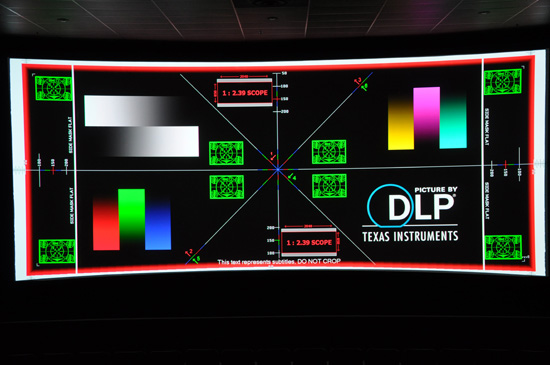
The screen is just shy of 40-feet wide and chord depth is just shy of 4-feet deep. The curve was designed years ago by me to optimize on a pearl screen using suitable lenses that would pincushion the image. The results were less light needed and relatively uniform illumination.
Now, as a silver screen, I was pleasantly surprised that the depth of focus of the Fujinon lens/DLP was good enough to resolve the pixels clearly, even o the sides (Boresight/Scheimpflug as to be spot-on). The worst aspect is the Real-D XL which is impossible to get perfect at all points on the screen. You can get most of it but not all.
As for deeper curve screens being "Taboo" most things, like Anamorphics, are "taboo" due to the stupidity of those designing projection systems in theatres rather than anything inherently wrong.
-Steve
Powered by Infopop Corporation
UBB.classicTM
6.3.1.2