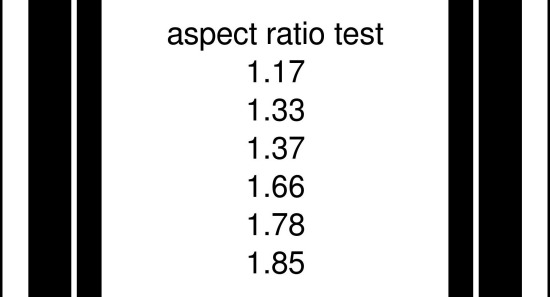
Here is some updated information, Scott.
The Commission Supérieure Technique de l’Image et du Son / CST and the Fédération Nationale des Cinémas Français / FNCF published this document on May 5th, 2011:
Technical Guide for the Projection Booth in Digital Cinema
On Page 21 they quote the following values (2K and 4K) for these ratios:
1.33 ........ 1440 x 1080 ......... 2872 x 2160
1.37 ........ 1480 x 1080 ......... 2959 x 2160
1.66 ........ 1792 x 1080 ......... 3585 x 2160
1.78 ........ 1920 x 1080 ......... 3844 x 2160
Perhaps this could presently be treated as a "Standard" in the (to be confirmed) absence of any other relevant Standards documentation (e.g. SMPTE, ISO).
BTW, the website of the European Digital Cinema Forum / EDCF from which the CST / FNCF publication is sourced, contains several other very useful publications (usual disclaimer).
The Numerical SMPTE Standards List gives a range of recent D-Cinema Standards (ST 428-1 thru ST 433; not including related documents), but it is difficult to tell which ones might contain Aspect Ratio information (ST 428-1:2006 D-Cinema Distribution Master – Image Characteristics looks most promising), and more to the point, any values for the narrower ratios.
Unfortunately these are somewhat costly for the average user to obtain.
Posted by Scott Norwood (Member # 30) on 09-26-2011, 06:46 PM:
Many thanks, Brian!
So, how does this chart look?
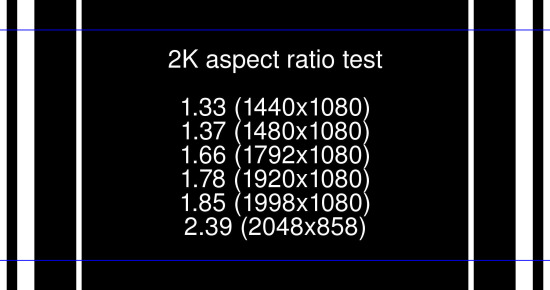
If anyone is interested, I'll supply a full-res and/or DCP version.
This was created with the Imagemagick tools and should be simple enough for anyone to modify at will. Here were the commands used to create it:
convert -background black -fill white -font Helvetica -gravity center -size 800 label:'2K aspect ratio test\n\n1.33 (1440x1080)\n1.37 (1480x1080)\n1.66 (1792x1080)\n1.78 (1920x1080)\n1.85 (1998x1080)\n2.39 (2048x858)' -extent 1260x1080 artest.jpg
mogrify -background black -gravity center -extent 1440x1080 artest.jpg
mogrify -background white -gravity center -extent 1480x1080 artest.jpg
mogrify -background black -gravity center -extent 1792x1080 artest.jpg
mogrify -background white -gravity center -extent 1920x1080 artest.jpg
mogrify -background black -gravity center -extent 1998x1080 artest.jpg
mogrify -background white -gravity center -extent 2048x1080 artest.jpg
mogrify -fill white -stroke blue -strokewidth 3 -draw "line 0,111 2048,111" artest.jpg
mogrify -fill white -stroke blue -strokewidth 3 -draw "line 0,969 2048,969" artest.jpg
Posted by Steve Guttag (Member # 268) on 09-27-2011, 06:14 AM:
Get arrows pointing to the actual line one is trying to hit so you know how close to the "cliff" you are.
Color coordinate said arrows too.
Posted by Scott Norwood (Member # 30) on 09-27-2011, 10:51 AM:
Good idea on the arrows. How does this look?
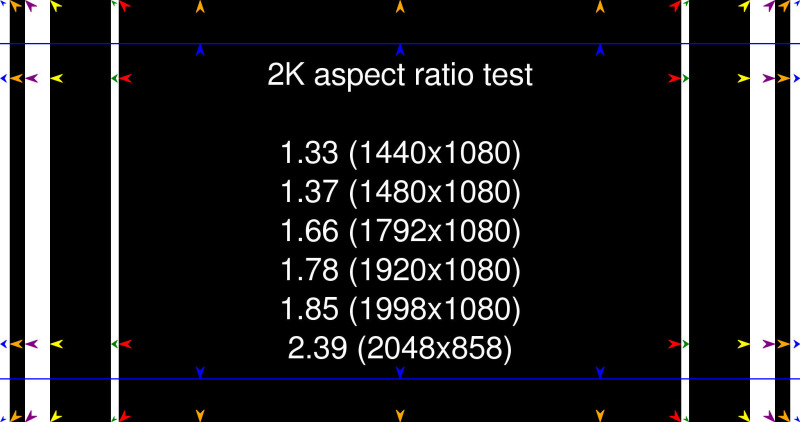
Any other suggestions?
Posted by Brian Guckian (Member # 1678) on 09-27-2011, 11:24 AM:
Great work!
How about colouring the number values on the chart to match the colours of the arrows for easy visual reference?
So - "1.33 (1440 x 1080)" in red, "1.37 (1480 x 1080)" in green, "1.66 (1792 x 1080)" in yellow, and so on.
Numerals that do not stand out well on a black background (blue for example) could be edged in white perhaps.
All you need now is the F-T logo! ![[Wink]](wink.gif)
Posted by Scott Norwood (Member # 30) on 09-27-2011, 12:47 PM:
Like this?
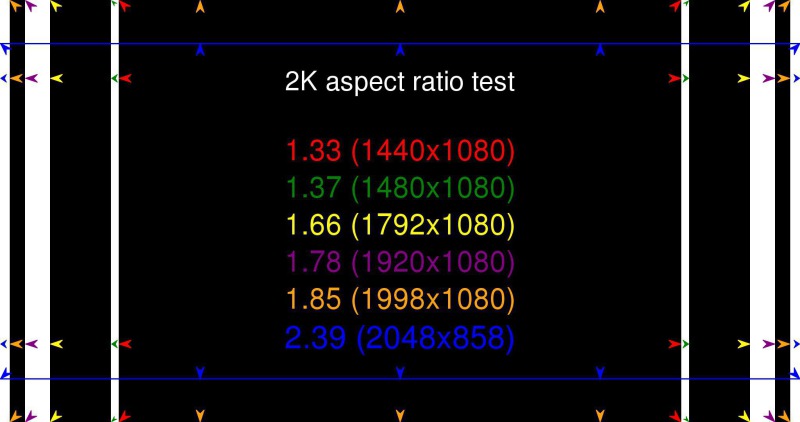
I tried outlining the blue text with white, but it looks odd when compared to the other colors, If it's not sufficiently visible, that could be added.
Edit: fixed position of corners for scope image.
Posted by Brian Guckian (Member # 1678) on 09-27-2011, 02:53 PM:
Yes, IMO that works really well, Scott, and noted the fix to the corner arrows for the 'Scope ratio.
It's probably the purple 1.78 ratio numerals that may look a little dark, but of course how the test pattern appears on a computer monitor will be significantly different to how it appears on a cinema screen.
Some field tests of course will iron out any issues that may not be apparent here.
Great work again!
Posted by Scott Norwood (Member # 30) on 09-27-2011, 06:23 PM:
Here is the DCP. (edit: don't use this one; use the new and improved version below; original version is gone)
File is just under 350MB, so it will take most people a while to download it. It should fit easily on a CD or USB flash drive. It will need to be unzipped and the files will need to be in the root directory of whatever removable media are being used to transfer it to a server.
I have not actually tested this, but the same methods used to create it have created DCPs that work fine on a Dolby server (which is the only one that I have access to). If anyone does test this, please post here and let me know if there are any issues.
Due to large DCP file sizes, it only shows the chart for about eight seconds; presumably, most people will want to freeze-frame it to do whatever needs to be done in the way of masking, etc.
Does anyone want a 4K version? It should be fairly trivial to throw that together if there is any demand.
As always, many thanks to those who offered help and suggestions for this.
[ 10-06-2011, 11:53 AM: Message edited by: Scott Norwood ]
Posted by Paul H. Rayton (Member # 1817) on 10-04-2011, 08:23 PM:
Hi, Scott -- Downloaded it, and successfully ingested it into my "antique" Quvis Cinema Player. And it plays OK!
Many thanks for this -- I'm not sure exactly when we'll need to use it, but as a venue that plays lots of older movies, both on film and digitally, I'm sure it will come in handy.
FWIW, I regard the Quvis as a really good test of the architecture of any DCP. If things are not formatted **exactly** right, it won't see it and won't load it. This worked perfectly. So, to expropriate one famous line from West Side Story, "Ya done good!".
Posted by Scott Norwood (Member # 30) on 10-05-2011, 10:27 AM:
Thanks, Paul.
It turns out that the arrows and text were not as clear as they should have been in the first version.
Revised DCP is here
The size is now down to about 200MB.
Let me know if there are any other comments or suggestions. If not, we'll call this the final version and I will ask Brad to add it to the downloads page.
edit: I have tested this on the Dolby server. It works.
[ 10-06-2011, 11:53 AM: Message edited by: Scott Norwood ]
Posted by Scott Jentsch (Member # 1681) on 10-06-2011, 09:53 AM:
If the blue is too low of a contrast, you may want to try a cyan (RGB: 0, 204, 255). Against black, that's going to be much more readable than pure blue.
Would it help to place a perfect circle in the center to make it easy to judge the aspect ratio visually as well?
Posted by System Notices (Member # 2357) on 10-10-2012, 02:11 PM:
It has been 370 days since the last post.
Posted by Richard May (Member # 2627) on 10-10-2012, 02:11 PM:
Great job Scott. Just what we were looking for. One more thing though regarding ratios. We have been getting a lot of 1.89 (2048X1080) movies in. Why is this ratio special? It sucks because our trailers are all 1.85 and you get the few people that bitch about the TINY bit of black on either side.
Posted by Jock Blakley (Member # 6552) on 10-10-2012, 05:13 PM:
1.89:1 (or 1.90:1 depending on how you chose to round 1.896...) is the "Full Container" ratio, which has appeared for no reason other than that it uses the full resolution of the projector imager.
Are you sure the movies are actually 1.90:1 though? While I often see DCPs with 2048x1080 frame sizes listed, they're actually just 1996x1080 files that have been pillarboxed.
I suspect that this comes from DCP-creation software that refuses to accept that the DCI standards only need one side of the image to meet a specified resolution.
Posted by Richard May (Member # 2627) on 10-10-2012, 05:19 PM:
You're probably right. They may have come up as 2048, but actually cropped to 1998.
Posted by Jock Blakley (Member # 6552) on 10-11-2012, 02:03 AM:
I'd suggest that black has been added to the side of the image rather than that the image has been cropped.
Posted by Monte L Fullmer (Member # 2797) on 10-11-2012, 03:32 AM:
Just zoom up the image to fit the side maskings....if you got people that anal on presentations.....