This is topic vaguely threatening letter from 20th Century Fox in forum Digital Cinema Forum at Film-Tech Forum ARCHIVE.
To visit this topic, use this URL:
https://ft-forum.com/ft/cgi-bin/ubb/ultimatebb.cgi?ubb=get_topic;f=16;t=000949
Posted by Scott Norwood (Member # 30) on 11-10-2011, 02:02 PM:
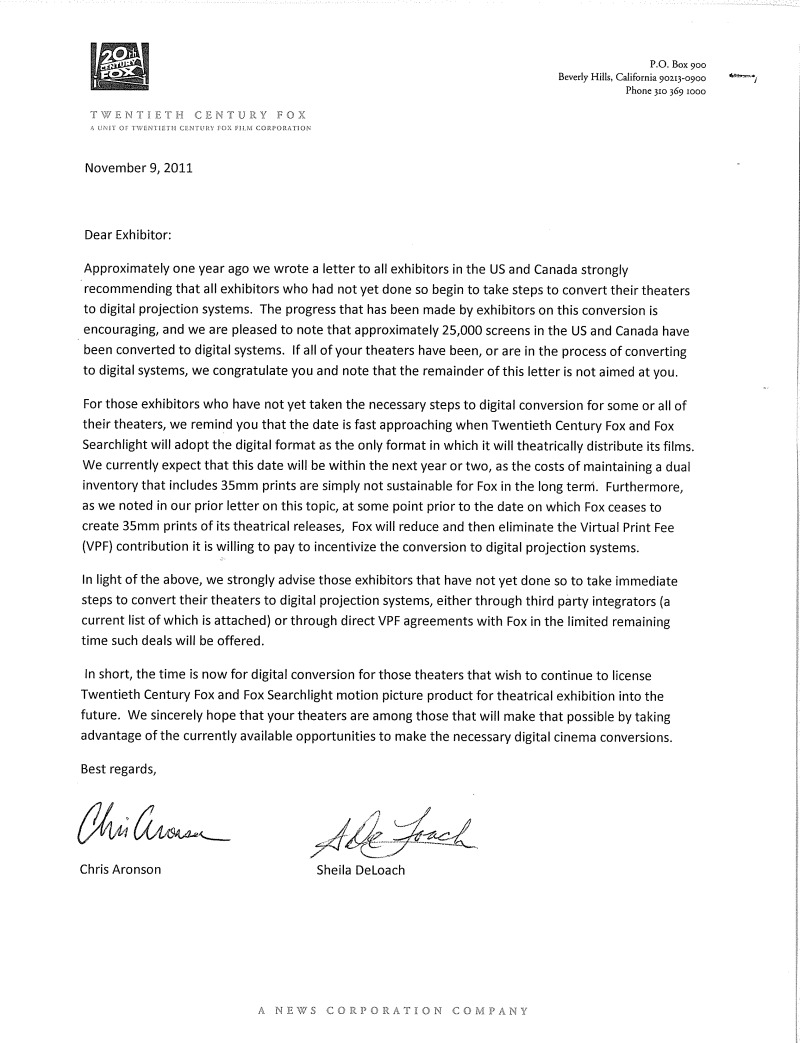
From yesterday. Apparently real.
I am tempted to call them and ask if this applies to older titles as well or just new releases.
I wonder when they will change their name to "20th Century Fox Video Corporation."
If you want to write to this guy and tell him how you feel, his address is
CHRIS ARONSON
Twentieth Century Fox
10201 West Pico Blvd.,
Bldg. 86, Room 112
Los Angeles, CA 90035
Posted by Louis Bornwasser (Member # 3063) on 11-10-2011, 02:06 PM:
Key word: "Reduce." Louis
Posted by Martin McCaffery (Member # 37) on 11-10-2011, 02:06 PM:
I had the same question. As I was informed Fox's old titles are handled by Criterion, but I don't know how far back and there are plenty of titles they don't have in 35mm. And, of course, the deal is not in perpetuity.
Oh, and that it is not sustainable in the long term for Fox to maintain duel inventories, but perfectly sustainable for exhibitors to take the hit on the installation and maintenance of digital cinema.
Posted by Justin Hamaker (Member # 2165) on 11-10-2011, 04:49 PM:
quote: Martin McCaffery
but perfectly sustainable for exhibitors to take the hit on the installation and maintenance of digital cinema.
Capitalism at work. There is absolutely nothing that says the studios have an obligation to provide any particular format for any particular amount of time. We are lucky that NATO and other the major studios were able to workout VPF deals. The studios could just have easily said we are on our own.
Yes, I know the relationship between studios and exhibitors is supposed to be symbiotic. They need us as much as we need them. But anyone who has been in exhibition for any period of time knows the studios do not do business that way. They view our screens as their entitlement and don't really care whether their terms are beneficial to our business.
Posted by Hillary Charles (Member # 769) on 11-10-2011, 04:59 PM:
Fox and their demands! We're still trying to pay off that "Miracle Mirror Screen" they forced us to buy!
Okay, it's been a while since I worked at that theater...
Posted by Mark Gulbrandsen (Member # 72) on 11-10-2011, 05:02 PM:
The date not mentioned in the letter is 1-1-13!
Posted by Louis Bornwasser (Member # 3063) on 11-10-2011, 06:55 PM:
Clearly, with VOD, they do not treasure us or our screens. Louis
Posted by Mark Campbell (Member # 4411) on 11-10-2011, 07:00 PM:
I guess I should start saying goodbye to my favorite independent neighborhood theatres.
Posted by Ian Parfrey (Member # 5122) on 11-10-2011, 09:13 PM:
Dear Chris Aronson and 20th Century Fox.
Kindly get fucked.
Yours
Independent Cinemas Worldwide.
Posted by Victor Liorentas (Member # 5272) on 11-10-2011, 09:21 PM:
![[Big Grin]](biggrin.gif)
Posted by Scott Norwood (Member # 30) on 11-11-2011, 08:25 AM:
I wrote to him. You should, too.
quote: Justin Hamaker
We are lucky that NATO and other the major studios were able to workout VPF deals. The studios could just have easily said we are on our own.
Not really. These deals pretty much universally suck, requiring the purchase of monitoring service and the signing of NDAs. And they won't help in 5-10 years when the current equipment needs to be upgraded. What really needed (needs) to happen is for there to be a dramatic shift in "film" rental terms.
quote: Mark Campbell
I guess I should start saying goodbye to my favorite independent neighborhood theatres.
If and when this happens, then, pretty much, yes.
Posted by Jock Blakley (Member # 6552) on 11-11-2011, 08:41 AM:
quote: Mark Campbell
I guess I should start saying goodbye to my favorite independent neighborhood theatres.
Well, maybe not all of them... if we can get twenty years out of this Barco.
Anybody got a truckload of Ushio DXL-65BAs going spare?
Posted by Carsten Kurz (Member # 5396) on 11-11-2011, 11:04 AM:
It may not be a statement we like - but at least they now MAKE official statements. Even if they are not accurate, this will create sort of a domino effect, other distributors will refer to this timeline as well, the word spreads, etc, so, slowly approaching that now fuzzy deadline, it will become more and more of a real deadline.
- Carsten
Posted by Scott Norwood (Member # 30) on 11-11-2011, 11:51 AM:
quote: Carsten Kurz
It may not be a statement we like - but at least they now MAKE official statements.
Agreed. I should have mentioned this earlier, but I do give them credit for being the first major US distributor to make a statement about this issue that can be taken somewhat seriously.
I still hate John Fithian for his "2013" deadline thing. He is not a film distributor and had no business stating a date, but he did it anyway. Now, it seems to have had some media traction and may become a self-fulfilling prophecy.
Posted by Justin Hamaker (Member # 2165) on 11-11-2011, 12:32 PM:
quote:
I still hate John Fithian for his "2013" deadline thing. He is not a film distributor and had no business stating a date,
You almost suggest that Fithian will be responsible for the death of film himself. The reality is the date has been sitting on the horizon for several years. Whether it's 2013 or 2015, it's still coming soon.
I image there are very few people who have a better understanding of the digital conversion status and time line than Fithian. His job is to represent theatre owners. I assume the 2013 date came from looking at the state of the industry and from information from the studios about when they would start to cut back on film.
My understanding is (some of) the studios have been saying for a while that they would start to ramp down 35mm once digital installs reached 50% of screens. The industry crossed that 50% mark a couple months ago and the pace is accelerating. Regardless of whether you like the deals, it is to the advantage of most theatres to get in on the VPF deals rather than to get shut out. And many owners had been dragging their feet until the last 6 months or so.
Furthermore, the issue is deeper than just the studios no longer distributing 35mm. We are also seeing the companies who support the 35mm industry fall: local couriers, equipment suppliers and distributors, and equipment manufacturers. The writing is on the wall, whether you choose to read it or not.
Posted by Mark J. Marshall (Member # 1409) on 11-11-2011, 01:47 PM:
quote:
...the costs of maintaining a dual inventory including 35mm prints is not sustainable...
I'm sorry. How does this make sense? How much money has been saved by sending HALF of your prints as 2 lb hard drives instead of 45 lb prints all over the country? How many Fed Ex planes have been parked due to half of the prints not being shipped anymore? How much warehouse space isn't needed anymore? I'm sorry, but this statement just doesn't make any sense at all.
Posted by Carsten Kurz (Member # 5396) on 11-11-2011, 01:58 PM:
Lower print quantities means higher cost per print. Similar things with other aspects of 35mm distribution. At some point, 35mm distribution cost will be higher than the savings from digital. Especially since digital has not gotten to the point of optimal cost savings but is in an intermediate state.
- Carsten
Posted by Brian Guckian (Member # 1678) on 11-11-2011, 04:04 PM:
That may be true re. print cost v. quantity (although it would be good to have some reliable, up-to-the-minute data on print costs), but even if so, consider this in the context of the lower volumes being printed: 50,000 no. prints at $700 each will cost $ 35 million, but 20,000 no. prints at $1000 each will cost $ 20 million, which represents a 43% saving in print costs even though the price per print has increased by 43%.
A hypothetical example to be sure, but perhaps worth considering.
Posted by Mark Gulbrandsen (Member # 72) on 11-11-2011, 04:08 PM:
What Justin said. The rest of you are a bunch of cry babies. Now go protest with the 99%!!
Posted by Justin Hamaker (Member # 2165) on 11-11-2011, 04:14 PM:
Brian, that may well be true. However, it is very easy to track the gross to the specific print. And with most of the major theatres having converted to digital, the question becomes whether the remaining 35mm locations generate enough gross to pay for the print they use. They might for major tent poles, but for your average release, they might not (especially when you consider the studio only gets 50-60% of the gross).
If you're an accountant, how do you justify spending $1500 for a print that might only generate $3000 of gross (or a little over $1500 payment to studio)? While it may only be about 55-60% of screens that are digital at this point, I venture to say they account for something like 75-80% of the gross.
Posted by Brian Guckian (Member # 1678) on 11-11-2011, 05:08 PM:
Interesting point Justin, although I'm not sure if it invalidates my point about total overall savings, in the scenario I posited (which is obviously open to argument).
And is totally eliminating revenue from a residual 35mm market - even if reduced per screen due to higher print costs - really a sensible idea?
(BTW - is there any hard evidence that print costs have actually increased?)
Posted by Carsten Kurz (Member # 5396) on 11-11-2011, 05:15 PM:
It's probably based on the assumption that those cinemas that do not convert are probably those who can not afford it and get no VPF deals. These will also be considered the ones with the smallest revenue. Now at some point distributors need to decide wether they want to support some 50 or 100 screens with their complete 35mm distribution chain. I don't think it's 50.000 vs. 20.000
It's, of course also to put some pressure on those that are still hesitating to convert.
- Carsten
Posted by Sam D. Chavez (Member # 1841) on 11-11-2011, 06:00 PM:
There's another whole way to look at this. The studios always want to play every town and fight each other for the best screen in a zone. It does not mean they actually make real cash money on these small town screens. Part of the reason they play the small towns is is for the more or less free blanket advertising platform for that title and other upcoming titles.
When you look at it this way the print cost does not matter so much, if indeed it ever did.
So please let's not get into feeling sorry for the studio having to supply a 35mm print.
The letter is just a statement saying we are going to do this because we can.
Same as B of A saying we're raising this fee or that fee because we decided it would make us more money. Funny, the Wall Street protests, messy as they are, forced B of A to retreat.
What does that tell us?
Posted by Martin McCaffery (Member # 37) on 11-11-2011, 06:09 PM:
Seriously, what percentage of a $250million budget is the cost of prints? And who do they charge it to, anyway? Drop that to 250-500 prints, about that of a big indie release, and the print costs is probably equal to one week's lunch budget.
Hollywood bookkeeping is Hollywood bookkeeping. Never believe anything they are saying when it comes to money. As Justin said earlier, it is capitalism at work. There job is to make as much money as they can while spending as little as they can. They are doing it because they can.
Criticize them or don't, but there is no reason to feel sorry for them.
Posted by Melanie Loggins (Member # 6454) on 11-11-2011, 07:54 PM:
quote: Sam D. Chavez
Same as B of A saying we're raising this fee or that fee because we decided it would make us more money
Oh man. This is brilliant. I wish I had thought of it!
Attention customers: we're going to double all of our prices because we decided it would make us more money!
Yep. I think this will work out nicely.
Posted by Monte L Fullmer (Member # 2797) on 11-11-2011, 08:22 PM:
quote: Brian Guckian
that print costs have actually increased
...cost of price increase due to that polyester comes from oil, and that aint cheap anymore..
The economy still hasn't settled down, wages up to $7.25 didn't help either, last year's 5% loss in nationwide attendance was not at all fun to handle, esp with big box companies who have investors to please, and you show them a 5% loss, grumpiness ensues badly.
Sorry, going digital had to happen and plan on the 3D gimmick to stay around for quite the time for digital alone isn't bringing any more ticket sales.
Plus, it had to make it easier on the owners. We employees are going to have to buck it up, or hit the road for greener pastures.
Posted by David M. Leugers (Member # 2968) on 11-11-2011, 09:11 PM:
quote: Martin McCaffery was the last to post
Capitalism at work
Uh, more like corporatism at work. Big difference.
I would love it if all the independent theaters would get together in a class action suit against the distributors. Strange that customers (theaters) being strong armed into making large capital investments in order for corporations to make larger profits. For theaters this in an unconscionable bargain. There is no consideration for the theater owners in the contract offer from Fox except for some reduction in the amount of money the theaters are being skimmed for. Some bargain.
Posted by Martin McCaffery (Member # 37) on 11-11-2011, 09:42 PM:
quote: David M. Leugers
Uh, more like corporatism at work. Big difference.
Let's call it corporate capitalism. ![[Wink]](wink.gif)
Posted by Justin Hamaker (Member # 2165) on 11-11-2011, 10:02 PM:
quote: David M. Leugers
I would love it if all the independent theaters would get together in a class action suit against the distributors.
What would be the grounds for such a lawsuit. Theatres have a choice about making the investment in digital. They are not being forced to do so. Yes, the choice is convert or go out of buisness, but it's still a choice. And there is no legal requirement for the studios to offer product in any specific format.
The only potential issue I could see is an anti-trust issue like collusion. But since everyone has known digital was coming and because theatres people as well as the studios were involved with the DCI, that might be difficult to prove. I'm not a lawyer, so I won't pretend to be an authority on these issues. I just don't see any legal ground for a lawsuit.
Posted by David M. Leugers (Member # 2968) on 11-12-2011, 12:07 AM:
Yeah, knowing what I do about our judicial system, there would be slim hope for a win in a lawsuit. Still, the issue should be raised. Just what exactly is the product that the distributors are selling or providing to theaters? It is sorta like you go out and invest in a car dealership. You have expectations of what that entails and what the car manufacturer will provide to you. Then you find out that the car manufacturer says that they are coming out with a radical new model and that if you want to sell it, you have to pay for the new dies and assembly robots. If not, you can go out of business because they will not be providing the usual cars any longer... this is so the car manufacturer can cut overhead and make a bigger profit. Your customers will get less car for more money and you will not make any additional money for selling the new model... Maybe it will be better just to go out of business, which is what I expect the small single screen theaters that are still around will do.
Posted by Mike Blakesley (Member # 26) on 11-12-2011, 12:34 AM:
The ones who haven't ,kept up with the times will probably go. The ones who have stayed current on the news and planned ahead will be around.
quote: Mark J. Marshall
I'm sorry. How does this make sense? How much money has been saved by sending HALF of your prints as 2 lb hard drives instead of 45 lb prints all over the country? How many Fed Ex planes have been parked due to half of the prints not being shipped anymore? How much warehouse space isn't needed anymore? I'm sorry, but this statement just doesn't make any sense at all.
The shipping thing has almost nothing to do with digital savings. Theatres pay for the cost of shipping prints to and from. The only time the studios see shipping costs is from the lab to the distribution point. There are probably some savings but I would guess it's not too significant in the big picture.
Posted by Pete Naples (Member # 761) on 11-12-2011, 04:21 AM:
And in good old rip off Britain, I am constantly hearing exhibitors telling me that shipping charge for digital hard drives are higher than for a 35mm print! Also for repertory, usually it's cheaper to reant a 35mm copy than a DCP.
Where is the sense in that?
Posted by Jonathan Goeldner (Member # 4854) on 11-12-2011, 09:22 AM:
quote: Mike Blakesley
The ones who haven't ,kept up with the times will probably go. The ones who have stayed current on the news and planned ahead will be around.
The shipping thing has almost nothing to do with digital savings. Theatres pay for the cost of shipping prints to and from. The only time the studios see shipping costs is from the lab to the distribution point. There are probably some savings but I would guess it's not too significant in the big picture.
I have a similiar question in regards to that. Do film festivals front the bill for 35mm prints as well? Two movies at last weekend's Virginia Film Festival were Fox Searchlight movies, 'The Descendents' and 'Martha Marcy May Marlene' were 35mm even though a DP system was also available. Wouldn't it be a more cost effective decision for festival's overall budget if studios provided and shipped the films as DCP and not 35mm?
Posted by David M. Leugers (Member # 2968) on 11-12-2011, 09:28 AM:
quote: Mike Blakesley
The ones who haven't ,kept up with the times will probably go. The ones who have stayed current on the news and planned ahead will be around.
Lots of the theaters I was referring to are more works of love than a profit generating business. They don't have the customer base to justify the large expense to go digital. Many only show films on the weekend for once or twice a night. I hope you are right, but if I were a betting man, I would bet in two years from now you might be singing a different tune. Good luck.
Posted by Carsten Kurz (Member # 5396) on 11-12-2011, 09:38 AM:
Well in that case there is something wrong with that specific business model. They are operating without a business model or more like a non-profit organization.
Yet they are dependant on and DEALING with the studios which are clearly a profit-making organization. This can only work for a limited time under very specific conditions.
We are running such a screen ourselves. But am I the guy telling our major distributor: 'Listen, we don't make much money for you if any. But would you please support us for the sake of the independant cinema operators and cross-finance us from the profits you make with the big chains'?.
If conditions change, we have to face that and act accordingly.
- Carsten
Posted by Scott Norwood (Member # 30) on 11-12-2011, 09:41 AM:
quote: Jonathan Goeldner
Do film festivals front the bill for 35mm prints as well?
Independent film festivals generally pay outbound shipping. Inbound shipping is typically paid for by the previous theatre that played the film in question. The idea is that the prints or tapes typically travel from one festival to another directly, without going back to the filmmaker or distributor between festivals. Generally, the filmmaker is expected to pay the difference if a print/tape needs to be shipped faster than ground shipping would allow.
In the case of festivals that play films that have distributors and where the prints need to return to the depot between screenings, they typically pay round-trip shipping, unless the screening in question is sponsored by the film distributor as a promotional screening, in which case the distributor pays for it.
The people who program film festivals are often not very technical, and it is not unheard-of for festivals to program titles in formats that they cannot show with the equipment at hand, which often results in a last-minute scramble to rent or borrow the necessary equipment. ![[Frown]](frown.gif) Fortunately, 35mm and HDCAM have been more-or-less standard for festivals for the last couple of years. No one asked about Blu-Ray until about a year and a half ago, yet it has become popular as well. But it would not surprise me to get a last-minute request to screen something in 16mm or DVCAM or some other random format. I have yet to have a festival ask about DCPs, however (not that any festival venue where I have worked could screen them, anyway, and the equipment cannot easily be rented on short notice).
Fortunately, 35mm and HDCAM have been more-or-less standard for festivals for the last couple of years. No one asked about Blu-Ray until about a year and a half ago, yet it has become popular as well. But it would not surprise me to get a last-minute request to screen something in 16mm or DVCAM or some other random format. I have yet to have a festival ask about DCPs, however (not that any festival venue where I have worked could screen them, anyway, and the equipment cannot easily be rented on short notice).
Posted by Carsten Kurz (Member # 5396) on 11-12-2011, 09:55 AM:
Over here, studios pay for inbound shipping, we pay for outbound shipping. We have already noticed that here, digital shippings cost half as much or even a third of 35mm shippings, so even for us it would be a cost saver, especially the logistics of drive collection and sending back mean less effort than scheduled pick-ups of 35mm copies. Of course, this would still not play a significant role in financing digital, but nevertheless...
I am quite sure, giving up 35mm completely would gain the distributors a significant amount of money in the long run. If this approaches 50 millions per year for a specific distributor, what should keep them from going this way?
- Carsten
Posted by Martin McCaffery (Member # 37) on 11-12-2011, 10:42 AM:
Two weeks ago we ran a DVD feature that was delivered by Technicolor/UPS. Cost exactly the same amount as a 35mm print. The distributors have volume deals with Tech, which has a deal with UPS, so the exhibitors are just paying a delivery fee, not the retail cost of shipping a film.
As for rep titles, depends on the distributor. Some use the regular Tech/UPS delivery, while others insist on overnighting the prints back and forth from LA via DHL, which is roughly five times as expensive.
Posted by Jake Spell (Member # 5294) on 11-12-2011, 06:54 PM:
Most we ever paid to Tech was to get two replacement reals for Pirates 4. They got them here in two days from Canada. Cost over $400 IIRC.
However most shipping charges are in the $20-$30 range
Posted by Barry Floyd (Member # 385) on 11-12-2011, 07:43 PM:
We got the letter too. I saw last weekend at the DITA meet where 52% of the nations screens have converted to digital, - but that 52% of screens probably represents 80% of the total money brought in. There’s going to be a point somewhere when the studios define for themselves what they’ll consider an acceptable loss? I would think that when that money number hit a magic level of 90%-95%, they’ll cut production on 35mm – justifying that 5%-10% of the money lost on the non-converted will be more than cost beneficial to them not to deal with the hassle of logistics on 35mm. What you’ve got to decided for yourselves is when the digital rapture comes…. Will you be left behind?
Had some local drive-in fans come thru my place last night and they were telling me they had visited another local drive-in just south of Nashville last weekend. The owner there told them “he didn’t have to convert to digital – it’s not going to be required for drive-ins”. Sorry, gonna miss that place… but if I were in my 70’s, operating on leased land… I wouldn’t convert either. Since coming back from Texas, I’ll fully admit to drinking the “digital kool-aid”. I’ve even been described by one drive-in owner over the phone as sounding like I just got back from an Amway meeting. Don’t see how I’m going to make any money with these new machines, but the reality is if you want to remain in the movie business… start planning now to convert. It truly is going to be a survival of the financially fittest.
Posted by Louis Bornwasser (Member # 3063) on 11-12-2011, 10:07 PM:
Looks like a good time to retire! Oh, yeah! I just did that. Louis
Posted by Brian Guckian (Member # 1678) on 11-13-2011, 02:28 PM:
quote: Martin McCaffery
Seriously, what percentage of a $250million budget is the cost of prints?
Ten years ago, the average spend on prints seemed to be about 4% of production budgets, based on MPAA data.
Also, apologies for the bad example I gave previously in the thread, where I quoted "50,000" prints for "$ 35 million". Obviously in the real world, prints cost nothing like that, and the screen count in the US was just over 39,000 in 2009 (Source: NATO).
Posted by Carsten Kurz (Member # 5396) on 11-13-2011, 04:49 PM:
It's not only the cost of a single print. It's higher transport cost, replacements, storage, disposal/recycling, general logistics, Dolby SR/DD/DTS licensing, etc.
No one will argue that these are much lower with reusable harddiscs which cost 20-30US$ at the quantities requested by distributors. Mass duplication of discs incl. verify is very easy once a distributor/service company really dedicates themselves to it.
There are also small independent producers who do this all on their own. Have a master produced, then copy to USB drives and ship from their desk. If 35mm would be cheaper, they certainly would continue to use it.
Think logical - why have we lost 70mm and 16mm?
- Carsten
Posted by William F Green (Member # 3192) on 11-15-2011, 10:30 AM:
I feel torn on this whole issue..
On the one hand, I can see that conversion to digital is essential for the long-term (like it or not).
But on the other hand it IS hard to justify the expenditure. I got off relatively lightly by buying used digital kit outright - but the screen we operate is actually a labour-of-love operation. In other words, in conventional business terms it shouldn't exist - it only exists because I give my time for free.
It's a screen that is highly valued by the locals and if it had to fund conversion by itself.. well it just does not have enough money. So I had to borrow money myself against my other business to fund a digital machine that will eventually find its way to the screen that can't currently afford it.
I had to borrow £20k which in the scheme of things is not a vast amount and I didn't find it hard to raise the funds - just a phone call to the bank and it was agreed. The other side of the coin is that I had to personally take responsibility for the payback of that finance.
I never thought VPF's were either desirable or workable for us.
Rather ironically I feel I have future-protected one screen but I still have no viable alternative for our touring cinema business (currently portable 35mm) which actually generates the most income.. so the jury is still out on how we proceed on that one (and the digital clock is ticking).
Whatever the rights and wrongs there is no choice but to convert if you are to stay in the game of mainstream movie exhibition.
We are in a unique business in the sense that we don't own the material that we sell to the public - we only license or rent it. So that makes us far more vulnerable to changes imposed from the top down.
Apologies if the above is a bit of a ramble - just my thoughts.
By the way, although the letter from Fox may seem vaguely threatening I think that it's actually quite helpful to able to start to put some sort of 'deadline' on this whole issue.
We have started to fundraise to raise funds for the above mentioned screen and were accused by one local group (a film club) of scaremongering and exaggerating the imminent demise of 35mm - it's clear from the Fox letter that we were right. Being cautious we are estimating 35mm supply to be 'good' until the end of 2012. Beyond that, who knows?
Posted by Brian Guckian (Member # 1678) on 11-16-2011, 07:38 AM:
Reading the letter again, it does use (from a legal point of view) non-absolute language, with words like "expect", "advise" and "hope".
Separately, it's not clear whether a Supplier of a Product can legally compel a Retailer to start selling a different version of that product where it can be shown that this would place an unacceptable financial burden on the retailer, to the extent that the continuance of their business would be jeopardised.
Provisions in Contract Law that could apply in that case are those relating to Undue Influence and Economic Duress.
Since a side-effect of theatre closures would be more Unemployment, this should also have a bearing on the legal arguments, particularly in the current climate.
Also, while many will say that this is no different to the introduction of Sound, there has on the other hand been considerable development of Corporate and Case law over the last 80 years, so the legal context is very different today.
Posted by Mark Gulbrandsen (Member # 72) on 11-16-2011, 09:17 AM:
quote: Brian Guckian
Since a side-effect of theatre closures would be more Unemployment, this should also have a bearing on the legal arguments, particularly in the current climate.
LOL! You got to be kidding. Tell that to the thousand or more corporations that have laid off millions of working people around the world because the corporations complain about economic hardship. The conversion to D-Cinema is a speck on a gnat's ass comparatively speaking to the rest of whats going on.
Mark
Posted by Martin McCaffery (Member # 37) on 11-16-2011, 12:34 PM:
Brian, of course, is in a different country, which much different laws as far as employment, corporations, etc. So, who knows, it may work.
And, the Irish do deal with things different than we do:
http://www.youtube.com/watch?v=ndzKAaZ3prs
![[evil]](graemlins/evil.gif)
Posted by Scott Jentsch (Member # 1681) on 11-23-2011, 12:22 PM:
quote: Scott Norwood
What really needed (needs) to happen is for there to be a dramatic shift in "film" rental terms.
This is the most salient point of all this. Rather than negotiate the terms of only the item that was changing (the media being delivered), perhaps more attention should have been paid to the opportunity to renegotiate the base terms of how movie theaters and studios work together.
Posted by Scott Norwood (Member # 30) on 11-23-2011, 06:39 PM:
It has been almost two weeks and Mr. Aronson has not yet answered my letter. Did anyone write to him and receive a response yet?
(I do not seriously expect him to respond, but that expectation does not prevent me from considering him to be quite rude if he does not.)
Posted by Tony L. Hernandez (Member # 3524) on 11-23-2011, 11:57 PM:
I got the letter too and I am on the "nice of 'em to semi-clearly warn us" boat more than I am the "nasty threat" boat.
I was also verbally warned by Warner Brothers back in July that "we will stop supporting 35mm film this time next year, perhaps as late as Fall 2012".
To make things clear, I hate digital with a passion. I think the quality is terrible for the customer and the equipment is a financing and maintenence nightmare for theater owners, managers and staff... I always have felt that way and always will...that's my opinion and I will make no apology for that, ever. I also love film...the image and sound quality, the thrill of running it, the ease of trouble shooting...the list goes on and on. I also used to be one who said that 35mm will never end and if it does, there will be a class action lawsuit.
Now we are at the end of 2011 and things have been changing rapidly, just over the past year. With all the screens that have already been converted, the film end of the business has already been devastated beyond repair and there's no turning back...death (or at very least semi-death)of 35mm is all we have to look forward to. Operators have already lost their existing jobs and were forced to learn a new trade (even if it is still in the theater business), 35mm projectors and all related accessories have been scrapped or send to the landfill, film depots have closed and been remodeled into new uses and suppliers have either gone tits up or shifted gear to cater to digital.
Anyone is free to sue anyone for anything...that said, the chances of winning are very slim and even if you won, it will not bring 35mm back to what it was.
The studios have shown me and many others I know that they do not give a damn about anything but their bank accounts. As much as I love small town, historic and mom 'n pop operations, the bottom line is that they have never made a fortune for the studios and therefore, the studios couldn't care less weather or not they cease or continue to be. I do fear that many of these gems will close forever but I also am from a state with lots of tiny towns and know that many of these residents will raise hell about their theater closing and raise funds and/or write for grants to purchase a digital system for their local theater, weather it is privately or publicly owned.
I know I sound cheery but I am not...I am simply sitting back and letting nature take its course here, which it clearly is. For those like myself who are more worried about coming up with the money "right this minute" as opposed to the marginal benefits of VPFs, a game of "chicken" is not completely foolish; perhaps a limited amount of prints will continue to be struck for a good while. In the mean time, save up your nickels and dimes for the day they say "no more prints, ever!"
This is also gonna be a nightmare for drive ins and for the sake of their future digital equipment. Every DI booth I have ever been in has gotten it's fair share of daily dirt. A building that was most likely built "cheap" (as is the case with most DIs) from day one + dirt lot=lots of dirt to tear up delicate DC equipment. DIs need time to upgrade/remodel/dust proof their booths AND the less time the soon-to-be required digital gear is exposed to that dirt, the better. I am quite leary of converting our DI until I have to since I don't want it getting all full of dirt while I can actually still get and run 35mm, which I might add is much easier to clean as is the equipment that projects and handles it.
On the same "game of chicken" note, a friend of mine who owns a drive in recently pondered out loud that "maybe, the studios are trying to scare as many theaters as possible to convert so that in the end, they have to make far further prints to supply those who refuse to convert." I feel mostly like this is wishful thinking but part of me believes it deserves a good pondering.
Here's my worry:
do you think that existing "classics" library prints as well as some select newer arthouse and mainstream films that already exist on 35mm (not counting private collections) will ever cease to be? Although my arthouse theater has DC capabilities (although it would need a good overhaul if we were ever to rely on it full time), the theater is supported by true FILM lovers who I strongly believe will stop coming if we ever go all digital. In other words, I fear that if we ever see the day that we cannot get our hands on a 35mm (or at least 16mm) print of, say, "The French Connection" or play the occasional arthouse or avant garde release on 16/35mm, we are dead. And please don't say that "they don't care what it's running on", at that theater, I know my customers personally and well and know that they have no patience for digital, especially for classic and avant garde features...Any thoughts here?
Posted by Monte L Fullmer (Member # 2797) on 11-24-2011, 03:10 AM:
quote: Tony L. Hernandez
do you think that existing "classics" library prints as well as some select newer arthouse and mainstream films that already exist on 35mm (not counting private collections) will ever cease to be?
Nope...original negatives and digital stock are and will be stored in temp controlled vaults-to last for generations.
Yet, I bet you go ask "Mr. Joe Customer" on how the digital movie was, and he'd prob say "It was good". Then mention to him that it was a movie presented digitally, and I'm sure that he'll also respond to, "it was?"
..this is where the studios are going to put their answers: the public isn't aware, or do care on HOW it was presented,they came to that certain venue and wanted to be entertained with a good movie.
Sorry, right now and for a good long time, digital is here to stay.
Posted by Martin McCaffery (Member # 37) on 11-24-2011, 09:52 AM:
Gotta disagree. Lots of films 'cease to exist' already as rights shift and companies go out of business. This is particularly bad in the art/foreign/indie part of the biz.
As for digital storage, a few years ago Variety ran a story on what a nightmare that was for the studios. Digital decay was found in as early as nine months. And they will have to keep upgrading every digital feature they have (and elements?) with every upgrade in software and technology. The ironic tag at the end of the story was the best and cheapest way the studios discovered to preserve prints was B&W separations to film.
The studios can never be trusted to be preservationists of everything. Stuff will be lost. I'm hoping some sort of system can be developed in which they lease the rights to their older stuff to entities that want to make a limited number of circulating prints, somewhat like the arrangement Fox and Criterion have now, just expanded.
Posted by Louis Bornwasser (Member # 3063) on 11-24-2011, 10:40 AM:
Thank you, Tony. You have articulated my feelings exactly. I closed my shop when I found it harder and harder to obtain support from former 35mm factories who have fallen on hard times or have closed outright. Dwindling customer base, too, had an impact.
Your analysis is almostly perfectly right. Louis
Powered by Infopop Corporation
UBB.classicTM
6.3.1.2